Chapter XIX
Reading edition
POLYZOA (continued)
CLASSIFICATION—GEOGRAPHICAL DISTRIBUTION—PALAEONTOLOGY—METHODS FOR THE EXAMINATION OF SPECIFIC CHARACTERS—TERMINOLOGY—KEY FOR THE DETERMINATION OF THE GENERA OF BRITISH MARINE POLYZOA
Our account of the Polyzoa would be manifestly incomplete without some reference to the systematic arrangement of these animals. An outline of the principal groups has been given on p. 475. So far, the classification is easy, but it is otherwise when we attempt to subdivide most of the groups any further.
Systems of classification which depend exclusively upon the external characters of animals have been repeatedly shown to be unsatisfactory. Now with regard to the Polyzoa, not only is it the case that the great majority of forms are only known in their external characteristics, but current systems of classification cannot be regarded as final, because it is not yet certain which of the external features have most systematic value. Two obvious points can be at once selected—namely, the character of the zooecium and the character of the entire colony. One or two instances will serve to show what different results are obtained by depending exclusively on either of these characters by itself.
According to the older writers, the habit of the colony was taken as the most important generic character; and there can indeed be no doubt that this feature has great importance within certain limits. Any one who has examined different species of such genera as Flustra, Cellaria, Bugula, Retepora, etc., must feel that the form of the colony goes for a good deal. But a consideration of other cases shows that there is great risk in the indiscriminate use of this method of arranging the Polyzoa. The old genus Eschara, composed of forms with an erect coral-like habit,[584] included species which are now placed in such different genera as Lepralia, Porella, Microporella, etc. The older works on Polyzoa include all encrusting forms of Cheilostomata, with a completely calcareous front wall, in the genus Lepralia, the members of which are now distributed in numerous widely separated genera.
As an instance of the converse arrangement—essential similarity of the zooecia with great differences of the general habit—may be mentioned the common Membranipora (Electra) pilosa.[585] Ordinarily growing in the form of close encrustations on seaweeds, this species may take on entirely different habits of growth. The zooecia are now dissociated, growing in single lines over the substratum; now forming erect tufts, composed of single lines of zooecia or of several rows. The erect, branching habit appears to be induced in the first instance by the character of the seaweed on which the colony begins life. Thus colonies which encrust the thin branches of Corallina may have impressed on them something of the mode of growth of the seaweed, so that when they extend beyond the tips of the branches of the Corallina, they continue to grow in delicate branches, which still retain more or less the same diameter as those which form their base. An extreme variation results in the beautiful form known as Electra verticillata, in which the zooecia are arranged with great regularity in whorls, which together form erect branches.[586] But with all these variations, the zooecia are so much alike that it is hardly possible to regard the extreme forms as more than varieties of a single species. A careful examination of this case would convince most observers that the characters of the zooecium are a more trustworthy guide to classification than those of the entire colony, a result which was first clearly stated by Smitt, and amply confirmed by Hincks.[587]
The avicularia of the Cheilostomata afford useful help in classifying this group; but while certain genera are always provided with avicularia, others include some species with these organs, and other species without them. Again, while the species of some genera (e.g. Cellepora) possess a great variety of forms of avicularia, the same pattern of avicularium may characterise several widely different genera. Further, the position of the avicularium may be very different in species which are apparently closely related. Well-developed vibracula, although constant in their occurrence in such forms as Scrupocellaria (Fig. 254) and Caberea (Fig. 242), occur here and there in species of encrusting forms which are ordinarily placed in very different families.
Now although some of these discrepancies are perhaps due to errors in classification, whereby species which are really allied have been wrongly placed in distinct genera, this explanation would not prove satisfactory in all cases. Thus in Bugula, a genus which is specially characterised by the high development of its avicularia, these organs are normally absent in B. neritina. The fact that this species was rightly placed in the genus has been confirmed by the discovery made by Waters[588] that avicularia occur in specimens which are believed to be identical with that species.
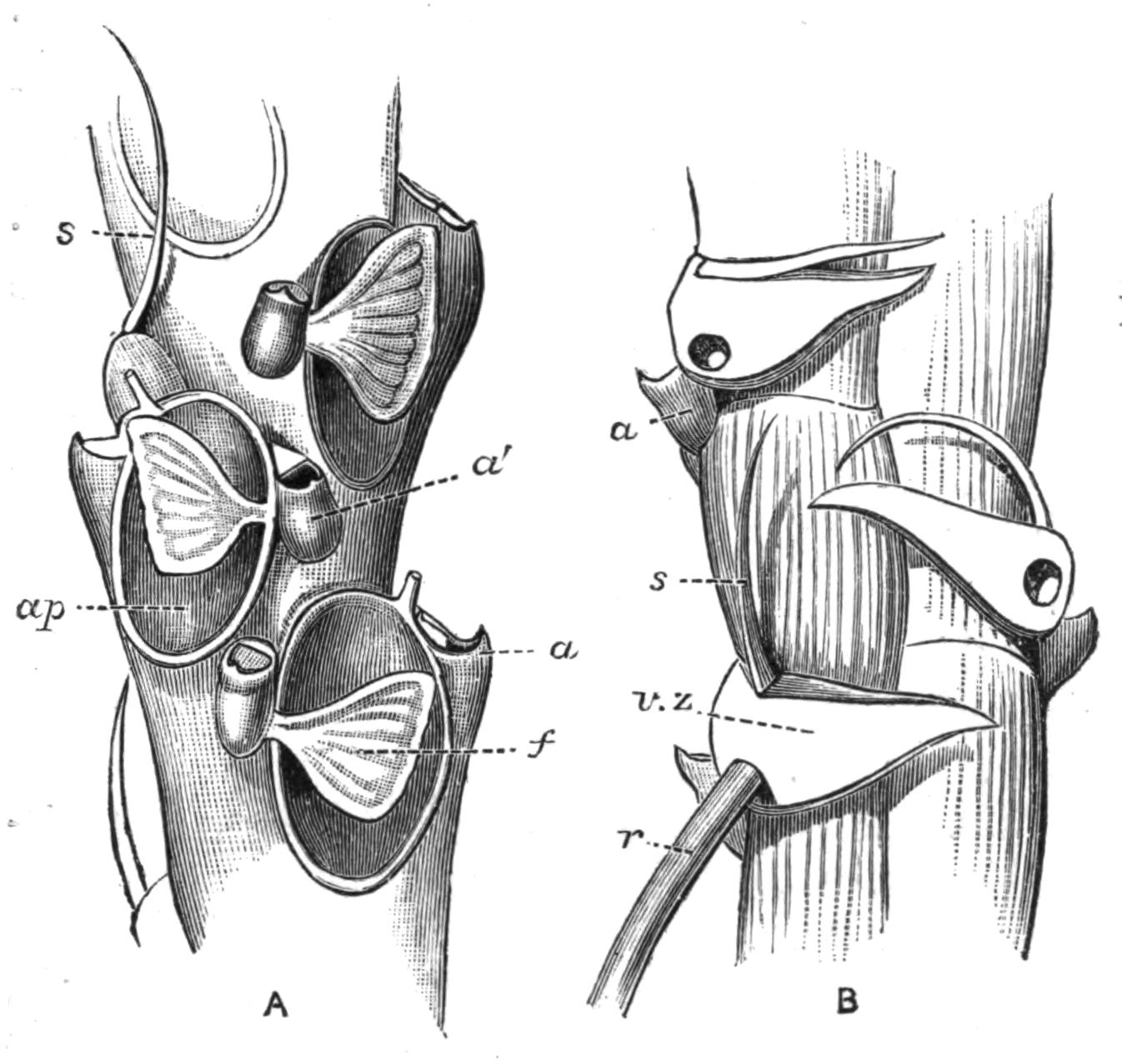
Fig. 254.—A, Front view, and B, back view of part of a branch of Scrupocellaria scabra, Van Ben., Durham Coast, × 43; a, lateral avicularium; a', smaller median avicularium; ap, membranous aperture; f, fornix; r, rootlet; s, seta of vibraculum; v.z, vibracular zooecium.
1. The Cyclostomata appear to fall naturally into two main groups, (A) the Articulata, including the Crisiidae (Fig. 237), distinguished by their erect branches, divided at intervals by chitinous joints; and (B) the Inarticulata, which include the remaining families, whether erect or encrusting, agreeing in the negative character of being unjointed.
2. The Cheilostomata consist of (A) the Cellularina, including the flexible, erect forms, such as Bugula (Fig. 233) and Scrupocellaria (Fig. 254); (B) the Flustrina, to which belong Flustra (Fig. 232), Membranipora (Fig. 256, A, B), Micropora (Fig. 256, C), and other forms in which the front wall of the zooecium is either membranous, or depressed and marked off by a ridge-like margin; (C) the Escharina, including the great majority of forms, in which no part of the front wall remains membranous, the wall of the zooecium being wholly calcified.
3. The Ctenostomata comprise (A) the Alcyonellea or encrusting forms; and (B) the Vesicularina or branching forms. The zooecia in the latter subdivision (Fig. 238) are given off from a tubular stem or stolon, which is usually erect and branching.
We thus have the following arrangement of recent forms. The genera mentioned are for the most part those which have already been alluded to in the preceding account:—
Sub-class I. Entoprocta. Loxosoma, Pedicellina, Urnatella. Sub-class II. Ectoprocta. Order 1. Gymnolaemata. Sub-order 1. Cyclostomata. A. Articulata. Crisia. B. Inarticulata. Hornera, Idmonea, Tubulipora, Stomatopora, Diastopora, Entalophora, Lichenopora. Sub-order 2. Cheilostomata. A. Cellularina. Aetea, Eucratea,[589] Catenicella, Cellularia, Gemellaria, Menipea, Scrupocellaria, Caberea, Notamia (= Epistomia), Bicellaria, Bugula, Beania. B. Flustrina. Cellaria, Flustra, Membranipora, Electra, Lunulites, Membraniporella, Cribrilina, Micropora, Selenaria. C. Escharina. Retepora, Microporella, Lepralia, Porella, Smittia, Mucronella, Schizoporella, Schizotheca, Mastigophora, Porina, Cellepora. Sub-order 3. Ctenostomata. A. Alcyonellea. Alcyonidium, Flustrella. B. Vesicularina. Vesicularia, Amathia, Bowerbankia, Farrella, Hypophorella, Triticella, Mimosella, Victorella, Paludicella. Order 2. Phylactolaemata. Fredericella, Plumatella (including Alcyonella), Lophopus, Cristatella, Pectinatella.
Even this classification, which deals only with the larger groups, must not be made use of without a word of warning. The division of the Cheilostomata is a matter of great difficulty; and no scheme which has yet been suggested can be regarded as more than tentative. The great number of forms included in this group makes its subdivision extremely desirable from the point of view of convenience; but a further knowledge of the anatomy and of the development of many of the forms of doubtful systematic position is probably necessary before any scheme which is likely to be permanent is put forward. Those who desire to make a further study of the classification of the Polyzoa should refer to the works of Hincks,[590] Busk,[591] MacGillivray,[592] and Gregory.[593]
The Polyzoa do not appear to lend any valuable assistance towards settling the disputed problems of Geographical Distribution. They are not in any case terrestrial, while the fresh-water species do not always respect the limits between the great zoogeographical regions. It has already been pointed out (p. 504) that Plumatella, Fredericella, and Lophopus are believed to occur in Australia, and the first-named genus is practically world-wide in its distribution.
Many marine forms also have a surprisingly wide distribution. Thus among the British species which are described by Mr. Hincks as occurring from Norway to New Zealand are Membranipora pilosa, Scrupocellaria scruposa, Cellaria fistulosa, Microporella ciliata, and M. malusii. Even if it should be proved that specific differences do exist between the southern forms and our own, there can be no doubt of the wide distribution of certain species. It was pointed out by D'Orbigny that Bugula neritina has the habit of attaching itself to the bottoms of ships, a fact which may possibly account for the wide distribution of this species; although it would not be safe to assume this explanation of the facts in all cases. Other Polyzoa, on the contrary, have a more restricted range. Thus Catenicella is specially characteristic of the Australian region.
It is perhaps surprising that marine Polyzoa should in so many cases have so wide a range. Even though it is the rule for Polyzoa to have free larvae, the period during which these larvae are free-swimming is, so far as is known, a short one in most cases. Cyphonautes is a common pelagic form (see p. 510), and probably remains for a considerable period in the larval condition. Other Polyzoon-larvae appear to fix themselves very soon after their birth; and this would not appear to give much time for them to be carried to great distances by ocean-currents. It may, however, be suggested that it does not follow that because we know that a larva may, under favourable conditions fix itself a few minutes after it becomes free, we should be justified in assuming that that larva would not retain for a long period the power of undergoing a normal metamorphosis should it be drifted away from suitable fixing-grounds.
Palaeontology.[594]—The number of fossil Polyzoa is enormous. D'Orbigny devoted two hundred plates and more than a thousand octavo pages[595] to a Monograph on the Cretaceous Polyzoa of France. Many of the fossil forms are extraordinarily well preserved, and there is often no difficulty in recognising the identity between certain fossil species belonging to the more recent formations and living forms. It thus becomes necessary to consult Palaeontological memoirs in working at recent Polyzoa.
While the great majority of fossil Polyzoa do not differ in any essential particular from recent species, this is not altogether the case with the Palaeozoic forms. Leaving out of account the Stromatoporoids, which have been variously referred to the Sponges, Hydrozoa, and Foraminifera, as well as to the Polyzoa, the Palaeozoic strata contain large numbers of peculiar Cyclostomata, together with members of the Trepostomata, a fourth Sub-order of Gymnolaemata, allied to the Cyclostomata. The Trepostomata are for the most part Palaeozoic, but a few survived as late as the Jurassic period.[596] These, with the other Polyzoa from the same formations, are considered by Dr. Gregory in his recently published Catalogue of the Fossil Bryozoa in the British Museum (1896).
The number of Polyzoa recorded from the earlier secondary strata is small. The majority of the known Jurassic forms belong to the Cyclostomata; and one or two Cheilostomes are recorded from the same period. Recent papers by Walford[597] on Jurassic Polyzoa contain the description of genera which are believed to be intermediate between the Cyclostomata and Cheilostomata, particularly with regard to the characters of their ovicells. Although it is not impossible there may be a connection between the ovicells of these two groups, it has yet to be proved that the two sets of structures are homologous.
The Cretaceous period marks the commencement of a large number of Cheilostome genera, although the Cyclostomes still remain numerous.
In the Tertiary formations the Cyclostomes gradually become less numerous, and although in earlier geological periods they far outnumbered the Cheilostomes, these relations are now reversed. Certain Tertiary strata, and particularly the Coralline Crag (Pliocene), are remarkable for the extremely large number of Polyzoa they contain. It will be noticed that no mention has been made of the Entoprocta, the Ctenostomata, and the Phylactolaemata. Their absence in the fossil condition[598] need not, however, be a matter for surprise, as none of these forms are so well suited for being fossilised as are the calcareous Cyclostomata and Cheilostomata. There is consequently no adequate reason for assuming that the absence of a palaeontological record implies that these groups have been recently evolved.
Determination of Genera of Marine Polyzoa.—The species to which a Polyzoon belongs can only be determined, in most cases, with the assistance of the low powers of a microscope. There are very great advantages in the use of a binocular instrument, by means of which a microscopic preparation appears with its parts standing up in proper relief.
In the case of the calcareous forms, the external characters may be more readily made out in a dry preparation than in any other way. For this purpose, the colony should be washed with fresh water, in order to remove the salts, which otherwise crystallise out on drying and obscure the surface. Preparations of this kind must be looked at with the aid of reflected light. Canada-balsam or glycerine preparations are also valuable, whether stained or unstained; and are essential for the examination of the softer forms. In the case of erect species, both surfaces of the branch should be looked at. The opercula, avicularia, and rosette-plates afford important systematic characters in the case of the Cheilostomata.
It must not be forgotten to take account of the condition of the zooecia at different ages. The old zooecia often become entirely altered in form, by the deposition of additional calcareous matter, or by the loss of certain parts present in the younger zooecia. Thus the marginal spines may be entirely lost in the older individuals, while in those forms which develop a "peristome" (see Fig. 255 and p. 524), the characters of the orifice can often be determined in the young zooecia only. It is thus essential to examine the growing ends of the branches or the rim of the colony, as the case may be.
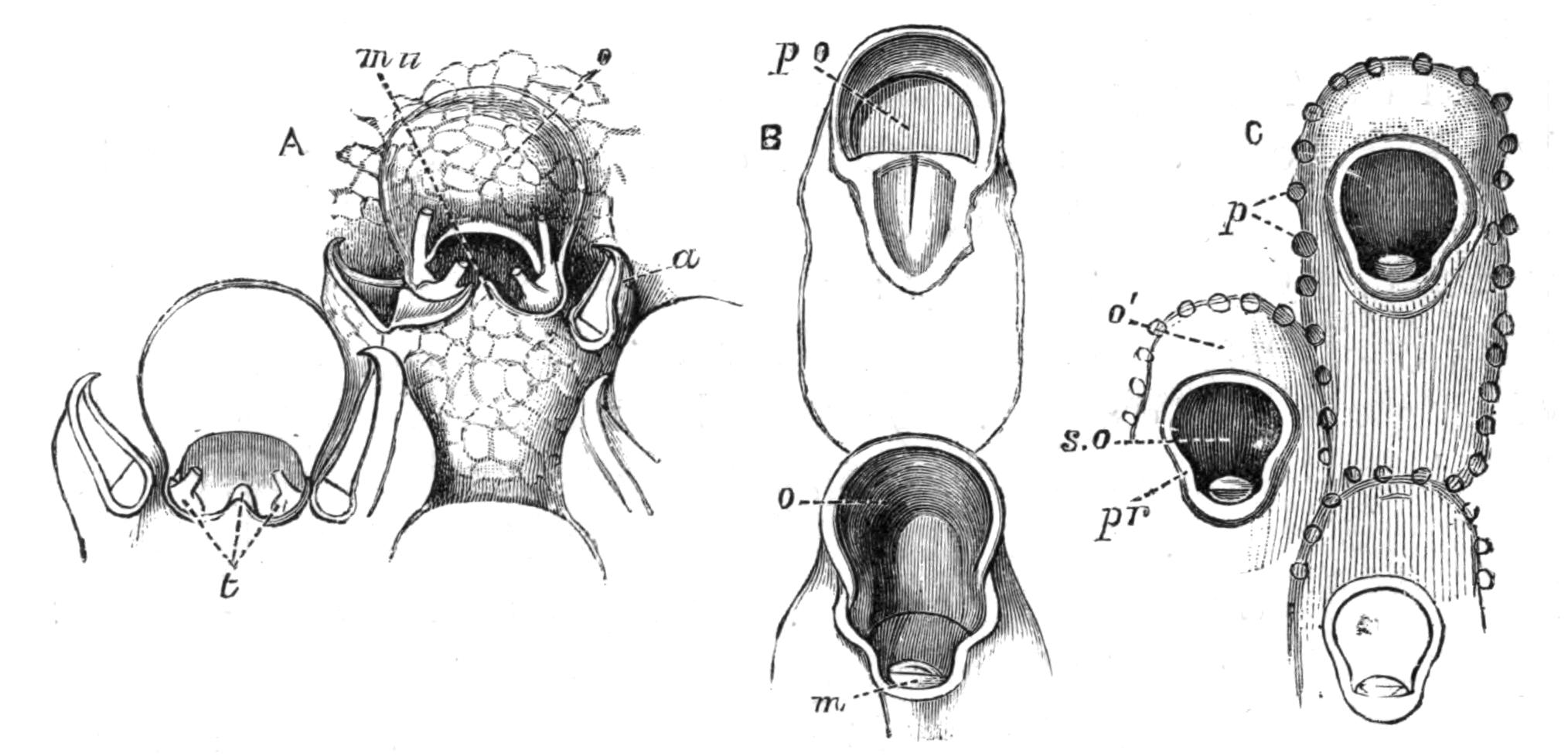
Fig. 255.—Illustrating the nature of a secondary orifice (Cheilostomata). A, Mucronella coccinea Abildg., Scilly Is., × 40. The ovicell (o) overhangs the primary orifice, which is concealed by the great development of the peristome, produced into the mucro (mu); t, the three teeth (denticles) within the secondary orifice; a, avicularium. B, Porella compressa Sowb., Norway, × 40; p.o. primary orifice, above which is a concave lamina, the beginning of the ovicell. In the lower zooecium the ovicell (o) is further grown. The primary orifice is still visible, but it is partially concealed by the growth of the peristome, which encloses a minute avicularium; m, mandible of avicularium. C, Older part of the same colony; pr, peristome; s.o, secondary orifice; o', adult ovicell; p, pores.
In order to make preparations with the tentacles expanded, hydrochlorate of cocaine, chloral hydrate or spirit should be added gradually to the water. When the animals are completely anaesthetised they may be killed by means of a 7-10 p.c. solution of sulphate of copper (best made in distilled water or in rain water). This method gives admirable results in the case of both fresh-water and marine Polyzoa. The use of formaline (see p. 229) may be strongly recommended for the Vesicularina.
The only recent work dealing with all the marine British forms is Mr. Hincks' invaluable History of the British Marine Polyzoa.[599] As the use of this book, unaided by any artificial help, is by no means easy to the beginner, the following key has been compiled as an index to the genera. The Entoproct forms, Loxosoma and Pedicellina (see pp. 488-491), are not included in the table.
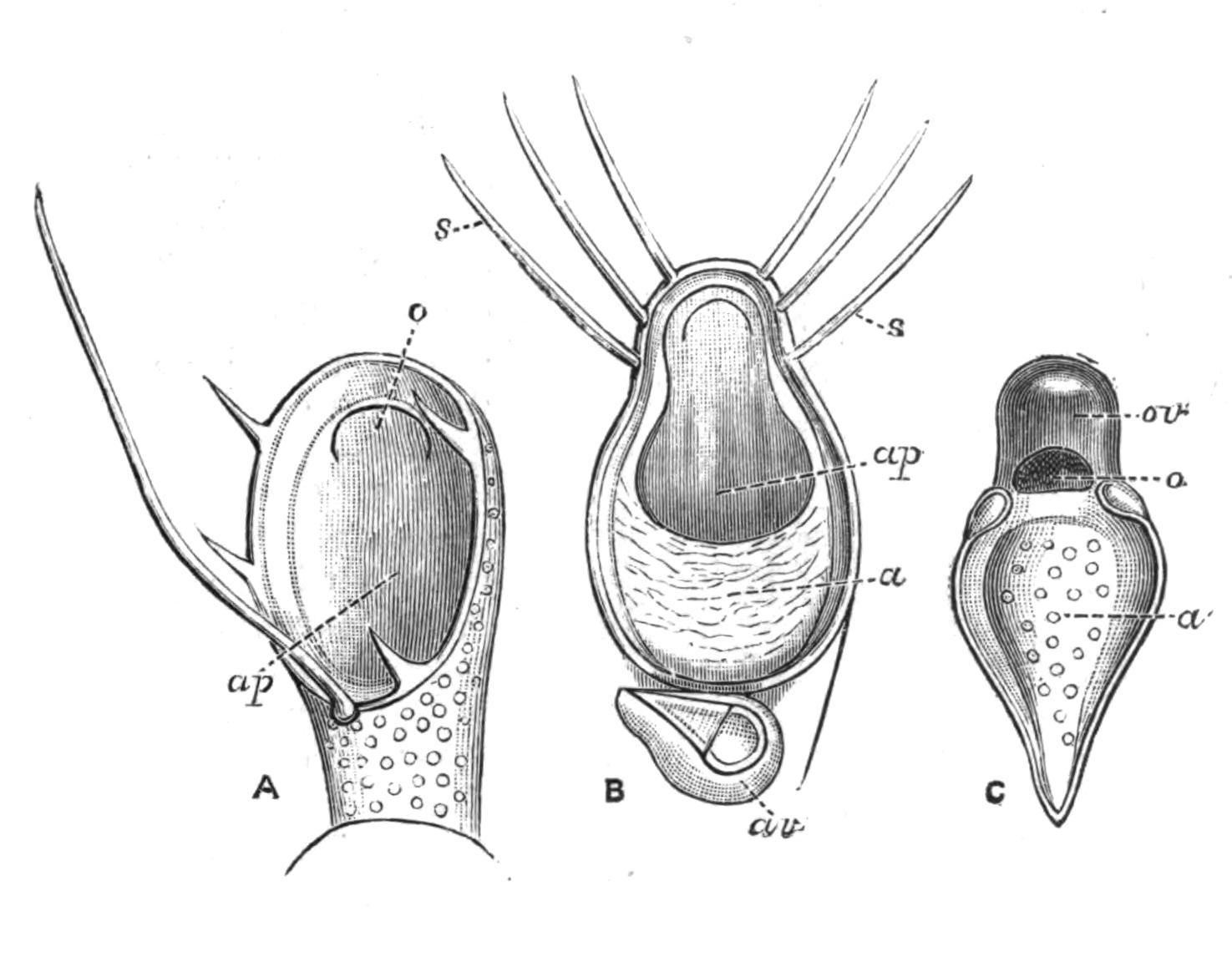
Fig. 256.—Illustrating the terminology of the front surface of the zooecium (Cheilostomata). A, Membranipora (Electra) pilosa L., Cromer, × 47; ap, the membranous "aperture;" o, orifice. B, Membranipora flemingii Busk, Plymouth, × 60; ap, the aperture, enclosed in a calcareous "area" (a); av, avicularium; s, marginal spines. C, Micropora coriacea Esper, Plymouth, × 43; a, area (calcareous); o, operculum; ov, ovicell.
In order to facilitate the use of the table here given in conjunction with Mr. Hincks' work, the nomenclature there adopted has been followed throughout. References to other descriptions of the species may be obtained by consulting Miss Jelly's admirable Synonymic Catalogue of the Recent Marine Bryozoa.[600]
Terminology.—A few technical terms must of necessity be employed. The colony is adherent when its zooecia are attached to the object on which the colony is growing. The zooecium is the body-wall of a single individual; and, except in transparent species, is the only part which can be seen from the outside in the retracted condition of the polypide or tentacles with the alimentary canal. The outermost layer of the zooecium is known as the ectocyst; it may be simply membranous, or calcified, or may be rendered opaque by foreign bodies; its surface in calcareous forms is often marked by pores (Fig. 239, C, p), which are vacuities in the calcareous wall, closed externally by membrane. A special median pore (Fig. 241, A, m.p) may occur, and is in some cases at least a complete perforation through the body-wall.
The tentacles are protruded through the orifice, which in Cheilostomata is usually guarded by a movable chitinous lid, or operculum (Fig. 256, A, o). Should the ectocyst be thickened or raised into a ridge surrounding the orifice, a tubular passage results, known as the secondary orifice (Fig. 255), at the deeper end of which is the true orifice. The peristome (Fig. 255, C, pr) is the raised or thickened part which gives rise to the secondary orifice. Should the zooecium be outlined by a raised ridge, the part so enclosed is known as the area (Fig. 256, C, a), if calcareous. The aperture or opesia (Fig. 256, A, B, ap) is a membranous part of the front surface; and may consist of the whole or part of the area. The orifice or the aperture is commonly provided with spines (Fig. 256, B, s).
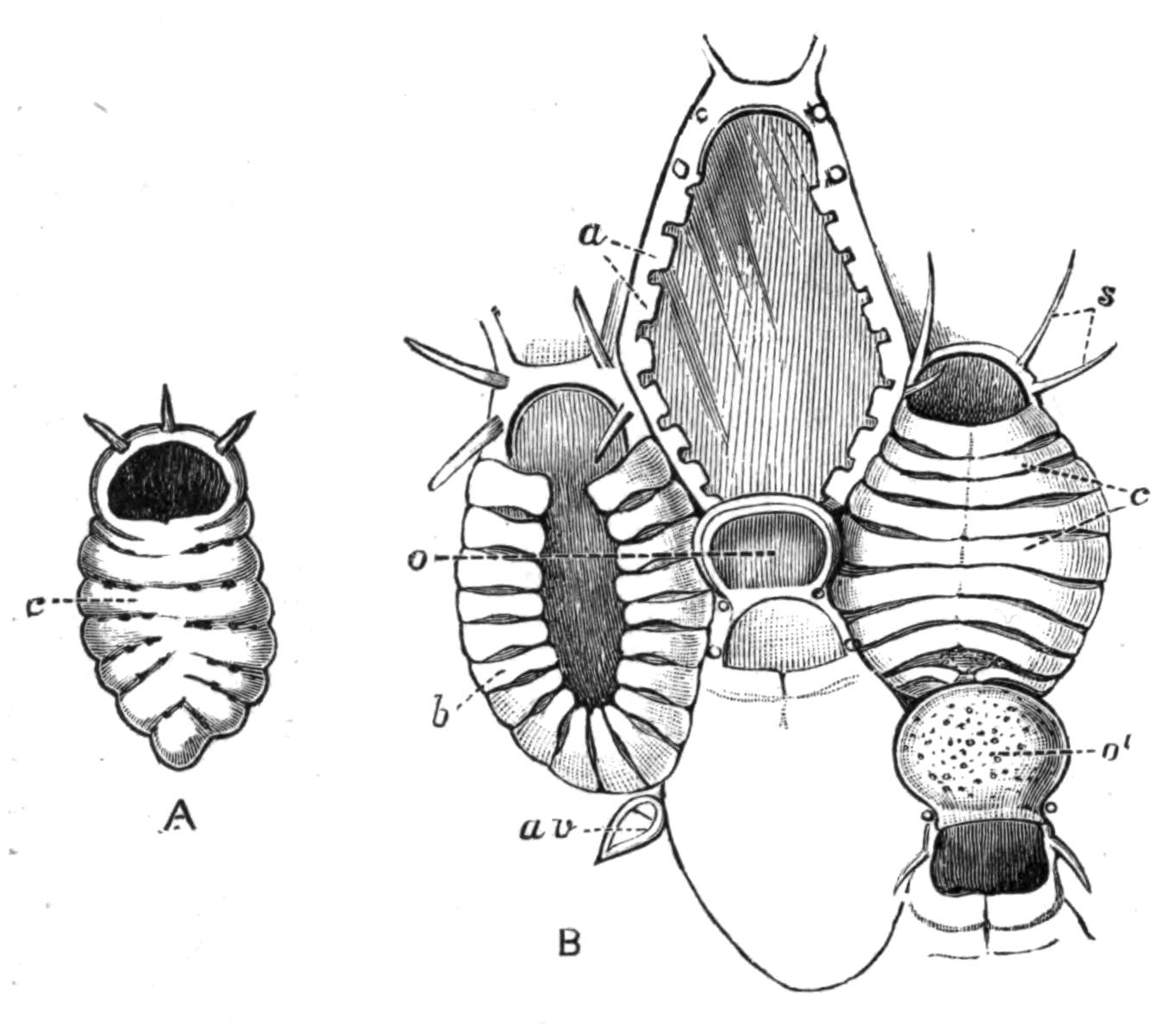
Fig. 257.—A, Cribrilina annulata Fabr., Norway, × 33; c, calcareous bars concealing the membranous aperture: B, Membraniporella nitida Johnst., Plymouth, × 45; a, calcareous bars growing up round the margin of the aperture; b, the same, further developed; c, the same, completely formed (as in A); av, avicularium; o, immature, and o', mature, ovicell; s, marginal spines.
The avicularium and the vibraculum are specially modified zooecia (see p. 482), which occur in a great variety of forms, in certain Cheilostomata only. The operculum of the ordinary zooecium is represented by the mandible (Fig. 239, B, m) in the avicularium, and by the seta (Fig. 242, s) in the vibraculum. The representative of the zooecium itself is known as the avicularian (Fig. 239, A, a.z) or vibracular zooecium (Fig. 242, v.z).
An ovicell is a swelling in which the embryo develops, in certain Cyclostomata (Fig. 237) and Cheilostomata (Fig. 241, A, o). A stolon (Fig. 238, B, st) is a stem, not formed of fused zooecia, from which new individuals originate. An internode, in a jointed colony, is the part between any two joints. The fornix or scutum (Fig. 254, A, f) is a modified spine which in some Cheilostomata overhangs the aperture. A mucro (Fig. 255, A, mu) is a spike or protuberance developed just below the orifice. A sinus (Fig. 239, B, s) is a slight bay on the lower margin of the orifice.
The orifice opens at the upper end of the zooecium, on its front surface. The length of the zooecium is the distance from the upper to the lower ends, and the width the distance between its sides.
1. One or more of the following characters: orifice provided with an operculum; avicularia or vibracula present; a globular ovicell above the orifice of certain zooecia (Cheilostomata) 7

Opercula, avicularia, vibracula, and ovicells completely absent, or inconspicuous. Calcareous or non-calcareous. If calcareous, the orifice is not at the end of a free cylindrical portion 3
Calcareous; zooecia cylindrical, often united for the greater part of their length, but usually ending in a free cylindrical portion, which bears the terminal orifice. The zooecia may be much obscured by calcifications surrounding their basal parts 2
2. Zooecia long, tubular, with a lateral membranous region at the upper end, given off quite separately from a creeping stolon Aetea

Zooecia more or less united to one another, orifice without chitinous operculum (Cyclostomata[601]) 63
3. Zooecia without marginal spines; arising from a branching axis, which is not formed of zooecia 74

Colony adherent; or erect, fleshy and slightly branched; or erect, encrusted with earthy matter and repeatedly branched 72
Characters not as above 4
4. Zooecia minute, boat-shaped, united by a delicate tube. Aperture large, with marginal spines Beania mirabilis

Colony delicate, erect; zooecia wider above than below 5
5. No marginal spines 6
Zooecia uniserial; with marginal spines. Branches arising from the top of a zooecium Brettia
6. Zooecia uniserial; branches arising just below the large aperture. An ovicell may be developed above the orifice of a modified zooecium Eucratea chelata
Zooecia somewhat pear-shaped; orifice small, semicircular Huxleya fragilis
7. Colony erect 8

Zooecia in several layers forming confused masses 30
Colony entirely adherent,[602] the zooecia usually in a single layer 31
Erect Cheilostomata.
8. Branches cylindrical, calcareous, divided by chitinous joints. Orifices arranged all round the branch Cellaria (Fig. 239, A)
Branches flexible, jointed or unjointed. Orifices not arranged all round the branch. 9
Calcareous, unjointed, rigid 21
9. Branches leaf-like, flattened 10

Branches not leaf-like 11
10. Avicularia resembling birds' heads, movable Bugula (Fig. 233)
Avicularia not resembling birds' heads, unstalked; or absent. Colony broadly leaf-shaped, composed of a single layer or of two layers of zooecia Flustra (Fig. 232)
11. Zooecia in pairs, at the same level 12
Zooecia not obviously paired 13
12. Branches numerous, straight. Zooecia back to back, with an oblique aperture. No avicularia Gemellaria loricata
Branches delicate, curved. A pair of stalked avicularia between each two pairs of zooecia Notamia (= Epistomia) bursaria
13. Avicularia or vibracula conspicuous 14
Avicularia or vibracula inconspicuous or absent 17
14. Avicularia resembling birds' heads, movable. Vibracula absent 15

Avicularia large, unstalked. Vibracula present or absent 16
Avicularia inconspicuous. Setae of the vibracula large, very conspicuous, on oblique vibracular zooecia, which almost cover the backs of the branches Caberea (Fig. 242)
15. Zooecia in two series, alternate, with one or several conspicuously long marginal spines Bicellaria
Zooecia in two or more series. Aperture occupying most of the front of the zooecium. Colony often spiral. Avicularia usually large Bugula (Fig. 233)
16. Zooecia long, narrow below, commonly in triplets, with two lateral avicularia to each triplet. Fornix present. Menipea ternata
Zooecia biserial, a considerable number forming an internode separated by a joint (often inconspicuous) from the next internode. Lateral avicularia usually large. Vibracular zooecia on the back or sides of the branches Scrupocellaria (Fig. 254)
17. Characters as in Scrupocellaria (No. 16), but with inconspicuous avicularia. A branched fornix Scrupocellaria reptans
Vibracula absent 18
18. A single, short, marginal spine; or none 19
Marginal spines present 20
19. Characters as in No. 6 Eucratea chelata, Huxleya fragilis
Zooecia biserial. Aperture large, the semicircular orifice at its upper end, where there is commonly a short spine Cellularia peachii
Zooecia in one or two series. Branches originating from the backs of the zooecia, and facing in the opposite direction to the parent branch. Aperture small Scruparia clavata
20. One or more conspicuously long marginal spines. Avicularia present or absent Bicellaria
Zooecia uniserial (see No. 5) Brettia
Zooecia biserial, in short internodes. An inconspicuous avicularium below the aperture. Fornix present Menipea jeffreysii
21. Colony consisting of a network of narrow branches, the zooecia opening only on one of their surfaces Retepora

Colony large, brittle, composed of contorted plates, uniting irregularly, usually composed of two layers of zooecia. Orifice large, indented laterally Lepralia foliacea
Branches delicate, cylindrical 22
Branches or lobes coarser, not necessarily cylindrical 24
22. Branches composed of four rows of zooecia 23
Zooecia in more than four regular, longitudinal rows. Peristome raised, and, with the ovicell, forming a swelling on the surface of the branch Escharoides quincuncialis
23. Orifice circular. A row of pores round the margin of the zooecium. A median pore resembling a small orifice below the true orifice. Small lateral avicularia Porina borealis
Orifice surrounded by a peristome, produced into a mucro beneath the orifice. No pores Palmicellaria elegans
24. Zooecia arranged in regular series 25
Zooecia irregularly heaped, their long axes often perpendicular to the surface of the colony. Mucro largely developed, concealing the form of the orifice, and bearing an avicularium Cellepora
25. Orifice with a sinus; or peristome interrupted or extended below into a sinus-like outgrowth, which usually includes a small avicularium 26
Neither median sinus nor interrupted or extended peristome 28
26. Orifice with a sinus Schizoporella (Fig. 239, B)
Peristome interrupted or extended below 27
27. Branches of various forms. Surface of the older parts very even. Secondary orifice rather long, usually wider above, enclosing a small avicularium below, and appearing as a hole in the even surface of the branch Porella (Fig. 255, B, C)

A prominent tooth projects into the orifice from its lower side. Zooecia with thin walls Smittia landsborovii (Fig. 239, C)
No tooth in the orifice, at the side of which is a small avicularium. Old zooecia with thick walls. Colony composed of a short stem and flattened branches Escharoides rosacea
28. A tooth projects from the lower side into the large, subcircular orifice, on each side of which is a small oval avicularium (colony erect or encrusting) Mucronella pavonella
No tooth: mucro sometimes present 29
29. Branches cylindrical. Old zooecia with thick walls. Orifice in young zooecia longer than broad; beneath it a median pore, and in some cases a lateral avicularium with vibraculoid mandible Diporula verrucosa
A distinct mucro, which may bear an avicularium above Palmicellaria
Encrusting Cheilostomata.
30. Usually growing on a small univalve shell. Orifice longer than broad, indented laterally. Mucro present Lepralia edax
One or two conspicuous processes, each bearing an avicularium, near the orifice, which is often concealed. Avicularia in many cases found on other parts of the colony Cellepora
31. Zooecia distant; or in single rows 32
Zooecia forming continuous expansions 36
32. An oval aperture, larger than the orifice 33
No aperture 34
33. A tubular process below the aperture, in some cases: zooecia very narrow below Eucratea chelata, var. repens
No tubular process below the aperture Membranipora
34. Peristome much raised below, collar-like Phylactella
Peristome not much raised below 35
35. Zooecia minute, much narrowed below. Orifice small, usually with a sinus Hippothoa
Zooecia not narrowed below. Orifice with a sinus Schizoporella
36. Zooecia partly separated by a thin calcareous crust. Colonies small 37
Zooecia contiguous 38
37. Zooecia pear-shaped. Orifice with a sinus Hippothoa expansa
Zooecia ovoid. Orifice subcircular, with a tubular peristome Lagenipora socialis
38. Orifice close to the upper end of the zooecium (unless crowned by an ovicell). Front of the zooecium marked by transverse or radiating furrows or lines. The very young zooecium may possess a membranous area, which becomes roofed in by the union of two lateral series of converging bars (Fig. 257) 39
Characters not as above 40
39. Furrows with uniserial rows of pores (often minute), which are rarely irregular Cribrilina (Fig. 257, A)
No rows of pores. Distinct transverse lines or spaces and a median longitudinal suture between the bars Membraniporella (Fig. 257, B)
40. Zooecia arranged in regular series 41

Zooecia irregularly[603] heaped together (cf. No. 30) Cellepora
41. Primary orifice conspicuous; with a sinus, or with a peristome extended or interrupted below, and sometimes simulating a sinus 42

Neither sinus[604] nor interrupted peristome 44
Surface of the old zooecia much thickened, so that the secondary orifice does not project beyond the most prominent parts of the zooecium. Secondary orifice concealing the primary orifice, wider above, enclosing a small avicularium below Porella (Fig. 255, B, C)
42. Primary orifice with a sinus, but no tooth 43
A prominent tooth projects into the orifice from its lower side. Peristome interrupted or with a sinus. Surface of the old zooecia not much thickened Smittia
43. Orifice with a sinus and long spines. Peristome interrupted. Ovicell with a wedge-shaped or linear longitudinal fissure. Avicularia generally present, the avicularian zooecium conspicuous. Schizotheca

Orifice semicircular. Vibracula present, near the orifice. Mastigophora (Fig. 241, B)
Orifice semicircular or subcircular. No vibracula; avicularia with vibraculoid mandibles may occur Schizoporella (Fig. 239, B)
44. Zooecium with a median pore; or completely tubular above 45
Zooecium with no median pore. The orifice may be partially surrounded by a collar-like development of the peristome, but it is not completely tubular 49
45. Orifice not tubular. A median pore Microporella (Fig. 241, A)
Orifice tubular 46
46. Zooecia narrow or small 47
Zooecia ovoid 48
47. Orifice markedly tubular. Median pore conspicuous Porina tubulosa
Colony very small. Zooecia irregularly arranged, with no median pore Celleporella
48. Zooecia very convex, with a granular surface; ovicells set far back. Orifice wider than long Mucronella microstoma
Young zooecia with stellate pores. A minute avicularium, or merely a pore, on the upper and lower sides of the orifice in some zooecia. Anarthropora monodon
49. Front of zooecium with an elevated margin, enclosing an area 50
Area not present 55
50. Front wall wholly calcareous 51
Front wall wholly or partly membranous 54
51. Avicularian or vibracular zooecia replacing an ordinary zooecium, or at least situated between the zooecia 52
Avicularia and vibracula absent, or if present not replacing a zooecium 53
52. Vibracula present. Colonies small. A pair of longitudinal slits within the area Setosella vulnerata
Very large avicularia present. Ovicell closed by a movable lid. Orifice subcircular, with a minute lateral tooth on each side. Thalamoporella[605] (Steganoporella) smittii
53. Orifice semicircular, quite at the upper end of the zooecium; usually with a knob on each side Micropora coriacea[606] (Fig. 256, C)
A transverse chitinous plate lies immediately below the operculum. A vibraculoid spine may occur Megapora ringens
54. Area entirely membranous, usually bordered by spines. Membranipora (including Electra[607]) (Fig. 256, A)
Membranous portion reduced to a small portion, which may be variously lobed, enclosing the orifice. Membranipora (other species) (Fig. 256, B)
55. Peristome present. No mucro 56
Peristome absent; or if present, with a mucro 57
See also Mucronella pavonella, No. 28).
56. Peristome collar-like, much raised below and at the sides of the orifice, deficient above. No avicularia Phylactella
Orifice large, longer than broad. Peristome not deficient above the orifice Lepralia
57. Wall of zooecium thin, shiny, and without pores 58
Not agreeing with the characters given under No. 58 59
58. A minute avicularium above the orifice, or where an ovicell is present, situated at the summit of that structure. Zooecia not quite contiguous. Mucro sometimes present. Chorizopora brongniartii
No avicularia. Ovicells on rudimentary zooecia, lying in a plane superficial to that of the rest of the colony. Zooecia long. Schizoporella hyalina
59. A more or less distinct mucro or prominence beneath the orifice. 60
Mucro rarely present. Orifice nearly always longer than broad, or nearly circular, usually large, and slightly indented laterally. Lepralia
60. A tooth projects into the orifice from its lower side 61
No tooth 62
61. Colony glistening. Orifice much obscured by the mucro and by stout spines developed from the peristome. Tooth (concealed in old zooecia) large, strongly curved to one side. Rhynchopora (Rhynchozoon[608]) bispinosa
Tooth of the lower margin of the orifice symmetrical, sometimes bifid. Avicularia may be present laterally, but are not developed on the mucro Mucronella (Fig. 255, A)
62. Orifice at least half the width of the zooecium, bordered below by a well-developed prominence or "umbo." Surface of the zooecium strongly areolated round the margin Umbonula[609]
Orifice considerably less than half the width of the zooecium. Schizoporella (Fig. 239, B)
Encrusting Cyclostomata.
63. Colony erect. Branches of two or one series of zooecia, divided at intervals by chitinous joints. Ovicells pear-shaped. Crisia (Fig. 237)
Colony erect, unjointed 69
Colony in the main adherent; or circular; or lobed 64
64. Colony more or less circular, discoidal or cup-shaped, sometimes forming secondary colonies by marginal budding 65
Colonies not circular 68
65. Zooecia separated by calcified interspaces, which may contain large pores, often difficult to distinguish from the orifices 66
No large pores as above. Orifices not spiny. Zooecia nearly always contiguous, except where an ovicell is developed 67
66. Colony composed of one or more convex discs, bearing radial ridges, each composed of many zooecia Domopora
Colony encircled by a thin calcareous lamina, which gives rise to new zooecia, its centre usually devoid of zooecia when adult, and often bearing the orifice(s) of the ovicell. Zooecial orifices often spiny. Lichenopora
67. Zooecia with a long, tubular, free portion, in some cases curved in a horizontal plane. Colony fan-shaped until a late stage. Tubulipora flabellaris
Tubular portion absent, or for the most part curved in a vertical plane. Some of the orifices may be closed by a calcareous plate. Colony circular or bluntly lobed Diastopora
68. Zooecia in one or few series, forming a linear or branched colony, which is closely adherent, but may give rise to short erect portions. Branches narrow, but often broadening at their ends. Zooecia usually with a free upper end Stomatopora
Colony broadly lobed, some of the zooecia in transverse or oblique ridges composed of contiguous zooecia, arranged like a row of organ-pipes Idmonea serpens
Colony broadly lobed, or fan-shaped; zooecia in many series, which are not arranged like organ-pipes Tubulipora
69. Well branched. Orifices confined to one surface of the colony 70
Not much branched 71
70. Zooecia in transverse rows, their upper ends united in the manner of a row of organ-pipes. Ovicell (when present) an inflation of the front of the branch Idmonea atlantica
Zooecia not in regular transverse rows. Ovicell (when present) large, mostly on the back of the branch Hornera
71. Branches cylindrical, their ends massive and raised into radial ridges, which carry the orifices Domopora stellata
Ends of zooecia tubular, arranged all round the branch. Entalophora
Encrusting Ctenostomata.
72. Colony entirely adherent, or forming thick, soft, erect lobes 73
Colony erect, well-branched, dark and opaque, resembling seaweed. Zooecia with a long tubular free portion Anguinella palmata
73. Orifice large, with two distinct lips. A variable number of stout, brown spines. Encrusting Flustrella hispida
Orifice small, rounded, borne by a more or less distinct papilla. Encrusting or erect. Zooecia crowded, rarely in single lines. Alcyonidium
Orifice small, rounded. Zooecia widely separated, connected by narrow tubes Arachnidium
74. Axis of colony erect, usually branched 75
Axis creeping 79
75. Zooecia in elongated clusters, which occur at intervals 76
Zooecia not grouped; or in irregular groups; or in whorls 78
76. Zooecia regularly biserial 77
Zooecia long, less regularly arranged. Polypide with a gizzard. Bowerbankia (Fig. 238)
77. Clusters of zooecia very regular, occurring immediately below a bifurcation of the axis. Zooecium with a broad base, not movable. Amathia lendigera
Zooecia arranged like the pinnules of a leaf, with a constricted base, and movable on the branch Mimosella gracilis
78. Main stem zigzag. Branchlets delicate, many ending in sharp points. Zooecia small, ovoid Vesicularia spinosa
Axis jointed. Zooecia small, in small clusters. Polypide without a gizzard Valkeria uva, var. cuscuta
Zooecia in whorls, attached to the axis by thread-like stalks, much longer than themselves Hippuraria egertoni
79. Zooecia pear-shaped, produced at the lower end into a distinct stalk. Gizzard absent 80
Zooecia not distinctly stalked, although sometimes constricted at the base 81
80. Stalk long. Zooecium movable on its stalk, compressed, with a membranous area on one side. Twelve or more tentacles. Usually found on Crustacea Triticella
Stalk variable. Zooecium very transparent; orifice bilabiate. Ten to sixteen tentacles Farrella repens
Zooecium very small, much elongated and narrow. Eight tentacles. Valkeria tremula
(See also Arachnidium, No. 73).
81. Zooecia short, minute, with a few short spines on each side of its broadened base. Upper end tubular Buskia nitens
Zooecia elongated 82
82. Zooecia transparent 84
Zooecia brown, often quite opaque 83
83. Zooecia large (about 1⁄16 inch long), distant, constricted at the base, bearing scattered bristles. Usually found on Crabs or Hydroids. Avenella fusca
Zooecia tall, cylindrical, not constricted at the base. Cylindroecium
84. Zooecia minute. Axis dilating at intervals into swellings, from which new zooecia originate. These may give rise to new stolons, or directly to new zooecia. No gizzard. Found in brackish or fresh water Victorella pavida
Axis not dilated, as above 85
85. Zooecia small, in small groups. No gizzard Valkeria uva
Zooecia long, scattered or in groups. Gizzard present. Bowerbankia (creeping forms)
It is highly probable that the Ctenostome genus Hypophorella[610] will before long be added to the British Fauna. The animal consists of delicate stolons, which give off small zooecia at intervals; and it is known to excavate passages in the substance of the tubes of certain Polychaet worms (Chaetopterus and Lanice).
ADDENDUM TO CHAETOGNATHA
Since the Chapter on the Chaetognatha was printed the following list[611] of "The Known Chaetognaths of American Waters" has appeared:—
1. Sagitta elegans Verr. This species resembles S. bipunctata (vide pp. 191 and 193), but differs in size, in the relative proportions of caudal and body segments, and in the presence of diverticula from the intestine.
2. Sagitta flaccida Con. This species resembles S. hexaptera (vide p. 193); it is, however, smaller (length, 1.3-1.8 cm.) and has more spines (anterior, 7-8, posterior, 10-12), and its tail segment is relatively smaller.
3. Sagitta tenuis Con. Length, 5.25 mm.; hooks, 7-8; anterior spines, 4-5; posterior spines, 7-10.
4. Sagitta hispida[612] Con. Length, 7-11 mm.; hooks, 8-9; anterior spines, 4-5; posterior spines, 8-15; tail segment one-third body length; intestine with two diverticula; sensory hairs very numerous.
5. Sagitta hexaptera (vide p. 193).
6. Krohnia hamata (vide p. 194).
7. Spadella maxima Con. Length, 5.2 cm.; hooks, 6; anterior spines, 3-5; posterior spines, 5-7; epidermal thickenings round the neck.
8. Spadella draco (vide p. 194).
9. Spadella schizoptera[612] Con. An opaque, yellowish-brown species living among algae. Length, 4 mm.; hooks, 8; anterior spines, 4-6; posterior spines wanting. Caudal segment occupies one-half the body length.
Professor Verrill states that the name S. gracilis (vide p. 191) was due to a clerical error, the species really referred to being S. elegans.
A. E. S.