Chapter XII
Reading edition
CHARACTERS OF THE SUB-ORDERS OF POLYCHAETES—CHARACTERS OF THE FAMILIES—DESCRIPTION OF BRITISH GENERA AND SPECIES—THE MYZOSTOMARIA.
Systematic.—The Order Polychaeta may be divided into two branches, in one of which, the Phanerocephala, the prostomium retains its ancestral condition as a lobe overhanging the mouth, and frequently carries, in addition to paired eyes, certain sensory processes of a simple structure, the tentacles and palps; the body-segments are more or less alike, and (except in some Spioniformia, some of the Terebelliformia, and the Capitelliformia) do not present two sharply marked regions, owing to the differential arrangement or character of the chaetae. In the second branch, the Cryptocephala, the peristomium grows forwards during development, so as to compress or even hide the prostomium, which thus becomes a very insignificant organ. The tentacles are reduced, but the palps become greatly developed and take on sundry new functions. The body in this group, by the character and arrangement of the chaetae, is distinguishable into a thorax and abdomen, presenting certain internal differences.
These two branches may be supposed to have arisen from a common ancestor having a general resemblance to a nereidiform worm, such as Syllis, possessing palps and tentacles on the prostomium, definite parapodia and cirri on the body, and internally, a well-marked and regular repetition of organs.
The branch Phanerocephala contains the following five sub-Orders, though it is possible that the Capitelliformia deserves a more important position in the system:—
Sub-Order 1.—The Nereidiformia have well-developed tentacles and palps; the peristomium almost invariably possesses special cirri; the parapodia are well-marked locomotor organs, supported by acicula, and carry dorsal and ventral cirri. The chaetae are usually jointed, though unjointed ones may coexist with these; uncini are never present. An eversible buccal region leads into a muscular pharynx, which in the majority is armed with chitinous jaws; the septa and nephridia are regularly repeated throughout the body. The worms lead a predaceous life, and are mostly carnivorous; a few form tubes.
Sub-Order 2.—The Spioniformia possess neither tentacles nor palps; the peristomium usually carries a pair of long tentacular cirri, and extends forwards at the sides of the prostomium. The parapodia project only to a slight degree; the dorsal cirri may attain a considerable size, and act as gills throughout the greater part of the body. The chaetae are unjointed; uncini are only present in the aberrant Chaetopterus.[364] The body may present two regions more or less distinctly marked externally, but without corresponding internal differences. The buccal region may be eversible, but there are no jaws. Septa and nephridia are regularly developed. The worms are burrowers, or tubicolous.
Sub-Order 3. Terebelliformia.—The prostomium is a more or less prominent lobe (upper lip) with or without tentacles but without palps. The peristomium may carry cirri or "tentacular filaments."[365] The parapodia are feebly developed; there are no ventral cirri; the dorsal cirri may exist and function as gills on more or fewer of the anterior segments. The chaetae are unjointed, and uncini are usually present. The buccal region is not eversible; there are no jaws. The septa are usually incomplete, with the exception of one strongly-developed "diaphragm" anteriorly; the nephridia are dimorphic, those of the anterior (prediaphragmatic) segments are of large size and are excretory; the posterior series are mere funnels, and act as genital ducts. These worms are burrowers or tube-formers, and in the majority the tube-forming glands are grouped on the ventral surface of the anterior segments to form "gland-shields."
Sub-Order 4.—The Capitelliformia have no prostomial processes, but possess a pair of large retractile "ciliated organs." The parapodia do not project; the chaetae are unjointed, and are hair-like in the anterior segments and hooded "crotchets" posteriorly; this external division of the body does not correspond with definite internal differences. There are no cirri, though special "gills," often retractile, are frequently present. The buccal region is eversible; there is no armed pharynx. An "accessory gut" or "siphon" exists. The nephridia are small, and sometimes more than one pair in a segment; special genital funnels exist in more or fewer of the anterior segments of the hind body. There is no system of blood-vessels; the coelomic corpuscles are red. The worms are burrowers.
Sub-Order 5.—The Scoleciformia possess a prostomium, which rarely (Chlorhaemidae) carries any sensory processes; the peristomium is without cirri (except, perhaps, in the Chlorhaemidae). The parapodia are ill developed, and may be absent; only rarely are dorsal cirri present, acting as gills; ventral cirri are absent. The chaetae are unjointed; true uncini are not present. The buccal region is eversible, but there is no armed pharynx. The septa are not regularly developed, as more or fewer are absent, and the nephridia are considerably reduced in number, it may be to a single pair (Sternaspidae and some Chlorhaemidae), but they are all alike.[366] The worms are mostly burrowers.
The branch Cryptocephala contains two sub-Orders:—
Sub-Order 1. Sabelliformia.—The prostomium is entirely hidden by the forward extension of the peristomium; the tentacles are very small, being frequently represented merely by small knobs of sense-cells; the palps, on the other hand, are greatly developed, branched, and contain blood-vessels, acting as respiratory as well as sensory organs. The peristomium never carries cirri or chaetae, and it is usually raised up into a projecting collar, used in fashioning the lip of the animal's tube. The parapodia are but feebly developed; cirri are absent, except in the Serpulidae, where the dorsal and ventral cirri become united to form the "thoracic membrane" (Meyer). The chaetae are of two kinds—unjointed, hair-like, fringed bristles and "uncini." By their arrangement the body is divided into a thorax of nine segments and an abdomen; in the former the capillary chaetae are dorsal, and in the latter ventral. The buccal region is not eversible; there is no pharynx. The septa are regularly developed in the abdomen, but are absent in the thorax; the nephridia are dimorphic; there are two large ones in the thorax opening by a median dorsal pore just above the brain; those of the abdomen are small funnels, and act as genital ducts. The worms are tubicolous; "gland-shields" are present on the thoracic segments.
Sub-Order 2. Hermelliformia.—The peristomium (Fig. 135) is enormously developed, and forms a bilobed hood capable of closing over the mouth; the truncated free end of each lobe carries three semicircles of peculiar chaetae, which act as an efficient protection when the worm is withdrawn into its tube. The prostomium is very small, but retains a pair of well-developed tentacles; the palps, which are subdivided as in the Sabelliformia, have become fused with the ventral edges of the peristomium, and appear as a series of ridges on each side, carrying numerous filaments. The thorax consists of five segments, the notopodia of three of which are well developed and bear strong chaetae; dorsal cirri are present along the greater part of the body, and act as gills. The arrangement of the chaetae and of the internal organs is as in the Sabelliformia. The worms form tubes of sand.
BRANCH A. PHANEROCEPHALA.
Sub-Order 1. Nereidiformia.[367]
Fam. 1. Syllidae.—These are small worms, the majority being less than an inch long, so that they are not easily observed. The body consists of a fair number of segments.[368] In many genera a dorsal bundle of unjointed, natatory chaetae makes its appearance at maturity. The palps, which are grooved, are in some cases so united with one another and with the prostomium as to be scarcely recognisable. (For head see p. 262, and for feet see p. 264.) The pharynx is armed with one or more teeth. There is a special gizzard, following the pharynx, and provided with thick, muscular walls of peculiar structure. Following the gizzard, the oesophagus receives in many genera a pair of T-shaped diverticula, that are used for storing water, which is swallowed with food. These diverticula are absent in Autolytus and other free-swimming forms. The reproduction of the members of this family is interesting, and has already been described (p. 278).
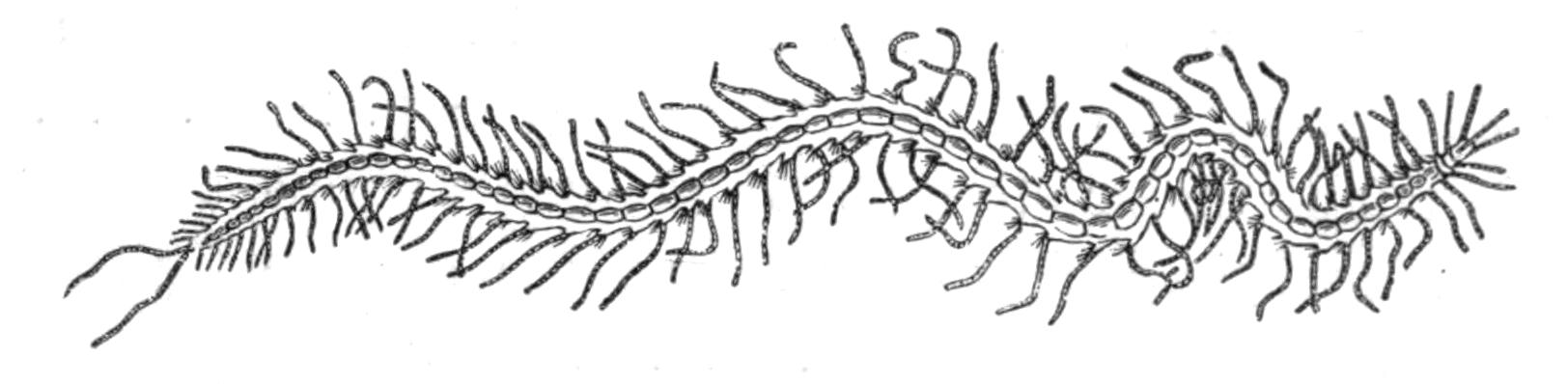
Fig. 160.—Syllis armillaris Müll. × 2. (From Johnston.) The head is towards the right.
Syllis.—The tentacles and cirri are moniliform; the palps large; there is a single dorsal tooth, which is provided with a poison gland, the duct of which opens near its apex; it is used rather for stabbing its prey than for grasping and tearing. S. krohnii Ehlers, is abundant under stones, and forms tubes of sand; it is nearly an inch long, and consists of some eighty-five to ninety-five segments marked with yellow bands. It may readily be identified by longer dorsal cirri, terminally dilated, alternating with shorter ones. S. cornuta Rathke, has a translucent green body, about half an inch long; no alternation of cirri. Mediterranean, Atlantic, on the Norwegian coast, off Spitzbergen, and on the Madeira coast. S. armillaris Müll. is very common at low water; it is pale yellowish-brown, with a couple of dusky marks on each segment; and measures 2 inches. The dorsal cirri are quite short, consisting of only eight to ten joints. In Pionosyllis the tentacles and cirri are not moniliform; a single dorsal tooth. P. malmgreni M‘I. under stones. Sphaerosyllis.—The dorsal cirri are swollen at the base, and are not moniliform; the long palps are fused along nearly their whole extent. S. hystrix Clap. is only about one-eighth of an inch in length. Exogone Oerst. Grubea Qfg.
Autolytus.—The small palps are entirely fused with the prostomium; the pharynx, which is bent upon itself, is armed with a circle of denticles. Dorsal cirri somewhat foliaceous. There are no ventral cirri. The male and female differ from one another and from the asexual "stock" (see p. 279). A. pictus Ehl. is abundant under stones. It measures about two-thirds of an inch in length, is darkly coloured with a median lighter band; the anterior dorsal cirri are long. A. prolifer Müll. is common.
Myrianida fasciata Milne Edwards, with its foliaceous cirri, occurs off our coasts (see Fig. 149, p. 280). Atlantic, Mediterranean.
Fam. 2. Hesionidae.—The body is relatively short, with only a few segments (sixteen to fifty, according to the genus); in the larger forms it is cylindrical. The parapodium is usually uniramous; the dorsal cirri are long and multiarticulate; the chaetae are jointed. The prostomium carries, in addition to four eyes, two or three tentacles, and generally a pair of jointed palps. The peristomium and two or more of the following segments are achaetous, and carry long "peristomial" cirri. The pharynx is very long but unarmed.
Psamathe Johnston, has many segments; head with two tentacles and a pair of three-jointed palps. P. fusca Jnstn. occurs amongst coralline Algae, to which it bears some resemblance, which is heightened by the moniliform cirri. It is a small worm, less than an inch in length. Mediterranean. Castalia punctata Müll. is dirty green or brownish, with a narrow purplish band on each side. It occurs in deeper water than the preceding. In Ophiodromus the head has three tentacles; the palps are two-jointed; there are six pairs of peristomial cirri; the parapodia are biramous. O. vittatus Sars is dredged in numbers off the Scotch coast, and is found also at low tides. It measures 2 inches in length. A closely allied species lives in the ambulacral grooves of the starfish Astropecten.
Fam. 3. Aphroditidae.[369]—The most characteristic feature of this family, and one by which its members are absolutely distinguished from all other Chaetopods, is the possession of scales or "elytra" on the back. These flattened dorsal cirri are of a somewhat horny texture, and are carried, generally, on alternate segments of the body; filamentous cirri occurring on the other segments. In the sub-families Hermionina and Polynoina the elytriferous segments are 2, 4, 5, 7, 9, etc., up to 23; then every third segment. The worms are usually short, with some thirty-five to forty-five segments, though Sthenelais and a few others have many more. (For head see p. 262, and for parapodium see pp. 265, 268.) The pharynx is very thick walled, and furnished with two pairs of jaws, which are, however, not hardened in the sub-family Hermionina. The intestine is provided with a number of paired longer or shorter caeca (Fig. 142). A considerable number of this family are commensal or parasitic (see p. 297). The family is well represented on our own coasts, so that only a few of the more readily distinguishable species can be here described.
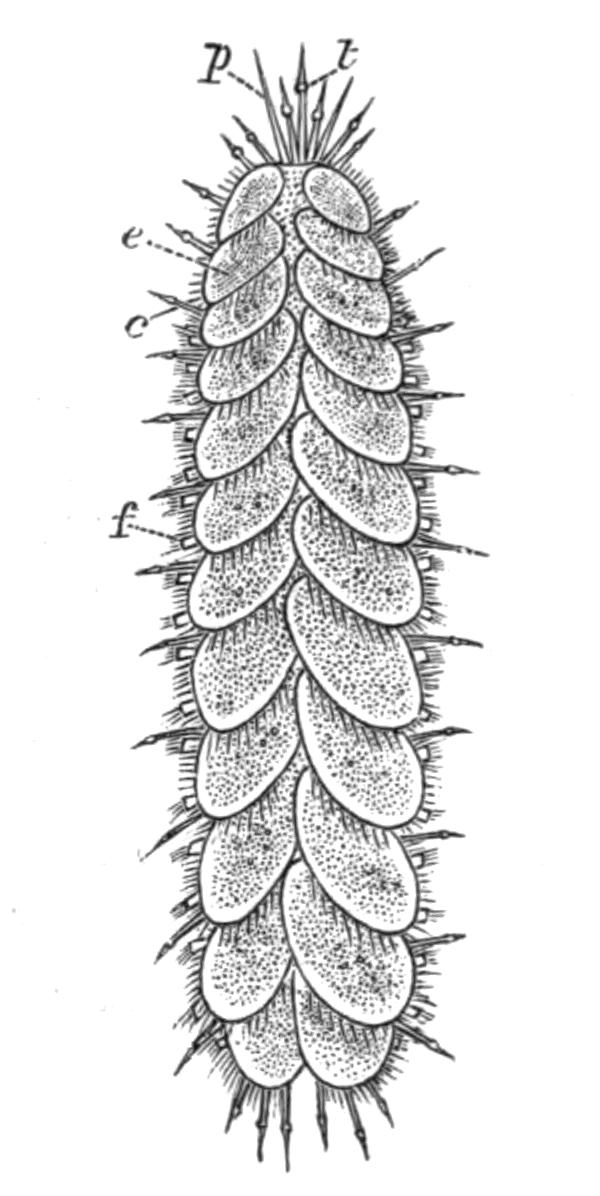
Fig. 161.—Polynoë squamata L. Nat. size. c, Notopodial cirrus; e, elytron; f, parapodium; p, palp; t, tentacle. (From Johnston.)
Sub-Fam. 1. Polynoina.—Body flattened, with nearly parallel sides, usually short, more rarely worm-like; three tentacles; peristomium with long dorsal and ventral cirri; the ventral cirri of the next segment are also elongated. Jaws are present. Elytra, usually twelve to eighteen pairs, the surface of which is more or less papillose, and may be "fringed" along the outer border, with long processes. The colouring of the elytra is characteristic in most cases, though liable to considerable variation in some species. The chaetae are generally strong, and of bright golden colour: they are all unjointed. The Polynoina are generally but feeble swimmers, and are mostly found under stones at low tide. Some species have a very wide geographical range.
Polynoë.[370]—The body is short; none or only a few segments at the end of the body are uncovered by the elytra, except in the long body of P. johnstoni.
A. With twelve pairs of elytra.—In P. squamata Linn. the elytra entirely cover the body and conceal the head, each elytron overlapping the next posterior one, and those of the two sides overlapping. General colour sandy-brown, speckled, lighter or darker. The fringed elytra are very firmly fixed to the body. The notopodial chaetae scarcely project from below the elytra. The worm is common between tide-marks and in the coralline region, is about one to one and a half inches in length, and about one-third of an inch in width. Atlantic. P. clava Montagu, may attain a larger size, though it is generally smaller. The elytra are dark, usually grey, mottled with white or light grey, unfringed, and do not overlap to so great an extent as in P. squamata, so that the middle of the back and the hinder part of the body is more or less exposed. This is never the case in the preceding species, but even here it is subject to variation in extent, depending on the amount of food contained by the worm or on the ripeness of the genital products. It occurs in the Mediterranean.[371]
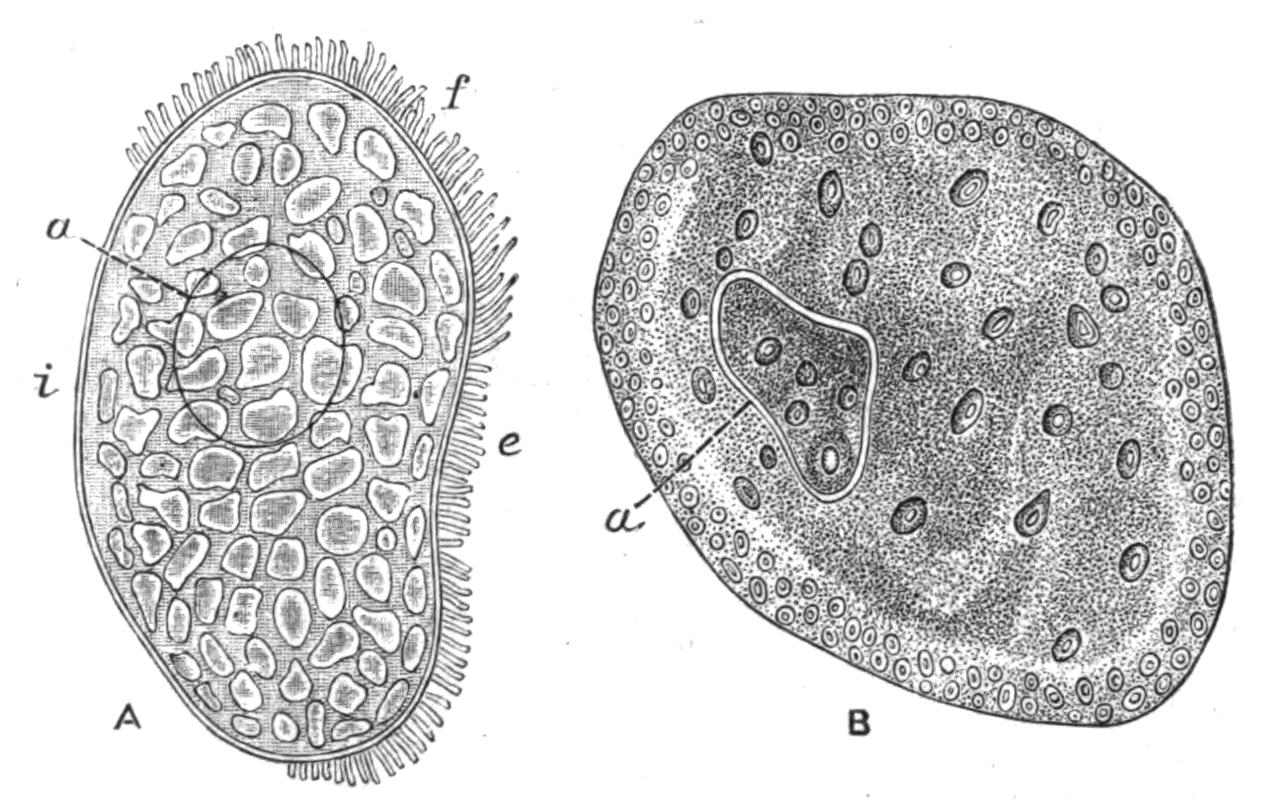
Fig. 162.—Elytra, A, of Polynoë squamata L.; B, of P. clava Mont. × 10. a, Area of attachment; e, external margin; f, fringe (the letter is at the posterior side of the elytron); i, internal margin. (From Bourne.)
B. With fifteen pairs of elytra.—P. imbricata L. is probably the commonest species of the genus, occurring nearly everywhere under stones at low tide. It is about an inch in length; the elytra are deciduous, and are very variously coloured and marked; sometimes uniformly grey or even black, sometimes mottled with brown: in other specimens each elytron has its outer half pale or white, while its inner half is darker, usually some tint of brown or olive green, so that the worm appears to have a dark band along the middle of its back. Other patterns occur. The body is entirely covered by the elytra. The chaetae project considerably, and are nearly as long as half the width of the body; those of the notopodium are brown and are directed upwards, being nearly as long as the golden neuropodial chaetae. This species has a very wide range, occurring on both sides of the Atlantic, even on the shores of Nova Zembla, and reappearing again at Japan. P. semisculptus Leach is rather larger than the foregoing. The elytra are very readily detached: they are light in colour, without a fringe, but with large papillae near the margin. The notopodial chaetae are thicker than those of the neuropodium. Several other species are also common, but P. johnstoni v. Marenz.[372] differs from the rest in having an elongated body of some seventy segments, so that the posterior half is uncovered by the elytra, which are small, greenish-grey, speckled, and have no fringe. It is common and widely distributed, but appears to be only found in the tubes of Terebella nebulosa.
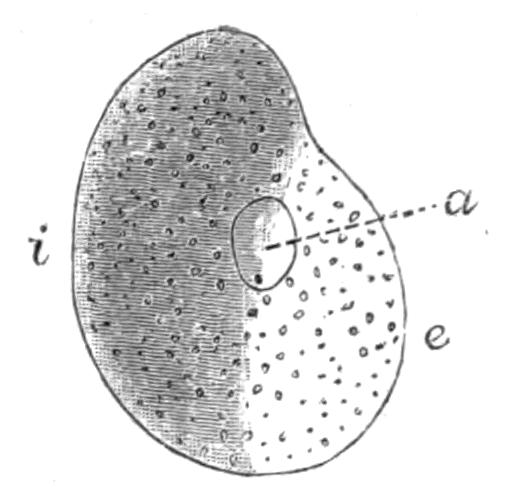
Fig. 163.—Elytron of Polynoë imbricata. a, Area of attachment to body; e, outer border; i, inner border.
C. With eighteen pairs of elytra.—P. gelatinosa Sars, may attain a length of 2 inches. The elytra are very faintly coloured, transparent and soft, attached by rather long peduncles. In spirit they become swollen and folded, giving the worm a very untidy appearance. The prostomium is partly overlapped by a peculiar collar-like fold of the peristomium.
D. With numerous pairs of elytra.—Lepidasthenia has a very long body, consisting of more than eighty segments. The elytra are quite small, and occur throughout the body on the usual segments. There are no notopodial chaetae. L. elegans Gr. is a very elegantly marked worm, which, however, has not been recorded from the British area; it occurs in the Mediterranean (see Fig. 156, p. 293).
Sub-Fam. 2. Hermionina.—The body is short, oval and depressed; the particularly strong notopodial chaetae are directed upwards and backwards so as to protect the elytra. The neuropodial chaetae are also strong. The prostomium carries a single tentacle and two long palps; the prostomial ridge may be well developed. The peristomium is chaetigerous, with long cirri. The jaws are represented merely by thickened prominences.
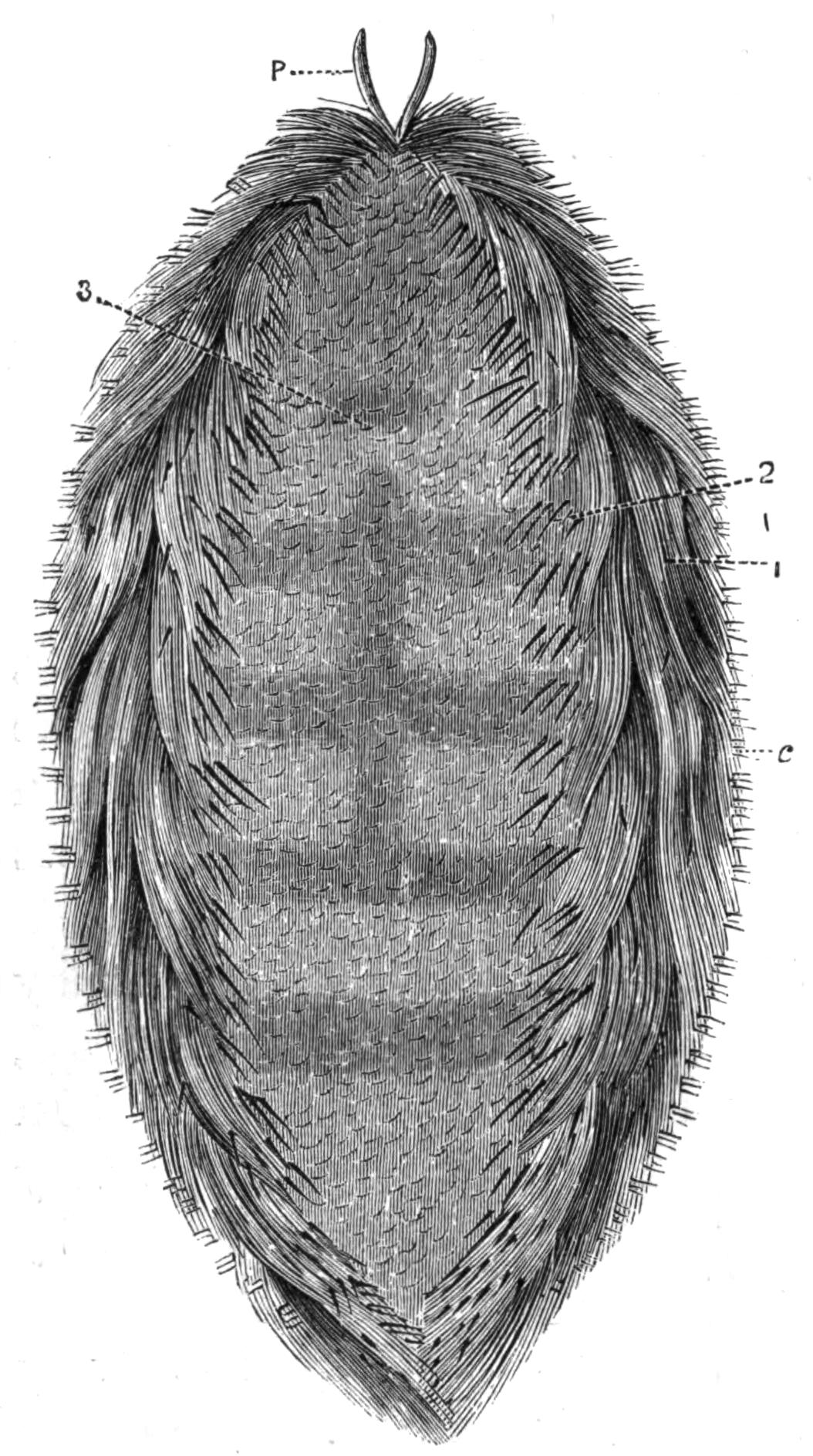
Fig. 164.—Aphrodite aculeata L. (from Règne Animal). Nat. size. c, Neuropodial chaetae; p, palps; 1, iridescent bristles; 2, stiff chaetae; 3, felting bristles of notopodium.
Aphrodite.—The fifteen pairs of elytra, arranged as in Polynoë, are concealed by a "felting" of hair-like chitinous threads arising from the notopodium (Fig. 139, p. 268). A. aculeata L.—The "sea-mouse" is one of the most beautiful of the Polychaetes. The small tentacle is very readily detached; the palps are very long; the parapodia of the peristomium are directed forwards so as to form lateral lips; and its cirri are not especially modified (see Fig. 132, p. 260). The body, which measures 3 to 6 inches, consists of thirty-five to forty segments, and is broadest in the middle, the last dozen segments being very small; the body terminates in a point. Some of the notopodial chaetae are brilliantly iridescent, and give the worm its characteristic coloration. It is fairly common in the coralline regions, and is frequently thrown ashore after storms. Atlantic and Mediterranean.
In Hermione the "felt" is absent, so that the elytra are exposed. H. hystrix Sav. occurs in ten to thirty fathoms of water all over the British area and Mediterranean. It resembles in its general appearance a fat Polynoid, with strong chaetae. Laetmonice filicornis Kinb. also occurs on our north-west coasts, and L. producta Gr. has been dredged in 500 fathoms off the west coast of Ireland; it has been recorded also from Kerguelen and from Japan, so that it has a very wide distribution.[373]
Sub-Fam. 3. Acoetina.[374]—The long, vermiform body has some thirty-nine to ninety-three pairs of elytra, placed on every alternate segment throughout. It is represented in the British area by Panthalis from 75 fms., which forms a tube of black mud.
Sub-Fam. 4. Sigalionina.—This sub-family includes forms with a long, vermiform body; anteriorly the elytra are on alternate segments, up to the twenty-sixth, and posteriorly on every succeeding segment; "gills" here coexist with elytra; cirri are absent. The prostomium in Sthenelais Kinb. has a median tentacle, which is absent in Sigalion Aud. and Edw. Sth. boa Jnstn. is common off our coasts near low-water mark, where it burrows in the loose sand with rapidity. It is an elegant worm, and may attain a length of 8 inches, though it is generally smaller; it is narrow, flat, and only slightly tapering at each end; the elytra, which may be more than a hundred pairs, are greyish or slightly brownish, some being lighter than others; the margin is fringed with simple processes (which in Sigalion are pinnate). Atlantic and Mediterranean. In Psammolyce the elytra are covered with sand grains. British and Mediterranean.
Fam. 4. Phyllodocidae.—The members of this family make use of the foliaceous cirri (Fig. 136, F) in their very active movements. The rounded prostomium bears four or five tentacles; there are four long peristomial cirri on each side (see Fig. 134, E).
Sub-Fam. 1. Phyllodocina.—The body is elongated, with numerous segments; the eyes are small; the chaetae are jointed; the dorsal and ventral cirri are foliaceous; the pharynx is covered with papillae externally, but contains no "jaws."
Phyllodoce has a more or less depressed body; four prostomial tentacles; four pairs of peristomial cirri. P. lamelligera Jnstn.[375] (the "paddle-worm") may reach a length of 24 inches, but is usually 8 to 12 inches long and ½ inch across. The general colour is bright bluish-green or yellowish-green, with metallic iridescence; the parapodia olive-green or brown, the sensory processes yellow. It lurks, during day, under stones and shells, etc., in the Laminarian zone. The green egg masses, so frequently referred to as belonging to Arenicola, are laid by Phyllodocids.[376]
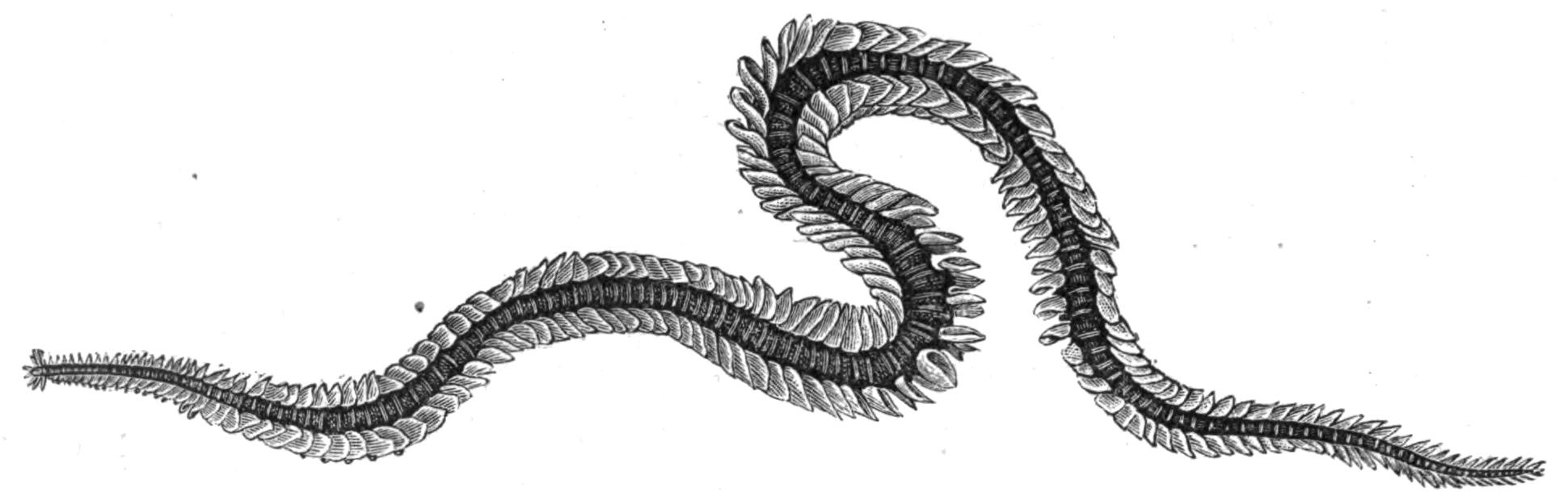
Fig. 165.—Phyllodoce paretti Blv. × ½. (From Règne Animal.)
In Eulalia an additional (fifth) tentacle arises from the middle of the back of the prostomium. E. viridis Müll. is a dark green worm smaller than the preceding; common between tide-marks, hiding in cavities and tunnels in limestone rocks, which have been bored by the mollusc Saxicava; it is rare where such rocks are absent. It might have been thought that its vivid colour would harmonise with its surroundings, but it is most abundant in regions where Fucus abounds and Ulva is absent. It is evident then that the colour is not protective; it may perhaps be of warning significance, for the mucus secreted in quantities by glands on the cirri of the Phyllodocids is probably objectionable to their enemies. Phalacrophorus Grf. and Pontodora Grf. may be mentioned as pelagic genera.
Sub-Fam. 2. Lopadorhynchina.—This includes small forms, Lopadorhynchus Gr., Pelagobia Grf., and other pelagic genera.
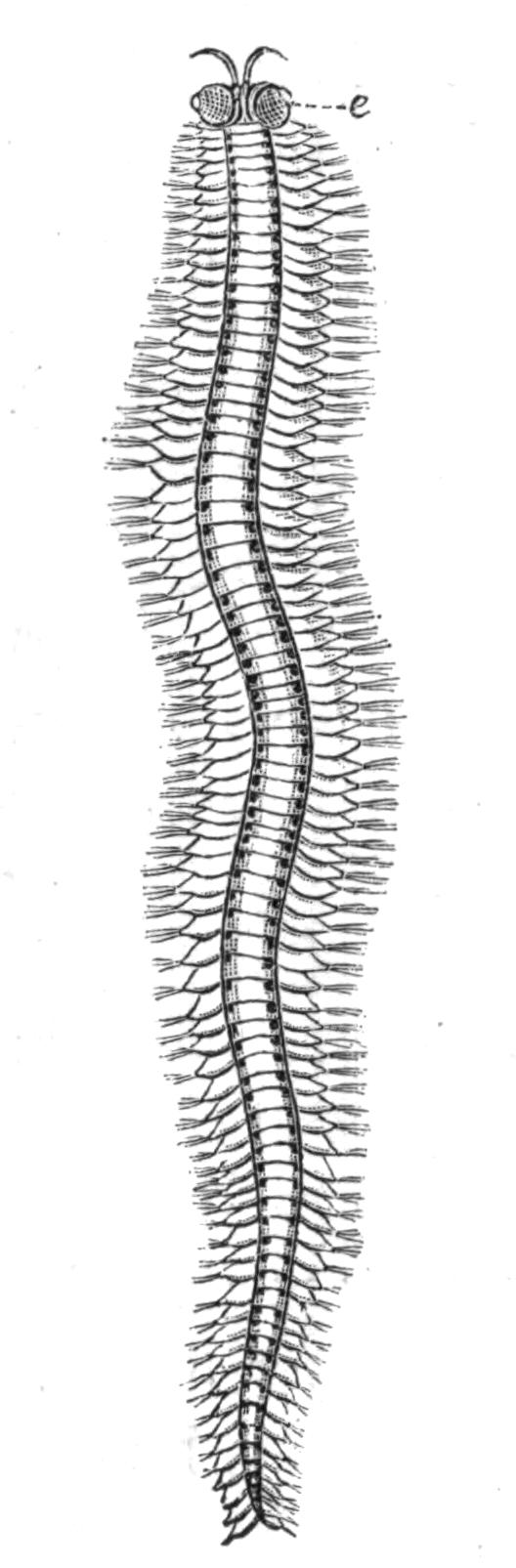
Fig. 166.—Nauphanta celox R. Grf. × 4. (From Greef.) e, The large eye.
Sub-Fam. 3. Alciopina.—These are surface forms, and, like most pelagic animals, are colourless and transparent; the eyes, however, are very large, and, with certain brown spots in each segment,[377] are the only coloured parts in the body; in structure the eyes are much more complicated than those of other Polychaetes. The prostomium has five tentacles; there are long peristomial cirri, and in general their anatomy agrees most closely with that of Phyllodocids. Alciope, Asterope, Vanadis, Nauphanta are genera of the family;[378] none have been recorded from the British area.
Fam. 5. Tomopteridae.[379]—This includes but one genus, Tomopteris, which is pelagic. The transparent, colourless body consists of only a few (eighteen to twenty) segments; the parapodia are as long as the body is wide, and carry no chaetae; each is bilobed, and fringed with a membrane; each of these lobes contains a yellow rosette-shaped photogenic organ. The only chaetae present in the worm are on the "head." The prostomium is hammer-shaped, and appears to carry a pair of short filaments ventrally (Fig. 167, x) each with a single chaeta within it; and a longer filament laterally (y), supported by a long, very delicate chaeta. The mouth is behind these, and they probably are the first pair of parapodia which have shifted forwards. T. onisciformis Eschscholtz is not unfrequently obtained off our shores in the tow-net.
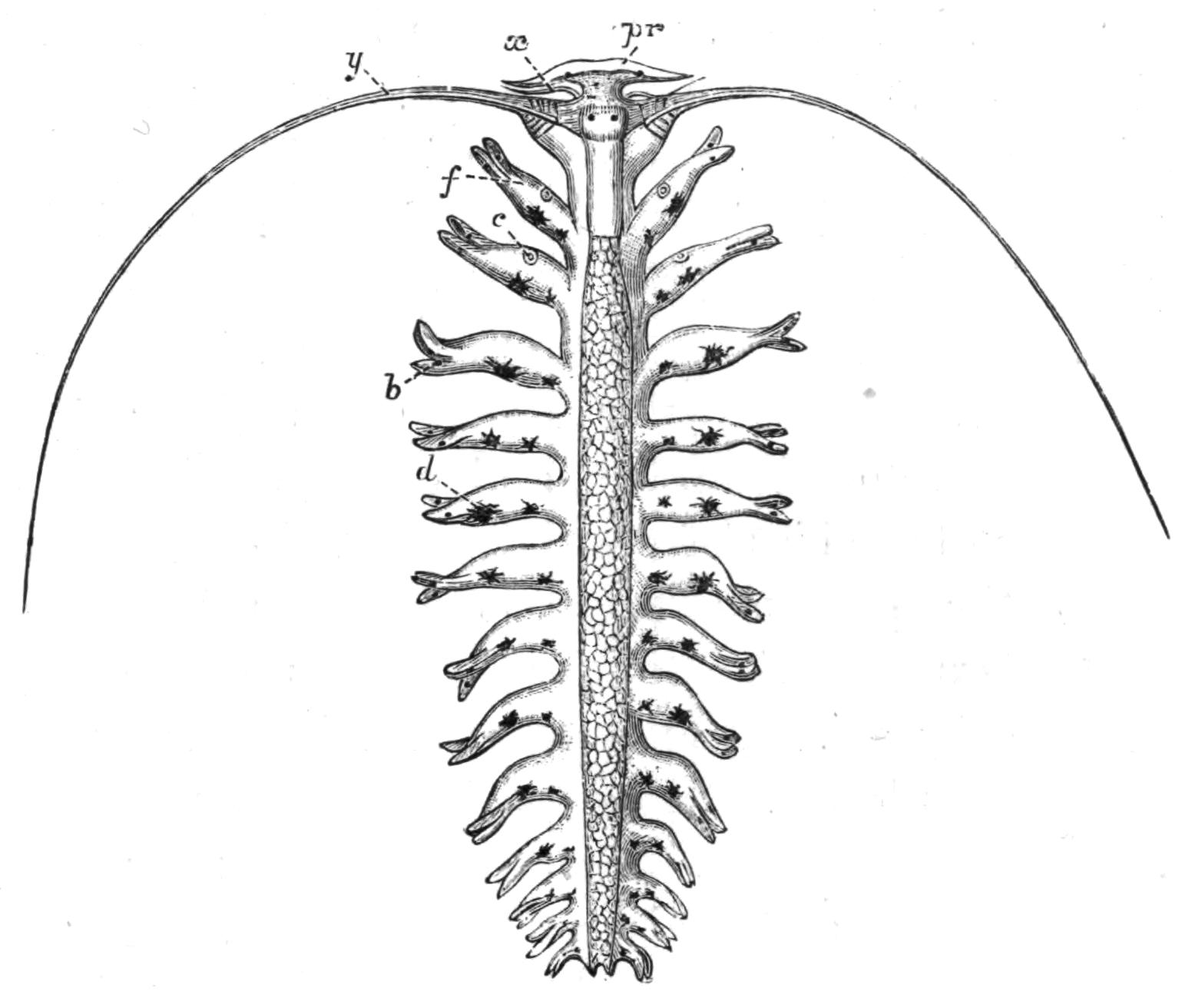
Fig. 167.—Tomopteris rolasi Grf. × 10. From Guinea Isles. pr, Hammer-shaped prostomium; x, first chaetigerous process; y, second chaetigerous process; c, rosette (photogenic) organ on first two parapodia; b, similar organ in the lobes of the following parapodia; d, pigment spots; f, parapodium. (From Greef.)
Fam. 6. Nereidae (Lycoridae).—This family contains a very large number of species, differing from one another in small and not readily recognisable characters, such as the relative lengths of the various processes of the head, of the lobes of the feet, the arrangement of the "paragnaths" (see Fig. 125, d) and so forth. The general features of the family have been already described. The genus Nereis is represented by six fairly common species on our coast, which are almost world-wide in distribution.
N. diversicolor Müll. is about 3 to 4 inches in length, of a general fleshy-red colour, though tending in some cases to yellowish-brown or even greenish. It may be distinguished by two diverging brown bands, which start on the peristomium and pass backward one along each side of the body for several segments. The prostomium is broader than it is long. The worm burrows in mud or sand, all round our coast between tide-marks. It has a very wide distribution, being met with on this side of the Atlantic, and off the coast of Greenland, and off Japan. It is even found in brackish water at Bembridge, Isle of Wight.
N. cultrifera Gr. is green or greenish-grey, with a series of small rectangular light spots along the mid-dorsal surface, and oblique light lines at the sides of each segment. Posteriorly the greenish pigment becomes less and less till the hinder segments are flesh-coloured. The prostomium is as long as it is broad. This species attains a length of 6 inches. Southern coasts: locally known as "Red Cat."
N. dumerilii Aud. and Edw. is rather smaller and narrower than the two preceding species; it is reddish-violet in colour, marked with darker transverse lines in each segment. It is readily recognised by the two dark brown spots on the upper surface of the base of the notopodium in most of the segments, and by the great length of the peristomial cirri, the longest of which reaches the fifteenth segment. It is sometimes found enclosed in a cocoon-like tube of hardened grey mucus, more or less covered with foreign particles, such as sand grains. Atlantic, Mediterranean, Japan.
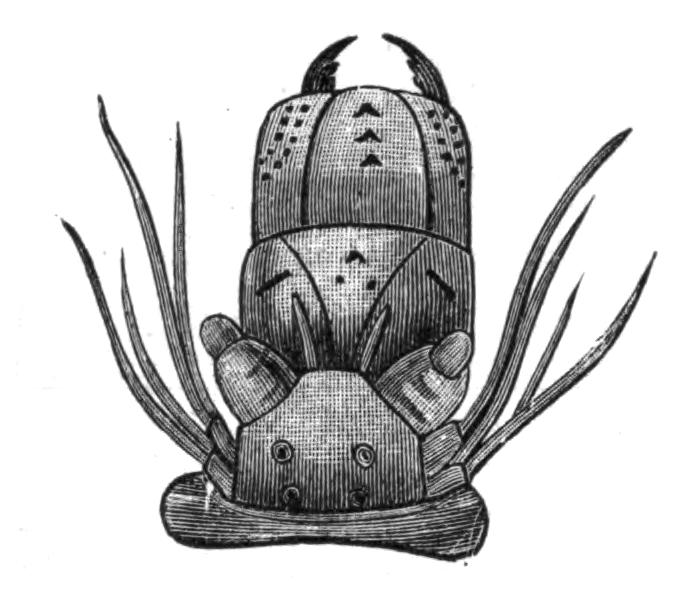
Fig. 168.—Nereis cultrifera Gr. × 6. Head with buccal region everted, to show the arrangement of the jaws. (From Ehlers.) Cf. N. diversicolor, Fig. 125, p. 248.
N. pelagica L. is red-brown or bronze in colour, and is generally larger than the other species, from which it is distinguished by being widest about the middle of the body (see Fig. 122, p. 246); whilst in the preceding species the greatest breadth occurs at the segments immediately following the head. Further, the palps are long, the peristomium is twice as long as the next segment, and the back of the worm is strongly arched. At all depths on rocky and stony ground. Northern coasts.
N. (Nereilepas) fucata Sav. lives in the topmost whorls of empty whelk shells and in those occupied by hermit crabs. The ground colour is tile-red, with two milk-white bands along the dorsal surface. The dorsal lobe of the foot is slightly foliaceous, glandular, and vascular.
N. (Alitta) virens Sars. is a giant amongst Polychaetes, reaching a length of 18 inches. Its name suggests its colour; it is very plentiful at certain times at St. Andrews, and between tide-marks along the shore of the Mersey estuary, as well as elsewhere. It forms a burrow in the clay, etc., of the shore, and lines it with mucus, which is abundantly secreted by the great foliaceous lobes of the parapodia. These great leaf-like lobes of the foot recall the modification which the foot of many species of Nereis undergoes in transformation into Heteronereis: they are so greatly developed that, at first sight, the worm might be mistaken for a large Phyllodoce. The worm is known as the "Creeper," and is much esteemed as bait on some parts of our coast.
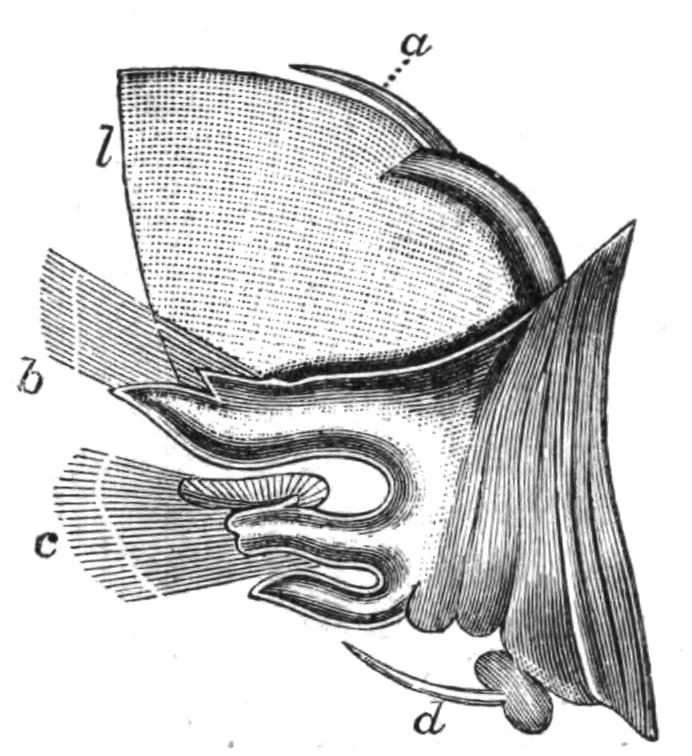
Fig. 169.—Parapodium of N. virens Sars. ×4. a, Notopodial cirrus; b, notopodium; c, neuropodium; d, neuropodial cirrus; l, foliaceous appendage. (From Ehlers.)
Fam. 7. Nephthydidae.—The elongated body is quadrangular in section, the dorsal and ventral surfaces being almost flat. (For head see p. 262, and for parapodium, p. 264.) The two lobes of the parapodium are widely separated, and each is fringed with a membrane, while a sickle-shaped "gill" hangs down from the under surface of the notopodium. The pharynx is enormous. Of the genus Nephthys two species, called the "Lurg" or "White Cat" by fishermen, occur on our coasts. Their active movements and beautiful mother-of-pearl tint are characteristic. N. hombergii Aud. and Edw. occurs on the shore, and down to 20 fathoms; it is 3 or 4 inches long, and may be found burrowing in the sand; the chaetae exceed in length those of N. caeca Fabricius, which occurs less frequently and in deeper water, and is larger than the preceding. Both are Atlantic forms.
Fam. 8. Amphinomidae.—The body in this family is either vermiform, as in Eurythoe, or oval and flattened, as in Euphrosyne and Spinther. The head carries a peculiar sense organ, the "caruncle," consisting of a smooth axis with the sides folded so as to look like a number of lamellae. The parapodia carry gills. Most of the Amphinomids are tropical and Southern forms.
Eurythoe borealis Oerst. measuring 6 inches, occurs all round the British area, from the Shetlands, where it occurs in deep water, to the Channel Isles, where it lives on shore, under stones, etc. (For parapodium of Amphinome see p. 264.)
Euphrosyne.—The body is short, oval, and flattened. The parapodia are not distinct processes, but the chaetae extend from each side of each segment nearly to the middle dorsal line, and are absent ventrally (Fig. 137, C, p. 265). The dorsal and ventral cirri are more or less filiform, and there is an intermediate similar process on the back (? = lip of chaetigerous sac). Amongst the chaetae are a number of curious branched processes—usually called "gills."[380] The presence of these and of the chaetae give the upper surface of the body a fluffy appearance. E. foliosa Aud. and Edw. is fairly common under stones on our southern shores. It is about an inch in length and is of a cinnamon-red colour.
Fam. 9. Eunicidae.—The elongated body is provided with parapodial gills in more or fewer segments (except in Lumbriconereis). The "gills" may be cirriform (Hyalinoecia), pectinate (Eunice, Onuphis), or more complex (Diopatra). The notopodium is represented by a lobe (usually called "cirrus") into which an aciculum projects; in some cases it even contains a few chaetae; most of the neuropodial chaetae are jointed (Fig. 138, F). The prostomial tentacles vary in number; they may be three or five, or five and two short "frontal palps," or they may be absent. Peristomial cirri are absent, though in Eunice, Diopatra, and Onuphis "nuchal cirri" are present on the dorsal surface of the second segment (Fig. 134, D). One of the most characteristic features in the anatomy of the Eunicids is the peculiar jaw apparatus (see p. 270). The majority of the genera form permanent tubes of parchment-like consistency, which may be further strengthened by the addition of grains of sand, small pebbles, etc.; the tubes may be branched.
Eunice has five tentacles, two great palps, and a pair of nuchal cirri; the gills are pectinate, and there are four anal cirri. E. harassii Aud. and Edw. is about 8 inches long. It is reddish-brown, with white spots down the back, one to each segment, and others at the sides. The gills begin at the sixth segment, and when fully developed have eleven branches. The dorsal cirrus is not longer than the gill. E. philocorallia Buch.[381] forms its tube amongst the branches of Lophohelia prolifera, in 200 fathoms, off the west coast of Ireland.
Marphysa resembles Eunice, but has no nuchal cirri. M. sanguinea Mont. is a fine bronze colour, with bright red gills, which commence on the twentieth segment, and have only four or five branches. The worm, which measures 12 to 18 inches, and is as thick as one's finger, hides in clefts in rocks and under stones below low water. Mediterranean. It is known as "Rockworm" in the Channel Islands.
Hyalinoecia Mgrn., in addition to the five prostomial tentacles and palps, possesses a pair of small "frontal palps" arising from the anterior border of the prostomium; there are no nuchal cirri, and the gills are simple filiform processes. H. tubicola Müll., about 3 inches long, is yellowish-brown, and forms a transparent, parchment-like tube. Atlantic and Mediterranean.
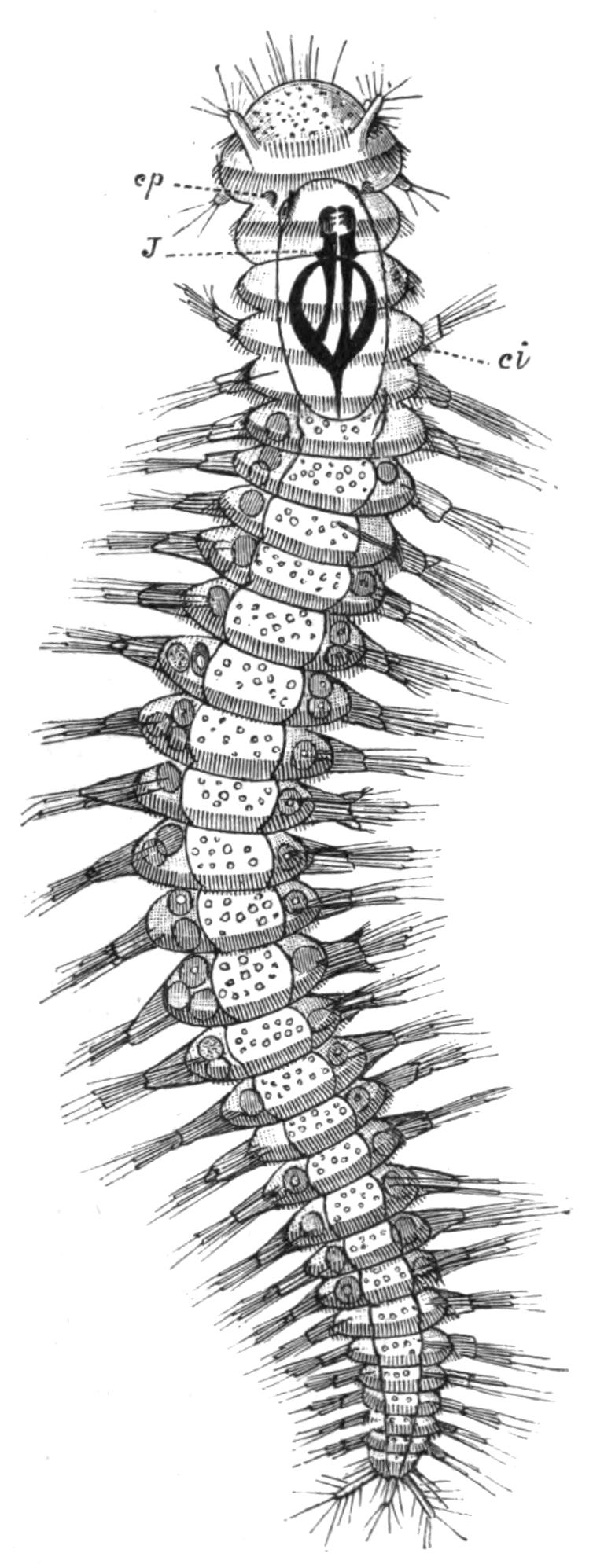
Fig. 170.—Ophryotrocha puerilis Clap., Metsch. × 25. ci, Bands of cilia; cp, ciliated pit (nuchal organ); J, jaws. (From Korschelt.)
Onuphis Oerst. has a head like the preceding, from which it differs in having pectinated gills and two nuchal cirri like Eunice. In making its tube it employs small pebbles, bits of shell, and even echinid spines, which it glues together with mucus, so that it bears a general resemblance to its surroundings. O. conchylega Sars, has a flattened, scabbard-like tube, which can be carried about by its owner. Atlantic.
Lumbriconereis has a more or less conical prostomium, without any tentacles, but with large palps: segments without gills. L. fragilis Müll. is reddish or brownish, with a beautiful iridescence; it is cylindrical, very narrow, and some 5 or 6 inches long; L. tricolor Jnstn. is much larger.
Ophryotrocha (Fig. 170) is a small form often occurring in aquaria; it is chiefly remarkable for the possession of segmentally-arranged girdles of cilia—a permanent larval feature. Lysidice ninetta Aud. and Edw. belongs here.
Fam. 10. Glyceridae.—Elongated worms with numerous segments. The prostomium, though narrow, is long, conical, annulated, and carries at its apex four very small tentacles; at its base a pair of palps. Special retractile gills are present. The armed pharynx is very long, and when protruded appears wider than the animal. The members of this family are without any system of blood-vessels, but the coelomic corpuscles are coloured red. Glycera has four jaws, the parapodia are all alike (Fig. 136, C). G. capitata Oerst. is 2 or 3 inches in length, is yellowish in colour, with a dark-red median line. It may be found burrowing in sand. The setigerous lobes of each foot are coalesced to form one large lobe with pointed apex. The dorsal cirrus is a small wart above the base of the foot. Atlantic and Mediterranean. A second species, which is much larger and flesh-coloured, also occurs.

Fig. 171.—Glycera meckelii Aud. and Edw. with pharynx everted, × 1. (Règne Animal.)
Goniada is distinguished from the preceding by the fact that the parapodia suddenly change in size and character at about one-third the length of the body. The pharynx has numerous paragnaths. G. maculata Oerst. occurs off our coasts.
Fam. 11. Sphaerodoridae.—The dorsal and ventral cirri of each segment are spherical. The chaetae are usually jointed, and there is an aciculum to each parapodium. Ephesia Rthke. (E. gracilis R. = Sphaerodorum peripatus Jnstn.) is exceptional in having unjointed chaetae. North Sea, Arctic Ocean, and the Channel. The family, which is much modified, is allied in some respects to the Syllidae.
Fam. 12. Ariciidae.—These worms burrow in sand between tide-marks. The body consists of many short segments, and is nearly cylindrical. The prostomium is more or less pointed; the chaetae are all capillary; in the first few segments they project laterally but soon come to lie dorsally, and are carried by slight conical papillae (supported by acicula), which are longer in the middle of the body. Most of the segments carry filiform "gills," representing the dorsal cirri (Fig. 137, B).
Scoloplos armiger Müll. is extremely common on our coast. It is about an inch long, yellowish, with red gills, commencing about the twelfth segment. Each of the lobes of the parapodium possesses an aciculum, and the chaetae are bent in a peculiar way. The everted buccal region has the form of a six- or eight-rayed star. The spawn of this species may be found on the shore in spring as brown, pear-shaped, jelly-like masses, each with a long stalk, by which the mass is fixed to the sand. In the jelly are the eggs, which may be watched passing through the earlier stages of development. Atlantic on both shores, even off Spitzbergen, and Nova Zembla. Another representative is Theodisca mamillata Clap., which occurs amongst the roots of Laminaria.
Fam. 13. Typhloscolecidae.[382]—Pelagic, greatly modified forms, apparently related to the Phyllodocidae, but with very uncertain affinities. The prostomium is pointed and carries a pair of foliaceous tentacles; each of the first two segments bears a pair of foliaceous cirri; the remaining segments possess a dorsal and a ventral pair of foliaceous cirri, with a small bunch of chaetae and a single aciculum. All the cirri have peculiar rod-cells. Typhloscolex Busch, Sagitella Wagner, and Travisiopsis Uljanin: all small worms. North Sea Atlantic.
Sub-Order 2. Spioniformia.
Fam. 1. Spionidae.—Mostly small worms, with small ridge-like prostomium carrying a pair of eyes, but no tentacles or palps. The peristomium, which extends forwards on each side of the prostomium, bears a pair of very long cirri (usually termed "tentacles") normally directed backwards, very mobile, and more or less coiled. They are readily thrown off by the animal. The notopodial cirri are long, finger-shaped, and curved over the back; they are vascular and ciliated, and function as "gills." The neuropodia project laterally. Both are usually provided with a "podal membrane" along their outer margin. There are no ventral cirri; the dorsal chaetae are fringed capillaries; the ventral are "crotchets." The buccal region is eversible. The worms burrow in mud and sand.
Spio seticornis Fabr. is a small worm less than an inch in length, colourless except for the red blood in its vessels. It builds long and flexible tubes of sand in the clefts of rocks and under stones in the upper part of the littoral zone. The prostomium is notched at the anterior margin. The gills commence on the twelfth segment, and do not extend to the end of the body. A membrane-like cirrus exists also on the second chaetigerous segment. The podal membrane is adnate to the gill throughout its extent. Four short anal cirri occur. Greenland and Scandinavia.
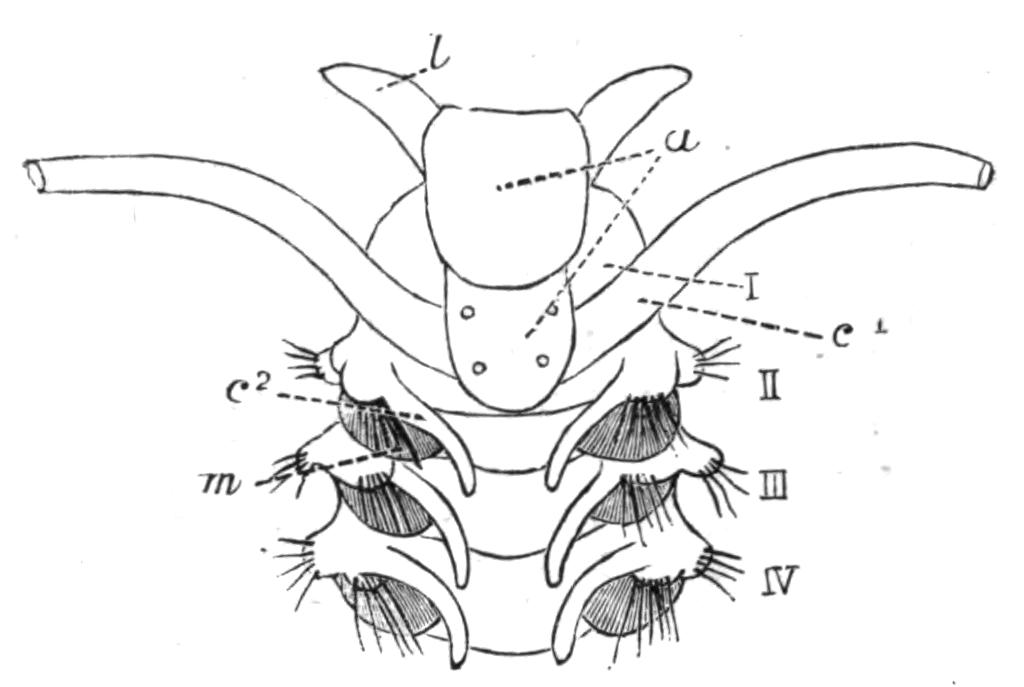
Fig. 172.—Nerine vulgaris Jnstn., enlarged. (From Cunningham.) a, Prostomium; c1, cirrus of peristomium; c2, "gill"; l, lobes; m, podal membrane; I, peristomium; II, III, IV, following segments.
Nerine is represented by two species, sometimes called "Ragworms." The genus is very similar to Spio, but the worms are of larger size. The prostomium is compressed by the forward growth of the peristomium, and appears as a ridge on the latter segment, extending downwards in front towards the mouth. The "gills" commence on the second segment, and are continued in every segment except the hindmost. Nerine (Scolecolepis) vulgaris Jnstn. is readily distinguished from other species by its somewhat T-shaped prostomium. It is an extremely common worm under stones and amongst seaweed at low water. It is some 3 or 4 inches in length and more slender than the following species. Its colour is yellowish-brown, and the red gills directed upwards and backwards give the appearance of oblique red lines. The podal membrane does not reach the tip of the gill. North Atlantic. It is said to ascend rivers and live in brackish water. N. coniocephala Jnstn. is much the same colour, but reaches a length of 8 inches, and a diameter of ¼ inch. The prostomium is conical. The podal membrane reaches to the tip of the gill in the anterior segments. The worm burrows rather more deeply and nearer low-water mark than the preceding species.
Fam. 2. Polydoridae.—Polydora Bosc (= Leucodore Jnstn.) is readily distinguished from the other Spionids, and, indeed, from any other Polychaet (except Chaetopterus), by possessing specially strong chaetae in the enlarged fifth chaetigerous segment. The anterior segments differ from the rest in the absence of gills and in the character of the chaetae (Fig. 133, A, p. 261).
P. ciliata Jnstn. inhabits soft mud tubes near low water; it also makes U-shaped galleries in stones and shells, and the tube projects from each mouth. The worm is about ½ inch long, consists of some forty segments, and is yellowish or flesh-coloured. The prostomium resembles that of Spio; the peristomium is raised into a slight collar at each side. The anus is surrounded by an incomplete funnel. The species has almost a world-wide distribution, having been recorded from Iceland, Australia, the Philippine Islands, as well as from the European seas. P. coeca Oerst. often lives commensally with a sponge, having a protective odour.
Fam. 3. Chaetopteridae.—The family is represented on our coasts by Chaetopterus variopedatus Ren.,[383] which is found at the Channel Islands, the Scilly Isles, the Isle of Man, and the west Scottish coast, and probably at various other places, at low water and down to a depth of some 15 fathoms. It occurs in all European seas. The animal builds a long tube, the basis of which is a tough, parchment-like substance; this is coated externally with sand, small pebbles, and other débris: it is of considerable length and about ¾ inch in diameter, is U-shaped and open at both ends, the greater part of it being embedded in sand or in crevices of rocks. The animal, whose body-wall is thin and delicate, never leaves its tube. The body has a bizarre appearance; three regions are readily distinguishable, which may be denoted by the letters A, B, and C. The most anterior region, A, is flattened, and carries nine pairs of conical lobes with delicate chaetae, though the fourth lobe possesses special stouter chaetae (as in Polydora). The anterior end of the body terminates in a wide funnel, the boundary of which is formed chiefly by the peristomium; on its dorsal surface is a pair of tentacle-like processes (peristomial cirri); the region between which represents the prostomium.
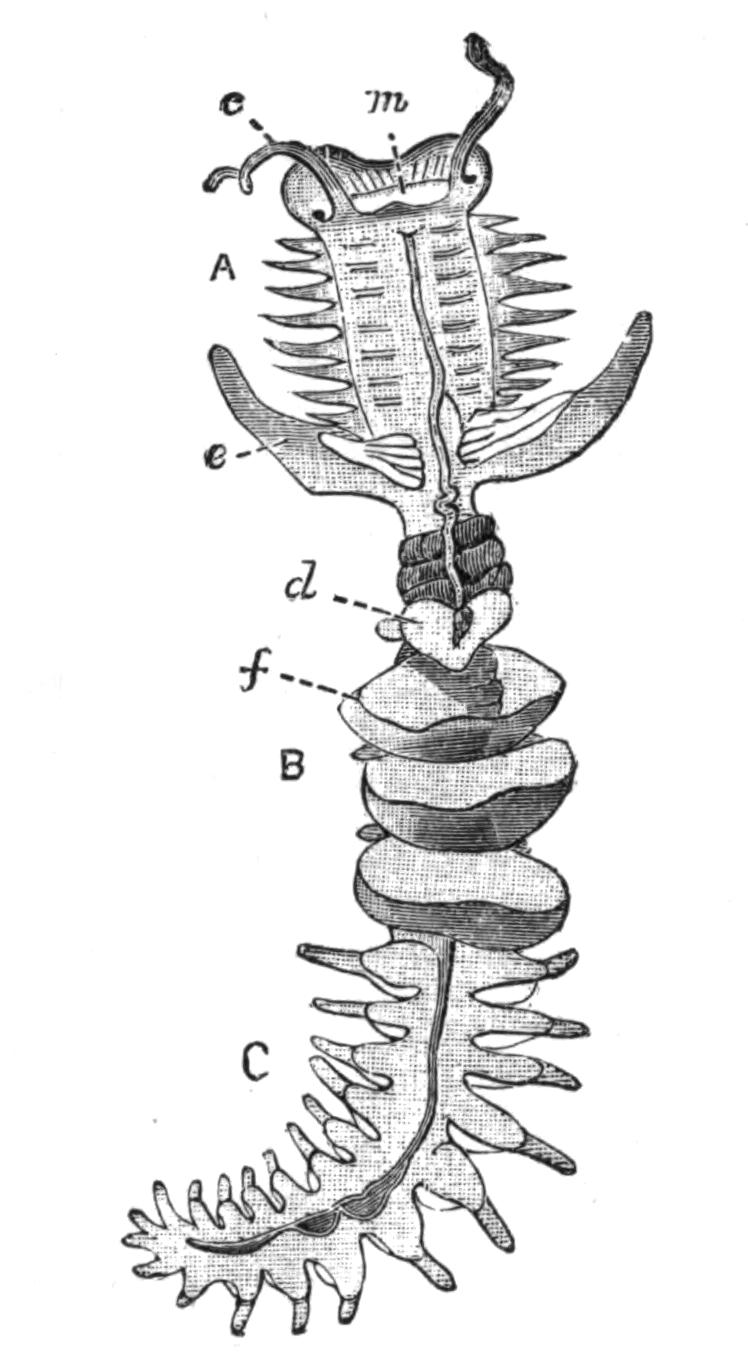
Fig. 173.—Chaetopterus. (From Panceri.) Natural size of a young specimen. A is the anterior region of the body; B, the middle region; C, the hinder region. c, Peristomial cirri; d, "sucker"; e, the great "wings"; f, the first of the three "fans"; m, mouth.
The second region, B, is very curiously modified; it is formed of five segments. The most anterior is produced on either side into a great wing-like process, which in life is directed forwards above the region A. Each is grooved on its inner side, the ciliated grooves being continuous with a median groove running forwards along the back of A; this apparatus serves to bring food to the great funnel-like mouth. The next segment (twelfth) carries a dorsal and ventral "sucker," representing the parapodia. Each of the segments 13, 14, 15 carries a membranous fold encircling the body. By the constant movement of these "fans," which have nearly the same diameter as the tube, a current of water is constantly washed over the animal. The fans represent the notopodia; the neuropodia are bilobed rounded knobs. The region C consists in the adult of about thirty segments, all alike, and less modified than the preceding. The animal is the most truly tubicolous of the Polychaetes, and is much modified on this account. No locomotor chaetae are present, though the great wings and notopodial processes of region C contains chitinous bristles, which, however, do not project;[384] the anterior region with its stiff chaetae, and the neuropodial uncinal plates of the rest of the body serve in its movements up and down the tube, while the "suckers" fix the worm temporarily to the wall of its house.
Chaetopterus is highly phosphorescent (see p. 295). It is further interesting on account of the green colouring-matter, which is extracted by alcohol. Two commensal Polynoids occur in the tube, viz. Polynoë glabra and P. cirrosa. The larva is "mesotrochal" (with a ciliated ring round its middle), that region of the body lying in front of the cilia giving rise to the region A, whilst the rest of the body gives rise to regions B and C.
Fam. 4. Magelonidae.—This family includes only the very peculiar worm, Magelona papillicornis Fr. Müll., which lives buried in sand, between tide-marks, in various parts of our coast and that of the United States. Its chief features are the large, flat, spoon-shaped prostomium; the long peristomial cirri, slightly expanded terminally, carrying papillae along one side; the enormous, eversible buccal region, which is an important respiratory organ. The blood is of a madder-pink colour, and the blood-vessels in the thorax are greatly dilated. The body of the worm is divisible into two well-marked regions, owing to differences in the chaetae.[385]
Fam. 5. Ammocharidae.—This family contains only one species, Owenia filiformis D. Ch. Some of the anterior segments are longer than the hinder ones, though the arrangement of chaetae is alike throughout. The mouth is wide, like that of Chaetopterus, and is surrounded, except ventrally, by a membrane, so deeply notched as to give rise to flattened filaments containing blood-vessels. These "gills" appear to belong to the peristomium. The small worm in its sandy tube is plentiful on our coasts in about 20 fathoms. Off Greenland and the Mediterranean.
Sub-Order 3. Terebelliformia.
Fam. 1. Cirratulidae.—These worms have a cylindrical body, more or less attenuated at each end; the segments are distinct, and similar throughout, with capillary chaetae on each side in two bundles, carried by small papillae. The prostomium is conical, the peristomium usually without cirri. On more or fewer segments the dorsal cirri are long and filamentous, and function as gills. There is a single pair of anterior nephridia: the septa and genital ducts are repeated throughout the hinder part of the body. The worms usually live in burrows.
Cirratulus.—The prostomium is long, sometimes annulated. In addition to the segmental filamentous "gills" there is a transverse row of long "tentacular filaments" across one of the anterior segments, and it has been suggested that they are really prostomial tentacles which have shifted backwards. They and the gills twist about in a very active fashion during life, and look like small independent worms, especially when they are detached. C. cirratus Müll, is a brown or dirty yellowish worm about 4 to 6 inches in length, usually to be found under stones, partially embedded in the mud or sand. The prostomium carries a pair of linear groups of "eye-spots"; the first chaetigerous segment carries a transverse row of tentacular filaments, and the red gill-filaments commence on the same segment. Common. C. tentaculatus Mont. is a larger worm, dark red in colour, and is distinguished from the preceding by the absence of eyes and by the fact that the tentacular filaments are on the seventh chaetigerous segment, while the gills commence more anteriorly. Atlantic and the Mediterranean.
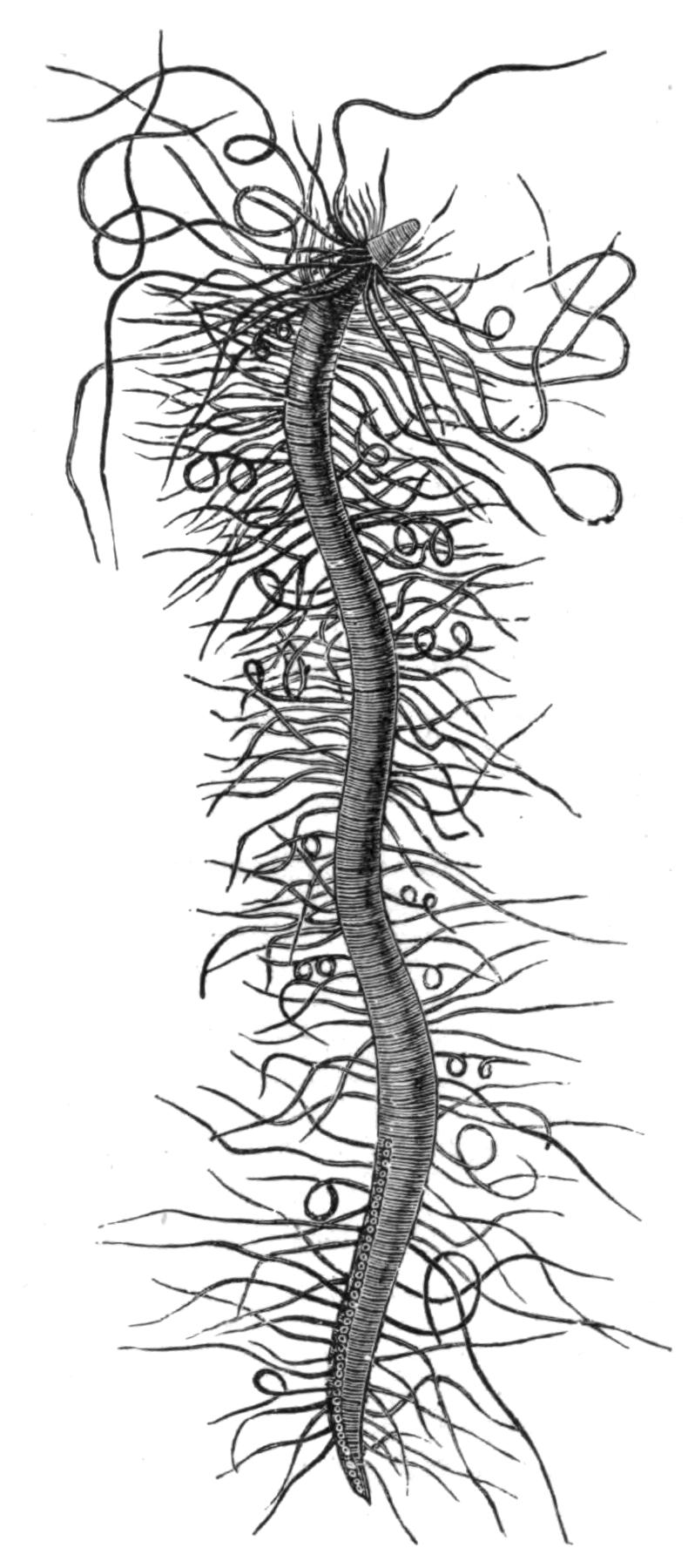
Fig. 174.—Cirratulus tentaculatus Mont. (½ nat. size). (From Règne Animal.)
Chaetozone setosa Mgrn. occurs in the North Atlantic. Dodecaceria concharum Oerst. is about an inch in length, olive-green or brownish in colour, and is not uncommon amongst roots of Laminaria. It is stated to live also in tortuous tubes bored in shells and stones, but whether it makes these tubes is uncertain. The worm has two thick tentacular filaments, and the thinner gills are only on four segments. Hekaterobranchus shrubsolii Buch.[386] is a small worm some ½ inch long, found at Sheerness, where it occurs at low tide in soft mud; here it forms a loosely coherent tube, though it also moves freely in the mud. Its chief features are (1) a pair of long, ciliated "cephalic tentacles," probably peristomial, and similar to the "tentacular filaments" of Dodecaceria; (2) a pair of filamentous gills (dorsal cirri) on the first chaetigerous segment; (3) a pair of large green nephridia in the anterior segments. The describer placed it amongst the Spionids, but the above and other features point to Cirratulid affinities.
Fam. 2. Terebellidae.—The body is cylindrical, and generally larger in front than behind. The prostomium is generally flattened, and forms a mobile upper lip, which always carries a transverse series of many tentacles; it may bear "eye-spots," but never palps; the lower lip is formed by the peristomium. There are one to three pairs of gills, which are usually more or less branched, on as many segments.[387]
The chaetigerous lobes are small; the dorsal ones contain capillary chaetae, which are frequently confined to the anterior segments, whilst the ventral chaetae are uncini. The ventral surface of the anterior segments is thickened by glands which secrete the mucus employed in tube-building; the number of these "shields" and of the dorsal bundles of chaetae have to be noted in identifying the worms. There are one to three pairs of large anterior nephridia. A very strong "diaphragm"—usually more or less pouched—cuts off this anterior region of the body-cavity from the rest, and is the only complete septum in the body; from three to twelve pairs of small generative ducts occur behind it. The family is tubicolous, foreign materials being generally used in the formation of the tube.
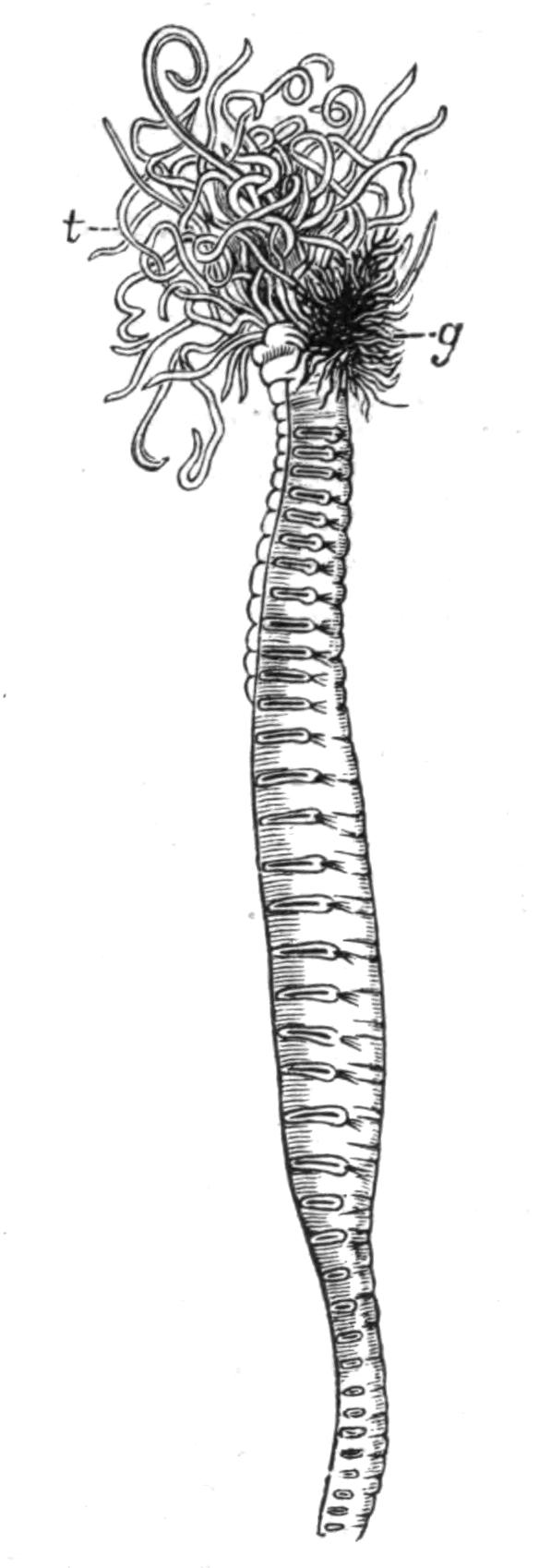
Fig. 175.—Amphitrite johnstoni (½ nat. size). g, Gills; t, prostomial tentacles. (From Cunningham and Ramage.)
There are six genera which are fairly common round our coast, and their identification may be facilitated by means of the following table[388]:—
A. Capillary chaetae confined to the anterior part of body; commencing on the fourth segment. Gills ramose. 3 pairs, which are equal in size. Amphitrite. 24 notopodia.
unequal in size. Terebella. 17 notopodia.
2 pairs. 17 notopodia. Gills equal. Eye-spots. Nicolea.
Gills unequal and of peculiar shape. Pista.
B. Capillary chaetae throughout the body; commencing on the third segment. Gills arborescent; 3 pairs. Leprea.
filiform; in transverse series in two segments. Thelepus.
A. Capillary chaetae confined to the anterior part of body; commencing on the fourth segment. Gills ramose. 3 pairs, which are equal in size. Amphitrite. 24 notopodia.


unequal in size. Terebella. 17 notopodia.
2 pairs. 17 notopodia. Gills equal. Eye-spots. Nicolea.

Gills unequal and of peculiar shape. Pista.
B. Capillary chaetae throughout the body; commencing on the third segment. Gills arborescent; 3 pairs. Leprea.
filiform; in transverse series in two segments. Thelepus.
Amphitrite johnstoni Mgrn. (Fig. 175) is brown in colour, about 4 to 6 inches in length, and nearly ½ inch in breadth anteriorly. Each of the gills consists of a curved stem; from the convex side of which arise a number of branches, themselves dichotomously divided, the final branches being long (Fig. 176, A). There are twelve ventral "gland shields." The worm is fairly common between tide-marks, below stones in muddy places: the end of its tube of mud projects above the surface. Atlantic.
Terebella (Polymnia) nebulosa Mont. is distinguished by its bright red colour, spotted with white; it is 6 or 7 inches in length, and ½ inch across. Large specimens of this beautiful worm may be obtained at Weymouth and elsewhere on the south coast, where it lives in about 14 fathoms. Each gill appears much more arborescent than in the preceding (Fig. 176, B); it consists of a main stem, from which comparatively few branches arise; these subdivide frequently, and the terminal branchlets are quite short. The "gland shields" are fourteen to sixteen in number. The tube is of mud. North Sea and Mediterranean. T. (Leprea) lapidaria L. is 1 inch in length, orange-red in colour; and has 12 ventral shields. The tube, of fine mud, lies horizontally on the under surface of stones.
T. (Lanice) conchilega Pall. (the "sand mason") forms a very characteristic tube of sandy particles, small pebbles, and pieces of shell. It is buried in the sand, but a short portion protrudes, and bears, set round its edge, a fringe of branching sandy threads (Fig. 153) commonly seen on sandy shores between tide-marks. The worm may be distinguished from the preceding species by the fact that the series of fourteen to seventeen gland shields are red, and continuous from segment to segment. The gill is shown in Fig. 176, C. North Sea, Atlantic, and Mediterranean.
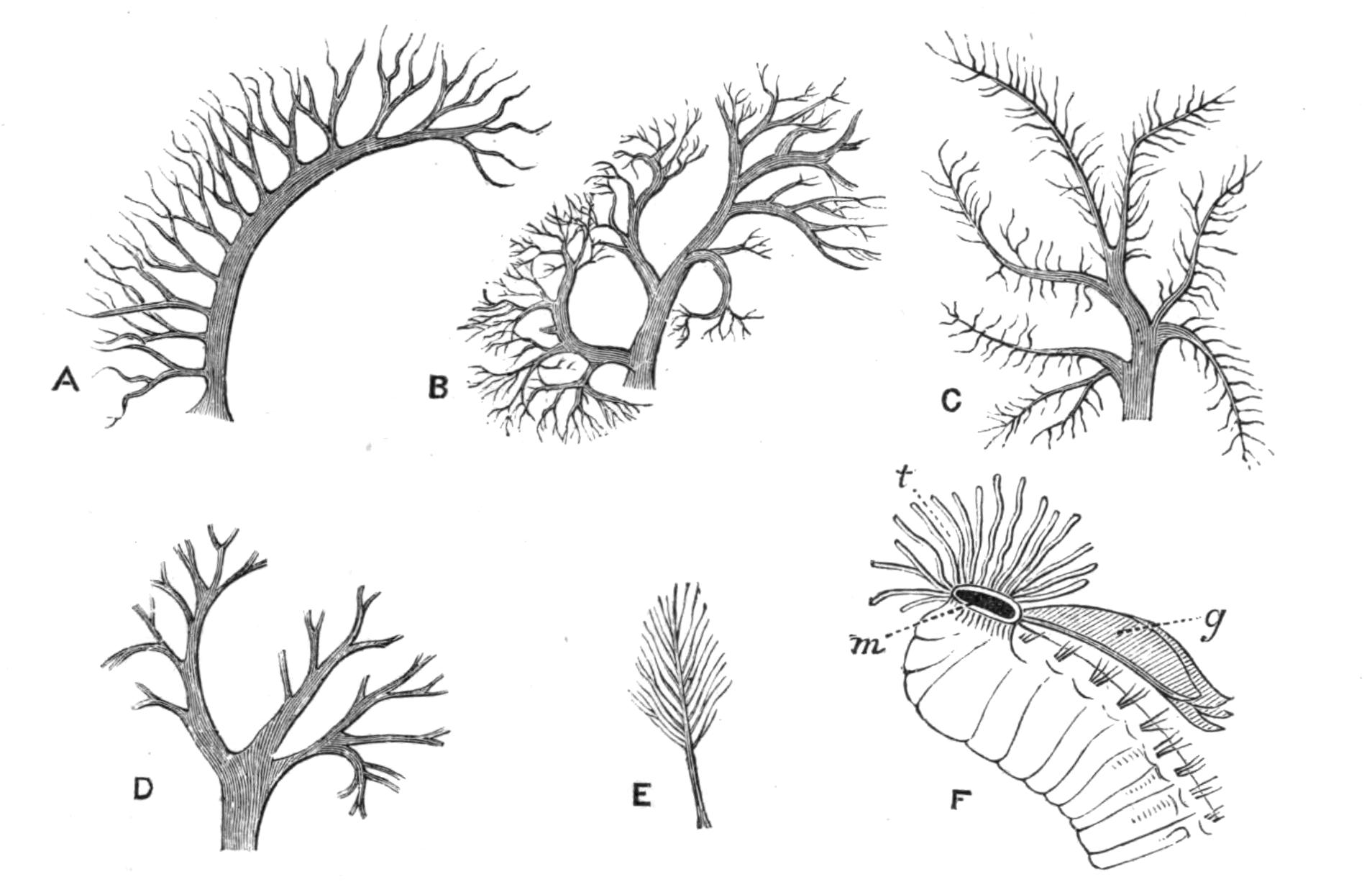
Fig. 176.—Gills of various Terebellids. × 4. A, Amphitrite johnstoni Mgrn.; B, Terebella nebulosa Mont.; C, T. conchilega Pall.; D, Nicolea Mgrn. (the finer branches are not indicated); E, Pista Mgrn.; F, Terebellides Sars (after Malmgren). g, Gill; m, mouth; t, tentacles.
Nicolea venustula Mont. has only two pairs of equal, arborescent gills (Fig. 176, D); the tentacles are comparatively few. The animal, which is about an inch in length, is cinnamon-yellow with white spots, and has seventeen gland shields. 20 fathoms, North Sea and Mediterranean. Pista cristata Müll. is readily recognised by the shape of the gills (Fig. 176, E), of which there are only two pairs. Each consists of a long peduncle, bearing a number of dichotomously dividing, rather spirally-arranged branches, the whole having the appearance of a "bottle-brush." The worm is 2 to 4 inches long, of greyish-red to yellow colour. Atlantic east and west (even at the mouth of the Congo), and Mediterranean. Thelepus cincinnatus Fabr. is about the same length, pale red in colour, marked on its back with clear areas, giving the appearance of lacework. The gills are represented by numerous unbranched filaments arising separately in two transverse rows. The tube, which is adherent to shells, etc., along its whole length, is of thin, transparent, and flexible material like mica, covered with foreign bodies, and even with Polyzoa and Hydrozoa. 30 fathoms, Atlantic and Mediterranean.
Polycirrus aurantiacus Gr. is sometimes placed in a special sub-family, as it has no gills. The numerous tentacles are very long, and arise from a great hood over the mouth; the capillary chaetae commence in the first segment and extend for about half the length of the body; the uncini commence in the ninth segment. The ventral "shields" are paired. The animal is highly coloured; its phosphorescence and its distastefulness have already been mentioned on p. 294. In Terebellides stroemi Sars, four comb-like gills arise from a single common thick peduncle on the back of the second segment (Fig. 176, F). The ventral surface of the body bends upwards anteriorly so as to bring the mouth to the dorsal surface. 13 to 16 fathoms, muddy bottoms, North Sea and Mediterranean.
Fam. 3. Ampharetidae.—This family differs from the Terebellids chiefly in the shape of the head and in the presence of a bundle of strong chaetae (or paleae) on each side of the head in front of the gills, of which there are four on each side. Each gill is a simple filiform process, considerably longer than the tentacles, which are very few in number. Amphicteis gunneri Sars, Ampharete gracilis Mgrn., and Melinna cristata Sars, occur on our coasts.
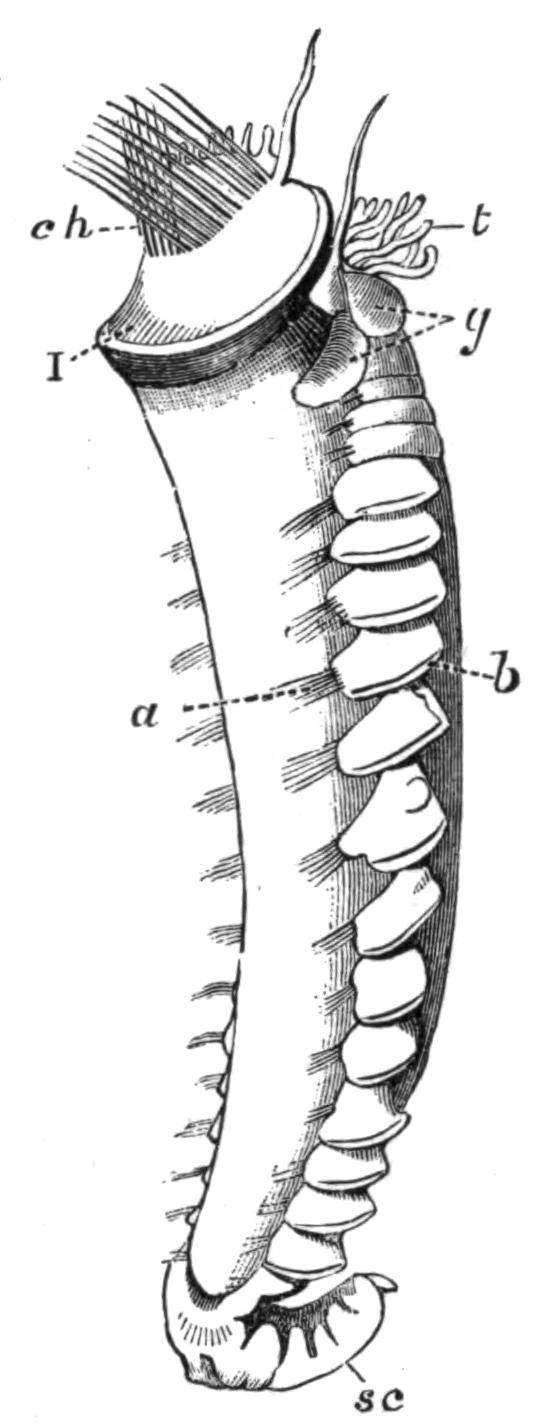
Fig. 177.—Pectinaria belgica Pall. Slightly enlarged. a, Neuropodial chaetae; b, notopodium; ch, paleae; g, gills; sc, scapha; t, prostomial tentacles; I, peristomium. (From Malmgren.)
Fam. 4. Amphictenidae.—This contains the interesting genus Pectinaria, in which the head is protected by great golden chaetae on the second segment; they are flattened, curved, and pointed, and are arranged in a single transverse row on each side, serving as an operculum to the tube. The posterior end of the worm has undergone great degeneration, and is represented by a small leaf-like "scapha" which serves to close the tube posteriorly. The worm is 1½ inches in length and consists of only twenty segments, of which seventeen are chaetigerous. The tube is nearly cylindrical, but wider anteriorly than posteriorly (Fig. 152, p. 288); the sand grains are uniform in size, and are embedded in the secreted mucus in a very regular way, the surface being smooth both inside and out. These tubes can be carried about by the worm, but may be found projecting from the sand at very low tides. P. belgica Pall. forms a straight tube, whilst in P. auricoma Müll. the tube is larger and slightly curved. The former species appears to be confined to the North Sea; the latter occurs in deeper water, and is also present in the Mediterranean.
Sub-Order 4. Capitelliformia.
Fam. Capitellidae.[389]—Capitella capitata v. Ben. occurs pretty frequently in the sand under stones near low tide-mark. It is a red worm, about 1½ to 2 inches long, greatly resembling a Tubificid Oligochaete. It may readily be distinguished from other Polychaeta by the strong genital chaetae in the male, which replace the notopodial chaetae of segments 8 and 9; those in the former segment are pointed backwards, and in the latter forwards. There is but a single pair of generative ducts in either sex in the eighth segment. North Sea, Mediterranean.
Notomastus latericeus Sars is a longer worm, living in shallow water, off our coast and in the Mediterranean. The anterior twelve segments are wider than the rest of the body. The notopodial chaetae of the anterior segments of the hind body form a ring. Dasybranchus caducus Gr., which occurs in the Mediterranean, but not on our coast, reaches a length of 2 or 3 feet. It has gills on the hinder segments above the neuropodia.
Mastobranchus Eis. is found in the Mediterranean.
Sub-Order 5. Scoleciformia.
Fam. 1. Opheliidae.—Comparatively short, rather ugly worms of a pearly colour, no prostomial processes: parapodia obscure. The family is represented in British waters by four species, occurring in shallow water.
Ammotrypane aulogaster Rathke, is about 2 inches long; the nearly cylindrical body has a ridge running along each side below the chaetae. The conical prostomium is tipped with a small knob, and carries at each side a ciliated pit (Fig. 144, p. 273). Every segment, except the first chaetigerous, is provided with a filamentous gill (dorsal cirrus). The segmentation is very obscurely marked, for internally there are only three complete septa, placed far forwards. The intestine is bent upon itself. In Ophelia limacina Rthk. the gills commence in the eighth segment, and the longitudinal ridge does not extend in front of this segment. The worm is about 1½ inches long, and occurs between tide-marks. Travisia forbesi Jnstn., North Sea. Polyophthalmus pictus[390] Duj. is very abundant at some parts of the coast. There are two bundles of chaetae on each side of every segment; each bundle contains three chaetae, of which only one projects to any distance. Paired eye-like spots exist on the sides of twelve segments. The worm is about an inch in length.
Fam. 2. Maldanidae (= Clymenidae).—Represented on our coasts by four fairly common species. They form sandy tubes, which are embedded in the sand with a short portion projecting. In some places they are so abundant that at low water the sand has quite a rough appearance. The prostomium is frequently truncated and depressed, and is always fused with the peristomium. A horny plate may be developed on the upper surface of the head, and the skin at the side of the prostomium is frequently raised into a more or less prominent fold. The hinder end of the body carries a funnel surrounding the anus. There are no gills or sensory processes on the body. Some of the segments towards the middle of the body may be longer than the rest. Peculiar serrated hooks of characteristic shape constitute the neuropodial "torus." The buccal region is eversible.
Nicomache lumbricalis Fabr. is a rosy-pink worm with white spots anteriorly; the chaetigerous ridges are red. The worm consists of twenty-six segments, and measures 2 or 3 inches. It is very narrow and readily breaks in pieces. The prostomium is laterally compressed; the anal funnel is fringed with a number of short equal processes. Under stones in the Laminarian zone.
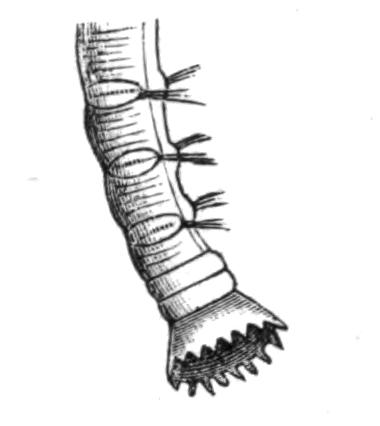
Fig. 178.—Anal funnel of Nicomache lumbricalis. (From Malmgren.)
Axiothea catenata Mgrn., which may reach a length of 3 or 4 inches, resembles the above in general colour, though of a deeper tint. There are only eighteen chaetigerous segments. The head has a membranous fold of skin on each side, and the anal funnel is produced into longer and shorter processes. Both these species are also found on the west side of the Atlantic. Clymene lumbricoides Qfg. is about 8 inches long; pink, with a light ring round each segment; the seventh segment is larger and reddish-brown. The prostomium is laterally compressed. Anus on a cone, which rises from the bottom of a funnel, the margin of which is entire. Atlantic.
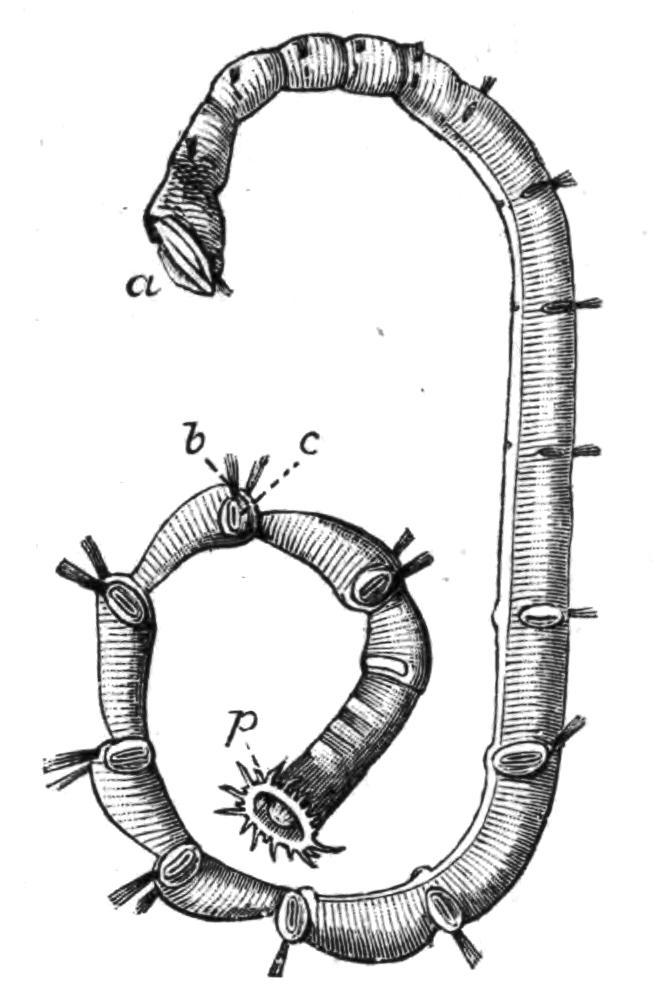
Fig. 179.—Axiothea catenata. × ½. a, Anterior end; b, notopodial and c, neuropodial chaetae; p, perianal funnel. (From Malmgren.)
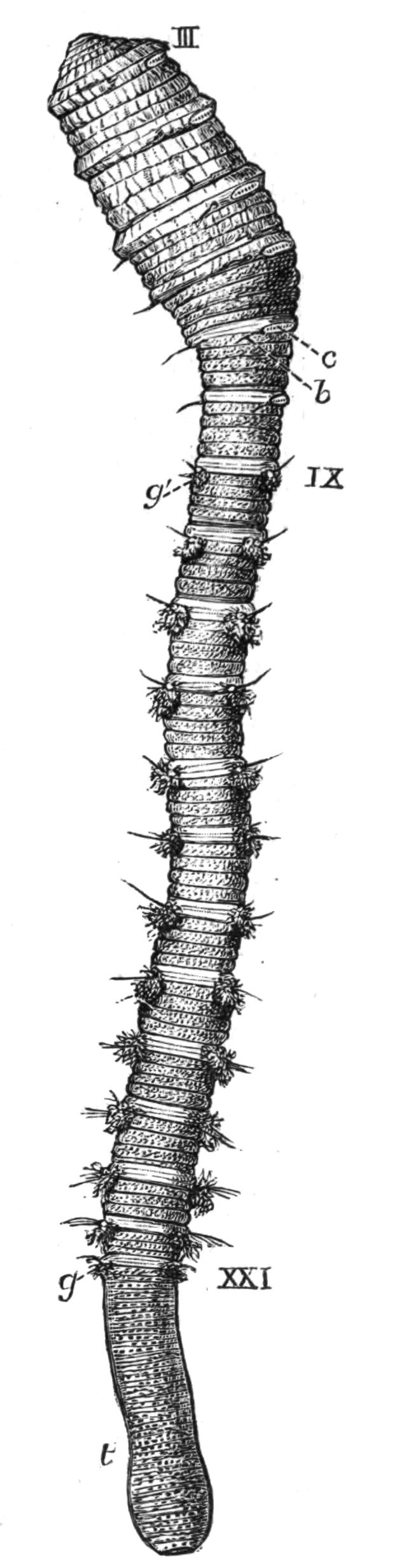
Fig. 180.—Arenicola marina. × 1. Dorsal view. The anterior end is seen partly from the side. III, The first chaetigerous segment; IX, the ninth chaetigerous, and first branchial segment; XXI, the last branchial segment; b, notopodial and c, neuropodial chaetae; g', g, the first and last gills; t, the non-chaetigerous tail.
Fam. 3. Arenicolidae.—Here belongs the common "lug-worm" Arenicola marina L., which occurs all round our coasts between tide-marks, and is so generally used as bait in fishing. The worm, which measures 5 to 8 inches, is of a dark tint, usually brownish-green. It burrows to a depth of some 18 inches or 2 feet, and throws up a considerable quantity of "castings" or "sand-ropes," which are noticeable on every shore consisting of mud or muddy sand. The body of the worm is cylindrical, thicker anteriorly; the segments are indistinct, owing to the secondary groovings and furrows on the skin. The prostomium is in the adult fused with the peristomium; this and the second segment are achaetous. Then follow twenty chaetigerous segments with dorsal bundles of capillary chaetae and ventral rows of short crotchets. The hinder region of the body is achaetous and narrower than the rest, forming a "tail." There are twelve (sometimes thirteen) pairs of arborescent red gills on segments 9 to 20 (21). Internally there are only four complete septa, and six pairs of nephridia, which are of large size: the fore-gut is eversible. Atlantic and Mediterranean. A second and smaller species, A. ecaudata Jnstn., occurs on our southern coasts; it is readily distinguished by the absence of a "tail," the chaetae and gills being continued to the end of the body.
Fam. 4. Scalibregmidae.—Prostomium ill-marked, fringed with small processes. Parapodia represented by slight papillae; two bundles of chaetae; usually cirriform lobes above and below them. Lipobranchius jeffreysii M‘I. has a grub-like body pointed at each end; forms tubes of mud. Firth of Clyde and elsewhere in North Sea. Sclerocheilus Gr. in old oyster shells. Channel, Mediterranean. Eumenia crassa Oerst. has gills on first six segments. North Sea. Scalibregma inflata Rthke. has arborescent gills on segments 4 to 7. The anterior part of the body is dilated. North Sea.
Fam. 5. Chlorhaemidae.—The family derives its name from the green colour of the blood, due to chlorocruorin. The representatives are comparatively short worms, with capillary chaetae on all the segments, the limits of which are not evident. The prostomium carries a pair of long grooved yellowish processes, which are perhaps palps, and several green tentacles, acting as "gills," arranged in a transverse series above the mouth (Fig. 134, F, p. 262). The peristomium is achaetous; the whole "head" can be withdrawn into the body. The chaetae of the anterior segments are especially long, and directed forwards so as to form a "cage" for the head. The body-wall is covered with longer or shorter papillae. Internally, the chief points of interest are the presence of only two septa (Trophonia) or only one septum (Siphonostoma), situated somewhere in front of the middle of the body, and forming a great backwardly-directed pouch, which contains a part of the looped intestine, and the nephridia, of which there are only two or four.
Trophonia plumosa Müll. is about 2 to 4 inches long, yellowish-brown in colour, with a rough skin; the head is usually retracted. It lives in the mud amongst Laminarian roots down to 50 fathoms. North Atlantic. Siphonostoma (Flabelligera) diplochaitos Otto, has a transparent body-wall, so that the coloured viscera are visible. The skin carries long papillae, which traverse a thick jelly-like envelope secreted by it, in which numerous diatoms live (symbiotically?); the surface is covered by particles of mud, etc. This species, which may be found under stones at low tide, occurs also in the Mediterranean.
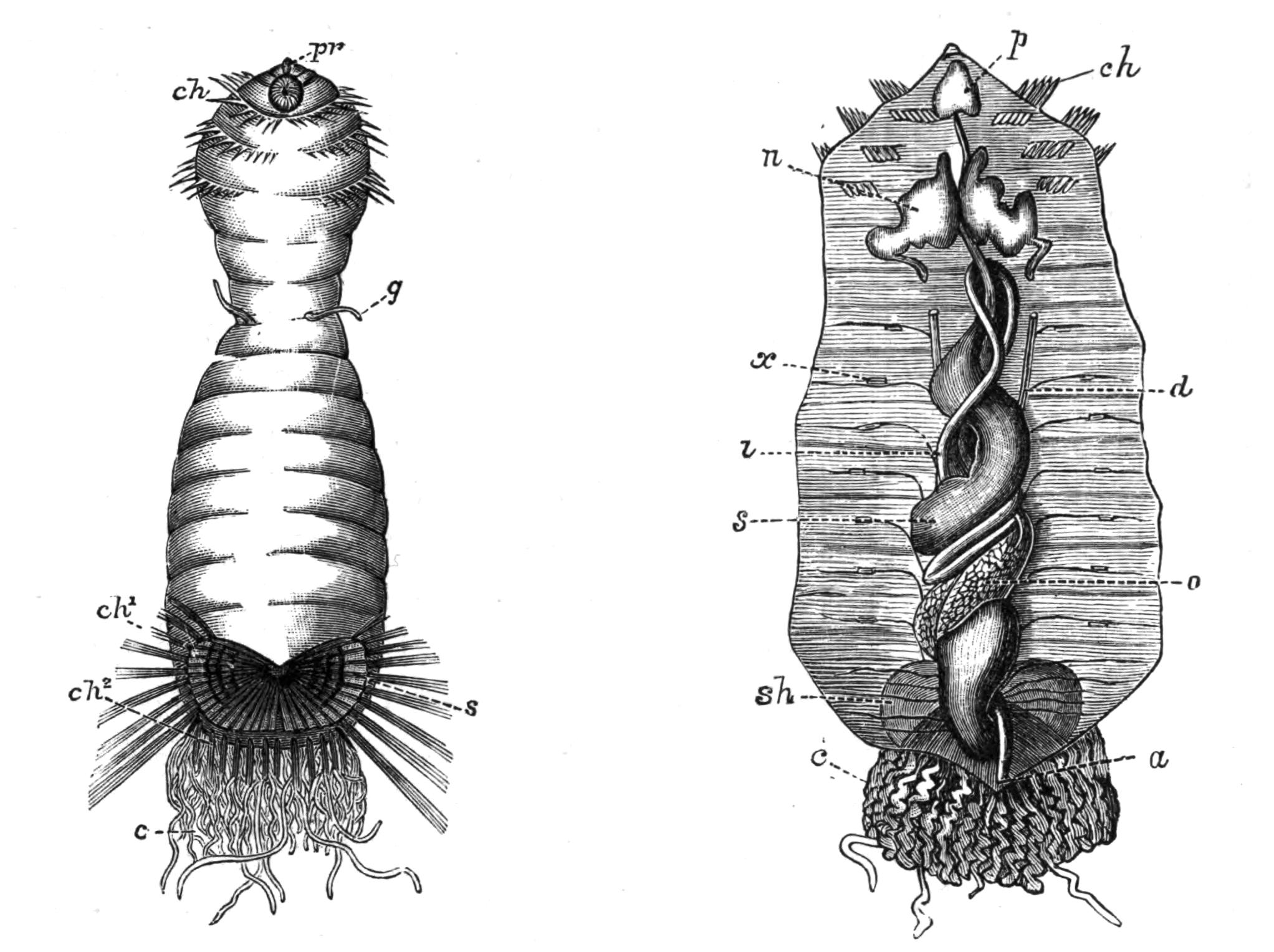
Fig. 181.—Sternaspis scutata Ranz. × 2. (From Vejdovsky.) The left figure shows the ventral surface; the right represents the internal organs as seen when the body-wall is pinned aside, having been slit up along its dorsal surface. a, Anus; c, gills; ch, anterior strong chaetae; ch1, bundles of chaetae along the lateral margin of the shield; ch2, the posterior marginal chaetae; d, oviduct; g, the external tube carrying genital pore; i, coiled intestine; n, nephridium ("brown tube"); o, ovary, amongst the coils of the alimentary canal; p, pharynx; pr, prostomium, with mouth just behind it; s, shield (on left figure); s, stomach (on right); sh, outline of shield seen through the ventral body-wall (in right figure); x, chaetae embedded in the body-wall, with nerves passing by them.
Fam. 6. Sternaspidae.—The single genus, Sternaspis, has not been recorded on our coasts, but is of so peculiar a structure as to deserve a description.[391] S. scutata Ranzani, occurring in the Mediterranean, is rather less than an inch in length, and derives its name from the possession of a pair of peculiar "horny" plates or shields on the ventral surface posteriorly. Around their margins are set about thirty bundles of long capillary chaetae. There are three half rings of stronger chaetae on each side near the anterior end of the body. The mouth is overhung by a very small rounded knob (prostomium), which in S. spinosa Sluiter, is prolonged outwards on each side to form a grooved palp-like organ, recalling that of Bonellia. The anus is placed posteriorly; and in front of it, on the dorsal surface, are two bundles of many long thread-like gills. On the ventro-lateral surface, in front of the middle of the body, is a pair of finger-shaped processes containing the genital ducts. The anterior segments of the body can be withdrawn into the body, as in the Chlorhaemidae. Further examination leads to the conclusion that the body of Sternaspis consists of about thirty segments, most of them provided with paired bundles of capillary (neuropodial?) chaetae, distributed as follows:—Each of the segments 2, 3, 4 has a half ring of strong chaetae on each side; segments 5 to 7 are without chaetae; segments 8 to 14 have chaetae embedded in the body-wall, but not projecting. The shields cover the remaining segments; and along the outer edge of each are some ten bundles of chaetae, and along the hinder edge some five or six bundles, representing as many segments. Thus the worm consists of about thirty segments whose outlines are nearly obliterated (as in the Chlorhaemidae), and whose chaetae, except those which are specially developed, are disappearing: while posteriorly a great shortening of the body brings the bundles close together. A continuation of this process, involving a further disappearance of chaetae, leads readily to the condition met with in Echiurus, one of the chaetigerous Gephyrea. Internally, further evidence of the relation between Sternaspis and the Chlorhaemids with the Gephyrea is afforded by the absence of septa, by the coiled alimentary canal, and by the presence of a single pair of nephridia, which in the latter group act both as excretory organs and as genital ducts.
BRANCH B. CRYPTOCEPHALA.
Sub-Order 1. Sabelliformia.[392]
Fam. 1. Sabellidae.—The branchial crown consists of a usually considerable number of filaments arising from a semicircular base. The peristomium may be reflexed to form a collar, which is frequently notched, so that a lateral and a ventral lobe on each side may be distinguished (Fig. 133, B, p. 261). The thorax consists of nine segments, and is provided with ventral "gland shields," which are continued along the abdomen, where they are subdivided into two by a ciliated "faecal groove," which sometimes bends to one side on reaching the thorax, and may extend forwards along the dorsal surface to the head: this groove serves to carry the faeces out of the tube. The gill filaments are always provided with secondary processes, and may be provided with compound eyes.[393] The tubes of the Sabellidae are always of fine mud or of sand.
Sabella pavonia Sav. is about 10 to 12 inches long and about ¼ inch across; the tube of fine mud is considerably longer and embedded deeply in the mud, with its free end projecting to some 2 or more inches, where it serves for the attachment of seaweed, Polyzoa, Hydrozoa, etc. The colour of the animal is orange-brown; the gills, which are about 1½ inches long, are green (due to contained blood) marked with more or less extensive brown or purple-brown spots, which may even hide the green tint. There is a pair of dark filaments arising between the dorsalmost gill filaments, which have been erroneously regarded as "prostomial tentacles"; they are, in fact, prolongations of a peculiar membrane or lip round the base of the gills, which bounds a groove leading to the mouth. These lip-processes (Fig. 133, B, l) occur in other Sabellids. Atlantic, North Sea, and Mediterranean.
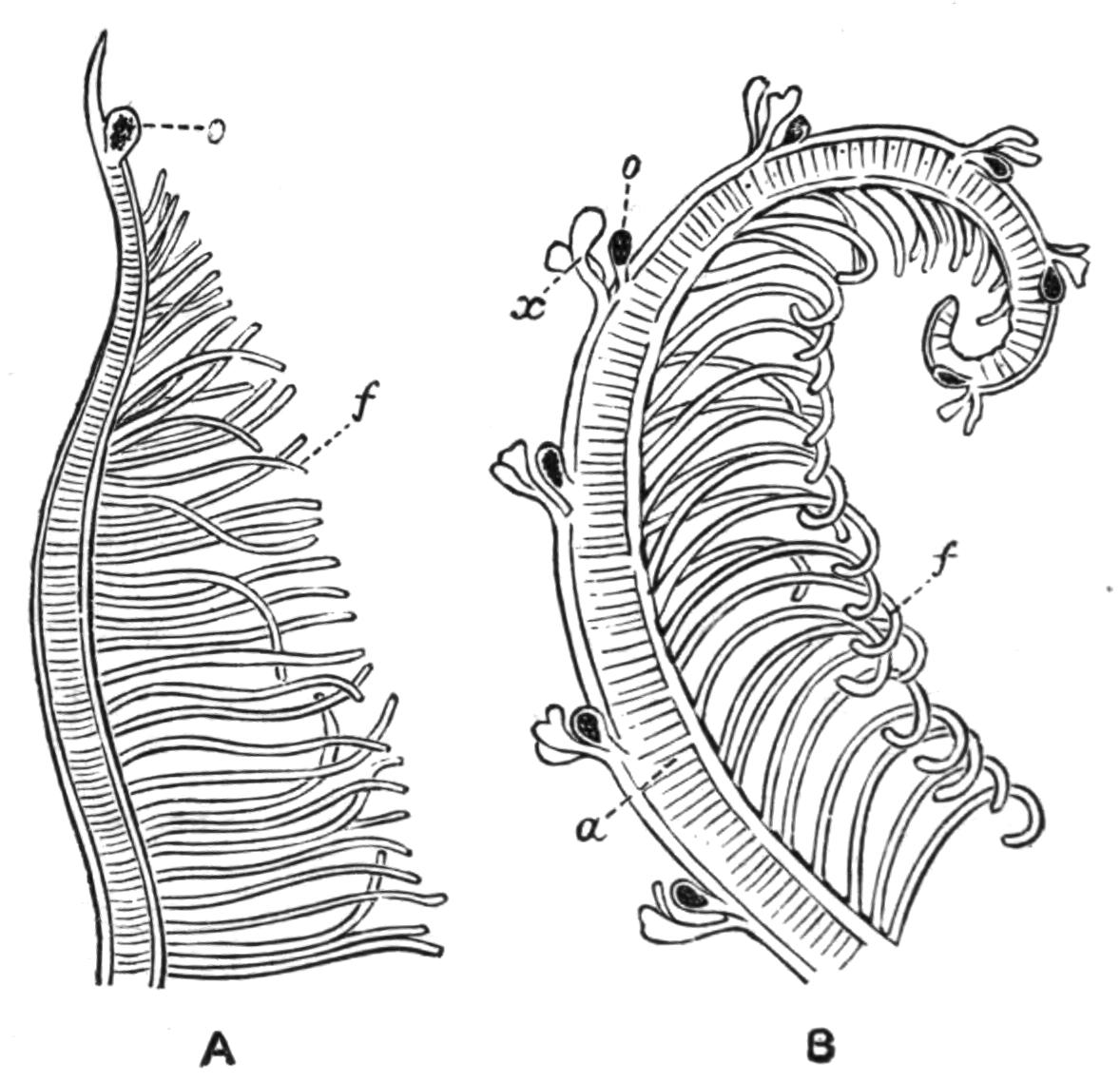
Fig. 182.—A, A gill filament of Branchiomma; B, of Dasychone. a, Axis; f, secondary filaments; o, eye; x, dorsal appendices.
Branchiomma vesiculosum Mont. forms a sandy tube near low tide-mark. The animal, measuring 6-7 inches, is rich brown, darker anteriorly, abundantly speckled with white; the ventral surface is pink; the gills are green or olive-brown, marked with white bands in a fairly regular fashion. Each gill filament has, just below its tip, a compound eye, consisting of several lenses and retinae. North Sea and Mediterranean.
Dasychone bombyx Dalyl. is a short, comparatively stout worm usually 1 to 1½ inches long; reddish-brown in colour, with a darker spot on each side of every segment. The gills are lighter with greenish marks. This worm may readily be recognised, for each of the gill filaments carries some six to ten pairs of dark compound eyes at intervals along its length, and near to each pair there arise two short processes from the outer side of the filament, which are known as "dorsal appendices." The worm forms a tube of mud, more or less mixed with sand. It occurs at low water and to some depth round the coasts of the Atlantic, North Sea, and Mediterranean.
Chone infundibuliformis Kröyer may be recognised by the absence of lobes on the collar, the presence of a membrane connecting the gill filaments, and the passage of the faecal groove along the dorsal surface of the thorax. The worm is 6 inches long, with purple gills, spotted with yellowish-white. The tube is formed of yellowish membrane covered with sand, and is fixed to stones and other objects. Potamilla reniformis Müll. is about 3 inches long, with about twelve brown gill filaments, some of which have eyes near the base. The tube is transparent and horny, with sometimes a slight covering of sand. Found in old oyster shells. North Sea, Atlantic, Mediterranean.
The genus Spirographis contains one of the largest European Sabellids, S. spallanzanii Viv., which occurs off the Channel Islands and in the Mediterranean. The two gill plumes are unequal; the large rone forms an upright, spirally-coiled column.
Fam. 2. Eriographidae.—Myxicola infundibulum Mont. has its gill filaments connected by a membrane reaching nearly to their tips. Each gill plume forms a semicircle; there are no eyes; the peristomium does not form a collar; no gland shields. The worm requires neither of these structures, since it is practically a free-swimmer, envelopes itself in mucus, and moves tail first. The faecal groove is not well marked, though continued dorsally. In the abdomen the tori uncinigeri extend dorsally and ventrally (beyond the neuropodial chaetae) and nearly encircle the body. The animal is 4 or 5 inches long, dull green, with purplish gills. Between tide-marks. North Sea and Mediterranean.
Amphiglena mediterranea Leyd. is only about ¼ inch long, hermaphrodite, and has eyes on the peristomium and on the anal segment. It is a very elegant little worm, and as a living object under the microscope, with the cilia on the gills, is very beautiful. The gills consist of six filaments on each side, provided with the usual double row of ciliated processes.
Fam. 3. Amphicorinidae.—Small hermaphrodite Sabellids in which each gill tuft contains only a few branching filaments. The simplest form is Haplobranchus aestuarinus Bourne,[394] which occurs in the rather foul mud at low tide in the estuaries of the Thames, the Liffey, and other rivers. The animal is about ¼ inch long, with four finger-shaped processes on each side, and a pair of larger, vascular processes on the ventral surface. These five branches are gills (palps), although, owing to the small size of the worm and simple vascular system, the four lateral filaments have no blood-vessels. The animal consists of only eleven chaetigerous segments, and lives in a tube made of mud particles.[395] Fabricia sabella Ehrenb. (Amphicora fabricia Müll.) has three gills on each side, each with a number of secondary branches of different sizes, but so arranged as all to reach the same level. It has eyes in its tail and swims backwards.
Fam. 4. Serpulidae.—The thorax is provided with an undulated membrane on each side, chiefly employed in smoothing the inside of the tube; it represents the dorsal and ventral cirri of these segments. The gland shields are confined to the thoracic segments. In many genera the dorsalmost gill filament on one or both sides is terminally dilated and serves as an operculum. The tube is calcareous, and attached to rocks, shells, etc., for a greater or smaller part of its extent.
Serpula vermicularis L. forms a pinkish tapering tube about 3 inches long; the narrower fixed end is coiled. It is marked at irregular intervals with encircling ridges, indicating cessation in formation, and has a circular aperture. The worm itself is about 1½ inches long. The horny operculum is conical, with its base upwards, fringed with short processes. 20 fathoms in the North Sea and Mediterranean; also from 275 fathoms off the west coast of Ireland.
Pomatoceros triqueter L.—The white shell is adherent, with a distinct keel along its upper surface; the aperture is overhung by a spine. The tubes are abundant everywhere, attached to rocks, stones, shells, etc., between tide-marks and down to 18 fathoms. The animal is very handsome, the thorax being deep blue, the abdomen red in the female, whitish in the ripe male. The branchiae are barred and spotted with blue, orange, and white; the operculum is calcareous, and furnished with a couple of horn-like processes.
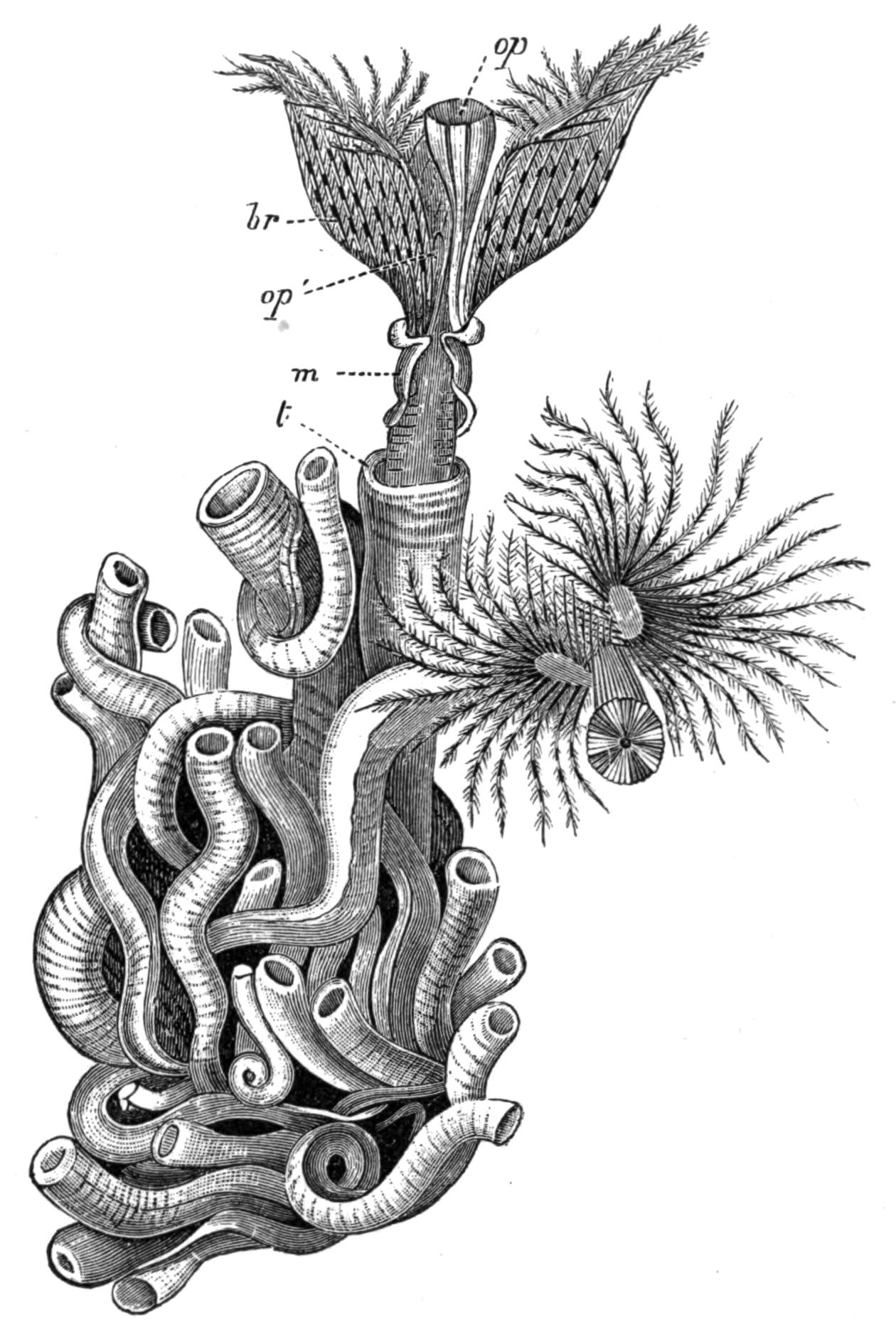
Fig. 183.—A group of tubes of Serpula vermicularis L., from the mouths of two of which the animals are protruding, that on the right being seen from above. br, The gill plume; m, thoracic membrane; op, operculum; op1, corresponding gill filament of the opposite side; t, tube. (From Cuvier's Règne Animal.) Nat. size.
Filigrana implexa Berkeley is a small worm, but the slender white tubes intertwine and adhere together in masses 3 or 4 inches high, occurring at low tide and down to 18 fathoms in the North Sea and Mediterranean. The animal has only eight gill filaments on each side, one of which on each side is slightly expanded to serve as an operculum. The worm multiplies by transverse division.
Spirorbis borealis Daudin is a still smaller worm, the tube of which is coiled in a flat spiral about 1⁄16 to ⅛ inch across; it is common, adhering to Fucus, shells, and other objects. It is represented by fossils in the Palaeozoic rocks. Cosmopolitan.
Protula (Psygmobranchus) tubularia Mont. is a Serpulid without an operculum; it forms a straight or slightly and irregularly curved tube. Atlantic and Mediterranean. Salmacina dysteri Huxley has no operculum; it is a small worm incrusting seaweeds, or forming masses like Filigrana.
Sub-Order 2. Hermelliformia.
The single family Hermellidae is represented by two species—Sabellaria alveolata L., which is littoral, and S. spinulosa Leuck., occurring in 10 to 30 fathoms.
S. alveolata[396] is about an inch long; the thorax is purple, the abdomen yellow to red. The narrow caudal region is bent sharply forwards, so that the anus, situated at its tip, comes to lie at the orifice of the tube, which is irregular and sandy. Great numbers of the animals live together, so that the masses of their tubes may be 2 or 3 feet thick and several feet long. They are well seen on the shore, at Paignton, near Torquay, and on Hilbre Island, off the Cheshire coast. North Sea, Atlantic, Mediterranean.
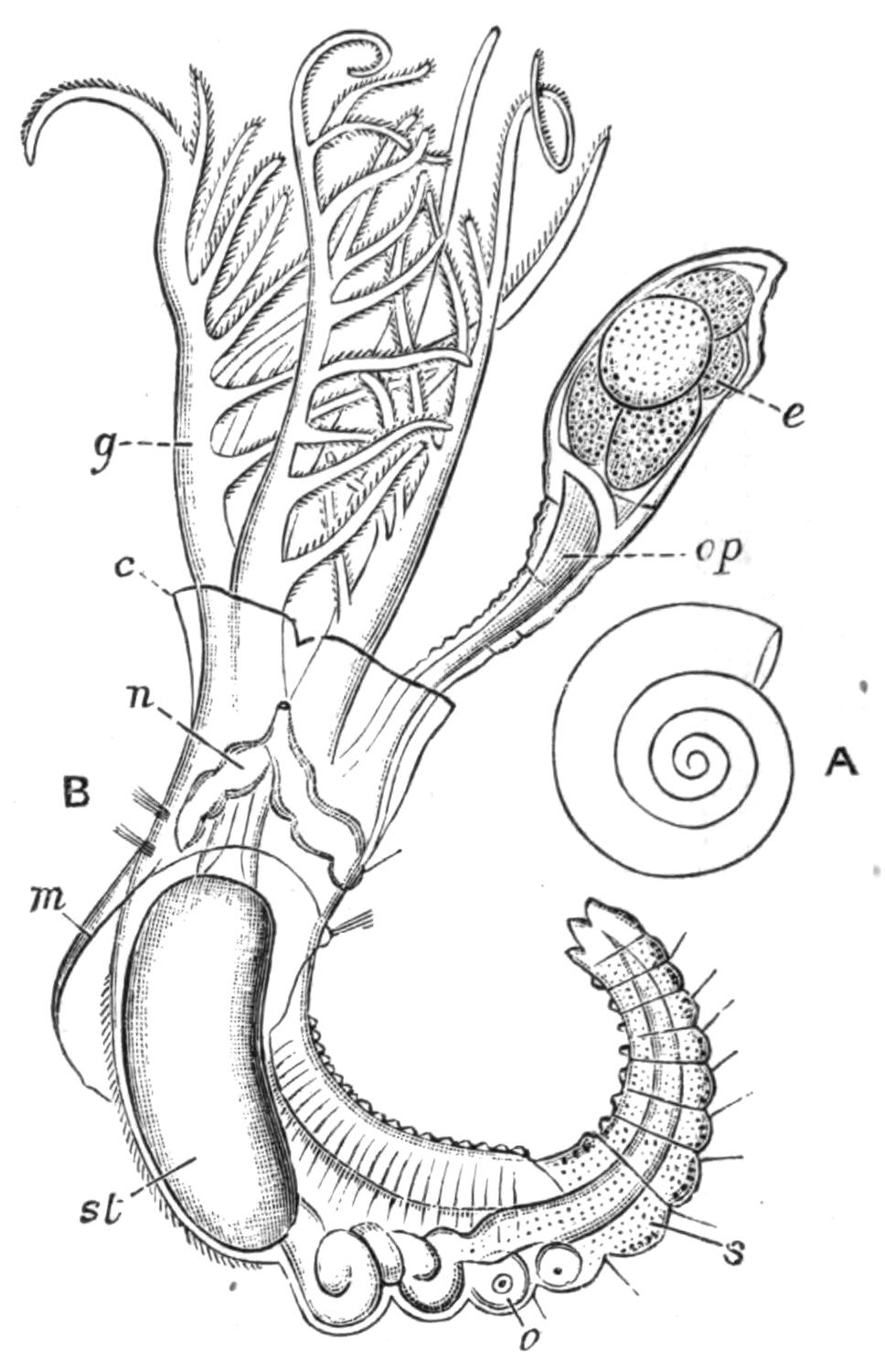
Fig. 184.—Spirorbis. A, the shell, enlarged. B, the animal, × 50. c, Peristomial collar; e, eggs in the brood pouch at the end of the operculum; g, gills; m, thoracic membrane (characteristic of Serpulidae); n, the single pair of thoracic nephridia opening by a median dorsal pore beneath the collar (common to all Sabelliformia); o, ova in the anterior abdominal segments; op, operculum; s, spermatozoa in the hinder abdominal segments; st, stomach. (From Claparède.)
Order III. Myzostomaria.[397]
These animals are parasitic on Crinoids or Asteroids.[398] The single family, Myzostomatidae, contains but two genera, Myzostoma F. S. Lkt. and Stelechopus v. Gr.
Some of them move, more or less actively, on the surface of their hosts, others live in a sessile condition between the joints of the arms or pinnules, causing a greater or less malformation thereof, sometimes leading to the formation of a more or less globular cyst like a plant-gall, due to overgrowths of the joint, as in M. deformator v. Gr. and M. cysticola v. Gr.: while M. pulvinar v. Gr. is endoparasitic in the intestine. Two species occur on our common Antedon (Comatula) rosacea; one, M. cirriferum Lkt., creeps about the oral surface, especially along the food grooves of the disc and arms; the other, M. glabrum Lkt., lives close to the mouth of the Crinoid, so that its pharynx can be inserted into the oesophagus of the host; this species rarely moves from this position, and carries a young one on its back.
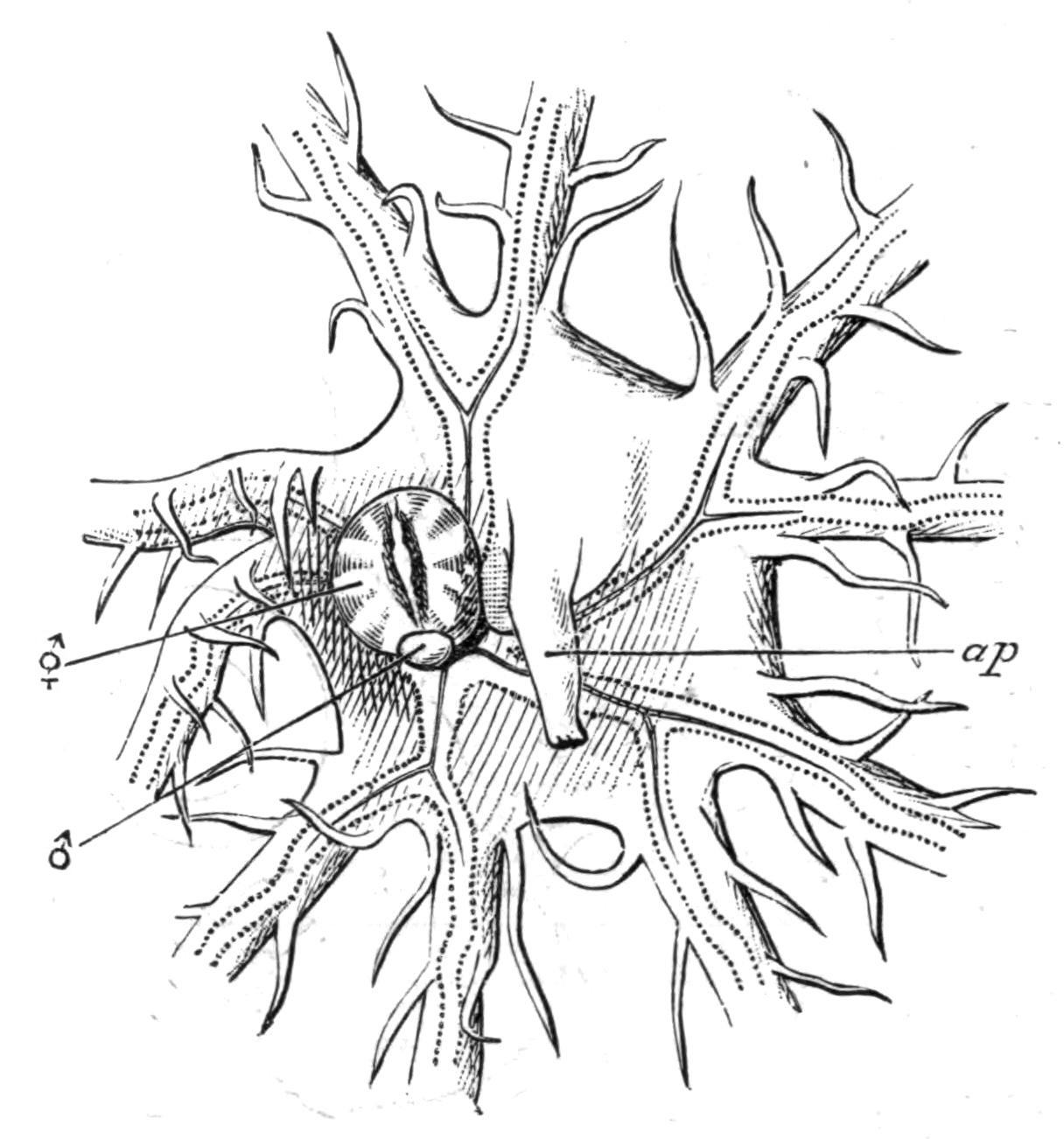
Fig. 185.—Myzostoma glabrum Lkt., on the disc of Antedon rosacea. The hermaphrodite individual (⚥) lies over the mouth of the Antedon, and carries on its back at the anterior end a young one (♂) with only male organs fully developed. ap, The anal papilla of Antedon. × 4.
The Myzostomaria are circular or oval, more or less markedly convex dorsally, flat ventrally; Stelechopus, however, which lives on Hyocrinus, is elongated. The margin of the body is provided with ten or more pairs of cirri, short (M. glabrum) or long (M. cirriferum), and the general appearance of the animal is greatly changed in some species by the great elongation of the hinder cirri, into which the viscera may extend (M. filicauda v. Gr.). On the ventral surface are five pairs of small conical "parapodia," arranged, like the internal organs, in a radiate manner. Each parapodium carries a couple of chaetae; one a hook, the other serving as a "guide" for this hook. The four "suckers" on each side are either glandular or sensory organs; and Wheeler considers them homologous with the lateral organs of Capitellids; they are usually little developed in those species which live inside cysts.
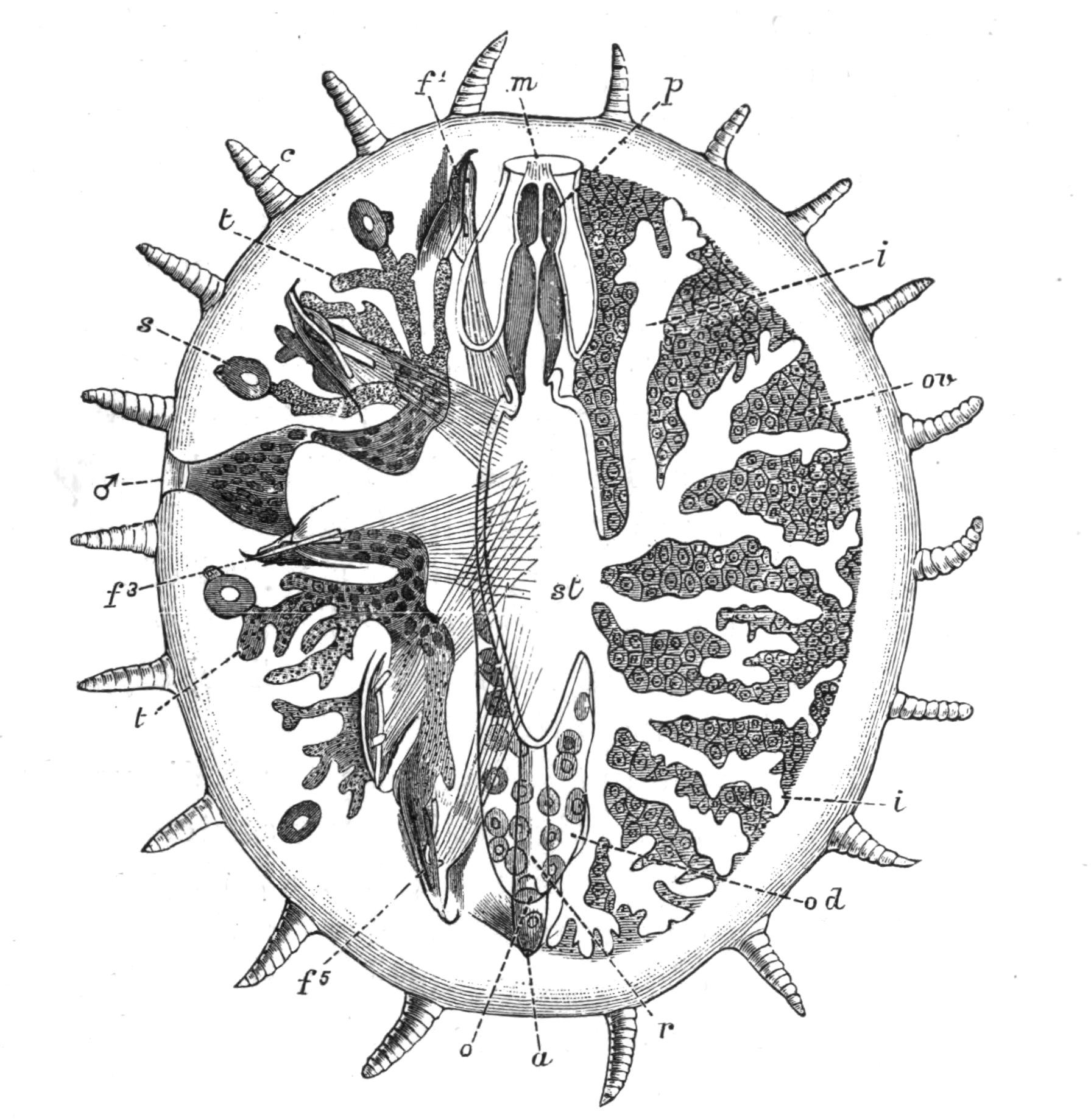
Fig. 186.—Myzostoma cirriferum. (After Lang and v. Graff.) The organs are supposed to be seen by transparency. On the right side the more dorsal organs are shown, and on the left, those lying more ventrally. a, Anus; c, ten pairs of marginal cirri; f1 to f5, the five parapodia of the left side, each with two chaetae; i, the branches of the intestine on the right side; m, mouth; o, the opening of the oviduct (od) into the rectum; ov, the uterus or coelom, filled with eggs, occupying the spaces between the lobes of the intestine; p, the pharynx (acrecbolic introvert) lying in the pharyngeal sac; r, rectum; s, the four "suckers" of the left side; these, like the parapodia, really lie on the ventral surface; st, stomach; t, the branching testis; ♂, the pore of the sperm-duct.
The mouth and anus are usually ventral; but in M. glabrum the anus is dorsal, and in a few species both apertures are carried on to the back by the great development of the ventral surface. The alimentary canal is provided with a protrusible pharynx; the intestine is branched; amongst its branches is the coelom, packed with eggs, and functioning as a uterus (usually called "ovary"). The true ovary is a small mass of cells on each side, a proliferation of the coelomic epithelium covering the intestinal wall. A median continuation of the uterus passes backwards above the rectum, and opens either into it or by an independent pore dorsal to the anus. The "lateral oviducts" of Nansen are nephridia with ciliated funnels opening into the coelom (uterus), and with pores leading into the cloaca on its ventral surface; or, in M. belli Wheeler, opening to the exterior. The two testes are branched, and each sperm-duct opens laterally on a papilla, just outside the third parapodium of each side. Wheeler[399] has recently shown that in the young Myzostoma the spermatozoa ripen before the ova, so that it is functionally a male; before the spermatozoa are all discharged the ova mature, and the animal is for a time hermaphrodite; later on, however, when all the spermatozoa are used up, the worm is a female. Beard's "dwarf males" are therefore merely the young of hermaphrodite forms. In cysticolous species each cyst usually contains a large female individual and a small male. In these cases the young one (male) discharges all its spermatozoa before the ova ripen, so that a period of immaturity intervenes and a true hermaphrodite condition is omitted; the animal is at first male, and later female. The Myzostomaria are thus "protandric hermaphrodites."
The affinity of these animals has been much discussed; they superficially resemble the Tardigrada in many anatomical features, and differ greatly from Chaetopoda, but as they possess the characteristic chaetae or parapodia, and pass through a larval stage[400] similar to that of the Polychaetes, there is no doubt that they are closely allied to the group, and indeed may be regarded as degenerate Chaetopods. It has been suggested that they form a passage group between them and the Tardigrada; and von Graff forms a group Stelechopoda, to include the Myzostomaria, the Tardigrada, and the Linguatulida.