Chapter XI
Reading edition
NATURAL HISTORY OF POLYCHAETES—GENERAL HABITS—CHARACTER OF TUBE AND ITS FORMATION—COLOURING—PROTECTIVE AND MIMETIC DEVICES—PHOSPHORESCENCE—FOOD—USES—ASSOCIATED WORMS—WORMS AS HOSTS—DISTRIBUTION—FOSSIL REMAINS.
All the many hundreds of species of Polychaetes are marine, with a very few exceptions, which have been in recent years recorded from fresh (i.e. drinkable) water, viz. a species of Nereis from a lake in Mingrelia, another Nereis and a Lumbriconereis from running water in Trinidad,[340] a Sabellid, Manayunkia speciosa,[341] from Philadelphia; and another Sabellid, Coabangia,[342] from fresh water at Tonquin, which lives in borings in shells of Melania; and it is by no means improbable that other fresh-water Polychaetes exist in Lake Tanganyika in Africa, where a Medusa has recently been discovered.
In brackish water of various densities many Polychaetes live; Arenicola especially is regardless of the character of the medium, and Nereis diversicolor appears to withstand considerable admixture of fresh water.
The majority of the Polychaetes occur "inshore," that is, between tide-marks and in shallow water down to 20 fathoms; but they occur at all depths more or less abundantly, and some have been dredged from depths of more than 3000 fathoms.
The nature of the soil composing the shore has a good deal to do with the number of worms to be found there; thus in calcareous districts they are fewer than in places where harder rocks, such as granite, form the shore line, for the chalk or limestone wears away more quickly, and exposes to destruction the worms which may have sheltered in its crevices: further, it does not give so permanent a place of attachment to seaweeds, on which many Polychaetes feed. The calcareous rocks, too, are more likely to be traversed by springs of fresh water, which is not to the taste of the worms. The sand resulting from the destruction of the rocks, whether hard or soft, is of itself unsuitable to the majority of worms, which are most abundant where mud containing decaying vegetable matter is mixed with the sand: this, which gives a firmer consistency to the soil, so that the burrows retain their form better, supplies food for the burrowers.
General Habits.—The division of the Polychaetes into the "Errantia" or free-swimming and wandering forms, and "Sedentaria" or tubicolous and sedentary forms, is a misleading mode of classification, for as a matter of fact only a comparatively few forms are really free-swimming throughout life; the majority, even if they do not form definite tubes, burrow galleries for themselves in the soil, and these burrows are in many cases only rarely left; this is true of both groups. Amongst the "errant" Polychaetes nearly all the Eunicidae secrete a parchment-like tube, and some Polynoids form mud tubes. Among the "sedentary worms" there are forms which merely burrow; while Myxicola readily leaves its gelatinous tube and swims freely; Pectinaria carries its house with it as it moves about, and Polycirrus, a Terebellid, does not form any tube at all.
Owing to their sedentary habits, quite a representative collection of genera may be made, especially at a spring tide, at any seaside place which is provided with a sandy shore, and with rocks and seaweed. The larger species, however, require to be dredged, and the best time is at night, for then many forms which during the day are concealed in their burrows, will be issuing forth to obtain food.
It may be useful to give instances of worms occurring in various situations between tide-marks. Throughout pretty well the whole of the area left uncovered by the tide, even up to nearly high-water mark in many parts of the coast, the cylindrical "castings" of sand and mud, forming little heaps, indicate the burrows of Arenicola, the common "lug-worm"; these "castings" have passed through the worm's body, having been swallowed during the process of burrowing as well as for the purpose of obtaining food, as in the case of the earthworms. Rather nearer the water may be seen little tufts of sand-threads, about an inch high, springing from a short piece of cylindrical, sandy tube rising up out of the sand; this is the head end of the tube of Terebella conchilega (Fig. 153).
Amongst the rocks may be found loose stones of different sizes; on lifting them up, various kinds of worms may be brought to light, according to the locality, the time of year, the position with respect to the sea, and so on. Polynoë is pretty sure to be present somewhere near low-tide mark; the number of species is considerable, and their colouring very varied: but as the worms have a habit of remaining still on the under surface of the uplifted stone, the observer may easily overlook them.
Other worms occur below the stones, more or less buried in the sand or mud; for instance, a small Nereis may be lying in its temporary burrow immediately underneath, and will at once withdraw from the now injured part of the burrow; while deeper in the mud or sand, especially in rather highly-smelling mud, little red worms are abundant, such as Scoloplos, Nerine, Capitella, and others. By digging near low water one may find Nephthys, Glycera, and others burrowing or hiding in the soil.
In rock pools, or sandy stretches amongst rocks kept moist and cool by abundant Fucus, one may see under stones the red or yellow gill filaments of Cirratulus and of Terebellids protruding from their burrows and tubes, while other worms are to be met with in clefts of the rocks, and amongst the roots of Laminaria.
Still farther out, below low-water mark, where one must wade, can be seen the beautiful branchial crowns of various Sabellids protruding from their tubes; but care is necessary on approaching these worms, as eyes are, in many cases, present on the branchiae and a shadow is readily perceived; then the brightly-coloured tuft disappears, and only a piece of sandy or muddy cylindrical tubing remains to tell where the Sabella has withdrawn. In order to obtain the worms one must dig quickly and deeply before they have been disturbed; for the tube is of considerable length, and the inhabitant withdraws to the bottom of it. Some of these soft-skinned worms have the power of boring into hard rocks,[343] though by what means they do so is uncertain.[344] Polydora ciliata makes a tube of mud projecting from the mouth of U-shaped galleries in chalk, limestone, shells, and even shale; it has no hard jaws or other structures sufficient to account for the holes, but it is possible that the specially strong chaetae on the sixth segment may be of some use in this work. Other lithodomous worms are Sabella saxicava and Dodecaceria concharum, which is a common little borer, forming galleries in oyster-shells, etc.
The tubes formed by these Polychaetes are very varied in constitution.[345] In some cases a mucus, which hardens to form a firm protective envelope, is secreted from special parts (e.g. the ventral gland shields of Terebellids and Sabelliformia), or from the greater part of the general surface of the body; in other cases the secretion serves to stick together particles of mud or sand, or shelly fragments, so as to form a more or less cylindrical tube (rarely branched), which is lined internally by the hardened "mucus," having the appearance of silk.
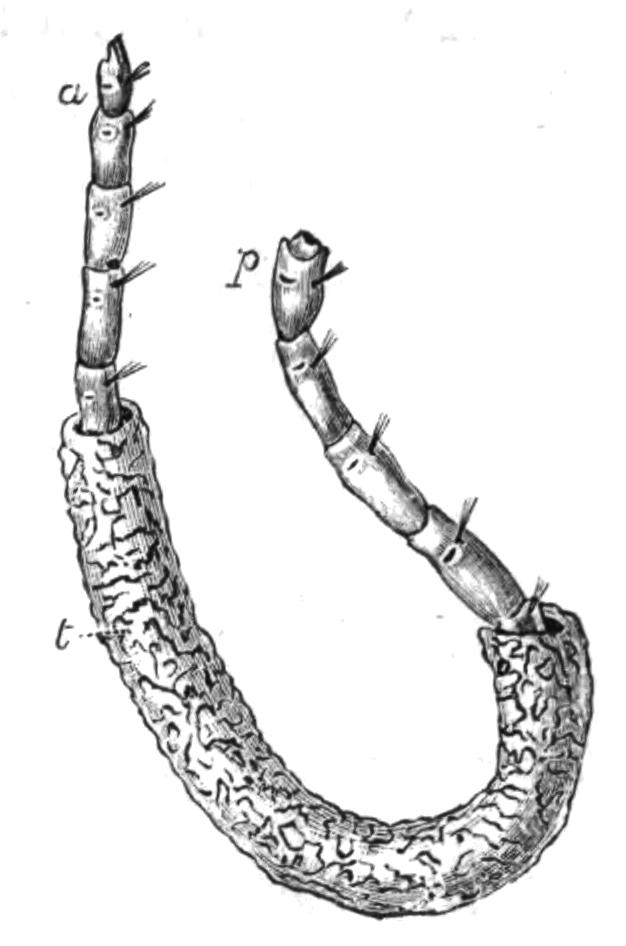
Fig. 151.—Clymene ebiensis in its tube (t) (from Règne Animal). a, Anterior, p, posterior end, which is, however, injured.
But the process of tube-making is not a simple one, for in many cases, at least, the worms exhibit definite powers of choice. Thus some species of Sabella choose only the very finest particles of mud; Terebella conchilega chooses fragments of shell and grains of sand; Onuphis conchylega employs small stones more or less of a size; Sabellaria makes use only of sand grains. Whilst some worms, like Terebella, Nicomache, and others, make a very irregular tube, Pectinaria builds a most remarkably neat house, open at each end, which it carries about with it, the narrow end uppermost (Fig. 152); the grains of sand are nearly all of the same size and only one layer in thickness, embedded in abundant "mucus," and with the outer surface quite smooth.
Sir J. Dalyell[346] made some most interesting observations on the method followed by sundry tube-formers in the building of their tenements, and these observations, though made nearly half a century ago, have required very little addition or correction in modern times. In speaking of Sabella, he writes as follows:—

Fig. 152.—The tube of Pectinaria auricoma. × 3. (From M‘Intosh.) This is its natural position as carried about by the animal.
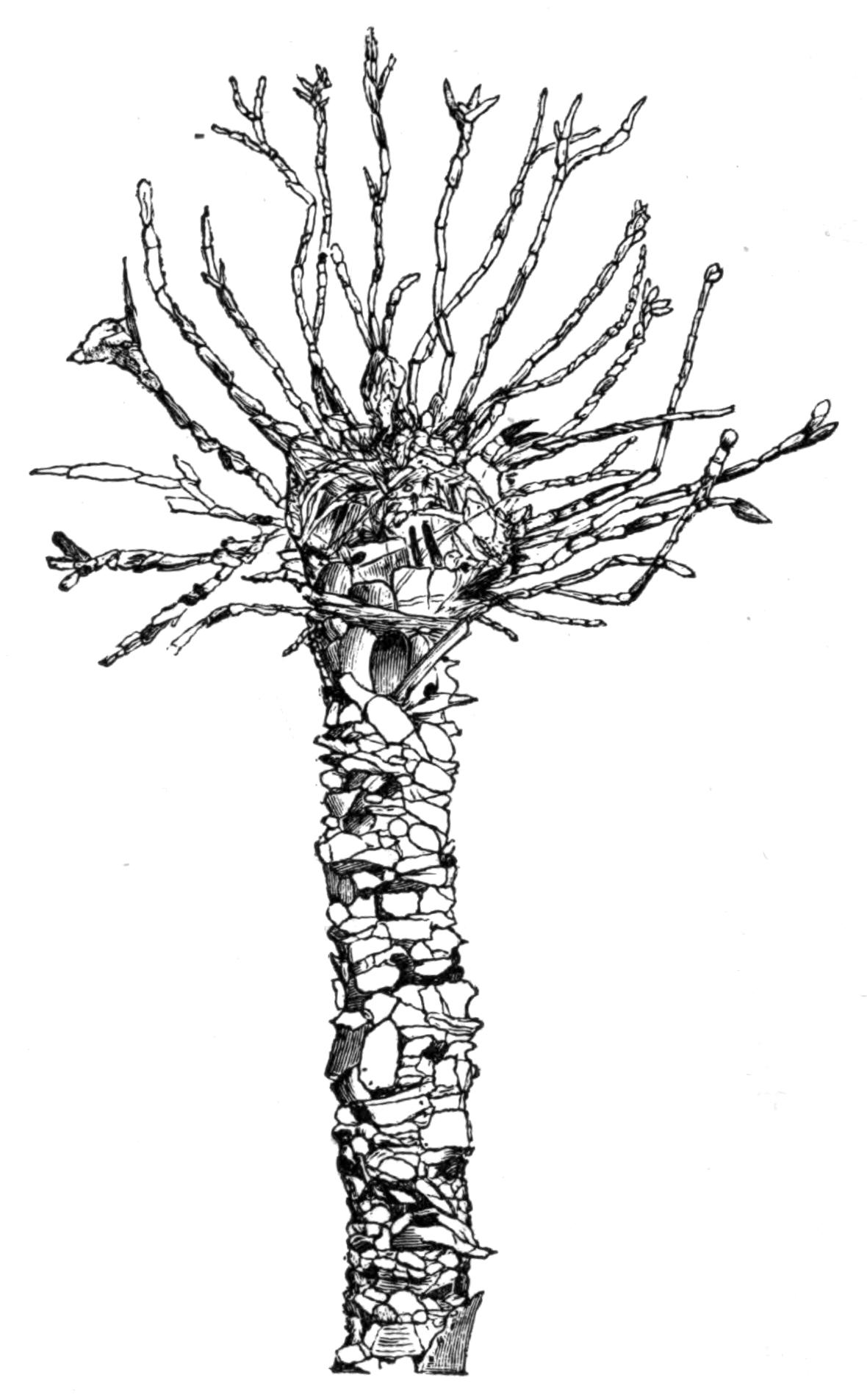
Fig. 153.—The upper end of the tube of Terebella conchilega. Slightly enlarged. (From M‘Intosh.)
"Let a tall and ample crystal jar containing a Sabella be emptied of its contents and speedily replenished with sea-water; the animal, if in view, has retreated during the short interval; the orifice of the tube is closed, all is at rest. But soon after replenishment it rises, to display its branchial plume still more vigorously than before, and remains stationary, as if enjoying the freshness of the renovated element, always so grateful—the harbinger of health and strength to those whose dwelling is there. The passing spectator would conclude that he now beholds only a beautiful flower, completely expanded, inclining towards the light like some of those ornaments of nature decorating our gardens. He pauses in admiration. But if a drop of liquid mud falls amidst the element from above, disturbing its purity, then, while the plume unfolds to its utmost capacity, does the animal commence a slow revolution, the body also passing around within the tube. Now are the thousands of cilia fringing the ribs [i.e. the secondary filaments] of the branchiae discovered to be in vigorous activity, and their office to be wondrous. A loose muddy mass is soon afterwards visibly accumulating in the bottom of the funnel; meantime the neck or first segment of the body, rising unusually high above the orifice of the tube, exhibits two trowels beating down the thin edge as they fold and clasp over the margin, like our fingers pressing a flattened cake against the palm of the hand. [This refers to the lappets of the peristomial collar.] During these operations muddy collections are seen descending between the roots of the fans [right and left gills] towards the trowels, while another organ, perhaps the mouth, is also occupied, it may be, in compounding the preparation with adhesive matter. Still does the partial or complete revolution of the plume above, and of the body within the tube, continue; the bulk of the muddy mass diminishes, activity abates; it is succeeded by repose, when the tube is found to have received evident prolongation."
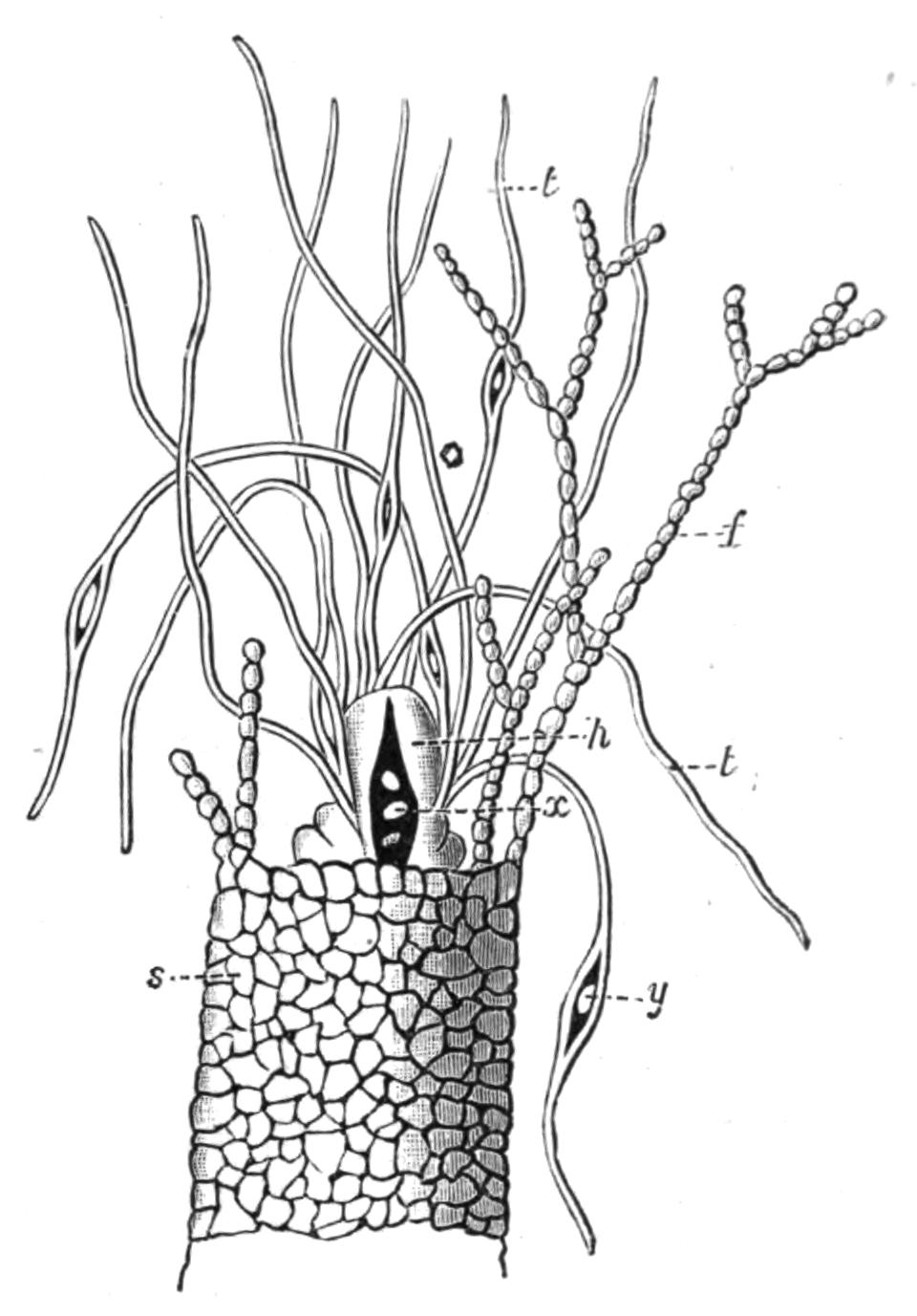
Fig. 154.—Terebella conchilega Pall. Upper end of the tube (s) showing the anterior end of the worm. h, Its head; t, tentacles collecting sand grains (y) in their grooves; x, sand grains in mouth of worm; f, filamentous fringe of tube. (After Watson.)
The Terebellids use their numerous tentacles in searching for particles of sand, etc.; each tentacle is grooved along its ventral surface, and the particle is conveyed along the furrow to the mouth. These particles are actually taken into the mouth, and mixed with some sort of secretion; on ejection again, each particle is placed by another tentacle in its position at the edge of the tube, and by means of its lower lip the Terebellid works it into place.[347]
But whereas the greater number of tubicolous worms make use of adventitious material wherewith to strengthen the wall of their tube, the Serpulidae secrete carbonate of lime from their tube-glands, and mould a tube of this substance. Amongst the Eunicidae the secreted substance is of itself strong enough to protect the animal; for in Hyalinoecia and species of Eunice the tube consists of a translucent, tough, parchment-like material.
Chemical analysis has been employed in a few cases to determine the substance composing the tube. In the case of Hyalinoecia (sometimes erroneously called Onuphis) the material consists of a phosphoric salt containing magnesia and a characteristic organic substance "onuphin"[348]; in Spirographis, a Sabellid, the name "spirographin" is given to its special secretion, whilst in Serpulids the organic base of the calcareous tube is "conchiolin."
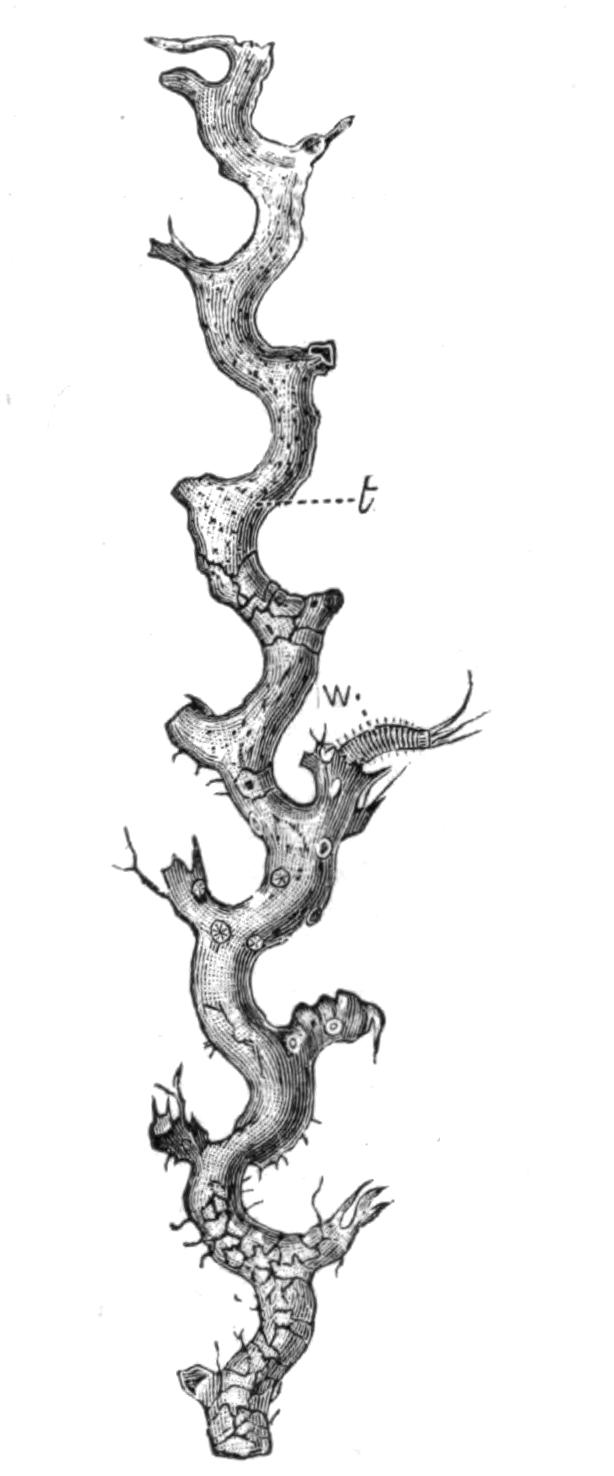
Fig. 155.—Eunice tibiana Pourt. × ½. The branching tube (t) with the worm (w) protruding its head through one of several openings. (From Ehlers.)
The majority of worms are solitary, but there are a few instances of social worms—not that there is any co-operation or distribution of labour amongst the individuals, but they merely occur together in quantities; thus the sandy tubes of Sabellaria may form compact masses of several cubic feet, which, left uncovered by the receding tide, look like rocks upon the shore; as, for instance, at Paignton and Torquay. Filigrana implexa and Serpula uncinata similarly intertwine their calcareous tubes to form masses.
Whereas most worms live at the bottom of the sea, at various depths, a few are to be found at the surface. Purely pelagic habits are confined to a few families, viz. Tomopteridae, Typhloscolecidae, and the Alciopids and others amongst the Phyllodocidae; though Nectochaeta, one of the Polynoidae, and Ophryotrocha, one of the Eunicidae, are modified for this mode of life.[349] Several genera become pelagic during the breeding season. All these forms are excellent swimmers, and many of them are transparent.
The Colouring of Polychaetes.—The majority of Polychaetes quickly lose their colour in spirits, and become uniformly dull or light brown in museums. There are a few, however, which retain their brilliancy, like Aphrodite and Chloeia, but in both cases the coloration is due to the beautiful hair-like bristles ranged along each side of the animal; in the former the colours of the rainbow flash from specimens which have been kept in spirit for any length of time. The Polynoids, too, with their golden chaetae and pigmented scales, retain to some extent their characteristic colouring. But the colours of most Annelids are due to pigments in the skin, together with the haemoglobin of the blood, which are soluble, or otherwise changed, in alcohol; for instance, the bright greenish-blue tint of the common Phyllodoce of our coasts is changed to a rich chocolate brown; but such cases are rare, most worms becoming more or less decolorised.
The varied colouring in the Polychaetes, as in other animals, is due to a variety of causes. The red is in many cases due to haemoglobin of the vascular system showing through the transparent body; the green of the tentacles of the Sabellids and Chlorhaemids is similarly due to chlorocruorin. In other cases the contents of the intestine or the tint of the coelomic fluid may affect the colour of the worm. In Capitella the coloured excretory products are regained in the skin; in an Eunicid living in a yellow sponge, on which it feeds, the colouring matter is extracted and stored in the skin; in the same kind of way green caterpillars may owe their tint to feeding on green leaves. But many of the Polychaetes possess distinct pigments in the skin; thus in Arenicola the dark pigment melanin has been recognised; in Cirratulus and Nereis certain lipochromes; whilst Eulalia viridis contains a pigment allied to bonellein. These various pigments yield different absorption bands when a solution is examined with the spectroscope; others, however, give no bands, but are distinguished by different chemical reactions.[350] The colour of the intestine of Chaetopterus has been stated to be due to "modified chlorophyll," but it is quite a different substance.
When seen in the living and healthy condition, however, these Polychaete worms vie with the very butterflies in their brilliant and beautiful colourings, and though our own worms are not lacking in beauty, many tropical and southern forms exceed them in gayness of tint. Bright reds, orange, yellows, greens, blues, rich violets, and sombre browns are all displayed.[351]
The handsome Terebella nebulosa of our own coasts is coloured bright red, sprinkled with white spots. Nicomache lumbricalis is pink, with red girdles. Eunicids are frequently red or brown, and the red gills along each side, together with a brilliant iridescence, render these worms very beautiful. Nereids present a great range of coloration, from light green to sundry tints of brown and red in various combinations. Amongst the Serpulids our common S. vermicularis is a very showy little worm, with its orange body, its red gills splashed with orange, and its orange operculum streaked with red; and a Southern form, Placostegus coeruleus, occurring at the Cape of Good Hope, is provided with beautiful lavender-blue gills. Our own Sabellids present examples of beautiful markings on the gills, in different colours or in different shades of the same colour. Amongst Polynoids, P. leucohyba, from the Antilles, has blue elytra; Hemilepidia erythrotaenia, a long worm from the Cape of Good Hope, has the anterior end of its body covered with light blue elytra, whilst the uncovered part is orange, with a broad magenta-red band along the dorsal surface.
The Phyllodocids are mostly very brightly coloured. The common P. lamelligera of our coast has a bluish-green body, with olive-green parapodia; but Lopadorhynchus erythrophyllum, from Jamaica, has a blue body with red parapodia; whilst Notophyllum myriacyclum has a brown body with longitudinal dark-brown stripes and yellow parapodia. Both these worms live in coral reefs, where brilliancy of colour is one of the characteristic features of the fauna. Other worms are of various shades of green: the dark green Arenicola with red gills; the bright green Eulalia viridis; the deep green Amphinome smaragdina, from Jamaica; Gnathosyllis diplodonta, with its green and yellow body, serve as examples.
Patterns or "markings" may be exemplified by Lepidasthenia elegans (Fig. 156), and Myrianida fasciata, which has a bright red band on each segment (Fig. 149, p. 280). From this brief list of examples it will be seen that beautiful, and even brilliant, coloration is not confined to any particular mode of life; many of the most typically tubicolous forms, like the Terebellids and Serpulids, are as brilliantly coloured as the most typically free-swimming genera, like the Phyllodocids. Carnivorous forms like Amphinomids and Syllids present as wide a range of tint as the limivorous forms like Cirratulus, Sabella, or Maldanids. Shore-lovers, and deep-sea dwellers, and surface-swimmers, all exhibit equally bright or equally sombre tints; it is therefore difficult and rash to dogmatise on the "use" of these colourings to these animals, or to point to this worm as being protectively, to the other as being warningly, coloured; for we are too ignorant as to the habits of the worms.

Fig. 156.—Lepidasthenia elegans Gr., × 2, to illustrate colour-markings: the dark bands in the anterior part of the body occupy two elytriferous, and the intermediate segments. In the hinder region, where the elytra are in every third segment, this one is dark. el.12, The twelfth elytron.
Protective and Mimetic Devices.—From the point of view of "protection" in the evolutionist's sense of the word, we can say but little. Protective resemblance there is undoubtedly amongst the Polynoids, for the scales of these forms resemble more or less closely the stones or sand amongst which they live; in the same species there is great variety in coloration. This protective habit is carried still further in the case of Psammolyce by the attachment of sand grains to little cups on the elytra, so that the back of the animal is concealed. Certain commensals, such as Polynoë arenicolae, P. pentactes, are coloured so as to resemble their associates. In a few cases it is possible that the gills of Sabelliformia are protectively coloured; for in Sabella pavonia they vary from a light yellowish tint to a deep violet-brown, and the dark markings on them are therefore more or less distinct. Spread out as the gills are in life, they are in many cases difficult to recognise; it is rather their movement as they are withdrawn that attracts one's attention to them, as the tubes of these worms frequently serve for the attachment of brownish seaweeds, to which the gills bear resemblance. But, as a matter of fact, little work has been done in this direction, and speculation on the matter without evidence is worthless. Many pelagic forms, being transparent, such as Tomopteris and Alciopids, are no doubt protected by their lack of colour; yet these forms present brightly-coloured spots,—the light-producing organs in the parapodia of the former, and the large dark eyes of the latter.
Semper[352] mentions a case of possible mimicry in a species of Myxicola which lives in the clefts of a coral, Cladocora. The branchial funnel, when expanded, resembles very closely the expanded coral in size, colour, etc.; but he points out that the species occurs in other situations, where its colouring is not protective. Probably the "mimicry" is in other instances merely accidental.
No doubt many Polychaetes may be "warningly coloured," but experimental evidence is incomplete. Polycirrus aurantiacus is bright red, with orange tentacles; these worms were rejected by certain fish.[353] The animal has given up living in tubes as all its allies do, and it is the tentacles which appear to be distasteful to its enemies, for when irritated it coils itself up and wraps itself round with its tentacles. Moreover, when the tentacles were cut off the fish did not reject the body of the worm. The tentacles are thus coloured in such a way that fish recognise them, and associate with the colour some distasteful property.
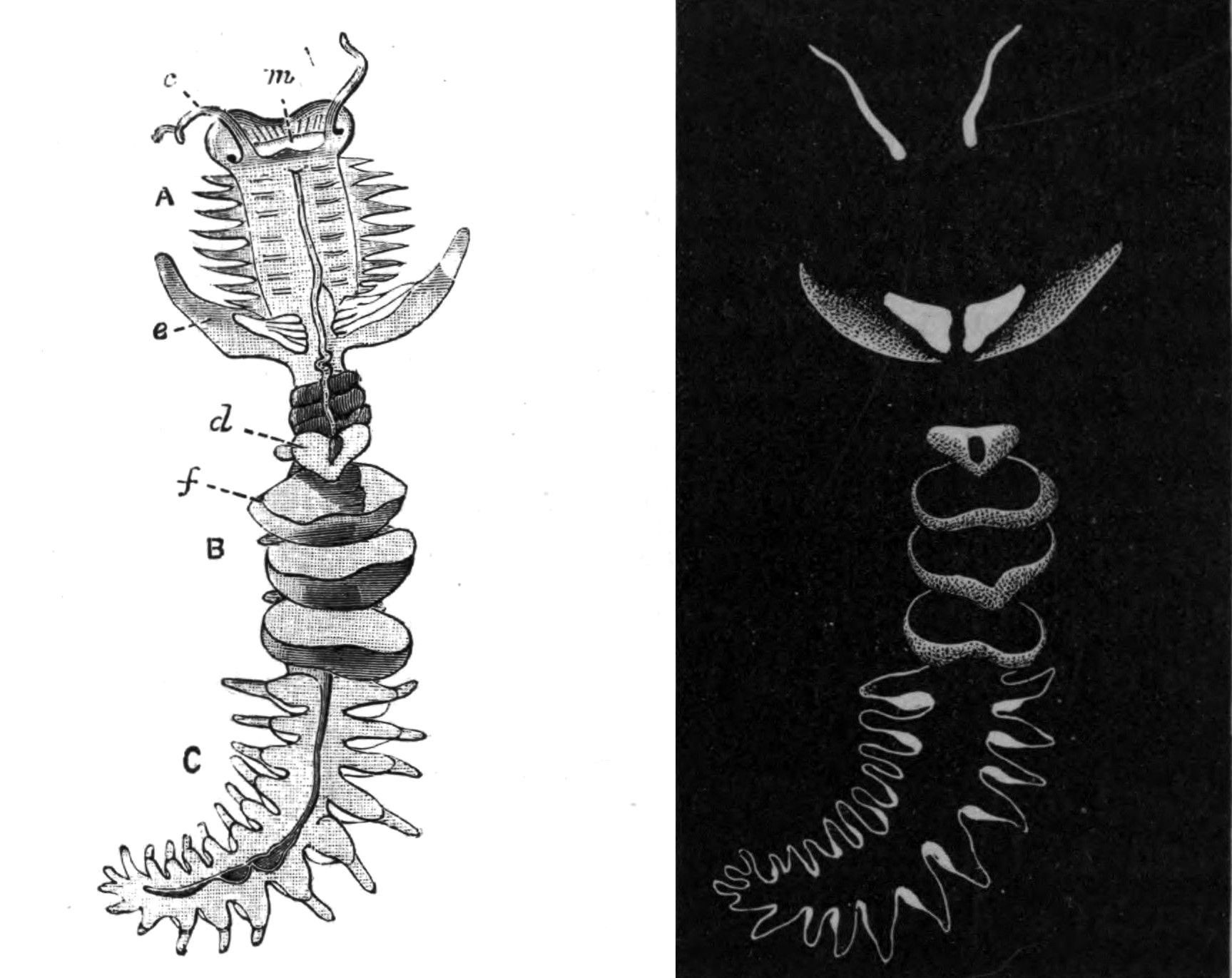
Fig. 157.—Chaetopterus variopedatus Ren. × ½. On the left the entire animal, with the three regions A, B, C. c, Peristomial cirrus; d, "sucker"; e, the great "wings"; f, "fan"; m, mouth. On the right the animal is represented in the dark, under stimulation, so as to exhibit the phosphorescent portions of the body. (From Panceri.)
Phosphorescence.—Many worms of very different habits have the power of emitting a light from some parts of the body, and they are then said to be "phosphorescent."[354] Probably Chaetopterus is most eminently photogenic; the base of the great "wings," the "fans," and other parts emit, on stimulation, an azure blue to greenish light, so bright that one may read one's watch by it. Several species of Polynoë exhibit a similar phenomenon, each elytron, with the exception of the area of attachment, being brilliantly illuminated. In these species the phosphorescent elytra are frequently thrown off by the animal, so that possibly they deceive enemies. Polycirrus aurantiacus produces a beautiful violet phosphorescence; usually its many tentacles alone show the light, but under strong stimulation the entire body takes part in the display, and no doubt the phosphorescence has, like the colour, a "warning" purpose.
The production of the light in these various forms is apparently due to two different processes. In some cases, e.g. Chaetopterus, Syllids, Terebellids, it appears to be due to the oxidation of certain cell contents which are discharged more or less freely on irritation of the nerves; whilst in Polynoids the phenomenon is due to some purely nervous process, for the elytra have no glands, but are provided with ganglia and a nervous network.
In other worms, however, there are definite light-producing organs. In Tomopteris there is on each parapodium, above and below, a brightly-coloured spherical organ, which for a long time was regarded as an eye, but from its structure appears to be a "photogen" (Fig. 167, p. 315). The same is very likely the true explanation of the segmental "eyes" of Polyophthalmus, for their structure recalls that of the light-organs of deep-sea fishes.
As many of the phosphorescent Polynoids are commensals, while Chaetopterus inhabits tubes, and close allies of other phosphorescent worms have no power of emitting light, it is impossible to apply the same explanation of its purpose to all cases alike; in some it may be "accidental," though in others it may be of definite use in warning enemies or in attracting prey.
The Food of Worms.—The Nereidiformia are mostly carnivorous, and feed on small Crustacea, Mollusca, sponges, and other animals; and Polynoids are even said to eat one another. Many worms do not disdain various seaweeds, whilst the Spioniformia and Scoleciformia, which burrow in mud and sand, and are without biting organs, swallow the mud and digest what animal or vegetable débris it may contain. The Terebellids and Cryptocephala depend on minute organisms which may be driven into the mouth by the action of the cilia of the gills or tentacles.
In the case of deep-sea forms, it is an interesting fact that the intestines are not unfrequently crammed with Radiolaria and Foraminifera in a fairly fresh, uninjured condition, indicating that these Rhizopods do not merely sink to the bottom, but must actually live there.[355]
The economic purposes to which Polychaetes are put are few; they are used either as bait for fishes or as food for man.
One of the commonest baits used for certain fish, as all who have done any sea-fishing off the piers of our coasts know, is the common lug-worm (Arenicola marina), whilst Nephthys caeca and Nereis fucata are also used in some places; and for whiting Nereis cultrifera and N. diversicolor. Marphysa sanguinea, known to the fishermen in some parts as "varme," is less frequently used.
A peculiar worm—Palolo viridis—is used as food by the natives of Samoa and Fiji. The worm is similar to our Eunicid Lysidice ninetta, and lives in fissures among corals on the reefs, at a depth of about two fathoms. At certain days in October and November they leave the reefs and swim to the shores of the above islands, probably to spawn; and this occurs on two days in each of the above months—the day on which the moon is in her last quarter, and the day before. The natives, who call the worm "Mbalolo," give the name "Mbalolo lailai" (little) to October, and "Mbalolo levu" (large) to November, thereby indicating the relative abundance of the worms in these two months. The natives eat them either alive or baked, tied up in leaves; and they are esteemed so great a delicacy that presents of them are sent by the chiefs who live on shore to those living inland. A dark green-blue Phyllodocid, which is called "A'oon," occurs in abundance off Mota Island, amongst the New Hebrides, has similar habits, and is also eaten.[356]
Associated Worms.—A considerable number of worms live in association with other animals, either as commensals or as parasites, and it is not in every case possible to decide in what relation the two animals stand. Labrorostratus parasiticus, a Eunicid, is parasitic in the body-cavity of Odontosyllis ctenostomatus (Fig. 158); such an association between two members of the same group of animals is peculiar; but still more exceptional is the occurrence of Haematocleptes terebellides, as a parasite in Marphysa sanguinea, for both parasite and host are members of the same family, the Eunicidae. Another Eunicid, Oligognathus bonelliae, occurs in the body-cavity of the Gephyrean Bonellia.
The Polynoid Acholoe astericola and the Hesionid Ophiodromus flexuosus occur as ectoparasites (or perhaps commensals) in the ambulacral grooves of the starfish Astropecten aurantiacus. An Amphinomid is stated to live in the branchial chamber of the barnacle, Lepas anatifera. Alciopina parasitica lives, during the early stages of its life-history, within Cydippe, and it is possible that most of the Alciopids thus make use of Ctenophores as their nurseries.
A considerable number of the Polynoids are ectoparasitic: P. castanea lodges in the peri-oral region of Spatangus purpureus, and in the ambulacral grooves of Astropecten; P. (Halosydna) bairdi lives between the mantle and foot of the mollusc Fissurella cratitia; P. pentactes is found on the body of the Holothurian Cucumaria pentactes, and appears to be protectively coloured. P. (Antinoë) parasitica lives under the elytra of another Polynoid, and P. acanellae on the coral Acanella normani.[357]
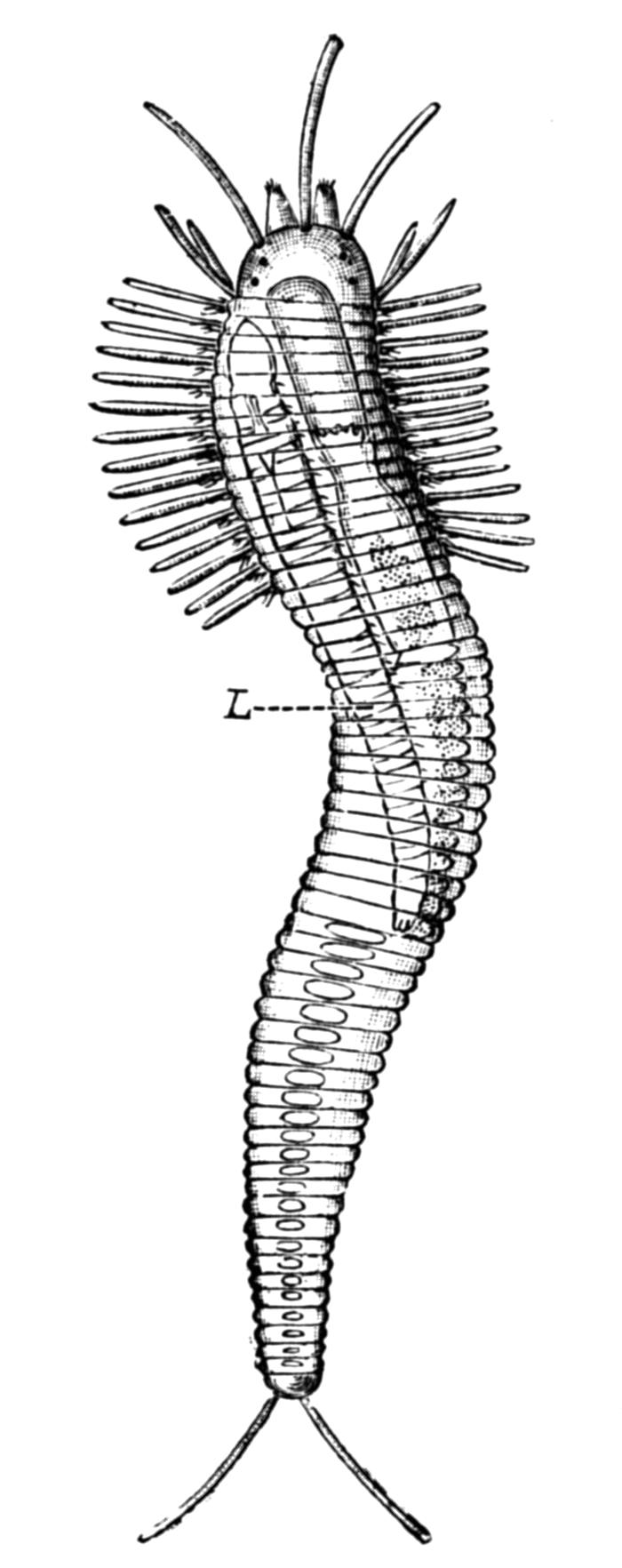
Fig. 158.—Odontosyllis ctenostomatus, with (L) Labrorostratus parasiticus in its body-cavity. The parapodia and cirri are omitted from the greater part of the body. (After St. Joseph.) × 4.
As commensals there may be mentioned Nereis fucata, which lives in the upper coil of whelk-shells which are inhabited by a hermit crab. The same shell usually bears a particular sea-anemone, so that there are three animals living together in or upon the cast-off house of a fourth. Siphonostoma is found in the "nests" made by the mollusc Lima. A Eunice is constantly associated with the coral Lophohelia prolifera, amongst the branches of which the worm twines its tube; whilst another Polychaete inhabits a tube formed by the interweaving of the fine branches of the coral Antipathes filix,[358] found in the West Indian seas. A species of Polydora forms its tube in Heliopora. The Polynoids present many instances of commensalism, a few of which may be here mentioned. P. johnstoni Marenz. is only found in the tubes of Terebella nebulosa; other species occur in the tubes of other Terebellids. P. marphysae lives in tubes of the Eunicid Marphysa sanguinea. Two species live in the tubes of Chaetopterus. P. extenuata has been found in tubes of Serpula vermicularis, while P. arenicolae occurs on the body of the common lug-worm, with the colouring of which it closely harmonises.
Worms as Hosts.—The Polychaeta serve not only as food for fishes, Crustacea, and other predatory animals of larger size, but are also liable to be the hosts of parasites[359] such as Gregarines, and even, as we have seen, of other members of their own group. Sundry ectoparasitic Copepoda have been found attached to worms between the parapodia or to the sides of the feet, and an unnamed Copepod occurs attached, sometimes in considerable numbers, to the sides of Nereis cultrifera. The Polychaeta also act as protectors to other animals, for on the under surface of elytra of sundry Polynoids may very frequently be found specimens of Loxosoma, which may also be attached to gills of Eunicids; whilst below those of Aphrodite echidna and Hermadion pellucidum, Pedicellina belgica occurs. Under the felt of A. aculeata the Sabellid Branchiomma vigilans forms its tube, and Vorticellids may be found on chaetae, gills, or other parts of the body of sundry worms.
Distribution.—Very little can be said in a brief way of the geographical distribution of these worms, for many of the genera are cosmopolitan, although only a few species occur in all the great oceans, e.g. Polynoë imbricata, Hyalinoecia tubicola, Nerine (Scolecolepis) cirrata, and Terebellides stroemi.
As for species, it can be said generally that the different oceanic areas and even different coasts present different species, but we know practically nothing of variation amongst Polychaeta, and many so called species may be mere local varieties, for frequently the descriptions of "new species" are scarcely intelligible. At any rate we know that certain species occur at widely separated localities, for two or three species of Polynoids occur in Japan, and again at Dinard on the French coast. A considerable number of species are common to both sides of the North Atlantic ocean, having been obtained off Norway and in the Gulf of the St. Lawrence. A few of these which are common on our coasts may be enumerated:—Nereis pelagica, Nicomache lumbricalis, Glycera capitata, Thelepus cincinnatus, Scoloplos armiger, Sabella pavonia, Ophelia limacina, Aphrodite aculeata, Trophonia plumosa, Polynoë squamata, Capitella capitata, Sthenelais limicola.
As for bathymetrical distribution,[360] many genera occur at all depths, though Polychaetes appear to be most abundant, as far as we know at present, in "shallow water"—that is, down to twenty fathoms or so; but this may be due to the greater facility of collection on shore and in these slight depths, for the "Challenger" obtained considerable numbers of new species at greater depths.
The "deep-sea" forms are chiefly tubicolous, and since these tubes are fixed and partially embedded in the bottom, probably comparatively few are brought up. Some genera occur at very great depths; thus the Terebellid Leaena abyssorum and the Serpulid Placostegus benthalianus were brought up from 3125 fathoms—the greatest depth from which Polychaetes were obtained by H.M.S. "Challenger"; and it is interesting to note that species of each of these two genera occur in shallow water, the Serpulid being represented in our own coast fauna by P. tricuspidata.
Amongst our own fauna, a few examples may be given of the "replacement of species."[361] The littoral Sthenelais boa is represented by S. limicola in deeper water; Sabellaria alveolata by S. spinulosa; Polynoë imbricata by several deep-water species. Similarly with genera: the littoral Pomatoceros is replaced by Serpula in deeper water; and the Hesionid Psamathe by Castalia.
The limitation of species to certain regions, or to certain depths of an ocean, may appear at first sight peculiar, in view of the unrestricted communication between all its parts; but there are as efficient "barriers" there as on land, for generally a particular worm can live only in a certain temperature and at a certain pressure, and is dependent for its food on particular organisms, which in their turn depend on the depth and its accompaniments. It is, in fact, so much the more peculiar that certain species are more or less cosmopolitan, or occur at widely distant points. It is less peculiar, of course, to find different species of the same genus at different depths or in different areas, for any slight variation in a species advantageous to new conditions would readily be fixed, and give rise to a new species.
The distribution of the Polychaeta depends probably on the pelagic larvae, which are carried by currents from one part of an ocean to another. There can be little doubt that many Polychaetes are very "plastic," and can adapt themselves to changed conditions of life with considerable ease; for Nereis diversicolor, Arenicola marina, and others live equally well in water of very different densities, and with a different food supply. The great variety in the "habitats," and presumably therefore in their food supply, etc., exhibited by many Polychaetes, as well as the great variation observable in some species of Polynoina, and the close affinity of the species and genera of this sub-family, lead us to the same conclusion.
Extinct Polychaetes.—The most numerous fossil records of the Polychaetes are calcareous tubes of various shapes and sizes; they are irregularly or spirally curved, and are very usually attached at one end, or by one surface, to stones or to fossils. These tubes belong to the Serpulidae, and are referred to the genera Serpula, Spirorbis, Ditrupa, and others.[362]
Spirorbis is the oldest unequivocal representative of the Polychaetes, as its tubes are found more or less abundantly in the Silurian and other Palaeozoic strata. In Palaeozoic times Serpula was rare, as it was too in the Trias and Lias, but in the Jurassic strata it becomes abundant. In the chalk, S. socialis may occur in masses like S. uncinata of the present day, forming "Serpulite chalk." In the older tertiaries the genus is represented by Spirulaea.
Terebella lapilloides occurs in the Lias as a cylindrical, more or less curved tube of sand-grains.
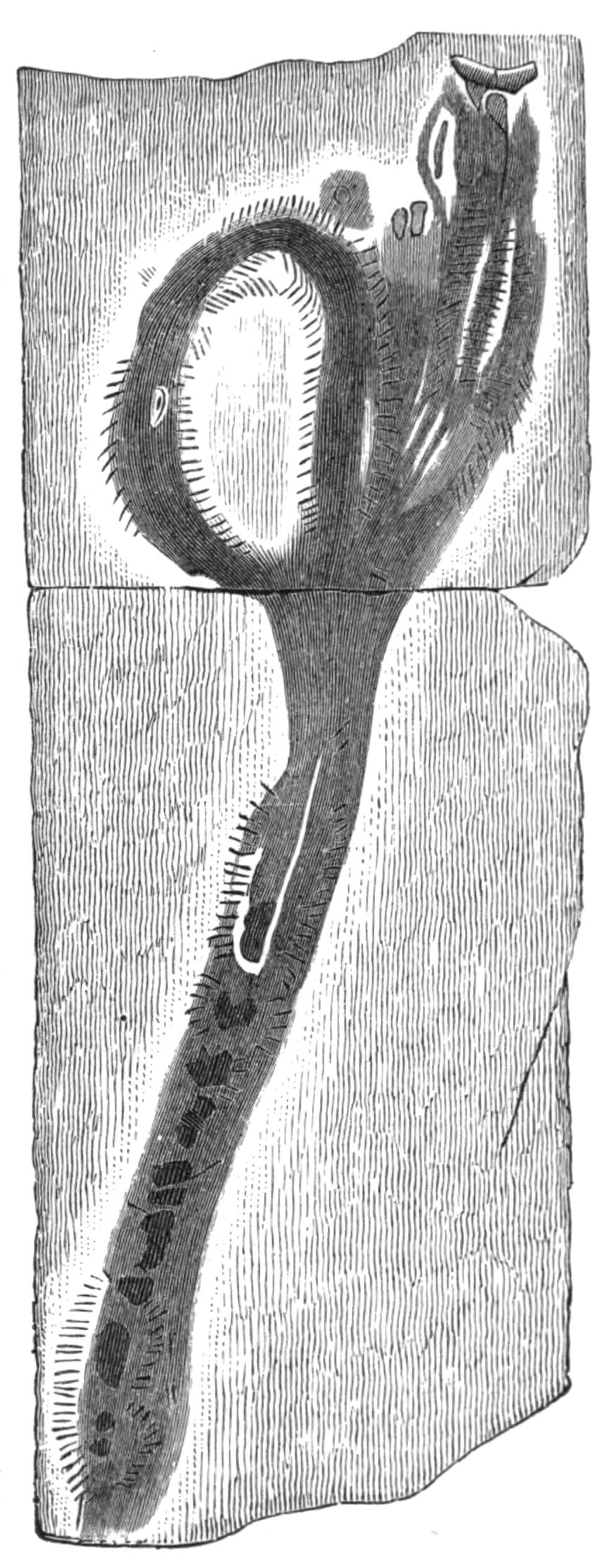
Fig. 159.—Eunicites avitus Ehl. A fossil worm from the lithographic slate of Solenhofen: the jaws are seen in front, and the acicula along each side. (From Ehlers.) Natural size.
Amongst the Nereidiformia the remains are fewer, but the acicula and the hard jaws are preserved in certain rocks, and can be referred to existing families. Eunicites avitus[363] is represented by a double series of acicula, indicating the parapodia of the two sides; and by remains of both upper and lower jaws (Fig. 159). Four different species of the worm have been described from the lithographic slate of Bavaria, of Jurassic age; and several upper jaws of other Eunicids have been discovered in the Palaeozoic beds of Canada and Scotland, and have received the names Lumbriconereites, Oenonites, and Arabellites, in reference to their nearest allies amongst living genera.
There are, however, numerous remains, in the forms of tracks or casts, in the earlier rocks, which have been referred to the Polychaeta. The names Crossopodia, Myrianites, Nereites, Phyllodocites, have been given to some of these traces, though they are open to numerous other interpretations. Some of the "tracks" are similar to those made by living Crustacea in walking over wet sand; others appear to be the casts of some animals. Tubular burrows in rocks or fossils, some straight, others U-shaped, have received such names as Arenicolites, Scolithus, Histioderma; whilst under the name Lumbricaria certain cylindrical, coiled structures, resembling worm "castings," are met with in this same lithographic stone of Solenhofen. Many of the tubes referred to Polychaetes by the earlier palaeontologists have been transferred to other groups; thus Cornulites is now believed to be a Pteropod shell.
This very meagre geological record is quite insufficient to form any basis for a phylogeny of the group. And this poor supply of remains is not surprising, when we consider the soft nature of the tissues, the absence, in the majority of families, of skeleton and of other parts which could have been fossilised; yet we might have expected a greater abundance of fossilised jaws than is represented at present. But it must be borne in mind that the conditions of life of these soft-bodied animals are not conducive to their leaving abundant fossilised remains.