Volume 1 — LIST OF MAPS APPEARING IN THE BOOK OF HISTORY
Reading edition
PAGE
The World as Known to its First Historian 8
Shifting of the Centre of the World’s Commerce 28
How the Mediterranean has Given Place to the Atlantic 29
The First Maps 51
Modern Representation of the World 52
The Europeanisation of the World 55
The Shaping of the Face of the Earth 85
How Mountain Ranges were formed 87
Europe Before the British Isles were Formed 118
The Submerged Lands of Europe 119
Europe in the Ice Age 155
Egypt in Three Periods 243
Babylonia 260
Sea Routes of Ancient Civilisation 283
Land Routes of Ancient Civilisation 284
How Civilisation Spread through Europe 359
The Expansion of White Races 361
The Island that Rules the Sea 378
Oceans of the World 383
Effect of Climate on the Course of History 391
Political Expansion 396
Relation of Rivers and Sea to the Civilisation of Countries 397
South America
Africa
Europe
The Far East, and Australia, Oceania and Malaysia 406
The Island Empire of Japan 432
Japan in the Fifth Century 457
Siberia 634
Movement of the Peoples of Siberia 656
Russia’s Advance in Western Asia 676
Growth of Russia in the Far East 677
The Trans-Siberian Line 692
The Chinese Empire 708
Korea and its Surroundings 858
The Malay Archipelago 886
Islands of Oceania 947
New Zealand 986
Australia and Tasmania 1010
Britain Contrasted with Australia 1012
South-east Australia, Indicating Products 1013
Bed of the Pacific Ocean 1102
The Middle East 1120
Modern India 1161
India in 1801 1266
Bed of the Indian Ocean and China Sea 1419
Suez Canal 1434
Mountain Systems In and Around Tibet 1457
The Approach of Lhasa 1505
Early Empires of the Ancient Near East 1562
Later Empires of the Ancient Near East 1563
Ancient Empires of Western Asia 1582
Modern Africa 2001
Races and Religions of Africa 2005
Natural Products of Africa 2009
Basin of the River Nile 2022
Delta of the River Nile 2024
Utica as it Was 2188
The Remains of Utica 2189
Ancient States of Mediterranean North Africa 2191
Niger River and Guinea Coast 2229
Great Britain in South Africa 2322
Basin of the Zambesi 2332
Basin of the Congo 2347
General Map of Europe 2356
Geographical Connection of the Mediterranean Coasts 2373
Ancient Greece 2482
World Empire of Alexander the Great 2561
Italy in the First Century B.C. 2621
The Roman Empire 2738
Origin of the Barbaric Nations 2797
Principal Countries of Eastern Europe 2894
World’s Great Empires Between 777 and 814 A.D. 2934
Turkey and Surrounding Countries in the 14th and 17th Centuries 3082
Historical Maps of Poland and Western Russia 3220
Western Europe in the Middle Ages 4138
Europe During the Revolutionary Era 4636
Modern Europe 4788
Britain’s Maritime Enterprise 5440
The British Empire in 1702 5462
The British Empire in 1909 5463
The Atlantic Ocean 5656
South America in the Sixteenth Century 5915
South America as it is To-day 5983
North Pole, with routes of Explorers 6014
South Pole 6045
North America 6431
This is the story of the earth from the first thing we know of it to the time in which we live. It is the story of man from the first thing we know of him to the last thought that the vision of modern science can suggest.
T
THERE is no need here to discuss the question how far it is possible to write a universal history, or on what lines such a history should proceed. These points may well be left where Lord Bryce leaves them in his introduction to this book. Nor need we consider what history is; the plain man may be left to make up his own mind as to that while the philosophers are making up theirs. A word may be said, however, of the plan and purpose of this work, especially of that distinction of it which is at once the ground of its appeal and its justification.
A UNIVERSAL HISTORY OF THE UNIVERSE
It is a commonplace to say of a great work that it is unique, and there would at first sight seem to be peculiar presumption in making such a claim for a History of the World. It may be claimed, however, without any fear of contradiction, that this work has no rival in the English language.
There have been histories of the world before; there are available in large numbers histories of all countries well worthy of attention; but there is not, and it may be doubted if there has ever been attempted before, a scientific World-History. This work is, as far as it can possibly be in the present state of knowledge, a universal history of the universe.
SCIENCE AND HISTORY
That is a far reaching claim to make, but a mere glance through the names of those whose services have been enlisted for the work will make its basis clear. The contributors include some of the foremost students of science. Many men of eminence whose names do not usually come into historical works will be found here. Their function may be described as holding the Lamp of Science up to History. It is for these authorities to read the story of the earth and to tell the plain man what they read there, as Turner read the sunset and painted what he saw. The simile is not so unfortunate as it may appear, because, although our canvas has not the same room for the artist’s imagination as Turner’s had, it will probably be admitted that the imagination of the scientist is often nearer to the truth of things than the conventional belief.
THE LIFE-STORY OF ALL NATIONS
And the scientist will come into our History whenever and wherever science has any light to throw upon its problems. To the creators of this work the world is not merely an aggregation of countries under more or less settled governments, nor is a country merely the seat of a political system. They conceive the earth as a part of the universe, as one world among many; and this is the story of a huge ball flying in space, on which men and women live and move, on which mighty nations rise and rule and pass away, on which great empires crumble into dust. It is the entrancing book of man and the universe, the life-story of all nations. It begins with the beginning; it regards the universe, as modern science has taught us to regard it, as a vast unit, in which the life of man is the ultimate consummation.
A history of the world cannot be written in a day. It is like an institution—it must be allowed to grow. It would be a purposeless sacrifice in an undertaking of such magnitude to reject any work of building-up that is available, and this History has a rare privilege in being able to utilise the result of the matchless research, the tireless industry, the unequalled knowledge of Dr. Hans Helmolt and the distinguished staff of scholars and investigators who have been engaged with him for many years in preparing a history of the world on precisely the lines laid down in this work.
THE MATERIAL FOR A WORLD HISTORY
It would be impossible to exaggerate the value of the elaborate research made for Dr. Helmolt by such of his eminent collaborators as Professor Johannes Ranke, Professor Ratzel, Professor Joseph Kohler, and others whose names stand for foremost authority wherever the value of learning is understood, and it is one of the chief claims of this work to recognition that it has behind it all the material collected by Dr. Helmolt’s staff, with all the judgment and skill of Dr. Helmolt himself in co-ordinating the labour of his assistants.
A work so universal in time and place must engage many minds. Behind it there must be the labour and thought of many lives. The materials for a world-history cannot be amassed by one man, cannot be gathered together in the time that it is possible for one man to devote to them. A moment’s reflection reveals the vastness and complexity of the arrangements for such a work, the reaching-out into far corners of the earth, the ransacking of historical libraries and official archives; the placing of the result of all this research into the hands of a hundred trained historians, the analysing, sifting, and editing of each part as if it were in itself a perfect whole.
A BOOK OF HUMAN EXPERIENCE
All this labour can hardly be measured. And if we add to our reckoning the work of illustrating the world’s history in pictures, the task of finding illustrations where they are rare as precious stones, or of choosing them where their number is bewildering, the labour that a world-history involves is, indeed, incalculable. It can only be accomplished by the co-operation of many minds, working over a long period, drawing upon actual experience in every part of the world.
Especially is this so in the present work. There are histories that can be made up from books, but this is not one of them. The BOOK OF HISTORY is not only a great book of human experience, as every history is; it is the product of experience. It could never have been written if the men who write it had not helped to make the history that they write.
THE MAKERS OF THE BOOK
It is a book of history by writers and makers of history; it is a book of action by men of action; it is a book, that is, by men who know intimately the real life of the world. When Professor Ratzel writes of the making of nations, he writes with perhaps an unequalled knowledge of the conditions that have made for human progress; when Dr. Flinders Petrie writes of Egypt, when Dr. Sayce writes of Assyria, they write with the same authority that Sir Harry Johnston has in writing of those parts of the British Empire that he has helped to govern.
The real rulers of the world are not the princes, and among the makers of this book are men who, though the fierce light that beats upon a throne has not beat upon them, have borne the burden of empire and of ruling men. It is the ideal collaboration, that of the brilliant investigator, the scientific interpreter, and the man of affairs, and it makes possible the achievement of a History which we have claimed to be unique.
THE WORLD YESTERDAY, TO-DAY & TO-MORROW
We have the facts from the pens of the men who have dug them up fresh from the earth itself or who know them from experience; we have them treated by the men who can turn upon them the full light of modern science; we have the world as it moves in our own time described by the men who know it from the centre, and know it therefore best.
This is the story of the world, then, yesterday and to-day. And, as history goes on, as to-day becomes yesterday and to-morrow becomes to-day, we shall find in this book a vision of the things that lie before. Out of the deeps of Time came man. Through the mists of Time he grew. Down the ages of Time he goes. Whence he came we guess; how he lives we know; where he goes the wisdom of History does not tell. But the history of the world is young, and young men shall see visions.
THE EDITORS
THE BOOK OF HISTORY


The Life-Story of the Earth and of All Nations
TOLD IN SEVEN GRAND DIVISIONS
This plan provides a general scheme for the HISTORY, but is not intended for reference. It does not follow that the exact order of countries here given is maintained throughout the volumes. A full index appears at the end of the work
I—MAN AND THE UNIVERSE
THE WORLD AND ITS STORY
A View Across the Ages: Introduction
Summary of the History of the World
Chronology of 10,000 Years and Chart of Nations
MAKING OF THE EARTH AND THE COMING OF MAN
The Beginning of the Earth
How Life is Possible on the Earth
The Beginning of Life on the Earth
How Man Obtained the Mastery of the Earth
THE RISE OF MAN AND THE EVE OF HISTORY
The World Before History
The Great Steps in Man’s Development
BIRTH OF CIVILISATION & THE GROWTH OF RACES
The Beginnings of Civilisation
How Civilisation Came to Europe
The Triumph of Race
An Alphabet of the World’s Races
MAKING OF NATIONS & THE INFLUENCE OF NATURE
The Birth and Growth of Nations
Influence of Land and Water on National History
How Nations are Affected by Their Environment
The Size and Power of Nations
The Future History of Man
II—THE FAR EAST
The Interest and Importance of the Far East
Japan. Siberia. China. Korea
Malaysia
Philippines. Malay States. Straits Settlements. Borneo. Sarawak. Sumatra. Java. New Guinea, and other Islands of Malay Archipelago
Australia
New South Wales. Victoria. Queensland. South Australia. West Australia. Tasmania
Oceania
New Zealand. Fiji. Pitcairn. Hawaii. Samoa. Tonga and other Islands
The Influence of the Pacific Ocean in History
III—THE MIDDLE EAST
The Importance of the Middle East
India
Including Ceylon and the Native States
Further India
Siam. Annam. Burma. Tonking. Cochin China. Cambodia. Champa
The Influence of the Indian Ocean in History
Central Asia
Afghanistan. Baluchistan. Turkestan. Thibet
IV—THE NEAR EAST
The Ancient Empires of Western Asia
Babylonia. Assyria. Elam
Early Nations of Western Asia
Scythia. Sarmatia. Armenia. Syria. Phœnicia. Israel
Western Asia from the Rise of Persia to Mohammed
Persia. Asia Minor. Syria. Palestine. Arabia. Mediterranean Islands
Western Asia from the Time of Mohammed
The Saracen Dominion. The Turkish Empire in Asia. Persia. Arabia
V—AFRICA
Legacy of Ancient Empires to the Modern World
Egypt and the Egyptian Sudan
North Africa
Tripoli. Tunis. Morocco. Algeria and the French Territories. Sierra Leone. Liberia. Gold Coast. Nigeria. German West Africa. Abyssinia. Somaliland. Erythrea. British East Africa. Zanzibar
South Africa
Native Races. The Portuguese and Dutch in South Africa. British South Africa: Cape Colony. Natal. Transvaal. Orange River Colony. Rhodesia. Congo Free State. Portuguese East Africa. Angola. German East Africa. German South-West Africa. Madagascar
VI—EUROPE
1. EUROPE TO THE FALL OF THE ROMAN EMPIRE
Mediterranean Influence in the Making of Europe
The Ancient Spirit of Greece and Rome
Early Peoples of Europe. Ascendancy of the Greeks
The Rise of Rome and the World Empire
Social Fabric of the Ancient World: Slave States
2. EASTERN EUROPE TO FRENCH REVOLUTION
The Byzantine Empire and the Turk in Europe
The Middle Peoples
Russia, Poland, and the Baltic Provinces
The Social Fabric of the Mediæval World: The Twilight of Nations
3. WESTERN EUROPE IN THE MIDDLE AGES
A Survey of Western Mediæval Europe
The Peoples of Western Europe
The Importance of the Baltic Sea
The Emerging of the Nations
Frankish Dominion and the Empire of Charlemagne. England. Spanish Peninsula. Italy. The Papacy. Scandinavia
The Development of the Nations
The German or Holy Roman Empire. France. England. Spain and Portugal. Italy. The Papacy. Scandinavia
The Crusades. Industry and Commerce
4. WESTERN EUROPE FROM THE REFORMATION TO THE REVOLUTION
A Survey of Western Europe
The Reformation and Wars of Religion
The Age of Louis XIV.
From the Peace of Westphalia to the Treaty of Utrecht
The Ending of the Old Order
From the Treaty of Utrecht to the Revolution
The Importance of the Atlantic to the World Powers
Religion After the Reformation. Industry and Commerce
5. THE FRENCH REVOLUTION
The Revolutionary and Napoleonic Era
The Revolution. The Republic at War and the Rise of Napoleon. The Zenith of Napoleon and his Fall
Great Britain in the Napoleonic Era
6. THE RE-MAKING OF EUROPE
Europe After Waterloo
The Triumph of Despotism. The Revolt Against Despotism
Europe in Revolution
The Second French Republic and the Coup d’Etat. The Uprising of the Little Nations. National Movements in Germany
The Consolidation of the Powers
Europe and the Second Empire. The Unification of Italy. The Unification of Germany. The Franco-German War
Great Britain to 1871. Russia and Turkey to 1871. Europe since 1871
Great Britain. Germany. France. Austria-Hungary. Spain and Portugal. Italy. Russia. Turkey. Switzerland. Greece. Belgium. Holland. Denmark. Norway. Sweden. Bulgaria. Servia. Roumania. Montenegro. Luxemburg. Monaco. San Marino
7. THE EUROPEAN POWERS TO-DAY
Europe in Our Own Time
Great Britain. Germany. Austria-Hungary. France.
Italy. Russia. Turkey. Spain and Portugal
Minor States of Europe:
Switzerland. Greece. Belgium. Holland. Denmark. Norway. Sweden. Bulgaria. Servia. Roumania. Montenegro. Luxemburg. Monaco. San Marino
VII—AMERICA
America Before Columbus
The Primitive Races of America. The Ancient Civilisation of Central America. The Ancient Civilisation of South America
The European Colonisation
The Discovery. The Spanish Conquest. The Spanish and Portuguese Empire in America. The Independence of South and Central America. The Pilgrim Fathers and the English Settlement. The Development and Expansion of the British Colonies
The American Nation
The Revolt of the Thirteen Colonies. The Struggle for Independence and the War. The Creation of the United States. The Development of the American Nation. The United States in Our Own Time
British America
Canada. Newfoundland. British West Indies. British Honduras. Bermudas.
Central America in the 19th and 20th Centuries
Cuba. Haiti. Dominica. Porto Rico. Mexico. Guatemala. Honduras. San Salvador. Nicaragua. Costa Rica. Panama
South America in the 19th and 20th Centuries
Colombia. Venezuela. British, French and Dutch Guiana. Brazil. Ecuador. Peru. Chili. Bolivia. Paraguay. Argentina. Uruguay
The World Around the Poles
Greenland. Iceland. Arctic and Antarctic Oceans
THE BOOK OF HISTORY
FIRST GRAND DIVISION
MAN AND THE UNIVERSE

FIRST GRAND DIVISION
MAN AND THE UNIVERSE
There can, of course, be neither absolute finality nor entire unanimity in the subjects of these chapters, which are designed to enable the reader to follow the course of history with greater interest and understanding than would be possible without some scientific knowledge of life. They are presented as a symposium of modern thought on the problems concerning the origin and development of the earth and mankind
PLAN
THE WORLD AND ITS STORY
A VIEW ACROSS THE AGES
Rt. Hon. James Bryce
A SUMMARY OF THE HISTORY OF THE WORLD
Arthur D. Innes, M.A.
CHRONOLOGY OF 10,000 YEARS AND CHART OF NATIONS
MAKING OF THE EARTH & THE COMING OF MAN
THE BEGINNING OF THE EARTH
Dr. Wm. Johnson Sollas, F.R.S.
HOW LIFE BECAME POSSIBLE ON THE EARTH
Dr. Alfred Russel Wallace, F.R.S.
HOW MAN OBTAINED THE MASTERY OF THE EARTH
Dr. Archdall Reid, F.R.S.E.
THE RISE OF MAN AND THE EVE OF HISTORY
THE WORLD BEFORE HISTORY
Professor Johannes Ranke
THE GREAT STEPS IN MAN’S DEVELOPMENT
Professor Joseph Kohler
BIRTH OF CIVILISATION & THE GROWTH OF RACES
THE BIRTH OF CIVILISATION
Dr. Flinders Petrie, F.R.S.
HOW CIVILISATION CAME TO EUROPE
David George Hogarth, M.A.
THE TRIUMPH OF RACE
Dr. Archdall Reid, F.R.S.E.
ALPHABET OF THE WORLD’S RACES
W. E. Garrett Fisher, M.A.
MAKING OF NATIONS & THE INFLUENCE OF NATURE
Professor Friedrich Ratzel
THE BIRTH AND GROWTH OF NATIONS
INFLUENCE OF LAND & WATER ON NATIONAL HISTORY
EFFECT OF ENVIRONMENT ON NATIONS
THE SIZE AND POWER OF NATIONS
THE FUTURE HISTORY OF MAN
For full contents and page numbers see Index
Mr. Kipling’s “Recessional” is quoted in a Frontispiece from “The Five Nations,” by permission of the Author and the Publishers, Messrs. Methuen

THE WORLD
AND ITS STORY
A VIEW ACROSS THE AGES
AN INTRODUCTION TO THE BOOK OF HISTORY
BY THE RIGHT HON. VISCOUNT BRYCE
W
WHEN History, properly so called, has emerged from those tales of the feats of kings and heroes and those brief entries in the roll of a temple or a monastery in which we find the earliest records of the past, the idea of composing a narrative which shall not be confined to the fortunes of one nation soon presents itself.
The First True Historian
Herodotus—the first true historian, and a historian in his own line never yet surpassed—took for his subject the strife between Greeks and Barbarians which culminated in the Great Persian War of B.C. 480, and worked into his book all he could ascertain regarding most of the great peoples of the world—Babylonians and Egyptians, Persians and Scythians, as well as Greeks. Since his time many have essayed to write a Universal History; and as knowledge grew, so the compass of these treatises increased, till the outlying nations of the East were added to those of the Mediterranean and West European world which had formerly filled the whole canvas.
Scientific History only now Possible
None of these books, however, covered the field or presented an adequate view of the annals of mankind as a whole. It was indeed impossible to do this, because the data were insufficient. Till some time way down in the nineteenth century that part of ancient history which was preserved in written documents could be based upon the literature of Israel, upon such notices regarding Egypt, Assyria, Babylon, and Iran as had been preserved by Greek or Roman writers, and upon those writers themselves. It was only for some of the Greek cities, for the kingdoms of Alexander and his successors, and for the city and Empire of Rome that fairly abundant materials were then available. Of the world outside Europe and Western Asia, whether ancient or modern, scarcely anything was known, scarcely anything even of the earlier annals of comparatively civilised peoples, such as those of India, China, and Japan, and still less of the rudimentary civilisations of Mexico and Peru. Nor, indeed, had most of the students who occupied themselves with the subject perceived how important a part in the general progress of mankind the more backward races have played, or how essential to a true History of the World is an account of the semi-civilised and even of the barbarous peoples. Thus it was not possible, until quite recent times, that the great enterprise of preparing such a history should be attempted on a plan or with materials suitable to its magnitude.
The last seventy or eighty years have seen a vast increase in our materials, with a corresponding widening of the conception of what a History of the World should be. Accordingly, the time for trying to produce one upon a new plan and enlarged scale seems to have arrived; not, indeed, that the years to come will not continue to add to the historian’s resources, but that those resources have recently become so much ampler than they have ever been before that the moment may be deemed auspicious for a new departure.
The nineteenth century was marked by three changes of the utmost consequence for the writing of history.
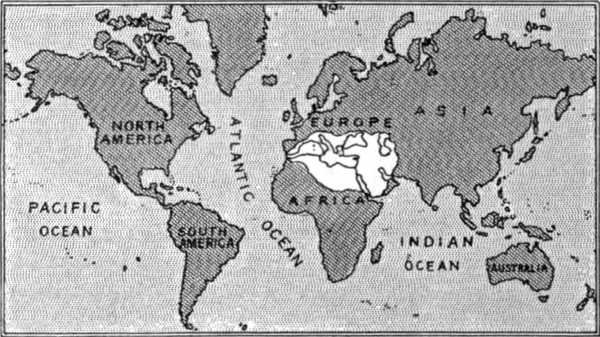
THE WORLD AS KNOWN TO ITS FIRST HISTORIAN
The world as known to Herodotus is shown by the white part of this map, indicating the limited range of ancient geographical knowledge.
New Material and New Methods
That century, in the first place, has enormously widened our knowledge of the times hitherto called prehistoric. The discovery of methods for deciphering the inscriptions found in Egypt and Western Asia, the excavations in Assyria and Egypt, in Continental Greece and in Crete, and to a lesser extent in North Africa also, in the course of which many inscriptions have been collected and fragments of ancient art examined, have given us a mass of knowledge regarding the nations who dwelt in these countries larger and more exact than was possessed by the writers of classical antiquity who lived comparatively near to those remote times. We possess materials for the study not only of the political history but of the ethnology, the languages, and the culture of the nations which were first civilised incomparably better than were those at the disposal of the contemporaries of Vico or Gibbon or Herder. Similar results have followed as regards the Far East, from the opening up of Sanskrit literature and of the records of China and Japan. To a lesser degree, the same thing has happened as regards the semi-civilised peoples of tropical America both north and south of the Isthmus of Panama. And while long periods of time have thus been brought within the range of history, we have also learnt much more about the times that may still be called prehistoric. The investigations carried on in mounds and caves and tombs and lake-dwellings, the collection of early stone and bronze implements, and of human skulls and bones found along with those of other animals, have thrown a great deal of new light upon primitive man, his way of life, and his migrations from one region to another. As history proper has been carried back many centuries beyond its former limit, so has our knowledge of prehistoric times been extended centuries above the furthest point to which history can now reach back. And this applies not only to the countries previously little explored, but to such well-known districts as Western Europe and the Atlantic coast of America.
Secondly, there has been during the nineteenth century a notable improvement in the critical method of handling historical materials. Much more pains have been taken to examine all available documents and records, to obtain a perfect text of each by a comparison of manuscripts or of early printed copies, and to study each by the aid of other contemporary matter. It is true that, with the exception of Egyptian papyri and some manuscripts unearthed in Oriental monasteries (besides those Indian, Chinese, and other early Eastern sacred books to which I have already referred), not very much that is absolutely new has been brought to light. It is also true that a few of the most capable students in earlier days, in the ancient world as well as since the Renaissance, have fully seen the value of original authorities and have applied to them thoroughly critical methods. This is not a discovery of our own times. Still, it may be claimed that there was never before so great a zeal for collecting and investigating all possible kinds of original texts, nor so widely diffused a knowledge of the methods to be applied in turning them to account for the purposes of history. Both in Europe and in America an unprecedentedly large number of competent men have been employed upon researches of this kind, and the result of their labours on special topics has been to provide the writer who seeks to present a general view of history with materials not only larger but far fitter for his use than his predecessors ever enjoyed. Then with the improvement in critical apparatus, there has come a more cautious and exact habit of mind in the interpretation of facts.
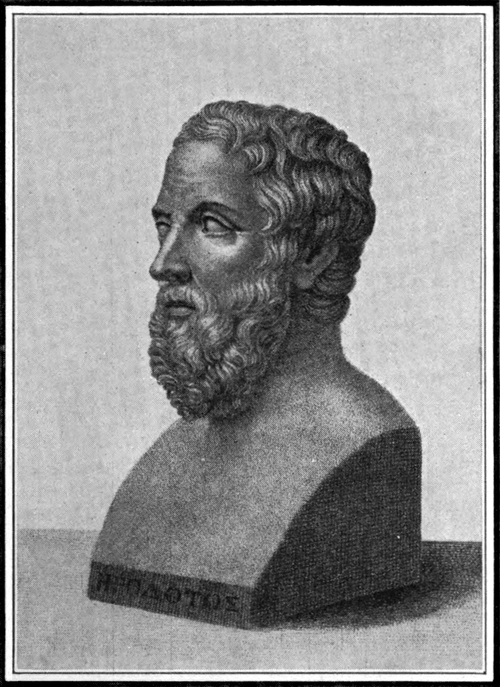
“THE FATHER OF HISTORY”
Herodotus, the first historian, was born between B.C. 470–480 at Halicarnassus, a Greek colony in Asia Minor
Thirdly, the progress of the sciences of Nature has powerfully influenced history, both by providing new data and by affecting the mental attitude of all reflective men. This has happened in several ways. Geographical exploration has made known nearly every part of the surface of the habitable globe. The great natural features of every country, its mountain ranges and rivers, its forest or deserts, have been ascertained. Its flora and fauna have been described, and thereby its capacity for supporting human life approximately calculated. The other physical conditions which govern the development of man, such as temperature, rainfall, and the direction of prevalent winds have been examined. Thus we have acquired a treasury of facts relating to the causes and conditions which help the growth of civilisation and mould it into diverse forms, conditions whose importance I shall presently discuss in considering the relation of man to his natural environment. Although a few penetrating minds had long ago seen how much the career of each nation must have been affected by physical phenomena, it is only in the last two generations that men have begun to study these phenomena in their relation to history, and to appreciate their influence in the formation of national types and in determining the movement of races over the earth’s surface.
Not less remarkable has been the increase in our knowledge of the more remote and backward peoples. Nearly every one of these has now been visited by scientific travellers or missionaries, its language written down, its customs and religious rites, sometimes its folk lore also, recorded. Thus materials of the highest value have been secured, not only for completing our knowledge of mankind as a whole, but for comprehending in the early history of the now highly civilised peoples various facts which had previously remained obscure, but which became intelligible when compared with similar facts that can be studied in their actuality among tribes whom we find in the same stage to-day as were the ancestors of the civilised nations many centuries ago.
Progress of the Sciences
The progress thus achieved in the science of man regarded as a part of Nature has powerfully contributed to influence the study of human communities as they appear in history. The comparative method has become the basis for a truly scientific inquiry into the development of institutions, and the connection of religious beliefs and ceremonies with the first beginnings of institutions both social and political has been made clear by an accumulation of instances. Whether or no there be such a thing as a Science of History—a question which, since it is mainly verbal, one need not stop to discuss—there is such a thing as a scientific method applied to history; and the more familiar men have become with the methods of inquiry and canons of evidence used in physical investigations, so much the more have they tended to become exact and critical in historical investigations, and to examine the causes and the stages by and through which historical development is effected.
Historical Knowledge in Our Time
In noting this I do not suggest that what is popularly called the “Doctrine of Evolution” should be deemed a thing borrowed by history from the sciences of nature. Most of what is true or helpful in that doctrine was known long ago, and applied long ago by historical and political thinkers. You can find it in Aristotle, perhaps before Aristotle. Even as regards the biological sciences, the notion of what we call evolution is ancient; and the merit of Darwin and other great modern naturalists has lain, not in enouncing the idea as a general theory, but in elucidating, illustrating, and demonstrating the processes by which evolution takes place. The influence of the natural sciences on history is rather to be traced in the efforts we now see to accumulate a vast mass of facts relating to the social, economic, and political life of man, for the sake of discovering general laws running through them, and imparting to them order and unity.
Although the most philosophic and diligent historians have always aimed at and striven for this, still the general diffusion of the method in our own time, and the greatly increased scale on which it is applied, together with the higher standard of accuracy which is exacted by the opinion of competent judges, may be, in some measure, ascribed to the examples which those who work in the spheres of physics and biology and natural history have so effectively set.
Finally, the progress of natural science has in our time, by stimulating the production and exchange of commodities, drawn the different parts of the earth much nearer to one another, and thus brought nearly all its tribes and nations into relations with one another far closer and far more frequent than existed before.
Oneness of the Human Race
This has been done by the inventions that have given us steam and electricity as motive forces, making transport quicker and cheaper, and by the application of electricity to the transmission of words. No changes that have occurred in the past (except perhaps changes in the sphere of religion) are comparable in their importance as factors in history to those which have shortened the voyage from Western Europe to America to five and a half days, and made communication with Australia instantaneous. For the first time the human race, always essentially one, has begun to feel itself one, and civilised man has in every part of it become a contemporaneous observer of what passes in every other part.
The general result of these various changes has been that while the materials for writing a history of the world have been increased, the conception of what such a history should be has been at the same time both enlarged and defined. Its scope is wider; its lines are more clearly drawn. But what do we mean by a Universal History? Briefly, a History which shall, first, include all the races and tribes of man within its scope; and, secondly, shall bring all these races and tribes into a connection with one another such as to display their annals as an organic whole.
Importance of the Small Races
Universal history has to deal not only with the great nations, but also with the small nations; not only with the civilised, but also with the barbarous or savage peoples; not only with the times of movement and progress, but also with the times of silence and apparent stagnation. Every fraction of humanity has contributed something to the common stock, and has lived and laboured not for itself only, but for others also, through the influence which it has perforce exercised on its neighbours. The only exceptions we can imagine are the inhabitants of some remote isle, “far placed amid the melancholy main.” Yet they, too, must have once formed part of a race dwelling in the region whence they came, even if that race had died out in its old home before civilised man set foot on such an oceanic isle in a later age. The world would have been different, in however small a measure, had they never existed. As in the realm of physical science, so in that of history no fact is devoid of significance, though the true significance may remain long unnoticed. The history of the backward races presents exceptional difficulties, because they have no written records, and often scarcely any oral traditions. Sometimes it reduces itself to a description of their usages and state of life, their arts and their superstitions, at the time when civilised observers first visited them. Yet that history is instructive, not only because the phenomena observable among such races enlarge our knowledge, but also because through the study of those which survive we are able to interpret the scanty records we possess of the early condition of peoples now civilised, and to go some way towards writing the history of what we have hitherto called prehistoric man.
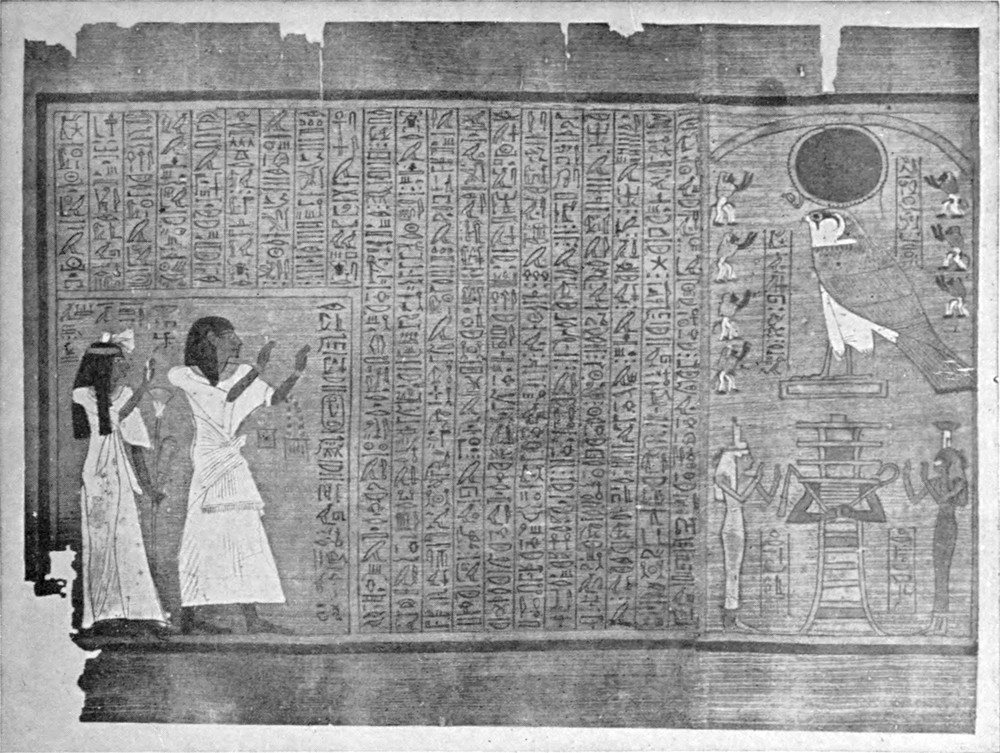
ANCIENT EGYPT’S STRANGE BOOKS AND PICTORIAL RECORDS, MADE OF PAPYRUS
Papyrus, a tall, graceful, sedgy plant, supplied the favourite writing material of the ancient world, and many priceless records of antiquity are preserved to us in papyri. The pith of the plant was pressed flat and thin and joined with others to form strips, on which records were written or painted. The above is a photograph of a piece of Egyptian papyrus, showing both hieroglyphics and picture-writing. The oldest piece of papyrus dates back to B.C. 3500.
Thus such tribes as the aborigines of Australia, the Fuegians of Magellan’s Straits, the Bushmen of South Africa, the Sakalavas of Madagascar, the Lapps of Northern Europe, the Ainos of Japan, the numerous “hill-tribes” of India, will all come within the historian’s ken. From each of them something may be learnt; and each of them has through contact with its more advanced neighbours affected those neighbours themselves, sometimes in blood, sometimes through superstitious beliefs or rites, frequently borrowed by the higher races from the lower (as the Norsemen learnt magic from the Lapps, and the Semites of Assyria from the Accadians), sometimes through the strife which has arisen between the savage and the more civilised man, whereby the institutions of the latter have been modified.
Obviously the historian cannot record everything. These lower races are comparatively unimportant. Their contributions to progress, their effect on the general march of events, have been but small. But they must not be wholly omitted from the picture, for without them it would have been different. One must never forget, in following the history of the great nations of antiquity, that they fought and thought and built up the fabric of their industry and art in the midst of a barbarous or savage population surrounding them on all sides, whence they drew the bulk of their slaves and some of their mercenary soldiers, and which sometimes avenged itself by sudden inroads, the fear of which kept the Greek cities, and at certain epochs even the power of Rome, watchful and anxious. So in modern times the savages among whom European colonies have been planted, or who have been transported as slaves to other colonies—sometimes, as in the case of Portugal in the fifteenth century, to
Europe itself—or those with whom Europeans have carried on trade, must not be omitted from a view of the causes which have determined the course of events in the civilised peoples.
Great Works of Little Peoples
To dwell on the part played by the small nations is less necessary here, for even a superficial student must be struck by the fact that some of them have counted for more than the larger nations to whose annals a larger space is commonly allotted. The instance of Israel is enough, so far as the ancient world is concerned, to show how little the numbers of a people have to do with the influence it may exert. For the modern world, I will take the case of Iceland.
The Culture of the Icelanders
The Icelanders are a people much smaller than even was Israel. They have never numbered more than about seventy thousand. They live in an isle so far remote, and so sundered from the rest of the world by an inhospitable ocean, that their relations both with Europe, to which ethnologically they belong, and with America, to which geographically they belong, have been comparatively scanty. But their history, from the first settlement of the island by Norwegian exiles in A.D. 874 to the extinction of the National Republic in A.D. 1264, is full of interest and instruction, in some respects a perfectly unique history. And the literature which this handful of people produced is certainly the most striking primitive literature which any modern people has produced, superior in literary quality to that of the Continental Teutons, or to that of the Romance nations, or to that of the Finns or Slavs, or even to that of the Celts. Yet most histories of Europe pass by Iceland altogether, and few persons in Continental Europe (outside Scandinavia) know anything about the inhabitants of this isle, who, amid glaciers and volcanoes, have maintained themselves at a high level of intelligence and culture for more than a thousand years.
The small peoples have no doubt been more potent in the spheres of intellect and emotion than in those of war, politics, or commerce. But the influences which belong to the sphere of creative intelligence—that is to say, of literature, philosophy, religion and art—are just those which it is peculiarly the function of a History of the World to disengage and follow out in their far-reaching consequence. They pass beyond the limits of the country where they arose. They survive, it may be, the race that gave birth to them. They pass into new forms, and through these they work in new ways upon subsequent ages.
The Wide Scope of History
It is also the task of universal history so to trace the march of humanity as to display the relation which each part of it bears to the others; to fit each race and tribe and nation into the main narrative. To do this, three things are needed—a comprehensive knowledge, a power of selecting the salient and significant points, and a talent for arrangement. Of these three qualifications, the first is the least rare. Ours is an age of specialists; but the more a man buries himself in special studies, the more risk does he incur of losing his sense of the place which the object of his own study fills in the general scheme of things. The highly trained historian is generally able to draw from those who have worked in particular departments the data he needs; while the master of one single department may be unable to carry his vision over the whole horizon, and see each part of the landscape in its relations to the rest.
In other words, a History of the World ought to be an account of the human family as an organic whole, showing how each race and state has affected other races or states, what each has brought into the common stock, and how the interaction among them has stimulated some, depressed or extinguished others, turned the main current this way or that. Even when the annals of one particular country are concerned, it needs no small measure of skill in expression as well as of constructive art to trace their connection with those of other countries. To take a familiar example, he who writes the history of England must have his eye always alive to what is passing in France on one side, and in Scotland on the other, not to speak of countries less closely connected with England, such as Germany and Spain. He must let the reader feel in what way the events that were happening in France and Scotland affected men’s minds, and through men’s minds affected the progress of events in England. Yet he cannot allow himself constantly to interrupt his English narrative in order to tell what was passing beyond the Channel or across the Tweed.
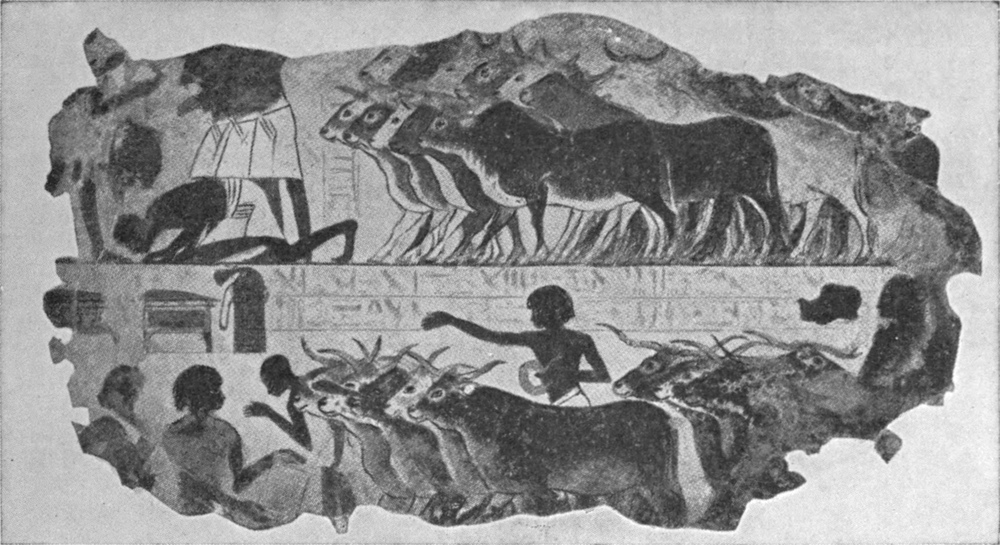
VIVID SCENES OF ANCIENT LIFE DEPICTED BY CONTEMPORARY ARTISTS
The walls of the tombs in Egypt form a great picture gallery of the vanished life of that country and are invaluable to the historian. This fragment from the British Museum shows how vividly the domestic figures were realised.
Unity of Universal History
Obviously, this difficulty is much increased when the canvas is widened to include all Europe, and when the aim is to give the reader a just impression of the general tendencies of a whole age, such an age as, for instance, the sixteenth century, over that vast area. If for a History of the World the old plan be adopted—that of telling the story of each nation separately, yet on lines generally similar, cross references and a copious use of chronological tables become helpful, for they enable the contemporaneity of events to be seen at a glance, and as the history of each nation is being written with a view to that of other nations, the tendencies at work in each can be explained and illustrated in a way which shows their parallelism, and gives to the whole that unity of meaning and tendency which a universal history must constantly endeavour to display. The connection between the progress or decline of different peoples is best understood by setting forth the various forms which similar tendencies take in each. To do this is a hard task when the historian is dealing with the ancient world, or with the world outside Europe even in mediæval and post-mediæval times. For the modern European nations it is easier, because, ever since the spread of Christianity made these nations parts of one great ecclesiastical community, similar forces have been at work upon each of them, and every intellectual movement which has told upon one has more or less told upon the others also.
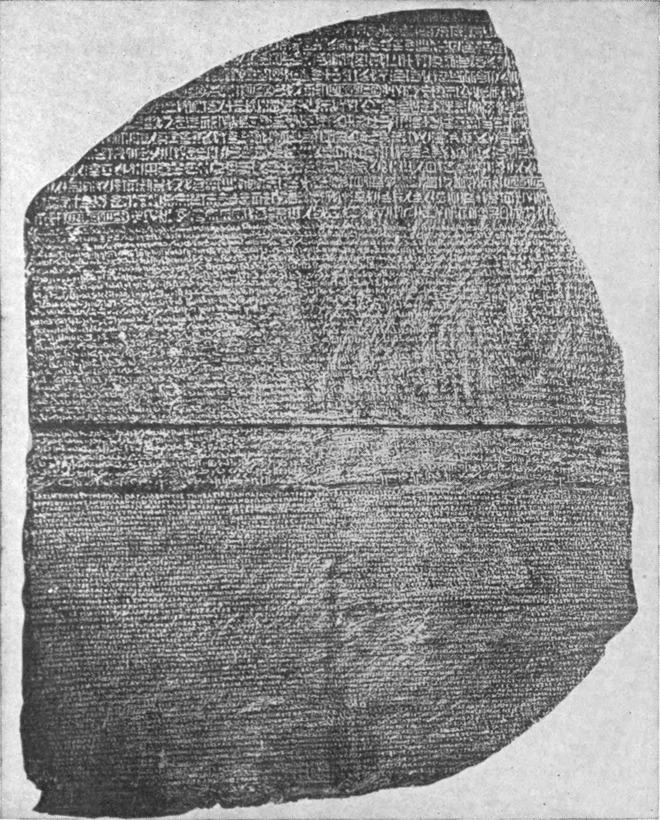
THE MASTER-KEY TO THE HIEROGLYPHICS
The inscribed stone found at Rosetta, in the Nile delta, in 1799, now preserved in the British Museum. It gave the key to the hieroglyphic writings of Egypt. It is a decree of Ptolemy Epiphanes, promulgated at Memphis in B.C. 196, and as it is inscribed in hieroglyphic and in the script of the country as well as in Greek, it thus solved the long standing mystery of the hieroglyphics of the monuments, which before its discovery had been quite unintelligible.
Central Line of Human Development The Study of Human Society Each Race a Distinct Entity
Such a History of the World may be written on more than one plan, and in the light of more than one general theory of human progress. It might find the central line of human development in the increase of man’s knowledge, and in particular of his knowledge of Nature and his power of dealing with her. Or that which we call culture, the comprehensive unfolding and polishing of human faculty and of the power of intellectual creation and appreciation, might be taken as marking the most real and solid kind of progress, so that its growth would best represent the advance of man from a savage to a highly civilised condition. Or if the moral and political sphere were selected as that in which the onward march of man as a social being, made to live in a community, could best be studied, the idea of liberty might be made a pivot of the scheme; for in showing how the individual emerges from the family or the tribe, how first domestic and then also prædial slavery slowly disappears, how institutions are framed under which the will of one ruler or of a small group begins to be controlled, or replaced as a governing force, by the collective will of the members of the community, how the primordial rights of each human creature win their way to recognition—in tracing out all these things the history of human society is practically written, and the significance of all political changes is made clear. Another way, again, would be to take some concrete department of human activity, follow it down from its earliest to its latest stages, and group other departments round it. Thus one author might take religion, and in making the history of religion the main thread of his narrative might deal incidentally with the other phenomena which have influenced it or which it has influenced. Or, similarly, another author might take political institutions, or perhaps economic conditions—i.e., wealth, labour, capital, commerce, or, again, the fundamental social institutions, such as the family, and the relations of the ranks and classes in a community, and build up round one or other of these manifestations and embodiments of the creative energy of mankind the general story of man’s movement from barbarism to civilisation. Even art, even mechanical inventions, might be similarly handled, for both of these stand in a significant relation to all the rest of the life of each nation and of the world at large. Nevertheless, no one of these suggested lines on which a universal history might be constructed would quite meet the expectations which the name Universal History raises, because we have become accustomed to think of history as being primarily and pre-eminently a narrative of the growth and development of communities, nations, and states as organised political bodies, seeing that it is in their character as bodies so organised that they come into relation with other nations and states. It is therefore better to follow the familiar plan of dealing with the annals of each race and nation as a distinct entity, while endeavouring to show throughout the whole narrative the part which each fills in the general drama of human effort, conflict, and progress.
A universal history may, however, while conforming to this established method, follow it out along a special line, which shall give prominence to some one leading idea or principle. Such a line or point of view has been found for the present work in the relation of man to his physical environment—that is to say, to the geographical conditions which have always surrounded him, and always must surround him, conditions whose power and influence he has felt ever since he appeared upon the globe. This point of view is more comprehensive than any one of those above enumerated. Physical environment has told upon each and every one of the lines of human activity already enumerated that could be taken to form a central line for the writing of a history of mankind. It has influenced not only political institutions and economic phenomena, but also religion, and social institutions, and art, and inventions. No department of man’s life has been independent of it, for it works upon man not only materially but also intellectually and morally.
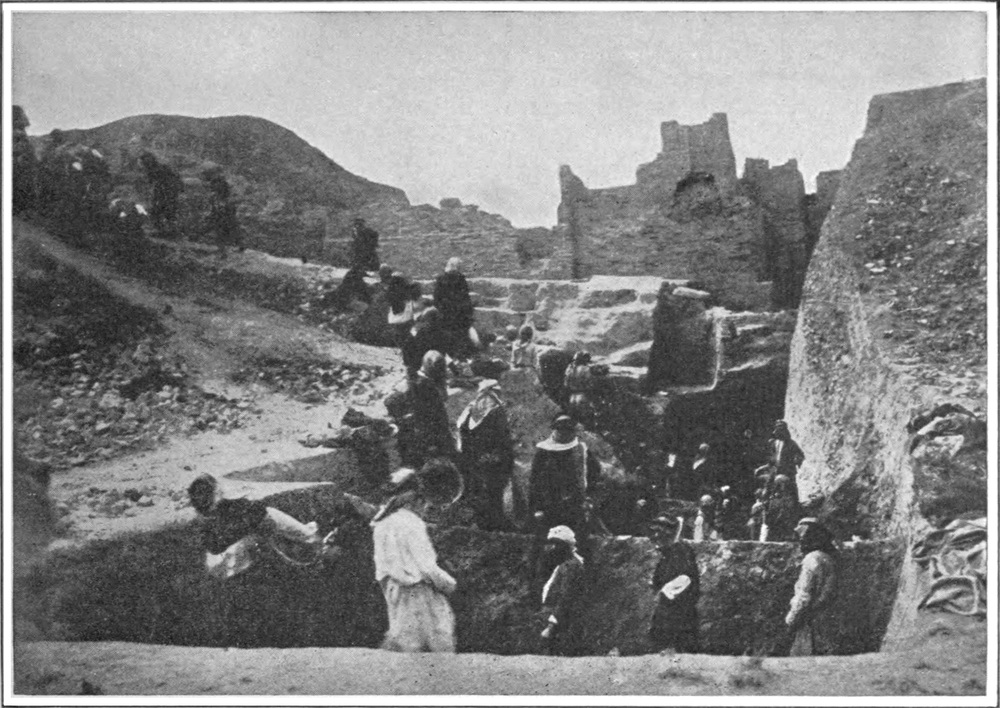
UNEARTHING THE RUINS OF ANCIENT BABYLON IN THE TWENTIETH CENTURY
This photograph illustrates how present-day exploration brings the remains of the ancient wonder cities of Babylonia to light after the sleep of ages. Much valuable knowledge of Babylon has been acquired quite recently as a result of excavations now being carried on under the supervision of English, American, French, and German explorers.
As this is the idea which has governed the preparation of the present book, as it is constructed upon a geographical rather than a purely chronological plan (though, of course, each particular country and nation needs to be treated chronologically), some few pages may properly be devoted here to a consideration of the way in which geography determines history, or, in other words, to an examination of the relations of Nature, inorganic and organic, to the life of man.
MAN’S PLACE IN NATURE’S KINGDOM
T
THOUGH we are accustomed to contrast man with Nature, and to look upon the world outside ourselves as an object to be studied by man, the conscious and intelligent subject, it is evident, and has been always recognised even by those thinkers who have most exalted the place man holds in the Cosmos, that man is also to be studied as a part of the physical universe. He belongs to the realm of Nature in respect of his bodily constitution, which links him with other animals, and in certain respects with all the phenomena that lie within the sphere of biology.
All creatures on our earth, since they have bodies formed from material constituents, are subject to the physical laws which govern matter; and the life of all is determined, so far as their bodies are concerned, by the physical conditions which foster, or depress, or destroy life. Plants need soil, moisture, sunshine, and certain constituents of the atmosphere. Their distribution over the earth’s surface depends not only upon the greater or less extent to which these things, essential to their existence, are present, but also upon the configuration of the earth’s surface (continents and oceans), upon the greater or less elevation above sea level of parts of it, upon such forces as winds and ocean currents (occasionally also upon volcanoes), upon the interposition of arid deserts between moister regions, or upon the flow of great rivers. The flora of each country is the resultant (until man appears upon the scene) of these natural conditions.
Natural Conditions of Life
We know that some plants are also affected by the presence of certain animals, particularly insects and birds. Similarly, animals depend upon these same conditions which regulate their distribution, partly directly, partly indirectly, or mediately through the dependence of the animal for food upon the plants whose presence or absence these conditions have determined. It would seem that animals, being capable of moving from place to place, and thus of finding conditions suitable for their life, and to some extent of modifying their life to suit the nature around them, are somewhat more independent than plants are, though plants, too, possess powers of adapting themselves to climatic surroundings; and there are some—such, for instance, as our common brake-fern and the grass of Parnassus—which seem able to thrive unmodified in very different parts of the globe.
Man the Servant of Nature
The primary needs of man which he shares with the other animals are an atmosphere which he can breathe, a temperature which he can support, water which he can drink, and food. In respect of these he is as much the product of geographical conditions as are the other living creatures. Presently he superadds another need, that of clothing. It is a sign that he is becoming less dependent on external conditions, for by means of clothing he can make his own temperature and succeed in enduring a degree of cold, or changes from heat to cold, which might otherwise shorten his life. The discovery of fire carries him a long step further, for it not only puts him less at the mercy of low temperatures, but extends the range of his food supplies, and enables him, by procuring better tools and weapons, to obtain his food more easily. We need not pursue his upward course, at every stage of which he finds himself better and still better able to escape from the thraldom of Nature, and to turn to account the forces which she puts at his disposal. But although he becomes more and more independent, more and more master not only of himself, but of her, he is none the less always for many purposes the creature of the conditions with which she surrounds him. He always needs what she gives him. He must always have regard to the laws which he finds operating through her realm. He always finds it the easiest course to obey, and to use rather than to attempt to resist her.
Here let me pause to notice a remarkable contrast between the earlier and the later stages of man’s relations to Nature. In the earlier stages he lies helpless before her, and must take what she chooses to bestow—food, shelter, materials for clothing, means of defence against the wild beasts, who are in strength far more than a match for him. He depends upon her from necessity, and is better or worse off according as she is more or less generous.
Man’s Advance in Knowledge
But in the later stages of his progress he has, by accumulating a store of knowledge, and by the development of his intelligence, energy, and self-confidence, raised himself out of his old difficulties. He no longer dreads the wild beasts. They, or such of them as remain, begin to dread him, for he is crafty, and can kill them at a distance. He erects dwellings which can withstand rain and tempest. He irrigates hitherto barren lands and raises abundant crops from them. When he has invented machinery, he produces in an hour clothing better than his hands could formerly have produced in a week. If at any given time he has not plenty of food, this happens only because he has allowed his species to multiply too fast. He is able to cross the sea against adverse winds and place himself in a more fertile soil or under more genial skies than those of his former home. As respects all the primary needs of his life, he has so subjected Nature to himself, that he can make his life what he will.
Neurdein
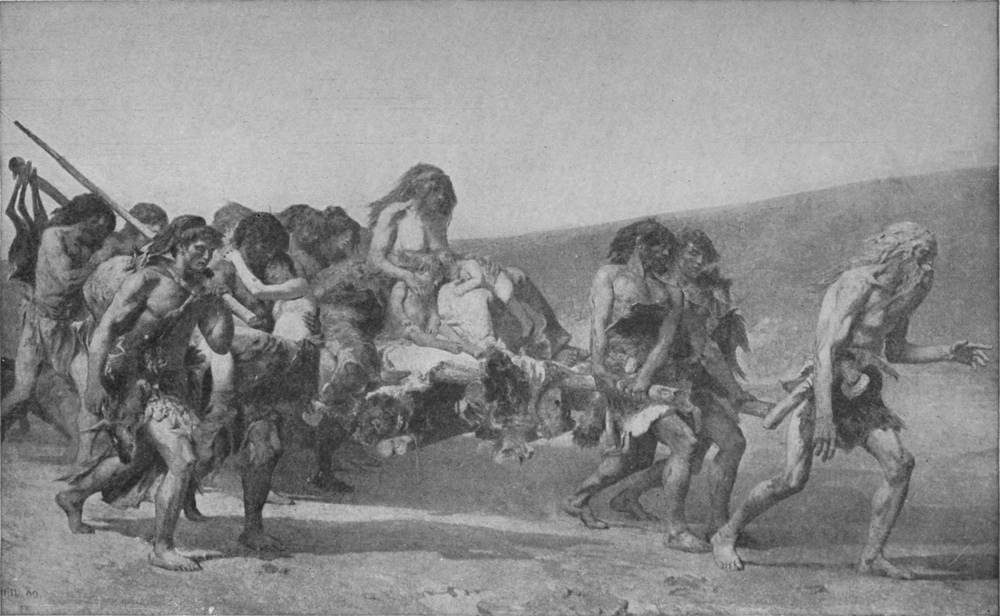
THE FIRST WANDERERS OF THE EARTH: TRIBAL MIGRATION IN PREHISTORIC TIMES
From the painting of “Cain” by Ferdinand Cormon
LARGER IMAGE
Man the Master of Nature
All this renders him independent. But he now also finds himself drawn into a new kind of dependence, for he has now come to take a new view of Nature. He perceives in her an enormous storehouse of wealth, by using which he can multiply his resources and gratify his always increasing desires to an extent practically unlimited. She provides forces, such as steam and electricity, which his knowledge enables him to employ for production and transport, so as to spare his own physical strength, needed now not so much for effort as for the direction of the efforts of Nature. She has in the forest, and still more beneath her own surface in the form of minerals, the materials by which these forces can be set in motion; and by using these forces man can, with comparatively little trouble, procure abundance of those materials.
Thus his relation to Nature is changed. It was that of a servant, or, indeed, rather of a beggar, needing the bounty of a sovereign. It is now that of a master needing the labour of a servant, a servant infinitely stronger than the master, but absolutely obedient to the master so long as the master uses the proper spell. Thus the connection of man with Nature, changed though his attitude be, is really as close as ever, and far more complex. If his needs had remained what they were in his primitive days—let us say, in those palæolithic days which we can faintly adumbrate to ourselves by an observation of the Australian or Fuegian aborigines now—he would have sat comparatively lightly to Nature, getting easily what he wanted, and not caring to trouble her for more. But his needs—that is to say, his desires, both his physical appetites and his intellectual tastes, his ambitions and his fondness for comfort, things that were once luxuries having become necessaries—have so immeasurably expanded that, since he asks much more from Nature, he is obliged to study her more closely than ever.
Man’s New Relations to Nature
Thus he enters into a new sort of dependence upon her, because it is only by understanding her capacities and the means of using them that he can get from her what he wants. Primitive man was satisfied if he could find spots where the trees gave edible fruit, where the sun was not too hot, nor the winds too cold, where the beasts easy of capture were abundant, and no tigers or pythons made the forest terrible. Civilised man has more complex problems to deal with, and wider fields to search. The study of Nature is not only still essential to him, but really more essential than ever. His life and action are conditioned by her. His industry and his commerce are directed by her to certain spots. That which she has to give is still, directly or indirectly, the source of strife, and a frequent cause of war. As men fought long ago with flint-headed arrows for a spring of water or a coconut grove, so they fight to-day for mineral treasures imbedded in the soil. It is mainly by Nature that the movements of emigration and the rise of populous centres of industry are determined.
Though Nature still rules for many purposes and in many ways the course of human affairs, the respective value of her various gifts changes from age to age, as man’s knowledge and power of turning them to account have changed. The things most prized by primitive man are not those which semi-civilised man chiefly prized, still less are they those most sought for now.
Using Natural Wealth
In primitive times the spots most attractive, because most favourable to human life, were those in which food could be most easily and safely obtained from fruit-bearing trees or by the chase, and where the climate was genial enough to make clothing and shelter needless, at least during the greater part of the year. Later, when the keeping of cattle and tillage had come into use, good pastures and a fertile soil in the valley of a river were the chief sources of material well-being. Wild beasts were less terrible, because man was better armed; but as human enemies were formidable, regions where hills and rocks facilitated defence by furnishing natural strongholds had their advantages.
Still later, forests came to be recognised as useful for fuel, and for carpentry and shipbuilding. Mineral deposits, usually found in hilly or mountainous districts, became pre-eminently important sources of wealth; and rivers were valued as highways of commerce and as sources of motive power by the force of their currents. To the Red Indians of the Ohio valley the places which were the most attractive camping-grounds were those whither the buffaloes came in vast herds to lick the rock salt exposed in the sides of the hills. It is now not the salt-licks, but the existence of immense deposits of coal and iron, that have determined the growth of huge communities in those regions whence the red man and the buffalo have both vanished. England was once, as New Zealand is now, a great wool-growing and wool-exporting country, whereas she is to-day a country which spins and weaves far more wool than she produces.
Ancient Harbours and Modern
So, too, the influence of the sea on man has changed. There was a time when towns were built upon heights some way off from the coast, because the sea was the broad high road of pirates who swooped down upon and pillaged the dwellings of those who lived near it. Now that the sea is safe, trading cities spring up upon its margin, and sandy tracts worthless for agriculture have gained an unexpected value as health resorts, or as places for playing games, places to which the inhabitants of inland districts flock in summer, as they do in England and Germany, or in winter, as they do on the Mediterranean coasts of France. The Greeks, when they began to compete with the Phœnicians in maritime commerce, sought for small and sheltered inlets in which their tiny vessels could lie safely—such inlets as Homer describes in the Odyssey, or as the Old Port of Marseilles, a city originally a colony from the Ionian Phocæa. Nowadays these pretty little rock harbours are useless for the large ships which carry our trade. The Old Port of Marseilles is abandoned to small coasters and fishing-boats, and the ocean steamers lie in a new harbour which is protected, partly by outlying islands, partly by artificial works.
The World-Importance of Medicine
So, too, river valleys, though still important as highways of traffic, are important not so much in respect of water carriage as because they furnish the easiest lines along which railways can be constructed. The two banks of the Rhine, each traversed by a railroad, carry far more traffic than the great stream itself carried a century ago; and the same remark applies to the Hudson. All these changes are due to the progress of invention, which may give us fresh changes in the future not less far-reaching than those the past has seen. Mountainous regions with a heavy rainfall, such as Western Norway or the coast of the Pacific in Washington and British Columbia, may, by the abundance of water power which they supply, which can be transmuted into electrical energy, become sources of previously unlooked-for wealth, especially if some cheap means can be devised of conveying electricity with less wastage in transmission than is at present incurred. Within the last few years considerable progress in this direction has been made. Should effective and easily applicable preventives against malarial fever be discovered, many districts now shunned, because dangerous to the life of white men, may become the homes of flourishing communities. The discovery of cinchona bark in the seventeenth century affected the course of events, because it provided a remedy against a disease that had previously baffled medical skill. If quinine had been at the disposal of the men of the Middle Ages, not only might the lives of many great men, as for instance of Dante, have been prolonged, but the Teutonic emperors would have been partially relieved of one of the chief obstacles which prevented them from establishing permanent control over their Italian dominions. Rome and the Papal power defended themselves against the hosts of the Franconian and Hohenstaufen sovereigns by the fevers of the Campagna more effectively than did the Roman people by their arms, and almost as effectively as did the Popes by their spiritual agencies.
Bearing in mind this principle, that the gifts of Nature to man not only increase, but also vary in their form, in proportion and correspondence to man’s capacity to use them, and remembering also that man is almost as much influenced by Nature when he has become her adroit master as when she was his stern mistress, we may now go on to examine more in detail the modes in which her influence has told and still tells upon him.
The Problem of Racial Distinctions
It has long been recognised that Nature must have been the principal factor in producing, that is to say, in differentiating, the various races of mankind as we find them differentiated when our records begin. How this happened is one of the darkest problems that history presents. By what steps and through what causes did the races of man acquire these diversities of physical and intellectual character which are now so marked and seem so persistent? It has been suggested that some of these diversities may date back to a time when man, as what is called a distinct species, had scarcely begun to exist. Assuming the Darwinian hypothesis of the development of man out of some pithecoid form to be correct—and those who are not themselves scientific naturalists can of course do no more than provisionally accept the conclusions at which the vast majority of scientific naturalists have arrived—it is conceivable that there may have been unconnected developments of creatures from intermediate forms into definitely human forms in different regions, and that some of the most marked types of humanity may therefore have had their first rudimentary and germinal beginning before any specifically human type had made its appearance. This, however, is not the view of the great majority of naturalists. They appear to hold that the passage either from some anthropoid apes, or from some long since extinct common ancestor of man and the existing anthropoid apes—this latter alternative representing what is now the dominant view—did not take place through several channels (so to speak), but through one only, and that there was a single specifically human type which subsequently diverged into the varieties we now see.
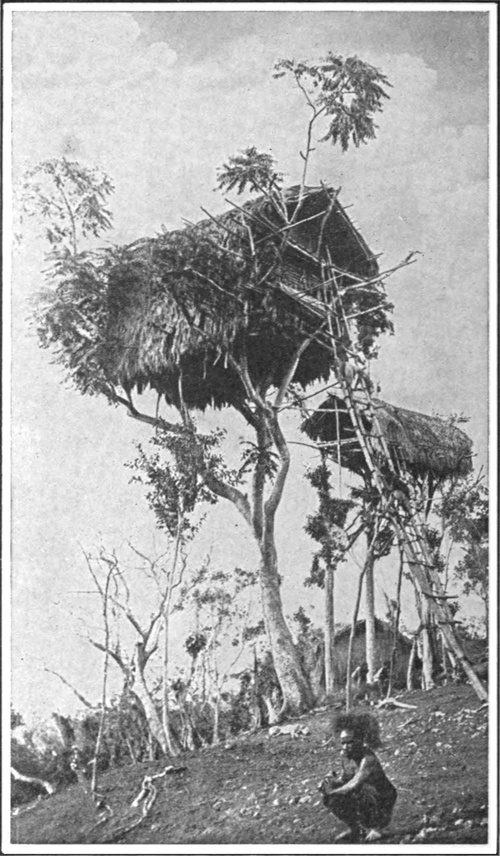
TREE DWELLERS IN THE TWENTIETH CENTURY
We must remember that such terms as “The Stone Age,” “The Bronze Age,” and so forth, are only loosely applied. The ages so called did not close at certain periods. There are races now living in all the conditions of these past ages. This photograph, for example, shows the actual tree dwellings of the Papuans in New Guinea to-day—one of the most primitive forms of human habitation.
If this be so, it is plain that climate, and the conditions of life which depend upon climate, soil, and the presence of vegetables and of other animals besides man, must have been the forces which moulded and developed those varieties. From a remote antiquity, everybody has connected the dark colour of all, or nearly all, the races inhabiting the torrid zone with the power of the sun; and the fairer skin of the races of the temperate and arctic zones with the comparative feebleness of his rays in those regions. This may be explained on Darwinian principles by supposing that the darker varieties were found more capable of supporting the fierce heat of the tropics. What explanation is to be given of the other characteristics of the negro and negroid races, of the usually frizzled hair, of the peculiar nose and jaw, and so forth, is a question for the naturalist rather than for the historian. Although climate and food may be the chief factors in differentiation, the nature of the process is, as indeed is the case with the species of animals generally, sometimes very obscure. Take an instance from three African races which, so far as we can tell, were formed under similar climatic conditions—the Bushmen, the Hottentots, and the Bantu, the race including those whom we call Kaffirs. Their physical aspect and colour are different. Their size and the structure of their bodies are different. Their mental aptitudes are different; and one of the oddest points of difference is this, that whereas the Bushmen are the least advanced, intellectually, morally, and politically, of the three races, as well as the physically weakest, they show a talent for drawing which is not possessed by the other two.
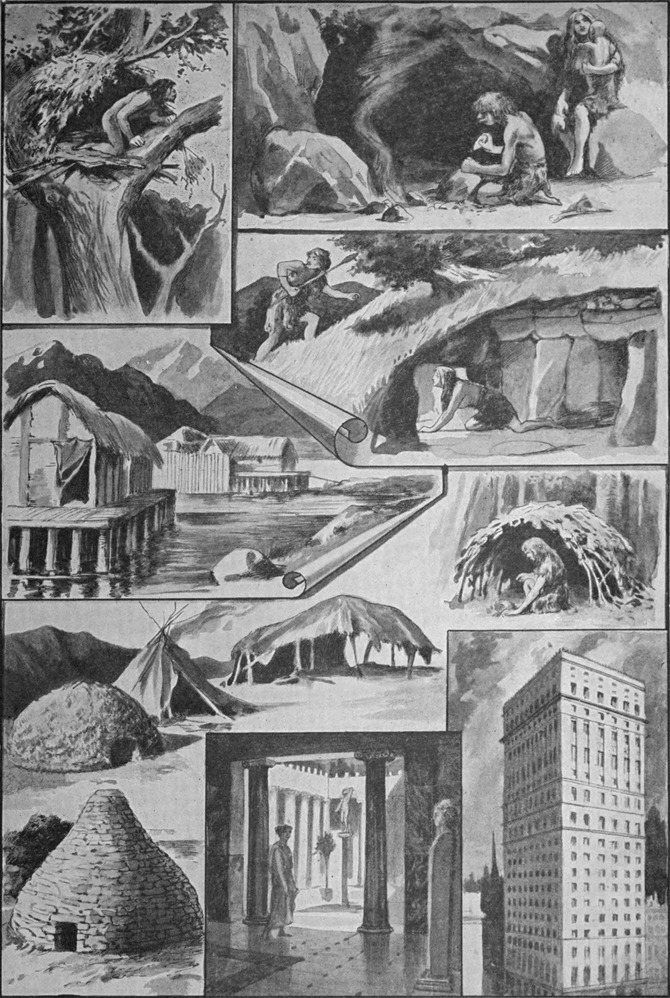
THE HABITATIONS OF MAN IN ALL AGES OF THE WORLD’S HISTORY
At first man built twig huts in trees, but becoming better matched with his animal foes he took to caves and underground habitations. Our illustration of the latter shows a section through the soil. Lake dwellings marked a distinct advance. Other varieties of primitive habitations are the leaf hut, the tents of skin, the mud hut, and the beehive hut of stone. Roman villas are still models of beauty. American “skyscrapers” are peculiar to our time; but all early forms of dwellings, while marking progress, have existed contemporaneously throughout history.
LARGER IMAGE
Is the Race Mystery Insoluble?
In this case there is, of course, a vast unknown fore-time during which we may imagine the Bantu race, probably originally formed in a region other than that which it now occupies (and under more favourable conditions for progress), to have become widely differentiated from those which are now the lower African races. We still know comparatively little about African ethnography. Let us, therefore, take another instance in which affinities of language give ground for believing that three races, whose differences are now marked, have diverged from a common stock. So far as language goes, the Celts, the Teutons, and the Slavs, all speaking Indo-European tongues, may be deemed to be all nearly connected in origin. They are marked by certain slight physical dissimilarities, and by perhaps rather more palpable dissimilarities in their respective intellectual and emotional characters. But so far as our knowledge goes, all three have lived for an immensely long period in the colder parts of the temperate zone, under similar external conditions, and following very much the same kind of pastoral and agricultural life. There is nothing in their environment which explains the divergences we perceive; so the origin of these divergences must apparently be sought either in admixture with other races or in some other historical causes which are, and will for ever remain, in the darkness of a recordless past.
Mixing of the World’s Peoples
How race admixture works, and how it forms a new definite character out of diverse elements, is a subject which anyone may find abundant materials for studying in the history of the last two thousand years. Nearly every modern European people has been so formed. The French, the Spaniards, and the English are all the products of a mixture, in different proportions, of at least three elements—Iberian (to use a current name), Celts, and Teutons, though the Celtic element is probably comparatively small in Spain, and the Teutonic comparatively small both in Spain and in Central and Southern France. No small part of those who to-day speak German and deem themselves Germans must be of Slavonic stock. Those who to-day speak Russian are very largely of Finnish, to some small extent of Tartar, blood. The Italians probably spring from an even larger number of race-sources, without mentioning the vast number of slaves brought from the East and the North into Italy between B.C. 100 and A.D. 300. In the cases of Switzerland and Scotland the process of fusion is not yet complete. The Celto-Burgundian Swiss of Neuchatel is still different from the Allemanian Swiss of Appenzell; as the Anglo-Celt of Fife is different from the Ibero-Celt of the Outer Hebrides. But in both these cases there is already a strong sense of national unity, and in another three hundred years there may have arisen a single type of character.
The Unique Case of Iceland
An interesting and almost unique case is furnished by Iceland, where isolation under peculiar conditions of climate, food, and social life has created a somewhat different type both of body and of mental character from that of the Norwegians, although so far as blood goes the two peoples are identical, Iceland having been colonised from Western Norway a thousand years ago, and both Icelanders and Norwegians having remained practically unmixed with any other race—save that some slight Celtic infusion came to Iceland with those who migrated thither from the Norse settlements in Ireland, Northern Scotland, and the Hebrides—since the separation took place. But by far the most remarkable instance of race admixture is that furnished in our own time by the United States of North America, where a people of predominantly English stock (although there were in the end of the eighteenth century a few descendants of Dutchmen, with Germans, Swedes, and Ulster Irishmen, in the country) has within the last sixty years received additions of many millions of Celts, of Germans and Scandinavians, and of various Slavonic races. At least a century must elapse before it can be seen how far this infusion of new blood will change the type of American character as it stood in 1840.
There are, however, two noteworthy differences between modern race fusions and those which belong to primitive times. One is that under modern conditions the influence of what may be called the social and political environment is probably very much greater than it was in early times. The American-born son of Irish parents is at forty years of age a very different creature from his cousin on the coast of Mayo. The other is that in modern times differences of colour retard or forbid the fusion of two races. So far as the Teutonic peoples are concerned, no one will intermarry with a negro; a very few with a Hindu, a Chinese, or a Malay. In the ancient world there was but little contact between white men and black or yellow ones, but the feeling of race aversion was apparently less strong than it is now, just as it was much less strong among the Spaniards and Portuguese in the sixteenth and seventeenth centuries than it is among Americans or Englishmen to-day. It is less strong even now among the so-called “Latin races;” and as regards the Anglo-Americans, it is much less strong towards the Red Indians than towards negroes.
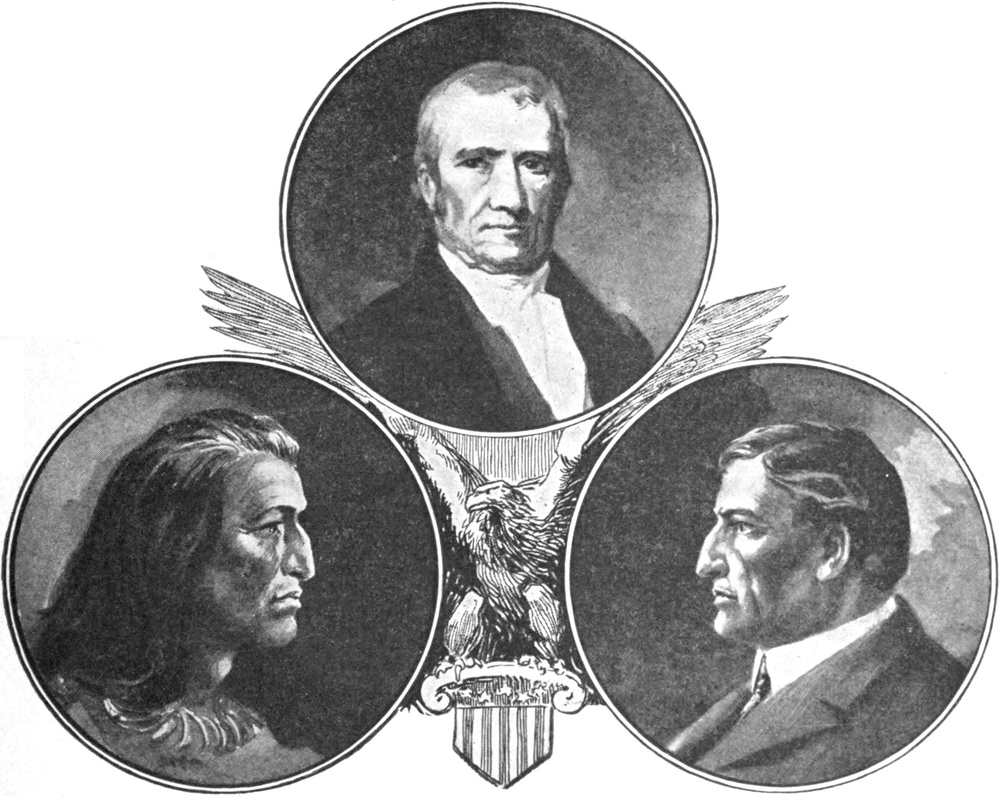
THE REMARKABLE INFLUENCE OF ENVIRONMENT ON PHYSICAL APPEARANCE
Mr. Bryce points out that the physical features of a people are determined chiefly by their environment. These illustrations show (at top) a typical English settler in the old Colonial days of America, a native Red Indian (left) and a typical American of to-day (right). Without any intermingling of red men and white, the modern American, thanks to climatic conditions, resembles the Red Indian far more closely than he does his own ancestors of the Colonial days.
As Nature must have been the main agent in the formation of the various races of mankind from a common stock, so also Nature has been the chief cause of their movements from one part of the earth to another, these movements having been in their turn a potent influence in the admixture of the races. Some geographers have alleged climate—that is to say, the desire of those who inhabit an inclement region to enjoy a softer and warmer air—as a principal motive which has induced tribes of nations to transfer themselves from one region to another.
It is no doubt true that the direction of migrations has almost always been either from the north towards the south, or else along parallels of latitude, men rarely seeking for themselves conditions more severe than those under which they were born. But it is usually not so much the wish to escape cold that has been an effective motive as the wish to find more and better food, since this means an altogether easier life. Scarcity of the means of subsistence, which is, of course, most felt when population is increasing, has operated more frequently and powerfully than any other cause in bringing on displacements of the races of man over the globe. The movement of the primitive Aryans into India from the plateaux of West Central Asia, probably also the movement of the races which speak Dravidian languages from South Central Asia into Southern India, and probably also the mighty descent, in the fourth and fifth centuries A.D., of the Teutonic races from the lands between the Baltic and the Alps into the Roman Empire, had this origin.
The Colonising Impulse
In more advanced states of society a like cause leads the surplus population of a civilised state to overflow into new lands, where there is more space, or the soil is more fertile. Thus the inhabitants of Southwestern Scotland, partly, no doubt, at the suggestion of their rulers, crossed over into Ulster, where they occupied the best lands, driving the aboriginal Celts into the rougher and higher districts, where their descendants remain in the glens of Antrim, and in the hilly parts of Down, Derry, and Tyrone. Thus the men of New England moved out to the West and settled in the Mississippi Valley, while the men of Virginia crossed the Alleghanies into Kentucky. Thus the English have colonised Canada and Australia and New Zealand and Natal. Thus the Russians have spread out from their ancient homes on the upper courses of the Dnieper and the Volga all over the vast steppes that stretch to the Black Sea and the Caucasus, as well as into the rich lands of Southwestern Siberia. Thus the surplus peasantry of Germany has gone not only to North America, but also to Southern Brazil and the shores of the Rio de la Plata.
The Need of Native Labour
In another form it is the excess of population over means of subsistence at home that has produced the remarkable outflow of the Chinese through the Eastern Archipelago and across the Pacific into North America, and that has carried the Japanese to the Hawaiian Islands. And here we touch another cause of migration which is indirectly traceable to Nature—namely, the demand in some countries for more labour or cheaper labour than the inhabitants of the country are able or willing to supply. Sometimes this demand is attributable to climatic causes. The Spaniards and Portuguese and English in the New World were unfitted by their physical constitutions for out-of-door labour under a tropical sun. Hence they imported negroes during the sixteenth and two following centuries in such numbers that there are now about eight millions of coloured people in the United States alone, and possibly (though no accurate figures exist) as many more in the West Indies and South America. To a much smaller extent the same need for foreign labour has recently brought Indian coolies to the shores of the Caribbean Sea, and to the hottest parts of Natal, as it brings Polynesians to the sugar plantations of Northern Queensland.
What Determines Race Movements
Two other causes which have been potent in bringing about displacements and mixtures of population are the desire for conquest and plunder and the sentiment of religion. But these belong less to the sphere of Nature than to that of human passion and emotion, so that they scarcely fall within this part of our inquiry, the aim of which has been to show how Nature has determined history by inducing a shifting of races from place to place. From this shifting there has come the contact of diverse elements, with changes in each race due to the influence of the other, or perhaps the absorption of one in the other, or the development of something new out of both. In considering these race movements we have been led from the remote periods in which they began, and of which we know scarcely anything except from archæological and linguistic data, to periods within the range of authentic history. So we may go on to see how Nature has determined the spots in which the industry of the more advanced races should build up the earliest civilisations, and the lines along which commerce, a principal agent in the extension of civilisation, should proceed to link one race with another.
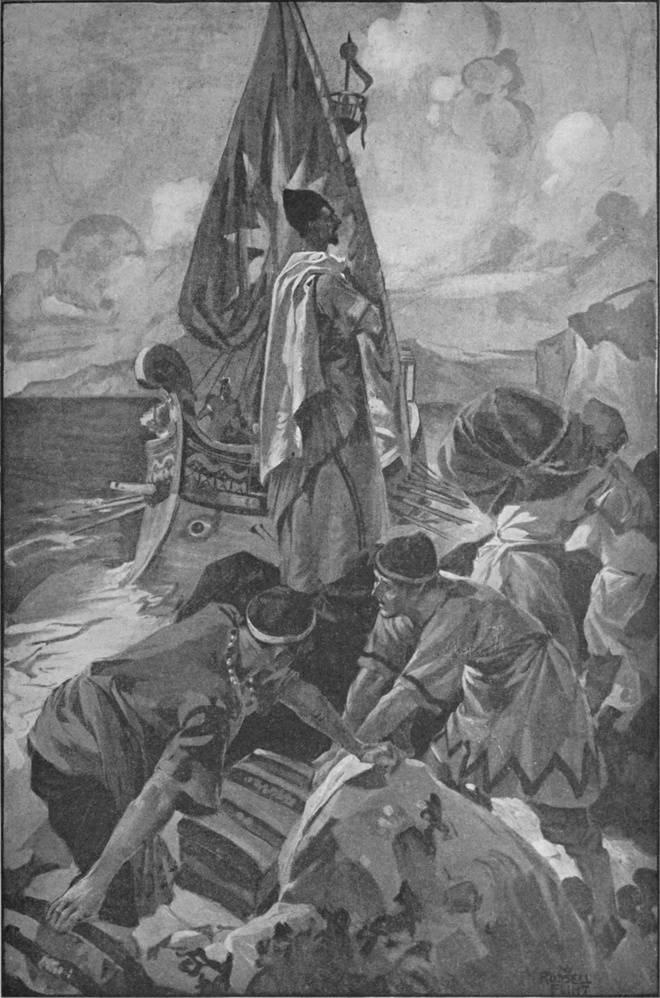
THE MERCHANT MARINERS OF THE ANCIENT WORLD
The earliest agents in the diffusion of trades and the arts were the Phœnicians, who from their great cities of Tyre, Sidon, and Carthage conducted a sea-borne traffic with lands as remote as England, and whose adventurous sailors, despite the smallness of their vessels, are believed even to have succeeded in rounding the Cape of Good Hope.
LARGER IMAGE
Isolation of Eastern Peoples
It was long since observed that the first homes of a dense population and a highly developed civilisation lay in fertile river valleys, such as those of the Lower Nile, the Euphrates, the Tigris, the Ganges, the Yang-tse-kiang. All these are situate in the hotter parts of the temperate zone; all are regions of exceptional fertility. The soil, especially when tillage has become general, is the first source of wealth; and it is in the midst of a prosperous agricultural population that cities spring up where handicrafts and the arts arise and flourish. The basins of the Lower Nile and of the Lower Euphrates and Tigris are (as respects the West Asiatic and Mediterranean world) the fountain-heads of material, military, and artistic civilisation. From them it spreads over the adjacent countries and along the coasts of Europe and Africa. On the east, Egypt and Mesopotamia are cut off by the deserts of Arabia and Eastern Persia from the perhaps equally ancient civilisation of India, which again is cut off by lofty and savage mountains from the very ancient civilisation of China. Nature forbade intercourse between these far eastern regions and the West Asian peoples, while on the other hand Nature permitted Egypt, Phœnicia, and Babylon to influence and become teachers of the peoples of Asia Minor and of the Greeks on both sides of the Ægean Sea. The isolation and consequent independent development of India and of China is one of the most salient and significant facts of history. It was not till the end of the fifteenth century, when the Portuguese reached the Malabar coast, that the Indian peoples began to come into the general movement of the world; for the expedition of Alexander the Great left hardly any permanent result, except upon Buddhist art, and the conquests of Mahmud of Ghazni opened no road to the East from the Mediterranean West. Nor did China, though visited by Italian travellers in the thirteenth century, by Portuguese traders and Jesuit missionaries in the sixteenth and seventeenth, come into effective contact with Europe till near our own time.
As the wastes of barren land formed an almost impassable eastern boundary to the West Asian civilisations, so on the west the expanse of sea brought Egypt and to a less extent Assyria (through Phœnicia) into touch with all the peoples who dwelt on the shores of the Mediterranean. The first agents in the diffusion of trade and the arts were the Phœnicians, established at Tyre, Sidon, and Carthage. The next were the Greeks. For more than two thousand years, from B.C. 700 onwards, the Mediterranean is practically the centre of the history of the world, because it is the highway both of commerce and of war. For seven hundred years after the end of the second century B.C., that is to say, while the Roman Empire remained strong, it was also the highway of civil administration. The Saracen conquests of the seventh century cut off North Africa and Syria from Europe, checked transmarine commerce, and created afresh the old opposition of East and West in which a thousand years earlier Herodotus had found the main thread of world history. But it was not till after the discovery of America that the Mediterranean began to yield to the Atlantic its primacy as the area of sea power and sea-borne trade.
Influence of the Seas in History
Bordered by far less fertile and climate-favoured countries, and closed to navigation during some months of winter, the Baltic has always held a place in history far below that of the Mediterranean. Yet it has determined the relations of the North European states and peoples. So, too, the North Sea has at one time exposed Britain to attack from the Danish and Norwegian lords of the sea, and at other times protected her from powerful continental enemies. It may indeed be said that in surrounding Europe by the sea on three sides, Nature has drawn the main lines which the course of events on this smallest but most important of the continents has had to follow.
Magellan and American Politics
Of the part which the great bodies of water have played, of the significance in the oceans of mighty currents like the Gulf Stream, the Polar Current, the Japan Current, the Mozambique Current, it would be impossible to speak within reasonable compass. But two remarks may be made before leaving this part of the subject. One is that man’s action in cutting through an isthmus may completely alter the conditions as given by Nature. The Suez Canal has of late years immensely enhanced the importance of the Mediterranean, already in some degree restored by the decay of Turkish power, by the industrial revival of Italy, and by the French conquests in North Africa. The cutting of a canal at Panama will change the relations of the seafaring and fleet-owning nations that are interested in the Atlantic and the Pacific. And the other remark is that the significance of a maritime discovery, however great at first, may become still greater with the lapse of time. Magellan, in his ever memorable voyage, not only penetrated to and crossed the Pacific, but discovered the Philippine Islands, and claimed them for the monarch who had sent him forth. His appropriation of them for the Crown of Spain, to which during these three centuries and a half they have brought no benefit, has been the cause which has led the republic of the United States to depart from its traditional policy of holding to its own continent by taking them as a prize—a distant and unexpected prize—of conquest.
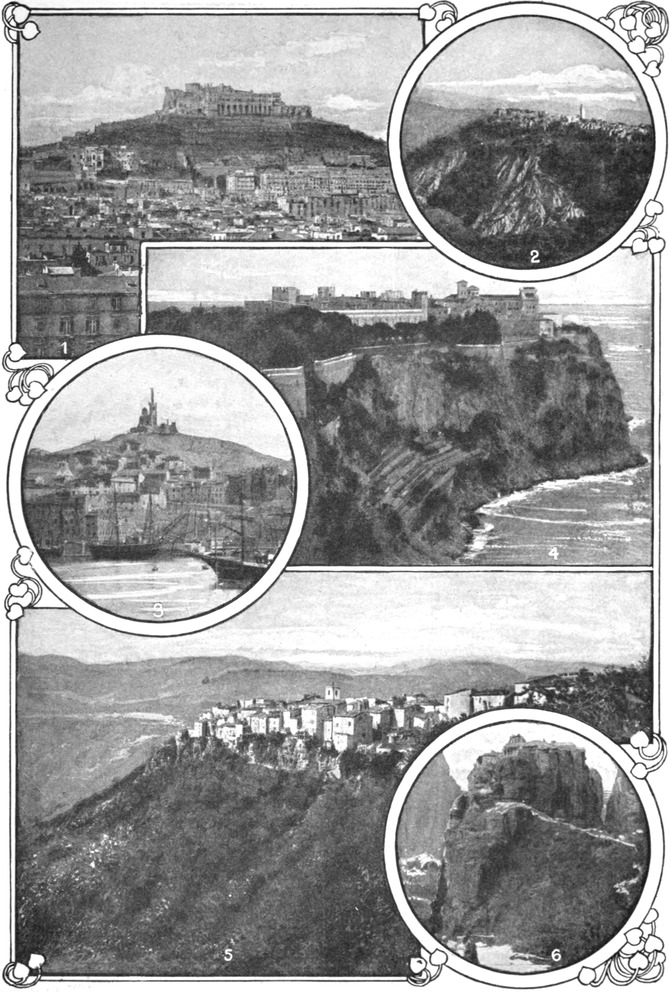
HOW NATURE DETERMINES THE SITES OF CITIES
Most towns and communities founded more than 300 years ago were on easily defensible hills, by the side of navigable rivers, or inlets of the sea. Our illustrations show (1) Naples, (2) Bonsuna, (3) Old Port and hill of Marseilles, (4) Monaco, (5) St. Cézaire, and (6) the Greek Monastery of St. Balaam.
Photos. by Frith and Underwood & Underwood
LARGER IMAGE
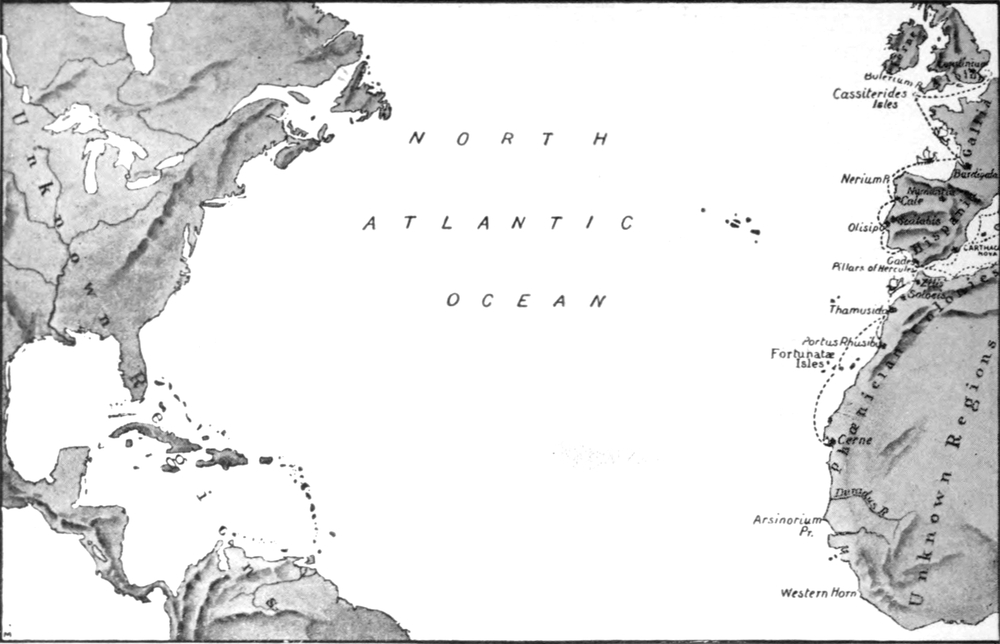
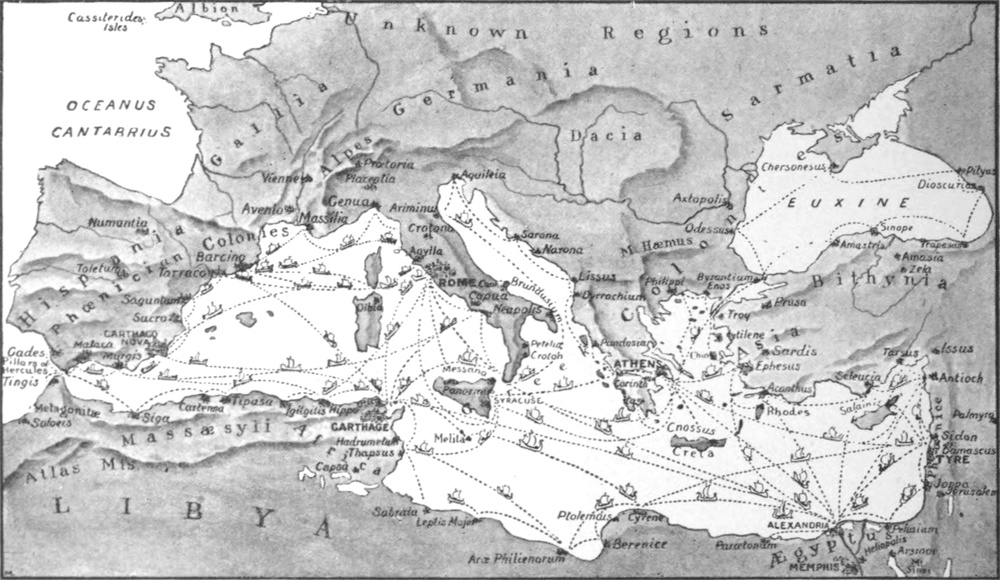
THE SHIFTING OF THE CENTRE OF THE WORLD’S COMMERCE
These two maps, which have been very carefully prepared from the most reliable authorities, indicate at a glance the relative importance of the Mediterranean and the Atlantic as highways of commerce in the time of Julius Cæsar, B.C. 102–44.
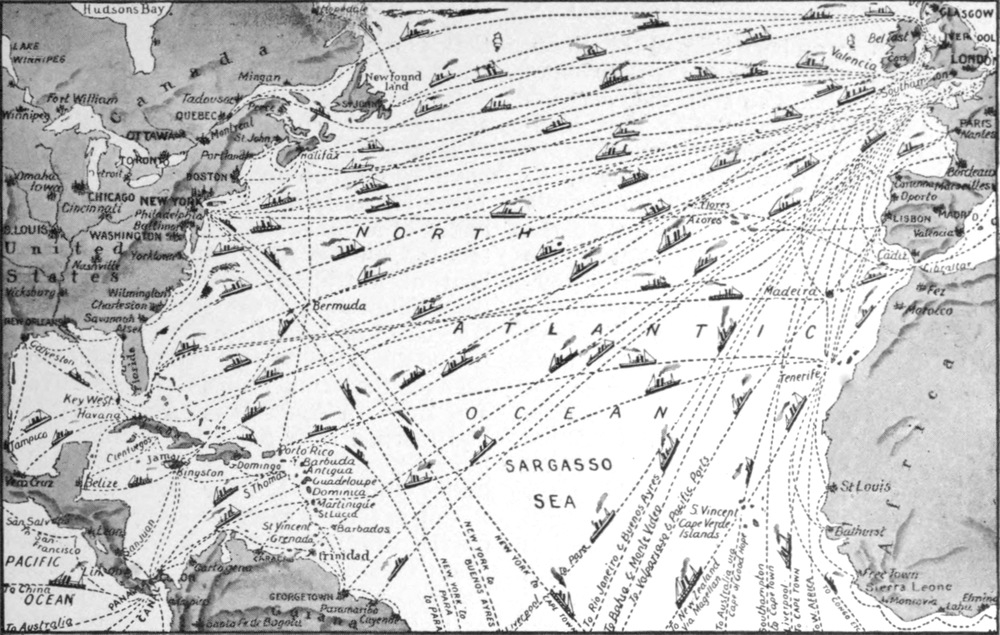
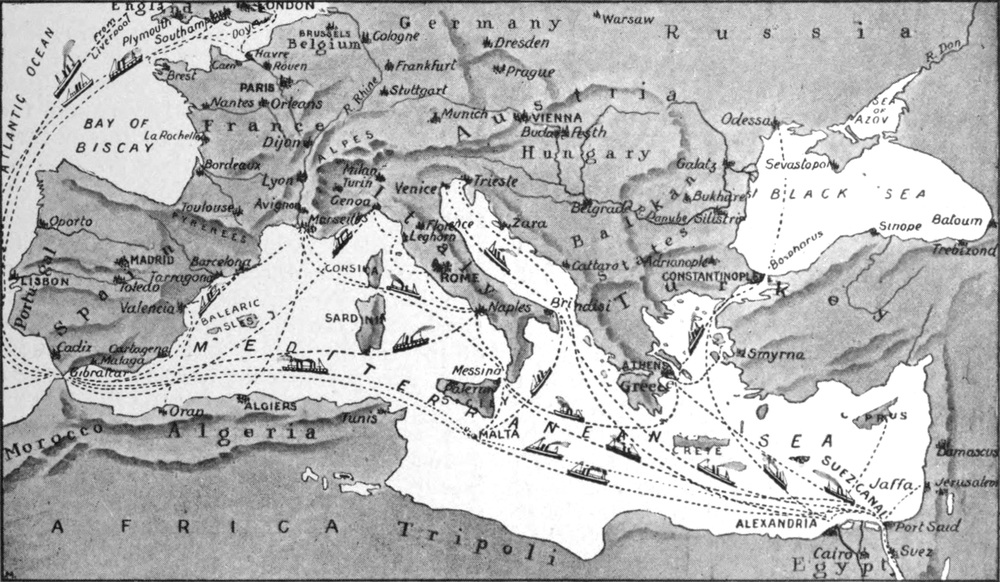
HOW THE MEDITERRANEAN HAS GIVEN PLACE TO THE ATLANTIC
Here is the contrast to the opposite page. In our time the Atlantic has become the centre of the world’s commerce, and the Mediterranean has sunk in importance. It would be almost deserted but for the routes to India via the Suez Canal.
A few words may suffice as to what Nature has done towards the formation of nations and States by the configuration of the surface of the dry land—that is to say, by mountain chains and by river valleys. The only natural boundaries, besides seas, are mountains and deserts. Rivers, though convenient frontier lines for the politician or the geographer, are not natural boundaries, but rather unite than dissever those who dwell on their opposite banks. Thus the great natural boundaries in Asia have been the deserts of Eastern Persia, of Turkestan, and of Northern Arabia, with the long Himalayan chain and the savage ranges apparently parallel to the Irawadi River, which separate the easternmost corner of India and Burmah from South-Western China. To a less extent the Altai and Thian Shan, and, to a still smaller extent, the Taurus in Eastern Asia Minor, have tended to divide peoples and States. The Caucasus, which fills the space between two great seas, has been at all times an extremely important factor in history, severing the nomad races of Scythia from the more civilised and settled inhabitants of the valleys of the Phasis and the Kura. Even to-day, when the Tsar holds sway on both sides of this chain, it constitutes a weakness in the position of Russia, and it helps to keep the Georgian races to the south from losing their identity in the mass of Russian subjects.
The Place of Mountains in History
Without the Alps and the Pyrenees, the annals of Europe must have been entirely different. The Alps, even more than the Italian climate, proved too much for the Romano-Germanic Emperors of the Middle Ages, who tried to rule both to the north and to the south of this wide mountain region. The Pyrenees have not only kept in existence the Basque people, but have repeatedly frustrated the attempts of monarchs to dominate both France and Spain. The mass of high moorland country which covers most of the space between the Solway Firth and the lower course of the Tweed has had something to do with the formation of a Scottish nation out of singularly diverse elements. The rugged mountains of Northern and Western Scotland, and the similar though less extensive hill country of Wales, have enabled Celtic races to retain their language and character in both these regions.
What Steam-power has Done
On the other hand, the vast open plains of Russia have allowed the Slavs of the districts which lie round Novgorod, Moscow, and Kiev to spread out among and Russify the Lithuanian and Finnish, to some extent also the Tartar, races, who originally held by far the larger part of that area. So, too, the Ural range, which, though long, is neither high nor difficult to pass, has opposed no serious obstacle to the overflow of population from Russia into Siberia. That in North America the Alleghanies have had a comparatively slight effect upon political history, although they did for a time arrest the march of colonisation, is due partly to the fact that they are a mass of comparatively low parallel ranges, with fertile valleys between, partly to the already advanced civilisation of the Anglo-Americans of the Atlantic seaboard, who found no great difficulty in making their way across, against the uncertain resistance of small and non-cohesive Indian tribes. A far more formidable natural barrier is formed between the Mississippi Valley and the Pacific slope by the Rocky Mountains, with the deserts of Arizona, Utah, Nevada, and Idaho. But the discovery of steam power has so much reduced the importance of this barrier that it does not seriously threaten the maintenance of a united American republic.
In one respect the New World presents a remarkable contrast to the Old. The earliest civilisations of the latter seem to have sprung up in fertile river valleys. Those of the former are found not on the banks of streams like the Nile or Euphrates, but on elevated plateaux, where the heat of a tropical sun is mitigated by height above sea level. It was in the lofty lake basin of Tezcuco and Mexico, and on the comparatively level ground which lies between the parallel ranges of the Peruvian and Bolivian Andes, that American races had reached their finest intellectual development, not in the far richer, but also hotter and less healthy river valleys of Brazil, or (unless we are to except Yucatan) on the scorching shores of the Caribbean Sea. Nature was in those regions too strong for man, and held him down in savagery.
How Nature fixes Sites of Cities
In determining the courses of great rivers, Nature has determined the first highways of trade and fixed the sites of many cities. Nearly all the considerable towns founded more than three centuries ago owe their origin either to their possessing good havens on the sea-coast, or to the natural strength of their position on a defensible hill, or to their standing close to a navigable river. Marseilles, Alexandria, New York, Rio de Janeiro, are instances of the first; Athens, Edinburgh, Prague, Moscow, of the second; Bordeaux, Cologne, New Orleans, Calcutta, of the third. Rome and London, Budapest, and Lyons combine the advantages of the second with those of the third. This function of rivers in directing the lines of commerce and the growth of centres of population has become much less important since the construction of railroads, yet population tends to stay where it has been first gathered, so that the fluviatile cities are likely to retain their preponderance. Thus the river is as important to the historian as is the mountain range or the sea.
Climate and Commerce
From the physical features of a country it is an easy transition to the capacities of the soil. The character of the products of a region determines the numbers of its inhabitants and the kind of life they lead. A land of forests breeds hunters or lumbermen; a land of pasture, which is too rough or too arid or too sterile for tillage, supports shepherds or herdsmen probably more or less nomadic. Either kind of land supports inhabitants few in proportion to its area. Fertile and well-watered regions rear a denser, a more settled, and presumably a more civilised population. Norway and Tyrol, Tibet and Wyoming, and the Orange River Colony, can never become so densely peopled as Bengal or Illinois or Lombardy, yet the fisheries of its coast and the seafaring energy of its people have sensibly increased the population of Norway. Thus he who knows the climate and the productive capacity of the soil of any given country can calculate its prospects of prosperity. Political causes may, of course, intervene. Asia Minor and the Valley of the Euphrates, regions once populous and flourishing, are now thinly inhabited and poverty-stricken because they are ruled by the Turks.
But these cases are exceptional. Bengal and Lombardy and Egypt have supported large populations under all kinds of government. The products of each country tend, moreover, to establish definite relations between it and other countries, and do this all the more as population, commerce, and the arts advance. When England was a great wool-growing and wool-exporting country, her wool export brought her into close political connection with the wool-manufacturing Flemish towns. She is now a cotton-manufacturing country, needing cotton which she cannot grow at all, and consuming wheat which she does not grow in sufficient quantities. Hence she is in close commercial relations with the United States on one side, which give her most of her cotton and much of her wheat, and with India, from which she gets both these articles, and to which she exports a large part of her manufactured cotton goods.
Common Needs make for Peace
So Rome, because she needed the corn of Egypt, kept Egypt under a specially careful administration. The rest of her corn came from Sicily and North Africa, and the Vandal conquest of North Africa dealt a frightful blow to the declining Empire. In these cases the common interest of sellers and buyers makes for peace, but in other cases the competition of countries desiring to keep commerce to themselves occasions war. The Spanish and Dutch fought over the trade to India in the earlier part of the seventeenth century, when the Portuguese Indies belonged to Spain, as the English and French fought in the eighteenth. And a nation, especially an insular nation, whose arable soil is not large enough or fertile enough to provide all the food it needs, has a powerful inducement either to seek peace or else to be prepared for maritime war. If such a country does not grow enough corn or meat at home, she must have a navy strong enough to make sure that she will always be able to get these necessaries from abroad. Attica did not produce all the grain needed to feed the Athenians, so they depended on the corn ships which came down from the Euxine, and were practically at the mercy of an enemy who could stop those ships.