Volume 1 — LIST OF MAPS APPEARING IN THE BOOK OF HISTORY (continued 5)
Reading edition
Like individuals, races differ in their mental characteristics. The English have one set of characters, the Japanese another, and the Russians a third. The problem of the extent to which these characters are inborn or acquired is very important to the student of history. Accordingly as we believe they are the one or the other we are driven to accept one or other of two very different readings of the past.
Influences in a Child’s Life
Are races, then, brave or cowardly, energetic or slothful, enlightened or savage, and so forth, by nature or by training? Are the qualities that have enabled some races to flourish, while others are decadent, transmitted as instincts or handed on, as knowledge is? The reader has now materials of a kind not usually found in historical works on which to found a judgment. He must bear in mind that, while an American infant reared by cannibals would retain the bodily characteristics of his race mentally, he could not be other than a savage. He must remember also that some races have altered their mental characteristics very rapidly. Thus, in the fifteenth and sixteenth centuries, immediately after the long Dark Ages, the British and several other European races suddenly became intellectually active and socially progressive. The Japanese supply a more modern, the Greeks and Romans more ancient, instances. The latter quite as suddenly sank into abysmal degradation. Innate mental characters, such as the instincts, usually change so slowly that not merely historical but geological time elapses before the alteration is perceptible. Again, the reader must note that, while the opinion that racial traits are inborn is nearly universal, most men act as if they knew them to be acquired; for nearly all men are careful in training their children, especially with respect to those traits that contribute to the formation of character.
Great Facts to Remember
Doubtless, races of men differ innately in mind as they do in body, but these differences can occur only within narrow limits. The instincts of all races are, of course, very similar, for all the instincts are essential to the preservation of life. But races may differ in strength of instinct, and more especially in powers of memory. Thus it is possible, or probable, that the English, for example, are more capable of profiting by experience than Australian blacks. Certainly, their brains are larger. On the other hand, the brain grows under the stimulus of use, and therefore the larger size of the English brain may be due to more arduous labour.
The Real Value of History
Lastly, the reader must ask himself the question: What mental effects have centuries of freedom or slavery, or of civilisation, or of barbarism, on races? Do they produce innate changes, or do they merely render certain acquirements so nearly universal that their perpetuation by imitation is insured? If he supposes that the changes are innate, he must ask himself the additional question whether they arose through the transmission of parental acquirements to offspring, or through the actual and constant destruction in certain environments of certain definite types of individuals who were thus prevented from leaving offspring and so perpetuating their like. The former hypothesis is now generally repudiated by science. The latter may be true, but as yet has not been supported by evidence; or at any rate is supported only by such evidence as that which Mill and Buckle denounced. In either case, though history may furnish him with intellectual occupation, it will supply few lessons of practical value. If, on the other hand, he has perceived the greatness of the part played in the human mind by acquirement, if he has noted that man is man, a thinking and rational being, the conqueror of the earth, only because he is the most impressionable and therefore the most adaptable of living types, the reader will learn from the racial see-saw of the past what kinds of mental training have conduced to success and happiness and what to ruin, and so perhaps he may find himself in a position to help the fortunes of his people and his children. The real value of history, as in the last analysis of all experience, lies in its educational applications.
G. ARCHDALL REID
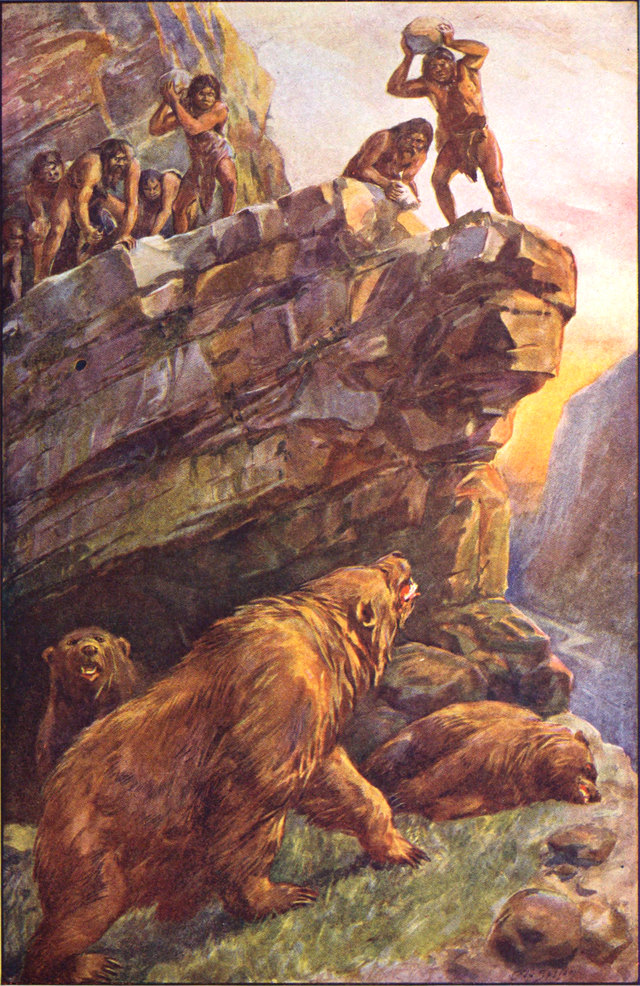
PREHISTORIC MEN ATTACKING THE GREAT CAVE BEARS
LARGER IMAGE
THE RISE OF MAN
AND THE EVE OF HISTORY
THE WORLD BEFORE HISTORY
By Professor Johannes Ranke
THE WONDERFUL STORY OF DRIFT MAN
Nature’s Great Book of History
T
THE history of the world is the history of the human mind. The oldest documents affording us knowledge of it lie buried in those most mighty and comprehensive historical archives, the geological strata of our planet. Natural philosophy has learned to read these stained, crumpled, and much-torn pages that record the habitation of the earth by living beings; but only a few sections of this book of the universe have yet been perused, and these appear but fragmentary in comparison with the whole task. The passages that relate to the human race are small in number and often even ambiguous, and it is only the last pages that can give an account of it.
The oldest undisputed traces of the presence of man on the earth that have hitherto been discovered are met with in the strata of the Drift Epoch, and it is only during the last generation that the existence of “Drift Man” has been palæontologically proved beyond dispute. The late Sir J. Prestwick believed, however—and his results have been confirmed by later discoveries—in the existence of evidence of the presence of man in Western Europe before the present river system of our land was established, long before the age of the “Drift” relics. The evidence consists of rudely shaped pieces of flint, apparently artificially chipped along one or more edges. These supposed implements are termed “Eoliths.” They were first discovered by Mr. Benjamin Harrison in the high-level plateau, probably of the Upper Pliocene Age, in Kent, and their significance is now widely accepted.
Up to the middle of last century research appeared to have established as a positive fact that man could not be traced back to the older geological strata; remains of man were said to be found only in the newest stratum of the earth’s formation—in the alluvial, or “recent” stratum. The bones of man were accordingly claimed to be sure guides to the geological formations of the present time, as the bones of the mammoth and cave-bear were to the strata of the Drift. Where traces of man were found it was considered as proved by natural science that the particular stratum in which they occurred was to be allotted to the most recent system, which we see forming and being transformed under our eyes at the present day.
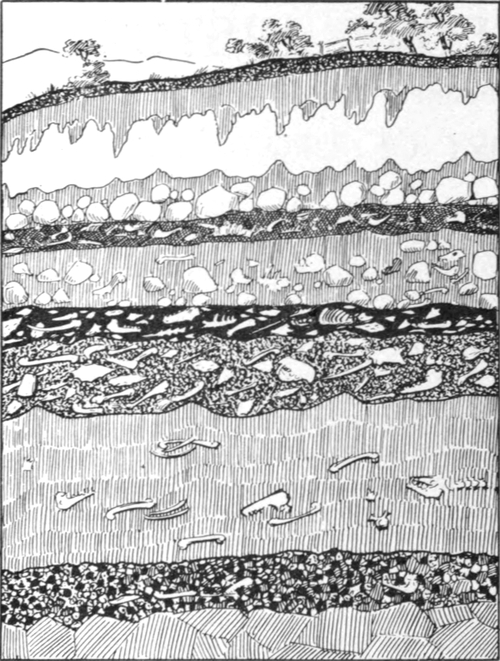
A PAGE FROM NATURE’S HISTORY BOOK
It is in the successive layers of the earth’s strata with their human and animal remains that we read the story of the past. Embedded in the earth itself we have the existence of “Drift Man” established. Our illustration is that of a section of the famous Kent’s Cavern, near Torquay, which is rich in prehistoric remains.
The Theory of Natural Catastrophes
While it was declared that man belonged to the alluvial stratum, it was at the same time stated, according to the doctrine of Cuvier, which had the weight of a dogma, that man could not have belonged to an older geological stratum or era, and therefore not even to the next older one, the Drift. The beginning and the end of geological eras are marked by mighty transformations which have caused a local interruption in the formation of the strata of the earth’s surface. In many cases we can point to volcanic eruptions as the chief causes, but more especially to a change in the distribution of land and water. Cuvier had conceived these changes involving the transformation to have been violent terrestrial revolutions, the collapse of all existing things, in which all living beings belonging to the past epoch must have been annihilated. It appeared impossible that a living thing could have survived this hypothetical battle of the elements, and passed from an older epoch into the next one; and the new epoch was supposed to have received plants and animals by re-creation. All this had to be applied to man also; he was supposed to have come into existence only in the alluvial period. Not without consideration for the Mosaic account of the Creation, which, like the creation legends of numerous peoples scattered far and wide over all the continents of the earth, tells of a great deluge at the beginning of the present age, the Pleistocene Epoch of the earth’s formation preceding the present period had been termed the Flood Epoch, or Diluvium. In its stratifications it was thought that the effects of great deluges could largely be recognised; but the human eye could not have beheld these, for, according to the catastrophe theory, it appeared out of the question that man could have been “witness of the Flood.”
What Actually Happened
Here modern research in the primeval history or palæontology of mankind begins, starting from the complete transformation of the doctrine of the geological epochs brought about by Lyell and his school. Proofs of terrestrial revolutions, as local phenomena and epoch marks, are doubtless to be found, imposing enough to make the views of the older school appear intelligible; but, generally speaking, a complete interruption of the existing conditions did not take place between the periods. Everything tends to prove that even in the earlier eras the transformation of the earth’s surface went on in practically the same way as we see it going on before our eyes to-day in a degree that is slight only to appearance. The effects of volcanic action; the rising and sinking of continents and islands, and the alteration in the distribution of sea and land caused thereby; the inroads of the sea and its work in the destruction of coasts; the formation of deltas and the overflowing of rivers; the action of glaciers and torrents in the mountains, and so forth, are constantly working, more or less, at the transformation of the earth’s surface.
Nature’s Unbroken Chain
As we see these newest alluvial deposits being formed, so in principle have the strata of the earlier eras also been formed, and their miles of thickness prove, not the violence of extreme and sudden catastrophes, but only the length of time that was necessary to remove such mighty masses here and pile them up there. It was not sudden general revolutions of great violence, but the slowly working forces, small only to appearance, well known from our present-day surroundings, which destroy in one place and build up again in another with the material obtained from the destruction—it was these which were the causes of the gradual transformation of the earth in all periods of its history comparable to the present. According to this new conception of geological processes, a general destruction of plants and animals at the end of eras, and a new creation at the beginning of the following ones, was no longer a postulate of science as it had been. The living creatures of the earliest eras could now be claimed as ancestors of those living to-day; the chain seems nowhere completely broken. The ancestors of the human race were also to be sought in the strata of the earlier geological periods.
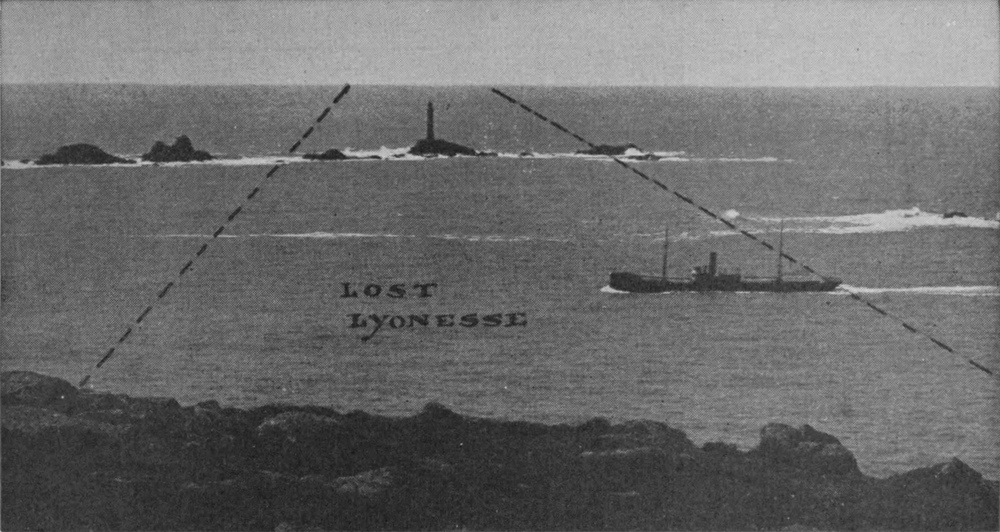
This indicates a vast stretch of the lost land of England, looking towards the Scilly Isles from Land’s End. All between the broken lines was once land as far as Scilly, thirty miles away and fifty miles thence to Lizard Point.
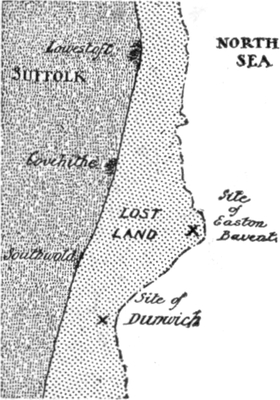
In old maps Bavent was formerly the most easterly point of England; now that is Lowestoft.
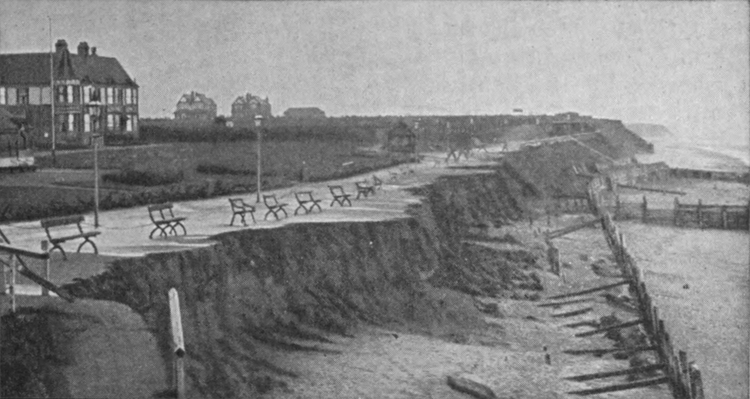
The coast of England is being slowly worn away by the sea. In many places houses have been swallowed up. Here we see the disintegrating process going on at Holderness, where the sea front presented this appearance after a gale.
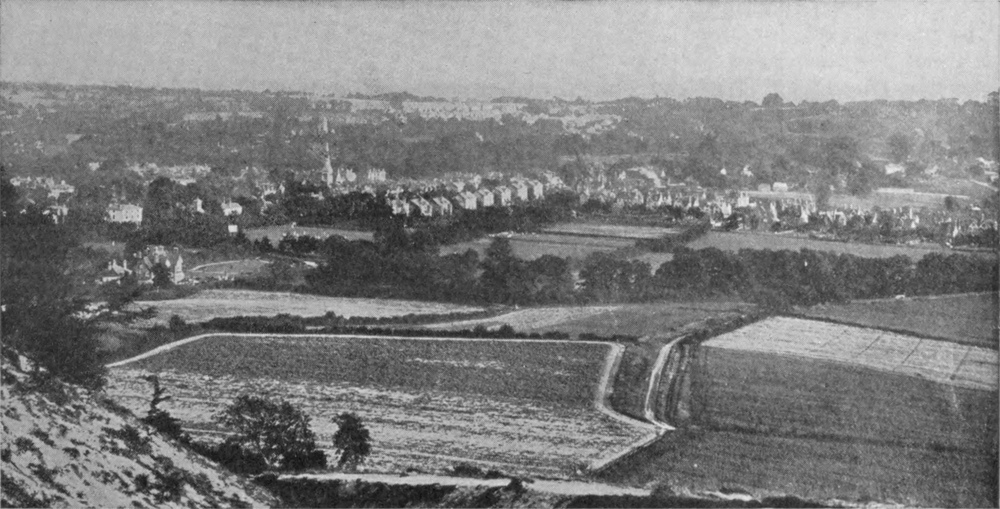
SLOW INFLUENCES THAT DESTROY IN ONE PLACE AND BUILD UP IN ANOTHER
The coming of the sea over the land is so slow as to be almost imperceptible, but these pictures illustrate its progress. The pictures in the upper half of the page show how the sea is encroaching on the coast; the opposite result is shown in the bottom view from Reigate Hill, where we see an ancient arm of the sea now a rich and populous valley.
Among the forces which we find attended by a transformation of the fauna and flora of the earth’s eras, the influences of climatic changes in particular are clearly and surely shown. In that primeval period in which the coal group was formed the climate in widely different parts of the earth was comparatively equable, little divided into zones, and of a moist warmth; this is proved by the really gigantic masses of plant growth implied by the formation of many coal strata, in which the remains of a luxuriant cryptogamic flora are everywhere embedded. In Greenland, in the strata belonging to the chalk period, and even in the deposits of the Tertiary Period, which immediately precedes the Drift Era, the remains of higher dicotyledonous plants of tropical character are found. The occurrence of palæozoic coral reefs in high latitudes also goes to prove that the temperature of the sea water there was higher at that time: in fact, that a tropical climate existed in the farthest north—an extreme contrast to the present ice-sheet on its land and the icebergs of its seas.
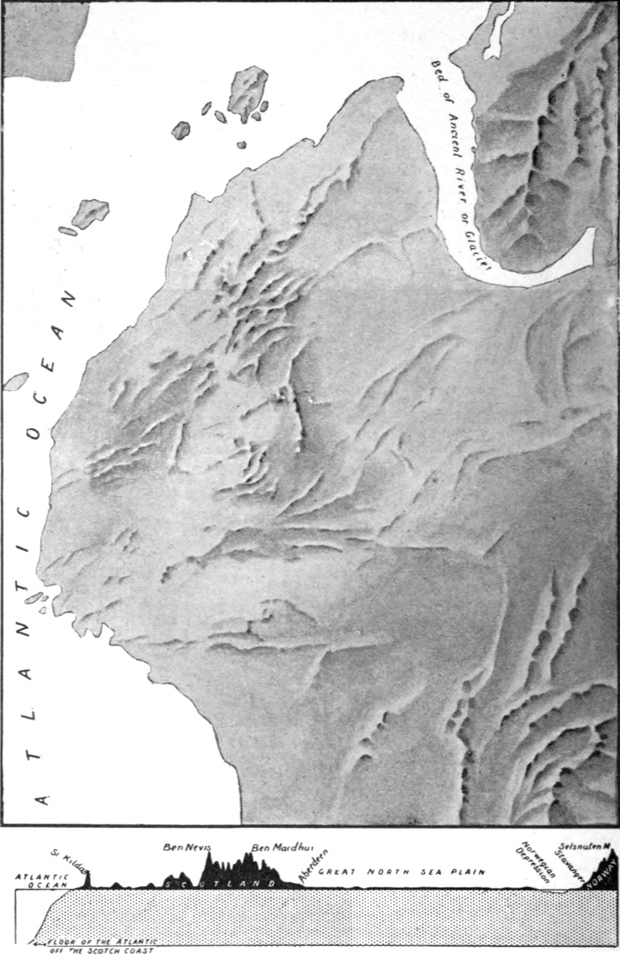
EUROPE BEFORE THE BRITISH ISLES WERE FORMED
This map and section illustrate the coast line of Prehistoric Europe when the British Isles were part of the Continent and the North Sea did not exist. The black parts of the section were all above the level of the Atlantic.
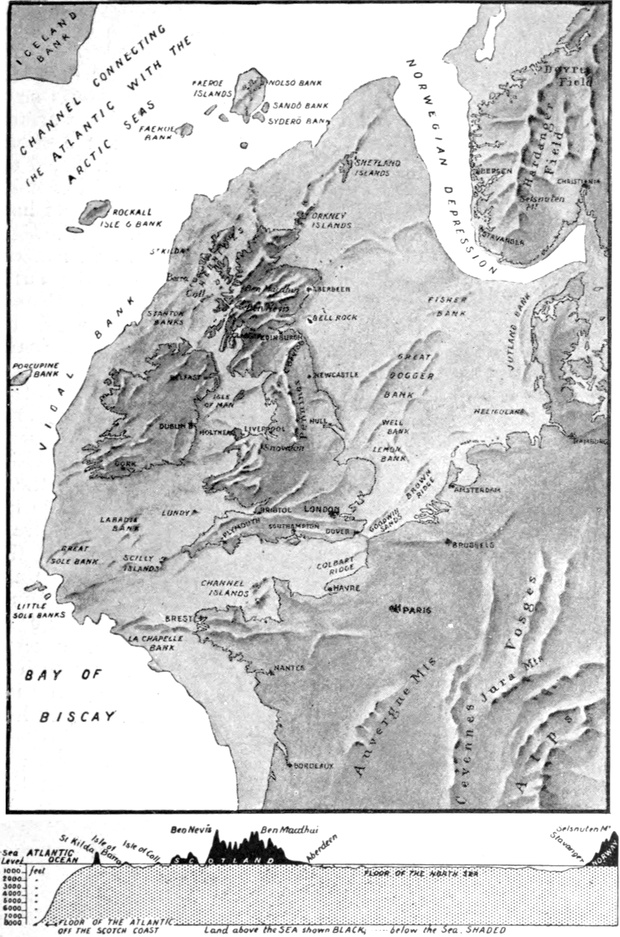
THE SUBMERGED LANDS OF EUROPE
This map and section show how the Continental shelf of Europe runs out to the Atlantic, and how enormous is the area now submerged in the comparatively shallow water of the North Sea, the Irish Sea, and the Channel.
In Central Europe the climatic conditions can have been only slightly different. During the middle Tertiary Period palms grew in Switzerland; and even at the end of the Tertiary Period, as it was slowly passing into the Drift Era, the climate in Central Europe was still warmer than now, being much like that of Northern Italy, and its protected west coast the Riviera. There was also a rich flora, partly evergreen, and a fauna adapted to such mild surroundings. Even in the oldest (Preglacial) strata, and again in the middle (Interglacial) strata of the Central European drift, there was still an abundant plant-growth requiring a temperate climate, at any rate not more severe than Central Europe possesses at the present day. Our chief forest trees grew even then—the pine, fir, larch, and yew, and also the oak, maple, birch, hazel, etc. On the other hand, Northern and Alpine forms are absent among the plants. The same holds good of the animal world, which was certainly much farther removed than the plant world from the conditions prevailing now. The gigantic forms—the elephant, rhinoceros, and hippopotamus—appear particularly strange to us, as also the large beasts of prey—the hyena, lion, etc. But besides these, and the giant deer with its powerful antlers, and two large bovine species—the bison and the urus—there were also the majority of the present wild animals of Central and Northern Europe that were originally natives—as the horse, stag, roe, wild boar, and beaver, with the smaller rodents and insectivora, and the wolf, fox, lynx, and bears, of which last the cave-bear was far larger than the present brown bear, and even than the Polar and grizzly bears.
We have sure proofs that through a decrease in the yearly temperature a glacial period set in over Europe, North Asia, and North America, burying vast areas under a sheet of ice, of the effect and extent of which Northern Greenland, with its ground-relief veiled in inland ice, can give us an idea.
The immediate consequence of this total climatic change was an essential change in the fauna. Forms that were not suited to the deteriorated climate, that could neither stand it nor adapt themselves to it, were first compelled to retire, and then were exterminated. This fate befell the hippopotamuses, and also one of the two elephant species, Elephas antiquus, with its dwarf breeds in Sicily and Malta, probably thus developed by this retreat; then the rhinoceros-like Elasmotherium, a species of beaver; the Trogontherium, and the powerful cat Machairodus or Trucifelis, which still lived in England, France, and Liguria during the Drift Period. Other animals, like the lion and hyena, withdrew to more southerly regions, not affected by the increasing cold and more remote from its effects.
The Older Drift Animals
On the other hand, according to Von Zittel’s description, an immigration of cold-loving land animals took place, which at the present day live either in the Far North or on the wild Asiatic steppes, or in the high mountain ranges. These new immigrants mixed with the surviving forms of the older drift fauna. The latter lived, as we have seen, by no means in a warm climate, but only in a temperate “northerly” one, even in the warmer periods of the epoch. So we can understand that many of this older animal community were well able to adapt themselves to colder climatic conditions, and among them two of the large Drift pachydermata, the elephant and rhinoceros, whose kin we now find only in the warmest climes. But a thick woolly coat made these two Drift animals well fitted to defy a raw climate—namely, the woolly-haired mammoth, Elephas primigenius, one of the two Drift species of elephants of Europe, and the woolly-haired rhinoceros, Rhinoceros antiquitatis. A second species of rhinoceros, Rhinoceros merckii, was also preserved, and maintained its region of distribution. The horse was now more largely distributed, and inhabited the plains in herds; but, above all, the reindeer immigrated along with other animals that now belong only to Far Northern and Arctic regions, and pastured in large herds at the edges of the glaciers. With the reindeer, although less frequent, was the musk-ox of the Far North, besides many other cold-loving species, such as the lemming, snow-mouse, glutton, ermine, and Arctic fox. Many of the animal forms that were very frequent then, in the Drift Period, appear now in Central Europe only as Alpine dwellers, living on the borders of eternal snow, such as the ibex, chamois, marmot, and Alpine hare.
The Animal Invasion of Europe The Change of the Ice Age Climate
Of special importance for our main question is the great invasion of Europe by Central Asiatic animals; immigrants direct from the Asiatic steppes pushed westward “as in a migration of nations,” among them the wild ass, saiga antelope, bobac, Asiatic porcupine, zizel, jumping mouse, whistling hare, and musk shrew-mouse. According as the glaciers and inland ice grew or shrank, the animals of the glacial period advanced more or less far to the North or retired more to the South, extending or reducing their range of distribution. The Glacial Period was no invariable climatic phenomenon. It is perfectly certain that a first Glacial Period with a low yearly temperature, under the influence of which the ice-masses, with their moraines, advanced a long way from the North and from the high mountains, so that in Germany, for instance, only a comparatively narrow strip remained free and habitable for higher forms of life between the two opposing rivers of ice—was succeeded by at least one period of warmer climate, and that certainly not a short one. The mean yearly temperature had increased so much that the ice-masses melted to a considerable extent, and had to retire far to the North and into the high valleys of the Alps. In this warmer Interglacial Period, as it is called, the Drift animals advanced far to the North, especially the mammoth, which, with the exception of the greater part of Scandinavia and Finland (districts which remained covered with ice during the Interglacial Period), is distributed throughout the drift strata of the whole of Europe and North Africa, and as far as Lake Baikal and the Caspian Sea in Northern Asia. Even the older Drift fauna, so far as it had not yet died out or retired, returned to its old habitats, so that the Interglacial fauna of Central Europe appear very similar to the Preglacial fauna. A long-sustained decrease of temperature led once more to the growth of the ice, which in this second Glacial Period almost reconquered the territory it had won at first.
In consequence of these oscillations in the climatic conditions of the Drift Era as a whole, we have to distinguish the Preglacial Era and the Interglacial Era, as warmer sub-periods of the Drift, from the real Glacial Periods. The latter appear as a first, or earlier, and a second, or later Glacial Period, as remains of which the zone of the older moraines and the zone of the later ones clearly mark the limits of the former glaciation.
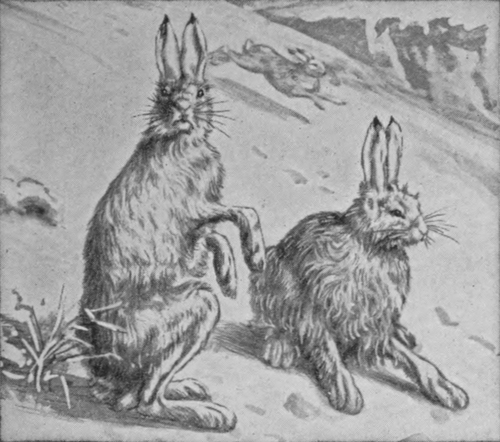
Alpine Hares
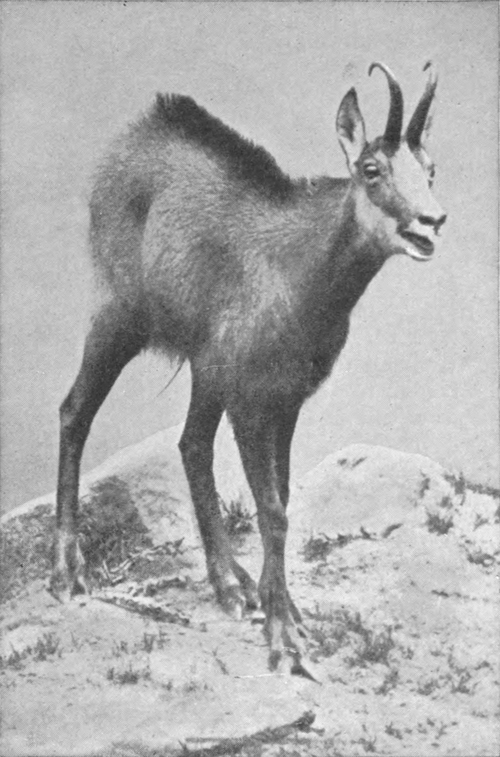
The Chamois
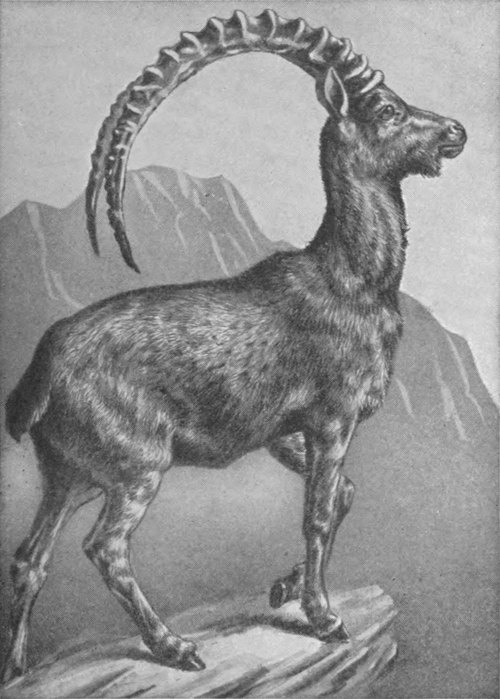
The Ibex
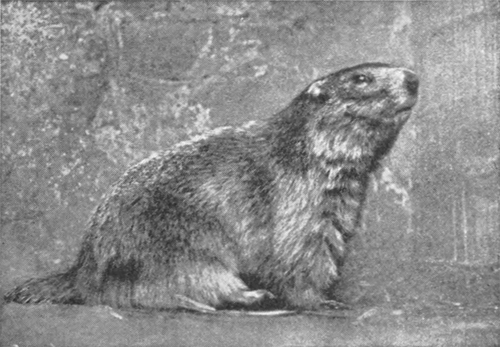
Dando
The Marmot
TYPES OF ANIMALS SURVIVING IN CENTRAL EUROPE FROM THE DRIFT PERIOD
Many of the animal forms that were very frequent in the Drift Period appear now in Central Europe only as Alpine dwellers, living on the borders of eternal snow. Such are the ibex, chamois, marmot, and Alpine hare.
Breaking up of the Earth
It was this second deterioration of the climate, with the fresh advances made by the glaciers and masses of inland ice, which definitely did away with the older Drift fauna that was not equal to the sudden climatic change. Nor did the woolly-haired rhinoceros, the Rhinoceros merckii, and the cave-bear survive the climax of the new Glacial Period. Even the woolly-haired mammoth succumbed. It and the woolly-haired rhinoceros, accompanied by the musk-ox and bison, had made their way into the Far North of Asia. But while the two last species bore the inclemencies of the climate, the rhinoceroses and elephants met their end here. And yet they had long preserved their lives on the borders of eternal ice. Whole carcases, both of the woolly-haired and Merckian rhinoceroses, and also of the woolly-haired mammoth, the bison, and the musk-ox, with skin and hair and well-preserved soft parts, have been discovered in the ice and frozen ground between the Yenisei and Lena, and on the New Siberian Islands at the mouth of the Lena. The carcases of the mammoth and rhinoceros found imbedded in the ice were covered with a coat of thick woolly hair and reddish-brown bristles ten inches long; about thirty pounds of hair from such a mammoth were placed in the St. Petersburg Natural History Museum. A mane hung from the animal’s neck almost to its knees, and on its head was soft hair a yard long. The animals were therefore in this respect well equipped for enduring a cold climate. As regards their food they were also adapted to a cold climate, traces of coniferæ and willows—that is, “Northern plants”—having been found in the hollows of the molar teeth of mammoths and rhinoceroses. The mammoth proves to have had greater resisting power, and to have been more fit for further migrations, than the rhinoceros. The latter’s range of distribution extended over the whole of Northern and Temperate Europe, China and Central Asia, and Northern Asia and Siberia. But, as we have seen, the mammoth penetrated not only into North Africa, but, what is of the highest importance for the proper understanding of the settling of the New World, even into North America.
Companions of the Mammoth Mammoth’s Arrival in Europe
The connection which in earlier geological periods had united Europe, Asia, Africa, and North America in the greatest homogeneous zoogeographical kingdom, the Arctogæa, was broken during the Tertiary and Drift Periods, so that several zoogeographical provinces were formed. The connection with North America was the first to be broken, so that even in the last two divisions of the Tertiary Period, the Miocene and Pliocene Epochs, the Old and the New Worlds stood in the relation of independent zoogeographical provinces to one another. Now, it is of the greatest importance to note that during the Drift Period North America again received some Northern immigrants from the Old World, according to Von Zittel “probably viâ Eastern Asia.” Consequently, during the Drift Period communication existed, at least temporarily, between Asia and North America in the region of Bering Strait, sufficient to allow the mammoth and some companions to migrate from the one continent to the other. In Kotzebue Sound mammoth remains are found in the “ground-ice formation,” together with those of the horse, elk, reindeer, musk-ox and bison. Mammoth remains are also known to have been found in the Bering Islands, St. George in the Pribylov group, and Unalaska, one of the Aleutian Islands. In that period the mammoth arrived in the New World as a colonist driven from the Old. It spread widely over British North America, Alaska, and Canada; it has also been found in Kentucky. A relatively recent union of the circumpolar regions of the Northern Hemisphere—of Europe, Asia, and North America—is also proved by the occurrence of animals that we recognise as companions of the mammoth, but which, surviving the Glacial Period, are still distributed over the whole region, such as the reindeer, elk, and bison. The absence in Asia of several animals specially characteristic of the European Drift (the hippopotamus, ibex, chamois, fallow-dear, wildcat, and cave-bear) explains also their absence in the North American Drift fauna. It is particularly strange that the cave-bear did not reach Northern Asia. It is otherwise the most frequent beast of prey of the Drift Period, and hundreds of its carcases often lie buried in the caves and clefts it once inhabited. In Southern Russia numerous remains of it are found, whereas in the English caves it is rarer, the cave-hyena predominating here. Apart from the exceptions just mentioned, J. F. Brandt considers North Asia and the high Northern latitudes to be the region in which the European, North Asiatic, and North American land fauna had concentrated during the Tertiary and Drift Periods, and whence their migrations and advances took place according as it grew older. As the northern fauna spread over more southern latitudes during the Drift Period, they took possession of the habitats of the species there belonging to the Tertiary Period, drove them back into tropical and subtropical regions, and formed the real stock of the Drift fauna, as described by Von Zittel in his “Palæozoology.”
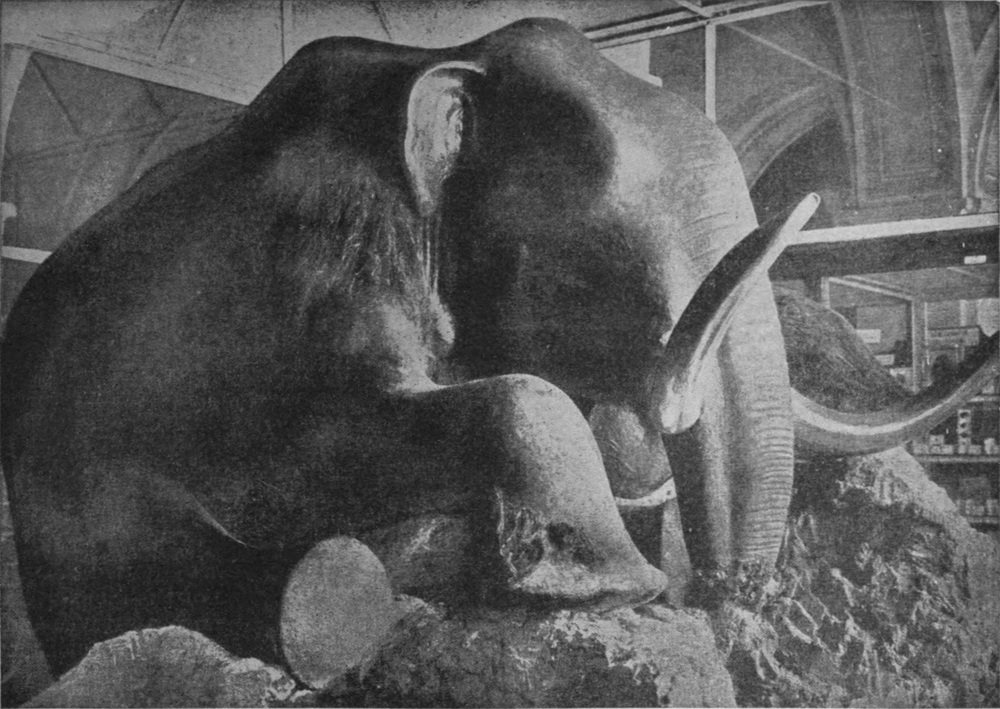
AN ACTUAL PHOTOGRAPH OF THE PREHISTORIC MAMMOTH
This stuffed carcase of a mammoth is the rarest treasure of St. Petersburg Academy. Skeletons of these creatures exist in plenty, but actual carcases are very rare. This was found embedded in the ice on the New Siberian Islands. One carcase so embedded was discovered five years before it could be freed from the ice.
One thing is certain—namely, that the northern borders of Siberia were not the real home of the mammoth and its companions; the original habitat of these animals points to the far interior of Asia, particularly to the wild table-lands, where they so far steeled themselves in enduring the climate that in the course of the Glacial Period half the world became accessible to them. As far as is known to-day, the mammoth arrived in Europe earlier than on the northern borders of Asia, where, protected by climatic conditions, its remains are most numerous and best preserved. The number of these gigantic animals must have been very considerable in this Far Northern region for a time, judging from the abundance of bones found there. In Central Europe only a few places are known—such as Kannstatt, Predmost in Moravia, etc.—where the mammoth is found with similar frequency. The mammoth attained its widest distribution in the Interglacial Period. In that period it crossed the Alps, and arrived on the other side, in North Asia, at the border of the “stone-ice” masses of inland ice that were still preserved from the first Glacial Period. The vegetation there was richer then than it is to-day; now only the vegetation of the tundra can exist. Animals found coniferæ, willows, and alders in sufficient quantity to enable them to keep in herds. All the same, we have not to imagine the climate on the borders of the ice to have been “genial,” for from that period originate the mammoth carcases that are found frozen entire in crevasses of the ice-fields. When the new period of cold—the second Glacial Period—began, these Far Northern regions must have become unsuitable for the mammoth owing to the want of food. Von Toll, who has examined the fossil ice-beds and, their relation to the mammoth carcases particularly on New Siberian Islands, says:
The mammoths and their contemporaries lived where their remains are found; they died out gradually in consequence of physical geographical changes in the region they inhabited, and through no catastrophe; their carcases were deposited during low temperatures, partly on the river-terraces, and partly on the banks of lakes or on glaciers (inland ice), and covered with mud; like the ice-masses that formed the foundation of their graves, their mummies were preserved to the present day, thanks to the persistent or increasing cold.
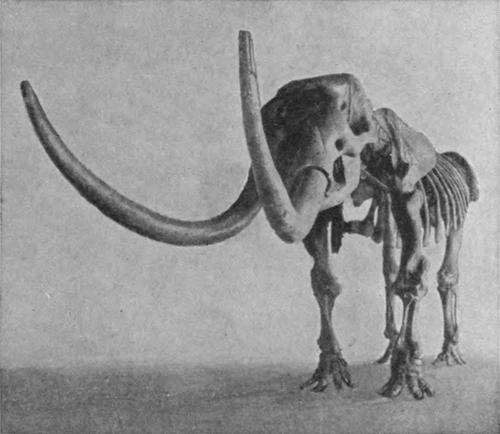
SKELETON OF A MAMMOTH
in the Natural History Museum, South Kensington.
The woolly-haired mammoth did not survive the second Glacial Period anywhere; in the post-Glacial Period its traces have disappeared.
The Drift series of strata are nowhere so clearly exemplified as in the New Siberian Islands, where the Drift stone-ice still forms very extensive high “ice-cliffs,” always covered with a layer of loam, sand, and peat, and having precipices often of great height—in one place seventy-two feet.
Embedded in these cliffs of stone-ice have been found the mammoth carcases, which formerly sank into crevices in the ice. These crevices are partly filled up with snow, which has turned into “firn” and finally into ice, but partly also with loam or sand, which are merged above immediately into the strata overlying the stone-ice. In the year 1860 Bojavski, the mammoth-hunter, found a mammoth, with all its soft parts preserved, sticking upright in a crevice in the ice filled with loam; in 1863 it was thrown down, together with the coast-wall that sheltered it, and washed away by the sea.
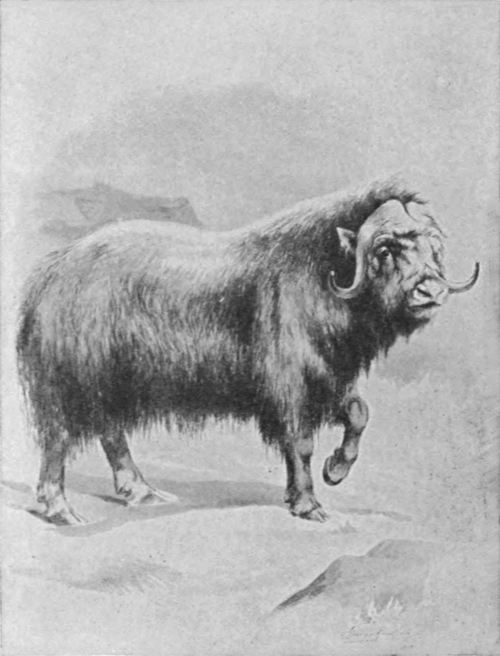
A SURVIVOR OF THE DRIFT PERIOD
Only one representative of the great Drift fauna, the musk-ox, has been able to preserve its life to the present day on the larger remnants of its former vast home, such as Greenland and Grinnell Land.
The Tunguse Schumachow had been more fortunate as early as 1799. During his boating expeditions along the coast, on the look-out for mammoth-tusks, he observed one day, between blocks of ice, a shapeless block which was not at all like the masses of driftwood that are generally found there. In the following year the block had melted a little, but it was only at the end of the third summer that the whole side and one of the tusks of a mammoth appeared plainly out of the ice; the animal, however, still remained sunk in the ice-masses. At last, towards the end of the fifth year, the ice between the ground and the mammoth melted more quickly than the rest, the base began to slope, and the enormous mass, impelled by its own weight, glided down on to the sand of the coast. Here Adams found the carcase in 1806, or as much as the dogs and wild animals had left of it. The whole skeleton, with a portion of the flesh, skin, and hair, has since formed one of the chief ornaments of the collection in the Academy at St. Petersburg. According to Von Toll, who personally visited the site of Bojavski’s discovery, the following profile presented itself there: first the tundra stratum; then an alternation of thin strata of loam and ice; under these a peat-like layer of grass, leaves, and other vegetation, that had been washed together; then a fine layer of sand, with remains of Salix, etc., and finally stone-ice. At another place, in Gulf Anabar, in 73° north latitude, Von Toll also found the ground-moraine under a fossil ice-bed, which appears to prove his theory of a Drift region of inland ice, of which the stone-ice beds of New Siberia and Eschscholtz Bay are remains.
Of these strata the frozen loam deposits over the stone-ice, containing the willow and the alder, are doubtless Interglacial. Some of the remains of the alder are in such wonderful preservation that there are still leaves and whole clusters of catkins on the branches.
The land-mass to which the present New Siberian Islands belong was only dismembered at the end of the Interglacial Period, when colder sea-currents procured an entrance, and the accumulation of snow-masses diminished simultaneously with the sinking of the land, whereas the cold increased. The flora died off, says Von Toll, and the animal world was deprived of the possibility of roaming freely over vast areas. Only one representative of the great Drift fauna, the musk-ox, has been able to preserve its life to the present day on the larger remnants of its former vast home, such as Greenland and Grinnell Land.
Remains of the Ice Age
As we have said, the geological and climatic conditions in all regions of the earth affected by the Glacial Period were closely similar to those just described. In other places the Drift stone-ice has long disappeared, but the ground-moraines of the former inland ice-masses, and the surface-moraines (terminal and lateral) of the former gigantic glaciers, constitute its unobliterated traces. On the moraines of the earlier Glacial Period we find the strata of the Interglacial Period deposited, and on the later moraines of the second (last) Glacial Period lie the remains of the post-Glacial Period, in the course of which a continual increase in the yearly temperature—probably only a few degrees of the thermometer—caused the glaciers to melt and retreat, and opened the way for the return of plants and animals to what had been deserts of snow and ice. The place formerly occupied by the Interglacial and Glacial fauna is then taken by the post-Glacial fauna, which proves considerably different.
A number of the most characteristic species of the former sections of the Drift Period are already absent in the earliest post-Glacial deposits; the fauna approaches nearer and nearer in its composition to that of the present day. The inland ice-masses and gigantic glaciers began to melt away, and gradually retired to the present limits of the glaciation that forms the remains of the Glacial Period of the Drift. The animal forms of the beginning of the post-Glacial Period are still living, and the plants characterising this final stage of the Drift Period are still growing on the borders of the ice at the present day. In the post-Glacial Period a few Northern forms—such as the reindeer, lemming, ringed lemming, glutton, zizel, whistling hare, and jumping mouse—still retained for a time their habitats in Central Europe. Part of the Drift fauna—as the horse, wild ass, saiga antelope, and Asiatic porcupine—concentrated again in the Asiatic steppes, from which they had formerly won their territory of the Drift Period; the specific Glacial forms—the reindeer and his above-mentioned companions—followed the retreating ice-masses into the Far North, and even into Polar regions. Another part—the specially Alpine forms, such as the ibex, chamois, marmot, and Alpine hare—migrated with the Alpine glaciers into the high valleys of the Alps, where they could continue the life they had led in the lowlands during the Glacial Period. The mammoth, woolly-haired rhinoceros, and cave-bear are extinct.
The present-day mammalian fauna of Europe and North Asia accordingly bears a comparatively young character; during the Drift, and especially in consequence of the Glacial Period, it underwent the most considerable transformations.
Coming of Man upon the Scene
It is in the middle of this great drama of a gigantic animal world struggling and fighting for its existence with the superior powers of Nature, during the Interglacial period of the Drift, that man suddenly appears upon the scene in Europe like a deus ex machina.
Whence he came we do not know.
Did he make his entrance into Europe in company with the Drift fauna that immigrated from Central Asia, or have we to seek his original home in the New World?
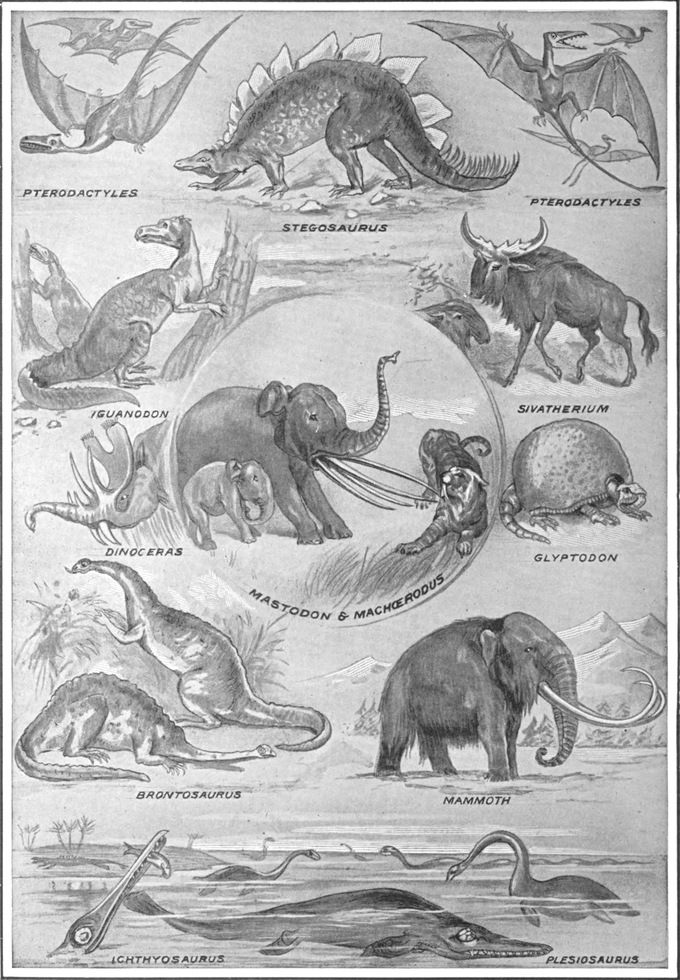
THE FIRST TENANTS OF THE WORLD: CREATURES THAT LIVED BEFORE MAN
This page represents the most typical of the giant creatures that inhabited the world before man. With possibly one exception, they had disappeared before man came and, through long centuries, slowly won dominion over the earth.
LARGER IMAGE
THE WORLD BEFORE HISTORY—II
Professor JOHANNES RANKE
THE APPEARANCE OF MAN ON THE EARTH
The Mystery of a Human Skull
T
THE remains of the Drift fauna are usually found mixed up and washed together in caves and rock-crevices. From the investigation of the caves in Thuringia, Franconia, and elsewhere practically proceeded the first knowledge of the Drift fauna of Central Europe. Here, right among the bones of primeval animals, were also found bones and skulls of man. The strata in which they were discovered appeared undisturbed; that they came into the old burial-places of the Drift fauna subsequently—perhaps by an intentional burial of relatively recent times—was thought to be out of the question. The discovery that became most famous was Esper’s, in one of the richest caves of “Franconian Switzerland,” the Gaillenreuth cave. There, in 1774, Esper found a man’s lower jaw and shoulder-blade at a perfectly untouched spot protected by a stone projection in the cave wall, in the same loam as bones of the cave-bear and other Drift animals. Later, a human skull with some rude potsherds of clay came to light in another place. Esper argued thus:
As the human bones (lower jaw and shoulder-blade) lay among the skeletons of animals, of which the Gaillenreuth caves are full, and as they were found in what is in all probability the original stratum, I presume, and I think not without sufficient reason, that these human limbs are of equal age with the other animal fossils.
The Cuvier catastrophe theory could not allow this inference; according to that theory it was a “scientific postulate” that man could not have appeared on the earth until the alluvial period, and therefore after the Drift fauna had become extinct. Therefore, in spite of appearances, the human bones must have been more recent; and it was indeed absolutely proved that the skull that Esper had found in the cave with the rude clay potsherds originated from a burial in the floor of the cave. As this was full of remains of Drift animals, the corpse, which had been covered with the earth that had been thrown up in digging the grave, was necessarily surrounded by these remains, and even appeared embedded in them.
The Story of the Caves
It was ascertained that in very early times, but yet long after the Drift Period, the dwellers near by had had a predilection for using the caves as burial-places, so that the fact of human bones coming together with bones of Drift animals in the floor of the same cave is easily explained. Moreover, it was found that from the earliest times down to the present day the caves had been used by hunters, herdsmen, and others as places of shelter in bad weather, as cooking-places, and sometimes even—especially in very early times—as regular dwelling-places for longer periods, so that refuse of all kinds, and often of all ages and forms of civilisation that the land has seen from the Drift Period down to modern times, must have got into the floors of the caves. If these were damp and soft, the remains of every century were trodden in and got to lie deeper and deeper, so that, for instance, the fragments of a cast-iron saucepan were actually found right among the bones of regular Drift animals in a cave in Upper Franconia.
The Caves do not Prove Drift Man
The discoveries of human remains in caves appeared discredited by this, and to be of no value as proofs of the co-existence of man with the Drift fauna. And indeed this position must practically be still taken at the present day: all cave-finds are to be judged with the greatest caution. They in themselves would never have been sufficient to establish the existence of Drift Man, although, according to the general change in scientific thought that led to the overthrow of Cuvier’s theory, Drift Man is now just as much a postulate of science as was formerly the case for the opposite assumption.
Finding the First Drift Man
The first sure proofs were adduced in France by Boucher de Perthes, in the Drift beds of the Somme valley, near Abbeville, at the end of the third decade of the nineteenth century. Fully recognising the inadequacy of proof given by cave-finds, he had sought for the relics of man in the undisturbed Drift beds of gravel and coarse sand that contains the bones of Drift animals, which by their covering and depth precluded all suspicion of having been subsequently dug over. And he was successful. He had argued in exactly the same manner as Esper had formerly done, but with better right. In the stratified Drift formations every period is sharply defined by the layers of differently coloured and differently composed strata horizontally overlying one another. Here the proofs begin. They are irrefutable if it is shown that the relics of man have been there since the deposit. Being no less immovable than this stratum in which they lie, as they came with it, they were likewise preserved with it; and as they have contributed to its formation, they existed before it.
The Overthrow of Cuvier’s Famous Theory
That is the line of thought according to which Boucher de Perthes was able, in 1839, to lay before the leading experts in Paris—at their head Cuvier himself—his discoveries proving the former existence of Drift man. But his demonstrations were not then sufficient to break the old ban of prejudices that were apparently founded on such good scientific bases; his proofs of the presence of man in the Somme valley at the time of the Drift, contemporaneously with the extinct Drift animals, were ridiculed. It was twenty years before these long-neglected discoveries in the Somme valley concerning the early history of man were recognised by the scientific world. This was only made possible by Lyell, whose authority as a geologist had risen above Cuvier’s, placing the whole weight of it on Boucher’s side, after having personally travelled over the Somme valley three times in the year 1859, and having himself examined all the chief places where relics of Drift Man had been discovered. According to Lyell’s description, the Somme valley lies in a district of white chalk, which forms elevations of several hundred feet in height. If we ascend to this height we find ourselves on an extensive tableland, showing only moderate elevations and depressions, and covered uninterruptedly for miles with loam and brick earth about five feet thick and quite devoid of fossils. Here and there on the chalk may be noticed outlying patches of Tertiary sand and clay, the remains of a once extensive formation, the denudation of which has chiefly furnished the Drift gravel material in which the relics of man and the bones of extinct animals lie buried. The Drift alluvial deposit of the Somme valley exhibits nothing extraordinary in its stratification or outward appearance, nor in its composition or organic contents. The stratum in which the bones of the Drift fauna are found intermingled with the relics of man is partly a marine and partly a fluviatile deposit. The human relics in particular are mostly buried deep in the gravel; almost everywhere one has to pass down through a mass of overlying loam with land shells, or a fine sand with fresh-water molluscs, before coming to beds of gravel, in which the relics of Drift Man are found.
Animals of the Ice Age
Everything shows that the relics of man are here in a secondary situs, deposited in the same way as the bones of extinct animals and the whole geological material in which everything is embedded. That is the reason why the finds cannot be more exactly dated. They doubtless belong to the general drift, but whether to the Postglacial Period, or the warmer Interglacial Period, cannot be decided. The fauna admits of no absolute limitation, owing to its being mixed from both periods. The mammalia most frequently found in the strata in question are the mammoth, Siberian rhinoceros, horse, reindeer, ure-ox, giant fallow-deer, cave-lion, and cave-hyena. In very similar Drift deposits of the Somme near Amiens traces of man were found beside the bones of the hippopotamus and the elephant.
These animals were chiefly prevalent in France and Germany in the Preglacial and Interglacial Periods of the Drift. Part of the animal remains found near Abbeville, particularly those of the cave-lion and cave-hyena, also point to the warmer Interglacial Period; on the other hand, the mammoth, Siberian rhinoceros, and especially the reindeer, appear to indicate with all certainty the second Glacial and Postglacial Periods. The bones of the older Drift animals may have been washed out of other primary situs; the reindeer had certainly already taken possession of those parts of France when the relics of man were embedded.
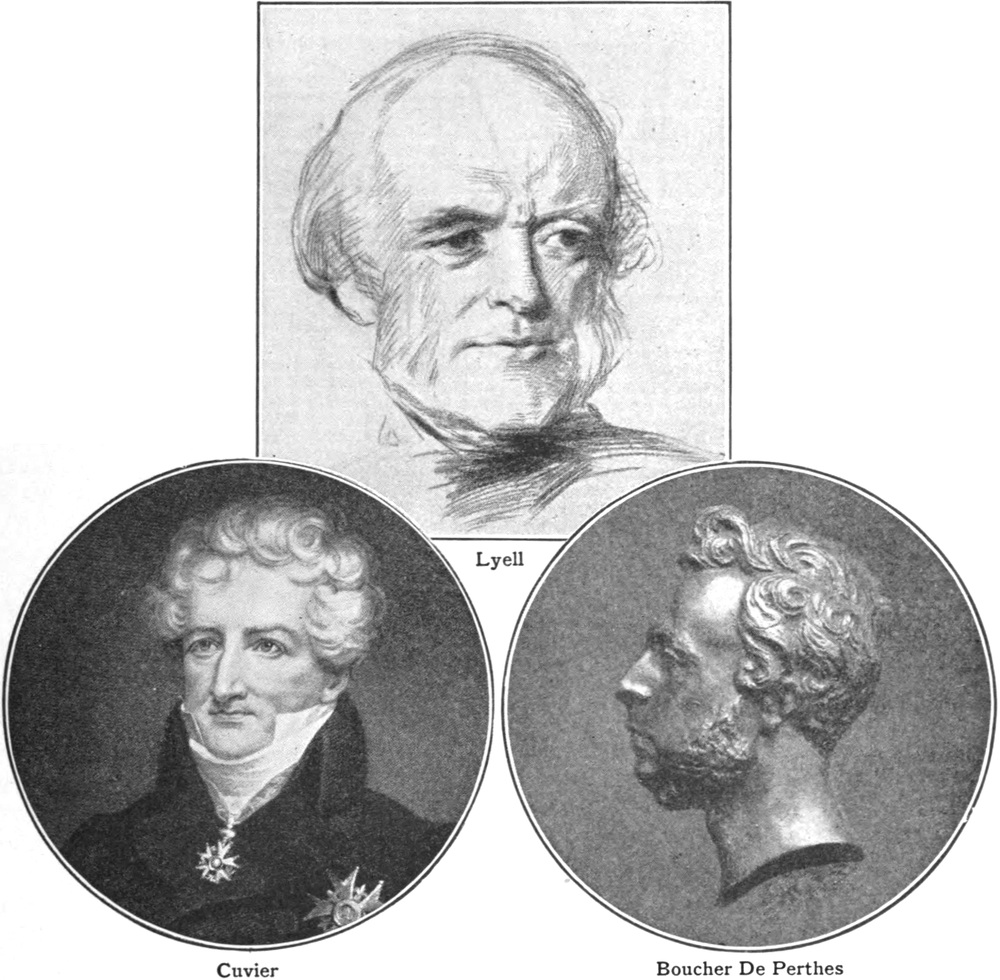
THE OVERTHROW OF A FAMOUS THEORY OF THE ORIGIN OF THE EARTH AND MAN
When Cuvier was supreme among geologists his theory that the great geological ages ended with sudden catastrophes which annihilated all life, and that all life was then created afresh, was universally accepted. One result of this theory was the disbelief in the existence of man before the Glacial Age. Boucher de Perthes sought to establish the former existence of Drift Man on finding human relics in the Somme Valley; but not until Sir Charles Lyell threw his influence on the side of De Perthes was the Preglacial existence of man admitted, and the long-accepted theory of Cuvier overthrown.
In spite of the most eager search for similar relic-beds affording sure evidence of Drift Man, only a very few have as yet been discovered that can be placed by the side of those in the Somme valley. Two are in Germany, and are the more valuable as a more exact date can be given to them within the Drift Period. One is near Taubach (Weimar), the other at the source of the Schussen. The one at Taubach belongs to the Interglacial Period, that at the source of the Schussen to the Postglacial Period. The former lies on the moraines of the first Glacial Period, which was followed by the Interglacial Period; the latter on the moraines of the second Glacial Period, which slowly passed into the Postglacial Period.
The Climate of the Ice Age
The Drift relic-bed in the calc-tufa near Taubach lies, as we have said, over the remains of the first Glacial Period, and according to Penck, one of the best authorities on the Drift, belongs to the warmer intermediate epoch between the two great periods of glaciation. The proofs given by the plant and animal remains agree entirely with the proofs given by the conditions of stratification. In the rich fauna found there, animals indicating a cold climate are entirely absent, and a comparison of the whole of the finds proves that at the time when man was present there no kind of arctic conditions can have prevailed. There is no reindeer, no lemming. The roe, stag, wolf, brown bear, beaver, wild boar, and aurochs were at that time inhabitants of these regions, and the only inference they allow is that of a temperate climate. The mollusc fauna, in which also all Glacial forms are absent, also leads to the same conclusion; all that occur are familiar to us from those of the present day in the same district. The fauna would really appear quite modern were it not that a very ancient stamp is imparted to it by several extinct types. With the modern animals enumerated are associated the cave-lion, cave-hyena, ure-elephant, and Merckian rhinoceros, characterising the whole deposit as a distinctly Drift one, which is still further proved stratigraphically by the covering of “loess.” The Taubach relic-bed is a typical illustration of the climatic and biological conditions of the warmer Interglacial Period; the regions of Central Europe, which had been covered with masses of ice in the first Glacial Period, had, after the ice melted, become once more accessible to the banished plants and animals of the Preglacial Period, until they were annihilated, or at least driven definitely from their old habitats by the second Glacial Period. The celebrated relic-bed at the source of the Schussen, near Schussenried, at a little distance from Ulm, brings us—in strong contrast to Taubach—into quite glacial surroundings. It was on the glacier-moraines of the last great glaciation, and belongs, therefore, to that period which must still be reckoned as part of the Drift—the Postglacial Period, which gradually passed into the warmer present period. Under the tufa and peat at the source of the Schussen we find the type of a purely northern climate, with exclusively northern flora and fauna; everything corresponds to climatic conditions such as prevail nowadays on the borders of eternal snow and ice, or begin at 70° north latitude.
Flora and Fauna of the Ice Age
Schimper, one of the best authorities on mosses at the present day, found among the plant-remains under the tufa at the source of the Schussen only mosses of northern or high Alpine forms. Among them was a moss brought from Lapland by Wahlenberg, which, according to Schimper, occurs in Norway near the chalets on the Dovrefjeld, on the borders of eternal snow, and also in Greenland, Labrador, and Canada, and on the highest summits of the Tyrolese Alps and the Sudetic Mountains. It has a special preference for the pools in which the water of the snow and glaciers flows off with its fine sand. There were also found mosses which have now emigrated to cold regions, to Greenland and the Alps. The most numerous animals were the reindeer, and yellow and Arctic foxes, as distinctly Arctic forms; and there were also the brown bear and wolf, a small ox, the hare, the large-headed wild horse—which always occurs in the Drift as the companion of the reindeer—and, lastly, the whistling swan, which now breeds in Spitzbergen or Lapland. There is an absence of all the present animal forms of Upper Swabia, as well as of the extinct Drift animals, either of which would indicate a warmer climate.
More decided climatic or biological contrasts than those afforded by the relic-beds at Taubach and the source of the Schussen could not be imagined; here we have with certainty two perfectly different periods before us, but both belonging to the general Drift Era.
Although almost all the other places where Drift Man has been found exhibit peculiarities, Taubach and the source of the Schussen seem the best representatives of the two chief types in Europe. Places giving better proof have not yet come to light anywhere in the Old World.
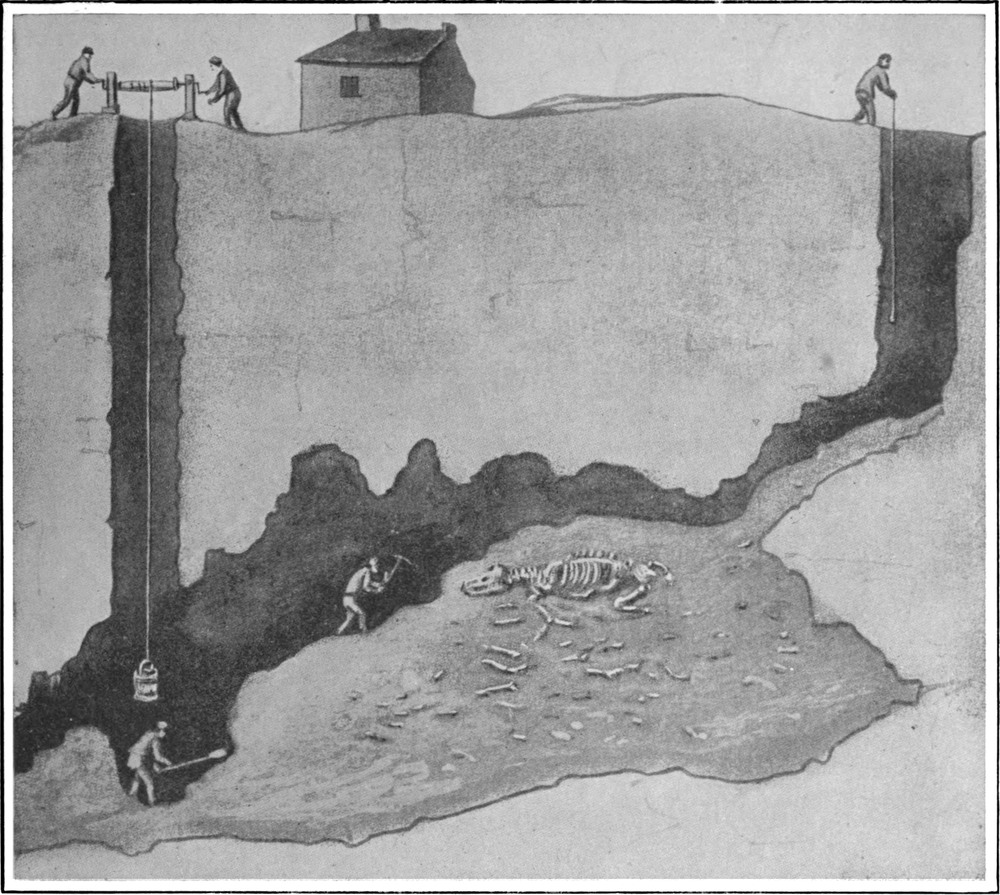
REVEALING THE UNKNOWN LIFE OF THE PREHISTORIC PAST
A section of the earth, representing excavators in the act of discovering the remains of mammals in a cave in the South of England. Our illustration is reproduced from Buckland’s “Reliquiæ Diluvianæ,” London, 1822.
Evidence from South America
At first sight the palæontological strata of South America, in which the presence of man has been proved by Ameghino, appear to give a very different picture. The animal forms occurring here contemporaneously with man deviate to such an extent from those familiar to us in the Drift of the Old World that it required the keen eye and the complete grasp of the whole palæontological material of the world that characterise Von Zittel to recognise and establish the connections here, while the discoverer himself thought that he must date his discoveries of man back to the Tertiary Period. The strata in which the earliest traces of man as yet appear to be proved in South America are the extensive “loess-like” loam deposits of the so-called “pampas” formation in Argentina and Uruguay, with their almost incomparable wealth of animal remains, particularly conspicuous among which are gigantic representatives of edentates that now occur only in small species in South America: Glyptodontia (with the gigantic Glyptodon reticulatum) and dasypoda; also of the gravigrada, the giant sloth (Megatherium americanum). The toxodontia were also large animals, now extinct. But besides the specifically South American forms, numerous “North American immigrants” also appear in the pampas formation. It was only at the close of the Tertiary Period that the southern and northern halves of America grew together into one continent, and the faunæ of North and South America, so characteristically different, then began to intermingle with one another. The South American autochthons migrate northward; on the other hand, North American types—as the horse, deer, tapir, mastodon, Felis, Canis, etc.—use the newly-opened passage to extend their range of distribution. The northern animal forms are very conspicuous among the animal world of South America, hitherto cut off from North America and characterised by the above-mentioned wonderful and, in part, gigantic edentates, marsupials, platyrhine apes, etc. Of the great elephantine animals of North America only the mastodon crossed over to South America. In the middle and latest Tertiary formations the genus mastodon is widely distributed over Europe, North Africa, and South Asia. In North America the oldest species of the mastodon appear in the Middle Tertiary (Upper Miocene), but the most species are found in the latest Tertiary (Pliocene) and the Drift (Pleistocene); in South America the mastodon is limited to the time of the pampas formation. Its tusks are long and straight, or slightly curved upward; its lower jaw also possesses two tusks, which project in a straight direction, but are considerably less than the upper tusks in size. From the results of Ameghino’s investigations man appears to have come to South America with these northern immigrants, especially with the mastodon. In Ameghino’s lists of the animals of the pampas formation Von Zittel describes man, like the animal forms enumerated above, as an immigrant from North America, and as a northern type.
According to Von Zittel’s statements there is no longer any doubt that the pampas formation, and with it early man, of South America, is to be assigned to the Drift Era; he sums up the case in these words:
In South Asia and South America the Tertiary Period is followed by Drift faunæ, which in the main are composed of species still existing at the present day, but yet show somewhat closer relations to their Tertiary predecessors.
THE WORLD BEFORE HISTORY—III
Professor JOHANNES RANKE
THE LIFE OF MAN IN THE STONE AGE
Man a Witness of the Flood
T
THE oldest remains affording us knowledge of man are not parts of his body—not the skeleton from which, in the case of primeval animals, we have learned to reconstruct their frame—but evidences of the human mind. Until the discoveries of Boucher de Perthes turned the scale, search had been made in vain among the bones of the fossil fauna for remains of the skeleton of fossil man of undoubtedly the same age; it was not bones, but tools, by which the Abbeville antiquary proved that man had been a “witness of the Flood” in Europe; tools which taught irrefutably that the mental powers of fossil man of the Drift were similar in kind to, if possibly less in degree than, those of living members of mankind. The Drift tools prove that, even in that early epoch to which we have learned from Boucher to trace him back, man was distinctively man.
Boucher de Perthes was an expert archæologist, and he knew that in Europe, in a very early period of civilisation, men had made their tools and weapons of stone, as many tribes and races in a backward state of civilisation—for example in South America, the South Sea Islands, and many other places—do at the present day. These stone implements are practically indestructible, and from ancient times manifold superstitions have attached to the curious articles that the peasant turns up out of the earth in ploughing. Such stone weapons were called lightning-stones by the Romans, as they are by country-folk at the present day. Scientific archæology occupied itself with them at an early date. In 1778 Buffon declared the so-called lightning-stones, or thunder-stones, to be the oldest art-productions of primeval man, and as early as 1734, Mahudel and Mercati had pronounced them to be the weapons of antediluvian man. Such views determined the line of thought in Boucher’s researches. From the very beginning he sought, in the undisturbed Drift beds of his home, not so much for the bones of Drift Man as for his tools, which he suspected to be of the form of the lightning-stones, although he knew that, so far as was hitherto known, these belonged to a very much later epoch—that is, specially to the Alluvial or “Recent” Period.
His expectations were crowned with success. Deep below the mass of overlying loam and sand, right in the strata of gravel and coarse sand, he found stone tools, which without the slightest doubt had been worked by the hand of man for definite and easily recognisable purposes as implements and weapons. Although to a certain extent ruder, they are practically the same forms as the tools, weapons, and implements of stone that we see in use among so-called “savages” of the present day. It is the tool artificially prepared for a certain purpose that raises man above the animal world to-day, as it did in the time of the Drift.
Drift Man’s Three Kinds of Tools The Chief Forms of Tools
Upon his first visit to the relic-beds near Abbeville in the spring of 1859, Lyell had obtained seventy specimens of these stone tools from the chief of them. The tools were all of flint, which occurs in abundance in the chalk of the district, and is still obtained and worked for technical purposes at the present day. The worked stones that Boucher found were termed flint or silex tools, according to the material of which they were made. They occurred in the particular beds, as Lyell expressed it, in wonderful quantities. The famous geologist distinguished three chief forms. The first is the spear-head form, and varies in length from six to eight inches. The second is the oval form, not unlike many stone implements and weapons that are still used as axes and tomahawks at the present day—for instance, by the aborigines of Australia. The only difference is that the edge of the Australian stone axes, like that of the European implements of later periods of civilisation known as thunderbolts or lightning-stones, is mostly produced by grinding, whereas on the stone axes from the drift of the Somme valley it has always been obtained by simply chipping the stone, and by repeated, skilfully directed blows. According to Tylor the stone implements of the old Tasmanians were entirely of Drift form and make, all without traces of grinding, being simply angular stones whose cutting-edge had been sharpened by being worked with a second stone. Some of these stone implements of Drift Man may have been simply used in the hand when the natural form of the stone offered a convenient end, but the majority were certainly fastened in a handle in some way or other, to serve as weapons—spear-heads or daggers—both for war and the chase. Lyell’s second chief form would have been used as an axe for such purposes as digging up roots, felling trees, and hollowing out canoes, or to cut holes in the ice for fishing and for getting drinking water in the winter. In the hand of the hunter and warrior the stone axe also became a weapon. As the third form of stone implements Lyell distinguished knife-shaped flakes, some pointed, others of oval form or trimmed evenly at one end, obviously intended partly as knives and arrow-heads, and partly as scrapers for technical purposes.
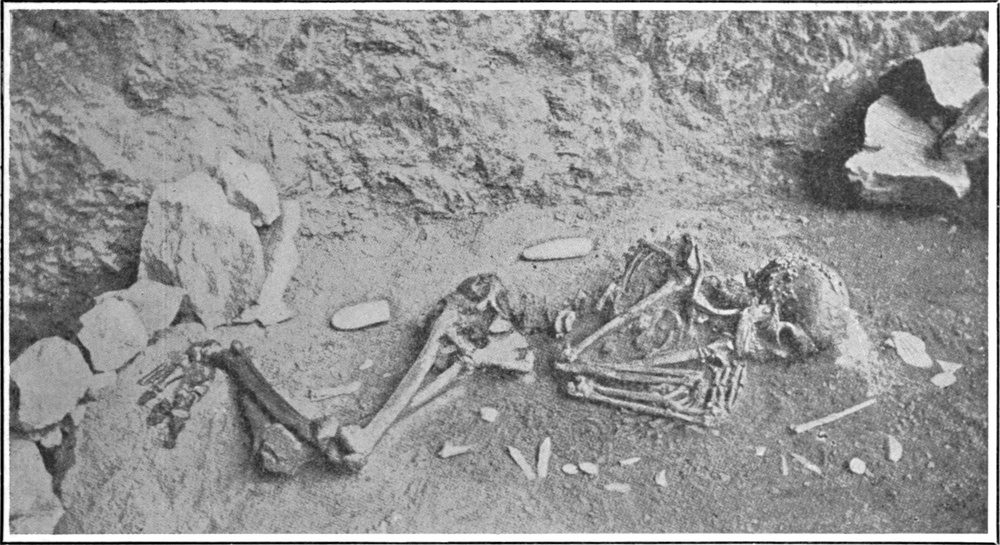
HOW PREHISTORIC MANKIND IS REVEALED
Most of our knowledge of the earliest life of man has been revealed by the excavator. When at a certain depth below the earth’s surface the skeleton of a man is found, surrounded with rude stone weapons, ornaments, and the remains of domestic animals, a whole chapter in the life of Prehistoric Man stands revealed at one glance. Our photograph shows an actual skeleton and grave of the Stone Age, as discovered in the year 1875 near Mentone.
Although there are many variations between the first two chief forms, yet the typical difference indicating the different purpose of their use is always easily recognised in well-finished examples. A large number of very rude specimens have also been found, of which many may have been thrown away as spoiled in the making, and others may have been only rubbish produced in the working. Evans has practically proved that it is possible to produce such stone implements in their remarkable agreement of form without the use of metal hammers. He made a stone hammer by fastening a flint in a wooden handle, and worked another piece of flint with this until it had assumed the shape of the axe form—the second, oval form—of the Drift implements.
Lyell’s Find in the Somme Valley
Lyell draws attention to the fact that, in spite of the relatively great frequency of stone implements, it would be a great mistake to rely on finding a single specimen, even if one occupied himself for weeks together in examining the Somme valley. Only a few lay on the surface, the rest not coming to light until after removing enormous masses of sand, loam, and gravel. As we may presume with Lyell that the larger number of the Drift stone implements of Abbeville and Amiens were brought into their position by the action of the river, this sufficiently explains why so many were found at great depths below the surface; for they must naturally have been buried in the gravel with the other stones in places where the stream had still sufficient force or rapidity to wash stones away. They can, therefore, not be found in deposits from still water, in fine sediment and overflow mud.
Bones of Drift Man are absent from the deposits of the Somme valley, in spite of the wonderful abundance of stone implements. The “lower jaw from Moulin-Quignon, near Abbeville,” had been fraudulently placed there by workmen. But proof of the existence of man is undeniably assured by the objects, so unpretentious in themselves, that have been recognised as the work of his hands.
When once the recognition of Drift Man, founded on the authority of Lyell, was achieved, search for further relic-beds was made in England and France with success. Yet scarcely one of the newly discovered stations was to be compared to those of the Somme valley as regards purity of stratification and conditions of discovery. The relics of the “earliest Stone Age” or “Palæolithic Period,” as the period of Drift Man was called, frequently came from caves and grottos, whose primary conclusiveness Boucher had rightly doubted.
Under these circumstances it was of the greatest importance that in Germany Drift Man was discovered in two places, where not only was the geological stratification just as clear as at Abbeville and Amiens, but where also the relics of Drift Man were found, not in a secondary situs, as they were then, but in a primary one. In addition to this the two German relic-beds may be safely assigned to the last two great divisions of the Drift Period, to the warmer Interglacial Period, and to the cold Glacial Period proper, with its Postglacial Period; and their climatic conditions were made clear from the remains of plants and animals found in them.
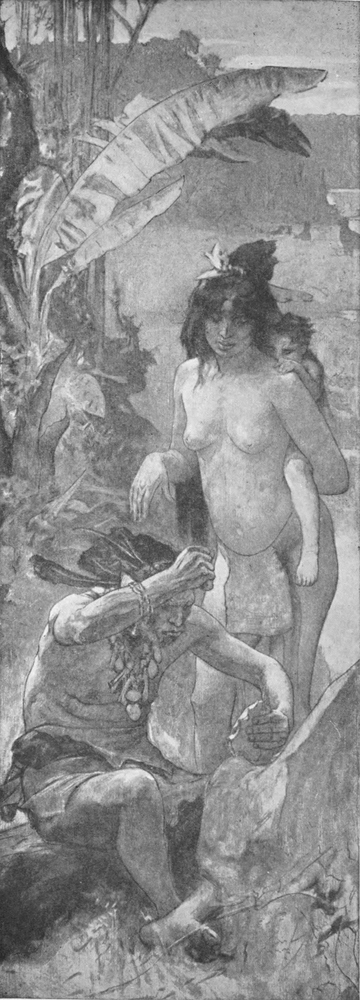
Mercier
A WORKER IN THE STONE AGE
Making an axehead of flint, like that photographed on the opposite page. From the painting by F. Cormon.
LARGER IMAGE
From the occurrence, in the deposits of the Somme, of reindeer that contain the stone implements of Drift Man, we can not, as we saw, exactly settle in what part of the Drift Era man lived there, whether in the Interglacial Period, to which numerous animal remains found there doubtless belong, or not until the “Reindeer” Period, as the last Glacial and early Postglacial Periods were called, when the reindeer was most largely distributed over France and Central Europe. One is inclined to date man’s habitation of the Somme valley back to the Interglacial Period; but it is certain that the relic-bed near Taubach is the first, and, as far as I can see, the only one hitherto, that has given sure proof of Interglacial Man in Europe. There the oldest vestiges of man in Europe were found that have yet been absolutely proved. We have not hitherto succeeded in Europe in tracing man farther back than the Interglacial Period. Relics of him are hitherto as absent in the older Drift as they are in the Tertiary.
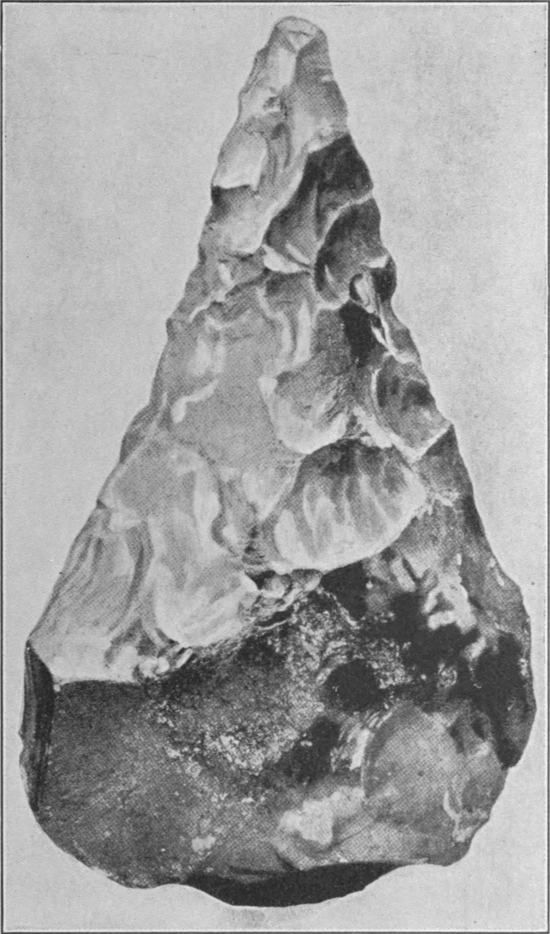
A WORKMAN’S TOOL IN THE STONE AGE
Flint implement found in Gray’s Inn, London; now in British Museum.
The Taubach relic-bed also furnished no bones of Drift Man among all the parts of skeletons of Drift animals that we have mentioned. Here, too, as in the Somme valley, the proof of the presence of man is based on the works of his hand and mind. Here, too, stone implements and stone weapons are the chief things to be mentioned. But whereas, in the chalk district of France, flints of every size were to be had in the greatest abundance for the preparation of weapons and tools, corresponding stones are not exactly wanting at the two standard German places, though they occur in limited number and size. It is due to this that the larger forms of flint implements, which are most in evidence in the Somme valley, are absent at Taubach. On the other hand, smaller “knives and flakes”—Lyell’s third form of Drift flint implements—occur here with comparative frequency and variety of form. Next to the usual lancet-shaped knife, worked flint flakes, of triangular prismatic form, with sharp corners, are most numerous at Taubach, and scrapers, chisels, awls, and the chipping-stones with which the stone implements were produced may also be distinguished among other things. The material for the implements was supplied by the older Drift débris of the valley—namely, flint, flinty slate, and quartz porphyry.
Besides the stone implements which alone were observed in the Somme valley, still further important relics were found here in their primary situs. Above all, numerous finds of charcoal and burnt bones prove that the Drift Men of Taubach not only knew how to kindle fire, but were also accustomed to roast the flesh of the animals they killed in the chase. Stones and pieces of shell limestone also occur which have become reddish and hard from the action of heat. These are to be regarded as the floors and side-walls of the fireplaces on which the food was then and there prepared. The animal bones, especially those that were taken up from around the fireplace, appear in most cases to be remains of meals. This is shown at once by the fact that bones of young representatives of the large beasts of the chase—such as the rhinoceros, elephant, and bear—are very frequent as compared with the rare occurrence of full-grown animals.
Hunters of the Stone Age How Drift Man Killed the Great Animals
It appears that in the hunting and capture of animals the young ones were most easily killed, and therefore served chiefly as food. Whenever a large animal was killed, it was probably cut up on the spot by the fortunate hunters, who consumed at once part of its flesh; the trunk was then left at the scene of the killing, while the head, neck, and fore and hind legs, on which was the most muscular flesh, and which were at the same time easier to carry away, were taken to the settlement. This may explain why, among the many large bones of the rhinoceros that have hitherto been found, the ribs and the dorsal and lumbar vertebræ are almost entirely absent. Some of the bones of the beasts of the chase bear the unmistakable traces of man. They are broken in the manner characteristic of “savages” of all ages and climes—for the sake of the marrow, one of the greatest dainties of men living chiefly on animal fare. The broken-off heads of the metatarsal bones of the bison still show particularly clearly the method of breaking. They are broken off transversely exactly where the marrow canal ends, and on all these bones there is a roundish depression, or hole, at the same place—namely, in the middle of their front or back surface, and just where the end of the marrow canal is, therefore about in the centre of the break of the broken-off piece. The hole is a “blow-mark” of one inch in diameter, evidently driven in by force from without, as several well-preserved specimens still show the edges and splinters of bone pressed inward. These splinters and all the breaks are old, and have on the surface the same greasy coating, full of the sand in which they lay, as the bones themselves. The instrument used for breaking the bones in this way might very well have been the lower jaw of a bear with its large canine tooth, as Oscar Fraas has ascertained to have been the case in other places where Drift Man has been found. Such lower jaws were found at Taubach, and the nature and size of the hole and its edges agree with this assumption. The long bones of the elephant and rhinoceros were whole. Drift Man did not succeed in breaking these huge pieces, and where such bones are found broken they are accidental fractures. On the other hand, almost all bones of the bear and bison are intentionally split—in almost all cases transversely, and seldom lengthways.
Drift Man at his Meals
In the Somme valley we have only the flint implements—which, although rude, are very regularly and uniformly made for different recognisable purposes—to tell us of the life and state of Drift Man; but the finds at Taubach afford us a rather closer insight into the conditions of his life and culture. What we had suspected from the first finds is confirmed here. During the Interglacial Period we see near Taubach, on the old watercourse of the Ilm, which had there at that time become dammed up into a kind of pond, a human settlement. This was occupied for a long period, as is proved by the large number of bones, evidently remains of meals, and by the quantity of charcoal. Immediately on the bank were the fireplaces—rude hearths built of the stones obtained without trouble in the neighbourhood. Here the flesh of the beasts of the chase, the bison and the bear, and also the elephant and rhinoceros, was broiled in a crude manner in the hot ashes, as is still done by savages on the level of the Fuegians and primitive tribes of Central Brazil at the present day. For this no utensils are required, a sharpened rod or thin pointed stick being sufficient for turning and taking out the pieces of meat. The ashes that the gravy causes to adhere supply the place of salt and other seasoning. The meat was cut up with the stone knives, and many traces of cuts on the bones may also be attributable to these instruments. For cutting out larger portions a powerful and very suitable instrument was at hand, in the lower jaw of the bear, with its strong canine tooth, which also served for breaking bones to obtain the marrow. In spite of the apparent meanness of the weapons, remains of which we have found, the Drift Men of Taubach were yet able, as their kitchen refuse proves, not only to kill the bison and bear, but also the gigantic elephant and rhinoceros, both young and full grown.
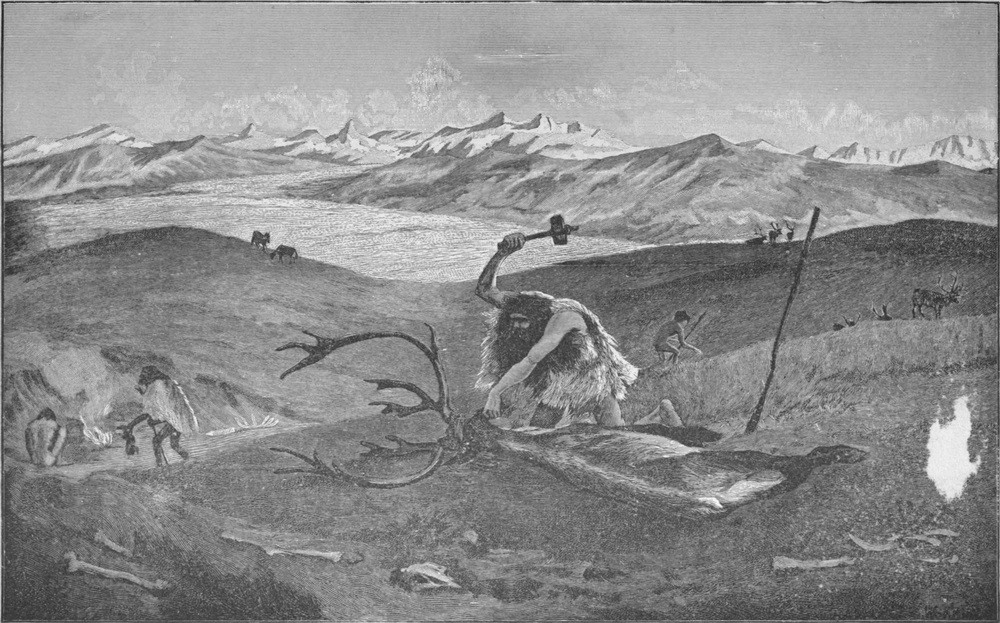
REINDEER HUNTING IN THE LATER ICE AGE. After a picture by W. Kranz
The reindeer was the most familiar animal of the Later Ice Age, its body supplying food, clothing, and implements for Glacial Man.
LARGER IMAGE
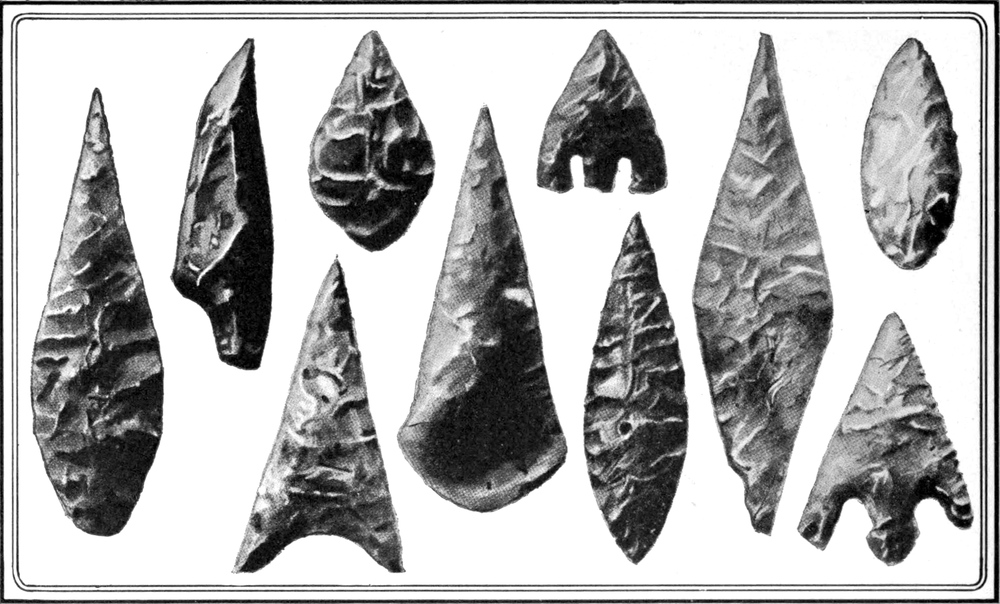
WEAPONS OF THE CHASE USED BY PREHISTORIC MAN
A collection of neolithic lance and arrow heads found in Ireland, now to be seen in the British Museum.
Drift Man after the Hunt
This shows man to have been then, as he is to-day, master even of the gigantic animal forms which so far surpass him in mechanical strength. It is the mind of man that shows itself superior to the most powerful brute force, even where we meet him for the first time. From the finds in the Somme valley it appears that Drift Man already possessed spear, dagger, and axe, besides the knife, as weapons. There the blades were of stone. The relatively small blades of the Taubach stone implements are, it is true, of the same character as the stone implements of Abbeville and Amiens, but they are chiefly, as we have said, merely knife-like articles, very suitable as blades for knives, scrapers, and daggers, and as arrow-heads, but not strong enough as hunting-weapons for such big game. The hunt must, therefore, have been more a matter of capture in pits and traps, as practised at the present day where similar large types of animals are hunted by tribes armed only with defective weapons. The kitchen refuse also proves that the settlement by the Ilm pond, near Taubach, was a permanent one, to which the hunters returned after their expeditions, bringing their game and trophies so far as they were easily transportable. But there is no trace of domestic animals. They could not have completely disappeared, any more than remains of clay vessels, which are still less destructible than bones, and in this respect may be compared to stone implements. There was no trace of potsherds either.
The Best “Find” of the Ice Age
The finds in the Somme valley and near Taubach are of incalculable importance as sure, indisputable proofs of Drift Man in Europe; but as regards the wealth of information to be derived from them respecting man’s psychical condition in that first period in which we can prove his existence, they are far and away surpassed by the find at the source of the Schussen, which Oscar Fraas, the celebrated geologist, has personally inventoried and described. Fraas has rightly given to his description of this find of Glacial Man—the most important and best examined hitherto—the title “Contributions to the History of Civilisation During the Glacial Period.”
The geognostic stratification of the relic-bed on one of the farthest advanced moraines of the Upper Swabian plateau proves that it belongs to the Glacial Period, and that this had already pushed its glacier-moraines to the farthest limit ever reached. In point of time the finds are, therefore, to be placed at the end of the Glacial Period, as it was passing into the Postglacial Period; everything still points to Far Northern conditions of life. The finds at the source of the Schussen are thus decidedly more recent, geologically, than those made at Taubach. They are a typical, or, better, the typical example of the so-called “Reindeer Period” of the end of the Drift.
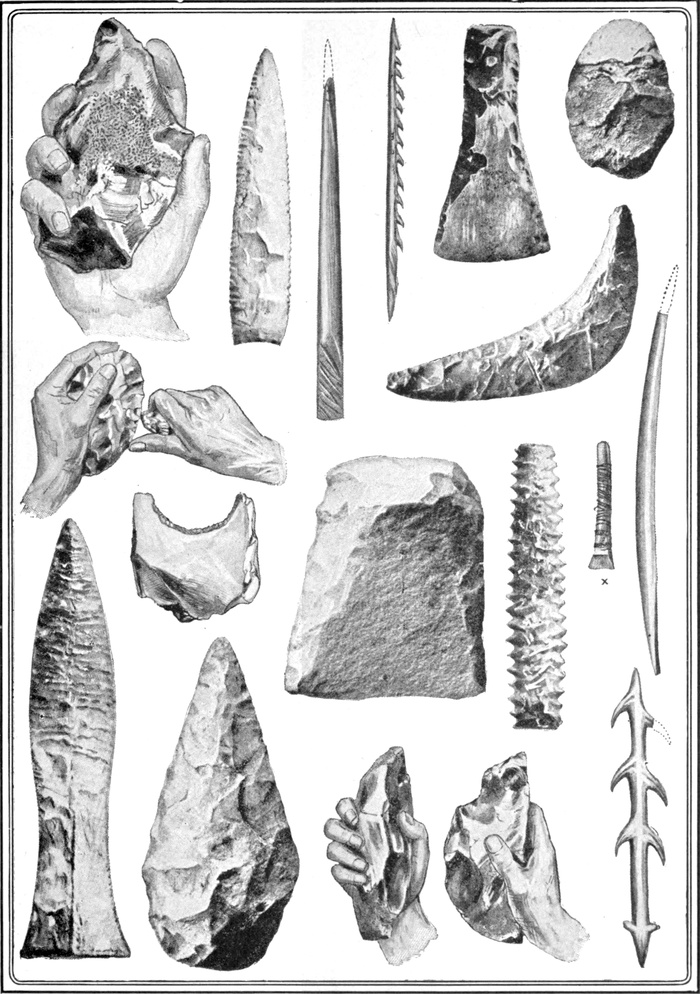
IMPLEMENTS OF THE STONE AGE AND THEIR MAKING
The methods of holding a hammer-stone and of making a flint by pressure are illustrated at the top, those of using a chopping tool at the bottom, of this plate. The other objects are spear-heads, axes, and hammers of stone and flint, and javelin-heads of horn, the latter being smooth and barbed. The method of tying a flint chisel to a wooden handle is shown at the right (×). Most of these objects are to be seen in the British Museum.
LARGER IMAGE
From Fraas’s description there seems to be no doubt whatever that the relic-bed, with its remains of civilisation, was perfectly undisturbed, and its palæontological contents plainly show its great geological age. It was perfectly protected by Nature. On the top lies peat, the same that covers the lowlands of the whole neighbourhood for miles, and forms the extensive moorlands of Upper Swabia, on which no other formations are to be seen than the gravel drift-walls thrown up by glaciers of the Drift Period. Under the peat lies a layer of calc-tufa, four to five feet thick, a fresh-water formation from the water-courses that now unite with the source of the Schussen. Under this protecting cover of tufa were the remains of the Glacial Period and Glacial Man. The tufa covered a bed of moss of a dark brown colour, inclining to green, the moss still splendidly preserved. Under this bed of moss was the glacier drift. The moss was dripping full of and intermingled with moist sand. In it were the relics of Glacial Man—all lying in heaps as fresh and firm as if they had been only recently collected. A sticky, dark-brown mud filled the moss and sand and the smallest hollow spaces of antlers and bones, and emitted a musty smell.
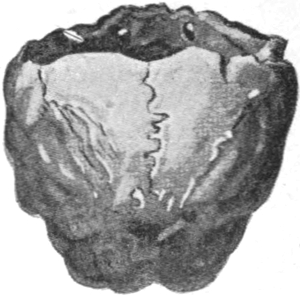
EARLY DRINKING VESSEL
Reindeer’s skull used as drinking vessel by men of the Stone Age. British Museum collection.
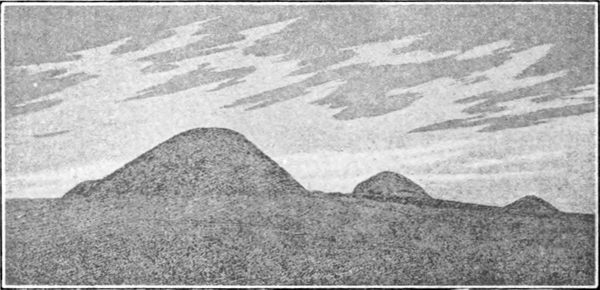
TREASURE-STORES OF PRIMEVAL KNOWLEDGE
Such to-day are the mounds of prehistoric rubbish accumulated by the people of the Stone Age. These Danish “kitchen middens” have vastly enriched our knowledge of the remote past.
Glacial Man had used the place as a refuse-pit. Among the bones and splinters of bone of animals that had been slaughtered and consumed by man, among ashes and charred remains, among smoke-stained hearthstones and the traces of fire, there lay here, one upon the other, numerous knives, arrow-heads, and lance-heads of flint, and the most varied kinds of hand-made articles of reindeer horn. All this was in a shallow pit about seven hundred square yards in extent, and only four to five feet deep in the purest glacier drift, clearly showing that the excellent preservation of the bones and bone implements was solely due to the water having remained in the moss and sand. The bank of moss was like a saturated sponge; it closed up its contents hermetically from the air, and preserved in its ever-damp bosom what had been entrusted to it thousands of years before.
Under the peat and tufa at the source of the Schussen we find only the type of a purely Northern climate, with Northern flora and Northern fauna. There are no remains of domestic animals—not even of the dog, nor any bones of the stag, roe, chamois, or ibex. Everything corresponds to a Northern climate, such as begins to-day at 70° north latitude. We see Upper Swabia traversed by moraines and melting glaciers, whose waters wash the glacier-sand into moss-grown pools. We find a Greenland moss covering the wet sands in thick banks; between the moraines of the glaciers we have to imagine wide green pastures, rich enough to support herds of reindeer, which roved about there as they do in Greenland, or on the forest borders of Norway and Siberia, at the present day. Here, also, are the regions of the carnivora dangerous to the reindeer—the glutton and the wolf, and, in the second rank, the bear and Arctic fox.
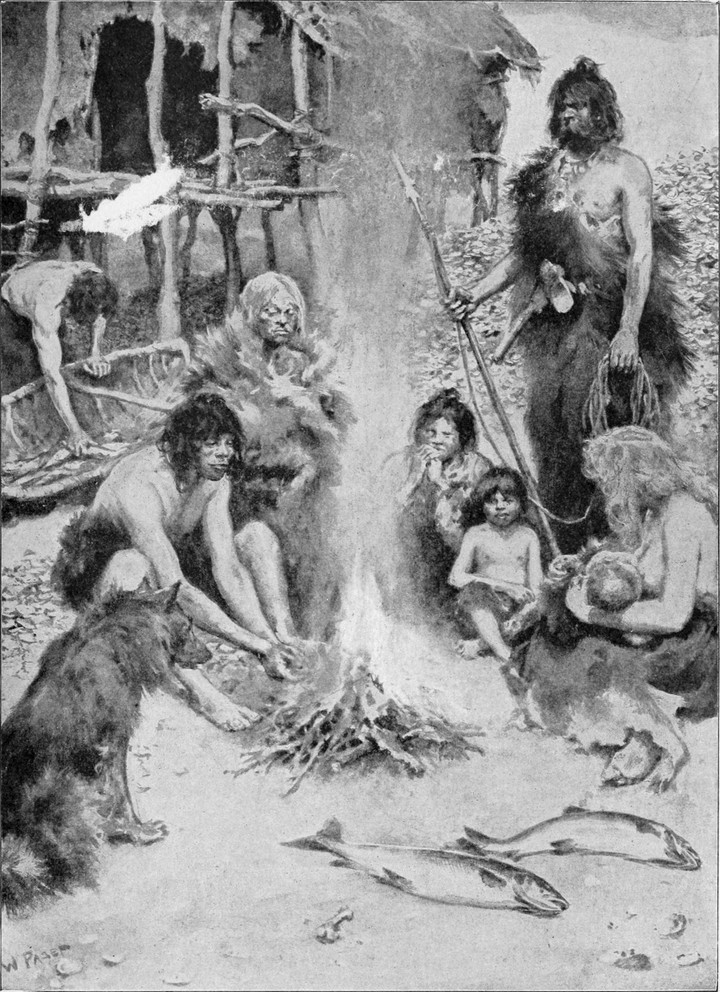
A FAMILY GROUP IN THE STONE AGE
It was thus that the Danish kitchen middens illustrated on the opposite page were created. Each family group cast its refuse, in the shape of shells, bones, wood, etc., on the midden near at hand, and these heaps of rubbish in process of time became valuable records of the people’s life, in which the archæologist can read for us the story of the past.
LARGER IMAGE
History in a Rubbish Heap
According to Fraas, it is on this scene that man of the Glacial Period appears; in all probability, a hunter, invited by the presence of the reindeer to spend some time—probably only the better portion of the year—on the borders of ice and snow. It is true that the relic-bed that tells of his life and doings is only a refuse-pit, which contains nothing good in the way of art productions, but only broken or spoiled articles and refuse from the manufacture of implements. The bulk of the material consists of kitchen refuse, such as, besides charcoal and ashes, opened marrow-bones and broken skulls of game. Not one of the bones found here shows a trace of any other instrument than a stone. It was on a stone that the bone was laid, and it was with a stone that the blow was struck. Such breaking-stones came to light in large numbers. They were merely field stones collected on the spot, particular preference being given to finely rolled quartz boulders of about the size of a man’s fist. Others were rather rudely formed into the shape of a club, with a kind of handle, such as is produced half accidentally and half intentionally in splitting large pieces. Larger stones were also found—gneiss slabs, from one to two feet square, slaty Alpine limes, and rough blocks of one stone or another, which had probably represented slaughtering-blocks, or done duty as hearthstones, as on many of them traces of fire were visible. Where these stones had stood near the fire they were scaled, and all were more or less blackened by charcoal. Smaller pieces of slate and slabs of sandstone blackened by fire may have supplied the place of clay pottery in many respects; for, with all the blackened stones, not a fragment of a clay vessel was found in the layers of charcoal and ashes of the relic-bed.
Making Drift Man’s Tools
The flint implements are of the form familiar to us from Taubach and the Somme valley, being simply chipped, not ground or polished. At the source of the Schussen, also, only comparatively small pieces of the precious raw material were found for the manufacture of stone implements. So that here, too, as at Taubach, Lyell’s third form, the knife or flake, was practically the only one represented. They fall into two groups—pointed lancet-shaped knives and blunt saw-shaped stones. The former served as knife-blades and dagger-blades, and lance-heads and arrow-heads; the latter represented the blades of the tools required for working reindeer horn. The larger implements are between one and a quarter and one and a half inches broad and three to three and a half inches long; but the majority of them are far smaller, being about one and a half inches long and only three-eighths of an inch broad. The various flint blades appear to have been used in handles and hafts of reindeer horn. Numerous pieces occur which can only be explained as such handles, either ready or in course of manufacture.
Moreover, owing to the want of larger flints, numerous weapons, instruments, and implements were carved from reindeer horn and bone for use in the chase and in daily life. Fraas has ascertained exactly the technical process employed in producing articles of reindeer horn, and we see with wonder how the Glacial men of Swabia handled their defective carving-knives and saws on the very principle of modern technics. They are principally weapons—for example, long pointed bone daggers, otherwise mostly punchers, awls, plaiting-needles (of wood), and arrow-heads with notched grooves. These may possibly be poison-grooves; other transverse grooves may have served partly for fastening the arrow-head by means of some thread-like binding material, probably twisted from reindeer sinews, as is done by the Reindeer Lapps at the present day; other scratches occur as ornaments.
The Skilled Workman of the Drift
The forms of the bone implements show generally a decided sense of symmetry and a certain taste. For instance, a dagger, with a perforated knob for suspension, and a large carefully-carved fish-hook. Groove-like or hollow spoon-shaped pieces of horn were explained by Fraas to be cooking and eating utensils; probably they also served for certain technical purposes—as for dressing skins for clothing and tents, like the stone scrapers found in the Somme valley. A doubly perforated piece of a young reindeer’s antler appears to be an arrow-stretching apparatus, like those generally finely ornamented, used by the Esquimaux for the same purpose. A branch of a reindeer’s antlers, with deep notches filed in, is declared by the discoverer to be a “tally.” The notches are partly simple strokes filed in to the depth of a twelfth of an inch, and partly two main strokes connected by finer ones. “The strokes,” says Fraas, “are plainly numerical signs—a kind of note, probably, of reindeer or bears killed, or some other memento.” Among the objects found were also pieces of red paint of the size of a nut—clearly fabrications of clayey ironstone, ground and washed, and probably mixed with reindeer fat and kneaded into a paste. The paint crumbled between the fingers, felt greasy, and coloured the skin an intense red. It may have been used in the first instance for painting the body. The Glacial men at the source of the Schussen were, according to the results of these finds, fishermen and hunters, without dogs or domestic animals and without any knowledge of agriculture and pottery. But they understood how to kindle fire, which they used for cooking their food. They knew how to kill the wild reindeer, bear, and other animals of the district they hunted over; their arrows hit the swan, and their fish-hooks drew fish from the deep. They were artists in the chipping of flint into tools and weapons; with the former they worked reindeer horn in the most skilful manner. Traces of binding material indicate the use of threads, probably prepared from reindeer sinews; the plaiting-needle may have been employed for making fishing-lines. Threads and finely-pointed pricking instruments indicate the art of sewing; clothing probably consisted of the skins of the animals killed.
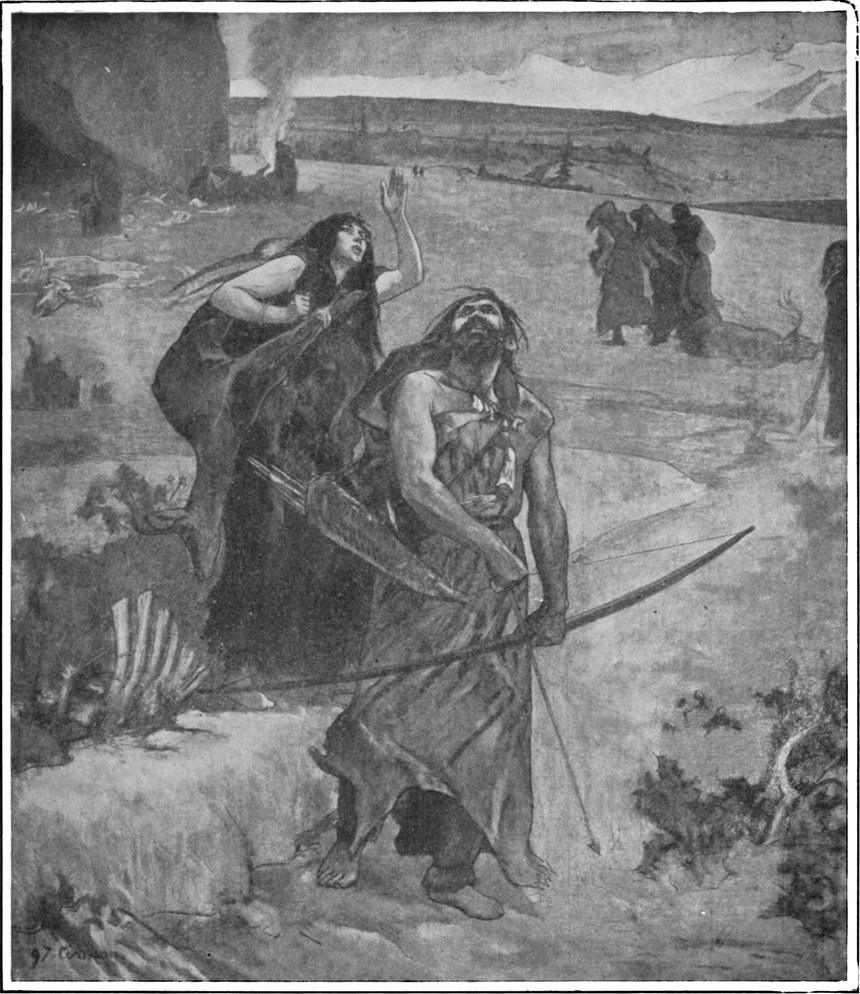
Mercier
HUNTING FOR FOOD IN THE LATER ICE AGE
From the painting by Ferdinand Cormon
To this material concerning Drift Man, scientifically vouched for, coming from Drift strata that have certainly never been disturbed, other countries have hitherto made no equal contributions really enlarging our view. Yet the numerous places where palæolithic—that is, only rudely chipped—implements of flint, such as were doubtless used by Drift Man, have been found must not remain unmentioned here. We know of them in Northern, Central, and Southern France, in the South of England, in the loess at Thiede, near Brunswick, and in Lower Austria, Moravia, Hungary, Italy, Greece, Spain, Portugal, North Africa, and Russia.
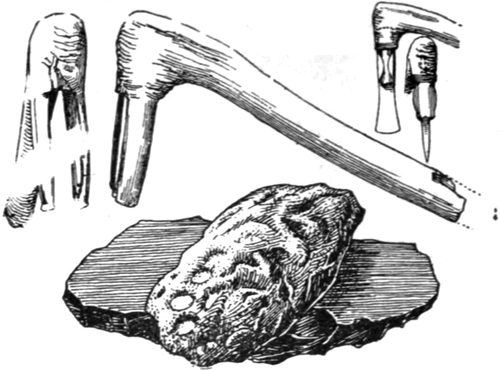
IMPLEMENTS OF THE STONE AGE
The upper illustrations show handles of celt or stone-cutting instruments and method of hafting; the lower picture is that of a handmill of sandstone.
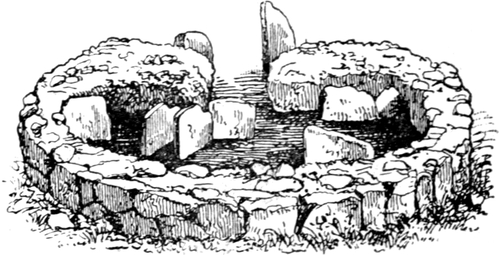
A HUT-CIRCLE OF THE BRONZE AGE
One of the earliest forms of habitation in Britain. From the British Museum “Guide to the Bronze Age.”
It is of special importance to note that similar flint tools have also been found along with extinct land mammalia in the stratified drift of the Nerbudda valley, in South India, as the supposition more than suggests itself that Drift Man came to our continent with the Drift fauna that immigrated from Asia. The possibility that man also got from North Asia to North America with the mammoth during the Drift Period can no longer be dismissed after the results of palæontological research. It explains at once the close connection between the build of the American and the great Asiatic (Mongolian) races.
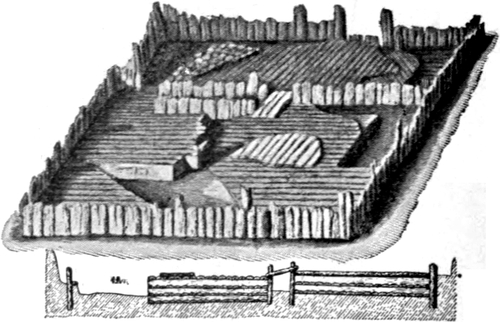
REMAINS OF A STONE AGE MANSION
These remains of a large pile hut discovered in Germany show that Stone Age Man had made good progress in building. The lower diagram shows a transverse section.
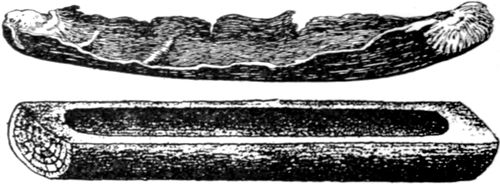
THE EARLIEST EFFORTS AT BOAT-BUILDING
The dug-out canoe, hollowed from a single trunk, was the far-off parent of the ocean-going ship. The upper picture represents a prehistoric canoe found in Sussex and the lower example is taken from a German specimen.
Stone implements of palæolithic form have been found in Drift strata in North America, and the same applies also, as we have seen, to South America. The best finds there were those made by Ameghino in the pampas formation of Argentina. Here marrow-bones, split, worked, and burnt, and jaws of the stag, glyptodon, mastodon, and toxodon have been repeatedly found along with flint tools of palæolithic stamp; and Santiago Roth, who took part in these researches, supposes that fossil man in South America occasionally used the coats of mail of the gigantic armadillos as dwellings. But the civilisation of South American man is doubtless identical with that of European fossil man—tools and weapons of the stone types familiar in Europe, the working of bones, the use of fire for cooking, and animal food, with the consequent special fondness for fat and marrow.
THE WORLD BEFORE HISTORY—IV
Professor JOHANNES RANKE
PRIMITIVE MAN IN THE PAST & THE PRESENT
T
TO the picture of Drift Man that has been drawn for us by the discoveries of human activity in deposits of uniform character and sharply defined age, the much richer but far less reliable finds in the bone caves add scarcely any entirely new touches. Von Zittel says:
The evidence of the caves is unfortunately shaken by the uncertainty that, as a rule, prevails with regard to the manner in which their contents were washed into them or otherwise introduced, and also with regard to the beginning and duration of their occupation; moreover, later inhabitants have frequently mixed up their relics with the heritage of previous occupants.
First Dwellers in Caves
This doubt strikes us particularly forcibly as regards man’s co-existence with the extinct animals of the earlier periods of the Drift, the Preglacial and Interglacial Periods. On the other hand, the habitation of the caves by man during the Reindeer Period appears in many cases to be perfectly established, and, according to Von Zittel, the oldest human dwellings in caves, rock-niches, and river-plains in Europe belong for the most part to the Reindeer Period—that is, the second Glacial and, in particular, the Postglacial Period.
In the caves there is also no domestic animal, and no pottery or trace of potsherds, in the best-defined strata where Drift Man has been found. In the Hohlefels cave, in the Ach valley in Swabia, a new utensil was found in the form of a cup for drinking purposes or for drawing water, made out of the back part of a reindeer’s skull. Also a new tool in the form of a fine sewing-needle with eye, from the long bone of a swan, such as have also been found in the caves of the Périgord. Teeth of the wild horse and lower jaws of the wildcat, which are found in the caves, perforated for suspending either as ornaments or amulets, are also hitherto unknown, it appears, in the stratified Drift. As both animals are at a later period connected with the deity and with witchcraft, one could imagine that similar primitive religious ideas existed among the old cave-dwellers. In the stratum of the Reindeer Period at the Schweizerbild, near Schaffhausen, Nüesch found a musical instrument, “a reindeer whistle,” and shells pierced for use as ornaments.
Drift Man’s Working Materials
The finds in the French cave districts prove that man was able to develop certain higher refinements of life, even during the Drift in the real flint districts—where a very suitable material was at man’s disposal in the flint that lay about everywhere or was easily dug up; which was worked with comparative ease into much more perfect and efficient weapons and implements than those supplied by the wilder stretches of moor and fen of Germany, with their scarcity of flint.
If we compare the small, often tiny, knives and flint flakes from the German places with the powerful axes and lance-heads of those regions, it is self-evident how much more laborious life must have been for the man who used the former. What labour he must have expended in carving weapons and implements out of bone and horn, while flint supplied the others with much better and more lasting ones with less expenditure of time and trouble! In this light a wealth of flint was a civilising factor of that period which is not to be under-estimated. In the flint districts not only are the stone implements better worked, answering in a higher degree the purpose of the weapon and the tool, but delight in ornament and decoration is also more prominent.
The Life in the Caves Drift Man as Artist
Life in the caves and grottos and under the rock shelters in the neighbourhood of rivers was by no means quite wretched. The remains left in the caves by their former inhabitants give almost as clear an idea of the life of man in those primeval times as the buried cities of Herculaneum and Pompeii do of the manners and customs of the Italians in the first century of the Christian era. The floors of these caves in which men formerly lived appear to consist entirely of broken bones of animals killed in the chase, intermixed with rude implements and weapons of bone and unpolished stone, and also charcoal and large burnt stones, indicating the position of fireplaces. Flints and chips without number, rough masses of stone, awls, lance-heads, hammers, and saws of flint and chert lie in motley confusion beside bone needles, carved reindeer antlers, arrow-heads and harpoons, and pointed pieces of horn and bone; in addition to which are also the broken bones of the animals that served as food, such as reindeer, bison, horse, ibex, saiga antelope, and musk-ox. The reindeer supplied by far the greater part of the food, and must at that time have lived in Central France in large herds and in a wild state, all trace of the dog being absent.
Pictures from the Drift World
Among these abundant remains of culture archæologists were surprised to find real objects of art from the hand of Drift Man, proving that thinking about his surroundings had developed into the ability to reproduce what he saw in drawing and modelling. The first objects of this kind were found in the caves of the Périgord. They are, on the one hand, drawings scratched on stones, reindeer bones, or pieces of horn, mostly very naïve, but sometimes really lifelike, chiefly representing animals, but also men; on the other hand imitations plastically carved out of pieces of reindeer horn, bones, or teeth. Such engravings also occurred on pieces of ivory, and plastic representations in this material have been preserved. On a cylindrical piece of reindeer horn from the cave excavations in the Dordogne is the representation of a fish, and on the shovel-piece of a reindeer’s horn are the head and breast of an animal resembling the ibex. Illustrations of horses give faithful reproductions of the flowing mane, unkempt tail, and disproportionately large head of the large-headed wild horse of the Drift. The most important among these representations are such as endeavour to reproduce an historical event. An illustration of this kind represents a group consisting of two horses’ heads and an apparently naked male figure; the latter bears a long staff or spear in his right hand, and stands beside a tree, which is bent down almost in coils in order to accommodate itself to the limited space, and whose boughs, indicated by parallel lines, show it to be a pine or fir. Connected with the tree is a system of vertical and horizontal lines, apparently representing a kind of hurdlework. On the other side of the same cylindrical piece are two bisons’ heads. Doubtless this picture tells a tale; it is picture-writing in exactly the same sense as that of the North American Indians. Our picture already shows the transition to abbreviated picture-writing, as, instead of the whole animals—horses and bisons—only the heads are given. The message-sticks of the Australians bear certain resemblances; Bastian has rightly described them as the beginnings of writing.