Volume 1 — LIST OF MAPS APPEARING IN THE BOOK OF HISTORY (continued 10)
Reading edition
Civilisations Help One Another
At the same time it is necessary to add that this derivation of the higher developments of mid-European and Scandinavian culture in the Bronze and Early Iron ages from the influence of Ægean civilisation is far from certain, whatever be the case for the Adriatic lands. Knowledge obtained since Dr. Evans and Dr. Montelius first expressed their views, especially in regard to the so-called Neolithic or “Butmir” pottery, which has a very wide range in South-Eastern Central Europe, has not strengthened their case, but rather tended to suggest that the continental culture developed independently to, though in a parallel direction with, that of the southern peninsulas and isles. If this view ultimately prevail, it will illustrate the opinion, to which we personally incline, that the derivation of civilisations, one from another in early times, is the exception and not the rule, except in respect of minor matters.
The Vigorous Hittite Civilisation
Two other intermediary civilisations of the South-east remain to be considered—the Hittite and the Phœnician. The first is still, unfortunately, very little known to us, and we are hardly in a position to say much about its influence on Europe until more small objects of use and ornament have been discovered on Hittite sites. The general facts so far ascertained, which make such influence probable, are these. This civilisation, characterised and distinguished from all others by a very individual art, and by a system of writing apparently independent of the Mesopotamian and Egyptian systems, but in its later development showing kinship to Mediterranean systems, lay across all the mainland routes from inner Asia and Egypt to South-eastern Europe. Its monuments have been found scattered thickly from the valley of the Syrian Orontes northwards, to within 150 miles of the Black Sea, and westward to the last passes which lead down from the Anatolian plateau to the Ægean littoral. So far as we can judge at present, its place of origin was Cappadocia, but its later focus was possibly in North Syria; while its period of florescence ranges back from about the sixth century B.C. for at least a thousand years.
It was, as we know from many written records, in frequent collision with both Egypt and Assyria, and in its southern home and latest period came under Mesopotamian domination. As is to be expected, therefore, its monuments show very strong Mesopotamian, and less strong Egyptian, influence. At the last, indeed, those of North Syria approximate very closely indeed to the contemporary Assyrian of the Sargonid Age. At the same time, however, they retain sufficient individuality never to be mistaken for other than Hittite; they represent facial types, dress, and fashion of arms which are peculiar; and the inscriptions they bear are always couched in a script having no relation to cuneiform writing.
Europe and Hittite Influence
This vigorous civilisation, occupying the great land bridge from Asia into Europe in the dawn of the historic Hellenic period, and eminently receptive of Mesopotamian influences, cannot but have been a medium through which these reached the Ægean Sea, and so told on Europe. But this did not take place to any appreciable extent in what is known as the prehistoric period. The Cretan products, and those of the other Ægean Isles and mainland Greece, betray very little Mesopotamian influence, and none that we can reasonably trace to the Hittites. So far as we can see, the Ægean culture was much more ancient than the Hittite, and if there was kinship between them we are bound, on the evidence, to derive the latter from the former, and not vice versa. There is a certain relation between late Ægean art and products of inland Asia Minor, but it indicates influence passing eastward rather than westward; and even on the remoter Ægean sites of Asia Minor—Hissarlik, for instance—non-Ægean traces are but slight, and do not suggest the influence of a strong civilisation focused inland.
The Hittite Pathway of Civilisation Part Played by the Phœnicians
In the early Hellenic Age, on the other hand, we have to note considerable Mesopotamian influence on Greek culture, and, at the same time, certain evidence of counter influence, both sub-Ægean and Græco-Lydian, on Mesopotamia, which is as yet not fully understood. But whether both or either of these respective influences were transmitted through the Hittite civilisation is still very doubtful. The Egyptian influence on archaic Anatolia, especially on Rhodes, and even on the Greek mainland, seems clearly to have come by way of the sea; and considering the part which the Phœnicians had been playing for some time previously as transmitters of things eastern, there is a probable alternative westward route for Mesopotamian influence also. In Cyprus, at any rate, this influence, which at a certain period has left strong traces, certainly came for the most part through the western Semites. The claim of the Hittites, however, is not to be denied altogether. Their script seems undoubtedly to have been the parent of the Lycian and other local Anatolian systems. Phrygian art and writing attest Græco-Lydian influence inland; Ionian culture was certainly not unaffected by the Lydian in which many students recognise a western offshoot of the Hittite; and there are a few features in Ionian cult and in cult representations which seem to be owed rather to the religious system of the central plateau than to that native to the Ægean area. In this state of suspense we must leave the question, adding only these final remarks, that Greek tradition itself ascribed some of the arts and luxuries of its civilisation—for example, the coining of money—to Lydian invention, and also affiliated to Lydia a whole western culture, that of Etruria; while it is an undoubted fact that a Mesopotamian standard of weight-currency travelled to the Ægean, and thence affected all western commerce, but by what channel we do not certainly know. There is an unknown quantity in all this problem—viz., Lydia. We have reason to suspect the latter of a considerable influence on early Hellenic civilisation, both as creator and transmitter, but must await further evidence.
The part played by the Phœnicians in transmitting influences of civilisation from East to West is far more certain, and is now much better understood than it was a few years ago. Much vague exaggeration of it has been swept away by recent demonstration that there is practically nothing of probable Phœnician origin in the remains of the Ægean culture. The script of the latter is wholly independent; the typical Phœnician vehicles of glyptic art, the cylinder and the scarab, were never naturalised in the early Ægean; the whole path of the latter’s artistic development was distinct; and the Ægean religious representations, once regarded as Semitic, are now seen to be native. On the other hand, decadent and derived Ægean forms and motives appear among the earliest Phœnician known to us. Influence, if it passed at all, between the Ægean and the Syrian coast lands, in the prehistoric age, moved from west to east.
Origin of Our Written Language Semitic Influence in Greek Art
In short, we now know that the Phœnicians did not begin to spread over the western sea and influence Europe till the break up of the Ægean civilisation. The Homeric lays and Hellenic myths reflect the inception of a Semitic expansion, which must be placed after 1100 B.C. Even in Homer there is more mention of Greek ships than of Sidonian, and the Tyrian power is yet to come. The latter pushed westward later, and the founding of Carthage, usually dated in the eighth century, marks its first great achievement along those distant sea-routes, which certainly the Semites had been coming to know during a couple of centuries of huckstering trade, even if the dependence of the early Hellenes on Phœnician knowledge of these waters has been overrated. But, in any case, during the interval between the fall of Ægean power and the rise of the Hellenic maritime cities these Semites counted for much. Even in the light of Cretan discovery, we need not question their responsibility for the Greek alphabet, and thus, indirectly, for the ultimate medium of written communication used throughout European civilisation; nor need it be doubted that Hellenic writers, who trace early instruction in trade and barter to visits of Semitic ships to their coasts, show real, though limited, knowledge of fact. Phœnician factories were certainly established on Greek shores, and left Semitic forms among later Greek place-names; and it is quite possible that political power was exercised at one time by Semitic colonists in parts of Hellas. Sufficient Phœnician art products have been found on archaic Hellenic sites, to prove that, in the period between 1000 and 500 B.C., the Ægean coasts were often visited by these Semites. Such objects are especially numerous in Rhodes, a convenient stage on the westward sea route, and they radiate over not only Ionia and the Hellenic lands, but also into the further Mediterranean, to Sicily and its neighbouring islands, to Italy and South Gaul, and to Sardinia and Spain. Carthage probably had much to say in their western distribution.
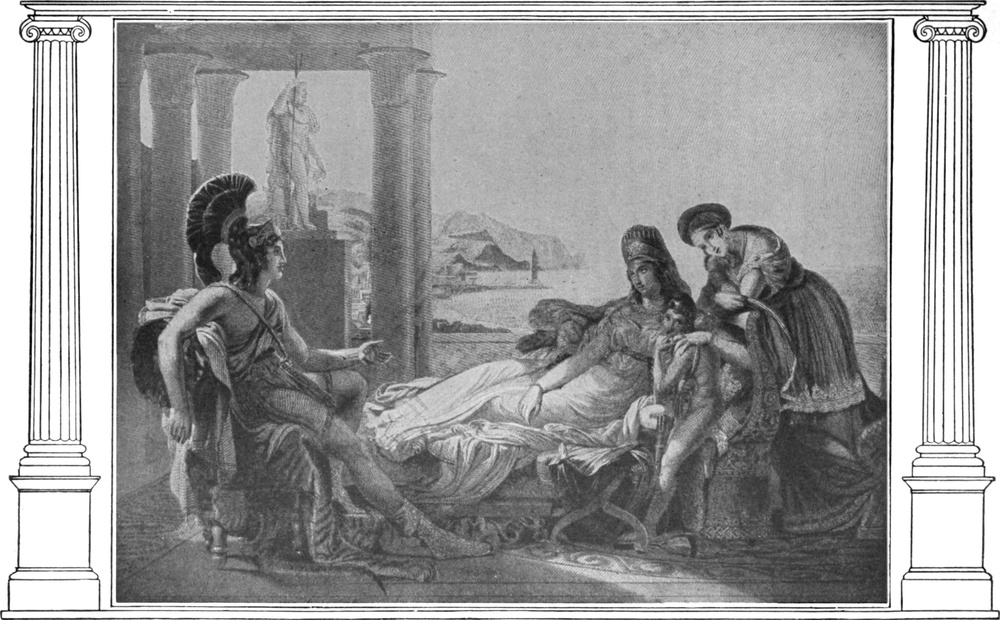
ÆNEAS AND DIDO: THE QUEEN OF CARTHAGE LISTENING TO THE STORY OF THE SIEGE OF TROY
From the Painting by P. Guerin, in the Louvre.
LARGER IMAGE
No Phœnician Influence in Britain
Of Semitic influence on archaic Greek art there is considerable evidence. After the Geometric Age, we find in the Greek lands pottery and metal-work showing certain motives and arrangement of decoration foreign to Ægean art, and referable ultimately to the Mesopotamian and Egyptian. Such are the animals and monsters disposed in concentric friezes and zones on Cypriote bowls, Corinthian vases, and the Cretan shields of the Idaean Cave. But this influence, strong and undoubted as it was, must not be over estimated. As the Hellenes rose to power, their instinct of sincerity and naturalism, inherited from Ægean civilisation, revolted against, and triumphed over, this parasitic Semitic art, and already in the ninth or eighth century we find a Græco-Lydian influence, which owes nothing to Phœnician, breaking back to the east and creating the ivories of the Sargonid Age at Nineveh. Phœnician objects thenceforward become fewer and fewer in Hellenic strata, and in the sixth century B.C. they virtually vanish. By this time Phœnicia had become a subject country, about to give up the last ghost of its independence to the Greeks themselves, as its western offshoot, Carthage, was also to surrender a little later to another civilisation near akin to the Greek. But, needless to say, the Semite has had his full revenge for the short tenure of his earliest predominance in European waters. The fall of Phœnicia cleared the way for another Semitic family to capture international trade, and, first with one creed and then another, to conquer the Greeks, the Romans, and the World.
There are, of course, possibilities of direct Phœnician intercourse with non-Mediterranean Europe—for example, with England’s south-western coasts; but they need not detain us. For whether certain Semites came to Cornwall in quest of tin or no, it is certain that by these no lasting influence of civilisation passed in to England. Neither the religion, the speech, nor the script of Britain owed them anything. Recent scholarship tends to discredit any Semitic element even in English south-western place-names.
The Origins of our Civilisations
Such, in brief outline, are the channels through which the civilisations of the South-eastern river-valleys could communicate with primitive Europe. It is easier to point them out than to say exactly what flowed along them. Seldom can so definite a debt be recorded as that under which we lie to the Semites of Phœnicia, for the names and the forms of the written characters which, presumably, they themselves had borrowed from Egypt, and modified ere they passed them westwards. Usually the obligation must be stated much more vaguely, being confined, as in the case of Ægean influences, to little more than a general responsibility for the spirit, and for many forms of the expression, of the first great artistic growth on the mainland soil of Europe, as well as for certain persistent and dynamic features in South European cults.
Thus, it becomes even more apparent at the end of our discussion than it was at the beginning that when all has been said about influences of Egypt and Mesopotamia, and influences of the intermediate civilisations of the Ægean, Syria, and Asia Minor, only a very small part of the whole story of incipient European civilisation has been told. Nor is it to be expected that the origin of our culture should be capable of being adequately expressed in terms of other cultures, developed at a great distance and under different geographical conditions. Civilisations, destined to be living growths, spring, it seems, of themselves, and the debts which they can incur at the first are very small and mostly in small things. It is only when they are come to adult estate, have bred men of wealth and leisure with open and receptive minds, and have broken through the geographical barriers about them, that they begin to borrow at large.
In the Childhood of Europe
One of the intermediate civilisations of which we have treated, the Ægean, the only one whose own origins are fairly well known, offers proof in point. Its remains indicate but trifling obligations to neighbouring Egypt till a very late period, that which, in Crete, we call the Third Minoan. Thereafter, in the space of two or three generations, the evidence of its debt increases at a wholly disproportionate rate. So too, no doubt, in the misty period of the childhood of Central and Western Europe, little was borrowed from abroad that was essential to civilisation; and the heavy obligations which we owe to the Eastern lands fall in ages much more recent. They fall, in fact, in those times which saw the Anatolian cult of Kybéle and Attis, the Egyptian cult of Isis and Horus-Harpocrates, the Mesopotamian cult of Mithra, and, far more momentous, of course, than these, Christianity—Hebrew in origin if modified by Greek conceptions—brought by a greater intermediary civilisation than any with which we have had to deal, to the knowledge of inner European races already long emerged from savagery, and able and eager to borrow.
DAVID GEORGE HOGARTH
I
IT is a familiar fact that offspring resemble their parents on the whole, but differ from them in details. For example, the child of a human being is always another, but never an exactly similar, human being.
These differences in detail are of two sorts, inborn and acquired. Inborn or innate differences arise “by nature”; the child is inherently unlike the parent—taller or shorter, fairer or darker, and so forth. Acquired differences, on the other hand, are due to the conditions under which parents and children have lived. Thus, owing to better or worse surroundings, the child may develop better or worse than the parent and so be taller or shorter, or a greater exposure to weather may render him darker or fairer.
Things We Cannot Inherit
It was formerly believed by scientific men, and is still believed by the public, that traits acquired by the parent tended to be inherited by the child—that is, reproduced as inborn traits. Thus it was supposed that if a man were made strong by exercise, or injured by accident, his child would tend to inherit, in some degree at least, the acquired benefit or injury, and as a result be naturally stronger or more defective than the parent was at the start.
Acquired Traits not Hereditary
But very prolonged and careful investigation has proved that this is certainly an error. For example, though for æons human beings have been learning to speak and walk, and make a multitude of other acquirements, yet none of these are ever inherited. In fact, owing to the evolution of memory and the retrogression of instinct, man, of all animals, acquires the most and inherits the least. Every child has to begin afresh and learn what its ancestors learnt; all are born ignorant; none speak or walk “naturally.” Each starts where the parent began, not where he left off. The parental traits, if reproduced at all, are always of the same kind in the child as in the parents, and appear in the same way. That is, the inborn traits of the parent are always inborn in the offspring; the acquired traits are never anything but acquirements resulting from the same causes as they did in the parent. In brief, the acquirements of the parent are never transmuted into inborn characteristics in the child. They are never inherited. It is admitted on all hands that inborn differences—variations, as they are termed technically—tend to be inherited.
Thus, if the parent is naturally darker than the grandparent, the child tends in colour to resemble the former more than the latter. Since the child may vary from the parent in the same direction as the latter varied from the grandparent, these inborn differences may be accentuated in subsequent generations. It is due to this fact that plant and animal breeders have improved domesticated species. They are able to benefit the individual by improving his surroundings, but the race they can improve only by breeding from the best. In other words, when they have the latter end in view, they must build on natural variations, not on acquirements.
A Great Problem of Science Differences among Kindred
One of the most important problems in the whole range of science is the question as to what causes offspring to differ in this inborn, natural way from their parents. Many theories have been formulated, and the subject is still to some extent under discussion; but the evidence is overwhelming that variations—natural differences—are not generally caused, as most people believe, by anything that happens to the parent before the birth of the child, but are “spontaneous.” The subject is a large and intricate one, and we have not space to discuss it at length. One or two facts, however, may be mentioned. The members of a litter of puppies, kittens, or pigs, may differ naturally amongst themselves and from their parents in all sorts of ways—in colour, shape, size, hairiness, disposition, and so on. One puppy may present points of resemblance to the father, another to the mother, a third to some ancestor, while a fourth may be unlike any of its predecessors. Since, practically speaking, the puppies were all conditioned alike before birth, it is evident that these great differences must be “spontaneous.” They cannot have been caused by such things as the good or ill health of the parents, their food, or the life they led, for, in that case, the puppies would all have varied in the same way.
Again, malaria is, in effect, a universal disease on the West Coast of Africa. Individuals differ naturally in their powers of resisting it, some taking it lightly and some severely; but almost every negro suffers, and many children perish of it. If the sufferings of the parents caused children to be born weaker “by nature,” it is evident that every individual would start life inferior to his predecessor at the start, and the race would thus degenerate and ultimately become extinct. On the other hand, if variations are “spontaneous,” if, quite unaffected by the sufferings of the parents, some children are born naturally different, naturally more or less resistant to malaria than their predecessors, it is plain that the weeding out of the unfittest, the weak against the disease, would ultimately make the race resistant to it. In the one case the race would drift to destruction; in the other it would undergo protective evolution. Obviously, the latter is what has happened. Negroes show no signs of any kind of degeneration, but they are of all races the most resistant to malaria.
Suffering Produces Strength
Similarly, Englishmen who have been much exposed to consumption and measles, natives of India who have been much afflicted by enteric fever and dysentery, Esquimaux who have suffered from cold, Arabs who have endured heat, Chinamen and Jews who have long dwelt under that complex of ill conditions found in slums and ghettos, are none of them degenerate, but, on the contrary, have become resistant, each race to its own particular ill-conditions in proportion to its sufferings in the past. In fact, it may be laid down as a general rule that races strengthen only when exposed to ill conditions, and deteriorate only when the conditions are so favourable that the unfit are not eliminated. An example of the latter is seen when prize breeds of animals and plants, however well nourished and cared for, are no longer bred with care. It follows that races, if not exterminated, are not injured but strengthened by ill conditions, by the elimination of the unfittest, as gold is refined by fire.
Survival of the Fittest
It is a remarkable fact that many people are able to accomplish the surprising feat of knowing that races have become inured to ill conditions, and of believing at the same time that the offspring of people exposed to such conditions tend, as a rule, to be degenerate. It is as if they believed that two and two make four, and two more six, but that if a great number of two’s are added together the total result is a minus quantity. Obviously the two beliefs are incompatible. A race cannot degenerate in every generation and yet emerge in the end strengthened from the struggle. The confusion has arisen because the two diametrically opposite propositions are seldom considered together, and in part also from a mistaken interpretation of what is observed in such situations as the slums of cities. Here puny children are seen to be derived from puny parents, and it is assumed that the children are degenerate because the parents have suffered.
As a fact we have no reason to doubt that the children are affected in precisely the same way as the parents. On the one hand, slums are sinks into which descend people naturally inferior, people who have varied spontaneously from their ancestors in such a way as to be feeble, physically or mentally, and who reproduce their like. On the other hand, the conditions are such that even the naturally strong, both parents and children, develop badly. Doubtless, owing to the constant elimination of the unfit, the latter—the naturally strong—are by far the more numerous. There is nothing to show that, if they were removed in early life to better surroundings, they would not develop just as well as the offspring of country folk.
An Evolution that has now Ceased
The fact that races grow resistant to the ill conditions to which they are exposed, and degenerate when placed under particularly good conditions, is decisive proof that offspring are not, as a rule, innately affected by the surroundings of their parents. No doubt exceptions occur, but these are amongst the most unfit, and the race is soon purged of them. Thus European dogs are said to degenerate when taken to India. But the existence of old-established native races of dogs is proof that the degenerative process is not perpetual. Malaria and many other ill conditions are quite normal parts of the environment of the races exposed to them, and have been so for thousands of years. Except for occasional unfavourable variations, which are quickly eliminated, they have long purged the races of those strains that tended to become degenerate under their influence.
After man—through the evolution of the structures and faculties which distinguish him from the lower animals, the large brain, with its accompanying memory, the organs of speech, the hand, the erect attitude—had achieved the conquest of the earth, his selection and evolution along the ancestral lines gradually diminished, and has now almost ceased. At the present day clever, strong, or active people do not on the average have an appreciably more numerous progeny than those who are not exceptionally endowed. No modern race is intellectually superior to the Greeks who flourished more than two thousand years ago. The brains, the hands, the organs of speech, the erect attitude, have not altered. Apparently nothing more than traditional knowledge has improved.
The gradual accumulation of traditional knowledge during prehistoric times enabled man to cultivate animals and plants, and so to increase and regulate his supply of food. As a consequence his numbers multiplied. Areas of country which formerly supported only a few wandering hunters now afforded sustenance to growing multitudes of agriculturists, who often dwelt together for mutual protection in villages. Commerce followed agriculture, towns and cities arose, and civilisation dawned.
Civilisation implies a dense and settled community, protected from most of the dangers which beset wild animals, and in which, therefore, the elimination of the unfit is no longer of the kind that weeded out the brute and the utter savage. Some sort of elimination does occur, however, for, even in the most civilised states, multitudes of people perish in youth, before they have contributed their full quota of offspring to the race.
Natural Selection at Work
We have excellent opportunities of studying this elimination and noting whether it results in evolution. Indeed, man presents the only instance in Nature in which we are able to observe natural selection actually at work. In all modern states statistics are compiled which set out the causes of death, the mortality from each cause, and the ages of its victims. By comparing races which have been much afflicted by this or that cause of mortality with races that have been little or not at all affected, we are able to ascertain the resulting racial change, if any. As may be noted by everyone, civilised people perish, with rare exceptions, of disease.
MANKIND’S LONG BATTLE AGAINST BACTERIA
Resistance of Races to Disease
W
WE have just seen that every race is resistant to every disease precisely in proportion to its past experience of it. It follows that the evolution of civilised peoples is against disease. If any other kind of evolution is now occurring, no one as yet has been able to demonstrate it, though many unproved guesses have been made. Mere alterations in traditional knowledge is not evolution. Children may derive it just as well from other people as from their parents.
The vast majority of deaths from disease are of zymotic origin. A zymotic or microbic disease is caused by the entrance into the body of minute animals or plants (microbes), which find their nutriment there. There are many species of microbes, each disease being due to one. Some species are mainly air-borne, and infect through the breath; others are water-borne; others earth-borne; yet others insect-borne; while a few pass by actual contact from an infected to a healthy person.
The Way Disease is Spread
Some diseases—for example, consumption and leprosy—are of indefinite but always prolonged duration; others, like measles, are short and sharp. In the case of the latter, for reasons we need not dwell on here, the body after an attack becomes, for a longer or shorter time, an unfit habitation for the microbes of that particular species. The rapid recovery which occurs in these “acute” diseases, indeed, implies the banishment of the microbes. The air-borne diseases—measles, influenza, smallpox, and the like, all of that acute type which confers immunity against subsequent attacks—are very infective, spreading through a susceptible population with great rapidity. Under favourable conditions the water-borne diseases also—cholera, dysentery, enteric fever, and the like—may spread very quickly. Chief amongst the earth-borne diseases is consumption. It is contracted chiefly in such dark, ill-ventilated, and crowded houses as are built by the inhabitants of cold and temperate climates.
The disease-producing microbes are an infinitesimal proportion of the total number of bacterial and protozoan species. In Nature it is not easy to find a speck of earth or a drop of water from which these minute living beings are absent. All decay, by means of which the dead bodies of plants and animals are returned to the soil, is due to them.
The Immense Antiquity of Diseases
It is a safe assumption that the microbes of human diseases have evolved from non-parasitic species. The niche they now occupy in Nature is the human body. Two things formed essential parts of this evolution—first, the microbes became capable of existing and multiplying for a shorter or longer period in the body; secondly, they evolved means of passing from one living body to another. The latter must have been the more difficult process. Under favourable circumstances several species of microbes—for example, those of putrefaction, which are ordinarily non-parasitic—are capable of entering the human body and becoming virulent; but, since they cannot secure passage from one individual to another, they die out, and their virulence is lost. Historical evidence renders it probable that all known human diseases are of immense antiquity, the so-called new diseases being merely newly-observed diseases. It appears probable, therefore, that, owing to constant persecution by disease, by continued survival of the fittest, humanity has grown so resistant that no species of microbe which has not undergone concurrent evolution is now able to establish itself as a regular parasite.
Obviously, since the microbes of human diseases draw their nutritive supplies from man, they cannot persist except amongst populations so crowded that they are able to pass from one individual to another in unending succession. When the succession fails, the disease dies out, and is not renewed, except from foreign sources. Microbic disease is never contracted in desert places far from human settlements, and even in modern times it is comparatively rare amongst nomadic tribes, and, seemingly, was quite unknown in Arctic regions and in many Pacific islands before its introduction by Europeans. These maladies, therefore, must have made their appearance only after men had peopled certain regions in considerable numbers.
Progress of Sanitary Science
On the other hand, we have no certain evidence that any well-established parasitic disease has ever completely died out. The chances are all against such an occurrence in the past. When once established as parasites, the microbes, owing to the constant growth of human population, found a constantly augmented food supply, and therefore constantly increased opportunities of reaching fresh fields of conquest. Sanitary science is still in its infancy. Preventive measures, and perhaps other agencies, have caused the disappearance of leprosy from several countries, but it is still prevalent in many quarters of the globe. Contagious diseases have spread very widely. Earth and air borne diseases have become endemic instead of merely epidemic. Consumption is always with us, and almost every child contracts measles, whooping-cough, chicken-pox, and common cold. Small-pox has been replaced by vaccination, which is merely modified small-pox. Malaria has spread but little during the historic epoch, but only because its microbes were already present in almost every place where the mosquitoes that convey it are able to exist.
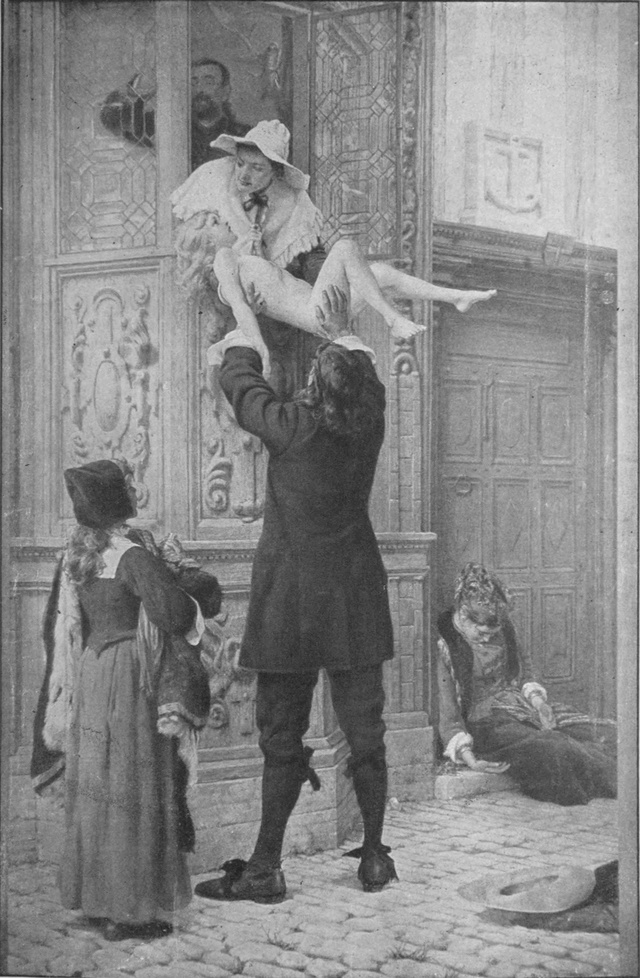
THE DAYS OF THE PLAGUE IN LONDON
Dr. Archdall Reid, in his essay on race supremacy, explains that the evolution of civilised peoples is against disease, and the age of pestilence and plague is passing. This picture of an incident in the greatest plague that has affected London in historical times—in the year 1665—is from the painting by F. W. Topham, R. I.
LARGER IMAGE
All our information indicates the Eastern Hemisphere as the place of origin both of man and of his microbic diseases. Parts of it have been inhabited by a dense and settled population from a time immensely remote. “Behind dim empires ghosts of dimmer empires loom.” Beyond the traces of the oldest civilisations we find evidences of primitive agricultural communities, and far beyond these the remains of the cave-men and hunters of the Stone Age. Even a race of hunters tends to increase faster than the food supply. Doubtless the pressure of population in the Old World led to the colonisation of the New. But even in the New World there are signs of a civilisation so ancient that some authorities have placed its beginnings as far back as a score or more of thousands of years. With the exception of malaria, it is extremely doubtful whether any zymotic disease existed in the whole of the New World at the time of its discovery by Columbus.
The subject is involved in obscurity; but, while it is evident that the European adventurers introduced many diseases, there is no clear indication that they found and brought back one. Apparently all the diseases which have been prevalent in Europe and America during the last four hundred years were prevalent in the former continent before the fifteenth century. Venereal disease and yellow fever have sometimes been regarded as exceptions. But the former was well known to the Roman physicians, and was common during the Middle Ages. Moreover, the inhabitants of the New World take the disease in a very acute form, and it is not found in remote communities to which Europeans have had no access. Yellow fever was first noted with certainty in the West Indies in the middle of the seventeenth century. The records of the time “tell of the importation of the disease from place to place, and from island to island.”
Origins of Rare Diseases
Not till more than a century later was it observed on the West Coast of Africa. There can be no doubt, however, that the earlier observers confused yellow fever with bilious malaria, and that it was present both in the West Indies and Africa long before a differential diagnosis was made. The fact that of all races negroes are most resistant to the disease would seem to indicate West Africa as the place of origin. In any case, it is certain that, with the exception of malaria, zymotic diseases, if not entirely absent, were extremely rare in the New World.
THE DISAPPEARANCE OF THE NATIVE RACES
The Age of Pestilence is Passing
Z
ZYMOTIC disease, then, arose amongst the slowly-growing populations of the Old World. Air and insect borne diseases may have arisen amongst the early hunters and nomads. Similar forms of disease, murrains as they were anciently termed—for example, distemper, rinderpest, the horse sickness in South Africa, the rabbit plague in Northern Canada, and the cattle fever in Texas—occur among lower animals, when these are present in considerable numbers. With the exception of tuberculosis and leprosy, endemic disease was probably almost unknown in the sparsely-peopled ancient world. The facts that air and water borne diseases spread very rapidly, that the illnesses caused by them are comparatively short and sharp, and that recovery is followed by immunity, must have caused rapid exhaustion of the food supply of the microbes. Under such conditions the persistence of the pathogenic species was maintained among the scanty populations by a passage to new and perhaps very distant sources of supply.
Introduced by travellers, or spreading from tribe to tribe, they appeared suddenly in epidemic form as plagues and pestilences, and, disappearing as suddenly, were not known again till a fresh generation furnished a fresh supply of food.
When, however, in spite of war, famine, and pestilence, the human race increased to such an extent that the number of fresh births furnished a perennial supply of food, while at the same time a rising civilisation and improved means of communication lessened the isolation of various communities, then many diseases slowly passed from an epidemic to an endemic form. Pestilence grew rare, but every individual was exposed to infection, and, during youth, either perished from, or acquired immunity against, the more prevalent forms of disease.
Measles a National Scourge
When endemic, zymotic disease—at any rate, disease against which immunity can be acquired—is far less terrible than when epidemic. Modern examples of ancient epidemics may be seen in isolated regions. In Pacific islands, for example, air-borne disease spreads like a flame. The whole community is stricken down. The sick are left untended and perish in multitudes. The entire business of the community is neglected, and famine frequently follows. Under such conditions measles or whooping-cough, diseases which we in England are accustomed to regard as scarcely more than nuisances, may rise to the level of a great national disaster. Thus, in 1749, 30,000 natives perished of measles on the banks of the Amazon. In 1829 half the population died in Astoria. In 1846 measles committed frightful ravages in the Hudson Bay territory. More recently a quarter of the total inhabitants was swept away in the Fiji group of islands.
Sanitation is Sometimes Powerless
At the dawn of history, long after the evolution of zymotic disease, the population of the Eastern Hemisphere was still sparse and scattered. Even as late as the Norman Conquest that of England was barely two millions—about one-third of the number now present in London. Means of communication were poor and beset by dangers. A journey from York to London was then a more serious affair than a journey from London to San Francisco to-day. Water and air borne diseases were, therefore, absent during long periods of time. When they came they spread as epidemics. Accordingly we read of plague and pestilence; of diseases suddenly becoming epidemic and sweeping away a fourth or half of entire communities. Historians are apt to attribute these immense catastrophes partly to the bad sanitation of the period and partly to diseases which have died out of the world, or, at any rate, out of Europe. Doubtless they are right in a few instances. But, apart from diseases which spread under special circumstances from tropical centres, had sanitation, under modern conditions of intercommunication and crowding, tends to render water-borne disease endemic, not epidemic. Over air-borne disease it has no effect. Measles, whooping-cough, chicken-pox, influenza, common cold, and small-pox (in a modified form) are as common as ever.
Plagues “the Wrath of God”
The character of these ancient epidemics, their special symptoms as indicated in old literature, their sudden and portentous appearance, which men attributed to the wrath of God, their tremendous infectivity and rapid spread, their equally sudden and complete departure as of Divine anger assuaged, point rather to air and water borne diseases of the types now endemic and comparatively harmless among us, but still so fearful in their effects on isolated communities. Like the light flashed from a child’s mirror on a darkened wall, so they flickered and swept forwards and backwards from end to end of the Old World—from the Malay Peninsula to the North Cape of Norway, from Kamschatka to the south point of Africa. A parallel may be found in the recent epidemic of rinderpest amongst the herbivorous animals of Africa. Years might pass, old men might remember, the peoples might sacrifice to their gods; but when a fresh generation of those who knew not the disease had arisen, when the harvest of the non-immune was ripe and ready, the diseases would return to the dreadful reaping. Behind them the earth was heaped with the dead, and the few and stricken survivors grubbed for roots to satisfy their hunger. To-day sanitation has nearly abolished water-borne diseases, and, in a population largely immune, epidemics of air-borne disease, like a light thrown on a sunlit wall, are but faint shadows of that which they were in their old days of awful power.
Growth of Resisting Power
The progress of consumption was different; it was never truly epidemic. Owing to its low infectivity, to its lingering nature, to the fact that no immunity could be acquired against it, it did not spread suddenly when first introduced, but when once established its virulence did not abate within measurable time. In other words, it was endemic from the beginning. It made its home in the hovels of the early settlers on the land. In such situations—as in Polynesian villages—modern Englishmen do not take the disease. But their remote ancestors were more susceptible; they could be infected by a smaller dose of the bacilli. Gradually, as civilisation advanced, the conditions grew more stringent; men gathered into larger and denser communities, into hamlets and villages in which they built houses ill lighted and worse ventilated.
With the rise of towns, and ultimately of great cities, the stringency of selection continually increased; and with it, step by step, the resisting power of the race. To-day Englishmen dwell under conditions as impossible to their remote ancestors as to the modern Red Indians. In fact, no race, especially in cold and temperate climates, is now able to achieve civilisation, to dwell in dense communities, unless it has previously undergone evolution against tuberculosis. But of this more anon.
So during the long sweep of the ages microbic diseases strengthened their hold on the inhabitants of the Eastern Hemisphere, who in turn slowly evolved powers of resistance. In like manner antelopes grew swift and wild sheep active when persecuted by beasts of prey. Then, when the germs of disease were rife in every home and thick on the garments of every man, there occurred the greatest event in human history, the vastest tragedy. Columbus, sailing across an untracked ocean, discovered the Western Hemisphere. The long separation between the inhabitants of the East and West ended. The diseases of the Old World burst with cataclysmal results on the New.
3,500,000 Destroyed by Small-pox
The ancient condition of the Eastern Hemisphere was reproduced in the West. Again we read of plague and pestilence, of water-borne and air-borne diseases coming and going in great epidemics, and of the famines that followed. Measles and cholera piled the earth with the dead. The part played by small-pox was even greater. When taken to the West Indies in 1507 whole tribes were exterminated. A few years later it quite depopulated San Domingo. In Mexico it destroyed three and a half millions of people. Prescott describes this first fearful epidemic as “sweeping over the land like fire over the prairies, smiting down prince and peasant, and leaving its path strewn with the dead bodies of the natives, who—in the strong language of a contemporary—perished in heaps like cattle stricken with murrain.” In 1841 Catlin wrote of the United States: “Thirty millions of white men are now scuffling for the goods and luxuries of life over the bones of twelve millions of red men, six millions of whom have fallen victims to small-pox.”
But the principal part was played by tuberculosis. Air-borne and water-borne diseases generally left an immune remnant, but against tuberculosis no immunity could be acquired. Red Indians and Caribs could not in a few generations achieve an evolution which the inhabitants of the Old World had accomplished only after thousands of years, and at the cost of hundreds of millions of lives. Civilisation, which implies a dense and settled community with cities and towns, had suddenly become a necessity, but remained an impossibility to all the inhabitants of the temperate parts of the West. It is a highly significant fact that throughout the New World no city or town has its native quarter, whereas every European settlement in Asia and Africa has its native suburbs. The aborigines of the New World are found only in remote or inaccessible parts.
A Plague that Spread like Fire
The following is an example of the manner in which tuberculosis went to work: “The tribe of Hapaa is said to have numbered some four hundred when the smallpox came and reduced them by one-fourth. Six months later, a woman developed tubercular consumption; the disease spread like fire about the valley, and in less than a year two survivors, a man and a woman, fled from the newly-created solitude.... Early in the year of my visit, for example, or late in the year before, a first case of phthisis appeared in a household of seventeen persons, and by the end of August, when the tale was told to me, one soul survived, a boy who had been absent on his schooling.”
The Caribs of the West Indies are almost extinct. The Red Indians are going fast, as are the aborigines of cold and temperate South America. The Tasmanians have gone. The Australians and the Maoris are but a dwindling remnant. As surely as the trader with his clothes, or the missionary with his church and schoolroom appears, the work of extermination begins on Polynesian islands. Throughout the whole vast extent of the New World the only pure aborigines who seem destined to persist are those which live remote in mountains or in the depths of fever-haunted forests, where the white man is unable to build the towns and cities with which he has studded the cooler and more “healthy” regions of the north and south.
Races that Decline before the Whites
Many explanations, or pseudo-explanations, have been offered to account for the disappearance of the natives. We are told that they cannot endure “domestication,” that they “pine like caged eagles” in confinement, that the change produced by civilisation makes them infertile, as the change produced by captivity makes some wild animals infertile, and so forth. But the only peoples who are disappearing are those of the New World, some of whom were by no means savage. In Asia and Africa are many tribes far lower in the scale of civilisation who have persisted in constant communication with dense and settled communities from time immemorial. Notwithstanding all that has been written, the people of the New World do not wither away mysteriously when brought into contact with the white man. They die as other men do of violence, or famine, or old age, or disease. But deaths from all these causes, except the last, are now comparatively rare amongst them—much rarer than formerly during the time of their perpetual wars. The vast majority die of imported diseases—exactly the same diseases as white men die of. But their mortality is invariably much higher than that of white men, and they perish on an average at a younger age.
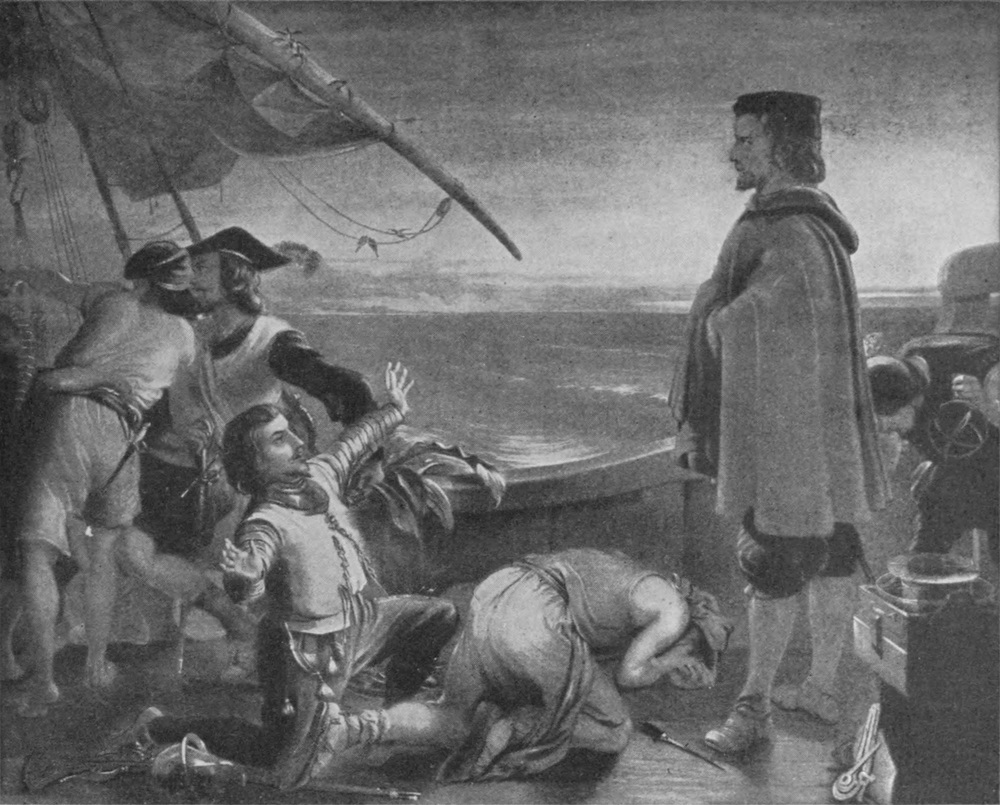
THE EVE OF “THE VASTEST TRAGEDY IN HISTORY”: COLUMBUS SIGHTING AMERICA
“The greatest event and the vastest tragedy in human history” is Dr. Archdall Reid’s striking description of the discovery of America by Columbus. It ended the long separation between the inhabitants of East and West, and the diseases of the Old World burst with cataclysmal results upon the New. The picture, by George Harvey, shows Columbus approaching America, his rebellious crew pleading for pardon.
All this is not mere hypothesis. It can be proved by reference to carefully collected and tabulated statistics published by every department of Public Health in America, Australasia, and Polynesia. The cause of the sterility cannot be demonstrated with the same precision; but it is hardly necessary to invent fanciful causes when a reasonable one is to hand. The high mortality indicates a high sick-rate, and presumably illness is as much a cause of sterility in the New World as in the Old, among savages as among civilised people.
The Spanish conquest of the West Indies was followed by the swift disappearance of the natives. To that end the Spaniards unconsciously adopted the most effectual means possible. They satisfied their greed by forcing the natives to labour in plantations and in mines, and their religious enthusiasm by compelling attendance in churches and cathedrals. In other words, they placed the natives under conditions the most favourable for acquiring the diseases which they imported by every vessel. When the native population dwindled, it was replaced by negro slaves from West Africa.
Africans Die in our Civilisation
The history of negro migrations is extremely interesting and illuminating. There are no accounts of negro conquest outside the limits of Africa, but from very ancient times a constant stream of slaves has passed to Southern Europe and Asia, where they have been employed mainly in domestic service, and in more modern times to America, where their occupation has been mainly agricultural. The invasion of Asia has continued to our own day. But one may search from Spain to the Malay peninsula and, except in recent importations, find scarcely a trace of a negro ancestry. Yet slaves, like cattle, are valuable property, more cheaply bred than imported. In Eastern countries they have often been kindly treated, and many have attained to wealth and power. Like the African soldiers in Ceylon, of whom it is recorded that, though many thousands were imported by the Dutch and English, hardly a descendant survives, all perished in a few generations, the elimination of the unfit being so stringent as to cause extinction, not evolution. A permanent colony of native Africans in the midst of an ancient consumption-infested civilisation is impossible.
Fate of Natives of America
The fate of the negro migrations into America has been different. The race had undergone some evolution against consumption in Africa, and, therefore, was more resistant than the vanishing aborigines. In its new home, employed in agriculture in a hot climate where white men and tubercle bacilli, also recent importations, were as yet few in numbers, it was placed under the best conditions possible. Gradually, as the stringency of selection waxed, it evolved resisting power. To-day, American negroes are able to dwell even in Northern cities, though it is said “every other adult negro dies of consumption.” After the discovery of America the principal maritime races of Western Europe competed for its possession. Spain and Portugal, then powerful nations, had the first start in the race, and chose the seemingly richer tropics. But the forests of the centre and south were defended by malaria, which raised a barrier against immigration, and by heat and light, which raised a barrier against tuberculosis. Moreover, the Spaniards and the Portuguese intermarried freely with the aborigines, and the mixed race which resulted inherits in half measure the resisting power of both stocks. At the present day this mixed race, with a leavening of mulattoes, pure Spaniards, Portuguese, and negroes, inhabits the cities and more civilised parts. Even in tropical America the pure aborigines are found, speaking generally, only beyond the verge of civilisation. Farther south the disappearance of the natives has been more complete, and the cooler, healthier, and more open pampas are settled by a race more purely European.
THE TRIUMPH OF THE ANGLO-SAXON PEOPLES
Expansion of the Anglo-Saxon
T
THE weaker British and French were shouldered into the seemingly inhospitable north. But the British won the battle of Quebec, and the French immigration soon ceased. That little fight is half forgotten, but it is doubtful if any battle in history had results half so important. It placed all North America in the grasp of the Anglo-Saxon, and gave his race enormous space for expansion. Unchecked by malaria, the new-comers gathered into communities and built towns and cities such as those which across the Atlantic were the homes of tuberculosis. The cold forced them to admit little air and light into their dwellings. The aborigines melted away from the borders of the settlements. Under the conditions there was little intermarriage. In that climate Indian women, and even half-caste children, could not exist within stone walls. The few white men who took native wives preserved them only while living a wild life remote from their kin.
The British conquest of North America and Australasia resembles the Saxon conquest of Great Britain. The natives have been exterminated within the area of settlement. It is in sharp contrast to their conquests in Asia and Africa. Both in the Old World and in the New the subjugation of the natives was accompanied by many wars and much bloodshed, and probably the conflicts in the former were more prolonged and destructive than those in the latter. But in no part of the Old World have the British exterminated the natives. They do not supplant them; they merely govern them. Southern Asia and East and West Africa are defended by malaria. The British cannot colonise them, and the natives have undergone such evolution against tuberculosis that they are capable of resisting the hard conditions imposed by modern civilisation. In South Africa, where there is little malaria, Europeans share the land with the natives, but the latter are likely to remain in an overwhelming majority.
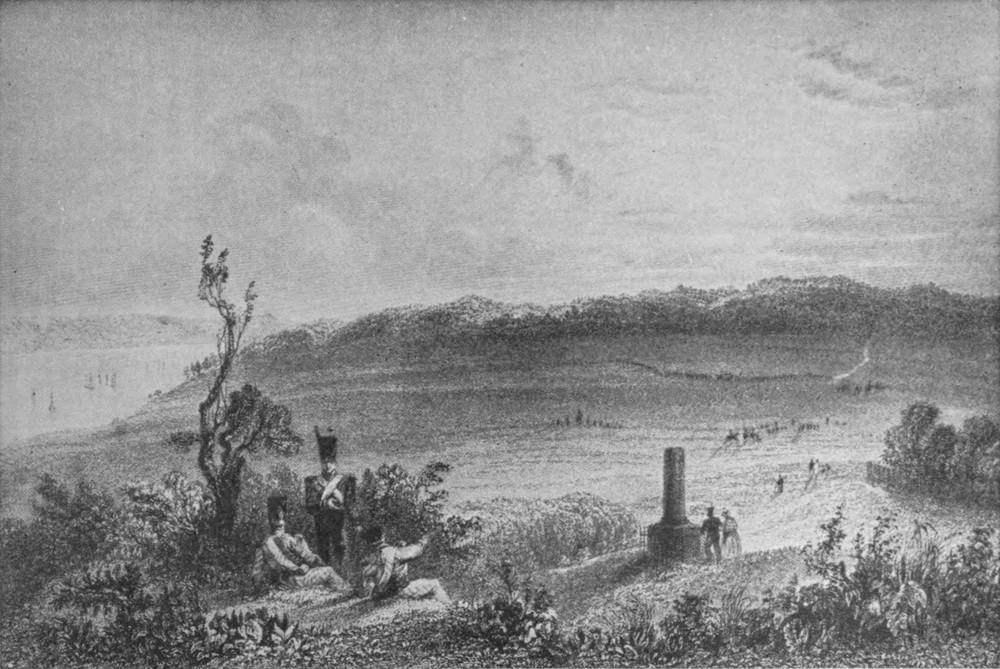
WHERE THE ANGLO-SAXON RACE OBTAINED POSSESSION OF NORTH AMERICA
On the Plains of Abraham, outside Quebec, the British and French troops fought in 1759, and the battle placed all North America in the grasp of the Anglo-Saxon, giving his race enormous space for expansion. It is doubtful, says Dr. Archdall Reid, if any battle in history had results half so important as this, although it is half forgotten.
If history teaches any lesson with clearness it is this—that conquest, to be permanent, must be accompanied with extermination, otherwise in the fulness of time the natives expel or absorb the conquerors. The Saxon conquest of England was permanent; of the Norman conquest there remains scarcely a trace. The Huns and the Franks founded permanent empires in Europe; the Roman Empire, and that of the Saracens in Spain, soon tumbled into ruins. It is highly improbable, therefore, that the British will retain their hold on their Old World dependencies. A handful of aliens cannot for ever keep in subjugation large and increasing races that yearly become more intelligent and insistent in their demands for self-government. But no probable conjunction of circumstances can be thought of that will uproot the Anglo-Saxons from their wide possession in the New World. The wars of extermination are ceasing with the spread of civilisation. We have ransacked the world, and now know every important disease. Diseases cannot come to us as they came to our forefathers and to the Red Indians, like visitations from on high. All the diseases that are capable of travelling have very nearly reached their limits; the rest we are able to check. Even in the unlikely event of a new disease arising, it would affect other races equally. Canada and Australasia, like the United States, may separate from the parent stem, but the race will persist. If ever a New Zealander broods over the ruins of London, he will be of British descent.
The Natural History of Mankind
The natural history of man is, in effect, a history of his evolution against disease. The story unfolded by it is of greater proportions than all the mass of trivial gossip about kings and queens and the accounts of futile dynastic wars and stupid religious controversies which fill so large a space in his written political history. In the latter, as told by historians, groping in obscurity and blinded by their own preconceptions, men and events are often distorted out of all proportions. A clever but prejudiced writer may pass base metal into perpetual circulation as gold. Luther and the Reformation are accepted as Divine by many people; they are reviled as diabolical by more. Cromwell was long regarded as accursed; to-day he is half-deified. How many of us are able to decide, on grounds of fact, not of fiction, whether the Roman Empire perished because the Romans, becoming luxurious, sinned against our moral code, as ecclesiastic historians would have us believe, or because a disease of intolerance and stupidity clouded the clear Roman brain and enfeebled the strong Roman hand, as Gibbon would have us think? But the natural history of man deals, without obscurity and without uncertainty, with greater matters. Study it, and the mists clear away from much even of political history. We see clearly how little the conscious efforts of man have influenced his destiny. We see forces unrecognised, enormous, uncontrolled, uncontrollable, working slowly but mightily towards tremendous conclusions—forces so irresistible and unchanging that, watching them, we are able even to forecast something of the future.
The mere political results of man’s evolution against disease are of almost incalculable magnitude. The human races of one half of the world are dying, and are being replaced by races from the other half. Not all the wars of all time taken together constitute so great a tragedy. A quite disproportionate part in this great movement has been borne by our own race. It has seized on the larger part of those regions in which the aborigines were incapable of civilisation, because incapable of resisting consumption, and were undefended by malaria. In the void created by disease it has more room to spread and multiply than any other race.
Disease Mightier than the Sword
Other races may dream of foreign conquests, but the time for founding permanent empires is past. There remains for them only temporary conquest, in a few malarious parts of the world in which Europeans cannot flourish and supplant the natives. Spain and Portugal lost their opportunity when they turned from the temperate regions and chose the tropics. France lost her opportunity on the Heights of Abraham. Germany is more than a century too late in the start. Russia can conquer only hardy aliens who will multiply under her rule and ultimately assert their supremacy. In times now far remote in the history of civilised peoples, the sword was the principal means for digging deep the foundations of permanent empires. Its place was taken by a more efficient instrument. A migrating race, armed with a new and deadly disease, and with high powers of resisting it, possesses a terrible weapon of offence. But now disease has spread over the whole world and so is losing its power of building empires. The long era of the great migrations of the human race, of the great conquests, is closing fast.
Possibilities of the Black Races
It is generally supposed by historians and others that races that disappear before the march of civilisation are mentally unfitted for it. The assumption is not supported by an iota of real evidence. To be mentally incapable a race must be of very defective memory. Recently a school of Australian natives, who belong to one of the “lowest” of races, took the first place in the colony. Negroes occupy a very inferior position in America, especially in Anglo-Saxon territories. But they are stamped by glaring physical differences, are treated with great contempt and jealousy by the whites, and their acquired mental attitudes, therefore, do not develop under good conditions. It is very possible that they are mentally inferior to the whites; but not so inferior as is commonly believed.
Russian peasants, though not sharply differentiated by physical peculiarities from the governing classes, are equally scorned by them, and show a mental development hardly, if at all, superior to the negroes of United States. The Latins of South America seem very incapable of orderly government, but they are the heirs of a civilisation older than our own. At any rate, while it is conceivable the American negroes and some other races are incapable of building up a highly-enlightened society by their own efforts, it is manifest that they are able to persist and multiply when civilised conditions are imposed on them. Not so the aborigines of the New World, some of whom—for example, the Maoris and the Polynesians—are admittedly of good mental type. They perish swiftly and helplessly of bodily ailments.
Very clearly, then, human races are capable or incapable of civilisation, not because they are mentally, but because they are physically, fit or unfit.
G. ARCHDALL REID
A
AN attempt is made in these pages to compile a dictionary of the main existing races of the world, arranged in alphabetical order. The accompanying Ethnological Chart on page 352, will enable the reader to see at a glance the relationship of the various main divisions, families, and stocks under which these races are distributed. The Dictionary and the Chart, if used in conjunction, will thus supply information about any race named in the list, and will tell the inquirer to what branch of the human race it belongs. It is obviously impossible to make the Dictionary inclusive of every tiny and out-of-the-way tribe of Africa or South America, but all important races are included. If the reader wants to know something about the Abyssinians, he will look them up in the Dictionary, and find that they are partly Semitic Himyarites, partly Hamitic Gallas, etc. The Chart will then show him that the Hamitic and Semitic families belong to the great Caucasic Division of mankind, that the Himyarites are one of the main stocks of the Semitic family, and that the Gallas belong to the Eastern branch of the Hamitic family. The student should familiarise himself with the names and places of the families and chief stocks of mankind, as given in the Chart, and so greatly facilitate the task of reference. The intention of both Chart and Dictionary is, of course, to serve as a kind of index to the History proper, which must be consulted for further information. As far as can be discovered, no previous attempt has been made to summarise the conclusions of modern ethnology in this convenient form. The illustrations depict some of the most interesting races.
Ababua. A tribe of Sudanese negroes in Central Africa. See WELLE GROUP.
Abaka. See NILITIC GROUP.
Abkhasians. A Western Caucasian tribe occupying the Black Sea coast from Pitzunta to Mingrelia, akin to CIRCASSIANS (q.v.).
Abo, or Ibo. See NIGERIAN GROUP.
Abors. An Assamese tribe in the Brahmaputra Valley, belonging to the Tibetan branch of the Southern Mongolic family. Wild jungle-dwellers.
Absarakas. See SIOUAN.
Abukaya. A negro tribe in the Sudan. See NILITIC GROUP.
Abunda. A settled and fairly civilised race of Bantu Negroes, occupying the seaboard and inland districts of Portuguese West Africa, south of Ambriz.
Abyssinians. A mixed race of Hamitic, Semitic, and Negro stock, inhabiting Abyssinia (from Arabic habashi—mixed). The main racial element—Abyssinians proper—consists of brown-skinned Semitic Himyarites, who probably emigrated from Arabia in prehistoric times, and profess themselves descended from the Queen of Sheba. Since the sixteenth century Abyssinia has been over-run by the Hamitic Gallas (q.v.), who have largely mingled their blood with this older element. There is also a considerable admixture of Sudanese Negro blood. Since the fourth century the religion of Abyssinia has been a corrupt form of Christianity; the mediæval myth of Prester John perhaps relates to this fact.
Acadians. French settlers of seventeenth century in Nova Scotia.
Achcæans. See ARGIVES.
Achinese. A warlike Malay race of Sumatra, long at war with the Dutch colonists.
Accras. See GA.
Achuas, or Wochua. A pygmy Negrito race, well-proportioned, though dwarfish, inhabiting the forests of the Welle and Aruwimi districts in Central Africa, and living by hunting.
Adamawa Group. A group of Sudanese Negro tribes inhabiting the district of the Upper Benue in Northern Nigeria.
Adansis. Negro tribe on Guinea coast. See TSHI.
Æolians. See HELLENES.
Aetas. A Negrito race of the Philippine Islands, belonging to the Oceanic family of Ethiopic Man. Short of stature, black-skinned, with woolly hair, they present many points of resemblance to the Negritoes of Central Africa. There are many crosses between Aetas and Malays.
Afars. A nomadic Turki tribe of Persia. See also DANAKILS.
Afghans. A race of Iranian stock, belonging to the great Aryan family, who form about half the population of Afghanistan. They are divided into various tribes, of which the Duranis are the dominant one, the Ghilzais the most warlike, and the Yusufzais the most turbulent. There are also large tribes known as Pathans, who are of the same stock as the Afghans, but are classed separately. The Afghans are a handsome and athletic race, inured to war from their childhood, lawless and treacherous, but sober and hardy. Throughout the nineteenth century they were a constant source of trouble to British India, but a new era seems to have opened under the present Amir. For non-Afghan inhabitants of Afghanistan, see HAZARAS, KIZIL-BASHIS, and TAJIKS.
Afridis. A warlike and turbulent Pathan race, occupying the neighbourhood of the Khyber Pass, and often at war with the English.
Afrikanders. Persons of European descent born and living in South Africa.
Agaos. An indigenous Hamitic race of Northern Abyssinia.
Ahoms. Primitive inhabitants of Assam, belonging to the Indo-Chinese stock of the Southern Mongolic family.
Ainus. An aberrant family of Caucasic Man in the Far East. They were probably the aboriginal inhabitants of Japan, but are now few in number, and confined to Yezo, the Kurile Islands, and part of Sakhalin. They have regular and often handsome features of Caucasic type, but are of low stature, and characteristically marked by an abundance of coarse, black, wavy or crisp hair on head, face, and body, whence they are commonly called the “Hairy Ainus.”
Akawais. See CARIBS.
Akkas. A pygmy Negrito race of the Welle district in Central Africa, akin to the Achuas (q.v.), who are specially interesting because they are represented on Egyptian monuments of 3400 B.C., with their existing racial characters.
Akkads, or Akkadians. An extinct Mesopotamian race, founders of the oldest known civilisation in Babylonia, who belonged to the Northern Mongolic family, and probably to the Turki or Finno-Ugrian stock. They invented the cuneiform alphabet, which was adopted by their Semitic successors—see BABYLONIANS—and it is thought that they may have been the ancestors of the Chinese.
Akpas. See NIGERIAN GROUP.
Alani. A warlike nomadic race, probably belonging to the Turki stock of the Northern Mongolic family, and allied to the Tartars (q.v.). In the fifth century they made settlements in Gaul and Spain, where they were absorbed by the Vandals and the Visigoths respectively. The remnant left in the East of Europe were conquered in the thirteenth century by the Golden Horde, and their name disappeared from history.
Albanians, or Arnauts. The warlike race of mountaineers who inhabit Albania, on the western coast of the Balkan Peninsula. They are semi-civilised, live in a perpetual state of tribal warfare, and make admirable soldiers, forming the best part of the Turkish Army. They are probably the oldest of the Balkan races, and represent the earliest Aryan immigrants into Europe [see ILLYRIANS]. They are partly Christian, partly Mohammedan.
Albigenses. A heretical sect, mostly of Provençal descent, who appeared in the South of France about the eleventh century, and were rigidly persecuted until they became extinct in the middle of the thirteenth century.
Alemanni. An ancient German tribe on Upper Rhine, of Teutonic stock, from whom the modern Swabians and Swiss are in great part descended.
Aleutians. Natives of Aleutian Islands, belonging to Eskimo stock of Northern American family.
Alfuros. A half-breed race between Malays and Papuans: in Malaysia, a term given by Malays to their rude non-Mohammedan neighbours.
Algonquian. A group of North American Indian tribes, formerly inhabiting the Central and Southern States of America, east of the Rocky Mountains, and as far south as South Carolina, now gathered into Indian Reservations. They include the Algonquin, Blackfoot, Cheyenne, Cree, Delaware, Fox, Illinois, Massachusett, Mohican, Ojibway, Sac, Shawnee, and many smaller tribes.
Alibamus. See MUSKHOGEAN.
Ali-Elis. See TURKOMANS.
Alsatians. Natives of Alsace, of High German stock, allied to the Swabians (q.v.).
Amadis. See WELLE GROUP.
Ama. Prefix of many Bantu racial names, as Ama-Zulu, Ama-Xosa. See ZULU, etc.
American. One of the four main divisions of the human race, comprising three families, occupying North, Central, and Southern America respectively. Typically red-skinned, with lank, black hair, retreating foreheads, high-bridged noses, and either long or broad skulls—dolichocephalic or brachycephalic.
Americans. The English-speaking white inhabitants of the United States, mainly of Anglo-Saxon descent. See also LATIN AMERICANS.
Amharas. Natives of Central Abyssinia, of Hamitic descent.
Amorites. A branch of the ancient Libyan race, of Semitic origin, inhabiting Canaan before the arrival of the Israelites from Egypt.
Anatolian Turks. See TURKS.
Andamanese. Natives of Andaman Islands, a race belonging to the Oceanic Negrito family, possibly representing the primitive type from which both Negroes and Papuans have sprung. They exhibit the lowest stage of civilisation.
Andis. See LESGHIANS.
Angles. A Teutonic race of Low German stock, who formerly inhabited the country round Schleswig, in North Germany. In the fifth century they migrated in large numbers to Britain, and with the Jutes and Saxons formed the stock of the Anglo-Saxon or English people.
Anglo-Saxons. A general name now given to the English-speaking races of English, Scotch, and even Irish and Welsh descent, who inhabit the British Empire; in a wider sense, to all people of British descent.
Annamese. Natives of Annam, or Cochin-China, belonging to the Indo-Chinese stock of the Southern Mongolic family; now under French rule.
Apaches. See ATHABASCAN.
Appalachis. See MUSKHOGEAN.
Arabs. One of the main branches of the Semitic family, inhabiting the Arabian peninsula. They are usually divided into two branches, the Ishmaelites of the north and the Joktanides of the south. The latter probably represent the oldest Arab stock, and may be of African origin. The primitive Arabs were nomadic horse-breeders and shepherds, very warlike, and of fine physical development. Under Islam they reared an enduring religious civilisation, which has had the greatest influence on the world after Christianity.
Arakanese. Natives of Arakan, in Lower Burma, of Indo-Chinese stock.
Aramæans. One of the main groups of the Semitic family, Syro-Chaldeans, who anciently inhabited Syria, Palestine, and the Euphrates Valley. The modern Syrians (q.v.) belong to it.
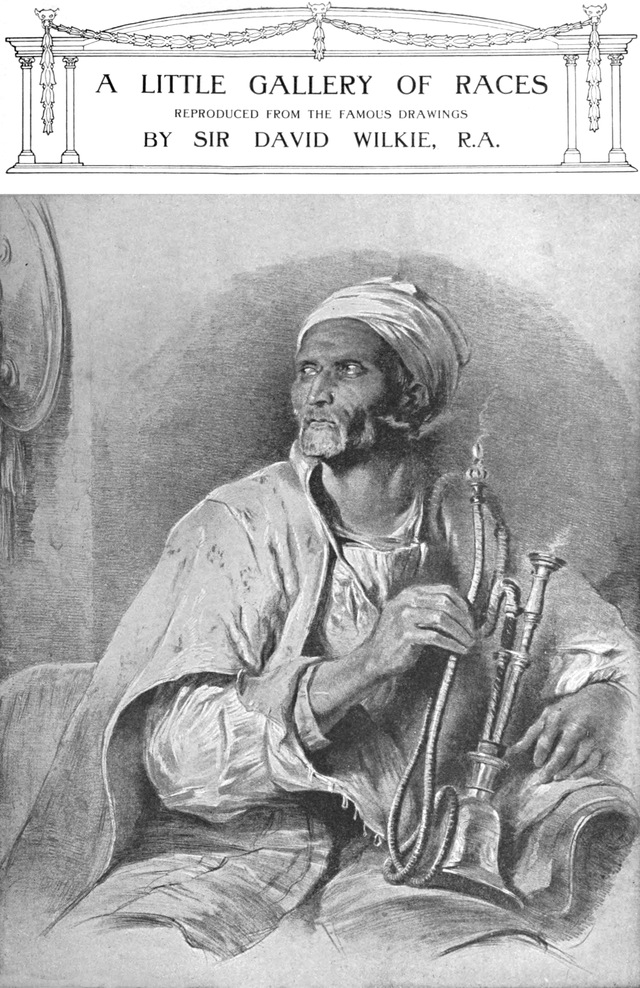
A NATIVE OF BRITISH INDIA
LARGER IMAGE
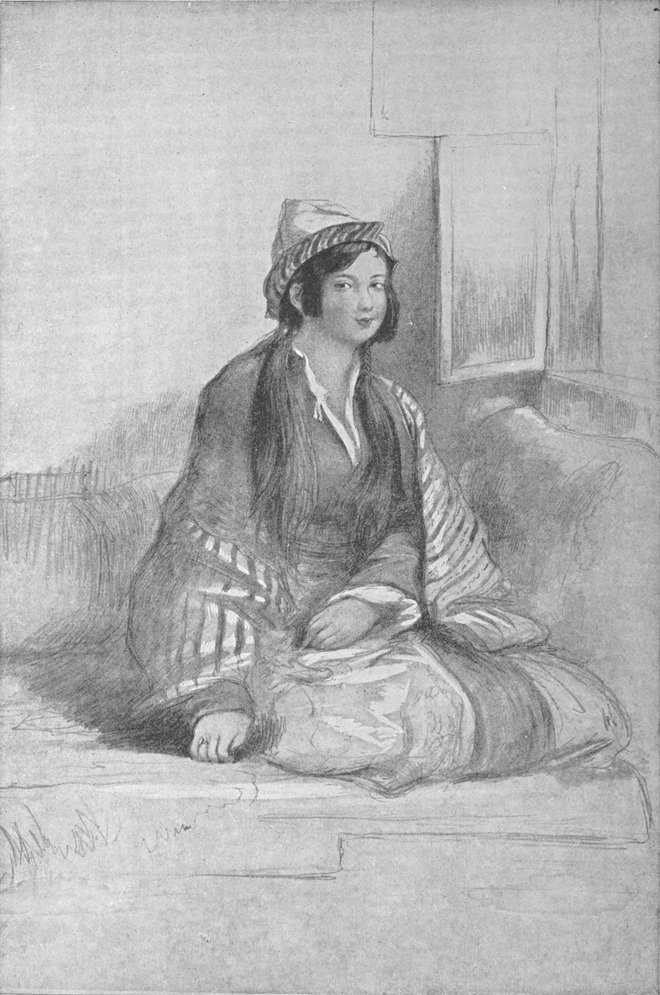
A CIRCASSIAN LADY
LARGER IMAGE
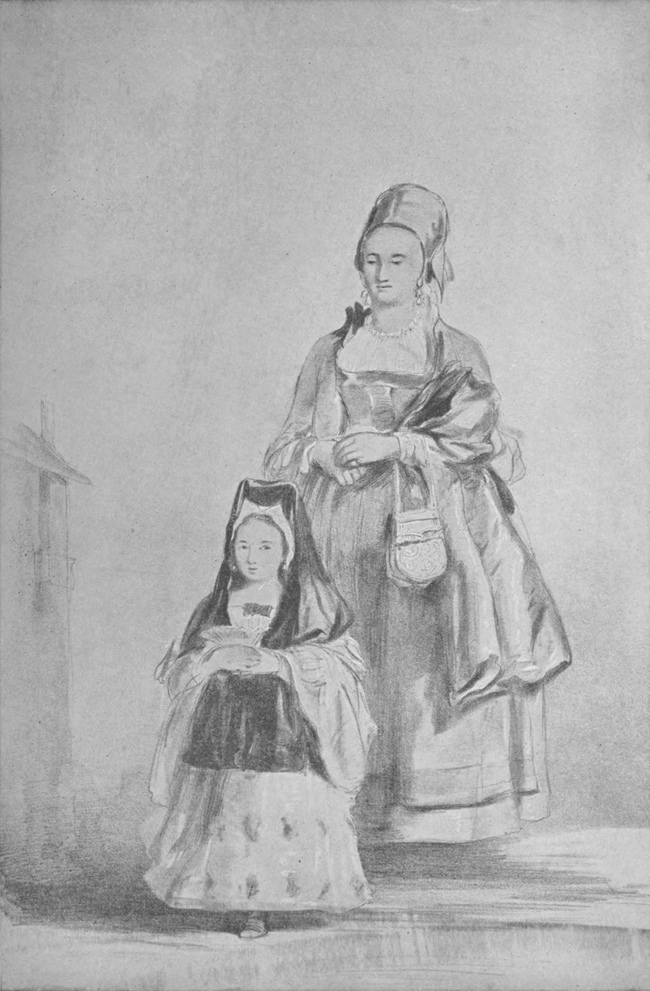
A SPANISH CHILD WITH HER NURSE
LARGER IMAGE
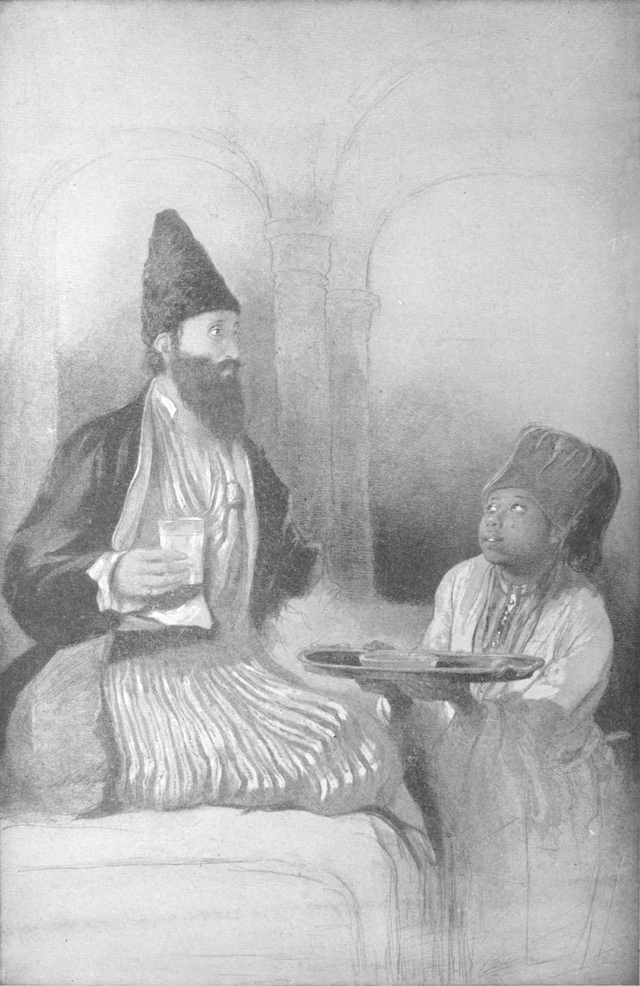
A PERSIAN PRINCE AND HIS NUBIAN SLAVE
LARGER IMAGE
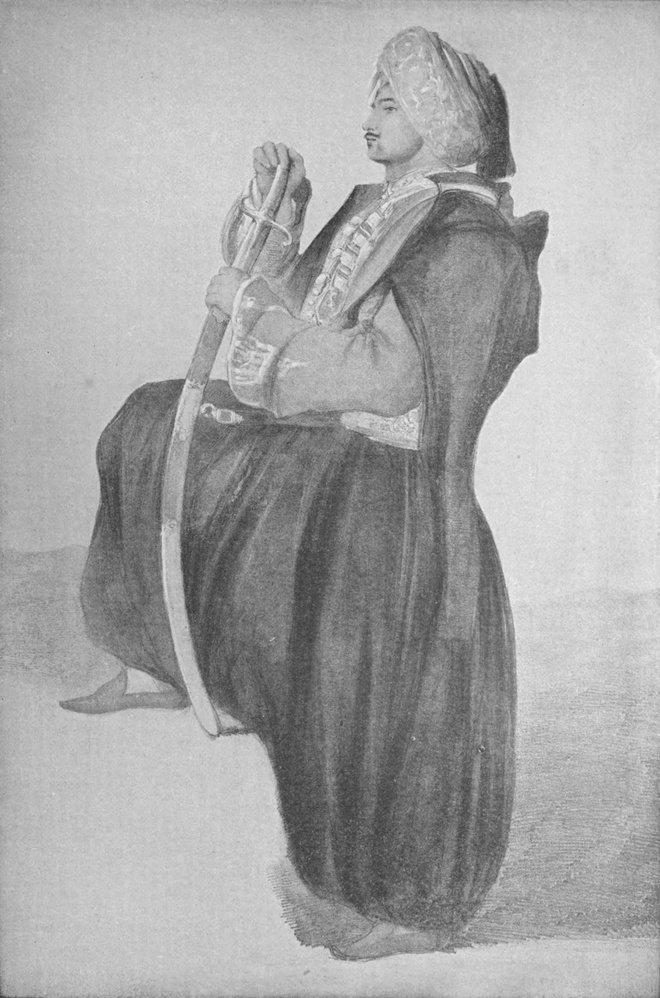
A DRAGOMAN AT BEYROUT
LARGER IMAGE
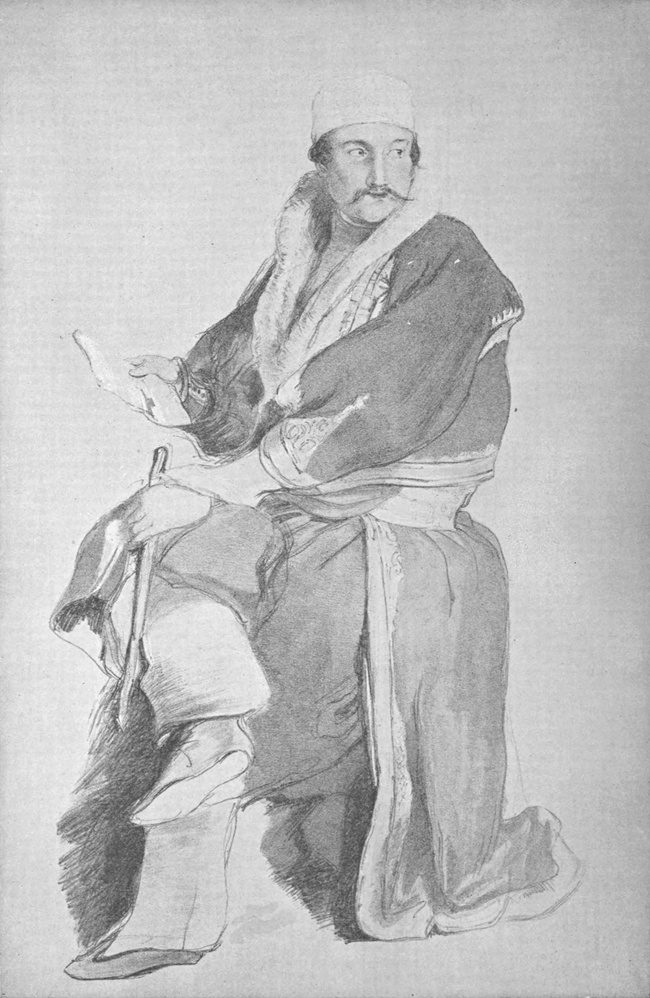
A TRAVELLING TARTAR
LARGER IMAGE
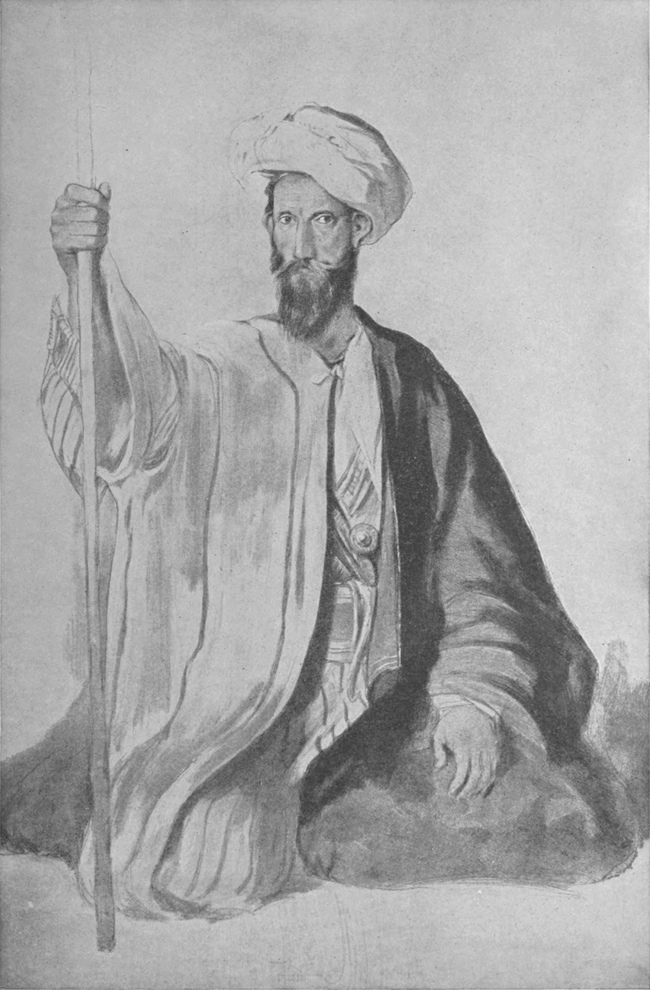
AN ARAB SHEIK
LARGER IMAGE
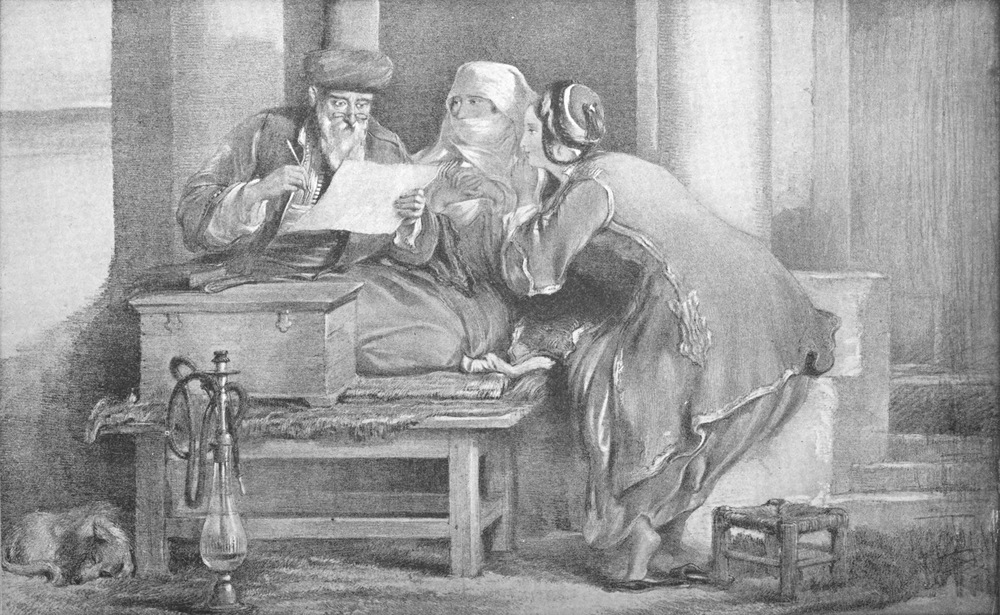
A LETTER-WRITER OF CONSTANTINOPLE
LARGER IMAGE
Araucanians. The chief Indian race of Chili, possessing an ancient civilisation like those of Peru and Mexico, though less advanced. The Araucanians are probably the finest native race of the New World. They are a fierce and warlike people, who have always preserved their independence.
Arawaks. A group of South American Indian tribes in the Guianas, including Maypuris, Wapisianas, Atorais and others.
Arcadians. A race of ancient Greece, inhabiting the central highlands of the Peloponnesus, whose seclusion from the world caused them to be identified with the quality which we still call Arcadian simplicity.
Arecunas. See CARIBS.
Argentines. White natives of the Argentine Republic in South America, mainly of Spanish descent.
Argives. Natives of Argos, the most important state of Homeric Greece: hence a generic term for Greeks or Hellenes in the Homeric Age. Achæans is another term similarly used.
Armenians. Natives of Armenia, the mountainous country round Mount Ararat, now divided between Russia, Persia, and Turkey. They belong to the Iranian stock of the Aryan family, blended with Semitic blood, and with a still older unknown but probably non-Aryan element. They are not warlike, but of quick intelligence and specially successful in commerce.
Arnauts. See ALBANIANS.
Aryans. The most important family of Caucasic Man, to which all the chief civilisations of modern times belong. A tall, fair-skinned, long-headed race, whose origin is still doubtful—though it was probably in Central Asia—and who spread in prehistoric times over the whole of Europe and parts of Asia and Africa. Almost all modern Europeans are of Aryan descent. The family is also called INDO-EUROPEAN or INDO-GERMANIC, but these names are open to objections from which the term Aryan is free.
Ashantis. See TSHI.
Assamese. Natives of Assam, between India and Burma, belonging to the Hindu stock of the Aryan family.
Assinaboins. See SIOUAN.
Assyrians. One of the main branches of the Semitic family. The Assyrians founded a great empire in the northern part of Mesopotamia, of which Nineveh was the capital, and afterwards conquered the older Babylonian state (710 B.C.) and Egypt (671 B.C.), thus forming the first world-empire known to history. Within a century Assyria had become a Median province, and its people ceased to have an independent existence.
Athabascan or Tinney. A group of North American Indian tribes, formerly inhabiting Alaska and the greatest part of Canada. It includes the Apaches, Chippewayans, Hupas, Kutchins, Navajos, Tacullis, and Umbquas.
Athenians. The most important race of ancient Greece, whose city of Athens was the earliest centre of civilisation in the historical age of Europe.
Australians. The aborigines of Australia, a branch of the Oceanic Negro family. Their numerous tribes present a general uniformity of physical and mental development, under which two main types may be recognised. The earlier of these is probably that shown by the extinct Tasmanians (q.v.), one of the lowest races in point of culture yet discovered, who were probably still in the earliest stage of the Stone Age. The other type was perhaps akin to the Dravidians of India, or to a very low Caucasic race. The Australians are among the lowest of savage races, and present many features which have thrown light on the manners, customs and beliefs of primitive man.
Australians. White inhabitants of Australia, mostly of Anglo-Saxon descent.
Austrians. Inhabitants of the Austrian empire, including a great diversity of races. The name is properly applied only to the German-speaking people, of High-German Teutonic stock, who predominate in Austria proper.
Auvergnats. Natives of Auvergne, in Central France. A short, sturdy, dark, round-skulled race, formerly regarded as typical Aryan Celts, but possibly descended from an older non-Aryan people. Much employed in Paris as porters.
Avars. See LESGHIANS.
Avars. A Tartar tribe, belonging to the Turki stock of the Northern Mongolic family, who appeared in the district round the Caspian Sea about the fourth century, and later made predatory raids over a large part of Eastern Europe. They were subdued by Charlemagne, and disappeared from history in the ninth century. They seem to have been closely allied to the Huns, whom they resembled in physical characteristics and warlike qualities.
Awawandias. Bantu Negroes of the Nyassa plateau in British Central Africa.
Aymaras. A race of South American Indians in Bolivia, probably related to the Incas (q.v.) and perhaps their ancestors.
Azandeh, or Niam-Niam. Sudanese Negroes of the Welle group. Notorious cannibals.
Aztecs. The dominant Indian race in Mexico at the arrival of the Spanish invaders. They entered the country about the end of the thirteenth century, and founded the city of Mexico in 1325. Around it they reared a remarkable civilisation and a sanguinary religion. They were warlike, ferocious and cruel, but had a considerable aptitude for the arts of peace. Their empire was destroyed by Cortes in 1521, and annexed to Spain. Every trace of Aztec nationality was suppressed, but their name still lingers among the Nahuan Indians, and their blood is mixed with that of the conquerors. Many attempts have been made to find an Old World origin for Mexican culture, but they are not convincing.
Babylonians. The Semitic race which founded one of the greatest of ancient civilisations in the rich alluvial plains of Chaldæa and on the arid plateau of Mesopotamia. Their history is too long to summarise here, but it may be stated that the Semitic peoples, variously known as Babylonians, Chaldæans, Elamites, Medians, and Assyrians, invaded and dispossessed at different times the primitive Mongolic race of Akkads (q.v.). Their earliest settlement seems to have been at Ur of the Chaldees, on the right bank of the Euphrates. Babylon and Nineveh were afterwards the seats of the Babylonian and Assyrian powers, whilst Elamite and Median conquerors intervened at various times. These powerful Semitic races made great advances in art, science, literature, religion, and social policy. Their first incursion, probably from Arabia, into the Euphrates Valley dates back to about 3800 B.C.
Baggaras. A fierce and warlike race settled in the Anglo-Egyptian Sudan, and formerly dominant under the Mahdi.
Baghirmis. See LAKE CHAD GROUP.
Bakairi. See CARIBS.
Bakatla, Bakwena. Bantu Negroes of Bechuana stock.
Bakwiri. Bantu Negroes settled in the Cameroons.
Balinese. A Malayan race of the East Indian Archipelago.
Balolo. Bantu Negroes of the Middle Congo; one of the finest negro races.
Balong. Bantu Negroes of West Africa.
Baltis. A hardy Tibetan race, inhabiting the Alpine valley of the Upper Indus.
Baluba, or Basonge. A dominant Bantu Negro race of the Kassai basin in Equatorial Africa.
Baluchis, or Beluchis. Natives of Baluchistan, south of Afghanistan, of Iranian (Aryan) descent, with a mingling of Tartar (Mongolic) blood. The dominant race of the country is the Brahui, aboriginals who are probably of Mongolic descent, allied to the Dravidians (q.v.) of India. The Brahui are of Mongolic type, short, with round flat faces, hospitable and generous. They are the more settled portion of the inhabitants. The Baluchis are chiefly nomads, taller, with more Aryan features, a warlike and predatory people.
Balunda. Bantu Negroes of South Central Africa, occupying the Congo-Zambesi divide.
Bamangwato. Bantu Negroes of north Bechuanaland; Khama’s semi-civilised people.
Bambaras. See MANDINGAN.
Banandi. Bantu Negroes of apish type, in the Semliki forests.
Bangalas. Bantu Negroes of Middle Congo, on the Ubangi river.
Bantus. One of the two subdivisions of the African Negro family of Ethiopic Man, occupying the southern half of the African continent, south of the Cameroons and Albert Nyanza. A Negro race modified from the Sudanese type by Hamite influences.
Banyai. Bantu Negroes, south of the Middle Zambesi.
Banyoro. See WANYORO.
Bapedi. Bantu Negroes of Bechuana stock.
Bareas. Sudanese Negroes inhabiting the Abyssinian slopes.
Barguzins. See BURIATS.
Baris. See NILITIC GROUP.
Barolongs. Bantu Negroes of Bechuana stock, between Vryburg and Molopo river. Mafeking is their capital.
Barotse. Bantu Negroes of Bechuana stock, about headwaters of Molopo river.
Barrés. South American Indians in Venezuela and Guiana.
Basés. Sudanese Negroes of Abyssinian slopes, a very low negroid type.
Bashkirs. A branch of the Turki stock of the Northern Mongolic family. They are first mentioned in the tenth century as a warlike and idolatrous race, noted for their large, round, short heads, from which their name is derived. They now inhabit the Orenberg and Perm districts of Russia, on the western slopes of the Ural. Some are settled agriculturists, others pastoral nomads.
Bashukulumbwe. Bantu Negroes of Kafue basin in Zambesia.
Basimba or Cimbebas. Aboriginal Negroes of South Angola; a low Bantu type, or possibly Negrito, allied to Bushmen.
Basonge. See BALUBA.
Basques. One of the few non-Aryan races still existing in Europe, where they inhabit the districts on the French and Spanish sides of the Western Pyrenees. They originally occupied a much wider area in this neighbourhood, and preserve their ancient costume and language. Their ethnological affinities are still in dispute, but the best opinion is that they represent the ancient Iberians (q.v.), a Western Hamitic race, related to the Berbers of North Africa on the one hand and to the Picts of Scotland and the ancient Irish on the other. Probably they have occupied their present home since Neolithic times. They are mainly agriculturists, with all the rustic virtues, and make excellent soldiers and servants.
Bassas. See LIBERIAN GROUP.
Bastaards. See GRIQUAS.
Bastarnæ. See GOTHS.
Basutos. The most civilised race of Bantu Negroes, of the Bechuana stock, who inhabit the rugged uplands of Basutoland, a British Crown Colony. They have long been subjected to European and Christian influence, under which they have presented the sole instance of a pure negro community, which has made itself self-supporting and approximately civilised. They have succeeded in assimilating Western culture, and their little State—which always preserved its independence against other natives and Boers—is a very flourishing example of what the negro can do under favourable auspices.
Batanga. Bantu Negroes of the Cameroons.
Batavi. An ancient German race inhabiting the island formed by the Meuse and an arm of the Rhine. Ancestors of the modern Dutch.
Bateke. Bantu Negroes of Congo, above Stanley Pool.
Batjans. See INDONESIAN.
Batlapi. Bantu Negroes of Bechuana stock, near Vryburg.
Batonga or Batoka. Bantu Negroes of Zambesia, Manicaland and Tongaland.
Battaks. A pre-Malay race of North Sumatra, probably allied to the Polynesians (q.v.).
Batwas. A pygmy (q.v.) Negrito race south of Congo, allied to Bushmen.
Batwanas. Bantu Negroes of North Bechuanaland.
Bavarians. A branch of the High German stock of the Teutonic family, in Bavaria.
Bayansis. Bantu Negroes of Middle Congo, on Kwa River. Strong negro element.
Bechuanas. A main stock of Bantu Negroes, occupying what is known as British Bechuanaland. The name is of European origin, and has no native significance as applied to the race, but is a convenient general term.
Bedawi or Bedouins. Nomadic Arabs (q.v.) who inhabit the deserts of Arabia and the neighbouring countries, and live by stock-breeding and robbery. Their breed of horses is world-famous. They are independent, chivalrous and hospitable. They correspond to the Biblical Ishmaelites, whose race and customs they preserve practically unchanged.
Bejas. A race of Eastern Hamites, of splendid physique, occupying the eastern seaboard of Africa north of Massowah, including Bisharis, Hadendowas, and other tribes.
Belgae. The northernmost of the three races occupying Gaul in Cæsar’s time, probably of Low German stock, with perhaps a Celtic element.
Belgians. The inhabitants of Belgium, formerly the Spanish or Austrian Netherlands, of very mixed origin. The natives are either Flemings of Teutonic stock, or Celtic Walloons (q.v.). Mingled with these are large numbers of German, French and Dutch immigrants; and constant crossing of blood has tended to produce a truly Belgian type out of all these fluctuating elements. They are among the most patient and productive of agriculturists, mostly small proprietors; and they possess flourishing manufactures and a rich commerce through the great port of Antwerp.
Beluchis. See BALUCHIS.
Bengalis. The majority of the natives of Bengal belong to the Hindu stock of the Aryan family, which was probably the first to develop a true civilisation and a great literature (in the ancient Sanscrit tongue). The typical Bengali is quick-witted, versatile, and successful in the arts of peace, but not warlike—though the native army of the old East Indian Company was largely recruited from Bengal. The Bengali Babu, of the professional or lower official class, is well known.
Beluchis. See BALUCHIS.
Benin. See NIGERIAN GROUP.
Berbers. A Western Hamitic race occupying the Atlas Mountains and the Northern Sahara, of predatory and warlike habits. They are known in Algeria as Kabyles, and in Sahara as Tuaregs. Largely dark-haired and swarthy, with prominent noses, they belong to the Melanochroid branch of Caucasic Man. They correspond to the ancient Numidians.
Betsimisarakas. One of the three main divisions of the Malagasy, or Malayo-African race which inhabits Madagascar. They occupy the east coast.
Bhils. Primitive and still wild non-Aryan inhabitants of Central India, of Kolarian family (q.v.).
Bisharis. See BEJAS.
Blackfoot Indians. See ALGONQUIAN.
Bœotians. A branch of the Æolian race in ancient Greece. The Bœotians were supposed to be peculiarly dull, and were the typical rustic clowns of Greek literature.
Boers. White inhabitants of Cape Colony, the Transvaal, and the Orange River Colony, mainly of Dutch descent, with a French Huguenot element and a sprinkling of Negro blood. They were the original colonists of South Africa, which they entered in 1652. A race of farmers (Boer is derived from the Dutch boor, peasant), they also proved themselves to be hardy pioneers and admirable, though not at all romantic, fighters, learning in long native wars the arts of strategy, which they exercised so well against the English in the South African War of 1899–1902. They have now accepted the English rule, and promise to be among our most flourishing African subjects.
Bohemians. See CZECH.
Bolivians. White natives of Bolivia in South America, of Spanish descent, with a considerable admixture of Indian blood.
Bongos. See NILITIC GROUP.
Botocudos. South American Indians on eastern seaboard of Brazil.
Brahui. See BALUCHIS.
Brazilians. White natives of Brazil, mainly of Portuguese descent, but with a considerable admixture, in many districts, of Indian and negro blood.
Bretons. Natives of Brittany, descended from a short, round-headed, dark race, generally called Celtic, but perhaps pre-Aryan.
Bribris. South American Indians of Costa Rica.
Britons. (1) The ancient Britons were a Celtic race, whose remnants are still to be found in the Welsh (q.v.). They attained a considerable degree of civilisation under the Roman conquerors, and adopted Christianity. The Anglo-Saxon conquest of Britain drove most of them back into Wales, Cornwall, and other outlying portions of the island, whilst the remainder were either destroyed or assimilated. (2) In the wide modern sense, Britons are the white citizens of the British Empire.
Bugis or Buginese. Natives of Boni in Celebes; a primitive Malay race.
Bulalas. See LAKE CHAD GROUP.
Bulgars. A branch of the Finns (q.v.), who were originally settled on the banks of the Volga. In the sixth century they crossed the Danube and conquered the modern Bulgaria, then occupied by the Slavonic Slovenians (q.v.). A speedy fusion took place between the Slovenians and the Bulgars, who adopted the language and customs of the former, and rose to greatness as a Slav power. In the ninth and tenth centuries they ruled the greater part of the Balkan Peninsula, and warred successfully with the Byzantine Empire, which, however, subjected them in 1019 under Basil II., “the slayer of the Bulgarians.” Later they passed under the Turkish rule, and ceased to have an independent national existence down to the nineteenth century.
Bulgarians. Inhabitants of the modern Balkan state of Bulgaria, descended from the Bulgars (q.v.) with considerable admixtures of Greek and Turkish blood.
Bulloms. See TEMNÉ GROUP.
Burgundians. An ancient people of Teutonic race (High German), who were originally settled between the Oder and Vistula. In the fifth century they invaded Gaul, where they formed the first kingdom of Burgundy, between the Aar and the Rhone. There were many later Burgundian kingdoms and duchies, of which the last and most famous was that of Charles the Bold, annexed to France in 1477. The Burgundians are now French subjects, but still show traces of their Teutonic origin.
Buriats. The Western or Siberian branch of the Mongol stock of the Northern Mongolic family. They occupy the vicinity of Lake Baikal The majority are nomad pastors, but some have taken to agriculture. A peace-loving, but lazy and drunken people; they include various tribes, such as the Barguzins, Selengese, Idinese, Kudaras and Olkhonese.
Burmese, or Burmans. A short-statured, thick-set and flat-featured people, approaching the Chinese type, the principal race of the Indo-Chinese stock of the Southern Mongolic family. They inhabit Burma—now a British possession—and are excitable, turbulent, and given to dacoity, or highway robbery. They make good farmers and shopkeepers, but are not warlike or methodical.
Burus. See INDONESIANS.
Bushmen. A nomadic Negro race of South Africa, who stand at the lowest stage of human culture. They are probably the aborigines of South Africa, where they have been dispossessed by Hottentots and Bantus from the north. They are thin and wiry, of small stature, not unlike the Hottentots in colour and features. They live by hunting, and possess a curious mythology. Their artistic powers, comparable to those of Palæolithic Man, are shown in the remarkable rock-drawings on the walls of their caves.
Calchaquis. South American Indians, in Plate River district.
Cambojans. Natives of Cambodia, Mongoloid approaching Caucasic type.
Canaanites. One of the main branches of the great Semitic family, inhabiting Palestine and the Mauritanian sea-coast in ancient times, including Jews, Phœnicians, Carthaginians, Moabites, Amorites, Idumæans and Philistines (q.v.). A fierce and warlike people, with a remarkable genius for religion, which has greatly influenced the modern world.
Canadians. White natives of Canada, of mixed French and Anglo-Saxon descent.
Caribs. South American Indians, formerly occupying the West Indian Islands, and now the shores of the Caribbean Sea, including Macusi, Bakairi, Akawai, Arecuna, and Rucuyenne tribes. They are strongly built, warlike and fierce, but honourable. The term cannibal is supposed to be a corruption of their name based on their habits.
Carthaginians. Natives of one of the great empires of the ancient world, which was founded at Carthage, near the modern Bizerta, by Phœnician colonists in the ninth century B.C., and was destroyed by Rome in 146 B.C. Carthage was the great rival of Rome as a Mediterranean power. Its inhabitants belonged to the Canaanite stock of the Semitic family, and were a nation of traders, cruel and gloomy in temperament, worshippers of Moloch with human sacrifices. Though in Hannibal they produced one of the greatest of generals, they were not warlike, and trusted chiefly to mercenaries, wherefore they fell.
Catalans. Natives of North-east Spain, mostly of Gothic descent, and still distinct from other Spaniards in language and costume. Honest and enterprising, turbulent, and intensely devoted to liberty.
Caucasians. One of the families of Caucasic Man, inhabiting the mountainous region of the Caucasus, and divided into southern, western, and eastern branches [see GEORGIANS, CIRCASSIANS, CHECHENZES, LESGHIANS]. They include a great number of different tribes, who seem to have settled there from the earliest historical times. Some of these, the Melanochroid highlanders, like the Georgians, Circassians, and Lesghians, present an almost ideal standard of physical beauty, whilst others are squat and ungainly. Some ethnologists see in the Caucasus the primitive home of the Aryan family, from whom the Caucasians would, on this view, be an offshoot. The Ossets (q.v.) are certainly Aryan. The Caucasians are very warlike, and struggled till quite recently with success against the Russian domination.
Caucasic. One of the four great divisions of the human race. Type, white-skinned, square-jawed (orthognathous), skull between broad and long (mesocephalic), hair soft, straight, or wavy; in intelligence, enterprise, and civilisation, much superior to other divisions.
Cayugas. See IROQUOIAN.
Celts. See KELTS.
Chakhars. A branch of Eastern Mongols, settled on the south-east boundary of the Desert of Gobi.
Chaldæans. See BABYLONIANS.
Chamorros. Aborigines of the Ladrone Islands, so named from their thievish propensities. A branch of the Oceanic Mongolic family, probably allied to the Formosans (q.v.).
Chancas. See INCAS.
Chaudors. A nomad tribe inhabiting the steppes east of the Caspian and south of the Oxus. See TURKOMANS.
Chapogirs. See TUNGUSES.
Charruas. An extinct race of South American Indians in South Brazil, peculiar for their extremely black colour with lank hair.
Chechenzes. A branch of the Eastern stock of the Caucasian family, inhabiting the northern slopes of the Eastern Caucasus. Their chief tribes are Ingushis, Kishis, and Tushis.
Cheremisses. See FINNS.
Cherokees. A brave and warlike tribe of North American Indians. See IROQUOIAN.
Cheyennes. See ALGONQUIAN.
Chibchas. South American Indians of Bogota.
Chichimecs. See NAHUANS.
Chickasaws. See MUSKHOGEANS.
Chilians. White natives of Chili, of Spanish descent, with a mixture of Araucanian Indian blood.
Chinese. One of the most numerous races of the world, inhabiting the Chinese Empire. They are a stock of the Southern Mongolic family, and it is thought by some ethnologists that they are descended from the Mongolic Akkads (q.v.) of Mesopotamia. There is a remarkable uniformity in the physical type presented by the Chinese in all climates and environments; they are the most homogeneous of great peoples. They are yellow-skinned, short in stature, with obliquely set eyes, high cheek-bones, long skulls, and broad faces, with slight prognathism. They possess an ancient and highly organised civilisation, which is characterised by its conservatism and slowness to accept new ideas—so different in this from the Japanese. The Chinese are naturally frugal, industrious, and patient; they are excellent agriculturists, and very gregarious; they despise war, but make excellent soldiers when drilled by Europeans or Japanese. They are eminently literary, and have a high system of morality. There are many local varieties, such as the Puntis of the Canton districts, the Hakkas of Swatow, the Hoklas of Fohkien, the Dungans (q.v.), which need not be farther particularised.
Chinooks. A nearly extinct tribe of North American Indians on the Columbia River, on whose language is based the Chinook jargon, or traders’ Lingua Franca of British Columbia.
Chins. See SINGPHOS.
Chippewayans. See ATHABASCAN.
Chiquitos. South American Indians of Upper Paraguay basin.
Chiriguanos. South American Indians of Bolivia.
Chitralis. Natives of Chitral, in the Hindu Khush, rough, hardy hillmen, closely allied to the Kafirs (q.v.) of Kafiristan.
Chocos. A tribe of South American Indians of Matto Grosso.
Choktaws. See MUSKHOGEAN.
Chontals. Central American Indians of Nicaragua.
Chols. See MAYA-QUICHÉ.
Chorasses. See KALMUKS.
Chorotegans. Central American Indians of Nicaragua.
Chukchis. A Northern Mongolic race of North-east Siberia, closely akin to the American Eskimo in features and customs. They are of high character and very independent, but at a low stage of civilisation, and live by reindeer-breeding and hunting. A branch of the Chukchis, differing mainly in language, is known as the Koryaks.
Chunchos. South American Indians on tributaries of Beni River in Peru.
Cimbebas. See BASIMBA.
Circassians, or Tcherkesses. A race of Caucasian mountaineers, formerly inhabiting the Black Sea coast between Anapa and Pitzunta, of high physical type, who maintained an unavailing struggle against Russia till 1864, when their subjugation was followed by a wholesale emigration of the Circassian tribes to the Turkish Empire. Allied to them are the Abkhasians and Kabards (q.v.).
Colombians. White natives of Colombia, in Central America, mostly of Spanish descent, with an admixture of Indian and negro blood.
Comanches. See SHOSHONEAN.
Conibos. South American Indians of Peru.
Copts. Christian descendants of the ancient Egyptians (q.v.), of middle stature, slender limbs, and pale complexion, who inhabit Egypt, and preserve the language and customs of the last period of ancient Egyptian civilisation. They are essentially townsmen, clerks, or artisans.
Coras. See OPATA-PIMA.
Cornish. A race of Brythonic or P Celts, akin to Welsh and Bretons, inhabiting Cornwall in earlier times; now absorbed in English stock. Their language became extinct in seventeenth or eighteenth century. The crossing of the Cornish Celts with Anglo-Saxons has given birth to a singularly fine race of hardy fishermen and miners.
Corsicans. The aborigines of Corsica were probably a Western Hamitic race, allied to the Ligurians (q.v.). They were followed by Ionian invaders, and in turn by Carthaginian, Roman, Vandal, Hun, Gothic, Saracenic, and Italian conquerors, each of whom has added something to the mixture of blood in the modern Corsicans, a turbulent, lawless, and warlike race (now belonging to France), whose greatest son was Napoleon.
Costa Ricans. White natives of Costa Rica, in Central America, mostly of pure Spanish descent.
Crees. See ALGONQUIAN.
Creek Indians. See MUSKHOGEAN.
Creoles. Persons born in past or present French, Spanish, or Portuguese colonies, of pure European descent.
Cretans. An ancient race of prehistoric culture [see MYCENÆANS]; in modern times chiefly Greek, mixed with Turk.
Croats. Inhabitants of Croatia, now mainly of Slavonic race, mingled with an earlier short, dark race of non-Aryan descent. One of the motley races of the Austrian Empire. They are warlike, turbulent, and eager for independence.
Cro-Magnon. A prehistoric race settled in the Vezere district of France, which may be taken as the primitive type of Caucasic Man. It is only known by a few skulls and other relics, and probably dates back to the Glacial Period.
Crow Indians. See SIOUAN.
Cymry. See WELSH.
Czechs, or Bohemians. The most westerly branch of the Slavonic stock of the Aryan family, now occupying Bohemia, Moravia, and other parts of Austria. They are closely allied to the Slovaks of Hungary. They migrated from the Upper Vistula district to the modern Bohemia in the fifth century. Long an independent kingdom, and a bulwark of Christendom against the Turks, Bohemia passed to Austria in 1526. During the last century there has been a great recrudescence of the Czech nationality and language. The Czechs as a race are very musical and artistic.
Daflas. A Tibetan race inhabiting the northern border of Assam.
Dahomans. See EWE.
Dakotas. See SIOUAN.
Dalmatians. A Southern Slavonic race, crossed with Gothic blood. A fine race of hardy seamen, they manned the Venetian fleets, but now belong to Austria.
Damaras, or Hau-Khoin. See HEREROS.
Danakils, or Afars. An Eastern Hamitic race settled in the vicinity of Obock, between Abyssinia and the Red Sea. They are nomad pastors and fishermen, well-built, and slender.
Danes. Natives of Denmark, belonging to the Scandinavian stock of the Aryan family. Denmark was originally inhabited by the Angles, Saxons, and Jutes, who colonised England. On their departure, the Danes from Zealand settled on the deserted lands, and there reared the kingdom which still exists. The early Danes were brave warriors and skilled seamen, who for a time ruled Saxon England under Canute. Their descendants, of comparatively pure blood, preserve these characteristics, and are also industrious agriculturists.
Dards. A warlike and hardy race of Aryan descent, inhabiting the mountainous country around Gilgit, in North-west India, of whom the Hunzas and Nagars are the chief tribes.
Dargos. See LESGHIANS.
Delawares. A North American Indian race with whom William Penn dealt in the 17th century: now fairly civilised. See ALGONQUIAN.