Volume 1 — LIST OF MAPS APPEARING IN THE BOOK OF HISTORY (continued 13)
Reading edition
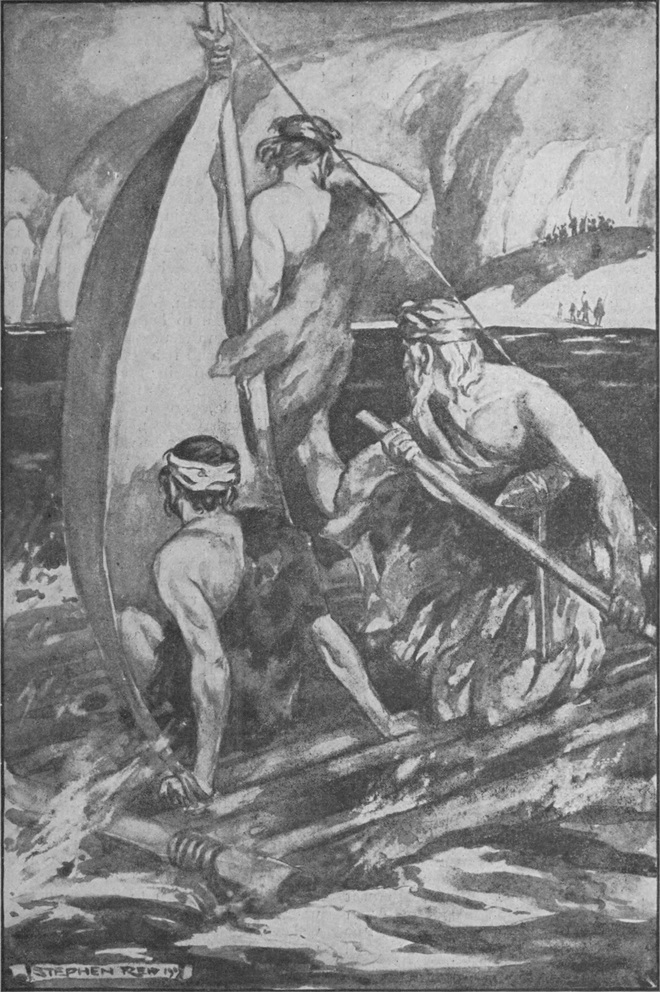
MAN’S FIRST STEP TOWARDS THE CONQUEST OF THE EARTH
The most momentous event in the early history of man was the launching of the first raft. That moment was instinct with all the mighty conquests and discoveries yet to be accomplished over seas; and even the discovery of fire, says Professor Ratzel, has been of less moment to the progress of mankind than that of the inventor who first joined logs together into a raft and set out on a voyage of discovery to the nearest islet.
LARGER IMAGE
Special combinations of characteristics arising from the geographical positions of oceans, continents, and islands are connected with the broad features common to oceanic continuity. These characteristics are reflected from the sea back to the land, and there give rise to historical groups. The historical significance of such groups is expressed in their names even—Mediterranean World, Baltic Nations, Atlantic Powers, and Pacific Sphere of Civilisation. They are primarily the results of commerce and exchange, and of the furthering, correlating influences of all coasts and islands. When they united all peninsulas, islands, and coasts of the Mediterranean into one state the Romans merely set a political crown upon the civilised community that had developed round about, and by means of, this sea.
Uniqueness of the Mediterranean
And if we wish rightly to estimate the significance of Roman expansion from a Central European point of view, we may express our conception very shortly—the diffusion of Mediterranean culture over Western and Central Europe. It was at the same time a widening of the horizon of a landlocked sea to that of the open ocean. The Atlantic Ocean succeeded to the Mediterranean Sea. The Americans and the Russians, and the Japanese, repeating their words, maintain that in the same manner the Pacific must succeed to the Atlantic; but they forget the peculiar features of the Mediterranean, especially its conditions of area. It is no more probable that such a compact, isolated development will occur again than that the history of Athens will repeat itself on the Korean peninsula or at Shantung. The greater the ocean, the farther is it removed from the isolated sea. It was not the Atlantic that succeeded to the Mediterranean, but the broad world-ocean that succeeded to the narrow basin called the Mediterranean Sea. There have always been differences between the various divisions of the main sea; and these variations will ever continue to be prominent, although constantly tending to become less and less so.
The vast Potentialities of the Pacific
The Pacific will always remain by far the greatest ocean, including, as it does, forty-five per cent. of the total area of water. Owing to its great breadth, the Pacific routes are from three to four times as long as those of the Atlantic. The Pacific widens toward the south; and Australia and Oceania lie in the opening, thus furnishing the Pacific with its most striking peculiarity—a third continent situated in the Southern Hemisphere, together with the richest series of island formations on earth. Whatever the Pacific may contribute to history, it will be a contribution to the annals of the Southern Hemisphere; and if a great independent history develop in the antipodes, it will have the Southern Pacific, bounded by Australia, South America, New Zealand, and Oceania, for its sphere of action. The area of the Atlantic Ocean is but half that of the Pacific. Nor is it for this reason alone that in comparison with the latter it is an inland rather than a world sea; for, owing to its narrowness between the Old and the New Worlds, the branches it puts forth, and the islands and peninsulas that it touches, it shortens the routes from one coast to the other. In it there is more of a merging of land and sea than a separation; and to-day it is chiefly a European-American ocean. The Indian Ocean is both geographically and historically but half an ocean. Even though important parts of it may be situated north of the equator, it is too much enclosed to the north; it widens to the south, and thus belongs to the Southern Hemisphere.
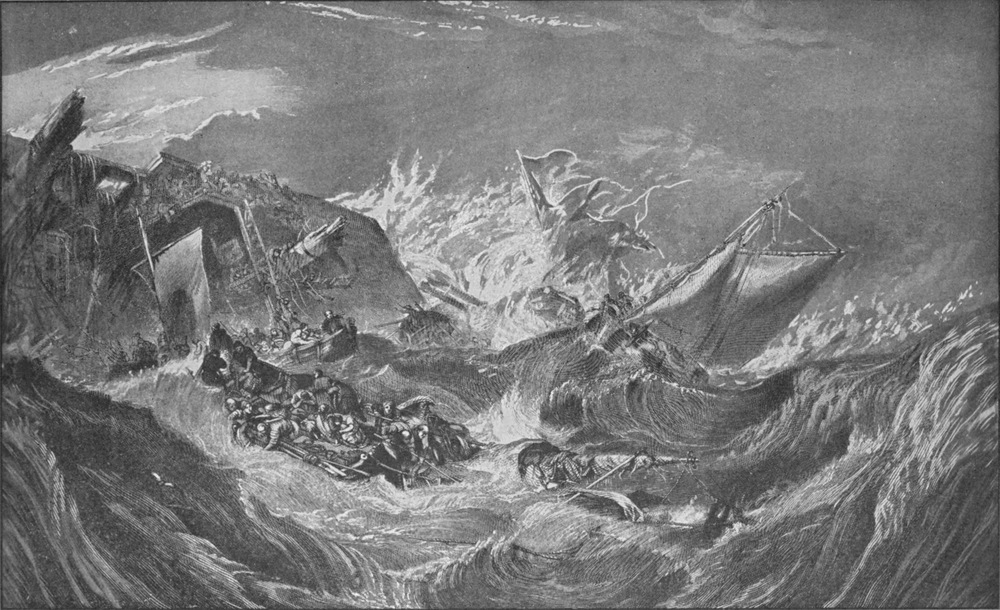
A STORM SUCH AS MAY SWEEP AWAY A NATION’S POWER
All maritime nations, says Professor Ratzel, have been short-lived. The more strength they draw from the ocean the less firm becomes their footing upon the land, and their power grows to resemble that of a fleet resting upon the waves; it may extend its influence over an enormous area, but it may also be swept away by a single storm.
LARGER IMAGE
The Coast the Threshold of the Land
The great oceans open up broad areas for historical movements, and through their instrumentality peoples are enabled to spread from coast to coast in all directions; the inland seas, on the contrary, cause the political life of the nations bordering upon them to be concentrated within a limited area. The Mediterranean will ever remain a focus towards which the interests of almost all European Powers concentrate. It has, moreover, become one of the world’s highways since the completion of the Suez Canal. The Baltic somewhat resembles the Mediterranean; but it would be saying too much to look upon its position as other than subordinate to that of the greater sea. The area of the Baltic is but one-seventh that of the Mediterranean; and it is lacking in the unique intercontinental situation of the latter. In many respects it resembles the Black Sea rather than the Mediterranean, especially by reason of its eastern relations.
Originally the coast was the threshold of the sea; but as soon as maritime races developed it became the threshold of the land. In addition it is a margin, a fringe in which the peculiarities of sea and land are combined; and for this very reason sea-coasts have a historical value greatly disproportionate to their area, especially as they constitute the best of all boundaries for the nations that possess them. Here harbours are situated, fortresses, and the most densely populated of cities. Owing to their close connection with the sea, the inhabitants of coasts acquire characteristics which distinguish them from all other peoples. Even if of the same nationality as their inland neighbours—as, for example, the Greeks of Thrace and of Asia Minor and the Malays of many of the East Indian islands—their foreign traffic nevertheless impresses certain traits and features upon them which in the case of the Low Countries led almost to political disruption.
Living and Dead Coasts
A coast is more favoured than an interior in all things relating to commerce and traffic; yet neither may enjoy permanent life alone without the other. The French departments of the Weser and of the Elbe were among the most ephemeral of the political results achieved by the short-lived Napoleonic era. With the sea at their backs it is easy for the inhabitants of a coast to become detached from their nation, and but a simple matter for them to spread over other coasts. Ever since the time of the Phœnicians there have been numerous colonists of coasts and founders of coast states. The Normans are most typical in European history. The expansion of coast colonies towards the interior is one of the most striking features of recent African development. Thus coasts are to be looked at from within as well as from without. To many races—such as Hottentots and Australians—the coast is dead compared with the interior; for Germany the coast has been politically dead for centuries. A river-mouth is best suited to carrying the influences of the coast inland.
All ancient historians supposed that the Mediterranean Sea, with its many bays, peninsulas, and islands, schooled the Phœnicians in seamanship. This, however, is not so. Nautical skill is transmitted from one people to another, as may be seen from some of the most obvious cases in modern history. No maritime people has become great through its own coast alone. It is not the coast of Maine, with its numerous inlets and bays, that has produced the best seamen, but the coast of Massachusetts, naturally unfavourable for the most part; and it has produced the best seamen for the reason that the inland districts bounded by it are far more productive and furthering to commerce than are the interior regions of Maine.
The Place of the Coast in History
Nature has forced races to take to the sea only in such countries as Norway and Greece, where the strips of coast are narrow and the inland territory poor. In order to have political influence it is sufficient to have one foot on the sea-coast. Aigues-Mortes, with its swampy environment, was sufficient to extend France to the Mediterranean during the reign of St. Louis; Fiume sufficed for Hungary. Forbidding desert coasts have had a peculiarly retarding effect on historical development. It was necessary to rediscover the Australian mainland, to touch at more favourable points, one hundred and thirty years after the time of Tasman; thus the history of the settlement of Australia by Europeans originated, not with him, but with Cook.
As portions of the general water area, rivers are branches or runners of the sea, extending into the land—lymphatic vessels, as it were, bearing nourishment to the ocean from the higher regions of the earth. Therefore they form the natural routes followed by historical movements from the sea inland and vice versa. A solid foundation of truth underlies those rivers of legendary geography that joined one sea with another. The connection of the Baltic and the Black Sea via Kieff is not that described by Adam of Bremen; but Russian canals have established a water-way, following out the plan indicated by Nature, just as the Varangians also realised it in a ruder way by dragging their boats from the Dwina to the Dnieper. By uniting the Great Lakes to the Mississippi by means of the Illinois River, the French provided a waterway from the North Atlantic Ocean to the Gulf of Mexico, a line of power in the rear of the Atlantic colonies. The latter fell back on salt water, the former on fresh. The Nile, flowing parallel to the Red Sea from Tanasee in the Abyssinian highlands, shares with the Red Sea even to-day in the traffic between Eastern and East-central Africa. The railway from Mombasa to Uganda completes a western Mediterranean-Indian line of connection, as a road along the Euphrates to the Persian Gulf would an eastern, each following the direction of rivers running parallel to the Red Sea. We can clearly see the transition of the functions of oceans to fresh, shallow water, to sounds and lagoons, in which sea traffic is furnished with smoother, quieter routes under the shelter of the coasts.
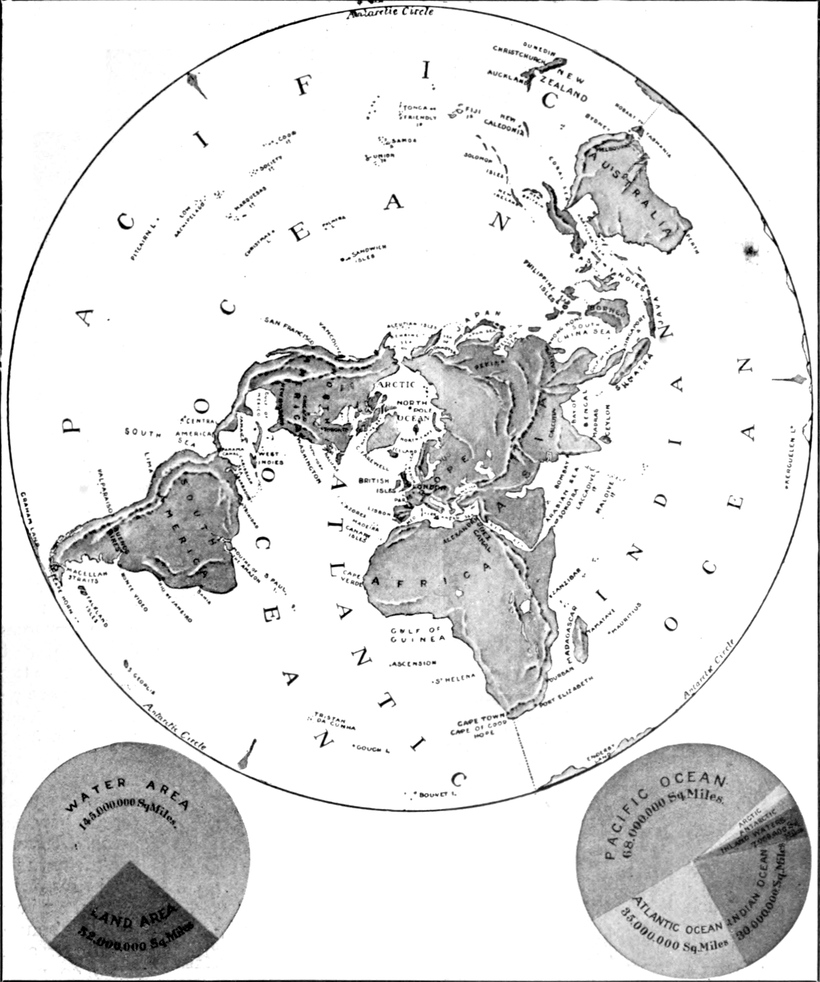
THE OCEANS OF THE WORLD
This map, on a projection used by mariners, shows the relative sizes of the great oceans, viewed from above. The natural advantage of the position of the British Isles for communicating with the ocean’s highways is clearly seen, and the vast area of the Pacific is strikingly indicated.
In truth, only portions of the lines of traffic follow rivers; for rivers flow from highland to lowland, watersheds breaking their course here and there. In comparison with the oceans, rivers are but shallow channels, the continuity of which may be broken by every rocky ledge. Thus different regions for traffic arise at various points in the same stream. Only that part of Egypt which is situated north of the first cataract is Egypt proper; the territory to the south was conquered from Nubia. The farther we travel up a stream the less water and the more rapids and falls we shall find; therefore traffic also decreases in the direction toward the river’s source. It may be seen from this that there is but little probability of truth in the analogy drawn between the flowing of rivers from elevations to plains and the migrations of nations and directions in which states expand. History shows that migration and development follow a direction contrary from that in which rivers flow.
Maritime and terrestrial advantages are concentrated where a river joins the sea; especially characteristic of such districts are deltas, at an early date rendered more efficient for purposes of commerce through canals and dredging. The fertility of the alluvial soil, the lack of forest occasioned by frequent floods, and the protection afforded by the islands of the delta, may have had not a little influence on the choice of such regions as settlements for man. At all events, estuaries and deltas, both small and great, were in the earliest times centres of civilisation. Egypt and Babylonia both testify to this; the colonising Greeks also showed a preference for river mouths. Miletus, Ephesus and Rome were states situated at the mouths of rivers, and so were the ancient settlements on the Rhone, the Guadalquivir, and the Indus. It would not be possible, however, to deduce from this proofs of a potamic phase of civilisation and formation of nations preceding the Thalassic, or Mediterranean. Estuary and delta states are far more a result of the Mediterranean culture. The latter led to the settlement of favourable districts on various coasts, all of which were finally swallowed up into the Roman Empire during the period of its northern and eastern expansion.
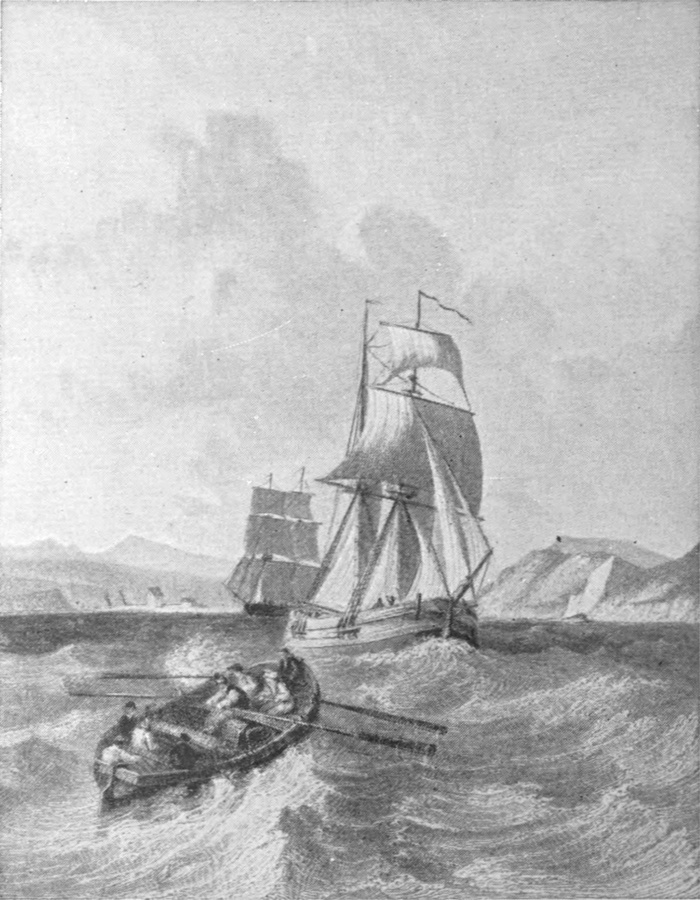
THE ORIGIN OF SEAFARING PEOPLES
It is not sufficient to have a favourable sea-coast in order to breed a race of sea-going people. The land behind the coast-line must be fertile and productive, else no inducement exists for seafaring. This condition is everywhere present along the British shores, of which this is a typical coasting scene.
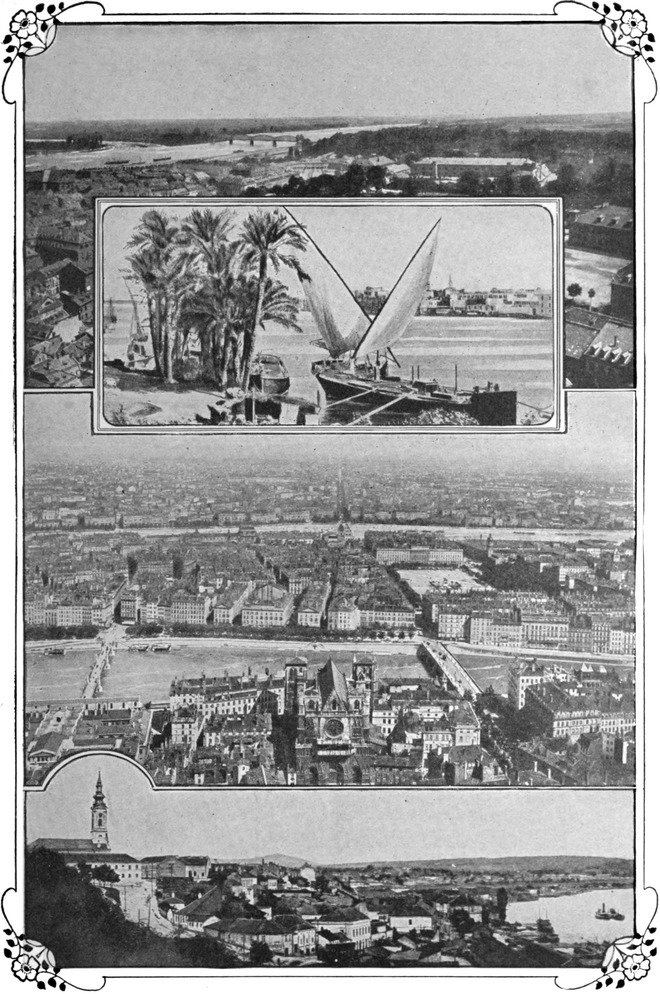
THE JUNCTIONS OF GREAT RIVERS ARE LANDMARKS OF HISTORY
Where two rivers join, two lines of political tendencies always meet, and their junction is the point whence political forces must be controlled. This is the significance of the situations of Mainz (1 at top), Khartoum (2), Lyons (3), and Belgrade (4)
Photos: Frith and Photochrome
LARGER IMAGE
Rivers as Highways of Development
Another much more evident process of development through the instrumentality of rivers was shown at the time when traffic began to extend itself over wide areas. Rivers are the natural highways in countries which abound in water, and are of so much the greater importance because in such lands other thoroughfares are frequently wanting. Taken collectively, rivers form a natural circulatory system. In America at the time of the exploration and conquest, in Siberia, in Africa to-day, they are natural arteries by means of which exchange and political power may be extended. The more accessible a river is to commerce, the more rapidly political occupation increases about its basin, as has been shown by the Varangians in Russia and the Portuguese in Brazil. The best example of a country having developed through conformity with a natural river system and in connection with it is that of the Congo State, with part of its boundaries drawn simply along the lines of watersheds. Mastery among rival colonies is determined by the results of the struggle for the possession of rivers; this has been as clearly shown by the St. Lawrence and the Mississippi in America, as by the Niger and the Benuwe in Africa. The influence of riverways in furthering the path of political development may be best seen in the contrast between South America and Africa; the colonising movement came to the latter more than 300 years later than to the former continent.
Every river is a route followed by political power, and is therefore at the same time a point of attraction and line of direction. The Germans have pushed their way along the Elbe between the Danes and the Slavs, and along the Vistula between the Slavs and the Lithuanians or old Prussians. The river that supports an embryonic nation holds it together when developed. The influence of the Mississippi was directed against the outbreak of the Civil War in America. As pearls are strung along a cord, so the provinces of new and old Egypt are connected by the Nile. Austria-Hungary is not the Danube nation only because the river was the life nerve of its development, but also because eighty-two per cent. of Austro-Hungarian territory is included within the regions drained by it. When the natural connection of rivers is broken then this power of cohesion ceases. The political and economic disunion of the Rhine, the Main, and other German rivers preceded the dissolution of the German Empire.
Rivers as Sources of Power
Where two rivers join there is always a meeting of two lines of political tendencies, and the place of their junction is the point whence the political forces must be controlled and held together. This is the significance of the situations of Mainz, Lyons, Belgrade, St. Louis, and Khartoum. The course followed by flowing water is far less direct than that of historical movements; the latter take the shortest way, and do not continue along the stream where a loop is formed; or they may follow a tributary that runs on in the original direction of the main stream, as in the case of the very ancient highway along the Oder and the Neisse to Bohemia. The sides of sharp angles formed by a river in its course lead to a salient point as, Regensburg and Orléans. A tributary meeting the main stream at this point forms the best route to a neighbouring river, or the angle may become a peninsula, so bounded by a tributary stream at its base as almost to take the form of an island.
Rivers as Dividers of Land
Breaks in the continuity of the land occasioned by rivers are caused rather by the channel in which the water flows than by the river itself. Thus we often find that dry river-beds are effective agents of this dividing up of the land. Permanent inequalities of the earth’s surface are intensified by flowing water. Therefore a river system separates the land into natural divisions. These narrow clefts are ever willingly adopted as boundary lines, especially in cases where it is necessary to set general limits to an extensive territory. Thus Charles the Great bounded his empire by the Eider, Elbe, Raab, and Ebro. Smaller divisions of land are formed by the convergence of tributaries and main streams, and again still smaller portions are created by the joining together of the lesser branches of tributaries, these taking an especially important place in the history of wars: for example, those formed by the Rhine, Weser, Elbe, and Oder, and on a lesser scale by the Moselle, Seille, and Saar. Fords are always important; in Africa they have even been points at which small states have begun to develop. Rivers as highways in time of war no longer have the value once attributed to them by Frederick the Great, who called the Oder “the nurse of the army.” Yet rivers were of such great moment in this respect in the roadless interior of America during the Civil War that the getting of information as to water-levels was one of the most important tasks of the army intelligence department. Rivers will always remain superior to railways as lines of communication during time of war, at least in one respect, for they cannot be destroyed.
THE MAKING OF THE NATIONS—III
Professor FREDERICK RATZEL
THE INFLUENCE OF ENVIRONMENT IN THE LIFE OF NATIONS
U
UPON the earth, with its varied configuration and formation of land and sea, are many kinds of hindrances and limits to life.
The most obvious effect of natural region and natural boundary lies in the counteracting forces opposed by the earth through them to a formless and unlimited diffusion of life. Isolated territory furthers political independence, which, indeed, is of itself isolation. The development of a nation upon a fixed territory consists in a striving to make use of all the natural advantages of that territory. The superiority of a naturally isolated region lies in the fact that seclusion itself brings with it the greatest of all advantages. Hence the precocious economic and political development of races that dwell on islands or on peninsulas, in mountain valleys and on island-like deltas.
The Rise and Death of Isolated States
Often enough growth that originates under such favourable conditions leads to ruin. A young nation deems itself possessed of all so long as it has the isolation that ensures independence; it sees too late that the latter has been purchased at the price of a suffocating lack of space; and it dies of a hypertrophy of development—a death common to minor states. This was the cause of the swift rise and decline of Athens and of Venice, and of all powers that restricted themselves to islands and to narrow strips of coast.
Natural Boundaries of a State A State must Forsake its Boundaries
The more natural boundaries a state possesses, the more definite are the political questions raised by its development. The consolidation of England, Scotland, and Wales was simple and obvious, as patent as if it had been decreed beforehand, as was also the expansion of France over the region that lies between the Alps and the Pyrenees, the Mediterranean and the Atlantic Ocean. On the other hand, what a fumbling, groping development was that of Germany, with her lack of natural boundary in the east! Thus in the great geographical features of lands lie pre-ordained movements, constrained by the highest necessity—a higher necessity in the case of some than of others. The frontier of the Pyrenees was more necessary to France than that of the Rhine; an advance to the Indian Ocean is more necessary to Russia than a movement into Central Europe. Growth is soundest when a state expands so as to fill out a naturally bounded region—as, for example, the United States, that symmetrically occupy the southern half of the continent of North America, or Switzerland, extending to the Rhine and Lake of Constance. There are often adjustments of frontiers which force the territory of a nation back into a natural region, as shown in the case of Chili, which gave up the attempt to extend its boundaries beyond the Andes, in spite of its having authorisation to do so, founded on the right of discovery, the original Spanish division of provinces, and wars of independence. A favourable external form is often coincident with a favourable internal configuration which is quite as furthering to internal continuity as is the external form to isolated development. The Roman Empire, externally uniform as an empire of Mediterranean states, was particularly qualified for holding fast to its most distant provinces, by reason of the Mediterranean Sea that occupied its very centre. Everything that furthers traffic is also favourable to cohesion. Hence the significance of waterways for ancient states, and of canals and railways for modern nations. Egypt was the empire of the Nile, and the Rhine was at one time the life-vein of the empire of Charles the Great. A state does not always remain fixed in the same natural region. However advantageous they may have been, it must, on increasing, forsake the best of boundaries. Since one region is exchanged for another, the law of increasing areas comes into force. Every land, sea, river region, or valley should always be conceived of as an area that must be discovered, inhabited, and politically realised before it may exert any influence beyond its limits. Thus the Mediterranean district had first to complete its internal development before it could produce any external effect.
First Continent State
This internal development first took possession of the small territories, and, mastering them, turned to the greater. Thus we may see history progress from clearings in forests, oases, islands, small peninsulas, such as Greece; and strips of coast, to great peninsulas, such as Italy; isthmian situations of continental size, such as Gaul; only to come to a halt in half continents such as the United States and Canada, and continents. Europe—next to the smallest continent—has had the richest history of all, but with the greatest breaking up of its area into small divisions. Australia, the smallest continent, is the earliest to unite its parts into a continental state. Development expends all its power in bringing the areas of the three greatest land-divisions into play, and in opposing their one hundred and five million square miles to the ten and a half million of the smaller divisions; their economic action is already felt to a considerable degree. Thus there arises an alternation of isolation and expansion, which was clearly shown in the history of Rome, whose territory grew from the single city, out over the valley of the Tiber, into Apennine Italy, into the peninsula, across the islands and peninsulas of the Mediterranean, and finally into the two adjacent continents.
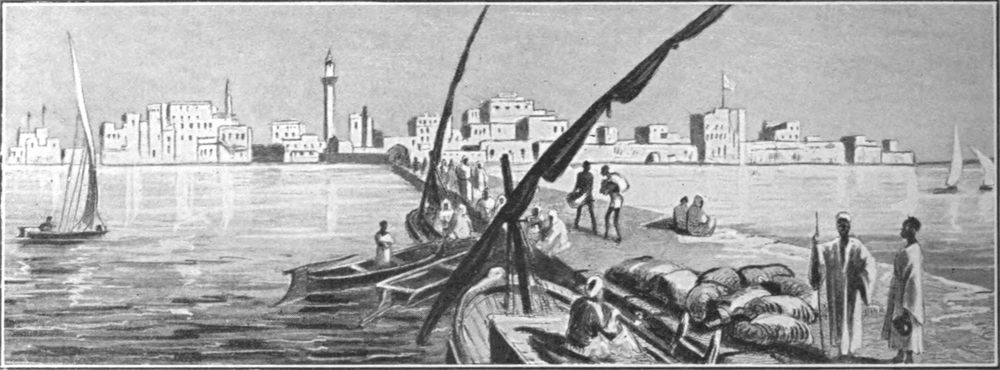
THE HOTTEST PLACE IN THE WORLD IS INHABITED BY MAN
No climate has triumphed over the endurance of man. Massowah, the most important town in the Italian Colony of Eritrea, in North Africa, is the hottest place in the world, but, like the coldest known place, it is inhabited.
Nature and National Destiny
The boundaries of natural regions are always natural boundaries. Although this delicate subject may be left to political geography, it is by no means to be neglected by those who are interested in history, boundary questions being among the most frequent causes of wars. In addition, boundaries are the necessary result of historical movements. In case two states strive against each other in expanding, the motion of both is impeded, and the boundary lies where the movement comes to a halt. It is in the nature of things that growing states are very frequently contiguous to uninhabited regions, not to other states. This contiguity is always a source of natural boundaries. The most natural of all arise from adjacency to uninhabitable regions: first the uninhabitable lands, then the sea. The boundary at the edge of the uninhabitable world is the safest; for there is nothing beyond. The broad Arctic frontiers of Russia are a great source of power. A high mountain range, also, may separate inhabited regions—which are always State territory—by an uninhabited strip of land. After all, the sea, marshes, rivers even, are uninhabitable zones. But traffic brings connection with it, and the Rhine, which to the Romans was a moat, especially well adapted as a defence, is now, with its thirty railway bridges and thousands of vessels plying up and down and across, far more of a highway and a means of communication than a dividing line.
The position, form, and movements of the earth seem far enough removed from the deeds and destinies of peoples, yet the more we contemplate the latter, the more we are led to consider the earth’s inclination to its axis, its approximately spherical form, and its motion, which, combined, are the cause of the recurrence in fixed order of day and night, summer and winter.
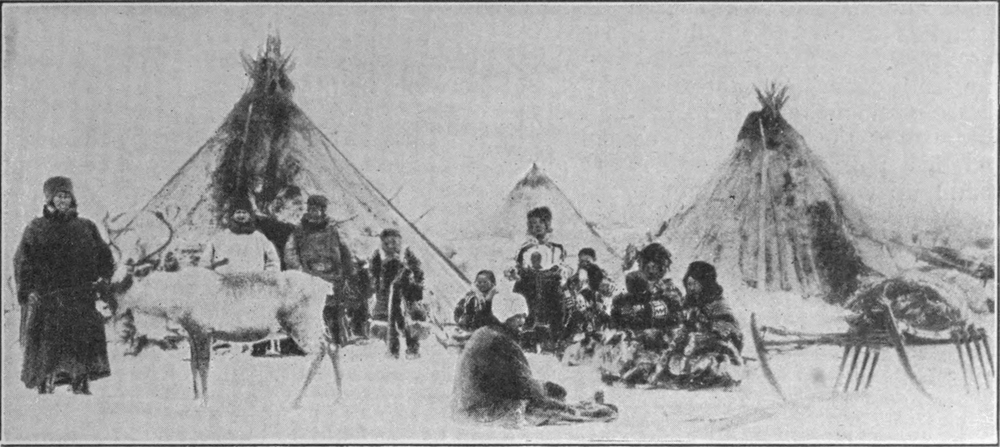
INHABITANTS OF THE COLDEST PLACE IN THE WORLD
Man is the most adaptable of living creatures. There is no climate in the world in which he cannot live. The lowest temperatures taken have been at Verkhoyansk, in Siberia, but the place is inhabited by people, of whom we give a group.
The effects of these great earthly phenomena are differently felt in every country; for they vary according to geographical location. Practically, that which most conforms to any given situation north or south of the equator is the climate of a land. Day and night are of more even length at the equator than in our country; but beyond the Polar circles there are days that last for months, and nights equally long. Scarcely any annual variation in temperature is known to the inhabitants of Java, while in Eastern Siberia Januarys of fifty degrees below freezing-point and Julys of twenty degrees above zero of Centigrade, winters during which the mercury freezes, and summers of oppressive sultriness, are contrasted with one another.
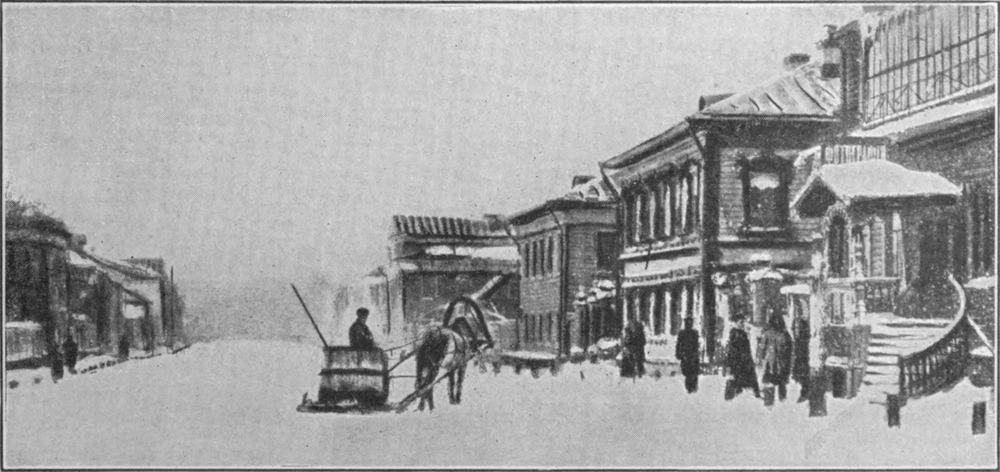
MAN’S TRIUMPH OVER CLIMATE: THE COLDEST PLACE IN THE WORLD
Just as man has established himself in the torrid heat of Massowah, so he can endure the highest degree of cold. The coldest place in the world, Verkhoyansk, of which this is a photograph, is the capital of a Siberian province.
In our temperate region there is rain, as a rule, during all months, but as far north as Italy and Greece the year is divided into a dry and a wet season. Great effects are produced over the entire earth and upon all living creatures by the thus conditioned climatic differences. They must be considered at the very beginning of every investigation into history. Since we know that a fluctuating distribution of heat is caused by the 23½° inclination of the earth’s axis, investigation also leads us to a knowledge of further phenomena, to a consideration of the dependence of the winds and of the precipitation of heat upon this very same condition.
The First Question about a Country
And thus we come into contact with the thousand connecting threads by which man’s economic activity, health, distribution over the earth, even his spiritual and his political life, are inseparably bound up with the climate. Hence the first question that should be asked concerning a country is: What is its geographical situation? A land may be interesting for many other reasons besides nearness or remoteness from the equator; but that which is of the greatest interest of all to the historian is a consideration of the manifold and far-reaching effects of climate.
The study of human geography teaches us that climate affects mankind in two ways. First, it produces a direct effect upon individuals, races, indeed the inhabitants of entire zones, influencing their bodily conditions, their characters, and their minds; in the second place, it produces an indirect effect by its influence on conditions necessary to life. This is due to the fact that the plants and animals with which man stands in so varied a relationship, which supply him with nourishment, clothing, and shelter, which, when domesticated and cultivated, enter his service, as it were, and become most valuable and influential assistants and instruments for his development and culture, are also dependent upon climate. Important properties of the soil, the existence of plains, deserts, and forests, also depend upon climate. Effects of climate, both direct and indirect, are united in political-geographical phenomena, and are especially manifest in the growth of states and in their permanence and strength.
Man can Bear all Climates
There is no climate that cannot be borne by man; of all organic beings he is one of the most capable of adapting himself to circumstances. Men dwell even in the very coldest regions. The place where the lowest temperatures have been measured, Verkhoyansk, with a mean January temperature of -54° F., is the capital of a Siberian province; and a district where the temperature is of the very hottest, Massowah, is the most important town in the Italian colony of Eritrea.
However, both heat and cold, when excessive, tend to lessen population, the size of settlements, and economic activity. The great issues of the world’s history have been decided on ground situated between the tropic of Cancer and the Polar circle. The question as to whether the northern half of North America should be English or French was decided between the parallels of 44° and 48° north latitude; and in the same manner the settlement as to whether Sweden or Russia should be supreme in Northern Europe took place a little south of 60° north. Holland did not lose and regain her Indian possessions in the neighbourhood of the equator, but in Europe; and Spain fell from the high estate of sovereign over South and Central America because her power as a European nation had decayed.
Strange Divergence of a Race
The coldest countries in the world are either entirely uninhabited—as Spitzbergen and Franz Josef’s Land—or very thinly populated. Some are politically without a master—the two territories just mentioned, for example; some are politically occupied, as is Greenland, but are of very little value. History teaches that traffic between such colonies and the mother country may cease entirely without the mother country suffering any loss thereby. The hottest regions in the world are for the most part colonies or dependencies of European Powers. This applies to the whole of tropical Africa, Asia, Australia, and Oceania, and partly to tropical America.
The exclusion of European nations from grasping for possessions in America was not determined upon in the compromised territory of tropical America, but in the United States, a short distance south of 39° north latitude. What a difference in the parts played in history by the two branches of the Tunguse race, the one held in subjection in the cold latitude of Russia, the other conquering China, and now the sovereign power in the more temperate climate of that country; or between the Turks who, as Yakuts, lead a nomadic life in the Lena valley, and the Turks who govern Western Asia! Latham called the region extending from the Elbe to the Amoor—within which dwell Germans, Sarmatians, Ugrian Finns, Turks, Mongolians, and Manchurians, peoples who strike with a two-edged sword—a “Zone of Conquest.” Farther to the north nations are poor and weak; toward the equator, luxurious and enervated. The inhabitants of this central zone have over-run their neighbours both to the north and to the south, while never, either from the north or from the south, have they themselves suffered any lasting injury. The Germans have advanced from the Baltic Sea to the Mediterranean; the Slavs inhabit a territory that extends from the Arctic Ocean to the Adriatic Sea; the Turks and Mongolians have penetrated as far south as India; and there have been times when Mongolians ruled from the Arctic Ocean to Southern India. Finally, the Manchurians have extended their sphere of influence over Northern Asia as far south as the tropic of Cancer.
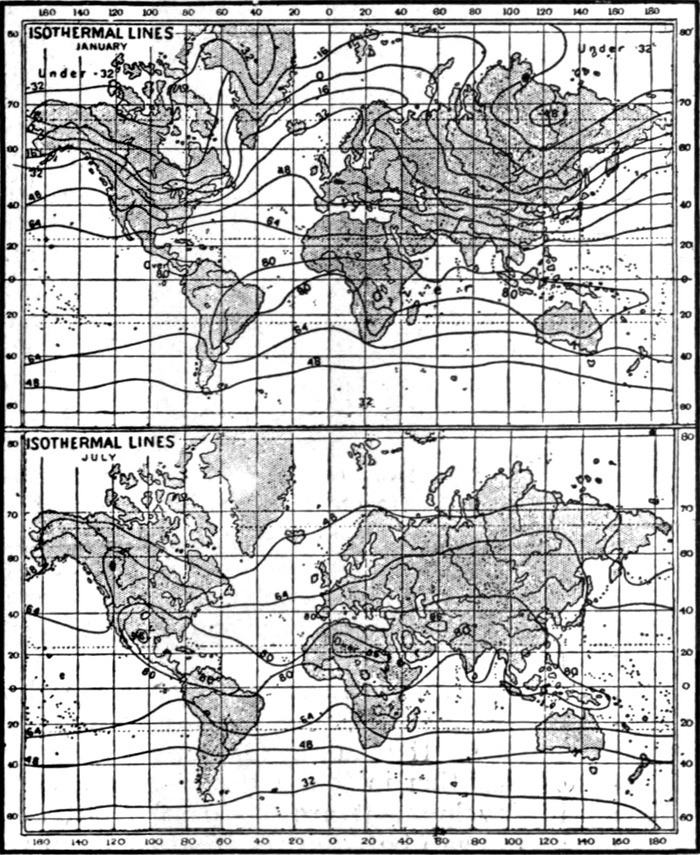
EFFECT OF CLIMATE ON THE COURSE OF HISTORY
A map on which the isothermal lines are drawn is rich in historical instruction. Where the lines diverge we have regions of equal temperature; where they crowd together, districts of different mean annual temperatures lie close together. The crowding of climatic variations in any region enlivens and hastens the course of history.
These differences occur over again in more restricted areas, even within the temperate zone itself. The inhabitants of the colder portions of a country have often shown their superiority to the men who dwell in the warmer districts. The causes of the contrast between the Northerners and the Southerners, which has dominated in the development of the United States, may for the most part be clearly traced: the South was weakened by the plantation method of cultivation, and slavery; its white population increased slowly, and shared to a lesser degree than did the Northerners in the strengthening, educating influences of agriculture and manufacturing industries. Thus after a long struggle that finally developed into a war, the North won the place of authority.
Sunbeams and Rainfall in History
In Italy and in France the superiority of the north over the south is partially comprehensible; and in Germany the advantages possessed by Prussia, at least in area and in sea coast, are obvious. But when in English history also the north is found to have been victorious over the south, conditions other than climatic must have been the cause. In this case elements have been present that are more deeply-rooted than in sunbeams and rainfall alone.
We must call to mind the zone-like territories of early times, occupied by peoples from which the nations of to-day are descended; the boundary lines have disappeared, but the northern elements have remained in the north, and the southern elements in the south. It is well known that Aristotle adjudged political superiority and the sphere of world-empire to the Hellenes because they surpassed the courageous tribes of the north in intelligence and in mechanical instinct, and were superior to the both intelligent and skilful inhabitants of Asia in courage. “As the Hellenic race occupies a central geographical position, so does it stand between both intellectually.” The thought that this union of extreme intellectuality and power in arms on Hellenic soil could be the result of ethnical infiltration did not seem to have occurred to the philosopher. The fundamental idea of Aristotle, the aristocratic state, in which the talented Hellene alone was to rule over bondmen of various origins, who were, above all, to labour for him, could not have been possible had his views been otherwise. And yet he had clearly seen that the two talents—for war and for industry—were unequally distributed among the different Hellenic stocks, and that they were also variable according to time.
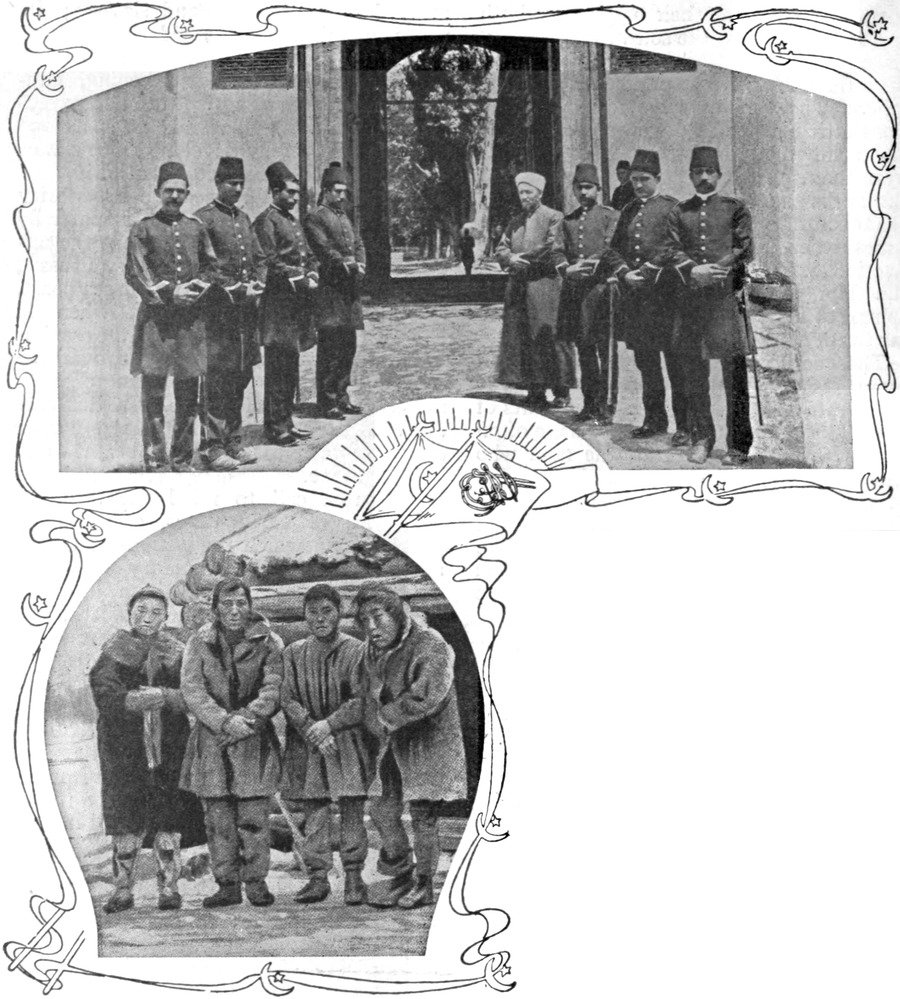
HOW THE SAME PEOPLES DIFFER
The Yakuts, who lead a nomad life in the valley of the Lena, and the Turks who govern Western Asia, are of the same stock, but the genial climate has enabled the Turks to flourish while the cold has kept the Yakuts poor. These groups represent both branches of the stock.
Considering the influence even of slighter differences in climate, the locations of regions of similar mean annual temperature, and the distances which separate them from one another, cannot be otherwise than important. A map on which the isothermal lines are drawn is rich in historical instruction. Where the lines diverge we have regions of equal temperature; where they crowd together, districts of different mean annual temperatures lie close to one another. The crowding of climatic variations in any region enlivens and hastens the course of history in that region. If the variations occur only at long intervals, all parts of a large territory having approximately equal mean annual temperatures, then climatic contrasts, which act as a ferment, as it were, are not present to any appreciable extent, and their effects lose in intensity and are dispelled.
Where are greater combinations of contrasting climatic elements to be found than in Greece and in the Alps? The joining together of the natives of rich, fruitful Zürich with the poor shepherds of the forests and mountains was of the utmost importance to the development of the Swiss Confederation. It was also a union of regions of mild and cold temperatures. The possession of Central European and Mediterranean climates, that shade into one another without any sharp line of demarcation, is a great advantage to France. If climatic differences approach one another in too great a contrast, clefts in development are likely to occur, such as the gap between the Northern and the Southern States in America, and that between North and South Queensland. If it be possible to adjust the political differences, then the union of areas of different temperatures has an invigorating effect, as shown by the history of the American Southern States since 1865.
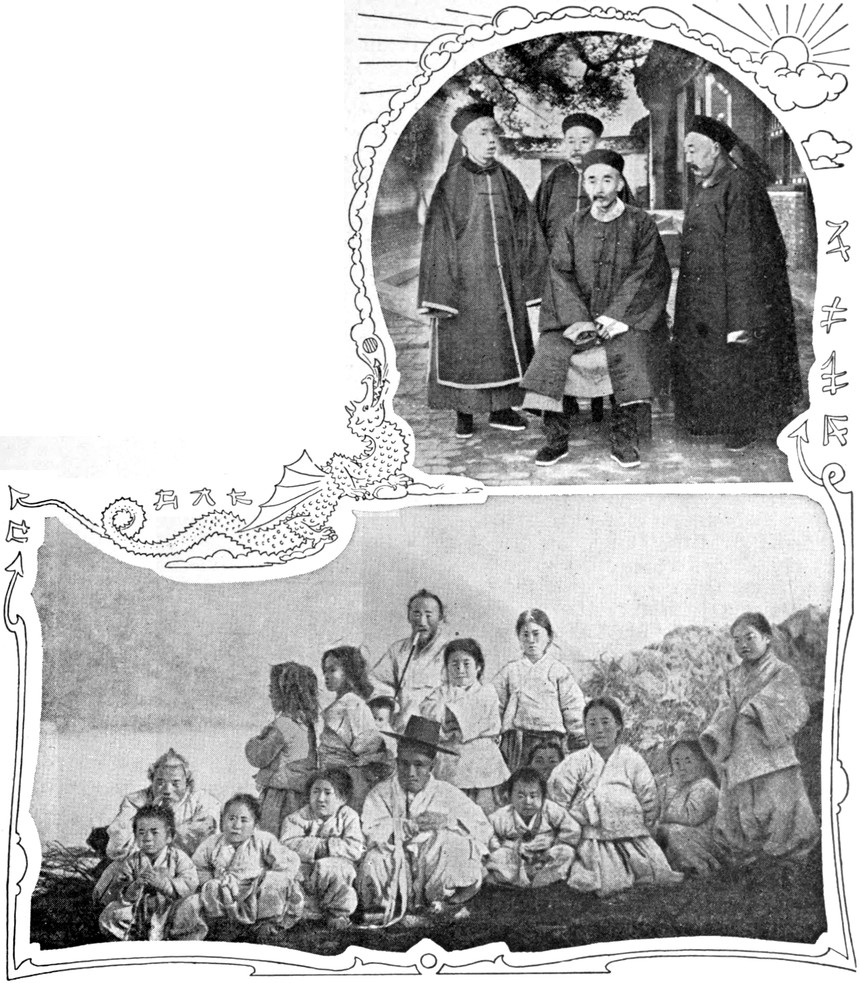
THE EFFECTS OF CLIMATE ON THE POWER OF PEOPLES
There is a world of difference between the two branches of the Tunguse race: the one is a poor people living in cold regions and subject to Russia; the other is the ruling race of the Chinese Empire, flourishing in a temperate climate. The upper group is composed of ruling Tunguses in China and the lower group represents Tunguses subject to Russia.
Winds blowing in a constant direction for many months at a time were of great assistance to navigation during the days of sailing vessels, which, indeed, have not yet been entirely supplanted by steamships. Before the time of steam vessels all traffic on the Indian Ocean was closely connected with the change of the monsoons; and important political expansions have followed in the track of the same winds—for example, the diffusion of the Arabs along the east coast of Africa and in Madagascar. The influence of the trade winds on the Spanish and Portuguese discoveries along the Atlantic coast of America is well known. The south-eastern trade winds have been a cause of both voluntary and involuntary emigrations of Polynesian races. It may be clearly seen from the history of Greece what advantage was obtained by the race that won the alliance of the coast of Thrace and the wind that blows south from it with constancy during the entire fair season, often eight months long.
Where the wind is most variable, visiting entire countries with storms, to the great destruction of lives and property, the result is a stirring up of the survivors to exertions that cannot fail to be strengthening both to body and to mind, and of direct benefit to life in general. At the same time that the people of Holland were engaged in forcing back the ocean, they won their political liberty. In another part of the North Sea coast the Frisians receded farther and farther south, owing to the invasions of the sea and the attacks of the natives of Holstein. The tempest that scattered the armada of Philip II. was one of the most important political events of the time; and it is not to be denied that the snowstorm in Prussian Eylau, at the beginning of the battle in which Napoleon suffered his first defeat, contributed not a little to the result.
One of the Greatest Problems
Acclimatisation is one of the greatest of human problems. In order that a nation shall expand from one zone into another, it must be capable of adapting itself to new climates. The human race is, as a whole, one of the most adaptable of all animal species to different conditions of life; it is diffused through all zones and all altitudes up to about thirteen thousand feet above the level of the sea. But single nations are accustomed to fixed zones and portions of zones; and long residence in foreign climates leads to illness and loss of life.
Climate and Will-Power
In some races the individuals are of a more rigid constitution than in others, and are thus less capable of adaptation. Chinamen and Jews adapt themselves to different climates far more easily than do Germans, upon whom residence in the southern part of Spain even, and to a still greater degree in Northern Africa, is followed by injurious effects. The constant outbreaks of destructive disease before which the German troops withered away are to be counted amongst the greatest obstacles opposed to the absorption of Italy into the German Empire. During the Spanish discoveries and conquests in America in the sixteenth century, whole armies wasted away to mere handfuls. The greatest hindrances to German colonisation in Venezuela are climatic diseases. Medical science has, to be sure, pointed out such deleterious influences as may be traced to unsuitable dwelling-places, nutrition, clothing, etc.; and the losses to Europe of soldiers and officials in the tropics have been greatly reduced. But even to-day deaths, illnesses, and furloughs make up the chief items in the reports sent in from every colony in the tropics. British India can only be governed from the hills, where the officials dwell during the greater part of the year.
Climatic influence is not limited to bodily diseases. One of the first effects of life in warm climates upon men accustomed to cold regions is relaxation of what is known as will-power. Even the Piedmontese soldier loses his erect carriage in a Neapolitan or Sicilian garrison. Englishmen in India count on an ability to perform only half the amount of work they would be capable of at home. Many inhabitants of northern countries escape the bodily diseases of the tropics; but scarcely one man of an entire nation is able to resist the more subtle alterations in spirit.
The Peoples of North and South
Their historical influence extends only the deeper for it. The conquering nations that advance from north to south have invariably forfeited their power, determination, and activity. The original character of the Aryans who descended into the lowlands of India has been lost. A foreign spirit rings through the Vedic hymns. West Goths and Vandals alike lost their nationalities in Northern Africa and Spain, as the Lombards lost theirs in Italy. In spite of all emigration, immigration, and wandering hither and thither, there always remains a certain fixed difference between the inhabitants of colder and those of warmer countries; it is the nature of the land, moulding the more ductile character of a people into its own form. There are differences also between the northern and the southern stocks of the same race, and thus climate exerts here greater and there lesser influence upon nations and their destinies.
Since it lies in the nature of climatic influences to produce homogeneity among those peoples who inhabit extensive regions of similar mean annual temperatures, it follows that a unifying effect is also produced on political divisions that might otherwise be inclined to separate from one another. In the first place, a similar climate creates similar conditions of life, and thus the northern and southern races of each hemisphere, with their temperate and their hot climates, differ widely. Climate is also the cause of similar conditions of production over large territories. Leroy-Beaulieu rightly mentioned climate—above all, the winter, during which almost every year the whole land from north to south is covered with snow—as next in importance to the configuration of the country in its unifying, cohesive effects on the Russian Empire. Winters are not rare during which it is possible to journey from Astrachan to Archangel in sledges; and both the Sea of Azov and the northern part of the Caspian Sea are frozen over during the cold months, as well as the Bay of Finland, the Dnieper as well as the Dwina.
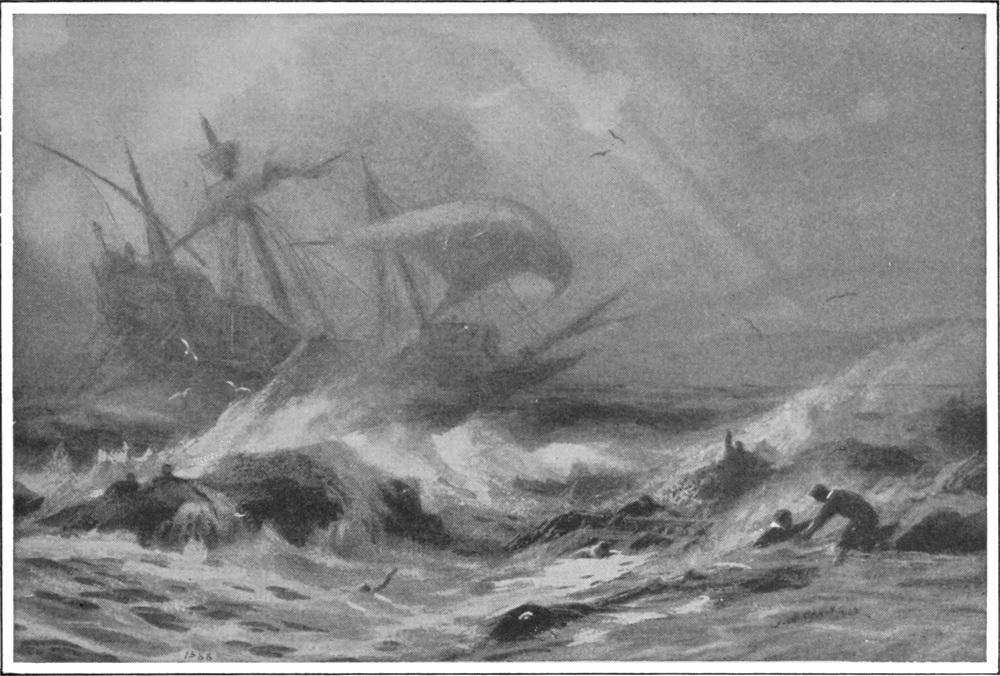
A STORM THAT CHANGED THE COURSE OF HISTORY: THE WRECK OF THE ARMADA
The weather has greatly influenced the course of history and helped to mould the fate of nations. The tempest that scattered the Spanish Armada in 1588 was one of the most important political events of the time. This picture, from the painting by J. W. Carey, illustrates the wreck of the galleon “Girona,” at Giant’s Causeway.
Situation determines the affinities and relations of peoples and states, and is for this reason the most important of all geographical considerations. Situation is always the first thing to be investigated; it is the frame by which all other characteristics are encircled. Of what use were descriptions of the influence of the geographical configuration of Greece on Grecian history, in which the decisive point that Greece occupies a medial position between Europe and Asia, and between Europe and Africa, was not insisted upon above all? Everything else is subordinate to the fact that Greece stands upon the threshold of the Orient. However varied and rich its development may have been, it must always have been determined by conditions arising from its contiguity with the lands of Western Asia and Northern Africa. Area in particular, often over-valued, must be subordinated to location. The site may be only a point, but from this point the most powerful effects may be radiated in all directions. Who thinks of area when Jerusalem, Athens, or Gibraltar is mentioned? When it is found that the Fanning Islands or Palmyra Island is indispensable to the carrying out of England’s plans in respect to telegraphic connection of all parts of the empire with one another, merely because these islands are adapted for cable stations on the line between Queensland and Vancouver, is it not owing to their location alone, without consideration as to area, configuration, or climate?
Every portion of the earth lends its own peculiar qualities to the nations and races that dwell upon it, and so does each of its subdivisions in turn. Germany, as a first-class Power, is thinkable only in Europe. There cannot be either a New York or a St. Petersburg in Africa. Our organic conception of nations and states renders it impossible for us to look upon situation as something lifeless and passive; far rather must it signify active relations of giving and receiving. Two states cannot exist side by side without influencing each other. It is much more likely that such close relationships result from their contiguity; that, for example, we must conceive of China, Korea, and Japan as divisions of a single sphere of civilisation, their history consisting in a transference, transplanting, action, and reaction, leading to results of the greatest moment. Some situations are, indeed, more independent and isolated than others; but what would be the history of England, the most isolated country in Europe, if all relations with France, Germany, the Netherlands, and Scandinavia were omitted? It would be incomprehensible.
The more self-dependent a situation is, the more is it a natural location; the more dependent, the more artificial, and the more it is a part of a neighbourhood. Connection with a hemisphere or grand division, identity with a peninsula or archipelago, location with respect to oceans, seas, rivers, deserts, and mountains, determine the histories of countries. It is precisely in the natural locality that we must recognise the strongest bonds of dependence on Nature. Apart from all other features peculiar to Italy, her central position in the Mediterranean alone determines her existence as a Mediterranean Power. However highly we may value the good qualities of the German people, the best of these qualities will never reach so high a development in the constrained, wedged-in, continental situation of their native land as they would in an island nation; for Germany’s location is more that of a state in a neighbourhood of states than a natural location, and for this reason more unfavourable than that of France.
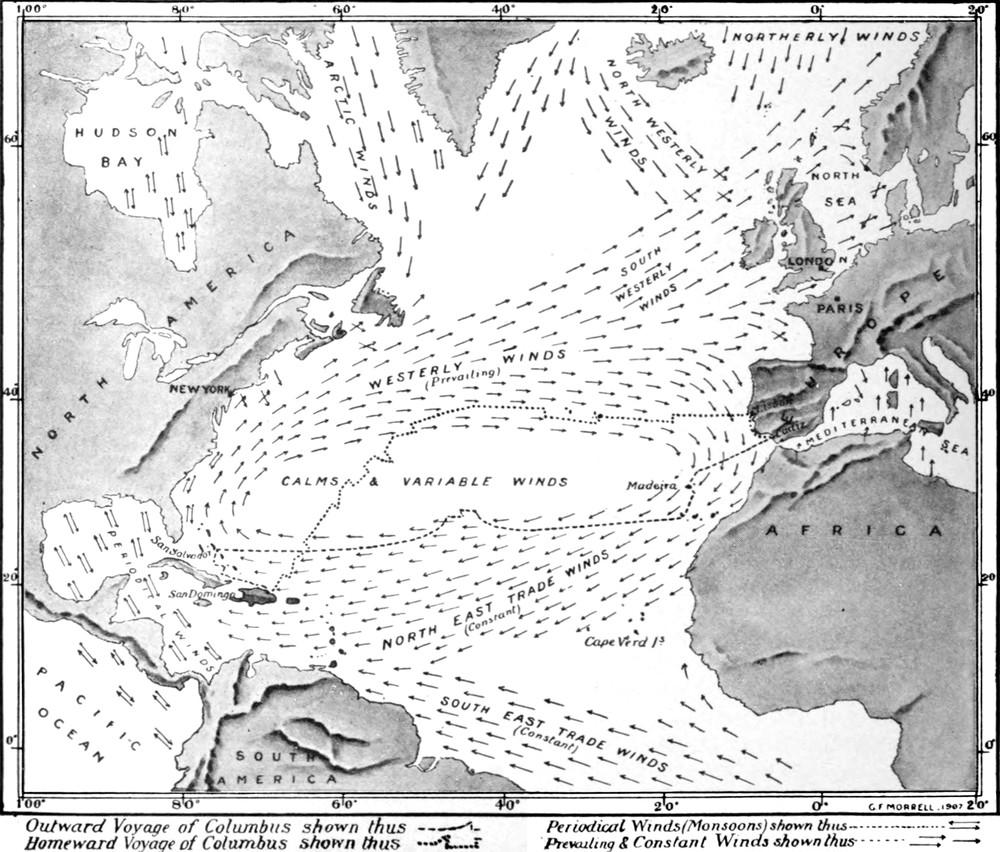
POLITICAL EXPANSION HAS FOLLOWED IN THE TRACK OF THE WINDS
This map illustrating the trade winds and prevailing winds shows how important were these winds before the days of steam vessels. It shows that the outward voyage of Columbus was entirely along the track of the north-east trade winds. Where the arrows cross, as off the North-west of Scotland, we have regions of wind disturbances.
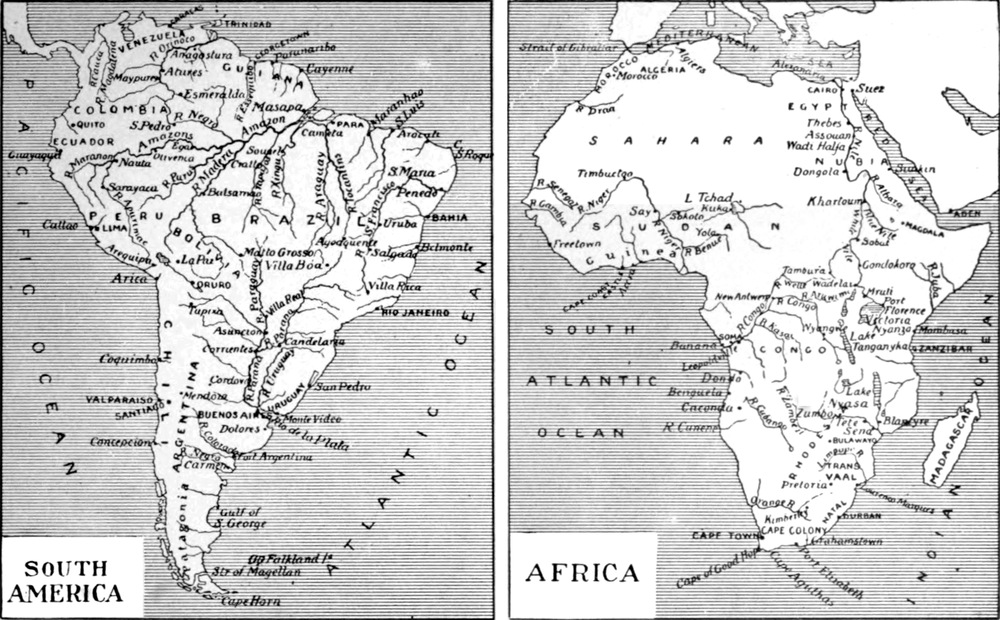
THE RIVERS OF TWO CONTINENTS AND THEIR INFLUENCE IN CIVILISATION
The influence of riverways in furthering political development may be best seen in the contrast between South America and Africa; the colonising movement came to Africa three hundred years later than to South America.
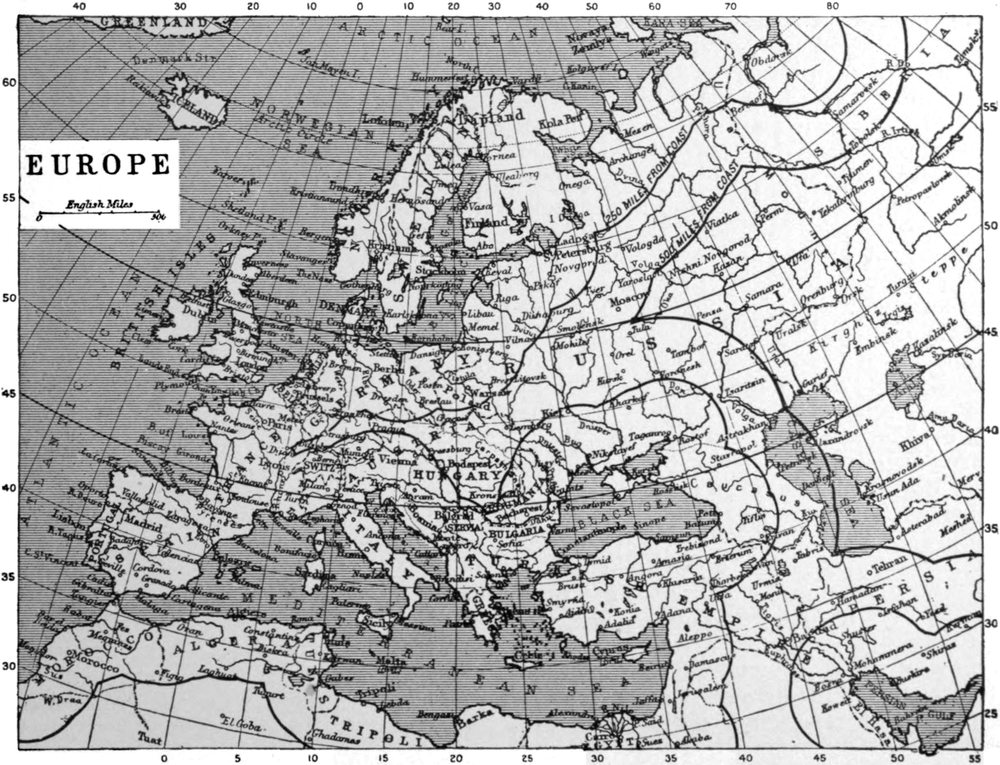
EUROPEAN COUNTRIES AND THEIR NEARNESS TO THE SEA
A country’s prosperity depends greatly upon its relation to the sea. This map shows the boundaries of European countries, and the black lines indicate those countries that lie within 250 and 500 miles from the sea-coast.
THE RELATION OF RIVERS AND THE SEA TO THE CIVILISATION OF COUNTRIES
The Ideal Situation for a State
Natural localities of the greatest importance result from the configuration and situation of divisions of the earth’s surface. The extremities of continents—such as the Cape of Good Hope, Cape Horn, Singapore, Ceylon, Tasmania, and Key West—are points from which sea power radiates; and at the same time they are the summits of triangular territories that extend inland and are governed from the apex. In the same way all narrowings of parts of continents are of importance. France occupies an isthmian position between ocean and sea; Germany and Austria between the North Sea, the Baltic, and the Adriatic. Some states are situated on the coast, occupying a bordering position; others occupy an intermediate location. And the more isolated situations are all fundamentally different, according to whether they are insular, peninsular, or continental. Situations in respect to the oceans are even more various. How different are Atlantic locations in Europe from those on the Mediterranean, the Baltic, or the Black Sea! Only a few nations occupy a position fronting on two great oceans. The ideal natural situation for a state may be said to be the embracing of a whole continent within one political system. This is the deeper source of the Monroe Doctrine.
Contrasts and Comparisons
Similar locations give rise to similar political models. Since there are several types of location, it follows that the histories of such locations assume typical characters. The contrast between Rome and Carthage, their association with each other, exhibiting the reciprocal action of the characters of the northern and southern Mediterranean coasts, is repeated in similarly formed situations in Spain and Morocco, in Thrace and Asia Minor, and on a smaller scale in the Italian and Barbary ports. In all these places events similar to those in Roman and Punic history have taken place. Japan and England are unlike in many respects; yet not only the peoples, but also the political systems, of the two island nations have insular characteristics. Germany and Bornu are as different from each other as Europe is from Africa, but central location has produced the same peculiarity in each—a source of power to the strong nation, of ruin to the weak.
Contiguity with neighbouring states brings with it important relationships. The most striking examples of such contiguity are to be seen in nations that are cut off from the coast of their continent and completely surrounded by other countries. Owing to the constant reaching out for more territory, such a situation in Europe, as well as in other continents, signifies unconditional loss of independence. Only connection with a great river can prevent the dissolution of a nation so situated. The instinctive impulse to extend its boundaries to the sea, shown by all nations, arises from the desire to escape an insulated continental position. Only the very smallest of states, such as Andorra and Liechtenstein—which, moreover, do not aspire to absolute independence—could have existed for centuries in the positions that they occupy. A medial situation held by one country between two others is also, in point of risk, comparable to a completely encompassed position. France was so situated when Germany and Spain were under the same ruler. The alliance of two neighbouring lands may place a third state in a similar position.
What is National Progress?
Whatever the individual locations of neighbouring states may be, their number is a matter of great importance. It is better to have a multitude of weak neighbours than a few strong ones. The development of the United States that gradually ousted France from the south, Mexico from the west, and Spain from both south and west, in order to be in touch with the sea on three sides, has, with the decrease in neighbouring Powers, resulted in an enviable simplification of political problems.
A nation covering various dispersed and scattered situations is to be seen at the present day only in regions of active colonisation and in the interiors of federal states. Powerful nations are consolidated into a single territory. We may see everywhere that when the area of distribution of a form of life diminishes in extent, it does not simply shrink up, but transforms itself into a number of island-like sites, giving the appearance that the form, of life is proceeding from a centre of the conquest of new territory. In what does the difference lie between islands of progress and of recession? With nations and states progress lies in the occupation of the most advantageous sites; retrogression lies in their loss and sacrifice. The American Indians, forced back from oceans, rivers, and fertile regions, form detached groups of retrogression; the Europeans who took these sites from them formed isles of progress as, one after another, they seized the islands, promontories, harbours, river-mouths, and passes.
THE MAKING OF THE NATIONS—IV
Professor FREDERICK RATZEL
THE SIZE AND POWER OF NATIONS
The State and its Territory
I
IT is not without reason that so much importance is attached to extent of surface in geography. Area and population represent to us the two chief characteristics of a state; and to know them is the simplest means—often too simple—for obtaining a conception of the size and power of a nation. We cannot conceive of any man, much less a human community, without thinking of surface or ground at the same time. Political science may, through a number of clever conclusions, reduce the area of a state to a mere national possession; but we all know that territory is too tightly bound up with the very life of a state for it to assume a position of so little importance. In a nation, people and soil are organically united into one, and area and population are the measure of this union. A state cannot exchange or alter its area without suffering a complete transformation itself. What wonder, then, that wars between nations are struggles for territory? Even in war the object is to limit the opponent’s sphere of action; how much more does the whole history of nations consist in a winning and losing of territory. The Poles still exist as they did in former times; but the ground upon which they dwell has ceased to belong to them in a political sense, and thus their state has been annihilated.
The Vast Modern Empires
During the course of history we constantly see great political areas emerging from the struggle for territory. We see nations from early times to the present day increasing in area: the Persian and Roman Empires were small and mean compared with those of the Russians, English, and Chinese. Also the states of peoples of a lower grade of culture are insignificant compared with the states of more advanced races. The greatest empires of the present day are the youngest; the smallest—Andorra, Liechtenstein, San Marino, Monaco, appear to us only as venerable, strange petrifications of an alien time. The relation of surface to the growth of spheres of commerce and of means of communication is obvious. Communication is a struggle with area; and the result of this struggle is the overcoming of the latter. The process is complicated because, as control is gained over area, one also acquires possession of its contents: advantages of location, conformation, fertility, and, by no means least, the inhabitants of the territory themselves. But the loss in value of all these things, brought about by their being widely scattered throughout an extensive area, can be overcome only by a complete control of the region over which they are spread.
Traffic Leads to Empire
The development of commerce is the preliminary history of political growth. This applies to all races, from Phœnicians to North Americans, who point out to us a post of the American Fur Company as the germ from which Nebraska developed. Every colony is a result of traffic; even in the case of Siberia, merchants from European Russia travelled thither as far as the Ob about three centuries before its conquest. The phrase “conquests of the world’s commerce” is perfectly legitimate. The building of roads is a part of the glory of the founders and rulers of nations. To-day, tariff unions and railway politics have taken the place of road-making. It has always been so; both state and traffic have had the same interest in roads and thoroughfares. Traffic breaks the way, and the state improves and completes it. It seems to be certain that the firmly organised state in ancient Peru opened the roads which were later a service to traffic. In a lower phase of development we may see commerce leading directly to the establishment of states; in a higher, to victory in war, arising from commercial and railway communication. It would be impossible for France to construct the Sahara Railway without first subjugating the Tuareg and seizing their country. Highways of traffic as weapons for hostile states, the important part played by commercial nations and the culture of strictly industrial and commercial peoples, the endeavour of traffic to be of service to the policies of states, and, finally, the powerful reactions caused by the removal and disuse of thoroughfares of commerce to races, nations, and to entire spheres of civilisation—can only be indicated here.
Every Trader Bears his State with him
Every political movement, whether it be a warlike expedition or a peaceful emigration, is preceded by movements which are not political. Inquiries must be made and relations instituted; the object must be determined, and the road explored. All the while that knowledge of the world beyond the bounds of a country is being gained, there is also an imperceptible broadening of the geographical horizon; and this not only widens out, but becomes clearer. Fabulous tales are circulated as to the terrors of strange countries; but the fear gradually vanishes as our knowledge increases, and with the latter a spirit of political enterprise awakens One can say that every trader who passes the bounds of his country bears his state with him in his load of merchandise. To be sure, there are both long preparations made and quick leaps taken in the processes of commerce. Roman merchants prepared the way to a knowledge of Gaul and its conquest. But how different the attitude of the Romans to Gaul before and after the time of Cæsar! What a difference in the Spanish estimate of the worth of American colonies before the days of Cortez and Pizarro, and afterward! The broader and clearer the geographical horizon grows, the greater become political schemes and standards of policy.
Causes of National Success and Failure
The widening of the geographical horizon and the clearing up of mysteries beyond are invariably a result of the travels of individuals or of groups for peaceful purposes. The first of these purposes is commerce; the chase and fishing are also to be taken into consideration; and the involuntary wanderings of the lost and strayed are not to be excluded. Europe possessed a Pytheas and a Columbus who discovered new worlds; and every primitive community had its explorers, too, who cleared paths from one forest glade to another. If such pioneers return, they also bring back with them contributions to the general stock of knowledge of the world without, and it becomes less difficult for others to follow in their footsteps; finally armies or fleets may advance, conquering in their tracks. Whenever traffic makes busy a multitude of men, and employs extensive means by which to carry on its operations, the truth of the saying, “The flag follows trade,” is finally established in its broadest sense. With all this struggling and labouring, territory does not fall to the state simply as a definite number of square miles. Just as single individuals bring enlightenment to the state, in the same manner the idea of area arises in the intelligence of the aggregate.
When we say that an area increases, we must remember that by this we mean that the intelligence which views it and the will that holds it together have increased, and naturally, also, that which is requisite for rendering intelligence and will capable for their work. In this lies one of the greatest differences that exist between nations, one of the greatest causes of success and failure in development.
A disposition for expansion that advances boundaries to the farthest possible limit is a sign of the highest state of civilisation. It is a result of an increase both of population and of intellectual progress.
Small States in Fine Situations
There is something very attractive in the small political models of early times: those city-states whose development had in definiteness and in precision a great deal of the lucidity and compactness of artistic compositions. Lübeck and Venice are more attractive than Russia. The concentration of the forces of a small community in a limited, beautifully situated, and protected location, is a source of a development that takes a deeper hold on all the vital powers of a people, employing them more extensively, and therefore ending in a more rapid and definite perfection of historical individuality. Thus small areas take the lead of large territories in historical development; and we may see many examples of a slow but sure transference of leadership from the small area to the large, and of the gradual diffusion of progress in the latter. Thus Italy followed Greece; Spain, Portugal; England, Holland.
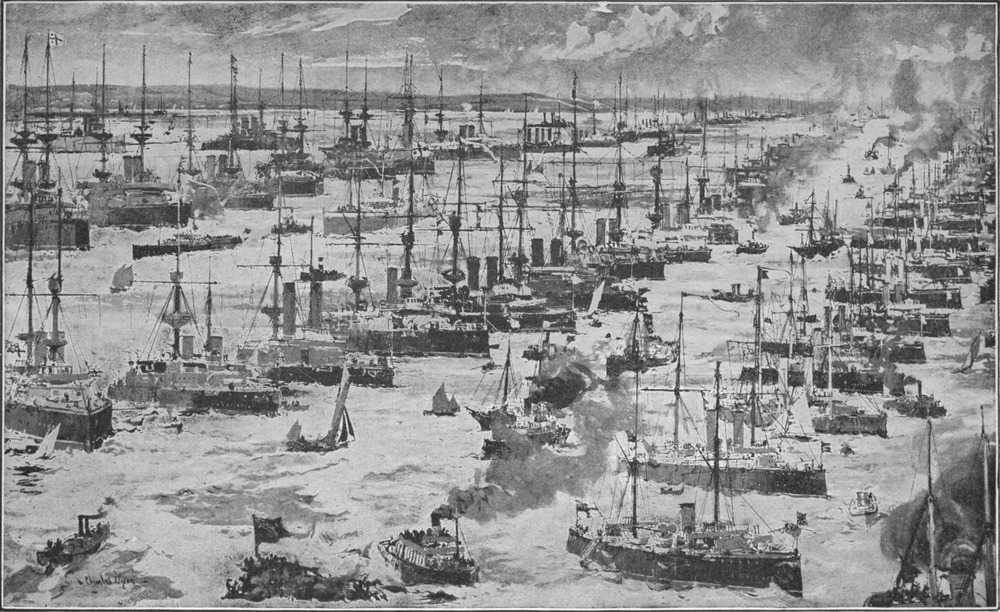
THE COMMAND OF THE SEAS: GREAT BRITAIN’S MIGHTY MACHINERY OF DEFENCE
Great Britain’s strength is a proof of the tremendous importance of the sea as a factor of political power. This is a bird’s-eye view of the British Navy assembled at Spithead.
LARGER IMAGE
The opposite of this is precocity in growth: the earlier a state marks out its limits without consideration for later expansion, the sooner the completion of its development. The growth in area of Venice and the Low Countries stood still, while all about them territories increased in size. The development of small countries flags unless the increase of population within a limited area leads to that disquiet and emigration and expulsion of citizens especially characteristic of small nations: the horizon grows too narrow for the times; patriotism becomes local pride; and the most important life forces are impaired. Thus minor nations, through which races are separated into little groups, develop: the great national economic and religious cohesive forces are broken up; and even the political advantages of the ground are reduced in value through disintegration.
Founding of States by Strangers
Under such conditions the impulse for new growth must be brought in from without. The native, who is acquainted with only one home, is always inferior to the foreigner, who has a knowledge of two lands at least. It is remarkable how numerous are the traditions of the establishment of states by strangers. Sometimes these are mighty hunters, as in Africa; often they are superior bearers of civilisation, as in Peru; and an especially large number of them have descended to the earth from heaven. In the face of history which tells of the foundation of a Manchurian dynasty in China and a Turkish in Persia, of the establishment of the Russian Empire by wandering North Germans, and that of the great nations in the West Sudan by the Fulah shepherds—these mythical accounts, although they may appear decidedly incredible when taken singly, as a whole are probable enough. The foundation of the nation of Sarawak in Borneo by Brooke is reality and corresponds with many of the old legends of the formations of states.
A Great Turning-point in History
The broad conception of a state, which acts as a ferment does on a disrupted mass, is introduced from one neighbouring nation into another, each sharing in its production. When such territories are adjacent, the state situated in the most powerful natural region overgrows the other. The more mobile race brings its influence to bear on the less mobile, and possibly draws the other along with it. The more compact, better organised and armed state intrudes on weaker nations, and forces its organisation upon them. A nation left to itself has a tendency to split up into small groups, each of which seeks to support its own life upon its own soil, heedless of the others; and as such groups increase, they always reproduce in their own images: families families, and tribes tribes. We find all sorts of measures taken by some nations to limit an increase in growth that would carry them beyond their old boundaries and place them under new conditions of life. Many an otherwise inexplicable custom of taking human life is a result of this tendency; perhaps, in some cases, even cannibalism itself. This impulse towards limitation would have rendered the growth of nations impossible had not the antithetical force of attraction of one to another led to growth and amalgamation. Truly, the advance from a condition of isolated, self-dependent communities to one of traffic between state organisms, which must of necessity lead to ebb and flow and union of one group with another, is one of the greatest turning-points in the history of man.
Nations as Neighbours
Since the tendency has been for territory to become the exclusive reward of victory in the competition of nations, balance of territorial possessions has grown to be one of the chief ends of national policies. The phrase “balance of power,” which has been so often heard since the sixteenth century, is no invention of diplomats, but a necessary result of the struggle for expansion. Hence we find an active principle of territorial adjustment and balance in all matters concerning international politics. It is not yet active in the small and simple states of semi-civilised peoples; such states are much more uniform, for they have all originated with a uniformly weak capacity for controlling territory. In addition, the principle of territorial isolation hinders the action of political competition. As soon, however, as necessity for increased area leads to the contiguity of nations, the conditions alter. The state that occupies but a small region strives to emulate its larger neighbour. It either gains so much land as is necessary to restore equality, or forces a decrease in the neighbour’s territory.
The Balance of Power
Both alternatives have been of frequent occurrence. Prussia expanded at the expense of Schleswig and Poland in order to become equal in territory to the other great Powers. The whole of Europe fought Napoleon until France had been forced back within such boundaries as were necessary to international balance. Austria lost provinces in Italy and replaced them with others in the Balkan Peninsula. This loss and gain appears to us, in looking over an easily epitomised history, such as that of France, as an alternation of violent waves and temporary periods of rest attained whenever a balance is reached. Therefore it is not owing to chance that the areas of Austria, Germany, France, and Spain may be respectively designated by 100, 86, 84, and 80, that the area of Holland is to that of Belgium as 100 is to 90, and that the United States stands to Canada as 100 to 96. To be effective, such balances must presuppose equal civilisations, similar means for the acquirement of power. Rome was so superior to her neighbours in civilisation that she could not permit any territorial balance. Perhaps the adoption of the River Halys as the boundary between Media and Lydia was a first attempt to establish a national system on the principle of balance instead of “world” dominion.
A New British Empire is not Conceivable
Our standards for measuring the areas of countries have constantly increased during the growth of historical territories. The history of Greece is to us but the history of a small state; and how many years shall pass before that of Germany, Austria, and France will be but the history of nations of medium size? England, Russia, China, and the United States include the better half of the land of the world; and to-day a British Empire in the other half could not be conceivable. Development has ever seized on greater and greater areas, and has united more and more extensive regions into aggregates. Thus it has always remained an organic movement. The village-state repeats itself in the city-state, and the family-state in the race-state, the smaller ever being reproduced in greater forms. The smallest and greatest nations alike retain the same organic characteristics more or less closely united to the soil.
Area Does Not Mean Power
The surface of a state bears a certain relation to the surface of the globe, and according to this standard is the land measured upon which the inhabitants of a nation live, move, and labour. Thus it may be said that the 208,687 square miles of the German Empire represent about 1⁄940 of the entire surface of the earth; further, that the empire has a population of 60,500,000, from which the ratio of 5·45 acres to each individual follows. Although it is true that wholly uninhabited or very thinly populated regions, high mountains, forests, deserts, etc., may be valuable from a political point of view, nevertheless the whole course of the world’s history shows us that, as a general rule, the value of territory increases with the number of inhabitants that dwell upon it. Thus, before their disunion, Norway-Sweden, with an area of 297,000 square miles—two-fifths greater than that of the German Empire—but with a population of 6,800,000, cannot be looked upon as a first-class Power; while Germany closely approaches the Russian Empire in strength, for although its area is but 1⁄43 that of the latter, its population is only one-half less. Thus area alone is never the deciding factor of political power. In the non-recognition of this fact lies the source of the greatest errors which have been made by conquerors and statesmen. The powerful influence that small states, such as Athens, Palestine, and Venice, have exerted on the history of the world proves that a great expanse of territory is by no means indispensable to great historical actions. The unequal distribution of mankind over a definite area is a much more probable source of political and economic progress.
Civilisation and political superiority have always attended the thickly populated districts. Thus the whole of development has been a progression from small populations dwelling in extensive regions to large populations concentrated in more limited areas. Progress first awoke when division of labour began to organise and differentiate among heaped-up aggregates, and to create discrepancies promoting life and development. A simple increase of bodies and souls only strengthens that which is already in existence by augmenting the mass. In China, India, and Egypt, population has increased for a long time; but development of civilisation and of political power has been unable to keep pace with it.
THE MAKING OF THE NATIONS—V
Professor FREDERICK RATZEL
THE FUTURE HISTORY OF MAN
Man and the Universe
L
LOOKING back upon the history of man, it appears to us the history of the human race as a life phenomenon bound and confined to this planet alone. We are thus unable to form any conception of progress into the infinite, for every tellurian life-development is dependent upon the earth, and must always return to it again. New life must follow old roads. Cosmic influences may broaden or narrow the districts within which man is able to exist. This was experienced by the human race during the Glacial Period, when the ice sheet first drove men toward the equator, and later, receding, enabled them once more to spread out to the north. The limits of world life in general depend upon earthly influences; and thus, for mankind, progress limited by both time and space is alone possible.
Perhaps it would be well, for the elucidation of the question of development, were geography to designate as progress only that which from sufficient data may be established as such beyond all doubt. Thus, to begin with, we have learned to know of a progress in space—man’s diffusion over the earth—which proceeds in two directions. The expansion of the human race signifies not only an extension of the boundaries of inhabited land far into the Polar regions, but also the growth of an intellectual conception of the whole world.
Manifold Growth of Mankind
Together with this progress there have been countless expansions of economic and political horizons, of commercial routes, of the territories of races and of nations—an extraordinarily manifold growth that is continually advancing. Increase of population and of the nearness of approach of peoples to one another goes hand in hand with progressing space. Mankind cannot become diffused uniformly over new areas without becoming more and more familiar with the old. New qualities of the soil and new treasures have been discovered, and thus the human race has constantly been made richer. While these gifts enriched both intellect and will, new possibilities were all the while arising, enabling men to dwell together in communities; the population of the earth increased, and the densely inhabited regions, at first but small, constantly grew larger and larger.
History is the Growth of Differences
With this increase in number, latent abilities came to life; races approached one another; competition was entered into; interpenetration and mingling of peoples followed. Some races acted mutually in powerfully developing one another’s characteristics; others receded and were lost, unless the earth offered them a possibility of diffusion over better protected regions. Already we see in these struggles the fundamental motive of the battle for area; and at the same time, on surveying this progress, we may also see the limit set to it—that increase in population is unfavourable to the progress of civilisation in any definite area, if the number of inhabitants become disproportionately large in respect to the territory occupied. Many regions are already over-populated; and the numbers of mankind will always be restricted by the limits of the habitable world.
Already in the differences in population of different regions lie motives for the internal progress of man; but yet more powerful are those incentives to the development of internal differences in races furnished by the earth itself through the manifoldness of its conformation.
The entire history of the world has thus become an uninterrupted process of differentiation. At first arose the difference between habitable and uninhabitable regions, and then within the habitable areas occurs the action brought about by variations in zones, divisions of land, seas, mountains, plains, steppes, deserts, forests—the whole vast multitude of formations, taken both separately and in combination. Through these influences arise the differences which must at first develop to a certain extent in isolation before it is possible for them to act upon one another, and to alter, either favourably or unfavourably, the original characteristics of men.
Earth’s Variety Reflected in its Peoples
All the variations in race and in civilisation shown by different peoples of the world, and the differences in power shown by states, may be traced to the ultimate processes of differentiation occasioned by variations in situation, climate, and soil, and to which the constantly increasing mingling of races, that becomes more and more complex with the diffusion of mankind over the globe, has also contributed. The birth of Roman daughter states, and the rise of Hispano-Americans and Lusitano-Americans from some of these very daughter nations, are evidences of a development that ever strives for separation, for diffusion over space, which may be compared only to the trunk of a tree developing, and putting forth branches and twigs. But the bole that has sent forth so many branches and twigs was certainly a twig itself at one time; and thus the process of differentiation is repeated over and over again. Progress in respect to population and to occupied area is undoubted; but can these daughter nations be compared to Rome in other respects? They have shown great powers of assimilation and great tenacity, for they have held their ground. Nevertheless, their greatest achievement has been to have clung fast to the earth; in other words, to have persisted. Certainly this is far more important than the internal progress in which the branches might perhaps have been able to surpass the older nation.
Decisive Element in a Nation
It is an important principle that since all life is and must be closely attached to the soil, no superiority may exist permanently unless it be able to obtain and to maintain ground. In the long run, the decisive element of every historical force is its relation to the land. Thus great forces may be seen to weaken in the course of a long struggle with lesser forces whose sole advantage consists in their being more firmly rooted in the soil. The warlike, progressive, on-marching Mongols and Manchus conquered China, it is true, but they have been absorbed into the dense native population and have assumed the native customs. The same illustration applies to the founding of nations by all nomadic races, especially in the case of the Southern European German states that arose at the time of the migration of Germanic peoples. The health and promise of the English Colonies in Australia present a striking contrast to the gloom that reigns over India, of which the significance lies only in a weary governing, conserving, and exploiting of three hundred millions of human beings. In Australia the soil is acquired; in India only the people have been conquered. Will a time ever come when all fertile lands will be as densely populated as India and China? Then the most civilised, evolved nation will have no more space in which to develop, maintain, and root its better characteristics; and the success of a state will not result from the possession of active forces, but from vegetative endowments—freedom from wants, longevity, and fertility.
The Goal of the Nations
Even though the future may bring with it a union of all nations in the world into the one great community already spoken of in the Gospel of John, growth may take place only through differentiation. And thus there is no necessity for our sharing the fear that a world-state would swallow up all national and racial differences, and all variations in civilisation.
From the fact that history is movement, it follows that the geographer must recognise the necessity for progress in space in the sense of a widening out of the historical ground, and a progressive increase of the population of this ground; further, a development toward the goal of higher forms of life together with an uninterrupted struggle for space between the older and newer life-forms. Yet, for all this, the definite bounds set to the scene of life by the limited area of our planet always remain.
Finally, all development on earth is dependent on the universe, of which our world is but a grain of sand, and to the time of which what we call universal history is but a moment. There must be other connections, definite roads upon which to travel, and distant goals, far beyond. We surmise an eternal law of all things; but in order to know, we should need to be God himself. To us only the belief in it is given.
FREDERICK RATZEL
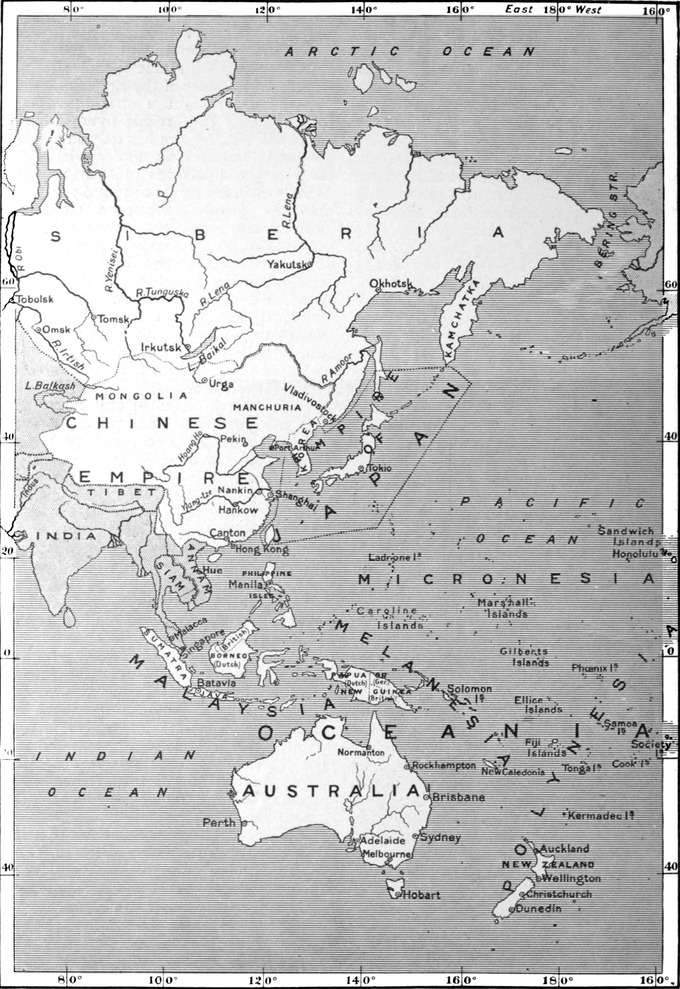
THE FAR EAST DIVISION OF THE HISTORY OF THE WORLD
This History begins with the East and comes westward round the world. Japan is therefore the first country to come into its survey, and from Japan we travel to Siberia, which, though extending far west, must be treated as one. After Siberia come China and Korea; and Australia, Oceania, and Malaysia all come into the “Far East” when thus treated geographically. The whole of the white portion of this map is treated in the Grand Division which now opens.
LARGER IMAGE
LARGER IMAGE

SECOND GRAND DIVISION
THE FAR EAST
The Far East falls into two sections, Asiatic and Oceanic. The Asiatic comprises the insular empire of Japan; and, on the continent, China, Korea, and Siberia, the extreme northern territory which, though extending far westward, must be treated as one.
The Oceanic division includes the Australian continent, with the island of Tasmania; the Pacific islands grouped under the names of Melanesia, Micronesia, and Polynesia, to which last New Zealand is attached, the whole being conveniently associated under the name of Oceania; and the Malay Archipelago, or Malaysia, lying between Australia and the Asiatic continent.
Of these three sections of Oceanic Far East only Malaysia has a record extending over centuries. The history of the other two, till the white sea-going races began to settle among them, is inferential, conjectural. A doubt was suggested whether New Zealand should be attached rather to Australia than to Oceania, for the reason that it has developed into one of the group of autonomous states which make up so large a portion of the British Empire; but this consideration must clearly yield to those based on geography and ethnology.

PLAN
THE INTEREST & IMPORTANCE OF THE FAR EAST
Angus Hamilton
JAPAN
Arthur Diósy and Max von Brandt
SIBERIA
Dr. E. J. Dillon and other writers
CHINA
Sir Robert K. Douglas, W. R. Carles, C.M.G., and other writers
KOREA
Angus Hamilton
AUSTRALIA & OCEANIA
Hon. Bernhard R. Wise and Professor Weule
MALAYSIA
Basil Thomson and other writers
INFLUENCE OF THE PACIFIC OCEAN IN HISTORY
For full contents and page numbers see Index

LANDS & PEOPLES
OF THE FAR EAST
THE INTEREST AND IMPORTANCE OF THE FAR EAST
BY ANGUS HAMILTON
T
THE influence of environment upon a people is seldom shown more prominently than in the high degree of civilisation attained by the early Chinese.
Although the records are shrouded in mystery and marred by discrepancies, a consensus of scientific opinion traces the origin of the Chinese to a nomad tribe who, setting out from the shores of the Caspian, continued to wander until it found a home on the banks of the Yellow River and in the plains of Shansi. Under the influence of these immigrants, the rude manners of the aboriginals gave way to conditions in which a knowledge of the smelting of iron and the resources of agriculture was acquired. In the upward process of development, the weaving of flax into garments and the spinning of silk from cocoons followed; then, with primeval chaos reduced to order and the faculties quickened by habits of industry, the beginnings of government were made in the separation of the tribes from one another under their own leaders.
While conditions of a settled existence were in course of attainment within the region which is now known as China Proper, the spectacle of a prosperous civilisation, reacting upon the uncouth instincts of tribes dwelling among the grassy uplands of Mongolia and the plains of Manchuria or amid the ice-clad fastnesses of the mountains and forest-strewn valleys of the farthest north, was presently to be responsible for the rise of predatory races, who, in the zenith of their strength, regarded the teeming cities of the south as lawful prizes. While the northern heights of Asia were producing a race that was to leave an indelible impression on the whole of the Asiatic Continent, the evolution of a no less specific type was proceeding in the islands off the coast. Carried by a wave of migration from India, which lapped the coast of Malaysia, Indo-China and Polynesia, and mingled in the islands of the Yellow Sea with a stream from New Guinea so that separate ethnographic identities were lost, were tribes who looked to the ocean for their existence much as the earlier Chinese relied upon the proceeds of their husbandry and the northern nomads upon their flocks.
Glancing at the people living amid the plains, the uplands, and the islands, it will be seen that an irresistible force was enveloping the several races, moulding their instincts and idiosyncrasies in accord with the nature of their environment. Thus, while the Chinese, under the incentive of a knowledge of arts and crafts, had already produced, in 2356 B.C., a system of civilisation destined to endure to our time, the nomads and the islanders, unqualified by knowledge and controlled by climate, were hardly removed from a state of savagery a few centuries before the Christian era.
If the passage of 4,000 years has affected the Chinese no more than the gliding of an hour, the existence of this great impassive people has not been without its effect upon the nations of Europe as upon the races of the Farthest East.
Eternal Mystery of China
A point of ancient contact between Christendom and the world of Confucius, reflecting, in contemporary Japan to-day the more permanent qualities of its teaching, China has stirred the spirits of the adventurous in all ages by its singular graces of refinement, its hidden wealth and the exquisiteness of its artistic perceptions. Arousing the curiosity of the Arab traders as early as the eighth century, it was known to the ancients, if they journeyed by the Southern Sea, as the kingdom of Sin, Chin, Sinæ, or China, in corruption, perhaps, of the word Tzin—under which dynasty occurred, in 250 B.C., the fusion of several petty kingdoms into an organic empire; or by the name of Seres if, traversing the longitude of Asia, they came by the overland route. Known to the Middle Ages by the name of Cathay—corrupted from Kitai, the name by which China is still described by Russia and by the races of Central Asia, but which itself sprang from the Khitans, the first of the northern dynasties—it represented to European commerce of the thirteenth century the embodiment of wealth, romance, and mystery; much as its position, maintained unchanged through long centuries, had made it the actual repository of the records of Central, as well as Southern, Asia.
Korea, the Middle Kingdom
Contemporary with the early Egyptians, the Assyrians, and the Hebrews, and comprising an empire that in 241 B.C. represented as nearly as possible the present limits of the Eighteen Provinces, the Middle Kingdom has been affected by the great upheavals of the Western world as little as she herself has troubled to impress her methods and manner of government upon the aboriginal races beyond her borders. Indeed, filled with a lofty disdain of the outer barbarians, it was not until the chance migration to Korea of some five thousand Chinese under Ki-tze, in 1122 B.C., that the ethical, social, and political systems in vogue in China were carried further afield. Once transplanted, however, the aboriginal life of the cave-dwellers of the peninsula gave way before the superior culture of Ki-tze’s followers, and within the course of the succeeding thousand years a cluster of independent states, fashioned upon the parental model, was firmly established.
Although in the centuries just before the Christian era there was a constant interchange of communications with these states of the Eastern Peninsula, the classic conservatism of the Middle Kingdom was unabated by any expression of curiosity or interest in the welfare of the unknown islands. Yet the islanders, confronted with a struggle for existence, had risked the perils of many voyages to the neighbouring coasts, spreading wonderful stories of their own land and returning with ample evidences of the power and importance of the Korean kingdom. Unconscious of this intercourse, but by reason of it, China, the tutor of Korea, became through the agency of her pupil a determining factor in the upward progression of the islanders when, between 290 B.C. and 215 B.C., in consequence of dynastic difficulties, a steady stream of inhabitants from the peninsula passed from the Land of Morning Radiance eastwards with the intention of settling on the coasts of Japan, with whose inhabitants, in fact, they at once merged.
Japan at the Dawn of Our Era
Though at the other end of the pole of human endeavour in comparison with the Chinese, and familiar only with the elemental accessories to life, the islanders, under the influence of this alien strain, at the dawn of our era had emerged from a state of tribal control to the recognition of the authority of a single and supreme ruler. Two centuries later Japanese arms were strong enough to invade Korea, where several victories were gained; but even then the Middle Kingdom maintained no communication with the islands of the Yellow Sea, and was more or less indifferent to the rise of over-sea relations between her vassal and the mariners from the East. It is possible to trace to this obliquity in the political vision of the Celestial Empire of the day much of the subsequent havoc that the self-same race were to inflict upon the coasts of Asia. Impressed with no consideration for the interests of the mainland, and troubled by no sense of material responsibility, Japanese corsairs harried the Chinese and Korean coasts unmercifully, finding in the occupation an outlet for that primitive but inherited instinct for aggression that stimulates the race to-day.
Disturbed less by the appearance of an island Power than by a confederacy of barbarian clans that, by 1000 A.D., had exerted a mastery over Mongolia, Tartary, and Manchuria, and a century later served as a menace to the safety of the dynasty itself, the Celestial Empire was beset on two sides by enemies who were attracted by the prosperity of its people. Unmindful to a great degree of the dangers which were accumulating, an instinct for and an interest in trade, confirmed by the revelation of the self-supporting character of an empire that reached to Cochin-China in one direction and the Pamirs in another, prompted the Chinese to neglect the arts of war in their preference for the triumphs of peace.
The Peaceful Path of the Chinese
Characterised by a capacity for infinite pains, and possessed of a complete understanding of the varied resources of agriculture, the Chinese insensibly pursued a path leading always in a contrary direction to those marked out by Nature for the islanders, as for the fierce nomads of the steppe. Thus innately addicted to habits of peace, centuries upon centuries of undisturbed prosperity chastened natures that were never very warlike; whereas the exact inversion of this existence propelled those hordes of Tartars, Huns, Turks, Khitans, Kins, Mongols, and Manchus to leave the Far North in a disfiguring passage through Asia, and bade the islanders release their sails in expeditions against Korea. It was not enough for the founder of the Tzin dynasty to fortify his northern frontiers by the construction of the Great Wall, or for that great warrior Panchow to drive the Huns before him to the Oxus itself, or for the rulers in the long period of disunion which unites the fall of the Han dynasty to the rise of the Sung to compromise with the leaders of successive rushes of barbarian horsemen by matrimonial alliances with their families. The cause lay in the foundations of the race itself. Yet, such was the insidious character of the land against which these mounted hordes so often flung themselves that, although the imminence of attack ultimately became a thing with which the Government of China was wont to conjure the peaceful, well-contented lower classes and the luxury-loving upper classes, the effect of each invasion was dissipated so soon as the invaders experienced the subtle blandishments of Chinese civilisation.
Swift-moving History in Little Known Lands
Presented with remarkable clearness, we have an array of devastating invasions, the one following the other in rapid succession and occasionally assuming such dimensions that the operations riveted the attention of Europe upon the little-known lands of Asia, which in most instances required only the passage of a few centuries for the minutest vestige to be obliterated. Thus the Kins, who left no trace, displaced the Khitans, equally irrecoverable, and were in turn dispossessed by the Mongols, whose wide dominion embraced so much of the earth’s surface that in 1227 A.D. the whole of High Asia, from the Caspian to Korea, and from the Indus to the Yellow Sea, recognised its sway—always excepting the strong but still despised sea-state of Japan, whose lusty inhabitants threw back the allied hosts of China, Korea, and the Mongol monarch in 1274 and 1281.
Yet if the Mongols, in an effort to wreak their vengeance on the Chinese, razed to the ground the cities of the vanquished so that their horsemen could ride over their deserted sites without stumbling, none the less they earned the acclamations of posterity by the facilities that the Mongol domination of Central Asia offered to communications between the West and Cathay. Marco Polo was not alone in his knowledge of the Court of the Great Khan, although doubtless he was the first to visit it. But this liberty of intercourse, existing only by the land route to Asia, was measured solely by the duration of the Mongol rule; freedom of action along the high-road from West to East stopped prematurely when the sway of Islam settled once again over Central Asia. Two centuries elapsed before, under the banners of the Manchus, bold horsemen of the North, in 1644, flashed once again through the plains of China, imposing, by a change of costume and of coiffure, perhaps the most striking effect of any that has followed in the train of these invasions.