Volume 1 — LIST OF MAPS APPEARING IN THE BOOK OF HISTORY (continued 9)
Reading edition
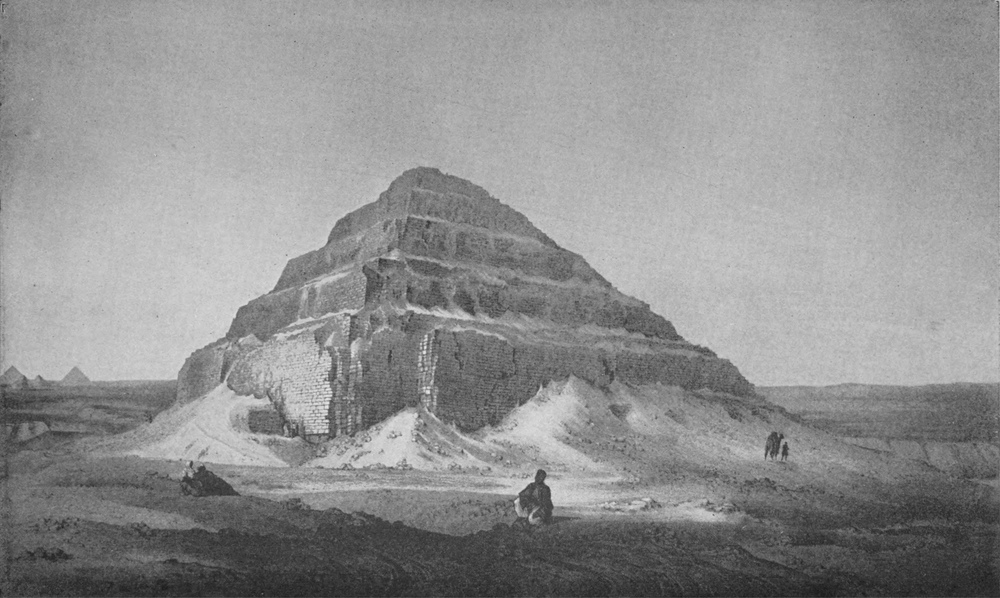
ONE OF THE WORLD’S OLDEST MONUMENTS: THE GREAT STEP PYRAMID AT SAKKARA
This pyramid was built by King Neterkhet of the third dynasty, about 4900 B.C.
LARGER IMAGE
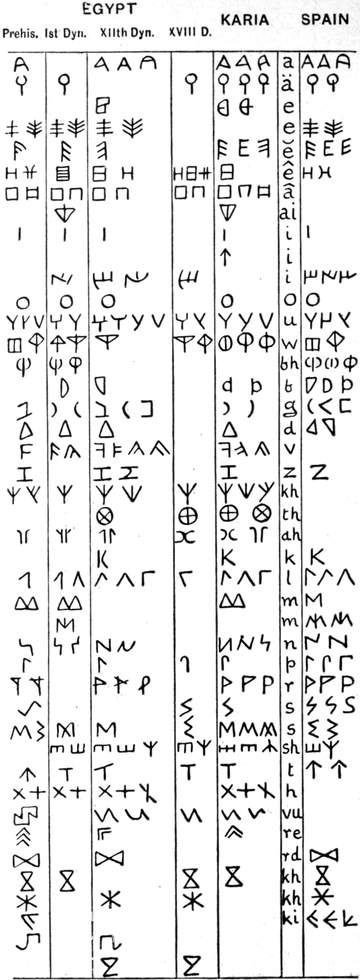
THE BEGINNING OF THE ALPHABET
The signary which was used in various early ages is here shown, as it has been gathered from examples of over 100 signs found in Egypt. Closely related to these are the early alphabets of Karia and Spain, the latter alphabet containing over 30 signs. It is from this prehistoric signary that the present Roman alphabet has been gradually selected during past ages.
LARGER IMAGE
GLAZING AND GLASS. The very ancient art of glazing, already used in two colours under Mena, did not take any new form till the eighteenth dynasty, when it was greatly varied by new colours and new applications. Large objects, five feet high, were covered with a single fusing of glaze; minute ornaments, for stitching on garments, blazed with the brightest red, green, blue, or yellow; while whole inscriptions were executed in coloured glaze hieroglyphs, inlaid in the white stone walls. Glass, however, was not made separately until about the time of Tahutmes III., 1500 B.C. There is no earlier example of true glass, nor any representation of working glass. All the truly Egyptian glass was wrought pasty, and never blown.
Blown vases belong entirely to the Roman age and later times. The large blown glass lamps of Arab age, covered with fusible enamel designs, are highly skilled pieces of work. The uses of glass to the Egyptian were mainly for beads, for coloured inlays in wood of shrines or coffins, and for variegated glass vases. The beads were made by winding a thread of glass on a wire; the vases, likewise, were made by modelling on an infusible core, held on a mandrel, and winding coloured glass threads on the body. The inlays were often of one colour, generally deep blue imitating lazuli; but often mosaics were used, made of a bundle of glass threads fused together, drawn out, and then cut off in slices. Such are all of Greek or Roman age. An important use of glass in Roman and Arab times was for weights, and for stamps impressed on glass bottle measures, inscribed with the names of the ruler and the maker.
Taste of the Times
Lastly we may note the variations in the nature of the Egyptian literature, as reflecting the civilisation. The earliest tales are those of magical powers, belonging to the pyramid age. Next, in the Middle Kingdom, comes the contrast between town and country, and the tales of adventure in foreign lands. In the New Kingdom the contrasts of character are the main interest, and, in the late tales, the pseudo-historical romance of the great tournament of the Delta, or the antiquarian interests of a priest. These subjects of romance varied as much or more than the actual grammar and language.
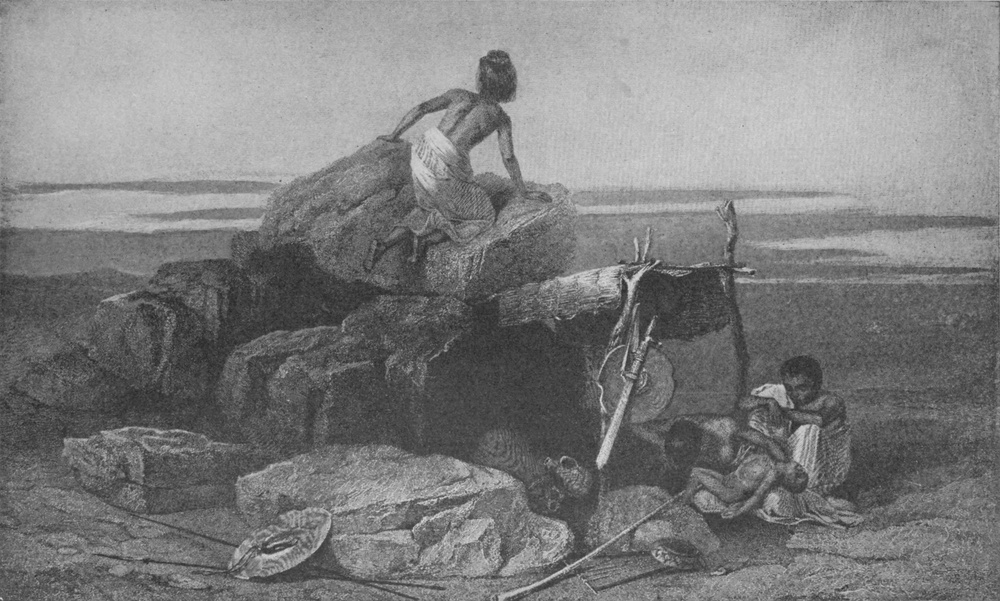
THE WANDERERS OF THE DESERT, AMONG WHOM EGYPTIAN CIVILISATION GREW UP
LARGER IMAGE
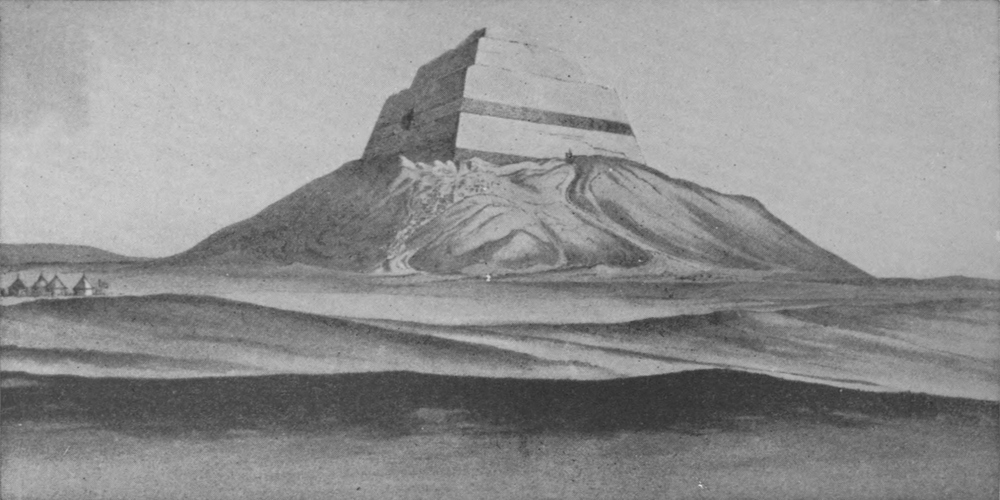
PYRAMID OF MEIDUM: BUILT BY SENEFERU, LAST KING OF THE THIRD DYNASTY
This tomb was begun as a square block of masonry, and was enlarged by successive coats, which are here seen. Then one smooth coating of sloping blocks was put over all from bottom to top, and so the first real pyramid appeared in 4700 B.C. The pyramid coating has been destroyed and only the base remains under the rubbish mounds.
ALPHABET. One subject of great European interest should be noted here, as Egypt has thrown much light upon it. The origin of the alphabets of the Mediterranean has been disputed, without historical knowledge of the examples of such signs in early ages. The Egyptian hieratic and the archaic Babylonian signs may have, perhaps, added a few to the Mediterranean signary, but neither source can at all account for it. The alphabet is by no means a clean cut series of 22 signs; it is a very complex tangle of parallel groups of signs in different lands, more or less alike. Of these groups two of the largest are those of Karia and Spain, comprising over 30 signs, and these have many points of peculiarity in common. This is sufficient to show that the fuller alphabet is the original form, from which the shorter lists have been selected. Now, in Egypt there are found scratched on pottery and woodwork over 100 signs, and these comprise the forms of the fuller alphabet. Moreover, these Egyptian examples are found at about 1200 B.C., or only a few centuries before the Karian and Spanish alphabets, again in 3000 B.C., in 5500 B.C., and before 7000 B.C. Of 41 alphabetic signs, 19 occur in 1200–1400 B.C., 32 in 3000 B.C., 27 in 5500 B.C., and 31 in 7000 B.C. As we have not a very large amount of material, the occurrence of from 19 to 32 out of 41 signs is as much as we could expect, as all the 41 occur in one period or another. The early date of these puts all derivation from the subsequent hieroglyphics entirely out of the question. We can as yet only say that a large signary of 40 or more linear forms was in continuous use from before 7000 B.C. downwards, and that these furnish all the forms of the fuller alphabets, those of the short Phœnician and Greek list of later time.
We have now outlined the rise of civilisation in Egypt, apart from the history of the country, which is dealt with separately; and we turn to the other great valley of early civilisation, in Mesopotamia, to compare the resemblances and the differences between the two lands.
W. M. FLINDERS PETRIE
NOTABLE DATES OF ANCIENT CIVILISATION
EGYPT BABYLONIA
B.C. B.C.
8000 Continuous civilisation of prehistoric age began S.D. 30 Before
7000 Asiatic invasion S.D. 40 6000 Susa founded
5800 Invasion of dynastic race
5500 Mena rules all Egypt S.D. 80 5000 Ea founds Eridu and civilises the land
4700 Khufu builds Great Pyramid 4700 Earliest monuments of Kings
4500 Urnina
4000 Invasion from north 3800 Sargon and Naramsin, Semitic rule
3400 Middle Kingdom, twelfth dynasty 3300 Gudea
2500 Hyksos invasion, fifteenth dynasty
2250 Second Hyksos movement 2280 Elamites conquer Babylonia
2129 Hammurabi
1580 New Kingdom, eighteenth dynasty 1572 Kassite dynasty
1380 Tell el Amarna letters 1380 Burnaburiash
701 Taharqa (Tirhakah) 690 Sennacherib
570–26 Aahmes (Amasis) 556–38 Nabonaid, fall of Babylon
T
THE first impression that strikes the reader in passing from the Egyptian to the Mesopotamian civilisation is the lack of that unity and conciseness which makes history in the Nile valley so intelligible, and its problems so well defined.
Disunion of Early Babylonia
In place of the well ordered history of Manetho, with its numbered dynasties, and totals stated throughout, there is practically nothing stated before Nabunasir in 747 B.C. The mythological extracts from Berosus, and the list of Ktesias, which cannot be identified with any known facts, give no help in arranging the outlines of the history. In place of the uniform language and writing, which develops without a break during the whole history of Egypt, there is the entire break from Sumerian to Semitic. In place of the continuous importance of Egyptian capitals, there is the change from the principalities to Babylon, and thence to Nineveh. In place of the unified kingdom of the Nile valley, through the whole written history, the greater part of the documentary period is filled with rival principalities, within thirty or forty miles of each other, the tops of whose temples must have been visible over the entire territory of their respective states.
As the general scale of Egypt is so familiar to the modern reader and traveller, it will be well to compare Mesopotamia with that. Babylon was twice as far from the sea as Cairo; and from Babylon to Nineveh was the distance from Cairo to Sohag. Or in other terms, starting from the sea, Babylon was as distant as Oxyrhynchos, Nineveh in place of Thebes, and the highlands of Carchemish, Commagene, and Lake Van were the equivalent of Nubia. The old land of Shumer was just the size of the Delta, and Akkad as large as Middle Egypt. The principalities of Eridu, Lagash, Ur, Erech, and others, were as far apart as those of the Delta—Bubastis, Benha, Sais, or Sebennytos. Indeed, it seems as if this were a natural unit-size of early dominions in a fertile plain.
The Nile and the Euphrates
Though the relative age of the beginning of civilisation on the Nile and the Euphrates is yet an uncertain matter, still it is clear that the unification of Egypt long preceded that of Babylonia. The earliest date of the scattered Sumerian kings is about that of the fourth dynasty; the earliest Semitic dynasty—Sargon and Naramsin—was contemporary with the ninth dynasty, and the rise of the dynasties of Babylon is of the later Hyksos age of the sixteenth dynasty.
Sea-shore Moved 47 Miles
EUPHRATES VALLEY. The conditions of the Euphrates valley are very different from those of the Nile. On the Egyptian coast the river runs into a strong current in the Mediterranean, which sweeps away its sediment and prevents any continuous growth of the coast. But the Mesopotamian rivers reach the sea-level at the head of a deep bay, the Persian Gulf, and hence there has been a continuous formation of new land at the estuary. The Mesopotamian valley and the Persian Gulf form one long drainage valley gently sloping down to a distance about twenty miles outside Hormuz, where the valley bottom drops suddenly three miles into the floor of the Indian Ocean. The slope of this valley so far as submerged, is about 1 ft. to the mile, and it is probably even less in the Babylonian plain, where sea-shells are found as far up as Babylon. This valley has been filled, and the sea-shore pushed downward, 47 miles in 2,200 years, or 115 ft. yearly, since Spasinus Charax—now Mohammerah—was founded on the shore in the time of Alexander. The account of a sea expedition to Elam by Sennacherib is usually interpreted as showing a more rapid growth; but in the uncertainty how far he went down a channel before entering the Persian Gulf, it is not decisive.
How far back the extension of land has been going on, and whether it was continuous to above Babylon, has not yet been proved. The appearance of the map much suggests that the original drainage bed ended—i.e., the valley was submerged—at about the nearing of the two rivers by Sippara, and that all below this is the filling up of the estuary. Should this growth have extended uniformly back so far, it would give limits to the possible ages of cities—5000 B.C. for Eridu, 8000 B.C. for the whole plain of Shumer, 10,000 B.C. for Nippur, and earlier for the site of Babylon. This would bar the southern region from being as old as Memphis, and Eridu was probably open sea when Menes laid out his capital.
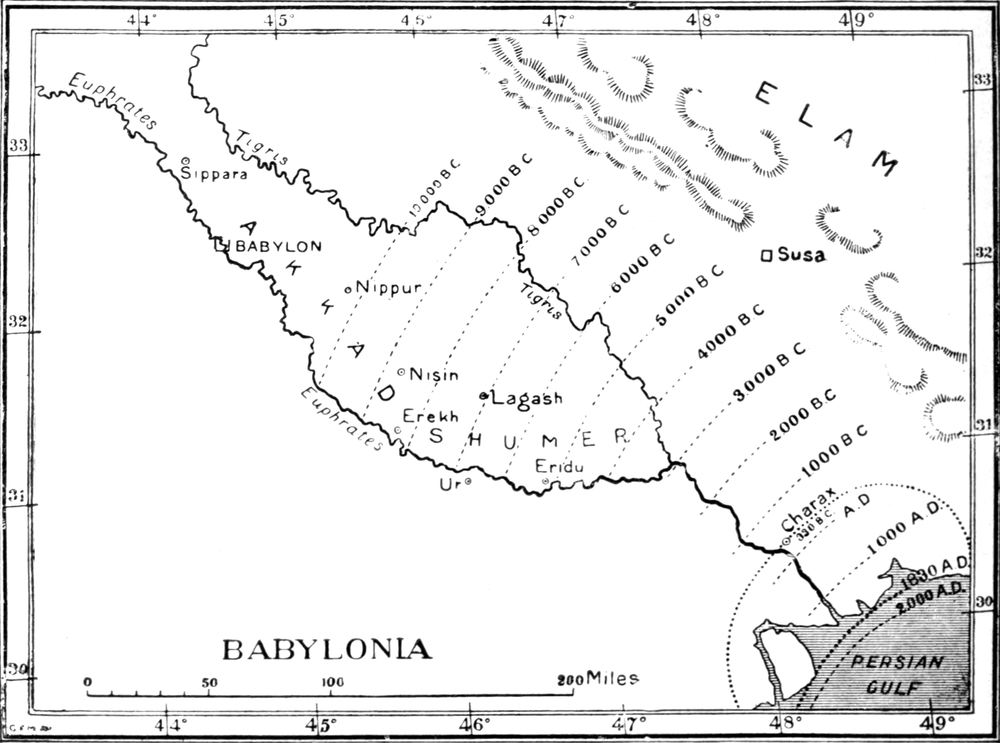
THE PLAIN OF BABYLONIA: ITS EXTENT AT DIFFERENT PERIODS IN HISTORY
This map shows how the Plain of Babylonia has been extended down by silting since 10,000 B.C. The dotted lines, marked 330 B.C. and 1830 A.D., show the known positions of the coast, as it shifted by silting up. These give an approximate scale of dating for the coast-line of earlier ages, which is marked here at each thousand years.
RANGE OF CIVILISATION. In looking for the earliest movements of people that we can trace, it seems that the Semites must have extended from Northern Arabia into Upper Mesopotamia and Assyria. In short, Semitica stretched up to the mountain ranges of Armenia and Media. But the culture was barbaric, and probably they were nomads who had no fixed centres of life or stable organisation which could resist any united movement. At this period the Persian Gulf probably extended as far as Babylon. On their eastern flank were the mountain tribes, in what is known as Parthia and Media, south of the Caspian. How remote is the beginning of civilisation in this region has been found in the last few years. On the north-east extremity of Parthia, in the far end of Hyrcania, stands a group of mounds, near the modern Askabad, not far from the celebrated Turkoman stronghold of Geok Tepe. Here are 14 ft. of town ruins with iron, 15 ft. with copper and lead, about 70 ft. of ruins with wheel-made pottery and domesticated animals, and 45 ft. of remains with only rude hand-made pottery. What ages these represent we cannot judge until the full account by Prof. Pumpelly is issued. But in any case a very long period is involved. If the accumulation is at the rate found in Palestine, 4½ ft. per century, the periods would be perhaps 1,500 years for the wheel pottery, and 1,000 years for the rough pottery, before the beginning of the age of copper.
At the other side of these countries stands the great mound of Susa, with over 80 ft. of ruins. The inscriptions show that about 26 ft. of the height was accumulated between about 4500 and 500 B.C., or in about 4,000 years. Yet before that there is a depth of about 50 ft. comprising three periods. In the upper of these is elementary cuneiform writing on tablets. Below that is a period of rather rough, thick pottery, painted with chequer patterns and closely-crossed lines, of the style common in early Syria and Cyprus. And at the bottom of all is a great quantity of very fine, thin wheel-made pottery of buff tints, with decoration of thin diagonal lines, rows of ostriches, and various patterns all derived from basket-work.
Measuring the Depths of Time
If the scale of accumulation of the historic times were to apply here, it would reach back to 12,000 B.C.; but if the far quicker scale found in Palestine applied, it would hardly reach 6000 B.C. In any case we have here evidence of a civilisation apparently much earlier than that of Babylonia, and none of this earliest fine pottery has been found in the great plains. The highland civilisation may have begun as early, or earlier, than that of Egypt; but that of Babylonia started probably later than the North African culture on the Nile. Seeing, then, that there was a very early civilisation at Susa on the west of Media, and that further east on the limits of Parthia we meet another early centre, it is not surprising that the inhabitants of these regions united to spread down into the fertile plain which was created by the growing delta of Mesopotamia. These people belonged neither to the Semite of Arabia nor to the Aryan of Persia and India, but used an agglutinative language of entirely different structure from these others, and most akin to Turkish or Finnish. Having descended from their mountain homes, the people were known as Akkadu, probably meaning “highlanders,” though there are other open derivations. And hence the northern part of the Babylonian plain, next to the Semitic Assyrians, was the land of Akkad; while the southern part, next to the sea, was known by the native Babylonian name of Sumer, or Shumer.
China’s Links with Babylon
SUMERIANS. The civilisation of the Sumerians was more akin to that of the Chinese than to western types, especially in its art, its picture writing and devotion to literature, its capacity for town life, and its religious ideas. The cognate origins of the people may well account for this, and some more precise resemblances led Terrien de Lacouperie to the view that Chinese civilisation was an offshoot from the Sumerian stock in its old Parthian home.
The elements of life were well developed by the Sumerians. They were great agriculturists, and wrote works on the main industry of man, much as the Carthaginians wrote standard works prized later by the Romans. They fermented the grape and corn, and had alcoholic drinks. Cattle of all kinds were raised, and prized as stock, which was fed on grass or grain or oilcake. The horse is mentioned first in Semitic times, Abut 2000 B.C. Dates and figs were the principal fruits grown; and, indeed, the date palm seems to have had a far more important place in the civilisation than it did in that of Egypt. Both wool and leather were used for clothing, as might be expected.
Materials for the Great Buildings
BUILDING. The main structural industry of the country was that of brickmaking and building. Immense piles of brickwork were made to support the temples, marking clearly the custom of the highlander Akkadi worshipping on the hilltops. The brick ziggurat, or five-stepped pyramid, at Nippur was 190 ft. by 128 ft., and about a hundred feet high. The earliest baked bricks are 8·7 in. by 5·6 in. by 2·2 in., and they were enlarged to 12 in. by 7·8 in. by 1·9 in. within the Sumerian age. Toward the close of that time large square bricks were used. Sargon made baked bricks 18 in. square and 3½ in. thick. From the time of Ur-Engur (3200 B.C.) onward the baked bricks were 11 in. or 12 in. square. Beside the baked brick used for pavements, drains, facings, and important work, the great bulk was made up of crude brick as in Egypt. For important purposes, such as store-rooms, the inside of chambers was lined with a coat of bitumen, rendering them damp-proof; and such a lining was used on tanks. Pottery is abundant in all ages, but we still need a study of the pottery such as has been made in Egypt, so that it can be used to date excavations in general. Stands for jars, framed of wood, were used as in Egypt; and also the clay sealings were of the same type in both lands. Stone vases were made to imitate pottery; and this suggests that the highlanders were only using basket-work when they descended into the plain, and therefore did not possess any types of stonework.
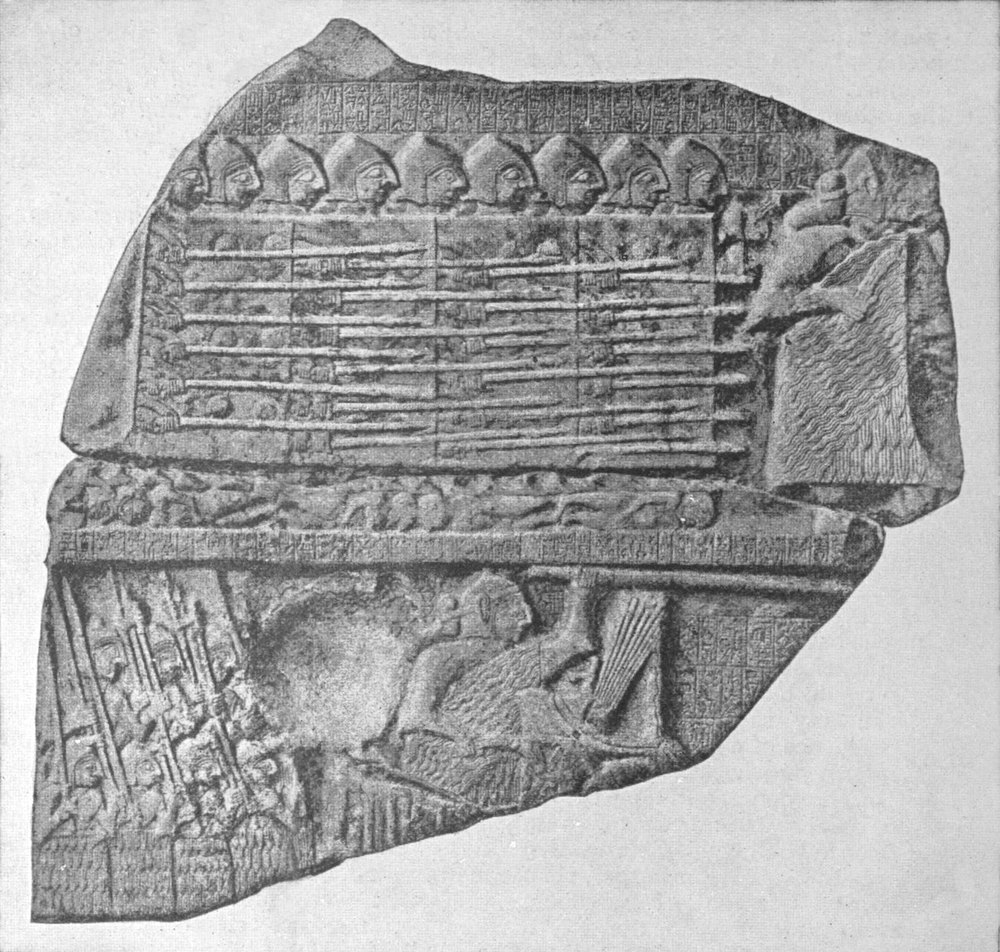
THE ANCIENT BABYLONIANS AND THEIR WEAPONS OF WAR
There is a fine study of weapons on a carving of Eannatum (4400 B.C.), where spears about 7 ft. long, with blade heads, are figured. Shields are shown reaching from the neck to the ankles, straight-sided, used edge to edge as a shield wall by a phalanx of soldiers. The heads of the men are covered by well-formed peaked helmets reaching down to the nape of the neck, with nose pieces.
TOOLS AND WEAPONS. The common tools were used, such as knives and drills; and great skill was developed in seal engraving upon hard stone cylinders. Of weapons there is a fine study on a carving of Eannatum (4400 B.C.), where spears of about 7 ft. long, with blade heads, are shown; also shields reaching from the neck to the ankles, straight-sided, and used edge to edge as a shield wall by a phalanx of soldiers; while the heads are covered by well-formed peaked helmets, with nose pieces, and reaching down to the nape of the neck. Bows and arrows and daggers were also used; and stone mace-heads, of the pear shape used in Egypt, were important ceremonially, and often bear inscriptions. Woodwork was elaborated with carving, and used for bed-steads and stools, as seen in the seats of the gods figured on seals and tablets.
CLOTHING. Clothing varied a good deal. A primitive custom of nudity when offering to the gods was continued down to the close of the Sumerian age, as shown on the tablet of Ur-en-lil. The kilt was worn with a fringe, not reaching the knee; or it was worn from the waist to the ankles, as by shepherds. A robe over the left shoulder reaching to the knee was used with a deep fringe all down the front edge and round the bottom. A long robe reaching to the ankles is shown on the figures of Gudea. But the most characteristic dress was that of ribbed woollen stuff, much like that of the fifth century B.C. in Greece, as on the Running Maiden. This stuff was worn as a flounced petticoat (Urnina 4500 B.C.), or in a longer form over the left shoulder and down to the ankles, as by Eannatum and Naram-Sin. A splendid flounced cape and long robe of this stuff is shown as worn by Ishtar on the Anubanini rock stele, about 3600 B.C.
SCIENCE AND ART. The system of number, weight, and measure was peculiarly Babylonian. Some people have theorised about all later standards having been derived in various intricate ways from those of Babylon. But it is very unlikely that standards should not arise in different centres, and still more unlikely that the complex derivations should be formed when the whole object would be to maintain a system in common.
Science in Sumeria
But there is no question of the great advance of the Sumerian in these matters. The sexagesimal system, which is far more convenient for many purposes than the decimal, and which we still retain for time and for angle, was due to the Sumerian intellect, while the standards of weight, the talent, maneh, and shekel, were also from the same source. And we cannot doubt that the cubit was already in use by a people living in cities and carrying on business.
The style of art was clumsy, owing to the habit of crowding together as much as possible into the space, in order to form the record. The human forms are thick and short, and detail is firmly and perseveringly repeated. It entirely lacks, in its early stages, the spontaneous truth of the early dynastic work in Egypt. At the close of the Sumerian age, under Naramsin, there is a fine bold design in groups of figures, well proportioned, and with good action, recalling curiously the spirit of late Greek work from Praxiteles to the Pergamene warriors. The stages of change cannot yet be distinguished, owing to the scarcity of the dated examples that we have.
Loss of History
LITERATURE AND WRITINGS. It is in literature that we know the Sumerian best. Unhappily, other branches of archæology have been neglected, and even destroyed, in the eager search for tablets, and yet more tablets. By the thousand they are found, and hurriedly removed, while the architecture, crafts, and art-history are thrown aside in the process. The hunter for tablets in Babylonia, and for papyrus in Egypt, is a heartless wrecker, without any interests beyond his own line. When so much has been sacrificed for the written record, we must glean all we can from it for the history of the civilisation, as most of the other material that might have been preserved has been sacrificed. The Sumerian language was the sole language of civilisation, until, at about 4000 B.C., the Semite began to conquer and to take part in the advance of the world. Yet the older tongue was by no means extinguished; it held its place as the official religious and literary language, like Latin in Europe. The literature of the world was in Sumerian, and only gradually did the new Semite intruders translate the older works or rise to writing a literature of their own.
The Sumerian literature was for long accompanied by a Semitic translation, like Latin and Saxon gospels; and syllabaries, vocabularies, and grammatical lists were written to teach the Semite the old religious language. Legal documents were drawn up in Sumerian, and it only gradually lost its precedence from 4000 B.C. down to 1600 B.C., when it was almost extinct, being only revived as a literary curiosity in the seventh century B.C.
How the Semite Made His Notes
The writing was a pictorial system like the Egyptian hieroglyphics. And so long as the Sumerian used it he clung to the pictorial origin even though obscured by the lineal style of drawing. On papyrus or parchment it is easy to make curved forms, and such were adopted in drawing the signs originally. But on clay, which was the all-available material in the Babylonian plain, impressing lines is far neater than scratching them up; and the handy tool for making impressions was a slip of wood with a square end. Hence all the curves tended to become four or five-sided outlines, and all the detail became built up of little lines tapering off to one end, or “digs” with the corner of the stylus. Yet down to the close of the Sumerian age the forms of the objects can still be discerned, and they are still pictures rather than mere immaterial symbols.
Mansell
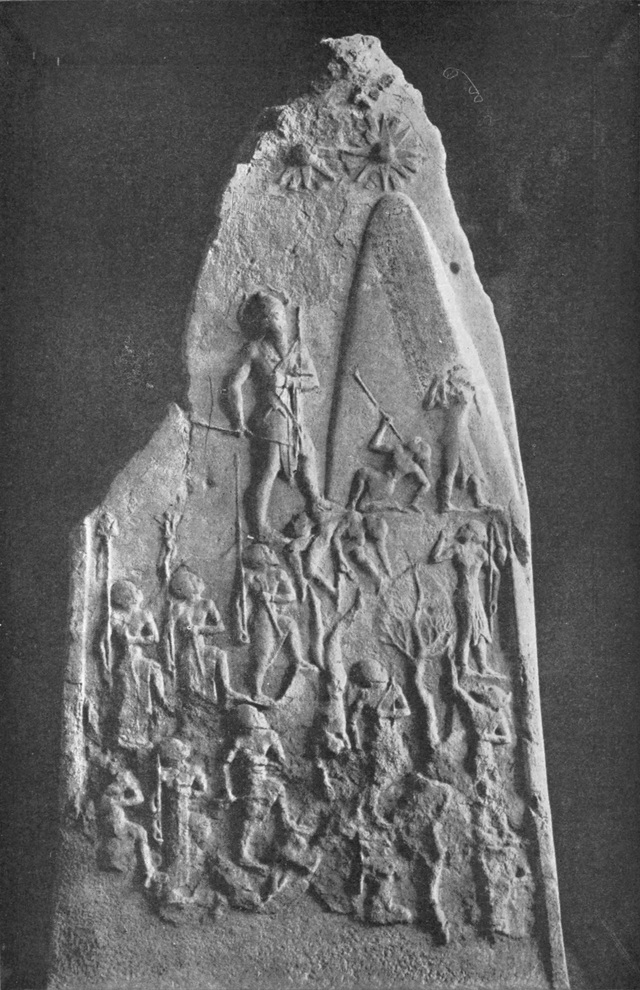
THE FINEST EARLY BABYLONIAN ART: TRIUMPH OF KING NARAMSIN, 3750 B.C.
This work, found in Susa, is curiously free and pictorial; it is unrivalled by any early carvings, and most resembles the action and spirit of late Greek sculpture. It marks the great period of the fusion of the Sumerian and Semite.
LARGER IMAGE
The Semite, however, changed all this. He learned merely the sound values of certain forms, their meaning could not appeal to him, and he built up his words out of these sounds or syllables. He found it inconvenient to write in vertical columns, which was the constant Sumerian habit, and turned his tablet sideways to his hand, so as to make his signs along a horizontal line of writing. Hence these signs became familiar to him on their sides, and as they had to him no pictorial values, the position was indifferent. Lastly, he produced a syllabary of signs written with combinations of four forms of impress, a long line wider at one end, a short line, a tall triangle, and a small equilateral triangle, written in horizontal lines; and each sign was standing on what had originally been its side. The wedge-shaped form of these lines has given rise to the name of wedge-writing, or cuneiform writing for this system.
The Story of a Language
The knowledge of this writing survived Greek influence for some four centuries after Alexander, only becoming extinct at the close of the first century of our era. In its long history, double that of the Roman alphabet at present, it had been used for very diverse languages. The Sumerian inventor had handed it on to the Semitic intruder, and he had passed it to the Syrian, the Mitannian, the Hittite, and the Vannic peoples. Probably it had kept its hold in its first home in Elam, where it is found in historic times, and thence it became the writing of Persia, and even of the Parthian, before it became extinct. The variety of languages and the extent of country which it covered is much like the scope of the Roman alphabet in Europe to-day.
LAW AND RELIGION. In matters of law the Sumerian was well advanced. The needs of city life which he had developed necessarily required a full definition of rights and duties. The first law book was that of Ea, the god of civilisation, the Oannes of the later legends of Berosus. The decisions of judges were kept in abstract, and such case-made law served as a body of precedent to guide decisions. The position of women was on a level with that of men; in the Sumerian hymns the woman takes precedence, and one of the great Sumerian divinities was Ishhtar, who became Ashtaroth of Syria, Athtar of Arabia, and hence Hathor of Egypt. In the Semitic system the goddess is but a feeble companion of a god; but Ishtar was the great divinity of war, to whom the kings owed their triumphs, as well as the queen of love, who ruled the course of nature.
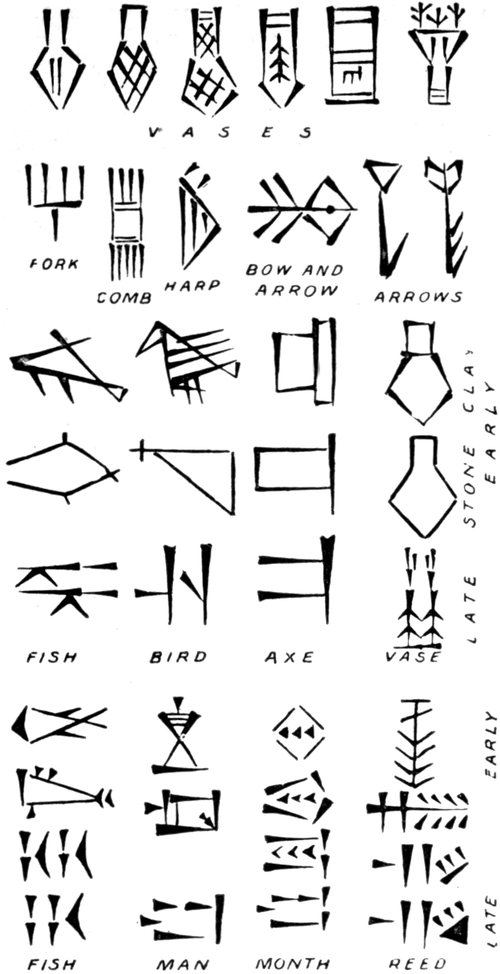
THE DECAY OF PICTURE-WRITING
This illustrates the decay of pictures into signs, and shows very clearly how the cuneiform writing was developed from the earlier hieroglyphics. It will be noticed that the word originally rendered by a crude drawing of the object—“fish,” for example—retains even in its final cuneiform style some resemblance to the tail of a fish. The cuneiform lettering was necessary to the Babylonians, as clay was the most abundant material in their land and could best be marked upon in lines without curves.
The religion of the Sumerians was like that of other Turanian races. These peoples have an aversion to the idea of a personal god, to which the Semitic peoples cling. The Samoyede believes in a multitude of local spirits, the Chinese have their impersonal Heaven and the host of gnomes or earth spirits. Thus also the Sumerian thought of all objects as having a zi or spirit, good or evil, which needed to be appeased by the weak or commanded by the sorcery of the strong. Shamanism was the type of religion; and books of exorcisms and magic spells were in permanent use. The importance of the principalities naturally led to their local spirits being of general importance; and hence the political changes brought Sin the moon god of Ur, or Utuki the sun god of Sippar and Larsa, or Marduk of Babylon, into a leading position, and led toward the Semitic type of deities. How far this change was due to the beginning of Semitic influence we cannot now say. Other native gods were less personal, such as Ana the sky, Enlila the earth, and Ea the sea.
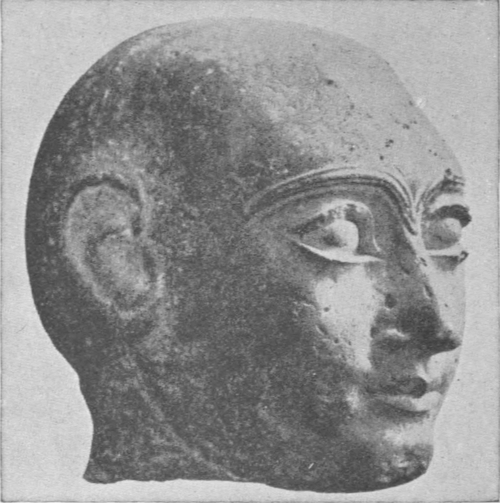
THE SUMERIAN TYPE OF BABYLONIAN
The fact that the shaven type of face appears in all the monuments back to 4500 B.C. indicates that the Sumerians were shaven as they were the older of the two main races in Babylonia.
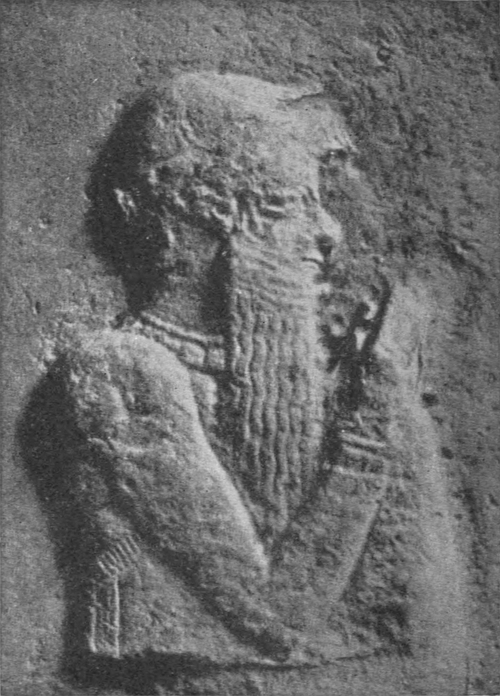
THE SEMITIC TYPE OF BABYLONIAN
Men with full beards are not represented on Babylonian monuments until 3750 B.C.; hence it is clear that such figures represented people of the Semitic type. This portrait is from a sculpture of King Hammurabi.
TYPES OF RACES. The physical type of the people is shown to us by the early monuments, though we hardly yet know enough of the early history to understand them fully. Two main types stand out entirely apart, the shaven and the full-haired. And when it is seen that the shaven type is that of all the earliest human figures, dating from 4500 B.C. and extending down to even 2100 B.C., while the full-haired type is not found on men before 3750 B.C., it is clear that the shaven is the Sumerian and the bearded is the Semitic type. The remarkable point is that the gods are represented with long hair tressed up and long beards from 4400 B.C.; and as early as we can go back there is never a figure of a beardless god. The reason probably is that personal gods were of Semitic origin, their worship was borrowed, and hence their forms. If so, we must see a large Semitic influence already acting on the earliest known Sumerian art. The variations of type may perhaps lead to some further distinctions. The full, curly, square-ended beard and long hair are usual for the gods, as seen under Eannatum (4400), Urenlil (4000), Gudea (3300), and Hammurabi (2100). The same beard, but with the hair done up into a disc (as on the Tello heads and Hammurabi), is worn by the King Anubanini (3600). The long and rather pointed beard is seen on Naramsin (3750), and Hammurabi (2100). The short, square beard is seen on the god, under Eannatum (4400), and on men about Naramsin’s age [see the seal of Ubilishtar]. The shaven type has a wide face, with a large prominent aquiline nose, best seen in the head from Tello. This type is that of all the human figures on the scenes of Urnina (4500), Eannatum (4400), and Urenlil (4000); and in the figures of the Scribe Kalhi (cylinder, 3750), Gudea (stele, 3300), the heads of the same age from Tello, and the later head of beautiful work at Berlin. The general conclusions may be that the beard was worn and admired by Semites, who elaborated a very full type for the gods; and that the Semitic influx, though ruling under Naramsin at Sippara, north of Babylon, was yet subordinate at the later date of Gudea, in the Sumerian south.
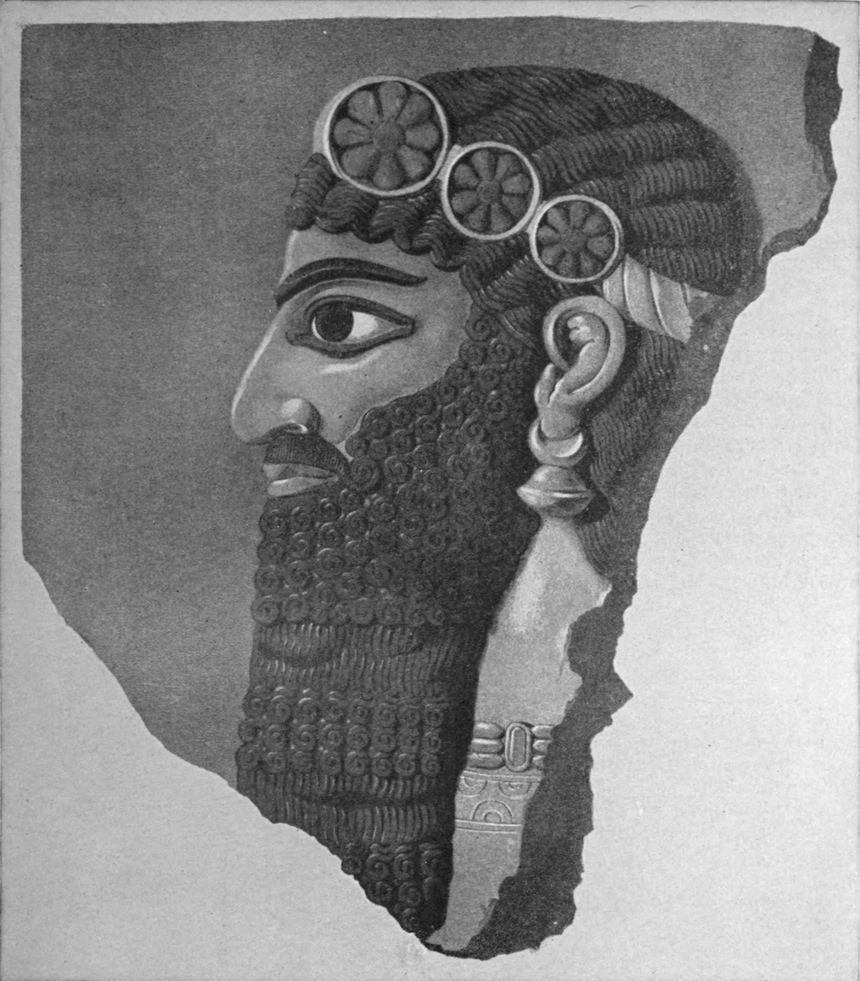
THE FAMILIAR BEARDED TYPE OF ASSYRIAN GODS AND MEN
Although the full-haired faces are later in appearing on the monuments of Babylonia, all figures of gods are shown as possessed of full beards and a wealth of hair. A familiar example is here reproduced. It is supposed that the Semitic race in Assyria was the first to personalise the deities, and hence the resemblance of the images to the features of the Semites.
SEMITIC AGE. We now turn to the later stage of the civilisation, as it flourished under the mixed race of Sumerians and Semites, partaking of the culture of the older race and the higher moral tone of the less advanced people. The Sumerians, as we have noted, had pushed down from the Median highlands into the growing plain of Babylonia, while the earlier Semites remained to the north in Assyria, and to the west in Naharaina and Syria. Sooner or later a fusion was inevitable; as we have seen already, the gods were of a Semitic type at a very early time, and gradually the union took place during three thousand years, until in the later times the product was unified in one strong civilisation which spread its strength far and wide to the Crimea, to Egypt, and to the deserts of Central Asia.
BUILDING. The old skill and abilities found a wide scope in this larger frame of life. The fundamental craft of brickwork was carried on to a vast extent. Every city had its great pile of an artificial hill of bricks, built in stages to support the temple of its god high above all. Immense walls surrounded the cities; those of Babylon were some nine miles around, and are stated to have been 85 ft. high and 340 ft. thick, surrounded by a moat lined with burnt brick laid in bitumen. Not only was brickwork used on this great scale in the Babylonian plain where stone was a luxury, but the force of example was so strong that the Assyrian, in his highland home, kept up the same scale of brickbuilding as his teachers, and used brick for his palaces and temples when stone would have been much more easily available.
In Babylonia, as in Egypt, the supply of material for brickmaking on a large scale is a serious question. For the great walls of cities, obviously a surrounding ditch was an advantage; but for the materials of houses, temples, and ziggurats, great pits had to be dug, or older buildings pulled down. At Nippur it was found that the later builders had torn down a long piece of the disused city wall and dug out a great pit below and around it. So in Egypt the outskirts of every village has its perilous hole where the bricks are made, which, in course of time, becomes a stagnant pond, and every ancient temple, with its fortifying wall, was built out of a large pit at its side which became the sacred lake of the temple.
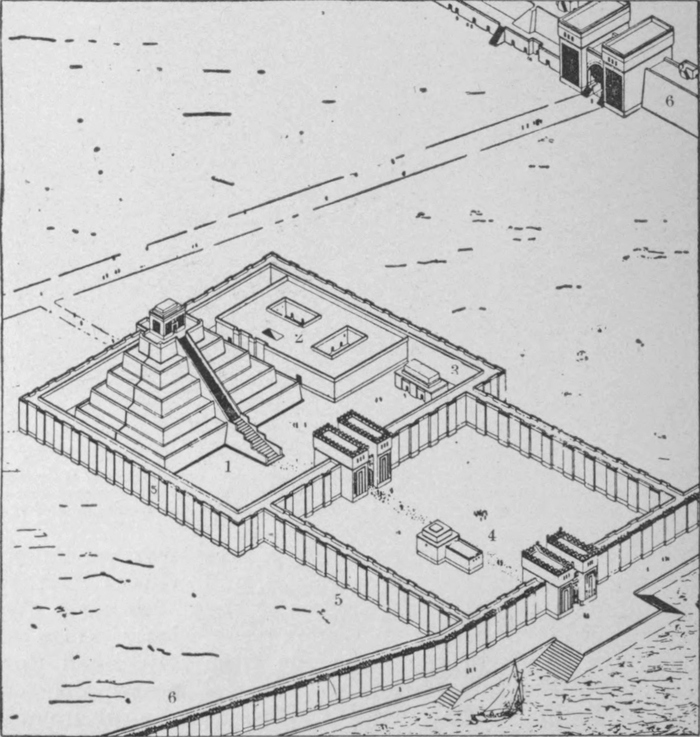
A TEMPLE PLATFORM, OR ZIGGURAT, OF BABYLONIA
This restoration of the Temple of Bel at Nippur, from the designs of Hilprecht and Fisher, gives a good idea of the massive character of Assyrian architecture. The portion marked (1) consists of a stage tower with a shrine at top and a long stairway leading thereto; (2) is the temple proper; (3) house for “honey, cream and wine”; (4) “place for the delight of Bur-sin”; (5) is the inner wall and (6) the massive outer walls.
A higher branch of building was the use of glazed bricks. In Egypt the use of glazed tiles for coating walls was boldly carried out in the earliest dynasties, before 5000 B.C.; but there was no glazing of the bricks, because in so dry a climate the Egyptian was never induced to burn his bricks. In the wet and damp of Babylonia, on the contrary, burnt bricks were usual, and all the facings and main divisions of structure were in the indissoluble material, which held together and protected the mass of crude brickwork within it. It was, however, mainly, or only, in the later times—from the ninth century onwards—that bricks glazed on the outer face were used for building. It seems that this was done not so much for utility—like our modern use of glazed bricks—as for the artistic effect of colours and designs. The grandest example of such work that is known is the façade of coloured glazed brick in relief, representing the royal archers, from Susa of the Persian age, now in Paris, restored from the fragments.
Beside baked brick, pottery was used on a large scale. Great jars occur in the earliest times, and cylindrical drains of large size, sufficiently wide for a man to descend in them for repair. In later times coffins of baked pottery of the Parthian age, and glazed coffins of slipper shape, dating from the Sassanian period, are very common on most of the city ruins. Unfortunately, sufficient attention has not yet been given to the pottery of any age.
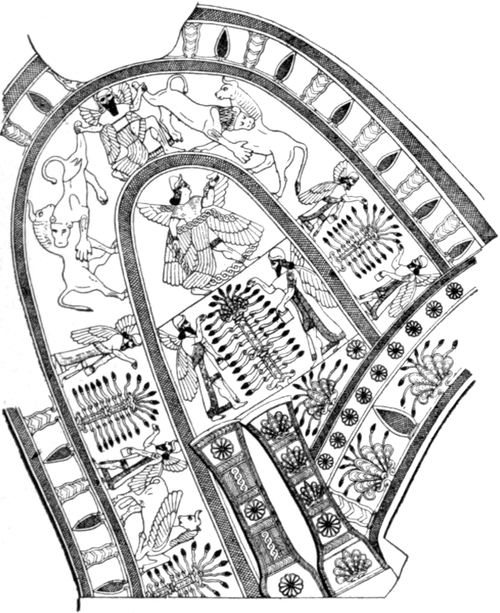
A KING’S EMBROIDERIES
This illustrates the richness of the decoration on the breast of an Assyrian king, whose complete attire is seen in the other picture on this page.
Wood was largely used in the more wealthy ages, but it was always valuable, as large timber had to be brought from a distance. The great halls of the palaces were all roofed with timber beams, and panels of cedar lined the walls where stone was not used. Probably palm trunks and palm leaves served for ordinary roofing, as in Egypt at present.
CLOTHING. Clothing became far more elaborate than in earlier ages, and the dominance of the more northern people brought a fuller dress into customary use. The Assyrian covered the whole body with a tunic down to the knees, and the upper classes wore a robe to the feet. Rich embroideries were usual among both Babylonians and Assyrians, and the splendour of Babylonian garments was spread far in other lands by trade. The cap was either cylindrical or conical, and the royal head-dress in Assyria was practically the modern tarbush, which has again been imposed on the East by the Turk. Sandals were used in Assyria, and the boot so characteristic of the Hittite was also brought in from the cold mountainous country. Women wore a long, thin robe to the feet, covered sometimes by a tunic and a cape. But Ishtar is always shown in a ribbed dress flounced from top to bottom. This is the regular women’s dress of the western Semites; and its use, like that of the beard for the male deities, points to the strong Semitic influence on the appearance and character of the divinities.
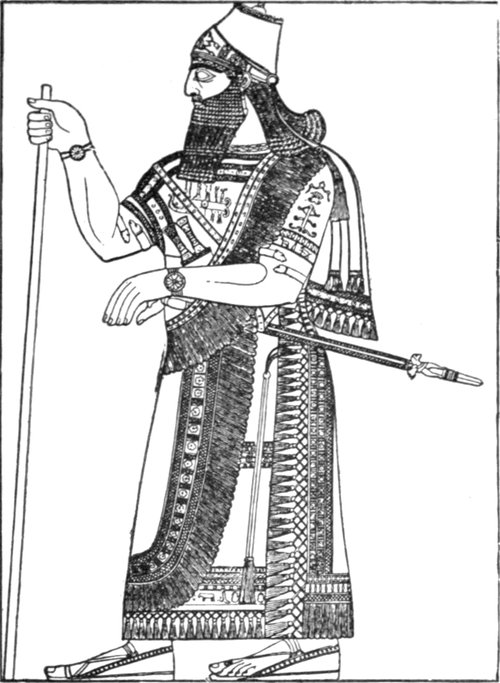
DRESS IN ASSYRIA’S GOLDEN AGE
Rich embroideries were usual among Babylonians and Assyrians, and the splendour of Babylonian garments was spread far in other lands by trade. The royal head-dress in Assyria was practically the modern tarbush, which has again been imposed on the East by the Turk.
The armour of the Assyrian was much the same as that in the early Sumerian days. The pointed helmet became rather taller, and did not cover the back of the head. The spear, and the bow and arrow, were the main weapons as before. The old straight-sided shield was also used in Assyrian times, but was partly superseded by the round shield considerably coned. The extension of the kingdom brought in various auxiliaries, who differed from the older Babylonians. Slingers, northern horsemen clad in leather, and mountaineers with woodman’s axes, all added new branches to the army.
Sculpture 5,000 Years Ago
ART. The arts were carried to great perfection by the mixed population. Broadly speaking, the best work is that of the early age of Naramsin (3750 B.C.), and that of the late age of Ashur-bani-pal (640 B.C.). Though not so fine, yet probably the Hammurabi sculptures are the highest between the early and late schools. This would give intervals of 1,650 and 1,460 years between the successive waves of art, and about 1,450 years more to the glories of Baghdad, a period much like that found on the Mediterranean, though not coincident with it.
The finest work of Naramsin (3750 B.C.) is his great stele from Susa, now in Paris. It is remarkably pictorial in style, agreeing in this with the pieces of a limestone stele representing rows of combatants from Tello, also in Paris. The figure of the king is lithe, active, romantic in attitude, the enemies and his soldiers are full of animation. No Oriental sculpture has had quite the same life in it; and it recalls the pictorial style of Crete and the later Greek sculpture. The art of Gudea (3300 B.C.) is more cold and formal, and has not the same fine sense of proportion; it is distinctly a period of survival and not of artistic instinct, as seen, for instance, on the limestone relief in Berlin. The age of Hammurabi (2100 B.C.) shows careful portraiture, but not the spirit of the earlier age; the work is well finished, and there was no hesitation in handling materials boldly, as on the great black stele of the laws, now in Paris. There was a fine sympathetic treatment in private sculpture, as shown in the beautiful limestone head of a Sumerian in Berlin [see page 266].
Fine Later Art
The last great age was that of the Assyrian Empire. Under Ashur-nazir-pal (885) the work is fine and severe, but without much expression. Shalmaneser III. (860) troubled more about history than about art, and his principal remains are the long records of the black obelisk and the Balawat gates, which are but clumsy in the forms. Under Sennacherib (705) there is a breadth of composition, as in the siege of Lachish, which is worthily aided by a more pictorial style, while under Ashur-bani-pal (668–626) the art reaches both grace and vigour, as in the splendid natural scenes of the wild-ass hunt, in the lion hunt, and in the garden feast with the queen.
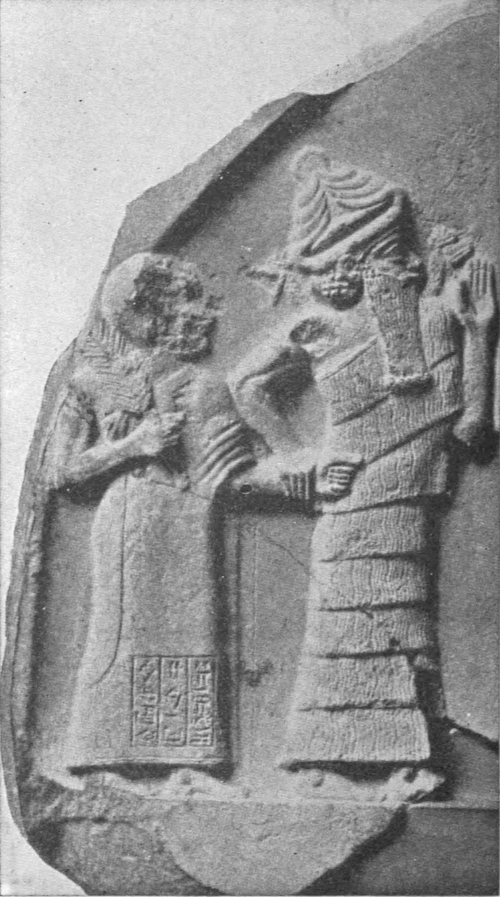
GUDEA LED BY A GOD
This shows the Babylonian art at 3300 B.C., inferior to the earlier style of Naramsin. The original is in Berlin Museum.
MECHANICS. The mechanical arts were also greatly developed. The large size of the buildings, the great quantities of stone transported for the sculptures, and the immense size of many blocks—the bulls weigh nearly 50 tons each—all show that there was not only considerable skill, but also large ideals and directive ability. Layard found that three hundred men were wanted for drawing his cart bearing the great bull; and the sledge used by the Assyrians for the transport must have needed as many, or more. Long levers are represented as having been used in a very effective manner; but the placing of such great blocks exactly in the right position required far more ability than the mere transport. The forms of tools were much in advance of those used by the Egyptians. As far back as Naramsin, the copper axes were all well hafted, generally with rings raised round the edges of the haft hole to strengthen the band and prevent it splitting.
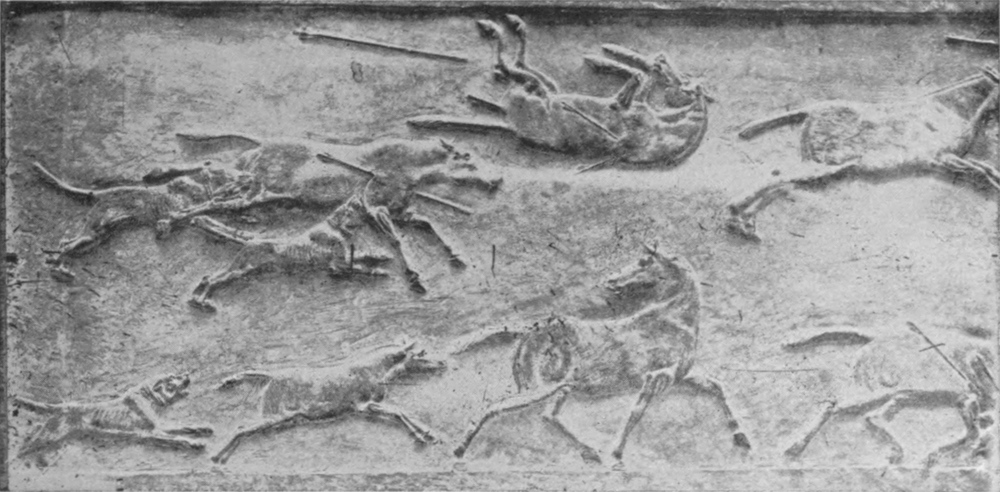
AN ARTISTIC TRIUMPH OF ASSYRIAN SCULPTURE
Under Ashur-bani-pal (668–636 B.C.) Assyrian art reached both grace and vigour, as is manifest in the splendid natural scene of the wild-ass hunt, which is here reproduced from the original in the British Museum.
Modern Tools of Ancient Workers
The forms of the iron tools are also excellent; and iron seems to have been common in Assyria at an earlier date than in any other country, probably from the tenth or twelfth century B.C. Certainly the set of Assyrian tools left at Thebes by an armourer of Esarhaddon in 670 B.C., show that the principles, and even the exact forms, of modern tools had already been reached. The chisels and rasp have not been improved since; the saw is the same as the modern Oriental pull-saw, but the teeth have not an alternate set; the centre-bits and files anticipate our forms, but have not reached the complete stage. The material of most of the edge tools is steel, showing that the hardening was then understood. The cutting of seals in hard stones was an early art, but it was well maintained, and some of the most beautiful specimens are the chalcedony cylinders such as that of Sennacherib in London. The engraving of the inscriptions also shows that cutting in hard stones was freely done on a great scale; but the writing, being entirely in straight lines, was much easier to engrave than the figures of natural objects of the Egyptian signs. Probably emery powder or copper was the means used, as in Egypt.
The Books of Babylonia
The use of an official stamp of guarantee on uniform pieces of silver was adopted by the time of Nebuchadnezzar, but as this is two centuries later than Greek coinage it was probably copied from that. In one respect the Mesopotamian never equalled the Egyptian. The Memphite school of work had attained to a mechanical accuracy which we can scarcely gauge; their errors on large pieces of work were only a matter of thousandths of an inch. But the Mesopotamian never did a piece of passably square or regular stonework; the inequalities and skew angles are glaring, even in highly elaborated works of art. The sense of accuracy was quite untrained, and neither Semite nor Sumerian show any ability in this line. Egypt, on the contrary, started with a prehistoric race which excelled in exquisitely true handwork and dexterous flint flaking, and with the artistic sense of the dynastic people added, the combination was one of the highest that the world has seen.
LITERATURE. To give any adequate idea of the literature of Babylonia is far beyond our scope, and only the main classes of it can be named in this outline. These were:
1. Theology and Omens. 2. History. 3. Despatches and Correspondence. 4. Language and Translation. 5. Mathematics. 6. Astronomy. 7. Geography and Natural History. 8. Medicine.
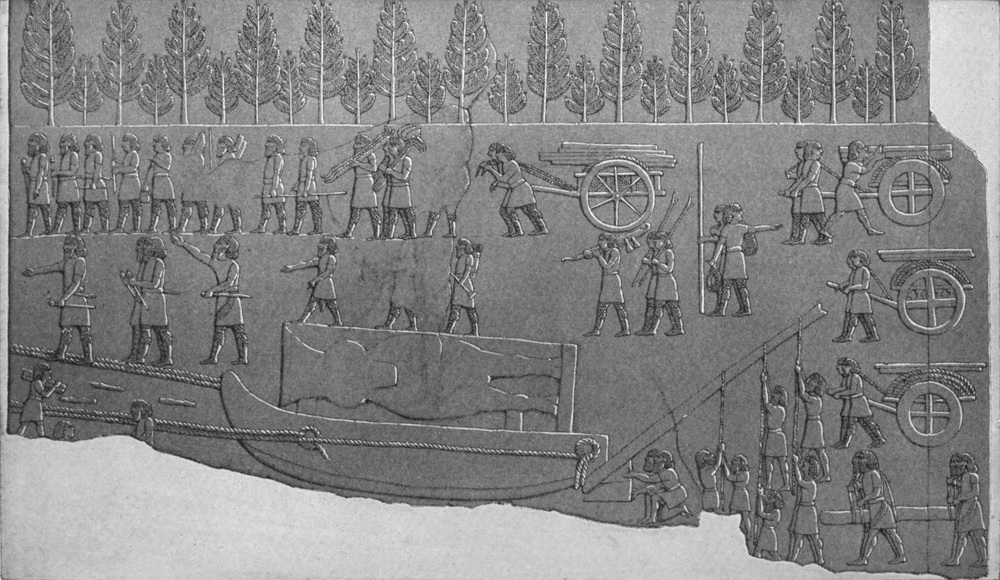
HOW THE GREAT STATUES WERE MOVED: A CONTEMPORARY RECORD FROM THE MONUMENTS OF NINEVEH
The large size of the buildings of Assyria, the great quantities of stone transported for the sculptures, and the immense size of many blocks—the bulls weighing nearly 50 tons each—all show that there was not only considerable skill, but also large ideals and directive ability. Layard found that 300 men were wanted for drawing his cart bearing the great bull; and the sledge used by the Assyrians for the transport must have needed as many or more. The tools used were much in advance of those of the Egyptians.
LARGER IMAGE
The striking omission is that of literature in the form of tales or poetry of actual life; there seems, amid all the myriads of tablets, to be nothing similar to the tales of the various periods of Egypt. We look in vain for the tales of the magicians, the romances of adventure, of love, or of history, which restore to us the living view of Egyptian thought. The Babylonian was severely commercial or scientific, and his poetical ideas were only developed in his theology; he seems to have had no play of fancy or taste for the excitement of story-telling. Similarly in the Middle Ages the “Thousand and One Nights,” though often referring to Baghdad, are yet tales of entirely Egyptian source and idea.
Wonderful Training of Babylonians
But for his own purposes the Babylonian was well educated from a literary point of view, and, considering the complexity of his writing, he was probably better trained than any modern people except the Chinese. The hundreds of signs which he had to remember had long lost their pictorial significance, and needed an attentive memory and long training; yet not only in public documents, but also in private letters, mistakes are but rarely found. Classification of the signs, classified lists of words of Sumerian and Semitic, grammatical works, and reading books were the apparatus used. Even the peasantry and sometimes the slaves learned to write, and there was hardly more need of a professional scribe than there is in England to-day. But this general education belonged to the Sumerian stock, and was much diminished where the Semite was in the majority, so that in Assyria only the upper classes could write, and nail-marks of contracting parties are common. The feeling for literature kept the names of great writers in remembrance, and the authors of the main religious pieces, such as the Epic of Gilgames, are still known. The Egyptian, on the other hand, has not preserved the name of a single author; even Pentaur was probably only a scribe. The honouring of literature led to the Assyrian kings amassing great libraries, and to the princes becoming librarians and secretaries. The copying of ancient tablets for the new libraries was a large business, carefully planned; and the scribe was required to exactly state where his original was defective and what uncertainties existed in the reading. Even private persons sought to obtain favour by presenting copies of works to the temple libraries.
Shall We Find an Assyrian State History?
Of the classes of writings, the religious works are noticed later; the historical writings are mainly Assyrian, recording the constant wars with other lands, and the tribute and booty brought from them. That there was a complete State history is shown by the ready allusions to the time since certain events had happened. Ashur-bani-pal recounts 1,635 years since the Elamite king had carried off an image. Nabonidus searched for and found the tablet of Naramsin, which he says had not been seen for 3,200 years; he recites that there were 800 years from his time to Shagarakti-buriash, and 700 years from Burnaburiash to Hammurabi. These references show that we may hope to recover a complete State history from Assyria, as we may hope yet for a complete historical papyrus from Egypt.
The despatches and correspondence give full light on detail of politics and affairs, showing the conditions of various countries; and where a sufficient number have been preserved together it is possible to build up a continuous history of a period, as in the case of the Tellal-Amarna letters. The yearly annals of a reign belong more to the historical division, and such records of Sennacherib, Ashur-bani-pal, and others are of the highest value. The private letters give a full view of the current life; and the business documents, especially receipts, are the commonest of all records, showing the trade, the law, and the business of the country in all its fulness.
Beginning of Astronomy
The tablets dealing with the Sumerian and Semitic languages together, and the translations from one to the other, we have noted already. The mathematical tablets are multiplication tables, lists of multiples of measures, tables of squares and cubes, and plans with measurements along the sides, which show the practical use of the science. The astronomical records were already tabulated in the time of the early Semitic Empire, Sargon having compiled for his library a work in seventy-two books, the title of which is rendered “The Observations of Bel.” The purpose of this was astrological, like the great mass of short tablets reporting observations of a later date. But the inquiries involved a considerable familiarity with astronomical movements, and a mass of records which became of great value to the student. The astronomical tablets of the Seleucid period are of special value, as they often contain valuable historical matter.
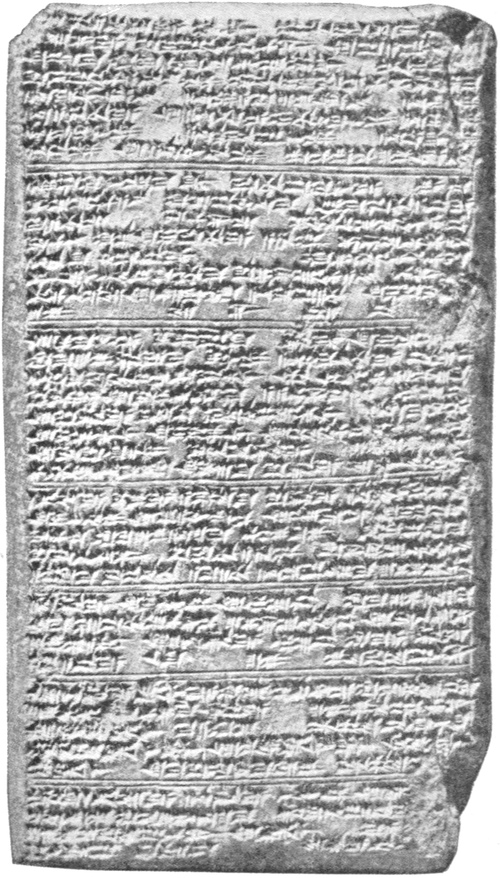
A KING’S LETTER OF 1400 B.C.
A clay tablet letter from Tushratta, King of Mitani, to Amenophis III., King of Egypt, announcing the despatch of valuable gifts and begging Amenophis to send him a large quantity of gold as payment for expenses incurred by his grandfather in sending gifts to the King of Egypt, and also as a gift in return for his daughter, a princess of Mitani, whom Amenophis had married.
LAW. In the domain of law the Babylonian had early formulated a code from the actual working of decisions. Case-made law was his basis, as in most countries, and abstracts of important cases were carefully preserved as precedents. No torture was used upon witnesses, and ample investigation of the right of a case seems to have been usual, with full cross-examination. High penalties were stipulated for the infringement of sales or contracts. The status of women was equal to that of men in the Sumerian, but became inferior in the Semitic law. Slavery was rather an assignation of labour than a control of the person, as a slave family could not be separated. Slaves could hold property, own other slaves, give witness, and were sometimes well educated. The family union was strong, as inherited land could not be sold without assent of relatives, and boys and girls alike inherited intestate property.
The detail of the laws form a long study, but we may here note the main sections of the great code of Hammurabi, showing the scope of the laws, and stating the number of enactments.
Witchcraft 2
Legal falsehood 3
Theft 3
Loss 5
Child and slave stealing 7
Robbery 5
Royal messengers and officers 16
Agriculture 24
Accounts 8
Licensed traders 6
Marriage property 19
Women 32
Votaries property 7
Adoption 10
Assault 20
Doctors 13
Builders 6
Shipping 7
Cattle 12
Hire 25, and
Slaves 5
Distraint & deposit 13
Thus the whole scope of an agricultural and commercial community was well safeguarded, and little doubt left as to general principles and penalties. All this must have been the product of innumerable cases and difficulties for two or three thousand years, before such a complete code was set up.
HISTORY IN MYTHOLOGY. The religion has usually occupied a large part of the attention and interest given to Mesopotamia; it is comparatively well known owing to the quantity of documents and representations. Here we need only mention such points as bear on the general civilisation. We have already noticed how the purely Sumerian Shamanism, or belief in the spirit of every object, which needed to be appeased, had been tinctured by the worship of personal deities of the Semitic neighbours, and how this influence was shown by borrowing the Semitic beard for the gods and flounced robe for the goddesses, and occasionally for the gods. Thus the Semite was the missionary of theism as against animism.
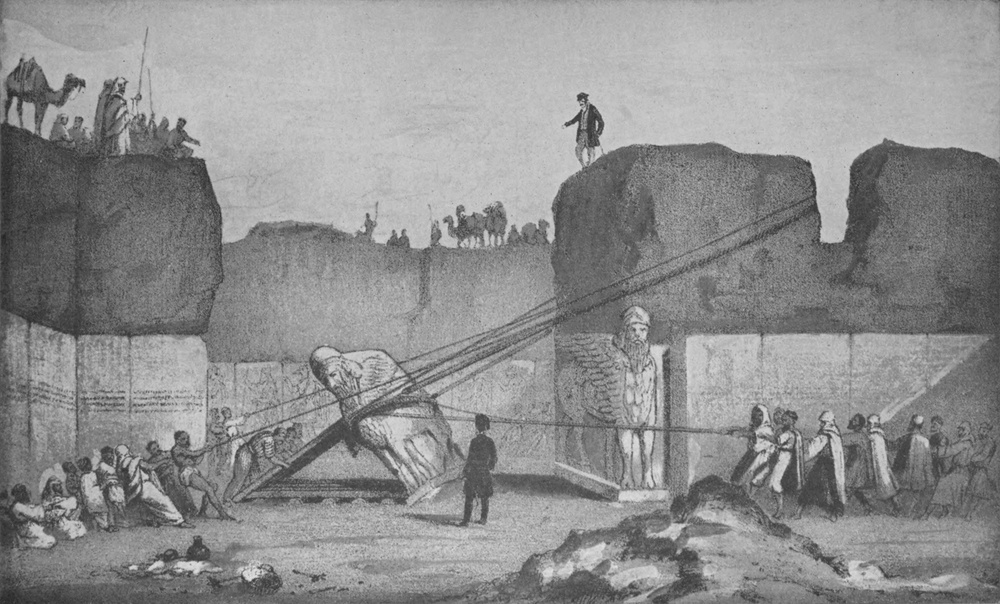
SIR A. H. LAYARD’S EXCAVATORS LOWERING ONE OF THE GREAT WINGED BULLS FOUND IN NINEVEH
These bulls weighed fifty tons each. Layard found that three hundred men were necessary to pull the cart on which the bulls were placed.
LARGER IMAGE
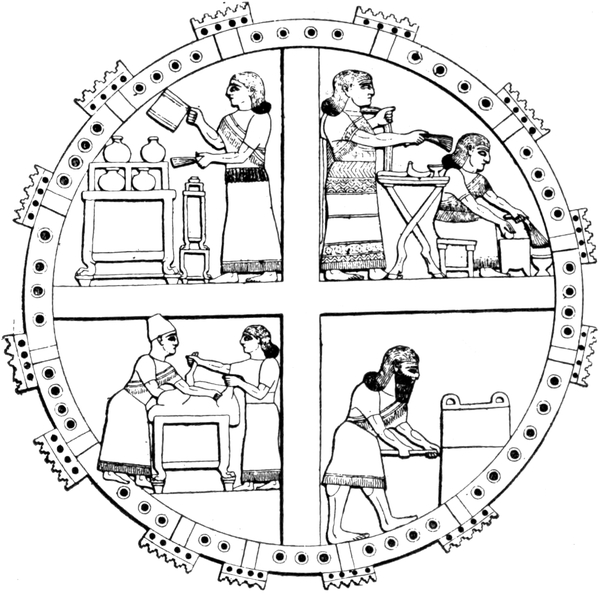
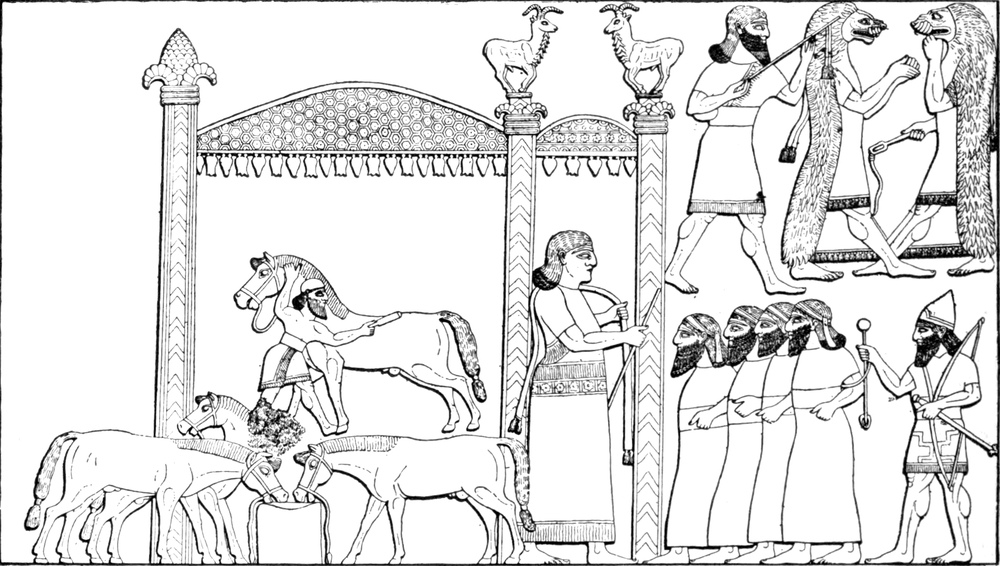
A CAMP SCENE IN THE DAYS OF NINEVEH’S POWER
The interior of a castle, indicated by a kind of ground-plan with towers and battlements, is divided into four compartments. In each is a group of figures, either engaged in domestic occupations or in preparations for a religious ceremony. The pavilion is supported by columns, probably of painted wood, and the canopy is adorned with a fringe of alternate flowers and buds, like the usual Egyptian border. Beneath the canopy is a groom cleaning a horse with a curry-comb. A eunuch at the entrance is receiving four prisoners. Above are two mummers dressed in the skins of lions, while a figure with a staff appears to be the keeper of these monsters.
On the other hand, the civilisation of Babylonia is expressly stated to have been given by Ea, or Oannes, who rose from the sea of the Persian Gulf; he passed the day among men, and taught letters and sciences and arts—the building of cities and temples, and the use of laws and geometry. Also he showed the uses of seeds and fruits, and softened and humanised the people, who had lived in a lawless manner like wild beasts. This full ascription of civilisation to sea immigrants shows that it cannot be set down as an indigenous growth, or as due to the Sumerian, or still less to the Semite. The date of this movement is roughly indicated by Ea, belonging to the city of Eridu; and 5000 B.C. is the earliest date at which we can suppose the ground of that city to have been dry land. Such must be taken as the extreme limit of the early civilisation, and what we find of the early kings of about 4700 B.C. is the first efficient rise of monumental history in the land. All this is parallel to the early civilisation in Egypt. That also came in apparently from the Red Sea at about 5800 B.C., as the civilising movement which changed the prehistoric age to the dynastic. And it came only a few centuries earlier than the mission of Ea. It may be possible that there is one common source of a seafaring people for both civilisations, and, if so, we might look to Hadhramot as being in the most likely common centre. At least, it is always convenient to explain the unknown by the unknown.
The nature gods of Apsu and Tiamat, the ocean and the chaos, described in the first tablet of the Creation series, belong to the primitive Sumerian. “The waters of these mingled in union, and no fields were embanked, no islands were seen; when the gods had not come forth, not one; when they neither had being nor destinies.” And afterward “Evil they plotted against the great gods.” After an attempt of Anshar (perhaps the same as the Egyptian Anher, the sky god) to subdue Tiamat (tablet 2), Marduk, the sun god, gains the victory; and in tablets 3 and 4, the supremacy of Marduk is finally confirmed by all the gods. In this we seem to have the echoes of a tribal history as in the Egyptian theology. The Shamanistic worship of a confused host of warring and malignant spirits, is at last subdued by the worshippers of personal gods under Semitic influence, and of these the people of the sun god take in the end the leading place. All of these changes were, however, long before the political domination of the Semite, which began about 3800 B.C., with Sargon.
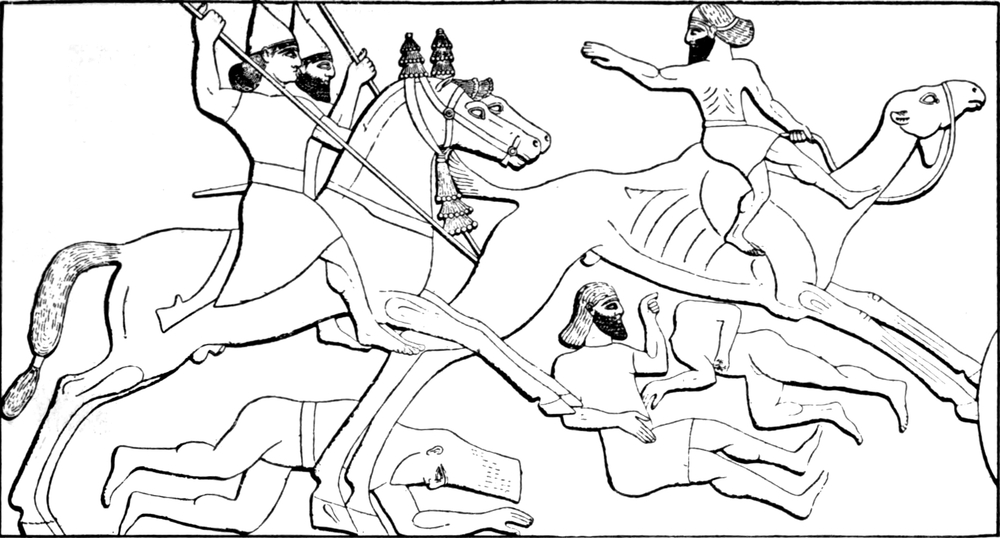
A CHASE IN THE DESERT, RECORDED ON THE MONUMENTS OF NINEVEH
The series of which this bas-relief formed a part appears to have recorded the conquest by the Assyrians of an Arab tribe or nation who made use of the camel in war as a beast of burden. This sculpture belongs to a later period than the bas-relief from the North-West Palace at Nineveh reproduced below.
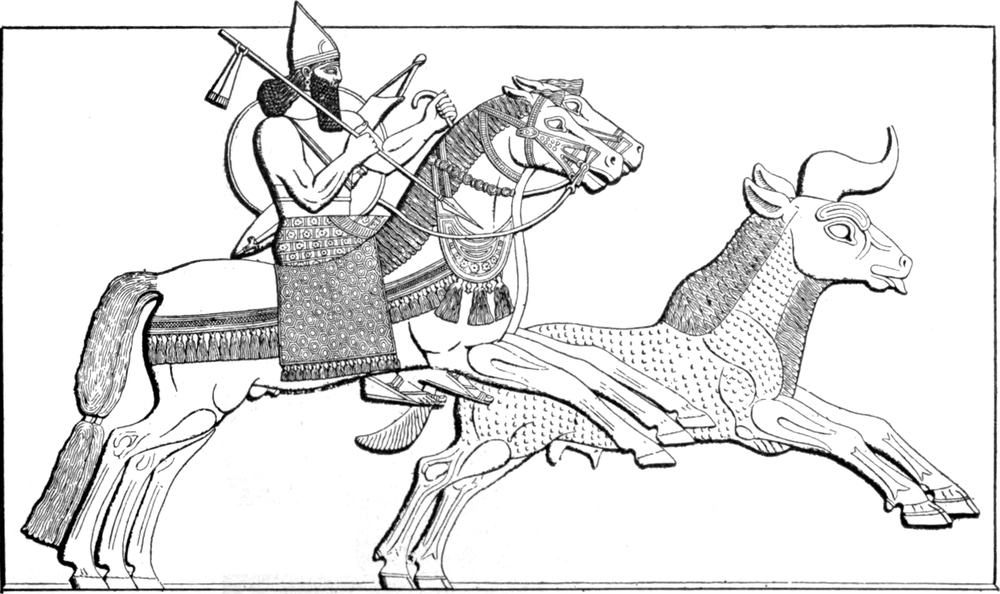
ROYAL SPORT IN THE DAYS OF ANCIENT NINEVEH
This bas-relief probably formed part of a subject representing the King of Nineveh in his chariot hunting the wild bull. The warrior rides on one horse and leads a second, richly caparisoned, for the use of the monarch. Numerous small marks on the body of the animal probably denote long and shaggy hair.
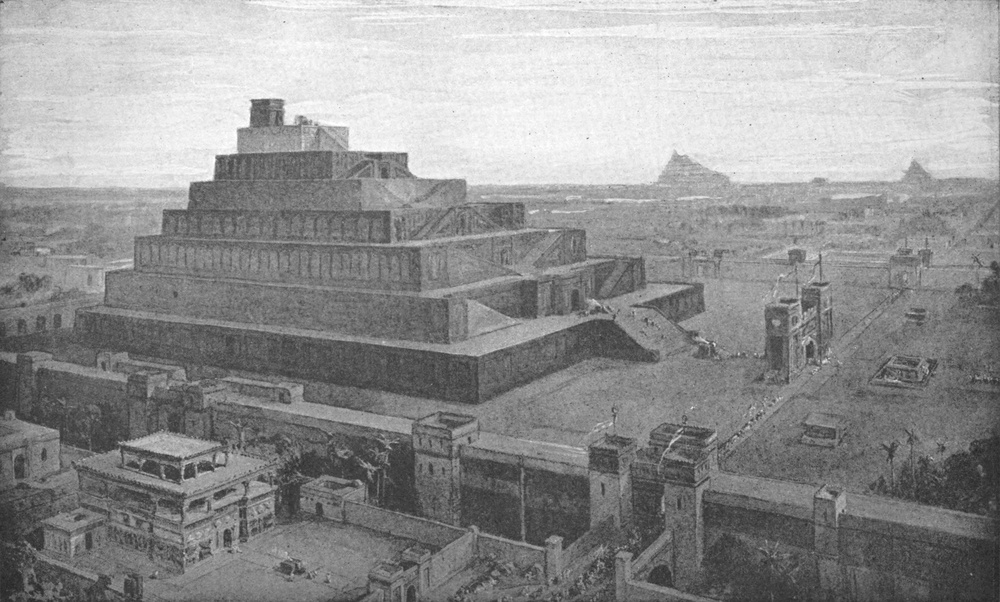
BABYLON: THE WONDER CITY OF ANCIENT CIVILISATION AT THE HEIGHT OF ITS POWER
LARGER IMAGE
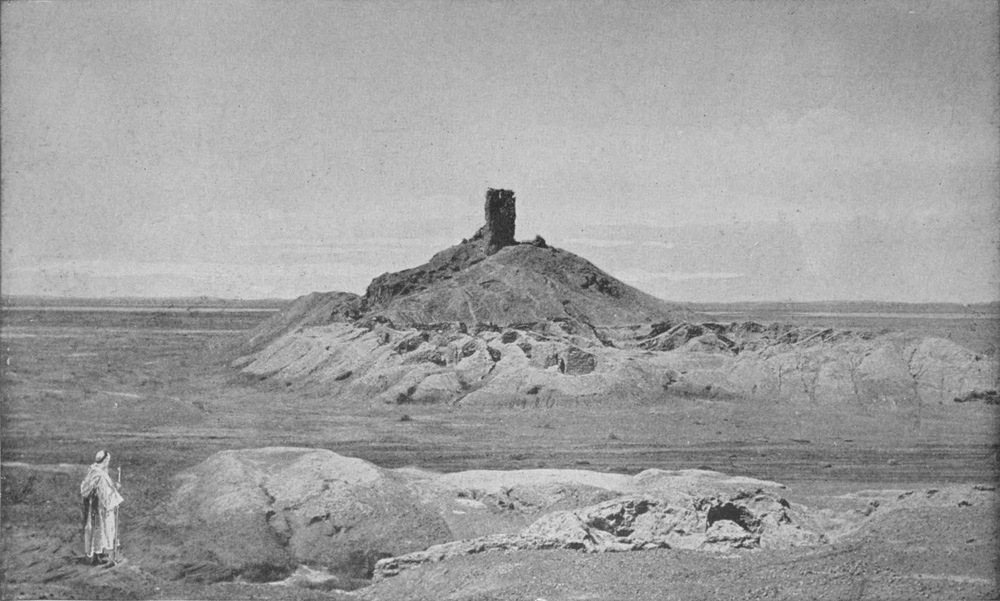
NIMRUD: ALL THAT IS LEFT OF ONE OF THE WONDER CITIES OF ANCIENT BABYLONIA
A view of Birs Nimrud, the traditional site of the Tower of Babel. On the plain below are the silent ruins of the ancient city, once filled with a teeming population.
LARGER IMAGE
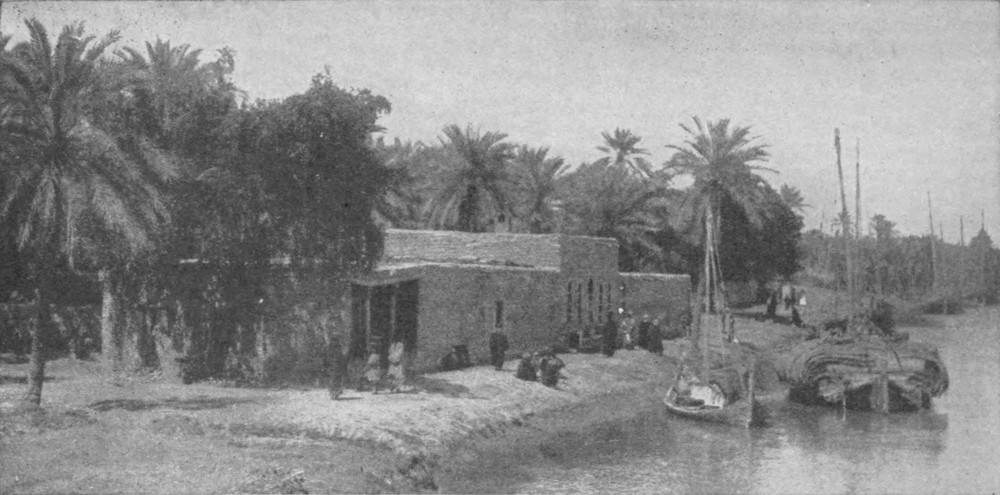
A VIEW OF HILLAH, THE MODERN BABYLON
We have now reviewed the questions of the rise of civilisation, as apart from the ordinary history of the countries, which is dealt with in its proper place in this work. Though it is difficult, and rather misleading, to look at civilisation and the political history apart, yet, so much has come to light in recent years to clear our view of the origins of culture that we may be allowed to focus our attention on that view of man, apart from his better known history. We seem at last to have reached back to a definite beginning of arts and capacities on both the Nile and the Euphrates, and to have touched a condition of things that seems to point in both lands to some external source of a yet pre-existing culture, which yet has to be traced. I am happy to add that one of our greatest Babylonian scholars, Dr. Pinches, concurs in the view of his subject which is here presented.
W. M. FLINDERS PETRIE
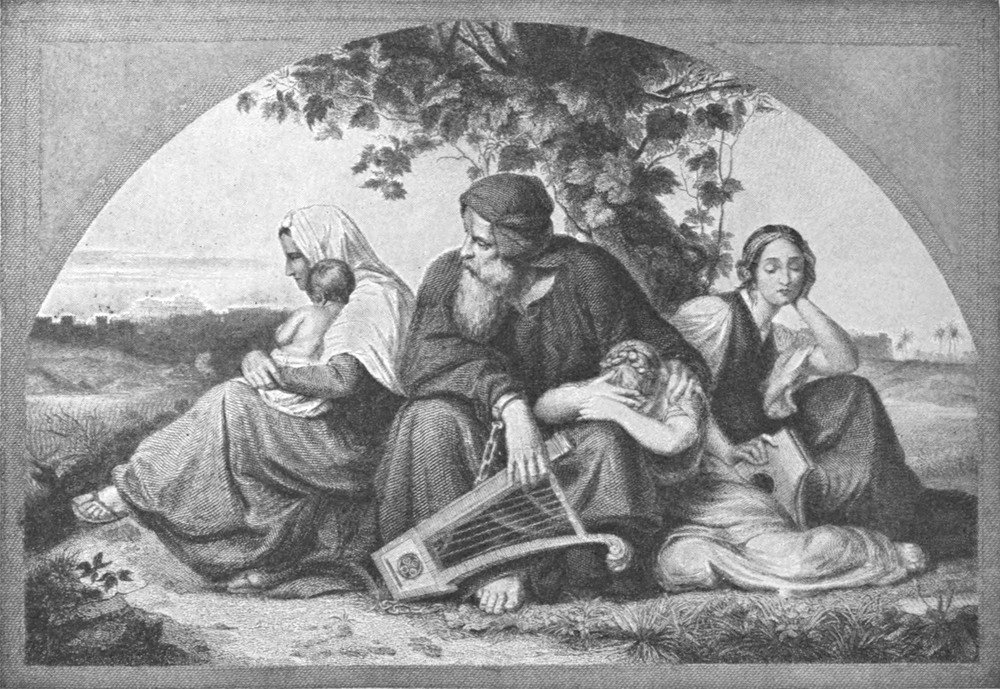
THE EXILES IN BABYLON
“By the rivers of Babylon there we sat down; yea, we wept.” From the painting by Bendemann.
“O
TUT of the East came Light” has been the text on which all great historians of civilisation have preached, from the authors of the Mosaic literature down through Greek and Roman times to our own. Hebrew writers have looked back to Mesopotamia; Greek writers to Egypt; Roman writers to Greece; writers of Western and Northern Europe and the New World to Rome, Greece, and Palestine. Their belief is justified in so far as it is based on two great facts. Man first found in the warm, alluvial valleys of Southern Asia and North-Eastern Africa the conditions of climate and soil most favourable to his upward progress from the savage state; and from these regions, so soon as with increase of numbers he was moved to migrate, his steps were turned by the geographical conditions surrounding his early homes, in a general way, westward. He knew not yet how to cross broad seas; deserts, sandy steppes, high mountains and tropical forests and swamps were equally deterrent. The Polar ice-sheet, which had extended in Pleistocene times to the Caspian, Black Sea, and Danube basins, and still lay, in the dawn of human civilisation, far south of its present limits, probably rendered, with its wide fringe of impassable moraine, forest, and tundra country, all the lands included in the present Empire of Russia singularly inhospitable. Whoso looks at the map of the Western Hemisphere, bearing these facts in mind, will see at once that the line of least resistance, and, indeed, the only possible line, led the men of the great sub-tropic river valleys towards and along the Mediterranean coasts.
Civilisation from Without
In so far, therefore, as European civilisation is a state of things due to influences from without, it is due to the East; but that is very far from the whole explanation of its origin. The impulse to rise above savagery has not always—not, indeed, usually—come to peoples from without; and probably in primitive time, when communications were slow and difficult to a degree which we can hardly realise, the origin of local culture was seldom or never to be accounted for thus. In modern days there have been obvious instances to the contrary; but even now it remains to be seen how far civilisations originated among absolutely barbarous peoples by contact with higher races are real and living growths. Examples of the modification and possible elevation of ancient indigenous societies by incoming aliens, such as have been seen in Mexico or Peru, India or Japan, Egypt or Barbary, are not in point; for in these cases local civilisations certainly existed long before the foreign influence. We must look to the history of the relations of white and negro, or other savage, races in the homes of the latter, and the results of such inquiries are far from conclusive. Does civilisation so originated grow and thrive? Do even the races thus civilised themselves any longer thrive and grow? Our antipodean colonies, and the story of the native races of North America, if there were no other instances, would not admit a categorical affirmative. Nay, rather, the evidence so far available tends to discount the permanence of transferred civilisation, and to throw doubt on the continued vitality of races so civilised.
The Escape from Savagery Conditions Essential for Civilisation
It is necessary to raise this question at the outset of the present essay because it has been too often assumed, both implicitly and explicitly, by historians of our civilisation, that all the cultural development of Central, Western, and Northern Europe has been due to alien influence, exerted from the south and south-east, and mainly by the agency of the Greek, Græco-Roman, and Græco-Romano-Semitic (the Christian) systems. Maine’s famous dictum that “Nothing moves in the world which is not Greek in origin” has long dominated our thoughts. Yet that magnificent generalisation is contrary not only to inherent probability, but to known fact. Escape from the savage state, as Buckle showed, depends in the first place on the existence of such conditions of geographical environment as favour the accumulation of wealth and the development of a leisured class—that is, such as conduce to the production of a good deal more than the minimum necessary for life. It can, therefore, have taken place wherever man found comparatively genial climate and remunerative soil, and, in process of time, made for himself, by clearing forests or draining swamps, an arable area which would feed him and his more abundantly than was absolutely necessary.
Where these conditions were presumably present it is unreasonable to suppose that the beginnings of civilisation were deferred age after age, until late in time some stimulus chanced to be imparted by an alien race or races which had, after all, advanced towards their own civilisation, albeit earlier, through the operation of similar conditions elsewhere. In the European areas inhabited by the Celtic and Germanic peoples, for instance, long before we have the slightest reason to believe that these can have come into intimate relation with the civilisations of the South and East, both climate and soil were unquestionably favourable, and local civilisations cannot but have been originated independently. As has been well said, “Man everywhere has the same humble beginnings”; and, up to a certain point, which is found to be, in fact, far later than the inception of some kind of culture, he will satisfy his primitive needs and desires in very much the same ways.
Spontaneous Civilisation in Europe
Under certain conditions, known to have arisen independently in many different regions of the earth, articles of luxury and art, irrefragable witnesses to incipient civilisation, begin to be produced spontaneously. To what remote periods have not cave deposits thrown back the history of artistic effort in the valleys of Gaul? And what credit, in reason, can be given to Greece, or even to Rome, for the elaborate social order of the Teutonic tribes, which was of ancient standing when first the Romans penetrated beyond the Danube and Rhine? So well rooted in the soil, so potent and so widely diffused were the Teutonic and Celtic social systems, that in the history of our actual civilisation they are factors as worthy of consideration as the influences of Rome, Greece, or Palestine. If Græco-Roman Christianity came greatly to modify them in the end, they had, perhaps, ere that, modified Christianity itself hardly less; and the social superiority of the northern and western adherents of the now dominant religion is probably as much due to character and habits developed before ever its creed was formulated, as the dominance of the Turkish peoples in the Islamic system is undoubtedly due to social characteristics evolved in the oases and steppe-lands of Central Asia far back in the “Times of Ignorance.”
Let it, therefore, be understood that in the following pages it is not necessarily the whole origin of European civilisation that is being set forth, but the modification and heightening of probably pre-existent European culture by the first influences of the Nearer East which can be supposed to have reached it. Of these influences the effect is to some extent a matter of inference only. We cannot always, or, indeed, often, point with any assurance to actual results of their action. In great part we must still be content with little more than a demonstration that directly along certain lines of communication, or indirectly through certain intermediaries, the civilisations of the South could, or did, come into relation with European areas at an early age.
The Two Great Sea Routes
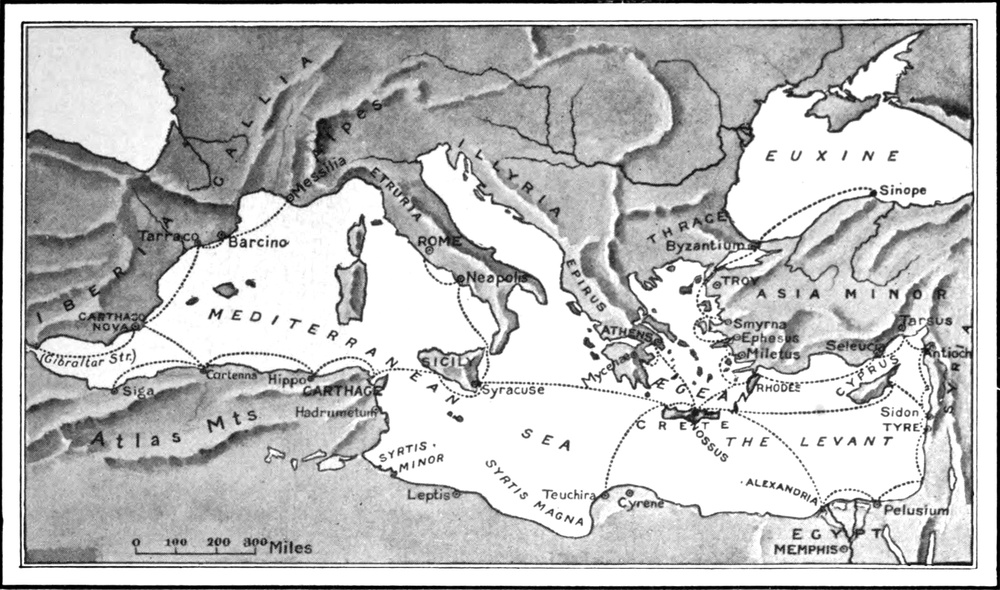
The sea routes which were most likely to be used in ruder ages by Levantine mariners, after leaving the Nile estuaries or the Syrian ports—which, as a matter of fact, are known to have been most used—are: that which followed the littoral of Asia Minor to Rhodes, whence it bifurcated, to Crete on the one hand, and to the Ægean isles and coasts on the other; or that striking across the narrow strait to Cyprus, and thence by way of Rhodes, or directly, to Crete. In connection with both these routes, the importance of Crete and Rhodes, and especially the former, must be obvious. Thence the Cyrenean and Carthaginian projections of Africa were reached with greater ease than by way of the littoral to west of Egypt, which, for some hundreds of miles, is desert, reef-girt, almost harbourless, and pitilessly vexed by an on-shore wind. From Carthage, Sicily and the Italian peninsula were readily accessible, or the Gibraltar strait and the Iberian shores could be made after coasting a littoral much kinder to navigation than that between Egypt and the western bight of the Syrtis.
THE GREAT SEA ROUTES OF ANCIENT CIVILISATION
Along the routes marked in this map lay the course of Ægean and Phœnician civilisation. The importance of Crete and Rhodes in the spreading of civilisation is clearly seen; they may be called the “half-way houses” between Mesopotamian culture, with its seat in the valley of the Euphrates, and Egyptian culture, in the valley of the Nile.
The Two Great Land Routes
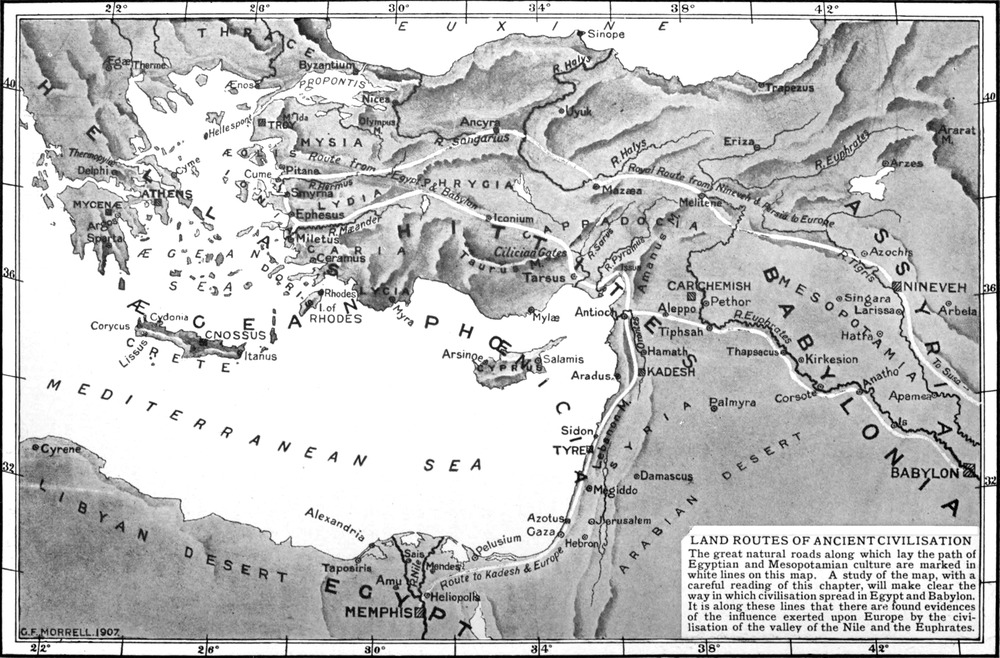
The land routes in chief were also two. The Nile valley, closed by desert on the western side, had comparatively easy access to the great natural road which, leading northwards through Syria, passes at first along the Palestinian littoral, and then through the central cleft between the Lebanons to the Orontes valley. Mesopotamian traders, following up the Euphrates till they had left the desert part of its course behind them, fell into this same road in the region of Aleppo and Antioch. Thence by the easy passes which turn the southern end of Mount Amanus, the combined caravans reached Tarsus, penetrated Taurus by the gap of the Cilician Gates, and found themselves on the plateau of Asia Minor with a choice of easy routes leading either to the rich western littoral, or the north-western straits, and from any and every point offering safe passage to South-eastern Europe. This was the only land route for Egyptian civilisation. But the Mesopotamian had an alternative one, leading by way of the upper Tigris valley to the north of Taurus and the Cappadocian plateau, whence it descended the Sangarius and debouched, like the first route, on either the north-western or the western coast of Anatolia.
The Royal Road up into Asia
In speaking of such land routes, we do not, of course, mean to imply the existence of any made road, nor even of a single track. When most definite, they probably resembled the Syrian Pilgrim Way—a skein of separate paths now spreading widely, now running into and across one another; and doubtless the early tracks diverged far more than this, and making great elbows, followed now one valley, now another, to meet again only after many days. One of the great lines from Mesopotamia to the western Anatolian coast, that described last in our enumeration, came to be defined more strictly than the rest, perhaps by the Kings of Nineveh and their “Hittite” rivals and allies in Cappadocia, and was known in the Persian era to the Greeks as the Royal Road “of all who go up into Asia.” But at the much earlier time with which we are most concerned, the influences of the East did not rush westward torrent-wise in one bed, but soaked slowly, finding a way now here, now there, in one general westward direction, and sending offshoots far out to right and left of the main streams.
LAND ROUTES OF ANCIENT CIVILISATION
The great natural roads along which lay the path of Egyptian and Mesopotamian culture are marked in white lines on this map. A study of the map, with a careful reading of this chapter, will make clear the way in which civilisation spread in Egypt and Babylon. It is along these lines that there are found evidences of the influence exerted upon Europe by the civilisation of the valley of the Nile and the Euphrates.
LARGER IMAGE
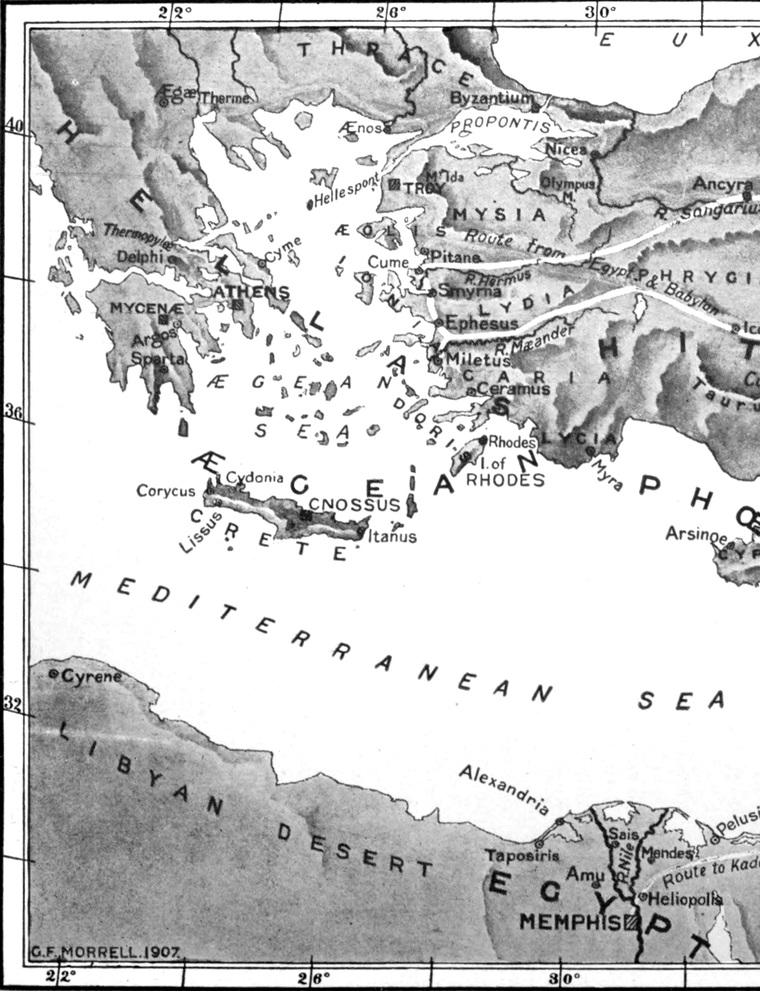
[Western Part of Preceding Map]
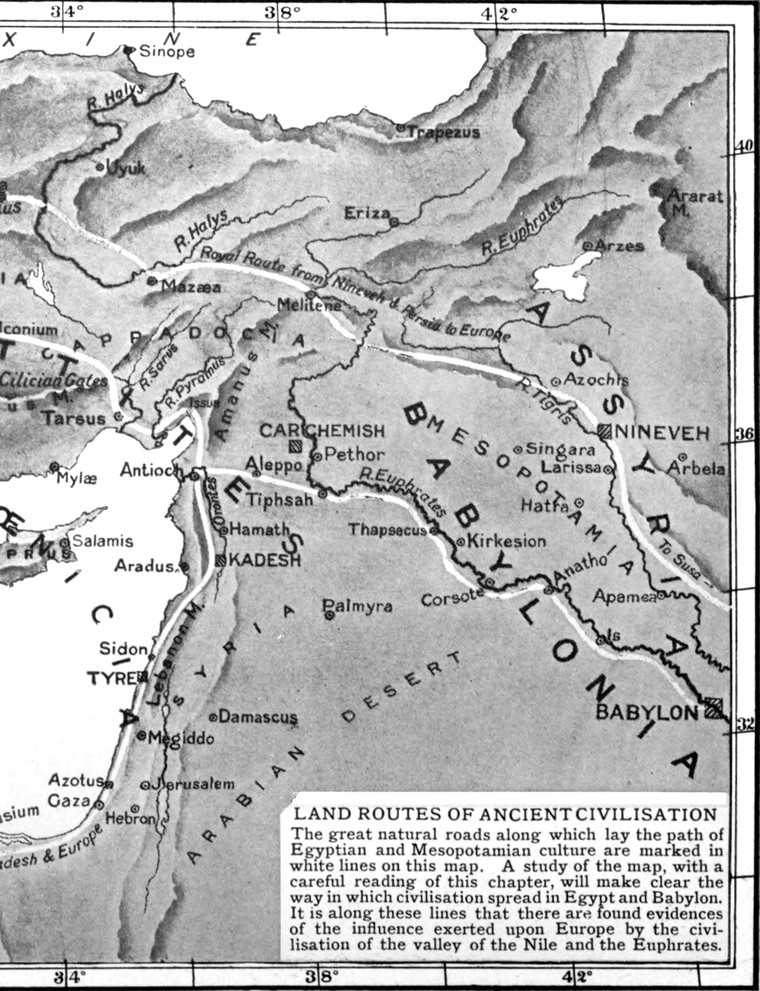
[Eastern Part and Legend of Preceding Map]
Half-way Houses of Civilisation
It has been said that there is evidence of the routes just indicated having been, in fact, those most used. It is upon these lines, and no others, that we find certain remarkable focuses of early culture disposed as half-way houses between the Mesopotamian and Egyptian civilisations on the one hand, and continental Europe on the other. These are, in relation to the sea routes, first, the prehistoric Ægean civilisation, focused from the first in Crete, but extended to all isles and peninsulas of South-eastern Europe from Cyprus to Sardinia and Spain; and, secondly, the Phœnician, originated on the Syrian coast, but focused also at a later time at a second point much farther west—namely, on that Carthaginian projection, whence lay easy sea-ways to Sicily and Italy and all the western seas. Hard by the Egyptian land route lay this same Phœnician society; while all about its point of junction with the Euphrates road, on both its continuations north-westward, and on the northern road from Mesopotamia so soon as this had passed Euphrates, was established the singular but as yet little understood civilisation which we call Hittite. How early we may assume the latter’s existence in North Syria is still doubtful; but since the discoveries of Winckler at Boghaz Keui, there is little question that it was focused in prehistoric time in Northern Cappadocia, whence its influence seems to have radiated southward to the confines of Palestine, and westward to Lydia and almost the shore of the Ægean Sea. It is to this North Cappadocian region that the Tigris route from Assyria and Babylonia, which was afterwards the Persian “Royal Road,” tended. Among these civilisations the most important for our present purpose is the Ægean, because its geographical area touched at some point all the westward roads, whether by sea or land; and, moreover, because it is the one which actual evidence both dates from the remotest antiquity and most clearly proves to have been operative on Europe, especially on the most expansive of its early cultures, the Hellenic. The recent exploration of Crete, due in the main to Messrs. Arthur Evans and Federico Halbherr, has enhanced enormously the significance of the civilisation revealed to the modern world at Hissarlik and Mycenæ by the faith and fervour of Henry Schliemann.
Far-back Evidences of Culture
We are now assured of certain facts of much moment to our inquiry. Firstly, that this civilisation was developed originally from its rudest beginnings within the Ægean area itself. This is proved by evidence of the uninterrupted evolution of fabrics and decoration, especially in ceramic ware, produced at Cnossus from the dawn of the historic Hellenic period right back to Neolithic time. At various points in this long retrocession we can place the Cnossian culture in synchronic relation with the Egyptian by the presence both of Egyptian objects in the Ægean strata, and Ægean in the Egyptian. These points correspond with the highest developments respectively of the New, Middle, and Old Pharaonic Empires—moments at which we should naturally expect to find evidence of international communication. The earliest point indicated by these synchronisms lies possibly as far back as the First Dynasty, if certain vases, exported apparently from the Ægean as vehicles for colouring matter, and found by Dr. Petrie at Abydos, are accepted as of the remote date to which their discoverer attributed them; but in any case the contemporaneity of some part of the Old Empire period with the Ægean civilisation is assured, and that, moreover, when the latter was already far advanced beyond its rudest origins, as represented by the contents of the thick strata of yellow clay which underlie the earliest structures at Cnossus.
The Ægean Civilisation is Native
Thus is the indigenous origin of Ægean civilisation assured. So also is the independence of its after development. The typical Cretan pottery, known as the “Kamares” style and lineally descended from Neolithic ware, which attained, about the acme of the Pharaonic Middle Empire a perfection both of fabric and ornament worthy of the highest ceramic products of any age, remained absolutely distinct. The same independence characterises a later ceramic product of the Ægean, a glazed ware with monochrome decoration, which went into Egypt abundantly under the Eighteenth Dynasty, and especially when Amenhotep IV., “Khuenaten,” was reigning in his new capital at Tell-el-Amarna. Nor is Ægean art distinctive only in its humbler products. The frescoes, the plaster reliefs, the chased work in precious metals, the ivory carvings, and the gem intaglios of the Ægean area, of which Sir Charles Newton said thirty years ago that they were not to be confounded with products of any other glyptic art, show the development and retention of an individual naturalistic style—a style which reacted on the fresco paintings of Egypt itself under Khuenaten. Finally, to clinch the proof of its independence with the strongest possible argument, the Ægean civilisation, as soon as it became articulate, evolved for itself, in Crete at any rate, a system of writing, displayed to us on some thousands of surviving clay documents, which was purely its own, and cannot be interpreted by comparison with any other known script.
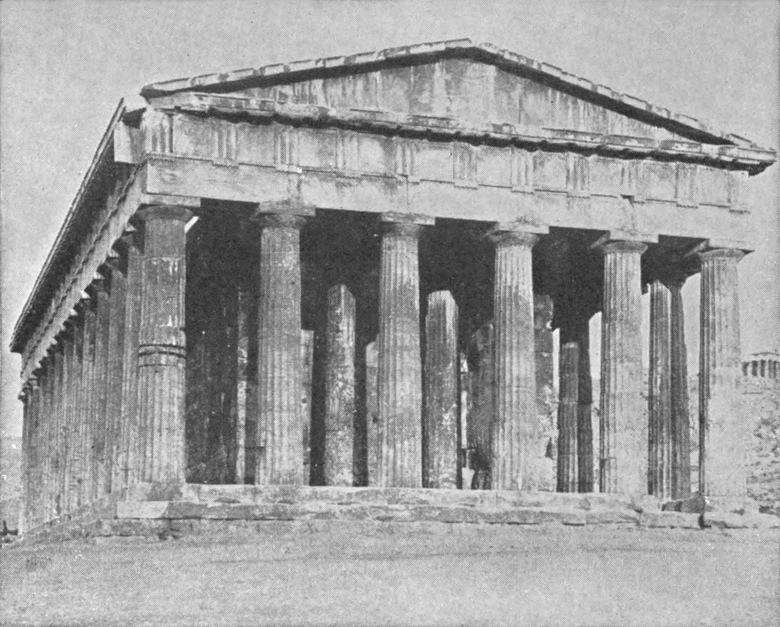
THESEION TEMPLE, ATHENS: DORIC ORDER OF ARCHITECTURE
The perfection of the Hellenic style, derived from Ægean architecture. 5th century B.C.
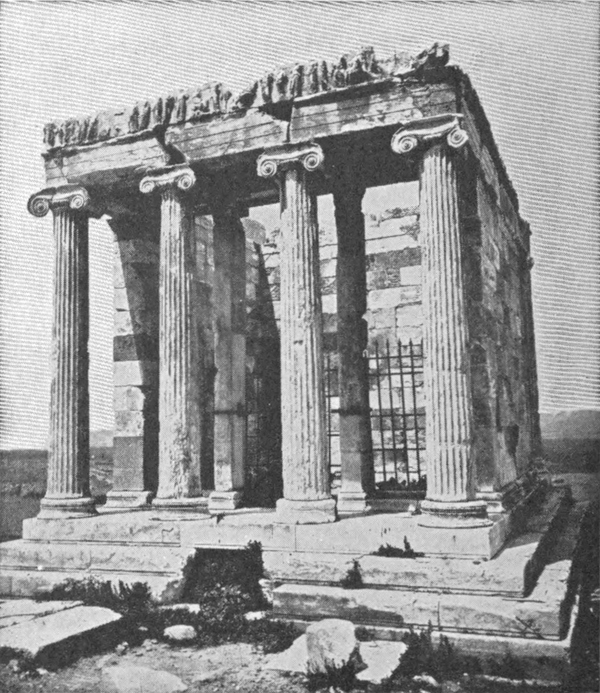
TEMPLE OF WINGLESS VICTORY: IONIC ORDER
The perfection of the second Hellenic style, refined from the Doric, probably in the first place by Asiatic Greeks. Fifth century B.C.
The Contact of Early Civilisations
Secondly, it is now known that this civilisation, of remote indigenous origin and independent development, reached a very high point of achievement in many respects which afford the best-known tests of culture—namely, in its artistic products, extant examples of which offer ample evidence of wonderfully close study of natural forms, of mastery of decorative principles and their execution, and of a sort of idealistic quality, which has been rightly called “a premonition of the later Hellenic”; also, in architectural construction and the organisation of domestic comfort, as displayed in the palaces at Cnossus and Phæstus, with their superposed stories, their broad stairways of many flights, their rich ornament, their arrangements for admitting air and light, and their astonishing systems of sanitation and drainage. The written documents found, though still undeciphered, plainly attest an advanced knowledge of account-keeping and correspondence. The frescoes and gem scenes, as well as many surviving objects of luxury, attest the existence of a leisured and pleasure-loving class; and, lastly, the tribute-tallies of Cnossus support the inference which is legitimately drawn from the uniformity of certain material objects all over the Ægean area at certain periods—notably that contemporaneous with the earlier part of the Eighteenth Egyptian Dynasty—and also from the wide range of certain place-names, that there was an extensive imperial organisation. The centre of this empire, as well as the original focus of the civilisation, was almost beyond question in Crete. The prejudice in favour of other focuses raised by the priority of Ægean discoveries elsewhere, especially those made in the Argolid, has been greatly weakened by demonstration of the superior catholicity and quality of Cretan culture, and by recognition of the failure of Mycenæ to offer evidence of anything like the same antiquity. And no more need be said here to counteract it than that, if Buckle’s statement of the climatic and geographical conditions necessary to the first development and upward progress of culture be sound, those conditions were never present in plenitude anywhere in the Ægean area except in Crete. There are found in the most conspicuous degree the combination of these geographical features—large tracts of fertile and deep lowland soil; mountains so situated as to cause abundant precipitation, and so high as to store snow against the early summer; absence of both swamps and desert areas; and a climate not prone to extremes.
What Crete has Taught us
Like all other high civilisations the Ægean both borrowed and lent. Since its debts could be contracted only with contemporary cultures as high as its own, they were owed mainly to Egypt and Babylonia, while its loans went out chiefly to lower civilisations further removed than itself from the eastern centres, those, namely, of the European continent. As regards Egypt, something has been said already of its intercourse with the Ægean in all ages of the latter’s prehistoric period. The evidence of that intercourse, known even before the exploration of Crete, was fairly abundant, though limited almost entirely to later ages of Ægean culture, often called particularly “Mycenæan.” The “pre-Cretan” case was set forth very concisely in a paper read before the Royal Society of Literature in 1897 by Professor Flinders Petrie, who enumerated the objects of Egyptian fabric or style found on Ægean sites, notably at Mycenæ, and in Cyprus and Rhodes; and of objects of Ægean style or fabric found in Egypt, notably at Thebes, Memphis and Tell-el-Amarna and in the Fayum. One word of warning only may be added—that the occurrence of such imported objects, especially if they be of the amulet class, on a site of a certain date does not necessarily imply exact contemporaneity with the period at which the objects were actually produced; for they may well have been carried hither and thither in the stream of trade for some time ere coming to rest, and been long preserved afterwards. Some of the Cypriote and Rhodian tombs, for example, in which scarabs and other Egyptian objects of the Eighteenth Pharaonic Dynasty have been found, are probably considerably later than that dynasty.
Crete has largely reinforced this evidence, not only by throwing it back to a much earlier time than that of the Eighteenth Dynasty, but by proving that in its later periods Ægean art had come to be considerably modified, both in forms and in motives and treatment of decoration, by the art of Egypt. We have then to do, not merely with mutually imported objects, but, much more than was previously understood, with the mutual action of influences—the strongest possible proof of close intercourse. On the Ægean side, our sole concern at present, are now found scenes represented in fresco-painting or metal-work—for example, the mural scene with a river and palms at Cnossus, and the well-known cat-hunting scene inlaid on a Mycenæan poniard—and also decorative motives which are of obvious Egyptian parentage. Other motives proclaim their alien origin by more or less mistaken treatment. The best instance in point is the use made of the lotus motive in Greece and the isles, where the flower was never domiciled.
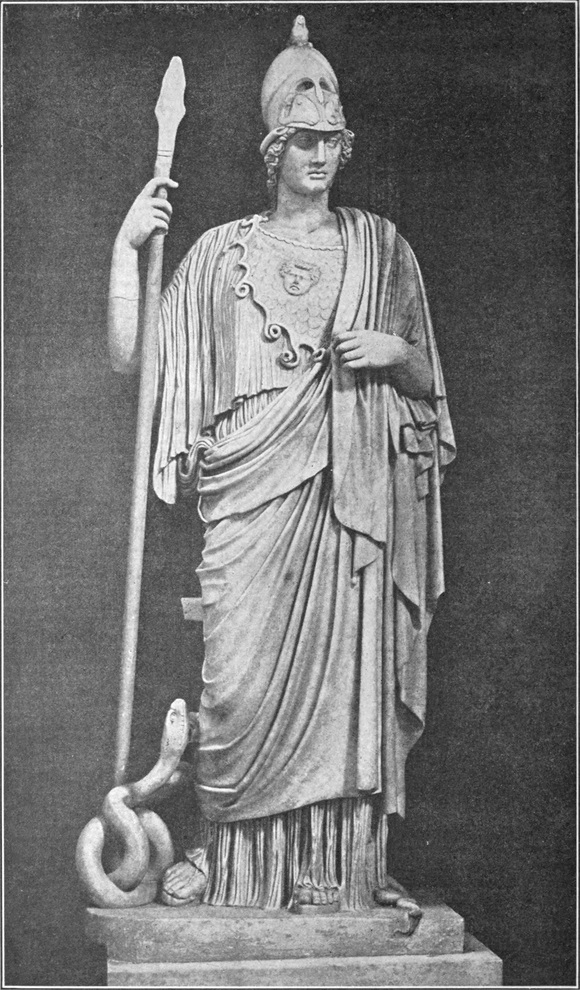
PALLAS ATHENA, THE MAIDEN GODDESS OF ATHENS
One of the chief glories of the art of ancient Greece left to the modern world. Athena was the goddess and protectress of Athens, and her statue stood at the height of the Acropolis, dominating the city.
LARGER IMAGE
THE SUPREME MONUMENT OF ANCIENT GREECE LEFT TO THE MODERN WORLD
The Venus of Milo, one of the noblest examples of Greek art, and one of the most famous statues extant. Found at Milo, in Crete, about 100 B.C., and now in the Louvre, Paris.
LARGER IMAGE
Influence of Egypt and Mesopotamia
For influences of the Mesopotamian civilisation we have to look in the main to the early civilisations of Syria and Asia Minor; but evidence is not wholly wanting on Ægean sites. A Babylonian cylinder came to light at Cnossus; the fashion of dress, especially female, as shown in Ægean frescoes and gems, is very like the Babylonian, from whatever primitive garments it had been developed; and in other respects also the intaglio class of Ægean art products shows at least as much Mesopotamian as Egyptian influence. It has borrowed the decoration of both cylinders and scarabs; but it proves its essential independence all the time by never adopting the forms of either of those characteristic alien vehicles of glyptic art.
Religious Ideas of Early Times
Lastly, in the most important of all aspects of early civilisation—the religious—we now know that the Ægean approximated very closely to the old civilisations to south and east of it. The main idea of its cult was that which seems to have been the oldest and the most dominant in such cults—namely, the worship of the reproductive force of Nature. This idea was embodied, as soon as divinities were imagined in human shape, in feminine form, the desired relation of divinity to humanity being expressed by the addition of a son-consort. How far other features of this cult, common to the south-eastern lands—such as the descent of the son to the human race, his periodical death at the hands of the latter, and his joyful resurrection—were present, we do not yet know. It would probably be false to ascribe the presence of this cult idea in Ægean civilisation to any foreign influence, for it seems to be a necessary expression of the religious sense of many peoples, and is as likely to have been as indigenous in the case of Rhea and Zeus (to give the Divine pair their possible Ægean names) as in those of Isis and Osiris, or Ashtaroth and Tammuz-Adon. But we may note first that here was a vital bond of affinity between the Ægean folk and their mainland neighbours on east and south, and second, that long before historic Hellenic times, the former had arrived at that essential condition of progressive civilisation, an anthropomorphic conception of divinity.
The Greek Debt to Ægean Civilisation
Enough has now been said to show that Ægean civilisation was both a broad channel through which influences of Asiatic and Egyptian culture could and did flow, and also in itself of such importance as to be likely to exert influence on nascent civilisation in Europe. To see whether it did so, we look first to the culture which succeeded it in its own area, the Hellenic culture of the historic age, about whose action, exerted indirectly on all subsequent civilisation, there is no possible doubt. And at the outset stress must be laid on the fact that we are dealing, in respect of the two civilisations in question, with one and the same geographical area. There is here no question of alien influences dependent on short or long communications by sea or land. The Hellenic race, if indeed to be distinguished from all elements in the earlier Ægean, came into the very domain of the latter, and experienced by actual contact the full force of the pre-existent culture. This being so, the probability of heavy debts having been contracted by the later culture to the earlier is enormous; and it becomes all but certainty when the few facts which we know about the early history of the Hellenic peoples proper come to be considered in the light of ascertained general laws governing the relations of intermingled races.
Emerging of Historic Hellenism
It is clear that the Hellenic tradition of a great descent of peoples from the north into mainland Greece and the western isles, about 1000 B.C., enshrines substantial fact. These peoples, possessed of iron weapons, were superior to the Ægean folk in war, but evidently inferior in the softer social arts. The Greeks called them Dorians, a name afterwards associated with the most distinctive, but the least cultivated, of the historic races of the peninsula—a race, however, possessed in its full form of the conception of the city-state; which implied the subordination of the individual to the corporate body, and was the chief social message to be taught thereafter by the Greek to the world.
Without calling these invaders by any one name, or supposing Northern folk to have made then their first appearance in the Ægean area, we may safely see in this Greek tradition the record of a cataclysmic change out of which historic Hellenism was to issue at the last. In proof of the invader’s inferiority in the useful arts we have the undoubted fact that the command of the Greek seas, formerly held by Cretans and other Ægean folk, passed for some centuries into Semitic hands—the hands of those Sidonian Phœnicians whose coming, but as yet incomplete, “thalassocracy,” is reflected in the most important of contemporary documents, the Homeric lays, and, under the lead of the Tyrians, was to grow greater yet. To illustrate their inferiority in the luxurious arts we have the dry, uninventive style of artistic decoration known as the “Geometric,” which also lasted for some centuries. It is evident that the newcomers were conquering soldiers, who destroyed, but could not of their own virtue create.
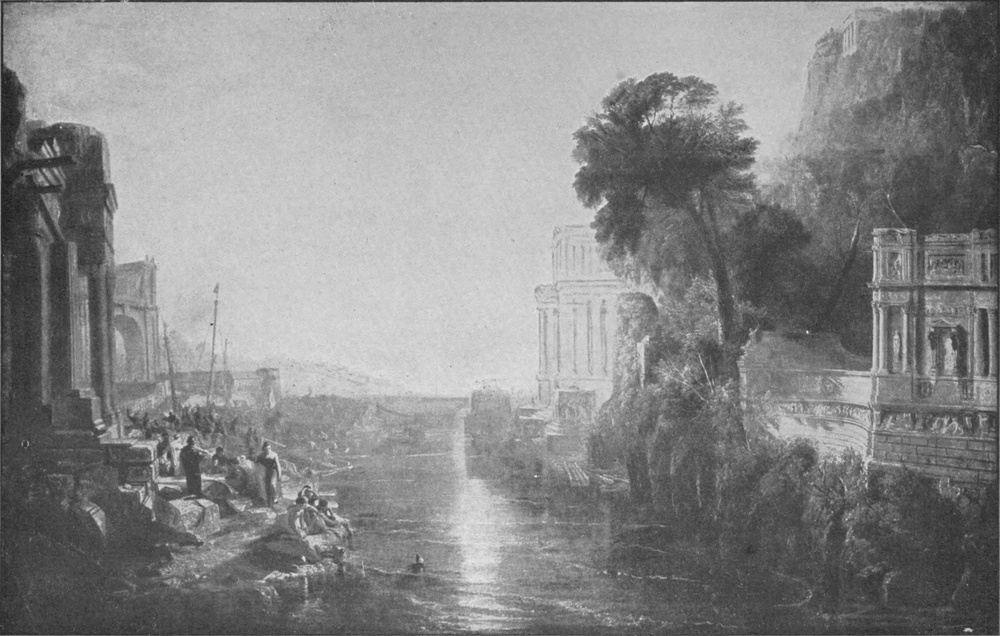
A GREAT CITY OF ANCIENT CIVILISATION: THE BUILDING OF CARTHAGE BY DIDO
From the painting by Turner, in the National Gallery.
LARGER IMAGE
Now, the course of events after all such conquests, if permanent but not exterminative, is the same. The rude military invaders, finding themselves deficient in woman-folk, take not only slaves but wives from the civilised people of the soil. The resultant children tend more and more, as time goes on, to be influenced by their native mothers. In them previous culture begins to revive, and ere many generations are past, so completely is the new race assimilated by the old that the language in general use is that not of the conquerors but of the conquered.
Hellas and its Conquerors The New Civilisation in Greece
For a crucial instance we need look no further than to the after history of the Norman invaders of Britain; and we might almost assume, were there no actual memorials of the fact, that the civilisation which arose anew in the Ægean area, after the tumultuous period reflected in the Homeric lays and the Greek tradition of early Asiatic colonisation, was largely influenced by what had been there in the Ægean Age. There is, however, proof that such was indeed the fact. As will presently be pointed out, the long period of unrest had allowed other alien influences to enter Hellas notably the Semitic from Phœnicia. But beside what appears to be Asiatic, and also beside what was new and distinctively Hellenic in the historic culture, which became prominent from the ninth century onwards (and this includes such all-important features as the conceptions of a supreme Father-God, and of the city-state—an idea of social order as obdurate to southern influences as our own Germanic social order has proved)—beside all this, the “non-Hellenic” elements in the civilisation are almost entirely such as may be referred to Ægean prototypes. Hellenic art, which flourished pre-eminently among the non-Dorian inhabitants, is distinguished from Eastern art by just those distinctive qualities of both realism and idealism which distinguished the highest art of the Ægean Age. Hellenic religion has for its oldest, most universal, and most popular deities various feminine impersonations, indistinguishable from the earlier Mother-Goddess. The chief of these is the unwedded Artemis-Aphrodite, supreme patroness of life all through the historic period of pagan Greece, the essential features of whose cult are still dominant in the observance of the Greek peasant-worshippers of the Christian Virgin. Hellenic cult is full of interesting survivals of the Tree and Stone ritual amply attested in Ægean cult. Hellenic custom retained many traces of a matriarchal system, appropriate to a society exclusively devoted to the Great Mother, whom Hellas took in name and actual primitive form to her pantheon under the names of Rhea and Kybéle. The Dorian and Ionian styles of architecture can be directly affiliated to the Ægean as revealed in Mycenæan tombs and Cnossian frescoes, and the Greek house is a development of the earlier domestic plan. Certain notable exceptions go far to prove the rule. The dress of the upper class, and the fashion of body-armour and weapons, seem to have been determined henceforth by the new folk. These are just the features in civilisation which conquering invaders would naturally introduce and retain. It is hardly necessary to add that if Ægean civilisation seriously influenced that of historic Hellas, it seriously influenced at second hand that of Western and Central Europe.
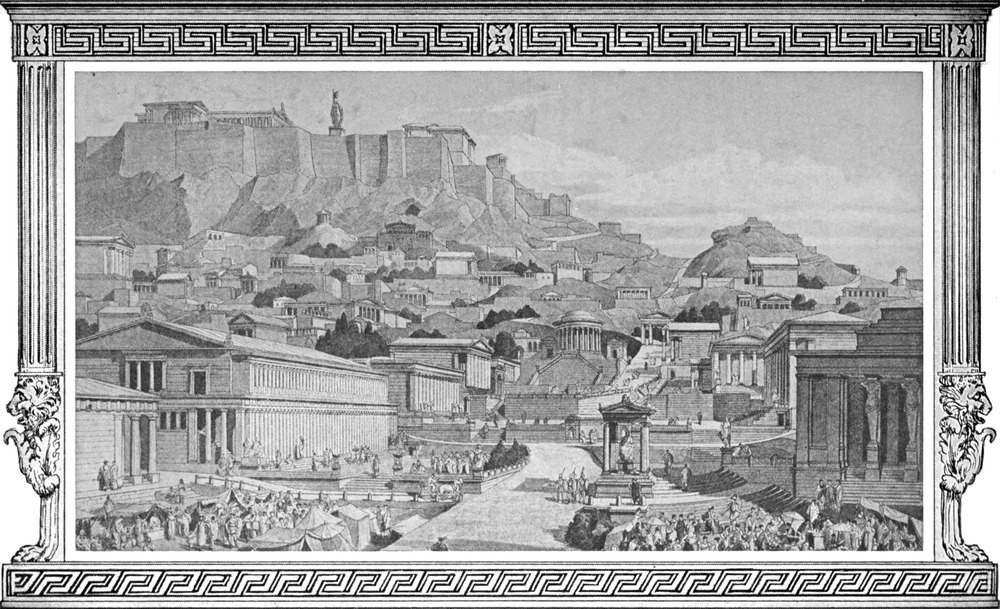
ATHENS IN THE HEIGHT OF HER CIVILISATION: THE MARKET PLACE RECONSTRUCTED WITH THE ACROPOLIS IN THE BACKGROUND
LARGER IMAGE
Other Ægean Influences in Europe Commercial Communication with Europe
Hellenic civilisation, however, was perhaps not the only medium through which Ægean influence affected inner Europe. In Scandinavian tomb-furniture certain presumably foreign decorative motives, notably the returning spiral and the triquetra, which are identical with characteristic Ægean types, make their appearance in the first part of the local Bronze Age; and these have been noticed also, at a slightly later period, in the art of early Ireland, at that time the most civilised of the British Isles. In point of form also some Northern weapons in bronze resemble those of the Far South. If the spiral motive stood alone, the affiliation of this distant decorative art to the Ægean would be very doubtful, since Nature, whether through the forms assumed by vegetable tendrils or animal horns, or through those of shavings of wood or metal, might easily have suggested the ornament independently. But taken together with other related motives, and the evidence of assimilation of weapon-forms, these spirals raise a presumption in favour of an early obligation of North Europe to Ægean civilisation. A possible explanation of this fact, if fact it be, has been found in the communication which appears to have been created by the Ægean demand for Baltic amber; and early ways for this traffic have been traced by Dr. Arthur Evans up the Adriatic, and also overland from the Ægean shores to the Danube basin, whence, from a point near the later Carnuntum, a combined route ran up the Moldau to the Elbe system. Further, it is the opinion of Professor Montelius and some other archæologists that not only certain bronze forms and decorative motives, but the usage of this metal itself was derived in Scandinavia from the south, somewhere before 1000 B.C. Since pure copper and pure tin hardly occur in Sweden among objects of this age, it has been held that the bronze was imported ready made in the mass. But Sweden contains large natural copper deposits, and tin is also found; and, therefore, this opinion is not universally accepted. Indeed, some authorities reverse the debt, and actually derive Ægean knowledge of bronze from Europe. If, however, the first derivation be ever proved, we shall have to refer the first use of metal weapons—an enormous step forward in social progress—in North and Central Europe to the Southern civilisations, such as the Egyptian, which had certainly known and used bronze for at least a thousand years before we find it in Sweden. It is sometimes maintained that Cyprus was the first, and long the sole, source of copper, which travelled north by way of Asia Minor and the Ægean to Hungary and inner Europe; but this is not proved. In any case, for some reason, bronze seems to have become known to the Scandinavians and Danes earlier than to the Gallic peoples.
Influences in Western Europe
Yet more evidence is there of possible Ægean communication with Central Europe after the introduction of iron, which seems not to have reached Scandinavia till almost the Christian Era. Transylvanian, Russian, and Balkan graves have yielded to recent explorers abundance of both weapons and decorated articles of personal use and adornment, closely resembling fabrics in the later periods of Ægean civilisation. Further into the European continent we have again the various evidence of the early Iron Age graves of the Salzkammergut on the south-eastern fringe of the Bavarian plain. This “Hallstatt” culture, as it is called, from the location of the chief cemetery, presents both in character and development an extraordinarily close parallel to that of the Ægean Geometric Age. About the same period we know also that a civilisation was in progress in the fertile lands round the head of the Adriatic, which is called Veneto-Illyrian, and shows even stronger evidence of Ægean influence than the Hallstatt culture; as, indeed, might be expected, if it be remembered that in Southern and Central Italy, as well as Sicily, forms and decoration, obviously learned from Ægean civilisation, as well as actual imported Ægean objects, had been plentiful ever since the bloom of the Ægean age. A visit to the local collections in Syracuse, Bari, and Ancona, will establish this fact to the satisfaction of any archæologist. These two civilisations, that of the Salzkammergut and that of the North Adriatic lands, have important bearing on the development of all Western Europe; for we know that the Celtic peoples, who penetrated south of the Alps in the sixth and fifth centuries B.C., learned much from both, and especially from the second; and graves, furnished after they had been pressed back again into Switzerland and Gaul, show abundant evidence of what is called “sub-Ægean” influence—that is, of form and ornament probably derived ultimately from Ægean culture, but indirectly, or after undergoing considerable degradation. Through various subsequent intermediaries, notably the Belgic tribes, these derivatives passed ultimately to our own islands, and we find their influence operative on early English art.