Volume 1 — LIST OF MAPS APPEARING IN THE BOOK OF HISTORY (continued 3)
Reading edition
At last, statesmanship and generalship found their supreme incarnation in one person, Julius Cæsar. For many years one of the two foremost men in the Republic, he finally crushed his rival Pompeius and became acknowledged head of the state. Before he could complete the work of reconstruction, Cæsar fell beneath the daggers of Republican enthusiasts; but ere many years had passed his adopted son Octavian triumphed over all rivals, and established the Principate or Empire, the absolute dominion of one ruler over the whole Roman world—although that dominion was still maintained under the Republican forms.
TIME-TABLE OF THE WORLD: B.C. 500 to 1
Collision of East and West. The Glory of Greece. Alexander and His Conquests. The Rise of Rome. Overthrow of Carthage and the Establishment of the Roman Empire
B.C. 500 The East and Africa Europe B.C. 500
GREECE: Revolt of Ionian Greeks from Persia, 499. Liberation from Persia of Greek States in Asia Minor. Revolt of Egypt from Persia: re-conquest. GREECE: Repulse of Persia at Marathon (490), Salamis (480) and Plataea (479) and of Carthage by Syracuse at Himera (480). ROME: Increase of political power of Plebeians. Tribunes. First Roman Legal Code (the XII. Tables).
450 450
Egypt again independent of Persia. GREECE: Age of Pericles, the great Athenian dramatists, and Phidias. Struggle for supremacy between Athens and Sparta. ROME: Decadence of Etruscan power. Progress of Plebeians in obtaining administrative power.
400 400
Revival of Persian energy under Artaxerxes Ochus. GREECE: Socrates and Plato. Spartan and Theban supremacies. ROME: Invasion by the Gauls. The land question: the Licinian Laws. Establishment of new “Senatorial” oligarchy. Extension of Roman military settlements or colonies.
350 350
Overthrow of Persia by Alexander; India invaded. Partition of Alexander’s Empire. The Ptolemies in Egypt, and the Seleucidæ in Asia. Friendly relations between Seleucus and Chandragupta of Hindostan. GREECE: Philip of Macedon. Demosthenes at Athens. Aristotle. Conquests of Alexander the Great, 334–322. ROME: Second Roman treaty with Carthage. Dissolution of Latin League. Supremacy of Rome in Italy. Samnite wars.
300 300
Contests between Syria (Seleucidæ) and Egypt (the Ptolemaic dynasty). ROME: Legislative power of Plebeian Comitia. Tributa established. Pyrrhus in Italy and Sicily. Treaty between Rome and Egypt. Senatorial supremacy at Rome. First Punic War (264–241). GREECE: Rise of the Achæan League.
250 250
Asoka, king of Maghada (Hindostan), Buddhist. Extension of the Seleucid dominion under Antiochus the Great. Rise of the Parthian dominion of the Arsacidæ. Fall of Carthage, 202. Carthaginian power established in Spain. ROME: Second Punic War, 218–201. Hannibal in Italy, 218–203. Scipio in Spain, 211–206. Zama, 202. Extension of Roman dominion over Spain and North Africa.
200 200
Wars between Parthia and the Seleucidæ. Maccabean revolt of Judæa. Antiochus Epiphanes conquers Egypt, but retires. Egypt and Syria become Roman protectorates. Organisation of provinces subject to the Imperial Republic. History of Europe merges in that of ROME. Collision of Rome with (1) Macedon; (2) the Syrian kingdom of the Seleucidæ. Macedon becomes a Roman province. Rome assumes protectorate of Egypt and Syria.
150 150
Nabatæan State in Arabia. A Tartar kingdom established in east of Parthia. Jugurthan War in Africa. Third Punic War, and destruction of Carthage, 146. Greek States absorbed into province of Macedonia. Development of political power of (1) demagogues; (2) soldiers. The Gracchi, 133–121. Conquest of South Gaul: defeat of Teutones and Cimbri by Marius.
100 100
Mithradatic wars, 88–63. The East, to the Euphrates, brought under Roman dominion. Judæa: fall of the Maccabees. Social war. Marius and Sulla. The Proscriptions. The Sullan Constitution, 81. Pompey. Rise of Julius Cæsar. The East brought under Roman dominion. Cæsar conquers Gaul; lands in Britain.
50 50
1 B.C. Scythian or Tartar incursion into India, and admixture with Punjab races. Egypt becomes a Roman province, 30. Overthrow of Pompey: Cæsar virtual emperor. Murder of Cæsar, 44. Rivalry of Antony and Octavian, 43–30. The Principate, or Empire, established under Augustus (Octavian) in virtue of the Imperium Proconsulare (27) and Tribunicia Potestas (23). The Empire organised. Cicero, Virgil Livy, Horace. 1 B.C.
The Birth of Christ
A tremendous event in itself, the reign of Augustus also witnessed one which has had a great influence on the history of the world—the birth of Christ. His ministry, to which perhaps the term event should be applied, was during the reign of the second Emperor, Tiberius. The new faith born on the soil of Judæa was to modify profoundly all the ideals, social and political as well as theological and personal, of the entire Western world; but for many years its adherents remained nothing more than a persecuted yet steadily growing sect; suspected and hated as anarchists rather than as misbelievers, in a world where the rankest and wildest superstitions lived side by side with a general intellectual scepticism.
For four centuries the Imperial city ruled over nearly the whole known world. Beyond the Euphrates on the east, beyond the Rhine and the Danube, she could maintain no permanent footing; within her own borders it seemed as though her sway became a part of the natural order—so much so that when her power had passed away her very conquerors did her homage and took upon themselves titles as her officers.
Rome in her Decline
But the overthrow was yet a long way off. The reconstruction organised by Augustus and his Ministers was developed by able rulers—Tiberius, Trajan, Hadrian, the Antonines—during some two hundred years, in spite of intervals when a murderous tyranny or a feeble incompetence occupied the throne of the Cæsars. From the Pillars of Hercules to the river of Mesopotamia, northward as far as Britain, southward to the deserts of Africa, Roman civilisation, Roman law and justice, Roman military discipline, and Roman roads maintained the Roman peace.
Fall of Rome and Rise of Goths
Then came an era when the Imperial purple became the prize of successful generals acclaimed by their legions; and the frontier armies, themselves largely formed out of Teutonic or other semi-“barbarian” tribes, found themselves face to face with new barbarian hordes which for another century and a half they held in check. But the tremendous external pressure on frontiers so vast made it imperative that the Government should be somewhat decentralised. At the end of the third century Diocletian parted the empire into four great divisions. The new system could not endure; Constantine the Great again became sole emperor. Under him Christianity was at length adopted as the state religion; the Church herself became a fundamental factor in the political system; and the political centre of gravity was transferred from Rome to Byzantium.
Beginning of Byzantium
Again the empire was partitioned, and then, for a brief while before the end of the fourth century, united again under Theodosius. But the end was at hand. For a few years the great general Stilicho held the Teutonic Goths at bay in Italy, while Vandals and Sueves poured through Gaul into Spain. Then, early in the fifth century, Stilicho died. Alaric led his conquering hordes to the gates of Rome, and sacked the Eternal City. His successor, Ataulf, took his Goths away, to drive the Vandals out of Spain into Africa, and set up a great western kingdom on their own account. But after the Goths, fresh barbarians swarmed in—Tartar Huns under Attila, who wrought huge devastation and then vanished for ever; then fresh Teutonic armies, which took possession of Italy, though in the East the Empire still held its own. And in Gaul the (German) Franks under their king, Clovis (Chlodwig, Ludwig), established the dominion which was to give its name to France when the Frankish element had almost passed out of the country. Far-away Britain had already been abandoned, and was falling a prey to the Saxons and the Angles, the “English” who were driving the earlier Celtic inhabitants before them into the mountain fastnesses of the west and north. Again, in the East, in the sixth century, the empire centred at Byzantium asserted its power. Justinian is memorable for that great codification of Roman Law on which the legal systems of half the jurists in Europe have been based. His reign is famous also for the exploits of his brilliant general, Belisarius, who destroyed the Vandal kingdom in Africa, restored the Imperial rule in Italy, and recovered provinces in Asia which had been in danger of falling into the grip of the now aggressive rulers of Persia. But in the West, the success was only temporary. Under pressure of Tartar or Slavonic hosts from the East, a fresh Teutonic swarm, the Lombards, entered Italy and mastered the North. The significance of Rome now lay in the supremacy of her pontificate, unacknowledged in the East.
TIME-TABLE OF THE WORLD: A.D. 1 to 500
Organisation of the Roman Empire. The Rise of Christianity. Partition of the Empire. The Barbarian Invasion and Fall of the Western Empire. Rise of the Franks
A.D. 1 The East and Africa Europe A.D. 1
Beginning of the Christian Era. Imperial system completed under Tiberius. Rhine, Danube, and Euphrates form frontiers of the Empire. Caligula and Claudius emperors. BRITAIN: Roman occupation. Spread of Christianity.
50 50
Destruction of Jerusalem by Titus, 70. Nero emperor: Galba, Otho, Vitellius. Vespasian: the “Flavian” emperors. Nerva chosen by Senate in succession to Domitian. The “Five good Emperors,” 96–180. Succession of Trajan, 98.
100 100
Arabia designated as a Roman province. Trajan’s expedition to the Persian Gulf unsuccessful. Eastward expansion of Rome checked. Trajan’s campaigns in Dacia. Administration organised under Hadrian. Roman law systematised by Salvius Julianus. Antoninus Pius.
150 150
Establishment of Roman supremacy in Armenia. Successful campaigns of Severus against Parthians. Development of Roman civilisation in Gaul and Spain. Campaigns of Marcus Aurelius in Pannonia. The legions in Illyria, largely composed of “barbarians,” acquire power. After Commodus, series of emperors by military selection. Severus temporarily assigns the West to Clodius Albinus.
200 200
Persian kingdom of the Sassanides displaces the Parthian Empire. Further systematising of Roman law by the juris consulti, Ulpian, etc. Increasing pressure of Teutonic tribes on the frontier. Campaigns of Maximinus. Decius emperor: official persecution of Christianity.
250 250
Overthrow of Emperor Valerian in the East by the Persians. Destruction of Palmyra in the reign of Zenobia. Advance of the Goths and Alemanni checked by Claudius and Aurelian. Diocletian emperor. Division of the Empire under a subordinate “Augustus” and two subordinate “Cæsars”.
300 300
Extension of Buddhism in China. Last persecution of Christians under Diocletian. Constantine the Great. Constantinople (New Rome, Byzantium) is made the centre of the Empire. Christianity established as the State religion Council of Nicæa.
350 350
Unsuccessful Roman campaign against Persia. Temporary revival of Paganism under Julian the Apostate. Advance of the Goths checked by Theodosius. Empire separated into East and West, 396. Alaric the Visigoth held in check in the Western Empire by Stilicho. Westward movement of Vandals through Gaul to Spain.
400 400
Vandals, expelled from Spain, established in Africa. Sack of Rome by Alaric, after death of Stilicho. End of the Roman occupation of Britain. The Goths withdraw westwards. Establishment of the Visigothic kingdom of Theoderic in Spain and Aquitania. Irruption of the Huns under Attila.
450 450
500 A.D. BRITAIN: The coming of the Saxons. Barbarian “Patricians” set up and depose Western Emperors. Odoacer, “King” in Italy, recognises supremacy of the Eastern Emperor Zeno. Theoderic the Ostrogoth founds a Teutonic State in Italy. Rise of the Franks in Gaul, under Clovis. 500 A.D.
In Spain, the Gothic supremacy gave promise of an orderly and just government. In the wide realms of the Franks anarchy and bloodshed were almost ceaseless. In neither did the dominant Teutons drive out the older Iberian and Celtic populations, as the English were doing in the open lands of the northern island. In both, the German institutions were developing into that feudal system which was utterly incompatible with the maintenance of a strong central rule, since it enabled a powerful vassal to bid defiance to his nominal suzerain. Throughout the sixth and seventh centuries progress was stayed in ancient Gaul; in Spain it was to be revolutionised by a new invader.
Islam in Being
Eastward, at the end of the sixth century, the Slavonic wave was surging upon the empire’s northern frontier; in Asia, Persia was again forcing her way towards the Mediterranean. Both were checked by the Emperor Heraclius early in the seventh century. But, meantime, a new Power had come into being. Mohammed had arisen. Inspired by the fanatical fervour of Islam, the warriors of Arabia, soon to be known as the Saracens, swept all before them. They did not at first make Europe their objective; the Caliphs carried their conquering arms over Western Asia, into Egypt, and along the southern coasts of the Mediterranean. Then they began to beat against the empire itself. The eighth century had hardly opened when they poured into Spain; dissensions among the Gothic chiefs gave them prompt victory. They swept up to the Pyrenees; but their advance was stayed by Charles Martel, the virtual lord of the Frankish kingdom. On the East their armies assailed Constantinople, but were disastrously repulsed by the Emperor Leo the Isaurian.
Now, for the first time, Papal sanction was demanded and obtained for a change of dynasty. The last Merovingian king of the Franks was deposed in favour of Pepin, the son of Charles Martel. He was succeeded by his son, Karl, a German of the Germans, despite the French form of his popular title Charlemagne.
Charlemagne and His Empire
During his long reign the Moors in Spain were driven back beyond the Ebro; the Saxon tribes across the Rhine were forced to submit and to accept Christianity; the Lombard oppressors of Italy were vanquished; and on the Pope’s initiative, Charlemagne himself was acclaimed and crowned at Rome as emperor and successor of the Cæsars. All of the West that remained to Byzantium was Southern Italy. The revived empire came into being on Christmas Day, A.D. 800.
The great dominion and the organisation constructed by Charlemagne fell into divisions after his death. The lands east of the Rhine remained German; on the west, the Teutonic forces yielded to the Latinised Celtic spirit. Slowly France and Germany emerged. In England the supremacy among the rival peoples passed from the Angles of Northumbria or of the Midlands to the Saxon house of Wessex. Hungary was held by the Mongolian Avars, presently to be displaced by their Magyar kinsmen; otherwise Eastern Europe, Illyria, as well as the Trans-Danube districts, was being gradually possessed by the Slavonic races. Their westward movement was decisively stayed in the tenth century by Henry the Fowler and Otto the Great, who, for the second time, revived the “Holy Roman Empire” in the West in a form which effectively translated it into the “German Empire.” Meanwhile, the Vikings from the north first ravaged the western coasts, then wrung great provinces from the kings of England, and of “Francia,” preparing for the day when the Norman spirit should set the tone of Western Europe.
Birth of Feudalism in Europe
In the Eastern Mohammedan world the Saracen dominion was passing to Tartar races—to the Seljuk Turks or the Ghaznavid Turks, and later to the Ottomans; the genuine Saracens had seen their greatest days in the times of Harun-al-Raschid, when the Frankish Empire of Charlemagne was being dismembered. Europe in the eleventh century had passed, or was passing, into what is distinctively known as the Feudal Period, or later Middle Ages. Everywhere it became the object of the great rulers to establish a strong central government, and of the Papacy to establish a supremacy over all governments. Feudalism and the Papacy were the rivals of the centralising tendency.
TIME-TABLE OF THE WORLD: A.D. 500 to 1000
Teutonic Races Dominate the West. Rise of Mohammed: extension of Mohammedan Rule from Cordova to Kabul. Western Empire Revived by Charlemagne and again by Otto
A.D. 500 The East and Africa Europe A.D. 500
Overthrow of the African Vandal kingdom by Belisarius, general of Justinian. Franks predominant on Rhine and in Gaul. Justinian emperor at Constantinople. Roman Law codified in the Institutes. Overthrow of Gothic kingdom in Italy by Belisarius. Advance of Saxons (South) and Angles (East) in England.
550 550
Buddhism introduced in Japan. Advance of Persia against the Eastern Empire. Lombard conquest of North Italy. Spread of Celtic Christianity in Britain by St. Columba. Pontificate of Gregory the Great. Latin Christianity introduced into Kent by St. Augustine, 597.
600 600
Overthrow of Persia by Emperor Heraclius. MOHAMMED. The Hegira (622). Conquest of Egypt and Syria by the Caliphs Abu-bekr and Omar. Conquest of Persia, and extension of Caliphate over West Asia. ENGLAND: Supremacy of Northumbria. ITALY: North under Lombard dominion; South attached to the Eastern Empire. Avar dominion in Hungary. Slavonic settlement in Servia.
650 650
Saracens (Caliphate) attack the Empire in the East and in Africa. Rise of the Shiite sect of Mohammedans. ENGLAND: Final overthrow of Paganism. Triumph of Roman over Celtic Christianity. FRANKS: Dukes of Austrasia (East Franks) dominate the Merovingian kings.
700 700
Revival in India of Brahmanism, gradually developing into modern Hinduism. Saracens (or Moors) overrun Spain. Saracen advance checked by Emperor Leo the Isaurian at Constantinople, and by Charles Martel at Tours. Beginning of the Iconoclastic controversy. Discussions between Papacy and Eastern Church.
750 750
Division of the Caliphate into Eastern (Abassid) at Bagdad and Western (Ommeiad) at Cordova. Rise of the Turks in the Caliphate armies. Harun-al-Raschid Caliph at Bagdad. ENGLAND: Supremacy of Mercia. FRANKS: Fall of the Merovingian dynasty. Pepin the Short founds the Karling or Carolingian Dynasty. Empress Irene at Constantinople. FRANKS: Karl the Great (Charlemagne) succeeds Pepin as king of the Franks. He drives the Moors beyond the Ebro, conquers the Lombards, and is crowned as Roman Emperor by the Pope. (800).
800 800
Increasing power of the Western Caliphate. Subjugation of the Saxons by Charlemagne. Division of Charlemagne’s dominion among his grandsons. ENGLAND: Supremacy of Wessex under Egbert. The Danes, or Northmen, harry the coasts of Europe.
850 850
Fatemide Mohammedan dynasty established in Egypt. Decline of the Abassid Caliphs. Carolingian dominion divided into West (Francia), East (Franconia, Germany), Central (Burgundy) and Italy. Pressure of Slavonic peoples on East Germany. ENGLAND: Alfred the Great. Settlement of the Danes in the Danelagh. Organisation of Government, Law, etc. Advance of Magyars in Hungary. Iceland colonised, 874–950.
900 900
FRANCE: Duchy of Normandy ceded to Rollo. NORWAY united under Harold Haarfager. ENGLAND: House of Wessex kings of all England. GERMANY: Henry the Fowler, Saxon King of Germany, and his son Otto the Great, check the Magyar advance. Pressure of Slavs on Eastern Empire.
950 950
1000 A.D. Recovery of Eastern Provinces from the Saracens by the Byzantine Empire. EMPIRE: Otto becomes King of Italy and Roman Emperor. The Holy Roman Empire is from this time definitely German. FRANCE: The Capet dynasty replaces the Carolingian. Slavs driven back by Eastern Emperors. Russians Christianised. Slav dominion established in Poland. 1000 A.D.
England and France
In England, where a Norman dynasty and Norman aristocracy established themselves, the unifying process was astonishingly rapid. The country was comparatively shielded from Papal interposition by distance. A series of vigorous and able monarchs prevented pure feudalism from ever getting developed; it resulted that in the thirteenth century baronage and people made common cause in imposing not feudalism, but constitutional control over the kings. In France, the victory of the crown over feudalism was far slower; the feudatories were too powerful, and among them were the kings of England, as dukes or counts of great territories within France. The Hundred Years’ War was, in fact, not so much a contest for the French crown as a struggle between the French kings and their mightiest vassals. It was not till the English had been finally expelled that Louis XI. was enabled to make the crown supreme in France. There, as in England, the monarchy never submitted to the Papacy; it was so far victorious in that struggle that in the fourteenth century the seat of the Roman pontificate was transferred to Avignon, and the Pontiff himself became literally the creature of France.
Christendom and the Crusades
Spain and Byzantium alike remained for the most part outside the general European current. They were the buffers between Christendom and Islam. In the Spanish Peninsula the Moors were held more or less at bay, but the land was not freed from their dominion till the close of the fifteenth century. Byzantium held the Turks at bay till the middle of the same century; then she fell for ever. Between the eleventh and thirteenth centuries, Christendom carried on against Islam the long contest of the Crusades; but the warriors who took part in those wars neither fought nor organised as though themselves forming an organic body; the Christian hosts in Palestine were mere miscellaneous gatherings, united only in the temporary fits of enthusiasm. The Holy Sepulchre was gained, but within a century it was lost again; the crusading cause was one to which not states, but individuals only, devoted themselves. Conquest would have been possible only if the Crusaders had gone forth prepared to make their own homes in Asia. The East could not be held by garrisons with no abiding interest there.
Islam, then, held, and more than held, its own against the West; while during these same centuries it swept east and south through the passes of the Punjab into India, establishing Turk and Afghan kingdoms over most of the great peninsula; though the vast bulk of the population there held to the Hinduism which, born of the earlier Brahmanism, had almost expelled the Buddhist religion, which, however, had established itself permanently in Further India and China.
Empire, Feudalism, & Papacy
The might of Islam could have been overthrown only by a united Christendom, and for that the disintegrating forces were too great. England and, more slowly, France freed themselves from feudalism. But Christendom required one head. If the Papacy had stood by the empire, feudalism might have been broken down, and the emperor have become that head. But the Papacy aimed at supremacy for itself—the spiritual power was at war with the temporal. Anti-imperial factions claimed the support of the Church; the efforts at consolidation of the great Hohenstaufen Emperors, Barbarossa and Frederick II., were unsuccessful. The empire itself became only a congeries of kingdoms and dukedoms, counties, bishoprics, free cities, and leagues of cities, under the Austrian house of Hapsburg; while Rome, mighty from the days of Gregory VII. to Innocent III., lost its prestige in the captivity at Avignon and by the Great Schism which followed. In England Wycliffe’s voice was raised; on the south-east of the empire the Hussite wars raged, premonitory of the Reformation.
End of the Middle Ages
In 1453 Constantinople fell, and the Turk was permanently established in the east of Europe. As a counterstroke, in the west, not forty years later, the Moorish dominion in Spain was wiped out, Spain emerging as a united Christian kingdom. Before the end of the century Columbus and Gama had discovered America, and virtually rediscovered India. Across the ocean a new, almost unlimited field for expansion, for enterprise, for rivalry had been opened to the European peoples. Already in the realms of intellect old forgotten knowledge had been gradually recovered by the Renascence, the revival of learning and letters; with the intellectual expansion and the invention of the printing press paths to new knowledge were being opened. Men were shaking themselves free from the shackles of authority and tradition. Hence, the sixteenth century witnessed that revolt of half Western Christendom from Rome which we call the Reformation; in its essence, though by no means in its form at the first, a revolt against the interposition of any human authority between the individual man and his Maker. With that revolt political and national divisions were inextricably blended, while the whole was complicated by the new conditions of political supremacy created by the New World.
TIME-TABLE OF THE WORLD: A.D. 1000 to 1500
Development of Feudalism. The Rise and Decadence of the Papacy. The Crusades. Holy Roman Empire. The Organisation of England, France, and Spain. The Renaissance
A.D. 1000 The Non-Christian World Christendom A.D. 1000
Mahmud of Ghazni. Beginning of Mohammedan invasions of India. Scandinavian power: Canute, King of Norway, Sweden, Denmark, and England. Franconian line of emperors; Burgundy reunited to Empire. Dynasty of Hugh Capet in France.
1050 1050
Power of the Seljuk Turkish Dynasty. ENGLAND: The Norman conquest, 1066. Norman conquests in Sicily and S. Italy. Power of the Empire under Henry III. Pontificate of Gregory VII. (Hildebrand). Beginning of the struggle between Papacy and Empire (Henry IV.) First Crusade.
1100 1100
Development of Papal power. ENGLAND: Organisation of central government under Henry I. checked under Stephen. Norman kingdom of Sicily. Conrad, first Hohenstaufen emperor. Beginning of Guelphs (Papal) and Ghibellines (Imperial).
1150 1150
Establishment of Mohammedan (Ghori) dynasty at Delhi. Conquests of the Saracens under the Seljuk Saladin. Third Crusade (Cœur-de-Lion). The Angevin dominion of Henry II., comprising half France. ENGLAND: End of feudal anarchy. Maximum power of Crown. Henry worsted in the struggle with the Church. Chivalry typified in Richard Cœur-de-Lion. Frederick Barbarossa emperor, 1155–1190. City development. Lombard League; and German Free Cities. Advance of Moors in Spain.
1200 1200
Genghis Khan: Tartar conquests in Asia and irruption into Europe. Buddhism obsolescent in India. Highest power of Papacy, under Innocent III. Francis of Assisi: institution of Mendicant Friars. ENGLAND: Magna Charta; contest of Crown and Barons. Loss of Angevin dominion. FRANCE: Development of central power under Louis VIII. and IX. Institution of the Teutonic knights. Break up of the Eastern Empire. Venice.
1250 1250
Rise of the Ottoman (Othman) Turks. Khublai Khan in Eastern Asia. Decadence of Imperial power. First Habsburg emperor. End of the Crusading period. ITALY: Rise of Florence. Dante. Giotto. ENGLAND: Establishment of Parliament (Montfort and Edward I.). Organisation of the English nation.
1300 1300
Mameluke Sultans in Egypt. The Papacy “in captivity” at Avignon. Independence of Scotland. Independence of Switzerland. Ottoman Turks establish a footing in Europe. ENGLAND AND FRANCE: Beginning of the 100 Years’ War.
1350 1350
Rise of the Ming dynasty in China: expulsion of Mongols. Conquests of Timur the Tartar (Tamerlane) The Jacquerie in France. The Great Schism: period of dual Papacy. ENGLAND: Peasant revolt. Failure of Richard II.’s attempt at absolutism. Wycliffe. Union of Lithuania with Poland.
1400 1400
Empires of Mexico and Peru. End of Great Schism. Hussite wars. English conquest of France, and subsequent expulsion. Increasing powers of Parliament. Invention of printing press.
1450 1450
1500 A.D. Discovery of America by Christopher Columbus; and of Cape route to India by Vasco da Gama. Turks capture Constantinople. ENGLAND: Wars of the Roses, 1455–1485. Maritime greatness of PORTUGAL. SPAIN consolidated under Ferdinand and Isabella. FRANCE consolidated under Louis XI. ENGLAND consolidated under Henry VII. Establishment of absolutism under constitutional forms. Revival of learning. Humanists. Savonarola. 1500 A.D.
Growth of Modern Nations
The next two centuries, then, saw France, already a consolidated state, develop into the first military Power under the most absolute monarch in Europe—through a stage of prolonged religious strife which ended by establishing the tolerationist Bourbon, Henry IV., on the throne, through the rule of the two great cardinals, Richelieu and Mazarin, to the intolerant autocracy of Louis XIV., with a close aristocracy no longer in opposition to the crown but allied to it.
In England the development was on different lines. There we find an absolutist movement, the outcome of the Wars of the Roses. But however autocratic the Tudors were, they held by constitutional forms, and preserved the intense loyalty of their people. On Elizabeth’s death, a century-old matrimonial alliance placed the sceptres of England and Scotland in a single hand.
Then, on the theory of Divine right, the Crown attempted to override the constitution; the Civil War gave the power neither to king nor parliament, but to a military dictator. On his death the country reverted to a compromise between Crown and Parliament; the Stuarts, again, with the aid of their cousin, the autocrat of France, attempted to recover absolutism. They were driven from the country, and constitutionalism—in effect, government by an oligarchy of landowners—was decisively established. The religious problem had found a decisively Protestant solution at an early stage; but Anglicanism and Puritanism soon grew mutually intolerant; it was only with the Revolution of 1688 that toleration and constitutionalism definitely triumphed together.
Europe in Development
Meanwhile, in the reign of Elizabeth, England had asserted her intellectual eminence by giving birth to Shakespeare and to Bacon; and had decisively displaced Spain from the rulership of the seas. In the next century her colonisation of North America counterbalanced the Spanish dominion in the south and centre of the Western Hemisphere, though it was not unchallenged by France. In the East a great commercial rivalry had grown up between English, Dutch, and French—a rivalry still to be fought out.
Collision of the Dynasties
In the early years of the sixteenth century matrimonial alliances had joined Spain, the Low Countries, and the empire under a single ruler, a Hapsburg of the (Austrian) Imperial house. The vast dominion was extended by the acquisition of the golden territories of the American continent. The Empire passed to one Hapsburg branch, Spain and her dependencies to another. In the empire, a temporary modus vivendi was established between Roman Catholics and Protestants; but Spain, the colossus which threatened to dominate Europe, was split by the revolt of the Netherlands, and her power shaken to its foundations by the collision with England. In the sixteenth century, Germany was devastated by the religious Thirty Years’ War; Austria emerged only as the chief among a number of German states, and Holland won a naval and commercial position second only to that of England. The Ottoman Turks, still aggressive, were still held in check. In India, a Turkish dynasty known as the Moguls (Mughàls, Mongols) extended its sway from Kabul to the mouth of the Ganges, and almost to Cape Comorin.
At the opening of the eighteenth century the aggressive Continental policy of Louis XIV. involved Europe in the “War of the Spanish Succession.” The French king’s armies were shattered by repeated blows at the hands of Marlborough and Eugene, but he finally obtained his primary object, the recognition of his grandson as king of Spain. The threat of a Hapsburg domination passed into the threat of a Bourbon domination. In the east of Europe a final limit was set to the Ottoman aggression. In Britain, the incorporation of Scotland was completed, formally by the Union of 1707, effectively by the suppression of Jacobitism in 1746.
TIME-TABLE OF THE WORLD: A.D. 1500 to 1700
New World Entered, and East Re-entered. The Reformation. Organisation of European Nations under Absolute Monarchies. Constitutional Struggle in England. English Naval Supremacy.
A.D. 1500 Asia and Africa Europe and America A.D. 1500
The New World bestowed on Spain and Portugal by the Bull of Pope Alexander VI. Portuguese dominion established in the Indian seas by Albuquerque. Conquest of Egypt by Ottoman Turks. Safid dynasty in Persia (“The Sofy”). Raphael, Michael Angelo, and Titian. Rivalry of Henry VIII. (1509–47), Francis I. (1515–47), and Charles V. (1519–56), who combines Spain, Burgundy, and the Empire. Luther challenges the Papacy, 1517–20. The Reformation era opens.
1520 1520
First circumnavigation completed, 1522. Invasion of Hindostan (Northern India) by Baber, the first “Mogul” emperor, 1526. Expulsion of Moguls: dynasty of Sher Shah at Delhi, 1540. Turkish advance under Solyman the Magnificent. Gustavus Vasa in Sweden, 1523–60. Spain conquers Mexico (1520) and Peru (1533). REFORMATION: Subjection of Church to Crown (England). Confession of Augsburg: Protestant League. Calvin creates Presbyterianism.
1540 1540
François Xavier in Japan. Restoration of Moguls, 1556. RUSSIA: Ivan the Terrible. Order of Jesuits formally established. GERMANY: Contest between Charles V. and Protestant princes of Germany ended by compromise at Peace of Augsburg. ENGLAND: Protestant Revolution (Edward VI.) followed by Romanist reaction (Mary), and final establishment of Protestantism (Elizabeth) in England and Scotland.
1560 1560
Rule of Akbar, 1556–1605. Toleration of Hinduism. SPAIN: Philip II. and the Inquisition. Council of Trent defines limits of Roman Catholicism. FRANCE: Series of civil wars of religion, 1562–95. Revolt of Netherlands from Spain. Turkish advance checked at Lepanto, 1571. PORTUGAL absorbed by Spain.
1580 1580
Mogul dominion established and organised throughout Northern India. Gradual success of the Netherlands revolt. English naval supremacy proved by the Armada 1588. Decadence of Spain. FRANCE: Toleration secured by Henri IV. Spenser, Marlowe, and Shakespeare.
1600 1600
Development of Japanese Feudalism. Reign of Jehan Gir in Hindostan, 1605–27. First English factory at Surat, 1611. First English Embassy to Delhi, 1615. Galileo and Bacon. Union of English and Scottish Crowns, 1603. Dutch and English commerce in the East Indies. Virginia, first successful British colony in North America, 1606. HOLLAND: Independence established, 1609. GERMANY: Thirty Years’ War begins, 1618–48.
1620 1620
Reign of Shah Jehan, 1627–58. The Taj Mahal built. End of the Portuguese power in the East. Extension of the Mogul dominion into the Deccan. Gustavus Adolphus. FRANCE: Richelieu organises absolutism. ENGLAND: Constitutional struggle between Charles I. and Parliament. The Petition of Right, 1628. PORTUGAL recovers independence.
1640 1640
Rise of the Manchu (Tartar) dynasty in China. Reign of Aurangzib, 1658–1707. Rise of the Mahrattas under Sivaji. FRANCE: Rule of Mazarin: absolutism established. ENGLAND: Civil War, resulting in military protectorate. Thirty Years’ War ended by Peace of Westphalia. Commercial and naval rivalry of English and Dutch. Development of France into the leading military power.
1660 1660
France enters the field in India. Revival of intolerant Mohammedanism by Aurangzib. Expansion of the Mogul Empire over Southern India. FRANCE: Louis XIV. initiates policy of aggression. ENGLAND: Charles II. undermines supremacy of Parliament. Repression of Nonconformity by Parliament. Louis XIV. attacks Holland, with occasional support from Charles II. ENGLAND: Attack on Romanism.
1680 1680
1700 A.D. Aggressive movement of Turkey. FRANCE: Louis XIV. revokes Edict of Nantes, 1685. Constitutionalism established in England by the revolution of 1688. Wars of England and Holland against France. RUSSIA: Peter the Great. Newton and Leibnitz. 1700 A.D.
Settling Down of the Powers
From 1739 to 1763 Europe was again plunged into wars, with an eight years’ interval. The motives of those wars, and of the combinations of states on either side, were complicated; the results were simple. Prussia, under Frederick the Great, emerged as a first-class Power; France lost her North American Colonies to Great Britain; the British East India Company defeated the attempt of the French to establish a paramount influence with the native princes, the Mogul Empire having broken up into a congeries of practically independent satrapies; and the British themselves became established as a territorial Power by the conquest of Bengal. Russia also, organised at the beginning of the century by Peter the Great, had taken her place definitely among the great Powers.
During the next twenty years (1763–1783) Poland was absorbed by her neighbours. The British Empire was sundered by the revolt of the older American Colonies, which were established as the United States of America; while Canada remained loyal. By this time the whole of Europe was practically governed by absolute monarchies; but a cataclysm was at hand. France became the scene of a tremendous revolution. Crown and aristocracy were toppled into the abyss.
Napoleon and the Revolution
France proclaimed herself the liberator of the peoples; the monarchs of Europe combined to suppress the proletariat. During the last decade of the century one revolutionary constitution after another was set up in Paris, while the revolutionary armies shattered monarchical armies, and turned the “liberated” peoples into subject dependencies of the Republic. On the seas, however, Britain successfully asserted her supremacy. Of the commanders of the Republic, the most brilliant was the Corsican Bonaparte. He dreamed of making Egypt the basis for achieving an Asiatic empire, and thence overwhelming Europe; but the dream was shattered when he found himself isolated by Nelson’s destruction of the French fleet at Aboukir in the Battle of the Nile. Returning to Paris, he transformed the republic into an empire; he set up his brothers or his generals as rulers over half the kingdoms in Europe; he dictated terms to every government except Britain. Britain annihilated his fleets, and fought and beat his generals in the Spanish Peninsula. He conquered the kings, but the nations rose against him, and overthrew him; his last effort was crushed at Waterloo.
Absolutism was reinstated, but the proletariats had learnt to demand freedom. Steam-power and steam-traction so changed the conditions of production as to revolutionise the relations between labour and capital, and between the landed and the manufacturing interests. In Great Britain political power passed from the landowners to the manufacturers with the great Reform Bill of 1832, and from the wealthy to the labouring classes with the Franchise Bills of 1867 and 1884. Every monarchy has been compelled to submit to limitations of its own powers more or less copied from Britain.
The World as it is
Britain herself, not untaught by the breach with America, has learned to establish responsible government in her Colonies, making them virtually free states; and among those states the idea of federation has taken root and is bearing fruit. In India, challenged by one native race after another, she has extended her sway over the whole peninsula, and has abolished the anomaly of governing her great dependency through a trading company. In the West her kinsmen have raised the United States into a mighty nation.
In Europe France has passed through monarchy and republic and second empire into a stable republic; Italy has revolted against foreign rulers, and become a united nation; the small peoples of the Balkan Peninsula have now achieved by arms their liberty from Turkish rule. Prussia has won the hegemony of the German states, and established a new German Empire. Russia, the bogey of the West, and of Britain in particular, has shown her weakness in collision with the sudden development of Japan.
Finally, the Dark Continent has been explored and partitioned: in the south, after a sharp conflict, British and Dutch are on the way to become a united people; in the north, Egypt has been reorganised under British administration. We end, as we began, with the land of the Pyramids.
ARTHUR D. INNES.
TIME-TABLE OF THE WORLD: A.D. 1700 to 1914
Struggle for Colonial Supremacy. French Revolution and Napoleonic Wars. Growth of Democracy and Consolidation of European States. Colonial Extension of Responsible Government
A.D. 1700 Asia, Africa, and Australasia Europe and America A.D. 1700
War of Spanish Succession, 1702–13. Bourbons established in Spain. Career of Charles XII. of Sweden, 1697–1718. GREAT BRITAIN: Incorporating union of England and Scotland, 1707. Turkish advance decisively stopped by Eugene, 1717. Alliance of France and Great Britain.
1720 1720
Anglo-Spanish War, combined with War of the Austrian Succession, 1739–48. Development of Prussian military power under Frederick William.
1740 1740
Struggle between British and French in Southern India, 1746–61. Clive conquers Bengal; beginning of British territorial power in India, 1757. GREAT BRITAIN: End of Jacobitism (the Forty-five) consolidates the union. Seven Years’ War (1756–63): Prussia and Great Britain against France, Austria, and Russia. Achievements of Frederick. Overthrow of France at sea, and in Canada and India.
1760 1760
British dominion receives Mogul’s sanction. Haidar Ali in Mysore. Governor-Generalship of Warren Hastings (1774–85), establishes the British power. Treaties of Paris and Hubertsburg exclude France from America and India, and confirm the position of Prussia. Partition of Poland. GREAT BRITAIN: Quarrel with Colonies; leading to War of American Independence, 1775–83.
1780 1780
Dual control in India by East India Company and Parliamentary Board of Control set up by Pitt’s India Act. Administration of British India systematised. Overthrow of Mysore, and institution of subsidiary alliances by Lord Wellesley. British recovery of naval predominance. UNITED STATES: Independence established 1783. FRANCE: French Revolution, 1789. War between European Coalitions and French Republic, 1792–1802. Rise of Bonaparte. Triumphs of French Army and British Navy. GREAT BRITAIN: Legislative Union with Ireland. Kant and Goethe.
1800 1800
Overthrow of Mahratta power by Lord Hastings (1819): extensive annexations. Acquisition of Cape Colony from Holland by Great Britain. Gradual planting of Australasian Colonies. War renewed (1803) between European Coalitions and Emperor Napoleon (1804). Trafalgar and Austerlitz, 1805. Peninsula War, 1808–13. Moscow Campaign, 1812. Waterloo Campaign, 1815. European reconstruction. Absolutist reaction: the Holy alliance.
1820 1820
Aggressive Eastward movement of Persia checked at Herat. First Afghan Wars, 1839–42. CHINA: First collision with Europe. Independence of South and Central American States. Greek War of Independence, 1822–29. FRANCE: Constitutional Monarchy under Louis Philippe, 1830–48. GREAT BRITAIN: Parliamentary Reform and manufacturing development. Railways.
1840 1840
Sikh Wars, 1845–49. Annexations under Dalhousie. Indian Mutiny, 1857. Transfer of Indian Government to British Crown, 1858. JAPAN: Admission of foreign traders. Charles Darwin. Revolutionary movements in Europe. FRANCE: Republic (1849) passing to Empire of Napoleon III. (1852). Crimean War, 1854–56. Establishment of responsible government in British Colonies.
1860 1860
JAPAN: Revived power of the Mikado. Advance of Russia in Central Asia towards India. Second Afghan War, 1878–80. American Civil War, 1861–65. Abolition of Slavery. Independence of United Italy under Victor Emmanuel. Prussia acquires leadership of German States 1866. Franco-Prussian War, 1870–71. New German Empire, and new French Republic. Russo-Turkish War, 1877–78.
1880 1880
Mahdism in the Eastern Sudan; ended at Omdurman in 1898. British control established. Partition of Africa into “Spheres of Influence.” War between China and Japan. Annexation of Philippines by United States. South African War (1899–1902) and incorporation of Dutch States into British Empire. Federation of Australian Colonies, 1901. War between Russia and Japan, 1904–5. British control established in Egypt. Repeated disturbances in the Balkan States established by the Russo-Turkish War. First Peace Conference of European powers at the Hague, 1899. Norway separates from Sweden and elects King Haakon, 1905. Second Peace Conference at the Hague, 1907.
1910 1910
A.D. CHINA: Revolution: Manchu dynasty displaced by Republic, 1912. Tripoli annexed by Italy from Ottoman Empire, 1912. Allied Balkan States defeat Turkey, 1912. Creation of Albania as independent state, 1914. Revolution in Mexico, 1913–14. A.D.
A TIME-TABLE OF THE NATIONS OF THE WORLD
FROM THE BEGINNING OF HISTORY TO THE PRESENT DAY
Showing at a glance the fate of all nations, their rise, their sway, their decline, and their successors
On this double-page are shown the empires of the ancient world to the rise of Rome, and on the succeeding double-page the ruling powers from Rome until the present day. The chronology is in divisions of a hundred years, except the first four, which, for convenience of space, are shown in longer periods
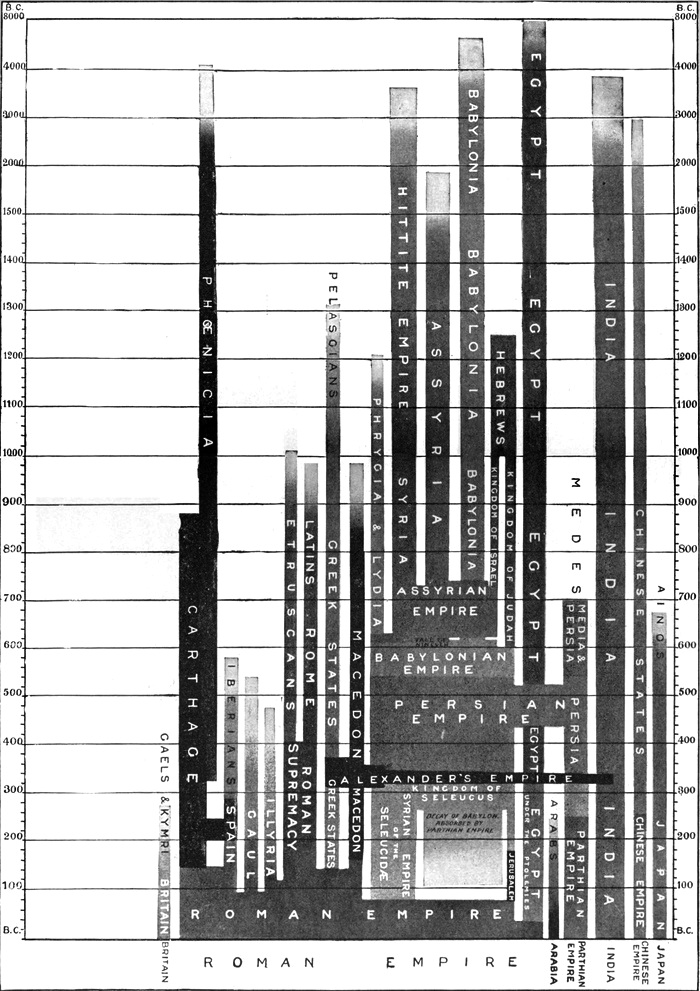
LARGER IMAGE
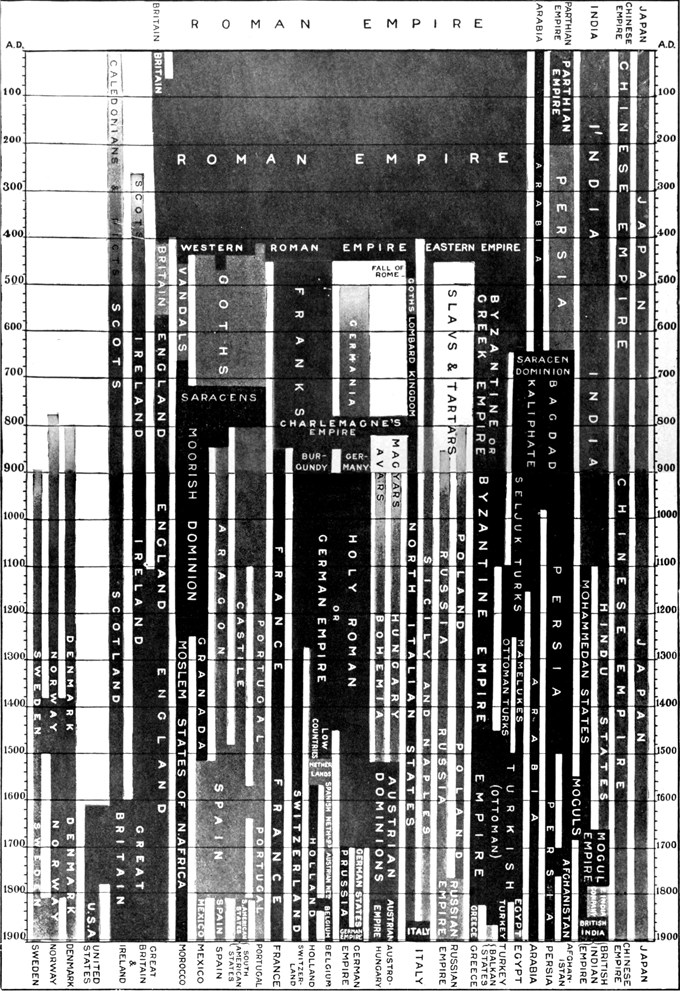
LARGER IMAGE
NOTABLE EVENTS
B.C. 8000 B.C. 8000
The earliest civilisation known is that of Egypt, traces of which have been found dating back to 7,000 or 8,000 B.C. Equally early civilisations were probably established in the Euphrates Valley. In the fifth millennium Khufu built the Great Pyramids; in the fourth a Semitic migration, spreading westward from Asia, peopled Babylonia, Assyria, Canaan, and Phœnicia afresh, establishing new nations and kingdoms. The third millennium saw the Aryan invasion of India; the beginning of Chinese history; and Aryan and Semitic waves of migration towards Europe.
2000 2000
Egypt was conquered by the Hyksos, a Semitic nomadic race. Hittite Empire established in Syria. During the next three hundred years, of which the history is obscure, the dynasty of the Ramesides was established in Egypt, which waged wars with the Hittite Empire. Rameses II. is popularly identified with the Pharaoh of the Exodus, an event which is also identified with the expulsion of the Hyksos. The supremacy in the Mesopotamian regions alternates between Assyrian and Babylonian dynasties.
1200 1200
Rise of a Hebrew nation. Age of Phœnician prosperity; commercial importance of Sidon and Tyre.
1100 1100
Ionic and Doric migrations. Predominance of Phrygia among kingdoms of Asia Minor. 1048 B.C. David captures Jerusalem and becomes King over all Israel.
1000 1000
975 B.C. Division of the Hebrew kingdom into Judah and Israel after the death of Solomon. Growth of the Hellenic States. The age of Homer.
900 900
850 B.C. Foundation of Carthage. Beginnings of the Latin and Etruscan peoples.
800 800
Assyrian conquest of Babylon, Syria, and Israel. 753 B.C. The foundation of Rome. Rapid spread of the Greek Colonies.
700 700
Beginnings of the Macedonian kingdom. Rise of Media. Beginnings of Japanese history. Decline of Assyria, fall of Nineveh, and establishment of new Babylonian Empire.
600 600
Cyrus, King of Persia, conquers Media, establishes his empire over Lydia, Assyria, and Babylonia (538 B.C.). His son Cambyses conquers Egypt, 525 B.C.
500 500
The Greek States revolt against Persia and are triumphant. Egypt regains independence. Steady growth of Roman ascendancy in Italy. Struggle between Athens and Sparta.
400 400
Conquests of Alexander the Great (334–322 B.C.). He conquers Persia, masters Egypt, and invades India. At his death his empire is divided: Egypt falls under the Ptolemies, Syria under the Seleucidæ.
300 300
Babylon absorbed by Parthian Empire. Carthage dominates Spain. Wars between Rome and Carthage. Overthrow of Carthage (202 B.C.).
200 200
Judea attains independence under the Maccabees. Growing power of Rome. Macedon a Roman province; Egypt and Syria made Roman protectorates. The Greek States are absorbed into province of Macedon.
100 100
B.C. Cæsar conquers Gaul and lands in Britain. Egypt becomes a Roman province. Augustus Cæsar. Establishment of the Roman Empire. B.C.
A TIME-TABLE OF THE NATIONS OF THE WORLD
continued from the preceding pages
FROM THE BEGINNING OF THE CHRISTIAN ERA TO THE PRESENT DAY
NOTABLE EVENTS
A.D. A.D.
For the first four centuries of the Christian era the Roman Empire absorbed the “known” world, bounded in Europe by the ocean, the Rhine, and the Danube, and in Asia by the Euphrates, and including the Mediterranean districts of Africa. Germanic tribes bore with ever-increasing pressure upon her European borders, and the Parthians defied her in the East. At the close of the third century the centre of political gravity was passing from Rome itself to Byzantium, preparing for the scission of the Empire, into Eastern and Western, which was practically at the close of the fourth century, when it was becoming increasingly clear that Rome could not stand against the Barbarian invaders, notably the Goths under Alaric.
400 400
In the fifth century the Empire, long weakened by corruption and the tyranny of the army, was overwhelmed by the Barbarians. Vandals, Western Goths, and Suevi poured into Spain; Franks and Alemanni spread over Gaul; Ostro-Goths and Lombards settled in North Italy; Huns and Avars attacked Thrace. Britain was invaded by Saxons, Jutes, and Angles.
600 600
The seventh and eighth centuries were marked by the rapid rise of Mohammedanism in Arabia; the conquests of the Saracens in Egypt, Africa, and West Asia; the establishment of the Caliphate at Bagdad; and their invasion of Spain. Here they were checked by the Franks. Charlemagne, son of Pippin, King of the Franks in Germany and Gaul, was crowned in 768, conquered Lombardy in 774, calling himself “King of the Franks and Lombards and Patrician of the Romans.” His empire was divided after his death; from it emerged modern France and Germany. His coronation by the Pope at Rome (A.D. 800) originated the idea of the Holy Roman Empire.
900 900
Disintegration of the Empire of the Caliphs, and rise in Asia Minor of the Seljuk Turks, making war against the Byzantine Empire and the Crusaders, and conquering Egypt. India is invaded by Mohammedan Afghan rulers, who eventually establish a dynasty at Delhi.
1100 1100
The Kingdoms of Hungary, Bohemia, and Poland, converted to Christianity in the tenth century, come into increasing prominence. The Kings of Castile, Navarre, Aragon and Portugal war against the Moors, who (A.D. 1248) are restricted to Granada. The Mamelukes (Slave kings) conquer Egypt (1252). Switzerland attains independence.
1300 1300
Failure of England to absorb Scotland, or to conquer France. The Hundred Years’ War.
1400 1400
The Turks capture Constantinople (1453). The Netherlands (Burgundy) united to the House of Hapsburg. (1477). Spain united; overthrow of the Moorish dominion.
1500 1500
Bohemia and Hungary united to Austria. Spain and Portugal take possession of the New World. Mogul Empire established in Hindostan. The Reformation leads to revolt of the Netherlands from Spain; Spain absorbs Portugal.
1600 1600
Union of English and Scottish crowns (1603); followed by legislative union (1707). Disruption of Germany in the Thirty Years’ War. Establishment of English Colonies in America. Portugal recovers independence.
1700 1700
Spain becomes a Bourbon Power. Rise of Russia and Prussia. Partition of Poland between Russia, Prussia and Austria. Further disintegration of German Empire. British dominion in India and North America. Independence of United States.
1800 1800
France predominant under Napoleon. Rise of South American States. Establishment of British India. Italy independent. Egypt, Greece, and Balkan States freed from Turkey. Foundation of German Empire.
1900 1900
A.D. Independence of Norway (1905). A.D.
CONTEMPORARY FIGURES IN HISTORY
TIME B.C. India China Persia Greece Rome Judah Egypt Macedon TIME B.C.
500 Buddha Confucius Darius Æschylus Tarquin the Proud Haggai 500
Xerxes Themistocles Zechariah
450 Artaxerxes Socrates Nehemiah 450
Plato Ezra
Pericles
Herodotus
Thucydides
Sophocles
400 Euripides 400
350 Aristotle Philip 350
Demosthenes Alexander
200 Hannibal Judas Maccabæus 200
50 Julius Cæsar Cleopatra 50
Cicero
Jesus Augustus John the Baptist Jesus
Christ Tiberius Christ
Horace
Virgil, Livy
A.D. Britain France Germany Switzerland Rome, Italy Spain Netherlands Africa & East A.D.
50 Boadicea Seneca Josephus 50
St. Paul
300 Constantine Athanasius 300
400 Alaric Augustine 400
600 Chas. Martel Mahomet 600
700 Bede 700
800 Alfred Charlemagne Haroun-al-Raschid 800
1100 The Cid Omar Khayyam (Persia) 1100
1200 St. Francis 1200
1300 Chaucer William Tell Aquinas Tamerlane 1300
Dante
1350 Wycliffe Froissart Arnold von Winkelried Petrarch Hafiz (Persia) 1350
Boccaccio
1450 Caxton Da Vinci 1450
1500 Knox Rabelais Luther Calvin Columbus Ignatius Loyola Erasmus 1500
Latimer Copernicus Savonarola St. Theresa
Machiavelli Ferdnd. & Isabella
Cortez Russia
1550 Philip Sidney Montaigne Cellini Alva William the Silent Ivan the Terrible 1550
Spenser Scaliger Tasso
1600 Shakespeare Corneille Kepler Galileo Cervantes Rubens 1600
Raleigh Richelieu Scandinavia
Bacon Descartes Gustavus Adolphus Van Dyck
Jonson Grotius
1650 Cromwell Pascal Peter the Gt. [& Catherine] 1650
Milton Racine Leibnitz Spinoza
Bunyan Molière
Dryden Fénélon
Locke Rochefoucauld
Hobbes Louis XIV.
1700 Swift 1700
Steele Handel Holberg
Addison
Walpole America
1750 Chatham Fredk the Gt Rousseau Franklin 1750
Burke Voltaire Goethe Gessner Washington
Pitt and Fox Lavoisier Schiller Pestalozzi
Wesley Napoleon Haydn Pestalozzi
Burns Mozart
Goldsmith Kant
Sheridan
Dr. Johnson
Coleridge
Flaxman
Reynolds
Gainsboro’gh
Nelson
Wellington
1800 Faraday Hegel Tegner 1800
Scott Beethoven Thorwaldsen
Byron
Keats
Shelley
Wordsworth
Lamb
1825 Gladstone Balzac Wagner Garibaldi Hans Andersen Irving 1825
Macaulay Dumas Heine Mazzini Runeberg Emerson
Disraeli Victor Hugo Bismarck Cavour Wergeland Longfellow
Landseer Georges Sand Moltke Victor Emmanuel Welhaven Whittier
Mill Lesseps Bunsen Ibsen Lowell
Livingstone Napoleon 3 William I. Bjornson Holmes
Ruskin Gambetta Lincoln
Dickens Turgenieff
Carlyle
Thackeray Tolstoy
Browning
Tennyson
Darwin Hungary
Huxley Kossuth
Spencer
1900 1900
MAKING OF THE EARTH
AND THE COMING OF MAN
THE BEGINNING OF THE EARTH
BY PROFESSOR SOLLAS
T
THE origin of our planet is a problem which has appealed to the intellect of thoughtful men from the most remote times, and the earliest recorded speculations concerning it—those of the Mosaic cosmogony—possess a peculiar interest, since they embody the views of the ancient Chaldeans, who were not only systematic observers of the heavens, but made practical use of their results.
Beginning of a Famous Theory
The Mosaic cosmogony is not unworthy of the great people among whom it took its rise; it recognises the fact that the earth had a history antecedent to the advent of man, and its account of the order of events in this history is not only remarkable as a feat of a priori reasoning, but accords in some respects with the results achieved after much labour by modern science.
It was not until the middle of the eighteenth century that the reign of evolution began, and attempts were made to trace the history of a planetary system from its source in a primeval nebula on purely mechanical grounds. Swedenborg (1735) was the pioneer in this direction, then came Thomas Wright (1750) of Durham, whose work furnished inspiration to Emanuel Kant (1755), and led him to construct a consistent scheme of the Universe. The last of this group of cosmic philosophers is Laplace (1796), whose admirable description of the evolution of the solar system was arrived at independently, and without knowledge of the previous work of Kant.
Laplace assumed as his starting-point the existence of a nebula formed of incandescent gas, and extending beyond the limits of the outermost planet of our system. It was in rotation about a central axis, and possessed in consequence a disc-like or lenticular form. Radiating its heat away in all directions through surrounding space, it grew continually colder, and in cooling diminished in bulk. As a consequence of this contraction its rate of rotation increased, till at length the centrifugal force of the outermost part became so great that this could no longer continue to follow the contracting mass within, and thus remained behind as a great rotating ring. The continued contraction of the internal mass, and the resulting increase in the velocity of rotation, again brought about the same condition of things, and a fresh ring was left behind.
Cooling of the Nebula
This process was repeated time after time, till as many rings were formed as there are planets in the solar system; the central mass which survived within the innermost ring condensed to form the sun. The rings were highly unstable—that is to say, a slight disturbing force was sufficient to destroy their continuity; they broke across and rolled up into great nebulous globes, which revolved round the sun in the same direction as the original nebula, and rotated on their axes in the same direction as that in which they revolved. Most of them repeated the behaviour of the original nebulæ, leaving behind rings as they contracted, and these rings either rolled up to form moons or satellites, or, in the solitary instance of Saturn’s rings, retained their annular form. The rings are now known to consist of a multitude of solid bodies, as proved by Clerk-Maxwell.
The Temperature of the Earth
By this hypothesis, so beautiful in its simplicity, an explanation was afforded embracing all the more important facts of our system; the revolution of all the planets in nearly circular orbits and in the same direction as that in which the sun rotates, and the revolution of their satellites, also in circular orbits and in the same direction as their primaries; the comparatively high temperature and consequent low density of the larger planets and the sun, as well as a variety of other phenomena, all seem to follow naturally from it. The fundamental assumption seems to be in harmony with a number of known facts. Thus in the case of our own planet the volcanoes distributed around the margins of the oceans, and the hot springs scattered irregularly over the whole terrestrial surface, suggest that great stores of heat exist beneath our feet, a presumption which finds confirmation in the fact that whenever we descend towards the interior of the earth, as in deep mines or wells, the temperature continues steadily to rise after we have passed a depth below which seasonal and diurnal changes of temperature cease to be felt, the rise being in some cases as much as 3 deg. for 100 ft., in others only 1 deg. for the same distance, but on the average 1 deg. for 60 ft. or 70 ft. If this increase of temperature continues down to great depths, and there seems to be no reason why it should not, then a point will be reached, say, at thirty or forty miles down, where the interior will attain a white heat.
The Earth as a Star
Thus the earth might be regarded as a white hot body surrounded with a film of rock growing continually cooler towards the surface. But such a hot body suspended in space must be cooling, just as all bodies which are hotter than their surroundings. It is cooler to-day than it was yesterday, or—what is the same thing—it was hotter yesterday than it is to-day, and so of all previous yesterdays. And thus as we travel backwards in time we perceive that the earth will be growing hotter, the level of white heat will be mounting upwards towards the surface, and will at last reach it, so that the earth, instead of being, as it now is, a dark body shining only with the reflected light of the sun, will be self-luminous, a tiny star of a magnitude so diminutive as to have awakened resentment on the part of some terrestrial inhabitants, who have regarded it as disproportionate to their dignity. But we cannot arrest imagination at this stage; our thought still extends its retrospective glance into the abyss of past time, and we perceive the earth still growing hotter, till its temperature transcends those limits at which it can exist in the solid state. It becomes molten—nay, more, it becomes gaseous, and thus resumes the nebular state from which it sprang. Precisely the same argument applies to the sun; our mighty luminary is also a cooling body, and if we could restore to it the heat which it has lost in the course of past æons it would resume a completely gaseous state. Modified in one way or another, this chain of reasoning seemed irrefragable in those happy days which preceded the discovery of radium.
Universe still in Evolution
The question may be considered from another point of view. On searching the heavens we find that many of the stages which are assumed in Laplace’s hypothesis are still represented by actual existences. There are, to begin with, those immense diffused nebulæ, almost incapable of definition, which are proved, on spectroscopic examination, to emit that kind of light which is characteristic of glowing gas; from these we pass to others which are resolvable by the telescope into a central and more condensed nucleus, with two mighty nebulous arms whirled round in a spiral, and bearing more condensed masses in their midst; even ring nebulæ are known to exist; and, finally, there are nebulous halos which surround some of the stars. Then we come to the stars themselves, which are suns of various degrees of magnitude, some immensely larger than our own luminary, and these are evidently in various stages of existence. Some are blue, and afford evidence of a higher temperature than that of our sun; others are yellow, and make a nearer approach to the solar temperature; while, again, others are red, and certainly colder.
These, in conjunction with other considerations, lead to the conviction that the universe is in a state of evolution, and that the solar system at one time existed in a nebular state. But whether Laplace’s description of the series of events through which the original nebula passed is the true one or not is a very different matter; it presents so many difficulties that scarcely any student now supports it.
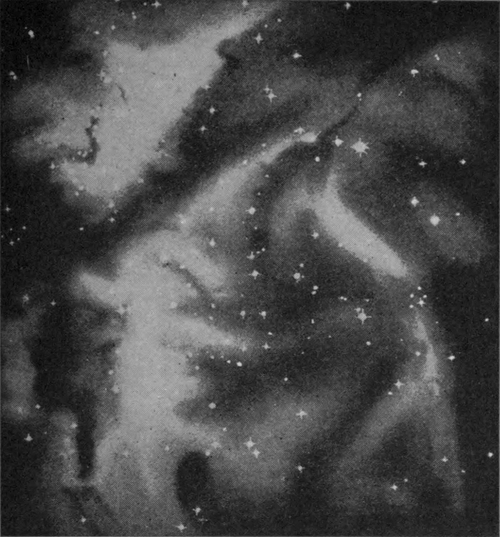
In the beginning, it is supposed that the earth was part of a vast nebula of gaseous matter and meteorites, resembling the nebula of Argo, illustrated above.
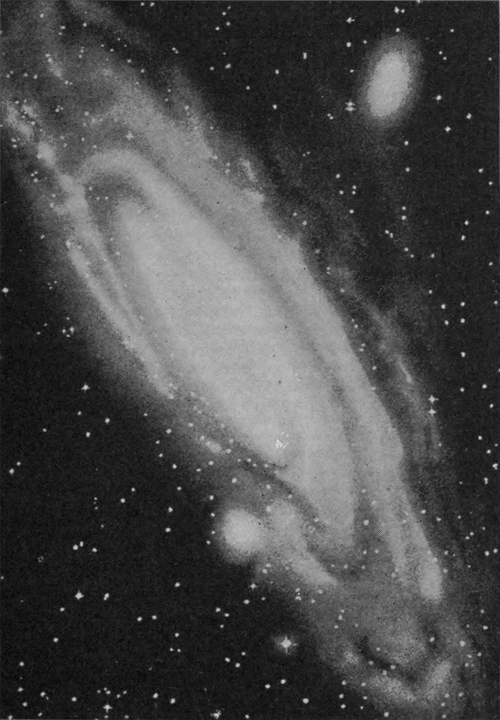
Later, as the cooling process advanced, the nebula assumed a rotatory movement in the form of a spiral. The nebula of Andromeda affords an excellent illustration of this.
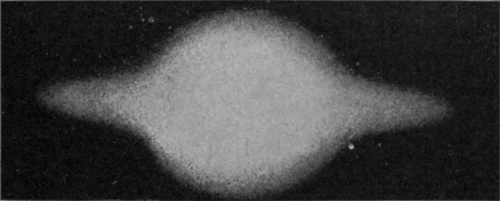
Another stage would be as in the annular nebula of Aquaris, the mass forming into a ball with the outer ring attached.
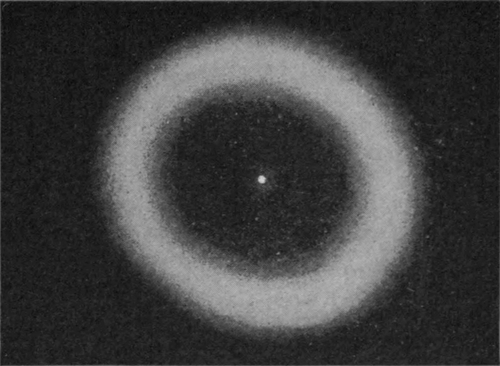
Or, like the nebula of Cygni, with the central sun well formed and the gaseous ring far removed, the earth would begin to shape, and the ring would roll up to form the moon.
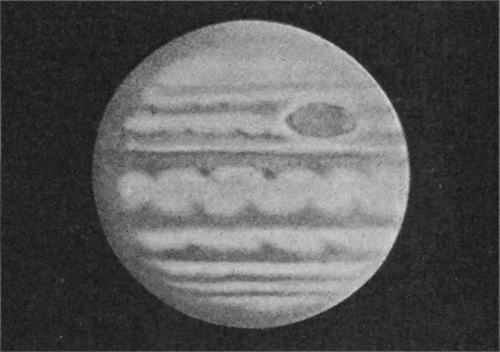
Jupiter, which is in a molten state, wreathed in thick vapour, with the “great red spot” indicating the beginning of the solidifying process, shows what the earth was like before it assumed its present solid condition.
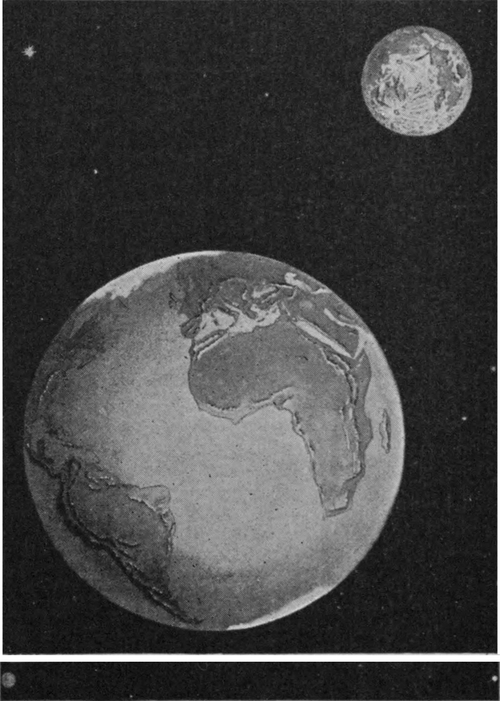
This shows the earth and the moon in their relative sizes; while the diagram below it illustrates the distance apart.
HOW THE HEAVENS TELL THE STORY OF THE ORIGIN OF THE EARTH
Laplace’s Theory Abandoned
A fundamental difficulty is the extreme tenuity of the gas which is assumed to have formed the planetary rings. A second difficulty, which has been emphasised by Professors Chamberlin and Moulton, is to be found in the comparatively small amount of rotational energy which the system at present possesses, for this is less than 1⁄200 of that which, on the most favourable assumption, must have been contained within the original nebula. Less fundamental, but equally fatal, is the fact that one of the satellites of Saturn revolves round its primary in a direction opposed to that of the rotation of the planet itself. [Recently Mr. Stratton, following out a suggestion of Professor W. H. Pickering, has shown that this is quite consistent, and, indeed, is a natural deduction from Laplace’s hypothesis.] Hence for these and other reasons we are reluctantly compelled to abandon an hypothesis which for over a century has exercised an influence on our conception of the cosmos not less profound, penetrating, and far-reaching than that of the famous Darwinian doctrine of natural selection, now on its trial.
What are the Nebulæ?
At present, unanimity of opinion, even on questions of the most primary kind, is far to seek. Philosophers are not even agreed as to the constitution of the nebulæ. It is questioned whether even those least resolvable and most diffused forms which give bright line spectra really consist of masses of incandescent gas. Many observers, among them Sir Norman Lockyer, now maintain that they are formed of swarms of meteorites, which, moving with prodigious velocity, meet in frequent collision, and by their impact evolve sufficient heat to become self-luminous. Others, again, like the distinguished investigator Arrhenius, while admitting the gaseous nature of these nebulæ, deny that they are incandescent, and assert that their temperature is not much above that of surrounding space. Their exterior parts consist of the lighter gases in a highly rarefied state, and minute particles of negative electricity, which are always careering through space, on penetrating these gases produce a luminous discharge. A nebula composed of swarms of meteorites would, as Sir George Darwin has shown, behave very much in the same way as one composed of gas, and if in rotation would rotate as a solid mass. The meteorites would stand in the same relation to the nebula as molecules to a gas, and thus the question of the constitution of the nebula, although of great interest in itself, becomes of subsidiary importance in tracing its subsequent history.
Shaping of the Planets
One of the latest attempts to frame a nebular hypothesis is that of Professor J. H. Jeans. His reasoning is of a highly mathematical character, and his conclusions are expressed in the most general terms. Starting with a spherical nebula of gas or meteorites endowed with a small amount of rotation, he shows that as it cools or loses energy the temperature of the interior will not fall continuously in precise correspondence with the cooling of the outer parts, and this “lag” of the interior temperature will bring about a tendency to instability. The contraction of the nebula due to cooling will increase the velocity of rotation, and this again will tend to instability. As a result of the instability so produced the nebula will change its form, and become more or less pear-shaped. The narrow end of the pear will then separate from the body and assume an independent existence as a primitive planet. This process will recur again and again till the nebula is resolved into a sun with its attendant planets. The planets, existing at first as gaseous masses or quasi-gaseous masses, will be liable to the same kind of transformation, and may thus bud off moons or satellites.
If the nebula were not in rapid rotation, a slight disturbing cause, acting at the critical moment when a planet was being ejected, might determine the inclination of the planet’s orbit, which might thus be very oblique to the equatorial plane of the nebula. Thus the hypothesis is not open to one of the objections which have been urged against that of Laplace—namely, that the orbits of some of the planets in the solar system are inclined at a large angle with the plane of the sun’s equator.
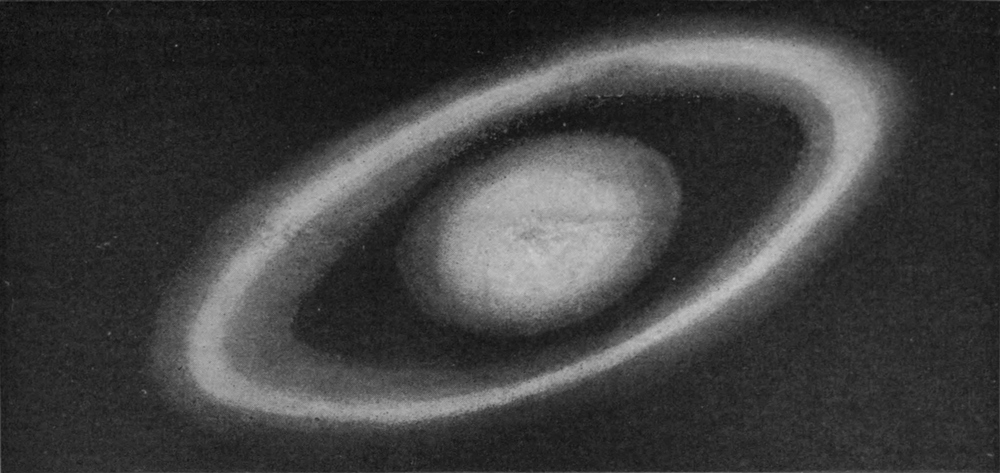
This illustrates Laplace’s theory, which conceived of a vast nebula filling the whole space of the solar system and rotating around a central axis. The outer and thinner part had much greater movement than the denser central mass, finally being thrown off as a ring, which in turn rolled up into a ball, still following the same course as the ring had followed. Thus the earth broke off from the sun and the moon from the earth. The theory is, however, no longer credited by scientists.
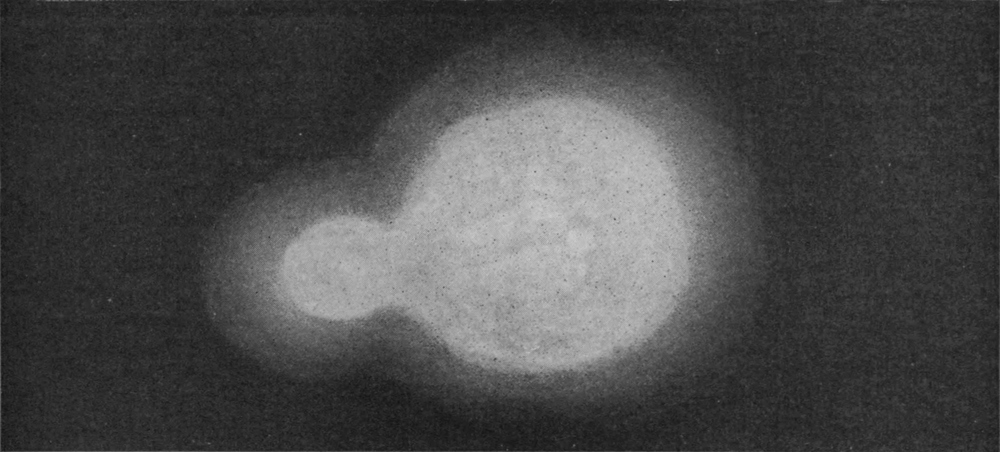
The pear-shaped nebula is the theory of a young English mathematician, Professor J. H. Jeans. Starting with a spherical nebula, he argues that in cooling it will assume the form illustrated above, and that the smaller part will separate and form a satellite rotating independently but within a distance influenced by the parent mass.
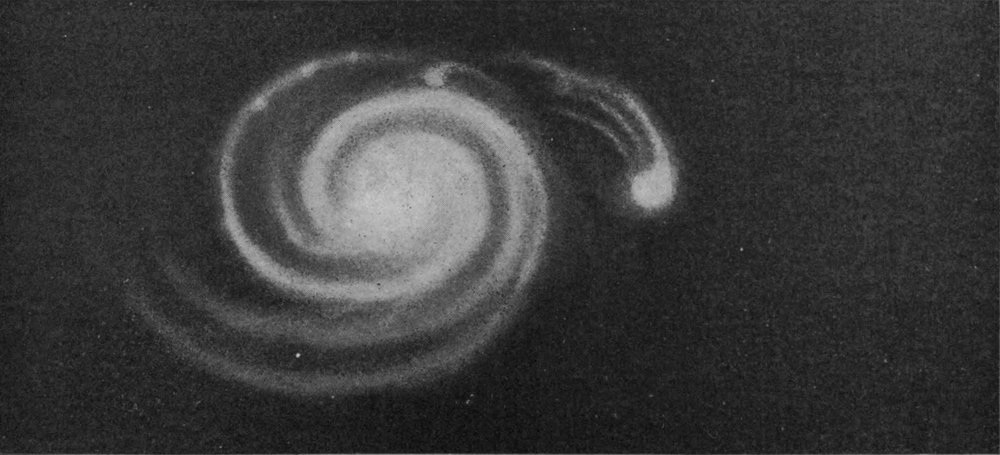
The spiral nebula in Canes Venatici, a revolving mass of gas or meteorites, supplies, according to the nebular hypothesis of Messrs. Chamberlin and Moulton, an excellent example of how the earth and moon were formed. We may reasonably imagine the smaller spiral to represent the moon in the act of being thrown off by the earth.
THREE FAMOUS THEORIES OF THE BEGINNING OF THE EARTH
Heavenly Bodies in Collision
Jeans mentions two disturbing causes in particular which might easily arise—one the penetration of the nebula by a wandering meteorite, which might precipitate an event already on the verge of happening, and simultaneously determine both the birth of a planet and the obliquity of its orbit; the second, the presence of some distant mass, such as a star, which, by raising a quasi-tide in the nebula, would give the final touch required to overturn its equilibrium. The influence of a distant body, such as a passing star, has been invoked by Moulton in another version of the nebular hypothesis. In conjunction with Chamberlin, he calls special attention to the spiral nebulæ, which are by far the commonest kind, as presenting the closest approach to the conditions which obtain when planets are actually in course of formation. Chamberlin and Moulton enter on a detailed account of the manner in which they suppose the planets to have grown by the gradual accretion of meteoric masses as these encountered each other while moving in various elliptical orbits.
At present it would seem impossible to speak with certainty as to the precise history of the solar system. Meanwhile, we may console ourselves with the closing words of Professor Jeans’ paper, to the effect that “no difficulty need be experienced in referring existing planetary systems to a nebulous or meteoric origin on the ground that the configurations of these systems are not such as could have originated out of a rotating mass of liquid.”
An investigation by Sir George Darwin, which has furnished inspiration to such hypotheses as that of Jeans, brings us nearer the immediate subject of this essay, since it treats of one of the last acts in the great drama of planetary existence, and attempts to derive the earth and moon from a common origin in a single rotating sphere.
Why the Day is Growing Longer
It is well known that, owing to the frictional effects produced by the tides, the earth is being gradually slowed down as it rotates upon its axis. Thus the day is constantly getting longer, so that in a few millions of years it will have increased in length from twenty-four to twenty-five hours. On the other hand, in past time it must have been shorter than at present: a few millions of years ago it was only twenty-three hours in length, and many millions of years earlier it was still less, only some five hours or so. At that time the earth was hotter than it is now, less rigid, more yielding, and, owing to its rapid rotation, less stable. The action on the moon of the tides produced in it by the earth is similar, and the rotation of the moon has been so far diminished by them that its day has become as long as the month—i.e., our satellite only turns once round on its axis in the time that it takes to revolve once round the earth; it is for this reason that our satellite keeps always the same face turned towards us.
The Moon Was Part of Our Sphere
The retardation of the earth in its rotation has, however, a very remarkable effect on the revolution of the moon; it involves—by the principle of the conservation of moment of momentum—a corresponding acceleration of the moon in its orbit, and, as a consequence of this, an enlargement of this orbit—that is, the moon is pushed away from us, as it were, and thus becomes more remote. But if so, the moon must have been nearer to us in times past. It is possible to trace the approach of the moon to the earth as we go backwards in time till the distance between them was only two and a half terrestrial radii instead of the sixty radii which now separate them. Mathematics do not take us farther back than this. But it is difficult to resist the suggestion that in the immediately preceding stage of development the earth and moon formed together a single sphere.
If we may adopt this view, then we must regard the sphere as subject to the tidal influence of the sun. It was much hotter, and therefore more yielding, than the present earth; it was also rotating much faster, probably once in about four or five hours. It would be contracting as a consequence of cooling, and the contraction would lead to instability (gravitational instability); its rapid rotation would also tend toward instability (rotational instability). It is difficult to say which of these two, gravitational or rotational instability, would be the most effective; but the combined result would be to give a pear-shaped form to the rotating mass, and eventually to deepen the constriction between the narrow and the broad end, till the smaller protuberance became completely dissevered from the larger mass, and so entered on an independent existence as the moon. This final step in the process would probably depend on the tide-producing power of the sun; the larger mass remained behind as the earth, whose individual existence may be said to date from this event.
How the Moon Broke Away
The young earth would be subject to very much the same conditions after as before the ejection of the moon, and might very possibly again pass into a pear-shaped form, but without proceeding further through those subsequent changes, which would have led to the formation of another satellite; and while possessing some such form as this, she might very well have consolidated. With advancing years she would lose, as we have seen, the activity of her youth, the drag of the tides would cause her to spin ever more slowly on her axis, till the day would become prolonged to the twenty-four hours of the present. With this diminished rate of spin, the earth, if free to yield, would lose the pear-shaped form and become an oblate spheroid, and the oblateness of this spheroid would continually diminish, so that it would continually approach towards a true sphere. Suppose, however, that the earth as it cooled lost its power of readily yielding—and at present it is more rigid than a globe of steel—then it would pass from form to form, not by a flowing movement, but by a series of ruptures, and its form at any moment might be a little in arrear of that which it would have possessed if it had been in the fluid state.
Thus it might indeed be possible still to discover some trace of an old-fashioned form in the existing planet; and a careful examination of the distribution of land and sea as represented on a terrestrial globe does, in fact, reveal a remarkable symmetry, in which we seem to recognise a surviving vestige of its early state. The great continent of Africa projects like the narrow end of a pear; around it are oceans—the Atlantic, the Indian Ocean, and the Mediterranean Sea, which was once of far greater extent; then comes a great dismembered ring of land, the two Americas, the Antarctic continent, Australia, Asia, and Europe. Within these, on the side opposite to Africa, is the great Pacific Ocean, which covers over the broad end of the pear.
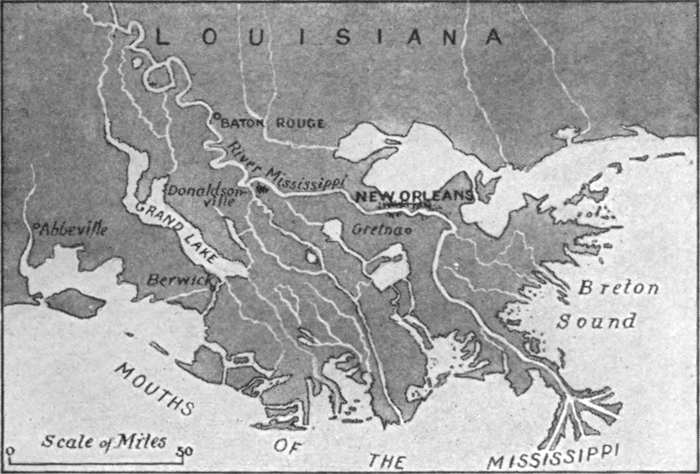
THE SHAPING OF THE FACE OF THE EARTH
Soon after the earth had cooled down, so that the oceans were formed, the shaping of the great continents began. The action of moving water in the making of new land is well illustrated by the vast delta of the Mississippi, where an area larger than Wales has been formed by debris deposited by the river.
Earth’s Unknown Changes
A line drawn from somewhere in Central Africa to its antipodes in the Pacific, through the centre of the earth, would correspond to the long axis of the pear; a second, at right angles to this, would correspond to its breadth; and a third, at right angles to both, would correspond to the axis on which it rotates. A diameter of the earth taken through the equator is almost 8,000 miles in length, the Polar diameter is about sixteen miles shorter, and this slight difference measures the oblateness of the spheroid, or the departure of the form of the earth from a true sphere. Further, it would appear that the diameter drawn through Africa is about half a mile longer than the equatorial diameter taken at right angles to it, and this insignificant quantity measures the departure of the form of the earth from that of an oblate spheroid to that of a pear, so nearly complete is the adjustment of its form to existing conditions. Before this nice adjustment was reached, the earth must have suffered many changes, passed through many times of stress and storm, and witnessed many geological revolutions.
An Age of Red-hot Rain!
If, at the beginning of her career, the earth was molten, or at a very high temperature, she must have been surrounded by a very deep and dense atmosphere, for all the waters which now rest on her surface—oceans, lakes, and rivers—would have contributed to it in the state of steam; and not till the temperature of the ground had fallen to 380 deg. C. could liquid water have begun to accumulate. Then a steady downpour of almost red-hot rain would have set in, filling up the neck of the pear and extending far and wide over its broad end.
The temperature would now fall somewhat rapidly, and in a short space of time the surface of the earth would have become as cool as it is at the present day. Directly the waters of the firmament had collected into the oceans, leaving behind an atmosphere like that which now exists, geological agencies of the kind we are now familiar with would begin their sway. Air and rain would exert their insidious power upon the rocks, sapping their strength, converting the hardest granite into soft sand and clay, which would be washed away by the rain through brooks and rivulets into the channels of many rivers, all hastening with their burden of sediment, to deposit it finally in the sea. Here it would accumulate, layer after layer, building up those mighty masses of strata which now form the greater part of the visible land. While this general action was everywhere in progress, wearing down continents and islands towards the level of the sea, more specialised activities were assisting to the same end.
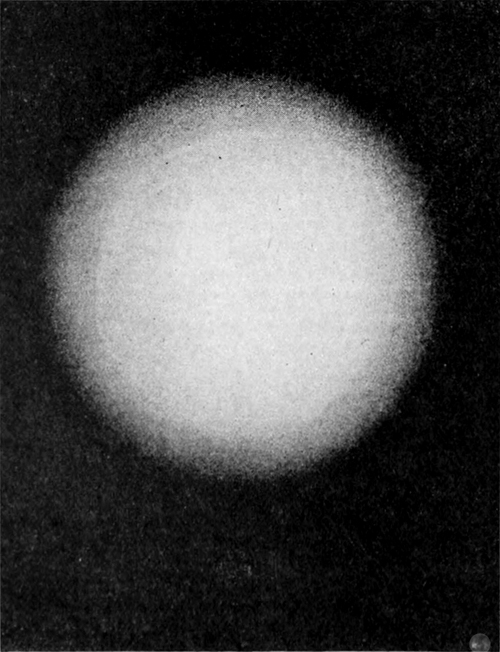
TWO STAGES IN THE LIFE OF THE EARTH
This illustrates in striking manner, based on the calculations of the best authorities, the comparative sizes of the earth, first as a gaseous mass, and, second, after it had cooled down and solidified into the planet on which we live. The small dot represents 8,000 miles, the earth’s diameter.
The waves which fall upon our coasts are now constantly undermining the cliffs and extending the margin of the sea at the expense of the land, and rivers not only serve to transport sediment, but cut down their channels deep into the rock, and so carve out the most varied landscapes of hill and valley from monotonous tableland.
Action of Winds and Tides
When we enter into calculations we are astonished at the rapidity with which these agents perform their work even at the present day; but as we proceed farther back into the past, when the earth was full of youthful energy, their power must have been greatly enhanced. We might almost take the measure of the day as the measure of their work, for they probably accomplished as much during the eight hours’ day which once existed as they do now in twenty-four hours. A little consideration will make this clear. It is the winds which, blowing over the surface of the ocean, produce the sea waves, and it is these falling on our coasts that perform the work of marine denudation. But the winds are due in the first place to the heat of the sun, and the difference of temperature established at the equator and the poles; and, in the next place, to the rotation of the earth. Thus, with the increased rapidity of rotation which we know to have existed, and with increased radiation from the sun, a very probable contingency, the winds would increase in strength and more powerfully erode our coasts. Again, with the moon in greater proximity, and with a more rapid rotation of the earth, the tides would be much higher and more frequent, and these, raising and lowering the cutting edge of the sea, greatly assist it in its work of destruction. The winds and the tides produce various marine currents, and these help to distribute the sediment which the rivers deliver into the sea, so that when stronger currents flowed as a result of more powerful tides and more violent winds, the sediments would be strewn over wider areas; hence, the more ancient strata of our planet are far more widely distributed than are those of later time.
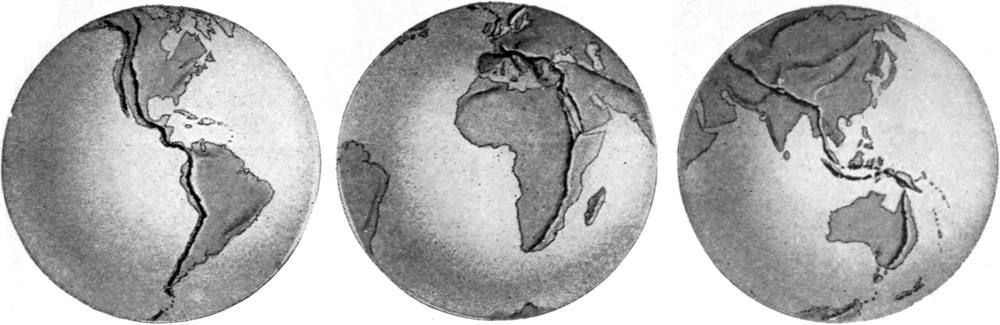
THREE VIEWS OF THE GLOBE SHOWING HOW THE GREAT MOUNTAIN RANGES WERE FORMED
In the days when the earth’s crust had formed but was still unstable, the process of cooling not having gone far enough, there would not be the mountains which now characterise it. These came when the earth contracted and crumpled up along certain well defined lines, which are now represented by the three great mountain chains of the world.
Building Up the Earth
Finally, a heavier rainfall would result from a more active atmospheric circulation, creating larger rivers, and thus, at the beginning, all those denuding agents which are engaged in wearing the land down into the sea would be working at a more rapid pace. Correspondingly, all the agents which are occupied in building up deposits of sediments would have extended their operations over a wider area, laying down a foundation broad and deep.
On the other hand, the contraction of the earth, due to the loss of its energy of rotation as well as of its internal heat, would also have proceeded more rapidly, new land would have emerged from the sea, old lands would have been submerged beneath it far less slowly than at the present day; ruptures of the crust, accompanied by earthquakes and volcanic action, would have been more frequent and thus, by the more rapid loss of its intrinsic energy, the renovation of the earth would have kept pace with its accelerated destruction.
One effect of the contraction of the earth which has manifested itself in even late geological times is the crumpling up of the terrestrial crust into the sharp folds of mountain chains; but at the beginning this crumpling must have been far more universal and energetic. In this connection it is interesting to observe that the most ancient rocks known to us—the Archæan—never present themselves under any other form than as intensely plicated masses. They originally consisted of lava flows and volcanic ashes, of ancient sediments and limestones, into which subterranean masses of granite and other molten, deep-seated rocks have been injected; but under the intense pressures to which they were subjected after their formation they and the invading granite have entirely lost their original character, and have been metamorphosed into gneisses, schists, and marble, all sharply and closely folded together. In any given district the direction of their folding is maintained with wonderful constancy over great distances. There is no succeeding system of rocks that has been so completely transformed, so universally plicated, as this ancient Archæan complex.
In later times we can pass from stratum to stratum of the sedimentary series and read their history almost as we turn over the pages of a book; in the Archæan all are kneaded together into a state of such desperate entanglement as to defy the powers of human ingenuity to unravel them. Thus the line of demarcation between the Archæan and subsequent sedimentary systems is the sharpest and most absolute that is known to us in the history of the earth. It marks the close of our planet’s infancy, the several events of which have passed into oblivion as profound as that of our own forgetfulness of our earliest days. Later events, on the other hand, are recorded in the stratified series with a faithfulness which increases as we approach existing times.
How We Know These Wonders The Ocean 100 million Years old! The Part Radium may play
A history without dates must seem very unsatisfactory to a historian, and the question will naturally arise whether we can assign any definite time to the various critical events recorded in the evolution of the earth. At present we can only make more or less plausible estimates. Thus, from a consideration of the thickness of the sedimentary crust, and the rate at which sediments are now being deposited, it has been asserted that the interval which separates us from the close of the Archæan era may amount to about twenty-six millions of years. Professor Joly, basing his argument on the undoubted fact that the ocean derives the greater part of its salt from the dissolved material contributed to it by rivers, comes to the conclusion that the ocean first came into existence about one hundred millions of years ago. As regards the birth of the moon, Sir George Darwin has given a minimum limit of fifty-four millions of years, but he adds that it may have taken place many hundreds of millions of years before this. Lord Kelvin has attempted to determine the time which has elapsed since the earth first acquired a solid crust. If we only knew the rate at which the earth is cooling we might calculate back to this time with some assurance of certainty, always, however, on the assumption that the earth is simply a hot body cooling like any other hot body—such, say, as a red-hot cannonball. But a few years ago it began to be seriously suspected that this assumption was a very doubtful one, for a new element—radium—was discovered in 1898, which possesses the remarkable property of spontaneously liberating heat, and this not in small quantities, but at an astonishing rate. One gramme of radium, for example, gives out enough heat in one hour to raise the temperature of one gramme of water to boiling point; hour after hour, year in, year out, this wonderful substance is setting free the energy it contains, and will continue to do so until, some thousands of years hence, it has exhausted its store. If this element should happen to exist in sufficient quantity within the earth, then the earth could not be said to be cooling just like a piece of hot iron, and the increase of temperature we experience as we descend towards the interior of the earth might possibly be due to the heat set free from radium. Indeed, the argument is not confined to the earth; it may apply also to the sun, and much of the heat we derive from that luminary may be provided by bursting atoms of radium. This was pointed out by Sir George Darwin and Professor Joly in 1903.
It became obviously a question of the first importance to discover what proportion of the earth’s crust consists of radium, and an investigation was undertaken for this purpose by the Hon. R. J. Strutt, who finds that the rocks composing the earth’s crust contain a superabundance of radium—sufficient, if this element is uniformly distributed through the whole earth in the same proportion as it occurs at the surface, not only to make good the heat which is radiated away into space, but actually to raise the temperature of our planet, which, on this evidence, should, therefore, be growing not colder, but hotter.
This is a result as disconcerting at first sight as it is astonishing, and its effects are very wide-reaching. Of course, it completely destroys the validity of Lord Kelvin’s argument, but it also deprives the nebular hypothesis of one of its cherished lines of evidence—a loss which the force of the general argument enables us to bear with equanimity.
On the Eve of great Events
In any case, the vast body of facts bearing on the history of the earth suffices to show that its temperature cannot be rising. Mr. Strutt has, therefore, imagined that the radium is not uniformly distributed throughout the mass of the planet, and supposes that it is restricted to an external zone forty-five miles in thickness; this would suffice to maintain the earth at its existing temperature. If, however, we admit a restriction of this kind, we are in no way bound to fix the limit at forty-five miles. All we can say is that we do not know how far downwards the radium reaches—for aught we know five miles, or even less, is as likely a limit as forty-five miles. Professor Joly, indeed, maintains that the radium we meet with is not proper to the earth at all, but comes from the sun.
Radium is a short-lived element, its existence being limited to a few thousand years; but as fast as it decays it is reproduced at the expense of another element—uranium—the lifetime of which is measured by hundreds of millions of years.
The last quarter of a century has proved fertile in great discoveries—more so than any corresponding period in the past. As a result, the whole world of scientific thought has been thrown into commotion; old-established theories, and even the most fundamental notions, seem to be in a state of flux. Under the stimulus of new ideas great questions, such as the constitution of matter, the origin of species, and the birth of worlds are being re-investigated with renewed energy, and we seem to be on the eve of great events.
WILLIAM JOHNSON SOLLAS
FOUR PERIODS OF THE EARTH’S DEVELOPMENT
A Postscript to Professor Sollas’s Chapter on the Wonderful Story of the World’s Birth, beginning on page 79
T
THE earth was once “a fluid haze of light.” The whole solar system once formed a vast nebula, consisting of glowing gas, or a swarm of meteoroids. Our planet was slowly shaped into a globe out of this primitive nebula.
This globe was at first intensely hot, and probably liquid. A solid crust formed on the surface as heat was lost by radiation, and this crust consisted of the oldest rocks of igneous formation like the granites and gneisses. During this Archæan or Eozoic Period, the earth acquired its atmosphere and its oceans, and it is probable that the mysterious origin of life took place.
The later history of the earth since the stratified rocks began to appear, and life existed, is divided into four main periods, of which the first is known as Primary, or Palæozoic.
The First Period of the Earth
CAMBRIAN SYSTEM. The rocks formed in the Cambrian Age are mainly grits, quartzites, and conglomerates, with shales, schists, and limestones. The earth was then mostly covered by seas, and the first well-defined forms of life were of marine origin.
SILURIAN SYSTEM. The Silurian rocks are mostly sandstones, shales, and slates deposited in the seas. The first vertebrates made their appearance as fishes, whilst insects began to flutter in the air, and occasionally to alight on the emerging land.
DEVONIAN SYSTEM. This was the age of the old red sandstone. Fishes reached a high state of development, whilst the first traces appeared of land vegetation, ferns and lycopods.
CARBONIFEROUS SYSTEM. This system is exceptionally important, because its chief rock is coal, the fossilised remains of the luxuriant vegetation which grew in tropical swamps. The first terrestrial animals, true air breathers, now appeared.
PERMIAN SYSTEM. The last of the primary systems gave us the new red sandstone, distinguished from the old by lying above the coal measures. The Permian Age was apparently unfavourable to life, and is only notable for the first appearance of the land reptiles into which the amphibians developed.
The Second Period of the Earth
The Secondary Period marks the emergence of the dry land into importance greater than that of the sea.
TRIASSIC SYSTEM. The Triassic rocks chiefly consist of sandstones and hardened clays laid down in shallow sea basins. Land vegetation now first began to assume a modern type, with conifers and cycads. The seas were still richly peopled, and the land first gave a home to huge reptiles, or dinosaurs.
JURASSIC SYSTEM. This system is marked by a great variety of limestones, the product of dead sea creatures. It is essentially the age of reptiles. The ichthyosaurus disputed the seas with the plesiosaurus; the pterodactyl ruled the air; whilst on land, huge monsters like the brontosaur and diplodocus browsed on tropical vegetation. From these reptiles the birds were developing, whilst small marsupials, the oldest of the great mammalian race, skipped under the branches.
CRETACEOUS SYSTEM. This was the age of the great chalk deposits. The birds, now emerging from their reptilian ancestry, dominated its life, and the first modern plants appeared on the land.
The Third Period of the Earth
The Tertiary Period marks the true beginning of modern geological history, when the great outlines of geography were laid down, and the first representatives of modern plants and animals made their appearance.
EOCENE SYSTEM. The Eocene rocks are mainly limestones, with sandstone and hardened clays. We owe them to the sea and its organisms. Modern evergreen trees now first appeared. The mammals come to the front, with the tapir-like palæotherium and the first recognisable ancestor of the horse.
MIOCENE SYSTEM. The Miocene Age was a mountain-building period, when the great chain which runs from the Alps into Central Asia received its final uplift. Deciduous trees, like the beech and elm, now made their appearance. The giant mastodon and the formidable sabre-toothed tiger roamed the Miocene forest, and true apes—man’s first forerunners—mopped and mowed in the boughs.
PLIOCENE SYSTEM. The last of the Tertiary ages set the final stamp on the geological moulding of the earth’s crust. Its plants were transitional to the flora of modern Europe. Great herds of herbivora now appeared.
The Fourth Period of the Earth
The Quaternary Period is that in which we are still living. Its outstanding feature is the appearance of man.
PLEISTOCENE OR GLACIAL SYSTEM. Its essential feature was the appearance of glacial conditions over most of the northern hemisphere, when great ice sheets rubbed our land into shape. The vegetation was Arctic, and only animals like the reindeer and the hairy mammoth could endure the cold.
HUMAN OR RECENT SYSTEM. The precise antiquity of man is still uncertain, but it was only after the close of the Glacial Period that he made his home in Europe, where he shared a precarious existence with mammoth, cave-bear, and rhinoceros. Man developed through the Palæolithic and Neolithic ages of stone implements to the Bronze and Iron ages, when metal was first worked. In the last of these we live.
GEOLOGICAL CLOCK OF THE WORLD’S LIFE
This page is an effort, based on Professor Lester Ward’s calculations in “Pure Sociology,” to show the comparative length of each geological period, and the thin white line between Tertiary and Archæan indicates the period of human history. Thin as this line is—and we could not show it thinner—it is too thick, and out of proportion to the rest of the clock. If we assume that from the beginning of the world—from its first forming into a solid sphere—to the present, time may be represented by a day of twenty-four hours, the time occupied by human history does not exceed twelve seconds. This is reckoning human history as ten thousand years. There is, of course, no possibility of obtaining more than relative figures for such a scheme as this, which should be regarded in connection with the previous page and the chart of the Beginnings of Life, facing page 96
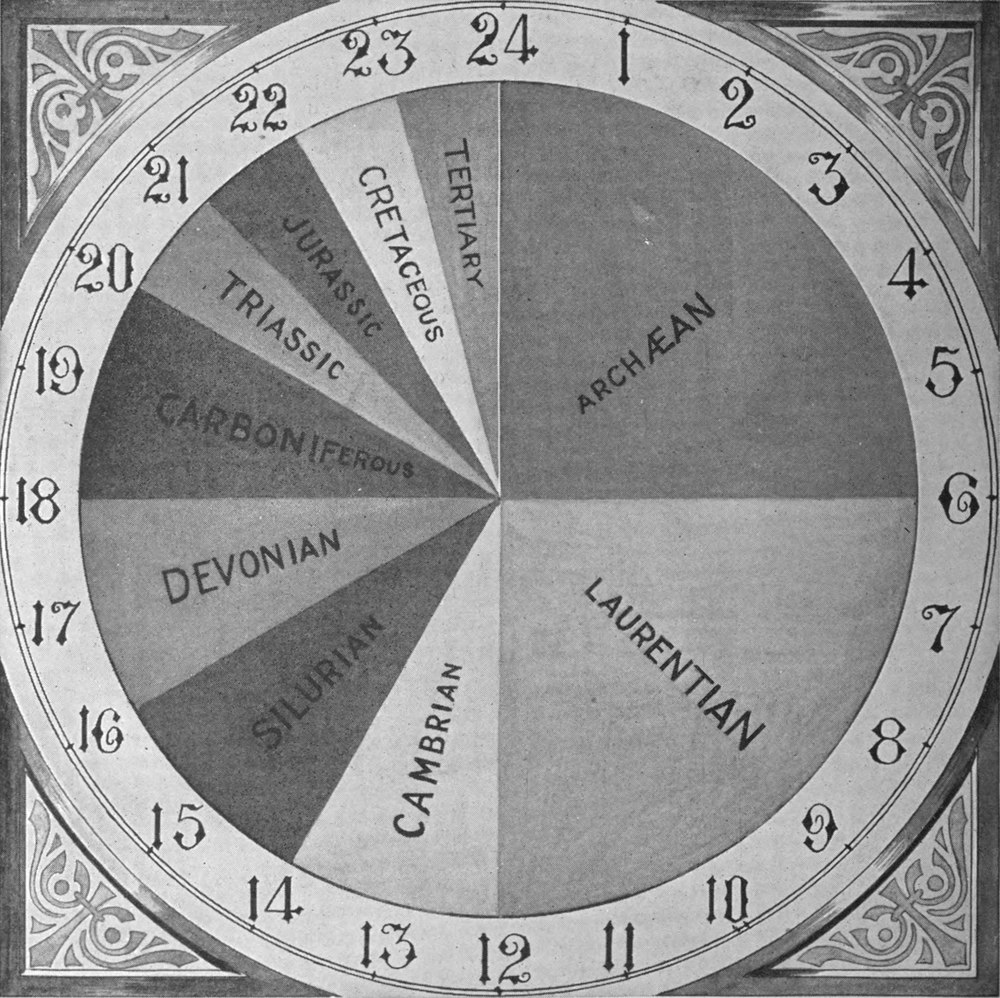
The thin white line between the Tertiary and the Archæan periods represents the duration of human history
TABLE SHOWING PROPORTIONS OF YEARS AND HOURS
Geological Periods Years Hours
Archæan 18,000,000 6
Laurentian 18,000,000 6
Cambrian 6,000,000 2
Silurian 6,000,000 2
Devonian 6,000,000 2
Carboniferous 6,000,000 2
Triassic 3,000,000 1
Jurassic 3,000,000 1
Cretaceous 3,000,000 1
Tertiary and Quaternary 3,000,000 1
The Quaternary Period is that in which we live 72,000,000 = 24
TERTIARY AND QUATERNARY PERIODS
At a rough guess, three million years may be allowed for the Tertiary and Quaternary periods
Geological Periods Years Hrs. Min. Sec.
Tertiary 2,600,000 — 52 —
Pleistocene 300,000 — 6 —
Human 100,000 — 2 —
Total 3,000,000 1 — —
Human History 10,000 = = 12
E
EARLY writers on the relation of man and animated nature to the material universe not only assumed that the latter existed for the former, but that both alike were the results of special acts of creation.
Furthermore, they usually took it for granted that all things were created very much in the condition in which we now see them, and that any changes that have since taken place are but slight superficial modifications of a permanent and unchanging whole. Not only were the sun and moon and stars created as appanages of the earth, but the earth itself in all its details of sea and land, hills and valleys, mountains and precipices, swamps and deserts, was made and fashioned just as we now see it, and every feature of its surface was supposed to have some purpose in connection with man.
The Old Ideas of Creation
These purposes we could, in some cases, understand, while in others they seemed wholly unintelligible, and much ingenuity was bestowed by the natural theologian and others to explain more and more of the observed facts from this point of view. The same opinions prevailed in regard to the infinite variety of animals and plants, each individual species being supposed to have been an independent creation, and all to have some definite and preordained purpose in relation to mankind.
These views, however absurd they seem to most people now, were almost universally held so recently as during the seventeenth and eighteenth centuries, and were thus coincident with one of the most brilliant epochs of our literature and our dawning science. It was only towards the beginning of the nineteenth century, when geology became widely studied and its results were fully appreciated, that the more rational conception of a very slow development of the earth’s surface during countless ages began to be generally accepted.