Volume 1 — LIST OF MAPS APPEARING IN THE BOOK OF HISTORY (continued 14)
Reading edition
Opening the Gates of the East Lifting the Veil in Japan
But if the exclusiveness of the Mohammedan conquerors closed the route to Cathay so effectually that for two hundred years nothing more was heard of the country, Columbus, Cabot and others set themselves the task of opening up communications by water. But it was not Cathay that they reached. That was left to the Portuguese Raphael Perestralo to accomplish by sailing, in 1511, from Malacca to Canton, and thus winning the coveted distinction of first approaching China by sea. Fifty years later (1560) the same race succeeded in obtaining a settlement at Macao, while the Spaniards gazed with longing eyes from their strongholds in the Philippine Islands upon the rich junks on the China seas. Such was the effect of these trading visits from the West that the Chinese in their turn were emboldened to visit for themselves these outlying centres of Western traffic. But it was more usually vessels from Japan that were seen, for the Chinese were still without any special appetite for Western trade. With the islanders, on the other hand, a love of barter, acting on the native instincts of a maritime people, caused them to traverse these more distant waters; although occasionally the scantiness of the resources in their own country moved them, so that they were propelled as much by stern necessity as by the lust of war and loot or a passion for trade. At first Polynesia, then Malaysia and India were visited. Again, trips were made to the remote coasts of Mexico. Still later, a colony founded at Goa became the centre of an important trading connection throughout the Indian hemisphere. In these voyages we see the attractive influence exercised by the Pacific and the Indian Oceans on an island people, who, fitted by temperament no less than by position, played in Eastern waters the rôle filled by the Elizabethan explorers on the coasts of the New World.
Raising the Curtain
As yet the distinctive call of the East had been heard only along the byways of Turkestan, and even those who had responded had ventured no further than the provinces of Cathay. Thus the isles of the Yellow Sea were to the Western mariner at the dawn of the sixteenth century as much a terra incognita as the Arctic and Antarctic regions are to the sailor of to-day. The spectacle of Japanese junks sailing gaily across the heaving waters of the Spanish Main and rounding the heel of India aroused the interest of the Western traders, who at once embarked for the fortunate lands of the East, arranging relations there even before they had been welcomed by the Chinese.
With the arrival of Portuguese traders off Japan in 1542, a curtain was raised which was never quite to descend. In the interval a commercial entrepôt was established on the island of Hirado, and an intercourse set afoot that encouraged a visit from a Spanish squadron towards the close of the sixteenth century. This visit was returned in 1602 by the despatch of a ceremonial embassy to the Governor-General of the Philippines.
Untold Wealth of Asia
Throughout the first half of that century Japan continued to attract the adventurous, and the Dutch now followed in the wake of the Portuguese and Spanish ships. The reception of the bold spirits was unequal, and in 1624 all foreigners except the Dutch and the English were banished. By 1641 no traders were allowed but Dutch, who, in spite of being restricted to the island of Deshima, enjoyed a monopoly of the trade with Japan until 1867. In the meantime, abroad, rumours of the untold wealth of Asia had brought the Indies, together with Cathay and Japan, into distinct prominence. Under the Chinese Emperor Kien-Lung, whose reign of sixty years, 1735–1795, was remarkable for its conquests and successful administration, commercial intercourse with the West was regularised, and the founding of recognised trading settlements on the China coast ended the era of furtive attempts to open trade relations with this exclusive people. From these early trading stations have sprung the several commercial capitals that now grace the China coast. Hong Kong, Canton, Shanghai, Tientsin, and Newchang are the links existing to-day between the magnificence of the merchant princes and the sway of the “John Company.” Of course conditions are now much altered, yet the memories of the past find a very splendid setting in the size, dignity, and importance of the modern treaty ports. Although the Far East was already manifesting its powers of holding the attention of the civilised world, the centres of interest there were concerned for many years solely with the kingdoms of China and Japan.
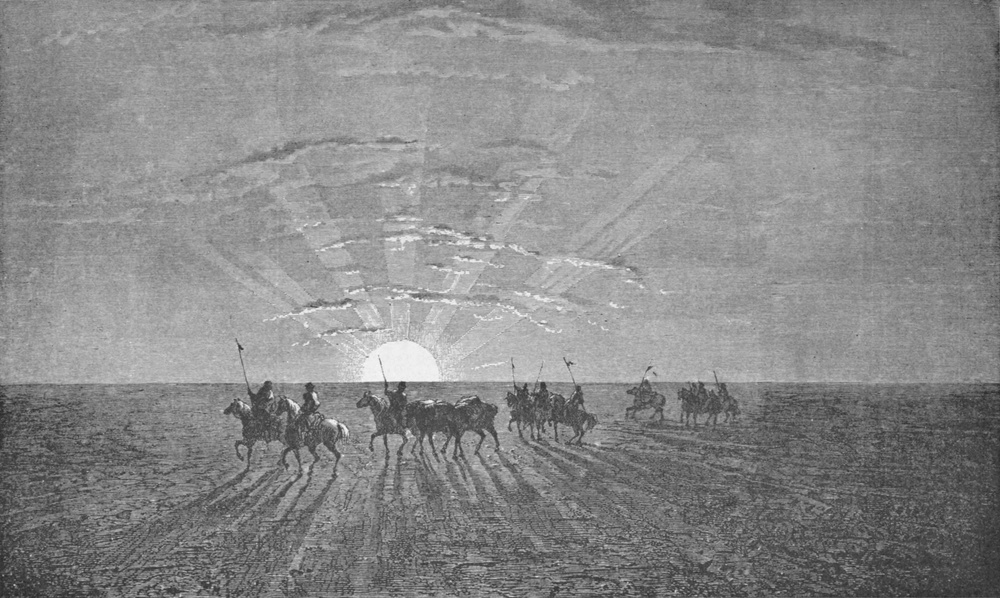
CALM IN THE FAR EAST: THE SETTING OF THE SUN IN THE MONGOLIAN DESERT
LARGER IMAGE
China on the Western Horizon
Australasia was a great unknown when the high latitudes of Asia were the fount of many conquering races. Obviously, therefore, the magnet of acquisitiveness pointed to the value of investigating the bleak northern steppes. Once started, the Pacific and the Amur were reached within eighty years under the impetus of an unrelenting progress which swept from west to east across the regions of North Asia. Begun at the instigation of Stroganoff, who pushed the hesitating footsteps of Yermak across the Urals in 1580, by 1584 this gallant freebooter was offering to Ivan IV. with no uncertain voice the wide dominions of Siberia as the price of pardon. Khan after khan was unseated, tribe after tribe dispossessed, for neither Tartar nor Turk, Buriat nor Tunguse, could offer effective resistance to the Cossacks from the Don. In the end this all-conquering advance was stayed by the Chinese, who, in the treaty of Nertchinsk, 1689, contracted their first formal convention with a foreign Power. For nearly two centuries Russia faithfully observed the terms of this engagement, apprehensive of endangering the Kiachta trade if she continued her encroachments upon Manchu territory. By this action the trade of China, which has now made the problem of the Far East of dominating importance, became of more than passing interest to a Western Government. As generations passed, however, the advance of Russia, to the Pacific in one direction, and in search of a warm-water harbour in another, was resumed. First Eastern Siberia and then Northern Manchuria were added to her Asiatic satrapy, and the Amur ceased to be the containing line. Ultimately her frontier rested on the ocean to the north, the east, and the south; Vladivostock, Port Arthur, Harbin, and Mukden becoming the centres from which her Far Eastern dominions were administered.
The English Find Australia
The spirit of adventure, now inspiring all ranks of society as well as most of the civilised races of the world, was by no means satisfied by territorial conquest. The wide dominions of the sea, as yet untraced and all unknown, embraced an empire which appealed as strikingly to the sympathies of geographers as did the prospects of Far Eastern trade to the feelings of the East India merchants. Much the same ceaseless quest carried the Cossack Dejneff, in 1648, round the north-eastern extremity of Asia; Torres, a Spaniard commissioned by the Spanish Government of Peru, in 1606 negotiated the strait between New Guinea and the mainland; and various Dutch expeditions in 1606, 1616, 1618, 1627 and 1642 endured the dangers of the reef-bound coasts. But it was not until 1688 that the English first made their appearance on the Australian coast. In some measure the situation was awaiting the man. The voyages of Captain Cook (1769–1777) took up the work of geographical exploration in the Southern Hemisphere in a style quite befitting the records already elsewhere accomplished.
Pacific and the Destinies of Peoples
If between the continent of Australia and the coasts of China to-day there is only a commercial connection, it must not be forgotten that Australia is closely identified with the Polynesian races, who in turn are related to the early Japanese. New Zealand, Australia, New Caledonia, and New Guinea, as parts of one and the same continent, which now in many places has disappeared beneath the sea, present an ethnographic study of unusual importance and interest. In few other parts of the world is so great an ethnographic variation imposed upon a single connecting racial family as in the island divisions of the South Seas—Australasia, Polynesia, Micronesia, and Melanesia. It is by the existence of this underlying relationship that the Indo-Pacific races, whatever their specific origin, undoubtedly link up two hemispheres which organically are widely separated. By the abruptly disintegrated character of existing racial location, however, it is possible to read the impression made by the Pacific Ocean on the history of the world. If oceanic influences are represented in other ways to-day, and tribal migrations in a body are occurrences of the past, the necessities of the age still make such heavy demands on what is, after all, the immemorial highway of mankind that the Pacific can still be said to mould the destinies of races to-day as easily as it has obliterated them in the past.
What will Happen To-morrow?
Turning to Asia, although the Empires of Russia in Siberia and of China have worked out their destinies independently of the Pacific, remaining unaffected by it more than all other Eastern states, the part that the Pacific has played in the development of Asia since the eighteenth century cannot go unnoticed. Japan, in particular, has profited by the readiness of communication that the ocean provides to rise above prejudices which are usually inseparable from an island people and are pre-eminently to be expected among Asiatics. In China the absence of any prominent dependence on the sea, either for food or means of transport, has produced in very sinister form an aversion against the West. None the less, under pressure from the Occident, and without regarding the example set by Japan, the Celestial Empire has permitted much commercial encroachment. Succeeding the galleons of the buccaneers have come the stately traders of the merchant princes of Europe and America, and these in turn have given place to the steamers of industrial trusts, exacting as large a tribute as the earliest marauders. While the consequences of industrial expansion among Oriental people have made the Pacific the focus of much restless energy, Japan, now as great a Power on land as formerly she was, and is, at sea, has developed an intelligence that has made her pre-eminent among the trading nations of the East. Undeterred by exertion, unmoved by expenditure, Japan has displaced the carrying trade of the Pacific by her fearless invasion of Western markets. Throughout the isles of the Southern Seas, and up and down the face of the Pacific slope, the islanders have swarmed, filling the lands of their passage with unaccustomed energy.
Looking back, then, at the conditions of Asia in the eighteenth and nineteenth centuries, and comparing them with those existing to-day, it will be noticed that a wide gulf still separates Japan from China in the twentieth century as it formerly separated China from the rest of the Far East. On the one side there is China, now emerging from revolution; on the other there is Japan, voicing the regeneration of Asia with raucous tones.
China Thirty years Hence
Meanwhile the vast interests of the Occident in the Orient are united with either power by frequent political intercourse and a traffic which has given to the Pacific priority of place in the battle for commercial supremacy. Yet while China is commercially independent of the West, and Japan dependent upon it, all branches of foreign industry cannot but view with alarm the increasing aggressiveness of the spirit of independence now inspiring Asia at the prompting of Japan. Obviously these signs are the indication of an approaching cleavage between East and West, which, when fully attained, will bear witness to the complete severance of the shackles hitherto enthralling Asia to the interests and purposes of the West. It must not be forgotten that Japan already has achieved her complete regeneration. Thirty years hence China, no doubt, will have followed suit, when a federacy of the Far Eastern Powers may become an accomplished fact. Even at this moment such a union is possible, and its realisation would impose upon all European Governments the immediate revision of their Asiatic policies.
At this time such a combination is hampered only by the unwillingness of China to accept the suggestions of Japan in anything affecting the policy of Asia, although, in spite of this objection, active reforming influences are gradually effecting important changes throughout the Chinese Empire. For the moment, therefore, Japan is content to tread alone the path she has marked out, encouraging her subjects by example to exploit Asia for the Asiatics, and to secure recognition of the doctrine of equality between the white and Asiatic races.
If the full significance of this movement is not yet discernible, there is enough evidence to show that the problem will rank among the greatest that the politics of the twentieth century can disclose. Not only one part of the civilised globe will be affected by the rise of a dominant Asia, for the whole world will be confronted equally with the necessity of resisting whatever indications may appear. If it is difficult to devise an arrangement short of total exclusion that does not admit an annual influx of a large number of Japanese, Chinese, Korean, or Indian immigrants into the lands affected by this invasion, it is at least tolerably certain that if the existing flow of Asiatics across the Pacific to America and Australasia continues unabated for a further decade, the areas now menaced will be inhabited by a white minority.
Problem of the Century
It appears evident that the continuation of the Far East under existing conditions is doubtful, if not impossible, in view of the awakening of Asia and the visible prejudices that Western democracy entertains against the Asiatic. Yet if the clash of conflicting interests ultimately precipitates a struggle between the two great racial divisions of the world, there can be no doubt that the moral teachings of humanity will be discredited.
ANGUS HAMILTON
GREAT DATES IN THE HISTORY OF JAPAN
B.C. To 500 A.D.
660 Supposed foundation of the Japanese Empire by Jimmu
A.D.
3 Emperor Suinin flourished. Abolition of the practice of burying retainers alive on the master’s death
59 Reputed Korean immigration
125 Legendary hero Yamato Daké flourished
202 Reputed conquests in Korea by Empress Jingō Kōgō
397 Probable introduction of Chinese civilisation, through Korea
500–1000
552 Introduction of Buddhism
645 The Taikwa Laws of Kōtōku
675 Encouragement of Buddhism by Temmu
689 The Laws reduced to a written code
750 Development of the Samurai class
782 Emperor Kwammu
800 Fusion of Shintō with Buddhism by Kōbō Daishi
889 High offices become hereditary in the Fujiwara family
1000–1500
1155 Wars of the Taira and Minamoto clans
1186 Victory of the Minamoto
1192 The Minamoto Shogunate established. Japanese feudal system
1220 Supremacy of the Hōjō family
1275 Attempt of Kublai Khan to invade Japan
1281 Destruction of the Chinese (Mongol) Armada
1333 Ashikaga revolt and overthrow of the Hōjō
1337 Rival Mikados of the North and South for fifty-five years
1500–1800
1543 First appearance of Europeans (Portuguese) in Japan
1549 Francis Xavier attempts to introduce Christianity
1574 Overthrow of Ashikaga by Nobunaga
1581 Rapid development of Christianity
1582 Death of Nobunaga. Supremacy of his general Hideyoshi (Taikō Sama)
1583 Envoys sent from feudal lords to the Pope
1592 Hideyoshi’s invasion of Korea
1598 Death of Hideyoshi. Accession to power of Iyeyasu
1606 Prohibition of Christianity
1615 Restoration of Minamoto Shōgunate
1617 Foreign trade limited to two ports
1621 Japanese prohibited from foreign travel
1624 Decree of expulsion against all foreigners except Dutch and Chinese
1637 Peasant and Christian revolt
1641 Dutch and Chinese restricted to Nagasaki
1694 Development of trade-guilds
1792 Russian squadron visits Japanese coast
1800–1867
1804 Russia attempts unsuccessfully to open relations with Japan
1818 Captain Gordon at Yedo Bay
1844 Holland makes proposals for extension of trade
1848 Visit of American and French warships to Japanese waters
1853 Commodore Perry in Yedo Bay
1854 First Japanese Treaty with a Western Power (U.S.A.) in March. First Treaty with Great Britain in October
1855 Russian Treaty
1856 Dutch Treaty
1859 Readmission of Christian missionaries
1861 Attack on British Legation
1862 Murder of Mr. Richardson Japanese Embassy to the Treaty Powers
1863 Bombardment of Kago-shima by British
1864 Bombardment of Shimonoseki by international squadron Contest and reconciliation of the two great clans (Sats-cho)
1866 Kei-ki, last Shōgun New Conventions with Western Powers
1867 Accession of Mutsu-hito as Mikado Appointment of Europeans: French military and British naval instructors Resignation of Shōgun Kei-ki
1868–1907
1868 Restoration of imperial power
1869 The Emperor takes up residence at Yedo, re-named Tokio. Emperor’s “charter” oath The Daimiyo surrender feudal rights
1871 Feudalism abolished
1872 Establishment of religious toleration
1873 Adoption of Gregorian Calendar Universal Military Service
1874 Saga rebellion. Formosan expedition
1875 Saghalin exchanged for Kuriles
1876 Korean Treaty
1877 Revolt and death of Saigo
1879 Annexation of Riu-Kiu Islands
1889 Promulgation of the Constitution. Establishment of local self-government. Anti-foreign reaction
1890 First Imperial Parliament. New civil and commercial codes
1894 War with China
1895 Victory over China. Formosa annexed
1897 Revised customs tariff. Gold standard. Freedom of Press and public meetings
1899 New Treaties on terms of equality. Opening of the whole country
1900 Expedition against Boxers in China
1902 Anglo-Japanese agreement
1904 War with Russia
1905 Victory over Russia. Japan obtains Port Arthur, S. Saghalin, control of S. Manchuria, and protectorate of Korea Anglo-Japanese alliance
1907 Franco-Japanese Agreement Russo-Japanese Convention
1910 Korea annexed
1911 Anglo-Japanese Agreement
JAPAN
THE COUNTRY AND THE PEOPLE
BY ARTHUR DIOSY
THE EMPIRE OF THE EASTERN SEAS
Length and Breadth of Great Japan
A
ASIA’S furthest outpost towards the vast waters of the Pacific Ocean, a long, narrow chain of rocky, volcanic islands, extends north-east to south-west along the eastern coast of the mainland, separated from it by the Sea of Japan and the China Seas. A glance at the map shows this long string of more than three thousand islands and islets, stretching from 51°5′, the latitude of Shumo-shu, the most northern of the Kurile group of islands, down to 21°48′, the latitude of the South Cape of Formosa, a total length of nearly thirty degrees. Its component parts extend from 157°10′ east longitude, at Shumo-shu, as far westwards as 119°20′, the position of the extreme western islets of the Pescadores, or Hokoto, archipelago, a distance of nearly thirty-eight degrees, the total breadth of the Empire of Dai Nippon—Great Japan.
The enormous length of the island empire, the configuration of which is likened by the Japanese to the slender body of a dragon-fly, provides a great variety of climate, from the Arctic rigour of the Kurile Islands and the Siberian climate, with its long and terrible winter and its short but fierce summer, obtaining in the larger northern islands, to the sweltering, steamy heat of Formosa, the tropic of Cancer passing through that island and through the Pescadores. These extreme temperatures apart—and they prevail only at the ends of the empire—Japan possesses a temperate climate, similar to that of the northern shores of the Mediterranean, but colder in winter and much damper, the excessive humidity causing both heat and cold to be very trying, though never dangerous. The rainfall is especially heavy in June and in September, but no month is entirely without rain. The hottest period of the year is called dō-yō, corresponding to our “dog-days,” and follows the rainy season of June and early July.
What Japan Owes to its Position
Japan owes its great humidity, the consequent fertility of such parts of its surface as are cultivable—about 84·3 per cent. of the whole area of Japan proper is too rocky to yield food for man—and the luxuriant verdure that clothes the lower slopes of its wooded hills, to its insular position, and, chiefly, to two great factors, a current and a wind. The great warm current known as the Kuro-shio, the Black Brine, or Black Tide, flowing from the tropical region between the Philippines and Formosa, raises the temperature of the east coast, and, where it is in part deflected by contact with the southern coast of Kiū-shū, also of the west coast, acting in the same beneficent manner as the Gulf Stream of the Atlantic. The wind that affects the Japanese climate most strongly is the north-east monsoon, tempered by the action of the dark, warm, ocean current.
Keystone View Co.
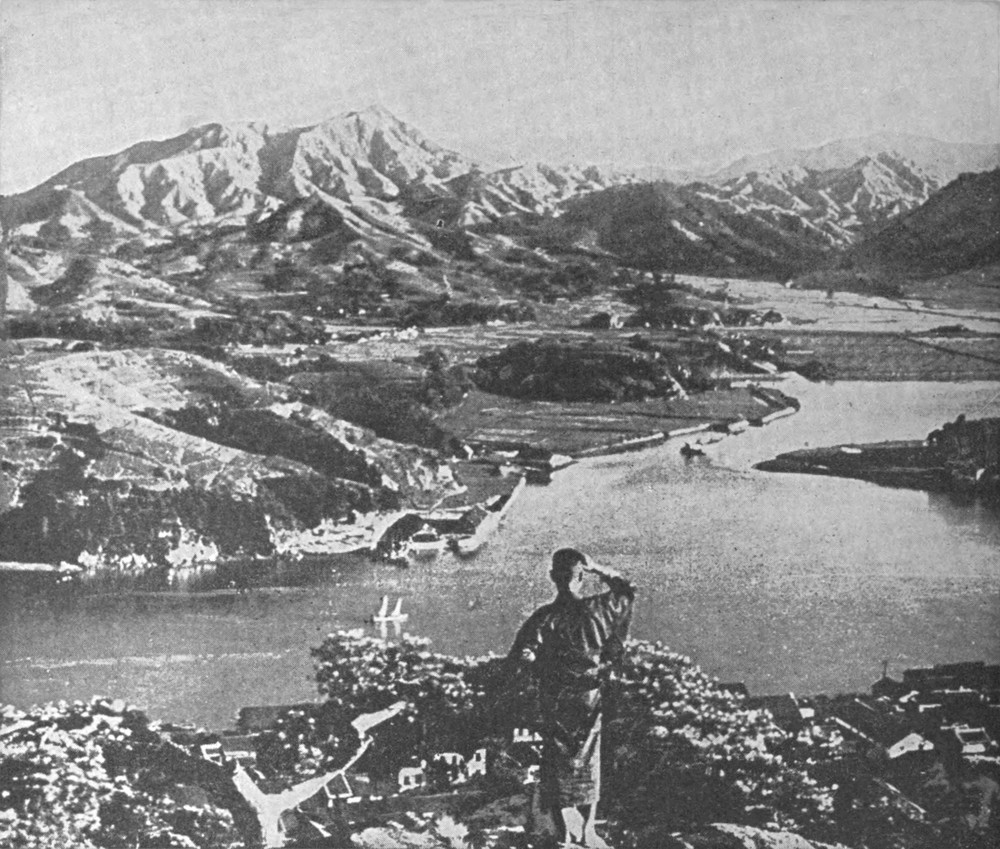
A GLIMPSE OF THE INLAND SEA, THE LOVELIEST SHEET OF WATER IN JAPAN
Studded with hundreds of islands, every part of the Inland Sea of Japan, stretching 240 miles in length, and widening once to 40 miles, offers an enchanting prospect. The islands occur often in clusters, giving the appearance of lakes.
The geographical position of Japan has had great influence on the history of its people, and clearly indicates the supremely important part the empire is destined to play in the future development of the Far East. Its insular character has preserved it from invasion—it is the proud and legitimate boast of the Japanese that no foe has, within historical times, trodden Japanese soil for more than a few hours—and whilst it rendered possible the seclusion in which the nation lived for more than two centuries, developing, undisturbed, a high civilisation of its own, the basis of many of the qualities displayed by the Japanese in our day, it has been, in recent times, the cause of Japan’s real might in the world—her sea-power, naval and commercial.
The map shows the four principal islands of Japan Proper: HON-SHŪ, or Hon-dō—“Principal Circuit,” the largest island of Japan, commonly called Nippon, really the name of the whole empire, meaning “Sun-origin,” equivalent to Sunrise Land; KIŪ-SHŪ, or Nine Provinces; SHI-KOKU, or Four States; and the great northern island of YEZO, the second in size, officially termed Hok-kai-dō—“North Sea Circuit.”
The four islands extend, opposite the mainland, from the coast of the Russian Maritime Province, on the north-west, down to the southern extremity of the Korean peninsula, on the south-west. North of Yezo, facing the mouth of the great River Amur, the long, narrow island of Saghalin—Karafuto, in Japanese—belongs partly to Russia, partly to Japan, its southern districts, up to the fiftieth degree of latitude, being ceded to the victors by Article IX. of the Treaty of Portsmouth (1905). Separating these islands, important channels afford communication between the Sea of Japan and the Pacific. The Gulf of Tartary divides Saghalin from the mainland, whilst the Strait of La Pérouse, or Strait of Tsugaru, separates the island from Yezo. The Straits of Korea, between that empire, now under the protectorate of Japan, and the main island, Hon-shū, or Nippon, are the way of communication joining the Sea of Japan and the eastern part of the China Sea, the straits being divided into three channels by the island of Iki and by those of Tsu-shima, a name rendered for ever glorious by Togo’s great victory on May 27th, 1905. The various straits are sufficiently narrow to be easily closed to an enemy by Japan’s splendid fleet.
Keystone View Co.
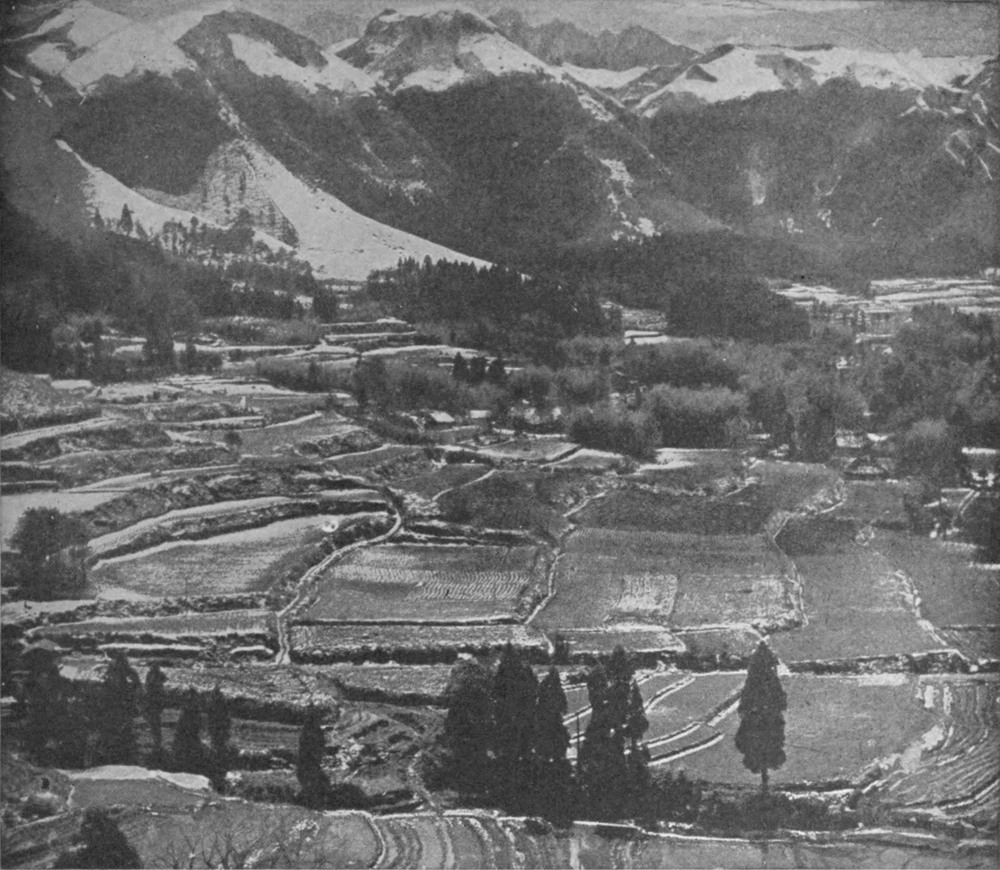
A CRATER WITH EIGHTY VILLAGES, IN WHICH TWENTY THOUSAND PEOPLE LIVE
Twenty thousand people live in eighty villages in the outer crater of Aso-san, probably the largest crater on earth, competing, says Professor Milne, with some of the great craters of the moon. The crater of Aso-san is from 10 to 14 miles across, and its wall is everywhere 2,000 feet high, the highest peak being Taka-dake, 5,630 feet.
Although Japan has remained immune from invasion throughout historical time, its proximity to the mainland, and especially to the Korean peninsula, led, in prehistoric ages, to its receiving from the continent an influx of immigrants who gradually conquered the insular natives, and whose descendants probably form the main stock of the present Japanese race. It was this proximity that brought the civilisation of China into Japan, in the first instance through Korea; the same route was followed by another mighty invasion of foreign thought, the introduction of Buddhism.
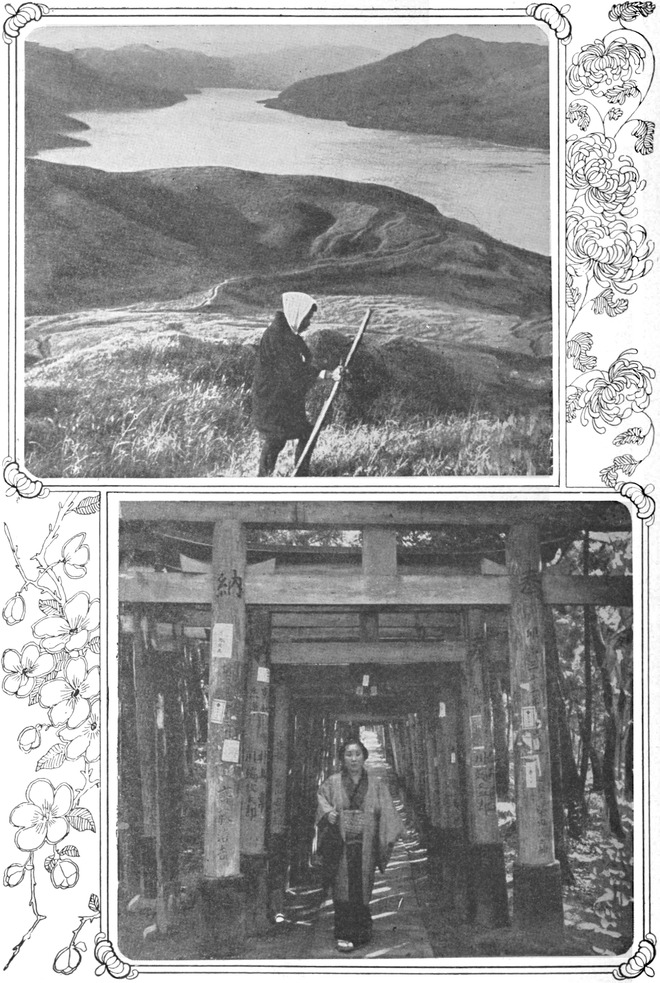
Keystone View Co.
HAKONÉ LAKE AND THE GATEWAY TO THE INARI TEMPLE IN KIŌTO
Hakoné Lake, the top picture, is a delightful summer resort. The bottom picture, the avenue of Torii (portals), forming the entrance to a Shintō Temple at Kiōto, is a wonderful sight. There are over 400 Torii, arranged in two colonnades.
LARGER IMAGE
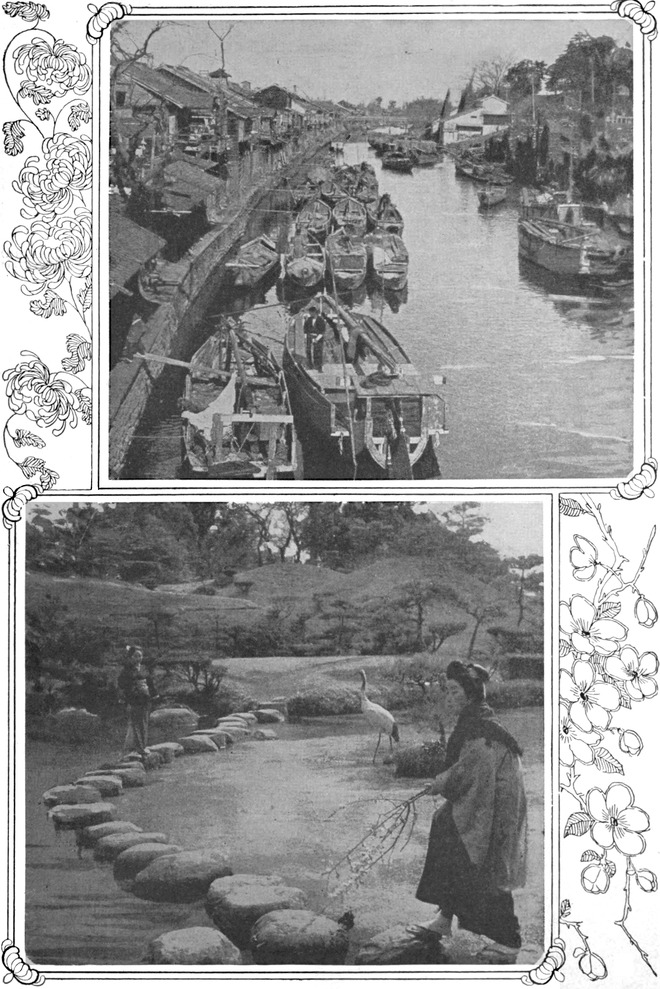
Keystone View Co.
A GLIMPSE OF THE BUSY NAGOYA CANAL AND OF THE PARK AT KUMAMOTO
Nagoya is one of the great manufacturing cities of Japan, and a busy canal links the city with the port of Yokkaichi. The park of Suizenji, in Kumamoto, is a beautiful example of Japanese landscape gardening.
LARGER IMAGE
No country has been better fashioned by Nature for the acquirement of sea-power than the Island Empire of the Rising Sun. Its enormous extent of coast-line, with countless indentations, especially numerous on the south-eastern coasts of Hon-shū, Shi-koku, and Kiū-shū, its many excellent harbours, naturally fortified by reason of the narrow entrances to the gulfs in which they are situated—for example: Nagasaki, in Kiū-shū, the naval stations at Sasebo, in the same island, Kure, in the Inland Sea, and Yoko-suka, near Tōkio Bay—and, above all, the excellence of its seafaring population, supply the elements that give Japan the mastery in Far Eastern waters.
Seafaring Qualities of Japanese
In the thousands of hamlets nestling in the bays, large and small, and creeks of the Japanese islands, dwells a hardy race of fishermen, inured to peril and fatigue, men of brawny strength and indomitable pluck, frugal and enduring, as fine material for the manning of warships and trading craft as the world has ever known. The persistence of those seafaring qualities which the Japanese owe chiefly to the natural advantages of their island home—partly, no doubt, to a strain of the blood of Malay sea-rovers, perhaps also of Polynesian canoe-men—is a remarkable phenomenon. In olden times they were bold seafarers, roaming as far as the Philippines and the coast of Indo-China. The waters of Formosa and of Siam were the scene of their piratical exploits, for, like all nations destined to be great at sea, they passed through a period when the spirit of adventure, as much as the lust for spoil, made them into daring sea-robbers.
But, with the closing of Japan to foreign intercourse—save on a strictly limited scale—early in the seventeenth century, came the enactment of laws devised to prevent the Japanese from visiting foreign parts; the tonnage and build of ships were fixed by these decrees in such a manner that only fishing and coasting trips were thenceforward possible. This prohibition lasted for two centuries and a half; yet, on its removal, the germ of the seafaring qualities, supposed to have died out, was found to have been only in a state of suspended animation; it revived with surprising rapidity. In less than a quarter of a century it produced a naval personnel capable of manning a highly efficient fleet of thirty-three sea-going fighting-ships; in ten years more the amazed world recognised Japan’s Navy as the triumphant victor in the greatest battle since Trafalgar, and coupled Admiral Togo’s name with that of Nelson.
The Sea as Japan’s Friend
The sea has, indeed, ever been Japan’s friend; to this day it supports a large number of the population, and, in a sense, it may be said to keep the whole nation alive, as the fish that teem in Japanese waters supply a considerable part of the people’s food. Every marine product available as nutriment is utilised, even seaweed of various kinds being largely used as food. Fishing seems to have been practised from the earliest times; it is probably in recognition of its antiquity and national importance that the Japanese of our day still affix to any gift a strip of dried seaweed, passed through a piece of paper peculiarly folded, the idea they thus symbolise being, it is said: “This is but a trumpery present, but it comes from a cheerful giver; be pleased to take it as it is meant. Remember our forefathers were poor fisherfolk; this strip of seaweed is to remind you that poverty is no crime.”
Japan’s Beautiful Scenery
There are many other customs connected with the harvest of the sea, and innumerable legends and folk-tales wherein the chief part is played by some marine spirit or by a visitor—deity or mortal—to the mysterious realms of the deep. And deep it is, for, off the eastern coast of Northern Japan, the sea-bed falls abruptly to a depression—the famous Tuscarora Deep, called after the United States warship of that name—of 4,655 fathoms, nearly 28,000 ft., or more than five miles, probably the deepest sea-bed in the world. The encircling sea forms an important part of most of the beautiful pictures the scenery of Japan offers to the delighted eye. Whether the waves dash tumultuously against the precipitous rocks of the south-eastern side of the main islands, especially of Shi-koku and Kiū-shū; whether the waters dance in the sunshine in the countless bays and creeks of those coasts where the frequency of the shelter afforded to fishing-craft led to an earlier and more dense settlement than on the north-west coast of Hon-shū; whether the far-famed Inland Sea shines like a mirror under the moonbeams, or the Sea of Japan tosses its grey billows or spreads a sullen expanse under the pall of fog caused by the meeting of warm and cold currents—in all its moods the ocean forms part of nearly all the grandest scenery of Japan.
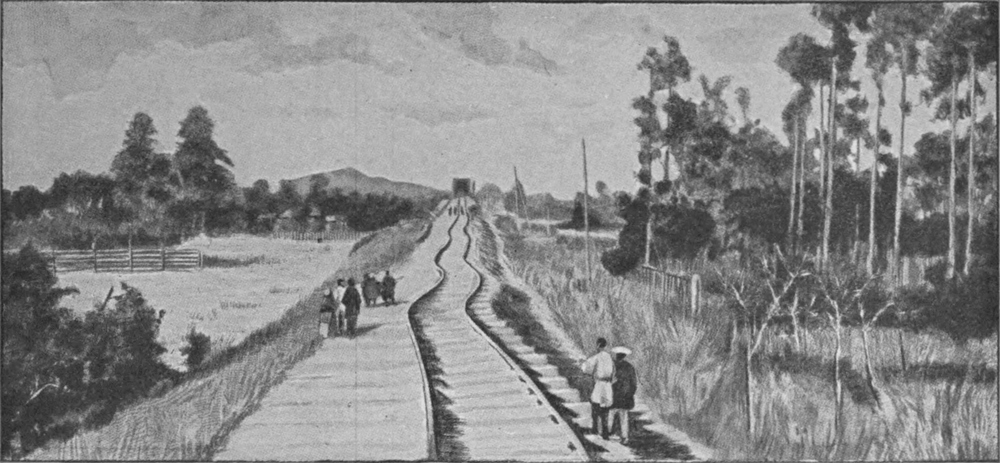
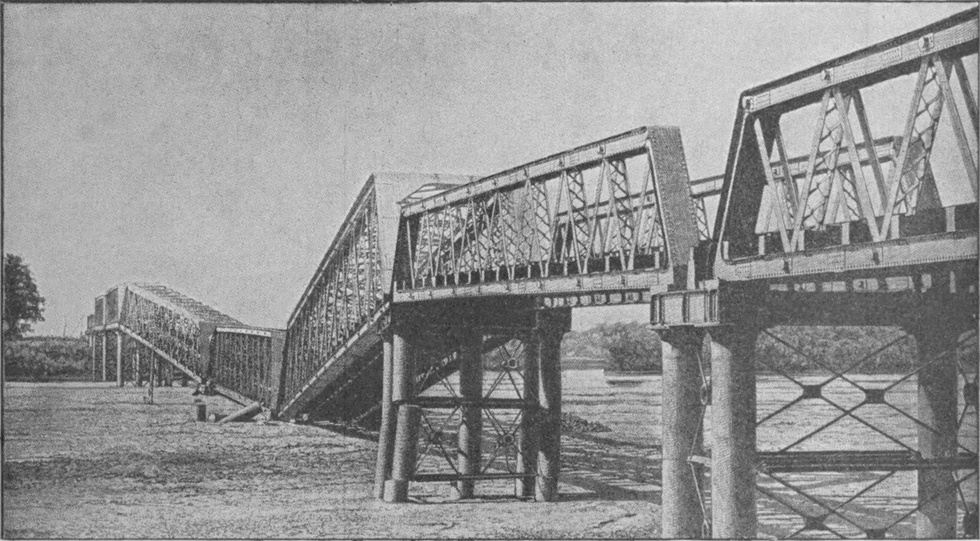
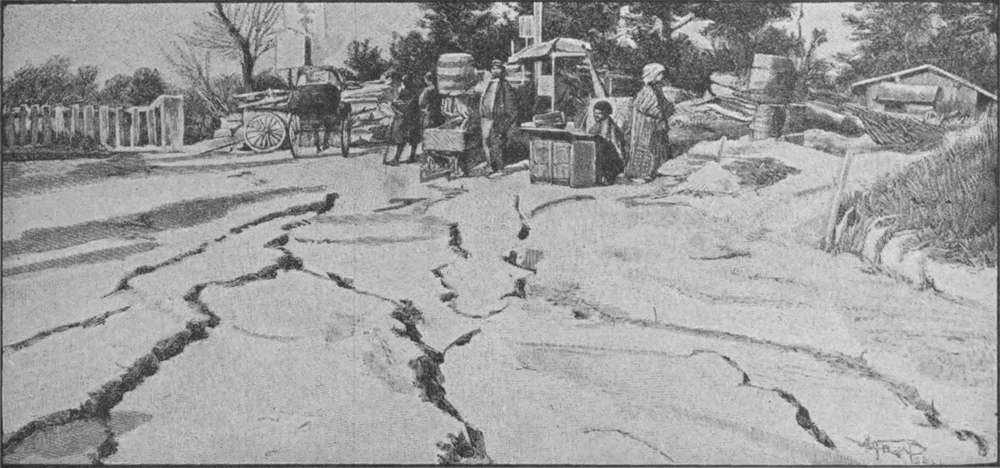
SCENES IN JAPAN AFTER AN EARTHQUAKE
There is at least one shock of earthquake every day in Japan; there are 500 shocks in a year. As late as 1891 an earthquake wrecked two populous towns and destroyed two smaller ones. These photographs show the havoc of such earthquakes.
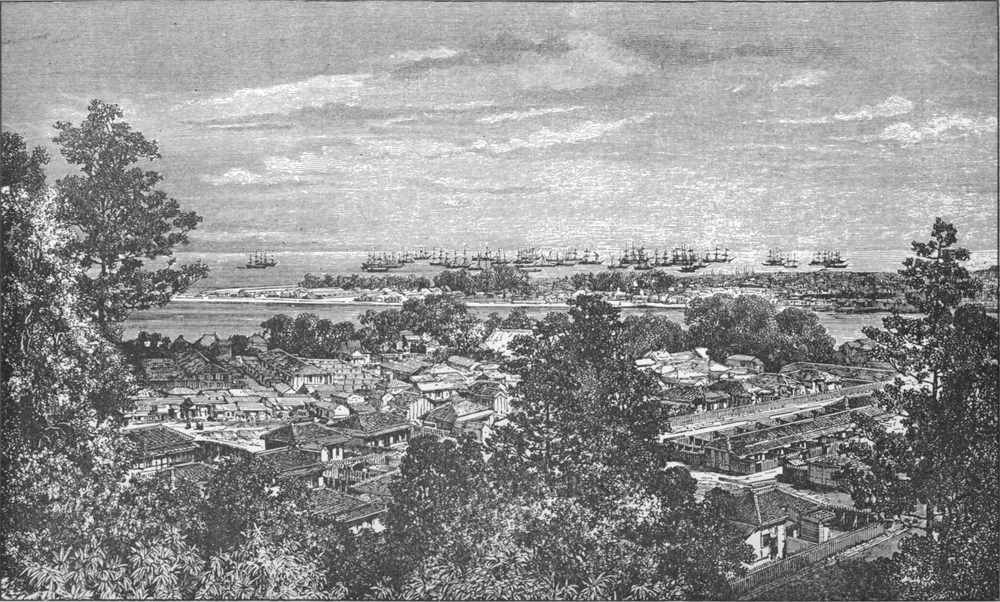
YOKOHAMA: THE TOWN AND HARBOUR IN THE EARLY DAYS OF THE GREAT CHANGE
LARGER IMAGE
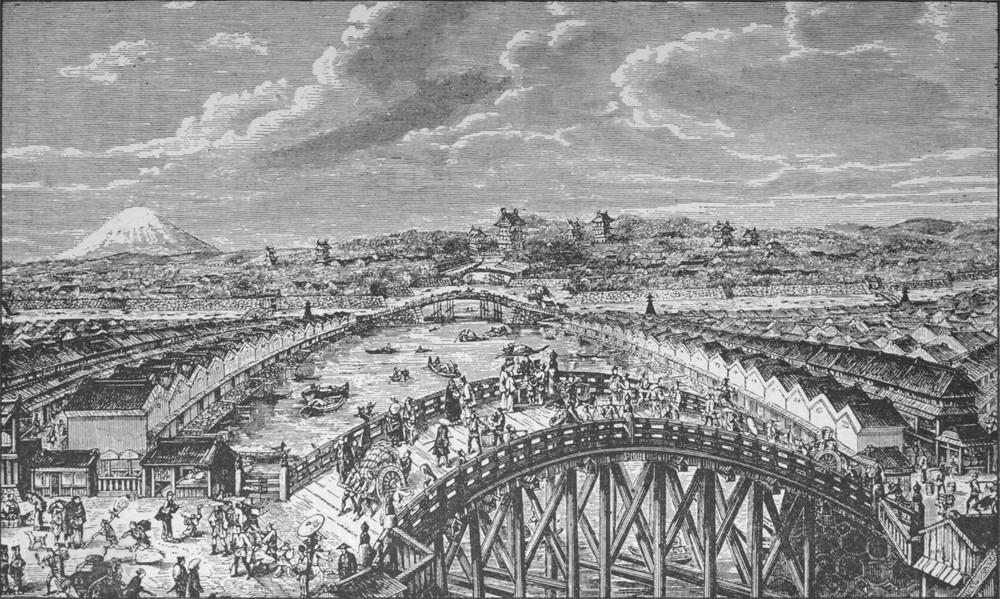
OLD TŌKIO: THE CITY OF YEDO, SEAT OF THE GOVERNMENT OF THE SHŌGUNS FOR HUNDREDS OF YEARS
The “Japan Bridge,” one of the striking features of the capital of Old Japan, was regarded as the centre of the empire, and from it all distances were measured.
LARGER IMAGE
The “Three Views,” known to every Japanese man, woman and child, for they are portrayed in countless pictorial representations, are sea-scapes. The 808 islets of Matsu-shima, with the thousand trees from which the group derives its name of Pine Islands, are the glory of the province of Sen-dai, in Northern Hon-shū; the hoary tori-i, or gateway, of the great Shin-tō temple at the sacred island of Miya-jima, or Itsuku-shima—so holy that no birth nor death may take place on the island, and no dog is allowed there—stands firmly amidst the very waves of the Inland Sea; Ama-no Hashidaté, the “Sacred Bridge,” stretches its slender two-mile length of sandy spit, only 190 ft. broad—crowned, all along, with an avenue of pine-trees—into the blue waters of the gulf of Miya-zu, in the Sea of Japan.
The so-called Inland Sea, 240 miles long from its narrow western entrance, only one mile across, between Shimo-no-seki on the main island and Mo-ji, the busy colliery port in Kiū-Shū to its eastern extremity, where it joins the open sea through the Aka-shi and Naru-to Straits—it widens to forty miles where the Bungo Channel divides Shi-koku from Kiū-shū—is perhaps the most lovely sheet of salt water in the world. Studded with many hundreds of islands, every part of its expanse offers an enchanting prospect, the islets being often in clusters, making many stretches appear like lakes.
Water enters into the beauty of every Japanese landscape; districts remote from the sea have their lakes and rivers—generally short, swiftly-flowing streams, almost, sometimes quite, dry in summer, exposing beds of pebbles, but rushing torrents in the wet season.
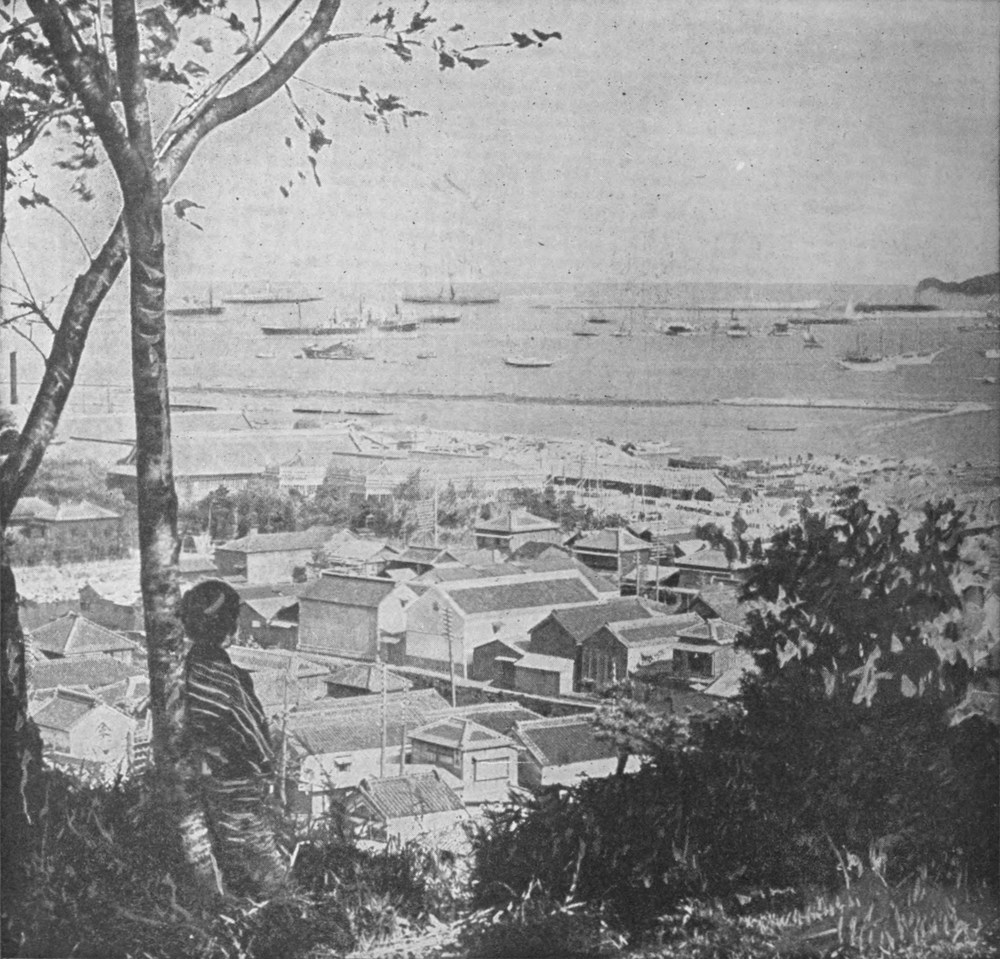
Keystone View Co.
MODERN YOKOHAMA: THE HARBOUR, SEEN FROM THE HEIGHTS OF THE TOWN
Biwa is the largest lake in Japan, and far-famed for its scenery; its area is about the same as that of the Lake of Geneva, and it is nearly as beautiful. Lake Chū-zen-ji, or Chū-gū-shi, is surrounded by luxuriant verdure at an altitude of 4,375 ft. above sea-level, and is surpassed in beauty by the smaller Lake Yumoto, higher up, in the sulphur-springs region, 5,000 ft. above the sea. There are many other lovely lakes in Japan, Lake Hakoné amongst them. Those just mentioned are singled out because they lie in the mountainous district round Nikkō, a region on the main islands, to the north of Tōkio, presenting, in their greatest beauty, characteristic features of Japanese inland scenery—imposing mountains, stately, venerable trees, and grand waterfalls comparable to those of Norway. The aspect of the Japanese islands is, as may be inferred, diversified, stern and rugged amidst the dark forests of the north, smiling in the sunlit regions further south, beautiful almost everywhere.
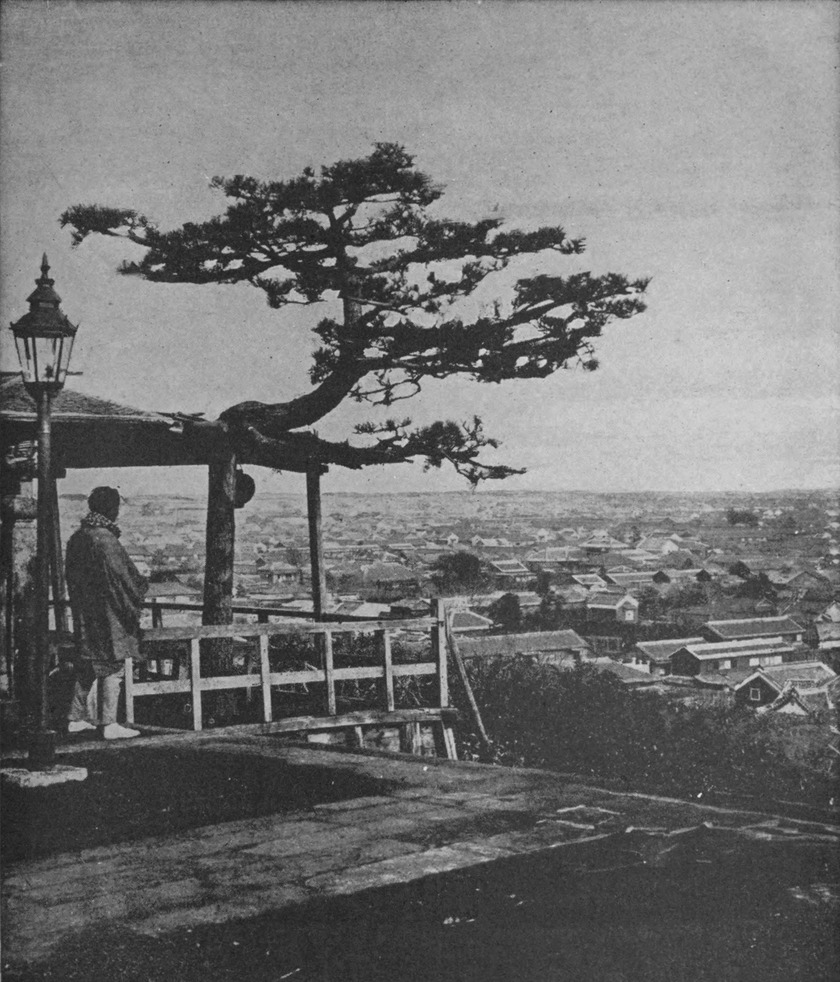
OVERLOOKING MODERN TŌKIO, THE CAPITAL OF JAPAN
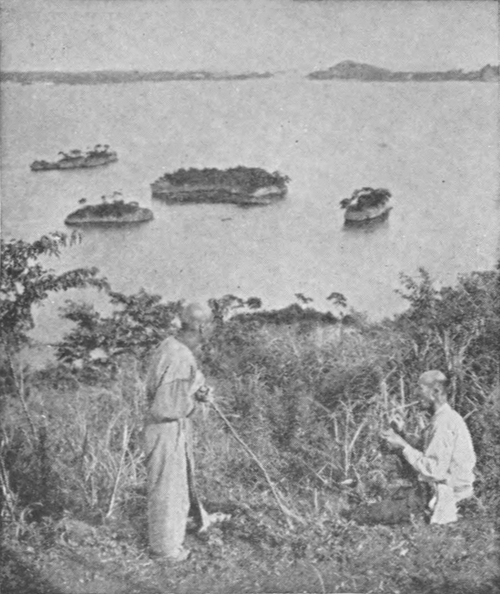
Looking over the Bay of 808 Islands
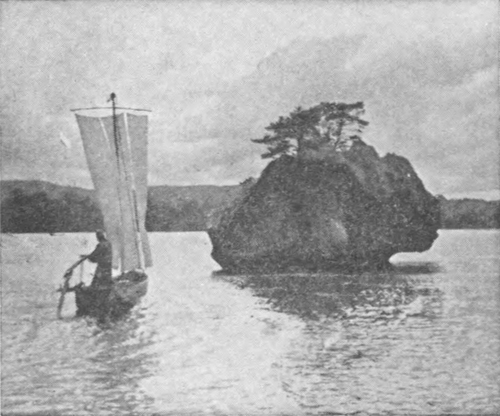
Sunset among the pine-clad rocks
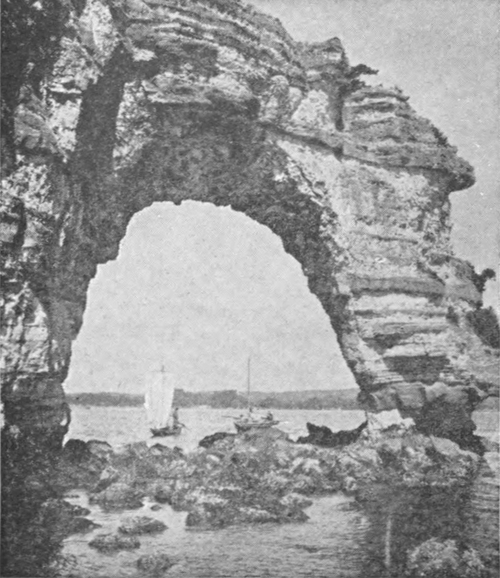
The White Co.
A natural arch
SCENES IN MATSUSHIMA BAY, JAPAN
The land is chiefly mountainous, the ranges running from south-west to north-east, interspersed with smiling valleys, fertile plains, chequered into regular squares by the narrow, raised embankments dividing the rice-fields, with, here and there, wild, desolate moors in places where even the untiring industry and agricultural skill of the people could not induce the stubborn ground to yield sustenance. Where anything useful can possibly be made to grow, the Japanese grow it. Beside plants of utility, they grow, to a greater extent than in any other land, plants intended only for pleasure, for the delight they give the Japanese eye by their beauty.
In no other country are flowers so reverently admired as in Japan; nowhere are they more skilfully grown and tended. Every month has a special blossom, and what may be termed its flower festival, when the people, high and low, rich and poor, go in their tens of thousands to seek happiness in the contemplation of Nature’s most delicate productions. The plum-blossom appears about a month after the New Year, and is followed by the far-famed cherry-flower early in April, when, in many ancient groves and on many hillsides, the lightest of delicate clouds, faintly pink, seem to have settled on the trees.
No words can do justice to the exquisite beauty of Japan in cherry-blossom time; it is then easily to be understood how dear the flower of the cherry is to the Japanese heart. To the people of Great Japan it is the emblem of patriotism and of chivalry, sharing their affections with the chrysanthemum, the badge of the empire. Other flowers grown to wonderful perfection are the peony, symbolical of valour; the graceful wistaria, the glowing azalea, the slim-stalked iris, the convolvulus, or “morning-glory,” in many strange forms, and the lotus, the sacred flower of Buddhism. Besides these and other cultivated flowers, Japan possesses wild blossoms galore that fleck its plains and valleys with colour. The leaves of the maple turn, in November, to hues of crimson and gold, clothing the woods with a glory to be equalled only in Canada.
The natural, beauty of Japan has undoubtedly fostered the æsthetic taste inborn with the Japanese of all classes. High and low, they admire and enjoy intensely the lovely scenes amidst which they dwell. This admiration and enjoyment are strong incentives to their patriotism. It seems to them that their beautiful country must indeed be Kami-no-Kuni, “the Land of the Gods.” To travelled Occidentals, the scenery of Japan suggests, in places, the Norwegian fjords; in others, the smiling shores of the Italian lakes; at some points the coves of Devonshire, the rocky coasts of the Channel Islands, or the pleasant hills of Surrey. That these impressions are correct is proved by the fact that Japanese travellers who visit any of these places never fail to recognise their similarity to some favourite spot in Japan.
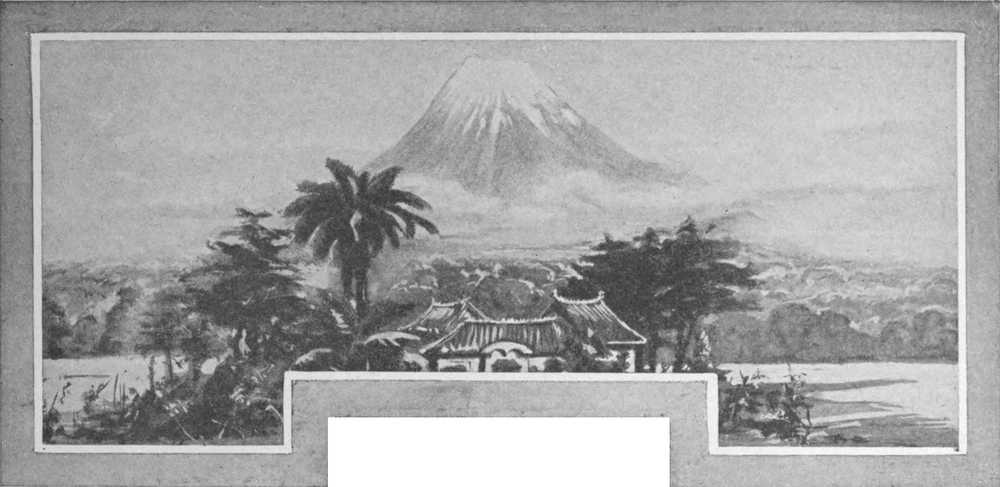
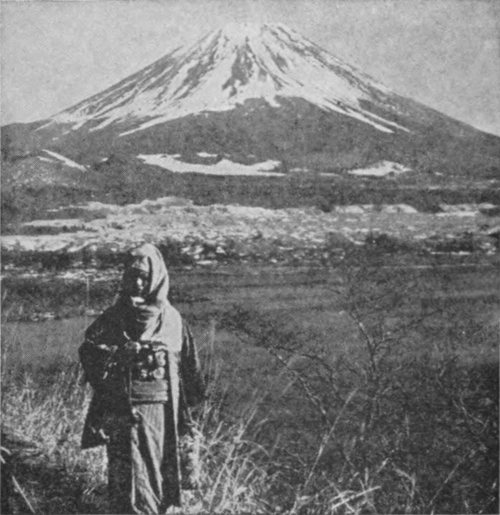
The “backbone” of the southern half of the main island and of the whole island of Shikoku consists of rock, principally primitive gneiss and schists; Kiū-shū, Yezo and the northern half of the main island are partly, the Kurile islands—Chishima—entirely, volcanic. Subterranean fires still smoulder in many parts of Japan, many of the mountains being volcanoes, not all of them extinct. Fuji, the glorious cone so dear to the Japanese heart, uplifting its peak 12,365 ft. from the surrounding plain, is a volcano that erupted last in January, 1708. Fifty-one volcanoes, such as Asama and Bandai-san in Eastern Japan, Aso-san in Kiū-shū, Koma-ga-také in Yezo, have been active in recent years, some of them, especially Bandai-san, with disastrous results. Nor do only volcanoes threaten danger to the inhabitants of Japan: earthquakes are frequent—about 500 shocks yearly—and sometimes appallingly destructive of life and property.
The great earthquake in the Gifu region, in the central provinces of the main island, on October 28th, 1891, wrecked two populous towns—Gifu and Ōgaki—completely destroyed two smaller ones—Kasamatsu and Takegahana—killed about ten thousand people, and caused more or less severe wounds to nearly twenty thousand. In Japanese earthquakes, a great part of the destruction arises from the innumerable fires that break out when the flimsy houses—mostly of wood, with paper partitions, in sliding frames, between the rooms—collapse through the shock, scattering the glowing charcoal from the kitchens amidst heaps of highly inflammable materials. Earth-tremors bring not only fiery ruin in their train; they cause at times upheavals of the sea that work stupendous havoc. On the evening of June 15th, 1896, the north-eastern coasts of the main island were overwhelmed by a so-called “tidal wave.” The sea, impelled probably by a seismic convulsion on the bed of the Northern Pacific, rose in a wave of towering height and, rushing inland with terrific speed, engulfed whole districts. More than 28,000 lives were lost, and more than 17,000 people were injured.
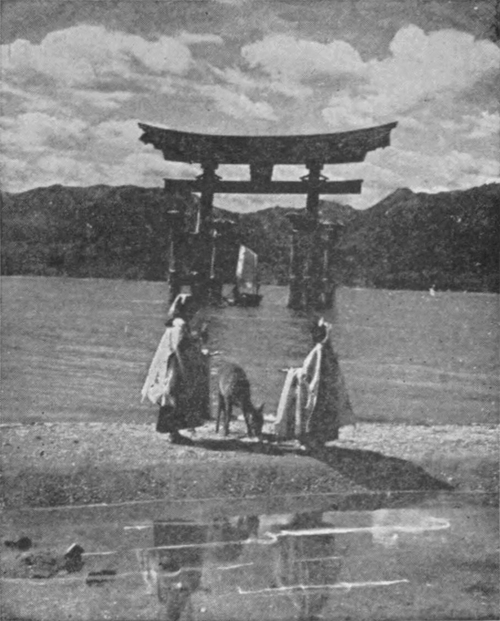
Sea-girt gateway of Miya-ima, a famous Shintō shrine
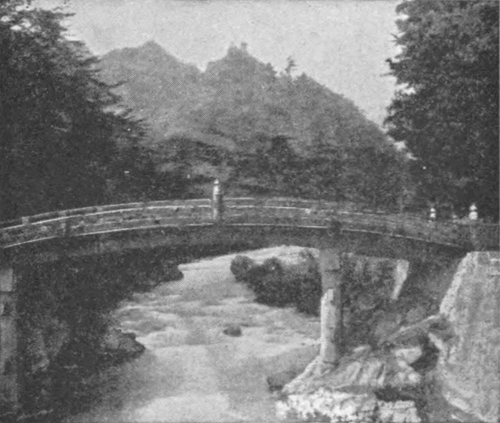
The Sacred Bridge at Nikko
The White Co.
View of Fuji-yama across Motosu
THREE FAMOUS SCENES IN JAPAN
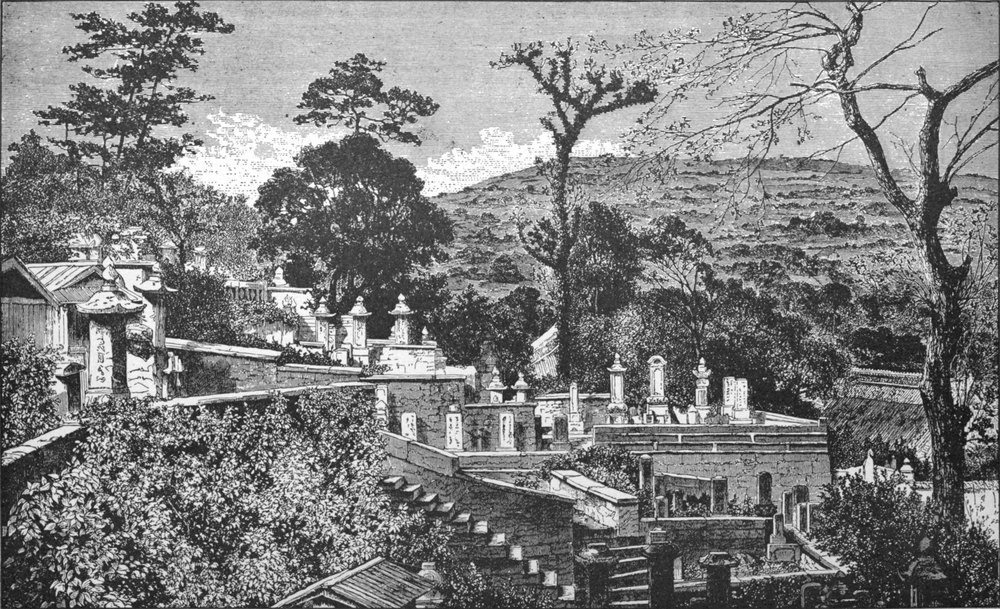
THE CEMETERY HILL AT NAGASAKI BEFORE THE MODERN EXPANSION OF THE TOWN
LARGER IMAGE
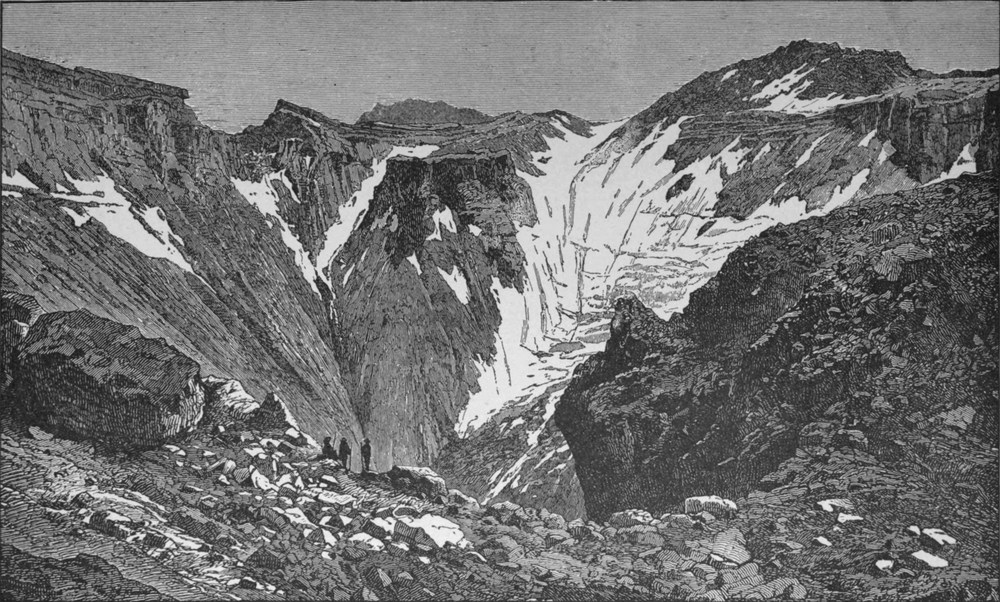
THE CRATER OF FUJI, THE MOST GLORIOUS MOUNTAIN OF JAPAN, MORE THAN TWO MILES HIGH
Japan has fifty volcanoes that have been active in recent years; this picture shows the crater of the most famous mountain in the island empire. Fuji, the cone so dear to the Japanese heart, uplifts its peak 12,365 feet from the plain. It has not erupted since the beginning of 1708. No other natural feature in Japan comes so often into its pictures as Fuji.
LARGER IMAGE
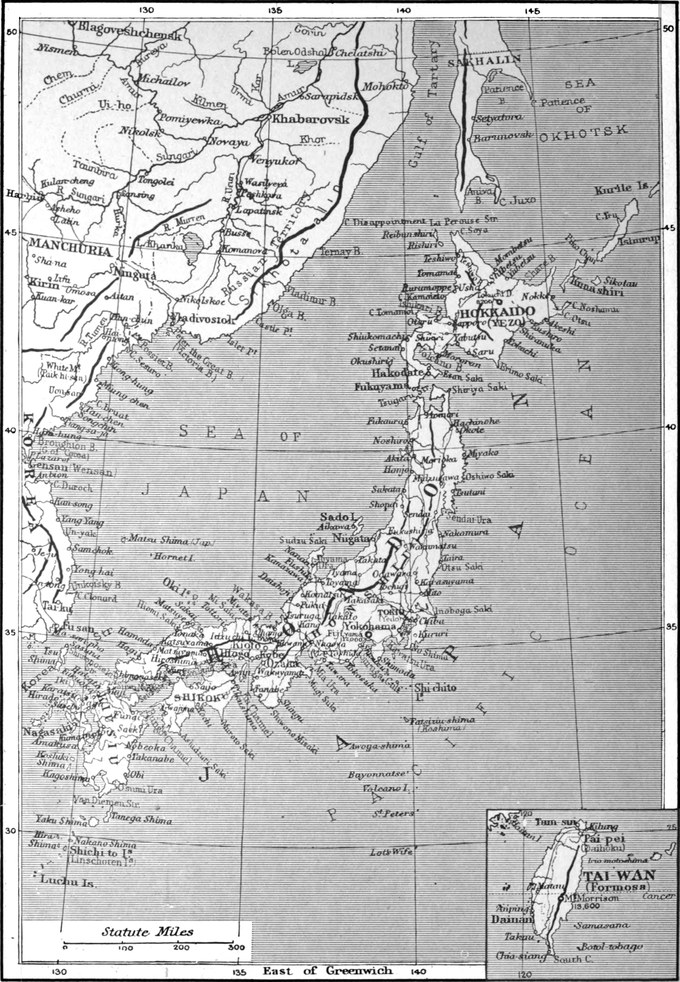
MAP OF THE ISLAND EMPIRE OF JAPAN
LARGER IMAGE
QUALITIES OF THE JAPANESE PEOPLE
The Wonderful Islanders
I
IT is in presence of great calamities that the best qualities of the Japanese masses shine brilliantly. Their resignation, their patient endurance, the altruism that prompts them to mutual help and to countless acts of kindness; their self-sacrificing bravery in the work of rescue, the proud honesty with which they will content themselves with the barest pittance, when relief is distributed, so that enough may be left for others in greater need—these are only some of the fine characteristics of the wonderful islanders whose achievements in recent times have earned the respectful admiration of the world, even of their late foes. There is, of course, another aspect of their character; they are not without some of the vices and failings human nature is heir to. An attempt is made, later in these pages, to describe their moral and mental characteristics, and in so doing to hold the scales impartially.
Underwood & Underwood
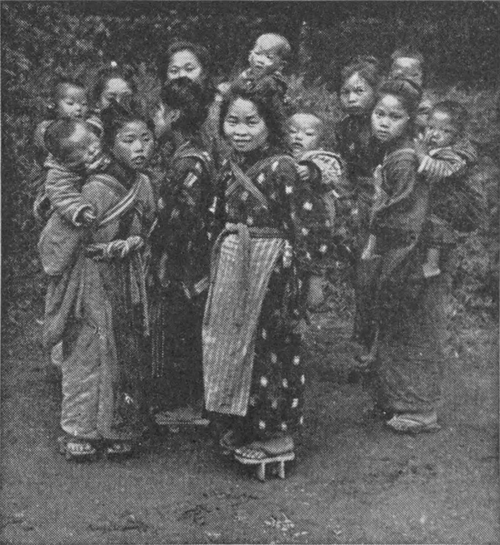
THE RISING GENERATION IN JAPAN
According to the census of 1913 there were 52,985,423 subjects of the Emperor of Japan (excluding Korea), and their number is increasing steadily and rapidly. The number of males exceeds that of females by well-nigh a million. The population is very dense in the fertile regions, and increases so rapidly that emigration is absolutely necessary. The masses are healthy and strong, capable of great endurance—a fact brought into striking prominence by the achievements of the Japanese forces in the Arctic winter of Manchuria, and in its torrid summer. The Japanese can, as a rule, bear cold much better than heat. Living thinly clad in unwarmed houses that offer but little protection and are by day draughty as bird-cages, they early become inured to cold. The average physique of the upper classes is by no means so good as that of the manual workers, and is considerably below the Occidental standards.
A Race of Little People
The Japanese are a black-haired race, with smooth skins, varying in colour through various yellowish shades, from a hue of brown, in the case of those working in the sun, to a light tint no darker than that of the Southern European, with comparatively large skulls, prominent cheek-bones, and a tendency to projecting jaws. They are of small stature, the average height of the male being only slightly over five feet (5·02 ft.), that of the female slightly over four feet six inches (4·66 ft.). In other words, the men are of about the same average stature as European females, the women proportionately shorter.
The Two Types of Japanese
There are, of course, exceptions, some Japanese being of a height that would cause them to be considered tall amongst Occidentals; but they appear as giants amongst their diminutive compatriots. Both men and women have small hands and feet, those of the upper classes being beautifully shaped. Even amongst manual workers it is not rare to find, especially amongst females, hands of an aristocratic type. The shapely appearance of the feet is often spoiled by thick ankles, probably the result of wearing sandals. The black hair is abundant on the head, straight and coarse; there is hardly any on the arms, legs and chest. The eyelashes are scanty, and grow immediately out of the eyelids, without the “hem” that borders the eyelids of Occidental races. The eyes are dark, full in the broad-faced, plebeian type, narrow in the aristocratic cast of countenance. In the latter they are generally set more or less obliquely, their slanting appearance being enhanced by the fact that the aperture for the eye seems to have been cut, as it were, directly in the smooth skin, tightly stretched over the upper part of the face, not, as in the white races, in a very marked depression under the brow.
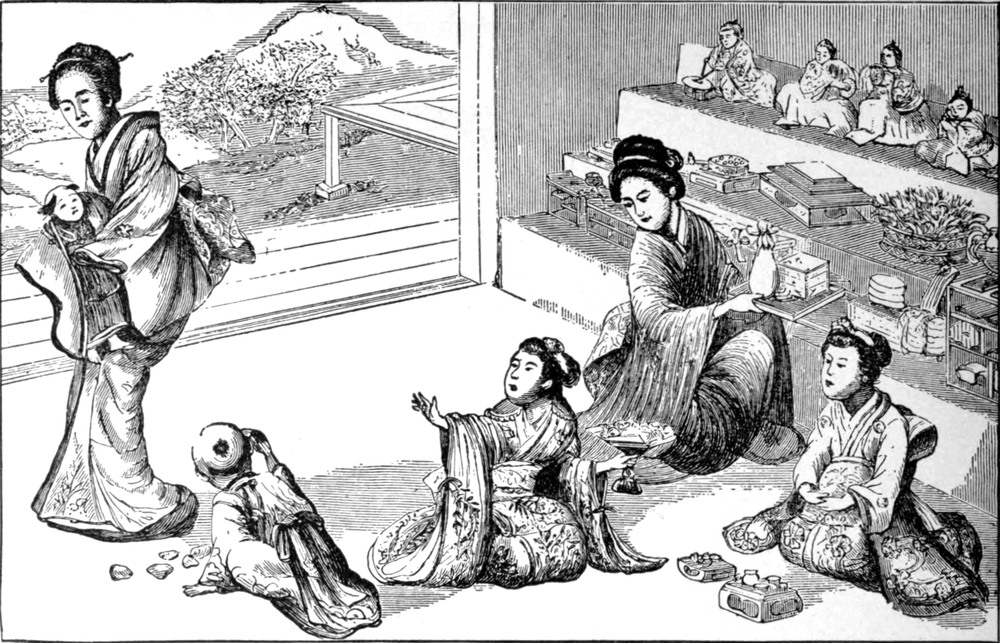
THE CHILDREN’S FESTIVAL: FEAST OF DOLLS IN A JAPANESE HOME
Japan is the land of love for children, and many quaint customs are observed for their sake. On the third day of the third month in each year the Feast of Dolls is held in thousands of Japanese homes, and the day is one of great delight.
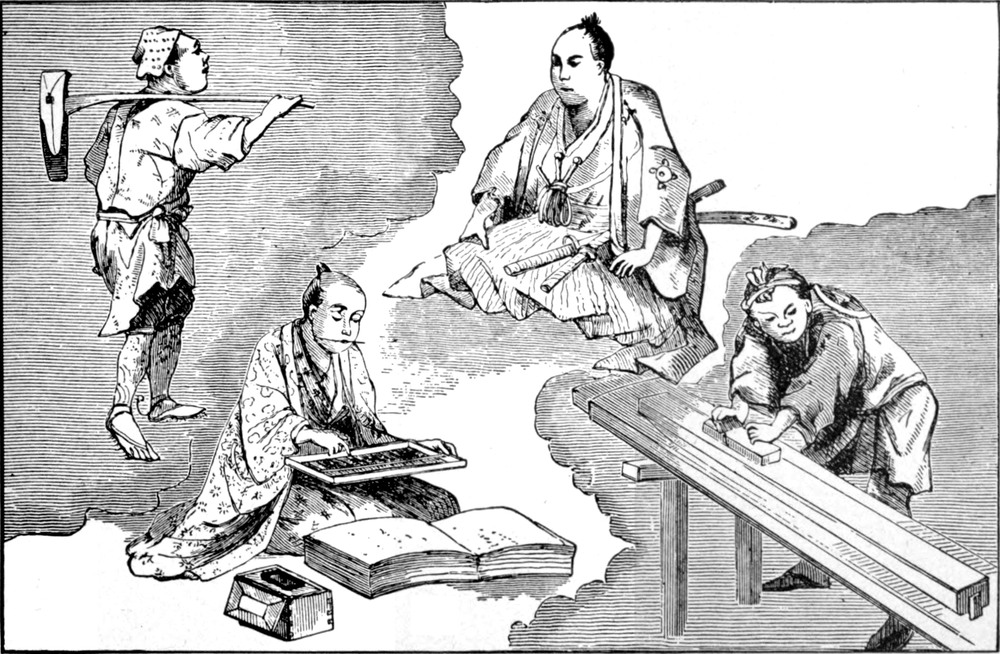
THE VARIOUS GRADES OF SOCIETY IN OLD JAPAN
Society in Old Japan was based on the principle that the producer was worthy of high honour. There were four great classes. At the top were the Shi, the nobility and gentry, warriors, administrators, and scholars. Next were the No, the agricultural class; thirdly came the Ko, craftsmen and artists; and at the bottom were the Sho, traders and bankers. Some of the wealthier classes were thus at the bottom, because they were not producers but only circulators.
Physique of the Nation Cleanest Nation in the World
There are two plainly distinct types in the nation. The majority are “stocky,” rather squat people, with broad, round faces, rather thick lips and flat noses; the minority, of the aristocratic type, are more slenderly built, with long oval face and aquiline nose. In both types the trunk is long as compared with the legs, their shortness being probably due, in some measure, to the national habit of sitting on the floor, in a kneeling posture, the weight of the body being thrown back on to the heels. Sitting on benches, as in school and in barracks, necessitated by the introduction of Western educational and military methods, has somewhat improved the proportions of the Japanese body in this respect. The admirable gymnastic training given in the schools to children of both sexes, and, still more, the naval or military service to which every able-bodied Japanese adult male is liable, have done wonders in improving the physique of the nation. Statistics collected by the Army Medical Department clearly show that the race is gradually growing taller since the introduction of universal service. The Japanese grow to maturity more rapidly than Occidentals; they also age earlier. As in other countries, very old women are more numerous than very aged men. Both the slender, often weakly, upper classes and the stout plebeians are nimble in their movements, have supple limbs and remarkably skilful fingers. The workers use their toes to hold and steady the material on which they are at work, often sitting at their labour where Occidentals would stand. The great toe is well separated from the others, owing to the effect of the loop of cord passing between them to secure the sandal to the foot, the tabi, or sock, of cotton-cloth being made with a separate compartment for the great toe. The skin of the whole body is generally of satin-like smoothness, owing, no doubt, to the very hot baths—at a temperature of about 110° F.—in which all Japanese indulge at least once a day, thus maintaining their well-deserved reputation as the cleanest nation in the world. To the Occidental eye, the majority of Japanese men are not comely, although there are notable exceptions, presenting fine faces, of noble and intellectual type. The women are often very pretty, judged by the Occidental standard; they are nearly always graceful and charming, owing to their exquisite manners and gentle voice. The chief element in their charm is undoubtedly their perfect femininity. There is absolutely nothing masculine about their ways or their speech, yet, when the need arises, they are capable of courage and self-sacrifice that places them on the same high level as their heroic fellow-countrymen. It may safely be asserted that there are no more dutiful wives, no better mothers. There are certainly no daughters with a greater sense of filial piety, a virtue that forms the basis of family life in Japan.
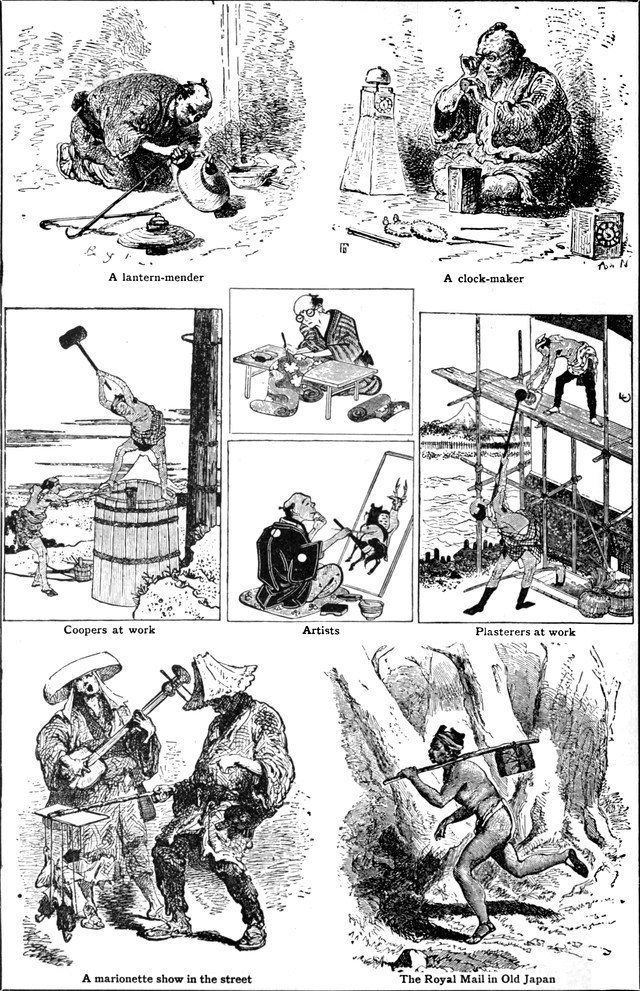
LIFE AND WORK IN OLD JAPAN: SOME TYPES IN THE ANCIENT CAPITAL
LARGER IMAGE
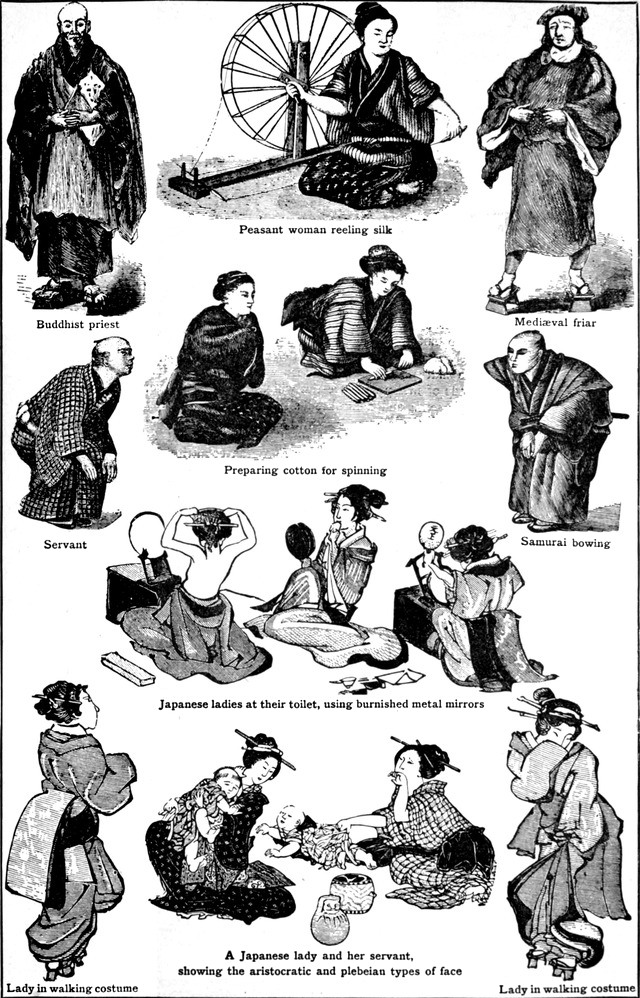
SOME TYPES IN OLD JAPAN: CHIEFLY DEPICTED BY NATIVE ARTISTS
LARGER IMAGE
The Chief Qualities of the Race
Throughout the Far East the whole social fabric is based on the family; the whole state is, indeed, considered as one great family, with the Emperor at its head. It is the mothers who train Japanese children from infancy in the spirit of reverence and obedience to parents and elders in the family circle, and to the Emperor as the supreme chief of the great national family. And well do the children assimilate the lessons of obedience and devotion so carefully inculcated by the mother, for there are none more docile than the boys and girls of Japan, whose respectful, courteous manners, not only towards their parents, but towards elder brothers and sisters, earn the admiration of Occidentals. The chief qualities of the Japanese race are patriotism—which is, with them, synonymous with loyalty—courage, filial piety, and cleanliness. In love of country, in self-sacrifice for the common weal, in loyalty to the sovereign—with them a cult—in reckless gallantry, and in bodily cleanliness, the Japanese surpass all other nations of our time. It may be truly said that patriotism is their real religion; it inspires their magnificent courage in war, on land and sea; it supplies the incentive of their lives in times of peace, all merely personal considerations being subordinate to this passionate national feeling.
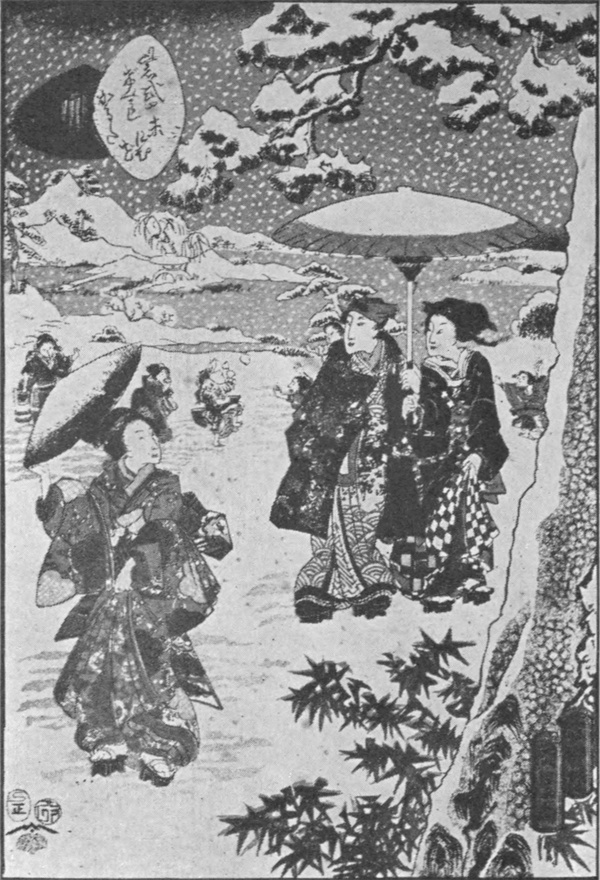
WINTER IN JAPAN; BY A JAPANESE ARTIST
The people of Japan are distinguished, besides, by quick intelligence, a remarkable power of observation—derived, no doubt, from their close study of Nature, of which they are devoted lovers—by a mastery of detail, and a very retentive memory, fostered by the system of learning by rote imported from China, together with the writing by means of ideographic signs, necessitating the memorising of thousands of characters standing for words. In politeness they stand first amongst the nations, every incident of life being attended by strictly-defined rules of social etiquette, observed by all, not only, as in Occidental countries, by the more highly educated classes. Their courtesy, though often degenerating into mere hollow formality, is based on a kindly regard for the feelings of others, a generous altruism and a consequent depreciation of self. They are hospitable and open-handed, the giving of presents attending numerous festivals and many occasions in social life.
Schooled from babyhood by the rules of their rigid etiquette, Japanese, young and old, of all classes, are remarkably quiet in their demeanour, the higher ranks being extremely dignified in manner, and completely concealing their feelings under an imperturbable mask. They bear pain, both physical and mental, with Spartan stoicism, their nerves being much less easily excited than those of Occidentals, so that they have often been described as “a nation without nerves.” Their apparent contempt for death arises chiefly from the fact that, to most of them, the passing out of this world does not imply a total severance from mundane interests, their general belief being that the spirits of the departed have cognisance of the doings of those they leave behind. This idea, inseparable from the ancestor-worship that has prevailed amongst them from time immemorial, and still prevails, was well exemplified in their great struggle with Russia, their forces being buoyed up by the conviction that the spirits of all the warriors who had died for Japan were fighting side by side with their gallant successors.
Artistic Taste of the Japanese
The love of the beautiful in Nature, common to all members of the Japanese race, is probably one of the chief factors in the artistic feeling so highly developed among all classes. Their appreciation of beauty of form and colour, their exquisite sense of appropriateness in decoration, the delicate restraint so evident in the productions of their wonderfully skilful, patient artist-craftsmen, are too well known to require more than passing mention. Even their commonest household utensils are beautiful in shape, elegant, and well adapted to their purpose. Their innate good taste has added a delicate refinement to the vigorous art they received, in early times, from China, chiefly by way of Korea. Their æsthetic perception enables even the poorest Japanese to derive intense pleasure from the contemplation of the beautiful, thus providing them with many delights unknown to the vast majority of modern Occidentals. Combined with the simplicity and frugality of their lives, and with their naturally contented spirit, it would seem to have enabled the Japanese to solve the great problem “how to be happy, though poor.”
A nation possessing, to a high degree, the virtues and qualities just enumerated would appear to be living in a perfect Utopia. There is, however, shade in the picture as well as bright light. This happy, contented, smiling people, pre-eminent in domestic virtues, industrious, fond of learning, easily governed, gentle in manners and speech, capable of rising, in moments of national emergency, to admirable heights of patriotic heroism and self-sacrifice, is, after all, human, and consequently tainted with some of the vices and many of the defects inherent in human nature. The defects of the Japanese character are, to a great extent, inseparable from their very virtues and good qualities in their extreme manifestations. Their intense patriotism is the cause of the anti-foreign spirit still, unfortunately, rife amongst them. Their country is to them “the Land of the Gods,” their nation the Elect People, living under the special protection of Heaven, whose blessings are transmitted to them by the benevolence of a superhuman sovereign, directly descended, in unbroken line, from the Sun Goddess.
National Pride of the Japanese
With this belief firmly rooted in the minds of the great majority of the people, it is no wonder that all those who have not the good fortune to be born Japanese appear to them not only as foreigners, but as Gentiles. The statesmen of New Japan are profuse in their assurances that it is the desire of their people to form a unit, on terms of equality, in the great family of nations.
This assurance is echoed by many Japanese writers; it is in accordance with the spirit of the tolerant, all-embracing, gentle Buddhist faith, brimming over with sympathy for all living creatures; it is also in agreement with the calm, placid tenets of the Chinese philosophy that, with Buddhism, has to such a great extent moulded the thought of Japan. Yet those statesmen and writers know full well that in this respect neither Buddhism, nor Chinese philosophy, nor the cosmopolitan spirit of the middle period of the nineteenth century, nor the brotherhood of man inculcated by true Christianity, has succeeded, to any appreciable degree, in causing the Japanese to look upon foreigners as brothers, or even on the same plane with their own heaven-descended race.
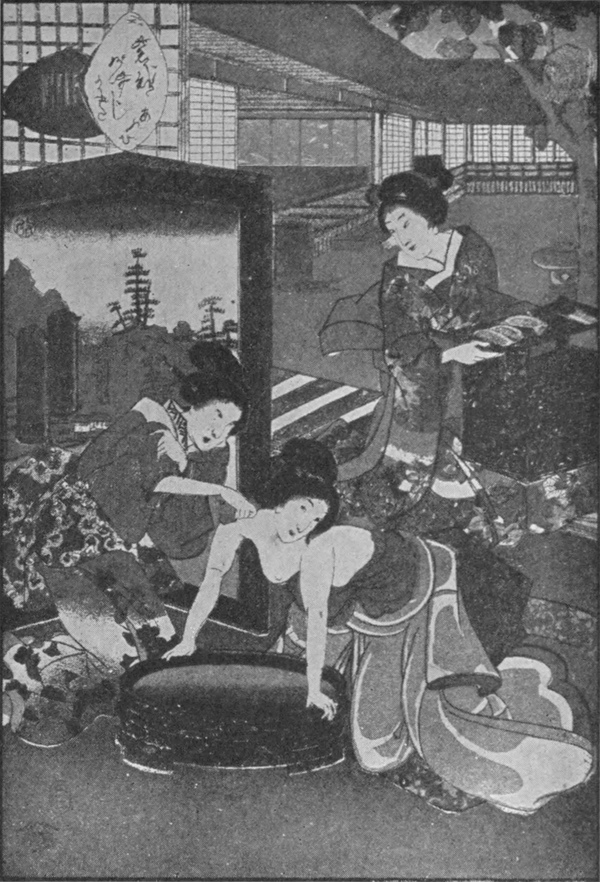
LADY AT HER TOILET: BY A JAPANESE ARTIST
The reckless bravery of the Japanese, their contempt for death, are closely related to the slight value they set upon human life and to the national delight in tales of bloodshed. Co-existent with the mildness of their manners and the placid tenor of their domestic life, there is found, deep in Japanese hearts, a wild delight in carnage, the legacy, naturally most cherished amongst those of the warrior class, of centuries of internecine warfare. The sword, “the living soul of the Samurai,” is still held in reverence as the instrument not only of national defence against the foreign foe, but of vengeance and of the chastisement of one looked upon by the wielder of the weapon as an enemy to the State. Hence the indulgence with which political assassination is still regarded by the masses in Japan. As the brutal instincts, inherited from primeval ancestors, often become manifest in an English-speaking crowd watching a football match or a boxing contest, so, in Japan, the old savagery reveals itself, time and again, at fencing bouts, the excited cries of the combatants recalling the bad, wild days of yore.
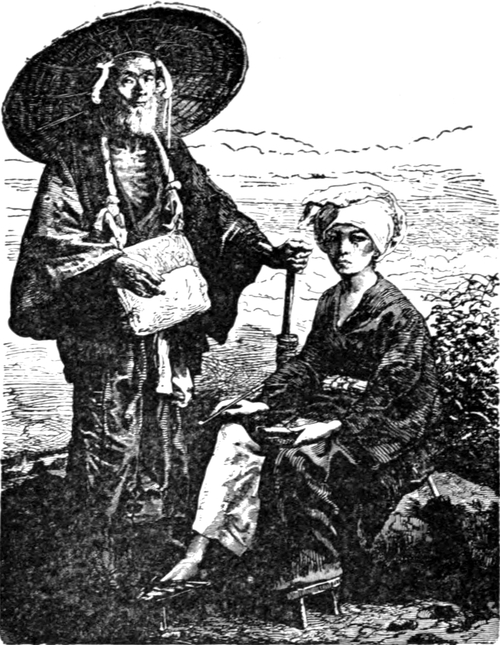
JAPANESE ON A PILGRIMAGE
This fierce spirit seems incompatible with the noble generosity towards prisoners of war, and the tender care of the enemy’s wounded and sick, that redounded to the glory of the Japanese in both their great struggles in our time, the wars against China and against Russia. It is difficult to believe that savagery can survive in the breasts of people capable of organising such an admirable institution as the Red Cross Society of Japan, whose noble work, in war and peace, is one of the chief glories of New Japan; but it must be remembered that the young Great Power still feels itself to be undergoing probation under the eyes of an observant and critical world. The natural instinct of the Japanese warrior would lead him utterly to destroy the foe who dared to oppose his Emperor’s will, and it requires the application of the most severe discipline to make him understand that on his exercise of humane forbearance to the vanquished depends, to a great extent, his nation’s good repute among the Powers.
This desire to stand well in the opinion of foreign nations has been so thoroughly inculcated in the people of New Japan that every individual brought into contact with foreigners beyond the boundaries of his native land feels that the honour of Japan is dependent on his behaviour, even in minute particulars. Hence the high reputation for excellent conduct enjoyed by Japanese students and others residing, or travelling, abroad.
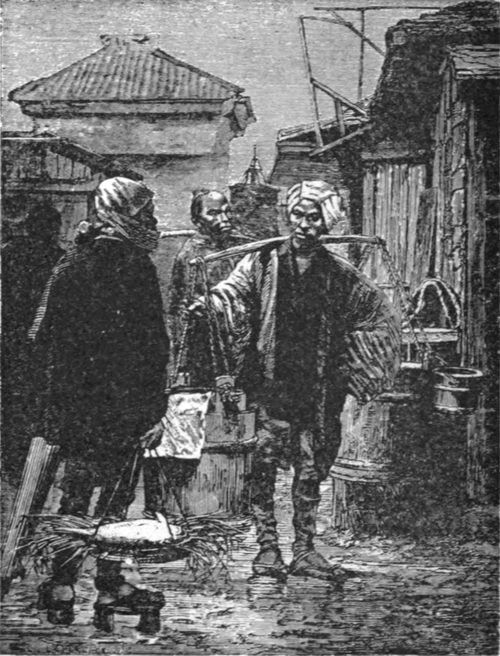
A FISH HAWKER IN JAPAN
The altruism and self-effacement, born of the family system, fostered by the division of the nation into clans—now officially abolished, but still binding huge groups of families with strong ties—and culminating in the most complete devotion to the head of the national family, the Emperor, are the causes of a peculiar defect in the Japanese character—the lack of individuality. It may be said of the Japanese that, on most important matters, they feel and think by millions. The whole system of their civilisation tends to make individual effort subservient to the common cause; the reverence and obedience inculcated from early childhood are not likely to develop the spirit of individuality. Hence the wonderful facility with which the Japanese combine to carry out any policy they recognise as needful for the public welfare once that course has been clearly indicated by their trusted leaders as one that has the Emperor’s approval.
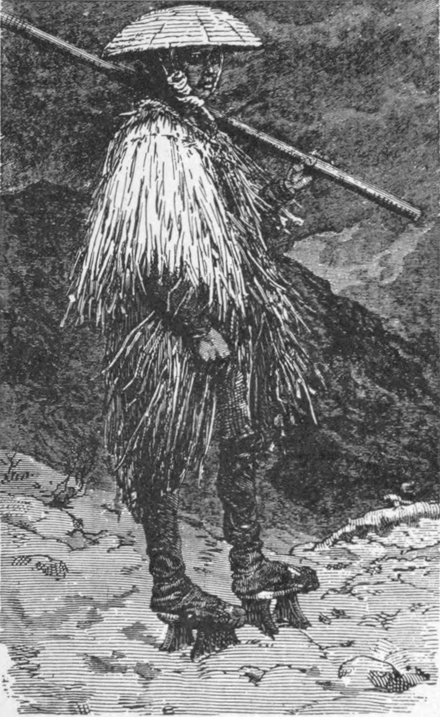
A PEASANT IN A RAIN CLOAK
(Made of straw.)
Japan is, for this reason, the land where leagues, unions, guilds, trusts and “combines” work with astonishing efficiency, such institutions being, by their very nature, well suited to the national character. There are, of course, exceptional Japanese who chafe under the repression of their strong individuality; these occasionally break through the national custom and strike out an independent line. Their fate is not encouraging to those who might be tempted to follow their example. Public opinion reproves them, and they are soon made to feel that their conduct is looked upon as anti-national. Those amongst them who will not bow their heads to the popular verdict, and refuse to be reduced to the level at which the nation strives to keep the individual, soon find life in their own country unbearable. In various cities of Europe, still more in those of North America, such Japanese individualists may be found living in self-imposed exile, shunned by their compatriots, until the day, which comes to most of them, when they submit and go home to resume their place in the ranks of a nation that abhors eccentricity and expects every man to fit into his proper groove in the great national machine.
The mental activity of the Japanese, their respect for knowledge and for all intellectual pursuits, causing them to admire keen wits and exercise of brainpower, have probably contributed in a large measure to form one of the traits in their character that is repellant to Occidentals—their inclination to be cunning and deceitful. In spite of the high and pure ideals of their chivalry, they have not our loathing for deceit, our contempt for chicanery, our respect for the truth. A Japanese convicted of an untruth merely conceals his annoyance at being found out by a smile, sometimes by a laugh, and is not deterred from another statement at variance with facts should he consider it useful to make one. Low cunning is frequently looked upon as cleverness; the suppression of facts is so common that there is no other country where it is so difficult to arrive at the truth. The national failing of intense secretiveness arises, no doubt, from the suspicious nature of the people, who distrust not only all foreigners, but even most of their own race—a condition of mind due, to a great extent, to the widely ramified system of spying that flourished during the rule of the Tokugawa Shōguns, and still exists to a lesser degree.
Their infinite capacity for attention to the most minute details leads to a certain pettiness, a disinclination to consider great abstract questions, and, consequently, to a narrowness of view that accounts for some of the blunders which occur in the execution of the otherwise marvellously efficient policy of the rulers of Japan.
Manners of the Haughty Samurai
The exquisite politeness of the Japanese is responsible for a great part of that insincerity with which they are taxed by Occidentals who have been much in contact with them. This extreme courtesy makes them so anxious to avoid any speech that might possibly give offence that they frequently distort the truth, suppress it entirely, or replace it by polite fiction, intended to give pleasure. It should be remembered that, in the knightly times of old—they continued until the early ’seventies of the nineteenth century—a Japanese had to be very guarded in his speech and demeanour; quite unintentionally, a word lightly spoken, an incautious gesture, might give dire offence to a Samurai—one of the gentry, privileged to wear two swords—who would be quick to resent the fancied slight to his punctilious sense of personal dignity. Insults, real, and often imaginary, were wiped out with blood. Hence the endeavour to avoid any possible cause of offence, for the same reason that made Europeans very circumspect in their behaviour in the days when gentlemen wore swords and drew them on small provocation.
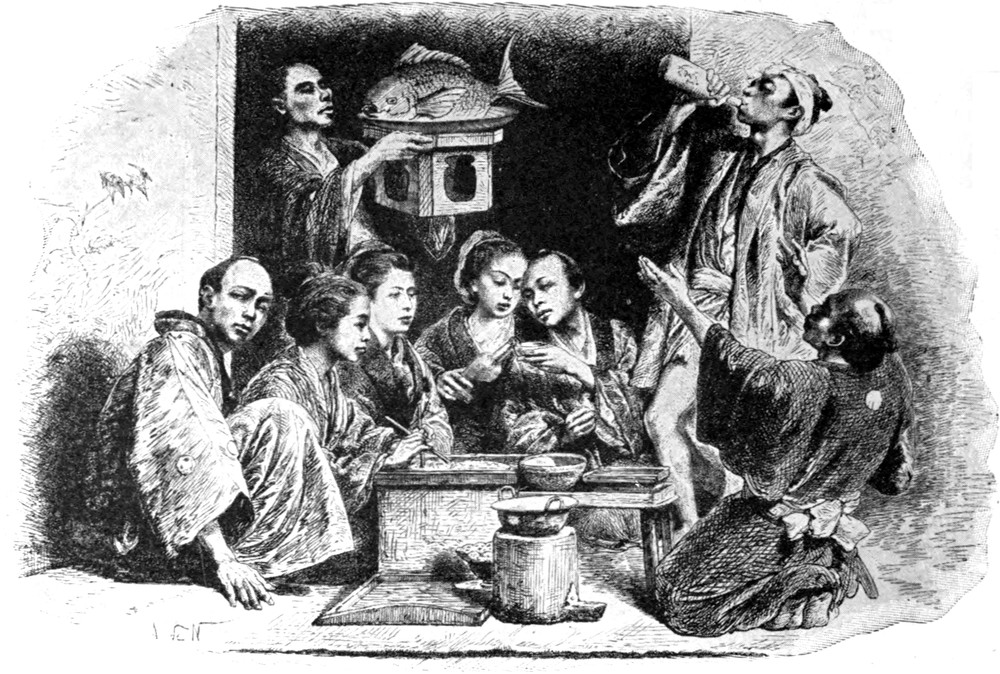
THE END OF A JAPANESE FEAST: BRINGING IN THE SEA-BREAM
To such a pitch was punctilio carried amongst Japanese gentlemen until quite recent times that they preferred death, inflicted by their own hands in the most painful manner—by self-disembowelment, or hara-kiri, more elegantly termed seppuku, or “self-immolation”—to living with a stain on their honour, such stain being often merely inability to disprove a slanderous imputation. To this day, the Japanese remain the most acutely sensitive people on the point of honour; so “touchy” are they that friendly intercourse with Occidentals is thereby rendered extremely difficult.
What places an additional bar to perfect cordiality in such relations is the deplorable fact that an Occidental may unwittingly give grave offence to a Japanese without the latter giving any sign of displeasure at the time. Allowance is seldom made for the perfectly unintentional error on the part of the offender, whilst the grievance is allowed to rankle, is rarely forgiven, and never forgotten. Where an Occidental would certainly call his friend’s attention to the fact that he was displeased by some remark or action that would, no doubt, be promptly atoned for by a sincere apology, thus terminating the incident, the Japanese says nothing. He nurses his resentment, sometimes for years, until a fitting opportunity presents itself to avenge the real, or fancied, wound to his feelings by some particularly unpleasant action directed against the Occidental, all unconscious of his offence.
This unfortunate peculiarity of the Japanese character is the outcome of two main currents that run through the national temperament—the spirit of secrecy, already alluded to, and the thirst for revenge. The latter, possibly due to the strain of Malay blood in the much-mixed Japanese race, is one of the chief stumbling-blocks hindering the introduction of Christianity, and has prevented Buddhism, also a religion teaching meekness, from obtaining a complete hold on the people. In its petty forms, this spirit of long-cherished spite is merely annoying; in its extreme manifestations it becomes exceedingly dangerous.
It may be thought that the admirable magnanimity displayed by the Japanese towards the vanquished in their wars with China and with Russia affords evidence that the old spirit of revenge is dying out. Unfortunately, it is as strong as ever, the explanation of the apparent anomaly being that, in both cases, the foe was vanquished, and thus became, according to the principles of Japanese chivalry, an object for mercy and compassion. As long as the opponent resists, or refuses to surrender at the mercy of the conqueror, he is implacably attacked; the moment he has, metaphorically speaking, grovelled and placed the victor’s foot on his head, he is raised from the ground and treated with the greatest consideration.
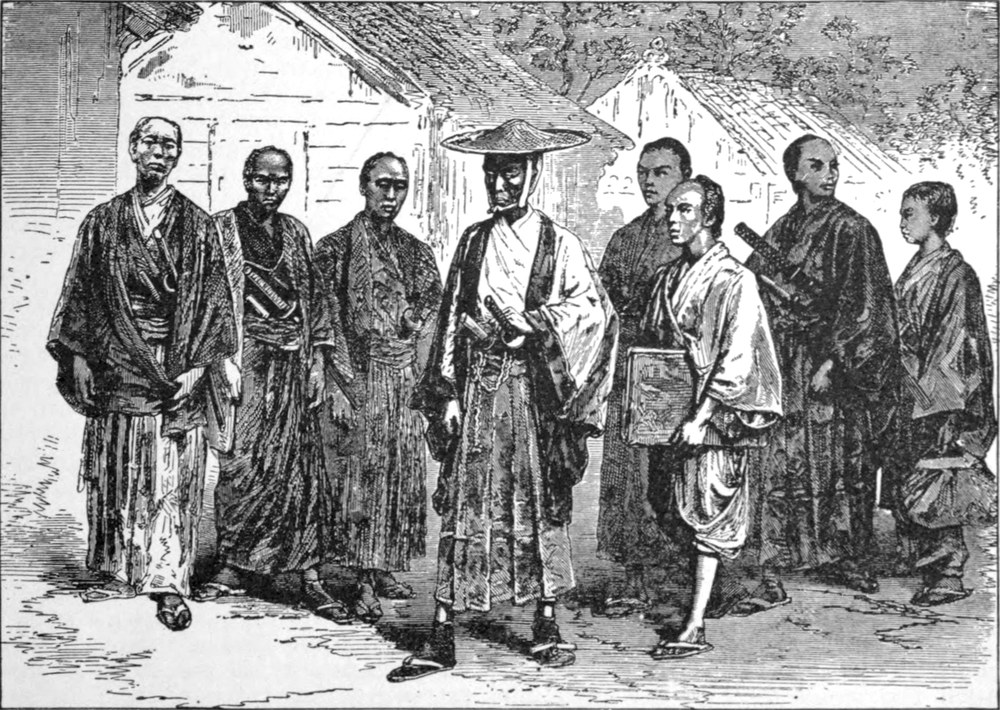
A GROUP OF CIVIL AND MILITARY OFFICIALS IN OLD JAPAN
This applies not only to warfare, but to those incidents in civil life, already alluded to, in which a Japanese considers himself aggrieved, especially when the offender is a foreigner. In such cases, humble apology for the slight, however unintentional—in fact, an attitude amounting to “I do not know what I have done to offend; but, in any case, I own I am in the wrong, and promise, with sincere apologies, not to offend again; deal with me as you think fit,” would generally ensure the restoration of good relations, provided the apology be sufficiently public to gratify the self-esteem of the Japanese. It is hardly to be expected that a self-respecting Occidental would demean himself thus to atone for an error unconsciously committed.
Defects of Japanese Character
Japanese self-esteem has just been mentioned; it often becomes insufferable arrogance, showing plainly, through a cloak of false modesty, “the pride that apes humility.” This arrogance, displayed chiefly towards foreigners, but also by Japanese in official positions towards their fellow-countrymen of inferior rank, is intimately connected with another national failing, excessive vanity. It is less noticeable amongst sailors and soldiers than amongst civil officials of corresponding rank.
Minor failings of the Japanese are jealousy, envy of those who achieve success, and, connected with these faults, a great love of gossip and a readiness to listen to slander, or to disseminate it.
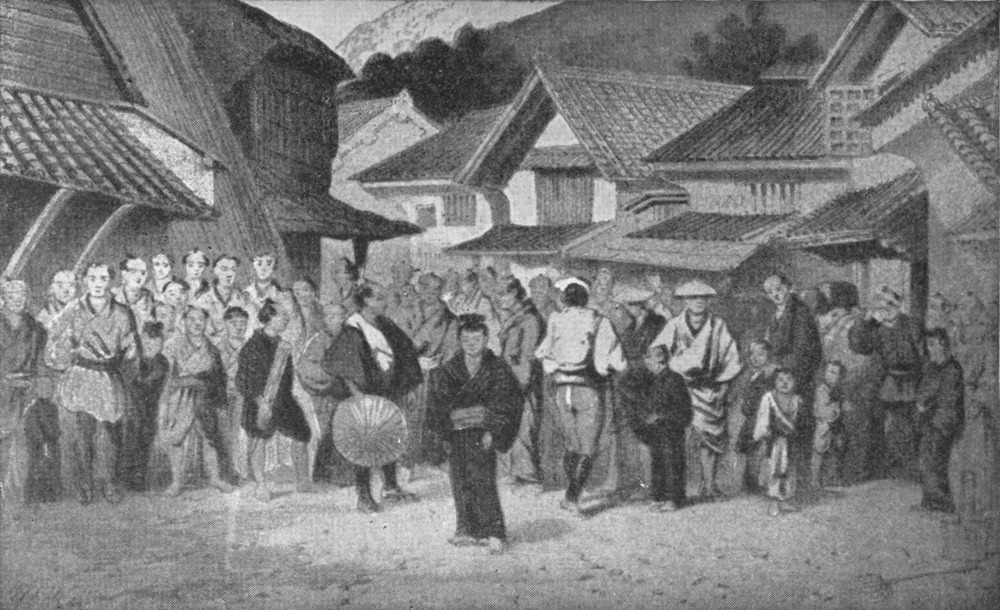
A STREET SCENE IN A VILLAGE OF OLD JAPAN
Japanese Ideas of Modesty
There are, finally, two charges to be examined that are frequently levelled at the Japanese by those who profess to know them well—the accusations of immorality, sexual and commercial. The first of these charges may be disposed of by the statement that the Japanese are about as moral in their sexual relations as the Latin nations of Europe, with the advantage slightly in favour of the Japanese. What has given them an evil repute in this respect is, probably, the fact that they consider as natural, and treat accordingly, certain evils that the Northern Occidental peoples affect to ignore. The natural, simple life led by the vast majority of Japanese predisposes them to take a natural, sensible view of matters that the less primitive conditions of Western civilisation have imbued with an objectionable significance. They see, for instance, no harm in nudity where it is unavoidable, as in bathing, or convenient, as in the performance of hard work in hot weather. A Japanese woman will feel no shame at being seen naked when entering or leaving the daily bath, but would strongly object to what she would consider the gross immodesty of exposing a considerable surface of her body in Occidental evening dress. In the first case, the nudity is looked upon as quite natural; in the second, as useless and provocative of pruriency.
National Honour in Commerce
As to the commercial morality of the Japanese, it is necessary to observe the great difference that exists between the position, in this respect, of Japanese State institutions, financial and commercial corporations, and firms of the first rank on the one hand, and the great mass of traders on the other. The Imperial Japanese Government, municipal corporations, and the great financial institutions and industrial and commercial associations under State control (such as subsidised steamship companies), have always met their obligations with scrupulous fidelity and are likely to continue to do so. With them the national honour is considered at stake; it is certain that the last Japanese will part with his last garment sooner than involve the national credit in disgrace by failure to meet the nation’s engagements towards the foreign creditor.
Results of Old Class Divisions
It is, unfortunately, quite otherwise in the case of the great bulk of the trading classes. There are, in Japan, a number of first-class firms, some of them established for centuries, whose reputation is above reproach; but between these and the majority of the merchants a great gulf is fixed. It must be remembered that, until the beginning of the New Era, in the early ’seventies of the nineteenth century, the trading community formed the lowest of the four classes, then sharply and immutably divided one from the other, composing that part of the Japanese nation that had full civil rights (below them stood only the Eta, who carried on despised occupations, involving contamination by contact with dead bodies, human or animal, and the outcast Hi-nin).
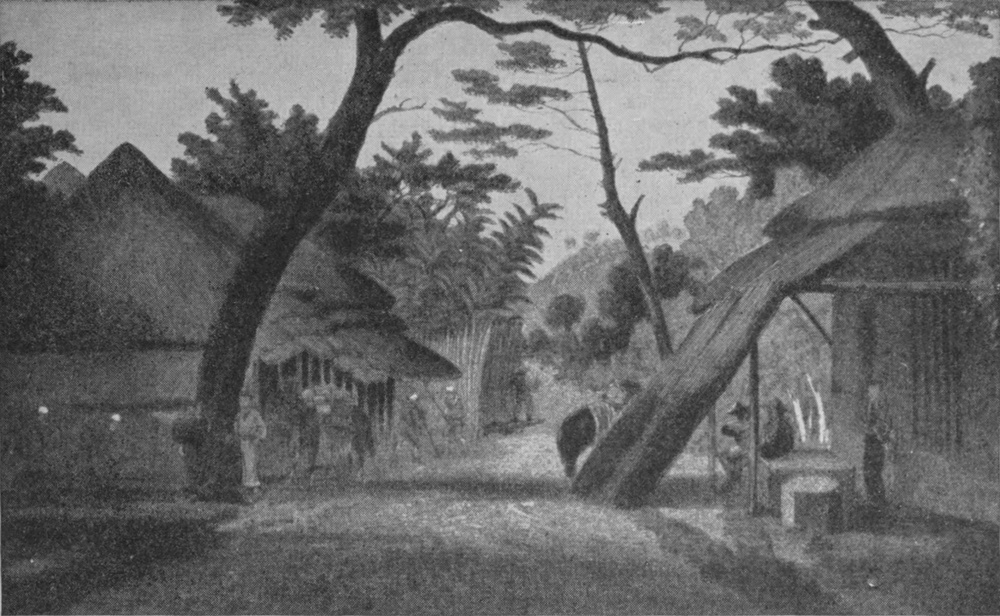
IN THE OUTSKIRTS OF YEDO, NOW TŌKIO, THE CAPITAL OF JAPAN
The nation was divided into Shi, the nobility and gentry, the military, scholarly and administrative class; No, the agriculturists; Ko, the craftsmen, with whom the artists were counted; and Sho, the traders, placed below farmers and handicraftsmen as non-producers.
The natural consequence of this low place in the social scale was a lack of self-respect on the part of those engaged in commerce and finance that led them to be unmindful of their good repute. Trade and finance were looked upon by the majority as occupations unworthy of a gentleman and beneath the callings of the peasant and the workman; every trick was considered excusable when practised by the merchant, whose whole business was looked upon as a sort of warfare, in which cunning stratagem could be legitimately employed to the end of personal gain, a purpose appearing most unworthy to the classes swayed by the old knightly spirit. The evil effects, on a class as on an individual, of a bad reputation and consequent public contempt have, unfortunately, outlived the abolition of the old social divisions. The Japanese merchants and bankers no longer form a separate and despised class; the gentry, even members of the aristocracy, are engaging every day more and more in financial, industrial and commercial pursuits, many of them with marked success, yet the old taint adheres to the bulk of the trading community.
The Desire to Trick the Foreigner
There are, of course, many strictly honourable dealers in Japan, even amongst the smaller tradespeople and retailers. It is amongst the wholesale merchants and the brokers that lapses from the straight path of commercial integrity are still frequent, especially in their dealings with foreigners. It is, unfortunately, still the case that an advantage gained over the foreigner, even by the most shady methods, is looked upon as, in some way, a national victory. This deplorable point of view is likely to prevail as long as Japanese nationalism exists in its extreme form.
Japanese National Finance
The Japanese Government has, time after time, loudly proclaimed, by the mouths of its statesmen at home, and its representatives abroad, its desire to facilitate, in every way, the introduction of foreign capital, the vital influence so urgently required for the realisation of Japan’s bold schemes of industrial and commercial development. Strange to say, this cordial invitation, though energetically responded to by the capitalists of Europe, especially of Britain, and by those of America, has not, as yet, led to the investment of any very considerable sums in Japanese enterprises, although, as is well-known, the Japanese Government has easily borrowed many millions sterling in London, New York and Paris, for purposes of State. The chief obstacle to the investment on a large scale, of foreign capital in Japanese enterprises is to be found in the fact that, forgetting that capital is, after all, a commodity, therefore subject to the laws of supply and demand, the Japanese financial and industrial classes do not realise that the capitalist, being virtually the seller, controls the price of his property.
The Social Qualities of the Japanese
A mistaken impression appears to prevail in Japan that foreign capital is obliged to find an outlet in the Empire of the Rising Sun and must, therefore, submit to such conditions as may seem suitable to the Japanese and accept such security as the Japanese may deem sufficient. As long as this erroneous view obtains, there can be no considerable influx of foreign money into the coffers of Japanese industrial and commercial concerns. Experience is proverbially the best teacher; the dearth of funds that is certain to follow, in due time, the abnormal and feverish activity which is animating Japanese economic conditions, immediately after the successful issue of the great struggle with Russia, will undoubtedly induce a more reasonable appreciation of the circumstances. Once the Japanese have been taught by experience that they must regulate their demands by the lowest terms considered acceptable by the foreign holders of capital, a vast and profitable field will lie before those Occidental capitalists who have the advantage of expert advice in their selection of Japanese investments.
As a general rule, it may be stated that intercourse with the people of Japan leaves Occidentals very favourably impressed with the social qualities of the inhabitants of the island empire. Their exquisite courtesy, their gentle manners, and the thousand ways in which they demonstrate that kindness of heart that lubricates the wheels of life’s machinery all tend to make ordinary, everyday relations with Japanese a delightful experience. It is only when the more serious aspects of life are approached that the Occidental begins to feel the wide divergence between his point of view, in nearly every important matter, and that of the Japanese.
Courtesy of the Japanese
It is exceedingly difficult to specify with exactitude the particular feature of the Japanese character which lies at the root of the unfortunate fact that nearly all Occidentals who have had serious dealings with the people of Dai Nippon have emerged from their experience exasperated and often disgusted. It is probable that want of candour is the trait that acts as the sharpest irritant, for it must be confessed that frankness, so highly prized by Occidentals, especially by those of the nations that “push the world along,” is neither appreciated at its true value nor generally practised by the Japanese. The very nature of their elaborate courtesy makes them shrink from that bluff frankness which obtains amongst Occidentals on a footing of intimate friendship. Even the Japanese mode of speech is a hindrance to direct statement of fact; a Japanese, asked if he has ever been in England, will reply, in his own tongue, “Yes,” and, after a pause, “I have never visited England.” He would not deem it polite to shock his questioner by a direct negative!
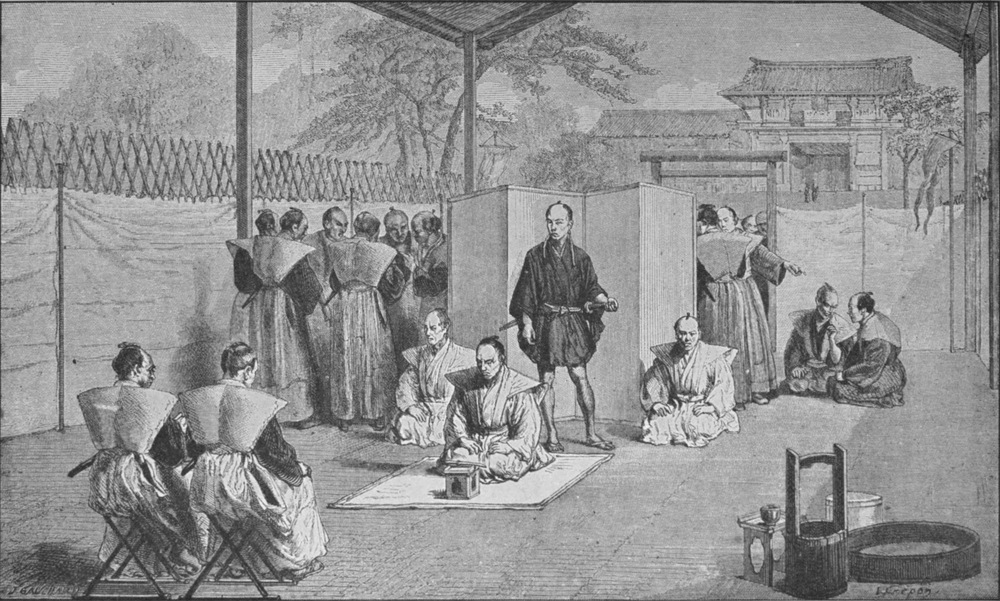
THE AMAZING SUICIDE: A GHASTLY FACT IN THE LIFE OF OLD JAPAN
This picture represents the Japanese custom of “Hara-kiri,” or disembowelment, known also as “Seppuku,” or self-immolation, the form of suicide which was the privilege of gentry in Old Japan instead of death at the hands of the executioner. Instances of this ghastly act occurred frequently during the Russo-Japanese war, Japanese destroying themselves rather than surrender. The standing figure in the picture is the best friend of the man about to die, acting as his kai-shaku, or second, ready to strike off his head on receiving the sign from the dying man.
LARGER IMAGE
Another peculiarity of the Japanese character, that is apt to loom large in Occidental eyes as a grave national failing, is the lack of the spirit of gratitude, as it is understood by the white races. The Japanese have, hitherto, never failed to deal out fair measure, according to the letter of the contract, to the numerous Occidentals whom they have employed, as advisers and instructors, in adapting Western civilisation to the material needs of their re-organised empire; their labours, as well as those of friends of Japan who have rendered voluntary, unpaid services, have also been recognised by the bestowal of marks of Imperial favour; but it is doubtful whether a real feeling of what we term gratitude has ever entered the hearts of the nation towards the many distinguished men who have given of their best to assist in the making of New Japan, or to spread a knowledge of its greatness. This doubt does not apply to the Navy and Army; those gallant forces, keeping the sacred fire of chivalry alight, show deep gratitude to the British sailors and European soldiers—French and, after them, Germans—who instructed them in the modern art of war.
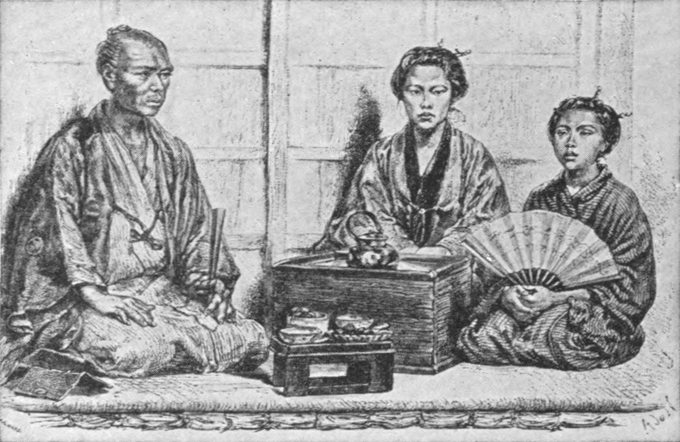
TYPICAL JAPANESE OF THE MIDDLE CLASS
Sympathy with their aspirations is, of course, cordially welcomed from every quarter by the Japanese; they are delighted to receive help of any kind from Occidental friends at such times as, in their view, render such assistance or sympathy necessary. When the occasion has passed, and they feel independent of foreign support, they not only cease to make any effort to attract, but take no pains to conceal their indifference to it. This attitude, induced by the severely practical nature of their policy, is repugnant to Occidental feeling, and has caused the accusation to be brought against the Japanese that they treat their foreign friends “like lemons, to be thrown away once the juice has been squeezed out of them.”
This course of conduct should not be judged too harshly; it should be remembered that such a proud, hypersensitive nation is ever desirous of displaying its independence, and is consequently averse to appearing to solicit help or sympathy from the outside. A gifted Frenchman, a true friend of Japan, the late Félix Régamey, several of whose spirited pictures of Japan are reproduced in this History, and who did much to gain sympathy for that country amongst his compatriots at a time when they were little inclined to extend it, said to the writer: “It would, indeed, be a pleasure to help the Japanese, but they will not let one help them.” It is noticeable that this coolness towards foreign sympathy is usually coincident with a period of national elation, consequent on the victory of Japanese arms or the obtaining of some solid advantage by Japanese diplomacy.
Reviewing impartially the good and the bad points of the Japanese national character, one must come to the comforting conclusion that its faults are likely to disappear, or, at least, to be considerably attenuated in the future, as Japan enters more and more into the active life of the family of nations. The pressure of the public opinion of the vast majority of civilised mankind must exercise a beneficial influence in bringing the Japanese gradually into line with ourselves where the points of view are still too widely divergent to admit of cordial co-operation between them and Occidentals. The virtues now pre-eminently Japanese may, indeed probably will, suffer to a certain extent in the process; it is the writer’s firm conviction that enough of them will remain to enable the Japanese to accomplish the glorious destiny towards which they are marching. Their patriotism, their valour, their thoroughness, their wisdom in matters of national moment, are of the virtues that make nations great.
ARTHUR DIOSY
