Volume 1 — LIST OF MAPS APPEARING IN THE BOOK OF HISTORY (continued 11)
Reading edition
Didos. See LESGHIANS.
Dinkas. See NILITIC GROUP.
Dogras. An Aryan race in the Punjab, between the Chinab and the Ravi, who contribute excellent soldiers to the British Native Army.
Dorians. See HELLENES.
Dravidas, or Dravidians. Indigenous non-Aryan inhabitants of South India, including the Telingas or Telugu of the Nizam’s Dominions, the Tamils of Karnatic and Ceylon, the Kanarese of Mysore, the Malayalim of Malabar Coast, those wild hunters the Gonds of Vindhya Hills, the Sinhalese of Ceylon, and perhaps the Veddahs (q.v.). A Mongoloid race originally, which has been assimilated to the Caucasic type by long intermixture of blood.
Druses. A brave, handsome and industrious white race, who have been settled in the Lebanon district of Syria for at least 800 years, and owe their unity to the possession of a special religion. Their origin is uncertain, but they are probably of a mixed stock, to which Arabs, Kurds, and Persians have all contributed. They are fair-haired and of light complexion. They are very warlike, have always preserved their independence against the Turks, and are the inveterate enemies of the Maronites (q.v.).
Dungans. Southern Mongolic inhabitants of Zungaria, between Tian-Shan and Altai. Allied to Chinese (q.v.).
Durbats. See KALMUKS.
Duranis. See AFGHANS.
Dyaks. The aborigines of Borneo, probably akin to the Malays (q.v.), whom they resemble physically, though of greater average stature. They are active and warlike, and formerly indulged in the practice of head-hunting, now dying out. The Sea-Dyaks were bold and inveterate pirates. They possess a considerable degree of indigenous civilisation, and their moral character is very fine.
Easter Islanders. (1) See POLYNESIANS. (2) Easter Island once possessed an older race of inhabitants, now extinct, who have left very remarkable traces in the shape of numerous colossal statues, thin-lipped and disdainful, standing on platforms of Cyclopean masonry, as well as many stone houses with thick walls, painted on the inside. Nothing farther is known of their race or history.
Ecuadorians. White natives of Ecuador, in South America, of Spanish descent; noted for their laziness and political instability.
Edomites. See IDUMÆANS.
Egbas. See YORUBAS.
Egyptians. (1) The ancient inhabitants of Egypt—known to them as Khem, the Biblical Mizraim—who reared one of the oldest and most important civilised states of the ancient world. The aborigines of Egypt were apparently a Palæolithic branch of Ethiopic Man, allied to the modern Bushmen. They were dispossessed and practically exterminated, probably about 7000 B.C., by a slender, fair-skinned race of European type, belonging to the Hamitic family, and resembling the modern Berbers (q.v.) in many respects. These were probably the same as the ancient Libyans (q.v.). Later this race was modified by the introduction of a Semitic element, partly from Syria, partly from the Phœnician conquerors who founded dynastic rule in Egypt under Menes, between 5000 and 4000 B.C. Their later history is written on their imperishable monuments, and need not be summarised here. In later times the Egyptian racial type was modified by Greek and Roman influence. The ancient Egyptians were highly skilled in agriculture and engineering, warlike but not aggressive, and with a highly developed literature and religion. (2) The modern Egyptians are partly descended from the ancient Egyptians, whose racial type as represented on the monuments is still to be found in purity, mingled with Bedouin Arabs, Turks, Syrians, and other races. See COPTS and FELLAHIN.
English. Natives of England; used in a wider sense as equivalent to citizens of the British Empire [See BRITONS, ANGLO-SAXONS]. The English people are a Low German branch of the Teutonic stock of the Aryan family, with a faint Celtic element derived from the primitive Britons, a strong Scandinavian element (especially in the north-east), derived from the invading Danes and Norsemen in the ninth to eleventh centuries, and a considerable Norman element—Norse modified by French culture. The typical Englishman is white-skinned and fair-haired, belonging to the Xanthochroi, but there are many deviations due to modifying influences. The race is eminently warlike and aggressive, and makes the most successful colonisers known to the world.
Erie Indians. See IROQUOIAN.
Erse. See IRISH.
Eshi-Kongo. A semi-civilised race of Bantu Negroes, belonging to the ancient Kongo Empire, now Portuguese West Africa.
Eskimos, or Innuits. An Arctic aboriginal race, now inhabiting Greenland and the northern coasts of the American continent. They are nomadic, live by hunting and fishing, and are inured to extremes of cold. They are very broad-headed, fat, and of short stature, with flat quasi-Mongolic features. They seem to occupy a place midway between the North American Indian and the Mongolic type, and there is some reason to suppose that they represent a prehistoric Mongoloid incursion from Northern Asia, or perhaps from Indo-Malaysia.
Esthonians. A branch of Baltic Finns (q.v.) settled in Esthonia, and possessing an ancient ballad literature and mythology.
Ethiopians. An ancient Berber tribe, settled in Egypt at least 5,000 years ago, now represented by the fair Berbers of Mauritania. Homer called them “blameless,” because he knew so little about them. See NUBIANS.
Ethiopic. One of the four great divisions of the human race, occupying Africa, Australia, and many islands of the Eastern Ocean. Its members are typically black-skinned and woolly haired, with projecting jaws and broad skulls.
Etruscans. An ancient Italian people, inhabiting Etruria in North Italy in pre-Roman times. They probably consisted of an aboriginal Pelasgian (q.v.) race, modified by a dominant race of invaders, who may have been of Mongolic type, or perhaps akin to the Hittites (q.v.). The Etruscans may be classed as Hamitic. They had a distinctive civilisation, and made great progress in art, of which many monuments remain. The Etruscan confederation, of which Veii was the chief city, long warred with the rising power of Rome, under whose dominion it fell in the fourth century B.C. Families of undoubted Etruscan descent are still found in North Italy.
Europeans. Natives of Europe, mainly Aryan.
Ewe. A group of Sudanese Negro tribes of Guinea Coast. The best known are the Dahomans, or natives of the ancient kingdom of Dahomey, on the Slave Coast. Of small stature, but robust and warlike, they are noted for their great human sacrifices and their employment of female warriors or “Amazons.” Now under French rule. The Togos are also an Ewe tribe.
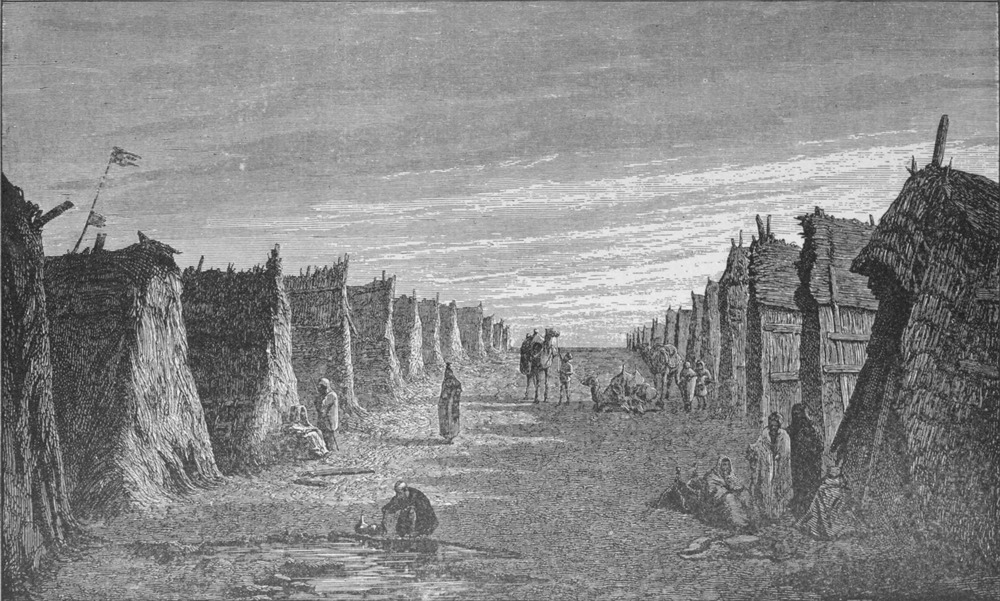
AN ARAB VILLAGE ON THE BORDERS OF EGYPT
LARGER IMAGE
Fans. A race of powerful and aggressive warriors, who intruded into Gaboon-Ogoway district about the middle of the nineteenth century; possibly related to Azandeh or Fulahs (q.v.). Cannibals, but otherwise of higher intellect and morality than the average Negro, from whom they differ in physical type.
Fantis. See TSHI.
Fellahin. The labouring peasantry of modern Egypt, industrious but not warlike, descendants of ancient Egyptians, with a mixture of Syrian and Arab blood.
Felup. A group of Sudanese Negro tribes on Casamanza and Cacheo estuaries.
Fertits. See NILITIC GROUP.
Fijians. Natives of Fiji, belonging to the Melanesian stock of the Oceanic Negro family. Formerly ferocious cannibals, they are now civilised.
Filipinos. See PHILIPPINES.
Fingus, or Ama-Fingu. Bantu Negroes of the Kafir division in South-east Africa, regarded by Zulus and Ama-Xosa as an inferior race.
Finno-Ugrian. A stock of the Northern Mongolic family, including (1) Ugrian or Siberian Finns, of which the chief races are Soyots, Ostyaks, Samoyedes, Voguls, Permian Finns, Siryanians, and Magyars (q.v.); (2) European Finns, divided into: (a) Volga Finns, (b) Baltic Finns.
Finns. The Finns proper are the inhabitants of Finland, between Russia and Norway. They are a Northern Mongolic race, of Finno-Ugrian stock, who are supposed to have originated beside the head waters of the Yenisei River. They entered Finland about the end of the seventh century and established themselves there, being afterwards annexed, first by Sweden and then by Russia. They are a strong, hardy race, who make excellent seamen, with round faces, fair hair and blue eyes. They are honest, highly moral and religious, and possess a remarkable ballad and folk-tale literature, of which the Kalevala is the chief example. The Baltic Finns of allied race include Esthonians, Karelians, Lapps, Livonians and Tavastians (q.v.). The Volga Finns are another branch of the same people, whose chief tribe was the ancient Bulgars (q.v.). The Mordvins and Cheremisses, still settled on the banks of the Volga in small communities, belong to the same race.
Flathead or Salish Indians. A mixed race of North American Indians, in British Columbia and Montana.
Flemings, or Flemish. The inhabitants of Flanders, now divided between Belgium and Holland, descended from Belgic tribes settled there in Cæsar’s time. They are a Low German branch of the Teutonic stock. They are an industrious and honest, though phlegmatic, people, who played a great part in mediæval commerce.
Formosans. Natives of Formosa, of mixed Malayan and Negrito descent. They were divided into three classes by the Chinese invaders: the Pepohwan, civilised agriculturists, under Chinese rule; Sekhwan, settled tribes who acknowledged Chinese rule; and Chinhwan, the wild savage tribes of the mountains, who waged unceasing war against the invaders. The island has now passed under Japanese dominion. The Formosans in general approximate to the Malay type, but are more sturdily built.
Fox Indians. See ALGONQUIAN.
Franks. A confederation of Germanic tribes, dwelling on the Middle and Lower Rhine in the third century. They belonged to the High German branch of the Teutonic stock. In the third and fourth centuries they began to invade Gaul, where they established a Frankish kingdom under Clovis (481–511), who adopted Christianity. This later developed into the modern State of France. The Franks were a brave and stalwart race of warriors, with blue eyes and long flowing hair, well-built and large-limbed. They were a nation of democratic fighting men, who practised agriculture in the intervals of war.
French. The inhabitants of modern France, a race of mixed origin. Among their ancestors are the Celtic Gauls, the Teutonic Belgae and Franks, the Hamitic Iberians, the Romans, and the Scandinavian Normans (q.v.). They are probably the quickest-witted and most intelligent race of modern Europe. Extremely warlike and aggressive in earlier days, they are now displaying greater devotion to the arts of peace, especially agriculture. Paris has long been the chief centre of ideas in Europe.
Frisians. A Teutonic race of Low German stock, living between Scheldt and Weser in Roman times, now belonging to the Netherlands.
Fuegians. Natives of Tierra del Fuego in South America, savages of a very low physical and mental type.
Fulahs. A warlike and predatory race of Saharan Hamites, formerly occupying small communities throughout the West and Central Sudan, who over-ran the native Hausa States about 1800–1810, and founded the empire of Sokoto.
Furs. See NUBA GROUP.
Ga. A Sudanese Negro group in Guinea, including Accras and Krobos.
Gaels. See HIGHLANDERS.
Gaikas and Galekas. See XOSAS.
Galchas. Highlanders of Hindu Kush and Turkistan, of Iranian descent.
Gallegos. Natives of Galicia, in Spain, of Gothic descent.
Gallas. A branch of Eastern Hamites, occupying Gallaland, south of Abyssinia. The finest people in all Africa, strongly built, of a light chocolate colour. They are distinguished for their energy and honesty. They are divided into numerous tribes, and are inveterate foes of the Somalis.
Gallinas. Sudanese Negroes of Sierra Leone.
Garamantes. An ancient Hamitic race inhabiting the neighbourhood of Tripoli in Roman times.
Garhwalis. Tibetan natives of Garhwal, on the border of Tibet.
Gascons. Natives of Gascony, of Basque descent, modified by Frank and French blood. They are notorious for their lively imagination and boasting “Gasconades.”
Gauchos. A mixed race of Spanish and Indian descent, admirable horsemen, who are the chief herdsmen of Uruguay and the Argentine Republic. See PUELCHES.
Gauls. In Cæsar’s time the Gauls occupied the central part, and formed the chief race, of modern France, which, after them, was called Gaul. They probably belonged to the Brythonic division of the Celtic stock, being closely allied to the ancient Britons, as well as to the modern Welsh and Bretons, who respectively represent the remnants of the primitive Celtic population of England and France. It is possible that there was a still earlier Celtic element in France, corresponding to the Goidelic division of the Celtic stock. Mingled with the Celtic element in the Gauls were traces of the earlier Iberian and Ligurian aborigines (q.v.). The Gauls were blue-eyed, fair-haired and long-headed, in distinction to the older dark-eyed, black-haired, round-headed type, which is more commonly known as Celtic, but is probably characteristic of an older race. Under Roman rule the Gauls acquired a considerable degree of civilisation. They were dispossessed in the decline of the empire by Franks, Burgundians and Visigoths (q.v.), but became in part ancestors of the modern French.
Georgians. The chief race of the Southern Caucasus, a fine athletic race of pure Caucasic type, noted for the personal beauty of its individuals. The Georgians were formerly fierce and warlike, but under Russian rule have become industrious in the arts of peace. They are noted for a passionate love of music. They first appear in history in the time of Alexander the Great, when they were already settled in their mountains. The Georgian kingdom had an independent existence for about seven centuries, but suffered much from Mongolian and especially Turkish invasions. Georgia and Circassia furnished the majority of white slaves for Turkish harems. In 1801 Georgia was annexed to Russia. Other important South Caucasian races are the Imerians and the Mingrelians, who closely resemble the Georgians in physical characteristics, but have displayed less aptitude for civilisation.
Gepidæ. See GOTHS.
Getæ. An ancient race of Thracian (q.v.) descent, who settled in Wallachia in the fourth century B.C. They were warlike and turbulent, but were conquered by Trajan and incorporated in the Roman Empire. In later centuries they appear to have been fused with the Goths (q.v.).
Germans. The Germans first appear in history as a multitude of independent and warlike tribes living amongst the dense forests which stretched in Roman times from the Rhine to the Vistula. They belonged to the Teutonic stock of the Aryan family. They were a tall and vigorous race, with long, fair hair and fierce blue eyes, who delighted in war and the chase. Their democratic social organisation has greatly influenced all Teutonic history; their love of liberty was a passion. At an early period they were divided into High and Low Germans, differing in type, according as they inhabited the central and southern portions of modern Germany or the low-lying lands towards the North Sea and the Baltic. The chief races of the former were the Goths, Franks, Burgundians, Swiss, Swabians, Austrians; of the latter, Saxons, Angles, Jutes, Frisians, Flemings, Batavi—from whom the modern English and Dutch are descended, whilst the High Germans represent the modern Germans. These are a very enterprising, thorough, and industrious race, alike in war and peace, and have thus given birth to one of the greatest Powers of the modern world.
Ghilzais. See AFGHANS.
Gilyaks. A Siberian Mongolic race of Saghalien.
Gipsies. A nomadic race, which was first described as appearing in Europe in the fifteenth century, and is now found in nearly all civilised countries. At first they were believed to come from Egypt, and their name is a corruption of “Egyptians.” They have a dark, tawny skin, black hair and eyes, are small-handed and often very handsome, and live by tinkering, basket-making, fortune-telling, and other arts which can be practised on the road. Their chief characteristic is independence and love of a wandering life. Their origin is still uncertain; though their language, Romany, is known to be a corrupt dialect of Hindi, which supports the older theory that they are of Indian descent. A later and well-supported theory is that they are the descendants of the prehistoric race which introduced metal-working into Europe. On this view they must have existed in Europe from time immemorial, without being noticed in literature. The gipsy problem still awaits solution.
Goajiris. See TUPI-GUARANI.
Golden Hordes. See KIPCHAKS.
Gonaquas. Hottentot Negro half breeds on Kafirland frontier.
Goads. See DRAVIDAS.
Goths. One of the chief Teutonic races of ancient times, who played a great part in European history from the third to the eighth century, but have left no descendants as a distinct race. They first appear in history in the third century, as a confederation of German tribes who had made a settlement in the district north of the Lower Danube. They soon split up into two distinct peoples, the East Goths or Ostrogoths, and the West Goths or Visigoths. There was a third and unimportant race of Mœsogoths, settled in Mœsia, for whom Ulfilas made his famous translation of the Scriptures. The Goths were extremely warlike and aggressive, a typical race of German warriors. The Ostrogoths remained north of the Danube, where they were subjugated for a time by the Huns of Attila. Recovering their independence, they invaded Italy, destroyed the Western Empire, and established a new kingdom under Theodoric. This was conquered by the Byzantine Narses in 552, after which the Ostrogoths disappear from history. The Visigoths, unwilling to submit to the Huns, crossed the Danube and settled in the Roman Empire, where they furnished many recruits for the army. In 395 they rebelled, and under Alaric invaded Italy and besieged Rome. Afterwards they founded kingdoms in the south of Gaul and in Spain, where the Visigoths ruled till the invasion of the Saracens, and where their blood is still found incorporated with that of the older races. A branch of the Ostrogoths which settled in the Crimea preserved its nationality and language down to the sixteenth century, or even later. The Bastarnæ, Gepidæ, and perhaps the Vandals (q.v.), were branches of the Gothic race.
Greeks. (1) For ancient Greeks, see HELLENES. (2) The modern Greeks are partly descendants of ancient Greeks, with a large admixture of Albanian, Wallachian and Slavonic elements. They are great in commerce, but not warlike.
Griquas. A race of Hottentot-Dutch half-breeds, also known as Bastaards, in Griqualand.
Guaicuris. Central American Indians of Lower California.
Guanches. Aborigines of Canary Islands: so-called “White Africans,” probably of Berber Hamitic stock.
Guatemalans. White natives of Guatemala, in Central America, of Spanish descent.
Guatusas. Central American Indians of Costa Rica.
Guebres. See PARSEES.
Gujeratis. Natives of Gujerat in Western India, Aryans of Hindu stock.
Gurkas. The dominant race of Nepal, who claim a Hindu (Aryan) origin, but have probably acquired a Mongoloid tinge from inter-marriages. They are of small stature, yet eminently warlike, and supply some of the best troops to our Indian Army.
Gypsies. See GIPSIES.
Hadendowas. See BEJAS.
Haidas. North American Indians in British Columbia.
Hamites. A family of Caucasic Man, belonging to the Melanochroid or dark type, ranging in colour from white to brown, and even black; hair soft, straight or wavy; skull, medium (mesocephalic); square-jawed (orthognathous); generally of fine physical development. Divided into Eastern Hamites—e.g., Somali, and Western Hamites—e.g., Berbers and Basques. Closely related to Semites.
Hau-Khoin. See HEREROS.
Hausas. The most important Sudanese Negro race of Northern Nigeria. Keen traders, physically well developed, they make excellent soldiers, and are largely utilised for this purpose by their British rulers. The Hausa States were over-run by the Hamitic Fulahs (q.v.) about 1800–1810, and now form part of the Empire of Sokoto. The Hausa language is the common medium of commerce in the Central Sudan.
Hawaiians. Natives of Hawaii, of brown Polynesian stock, akin to Maoris. A remarkably fine and handsome race, steadily decreasing since contact with European civilisation and diseases. Peculiarly subject to leprosy.
Haytians. Natives of the negro republic of Hayti, descended from negro slaves imported by the earlier Spanish and French owners, who freed themselves at the time of the French Revolution. The Spanish portion afterwards formed the Dominican Republic in the eastern part of the island. Of mixed Bantu and Sudanese Negro descent, with a cross of white blood.
Hazaras. Mountaineers of N.W. Afghanistan, a vigorous and turbulent race of Mongolo-Persian descent, often troublesome to British India.
Hebrews. See JEWS.
Hellenes. Inhabitants of ancient Greece, which they called Hellas. The Proto-Hellenes, or aborigines, were probably of Pelasgian origin, belonging to the Western Hamitic family, of whom the ancient Cretans and Mycenæans (q.v.) may represent the ancestral type. These were followed by the true Hellenes—Achæans or Argives—divided into three main branches—Dorians, Ionians, and Æolians. Later they were divided into many local states, such as Athens and Sparta. The modern Greeks are in part descended from the Hellenes, crossed with Albanian, Wallachian, and Turkish blood. It is to the Hellenes that we owe the first important developments of civilisation in Europe.
Helveti. Ancient inhabitants of Switzerland in Cæsar’s time, probably a German tribe, from whom the modern Swiss are in part descended.
Hereros, or Ovaherero. Bantu Negroes inhabiting the plains of Damaraland, or German South-West Africa. The Damaras or Hau-Khoin are a cross between Hereros and the Hottentot aborigines. A pastoral nation who migrated thither about two centuries ago from the inland districts, and dispossessed the aboriginal Hottentots, now represented by the Namas of Namaqualand, with whom they are perennially at war. Recently they rose against the German authorities, and have given them much trouble. A fine, warlike race.
Highlanders. The Gaelic-speaking inhabitants of Northern Scotland, a branch of the Goidelic or Q Kelts, also known as Gaels. They are descended from the ancient Scots (q.v.), who originally migrated from Ireland in the fifth century. One of the finest races of the British Islands, who give them their finest soldiers.
Himyarites. A branch of the Semitic family (“Red Men,” whence the Red Sea), formerly occupying Arabia Felix and Abyssinia; they form the main stock of the Abyssinian race. They included the kingdoms of the Minæans and Sabæans, the latter being identified by some with the Biblical Sheba.
Hindus. A stock of the Aryan family, comprising a large proportion of the natives of India, described under the headings of Kashmiris, Punjabis, Rajputs, Marathas, Bengalis, Sindis, Gujeratis, Assamis, etc. The original Hindus entered India—hence called Hindustan—from the north-west at some prehistoric time, and soon became the predominant race in the peninsula.
Hittites. A forgotten but once mighty people of Semitic race, who contested the entry of the Israelites into Canaan, and waged war with Egypt and Assyria for many centuries. Little is known about them, but they seem to have reared a mighty empire between Lebanon and the Euphrates, which endured for more than a thousand years, and was destroyed by the Assyrian Sargon II. in 717 B.C.
Hondurans. White natives of Honduras, of Spanish descent; few in numbers, the population being mostly of mixed blood.
Hor-Soks. A primitive Mongol-Turki race of the Tibetan plateau.
Hottentots, or Khoi-Khoin. The aboriginal Negro inhabitants of South Africa, which they shared with the Bushmen (q.v.). Possibly the Bushmen are degraded Hottentots, or the Hottentots are a cross between the Bantus from the north and the Bushmen, who would on this view be the true aborigines. The only surviving race of pure Hottentots are the Namas of Namaqualand: the Damaras, Griquas, Gonaquas, and Koranas, are other races in which Hottentot blood is mixed with that of Bantu Negroes or of Europeans (mostly Boers). The Hottentots are a distinct branch of the Negro family, marked by extremely long heads and high cheek-bones, a brownish-yellow complexion, with other physical peculiarities exemplified in the so-called “Hottentot Venus,” and also found in the Bushmen. Their language is peculiar for its unique “clicks,” which no European can pronounce, and which seem to stand between articulate and inarticulate speech.
Hovas. The dominant Malagasy race of Madagascar, of Malay descent, mixed with Bantu Negro blood from Africa. They stand nearest to pure Malays of all Malagasy peoples. The existing French Protectorate was only established after much fighting with the warlike Hovas, who had conquered all the other native tribes.
Huastec. See MAYA-QUICHÉ.
Hungarians. See MAGYARS.
Huns. A nomad race of the Northern Mongolic family, probably of Turki stock, who settled in the neighbourhood of the Volga and the Urals about the dawn of the Christian era. In the fourth century they conquered and dispossessed the Ostrogoths and Visigoths on the Danube. Under Attila, in the fifth century, they invaded Greece and Gaul, and pushed their arms as far as Rome, which was only saved by the diplomacy of the Pope. Their cruel fierceness in war caused their great leader to be known as the Scourge of God. Like the Mongols, they were essentially a race of horsemen, and their “deformed figures and hideous Mongolic faces” added to the terror which they inspired. After Attila’s death in 453 the Huns fell to pieces, and soon were absorbed into other nations—especially, perhaps, the Bulgars.
Hunzas. See DARDS.
Hupas. See ATHABASCAN.
Hurons, or Wyandots. A North American Indian race of Iroquoian stock, formerly inhabiting the shores of Lake Huron.
Hyksos. A Northern Mongolic race who invaded Egypt and established the dynasty of the Shepherd kings about 2000 B.C.
Ibeas. A Negro race which recently invaded the Cameroons from the East: they bring down ivory from the unexplored interior. Either Bantu, or Sudanese—perhaps connected with the Azandeh (q.v.).
Iberi, or Iberians. An ancient race of Western Hamites, related to the fair Berbers of Mauritania. The Basques are probably descended from them, and there is good reason for identifying them with the Picts of Scotland and the Irish aborigines.
Ibo. See ABO.
Icelanders. Inhabitants of Iceland, originally Norwegians, who settled there about the end of the ninth century. A typical tall, fair-haired, blue-eyed Scandinavian race. The Icelandic Sagas form the chief part of ancient Scandinavian literature.
Idumæans or Edomites. A warlike Semitic race of Canaanite stock, thought to be descended from Esau, who were conquered by the Israelites under Saul and David, and again by Judas Maccabæus in 165 B.C., after which they disappear from history.
Ife. See YORUBAS.
Igorrotes. An industrious agricultural race of the Philippine Islands. Indonesians of Malay descent, with a possible Chinese or Japanese element.
Illinois Indians. See ALGONQUIAN.
Illyrians. A savage piratical race of the eastern Adriatic sea-board, who were conquered by the Romans, and were the last of the Balkan peoples to be civilised. Probably the modern Albanians are descended from them, and they were among the first Aryan immigrants to Europe.
Ilocanos. A Malay race of the Philippine Islands.
Imerians. See GEORGIANS.
Incas. The chief of the six Indian races, including the Quichuas and the warlike Chancas, which formerly occupied the central mountain-region of Peru. The Incas became the dominant race about 1000 A.D., and built up a vast and peaceful civilisation, in which a purely socialistic government was successfully administered. This Inca Empire was destroyed by the Spanish under Pizarro in 1533, but the Inca Indians still survive as a race in Central Peru, where they are known as industrious and honest agriculturists.
Indians. Native races (1) of India; (2) of North, Central, and South America.
Indo-Chinese. A section of the Southern Mongolic family, inhabiting the countries between India and China.
Indo-European, Indo-German. See ARYAN.
Indonesians. The light-coloured, non-Malay inhabitants of the Eastern Archipelago and South Sea Islands, who are of Caucasic type, and are mostly brown-skinned Polynesians (q.v.). They also include the Batjans of Batjan I., the Burus, Korongui, and Suvu of the Malay Archipelago, and the Mentawey Islanders (q.v.).
Ingushis. See CHECHENZES.
Innuits. See ESKIMOS.
Ionians. (1) One of the three main Hellenic races of ancient Greece. (2) Greek inhabitants of the coast districts and islands of Western Asia Minor, forming the Ionian League, who passed in the sixth century B.C. under the Persian sway.
Iowa Indians. See SIOUAN.
Iranians. Ancient inhabitants of the Asian plateau bounded by the Indus, the Tigris, and the Hindu Kush. A stock of the Aryan family, now including Persians, Afghans, Baluchis, Kurds, and Armenians (q.v.).
Irish. (1) The aborigines of Ireland, probably Iberians (q.v.). (2) The later Erse-speaking inhabitants of Ireland, a branch of the Goidelic or Q Celts. (3) Modern inhabitants of Ireland, mostly Celtic, but largely mixed with Teutonic elements in the north.
Iroquoian. One of the families of North American Indians, including the Iroquois, or “Six Nations,” who comprised the Mohawks, Oneidas, Onondagas, Senecas, Tuscaroras and Cayugas; the Hurons, or Wyandots, including the Eries, and the Cherokees. Their territory was Upper Canada, round the great lakes, New York, and the Virginian Highlands, and they played a large part in the Franco-British warfare of the eighteenth century. They are now few in numbers and confined to Indian Reservations in the U.S. and Canada.
Israelites. See JEWS.
Italians. (1) Ancient inhabitants of Italy, of Ligurian stock, probably Eastern Hamites, related to the Pelasgians [see LATINS and ROMANS]. (2) Modern Italians, mostly of Latin stock, crossed with Teutonic (Gothic and Lombard) blood.
Italic. A stock of the Aryan family, including ancient and modern Italians (with ancient Romans), modern French, Spanish, Portuguese, and Roumanian, with Latin (Spanish and Portuguese) Americans.
Jallonké. See MANDINGAN.
Jangalis. An aboriginal Indian tribe, inhabiting the forest district north of Cuttack—the most primitive race in all India. Perhaps an early Dravidian (q.v.) stock.
Japanese. A race of the Northern Mongolian family, probably originating in Korea, whence they spread to Japan and dispossessed the Ainu aborigines, about the dawn of the Christian era. The most enterprising and civilised people in Asia, often called “the English of the Far East.” They possess a singularly high standard of honour and patriotism, which was the main factor in their recent victory over Russia, and they are eminently warlike, besides producing industrious agriculturists and enterprising traders. Of short but sturdy stature, white skin and yellow or sallowish complexion, oblique eyes, black hair.
Jats. A numerous agricultural race of the Punjab in North-west India. They are probably of an Aryan stock, but ethnologists disagree as to their history, assigning them ancient Scythian invaders, the Rajputs, or the Gipsies, for ancestors.
Javanese. A Malay race inhabiting Java, where they dispossessed the Negrito aborigines [see KALANGS] in prehistoric times. The Sundanese and Madurese are allied tribes, possessing parts of the island of Java, now under Dutch rule.
Jebus. See YORUBAS.
Jews, Hebrews, or Israelites. The most important of Semitic races, of the ancient Canaanite stock. The Israelites descended from Abraham, who came from Mesopotamia to Canaan about 2000 B.C.; thence they migrated to Egypt, and returned to take possession of Palestine. Their history is familiar to all from the Bible. After the Roman capture of Jerusalem under Titus, 70 A.D., the Jews—as they were now called—were dispersed through the world, but they have retained their racial characteristics in remarkable purity through long persecutions, and now play a great part in the commerce and finance of nearly all civilised countries, though they have no national unity or racial home.
Jivaros. South American Indians, in Peru, on the head-waters of the Amazon.
Jolofs. See WOLOFS.
Jutes. Early inhabitants of Jutland, a Low German branch of Teutonic stock, who invaded England in the fifth century and made the first Teutonic settlement in that country, in Kent.
Kabards. A Western Caucasian race, allied to the Circassians (q.v.) and presenting a high standard of physical beauty.
Kabyles. See BERBERS.
Kacharis. Natives of the Terai at the foot of the Himalayas, belonging to the Tibetan stock of the Southern Mongolic family.
Kafirs, or Kaffirs. Generic name of the fierce and warlike Bantu Negro races which occupied the south-eastern seaboard of South Africa when Europeans first colonised that country. They then held all the coast lands from the Gamboos to the Limpopo. The southern part (Kaffraria) belonged to the Kafirs proper, and the northern (Zululand) to the Zulus, an allied race, but usually distinguished from the Kafirs, or Ama-Xosa, whose chief tribes are Galekas, Gaikas and Tembus (q.v.). Throughout the greater part of the nineteenth century the English settlers were engaged in constant Kafir wars, which resulted in the gradual subjugation of both Kafirs and Zulus.
Kafirs. Fair-skinned mountaineers of Kafiristan, between the Kabul River and Hindu Kush. An offshoot of the Aryan family, thought by some to be descendants in part of the Greek troops with which Alexander the Great invaded India.
Kakhyens. A race of freebooters, inhabiting the northern frontiers of Burma, whence they raid the more civilised agriculturists of the plains and levy blackmail. A Southern Mongolic race of Indo-Chinese stock.
Kalangs. A recently extinct Negrito race of Java, remnants of the aborigines of that island; small, black and woolly-haired, with very retreating forehead and projecting jaws. The most ape-like of human beings, and the nearest approach yet found to the “missing link” between man and ape. They belonged to the Oceanic Negro family.
Kalmuks. The Western Mongol stock of the Northern Mongolic family, scattered through Central Asia, and extending into Southern Russia. Nomadic pastors, owning large flocks and herds, and living in tents on the great steppes, they include the tribes of the Chorasses, Turguts, Khoshots, and Durbats. A large horde of Kalmuks invaded Russia in 1650, and settled there for a century, but in 1771 most of them were expelled, and endured great sufferings on the march to China, so brilliantly described by De Quincy. These were mainly Khoshots and Durbats.
Kamchadales. A Siberian branch of the Northern Mongolic family, inhabiting Kamchatka; a hardy race of hunters and fishers.
Kanakas. A name given to South Sea Islanders, generally by sailors and traders, and especially to Polynesian labourers imported to Queensland.
Kanakas, or Bakanaka. Negro aborigines of Angola, probably akin to the Bushmen. Other similar tribes are the Korokas, Kulabes, Kwandes and Kwisses.
Kanarese. Mongoloid aborigines of Mysore in India. See DRAVIDIANS.
Kanembu, Kanuris. See LAKE CHAD GROUP.
Kara-Kalpaks, or Black Bonnets. A branch of the Turki stock of the Northern Mongolic family, dwelling on the south-east of the Aral Sea and in the Oxus basin. A pacific pastoral race, dominated by their warlike relatives, the nomadic Kirghiz, and now subject to Russia.
Kara-Kirghiz. See KIRGHIZ.
Karelians. An Eastern branch of Baltic Finns dwelling in the eastern parts of Finland and adjoining provinces of Russia. Probably a Slavo-Mongolic mixture in which the original Mongolic element has been largely eliminated.
Karens. Inhabitants of Burma, of the Indo-Chinese branch of the Southern Mongolic family. Largely Christianised. Formerly oppressed by the Burmans, than whom they are less clever, but more industrious. Agriculturists.
Karons. A Negrito race of New Guinea, of very degraded type, and addicted to cannibalism.
Kargos. See NUBA GROUP.
Kashmiris. Natives of Kashmir, belonging to the Hindu branch of the Aryan family. Of fine physique, but corrupt and untrustworthy.
Kassonké. See MANDINGAN.
Kazaks. See KIRGHIZ.
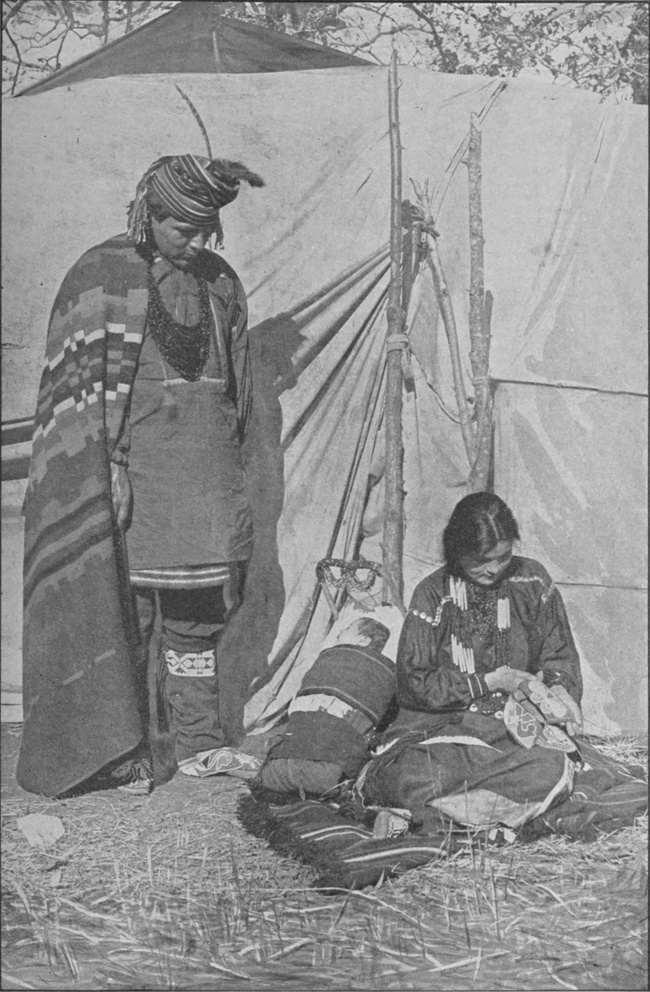
Underwood & Underwood
A RED INDIAN CHIEF AND HIS FAMILY
LARGER IMAGE
Kelts, or Celts. A stock of the Aryan family which settled in France and the British Islands in prehistoric times. The Gauls and Belgæ of Cæsar’s time and the early Britons represent them. They are divided into two branches, Goidelic and Brythonic Celts, respectively known also as Q and P Celts, from a linguistic peculiarity. The former are represented in modern times by Irish, Manx, and Scottish Highlanders; the latter by Welsh, Cornish, and Bretons. The typical Celt was probably a tall, broad-headed individual, with prominent nose, high cheek-bones, light hair and eyes. The small, round-headed, dark race which is also classed as Celtic, is more probably an earlier Hamitic type, allied to the Basques (q.v.).
Khulkas. A nomadic race of Eastern Mongols, occupying the Gobi desert.
Khamtis. An Assamese race—Indo-Chinese stock of Southern Mongolic family—in the Brahmaputra Valley.
Khasis. An Indo-Chinese hill tribe of Southern Mongolic family, in Khasi Hills of Assam.
Khoi-Khoin. The name given to themselves by the Hottentots (q.v.).
Khoshots. See KALMUKS.
Kickapoos. See ALGONQUIAN.
Kiowas. A North American Indian race in Oklahoma.
Kipchaks. A Turki race of Northern Mongolic family, settled in eleventh century between Urals and Don. In the middle of the thirteenth century, Batu Khan, a son of Genghiz Khan, led them to conquer all Central and South Russia, where they founded the Empire of the Golden Horde. It was broken up by Tamerlane about 1390, and from its fragments arose the Khanates of Astrakhan, the Crimea, etc., now absorbed by Russia. From the Eastern Kipchaks are descended the Kirghiz (q.v.), one of whose hordes is still known as Kipchak. The modern Kipchaks are nomadic, and live by stock-feeding in the steppes of western Turkestan.
Kirantis. A Tibetan race of East Nepal, of Southern Mongolic family.
Kirghiz. A nomadic people of Central Asia, where they occupy the vast steppes which lie to the north of Turkestan. They are descended from the Kipchaks (q.v.) of the Golden Horde. They form a group of the Turki stock of the Northern Mongolic family. The Kara-Kirghiz, who inhabit the uplands between the Issik-Kul and the Kuen-Lun, are the oldest Turki nomads of whom there is any historical record, and are divided into On and Sol—right and left wings. The Kirghiz proper, who call themselves Kazaks, or “riders,” roam from Lake Balkash to the Volga, over the vast level steppes, where they dwell in skin tents and support themselves by breeding camels, horses, oxen, sheep and goats. They live in the saddle, and were formerly a warlike people, who once could put 400,000 fighting men in the field. They are divided into four hordes—Great, Middle or Kipchak, Little, and Inner. They are all now under Russian dominion.
Kishis. See CHECHENZES.
Kissis. See TEMNÉ GROUP.
Kizil-Bashis. Persianised Turkis of Afghanistan, belonging to Turki branch of Northern Mongolic family, who supply the chief commercial classes of Afghanistan.
Kolajis. See NUBA GROUP.
Kolarians. One of the three non-Aryan races to which the primitive inhabitants of India belonged, of the Indo-Chinese stock of the Southern Mongolic family. They entered Bengal from the north-east, and are now represented by a few scattered tribes, like the Santals, Mundas, Kurkus, and Bhils.
Koranas. See HOTTENTOTS.
Koreans. Natives of Korea, belonging to the Koreo-Japanese stock of the Northern Mongol family. They stand midway between Chinese and Japanese, the latter being probably their descendants, and are taller, with lighter complexion and more regular features, than the typical Mongol. Their civilisation is of Chinese origin. They are not warlike, but are prosperous agriculturists.
Korokas. See KANAKAS.
Korungas. See WADAI GROUP.
Koryaks. An Arctic race of North-east Siberia, allied to the Chukchis (q.v.).
Krej. See NILITIC GROUP.
Krim-Tartars. See TARTARS.
Krus, or Krooboys. Sudanese Negroes of Liberian Group. Bold and skilful boatmen, employed for that purpose all along the West African Coast.
Kulabes. See KANAKAS.
Kulfans, Kunjaras. See NUBA GROUP.
Kurds. Native of Kurdistan, partly nomad and pastoral, partly settled and agricultural. A fierce and warlike people, they are much given to raiding, and were utilised by the Sultan to oppress the Armenians. They have settled in Kurdistan from time immemorial, and belong to the Iranian stock of the Aryan family.
Kurile Islanders. See AINUS.
Kurinis. See LESGHIANS.
Kurkus. A broken Kolarian tribe, allied to the Santals of Central India, belonging to the Indo-Chinese branch of Southern Mongolic family.
Kutchins. See ATHABASCAN.
Kwandes, Kwisses. See KANAKAS.
Ladakhis. Natives of Ladakh in the Upper Indus Valley, belonging to the Tibetan stock of the Southern Mongolic family, conquered by Kashmir in seventeenth century.
Lake Chad Group. A group of Sudanese Negro tribes, inhabiting the districts round Lake Chad, including Kanembus, Kanuris, Baghirmis (warlike slave-raiders), Mandaras, Yedinas, Logons, Mosgus, Bulalas, Saras, etc.
Lampongs. Malay inhabitants of Southern Sumatra.
Lamuts. See TUNGUSES.
Landumans. Sudanese Negroes of Senegambia.
Laos. See SHANS.
Lapps. A branch of the Finno-Ugrian stock of the Northern Mongolic family, inhabiting the parts of Norway, Sweden, Finland, and Russia collectively known as Lapland. They are the shortest and broadest-skulled people in Europe. Most of them are nomads, who live by their vast reindeer herds, though some have become settled and live by fishing and hunting. They are closely allied to the Baltic Finns, and like them show traces of a mixture of Caucasic blood.
Lascars. A term applied to sailors of Indian and Malay seafaring races, employed on British vessels.
Latins. The ancient inhabitants of Latium, the district of Central Italy which lay between the Tiber and the Liris, and included the Roman Campagna. They absorbed the earlier allied races of Oscans, Sabines, Samnites and Umbrians, and formed a league of thirty cities, which warred for some generations with Rome and then fell under the Roman dominion. Rome itself was originally a Latin city. The ancient population of Italy was divided into three grades: Roman citizens—not necessarily residents in Rome—Latins, and Italians. The Latins are a branch of the Italic stock of the Aryan family.
Latin or Romance Races. A name often given to the modern races which speak a Romance language derived from Latin, and belong in whole or part to the Italic stock of the Aryan family. They include Italians, French (including Provençals), Spaniards, Portuguese, and Roumanians.
Latin Americans. The white inhabitants of South America, of Spanish or Portuguese descent, and speaking these languages.
Lazes. See GEORGIANS.
Lencan. A group of semi-civilised Central American Indian tribes, including Chontals, Ramas, Payas, Wulwas, and Guatusas.
Lepchas. Natives of Sikkim and Bhutan, belonging to the Tibetan stock of the Southern Mongolic family.
Lesghians. A branch of the Eastern stock of the Caucasian family, inhabiting the Eastern Caucasus. Wild mountain tribes, who long offered an unavailing resistance to the Russian arms under Shamyl (1859). Their chief tribes are the Avars (the most cultivated and powerful), Andis, Dargos, Didis and Kurinis.
Lettic. A stock of the Aryan family, including Letts, Lithuanians and the extinct Pruczi, Borussians, or Old Prussians, from whom modern Prussia takes its name. The Letts and Lithuanians in the fifteenth century formed a united people, inhabiting the south-west of Russia, from Courland to Odessa. Afterwards they passed under Polish and then Russian dominion. They are now mostly peasant agriculturists. They are fair and well-built, with fine features and blue eyes.
Letts. See LETTIC.
Liberian Group. Sudanese Negro tribes, inhabiting the Grain Coast of West Africa. The Krus or Krooboys (q.v.), Queahs and Bassas are their chief tribes.
Liberians. Natives of the negro republic of Liberia on the Guinea Coast, partly descended from freed slaves of all races, but mainly belonging to the Liberian group.
Libyans. An ancient fair-haired and light-skinned race of Northern Africa, akin to the modern Berbers, belonging to the western stock of the Hamitic family. They are depicted on Egyptian monuments of fifteenth century B.C.
Ligures, or Ligurians. An ancient race of the western stock of the Hamitic family, probably the aborigines of North-West Italy round Genoa, to whom the Siculi, Sards and Corsicans were apparently akin.
Limbas. See TEMNÉ GROUP.
Lithuanians. See LETTIC.
Livonians. A branch of Baltic Finns, belonging to the Finno-Ugrian stock of the Northern Mongolic family; a dwindled remnant now inhabits the Baltic provinces of Russia.
Logons. See LAKE CHAD GROUP.
Lolos. A fair-complexioned aboriginal race on the frontiers of China and Tibet, belonging to the Chinese stock of the Southern Mongolic family.
Lombards. A race of Teutonic stock, formerly settled in the district of the Lower Elbe, who invaded Italy in 568, and there founded a powerful Lombard kingdom under Alboin and his successors. The Lombards were at first fierce warriors and little more; but they soon fell under the influence of Italian civilisation, and were merged into the Italian race when Charlemagne destroyed their independence in 774. Their name and some traces of their racial character still remain in Lombardy, between the Alps and the Po.
Luchuans. Natives of the Luchu or Liu-Kin Archipelago, between Japan and Formosa, resembling the Japanese, but with differences which are attributed to a cross of the aboriginal Ainu blood. They belong to the Koreo-Japanese stock of the Northern Mongolic family.
Lushais. A warlike race of Tibetan stock inhabiting the Lushai Hills on the confines of Assam, Bengal and Burma.
Mabas. See WADAI GROUP.
Macedonians. A warlike people of ancient Greece, who attained their greatest power under Alexander the Great. They were not true Hellenes, but a race of wild mountain tribes probably of Hamitic origin. Modern Macedonia is peopled by an extremely mixed race of Greeks, Bulgarians, Turks, etc., among whom some descendants of the ancient Macedonians may no doubt be found.
Macusis. See CARIBS.
Madis. See NILITIC GROUP.
Madurese. A Malay race inhabiting Java, and allied to the Javanese (q.v.).
Magars. A Tibetan tribe of Western Nepal.
Magwangwaras. A fierce predatory race of Bantu Negroes, occupying the head-waters of the Rovuma River in East Central Africa.
Magyars. A warlike and now highly civilised race belonging to the Finno-Ugrian stock of the Northern Mongolic family. They first appeared in Europe about a thousand years ago, being probably Scythian (q.v.) immigrants from the Caspian district. They conquered the Roman provinces of Pannonia and Dacia, and there founded the Kingdom of Hungary in the year 1000. They are still the dominant race in Hungary, which now forms part of the Austro-Hungarian Empire, and preserve their Finno-Ugrian speech. They are a chivalrous and highly intelligent race, whose Mongolic descent is no longer perceptible in their white skins and regular, often handsome features. Probably this is due to frequent crossing of blood with German, Slav and Roumanian neighbours.
Mahrattas. See MARATHIS.
Makololos. A warlike branch of the Basuto race of Bantu Negroes who, in 1835, moved north and conquered the Barotses, only to be reduced by them to vassalage about 1864.
Makuas. A savage cannibal race of Bantu Negroes, living north of the Zambesi in Portuguese East Africa.
Malagasy. A Malayo-African people of mixed blood, inhabiting Madagascar. The Hovas (q.v.) are the dominant tribe.
Malays. The dominant native race of Malaysia, the chief stock of the Oceanic Mongolic family. They are of a distinctly Mongolic physical type, of low stature and yellowish colour, with high cheek-bones, black lank hair and broad skulls. They may be divided into three races: the Orang-Benua, or men of the soil, the indigenous Malay tribes at a low stage of culture; the Orang-Laut, or men of the sea, who live by fishing and piracy; and the Orang-Malayu, or civilised Malays proper. They inhabit the southern provinces of Sumatra, the native states of the Malay Peninsula (Kelantan, etc.), the British Straits Settlements (Johor, Perak, Selangor, etc.), parts of Borneo, Ternate, Tidor and the Banda Islands, and many islands of the Malay Archipelago. They have wandered as far as Madagascar, where the Malagasy (q.v.) are Malays crossed with Negro blood. They were formerly warlike and much given to piracy, but are now the chief trading race of South-eastern Asia. Their origin is dubious, but Sumatra is generally regarded as their original home. Of kindred blood are many so-called Proto-Malay races, such as the Achinese, Javanese, Sundanese, Dyaks, etc. (q.v.).
Malayalim. See DRAVIDIANS.
Manchus. The dominant native race of Manchuria, who conquered China in the seventeenth century and founded the existing Chinese dynasty. They are of the Mongol stock of the Northern Mongolic family. They first appear in history in the thirteenth century, when a number of nomad Manchu tribes were formed into a single people. They probably originated in Siberia, where the Tunguses (q.v.) represent their primitive stock.
Mandans. See SIOUAN.
Mandaras. See LAKE CHAD GROUP.
Mandingans. The chief race of Sudanese Negroes in the Western Sudan, with numerous branches between the Upper Niger and the coast, including Mandé or Mandingoes, Bambaras, Jallonkés, Kassonkés, Masinas, Sarakolés, Solimas, Susus, etc. Timbuctoo was formerly the capital of the Mandingan empire, before it fell under Berber domination. A large proportion of American Negroes are descended from slaves of Mandingan origin.
Mangbattu. Sudanese negroes of Welle group, noted for their pronounced cannibalism.
Mangkassara. Malay natives of Macassar, in Celebes, under Dutch rule.
Manipuris. Natives of Manipur, between Burma and Assam, mostly wild hillmen of mixed Burmese and Hindu blood, but classed with the Indo-Chinese stock of the Southern Mongolic family.
Man-Tses. Inhabitants of the mountain districts of Sze-chuen in China, akin to Lolos (q.v.). m
Manx or Manxmen. Inhabitants of the Isle of Man, belonging to the Celtic stock of the Aryan family, and the Goidelic or Q Celt branch of it. There is a strong Scandinavian element in their blood, from the numerous invasions of the old Norse pirates. Their customs are also strongly marked by the Scandinavian element.
Manyuemas. Warlike Bantu Negroes of the Upper Congo, long allied with the Arab slave-traders.
Maoris. The aborigines of New Zealand, belonging to the tall brown race of Polynesians (q.v.), a branch of the Indonesian family. A brave, generous and warlike people, who are said to have reached New Zealand from the Pacific islands about a thousand years ago, they are one of the few native races which promise to assimilate western civilisation with success.
Marathis, or Mahrattas. A numerous Indian race of mixed origin, probably of aboriginal (Dravidian) blood in the main, with a Hindu element. They inhabit West and Central India, where they became the dominant power under Sivaji in the seventeenth century. The English had long and bloody contests with these wild and warlike mountaineers, who founded several great native states, some of which (Gwalior and Indore) survive to this day.
Maronites. A sturdy, warlike Christian race of mountaineers in the Lebanon, belonging to the Syrian branch of the Aramæan stock of the Semitic family. Implacable foes of the Druses, with whom they are constantly at war.
Marquesans. See POLYNESIANS.
Masais. A branch of the Eastern Hamites, settled in British East Africa on the Tana River. A finely-built race, whom only their chocolate colour and frizzy hair prevent from passing for Europeans. Extremely warlike and intelligent, they are confirmed raiders and cattle lifters.
Mashonas. Natives of Mashonaland, in South-eastern Rhodesia, formerly the half-fabulous empire of the Monomotapa, and the home of a forgotten civilisation, to which the ruins of Zimbabye and other similar relics bear witness. The Mashonas are Bantu Negroes, a peaceful, industrious people, who were subjugated about 1838 by the Matabeles under Umsilikatzi, and are now under British rule.
Massachusett Indians. See ALGONQUIAN.
Massalits. See WADAI GROUP.
Matabeles. A branch of the Zulu race of Bantu Negroes, which was expelled from Zululand in 1838, and conquered the Mashonas, in modern Rhodesia, under Umsilikatzi. Like the Zulus, they were proud and fearless warriors, who were only subjugated with difficulty by the English in 1893, and revolted unsuccessfully in 1896.
Matacoans. A South American Indian race on the Vermejo River in Argentine.
Mauri. See MOORS.
Maviti. Bantu Negroes of the Upper Shiré in British South Central Africa, of Zulu stock, who came as conquerors from the south.
Maya-Quiché. A group of Central American Indian races, mostly in Yucatan and Guatemala. It includes the Mayas of Yucatan, Zendals and Zotzils of Chiapas, Quichés, Chols, Pokomans, and Zutugils of Guatemala, Huastecs and Totonacs of Vera Cruz. Like the Aztecs, the Mayas possessed an ancient civilisation and system of picture writing.
Maypuris. See ARAWAKS.
Mbengas. Indigenous Bantu Negroes of French Equatorial Africa, about Corisco Bay.
Melanesians. The indigenous natives of the Western Pacific Islands, forming a distinct stock of the Oceanic Negro family of Ethiopic Man. They are long-skulled, or dolichocephalic, with the lowest cephalic index of all known races, prognathous, broad-nosed, of a sooty-black colour, with black frizzy hair, and of low stature. They are at a low stage of culture, being very savage, bloodthirsty, and treacherous, mostly cannibals and head-hunters, with little social organisation. They include the Fijians and the natives of the New Hebrides, the Solomon, Admiralty, Bismarck, and Loyalty Islands, New Britain, New Ireland, New Caledonia, and other islands of the Eastern Pacific. They are closely allied to the Papuans (q.v.), under which name some ethnologists prefer to class the whole body of Melanesians.
Melanochroi. A suggested division of Caucasic Man, in which a pale skin is typically accompanied by dark hair and eyes; it would thus include the Hamitic and Semitic families, with the Hellenic, Italic, and Celtic stocks of the Aryan family.
Mendis. See TEMNÉ GROUP.
Mentawey Islanders. A remnant of the aboriginal Polynesian race dispossessed by the Malays, off the coast of Sumatra.
Mestizos. Cross-breeds between Europeans and Indians, in Spanish and Portuguese America.
Mexicans. See AZTECS and NAHUANS. Also the modern inhabitants of Mexico, who are of Spanish descent, with a strong infusion of Indian blood.
Micmacs. An Indian race of Nova Scotia, in whom some ethnologists think that a trace of Norse blood, dating from the pre-Columbian discovery of America, is perceptible.
Minæans. See HIMYARITES.
Mingrelians. See GEORGIANS.
Minh-huongs. Franco-Annamese half-breeds in Cochin China, an increasing race who make very valuable colonists.
Minnetarees. See SIOUAN.
Mishmis. A wild Tibetan hill tribe occupying the jungle-covered hills through which the Brahmaputra flows, on the northern border of Assam. Warlike and turbulent.
Missouri Indians. See SIOUAN.
Mixtecs. An ancient Mexican race, contemporary with the Toltecs (q.v.), probably represented by the modern Miztecs of Oajaca.
Moabites. An ancient pastoral race of Semitic origin, ethnologically cognate with the Israelites, who dwelt on the east of the Dead Sea, and are now extinct.
Mœsogoths. See GOTHS.
Mohawks. See IROQUOIAN.
Mohicans. One of the most famous and warlike of redskin races, immortalised by Fenimore Cooper. See ALGONQUIAN.
Mojos, or Moxos. A yellowish Indian race of Bolivia, akin to the Chiquitos.
Mokis. See SHOSHONEAN.
Mongolic. One of the four great divisions of mankind. Typically characterised by yellowish skin, broad, flat features with prominent cheek-bones, broad skulls, mesognathous jaws, and oblique, almond-shaped eyes, with black, lank and coarse hair. The Manchus are a typical Mongolic race. The Mongolic races are mostly found in Asia, which is chiefly peopled by their stocks. The name “Mongolic” has replaced the older “Turanian.”
Mongols. A stock of the Northern Mongolic, otherwise known as Mongolo-Tartar or Ural-Altaic, family, from whom the general term of Mongolic is derived. The name seems originally to have meant “brave,” and the Mongols have provided some of the most fierce and warlike races of history. They originated as scattered tribes in modern Mongolia. Under Genghiz Khan they were formed into a confederacy which conquered the whole of Central Asia in the thirteenth century, thanks to an unlimited supply of hardy and very mobile horsemen. The existing Mongol tribes, nomad pastors of Mongolia in Central Asia, are divided into Sharras or Eastern Kalmuks, or Western Buriats, or Siberian Mongols, and Tunguses, including Manchus (q.v.).
Montenegrins. A Servian race of civilised mountaineers, inhabiting the rugged district of Montenegro; the only Balkan race which preserved independence and Christianity against the Turkish conquerors. Their history is one of constant warfare with the Turks, and they have thus preserved the primitive virtues of the warrior in great perfection.
Moors. The ancient Moors, or Mauri, were the inhabitants of the Roman province of Mauretania, roughly including the modern Algeria and Morocco. They were probably of mixed descent, partly Semitic from Arabia, partly Western Hamitic from indigenous sources. In modern times the name is applied (1) to the invaders and conquerors of Spain in the Middle Ages, who were mostly of Arab and Berber stock; (2) to the present inhabitants of Morocco and the Barbary States, of the same stocks, with a large infusion of Sudanese Negro blood. The Moors have always been a turbulent and warlike people, who furnished the most notorious pirates of modern history, thanks to their commanding position on the great highway of sea-borne commerce.
Moquis. See PUEBLO INDIANS.
Mordvins. A branch of the Finns (q.v.), forming small communities on the banks of the Volga.
Mosgus. See LAKE CHAD GROUP.
Mossis. See NIGERIAN GROUP.
Mpongwes. A Bantu Negro race on the Gaboon Estuary in French Equatorial Africa, given to drink and boasting, of little economic value, though once powerful.
Mulattos. Half-breeds between whites and negroes.
Mundas. A Kolarian race of Lower Bengal, with possible traces of Negroid blood.
Mundrucus. See TUPI-GUARANI.
Mundus. See NILITIC GROUP.
Mushi-Kongo. Bantu Negroes of Portuguese West Africa, still in an absolutely savage state.
Muskhogean, or Appalachian. A group of North American Indian tribes, formerly occupying the south-eastern corner of the present United States, south of Tennessee, and east of Arkansas. Formerly a powerful confederacy of warlike hunters, they are now extinct or confined to Indian reservations. The chief tribes are Alibamus, Apalachis, Chickasaws, Choktaws, Creeks or Muskhogees, and Seminoles.
Mycenæans. The inhabitants of ancient Mycenæ, one of the chief centres of prehistoric culture in Greece before the Homeric age. Recent excavations, at Mycenæ itself, at Cnossos in Crete, and other contemporary sites of government, have thrown light on the remarkable civilisation which then existed. The Mycenæans, Cretans, and their kindred peoples were probably a mixed Caucasic race, with affinities to the later Aryan Achæans and to the aboriginal Hamitic Pelasgians; but nothing is yet certainly known of their ethnological place.
Nagars. See DARDS.
Nagas. Aborigines of the Naga Hills, in South Assam, semi-savage and formerly accustomed to raid the British provinces; now under British rule. They are of Tibetan stock.
Nahuans, or Mexican Indians. The aboriginal inhabitants of modern Mexico, whose history dates back to the sixth century. The oldest of the Nahuan races was that of the Toltecs, who established a civilisation marked by architectural and artistic monuments still existing, north of the valley of Anahuac. They were followed by the ruder Chichimecs and the Aztecs (q.v.). Other branches of the same race are the Pipils and the Niquirans of Nicaragua.
Naimans. (1) See SHARRAS. (2) A tribe of the Middle Horde of the Kazaks. See KIRGHIZ.
Nairs. A Hindu tribe of Malabar, distinguished by their peculiar marriage customs. They practise polyandry, and a Nair’s property descends not to his own but to his sister’s children.
Namas or Namaquas. A Hottentot tribe of Namaqualand, the true aborigines and the principal representatives of the Hottentots (q.v.). Scattered in small pastoral groups.
Natchez Indians. An extinct North American Indian race, formerly inhabiting the region of the Lower Mississippi.
Navajos. See ATHABASCAN.
Neanderthal Man. A race of primitive man, represented only by a skull and a few bones found in a limestone cave of the Neanderthal in Rhenish Prussia in 1856. The most ape-like race yet known, and probably the oldest.
Negritoes. A branch of Ethiopic Man, found in Central Africa, and in the Andamans, the Malay Peninsula and the Philippines, akin to negroes but of smaller stature and more ape-like. Possibly the primitive stock from which the Negroes (q.v.) were developed.
Negroes. The most numerous branch of Ethiopic Man, divided into African (Sudanese, Bantu, and Hottentot-Bushman) and Oceanic (Papuan, Melanesian, and Australian) sections. American Negroes are descended from African slaves, mostly of Sudanese origin. See HAYTIANS.
Nempés. See NIGERIAN GROUP.
Nestorians. A Syrian race, belonging to the Aramæan stock of the Semitic family, distinguished by a special form of Christian belief, who were driven out of the Roman Empire in the fifth century, and whose descendants now form a special community in the mountain ranges of Kurdistan. They are poor and illiterate. A branch of Nestorians is found in Travancore, where they go by the name of Syrian Christians.
New Guinea Natives. See PAPUANS.
New Zealanders. (1) Aborigines [see MAORIS]. (2) White inhabitants of New Zealand, of Anglo-Saxon descent.
Nez Percés. A tribe of North American Indians, in British Columbia and Idaho, part of whom are well advanced in civilisation.
Niam-Niam. See AZANDEH.
Nicaraguans. White natives of Nicaragua, in Central America, of Spanish descent, with Indian and negro elements.
Nicobarese. Natives of the Nicobar Islands, of Malay blood mixed with that of the Mongolic aborigines. Formerly given to piracy.
Nigerian Group. A group of Sudanese Negro tribes, all of allied stocks, inhabiting the Niger Delta, the Oil River, Lower Benue, and Niger region, including the Niger Bend. Amongst them are the people of Benin—noted for their vast human sacrifices—the Abo, Nempé, Nupé, Akasa, Qua, Efik, Okrika, Akpa, Mossi, Sienereh, and many other tribes.
Nilitic Group. Another group of Sudanese Negro tribes, inhabiting the districts of the White Nile, Sobat, and the northern slopes of the Nile-Congo divide. They include the Abaka, Abukaya, Bongo, Shuli, Falanj, Madi, Bari, Nuer, Shilluk, Dinka, Mundu, Rol, Mittu, Krej, and Fertit tribes. They are mainly hard-working agriculturists, from whom the British draw material for excellent soldiery.
Niquirans. See NAHUANS.
Nogais. A race of Caucasian Tartars (q.v.) inhabiting the steppes of the Kuma River; nomadic cattle-breeders.
Normans. Natives of Normandy, descended from the Norsemen (q.v.) who settled on the French coast under Rolf the Ganger in the beginning of the tenth century. The history of the Normans, who conquered England and Sicily, is well known. The modern Normans still preserve many signs of their Scandinavian ancestry, which distinguish them from their French or Breton neighbours.
Norsemen or Northmen. A name given in the Middle Ages to the piratical emigrants from Denmark, Iceland, Sweden, and Norway, who descended on the coasts of England, France, Germany, and Southern Europe. They called themselves Vikings. These sea-rovers came, in the first instance, for portable plunder, but in many cases they were tempted by the look of the more fertile lands of the south to make settlements, among which those of the Danes in England and Ireland and of the Norwegians in Normandy, England, and Sicily were the most lasting and important.
Norwegians. A branch of the Scandinavian stock of the Aryan family. They are probably descended from Teutonic immigrants—perhaps of Gothic race—who entered the Scandinavian peninsula in prehistoric times, and drove out the aboriginal Lapps or Finns. Another theory makes Scandinavia the original home of the Aryans, of whom, on this view, the Norwegians would represent the primitive stock. Their history begins in the ninth century, when a Norwegian kingdom was established by Harold Fairhair. The old Norwegians were extremely warlike and piratical [see NORSEMEN]. Their modern descendants are a peaceful and industrious race, the most simple and democratic people of Europe, who recently threw off the Swedish rule and re-established the ancient Norwegian kingdom.
Nsakkaras. See WELLE GROUP.
Nuba Group. A group of Sudanese Negro tribes, occupying Nubia, Dar-Fur, and Kordofan, in the Egyptian Sudan. They include the Furs, Nubas, Nile Nubians, Tumalis, Kargos, Kulfans, Kolajis, and Kunjaras. They are an active and warlike race, in which the primitive Negro blood has frequently been modified by Semitic (Arab) and Hamitic influences. They supply many of our Sudanese regiments.
Nubians. Ancient inhabitants of Nubia, probably identical with Ethiopians (q.v.), but modified by the infusion of Negro blood. They established a Nubian kingdom in the Upper Nile basin about the sixth century.
Nuers. See NILITIC GROUP.
Numidians. An ancient Hamitic race, inhabiting the district now known as Algeria. They were fine horsemen, warlike, but treacherous, and were conquered by Rome B.C. 46. See BERBERS.
Nupés. See NIGERIAN GROUP.
Nutkas. A collective name given to the Indian tribes of Vancouver Island and the adjoining districts of British Columbia.
Obongos. A Bushman-like race of pygmy Negritoes discovered by Du Chaillu on the western coast of equatorial Africa, physically and mentally degenerate.
Ojibbeways. See ALGONQUIAN.
Okrikas. See NIGERIAN GROUP.
Olkhonese. A tribe of Buriats (q.v.) inhabiting the district of Lake Baikal.
Omaguas. See TUPI-GUARANI.
Omahas. See SIOUAN.
Onondagas. See IROQUOIAN.
Opata-Pima. A group of Central American Indian races, allied to the Nahuan group (q.v.), but of lower mental and physical type. It includes the Cora, Yuma, Papago, Tarahumara and Tepeguana tribes.
Orang-Benua, Orang-Lauts. See MALAYS.
Ordos. See SHARRAS.
Orochs. A nomadic tribe of the Siberian Tunguses (q.v.).
Osages. See SIOUAN.
Oscans. A primitive Italic race inhabiting Campania, who were conquered by and amalgamated with the Samnites (q.v.) in the fifth century, B.C. Their language was a ruder form of Latin.
Osmanlis. See TURKS.
Ossets. An isolated Aryan race inhabiting the Central Caucasus, and differing in language and customs from their Caucasian neighbours. They are probably allied to the Iranian stock, though some suppose them to be descended from Gothic settlers.
Ostrogoths. See GOTHS.
Ostyaks. A Ugrian race of Mongolic physical type, allied to the Samoyedes (q.v.), inhabiting the Obi basin in Western Siberia. They are mainly nomads, hunters and reindeer breeders. They are kind, gentle and honest, and show considerable artistic power.
Otoes. See SIOUAN.
Otomis. An Indian race of Mexico, assumed on linguistic grounds to represent the oldest of American Indian stocks.
Ottomans. See TURKS.
Ovaherero. See HEREROS.
Ovampos. The chief Bantu Negro race of German South-west Africa, tall and well-proportioned, with regular features—a fine Negro type. They are industrious agriculturists, given to raiding and inter-tribal warfare.
Oworos, Oyos. See YORUBAS.
Pampas Indians. See PUELCHES.
Pangasinans. A semi-civilised Malayan race in the Philippine Islands.
Papagos. See OPATA-PIMA.
Papuans. The savage aborigines of New Guinea and the neighbouring islands of the Torres Strait and East Malaysia. They belong to the Oceanic division of Ethiopic Man, and are allied to the African Negro, though they stand at a somewhat higher intellectual level. They are of Negroid physical type, characterised specially by their mops of frizzy hair; colour, a sooty brown to black, with projecting jaws, thick lips and retreating foreheads; nose sometimes flat, but oftener hooked and of Jewish appearance. The race has probably been modified by Malayan and Polynesian intermixture. Probably the Melanesians and the Australian aborigines are closely related to the Papuans. They are a fierce and treacherous race, hostile to strangers, and given to cannibalism and head-hunting. They show much agricultural skill, and in some cases are susceptible of European civilisation.
Paraguay Indians. See TUPI-GUARANI.
Parsees. Followers of Zoroaster, of Persian descent, who have settled in India, chiefly near Bombay, where they have become one of the most thriving sections of the community, owing to their marked ability for commerce. A small remnant of Parsees, known as Guebres, is still to be found in Persia itself.
Parthians. A warlike people of the ancient world, inhabiting a district of Northern Persia. They seem to have been of Scythian (q.v.) descent, and were noted for their habit of fighting on horseback and discharging their most fatal arrows whilst in pretended flight. Under Mithridates (171–138 B.C.), the Parthians became supreme in Persia, and afterwards warred for long successfully with the Romans.
Patagonians or Tehuelches. Natives of the most southerly region of the American continent, noted for their great stature, in many cases approaching the gigantic. They are one of the physically strongest races of the earth, of a yellowish brown colour, with well-formed and regular features. They are nomadic tribes of Araucanian (q.v.) descent, who live by fishing and hunting; and peacefully disposed to strangers.
Pathans. See AFGHANS.
Payaguas. A South American Indian race, in the Argentine, whose wealth of silver ornaments gave a name to the Rio de la Plata.
Pawnees. A brave warlike tribe of North American Indians, akin to the Shoshonean group (q.v.) and formerly settled in Nebraska.
Pechenegs. An ancient Mongolic race of Turki stock, a branch of the Kipchaks (q.v.).
Pelasgians. The pre-Aryan inhabitants of Greece, apparently the aborigines of that country, who were dispossessed by the Aryan Hellenes. Little or nothing is known of their racial characteristics and affinities; but the excavations recently made at Mycenæ, Knossos, etc., show that they had reached a high stage of civilisation in prehistoric times on the Ægean coast. Probably a branch of the Western Hamitic family, resembling Berbers (q.v.) in physical type. See MYCENÆANS and ETRUSCANS.
Permians. A branch of the Finnish race, inhabiting the district of Perm in Russia, and closely resembling the Karelians (q.v.).
Persians. The ancient Persians were the main branch of the Iranian stock of the Aryan family, a civilised and warlike nation, who taught their sons “to ride, to shoot with the bow, and to speak the truth.” They reared a great empire under Cyrus (B.C. 537) and his successors, which was destroyed by Alexander the Great and divided in 324 B.C. The modern Persians, known as Tajiks, and as Tats on the west of the Caspian, are the descendants of the ancient Persians with a considerable admixture of alien blood, due to a long period of Arab and Turkish domination. They present a fine Aryan type, however, and are cultivated and commercial, though not warlike.
Peruvian Indians. See INCAS.
Peruvians. White natives of Peru, partly of pure Spanish descent, partly crossed with Indian blood.
Philippine Islanders. The natives of the Philippines belong to three distinct races—Negritoes, Indonesians and Malays. The Negritoes are known as Aetas (q.v.). The Indonesians are confined to the island of Mindanao; they are light-skinned, tall and well-developed physically. Their chief tribe is that of the Igorrotes. The Malays are brown-skinned, with black hair and flat noses, being crossed with Negrito blood. Their chief tribes are the Visayans, Tagalogs, Bicols, Ilocanos, Cayagans, Pangasinans and Pampangas. These are all Christianised and fairly civilised. The interior is occupied by wild and savage tribes of similar race, and by the dwarfish and nomadic Negritoes. Many of these tribes practise head-hunting, cannibalism, and human sacrifices. The more civilised tribes, with the Spanish-Indian half-breeds, known as Filipinos, are turbulent and lawless, the source of much trouble to the new American as to the old Spanish rulers.
Philistines. An ancient race inhabiting the Mediterranean seaboard to the south-west of Judæa, who warred much with the Israelites, and were finally subdued by them. They were probably a Canaanitish people, belonging to the Semitic family; but some regard them as an immigrant Hamitic race, perhaps related to the Cretans or Pelasgians. The assumed inferiority of their culture to that of the Israelites has given rise to the modern use of “Philistine” as a term of reproach.
Phœnicians. The greatest seafaring and trading nation of ancient times, and the earliest of Mediterranean sea-powers. A branch of the Canaanite stock of the Semitic family, they inhabited the Mediterranean coast between Latakia and Acre, their chief cities being Tyre and Sidon. They possessed a remarkable polytheistic religion, disfigured by human sacrifices. They were an inventive race, to whom we owe glass and Tyrian purple. They seem to have entered Phœnicia from the direction of the Red Sea in prehistoric times, and were at first subject to Egypt, but about 1300 B.C. reared a great maritime empire, which endured for nearly a thousand years and was destroyed by Alexander the Great. They were the great traders of the ancient world, and carried on a commerce which ranged from Cornwall to Ceylon and Senegal. The Carthaginians (q.v.) were a colony of Phœnicians.
Phrygians. An ancient pastoral people of Asia Minor, closely related to the Armenians (q.v.), who were absorbed by the Persians in the sixth century B.C.
Picts. The aborigines of ancient Scotland, a short, round-headed, dark race, probably a branch of the Iberian stock of the Western Hamitic family, and thus closely related to the Basques (q.v.). The Picts were a wild and warlike race, who harassed the Roman province of Britain, and were exterminated by the invading Scots from Ireland in the early part of the Christian era. The whole Pictish problem is still unsolved by ethnologists, some of whom hold that the Picts were a Celtic race, allied to the modern Welsh or to the Scottish Highlanders of to-day.
Picuris. See PUEBLO INDIANS.
Pipils. See NAHUANS.
Pitcairn Islanders. Half-breed descendants of Englishmen (the mutineers of the “Bounty”) and Tahitian women. A peaceful and idyllic race.
Pocomans, Poconches. See MAYA-QUICHÉ.
Poles. A stock of the Western Slavonic family, originally dwelling between the Vistula and the Oder. In the tenth century Poland became an independent European Power, and remained an elective kingdom down to its partition in the eighteenth century between Russia, Austria and Prussia. The Polish peasantry have always been industrious and successful agriculturists, whilst the nobility were turbulent and warlike. The Poles who live under Austrian and German rule are fairly contented, but those of Russian Poland have carried on a long and often bloody series of struggles for liberty. Of late years, Russian Poland has become a manufacturing country, under German influence. The Poles have a considerable literature, and are eminently musical.
Polynesians. The chief stock of the Indonesian (q.v.) family, the tall, brown-skinned race of Caucasic type who inhabit the chief islands of the Eastern Pacific, and are generally known as South Sea Islanders. Their chief races are the Maoris (q.v.) of New Zealand, the Marquesans, Tahitians, Tongans and Samoans, besides the natives of Easter, Gambier, Hervey, and other smaller islands. They are of tall stature—only surpassed by the Patagonians—muscular frame, regular and often handsome features, with brown skins, square jaws, and broad skulls. They probably originated in Malaysia, where they are still represented by the Battaks of North Sumatra, some Dyak races, and certain tribes of the Philippines and Gilolo. They are a gay, pleasure-loving people, formerly addicted to cannibalism, but otherwise of pleasing manners, and are now rapidly acquiring civilisation, though their numbers are everywhere decreasing under the influence of European manners and diseases.
Poncas. See SIOUAN.
Portuguese. Natives of Portugal, a mixed race, probably of Iberian or Basque origin, with later Celtic elements. After falling successively under Roman, Visigothic, and Saracen dominion, they formed an independent kingdom in the twelfth century. The early Portuguese were enterprising seamen, who contributed largely to the exploration of the world, and founded many colonies in Africa, which they still possess. Brazil is their chief American settlement, now independent.
Provençals. Natives of Provence, in the South of France. Their primitive Ligurian (q.v.) stock was modified by many successive influences, such as the Greek colonists, who founded Marseilles, the Roman settlers in the Provincia (Provence), and, later, Gothic and Saracen invaders. The Provençals are a gay, impulsive and pleasure-loving people, markedly distinct from the more staid and industrious inhabitants of Northern France.
Pruczi, or Old Prussians. See LETTIC.
Prussians. The earliest inhabitants of Prussia were Slavonic tribes [see LETTIC]. The modern Prussians, the dominant race of the German Empire, belong to the High German branch of the Teutonic stock.
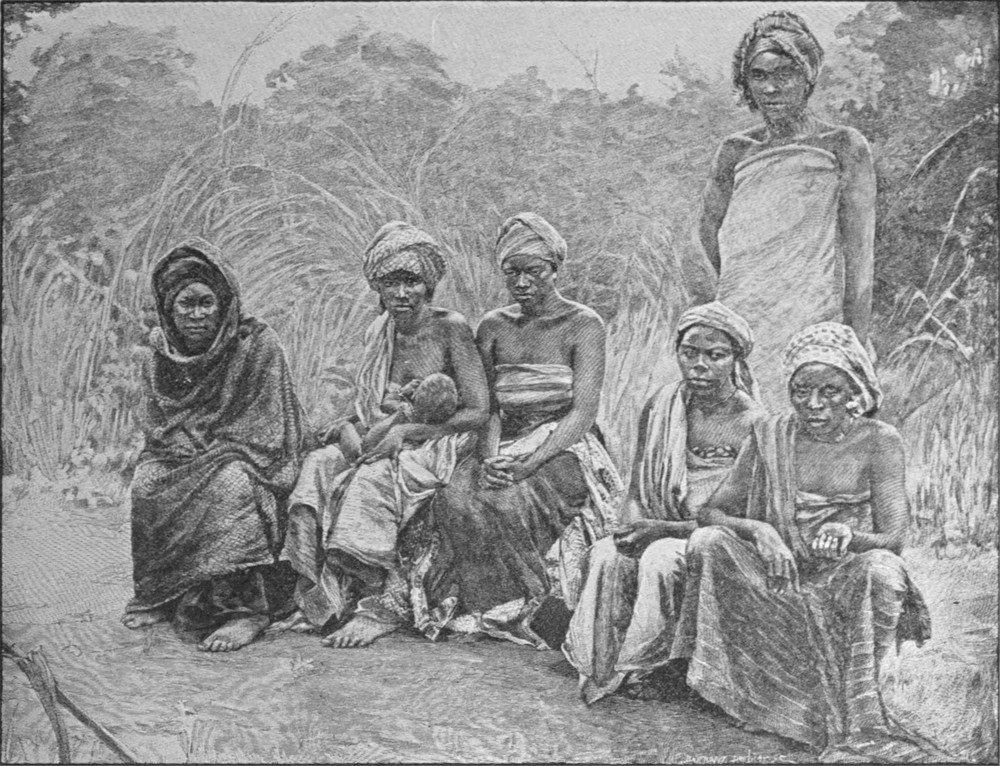
WOMEN OF THE NUPÉ TRIBE IN NIGERIA
The Nupé tribe is a family belonging to the Nigerian group of Sudanese Negroes. They inhabit chiefly the town of Lokoja, in West Africa. [See under Nigerian group].
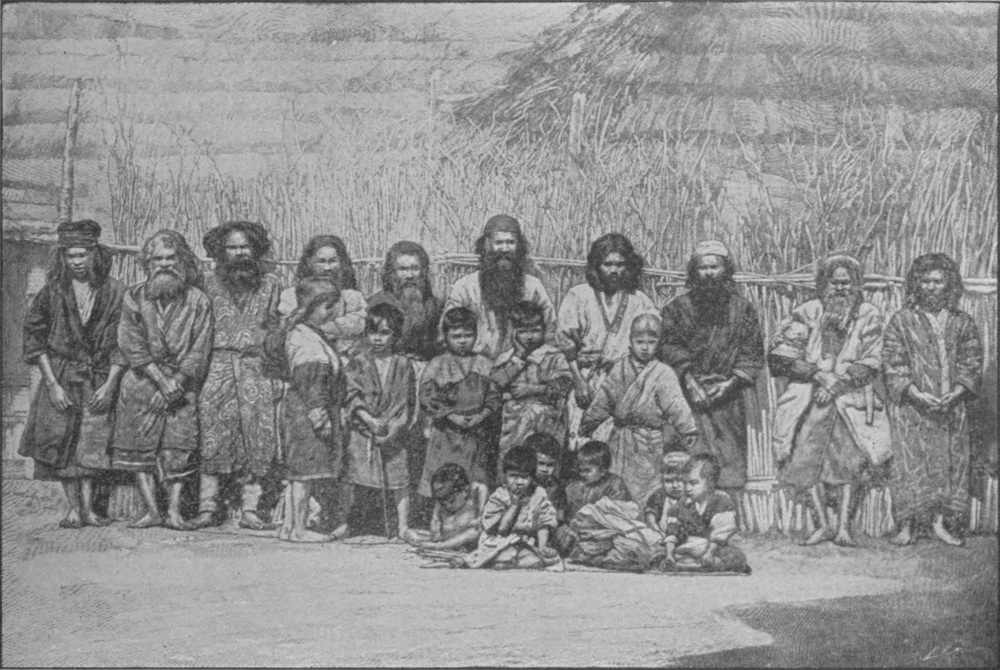
THE AINUS, PROBABLY THE ORIGINAL INHABITANTS OF JAPAN
The Ainus are a declining race, now confined to a small area in the Far East. They have, as is seen in this picture, handsome features and an abundance of hair. [See page 312].
Pueblo Indians. A semi-civilised race of North American Indians, dwelling in New Mexico and Arizona. They inhabit “pueblos,” or huge houses, often large enough to contain a whole tribe under one roof. They possess interesting religious and social customs, much studied by anthropologists. Their chief tribes are the Zunis, Teguas, Taos, Picuris, and Tusayas. The Moquis of Arizona are closely related to them.
Puelches, or Pampas Indians. A strongly-built, dark-skinned race of South American Indians, who inhabit the great plains or pampas from the Saladillo to the Rio Negro in Argentina. They are expert horsemen, from whom the Gauchos (q.v.) are derived.
Punjabis. Natives of the Punjab, in North-West India, mostly Jats and Sikhs (q.v.) belonging to the Hindu stock of the Aryan family. An agricultural and warlike people.
Puntis. See CHINESE.
Pygmies. Dwarfish Negrito races of Central Africa, long considered to be mythical, but now well known to ethnologists. They include the Akkas and Wochuas of the Welle Basin, the Obongos of the Gaboon, the Batwas of South Congo, etc. In very early times they were known by repute to the Egyptians—on whose monuments they appear in the thirty-fourth century B.C.—and the Greeks. They live by the chase in the Central African forests, and use poisoned arrows. Other small races, such as the Bushmen, Lapps, Kalangs, Samangs, etc., have contributed to the fame of the Pygmies.
Quas. A Sudanese Negro tribe on the Ivory Coast, belonging to the Nigerian group (q.v.).
Quapaws. See SIOUAN.
Queahs. See LIBERIAN GROUP.
Quichés. A race of Central American Indians in Guatemala, rivalling the Aztecs in the possession of an ancient civilisation and a curious mythology. See MAYA-QUICHÉ.
Quichuas. See INCAS.
Rajputs. The predominant race of Rajputana, in Central India, belonging to the Hindu stock of the Aryan family. They are a proud and warlike aristocracy of soldiers and landowners, who rule many native states, of which Jaipur, Jodhpur and Udaipur are the most important.
Ramas. See LENCAN.
Redskins. A term given in common parlance to North American Indians, from their colour.
Rejangs. A Malayan race of Sumatra, akin to the Achinese (q.v.).
Rols. See NILITIC GROUP.
Romans. The most powerful and warlike, and in every sense the greatest race of ancient Europe, who acquired the dominion of the Western world, and laid the foundations of modern civilisation. The city of Rome was founded by Alban shepherds, of Latin (q.v.) race, in the eighth century B.C. Oscan, Sabine, Samnite, and Umbrian (q.v.) elements were added to the original stock, and thus the great Roman character was moulded. Rome later extended her power over the whole of Italy, and then over the whole of the known world.
Romance Races. See LATIN RACES.
Romansch. Natives of the Grisons in Switzerland, speaking a Romance dialect, and probably of Italic race.
Roumanians, or Vlachs. Natives of the modern Roumanian kingdom, the leading Balkan State, composed of the older principalities of Wallachia and Moldavia, which were long subject to the Turks. The Vlachs (Wallachs, a name akin to our Welsh) are probably descended from the Latin-speaking inhabitants of the ancient Roman province of Dacia, a tribe of Thracian descent, which was subjugated by Trajan in the second century. They have preserved their language, but their blood has been mingled with that of numerous conquerors—Goths, Huns, Slovenians, Albanians, Turks, etc. The Roumanian peasantry are a hardy and thrifty race, retaining their old warlike traditions.
Rucuyennes. See CARIBS.
Russians. The chief of the Slavonic races inhabiting European Russia, and divided into Great, White, and Little Russians. The physical distinction between these races is attributed to the mixture of the primitive Russian stock respectively with Finnish, Lithuanian, and Turkish blood. The original Russians belonged to the Slavonic stock of the Aryan family, and seem to have been settled in prehistoric times between the Danube, the Elbe, and the south coast of the Baltic. Thus they must have entered Russia from the west in the early centuries of our era. There they conquered and drove out or assimilated the aborigines of Northern Mongolic (Finno-Turkish) stock, and established a number of small states, agricultural in character, which long suffered from Tartar invasion, notably that of the Golden Horde [see KIPCHAKS], and were gradually moulded into a single kingdom, with Moscow for its capital. Modern Russia, with its vast Asiatic dependencies, is one of the greatest Empires in the world, but it is in a state of transition, and its civilisation is consequently backward. The Russian peasants are very patient, industrious, and thrifty. When well led, they are admirable soldiers. Their chief occupation is agriculture.
Ruthenians. A branch of the Little Russian race, who inhabit the district of the Carpathians in Galicia and Hungary; poor, but hardy cultivators of the soil.
Sabæans. See HIMYARITES.
Sabines. An ancient Italic race, who inhabited the district between the Central Apennines—their ancestral home—and Rome. The Samnites were their descendants or near kinsmen, and the Umbrians were less closely related to them. When Rome was founded there was a strong Sabine element in its population, as indicated by the story of the Rape of the Sabine Women, and the statement that several of the early kings of Rome were of Sabine blood. The Sabines and Samnites warred against Rome for many years, but both were ultimately subdued and incorporated in the Roman State.
Sac Indians. See ALGONQUIAN.
Sakais, or Samangs. An aboriginal Negrito race of the Malay Peninsula; a wild and uncivilised people, with black skins and woolly hair, often approaching the ape-like in physical development and intelligence.
Sakalavas. One of the principal groups of the Malagasy tribes, inhabiting the west coast of Madagascar; of mixed Malay and negro blood, and akin to the Hovas (q.v.).
Salish. See FLATHEADS.
Samangs. See SAKAIS.
Sambos, or Zambos. Half-breeds sprung from Negro and Indian parents.
Samnites. See SABINES.
Samoans. A Polynesian (q.v.) race, of fine physical development, lazy and pleasure-loving, inhabiting the Samoan group of islands.
Samoyedes. A Finno-Ugrian race, inhabiting the Obi basin in Siberia, once widely spread over the extreme north of Europe and Asia. They are short and dark haired, with Mongolic features, brave and honest, live by hunting and fishing, and are still in the Stone Age.
Samsams. A mixed Malayo-Siamese race, forming a large part of the population of the Malayan States of Kedah and Ligor.
Santals. A negro-like aboriginal tribe of Orissa in India, agriculturists, of the Kolarian family (q.v.).
Saracens. A term applied in the Middle Ages to the Moslem enemies of Christendom, especially to the nomadic Arabs and Bedouins of the Syrian deserts.
Saras. See LAKE CHAD GROUP.
Sarakolés. See MANDINGAN.
Sards, or Sardinians. The aboriginal inhabitants of Sardinia, probably of the Western Hamitic family, akin to the Iberians or Ligurians (q.v.). The modern Sardinians are descended from this race, with considerable admixtures of alien blood from the Carthaginian, Roman, Saracen, Spanish and Italian owners of the island in successive periods.
Sarmatians. An ancient nomadic and warlike people, probably akin to the Scythians (q.v.), who roamed over the wide plains of Eastern Europe. Fine horsemen. They were destroyed by the Goths in the fourth century, and disappeared from history.
Sassaks. Natives of Lombok in the Sunda Islands, of Malayan race.
Savoyards. Natives of Savoy, originally a short, round-skulled, dark race, akin to the Auvergnats (q.v.), now largely mingled with Teutonic blood.
Saxons. (1) The Old Saxons originally inhabited the estuary of the Elbe and the neighbouring islands. They were a warlike race, of Low German stock, whose name is said to be derived from the “Saxes,” or heavy knives which they used in war. They were one of the most adventurous of Teutonic races, and made many piratical and colonising excursions, of which the most important was their settlement in Britain in the fifth century, where they united with the Angles (q.v.) to lay the foundation of the modern English people. (2) The Saxons who remained on the Continent gradually extended their dominion till it reached modern Saxony. Under Charlemagne the Saxon power was subordinated to that of the Franks. Saxony later became an independent duchy, which is still one of the chief States of the German Empire. The modern Saxons are less adventurous than their ancestors, very industrious, and successful in agriculture and industry, and make excellent soldiers.
Scandinavians. A main stock of the Aryan family, sometimes classed as a branch of the Teutonic stock, including the Icelanders, Norwegians, Danes and Swedes, as well as the old Norsemen and Normans (q.v.). Some ethnologists regard them as the original stock of the Aryan family. They are tall, blue-eyed, fair-haired, warlike, and good sailors and colonists.
Scots or Scotch. (1) The ancient Scots were a Celtic race, belonging to the Goidelic or Q Celts (q.v.), originally settled in Ireland—the ancient Scotia—whence they made settlements in the fifth century in modern Scotland, to which they gave their name. They were gradually driven back into the Highlands by Anglo-Saxon, Norman and Danish invaders, and are now represented by the Highlanders (q.v.) or Gaels. (2) The modern Scots, or Lowland Scots, are mainly of Anglo-Saxon race, modified by Norman, Danish, and Flemish elements. They are one of the finest and most hardy and industrious races in the world, equally successful in the arts of war and peace.
Scythians. An ancient nomadic and warlike race, found in the seventh century B.C. on the vast plains of South-eastern Europe, where they lived by cattle-breeding and raiding. They dwelt in tent-covered waggons, fought on horseback with bows and arrows, and made drinking-cups of their enemies’ skulls. Their origin is in dispute. Some regard them as a Mongolic race, which was modified by association with Aryan races, and others as an Aryan stock; their kinsmen, the Sarmatians (q.v.), were almost certainly Aryans. They made several incursions into Asia, where they conquered a large tract of Northern India and established a kingdom which lasted till about the fourth century A.D. The Rajputs and Jats (q.v.) are sometimes held to be their descendants.
Selengese. See BURIATS.
Seljuks. A warlike Turkish people who were settled on the Jaxartes in the eleventh century and afterwards founded a considerable empire in Western Asia. See TURKS.
Seminoles. See MUSKHOGEAN.
Semites. An important family of Caucasic Man, who probably originated in North Africa, from a similar stock to that of the Hamites. They are characterised by fine regular features, large aquiline noses, black eyes and hair, white skins, long skulls and square jaws. They are very intellectual, though less practical than the Aryan type; poets, prophets, and dreamers, rather than men of action. They have given the world its two greatest religions—Christianity and Islam. Their chief divisions are Assyrians, Aramæans, Canaanites, Arabs and Himyarites (q.v.). In the modern world they are best known from the ubiquitous Jews (q.v.).
Seneca Indians. See IROQUOIAN.
Serbs. See SERVIANS.
Serers. Sudanese Negroes inhabiting Senegambia in the Cape Verde district. They are the tallest of Negro races, with herculean frames, and are akin to the Wolofs (q.v.)
Servians, or Serbs. A race of Southern Slavonic stock, now inhabiting Servia. They were at first identical with the Croats (q.v.), and seem to have originated in the Carpathian district, whence they migrated into the Balkan peninsula in the seventh century. The Serbs then separated from the Croats, and in the twelfth century founded a powerful Servian kingdom, which was conquered by the Turks in the fifteenth. The Servians recovered their independence in 1830, under Milosh Obrenovitch. The Servians are a well-built race, proud and martial in temperament, quick-tempered and prone to deeds of violence, as their recent revolution witnessed.
Shangallas. A mixed negroid race of the Abyssinian slopes. Sudanese Negroes with a Hamitic infusion.
Shans. Natives of the independent Shan States, lying to the north of Siam. They are identical with the Laos, and closely related to the Siamese (q.v.). They belong to the Indo-Chinese stock of the Southern Mongolic family, and are probably descended from an aboriginal race of China, which appeared on the Upper Irawadi about 2,000 years ago. They are a peaceful, pleasure-loving people, mainly agricultural, but not unwarlike. They have a sallow skin and Mongoloid features.
Sharras, or Eastern Mongols. A branch of the Mongol stock of the Northern Mongolic family. They are a nomad, tent-dwelling, pastoral race, who roam over the great steppes of Central Asia. They include the Khalkas, north of the Gobi Desert, the Tanguts of Northern Tibet, the Chakars, Barins, Durbans, Uruts, Naimans, and Ordos south of the Gobi. They are descended from the older Mongols (q.v.), whom they resemble in physical type.
Shawnees. See ALGONQUIAN.
Shilluks. See NILITIC GROUP.
Shoshonean. A group of North American Indian tribes, all belonging to the Shoshone or Snake family, formerly occupying Idaho, Utah, and Wyoming, with neighbouring districts. They include the Shoshones or Snakes, Bannocks, Comanches, Utahs, and Mokis. With the exception of the warlike Comanches, they are a peaceful race, who have received the white invaders with friendship.
Shulis. See NILITIC GROUP.
Siamese. Natives of Siam, belonging to the Indo-Chinese stock of the Southern Mongolic family. They are closely related to the Shans (q.v.). They are of medium height, olive complexion, with slightly flattened noses, prominent lips, and black hair. They are a peaceful and indolent race, who have recently shown promise of assimilating Western civilisation. Their blood is largely mixed with Chinese and Malay. Siam is still independent, forming a buffer state between British and French possessions.
Siberian. A stock of the Northern Mongolic family, including the Chukchi, Koryak, Kamchadale, Gilyak, and Yukaghir tribes (q.v.).
Sicani, Siculi. See SICILIANS.
Sicilians. The primitive inhabitants of Sicily were the Sicani, probably a Hamitic race allied to the Ligurians (q.v.). They were followed by the Siculi, an Aryan race of Italic stock, who crossed from Italy about 1000 B.C. They were civilised and modified by Phœnician, and especially Greek settlers, with later Norman and Saracen influences. Of all these elements the modern Sicilians are compounded. They are a handsome, industrious, and amiable race, but turbulent, lawless, given to blood-feuds and brigandage.
Sienerehs. See NIGERIAN GROUP.
Sikhs. A powerful and warlike race of Northern India, united by a common religious faith, dating from the eighteenth century, and mainly of Jat (q.v.) descent. Under Ranjit Singh, at the beginning of the eighteenth century, they reared a formidable military power in the Punjab, which was conquered by the British in 1846–1849. The Sikhs contribute many of the best and most trustworthy troops to the Indian Army.
Silurians. A dark, round-skulled, short race who inhabited South Wales and the neighbouring districts of England in Roman times. They were probably of Iberian stock, related to the ancient Picts and modern Basques.
Sindis. Natives of Sind in North-West India, of Hindu descent.
Singphos. A wild, daring hill-tribe of Tibetan stock bordering on the Assam valley, formerly given to raiding, but now peaceful agriculturists. The Chins of the Arakan uplands are probably an identical race; they are still predatory.
Sinhalese. See DRAVIDIANS.
Siouan. A numerous and formerly powerful group of North American Indians, inhabiting the western prairies between the Mississippi and the Rocky Mountains. Their chief tribe was the Sioux or Dakotas, warriors of fine physique, courage, and military skill, who long maintained a successful resistance against the white settlers. Other allied tribes were the Assinaboins, Omahas, Poncas, Kaws, Osages, Quapaws, Iowas, Otoes, Missouris, Winnebagos, Mandans, Minnetarees, Absarakas or Crows, Tutelos, and Catawbas.
Sioux, or Dakotas. See SIOUAN.
Siryanians. A tribe of Ugrian Finns, dwelling on both sides of the Northern Urals, resembling the Samoyedes (q.v.), except in their white colour and fair hair, probably due to a mixture of Slavonic blood. See FINNO-UGRIAN.
Slavonic Races, Slavs or Slavonians. A main stock of the Aryan family, occupying the greater part of Eastern Europe, and formerly extending as far west as the Elbe. Many ethnologists consider them to be the primitive Aryan stock. They are a peaceful and industrious agricultural and pastoral race, broad-skulled, with fair hair and blue eyes; though the primitive type has been much modified by intermixture of blood, especially with Mongolic races, who have imprinted a Tartar character on many Slavonic physiognomies. The Slavs are divided into Eastern (Russians and Ruthenians), Western (Czechs and Slovaks, Poles and Wends or Sorbs), and Southern (Bulgarians, Servians, and Croats, Dalmatians, Slovenians, and Montenegrins). See under these heads.
Slovaks. See CZECHS.
Slovenians. A branch of Southern Slavonic stock, inhabiting Styria, Carinthia, and adjoining districts.
Solimas. See TEMNÉ GROUP.
Somalis. An Eastern Hamitic race of Somaliland in North-East Africa. They are a pastoral people, of good physique, handsome features, and light-brown colour, warlike and independent. The original Hamitic stock—closely akin to that of the Gallas (q.v.)—is modified by Semitic and Negro blood. They make excellent soldiers and servants.
Sonrhays. A Negro race of the Middle Niger, in whom the Sudanese stock is modified by Arab and Berber elements.
Sorbs. See WENDS.
Soyots. A tribe of Ugrian Finns, mixed with Tartar blood, in the Sayan Mountains of South Siberia. See FINNO-UGRIAN.
Spaniards, or Spanish. The earliest known race of Spain was the Hamitic Iberians (q.v.), now represented by the Basques. They were modified by Celtic invasions, which gave birth to the Celt-Iberian races of Central and Western Spain, who struggled so long against the Roman arms, by which they were finally subjugated and further modified. In the fifth century the Vandals and Visigoths (q.v.) invaded Spain, and founded a Gothic monarchy, which fell before the Saracens in 711. The Visigothic refugees in the northern mountains gradually recovered the country, and the kingdoms of Leon, Navarre, Castile, and Aragon were ultimately united into a single state. The modern Spaniards are thus of mixed race, in which the Iberian and Visigothic are the predominant elements. They are haughty, brave, and warlike, by which qualities they once owned the greatest power in Europe. But they are turbulent and lacking in political skill, so that Spain has decayed. There are now signs of a return to prosperity.
Spanish Americans. White natives of Central and South American States, except Brazil.
Spartans. Natives of Sparta, the greatest state of ancient Greece after Athens, of Dorian stock, eminently warlike and patriotic, but wanting in art or literature.
Sudanese. Full-blooded Negroes inhabiting the Western, Central, and Eastern or Egyptian Sudan—i.e. most of Africa north of the Victoria Nyanza. They are black in colour, with woolly hair, projecting jaws, long skulls, broad, flat feet and projecting heels, and form one of the main divisions of Ethiopic Man. They are less intelligent and susceptible of civilisation than the Bantus (q.v.), in whom the Negro blood is modified by Hamitic or Semitic admixtures. They are mostly of strong physique, warlike and predatory, fond of music and bright colours, with the most elementary notions of art and religion. They may be divided for convenience into several racial groups (q.v.), such as Wolof, Felup, Toucouleur, Mandingan, Temné, Nigerian, Nilotic, Liberian, Lake Chad, Wadai, Welle, Nuba, and Nilotic, besides the Tshi, Ga, Ewe, and Yoruba peoples of the Guinea district.
Suevi. See SWABIANS.
Sundanese. Natives of the Sunda Islands, of Malayan stock, closely allied to Javanese (q.v.).
Susus. See MANDINGAN.
Sutughils. See MAYA-QUICHÉ.
Swabians. Natives of Swabia, an ancient duchy occupying the south-western part of the modern German Empire; descended from the ancient Suevi, with whom the Alemanni (q.v.) were amalgamated. A strong, large-boned, and good-humoured race of High German stock. The Alsatians are closely allied to them.
Swahilis. Natives of Zanzibar and the adjoining mainland, Bantu Negroes, with a strong infusion of Arab blood, which has made them superior in intelligence and enterprise to the average negro. They play a large part in the commerce of East Africa, and their language—Ki-Swahili—is the principal medium of communication throughout the part of Africa between the Equator and the Zambesi.
Swazis. Natives of Swaziland, a native state on the south-east of the Transvaal. A cross between Zulus and other Kafirs, they are industrious and warlike.
Swedes. Natives of Sweden, a branch of the Scandinavian stock. They seem to have been originally a Teutonic race, who entered Northern Sweden about 3,000 years ago, and drove out the aboriginal Lapps and Finns. The inhabitants of Southern Sweden were called Goths, and may have been the ancestors of the Teutonic Goths. In time they amalgamated with the Swedes, and formed one nation, which has been an independent kingdom through most of the Christian era. The Swedes are warlike, and successful in commerce and industry; they make good sailors, and possess a considerable literature.
Swiss, or Switzers. The prehistoric inhabitants of Switzerland were the unknown builders of the lake dwellings. At the dawn of history, in Cæsar’s time, the country was largely occupied by a Celtic race, the Helvetii. Later, Switzerland was invaded by Teutonic races of High German stock, Alemanni, Burgundians, etc. The modern Swiss are mostly descended from these races; there is also a considerable mixture of French, Italic and Romansch elements. The Swiss have always been a warlike race, who preserved the independence of their mountainous country through all ages, and in earlier times furnished excellent mercenary soldiers to foreign armies. They are now very industrious and successful in many arts and crafts, such as watchmaking, wood-carving, hotel-keeping, etc. They are a simple and handsome race, possessing in full measures the virtues of the mountaineer.
Syrians. The ancient Syrians were a branch of the Aramæn stock of the Semitic family, and the modern Syrians are their descendants, with some Arab and Turkish elements added. They are tall, with white skins and dark complexions, black eyes and hair, often very handsome, and approaching the Jewish type. They are not warlike, but succeed in commerce.
Tacullis. See ATHABASCAN.
Tahitians. Natives of Tahiti, of Polynesian stock; pleasure-loving and polite, but immoral and untrustworthy; now civilised but formerly noted for their cruelty.
Taipings. The Chinese rebels who attacked the dynasty from 1850 to 1864.
Tajiks. See PERSIANS.
Talaings. An Indo-Chinese race who preceded the Burmese in the Irawadi Delta, and founded a state of which Pegu was the capital. They were subjugated by Burmese in the eighteenth century.
Talamancas. Wild hunting Indians, perfectly uncivilised, who occupy the forest-covered Atlantic slopes of Costa Rica.
Tamils. Natives of Northern Ceylon and the Indian Carnatic. See DRAVIDAS.
Taos. See PUEBLO INDIANS.
Tanguts. Nomadic Mongols of Northern Tibet. See SHARRAS.