Volume 1 — LIST OF MAPS APPEARING IN THE BOOK OF HISTORY (continued 8)
Reading edition
Justice varies according to the development of civilisation, and according to the function that it must perform in this development; in like manner every age creates its own material and spiritual culture. Every poet is a poet of his own time.
Right Way to View History
The notion of natural right, however unhistorical it was in itself, characterised a period of transition in so far as it enabled men to form a historical conception—a conception of what might be: for, by contrasting actual with ideal justice, we are enabled to escape the bonds of the opinions of a particular time, and to look upon such opinions and views objectively and independently. Yet it is certainly a foolish proceeding to consider an ideal, deduced principally from conceptions and opinions of the present, to be a standard by which to measure the value of historical events of all times, sitting in judgment over the great names of the past with the air of an inspector of morals. The office of the historian as judge of the dead is quite differently constituted. Every age must be judged in accordance with the relation which it bears to the totality of development; and every historical personage is to be looked upon as a bearer of the spirit of his day, as a servant of the ideas of his time. Thus it is quite as wrong to pronounce moral censure on the men of history, as it is wrong to judge an era merely according to its good or evil characteristics. A period must be estimated according to what it has either directly or indirectly accomplished for mankind.
Conception of a United World
There are common factors of civilisation shared by nations themselves, through which many contradictions disappear. The religious civilisations of Christianity, Mohammedanism, Judaism, Buddhism and Confucianism have been the determining factors of the intellectual and emotional life, even influencing the course of events, in vast regions. And thus it is also comprehensible that in the judicial life of nations there is an endeavour for a closer approach, and also the existence of equalising tendencies. In spite of countless variations in detail, there is a certain unity of law in the entire Mohammedan world; and although the hope of establishing the unity of Roman canonistic law over the whole of Christendom has not been realised none the less it was a tremendous idea: that of a universal empire founded on the Roman law of the imperators, and placed under the rule of the German emperor, thus ensuring the continuance of the law of the Roman people—an idea that swayed the intellects of the Middle Ages up to the fourteenth, even to the fifteenth century, and according to which the emperor would have been the head of all Europe, the other sovereigns merely his vassals or fief-holders. This idea, once advocated by such a great spirit as that of Dante, has, like many others, passed into oblivion; and in its place has arisen the conception of independent laws of nations. Yet the original idea has had great influence: it has led to a close union of Christian peoples; it opened a way for Roman law to become universal law, although, to be sure, English law, completely independent of that of Rome, has grown to unparalleled proportions as a universal system, entirely by reason of the marvellous success of the English people as colonists. Likewise international commerce will of itself lead to a unification of mercantile, admiralty, copyright, and patent law.
Then the idea of an international league must develop, arising from the idea of the unity of Christian nations. We have advanced a great distance beyond the time when every foreigner was considered an enemy, and when all foreign phenomena were looked upon as strange or with antipathy. Rules for international commerce are developed; state alliances are entered into for the furtherance of common interests and for the preservation of peace. Many tasks which in former times would have been executed by the empire are now undertaken by international associations; and the time for the establishment of international courts of arbitration for the adjustment of differences between states is already approaching.
Common Interests of Mankind
It also seems probable that states will unite to form political organisations, wholly or partially renouncing their separate positions. Thus nations will be replaced by a federal state, and a multitude of unifying ideas which would otherwise be accomplished with difficulty will come to easy realisation. Federal states were already in existence during the times of patriarchal communities: an especially striking example is that of the admirably constituted federation of the Iroquois nations.
Universal Transmission of Culture
The vision of no man may pierce through to the ultimate end of the processes of history, and to advance hypotheses is a vain endeavour—quite as vain as it would be to expect Plato to have foretold the life of modern civilisation or the imperial idea of mediæval times, or Dante to have foreseen modern industrialism or the character of industrial peoples. To-day we are more certain than ever that no process of development, however simple it may have been, has ever taken place according to a fixed model; all developments have had their own individualities according to place and to time. Thus we must forego discussion of the future.
However, there is another point of view. Development of nations as well as of individuals leads either to progress or to decay. No people may hope to live eternally; and how many acquisitions already gained will be lost in the future it is impossible to say. If a nation declines, it either becomes extinct or is annihilated by another state; it becomes identified with the newer nation, and disappears with its own character; thus its civilisation may also disappear. This is a serious possibility. It is the Medusa head of the world’s history which we must face—and without stiffening to stone.
Influence of Peoples on One Another
There is one truth, however, the knowledge of which fills us with hope for the future: it is the fact that the results of development and civilisation are often transfused from one people to another, so that a given development need not start again from the very beginning. This is owing to the capacity which races have for absorbing or borrowing civilisations. Absorption of culture is by no means universal; it does not prevent the occasional disappearance of civilisation, for every civilisation has before it at least the possibility of death. Nevertheless the transmission and assimilation of culture is constantly taking place. There are various ways in which it may be brought about. A conquering nation may bring its own civilisation with it to the conquered; culture is often forced upon the latter by coercive measures. The conquerors may acquire culture from the vanquished; or assimilation of culture may come about without the subjection of a people, through the unconscious adoption of external customs and internal modes of thought. Finally, culture may be borrowed consciously from one nation by another, the one state becoming convinced of the outward advantages and inner significance of the foreign civilisation.
In this way the problem of development becomes very complicated; many institutions of vanished races thus continue to live on. Certainly the race that acquires a foreign civilisation must, among other things, be so constituted in its motives and aspirations as to lose the very nerves of its being, its very stability, in order that, intoxicated with the joy of a new life, all traces of its past existence may be allowed to break up and disappear. On the other hand, many a promising germ of culture possessed by a vigorous people may come to grief, owing to the influence of acquisitions from without. But, in return, a race that knows how to assimilate foreign culture may obtain a civilisation of such efficiency as it would never before have been capable of attaining, by reason of the fact that its power is established on a recently acquired basis, and because it has been spared a multitude of faltering experiments.
Progress Goes on For Ever
Civilisation may be mutually obtained from reciprocal action, nations both giving and taking. Such a relation naturally arises when states enter into intercourse with one another, when they have become acquainted with one another’s various institutions and are able to recognise the great merits of foreign organisations and the defects of their own. Especially the world’s commerce, in which every nation wishes to remain a competitor, compels towards mutual acceptance of custom and law; no nation desires to be left behind; and each discovers that it will fall to the rear unless it borrow certain things from the others. Such reciprocal action will be the more effective the more like nations are to one another, the better they understand each other, and the more often they succeed not only in adopting the outward forms, but in absorbing the principles of foreign institutions into their own beings.
Thus we may hope that even if the nations of to-day decay and disappear, the labour of the world’s progress will not be lost; it will constantly reappear in new communities which may rejoice in that for which we have striven, and which we have acquired by the exertion of our own powers.
JOSEPH KOHLER

THE SEVEN WONDERS OF ANCIENT CIVILISATION
From the French of Victor Hugo
By HAROLD BEGBIE
The Temple of Diana at Ephesus speaks: The sun standeth in the high places of the mountains, Full of brightness and mirth is the dawn. But my loveliness is not shamed by him, Neither is it dimmed; For, behold and consider well, the sun is not more than thought. That which yesterday I was, to-morrow I shall be: I live: I wear upon my brow the moving ages and the spirit of man, And genius, and art: These things are more wonderful than the sun. Senseless is the stone in the earth, And the granite is not more than the formless night; The alabaster knoweth not the dayspring, Porphyry is blind, And marble is without understanding; But let Ctesiphon pass, Or Dædalus, or Chresiphon, And fix his eyes, full of the divine flash, Upon the ground where the rocks slumber, And lo, they awake, they tremble, they are stricken with understanding; The granite, lifting some vague and troubled eyelid, Struggleth to behold his master: The rock feeleth within himself the breathing of the unhewn statue, The marble stirs in the midnight of his darkness, Because that he is aware of the soul of a man. The buried alabaster desireth to rise up from the grave, Earth shudders, it trembleth violently, It feels upon it the will of a man; And behold, beneath the gaze of him who passeth with creation in his eyes, From the deeps of the sacred earth The sublime palace comes forth and mounts upward. When she has made an end, the Gardens of Babylon sing their laud of Semiramis: Glory to Semiramis, Who reared us up on the arches of the great bridges Whose span outraceth time. This great queen was wont to delight herself beneath our floating branches; In the midst of the ruin of two empires She laughed in our groves, She was happy in our green places; She conquered the kings of far countries, And when the man had humbled himself before her, Lo, she would go upon her way, She would come hither, She would sigh gleefully under our branches, Very pleasantly would she lie down on the skins of panthers. And after the Gardens have sung, there is heard the voice of the Mausoleum of Halicarnassus: I am the monument of a heart that knew itself infinite; Death is not death beneath my dome of blue, Beneath my dome, death is victory, Death is life. Here hath death so much of gold and of precious stone That he boasteth himself thereof; Behold, I am the burial which is a pageant, And the sepulchre which is a palace. Then, like a great thunder, the voice of Jupiter: I am the Olympian, The lord of the muses; All that which hath life, or breath, or love, or thought, or growth. Groweth, thinketh, liveth, loveth, and breatheth in me. The incense of supplication which rises to my feet Trembles with terror and affright; The slope of my brow doth touch the axis of the world; The tempest speaketh with me before he troubles the waters; I endure without age; I exist without pang; Unto me one thing only is impossible— To die. After Jupiter, from the island of Pharos sounds the voice of the great Lighthouse: In the midst of the mighty waters I tarry for the ceasing of the centuries. Sostratus the Cnidian built me, He built me that there might be thrown Across the rolling waters, And through the darkness where lurketh destruction, A rebuke to the lovely vanity of the stars. After the Lighthouse, the Colossus at Rhodes: I am the true Lighthouse. Rhodes lies at my threshold. Before the steadfast gaze of my unsleeping eyes Winter maketh white the mountains. I behold the deep waters in their cavernous mists; I am the sentinel whom none cometh to relieve; I look forth upon the coming of the night, And upon the coming of the dawn I behold the lifting of the mists, I behold the terror of the sea, With the immense dreaming of Colossus. And last speaks the Pyramid of Cheops: The desert, spread like a table, lieth beneath my foundations. Lo, from some mysterious gateway of the night I lift unto heaven my stair of terror, And out of the darkness itself seemeth it that I am builded. The sphinxes dropped their broods in the caverns; The centuries went by; the winds passed sighing; And Cheops said again: I am eternal! Then, after a profound silence, the creeping worm of the sepulchre lifteth up his voice: I say unto you Buildings that ye rise, and arise still more! Set ye up a stone above a stone, Above cities lift yourselves up, O temples! Lift up yourselves, like Babel! Column above column; Higher and yet higher; Let palaces arise upon the hollow places And let nothingness be fastened upon the foundations of night! Ye are like smoke, Therefore exalt yourselves with the clouds! Set not an end to your boasting! Mount up, mount up, for ever! Lo, in the dust beneath your feet I crawl and wait. Small am I, O mighty ones, And yet I say unto you, From the going down of the sun to his rising up, From all the corners of the earth, Everything which hath substance and which hath being, The thing which is sorrowful, And the thing which is glad, Descend unto me. And I only have strength, and I only endure for ever, For behold, I am death.

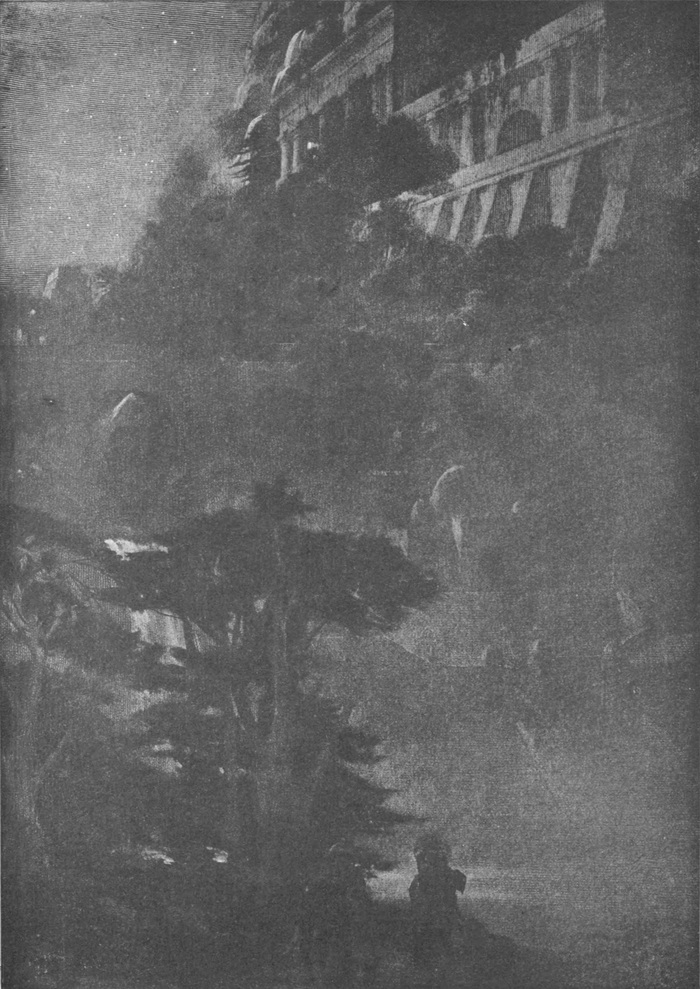
THE HANGING GARDENS OF BABYLON
The Hanging Gardens have been attributed to Semiramis, although Nebuchadnezzar is also said to have built them to please one of his wives, who, coming from a hilly country to Babylon, in the midst of a vast and barren plain, sighed for some reminder of the leafy beauty of her old home. The gardens, built in the form of a square extending some 700 feet on each side, rose to a great height in terrace upon terrace supported by massive pillars. A remarkable hydraulic system kept their multitudinous plants and trees in almost perpetual verdure.
LARGER IMAGE
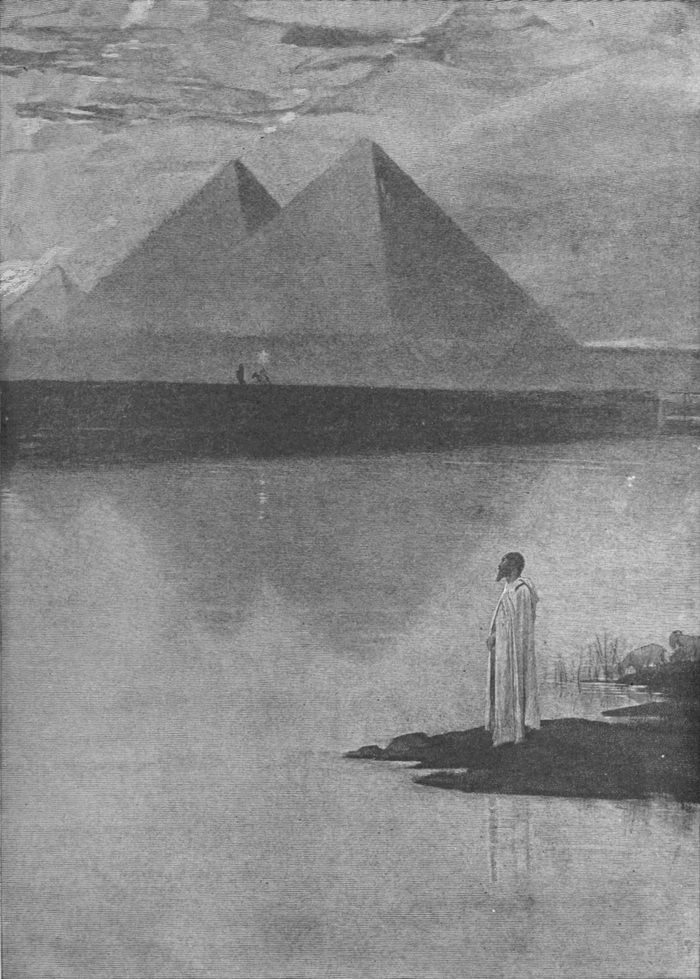
THE PYRAMIDS OF EGYPT
For six thousand years the Pyramids have thrown their shadow across the sands of Egypt. The stone of which they are built would make a great wall from Cairo to New York; the white marble which covered them would have built more king’s palaces than Egypt has had need of. The building of the Great Pyramid employed 100,000 slaves for 30 years, and the geometrical perfection of it is a marvel to this day. Khufu, or Cheops, who built the Great Pyramid—probably as his tomb—reigned about 4700 B.C., so that the pyramid is more than three times as old as the Roman Empire.
LARGER IMAGE
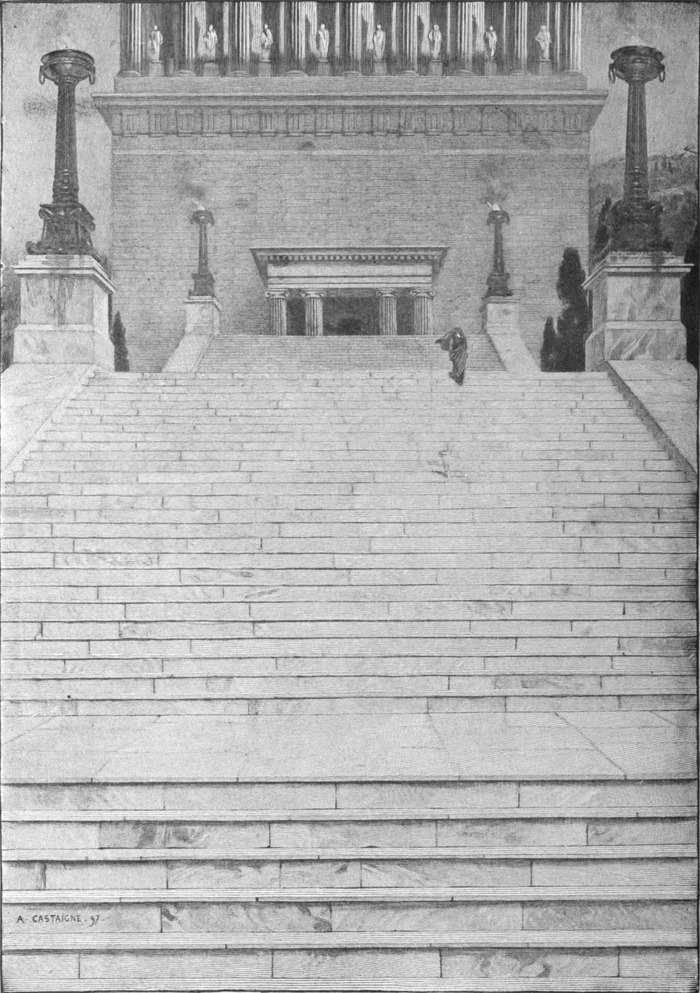
THE MAUSOLEUM AT HALICARNASSUS
This famous monument of antiquity was erected in the year 354 B.C. to the memory of King Mausolus of Caria by his widow Artemisia, at Halicarnassus, the beautiful Greek city-colony on the shores of the Ægean Sea. Some idea of its size will be gathered from the fact that it was surrounded by an esplanade which measured over three hundred feet on each side, while its total height was nearly a hundred and fifty feet. The statue existed almost intact until the fourth century of our own era, and was finally destroyed in the Middle Ages by the Turks.
LARGER IMAGE
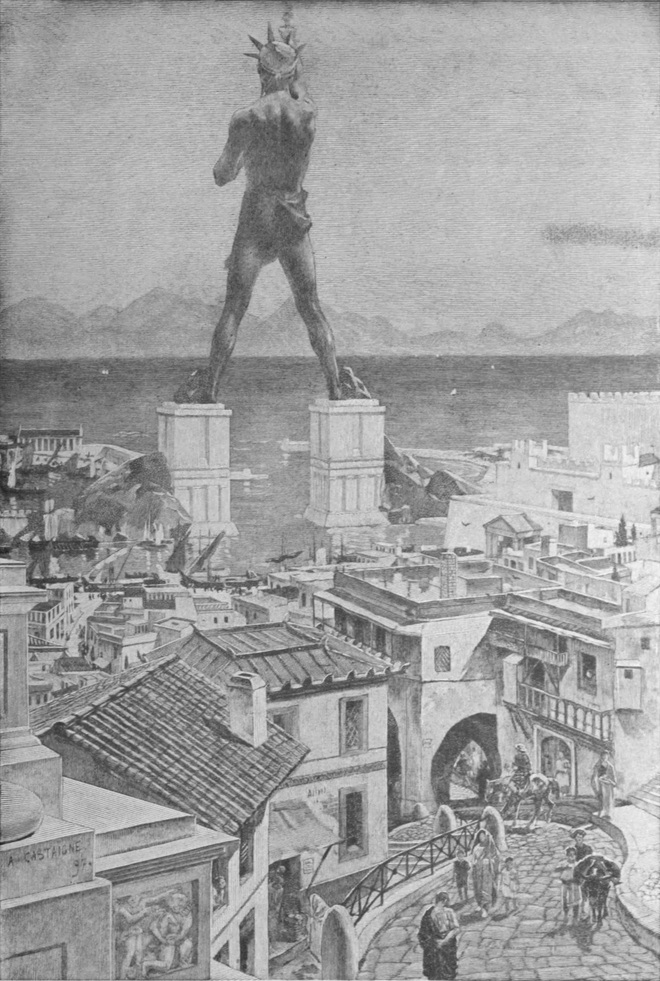
THE COLOSSUS OF RHODES
This short-lived achievement of ancient art dated from about 300 B.C. It was the largest of a hundred statues to the sun-god raised in the island of Rhodes, any one of which, said Pliny, would have made famous the place where it stood. Dedicated to Apollo, who was thought to have delivered Rhodes from Demetrius Poliorcetes, it was made from the engines of war which that besieger left behind. One finger of it was larger than an ordinary statue. An earthquake in 224 B.C. destroyed it, but even in its broken and fallen state it was long the wonder of Rhodes.
LARGER IMAGE
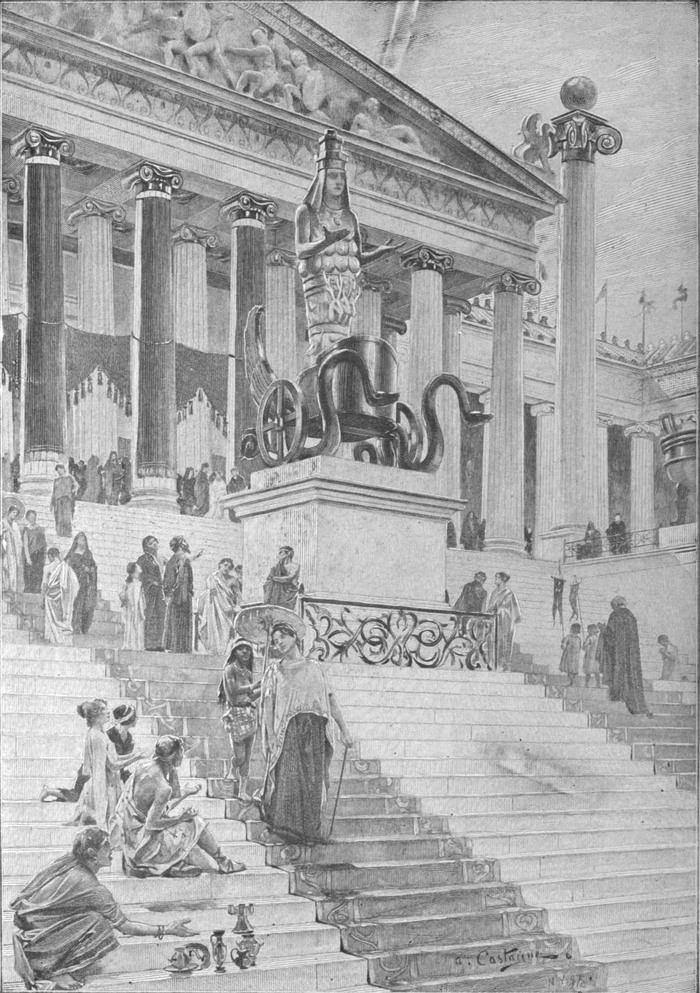
THE TEMPLE OF DIANA AT EPHESUS
“Great is Diana of the Ephesians.” Her temple was burned down in 356 B.C., and subsequent to that year the great temple famed in history was erected by the Ionians. It is said to have taken 220 years to construct, and measured about 400 feet in length and 200 feet in width, while it contained no fewer than 127 Ionic columns nearly 65 feet high. The temple was despoiled by Nero and destroyed by the Goths in 262 A.D., but some of its ruins still remain.
LARGER IMAGE
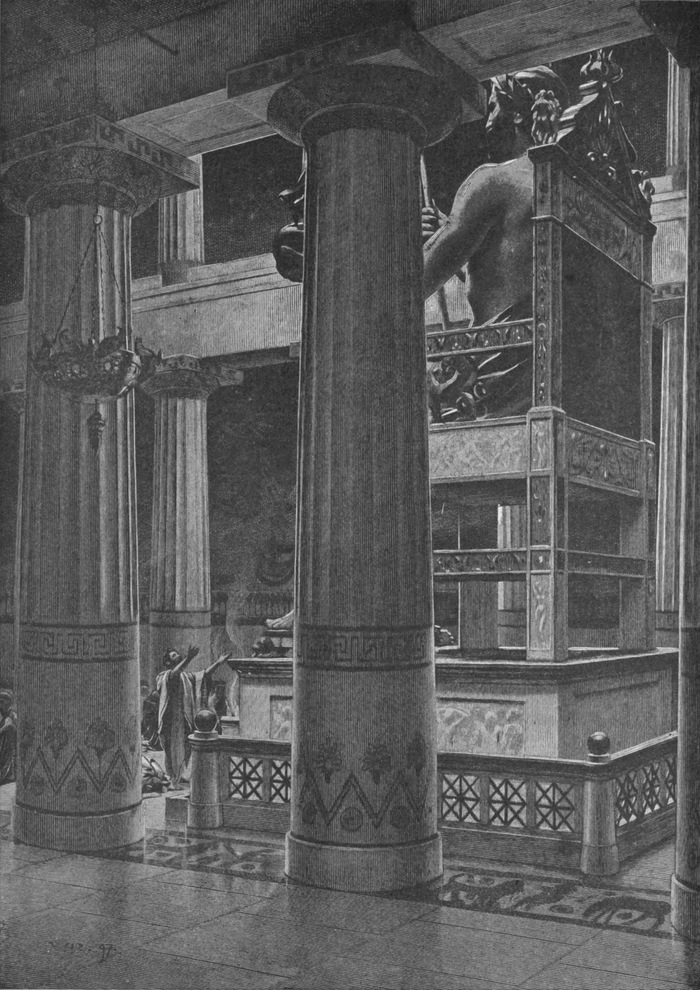
THE STATUE OF JUPITER ON OLYMPUS
The world-famous statue of Jupiter was the work of the great sculptor Phidias. It measured 43 feet in height above the base. The body of the god was carved from ivory, and the drapery was of solid gold. No other statue of such magnitude, of such artistic perfection, or of such precious material, has been known to history. Among the ruins of the temple are still to be seen the remains of the black marble mosaic on which the statue stood.
LARGER IMAGE
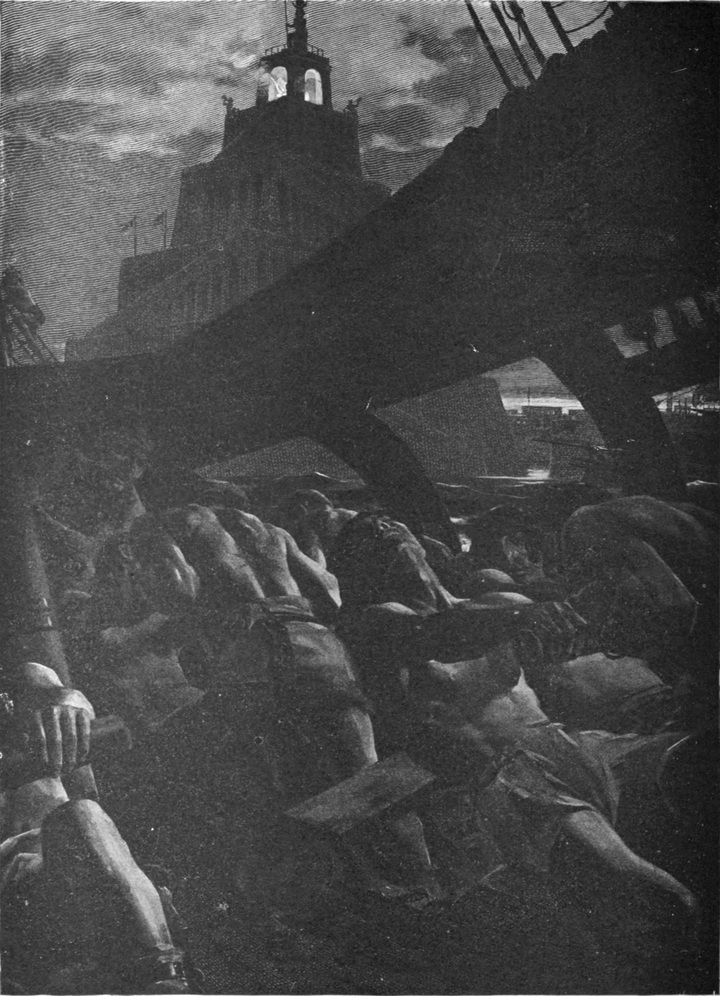
THE LIGHTHOUSE OF ALEXANDRIA
On the island of Pharos, close to Alexandria, stood the famous lighthouse erected by Ptolemy Philadelphus about 280 B.C. Constructed of white marble, in a series of vast stages of vaulted masonry, it reached the height of 520 feet, and in its summit burned night and day, an immense beacon fire of wood, which could be seen 30 miles at sea. The lighthouse was gradually destroyed by earthquakes and the action of the sea, but existed in some condition to the end of the 13th century.
LARGER IMAGE
BIRTH OF CIVILISATION
AND THE GROWTH OF RACES
THE RISE OF CIVILISATION IN EGYPT
BY PROFESSOR FLINDERS PETRIE
I
IN looking back to the beginning of civilisation in any country, we have to deal with the physical changes which the land has undergone, and to consider the conditions which promoted or hindered the advance of its inhabitants. The nature of a country largely rules the nature of its people, both bodily and mentally; and it may even be true that, if sufficient time be given, the same character and structure will always be produced by equal conditions.
Civilisation 10,000 Years ago How we can Fix the Date
From historical records, and the cemeteries that have been examined, it appears that the beginning of a continuous civilisation in Egypt must be set as far back as about 10,000 years ago, or 8000 B.C. The question then is how far the condition of the country at that age was similar to that now seen? The present state is quite new, geographically speaking, as the deposit of mud by the Nile, providing a suitable soil, is only a matter of a few thousand years. The accumulation of deposit is about 5 in. in a century (4·7 at Naukratis, 5·1 at Abusir, 5·5 at Cairo); and the depth of it is not less than 26 ft., and varies in different places down to 62 ft. The lower depths are, however, often mixed with sand beds, and do not show the continuous mud deposit; hence the average depth of 39 ft. is too large, and if we accept 35 ft., it will certainly be a full estimate. At the average rate of deposit, this would be formed in 6,000 years. But, on the other hand, the deposit may have been slower at the beginning, and hence the age would be earlier. Also, the full depth may be greater, owing to some borings hitting on ground which was originally above the river. Hence the extreme limits of age of Nile deposit in different positions are perhaps 7,000 to 15,000 years, and probably about 10,000 years may be a likely age for the beginning of continuous Nile mud stratification. Hence it is clear that the start of the civilisation was about contemporary with the first cultivable ground.
Stone Age in Egypt The First Dwellers in the Land
Earlier than the Nile deposits there must have been some rainfall, enough to keep up the volume of the river, and to prevent its slackening, so as to deposit its burden. We must picture, then, the country as having enough rainfall for a scanty vegetation in the valleys, while the Nile flowed down a mighty stream, filling the whole bed as it now does in flood, and bearing its mud out to the sea, except in some backwaters which were shoaling up. Such a land would support a small population of hunters, who followed the desert game and snared hippopotami in the marshes. The Nile had been in course of recession for a long period before it began to rise again by filling its bed. The gravels high above the present Nile contain flints flaked by human work; much as in Sinai such flakes are found, deep in the filling of the valleys which belong to a pluvial period. Yet after the Nile had retreated down to the present level, man appears to have been still in the Palæolithic stage, as freshly flaked, unrolled flints have been found at the lowest surface level of the desert. As the country, while drying up, and before mud deposits were laid down, would have only been suited for occupation by hunters, it seems probable that Palæolithic Man had continued in Egypt until the beginning of the Nile deposits—that is to say, till the beginning of the continuous civilisation as discovered in the cemeteries.
BUSHMAN TYPE. On turning to the remains of the earliest burials, we find that in many cases female figures of the Bushman—or more precisely Koranna—type, were placed in the graves; while at the same time long, slender figures of the European type are also found. The inference is that the Palæolithic race of the Koranna type was known to the earliest civilised race in Egypt, and that they were being expelled and exterminated, as only female figures are found—representing captive slave women—and even these soon disappear. Thus it would seem that Egypt, as an almost desert region, before the formation of the cultivable mud flats, was the last home on the Mediterranean of the hunters who continued in the Palæolithic stage. The physical type of the figures which we can attribute to this earliest population has the Bushman characteristics of fatness of the thighs and hips, with a deep lumbar curve; and a line of whisker covers the jaws of the female figures, akin to the fur on the bodies of women on the Brassempouy and Laugerie-Basse ivory carvings. This indicates that they belonged to a cold climate, and had not been developed in Egypt. As, however, man had certainly dwelt in the Nile valley for long ages, this northern indication points to a comparatively recent invasion from a colder to a warmer climate, such as has been the rule throughout historical times.
Time Without Dates
PREHISTORIC PERIOD. The beginning of the continuous civilisation of the country must be placed at about 8000 B.C. The written history extends back to the first dynasty, and places that at 5500 B.C., and this is checked at the sixth, twelfth, and eighteenth dynasties by records of the rising of Sirius, and of the seasons in the shifting year, which agree to this dating in general. For the length of the prehistoric age before these written records there is no exact dating. But, as in a given district of Egypt, where all the desert has been searched, the prehistoric graves are about as numerous as those made during the six thousand years of the historic time, at least 2,000 or 3,000 years must be allowed. The amount of change in every kind of production during this age is considerable; and as we can trace two cycles of civilisation, which usually occupy about 1,500 years each in the later times, it is likely that 2,500 years is too little rather than too long a period. As no definite scale of years can be used, the dating of the graves of this age is treated as a matter of sequence. From a careful statistical classing of the pottery, it is practicable to put about a thousand of the fullest graves into their original order; this series is then divided into 50 equal parts, and these are numbered from 30 to 80. Thus, sequence date 30 is the earliest type of graves yet found, and S.D. 80 is of the age of Mena, the founder of the first dynasty. The sequence dates are given below for each stage of the prehistoric times.
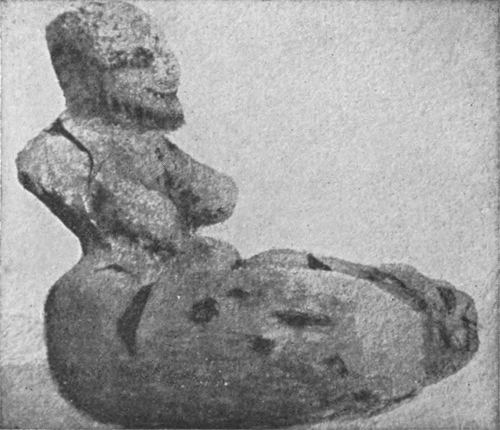
THE FIRST INHABITANTS OF EGYPT
As female figures of the Bushman type are found in the very earliest Egyptian graves, it is thought that this race was native to the country and was gradually expelled by the first civilised people. The photograph illustrates one of the figures taken from a grave.
EARLIEST BURIALS. The earliest graves found are shallow circular hollows on the desert, about 30 in. across, and a foot deep. The body lies closely doubled up, wrapped in goat-skins. There are very few objects placed with these burials; a single cup of pottery, red, with black top; rarely, a slate palette for grinding face-paint; and, in one grave, a copper pin to fasten the goat-skin. Pottery was in a simple stage, and weaving was quite unknown. These graves are classed as sequence date 30.
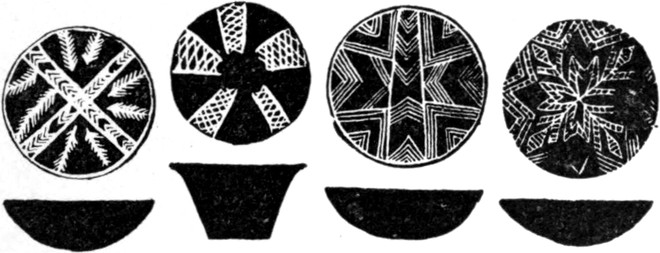
POTTERY OF FIRST EGYPTIAN CIVILISATION
The pottery of the first period of Egyptian civilisation is characterised by raised white lines on a red body, and from the fact that it closely resembles the pottery of the Kabyle people, who live in North Africa to-day, it is thought the first Egyptian civilisation may have come from the west. These examples are before 7000 B.C.
Civilisation Emerging from the Mists
FIRST CIVILISATION. The next period is that of the white patterns on red (S.D. 31 to 34). This use of lines of raised white slip is the same as on the present Kabyle pottery, and the patterns are so closely alike on the ancient and modern that this forms a strong evidence for a Western connection of the people. In this period the main lines of the civilisation become clearly marked. The fine flint chipping with delicate serrated edges; the polished red pottery, of circular and of fancy forms; the tall round-bottomed stone vases; the slate palettes for face-paint, of animal forms and of rhombic shape; the use of sandals; the ivory combs with animal figures; the disc-shaped mace-head—all of these were in use with the white cross-lined pottery, and stamp the general type of the beginning of the civilisation. We have before us a settled population, with strong artistic taste in handicraft, but not in copying Nature; with patience for very long and skilful work, and probably organised, therefore, under chiefs who commissioned such labour; yet with sufficient general demand for fine things to have raised hand pottery to its highest level; with strong beliefs about a future life, as shown by the uniform detail of the position of the body and the nature of the offerings in the grave; with the arts of spinning and weaving; fairly clothed, as shown by the use of sandals; fighters, with finely-made and treasured weapons; with the use of personal marks for property—altogether much in the stage which we now see in the highest races of the Pacific or Central Africa.
EASTERN INVASION. This civilisation had lasted for a few centuries when we see a change come over it. On searching the types of pottery we see many new forms arising from S.D. 38 to 43, while many older types disappear between S.D. 40 and 44. These changes serve to stamp the point of the change, but it is in other respects that the differences are most visible. The black-topped pottery, red polished, and fancy forms of pottery cease to develop after 43, whereas the decorated pottery, with brown line patterns on buff ware, is scarcely known till 40, and the late class of pottery begins at 43. In the stone vases the forms of tall tubular shape, with handles, cease at 40, and the barrel forms begin at 39, and are dominant by 42. In flint work the various new types begin from 39 to 45; the disc mace dies out about 40, and the pear-shaped mace begins at 42. In the slate palettes old types vanish and new ones arise from 37 to 42. The same is seen in ivories. Foreign intercourse was increased, as silver (from Asia Minor?), lazuli (from Persia?), serpentine and hæmatite (from Sinai?) all come into use from 38 to 40. In copying Nature, the steatopygous figures of the Bushman type are only found before 38, and human figure amulets are known from down to 44. Animal figure amulets begin in 45. Multiple burials in graves are common down to 40, and continue till 43; only single burials are known later.
Invasion from the East What Mythology Says
The racial changes that are thus indicated by these widespread differences can only be traced by the different products. The white line pottery characteristic of the earliest people is closely like that of the Kabyles, and the similarity of the skull measurements show that there is no bar to accepting the connection with the North African race. But the details of the new people, using animal amulets, a face veil, wavy-handled pottery like that of early Palestine, and the Asiatic silver and lazuli, all point to their coming in from the East. This change may be further linked with the religious traditions. This later mythology taught that Osiris had found the Egyptians in a brutal existence, and he had taught them agriculture, laws, and worship; this appears to be the tradition of the bringing in of cultivation by the earliest civilisation at S.D. 30. His worshippers were allied with those of Isis, who were a kindred tribe. Hence Osiris is said to have married his sister Isis. The myth further shows that this civilisation was attacked treacherously by the tribe who worshipped Set, in confederacy with an Ethiopian queen, and they succeeded in suppressing the worship of Osiris and removing his remains to Byblos in Syria. This seems to agree to the influx of Asiatic influence, about S.D. 40, which we have noticed above. The correction of the calendar from 360 to 365 days, is attributed to the beginning of the civilisation (at S.D. 30) by the myth that Osiris and his cycle of gods were born on the extra five days.
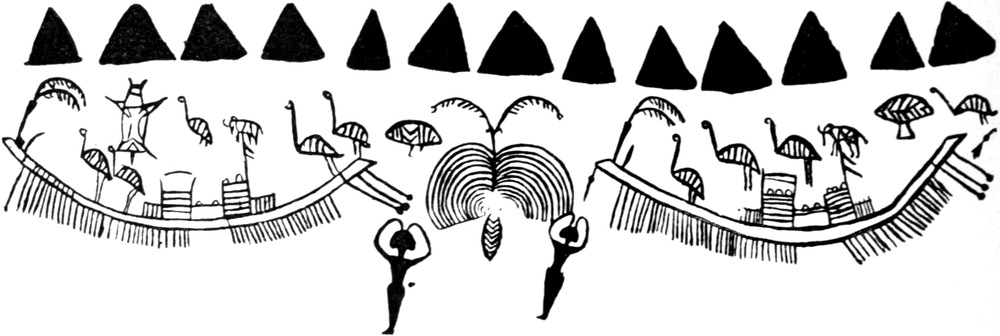
PREHISTORIC SHIPS: THE EARLIEST PICTURES OF EGYPTIAN VESSELS
The pottery of the second period of Egyptian civilisation is rich in representations of prehistoric ships. The vessels are shown with many oars, and the cabins are placed amidship with a gangway between. It is gathered from these crude drawings that in prehistoric times there was a considerable shipping trade along the coast of Egypt.
SECOND CIVILISATION. The second prehistoric civilisation, of which we have traced the Asiatic source, is specially marked by the use of a hard buff pottery, on which designs are often painted in brown outline. The art of these has no connection with that of the early white line designs; the habit of covering figures with cross lines, and the imitation of basket-work, have entirely disappeared; and, on the contrary, the plant, ostrich, and ship designs are quite new.
What, then, were the connections of these people? One indication is gleaned from carvings at the close of the prehistoric age. Two tributaries of the new king of Egypt are shown bearing stone vases of the style of those of the second prehistoric civilisation, S.D. 45–75. They have large pointed noses, and wear pigtails, and another tributary of the same type wears a long robe. Hence we may see that they came from a cold region where stone vases were wrought; and that by the form of the vase they were probably the same people as the later prehistoric stock. Yet, on the other hand, we occasionally find pottery vases of that people in the earlier prehistoric age, so that they must have been in touch with Egypt throughout. The more likely source for them was the mountainous region, where snow sometimes lies, between Egypt and the Red Sea; and certainly this was the source of the rare igneous rocks used for the prehistoric vases.
The general conclusion would be, then, that a people occupying the mountainous region east of Egypt had an independent civilisation, and were in touch with the early prehistoric people of the Nile valley. Then about S.D. 38 they began to push down into Egypt, and fully entered it by S.D. 44, bringing with them various different points of their own civilisation, and expelling the Osiris worship in favour of Set, who was their god. They probably brought in the Semitic elements to the Egyptian language, along with the other Asiatic connections.
Fleet of Prehistoric Ships
SHIPPING. Under this new order of things we see much more foreign and maritime connection. The introduction of silver from Asia, of lazuli from Persia, of hæmatite from Sinai, of serpentine from the Arabian desert—all show this. On the vases we see the starfish painted, and one of the most usual decorations was the figure of a great galley or ship. These ships are shown with oars on the pottery vases, and without oars or sails on the tomb paintings. From the proportion of the figures they appear to have been as much as 50 ft, long, and this is confirmed by the oars, which number up to sixty. Neither indication is exact; but the tendency would be to exaggerate the size of the figures, and certainly not to diminish them, and so aggrandise the ship. The shipbuilding in the early history may prepare us for the earlier rise of such work, when we read of Senefru building sixty ships of a hundred feet long in one year.
What the Ships Were Like
These prehistoric ships were all of one pattern. Amidships were the large cabins, and there was no poop or forecastle structure, probably because of the want of support fore and aft, the flotation being mainly in the middle. The two cabins were separated by a broad gangway across the boat, and joined above the gangway by a bridge from roof to roof. Lesser cabins projected fore and aft from the main cabins. On the roofs were rails at the corners, so as to secure top cargo without getting in the way of loading it up. In a large ship there was an upper cabin on the hinder main one, a light shelter shaded with branches. From the back of the hinder cabin stood up a tall pole bearing a solid object as a standard, which we shall notice below. At the stern was the steersman seated by an upright post, to which was probably lashed the steering oar, as in the historical boats. In the bows was a low platform, with a rail round it, for the look-out, shaded with branches. The cabins were narrower than the beam, and left free space for rowers on each side.
Trade in Those Days
FOREIGN IMPORTS. Vessels of this large size certainly imply a corresponding importance of commerce. We have noted already the foreign imports into Egypt; and others imply more distinctly a sea intercourse. From S.D. 33 down to S.D. 68 there is found black pottery with incised basket-work patterns [page 238] filled in with white. It is always rare, only occurring in less than 1 per cent. of the graves, and in only one case was there more than a solitary example. It is entirely disconnected from the Egyptian types, but it is closely akin to pottery found on the north of the Mediterranean, in Spain (Ciempozuelos), in Bosnia, and in the earliest town of Troy. At the close of the prehistoric age the black pottery of the late Neolithic city of Knossos is found in the lowest levels of the temple at Abydos. And in the royal tombs of the first dynasty there many vases and pieces have been found which are clearly of the earliest age of painted Ægean pottery. Considering that the bulk of the trade must have been for perishable goods—oil and skins from Crete and Greece, corn and beans from Egypt—it is not to be expected that a great amount of breakable pottery would pass and be preserved in burials. There are, moreover, some tallies left to us besides the northern pottery. Throughout the later prehistoric age emery was regularly in use for all the grinding and polishing of stone vases and of carnelian beads; and so common that one excelsior spirit in search of a tour de force had even cut a vase out of block emery, as being the hardest known material. This emery, so far as we know, must have come from Smyrna. Again, the gold of the first dynasty contains a large amount of silver. This points to its source from the Pactolus region, where electrum was found, rather than from Nubia, where the gold is free from silver.
CONNECTION OF THE SHIPPING. When we look at the evidence of the ships themselves we see that it points to their having been used at sea rather than on the Nile. It is impossible to row a ship up against the Nile stream, which runs at three miles an hour, and sailing or towing is the only way to go southward in Egypt. But in only one instance is a ship with a sail represented, while there are many dozens of figures of rowing vessels. The galley has always been the type of business ship on the Mediterranean. All through the classical wars the rowing galley was the mainstay of power. The Homeric catalogue of ships, the Phœnician coinage, the Assyrian sculptures, the Greek fleets, the Carthaginian navy and its destroyers of Rome, the pirates of Liburnia and Lycia, down to the Venetian fleet and the French galleys of a couple of centuries ago, all show the dominance of the oar.
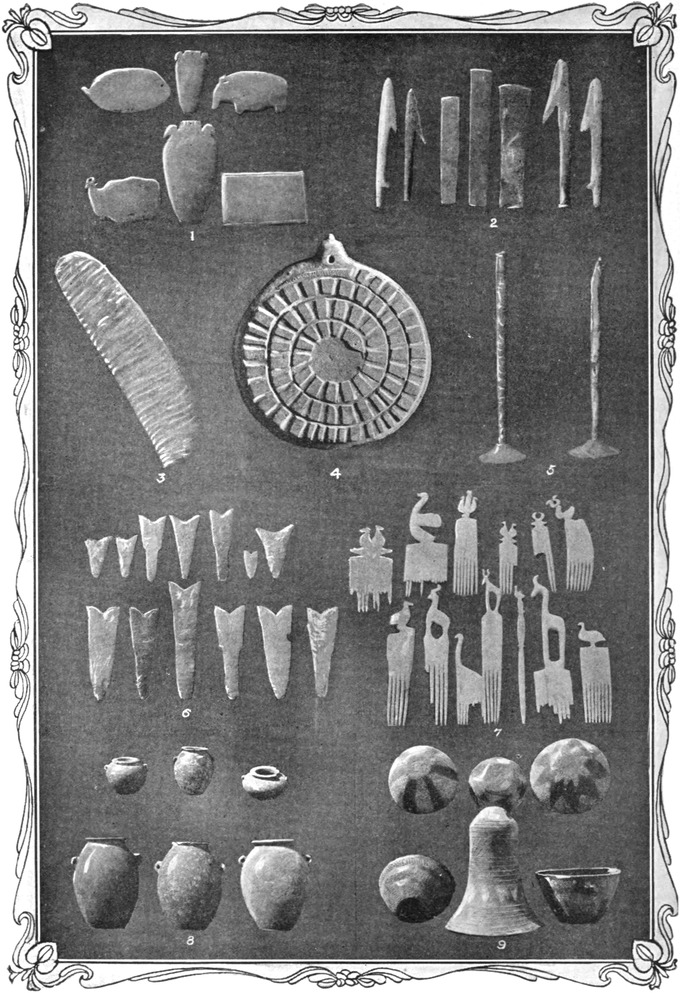
ARTICLES ILLUSTRATIVE OF THE EARLY CIVILISATION OF EGYPT
(1) Slate palettes on which paint for rubbing round the eyes was ground; (2) adze heads and harpoons, the harpoons at the sides being of bone, the others of copper; (3) beautifully flaked flint knife; (4) serpent amulet of stone; (5) maces of quartzose rock, very effective weapons; (6) forked lances of flint; (7) combs of ivory; (8) vases carved from hard stone; (9) black incised pottery, a foreign import into early Egypt.
LARGER IMAGE
Port Ensigns Carried
The nature of the standards upon poles carried by the ships has been variously interpreted. We can distinguish the elephant, bird on a crescent, and fish; the two or four pair of horns, the bush, and the branch; the rows of two, three, four, or five hills; the crossed arrows, and the harpoon, besides other forms which we cannot identify. The question is, what view will account for these most completely? Some have thought they were emblems of gods, and that the boats were sacred to divinities; but there are many which cannot be thus explained. Others have thought that they indicated tribes; but the rarity of repetitions, and the absence of any duplicates together, are against this. Marks of personal ownership have been suggested; and this is not impossible, as they might be well dedicated to special gods. But the prominence of the groups of hills as signs agrees best with their being marks of the ports from which they hailed; the divine emblems would naturally be those of the god of the port, the number of hills would be very likely to distinguish different ports, the elephant, the bush, or the fish might well be the mark of a port. And the parallel in later times of such being distinctive ensigns for ports—as in the ensign of Gades found in the Red Sea—agrees to this usage. The carrying of a port ensign in an age of independent city-states was equivalent to a national flag in later times; and it was essential for showing friends or foes.
We have dwelt at length on the detail of this shipping, as it is the most important subject for showing the extent and character of the early civilisation. It takes two to trade as well as to quarrel; and these large ships were not rowed about the Mediterranean unless there was a paying trade to be done on those coasts, a people civilised enough to produce goods that were wanted and to require foreign stuff in exchange, and a society stable enough to enable goods to be stocked in bulk and traded without any serious risk of fraud or force.
Ingenuity of the Hunters Mode of Ostrich Hunting
HUNTING. The main occupation represented in the prehistoric paintings is hunting. The bow and arrow was used. The bow was a single piece of wood, painted red and covered with zigzag white lines; the arrow was of reed, with a point several inches long of hard wood. The forked lance of flint was also a favourite weapon [p. 238]; it was inserted at the end of a wooden shaft, which was controlled by a long thong of leather ending in alabaster knobs which kept it from entirely flying from the fingers. Thus the lance could be thrown by a man in ambush to cut the legs of a gazelle, while, if it missed, it was jerked back by the elastic thong, and so saved from breaking the delicate edge of flint. These forked lances are found throughout nearly all the prehistoric time; and they continued in use in North Africa till the Roman Age, when Commodus borrowed thence their use for hunting the ostrich. This lance retained by a thong was the parallel to the favourite harpoon used in fishing. Another mode of hunting was the trap. This is represented as being formed of pointed splints or stakes, lashed together like spokes of a wheel, with the points around a central hollow. Such traps to catch the legs of animals are used now in Africa, and an example was found at the Ramesseum, dating perhaps from the twentieth dynasty. Sticks or clubs were used in hunting and in fighting.
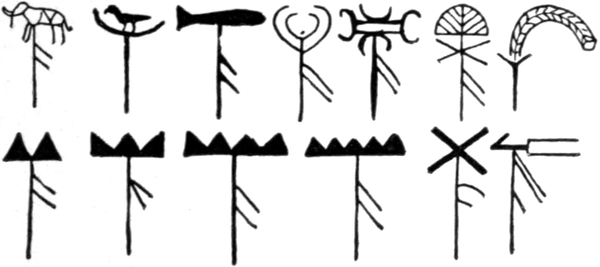
STANDARDS OF EGYPTIAN SHIPS
There has been much speculation as to the significance of the standards carried by the most ancient of the Egyptian vessels, as recorded on pottery and elsewhere. Some examples of these standards are here given. The most reasonable supposition is that these devices indicated the port from which the vessel sailed.
FIGHTING. The earliest representation of fighting is on a vase of the white slip on red, at the beginning of the prehistoric age. On that a man with long, wavy hair appears to be spearing another man in the side. Later, there are the fighters on the Hierakonpolis tomb, at about S.D. 63. On this hooked sticks are used, and the fighters are clad with a spotted animal’s hide on the back. One man has been killed, and another is hard pressed, fallen on one knee. To save himself from blows he has taken off the hide and is holding it up, thus anticipating the use of the shield. It seems likely that the Egyptian shields of hide stretched on a frame of sticks were directly copied from this use of the hide that was otherwise worn on the body. In another group a black man is holding three red captives bound with a black cord, while two red men approach him to deliver their kindred.
Fighting with Maces
The weapons mostly found are the stone maces [page 238]. These were sharp-edged discs in the earlier age, a form which is very effective in a mixed fight, as it cannot be turned aside like a battleaxe, but must cut in whatever direction it falls. These maces were usually made of porphyry and other quartzose rocks. The mace used in the later age was of a pear shape, and this form was continued into the historic times, and perpetuated in the conventional scene of the king striking an enemy, even in the latest times. The handle holes in these maces are very small, and this shows that probably the handles were dried thongs of hide. Nothing else would be sufficiently tough and elastic. The flint dagger was probably also used, and certainly the copper dagger. A very fine example of this, dated to S.D. 55 or 60, is wrought with a quadrangular blade, giving the utmost strength and lightness, a better design than that of any daggers of the historic times.
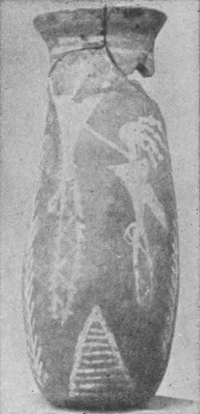
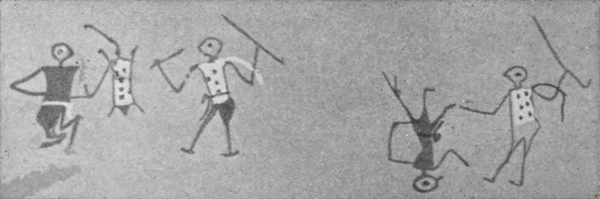
THE FIRST PICTURES OF FIGHTING
The earliest representation of fighting, at the beginning of the prehistoric age, shows a man with long, wavy hair, spearing another man in the side. Later, are fighters on the Hierakonpolis tomb, using hooked sticks and clad in piebald hides of animals.
TOOLS. Tools of metal begin with small, square chisels of copper at S.D. 38. The intermediate examples have not been found till we reach a fine large chisel of copper at the close of the prehistoric. Adzes of copper [p. 238] begin at S.D. 56, or earlier, and increase in size down to historic times; they continued to be the favourite tool of the Egyptians for both wood and stone working until Greek times. Borers are usually tapered, to work in soft material. Needles of copper appear as early as S.D. 48, and the fastening pins of copper begin with the very earliest graves of S.D. 30.
Flint working was the greatest artistic industry of the prehistoric age. The surfaces were not merely reduced by haphazard flaking, but the flints were ground into form, and then reflaked in a marvellously regular manner with uniform parallel grooves [page 238]. The finishing of the edges by deep serrations of the fineness of forty to the inch, and the chipping out of delicate armlets of flint, show also the same astonishing skill and perfection of hand work. The Scandinavian flint chipping used to be regarded as the most perfect, but the Egyptian work entirely surpasses it in regularity and boldness.
STONE VASES. Hard stones were largely employed for making vases [page 238]. In the earlier age tall, cylindrical forms were used, and in the later age barrel forms. The earlier material was usually basalt, but syenite, porphyry, alabaster and limestone were also used. The later materials included slate, grey limestone, breccia, serpentine, and diorite. The hollowing out of these vases was by grinding, but the outside was entirely formed by chipping and polishing without rotary motion. The perfect regularity of the forms, and the fine taste shown in the curves of the outlines, as well as the hardness of the material, place the vase working higher than any work of the historic times.
1,000 Forms of Pottery
POTTERY. Pottery was greatly developed, although the wheel was not used, and all the forms were entirely modelled by hand and eye without mechanical guidance. The outlines are true and fine, the circularity is astonishingly regular, although all the trimming and polish runs vertically; and it was as easy in such a mode of building to make oval, doubled, or square forms, all of which are found. The specially later pottery is the decorated, with brown-red lines on a hard buff body. The forms are clearly copied from those of the stone vases; and the patterns are derived from the fossils and veins in the stone, or from the cordage net in which the vases were slung for carrying. Next appear aloes and other bushes, and figures of ships, which we have already noticed. Rows of ostriches and of hills are also favourite designs.
Other pottery of this ware, but not decorated, has a curious type of projecting ledge, wavy up and down, for handles. Beginning at S.D. 40 as a globular vessel, the type narrows to an upright jar; by S.D. 60 the handles dwindle, becoming united around it as a wavy band of pattern; by S.D. 70 the jar at last becomes a cylinder; by S.D. 75 the band becomes a mere line; and then after S.D. 80—in the first dynasty—the jar dwindles to a rough tube like a thumbstall. The contents of such jars similarly deteriorate. At first, perfumed ointment was put in them, then it was covered with a layer of mud to retain the scent; the mud increased until it was merely scented mud, then only plain mud was used, and lastly they were left empty. Beside many other forms of this hard ware there was also a long series of types in a rough brown pottery, which passed on into the ordinary pottery of the first dynasty. As there are over a thousand different forms of this prehistoric pottery known, and their study has been the key to the whole arrangement of that age, this subject is a very wide one, which we have barely noticed here.
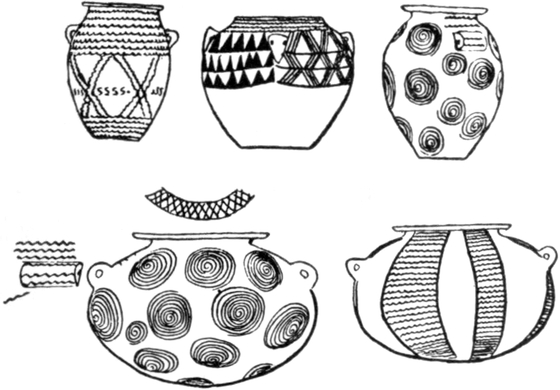
PREHISTORIC POTTERY OF EGYPT
The later pottery of the prehistoric period is characterised by brown-red lines on a hard buff body. The forms and decorations have been copied from earlier stone vases, and from the nets in which they were carried.
A Constant Personal Possession
SLATE PALETTES. A constant personal possession was the slab of slate upon which the green malachite or red ochre was ground for colouring around the eyes. Usually a brown pebble crusher accompanies it; and the dead often have a little leather bag of malachite in the hands. These slate palettes begin with a plain rhomb form, probably derived from the natural cleavages of the slate rock. Well-formed animal figures were also carved as slate silhouettes; the deer, hippopotamus, and turtle are the oldest, and the fish also comes into the earlier age. The double bird type begins with the second age, and all the types continuously degrade by repeated copying until their original form is quite indistinguishable at the close of the prehistoric age [page 238].
PERSONAL OBJECTS. Ivory carving is common, mainly for long combs to fasten up the hair. These usually have an animal on the top of them; but they only belong to the earlier age, suggesting that the hair was worn shorter in the second period. Decorated tusks of ivory are also early; they were fastened on to leather work, probably to close the openings of water skins. Ivory spoons belong only to the second period, as likewise do the forehead pendants of shell.
Amulets of animal forms were frequent in the second period. They are generally cut in stone, carnelian, serpentine, porphyry, and coloured limestones. The forms are the bull’s head (which continued in use into historic times), the hawk, serpent [p. 238], frog, fly, scorpion, claw, vase, and spear head. The meanings attached to them are quite unknown.
Games are found, as shown by the ivory draughtsmen, the small balls or marbles, the stone gateway and ninepins [page 242], the figures of lions and hares, and the throwing slips for obtaining a count as with dice.
What the People Wore
CLOTHING. The clothing of men was, at most, the kilt of linen, or an animal’s hide put over the body. Often only a belt was worn, with three narrow strips hanging down in front. A usual covering was a belt with a sheath attached to it to hold up the genitals. With the pleated kilt was also worn a belt having apparently a jackal tail hung behind. On some figures there is merely a double rope round the waist. These various forms may belong to different peoples and periods; but there are hardly enough examples to prove any distinctions, as the varying circumstance of the figures, captive and conquered, resting and working, rich and poor, in heat and in cold, may easily have led to the different dress that we see. Women are represented with a white linen petticoat from the waist to the feet. Leather was a favourite material for clothing, as well as for bags. It was painted with patterns, and decorated with beads, reminding us of the North American work.
The Oldest Capital of Egypt
DECAY OF CIVILISATION. All of this civilisation gradually decayed; the pottery is seen becoming coarser, good work dying out in rougher copying, new types seldom appearing, cheaper and poorer objects being more usual. There is ground, however, for supposing that at some time in this age there was a central rule at Heliopolis. There are many traditions of a principality there, which must certainly have been before the dynasties. The sacred emblem preserved in the temple was the shepherd’s crook, haq, which served for the title of “prince” in all later times; the other sacred emblem was the whip, and these two were the royal emblems of Osiris. The title of the nome was “the princes’ territory,” and this capital retained in later ages the reputation of being the centre of learning and theology. And on the fragment of the early annals known as the “Palermo Stone” there is shown a long row of kings of Lower Egypt before the dynasties; these cannot have ruled at Memphis, as that was a new foundation by Menes.
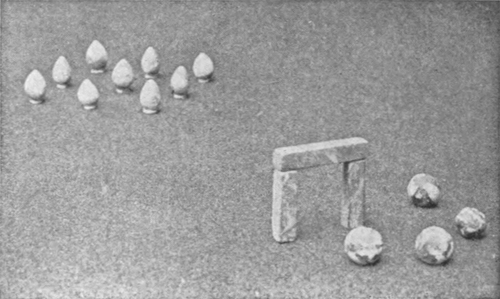
THE EARLIEST GAME OF NINEPINS
These ninepins, the gate to play through, and the porphyry balls were all found in a child’s grave.
History as Reflected in Mythology End of Prehistoric Times
HISTORY IN MYTHOLOGY. Of the breakup of this civilisation we may trace some relation in the mythology. After Isis had recovered the body of Osiris, and the worship of the Osiris and Isis tribes had revived again from the Semitic invasion of Set worshippers, Set again attacked the Osiris worship, and scattered the body of Osiris into fourteen parts in different places. This refers probably to the distribution of parts of the body to different districts, when it was cut up in the funeral ceremonies, according to prehistoric usage. These parts of Osiris were kept at sixteen nomes in Egypt in historic times, six in the Nile valley and ten in the Delta, probably the original nomes of the country. The civil discord implied in this persecution must have weakened the land; and then came the attack by the hawk worshippers from the south. In the legend of Horbehudti, or Horus of Edfu, we read that the crocodiles and hippopotami (animals of Set), attacked him, and his servants, armed with metal weapons, smote and conquered them, slaying 381 before the city of Edfu. Then the worshippers of Horus allied themselves with the sun worshippers, and “Horbehudti changed his form into that of a winged sun disc,” and “took with him Nekhebt the goddess of the South and Uazet, the goddess of the North, in the form of two serpents, that they might destroy their enemies in the bodily forms of crocodiles and hippopotami.” That is to say, the Horus, Ra, and serpent goddess tribes were all allied to attack the domination of the Set tribe. They gradually drove them back, and “Set went forth and cried out horribly”; he was finally struck down at Pa-rehehu. “Thus did Horbehudti, together with Horus, the son of Isis, who had made his form like unto that of Horbehudti.” That is to say, the rest of the Horus worshippers joined the Horus-Ra party.
The final battle and expulsion of Set was at Zaru on the eastern frontier of Egypt. This, in mythological form, seems to give the history of the driving out of the Semitic population of the later prehistoric age, by the dynastic race descending from Upper Egypt, at the close of the prehistoric period. An actual result of this war, all through later times, was the multitude of towns named Samhud, or “United to Behudti,” marking the allies of the Horus party.
HISTORICAL SLATE PALETTES. Of the period of the conquest by the dynastic races, which closed the prehistoric age, there is an invaluable series of monuments carved on slate. These carved slates are the elaborated outcome of the slate palettes used for grinding the face paints throughout the prehistoric age. A similar elaboration of a simple article is familiar in modern times in the snuff-box. A plain receptacle of bone or wood was decorated, plated, made of silver and of gold, inlaid with diamonds and painted with the costliest miniatures, and yet—it was but a snuff-box. So the plain slip of slate was carved into animal outlines, had animals scratched on it, then signs in relief upon it, and at last was covered with the most elaborate carvings, and yet—it was but a paint grinder, and had always the pan for colour carved on it, exactly of the shape of the pans on the painters’ palettes of that age. Every stage can be shown, from a formless slate to an artistic scene in relief. There are many stages to be seen in the artistic development.
A. In the prehistoric age are the scratched outlines.
B. The well-incised elephant is as early as S.D. 33–41; and with it are those signs in low relief.
C. The high relief sign is of S.D. 60–63.
D. On the boat slate, the drawing is much more detailed than on the boats of the Hierakonpolis tomb of S.D. 63. We can hardly separate this from the work of the artistic new-comers, and it may well be about S.D. 70–75.
E. The animal slate seems to be next, as the treatment of the lion’s hair is unlike the following.
F. The four-dog slate, being a coarser but more elaborated design of the same type, may well be next.
G. The hut slate shows for the first time the arrangement of lion’s mane as on the ivory lions of King Zer.
H. The gazelle slate shows the same treatment more advanced.
J. The towns slate shows the wiry detail of muscles, beginning to appear in archaic manner.
K. The bull slate has the same style carried out fully and finely.
L. The Narmer slate has a less forcible and smoother treatment of the bull, and brings us down to touch with the historic times.
The figures can be seen in Capart’s “Primitive Art in Egypt,” where they may be identified by these letters, corresponding to the paragraphs above: A, B, figures 61, 62; C, 63; D, 169; E, 171–2; F, 173–4; G, 170; H, 177–80; J, 175–6; K, 181–2; L, 183–4.
RACIAL TYPES. These slate carvings not only show the art of the time, but they present the different races and the details of their life, more fully than we find them for many centuries later. We see six different types of physiognomy in the early remains, and learn how complex the racial history must be at the most remote period accessible to us.
A. The aquiline type is that of the principal prehistoric race, closely like the Libyan on the west and the Amorite on the east. When mixed with negro it produced the exact type of a European-Negro mulatto. Probably equal to the Libyan. [See Heads 1 to 4 on next page.]
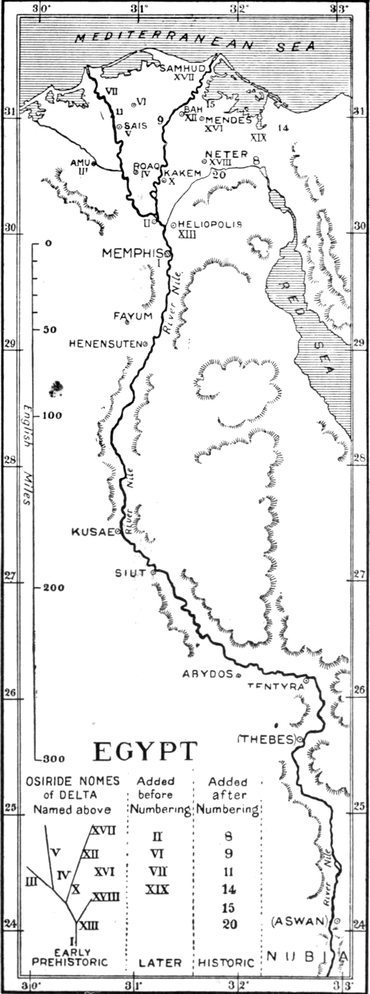
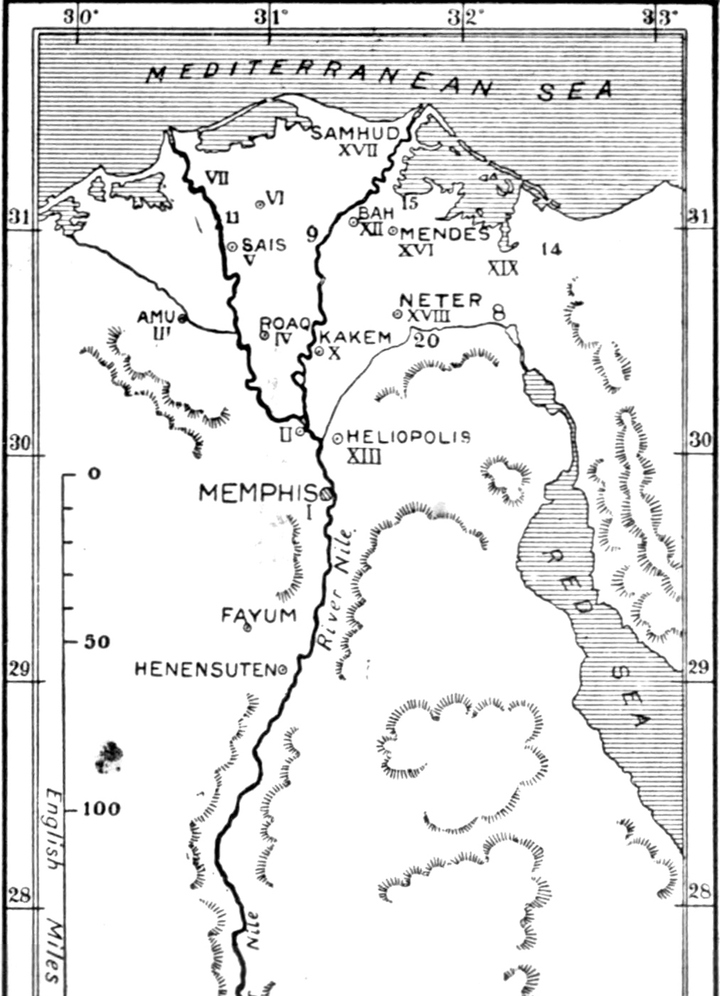
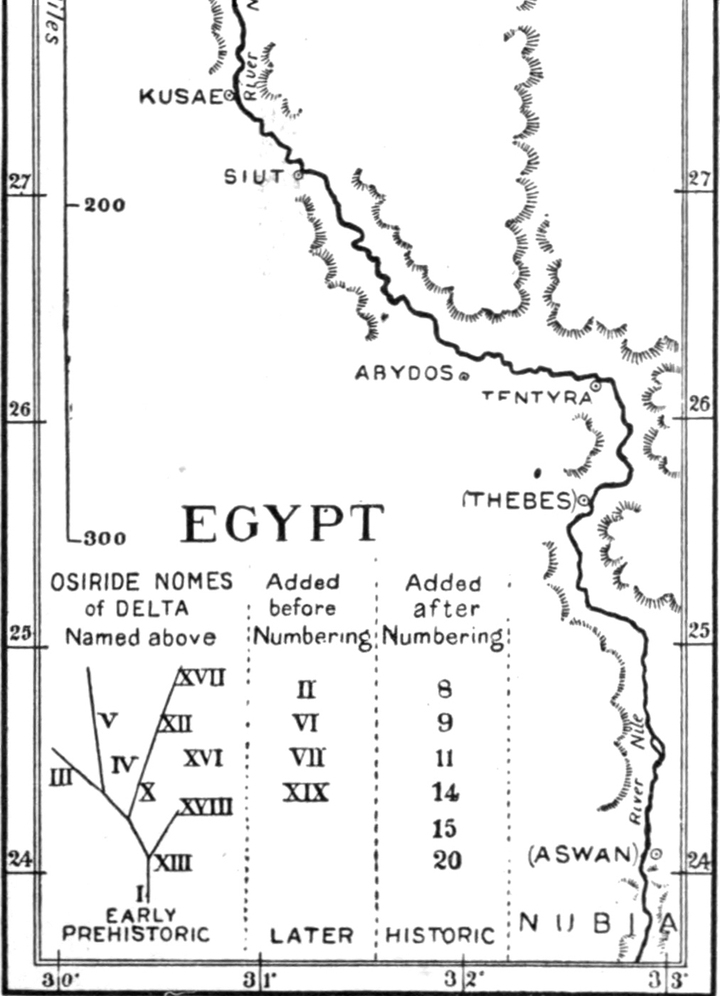
EGYPT IN THREE PERIODS OF ITS CIVILISATION
This map of Egypt shows Egypt in three of its early periods. (1) The earliest centres of culture were at the places where parts of Osiris were preserved in the prehistoric age, here named. (2) The second period is shown by other centres being placed in the right geographical order, all here numbered I to XIX, following down each branch of the Nile. (3) The third period is when other centres were inserted in the lists in the wrong order, here numbered 8 to 20. These three stages of Egypt’s history are all before the monarchy.
LARGER IMAGE
[Northern Part of Preceding Map]
[Southern Part and Legend of Preceding Map]
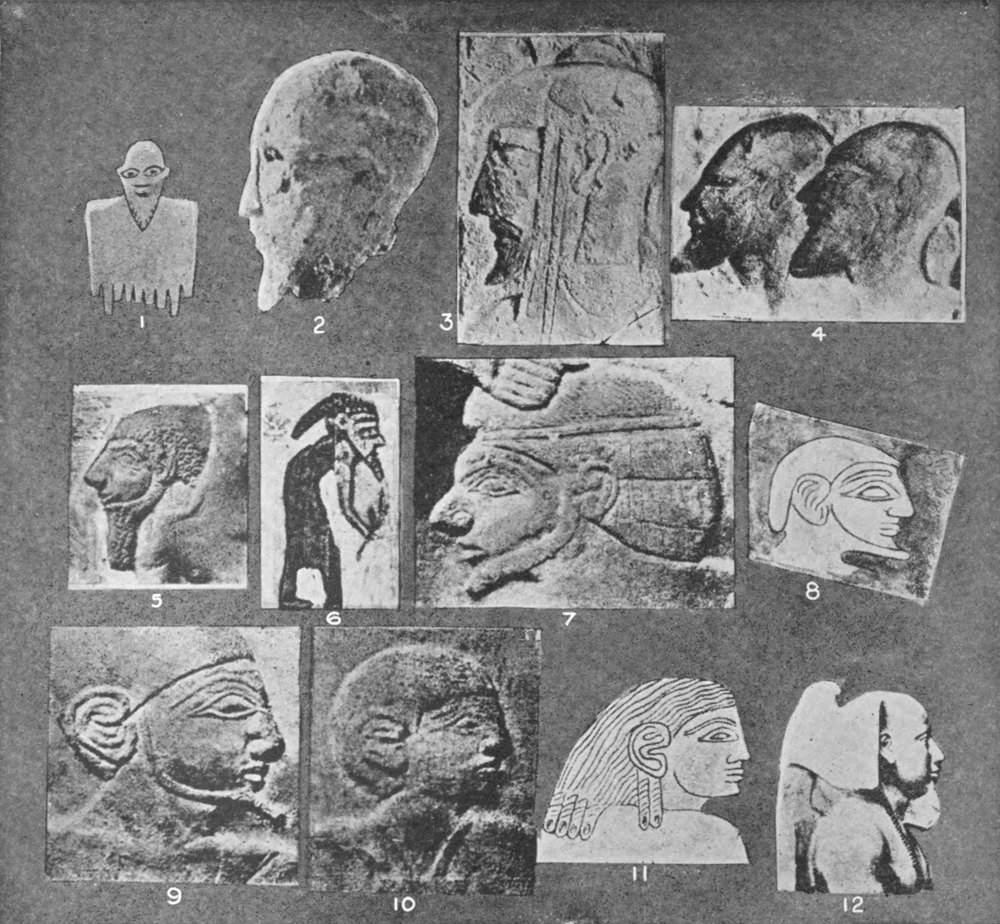
THE EARLIEST PORTRAITS OF VARIOUS RACES IN EGYPT
Numbers 1 and 2 are the aquiline type, similar to 3, the Libyan, and 4 the Amorite. 5 is the curly hair type, 6 the sharp-nosed type, 7 the short-nosed type, 8 the forward beard type, 9–11 the straight-faced type of dynastic conquerors. 12 is King Khafra of the Pyramid age, reverting to the original type of 1 and 2.
B. The sharp-nosed type, firstly, with the hair in a pigtail, bringing stone vases as tribute, and sometimes dressed in long robe; secondly, with bushy hair and armed with spear, throw-stick, mace, bow and arrows. Probably the Arabian mountain race mixed with Libyan. See figure 6 on this page.
C. The curly hair type, with plaited beard, conquered and destroyed by type B. Probably from North Syria, by sculptures there. See figure 5 on this page.
D. The forward beard type, with close-cut hair; much like the figures on early Naukratite vases. Probably a coast people of Libyan connection. See figure 8 on this page.
E. The short-nosed type, a variety of D, apparently belonging to the Fayum. Fig. 7.
F. The straight-faced type of the dynastic conquerors. See figures 9–11 on this page.
All of these different peoples were in continual mixture and struggle during the few centuries before the first dynasty. Looking to the tribal hints given by the mythology, it seems probable that:
A represents the early Osiris and Isis worshippers; B the first dominance of Set; C the second irruption of Set; D and E the allied Osiris and Isis worshippers of the Delta and coast who helped to expel Set; and F the hawk Horus worshippers, who took the lead in driving out B and C by alliance with A, D and E.
Earliest Promise of Greatness
DYNASTIC RACE. The most essential difference between the prehistoric and the dynastic people is in their artistic capacity. The earlier peoples, though highly skilled in mechanical detail and handling, were yet very crude in their copying of any natural forms. But as soon as we reach the dynastic race we find that there is an artistic sense and power in their work, which puts even the roughest of it far above all that had gone before. The earliest examples of their sculpture appear to be the colossal figures of the god Min, found at Koptos. These are of the most primitive style possible, the limbs scarcely marked off from the trunk, and no details of form attempted. But on the side of each there is a patch of hammer-work outlining some figures, perhaps a copy of embroideries on a skin pouch hung at the side. These are figures of a deer’s head and pteroceras shells on one, swordfish, shells, and standards of the god on another, and the same objects, together with an ostrich, elephant, hyena, and calf on the third. All are but roughly hammered round, yet the spirit and correct forms of the animals are of an entirely different order from anything that had yet appeared in Egypt. The promise of all the artistic triumphs of thousands of years to come is clearly seen in these decorations of the rudest statues known.
Mystery of Dynastic Race
The source of this dynastic race can only be inferred. Though marked off from the earlier inhabitants by their artistic taste, and by their use of hieroglyphic writing, we know so very little of the early history of any other lands near Egypt that we cannot yet trace any link to their original source. On looking in various directions, it seems at least clear that they do not belong to the southern tribes, to which they have no resemblance; nor can we suppose that the Libyans, who appear to be one with the prehistoric people, would also supply a race so different in face and in habits. The north and Syria seem barred by the earliest centres being at Abydos and Hierakonpolis in the south of Egypt, from which they conquered the north.
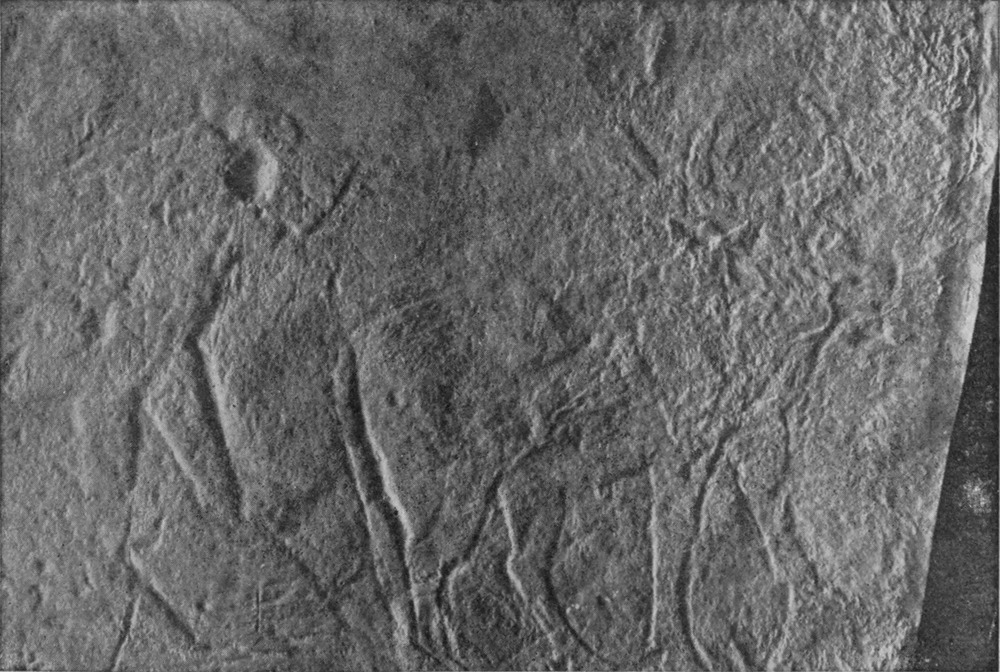
THE FIRST PROMISE OF THE ARTISTIC TRIUMPHS OF EGYPT
These animal figures were wrought by hammering around on the surface of the colossal statue of the god Min, found at Koptos, and show the beginning of the wonderful art of Ancient Egypt. It is the work of the earliest dynastic people, who have passed beyond the stage of making rude scratches on walls and on pottery, and have arrived, as the figures of the ox and the hyæna prove, at a real conception of the methods of sculpture.
The Way the Conquerors Came
Lastly, no source seems open except the East, the road from which joined the Nile at Koptos. It is there that the earliest statues have been found, and the decoration on those comprises the swordfish and pteroceras shell belonging to the Red Sea. Such seems to have been the road of the dynastic race into Egypt; but the origin of that race yet awaits research. There are undoubtedly some Babylonian elements in their culture, and somewhere at the south end of the Red Sea lay Punt—the “divine land” of the Egyptians. Thus we are tempted to look to some migration from Southern Arabia, whence also may have proceeded the kindred Sumerian culture, a few centuries later. From this centre in Pūn, or Punt, it may have conquered and colonised Egypt, and then later passed on up the Red Sea to the coast of the Pœni and their later Punic colony—Phœnicia and Carthage. Such is a pleasing co-ordination, but whether we shall ever recover the evidence to prove or disprove it hangs upon the chance of the past and the activity of the future.
CONQUEST OF EGYPT. The conquest of Egypt spread down from the south to the north. The earliest centres were Abydos and Hierakonpolis. Probably Edfu was as important, or more so; but the great Ptolemaic temple there being still complete, the remains of the earliest kingdom are sealed beneath its pavements. The conquest must have been a gradual process; it is described as such in the myth, many times and in many successive places was Set defeated and repelled. And the probability is that tribal war of such a kind would only gradually transfer district after district from one holder to the next. We know how in England the conquest occupied three centuries, from the Saxon landing to the first Saxon king of all the land. So it may well have been in Egypt.
Kings Before History
We read in Manetho of ten kings of Thinis (Abydos) who ruled for 350 years before the first dynasty of kings of all Egypt. And we know, from the fragment of the Palermo Stone, that at least thirteen kings of Lower Egypt were recorded before the first dynasty. It is obvious from this, and from the probabilities of the conquest, that there were Kings of Upper Egypt before the first dynasty; and there is no reason for not accepting this statement of Manetho as being equally correct with his account of the first dynasty, which we can verify. Of the actual course of the conquest, one fragment of carved slate has preserved the record. Seven towns are represented upon it, each attacked by one animal of the standards of the allies. These towns may be tolerably identified by comparing the hieroglyphics placed within them with the names known in historic times. The upper row of four towns seem to be Mem in the Fayum, Hipponon, Pa-rehehui, and possibly Abydos; and the lower three towns were probably in the delta, though there are the uncertainties of two northern similar names.
Graves of Unknown Kings
DYNASTY O. The contemporary remains that appear to belong to this age of the Kings of Abydos (which we may call Dynasty O) are the tomb chambers and funeral objects in the royal cemetery at Abydos. The plan of that cemetery shows a sequence of each later tomb being placed next to the previous tomb, and generally a receding further back into the desert as time went on. Now, in front of the tomb of Zer, the second king of the first dynasty, there are three large tombs alike, and four lesser ones. As objects of Mena, the first king, were found here, the other tombs are presumably those of six kings before the first dynasty, by their position. The actual objects found in these tombs are all of a more archaic style than those of Mena or any later king. The tombs themselves are all lesser and simpler than those of Zer and later kings. And the names of kings found here are all without the vulture and uræus title, but with only neb neb, the double lordship of Egypt. The whole of the evidence, therefore, goes to show that we have six tombs of the Thinite kings before Menes.
The names of these earlier kings, so far as we trace them, are Ka, Ro, Zeser, Zar, Nar, and Sma. Of these, Nar, or Narmer, has the most important remains—part of an ebony tablet, and an alabaster jar from his tomb, and the great slate palette, a great mace head, with scene of a festival, and an ivory cylinder, from Hierakonpolis. The next in importance is Zar, or the “Scorpion King,” of whom there is a great carved mace head, and also some vases. The objects of the carvings appear to be celebrations of the sed festival; this appears originally to have been the slaying of the king every thirty years, making him Osiris, one with the god, while his daughter was married to the new king. By the time of these carvings, it appears that the king took the place of Osiris in the ceremonials, and his successor masqueraded as the new king, and was henceforth the crown prince—the heir to the kingdom.
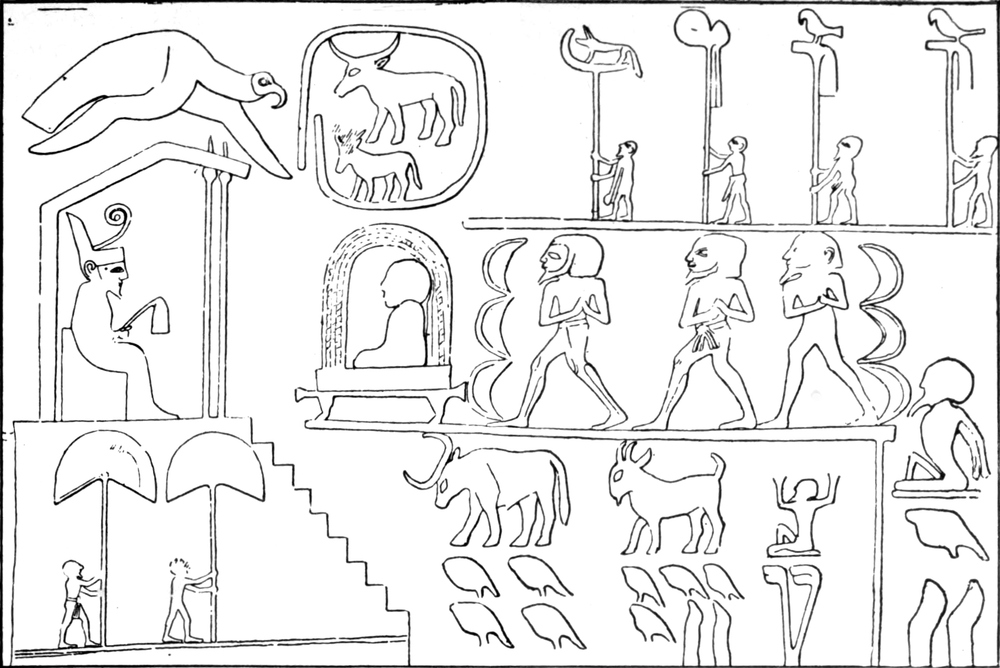
A FESTIVAL SCENE OVER 7,000 YEARS AGO, IN THE REIGN OF KING NARMER, 5,500 B.C.
A record of the festival of Narmer, a king of Abydos, who reigned before the first dynasty of kings of all Egypt. It indicates that when the festival of his own death was celebrated, in accordance with the ancient custom of killing the king every thirty years to make him one with Osiris the god, no fewer than 120,000 captives, 400,000 oxen, and 1,422,000 goats were offered. The numerical system is here seen to be complete up to millions.
Planting and Building
There were brought to the festival of Narmer 120,000 captives, 400,000 oxen, 1,422,000 goats; and the system of numeration was as complete before Menes as it was in any later time. The other mace head of King Zar shows part of the festival, and also the ceremony of the king hoeing the bank of a canal, probably at the inundation. We see the reclamation of the land, with men busy embanking the canals, and cultivating a palm tree in an enclosure of reeds, while they lived in reed huts with plaited dome tops, and used boats with a very high, upright stem. The carved slate palette of Narmer shows him grasping the chief of the Fayum, prepared to smite him, a scene which was repeated for five thousand years in all the Egyptian triumphs. The metal water-pot and sandals are carried behind the king by his body servant. On the other side of the palette is the king going to a triumphal ceremony, preceded by the scribe, thet, and four men of different types bearing the standards of the army, possibly connected with the four territorial divisions of the army found under Ramessu II. Before them lie ten slain enemies, with their heads cut off and put between their legs. The carving of the detail, and particularly the muscular anatomy of the king’s figure, is extraordinarily fine and firm, and as true as any work of later time.
WRITTEN HISTORY. Having now dealt with the history as drawn from the remains which have come to light, we now enter from this point on the continuous written history, which has come down from hand to hand without a break to our own times, during over seven thousand years. This history was compiled by the high-priest and scribe Manetho of Sebennytos in the Delta, and only a fragment of his work has been preserved on its full scale; but three later writers have given epitomes of it, and it is on their lists that we have to depend. These are Julius Africanus (221 A.D.), Eusebius (326 A.D.), and George the Syncellus (792 A.D.).
The Men Who Handed Down the Story An Ancient Historian and His Figures
Unfortunately, much confusion has been caused by scholars not being content to accept Manetho as being substantially correct in the main, though with many small corruptions and errors. Nearly every historian has made large and arbitrary assumptions and changes, with a view to reducing the length of time stated. But recent discoveries seem to prove that we must accept the lists as having been correct, however they may have suffered in detail. A favourite supposition has been that the dynasties named were arbitrary divisions of later times; but the earlier lists also show such divisions as far back as the eighteenth dynasty, and kings founding a dynasty used to copy the titles of the founder of the previous dynasty, showing that the change was recognised at the time.
Another idea has been that the dynasties were contemporary. But, on the contrary, in the overlapping of the tenth and eleventh and also the twenty-fifth and twenty-sixth dynasties, we can trace that Manetho was very careful to cut off from one dynasty all the time which he allows to another. As regards the general character of the whole length of time, we can show that Manetho’s version in 271 B.C. at Sebennytos was the same as that given to Herodotus two hundred years earlier at Memphis. Herodotus was told that from Menes to his time were 330 kings, and the totals of Manetho are 192 + 96 + 50 to Artaxerxes = 338, so that, in spite of corruption in detail, the totals seem to have been correctly maintained.
In earlier times we can compare Manetho with the fragments of the Turin papyrus, written in the eighteenth dynasty; and here, in one of the most disputable points—the kings of the thirteenth dynasty—the average of eleven reigns legible in the papyrus is 6½ years, and Manetho states sixty kings in 453 years, or 7½ years’ average. The general character of a great number of short reigns in this age is quite supported. Then in the eighteenth dynasty there is a rising of Sirius in the movable calendar, in the twelfth dynasty another rising of Sirius, and some seasonal dates, and in the sixth dynasty are two seasonal dates. [Owing to the ignoring of leap year, the Egyptian months shifted round the seasons in 1,460 years; hence any seasonal date can only recur once in 1,460 years, and fixes an absolute date in that cycle.] All of these agree with Manetho; and though the seasonal dates are vague, they at least show that there is not an error of several centuries in the total. In the earliest times there is the account of the first dynasty, the names and succession of which are verified by the sculptured lists in the nineteenth dynasty and by the actual graves of the kings. Every accurate test that we can apply shows the general trustworthiness of Manetho, apart from minor corruptions.
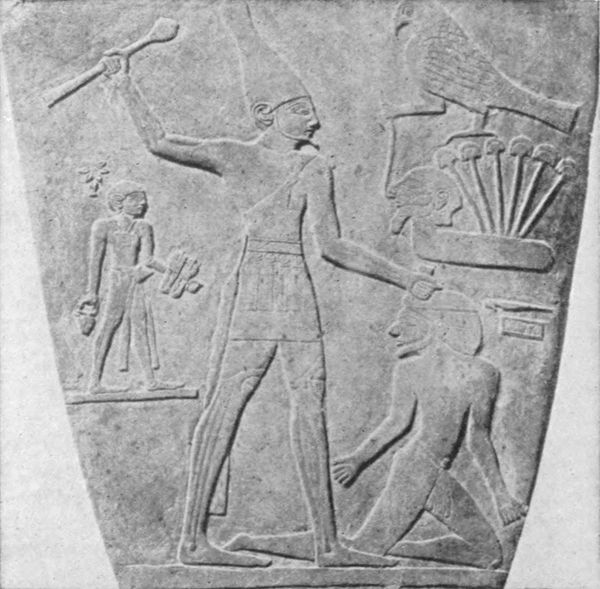
THE EARLIEST DETAILED SCULPTURE
This carved slate palette of King Narmer shows him grasping the chief of the Fayum, prepared to smite him, a scene which was repeated for five thousand years in all the Egyptian triumphs. The sculpture shows anatomical treatment for the first time in art.
Material for History of Early Times
It is naturally a question what sort of material existed for an accurate history of the early times. The fragment of annals known as the Palermo Stone was engraved in the fifth dynasty, and it recorded the principal events of all the years back to the beginning of the kingdom, a thousand years before, the height of the Nile for every year, the length of every king’s reign and of interregnum to the exact days. With such a record of the most remote times carefully maintained we have every reason to suppose that the high-priests and sacred scribes had adequate information as to the general course of their history. And we can see by the Turin papyrus how in the eighteenth dynasty there was a full historical list of all the kings, with their length of reigns, dynasties, and summations of numbers and years at each of the large divisions. Thus it is proved that there were historians at various periods who compiled and edited the history, and so provided a solid groundwork for later writers, such as Manetho.
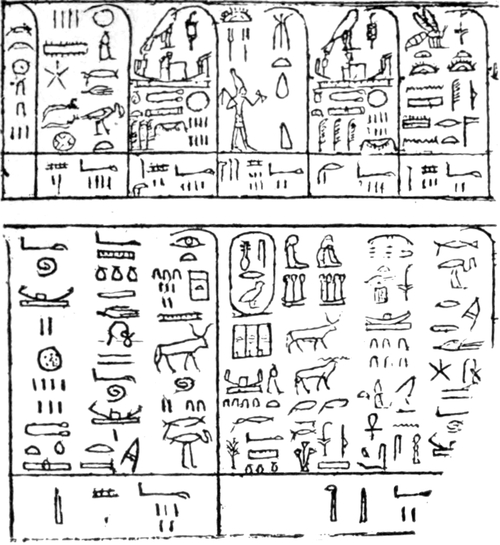
A RECORD OF EVENTS IN 4750 B.C.
A part of early annals known as the Palermo Stone. Each compartment contains the events of one year, with the height of the Nile in cubits stated below it. The lower right division records: “Building of a ship 170 feet long, and of 60 ships 100 feet long. Conquest of negroes, bringing 4,000 men, 3,000 women, and 200,000 cattle. Building a wall of the palaces of King Sneferu. Bringing 40 ships of cedar (from Syria).” The left division reads: “Making 35 hunting lodges and 122 tanks for cattle. Building a ship of cedar 170 feet long, and two other ships of 170 feet. 7th census of cattle.”
The Witness to Early Civilisation
The materials that we have for studying the civilisation of the early dynasties are the royal tombs and steles, the tablets of the annals, the sealings of officials, the inscribed stone bowls, glazed pottery, ivory, and wood, the rock steles of Sinai, fragments of buildings of the second dynasty and onward, the steles of private persons and their graves.
In the Kings’ Tombs
ROYAL TOMBS. The tombs show that brickwork was familiar on a large scale. The prehistoric houses and tomb chambers were by no means slight. The town at Naqada has house-walls about two feet thick, and a town wall nearly eight feet thick. The brick-lined tombs are sometimes as large as 8 ft. by 12 ft. The kings’ tombs of Dynasty O are about 10 ft. by 20 ft. Those of Narmer, Sma, and Mena are about 17 ft. by 26 ft., with walls 5 ft. to 7 ft. thick. Under Zer there is a great extension; the brick pit is 39 ft. by 43 ft.; it contained a wooden chamber 28 ft. by 34 ft., and it was surrounded by many rows of graves—318 in all. The later tombs of the first dynasty are less imposing. At the end of the second dynasty the tomb of Khasekhemui consisted of fifty-eight chambers covering a ground 223 ft. long and 40 ft. wide. The sizes of bricks were between 9 in. and 10 in. long, half as wide, and under 3 in. thick, in the prehistoric and through the first and second dynasties. Wood was used on a large scale. The royal tombs show beams for framing of about 10 in. wide and 7 in. deep, and 18 ft. or 20 ft. long, and these beams supported chamber sides and floors formed of planks 2 in. or 3 in. thick. The roof was made of similar beams, covered with boards and mats, which sustained 3 ft. or 4 ft. of sand laid over the tomb. Such was an extension of the roofs of poles and brushwood which were laid over the prehistoric tombs, and over the lesser tombs of the officials of the early kings. The sign for royal architect in the earliest inscriptions is that of a carpenter, the “two-axe man.”
The stone steles were of limestone in the first dynasty, and in the end of the first dynasty the steles of Oa are of black quartzose stone. Those of Perabsen in the second dynasty are of very tough syenite. The carving of all these is in high relief, finely and boldly cut in a simple, clear style. At the end of the second dynasty a stone-built chamber appears for the first time; the blocks have naturally cloven surfaces so far as possible, and the rest of the faces are dressed with a flint adze. Of the same reign of Khasekhemui there is a granite door-jamb with signs in high relief. Granite had already been wrought flat for pavements in the previous dynasty, at the tomb of Den.
Egypt’s Annual Record The Honour that Kings Died for
TABLETS OF ANNALS. The greater part of the inscriptions of this age are on small square tablets of ebony and of ivory, which were found in the royal tombs. These each have a hole in the top corner, and the sign of a year—the palm stick—down the side, as there is by the side of the entries of the events of each year on the early annals. They thus appear to be each the record of a year, and to have been strung together by the corner holes. There has not yet been any authoritative study of the meaning of these earliest inscriptions, which are very difficult to understand, owing to the transitory condition of ideographs having not yet yielded to syllabic usage. We can, however, glean many points about the civilisation from them. The towns were fortified with battlemented walls. The shrines were small sanctuaries, with a large court in front, like the temple courts of later times. At the entrance to the court were two tall poles, apparently with flags, which later developed into the row of masts with streamers in front of the pylon. The great festival at the close of each thirty years was one of the most important, already noticed here under Narmer. The sanctuary for it had two shrines back to back, each with a flight of steps, apparently for Upper and Lower Egypt. The dancing of the new king, or the crown prince as king, before the old Osirified king in the shrine, was one of the main events of the feast. The types of temple furniture were already fixed in the forms which lasted for several thousand years; the barks of Harakhti are shown with the same hangings at the prow, and are double—for the E. and W.—as in the temple of Sety I. Large bowls of electrum were offered in the temples by the king. Wild cattle were hunted by trap nets, as was done much later in Greece. And there is shown a long road, with resthouses and palm-trees, leading up to the great temple in the reign of King Zer.
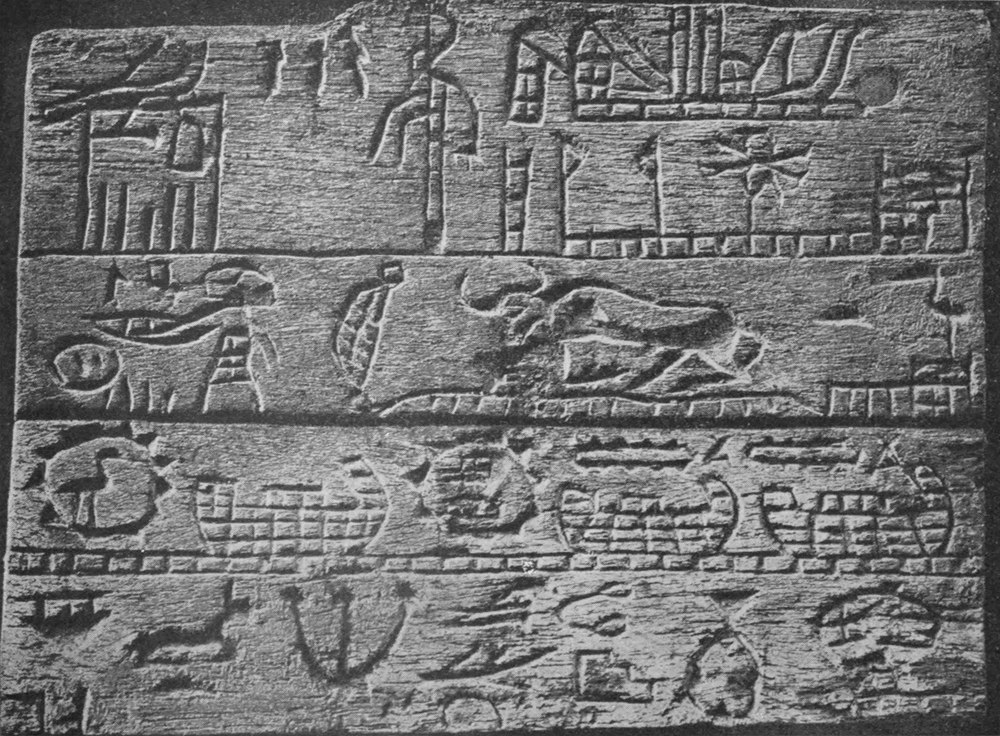
A RECORD OF A YEAR’S EVENTS: EBONY TABLET OF KING MENA, 5500 B.C.
The greater part of the inscriptions of the first dynasty are on small square tablets of ebony and of ivory. These each have a hole in the top corner, and the sign of a year—the palm stick—down the side. They thus appear to be each the record of a year, and to have been strung together by the corner holes. They were found scattered in the tombs.
Officers of the Empire
SEALINGS. The clay sealings of officials show much of the organisation of the country. The oldest titles, under Zer, are the “Commander of the Inundation” and “Commander of the Cattle.” In the reign of Zet we find a “Commander of the Elders” and “Archon,” or chief of the city; also the temple property, or “Inheritance of the Chief God,” is named. Under Merneit and Den there is a prince (ha). The vizier was “Commander of the Centre,” probably the major domo of the Court, and also “Over-head of the Commanders.” There are further named a “Royal Sealer of the Vat of Neit,” the “winepress of the north,” and a “Deputy of the Treasury.” In later reigns there is an “Over-head” of a city. And under the second dynasty the titles are “Royal Sealer of all Deeds,” “Scribe of Accounts of Provisions,” “Sealer of Northern Tribute,” “Collector of Lotus Seed,” and “Chief Man Under the King.” These titles are from but a very small part of the bureaucracy, only those whose seals were affixed to the royal provision which was placed in the tomb; but they suffice to show the regular organisation of the government at that age.
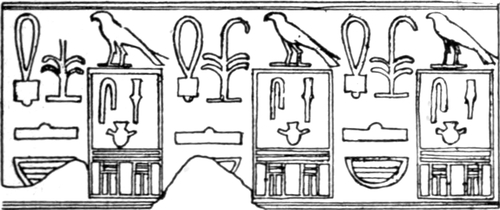
THE SEAL OF AN EGYPTIAN OFFICIAL
Much exact knowledge of the life of ancient Egypt is derived from the clay seals of high officials. The oldest known titles are those of “Commander of the Inundation.” The seal here is that of the “Southern Sealer of all Documents of King Sekhem-ab,” 5100 B.C.
STONE VASES. The stone vases for the royal palaces were cut in many kinds of hard rock. The rarer kinds are rock crystal, serpentine, and basalt; limestones, porphyry and syenite were more usual; and the commonest materials were metamorphic rocks formed from volcanic ash verging into slate, dolomite, marble, and alabaster. These materials were mostly selected for their beauty. The red porphyry is the rarest, being only known in a bowl of the time of Mena, and two prehistoric pieces. Black porphyry with very large detached white crystals belongs only to the age of Mena. Pink granite, blue-grey volcanic ash, the quartz crystal, and the pink limestones are all very beautiful materials. The hardness does not seem to have been aught but an attraction, as the finest work is always put on the best materials; whereas the soft alabaster and slate did not seem to challenge any great amount of care. The working of the inside was always done by grinding with blocks, sometimes having first removed the axis by a tube drill hole. The outside was dressed by chipping, hammer-dressing, and hand polishing; sometimes done by circular motion on a block, but often by crossing work by hand. The readiness with which oval forms were made shows how little depended on circular motion.
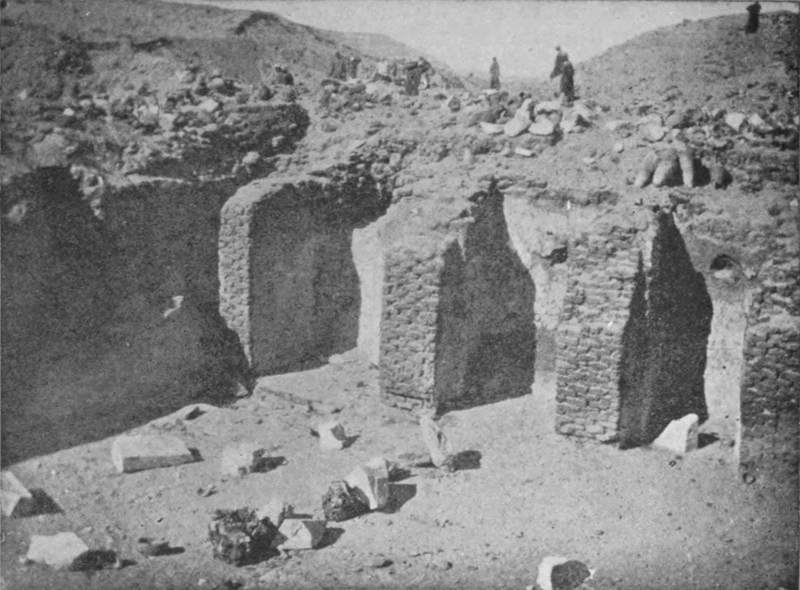
TOMBS OF KING ZER OF THE FIRST DYNASTY, 5400 B.C.
Brickwork was common in the houses and tomb-chambers of the prehistoric period, and in the time of the kings of Abydos the building of the tombs was greatly extended. Here are seen the brick partitions to contain offerings, around a wooden chamber now destroyed. Beyond this all round were 318 graves of the royal servants.
Two-Colour Glazing
The use of glazing had been already invented early in the prehistoric age, as far back as S.D. 31; but it was only applied to beads and small amulets. The earliest glazed pottery vase known is of Mena, and this has his name in violet glaze inlaid in the green glazed body. Glazed vases continued to be made throughout the first and second dynasties, but became rarer, and they have not been found revived till much later times. But ivory and wood were largely used for carved objects, sometimes of elaborate design. One of the most distinguishing points of the age of the early kings was the minute carving in imitation of leafage and basket-work, which was mainly done in slate, but also in wood. The fragments which remain show most elaborate patterns worked out with minute attention to detail. Nothing of the same kind is known in any other age.
Remains of the Oldest Sculpture
MONUMENTS. There are but few monumental remains from these early dynasties. The great rock-cut scene of Semerkhet conquering a Bedawy chief in Sinai is the main example. The figures are only summarily cut in the natural face of the sandstone; but the truth of the outline is better than in any of the more pretentious work of later times in that region. The scene of Sanekht—early third dynasty—is much poorer, and that of his successor, Zeser, is scarcely legible, the work is so rude and slight. The private tablets which were put over the graves around the royal tombs show that the fine work was limited to a small number of royal artists in the first dynasty, and that there was no general school of able men such as arose in later times. The figures and hieroglyphics are rudely hammered out, and the drawing is but clumsy. There is seldom more than just the name of the deceased. By the time of Den many are distinguished as the Akhu-ka, the “glorious soul”; while there is also a class apparently named “people of King Setui, daughter of the captive”—i.e., slaves born of captives taken in his wars.
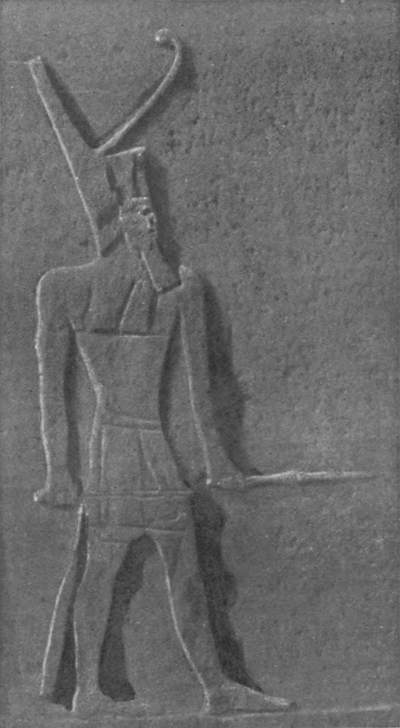
THE EARLIEST SCULPTURE
There are but few monumental remains from the early dynasties. The great rock-cut scene of Semerkhet, of which this shows a part, is the main example. The figures are only summarily cut in the natural face of the sandstone; but the truth of the outline is better than in any of the more pretentious work of later times in the same region.
It appears that the use of fine materials was at its height under Mena and Zer. Zer has the largest and best-built tomb, Zet shows the greatest delicacy in work, and Den seems to have had the most showy objects. The changes in about five generations here were much like those in an equal time from Amenhotep I. to III. in the eighteenth dynasty. Then decay markedly set in, and there was no revival until the Pyramid kings. But some development in the use of materials went on; and Zeser, of the third dynasty, is said to have built a stone palace; while Khasekhemui, a generation earlier, had a limestone chamber for his tomb, and carved granite for the door-jambs of his temple, at about 4950 B.C. These instances are the earliest use of stone for construction that are yet known; though as early as the middle of the first dynasty King Den had a pavement of red granite in part of his tomb.
Age of the Pyramid Builders
PYRAMID BUILDING. We now approach to the well-known age of the pyramid builders, when the civilisation appears at its highest development in most respects. We shall not deal with this in detail, as it falls into the ordinary historical period which appears elsewhere in this work [see Egypt]. But it may be useful to give the most essential facts of the material civilisation, which may otherwise be lost sight of in the mass of the history.
In stonework the accuracy reached its highest point in the fourth dynasty, when the Pyramid of Khufu was constructed with an average error of less than 1 in 15,000 of length, and even less in angle. The later work fell off from this accuracy; but in the twelfth dynasty the granite sarcophagus of Senusret II. was wrought with an average error in straightness and parallelism of under seven-thousandths of an inch, and an error of proportions between different parts of less than three-hundredths of an inch. There was no attempt to reach this high degree of accuracy in the later work. In sculpture the main character of the work of the Pyramid kings is its dignity and grandeur, representing individualism on the highest plane of abstraction.
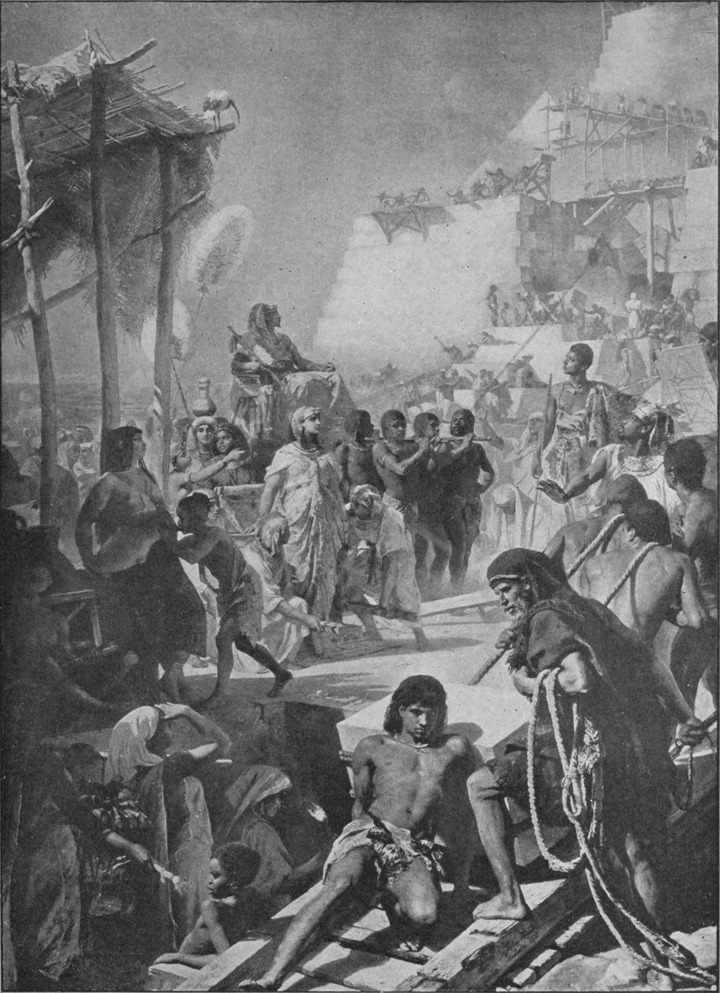
THE BUILDING OF THE PYRAMIDS IN THE ZENITH OF EGYPTIAN CIVILISATION
The age of the Pyramid builders may be regarded as the height of Egyptian civilisation. The greatest accuracy in stonework was reached during the fourth dynasty, when the Pyramid of Cheops, or Khufu, was constructed with an average error of less than 1 in 15,000 of length, and of even less in angle. In the twelfth dynasty the granite sarcophagus of Senusret II. was wrought with an average error in straightness and parallelism of under seven-thousandths of an inch.
LARGER IMAGE
The Great Navy of Egypt
Under the twelfth dynasty the personality is weaker and the style that of a formal school, highly trained but dependent upon training. In the eighteenth dynasty the vivacity of expression is directed to a purely personal appeal, more of emotion than of character. After that there is nothing but copying, good or bad. The growth of shipping at the early date of Sneferu, the end of the third dynasty, is surprising; and the record that we happen to have shows how much probably went on at other times, there being built, in one year sixty ships of 100 ft. long, in the next year two of 170 ft. long.
METALS. The use of copper is as remote as the beginning of the continuous civilisation in the prehistoric age, about 8000 B.C. It increased in quantity down to the eighteenth dynasty, and it was hardened by using arsenical copper ores, and leaving oxide in it; this, with hammering made it equal to soft steel for working purposes. Rare instances of tin, probably derived from natural mixture in the ore, are known from the third dynasty; but there was no regular use of it until we find pure tin, also known about 1500 B.C. Thence bronze was the main material until Roman times. Iron had been sporadically found in the fourth, sixth, twelfth, and other dynasties, and was known for about 4,000 years before it came into general use in Greek times. This agrees with its having been obtained from native masses rarely discovered, as has been the case in North and South America. Such native iron is the result of volcanic action on iron ore in contact with carboniferous strata. All these conditions exist in Sinai, and hence native iron might be found there. By about 800 B.C. iron was used for knives, but with a handle of bronze cast upon it to save the rarer metal. The iron tools in Egypt from the seventh to fifth century B.C. are all Assyrian or Greek, and it is not till Ptolemaic or Roman times that bronze tools disappear.
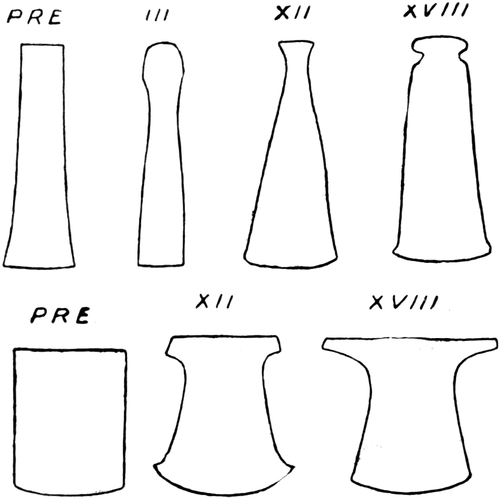
TOOLS OF ANCIENT EGYPTIANS
The plain strip of copper used for an adze in the early prehistoric age became in historic times widened at the edge, and had a slight contraction at the top; but the straight strip was kept up for 7,000 years without any attempt at a haft, simply lashed on to a bent handle. It is not till about 800 B.C. that any use of a haft occurs in Egypt, and then only for a hoe. The different dynasties are indicated in the examples here given.
Oldest Rock Drills
The forms of tools varied very little. The plain strip of copper, which was used for an adze in the early prehistoric age, became in historic times widened at the edge, and had a slight contraction at the top to assist in binding it on; but the straight strip was kept up for 7,000 years without any attempt at a haft, simply lashed on to a bent handle. It is not till about 800 B.C., or later, that any use of a haft occurs in Egypt, and then only for a hoe; while in Babylonia axes cast with a strong haft were used before 3000 B.C. Nor was a haft used for a hammer—a smooth stone in the hand was the only beating tool; while for striking tools a wooden mallet was used, cut out of a block. The axe began as a plain rectangle of copper, sharp on one edge; projections at the back were added, until they were half as long as the breadth of the axe, but no haft was attempted. The saw was used before the pyramid period; and also the saw and tube drill set with hard stones for cutting granite. Drills for boring vases were usually blocks of stone fed with sand and water, or probably emery for cutting the harder stones. Socketted chisels were an Italian invention in the later Bronze Age, about 900 B.C., and were copied by the Greeks, in iron, about 500 B.C.; but they were never used except under Greek influence in Egypt. Shears are also Western, and were unknown till Greek times in Egypt.