Volume 1 — LIST OF MAPS APPEARING IN THE BOOK OF HISTORY (continued 4)
Reading edition
Changing Conditions of the Earth
The grand nebular hypothesis of Laplace came to reinforce the views of the geologists, by showing how the earth itself may have originated as a gaseous or molten globe; and its slow process of cooling, with the reaction of the interior and exterior on each other, served to elucidate the facts of the heated interior, as shown by hot springs and volcanoes, as well as many of the phenomena presented by the distorted and metamorphosed strata which formed its crust. Hence it gradually came to be perceived that the condition of the earth, with all its endless variations of surface, of continents and oceans, of seas and islands, of vast plateaux and lofty mountain ranges and extensive low plains, with their ravines and cataracts, their great lakes and stately rivers, was subject to perpetual change from that remote epoch when it seems to have been actually the case that “the earth was without form and void,” and that owing to the greater density of the vapour-laden atmosphere, “darkness was upon the face of the deep.”
Changing Forms of Life
Another field of geological research forced us to the conclusion that the same continued process of change had affected the forms of life upon the earth. When carefully investigated, the crust was found to abound in the fossilised remains of animals and plants. Careful study of these showed that the oldest of all were of comparatively simple structure, and that the higher forms only appeared in more recent epochs; while the highest of all were probably very little older than man himself. It is only during the last half century that the theory of Evolution has been elaborated and has become generally accepted as applicable to the whole of the vast cosmic process—from the development of the nebulæ into stars and suns and systems, with a corresponding development of planets from an early condition of intense heat, through a more or less lengthy period of cooling and contraction, to an ultimate state of refrigeration, the earlier and later stages being alike unsuited to the existence of life.
Theory of Natural Selection
More important still, the discovery of the theory of Natural Selection by Darwin—and at a later period by myself—has led to a satisfactory explanation of the successive appearance of higher and more complex forms of life, and also of that wonderfully minute and complex adaptation of every species to its conditions of existence and to its organic as well as its inorganic environment, which all other theories—even the most recent—have failed to grapple with.
Wonderful Complexity of the Universe
The logical completeness as well as the extreme simplicity of this explanation of organic evolution has led great numbers of thoughtful but ill-informed persons to reject it, because it seems to render unnecessary the existence of a primary intelligent cause; while another equally large but, as I think, equally ill-informed class—the so-called monists—use it to demonstrate the non-existence, or, at all events, the needlessness, of any such cause. Both alike err, because they fail to take cognisance of the fact that every form of evolution, and pre-eminently that of the organic world, is an explanation of a process of change, a law of development, not in any sense or by any possibility an explanation of fundamental laws, causes, or origins. It presupposes the existence not only of matter—itself a thing whose nature is becoming more and more mysterious and unthinkable with the advance of physical science—but of all the vast complex of laws and forces which act upon it—mechanical, physical, chemical, and electrical laws and forces—all more or less dependent on the still more mysterious, all-pervading ether. Thus, the universe in its purely physical and inorganic aspect is now seen to be such an overwhelmingly complex organism as to suggest to most minds some vast intelligent power pervading and sustaining it.
Persons to whom this seems a logical necessity will not be much disturbed by the dilemma of the agnostics—that, however wonderful the material universe may be, a being who could bring it into existence must be more wonderful, and that they prefer to hold the lesser marvel to be self-existent rather than the greater. When, however, we pass from the inorganic to the organic world, governed by a new set of laws, and apparently by some regulating and controlling forces altogether distinct from those at work in inorganic nature; and when, further, we see that these organisms originated at some definite epoch when the earth had become adapted to sustain them, and thereafter developed into two great branches of non-sentient and sentient life, the latter gradually acquiring higher and higher senses and faculties till it culminated in man—a being whose higher intellectual and moral nature seems adapted for, even to call for, indefinite development—this logical necessity for some higher intelligence to which he himself owes his existence, and which alone rendered the origin of sentient life possible, will seem still more irresistible.
Mind Behind the World
The preceding remarks are intended to suggest that the theory of evolution, combined with the quite recent and very startling advances in physical science, so far from making the universe around us more intelligible as a self-sustaining and self-existent whole, has really rendered it less so, by showing that it is infinitely more complex than we had formerly supposed; and further, that matter itself, instead of being, as was once believed, a comparatively simple thing, eternal and indestructible, is in all its various forms subject to decay and disintegration. We now see that the only thing known to us that we can conceive as having unending existence is mind itself; and, just as Darwin’s theory of Natural Selection has opened up to us an infinite field of study and admiration in the forms and colours and mutual relations of the various species of animals and plants, so does modern science open up to us new and unfathomable depths in the inner structure of matter and of the cosmos, and thus compels us more and more to recognise a mental rather than a mere physical substratum to account for its existence.
There is, however, another set of relations which have been hitherto very little studied—those between the organic and the inorganic worlds in their broader aspects. These are now found to be very much more complex and more remarkable than is usually supposed, and they also have an important bearing upon the great problem of the origin and destiny of man. This is a subject which opens up a variety of considerations of extreme interest, showing that the exact adaptations of our earth—and presumably of any other planets—to enable it to sustain organic life, from its first appearance and through its long course of development, is as varied and complex and as much beyond the possibilities of chance coincidences as are any of the individual adaptations of animals and plants to their immediate environment. Most of these latter adaptations have been made known to us by Darwin and his followers, and they have excited the admiration and astonishment of all lovers of Nature. When the antecedent and grander relations of planet to life are studied with equal care, these also will, I believe, excite deeper admiration, still more profound astonishment, because any secondary laws that could have brought them about are less easy to discover, or even to imagine.
Essential Conditions of Life
Before we can form any adequate idea of the nature of a world which shall be able to support and develop organic life, we must consider what are the special conditions that alone render such life possible. We, of course, refer to the whole of the organic world, from the lowest to the highest, not to the few exceptional cases in which life may be possible under conditions that would be fatal to the higher as well as to most of the lower forms.
The Miracle of Human Life
The one striking speciality of the higher animals—and to a less degree of the higher plants—is that of continuous, all-pervading motion, every portion of their substance being in a state of flux: each particle itself moving, growing, living and dying, and being replaced by other particles of the same nature and fulfilling the same functions. To keep up this growth, and to enable every part of the structure to be continually renewed, food is required. This is taken into the stomach of animals in the solid or liquid form, is then decomposed and recomposed, that which is useless or superfluous being thrown off by the intestines, while what is needed for growth is transformed into blood and by a wonderfully intricate system of branching tubes is carried to every part of the body, furnishing nourishment and repair alike to bone and muscle, to all the internal organs and all the outward integuments, and to that marvellously complex nervous system which also permeates every part of the body and is essential to the higher manifestations of life—to the exertion of force, voluntary motion, and, apparently, to thought itself. Add to this the constant influx of air, which at once purifies the blood and supplies animal heat, and is so important that its cessation for a few minutes is usually fatal, and we have a machine so complex in its structure and mode of action that the most elaborate of human machines is but as a grain of sand to a world in comparison.
Basis of Physical Life
Now the very possibility of such a material organism as this depends upon a highly complex form of matter termed protoplasm, which is at once extremely plastic and of extreme instability, and is yet capable of secreting or building up its atoms into such solid and apparently durable forms as bone, horn, and hair, besides the various liquids and semi-solids which build up the organism. This fundamental organic substance consists of only four chemical elements—nitrogen, hydrogen, oxygen and carbon, and almost all animal and vegetable structures and products have the same elemental constitution, though with such widely different characteristics. Four other elements—sulphur, lime, silicon, and phosphorus—also occur in small quantities in organic tissues, to supply special needs; but these are not essential to all forms of life, and are only taken up and utilised by the living protoplasm when required. Protoplasm is undoubtedly the basis of physical life, yet it only exists in, and is produced by, living organisms. The moment such an organism dies, disorganisation and decay set in, and the whole mass becomes gradually changed into more stable compounds, or into its constituent elements. It appears, therefore, that some agency—usually termed “vital force”—must be at work, first to produce this wonderful compound, then to form it into “cells”—the physiological units of all organisms—and afterwards to direct the energies supplied by heat and light so as to build up the excessively complex structures, with all their wonderful powers and potentialities, which we term animals and plants. All this seems to imply not “a force” only, but very many forces, all of which must have some kind of mind in or behind them, to direct these forces to such infinitely varied yet perfectly defined ends.
A Marvel of Every Day
Consider for a moment one of the simplest of these cases. Let us take the minute seed of one of the great tropical fig-trees, and another seed of a strawberry, or of garden cress. Both will be about the same size and shape, and the most acute microscopist would not find any difference in the internal structure that could intelligibly account for the different results when these little grains of protoplasm are exposed to identical conditions. For, even if planted near each other, and exposed to the same amount of heat and moisture, to the very same atmosphere, and the same kind of water, as well as identically the same soil, yet invariably the one will grow into a large tree, the other into a small herb, and in the course of time, still with no change whatever of the physical conditions to which both are exposed, each will produce its peculiar foliage, and flowers, and fruit, very different in all their characters from those of the other. Were this result not so common as to seem to us “natural,” we should call it a miracle; and it is really and essentially as inexplicable as many things which are termed miracles only because they are unfamiliar and inexplicable.
Now, this wonderful substance, the physical base of all life—and as it is the only base that exists, or has ever existed, on the earth, we may fairly assume that no other is possible—can only maintain itself and perform its functions under certain very definite conditions, which conditions are now maintained on our earth’s surface, and must have been maintained throughout the long geological periods during which life has been slowly developing. What these conditions are we will now proceed to show.
The First Essential for Life
The first essential for organic life is a certain very limited range of temperature. We are so accustomed to consider the change of temperature from winter to summer, from day to night, and that which occurs when we pass from the tropics to the Polar regions as being very great, that we do not realise what a small proportion such changes bear to the whole range of temperature that exists in the known universe. The absolute zero of temperature is calculated to be minus 461° F., while the heat of the sun has been determined to be over 10,000° F., and many of the stars are known to be much hotter than the sun. The actual range of temperature is therefore enormous; but any development of organic life is possible only within the very narrow limits of the freezing and boiling points of water, since within those temperatures only is the existence of liquid water possible. But a much less range than this is really required, because albumen, one of the commonest forms of protoplasm, is coagulated or solidified at a temperature of about 160° F. Now, if, as is generally believed, the earth has been once a liquid or even a gaseous mass and has since cooled to its present temperature on the surface, and the sun is undergoing a similar process of cooling, we are able to understand that the very limited range of temperature within which life development is possible implies an equally limited period of time as compared with that occupied by the whole process of solar and planetary development.
We Live by the Heat of the Sun
It must be understood, however, that the present temperature of the earth’s surface is due entirely to sun-heat, and that if that were withdrawn or greatly diminished the whole surface of the globe would be permanently far below the freezing point and all the oceans be frozen for a considerable depth; so that all organic life would become extinct. Under such conditions no renewed development of life would be possible; and it is therefore quite certain that the sun has actually maintained the uniform moderate temperature required, and must continue to maintain it for whatever future period man is destined to continue his existence upon the earth.
But it is not only a certain amount of heat that is required, but also a sufficient quantity of light; and this implies a further restriction of conditions, because light is due to vibrations of a limited range of wave-length, and without these particular rays plants cannot take the carbon from the carbonic acid in the atmosphere, and by its means build up the wonderful series of carbon compounds, including protoplasm, which are essential for the life of animals. What is commonly termed dark heat, therefore, would not be sufficient for the development of any but the lowest forms of life, even though it produced the necessary temperature during a sufficient period of time.
All organisms, from the lowest to the highest, whether plant or animal, consist very largely of water, and its constant presence either in the liquid or gaseous form is essential for organic life. On our earth oceans and seas occupy the greater part of the surface, while their average depth is so great that the quantity of water is sufficient to cover the whole of the globe free from inequalities two miles deep. It is this enormous amount of water that supplies the air with ample moisture, such as renders the life of the tropics so luxuriant. Yet even now the inequality of water-supply is such that large areas in all parts of the earth are what we term deserts, only supporting a very few forms of life that have become specially adapted to them, and certainly unfitted for the continuous development of life from lower to higher forms.
Water and the Atmosphere
Water is also of immense importance as an equaliser of temperature, the currents of the ocean conveying the warmth of the tropics to ameliorate the severity of temperate and Polar regions, while the amount of water-vapour in the atmosphere acts as a retainer of heat during the night, without which it is probable that the surface of the earth would freeze every night even in the tropics. When we consider that water consists of two gases—oxygen and hydrogen—in definite proportions, and that without their presence in these proportions and in the necessary quantity the development of organic life would have been impossible, we find that we have here a remarkable and very complex set of conditions which must be fulfilled in any planet to enable it to develop life.
But this is not all. The atmosphere is so intimately associated with water in its life-relations, and is itself so absolutely essential to the existence from moment to moment of the higher animals, that the two require to be duly proportioned to each other and to the globe of which they form a part.
How Water Protects Earth by Night
In the first place the atmosphere must be of a sufficient density, this being needed in order that it may be an adequate storer up of solar heat, and also in order that it may be able to supply sufficient oxygen, water-vapour, and carbonic-acid gas for the requirements of both vegetable and animal life. We have a striking example of the use of air as a storer-up and distributor of heat and moisture in the very different character of our south-west and north-east winds. The effect of the density of the air is equally well shown when we ascend lofty mountains where we find perpetual snow and ice, due simply to the fact that the air is not dense enough to retain the heat of the sun—which is actually greater than at low levels—so that at night the temperature regularly falls below the freezing point. On the other hand a very much denser atmosphere would absorb so much water vapour as probably to shut out the light of the sun, and thus have a prejudicial effect on vegetable life.
Again, there is good reason to believe that the proportions of the various gases in the atmosphere are, within certain narrow limits, such as are most favourable not only for the life that actually exists, but for any life that could be developed from the elements that constitute the universe. Oxygen has properties which seem absolutely essential to organic life; but nitrogen, though only serving to dilute the oxygen so far as the higher animals are directly concerned, is yet indirectly essential for them, since it is in vegetables a constituent of that protoplasm which is the very substance of their bodies.
Use of Thunderstorms The Wonder of the Atmosphere
Now, plants obtain their nitrogen mainly from the minute proportion of ammonia that exists in the atmosphere, and this ammonia is formed by the union of the nitrogen of the air with the hydrogen of the water-vapour under the influence of electric discharges—that is, of thunderstorms. It is evident, then, that the required amount of this essential compound will depend upon a due adjustment of the quantities of nitrogen and aqueous vapour always present; while the electric discharges seem to be due to the friction of various strata of air with each other and with the earth’s surface, due to the winds and storms; and winds are due to highly complex causes, involving the rate of the earth’s rotation, the rise and fall of the tide, the density of the atmosphere, the quantity of its aqueous vapour, and the amount of solar heat which it receives. Unless all these very diverse factors existed in their due proportion, some of the results might be highly prejudicial if not quite inimical to the development of life. To these various adaptations of our gaseous envelope we must add one other. Carbonic acid gas in the atmosphere is absolutely essential to vegetable life, while it is directly antagonistic to that of the higher animals. Its quantity must, therefore, be strictly proportionate to the needs of both; and that beneficial proportion must have been preserved throughout the whole period of the existence of the higher air-breathing animals.
These various considerations show us that our atmosphere, consisting as it does mainly of two common gases mixed together, and therefore seeming to most people one of the simplest things possible, is really a wonderfully complex arrangement which is adapted to serve the purposes of living organisms in a great variety of ways. But this by no means exhausts the subject of its adaptation to support and develop organic life, because its very existence on the earth in a suitable quantity and composed of the essential elements can be shown to depend on other and deeper relations which will now be pointed out.
The older writers on the subject of the habitability of the planets took no account whatever of the importance of size, distance from the sun, period of rotation, and obliquity of the ecliptic as determining the possibility of organic life, but simply assumed that, because the earth possessed an abundant life-development, all the other planets must also possess it. But we know that the above-mentioned factors are of very high importance, as we will proceed briefly to point out.
Earth’s Envelope of Gas
It is now believed that the amount of atmosphere possessed by a planet is due mainly, perhaps entirely, to the planet’s mass, and its consequent gravitative power. Spectrum-analysis has shown that vast masses of gaseous matter exist in the universe, and it is probable that, in a state of extreme tenuity, these are very widely diffused. Just as meteoric dust is constantly attracted to the earth, and periodically in larger quantities, so are gases, and supposing the aggregations of free gaseous matter to have been distributed with some approach to uniformity, then, as planets grew in size, they would also tend to secure a larger amount of the diffused gases, thus forming deeper atmospheres. The observed facts agree with this view. The largest planets, Jupiter and Saturn, have such a depth of atmosphere as permanently to obscure any solid interior they may possess. The only planet closely approaching the earth in size and density—Venus—has an atmosphere which appears to be loftier than ours, but it may be composed of different gases. Mars, which has only one-ninth the mass of the earth, has a lofty but very tenuous atmosphere, and probably no water, the Polar snows being due probably to the freezing of some dense gas. The climate and physical condition of Mars is, however, still a subject of much controversy, which I hope to discuss in a separate work dealing with the arguments of Professor Lowell [see page 105]. In that volume the reader will find, fully set forth my reasons, on scientific grounds, against the supposed habitability of Mars.
The Earth Selects and Uses Gas
But, besides attracting cosmic masses of gaseous matter to form its atmosphere, there is another equally important function of the mass of a planet—its selective power on the kind of gases it can permanently retain in a free state. The molecules of gases are in a condition of rapid motion in all directions, which explains the elastic force they exhibit. The speed of this motion has been determined for all the chief gases, and also the gravitative force necessary to prevent them from continually escaping into space from the upper limit of the atmosphere. Thus the moon, which has a mass only one-eightieth that of the earth, can retain no free gas whatever on its surface. Mars can retain only the very heavy gases, but neither hydrogen nor water-vapour. The earth, however, has force enough to retain all the gases except hydrogen, which is just beyond its limit; and this may explain why it is that there is no free hydrogen in the atmosphere, although this gas is continually produced in small quantities by submarine volcanoes, is emitted sometimes from fissures in volcanic regions, and is a product of decaying vegetation. Once united with oxygen to form water, it becomes amenable to gravity in the form of invisible aqueous vapour, and is thenceforth a permanent possession for us in its most valuable form.
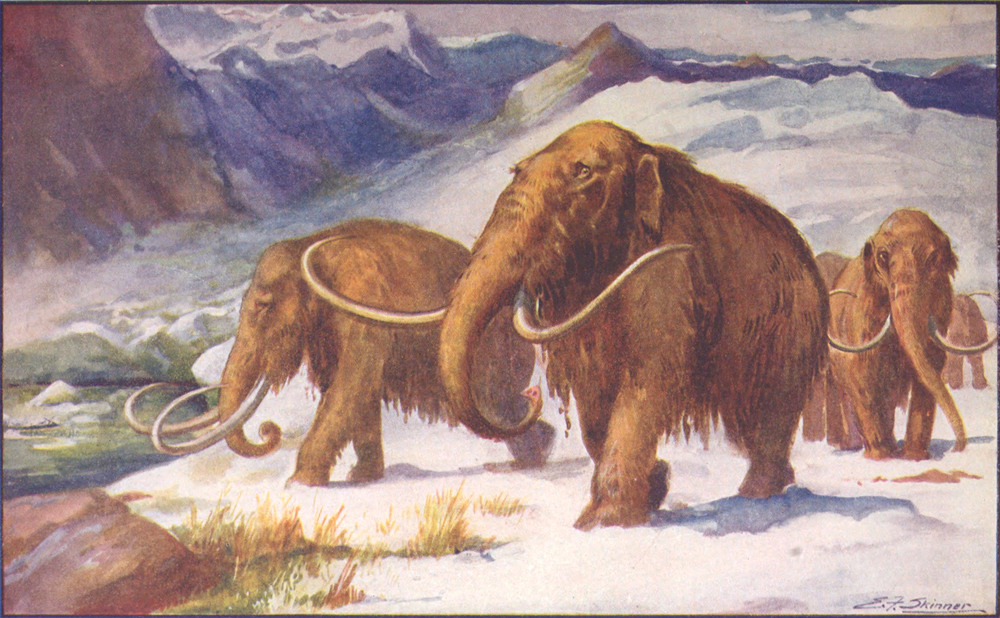
EARLY ICE AGE, WHEN MAMMOTHS ROAMED THE EARTH AND MAN WAS ARISING
LARGER IMAGE
The very accurate adjustments that render our earth suitable for the production and long-continued development of organic life, culminating in man, may be well shown by another consideration. If our earth had been 9,600 miles instead of 8,000 miles in diameter—a very small increase in view of the immense range of planetary magnitudes from Mercury to Jupiter—with a slight proportionate increase in density, due to its greater force of gravitative compression, its mass would have been about double what it is now. This would probably have led to its having attracted and retained double the amount of gases, in which case the water produced would have been double what it is—perhaps even more, because hydrogen gas would not then escape into space as it does now. But the surface of the globe would have been only one-half greater than at present; so that, unless the ocean cavities were twice as deep as they actually are, the whole surface of the earth—except, perhaps, a few tops of submarine volcanoes—would have been covered several miles deep in water, and all terrestrial life would have been impossible.
The Deep Atmosphere of Venus
From the various considerations here set forth it appears clear to me that no other planet of the solar system makes any approach to the conditions essential for the development of a rich and varied organic life such as adorns our earth. One only—Venus—has a sufficient bulk and density to give it the needful atmosphere; but as it receives about twice as much solar heat as does the earth, it is probable that its very deep atmosphere may be mainly due to the fact that a large proportion of its water is held in a state of vapour, its seas and oceans being proportionately reduced in extent. Judging from what happens on the earth, this would probably lead to an excessive area of deserts, and thus be inimical to life. But this planet appears to possess one feature which renders it fundamentally unsuitable for organic life.
Why there is no Life on Venus
Several modern observers have found that the older astronomers were all in error in giving Venus a rotation-period almost exactly the same as ours, an error due to the indefinite and variable markings of its surface. They have now deduced a period about equal to that of its revolution round the sun—a rate which has been confirmed by spectrum-analysis, and further confirmed by the fact that this planet has no measurable polar compression. As during transits of Venus over the sun’s disc the conditions for the accurate measurement of the compression, if any exist, are the best possible, and as none has been found, this alone affords a demonstration that the rate of rotation must be very slow, because the laws of motion necessitate a definite amount of equatorial protuberance corresponding to that rate. Half the surface has, therefore, perpetual day and the other half perpetual night, leading to violent contrasts of heat and cold for the two hemispheres with, in all probability, correspondingly violent winds, rains, and electrical disturbances—conditions so entirely opposed to the uniformity of temperatures and stability of meteorological phenomena during long geological epochs which are essential for the full development of organic life, that such development is perhaps less probable on this planet than on any other.
I think I have now shown not only that no other planet in the solar system makes any approach to the possession of the varied and complex adaptations which are essential for a full development of organic life, but also that on the Earth itself the conditions are so numerous and so nicely balanced that very moderate deviations in excess or defect of what actually exists in the case of any one of them—and of others not referred to here—might have rendered it equally unsuitable, so that either no organic life at all, or only a very low type of life, could have been developed or supported.
There is Purpose in our World
If, then, the more superficial indications of design in the relations of animals to their environment, and of man to the universe, have been shown by modern science to have required no special interference of a higher power to bring them about, but that they have been due to natural laws acting in accordance with and in subordination to the deeper laws and forces that determine the very constitution of matter and the unknown power and principle we term “life,”—yet, on the other hand, we find that a more careful study of the outer universe, or cosmos, reveals a new set of adaptations not less wonderful or more easily explicable by chance coincidence than those presented by the organic world.
Even the very brief sketch of the subject here given suggests the idea of purpose in a world so precisely and uniquely adapted to develop organic life, and to support that life during the countless ages required for the completed evolution of man. But that suggestion becomes a logical induction when the whole of the available evidence is set forth, as I have attempted to set it forth in my work on “Man’s Place in the Universe.” I have there shown not only that the cumulative evidence for the earth being the only supporter of a fully-developed organic life within the solar system is irresistible, but that there is some direct, and much more indirect, evidence that this uniqueness extends to the whole stellar universe; and it is certain that no particle of direct evidence for the existence of organic life elsewhere has been, or is likely to be, adduced.
I have also shown (in an appendix to the second edition of my book) that the purely biological argument for the uniqueness of the development of man—as the culminating point of one line of descent throughout the diverging ramifications of the animal kingdom—is overwhelmingly strong; hence the logical conclusion from the whole of the evidence is that man is the one supreme product of the whole material universe.
My object in the present essay has been limited to showing that, besides and beyond the special adaptations of the various kinds of animals and plants to their special environments, there exist in the earth as a planet, in its various physical and cosmical relations, a whole series of adaptations of a very remarkable character which, so far as we can judge, are essential to its function as a life-producing world. The study of these adaptations, therefore, may be considered to be appropriate here, as constituting a preliminary chapter in the natural history of the Earth and of Mankind.
ALFRED RUSSEL WALLACE
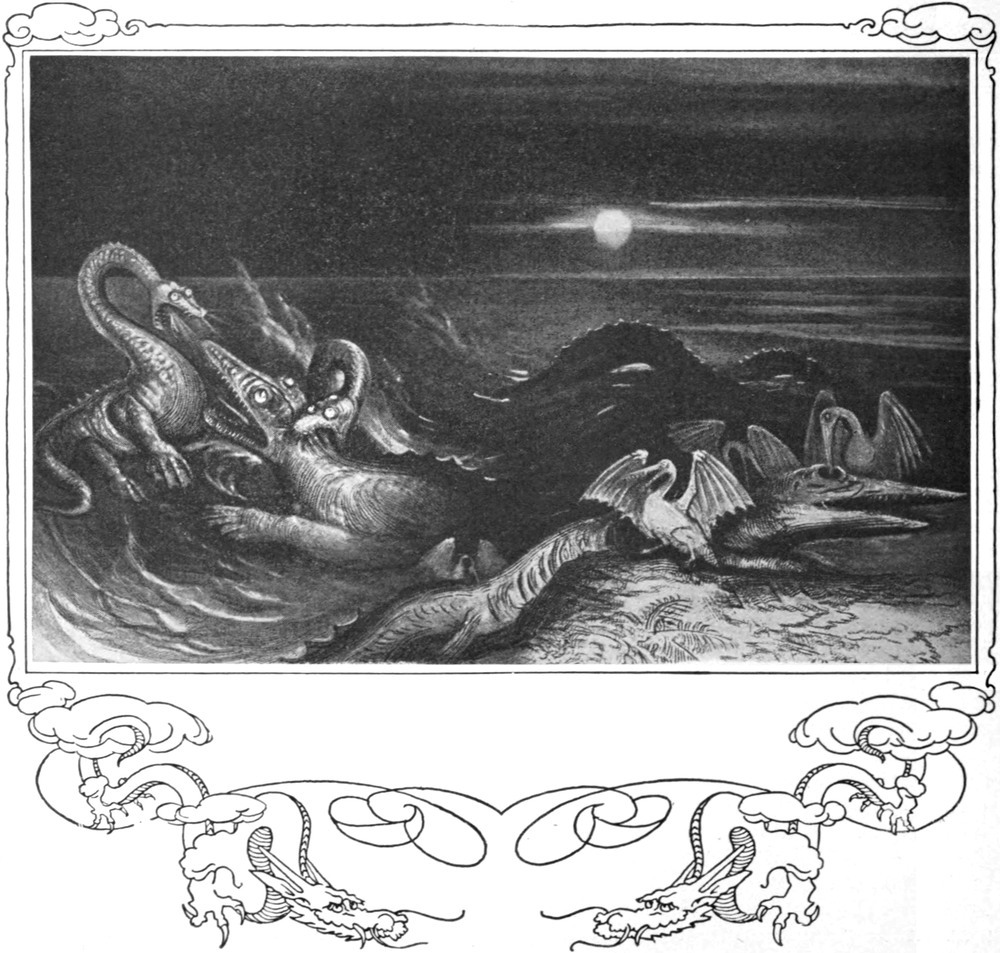
IN THE DAYS OF THE SEA MONSTERS
Reproduced from a plate in Hawkins’ “Book of the Great Sea Dragons.”
The Earth Without Life
F
FOR some decades past we have been faced with a critical difficulty at the most critical and important point in the history of the earth. In the first place, it has been definitely established that in the earlier period of its history there was no life whatever—as the word is usually understood—upon the earth, as is abundantly shown elsewhere in this work. None of the conditions that make life possible, as we know it, were satisfied. As a recent French writer has said, life is an aquatic phenomenon, absolutely incapable of existence except in the presence of liquid water; and there was an age of vast duration in the history of the earth when all its water must have been in the gaseous state. Other reasons of equal cogency may be at present ignored. The broad fact is that, however widely students of this matter may differ on other points, there is absolute agreement upon the cardinal and initial fact that whereas there is life upon the earth now, there was a time when there was none.
A Gap in the Philosophy of Evolution
Now, in the ever memorable year 1859, Charles Darwin published a volume, the main thesis of which is now universally accepted, wherein the following is the last sentence: “There is grandeur in this view of life, with its several powers, having been originally breathed by the Creator into a few forms or into one; and that, whilst this planet has gone cycling on according to the fixed law of gravity, from so simple a beginning endless forms most beautiful and most wonderful have been, and are being evolved.” “The Origin of Species” may be said, in a word, to establish the doctrine of the evolution of living organisms upon the earth “by laws acting around us”—to use Darwin’s own phrase. But Darwin’s work begins with and assumes the existence of life as an established planetary fact. There obviously remains a tremendous gap in the evolutionary philosophy as it stands in our statement of it thus far; and the first fact which we have to note is that the existence and recognition of this supposed gap, so far from being a matter of common recognition from the earliest times, so far from being an observation made by the critics of the doctrine of evolution, is, on the contrary, a special doctrine peculiar to scientific study and of quite recent origin, being indeed established—as was supposed—within the memory of many now living.
If we turn to the first chapter of Genesis, we shall see no suggestion or recognition of the supposed difficulty involved in the beginning of life upon the earth. In this immortal piece of ancient poetry it is stated that after the creation of the heaven and the earth, which were at first “without form and void,” God said, “Let the earth bring forth grass ... and it was so”; and later God said, “Let the waters bring forth abundantly the moving creature that hath life ... let the earth bring forth the living creature after his kind.” Here we have suggested to us the natural origin of living creatures in earth and sea under the will and direction of the Creator as conceived by the poet.
First Ideas on the Origin of Life The Coming of Darwin
Partly to the influence of Genesis, partly to the apparent facts of observation, and partly to the views which would naturally be held by poets and thinkers, we may attribute the belief which has been held by man, simple and philosophic alike, since first men began to think, until, we may say, the third quarter of the nineteenth century—the belief that the lowest of living things arose by a natural genesis or so-called spontaneous generation in suitable materials already provided on the land or in the sea. It was not suggested or believed that very large and conspicuous living creatures were thus bred, though it is true that the ancients thought even crocodiles to be generated by the action of the sun upon the slime of the Nile. The living creatures supposed to arise naturally in the womb of earth—the all-mother—were mostly small creatures, like insects and worms. The ordinary belief of the uninstructed to-day—a belief which they share with the greatest thinkers of antiquity and the Renaissance—is that the cheese-mite, for instance, is evolved from the substance of the cheese. Now, it is of particular moment to observe the vast contrast between the significance of this belief prior to the publication of “The Origin of Species” and its significance to-day. Before we accepted the doctrine of organic evolution, the supposed spontaneous origin of the cheese-mite in cheese, or of the maggot in putrid meat, was of no very great moment; a maggot or a cheese-mite is an extremely insignificant object. So far as the great problems of the universe are concerned, a cheese-mite, as we say, is neither “here nor there,” and its spontaneous generation was not regarded as a fact of any great moment.
But then there arose Darwin, who, in establishing the doctrine of organic evolution already supported by his own grandfather, by Lamarck, and Goethe, and Herbert Spencer, gave an entirely new importance to the question. He demonstrated how we could conceive the evolution of all organisms, including man, from a “few simple forms,” under the continuous influence of natural law; and thus such forms ceased to be insignificant, and the manner of their genesis came to be a vital problem in more senses than one. Such organisms—the mite, the maggot, and even the mould—could no longer be regarded as insignificant, for they were revealed as not unlike the ancestors of man himself.
Evolution a Continuous Process
The question of the beginning of life upon the earth had only to be satisfactorily answered for the establishment of the belief in a continuous process of evolution by natural law, even from the very beginning of the earth itself “without form and void,” until the production of the highest living organisms which it displays in our own time. And all ages, even by the mouths of their great thinkers and closest observers, had agreed in giving an apparently satisfactory answer to this question. It might well have been thought that Darwin was quite entitled to ignore altogether, as he did, the question of the origin of life. Everyone knew, so to say, that simple living organisms were every day evolved in organic refuse and elsewhere. Darwin himself, if we may judge from a casual remark in a letter, regarded the question apparently as purely speculative, and of small real moment. It is all rubbish, he says, thinking about the origin of life; we might as well argue about the origin of matter. We must beware of illegitimately attributing opinions to the immortal dead, but this remark, though a casual one, does seem to suggest that Darwin regarded these two questions as on all-fours, if not, indeed, as different forms of the same question, and that, if he had actually formulated his views, they would have taken the shape of the doctrine which asserts that life is implicit and potential in matter; in other words, that when suitable conditions arose—such, for instance, as the presence of liquid water—matter would display the properties of life.
An Abyss that could not be Bridged
Now, the remarkable fact—one of the most striking in the history of science—is that the time-honoured belief in spontaneous generation should have been attacked, and attacked with apparent success, just at the very time when it would otherwise have begun to assume real philosophic importance. For ages it had been accepted, taken as a matter of course, and not regarded as having any particular bearing upon the supreme questions. Then there came the time when this belief would have been an all-important link, without which the chain of evolution could not be completed, a link without which we were left to contemplate a perfect chain of inorganic evolution—the history of the earth before life—and a perfect chain of organic evolution—the history of life upon the earth, with an abyss between the two that could not be bridged, for how came life where there was no life? A series of experiments were made, experiments in which, strikingly enough, some of the greatest evolutionists of the day took a leading part, and these seemed to upset, just when it was most wanted by themselves for the establishment of their new doctrine, the belief which had gone without question for so many ages.
Is Life only Self-movement?
Now, some may be inclined to wonder how it should be that certain pioneers of the new doctrine of evolution, such as Tyndall and Huxley, should devote themselves with such persistence and labour and force to the overthrow of a doctrine which was so necessary for the complete establishment of their own case—so much so, that when they had overthrown it, they found themselves, as regards their own doctrine of evolution, placed in a difficulty from which they did not live to emerge. It is my own belief that this question can be answered, and the answer is of strict relevance to our present inquiry. I believe that Huxley and Tyndall were largely impelled by the desire to oppose a doctrine of the nature of life which was current in their time and is usually called “vitalism.” We shall not begin to understand the question of the beginning of life upon the earth, as that question may be legitimately stated to-day, unless we fully realise in what terms the doctrine of spontaneous generation was accepted in the past, and an understanding of this will teach us that the present-day revival of this doctrine presents it in a form very different from that which it so long held. Our discussion must be somewhat philosophic in character, but the question at issue is a highly philosophic one, and the reason why we have made so little progress in answering it hitherto is that men of science have too frequently discussed it without paying any serious attention to the profound philosophic questions which really underlie it. We have permitted ourselves to talk freely about life and matter, whilst claiming the right to take for granted the absolute validity of our conceptions of life and our conceptions of matter.
It was universally held by those, philosophic and simple, who also held throughout so many centuries the belief in spontaneous generation, that there is an overwhelming contrast between living and lifeless matter, and it was their belief in this overwhelming contrast that led them to give to the doctrine of spontaneous generation, as they held it, a form which cannot possibly be defended. The great character of life was conceived to be self-movement, this self-movement being displayed in the matter which composed the living organisms. But it was universally held that matter, as it was seen otherwise than in living organisms, was obviously and notoriously inert, gross, brute, and dead.
The Influence of Plato
The great influence of Plato taught men to despise matter in this fashion, and there was the everyday experience that a stone lies where it is placed until something from outside moves it, being, therefore, inert, whilst a living creature such as a bird moves freely at its own will. The more strongly men held the natural matter of which the earth is composed to be inert, the more necessary was it to suppose that when life was displayed in it the difference consisted in the taking possession of this dull clay by a vital force—a mystic and wonderful principle of quickening—which endowed even gross, inert matter with activity and power. From the time of Plato until the last few years of the nineteenth century thinkers vied with one another in insisting upon the impotence and grossness and inertness of matter, and each fresh insistence upon this doctrine rendered more necessary a corresponding doctrine of vital force or vitalism, which should explain the amazing transformation undergone by, let us say, the gross and inert matter composing food, when that food was converted by the “living principle” into the tissue of a living creature, and then displayed self-movement.
Philosophy of Dead Matter The Great Work of Pasteur
This doctrine of vitalism, which held sway for so long, was naturally invoked to explain the origin of life upon the earth, when the advance of astronomy and geology demonstrated a natural evolution for the earth and proved that there must have been a time when no life was possible upon it. The prevalent conception of matter came in at this point and denied altogether any such monstrous doctrine as that the wonderful thing called life could spontaneously arise in the despicable thing called matter. The material of the earth, whether solid, liquid or gaseous, consisted of eternal, unchangeable, and indestructible atoms. These were moved as forces from outside moved them. They had no energy or power of their own. Men simply thought of them as of incredibly minute grains of sand of various shapes and sizes, and it was as impossible to conceive of life being spontaneously generated in a chance heap of inert atoms as to conceive that a heap of grains of sand should organise themselves into a little organism. As for spontaneous generation occurring on the earth to-day, the development of mites from cheese and so forth, that was a very different matter, men must have thought—in so far as they thought at all—since cheese and flesh and so forth were themselves products of life. It is well worth noting that the common doctrine of spontaneous generation was always held in reference to organic materials, such as the slime of the Nile—not the dry sand of the desert. The reader may be inclined to say that men’s beliefs on this subject in the past generation make very confused reading, and indeed, that is true. But the fact is that their beliefs were most confused. The work of Darwin had staggered everybody, and straightforward, systematic, unprejudiced thinking was very nearly impossible in the welter of controversy. Nevertheless, something apparently definite was done. The doctrine of the beginning of life upon the earth was left almost undiscussed, and the accepted notion of the nature of matter—a notion which to us who know radium seems puerile—was left unchallenged in all its falsity. But the work of the great French chemist Pasteur led to a close examination of the belief that humble forms of life are daily produced from lifeless organic materials, and the conclusion was reached that no such spontaneous generation occurs.
Every Living Thing from a Living Thing
This conclusion is of great importance in the history of modern thought, and it was proclaimed with much rejoicing and vigour as a great achievement of science, whilst some of its chief advocates seemed at times to forget the extreme awkwardness of the inferences which had to be made from it. The doctrine may be stated in Latin in the form of the familiar dogma, “Omne vivum ex vivo,” every living thing from a living thing. Just as the existence of a man is quite sufficient to prove to us the prior existence of living human parents, just as we feel sure that every beast of the field has had living parents and that every oak has sprung from an acorn developed in a previous oak, so, according to the doctrine of “Omne vivum ex vivo,” we must believe that every living creature, whether human, animal, or vegetable, whether as big as the mammoth or as small as the smallest microbe not one-twenty-thousandth part of an inch in diameter, has sprung from living parents. Nature, according to this doctrine, was divided—as Nature, being a mighty whole, can never be divided—into two absolute categories, the living and the lifeless, or living matter and dead matter. Dead matter was notoriously dead and impotent, and life could not conceivably arise in it, though it could be used by life for purposes of food. On the other hand, living matter rejoiced in the possession of all those great attributes which lifeless matter lacked, and, in accordance with the contrast between the two kinds of matter, the living could never be produced from the lifeless but only from the living: for every creature, microbe or mammoth or man, we must trace back in imagination a series of living ancestors, differing perhaps in various characters, but always living. This series must be traced back and back and back until——?
Life Evolved from the Lifeless
And there the difficulty arose. For the uninhabitableness of the primitive earth was a fact of which men of science were as certain as if from some habitable planet they had been able to gaze upon it. Notwithstanding the dogma of “Omne vivum ex vivo,” it was impossible to assert that every living creature has an endless series of ancestors. How, then, did life begin?
What we may call the doctrine of the older orthodoxy—the doctrine of special creation, of supernatural interposition for the introduction of a new entity into the scheme of things—offered one alternative. To accept it, however, would be to abandon the whole modern conception of natural law and of a universe which was not created once on a day, and has not been tinkered with subsequently, but from everlasting to everlasting is the continuous expression to us of the Infinite and Eternal Power which to some eyes it veils and to others it reveals. Unless we are to abandon our philosophy, this alternative cannot be accepted, and it is now accepted by no philosophic thinker.
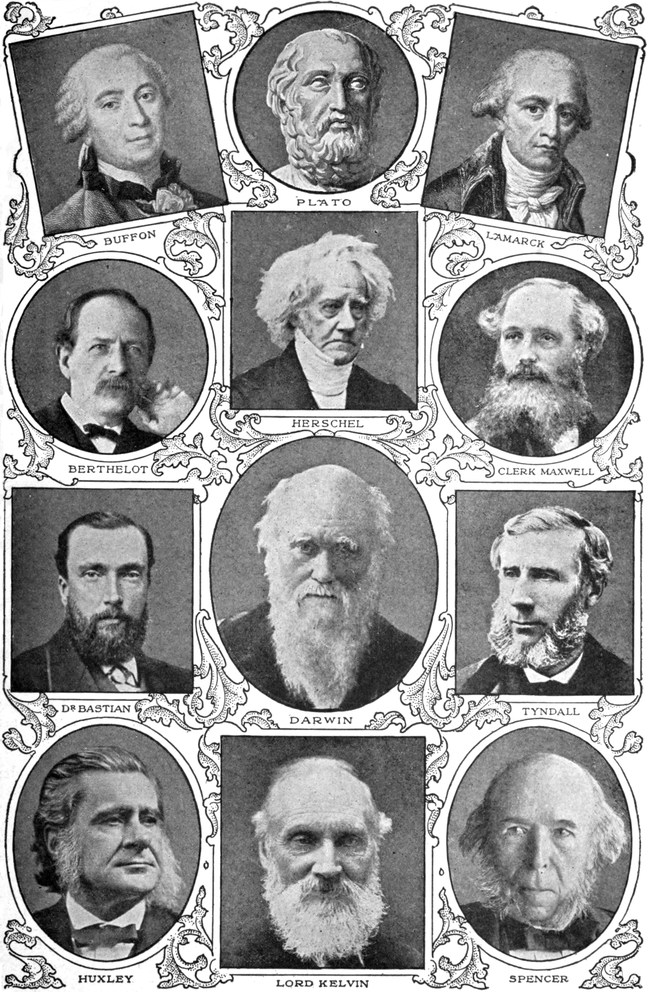
MASTER THINKERS WHO HAVE CONTRIBUTED TO OUR KNOWLEDGE OF LIFE
Photos by Gerschel, Maull & Fox, E. Walker, London Stereoscopic, Barraud, and Mills
LARGER IMAGE
Thus, whether “Omne vivum ex vivo” be true or false to-day, we are compelled to accept the only other alternative, which is that it has not always been true, or, in other words, that life was spontaneously evolved from the lifeless (so-called) at some remote age in the past. Just at the present time philosophic biology is out of fashion. Minds of the great cast which endeavour to see things in their eternal aspect have been lacking to the science of life since the days when Huxley and Spencer were in the plenitude of their powers. Anyone who cares to compare the principal reviews of the last decade with those same reviews from the year of, say, 1875 to 1890, can readily see this fact for himself. In the absence of that deliberate thought and discussion without which clear ideas on any subject are impossible, what may be called the official opinion of biology at the present time is thus most remarkable and contradictory. On the one hand, it is strenuously asserted as a matter of dogma that at the present day no life is produced or producible upon the earth except by the process of reproduction of previously existing life; and on the other hand it is asserted—when the direct question is put, though otherwise the subject is simply ignored—that life must somehow or other have been naturally evolved in the past, presumably once and for all. I have called this opinion contradictory, and it is indeed far more contradictory and unsatisfactory than it may at present appear. The obvious question that the critic asks is, “If then, why not now?”
“If then, why not now?” Is Life Now Arising from the Lifeless?
The answer alleged is that, of course, the experiments of Pasteur and Tyndall, to which some reference must afterwards be made here, merely demonstrated the impossibility of the spontaneous generation of life in our own day or under any conditions similar to those of our own day; but doubtless the first few simple forms of living matter arose by natural processes at some distant epoch “when the conditions were very different from those that obtain to-day.” Now it happens to be true that every difference between past and present conditions which physics and geology and chemistry can assert tends to the probability that if spontaneous generation is impossible now, it must have been a hundredfold more impossible a hundred million years ago. Yet for some three decades the great majority of biologists have been content to believe that spontaneous generation is impossible now, even though land and sea and sky are packed with organic matter under the very conditions which obviously favour life—as the all but omnipresence of life abundant to-day demonstrates—but that spontaneous generation was possible in the past when, by the hypothesis, there was no organic matter present at all, and when life had to arise in the union and architecture of such simple substances as inorganic carbonates! Such biologists are like those who know that the human organism can be developed from the microscopic germ in a few years, but find it incredible that man can have been developed from lowly organisms in æons of æons. Nor has any living biologist even attempted to make an adequate answer to the question, why what is impossible now should have been possible a hundred million years ago. On the contrary, so soon as the matter is looked at philosophically, we see that all the probabilities, all the analogies, all the great generalisations of science, are in favour of the belief that life must be arising from the lifeless now, as in the past, whenever certain conditions, such as the assemblage of carbon, oxygen, nitrogen and hydrogen in the presence of liquid water, are satisfied.
For the moment, however, I propose to postpone this question of the truth of “Omne vivum ex vivo” at the present day, for I desire to throw into the forefront of my argument two quite recent developments of science, unreckoned with because non-existent in the controversy of the ’seventies, and in my judgment not yet duly appraised to-day. In the present and future discussion of the manner and causation of that supreme event in the earth’s history, the beginning of life upon it, we must reckon with two new orders of inquiry relating to facts unthinkably contrasted in physical magnitude yet equally relevant to our subject. The first series of facts with which I will deal are astronomic, and the second atomic.
The Evidence from Other Worlds Vegetable Life on Mars
In discussing the origin of life upon the earth, we of the twentieth century must recognise such facts as may be obtainable in regard to life upon other orbs than ours. Now, in the first place, there is at least one illustrious contemporary astronomer, Professor Pickering, the chief living student of the moon, in whose opinion there are many evidences upon our satellite of the action of vegetation, either past or present. This, of course, is not the place for a discussion of that evidence; it is, however, the place to record the most highly qualified opinion at present obtainable, and to remind ourselves of the certainty that when the moon was first borne—or born—from the earth, life cannot possibly have been evolved, since the conditions of temperature alone, to name one factor, were such as life could not sustain, no liquid water being extant. There is some reason to suppose, then, that, whatever the present case may be, life was at one time spontaneously evolved upon the moon.
The second piece of astronomical evidence relevant to our inquiry is afforded by the planet Mars. This, of course, is a much controverted question, which cannot receive any discussion here. It suffices to note that Professor Lowell, who is admittedly the greatest living authority on Mars, has observed and photographed, not merely to his own satisfaction, but to that of an ever increasing number of astronomers, signs of vegetation upon Mars. I will say nothing here as to the existence of intelligent beings there. That fascinating and momentous question, upon which there will doubtless be difference of opinion for some time to come, does not now concern us. It is of quite sufficient significance for our present purpose if the existence of merely vegetable life, and no more, upon the planet Mars can be demonstrated, and there are now very few astronomers indeed who question this demonstration, however chary they may be of going any further. I submit that the question of the beginning of life upon the earth should not be considered without reference to the evidence which suggests the spontaneous origin of life upon the moon, and to the practically positive demonstration of the present existence, with seasonal alternations, as on our own earth, of vegetable life in the watered areas of Mars.
The Earth’s Crumbling “Foundations”
These considerations were entirely unknown to the great controversialists of a generation ago; but there is another order of facts, entirely unimagined by them, which are now demonstrable and admitted. For them, or for most of them, the ancient conception of matter which we trace to Plato was substantially true; nay, more. The recent work of the physicists and chemists had endowed that ancient conception of matter as gross and inert and dead with a new concreteness and vividness. One of the greatest physicists of the age, James Clerk-Maxwell, in his famous address to the British Association, spoke of atoms as the “foundation stones of the visible universe, which have existed since the creation unbroken and unworn.” The accepted conception of an atom was that of a passive thing; it had its own inherent shape and properties, which were impressed upon it at its creation. It had “the stamp of the manufactured article,” as Sir John Herschell said, and throughout its endless history it responded to and behaved under the influence of external forces in due accordance with its shape and size. But it was unchangeable, inert and brute, the sport of its surroundings, like the mote in the sun-beam.
Immeasurable Ocean of Energy
But to-day we stand amazed at such conceptions. We have learnt that within the atoms of matter there is a fund of energy so incalculably vast that the sum total of all the energies previously recognised, and now to be styled extra-atomic, is as nothing compared with it. This is a change indeed, that all the energies hitherto known to us should be merely the overflow trickling from the immeasurable ocean of the intra-atomic energy, the very existence of which has been formally and repeatedly denied by practically all thinkers from Plato down to our own time. Matter is not gross and inert, brute and dead. The atom, the so-called unchangeable foundation stone, is, on the contrary, itself an organism, the theatre of Titanic forces about which we at present know practically nothing except that they certainly exist, and are powerful beyond all our previous conceptions. The atom is no atom, but a microcosm; it is no more the unit of inorganic matter than the cell is really the unit of living matter.
Now it is surely evident on consideration, though the significance of the change has been ignored, that the whole discussion of the spontaneous origin or evolution of life in matter takes an entirely new shape when our old and widely erroneous conception of matter is abandoned, and a true one is substituted. Life is a marvellous and characteristic demonstration of energy. When the origin of this energy in matter was formerly discussed, we were told that the constituent parts of matter contain no energy at all, but now we know that a quite overwhelming proportion of the sum total of universal energy is to be found there, and nowhere else. This is one of the most revolutionary advances in the whole history of thought, and its full significance has yet to be recognised.
There must also be added an essential to any future discussion of this question, the extraordinary achievement of synthetic chemistry, of which Professor Berthelot was the grand master. As long ago as 1828 it was shown that there was at least one exception to the doctrine of the vitalists, that chemical compounds characteristic of living matter cannot be built up except by the living organism. To-day chemistry has succeeded in building up alcohols, starches, sugars, and even the forerunners of the proteids themselves, from the inorganic elements in the laboratory, under the action of non-vital forces. This fact could not be reckoned with a generation ago.
Can Chemistry Build Up Life?
We are now entitled to state very briefly the sequence of events which may reasonably be imagined as culminating in the origin of life upon the earth for the first time. Whatever we may hold as to the present, we have to recognise that the origin of life for the first time constituted a fact utterly different in certain essentials from any origin of life that may be expected to be occurring to-day. The capital fact is that in the beginning there was no organic matter to serve as food material. If ever there was a case in which it is the first step that costs, it is here. Nothing can be easier than to imagine the spontaneous origin of life in organic matter to-day, favoured with sun and water and air. The case is far different when a primary origin in inorganic matter has to be conceived. But of some things we are certain. We are certain, for instance, that so long as the earth’s surface temperature was above that of boiling water, no life was possible. It was not until the gaseous water in the atmosphere became liquefied by the lowering of the earth’s temperature that the production of life became possible. The first seas were seas of boiling water, or rather water infinitesimally below the boiling point, and we may reasonably suppose, with Buffon, that the Polar seas, being the first to cool, must have provided the first “nest” for life upon the earth. I assume, of course, that this essay will be read in conjunction with that of Professor Sollas upon the formation of the earth [page 79], and that of Dr. Wallace upon the exquisite adaptation between life and the earth to-day [page 91].
The Study of Ferments
But how were those complex organic bodies formed, especially those vastly complex proteids with which all life whatsoever, as we know it, is invariably associated? Apart from the laboratories of the synthetic chemists of to-day, these compounds are always the products of pre-existing life, and yet without them there could be no pre-existing life.
Mystery of the Cell Is the Cell a Product of Evolution?
It is my belief that this most difficult question, which quite baffles us, will seem simple and straightforward in another generation, when science has devoted itself on a large scale to a study now in its very infancy—I mean the study of those curious bodies which chemists call ferments. The properties of ferments are shared both by the familiar ferments, such as trypsin and pepsin, and also by certain inorganic substances, such as the metal platinum. Now, though pepsin is a product of living cells, platinum is certainly not. Altogether apart from the living world there are substances which have powers of fermentation; and ferments do not act exclusively, as is erroneously supposed, in breaking down complex compounds, but also build them up from their constituents. The powers of a ferment, moreover, are, so far as we know, inexhaustible. All life whatever is exercised by ferments, and it is true that life, chemically considered, is “a series of fermentations.” Now, there is quite recent evidence already which seems to show that certain ferments, acting in suitable material, have the power of reproducing themselves—that is to say, of converting that material into their like. These facts are highly suggestive, and it is difficult to refrain from suggesting that the gap between living and lifeless matter, which seemed so absolute to our ancestors, and which even to us, who have a new conception of matter, seems wide enough, may yet be bridged by the ferments. We are far too apt, I think, to assume that when we can see no intermediate stage there were no intermediate stages, and thus to make difficulties for ourselves. We declare that life began as a single cell, which was the starting-point of organic evolution. I myself believe rather that the cell constitutes the acme of a vast epoch of evolution, which may yet be reproduced in brief in the laboratory. Denying or declining to think of this, the biologist who knows the amazing complexity and intricacy of the architecture of the cell may well decline to believe that such a thing could spring with a single jump from inorganic matter. We preach and go on preaching that Nature does nothing by jumps, and in the same breath we declare that life began as a simple cell. In another hundred years we may begin to realise that a cell in its own measure and on its own scale is an organism, as complex and mature a product of evolution as a society, or, for the matter of that, as the atom of modern chemistry!
But the reader will legitimately declare that so long as the spontaneous generation of life to-day in the most favourable circumstances is a proved impossibility, he cannot be expected to accept the doctrine of its spontaneous origin in the past. There are signs, however, that the biologists are now beginning to listen to Dr. Charlton Bastian, the sole survivor from the great controversy of the ’seventies, whose book, “The Evolution of Life,” was published only a few months ago. Against Pasteur and Tyndall and Huxley, Dr. Bastian maintained that their experiments, asserted to be conclusive, were not conclusive—the facts observed were certainly facts, but the deductions were unwarrantable. The experiments only proved the impossibility under the experimental conditions. The difference is the difference between proving what you set out to prove, and begging the whole question. First establish conditions under which spontaneous generation is impossible, then demonstrate its non-occurrence under those conditions, and thence infer that it is impossible under any conditions.
The Creed of the Future
The student is right in declining to believe in the spontaneous beginning of life upon the earth so long as the possibility of spontaneous generation to-day is denied, but there are not a few who think that the most conservative attitude that can be adopted is one of suspended judgment.
The present philosophic tendency is undoubtedly in the direction of a return to the ancient conception that matter is not without its own degree of life, and that the distinction between the organic and the inorganic is a distinction of degree and not radical. Nature does not admit of being sorted into any of our puny categories. As the facts accumulate they point more and more definitely towards the opinion that hylozoism, or the doctrine of potential life in all matter, will be part of the scientific creed of the future.
Controversies as to the origin of life, judged in the light of this great conception, seem to become trivial if not puerile. Knowing, as we now do, that Plato’s conception of matter was as false as it possibly could be, and having had revealed to us by radio-activity the omnipresence within the very atoms of matter, of forces incessant and stupendous, we find the doctrine of vitalism, however stated, to be wholly meaningless; we find that the gap between the living and the lifeless is by no means abysmal or impassable.
How Long Has Life Existed?
And the definition of life as self-movement seems to become almost comical, for on that definition surely the whole physical universe, the only perpetual motion machine we know of, is itself alive. A discussion of this question can at the utmost only be suggestive. Very few positive assertions have been made, nor can their number be added to, in reference to a question which is bound to be asked: How long has life existed on the earth? The study of radium and its presence in the earth’s crust alone suffices to abolish altogether the old estimates, and new ones cannot yet be substituted. Only it is certain that the past history of planetary life may be far longer than any previous estimate has indicated. It now seems that the earth is not only not self-cooling, but actually self-heating, and if on the older assumption Lord Kelvin could talk of a hundred million years since, so to speak, water first became wet, and life, as we know it, possible, who shall say of how long periods we may speculate now? Meanwhile, the glass-eyed stare vacantly around them and declare that the progress of science means the destruction of the spirit of wonder and reverence. To them we reply in the words of the Earth Spirit in Goethe’s “Faust”:
“At the whirring loom of Time unawed, I weave the living garment of God.”
C. W. SALEEBY
A
ALL the world—at any rate, all that part of the world which is acquainted with the facts—is now agreed that man is a product of evolution, and that his remote ancestors were of different bodily make and shape, and of different mental type and calibre, from their late descendants. No study of human kind can be comprehensive that does not include a survey of the mode by which the faculties that have given man the mastery of the earth were evolved.
We Know the Present by the Past
A history of his evolution, based, like a political history, on episodes, cannot, of course, be written. But man is a bundle of parts and capabilities. By comparing the civilised being with the savage and the savage with lower animals, we are able to trace, in many important particulars at least, his natural history with a degree of certainty to which, I think, no political history can aspire. As our comprehension of adult man is helped by a knowledge of the development of the child, so our understanding of our species is aided by a study of its past. Armed with some clear conceptions of what man was, and is, we shall be the better fitted to investigate social and political change, and to perceive how it happens that while some nations have inherited the earth and the fruits thereof, others have stagnated or fallen into decay.
How Man Learns by Experience
At a certain stage in his development the caterpillar builds himself a cocoon. His dwelling is a wonderful structure, but from our human point of view the remarkable thing is that he does not learn to build it. He may never have seen a cocoon before, and he constructs only one in his life. Yet his work is perfect, or at least very excellent, and it is as good in its beginnings as in its endings. Evidently he owes nothing to experience, but is impelled and guided throughout by a faculty which we term instinct. An instinct may be defined as an innate, inherited impulse, an inclination to do a certain definite act, the instinctive act, on receipt of a certain definite stimulus or incitement to action. In the case of the caterpillar the stimulus appears to be the sight at the proper time of a suitable spot in which to build a cocoon. Since this particular impulse does not appear at the beginning of conscious life, it is termed a deferred instinct. Man, on the other hand, cannot build his house unless he first learns how to build. He depends, not on instinct, but on experience. The faculty by means of which experience is stored in the mind is memory. The faculty by means of which we use stored experience to guide present or future conduct is intelligence. When the contents of memory are very vast, and the processes of thought by which they are utilised comparatively difficult and complex, intelligence is termed reason. Intelligence and reason depend, therefore, on memory, on ability to learn, on capacity to profit by experience. Memory is not the whole of intelligence, but it is the basis of it. Without memory there could be feeling and emotion, but no thought, for the materials of thought would be lacking.
Instinct in Place of Memory The Basis of Rational Action
We always measure the intelligence of an animal by its power of profiting by experience. Thus, a cat is more intelligent than a rabbit because it can learn more; a dog, for the same reason, is still more intelligent. A purely instinctive animal, one that has no memory, can have no conception of its past, and therefore no idea of its future. It lives wholly in the immediate present; feeling, but not thinking. It acts entirely on inclination, not on reflection. It makes provision for the future, not with any notion of providing, but simply because it has an impulse to a certain course of action, the performance of which gives it pleasure of the kind a child derives from playing or eating, and with the ultimate result of which it is no more consciously concerned than a child. If a caterpillar sheltered in a hole with the idea, founded on past experience, of avoiding danger, his action would be intelligent. If, appealing to a memory in which a great number of complex experiences were stored, he took thought and designed himself a shelter in which provision was made for all sorts of remembered dangers, his action would be rational. But if, making no appeal to the past nor taking thought for the future, he builds only because impelled by an innate impulse, then, no matter how elaborate the edifice he rears, his action is instinctive.
Animals low in the scale of life—for example, most insects—appear incapable of learning. But often they are wonderfully equipped by instinct. The details of the behaviour of a small beetle, as quoted from Professor Lloyd Morgan, may not have been quite correctly ascertained, but they are sufficiently accurate for our purpose.
A certain beetle (Sitaris) lays its eggs at the entrance of the galleries excavated by a kind of bee (Anthophora), each gallery leading to a cell. The young larvæ are hatched as active little insects, with six legs, two long antennæ, and four eyes, very different from the larvæ of other beetles. They emerge from the egg in the autumn, and remain in a sluggish condition till the spring. At that time (in April) the drones of the bee emerge from the pupæ, and as they pass out through the gallery the Sitaris larvæ fasten upon them. There they remain till the nuptial flight of the Anthophora, when the larva passes from the male to the female bee. Then again they wait their chance. The moment the bee lays an egg, the Sitaris larva springs upon it. Even while the poor mother is carefully fastening up her cell, her mortal enemy is beginning to devour her offspring, for the egg of the Anthophora serves not only as a raft, but as a repast. The honey, which is enough for either, would be too little for both, and the Sitaris, therefore, at its first meal, relieves itself from its only rival. After eight days the egg is consumed, and on the empty shell the Sitaris undergoes its first transformation, and makes its appearance in a very different form.... It changes into a white, fleshy grub, so organised as to float on the surface of the honey, with the mouth beneath and the spiracles above the surface.... In this state it remains until the honey is consumed, and, after some further metamorphoses, develops into a perfect beetle in August.
Wonderful Instinct of the Beetle
The beetle has sense organs; therefore she feels. But we have no reason to suppose that she remembers or thinks. Memory would be of little use to her; therefore parsimonious Nature bestows little or none. Cast adrift in a hostile world, she must come into existence ready armed by instinct for the battle of life. She has no time to learn, and during the rapid and strange changes in her career has little opportunity of acquiring knowledge that could beneficially guide her future conduct. Since memory and its corollary reflection are most developed in the highest animals, and are imperceptible in the lower, they are clearly later and higher products of evolution than instinct.
Man’s Helplessness at Birth
Family life is a product of memory, for the mate and offspring are re-cognised; therefore it always implies some degree of intelligence. The young are watched and protected, and taught by the higher animals. Opportunities are thus afforded of learning about the world, and more particularly of acquiring the traditions, the stored experiences, of the race. With the opportunity to profit by experience comes the ability to profit by it, and with the latter a gradual decay of instinct. Intelligence is substituted, more or less, for unthinking impulse. All the instincts are not lost, but in the higher animals we find no such elaborate innate impulses as in the lower. “Sitaris” is able to fend for herself from the first; but just in proportion as animals are highly placed in the scale of life, so they are helpless at the beginnings of consciousness, but correspondingly capable later. A young pig can run as soon as it is born, but the acquirements of the most learned pig are small compared to that of a dog, which, though more helpless than the pig at birth, is so teachable that he becomes the companion of man. Our domestic animals are all teachable, otherwise we could not tame them.
Of living beings man is by far the most helpless at birth. He cannot even seek the breast. In him instinct is at its minimum. For him more than any other animal prolonged and elaborate tuition is necessary; but so vast is his memory, and so great his power of utilising its stored experience, that in later life he is beyond comparison the most capable of the inhabitants of the earth. Compare what even a dull man knows, including the words of a language and its inflections and articulations, with what is acquired by the cleverest dog, and the immensity of the difference is at once apparent. We may take a solitary frog and rear him from the egg in an aquarium. If, subsequently, we remove him to a pond, he will take his place with his fellows at once. He has little, if anything, to learn. Instinctively he knows his food, and how to seek it; his enemies and rivals, and how to escape or fight them; his mate, and how to deal with her; and she knows how to dispose of her eggs. But how forlorn and helpless would be a man reared from infancy in a dark cell out of sight and sound of his kind, and then turned into a world where his experienced fellows struggle for existence!
Fear is the Result of Experience
Traditional knowledge—knowledge, that is, imparted by one generation to the next—is common enough amongst the higher of the lower animals, and forms no inconsiderable part of their mental equipment. Thus we may see the hen teaching her chickens how to seek food, and the cat instructing her kitten how to ambush mice. Birds and mammals inhabiting desert islands have none of that fear of man which in our country they acquire from dire experience. We have a saying, “as wild as a hawk”; but Darwin relates how he almost pushed a hawk from its perch with his gun in the Galapagos Islands. Round our coasts the sea-birds are exceedingly shy; in a harbor they feed from the hand. Formerly the Arctic seals, impelled by fear of bears, inhabited the outer margin of the floes; at the present day they have retreated from the more dangerous neighbourhood of man to the landward edge. Antarctic seals, harried by the great carnivora of the ocean, are watchful in the water; on land or on the surface of the ice, where till lately they met no danger, they may be slaughtered like sheep in a shambles. They are capable of profiting by experience; but they are slow to learn, and can acquire but little. Judged by our human standard, they are very stupid. The means of escape adopted by Arctic seals, and the means of capturing them, the ships and guns adopted by man, furnish a measure of the intellectual difference.
Slavery in the World of Insects
When animals are social, and so have the opportunity of learning, not only from their parents, but from other members of the species, the power of making useful mental acquirements is correspondingly great. It reaches a remarkable degree of development even amongst insects, some species of which live together in great communities. Young ants, for example, are tended with anxious care. It is said that they are led about the nest and instructed by older individuals. They are reported to be playful. Most significant of all is the fact that some species have the habit of capturing slaves belonging to other species, which they take as pupæ, never as adult ants, and to whom, as they develop, they teach their duties. The slaves are neuter individuals, and have no offspring, the supply being maintained by fresh captures. It follows that the slaves must learn their work, and therefore that their performance of it is not instinctive, but intelligent.
It is a fair inference that many of the so-called instincts of ants are really acquired habits, bits of knowledge and ways of thinking and acting which are handed down from one generation to the next, not by actual inheritance, but traditionally and educationally, just as children receive from us language, or religion, or a trade. Indeed, there is reason to believe that the power of making mental acquirements has evolved to a greater degree in the favourable environment of the ant-nest than among any other species except man.
Man’s Essential Instincts
The instincts of man, though comparatively few and simple, are yet essential to his existence. He has the instinct of hunger and the instinctive recognition of food as food, the instincts to sleep periodically, to rest when tired, and to sport when rested, the instincts of curiosity and imitativeness, and the deferred instincts of sexual and parental love, and perhaps one or two others. All these innate impulses he shares with the lower animals, but those which impel him to store and use his vaster memory are more developed in him than in any other type. Thus the instinct of sport urges him, not only to develop his limbs, but, through experience, to acquire dexterity and much besides. The little girl turns naturally to her doll, which she handles as she will her baby. The play of a boy as naturally involves contests, which foreshadow the grimmer battles of adult life. As he grows older the character of his sport changes. More and more it becomes an appeal to the wits, an appeal to wider experience and a means of adding to it.
A Child’s Play Fits it for the Future
The higher amongst the lower animals also have their sports, which, in every instance, are adapted to fit the members of the species for the future business of life. Compare, for example, the ambush and pounce of the kitten, the ardent chase and overthrow of the puppy, and the climbing proclivities of the kid. As a general rule, in proportion as an animal is capable of becoming intelligent, and as long as it is so capable, it is inclined to sport. A cat loses the desire early in life, a man retains it to the end. A child’s play, therefore, is no indication of mere frivolity. It is the outward and visible sign of an eager and splendidly directed mental activity. Curiosity also prompts the child to store its memory. Imitativeness impels him to acquire those mental traits which enabled his progenitors to survive in their world. Parental love prompts to the care and instruction of offspring. Very illuminating and beautiful is the instinctive delight of some dull and careworn mother in babyish play with her infant, and her joy when it first “takes notice,” and in its earliest beginnings of speech and locomotion.
Every animal species is fitted by its structures and their associated faculties to its particular place in Nature. In some cases it holds its own largely through the evolution of some one structure or group of structures. Thus, the bat is especially distinguished by the great development of its fingers and of the web between them, and the elephant by its trunk. The principal distinguishing physical peculiarity of man is the enormous relative size in him of that upper part of the vertebrate brain which is termed the cerebrum, and, we have every reason to believe, constitutes the organ of memory and thought.
Evolution of Man’s Powers
Associated in a special way with his great brain are his organs of speech and manipulation. These three structures, the brain, the vocal apparatus, and the hand, undoubtedly underwent concurrent evolution by the constant survival, during a period of intense competition, of those individuals who were naturally the best capable of receiving and storing experience, of using it for the intelligent manipulation of objects, and of communicating it to their fellows and descendants through the medium of speech. Even the highest of the lower animals are able to learn from one another only by example or through such very elementary verbal signs as calls, growls, or cries of alarm, which express no more than simple emotions.
Their traditional knowledge, therefore, is as nothing compared with that of man, who by means of articulated speech communicates not only information concerning sense impressions and emotions, but complex items of knowledge and processes of thought which have been garnered, elaborated, and systematised during tens of thousands of years by millions of predecessors. Without speech, or some such method of communicating abstruse information, his great brain would be useless. But knowledge and powers of thought are of no avail unless they can be translated into action; and for this the hands are necessary. To set free the fore limbs, which had hitherto been organs of locomotion, for their new function of manipulation, man became a biped, and assumed the erect posture—by no conscious effort, however, but solely by the survival of the fittest in each generation.
Man Paves His Way to Greatness
Savage man, then, differs from the lower animals in that he has a larger brain, a more capacious memory, and greater powers of utilising and communicating its contents. Modern man differs from ancient man because he is the heir of longer experience. Civilised man differs from the savage chiefly in that he has invented and more or less perfected certain artificial aids to speech, written symbols by means of which he is able to store in an available form knowledge immensely more abstruse and voluminous than would otherwise be possible. His books are artificial memories and vehicles of communication of unlimited capacity and unerring accuracy. Moreover, by means of these symbols he is able, as in the mathematics, to perform feats of thinking quite beyond the powers of his unaided mind; just as by means of machinery and other mechanical contrivances he is able to perform physical feats beyond the unaided powers of his body.
To memory, then, is due the advance of the savage beyond the lower animal; to tradition, the child of memory, the advance of modern man beyond ancient man; to tradition stored in books the advance of civilised men beyond the savage. To written symbols are due also man’s vast powers for future advance. The brute, the mammoth, the mastodon, the whale, the elephant, and the tiger, became ever more and more helpless in the presence of a knowledge and an ingenuity that gathered with the rolling years, and, though accumulated for ages, were yet relatively new things in this enormously old world.
Low animals, in proportion as they lack memory, move in a narrow, instinctive groove. Their mental traits are all inherited, and therefore each individual follows exactly in the footsteps of its predecessor. Since they cannot learn, they cannot adapt themselves to circumstances. Removed from the ancestral environment they perish. Cast in a rigid, inexpansive mould, every individual resembles every other of the same species, as much mentally as physically.
Man can Revert to Savagery
It is different with man. He is preeminently the educable, the reflective, the adaptive animal. Since the experiences of no two men are quite similar, they differ in knowledge, ideas, and aspirations, and, therefore, none are very closely alike mentally. The child does not follow exactly in the footsteps of the parent. So great is human adaptability that, though the mind of the savage differs immensely in all except instinct and power of learning from that of the civilised man, yet, were the child of the latter trained from birth by the former, he could not be other than a savage.
On the other hand, utter savages—for example, the Maories of New Zealand—have passed in a single generation from barbarism to civilisation. The average individual amongst us may be trained to fill the rôle of a beggar or a king, a scientist or a monk, a thief or a legislator. He is able to dwell in the Tropics or in the Arctic, in the town or in the wild. Memory, knowledge, intelligence, adaptability, are all links in a single chain of efficiency.
Dawn of Human Life
Memory is of two sorts, conscious and unconscious. The conscious memory contains experiences which can be recollected, such as the words of a language or the sights we have seen. The unconscious memory contains impressions which cannot be recalled to mind, but which are none the less important. Thus, we learn to use our limbs, a process which involves a precise but quite unconscious adjustment of the actions of numerous nerves and muscles, the very names and existences of which are known only to the anatomist. So, also, in youth we unconsciously imitate our fellows, adopting in great measure their mental tones and attitudes without knowing how or when we were influenced. Much, too, that was once capable of being recalled is added to that hidden store, and, though apparently lost, remains potent for good or evil. Our minds are like floating icebergs, of which the visible part is but a fraction of the whole, and are moved by deep currents in a seemingly unaccountable way. At birth the mind of a child, unlike that of a beetle, is practically blank. Sights and sounds and the other feelings convey no meanings to it. But soon the messages sent by the sensation are understood. In a few weeks the child evolves order out of chaos, and comprehends to a wonderful degree the world around it. It learns to move its muscles in a purposeful way, and in a year or two is able to walk and speak a language, and do a vast deal more besides. In these early years, the period of man’s greatest mental activity, are made his most valuable and indispensable acquirements. But as he becomes more and more completely equipped for the battle of life, his powers of adding to the store slowly decline. In adult life the gains are balanced by the losses. In old age the losses exceed the gains. Compare the perfection with which the young acquire the manners of society, and every accent, inflection, and intonation of a language, with the imperfections displayed when learning is undertaken later.
Habits are Imitation Instincts
We learn to do new things, acquire new knowledge, and think new thoughts with toil. But practice brings facility. In the end we perform with ease that which was acquired with difficulty. We cannot, however, unlearn as we learnt, by an act of will. The facility lingers, and, as a consequence, our actions and thoughts, our mental attitudes, our whole outlook on life becomes more or less automatic and stereotyped. In other words, our acquirements come at last to resemble instincts, and are often so misnamed, as when a boy who has learned to dodge is said to avoid a blow instinctively. A being from another planet who for the first time saw a man walking or cycling could not distinguish the nature of these acquirements from such instinctive movements as the running or flying of an insect. The patriotism of a Spartan or a Japanese differs from that of a bee only in its mode of origin. In brief, the low animal is a creature of instincts, the man is a creature of habits, which are nothing other than imitation instincts.
Mankind’s Substitutes for Instinct
A principal function, then, of our faculty of making mental acquirements, of our conscious and unconscious memories, is to supply us with those automatic ways of thinking and acting which are our substitutes for instincts. Our conscious memories supply us with our stereotyped mental attitudes—desires, beliefs, aspirations, habitual way of thinking, and so forth. Our unconscious memories supply our stereotyped ways of acting—the automatic ways of acting we have just considered. It is a principal business of our lives to acquire them; but, though a great advantage is thus gained, one almost as great is lost. We act and think more quickly in familiar situations, but in proportion as we grow older we lose our splendid human capacity for learning. Beyond the verge of our imitation instincts spreads a domain, very wide in the infant, but narrowing as we pass towards old age, which is the real realm of the active intellect. Here, where thoughts and actions are not yet stereotyped, memory gathers fresh harvests, imagination plays, and reason ponders. Here man is a rational being in the strict sense of the word.
Mind and Memory
A little thought renders it evident that a feeble-minded person, an idiot, or an imbecile, is always one with a defective memory. He is unable to profit like the normal individual from experience. The truth that the higher faculties are more often absent in the feeble-minded than the lower is due entirely to the fact that they can be acquired only by people whose receptive powers are well developed. In effect and in fact the feeble-minded person is an instance of reversion to a prehuman mental state. Judged by the human standard, every monkey is an idiot. But the reversion is not complete, for, though the imbecile loses some part of his power of profiting by experience, he regains no part of the lost power of being guided by instinct. Therefore he is correspondingly helpless as compared with a lower animal.
Owing to the constitution of the human mind, some decay of the faculty of profiting by experience accompanies advancing age. But it need seldom be so great as it usually is, and never so great as it often is. Certain mental attitudes, certain systems of education, certain environments, leave the mind of the man almost as open as that of a little child; others inflict on it premature senility. An Aristotle or a Darwin learns to the last year of his long life; a Mohammedan or a Tibetan ecclesiastic is old before he has ceased to be young. Convinced that pestilence is due directly to the wrath of God, he scorns the notion that sanitation can be right or useful; believing that the earth is flat, no evidence will convince him that it is round; holding his sacred religion with a steadfast faith, he will murder the heretic rather than think out his propositions.
How the Minds of Men Differ
But habits of stupidity are not confined to particular regions of thought. Becoming almost as incapable of mental change as a beetle, a man may undergo an arrest of mental development which differs from that of the idiot only because it occurs later in life, is less complete, and is acquired, not innate. In his ordinary surroundings he appears a normal person; but placed among people of more open mind, his brute-like inability to learn suggests sharply the resemblance to the feeble-minded child. Let us sum up. Man has conquered the earth because he is pre-eminently the educable, the adaptive animal. His educability—indeed, his whole thinking capacity—depends on his memory. He has few instincts, a fact which increases his mental ductility; but one of the most important of his instincts is imitativeness, which impels him to copy not only such obvious things as the speech of his predecessors, but their mental attitudes as well. In this way not only the actual knowledge and beliefs but also the habits of thought of one generation are handed on to the next. Apart from a few instincts which are more active in the child than in the adult, and two or three others whose appearance is deferred till later life, the whole mental difference between the child and the adult lies in the fact that the former has a great memory in the sense that it is very capable of storing experience, whereas the latter has a great memory in the sense that it has already stored much experience. As parent to child, so one racial generation hands on its acquirements to the next, but with greater certainty; for the parent is not the only influence in the life of the child, who imitates many other people, sometimes more closely than the parent; whereas, since few individuals travel during youth, the young are seldom influenced by others than by members of their own race. Except in times of great change, therefore, racial generations resemble one another even more closely than parents and children.