Volume 1 — LIST OF MAPS APPEARING IN THE BOOK OF HISTORY (continued 6)
Reading edition
If we have interpreted them aright, the finds that have been made, with the tally from the source of the Schussen and the message-stick from the caves of the Dordogne, place the art of counting, the beginnings of writing, the first artistic impulses, and other elements of primitive culture right back in the Drift period.
The Emerging of the Human Mind
“None of the animals whose remains lie in the Drift strata,” says Oscar Fraas, “were tamed for the service of man.” On the contrary, man stood in hostile relation to all of them and only knew how to kill them, in order to support himself with their flesh and blood and the marrow of their bones. It was not so much his physical strength which helped man in his fight for existence, for with few exceptions the animals he killed were infinitely superior to him in strength; indeed it is not easy, even with the help of powder and lead, to kill the elephant, rhinoceros, grizzly bear, and bison, or to hunt down the swift horse and reindeer. It was a question of finding out, with his mental superiority, the beast’s unguarded moments, and of surprising it or bringing it down in pits and snares. All the more wonderful does the savage of the European Drift Period appear to us, “for we see that he belongs to the first who exercised the human mind in the hard battle of life, and thereby laid the foundation of all later developments in the sense of progress in culture.” And yet, in the midst of this poor life, a sense of the little pleasures and refinements of existence already began to develop, as proved by the elegantly carved and decorated weapons and implements, and there were even growing a sense of the beauty of Nature and the power of copying it. The bone needles with eyes and the fine awls are evidences of the art of sewing, and the numerous scrapers of flint and bone teach us that Drift Man knew how to dress skins for clothing purposes, and did it according to the method still used among the Esquimaux and most northern Indians at the present day. Spinning does not seem to have been known. On the other hand Drift Man knew how to twist cords, impressions and indentations of which are conspicuous on the bone and horn implements; on which also thread-marks were imitated as a primitive ornament. Pottery was unknown to Drift Man. Indeed, even to-day the production of pottery is not a commonly felt want of mankind. The leather bottle, made of the skin of some small animal stripped off whole without a seam, turned inside out as it were, takes the place of the majority of the larger vessels; on the other hand, liquids can also be kept for some time in a tightly-made wicker basket.
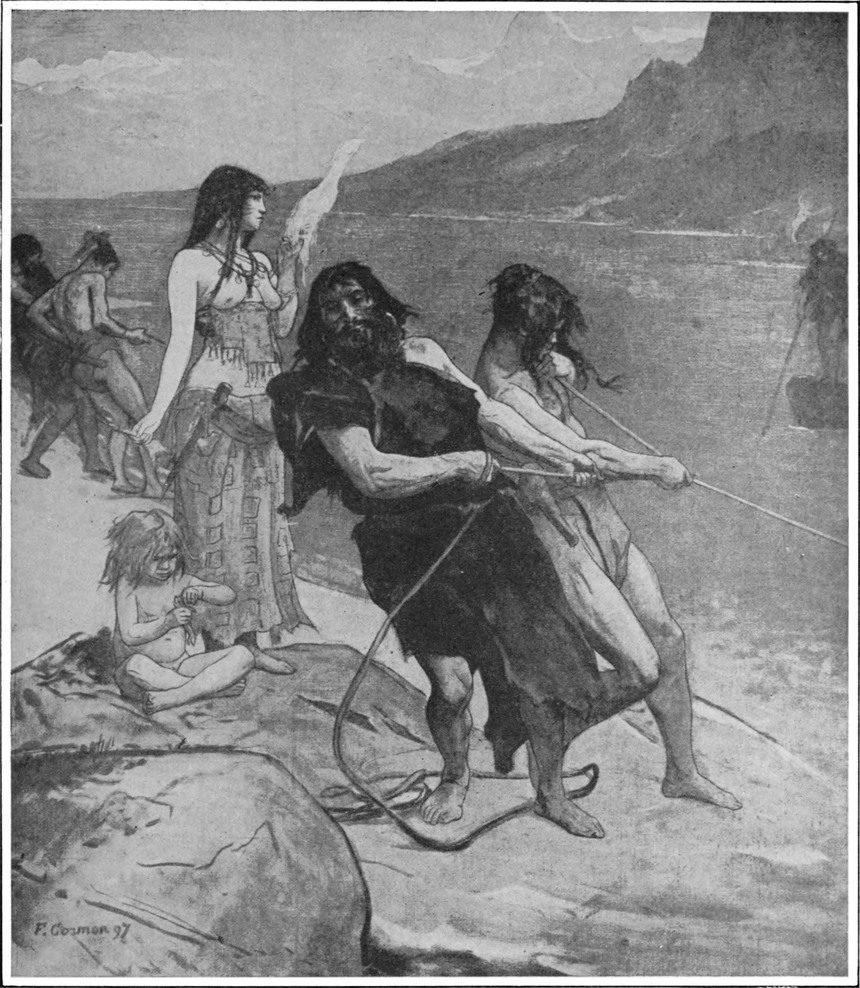
Mercier
PRIMITIVE NATURE FOLK ENGAGED IN FISHING
From the painting by Ferdinand Cormon.
The art of plaiting was known to Drift Man. This is shown by the ornaments on weapons and implements, the plaiting-needle from the find at the source of the Schussen, and the hurdlework represented on the message-stick mentioned above, which may be either a hurdle made of boughs and branches or a summer dwelling house. To these acquirements, based chiefly on an acquaintance with serviceable weapons and implements, is added the art of representing natural objects by drawing and carving. This results in the attempt to retain historical momenta in the form of abridged illustrations for the purpose of communicating them to others—incipient picture-writing. The tally shows the method of representing numbers—generally only one stroke each, but also two strokes connected by a line to form a higher unit. Of the art of building not a trace is left to us apart from the laying together of rough stones for fireplaces; nor have tombs of that period of ancient times been discovered.
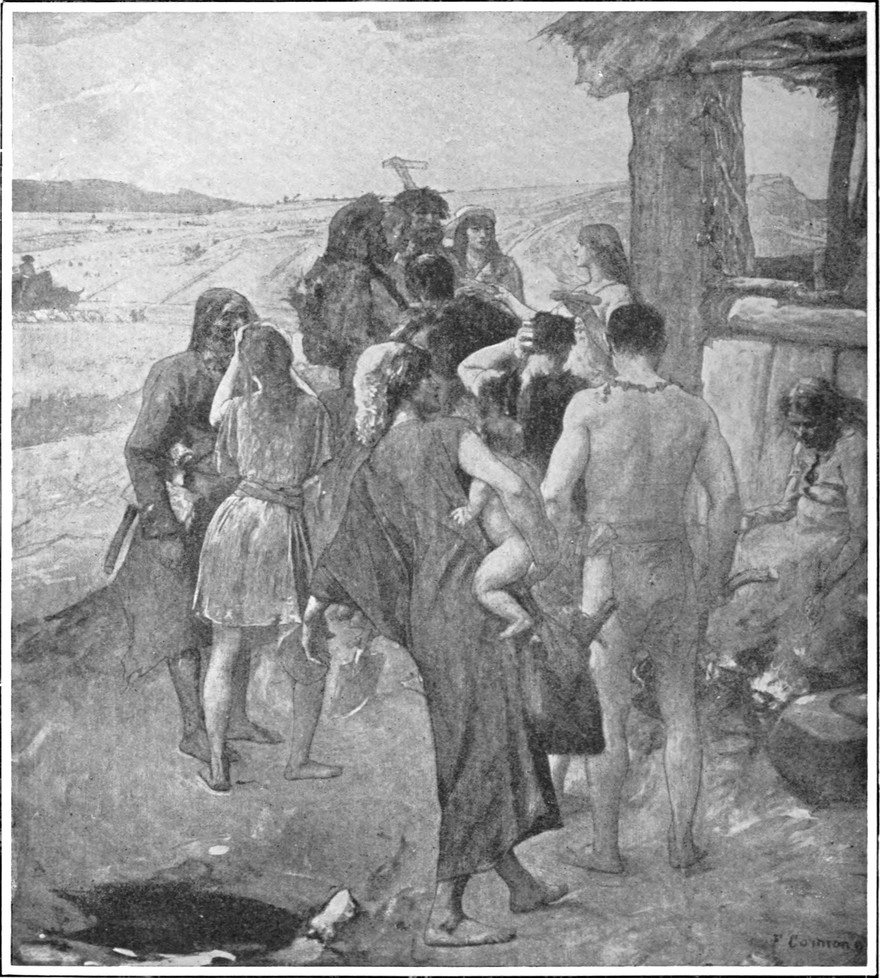
Mercier
EARLY AGRICULTURISTS, WITH IMPLEMENTS OF BONE, STONE, AND BRONZE
From the painting by Ferdinand Cormon.
The civilisation of Drift Man and his whole manner of life do not confront the present human race as something strange, but fit perfectly into the picture exhibited by mankind at the present day. Drift Man nowhere steps out of this frame. If a European traveller were nowadays to come upon a body of Drift men on the borders of eternal ice, towards the north or south pole of our globe, nothing would appear extraordinary and without analogy to him; indeed it would be possible for him to come to an understanding with them by means of picture-writing, and to do business with them by means of the tally.
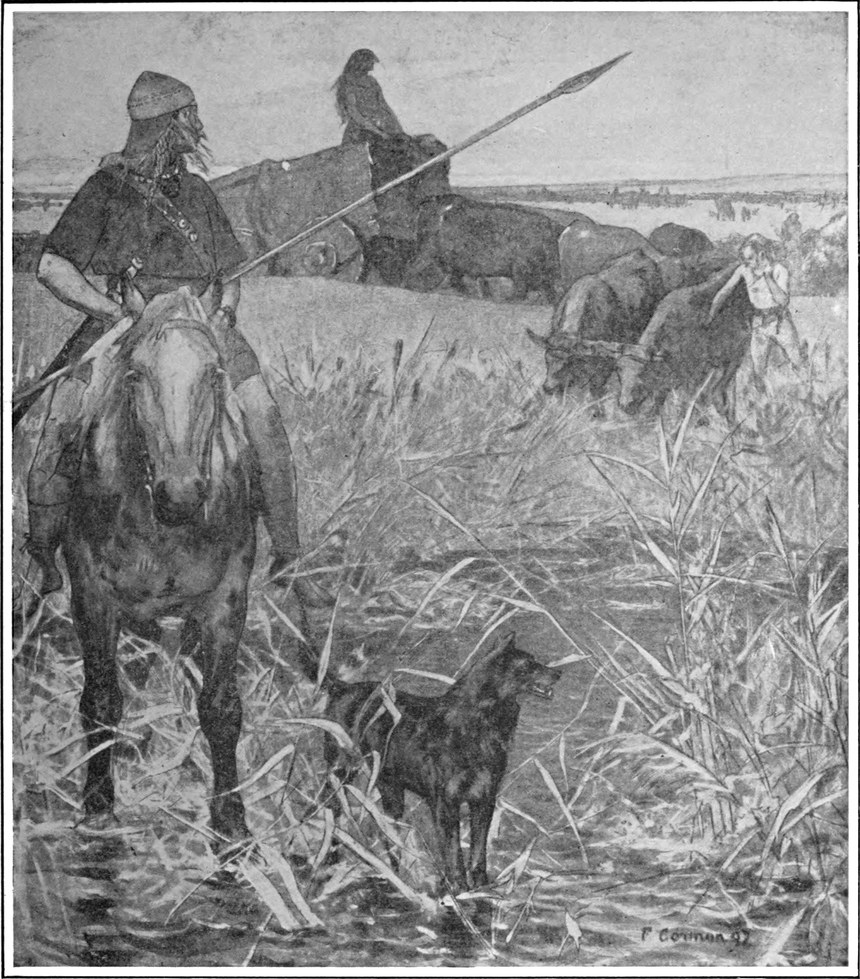
Mercier
AN EMIGRATION OF THE GAULS IN THE BRONZE AGE
From the painting by Ferdinand Cormon.
The manner of life led by man beyond the borders of higher civilisation, especially under extreme climatic conditions, depends almost exclusively on his outward surroundings and the possibility of obtaining food. The Esquimaux, who, like Drift Man of Central Europe in former times, live on the borders of eternal ice with the Drift animals that emigrated thither,—the reindeer, musk-ox, bear, Arctic fox, etc.—are restricted, like him, to hunting and fishing, and to a diet consisting almost entirely of flesh and fat; corn-growing and the keeping of herds of domestic animals being self-prohibitive. Their kitchen refuse exactly resembles that from the Drift. Before their acquaintance with the civilisation of modern Europe they used stone and bone besides driftwood for making their weapons and implements, as they still do to a certain extent at the present day, either from preference or from superstitious ideas. Their binding material consisted of threads twisted from reindeer sinews, with which they sewed their clothes and fastened their harpoons and arrows, the latter resembling in form those of Drift Man. They knew no more than he the arts of spinning and weaving, their clothes being made from the skins of the animals they hunted; pots were unknown and unnecessary to them.
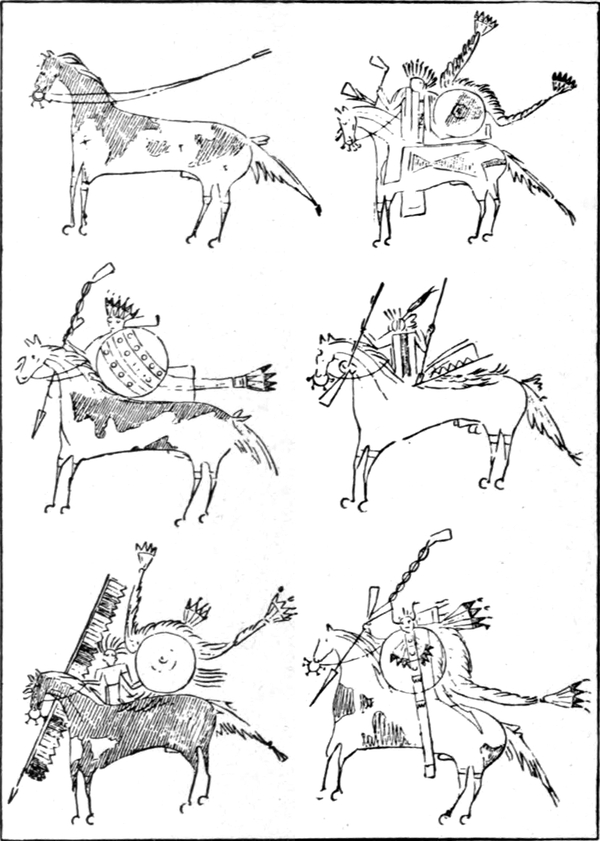
PRIMITIVE ART OF OUR OWN DAY
The picture-writing of the American Indians in our own day offers an interesting parallel to that of the primitive peoples of the remotest past. The Pawnees decorate their buffalo robes with such drawings as these, representing a procession of medicine men, the foremost giving freedom to his favourite horse as a sacrifice to the Great Spirit.
It has often been thought that we should have a definite criterion of the period if it could be proved that fresh mammoth ivory was employed at the particular time for making implements and weapons, or ornaments, carvings, and drawings. There can be no doubt that when Drift Man succeeded in killing a mammoth he used the tusks for his purposes. But on the borders of eternal ice, where alone we could now expect to find a frozen Drift Man, no conclusion could be drawn from objects of mammoth ivory being in the possession of a corpse to determine the great age of the latter. For the many mammoth tusks which have been found and used from time immemorial in North Siberia, on the New Siberian Islands, and in other places, are absolutely fresh, and are even employed in the arts of civilised countries in exactly the same way as fresh ivory. Under the name of “mammoth ivory” the fossil tusks dug up by ivory-seekers, or mammoth-hunters, form an important article of commerce.
The same conditions as many parts of Northern Siberia still exhibit at the present day prevailed over the whole of Central Europe at the end of the Glacial Period and the beginning of the Postglacial Period. Here man lived on frozen ground on the borders of ice-fields with the reindeer and its companions, as he does to-day in Northern Asia, and here, too—as he does there to-day—he must have found the woolly-haired mammoth preserved by the cold in the ice and frozen ground. The Drift reindeer-men of Central Europe presumably searched for mammoth tusks just as much as the present reindeer-men in North Asia. The great field of mammoth carrion at Predmost was, therefore, a very powerful attraction, not only for the beasts of prey—chief among them wolves—but also for man.
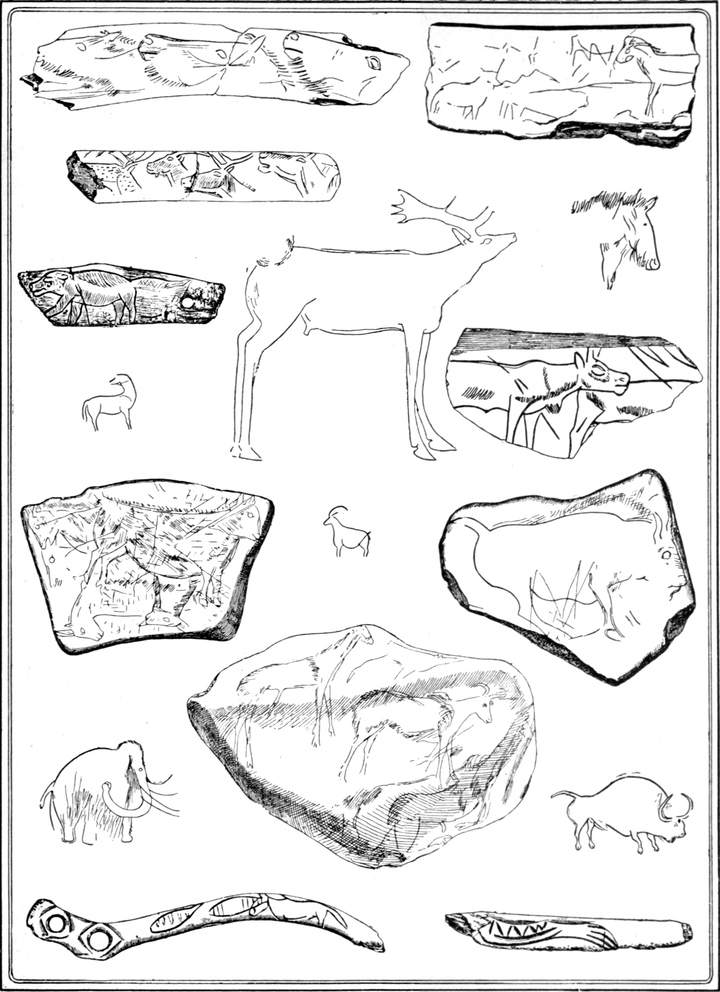
THE EARLIEST ART: MANKIND’S FIRST EFFORTS IN PICTURE-MAKING
These illustrations are of engravings on stone and bone and scratchings on rocks made by prehistoric man, chiefly in France. The figures of the reindeer and those of the mammoth and the bison, the two latter found at Dordogne, are astonishingly good, and indicate genuine power of draughtsmanship at a remote period of human life.
LARGER IMAGE
Drift Man Compared with Modern Man
In France especially many primitive works of art of the “Ivory Epoch” have been found, and even the nude figure of woman is not wanting; but no proof is given that these carvings belong to the time when the mammoth still lived. Much sensation has been caused by an engraving on a piece of mammoth ivory representing a hairy mammoth with its mane and strongly-curved tusks. This illustration has been taken as unexceptionable proof that the artist of the Drift Period who did it saw and portrayed the mammoth alive. But could the mammoth hunter Schumachow—the Tunguse who, in 1799, discovered, in the ice of the peninsula of Tumys Bykow at the mouth of the Lena, the mammoth now erected in the collection at the St. Petersburg Academy [see page 123]—have pictured the animal otherwise when it was freshly melted out of the ice? And the Madelaine cave in the Périgord, where the piece of ivory with the picture of the mammoth was found, certainly belongs to the Reindeer Period. Had we not independent proofs that Drift Man lived in Central Europe—for instance, at Taubach—with the great extinct pachydermata, neither the finds in the “loess” near Predmost, nor the articles of ivory, nor the illustration of the mammoth itself, could prove it. They furnish absolute proof of the existence of Drift Man only back to the Reindeer Period. To decide whether a corpse frozen in the stone-ice belonged to a Drift Man, the examination of the corpse itself, its skull, bones, and soft parts, would no more suffice than clothing, implements, and ornament. For at least so much is confidently asserted by many palæontologists, that all the skulls and bones hitherto known to have been ascribed to Drift Man by the most eminent palæontologists, geologists, and anthropologists, cannot be distinguished from those of men of the present day. Von Zittel, the foremost scholar in the field of palæontology in Germany, says:
The only remains of Drift Man of reliable age are a skull from Olmo, near Chiana, in Tuscany; a skull from Egisheim, in Alsace; a lower jaw from the Naulette cave near Furfooz, in Belgium; and a fragment of jaw from the Schipka cave in Moravia. This material is not sufficient for determining race, but all human remains of reliable age from the drift of Europe, and all the skulls found in caves, agree in size, form, and capacity with Homo sapiens, and are well formed throughout. In no way do they fill the gap between man and ape.
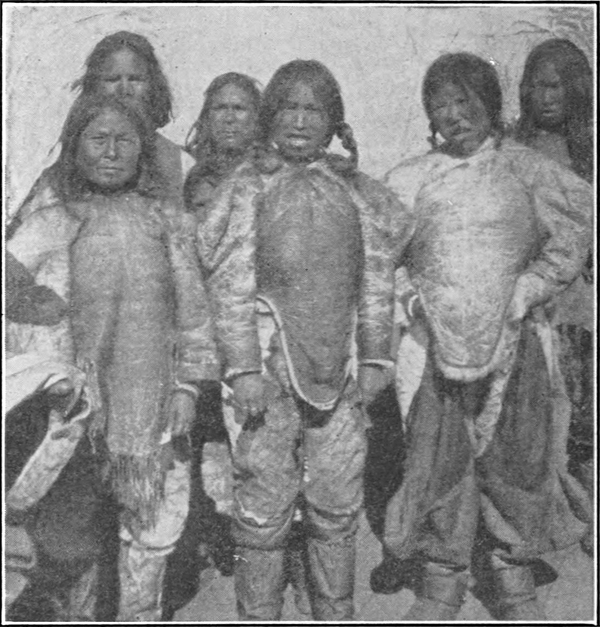
PRIMITIVE PEOPLE OF TO-DAY
Until they came in touch with European travellers the Esquimaux were in precisely the same condition as Drift Man: they were living in the Ice Age. They are but little more advanced now, and the difference between them and prehistoric men is slight. This is a group of young Esquimau women.
“On the other hand,” writes Dr. Chalmers Mitchell, “a large majority of modern anatomists and palæontologists accept the antiquity of such skulls as the Neanderthal specimen, and agree that these point to the existence of a human race inferior to any now existing. This race comprised powerfully-built individuals, with low foreheads, prominent, bony ridges above the eyes, and retreating chins. The radius and ulna were unusually divergent, so that the forearms must have been heavy and clumsy. The thigh-bones were bent and the shin-bones short, so that the race must have been bow-legged and clumsy in gait.”
A Type Between Man and Ape?
“The intermediate position of these primitive types has received extraordinary confirmation by the discovery of what may truly be called the link, no longer missing, between man and the apes. In 1894, Dr. Eugene Dubois discovered in the Island of Java in a bed of volcanic ashes containing the remains of Pliocene animals the roof of a small skull, two grinding-teeth, and a diseased femur. These remains indicate an animal which, when erect, stood not less than 5 ft. 6 in. high. The teeth and thigh-bones were very human, and the skull, although very human, had prominent eyebrow ridges like those of the Neanderthal type, and a capacity of about 1,000 cubic centimetres—that is to say, much greater than that of the largest living apes, and falling short by about 100 cubic centimetres of the largest skull capacities of existing normal human beings. This creature, regarded at first by some anatomists as a degenerate man, by others as a high ape, has now been definitely accepted as a new type of being, intermediate between man and the apes and designated as Pithecanthropus erectus.” There is no doubt that Asia, Europe, North Africa, and North America, so far as their ice-covering allowed of their being inhabited, form one continuous region for the distribution of Palæolithic Man, in which all discoveries give similar results. In this vast region the lowest and oldest prehistoric stratum that serves as the basis of historical civilisation is the homogeneous Palæolithic stratum. In the Drift Period, Palæolithic Man penetrated into South America, as into a new region, with northern Drift animals. In Central and South Africa and Australia, Palæolithic Man does not yet seem to be known. All the more important is it that in Tasmania Palæolithic conditions of civilisation existed until the middle of the last century.
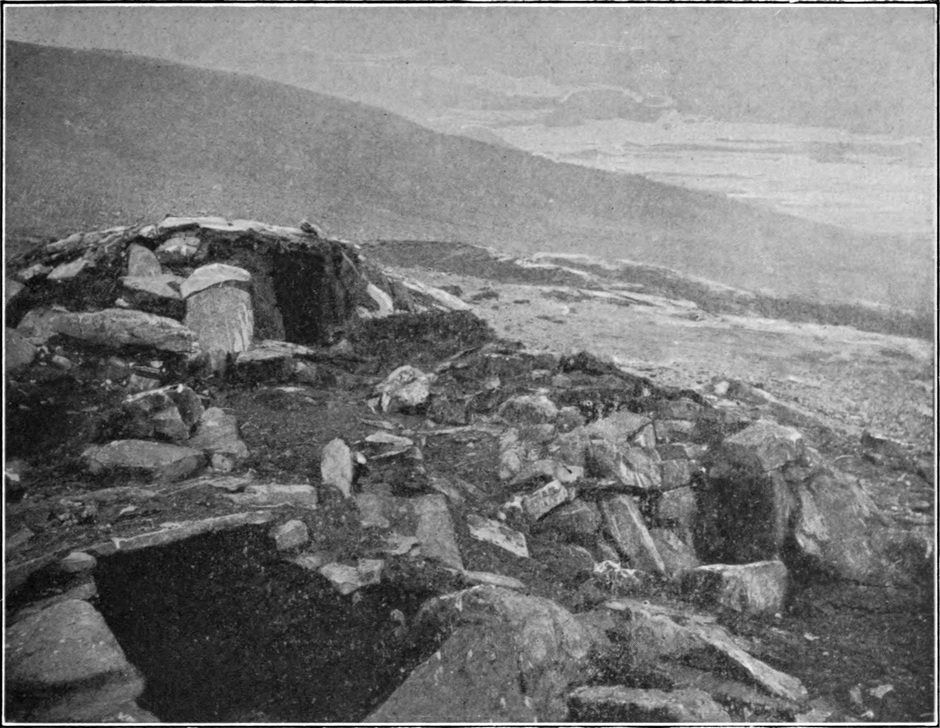
THE HOMES OF PRIMITIVE PEOPLE OF THE PRESENT DAY
There are people still living in dwelling-places of prehistoric type. This photograph of Esquimau stone and turf huts, in Greenland, shows exactly the kind of dwellings used by prehistoric men in the Ice Age.
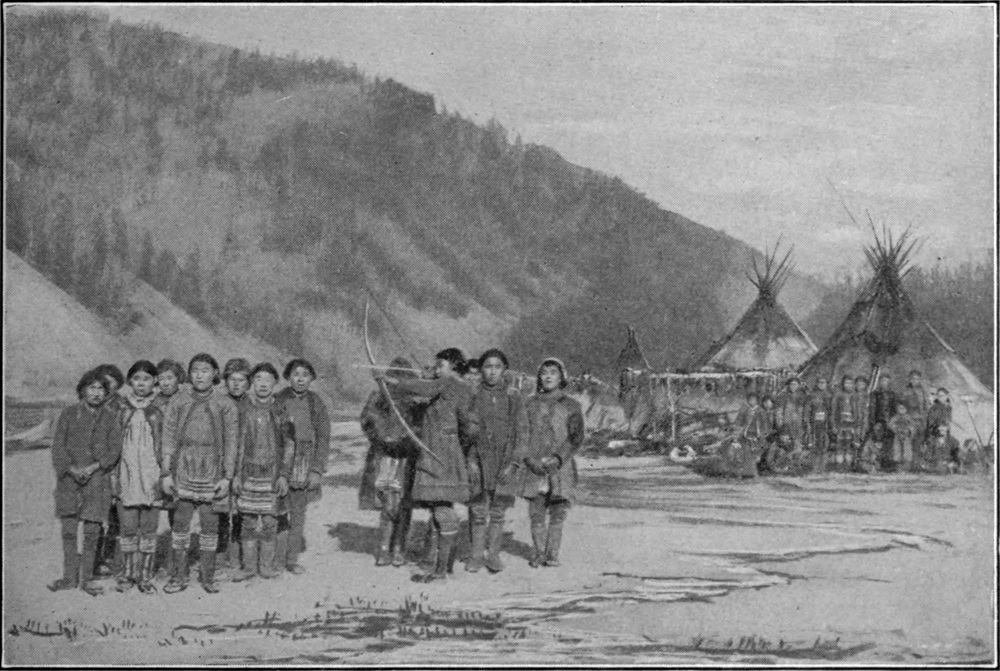
THE GRADUAL EXTINCTION OF PRIMITIVE PEOPLES
The Yukaghirs, natives of Siberia, a division of the Mongolic family, were formerly a wide-spread race, and, according to their national tradition, were so numerous that “the birds flying over their camp fires became blackened with smoke.” The Jesup Expedition found them reduced to 700 in number. Hunger had forced some of them to cannibalism and suicide. They are a primitive people, but considerably superior to the Esquimaux.
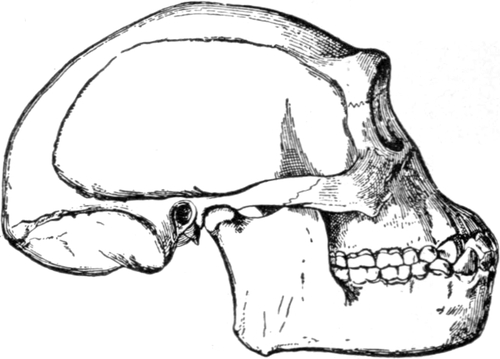
A CREATURE BETWEEN APE AND MAN
The skull of the Fossil Ape-man found in 1894, in the island of Java; restored by Dr. Eugene Dubois.
Backward Races of Europe
The palæontology of man has hitherto obtained good geological information of the oldest Palæolithic culture-stratum of the Drift in only a few parts of the earth, and only in Tasmania does this oldest stratum appear to have cropped out free, and still uncovered by other culture strata, down to our own times. Otherwise it is everywhere overlaid by a second, later culture-stratum of much greater thickness, which, although opened up in almost innumerable places, is not spread over the whole earth as is the Palæolithic stratum. As opposed to the earliest Stone Age of the Drift, which we have come to know as the Palæolithic Period, this has been called the Later Stone Age or Neolithic Period.
The Neolithic Period is also ignorant of the working of metals; for weapons and implements, stone is the exclusive hard material of which the blades are made. But geologically and palæontologically the two culture-strata are widely and sharply separated.
As regards Europe, and a large part of the other continents, the second stratum of the culture of the human race still lies at prehistoric depth. But in other extensive parts of the earth the stratum of Neolithic culture was not covered by other culture-strata until far into the period of written history. Even a large part of Europe was still inhabited by history-less tribes of the later Stone Age at the time when the old civilised lands of Asia and of Africa, and the coasts of the Mediterranean, had everywhere—on the basis of the same Neolithic elements, with the increasing use of metals—already risen to that higher stage of civilisation which, with the historical written records of Egypt and Babylonia, forms the basis of our present chronology.
When these civilised nations came into direct contact with the more remote nations of the Old World, they found them, as we have said, still, to a certain extent, at the Neolithic stage of civilisation, just as, when Europeans settled in America, the great majority of the aborigines had not yet passed the Neolithic stage, at which, indeed, the lowest primitive tribes of Central Brazil still remain. Australia, and a large part of the island world of the South Sea, had not yet risen above the Neolithic stage (Tasmania, probably, not even above the Palæolithic) when they were discovered. There the Stone Age, to a certain extent, comes down to modern times; likewise in the far north of Asia, in Greenland, in the most northern parts of America, and at the south point of the New Continent among the Fuegians.
The men of the later Stone Age are the ancestors of the civilised men of to-day. Classical antiquity among Greeks and Romans had still a consciousness of this, at least partly; it was not entirely forgotten that the oldest weapons of men did not consist of metal, but of stone, and even inferior material. The worked stones which the people then, as now, designated as weapons of the deity, as lightning-stones or thunderbolts, were recognised by keener-sighted men as weapons of primeval inhabitants of the land.
What the Kitchen Middens Tell Us
The “kitchen middens” on the Danish coasts mark places of more or less permanent settlement, consisting of more or less numerous individual dwellings. From these middens a rich inventory of finds has been made, affording a glimpse of the life and doings of those ancient times. The heaps consist principally of thousands upon thousands of opened shells of oysters, cockles, and other shellfish still eaten at the present day, mingled with the bones of the roe, stag, aurochs, wild boar, beaver, seal, etc. Bones of fishes and birds were also made out, among the latter being the bones of the wild swan and of the now extinct great auk, and, what is specially important in determining the geological age of these remains, large numbers of the bones of the capercailzie. Domestic animals are absent with the exception of the dog, whose bones, however, are broken, burnt, gnawed in the same way as those of the beasts of the chase. Everything proves that on the sites of these middens there formerly lived a race of fishers and hunters, whose chief food consisted of shellfish, the shells of which accumulated in mounds around their dwellings. Proofs of agriculture and cattle-rearing there are none; the dog alone was frequently bred not only as a companion in the chase, but also for its flesh.
The state of civilisation of the old Danish shellfish-eaters was not quite a low one in spite of its primitive colouring, and in essential points was superior to that of Palæolithic Man. Not only had they tamed a really domestic animal, the dog, but they made and used clay vessels for cooking and storing purposes. The cooking was done on fireplaces. They could work deer-horn and bone well. Of the former hammer-axes with round holes were made, and of animal bones arrow-heads, awls, and needles, with the points carefully smoothed. Small bone combs appeared to have served not so much for toilet purposes as for dividing animal sinews for making threads, or for dressing the threads in weaving.
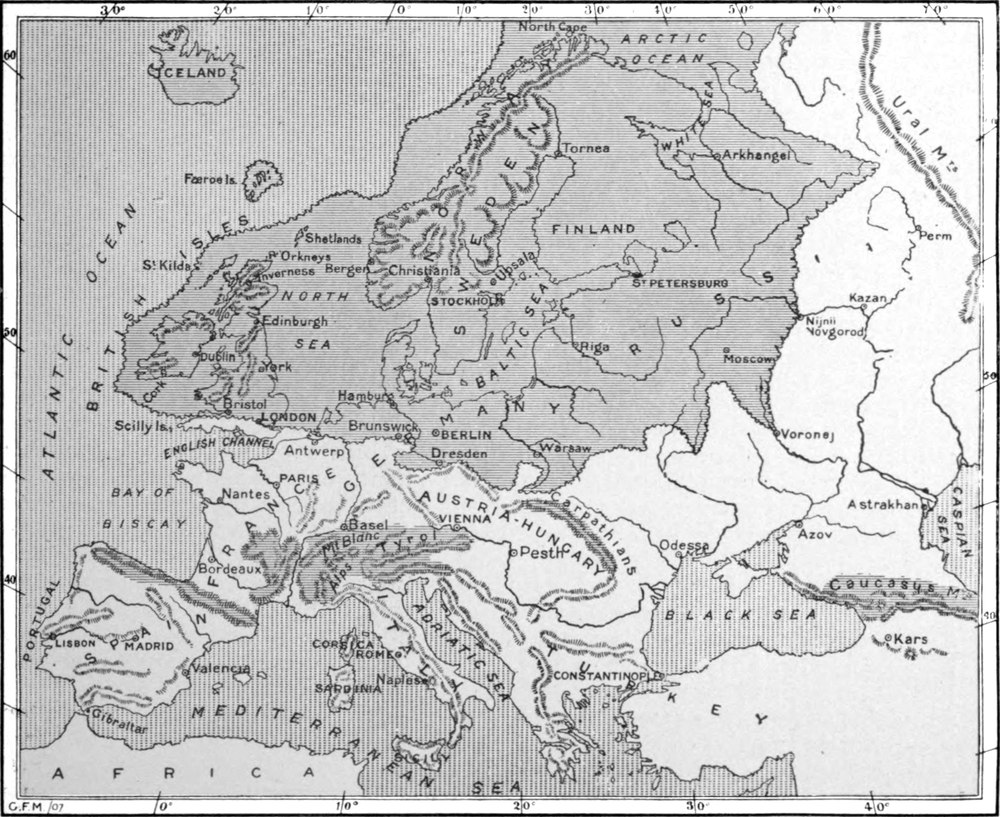
EUROPE IN THE ICE AGE
The map illustrates the extent of the Ice Age in Europe. It will be noticed that in England the ice-cap did not extend south of the position of London though it occurred much further south in the mountain regions of the Pyrenees, the Alps, Tyrol, the Carpathians and the Caucasus. The dark portions of the map represent the extent of the ice.
Drift Man and His Adversaries
In the way of ornaments there were perforated animal teeth. The fish remains found in the middens belong to the plaice, cod, herring, and eel. To catch these deep-sea fish the fishermen must have gone out to sea, which implies the possession of boats of some kind. Nor was only small game hunted, but also large game. Ninety per cent. of the animal bones occurring in the shell-mounds consist of those of large animals, especially the deer, roe, and wild boar. Even such dangerous adversaries as the aurochs, bear, wolf, and lynx were killed, likewise the beaver, wildcat, seal, otter, marten, and fox. The very numerous fragments of clay vessels belong partly to large pot-like vessels without handles and with pointed or flat bottoms, and partly to small oval bowls with round bottoms. All vessels were made with the free hand of coarse clay, into which small fragments of granitic stone were kneaded; as ornament they have in a few cases incisions or impressions, mostly made with the finger itself on the upper edge.
The great importance of the Danish middens in the general history of mankind is due to the fact that their age is geologically established, so that they can serve as a starting-point for chronology. It is to Japetus Steenstrup that the early history of our race owes this chronological fixing of an initial date.
The First Elements of Civilisation
The earliest inhabitants of the North of Europe during the Stone Age, as recorded by these kitchen-middens of the Danish period, were scarcely superior to Palæolithic Man in civilisation, judging from outward appearances. But a closer investigation taught us that, in spite of the poverty of their remains, a higher development of civilisation is unmistakable. And this superiority of the Neolithic over the Palæolithic Epoch becomes far more evident if we take as our standard of comparison, not the poor fisher population, who probably first reached the Danish shores as pioneers, but the Neolithic civilisation that had been fully developed in sunnier lands and followed closely upon these trappers or squatters. Next to hunting and fishing, cattle-breeding and agriculture are noticeable as the first elements of Neolithic civilisation, and in connection with them the preparation of flour and cooking; and as technical arts, chiefly carving and the fine working of stone, of which weapons and the most various kinds of tools were made; with the latter wood, bone, deer-horn, etc., could be worked. The blades are no longer sharpened merely by chipping, but by grinding, and are made in various technically perfect forms. Special importance was attached to providing them with suitable handles, for fixing which the stone implement or weapon was either provided with a hole, or, as in America especially, with notches or grooves.
The Mental Life of Ancient Days
In addition to these, there are the primitive arts of man—the ceramic art, spinning, and weaving. In the former, especially, an appreciation of artistic form and decoration by ornament is developed. The ornament becomes a kind of symbolical written language, the eventual deciphering of which appears possible in view of the latest discoveries concerning the ornamental symbolism of the primitive races of the present day. Discoveries of dwellings prove an advanced knowledge of primitive architecture; entrenchments and tumuli acquaint us with the principles of their earthworks; and the giant chambers, built of colossal blocks of stone piled upon one another, prove that the builders of those times were not far behind the much-admired Egyptian builders in transporting and piling masses of stone. The burials, whose ceremonies are revealed by opened graves, afford a glimpse of the mental life of that period. From the skulls and skeletons that have been taken from the Neolithic graves, science has been able to reconstruct the physical frame of Neolithic Man, which has in no way to fear comparison with that of modern man. Of the ornaments of the Stone Age the most important and characteristic are perforated teeth of dogs, wolves, horses, oxen, bears, boars, and smaller beasts of prey. How much in favour such ornaments were is proved by the fact that even imitations or counterfeits of them were worn. Numerous articles of ornament, carved from bone and deer-horn, were universal: ornamental plates and spherical, basket-shaped, square, shuttle-like, or chisel-shaped beads were made of these materials and formed into chains.
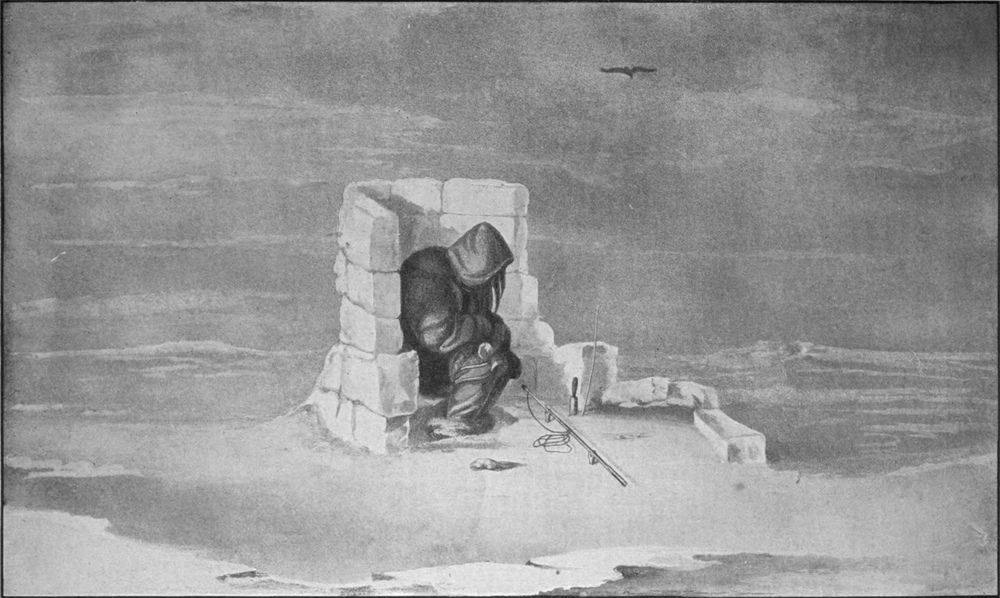
THE ICE AGE IN THE PRESENT DAY: AN ESQUIMAU WATCHING A SEAL HOLE
LARGER IMAGE
In the Swiss lake-dwellings of the Stone Age have been found skilfully carved ear-drops, needles with eyes, neat little combs of boxwood, and hairpins, some with heads and others with pierced side protuberances. Remains of textile fabrics, even finely twilled tissue, and also leather, were yielded by the excavations of the lake-dwellings of that period, so that we have to imagine the inhabitants adorned with clothes of various kinds.
Man’s First and Oldest Animal Friend
What raises man of the later Stone Age so far above Palæolithic Man is the possession of domestic animals and the knowledge of agriculture. As domestic animals of the later Stone Age we have proof of the dog, cow, horse, sheep, goat, and pig. Among the animals that have attached themselves to man as domestic, the first and oldest is undoubtedly the dog. It is found distributed over the whole earth, being absent from only a few small islands. Among many races the dog was, and is still, the only domestic animal in the proper sense of the word. This applies to all Esquimau tribes, to the majority of the Indians of North and South America, and to the continent of Australia.
We have no certain proofs that Palæolithic Man possessed the dog as a domestic animal. In the Somme valley, at Taubach, and at the source of the Schussen, bones of the domestic dog are absent. And yet, among Drift fauna in caves remains of dogs have been repeatedly met with, which have been claimed to be the direct ancestors of the domestic dog. The dog’s attachment to man may have taken place at different times in different parts. Man and dog immigrate to South America with the foreign Northern fauna simultaneously—in a geological sense—during the Drift. In Australia, man and dog (dingo), as the most intimate animal beings, are opposed to an animal world that is otherwise anomalous and, to the Old World, quite antiquated; probably man and dog also came to Australia together. We know of fossil remains of the dingo from the Drift, but no reliable finds have yet proved the presence of man during that period.
The Dog in the Stone Age
In the later Stone Age the dog already occurs as the companion of man wherever it occurs in historic times. In Europe its remains have been found in the Danish kitchen-middens, in the northern Neolithic finds, in the lake-dwellings of Switzerland, in innumerable caves of the Neolithic Period, in the terramare of Upper Italy, etc. It was partly a comparatively small breed, according to Rütimeyer similar to the “wachtelhund” (setter) in size and build. Rütimeyer calls this breed the lake-dwelling dog, after the lake-dwellings, one of the chief places where it has been found. Like all breeds of animals of primitive domestication, the dog at this period, according to Nehring, is small—stunted, as it were. With the progress of civilisation the dog also grows larger.
Great Value of the Dog to Man
In the later prehistoric epochs, beginning with the so-called “Bronze” Period, we find throughout almost the whole of Europe a rather larger and more powerful breed with a more pointed snout—the Bronze dog—whose nearest relative seems to be the sheep-dog. At the present day the domestic dog is mostly employed for guarding settlements and herds and for hunting. In the Arctic regions the Esquimaux also use their dogs, which are like the sheep-dog, for personal protection and hunting; they do particularly good service against the musk-ox, while the wild reindeer is too fast for them. But the Esquimau dog is chiefly used for drawing the sledge, and, where the sledge cannot be used, as a beast of burden, since it is able to carry fairly heavy loads. In China and elsewhere, as formerly in the old civilised countries of South America, the dog is still fattened and killed for meat. So that the domestic dog serves every possible purpose to which domestic animals can be put, except, it seems, for milking, although this would not be out of the question either. The dog was also eaten by man in the later Stone Age, as is proved by the finds in his kitchen refuse. The reindeer is now restricted to the Polar regions of the Northern Hemisphere—Scandinavia, North Asia, and North America, whereas in the Palæolithic Period it was very numerous throughout Russia, Siberia, and temperate Europe down to the Alps and Pyrenees. It does not seem ever to have been definitely proved that the reindeer existed in the Neolithic Period of Central and Northern Europe, although according to Von Zittel it lived in Scotland down to the eleventh century and in the Hercynian forest until the time of Cæsar. The earliest definite information we appear to have of the tamed reindeer, which at the present day is a herd animal with the Lapps in Europe, and with the Samoyedes and Reindeer Tunguses in Asia, is found in Ælian, who speaks of the Scythians having tame deer.
Oxen at present exist nowhere in the wild state, while the tame ox is distributed as a domestic animal over the whole earth, and has formed the most various breeds. In the European Drift a wild ox, the urus, distinguished by its size and the size of its horns, was widely distributed, and it still lived during the later Stone Age with the domestic ox. In the later prehistoric ages, and even in historic times, the urus still occurs as a beast of the forest.
The Taming of the Wild Horse
In the later Stone Age the horse, too, is no longer merely a beast of the chase, but occurs also in the tame state. During the Drift the horse lived in herds all over Europe, North Asia, and North Africa. From this Drift horse comes the domestic horse now found all over the earth. Even the wild horses of the Drift exhibit such considerable differences from one another that, according to Nehring’s studies, these are to be regarded as the beginning of the formation of local breeds. The taming and domestication of the wild horse of the Drift, which began in the Stone Age, led to the domestic horse being split up later into numerous breeds. The old wild horse was comparatively small, with a large head; a similar form is still found here and there on the extensive barren moors of South Germany in the moss-horse, or, as the common people call it, the moss-cat. At the present day the genus of the domestic horse falls, like the ox, into two chief breeds—a smaller and more graceful Oriental breed, and a more powerful and somewhat larger Western breed with the facial bones more strongly developed. The horse of the later Stone Age of Europe exhibits only comparatively slight differences from the wild horse; it is generally a small, half-pony-like form with a large head, evidently also a stunted product of primitive breeding under comparatively unfavourable conditions. Two species extant in the Stone Age still live wild on the steppes of Central Asia at the present day; one of them also occurs as a fossil in the European Drift, although only rarely. That the ass occurred in the European Drift is probable, but not proved. It has not yet been found in the Neolithic Period of Europe.
Did the Horse come from Asia?
A survey of the palæontology of the domestic animals shows that they come from wild Drift species which—at any rate, as regards the ox, horse, and dog—are now extinct, so that these most important domestic animals now exist only in the tame state. Some of the domestic animals came from Asia, and, according to Von Zittel, were imported into Europe from there; this applies to the peat-ox and the domestic goat and pig. The Asiatic origin of the domestic horse and sheep is probable, but not proved; the sheep is found wild in South Europe as well as in Asia. The tarpan, a breed of horse very similar to the wild horse, lives in herds independent of man on the steppes of Central Asia. This has been indicated as being probably the parent breed of the domestic horse, and the origin of the latter has accordingly also been traced to Asia.
One thing is certain: a considerable number of animal forms that co-exist with man in Europe at the present day—for instance, almost all the forms of our poultry and the fine kinds of pigs and sheep—have originally come from Asia. Our investigations show a similar state of things even in the Neolithic Period.
In the North of Europe, which has furnished us with our standard information regarding the Neolithic culture-stratum, the certain proofs that have hitherto been found of agriculture and the cultivation of useful plants having been practised at that time (to which civilisation owes no less than to the breeding of useful tame animals) consist not so much of plant remains themselves as of stone hand-mills and spinning and weaving implements, which indicate the cultivation of corn and flax.
History in the Lake Dwellings
Our chief knowledge of Neolithic agriculture and plant culture has been furnished by the lake-dwellings, especially those of Switzerland, which have preserved the picture of the Neolithic civilisation of Central Europe, sketched for us, as it were, in the North, in its finest lines. So far we can prove the cultivation of the following useful plants in the later Stone Age; their remains were chiefly found, as we have said, well preserved in the Stone Age lake-dwellings of Switzerland, which have been described in classical manner by Oswald Heer. Of cereal grasses Heer determined, in the rich Stone Age lake-dwellings of Wangen, on Lake Constance, and Robenhausen, in Lake Pfäffikon, three sorts of wheat and two varieties of barley—the six-rowed and two-rowed. Flax was also grown by Neolithic Man. This was, it seems, a rather different variety from our present flax, being narrow-leaved, and still occurs wild, or probably merely uncultivated, in Macedonia and Thracia. Flax has also been found growing wild in Northern India, on the Altai Mountains, and at the foot of the Caucasus.
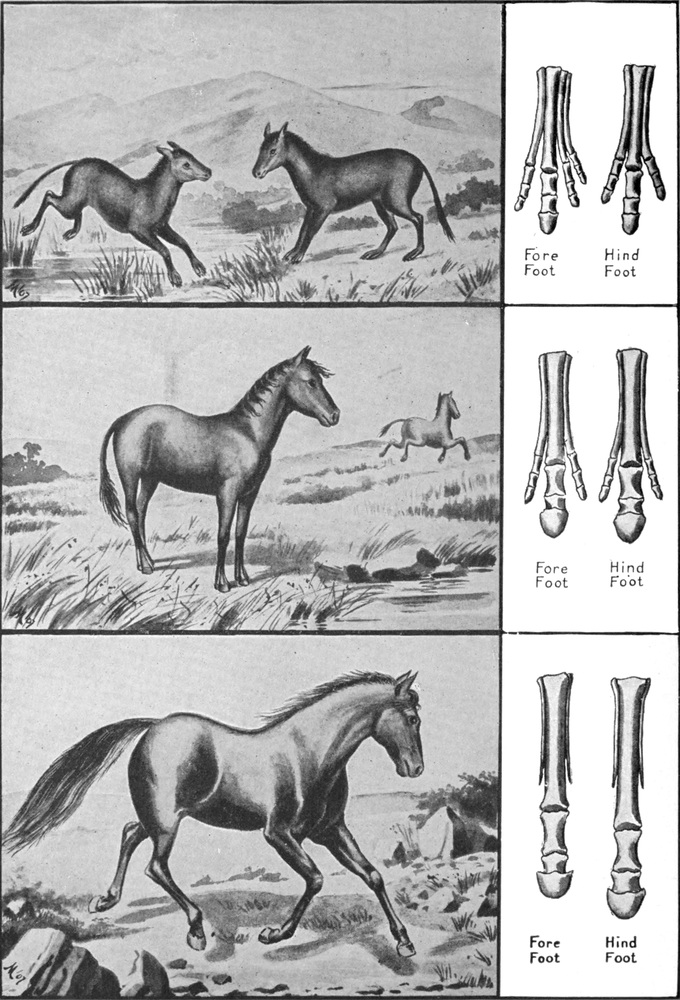
THE DEVELOPMENT OF THE HORSE
The horse which was common in the Stone Age was a wild ancestor of our own domestic horse, but not quite so large or so strong as the average well-bred creature familiar in our modern life. Its remotest ancestor was the Hyracotherium, or Orohippus, while an intermediary stage was that of the Hypparion, or Protohippus, in which, as shown in the diagram, the change from the foot to the hoof had advanced to a very great extent.
LARGER IMAGE
The common wheat occurring in the lake-dwellings of the Stone Age is a small-grained but mealy variety; but the so-called Egyptian wheat with large grains also occurs.
Gardening in the Stone Age
Traces of regular gardening and vegetable culture are altogether wanting. Some finds, however, seem to indicate primitive arboriculture, apples and pears having been found dried in slices in the lake-dwellings of the Stone Age; there even appears to be an improved kind of apple besides the wild-growing crab. But although they are chiefly wild unimproved fruit-trees of whose fruit remains have been found, we can imagine that these fruit-trees were planted near the settlements, and the great nutritious and health-giving properties of the fruit, as a supplement to a meat fare, must have been all the more appreciated owing to the lack of green vegetables. The various wild cherries, plums, and sloes were eaten, as also raspberries, blackberries, and strawberries. Beechnut and hazelnut appear as wild food-plants.
The original home of the most important cereals—wheat, spelt, and barley—is not known with absolute certainty; probably they came from Central Asia, where they are said to be found wild in the region of the Euphrates. The real millet came from India; peas and the other primeval leguminous plants of Europe, such as lentils and beans, came likewise from the East, partly from India. So that, apart from flax, which probably has a more northern home, the regular cultivated plants of the Stone Age of Central Europe—cereal grasses, millet, and lentils—indicate Asia as their original home. We have therefore a state of things similar to that observed in the case of the domestic animals.
Beginning of the Potter’s Art
The potter’s art was probably entirely unknown to Palæolithic Man, for in none of the pure Drift finds have fragments of clay vessels been found. So where clay vessels or fragments of them occur, they appear as the proof of a post-Drift period. On the other hand, pottery was quite general in the Neolithic Age of Europe. Still, the need of clay vessels is not general among all races of the earth even at the present day; up to modern times there were, and still are, races and tribes without pots. From their practices it is evident that the European Stone men of the Drift could also manage to prepare their food, chiefly meat, by fire without cooking vessels. The Fuegians lay the piece of meat to be roasted on the glowing embers of a dying wood fire, and turn it with a pointed forked branch so as to keep it from burning. Meat thus prepared is very tasty, as it retains all the juice and only gets a rind on the top, and the ashes that adhere to it serve as seasoning in lieu of salt. On a coal fire not only can fish be grilled, stuck on wooden rods, but whole sheep can be roasted on wooden spits, precisely as people have the dainty of roast mutton in the East. To these may be added a large number of other methods of roasting, and even boiling, without earthen or metal vessels, which are partly vouched for by ethnography and partly by archæology, and some of which, like the so-called “stone-boiling,” are still practised at the present day.
No Perfect Pottery in the Stone Age
Although, according to this, pottery is not an absolute necessary of life for man, yet it is certain that even those poorly equipped pioneers who first settled in Denmark in the Pine Period, in spite of their having an almost or quite exclusive meat fare, had clay pottery in general use for preparing their food, and probably also for storing their provisions. As we have already shown, the remains that have been preserved in the kitchen-middens are the oldest that have been found in Denmark. Simple and rude as the numerous potsherds that occur may appear, they are of the highest importance on account of the proof of their great age. Unfortunately, as we have already seen, not a single perfect vessel has come to light. The fragments are very thick, of rough clay with bits of granite worked in, and are all made by hand without the use of the potter’s wheel. The pieces partly indicate large vessels, some with flat bottoms, and others with the special characteristic of pointed bottoms, so that the vessel could not be stood up as it was. Smaller bowls, frequently of an oval form, also occurred with rounded bottoms, so that they also could not stand by themselves. It is very important to note that on these fragments of pottery we find only extraordinarily scanty and exceedingly simple ornamental decorations, consisting merely of incisions, or impressions made with the fingers, on the upper edge.
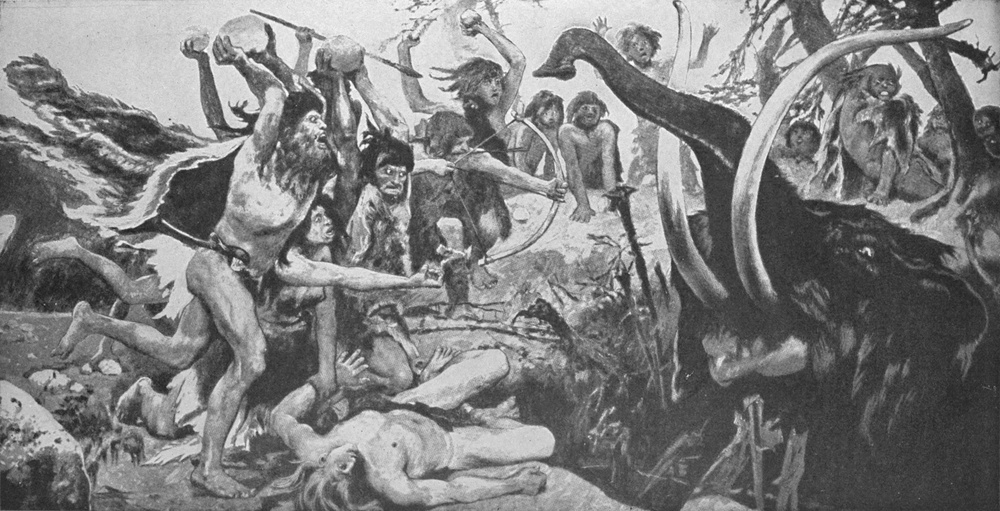
MAN’S FIGHT WITH THE GIANT ANIMALS OF THE ANCIENT WORLD
From the painting, “The Slaughter of a Mammoth,” by V. M. Vasnetsov, now in the Russian Historical Museum at Moscow.
LARGER IMAGE
We shall see how far this oldest pottery of the Stone Age is distinguished by its want of decoration from that of the fully-developed Stone Age. But it is very important to notice that this rudest mode of making clay vessels, which we here see forming the beginning of a whole series that rises to the highest pitch of artistic perfection, remained in vogue not only during the whole Stone Age, but even in much later times.
Stone Age Potter’s Handwork
It is true that in the fully developed neolithic Stone Age of Europe the clay pottery is also all made by hand, without the potter’s wheel, the oldest and rudest forms still occurring everywhere, as we have said; but besides these a great variety is exhibited in the size, form, and mode of production of the pottery. The clay is often finer, and even quite finely worked and smoothed, and the vessels have thin sides and are burnt right through. The thick fragments are generally only burnt outside, frequently only on one side, and so much that the clay has acquired a bright red colour, whereas the inside, although hard, has remained only a greyish black. We have numerous perfectly preserved vessels of the later Neolithic Age. They are frequently distinguished by an artistic finish and beauty of form, and on their surfaces we find ornaments incised or imprinted, but rarely moulded on them, which, although the style is only geometrical, cannot be denied a keen sense of beauty and symmetry. The clay vessels also show the beginning of coloured decoration. The incised strokes, dots, etc., are often filled out with white substance (chalk or plaster), which brings the patterns out into bold ornamental relief from the black or red ground of the surface.
After that it is no wonder that pottery advanced to the real coloured painting of the vessels during the Neolithic Period, at least in some places.
Growth of Artistic Taste
On these vessels the handle now appears, in its simplest form as a wart-like or flatter projection from the side of the vessel, pierced either vertically or horizontally with a narrow opening just large enough to admit of a cord being passed through. Other handles, just like those in use at the present day, are bowed out broad, wide, and high for holding with the hand. These generally begin quite at the top, at the rim of the vessel, and are continued from there down to its belly, whereas the first-mentioned are placed lower, frequently around the greatest circumference of the vessel.
There is no doubt whatever that in the main these clay vessels were made on the spot where we find their remains at the present day. This easily explains the local peculiarity that we recognise in various finds, by which certain groups may be defined as more or less connected with one another. Different styles may be clearly distinguished by place and group. But, this notwithstanding, wherever we meet with neolithic ceramics, they cannot conceal their homogeneous character. In spite of all peculiarities this general uniform style of the ceramics of the Stone Age, which we can easily distinguish and determine even under its various disguises, goes over the whole of Europe.
The Proofs of Man’s Mental Development
In finds that lie nearer to the old Asiatic centres of civilisation and to the coasts of the Mediterranean—as, for instance, at Butmir—the vessels are in part better worked, and the ornaments are richer and more elegant, and the spirals more frequent and more regular, and are sometimes moulded on, and sometimes, as we have mentioned, even painted in colour. But the general character remains unmistakably Neolithic, and may be found not only on the European coasts of the Mediterranean and the islands of the Ægean Sea, but in certain respects also in Mesopotamia and Egypt. The oldest Trojan pottery also exhibits unmistakable points of agreement with it.
Not only the stone weapons and implements, but, as far as we can see, even the remains of the oldest ceramics, show that uniform development of the culture of the Neolithic Period which proves a like course of mental development in mankind.
THE WORLD BEFORE HISTORY—V
Professor JOHANNES RANKE
THE HOME LIFE OF PRIMITIVE FOLK
What the Lake Dwellings Tell
A
A PICTURE, of unequalled clearness of delineation, of the general conditions of the life and culture of Central European Man during the Neolithic Period, was given, according to the results of the celebrated researches of Ferdinand Keller and his school of Swiss archæologists, by the lake-dwellings in the Alpine lowlands. Whereas in cave districts the caves and grottos often served the men of the later Stone Age as temporary and even as permanent winter dwellings, in the watery valleys of Switzerland the Neolithic population built its huts on foundations of piles in lakes and bogs. In that period we have to imagine the Alpine lowlands still extensively covered with woods and full of wild beasts; at that time the huts standing on piles in the water must have afforded their inhabitants a security such as scarcely any other place could have given. The first founders and inhabitants of settlements of pile-dwellings in Switzerland belong to the pure Stone Period. In spite of their lake-dwellings the old Neolithic men of Switzerland appear to have possessed almost all the important domestic animals, but they also knew and practised agriculture. They lived by cattle-rearing, agriculture, hunting, and fishing, and on wild fruit and all that the plant world freely offered in the way of eatables. Their clothing consisted partly of skins, but partly also of stuffs, the majority of which seem to have been prepared from flax.
Beginnings of a Social Order
The endeavour of the settlers to live together in lasting homes protected from surprises, and in large numbers, is an unmistakable proof that they were aware of the advantages of a settled mode of life, and that we have not to imagine the inhabitants of the pile-dwellings as nomadic herdsmen, and still less as a regular race of hunters and fishermen. The permanent concentration of a large number of individuals at the same point, and of hundreds of families in neighbouring inlets of the lakes, could not have taken place if there had not been through all the seasons a regular supply of provisions derived principally from cattle-rearing and agriculture, and if there had not existed the elements of social order. Even the establishment of the lake-settlement itself is not possible for the individual man; a large community must have here worked with a common plan and purpose. Herodotus describes a pile-village in Lake Prosias, in Thracia, which was inhabited by Pæones, who defended it successfully against the Persian general Megabazos. The scaffold on which the huts were built stood on high piles in the middle of the lake; it was connected with the bank only by a single, easily removable bridge. Herodotus says:
The piles on which the scaffolds rest were erected in olden times by the citizens in a body; the enlargement of the lake-settlement took place later, according as it was necessitated by the formation of new families.
The Lake Dweller At Home
According to the large number of lake-dwellings of the Stone Age in the Alpine lowlands, and according to the large quantity of products of primitive industry that have been found there, centuries must have elapsed between the moment when the first settlers rammed in the piles on which to build their dwellings and the end of the Stone Period.
The huts of the settlements of the Stone Age were partly round and partly quadrangular, and, like the pile-hut discovered by Frank near Schussenried, were divided into two compartments—one for the cattle, and the other, with a hearth built of stones, for the dwelling of man. The floor of the hut was made of round timber with a mud foundation, and perhaps also with a mud flooring; in Frank’s hut the walls were formed of split tree-trunks, standing vertically with the split sides turned inward, firmly put together between corner posts. The round huts had walls of roughly intertwined branches, covered with clay inside and out; of this clay-plaster numerous pieces have been preserved, hardened by fire, with the marks of the branches. The pile huts of the lakes were connected with the water by block or rung ladders. Victor Cross found such a ladder in one of the oldest stations; it consisted of a long oak pole provided at fairly regular intervals with holes in which the rungs were inserted.
First Traces of Textiles In a Stone Age Kitchen
Of special importance in estimating the degree of civilisation attained by the lake-dwellers of the Stone Age are the remains of spinning and weaving implements and of webs and textile fabrics, plaited work, etc. Flax has been found wound on the implements made of ribs, that we mentioned above as flax combs; we have also mentioned the fixing of blades with flax, or threads made of it, and the numerous wide and narrow nets made of threads. For spinning the thread, spindles were used just like those of the present day, a spindle-stick of wood being fastened into a spinning-whorl made of stone, deer-horn, or clay. The distaff was probably not yet known; a loom has not yet been found, either; but numerous weaver’s weights, which served for spinning the threads, have been. Excellent webs, some of them twilled, were produced, of which we have many fragments. Remains of mats and baskets prove that those were manufactured from the materials still employed at the present day. Corn was baked into a kind of bread consisting of coarsely ground grains. The millstones that were used for grinding the corn are found in large numbers. They are rather worn, hollowed slabs of stone, and smaller flat stones rounded on the top, with which the grains of corn were crushed on the larger slabs. Some of the kitchen utensils we find already much improved. Large and small pots for storing purposes, earthen cooking pots, and dishes, and large wooden spoons and twirling-sticks—the latter probably for churning—have been preserved. Vessels like strainers served for making cheese; they are pots in whose sides and bottoms a number of small holes were made for pouring off the whey from the cheese.
Here, in the fully developed Neolithic Period we find the early inhabitants of Switzerland to be a settled agricultural and farming population. Although hunting and fishing still furnished an important part of their food, so that in some places even more deer bones have been found among the cooking remains than bones of the ox, yet the milk, cheese, and butter of the cows, sheep, and goats, the flesh of these and of the hog, and bread and fruit, already formed the basis of their subsistence.
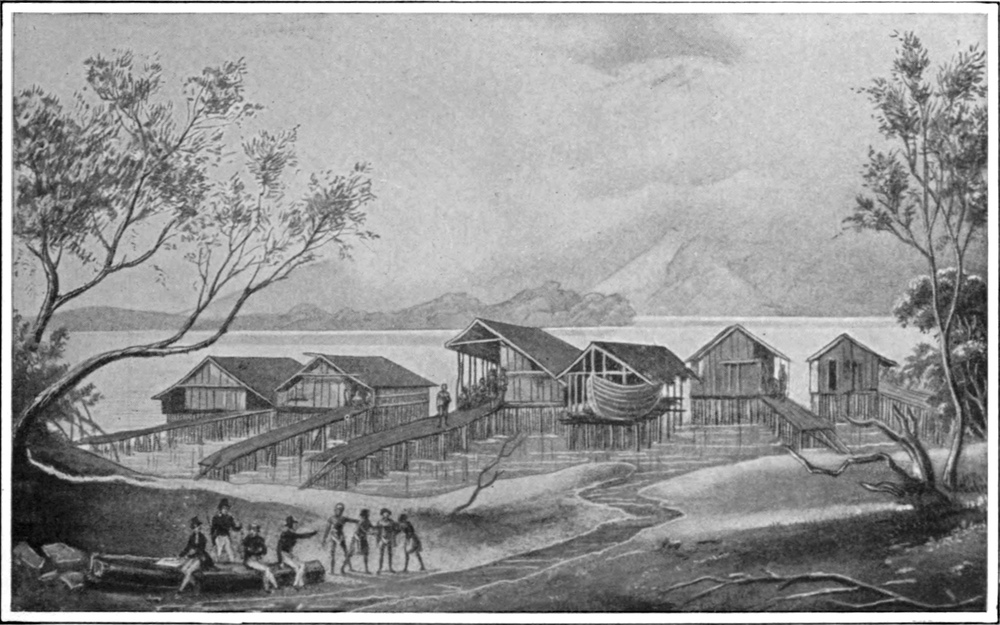
A PRIMITIVE STYLE OF DWELLING STILL WIDESPREAD IN SAVAGE LANDS
The lake dwellings still in use in New Guinea, illustrated in this reproduction from an old work, D’Urville’s “Voyage of the Astrolabe,” are exactly like the lake dwellings of prehistoric Europe.
Man Learning the Art of Living
The results of cave research are almost as rich and varied as the results yielded by the study of the lake-dwellings in their bearing on the Neolithic stratum. Where there is a Drift stratum in the cave-earth the confusion of Palæolithic and Neolithic objects can, as we have said, scarcely be avoided. But there are numerous grottos and small caves in which the Neolithic stratum is the oldest, so that mistakes are out of the question. In a large number of such places in the cave district of the Franconian-Bavarian Jura the conditions under which finds have been made in the Neolithic stratum have proved almost as pure and unmixed as in the lake-dwellings.
The cave-dwellers of the later Stone Age in the Franconian Jura were, like the Swiss lake-dwellers of the Stone Age, mainly a pastoral race. They possessed all the important domestic animals that the latter possessed—dog, cow, horse, sheep, goat, pig—and likewise practised agriculture, or, at any rate, flax-growing; at the same time hunting and fishing formed a considerable part of their means of subsistence. So that, not only on artificial pile-works on the shores of lakes, but also on the banks of South German rivers, there formerly lived a race which, although still mainly restricted to hunting and fishing, and using no metal, but exclusively stone and bone tools, already practised cattle-breeding and primitive agriculture, and was able to increase the means of existence afforded it by Nature by the first technical arts—by the chipping and grinding of stone instruments, bone carving, and, above all, pottery-making, tanning, and the arts of sowing, weaving and plaiting.
Beginning of Weaving and Knitting
Of most importance, as showing the state of civilisation of the Neolithic rock-dwellers, are the numerous articles carved from bone that must be looked upon as instruments for weaving and net-knitting. For the latter purpose there were large, finely-smoothed bone crochet-needles, some of them carved from the rib of a large ruminant. The handle-end is smoothed by use, and the end with the hook is rounded from the same cause. The end is frequently perforated, so that it might be hung up. Still more numerous were shuttles of various forms.
According to the numerous finds of perforated clay weaver’s weights, the loom, like that of the lake-dwellers, must have been like the ancient implement that, according to Montelius, was in use on the Faröe Islands a comparatively short time ago. Spinning-whorls are very numerous, being partly flat, round discs of bone pierced in the centre, and partly thick bone rings or large beads of bone and deer-horn and flat burr-pieces of deer-antlers.
It was formerly thought that the Neolithic Europeans did not possess the arts of engraving and carving animals and human figures which the Palæolithic Men had understood in such conspicuous manner. The progress of research has now produced more and more proof that in the later Stone Age the arts of carving and engraving had not died out. We have the celebrated amber carvings of the later Stone Age from the Kurisches Haff, near Schwarzort, some of which probably served a religious purpose; those of ivory, bone, stalactite, etc., from the caves of France and the Polish Jura; the figures from Butmir, and other evidences.
Fortified Settlements in Stone Age
In Italy, in Lombardy, and Emilia, another group of settlements of the Stone Age has been found, which again exhibit the civilization and all other signs of the later Stone Age, and in many respects more closely resemble the lake-dwellings than do the cave-dwellings. These are the “terramare,” whose inhabitants, however, had already to some extent advanced to the use of bronze. A sharp division of strata into habitation of the pure Stone Age and habitation of the Metal Age has not yet been made. The huts stood on pile-work on dry land, the piles being six to ten feet high; the whole settlement was fortified with trench and rampart, generally with palisades, and was of an oblong or oval plan. Besides many natural and artificial caves in Italy the dwelling-pits, which may formerly have borne the superstructure of a hut, also belong to the pure Stone Age.
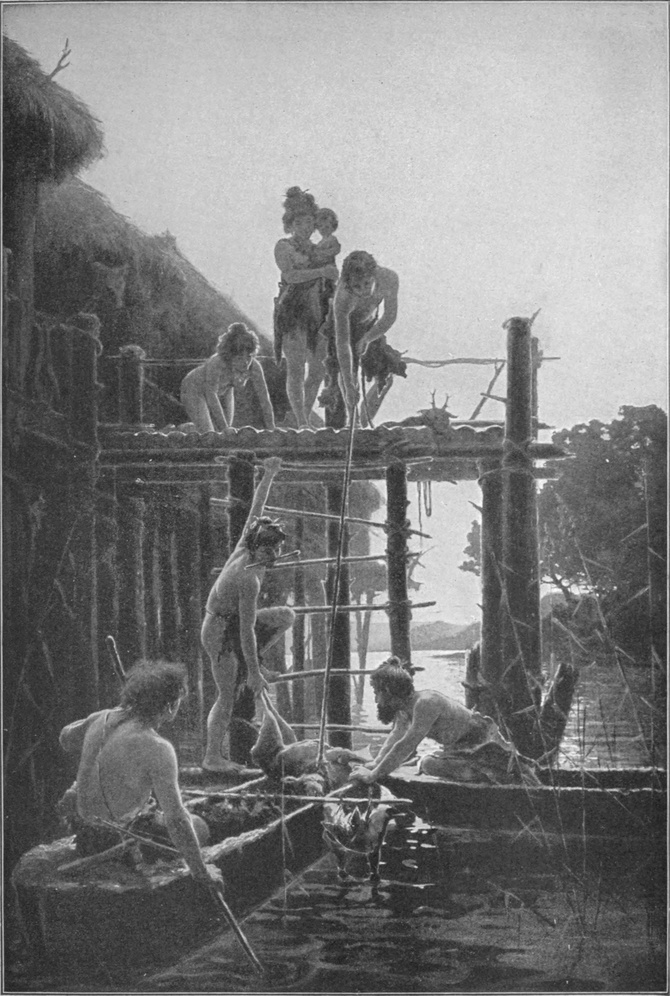
LAKE-DWELLERS RETURNING FROM THE HUNT IN THEIR DUG-OUT CANOES
From a painting by Hippolyte Coutau, in the Geneva Museum.
LARGER IMAGE
Strange Homes of Early Man
Such dwelling-pits of the Stone Age seem to have been distributed all over Europe. Burnt wall-plaster with impressions of interwoven twigs, has frequently been found near or in the pits, doubtless indicating hut-building. In Mecklenburg, where the dwelling-pits were first carefully examined by Liesch, they have a circular outline of ten to fifteen yards, and are five to six and a half feet deep. At the bottom of the pit lie burnt and blackened stones, hearthstones, charcoal, potsherds, broken bones of animals, and a few stone implements, the latter being mostly found in larger numbers in the vicinity of the dwellings. The same circular dwelling-pits of the Stone Age are found in France. Smaller hearth-pits were recently found in very large numbers in the Spessart, in Bavaria, with hundreds of stone hatchets and perforated axe-hammers, some of the former being very finely made of jadeite.
America before History
During the Neolithic Period dwellings were frequently made on heights, and it seems that even at that time they were to a certain extent walled round and fortified. Such settlements are numerous all over Southern and Central Germany, in Austria-Hungary, especially in the coast-country, and in Italy and France. Many of these stations belong purely to the Stone Age; indeed, the majority were inhabited already during the Stone Age, and furnish the typical Neolithic relics familiar from the foregoing. On the other hand, they continue to be inhabited even in the later metal periods, and in some cases right down to modern times. The rock near Clausen, in the Eisack valley, in the Tyrol, on which the large Säben monastery now stands, was a mediæval castle, and during the times of the Romans a fortified settlement called Sobona stood there; and when excavations were made in 1895, for adding new buildings to the monastery, a well-ground stone hatchet of the later Stone Age came to light. On many hills in Central Germany are found traces of the ancient presence of men who lived on them or assembled on them for sacrificial feasts; the earth is coloured black by charred remains and organic influences, and this “black earth on heights and hills” contains frequently, as we have said, the traces of Neolithic men. In Italy, many finds on such heights—for instance, those made on the small castle-hill near Imola—seem to exhibit that stage of the Stone Age that is missing in the terramare, and that precedes the beginning of the Metal Age of the terramare, but corresponds to it in every essential except in the possession of metal.
But the view that is opened up is still wider. The prehistoric times of the New World also exhibit a Neolithic stage, corresponding to that of Europe, as the basis of the further development of the ancient civilised lands of America. And where a higher civilisation did not develop autochthonously in America, European discoverers found the Neolithic civilisation still in active existence, as they did in the whole Australian world. Accordingly in these vast regions, which have never risen above the Stone Age of themselves, the same stage of civilisation which in the old civilised lands belongs to a grey, immemorial, prehistoric period, here stands in the broad light of historic times. The study of modern tribes in an age of stone throws many a ray of light on the conditions of the prehistoric Stone Age; and this study, on the other hand, shows us that the primitive conditions of civilisation of those tribes stand for a general stage of transition in the development of all mankind.
The Foundations of Society
The lake-dwelling stations, and the land settlements resembling them, prove of themselves how far the culture of the early inhabitants of Europe was advanced even in that ancient period which was formerly imagined to be scarcely raised above half-animal conditions. Such structures could not be erected unless men combined into large social communities, which is indeed indicated by the very fact of the number of dwellings that were crowded into a comparatively small space. For the first ramming-in of the pile-works a large number of men working together on a common plan was absolutely necessary. The same applies to the construction of the artificial islands, protected by pile-works and partly resting on piles, termed “crannoges” by Irish archæologists, and to the Italian villages called “terramare,” which likewise once rested on piles and were protected by ditches. From the extent of the pile-works we are able to estimate the number of the former inhabitants of the settlements supported by them. Quite as clear an idea of the number of the former inhabitants is also given by the early circumvallations on the tops of hills and shoulders of rock, which were likewise made and inhabited during the Stone Age.
The co-operation of a large number of men for a common purpose is also shown in the often huge stone structures to which, on account of the size of the stones employed in their construction, the name “megalithic” structures, or gigantic stone structures, has been given. In Northern Europe they, too, belong to the Stone Age proper. The majority of these gigantic structures were originally tombs; the principle on which they are built is often repeated even in far less imposing tombs.
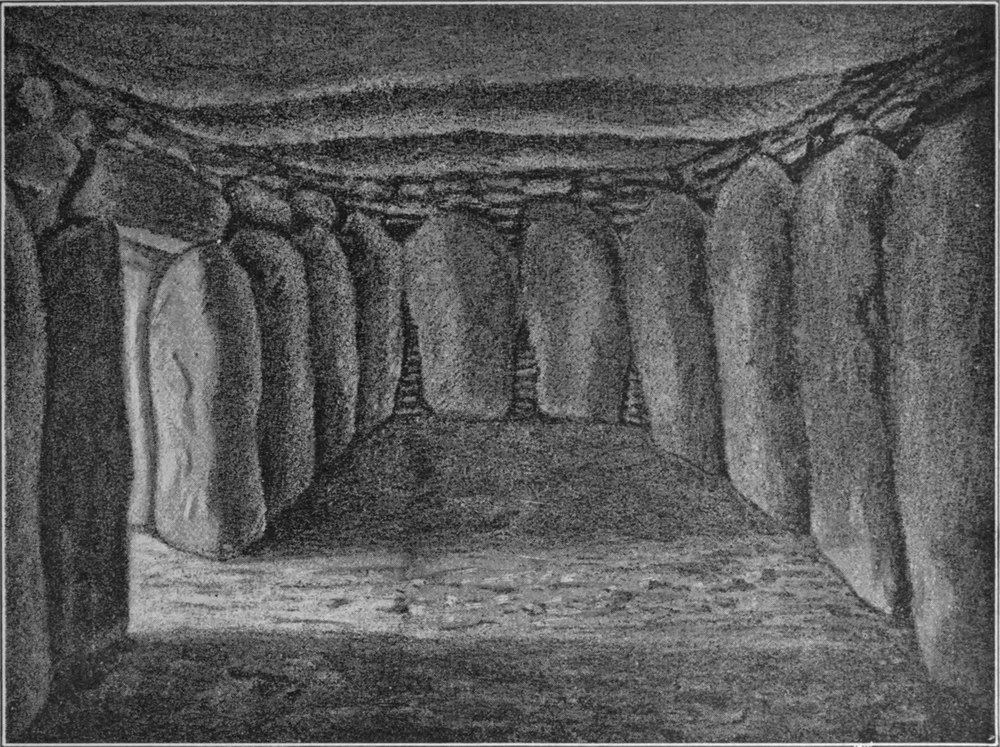
THE FAMOUS GIANT CHAMBER NEAR ROSKILDE IN DENMARK
That the men of the later Stone Age had developed a considerable degree of culture is proved by such remains as these. The erection of these giant chambers must have called for a vast amount of co-operation, skill, and ingenuity. The means whereby the massive stones were placed into position, and so fixed to withstand the shocks of thousands of years, have not yet been satisfactorily explained by archæology.
The stone blocks of which these gigantic structures are piled now often lie bare. Large stones placed crosswise, which represent, as it were, the side-walls of a room, support a roof of one or several “covering-stones” of occasionally colossal size. For the erection of these in their present position without the technical resources at the disposal of modern builders, human strength appears inadequate; in popular opinion only giants could have made such structures. Some of the stones are really so large, and the covering-stones especially so enormous, that these buildings have defied destruction, for thousands of years, by their very weight.
In the time of their construction these giants’ graves were mostly buried under mounds. They were the inner structures of large tumuli, in which the reverence of the men of the Stone Age once buried its heroes. One of the finest “giant’s chambers” is probably that near Öm, in the neighbourhood of Roskilde, in Denmark. The building material consists merely of erratic stone blocks of enormous size. The rough blocks were mostly set up by the side of one another, without any further working, so as to support one another as far as possible; at the same time all of them, as Sophus Müller observes, are slightly inclined inward, so that they are kept more firmly in position by their own weight. The stones thus erected, forming the parallel side-walls of the whole structure, stand so far apart that a huge erratic block, reaching from one wall to the other, could be placed on them as a roof. The distance between the side-walls of the giant’s chambers attains a maximum of eight to nine feet; the covering-stones placed on them are some ten to eleven feet long. The pressure of the covering-stones from above helps considerably to hold the whole structure together. In order to distribute the pressure of the covering-stones regularly, smaller stones were carefully inserted under the wall-stones where they had to stand on the ground. How exactly these proportions of weight were judged is proved by the fact that these structures of heavy and irregular stones, resting on their natural, differently shaped sides and edges, have held together until the present day. The inner walls of the chambers were made as carefully as possible. Where, as on the outside, the rough and irregular form of the stone block projects, either the naturally smooth side was turned inward or the roughness was chipped off.
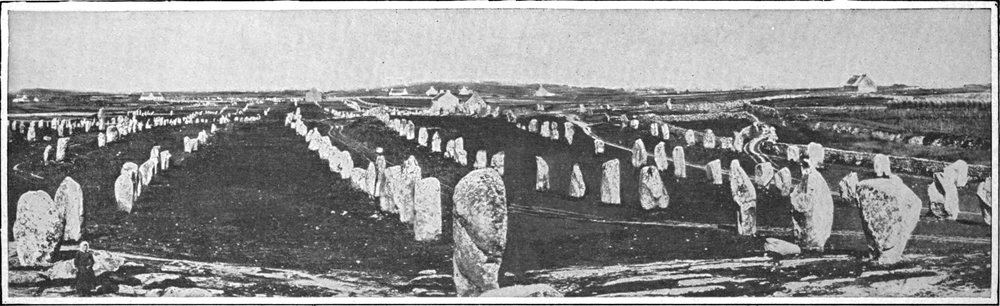
THE MARVELLOUS MEMORIALS OF THE STONE AGE AT CARNAC IN BRITTANY
On the plain near the little town of Carnac, in Brittany, stand eleven thousand immense monoliths in eleven rows, erected probably for religious purposes in the Stone Age.
LARGER IMAGE
These are the beginnings of a real architecture, seen also in the regular wedging with small stones of the spaces left between the wall-stones and covering-stones and between the wall-stones themselves. These small stones were frequently built in, in regular wall-like layers. Sandstone was often used for the purpose, being more easily split into regular pieces, which gave this masonry a still more pleasing appearance. The number of stone blocks used for the wall-sides varies according to the size of the giant’s chambers, as does also the number of covering-stones. For smaller chambers, with six to nine wall-stones, two or three covering-stones were required. But far larger stone chambers occur, as many as seventeen wall-stones having been counted. Such large chambers require a whole row of covering-stones beside one another. The door-opening often shows a special regard for architectonics. The two door-post stones are rather lower than the other wall-stones; on them a stone was laid horizontally, which kept them apart and distributed the pressure of the covering-stone equally on both posts.
Very often there was also a stone as a threshold. Leading to the door is a low passage, made in similar manner to the chamber, but of far smaller stones. The passage is only high enough to allow one to creep through, whereas the chamber itself is about as high as a man, so that one could stand upright in most of them. Larger stone chambers are rarely without this passage, and from it such grave-structures have been named “passage-graves.” Besides the building-in of small stones, the holes still remaining between the stones were also coated over on the outside with mud to keep the rain-water from soaking in; mud was also frequently used for making a rough plaster floor for the chamber if the natural floor could not be made level enough. On the floor is frequently found a compact layer of small flints, or a regular pavement of flat stones, often rough-hewn, or roundish stones fitting one another as nearly as possible, which were then probably also covered with a thick layer of mud.
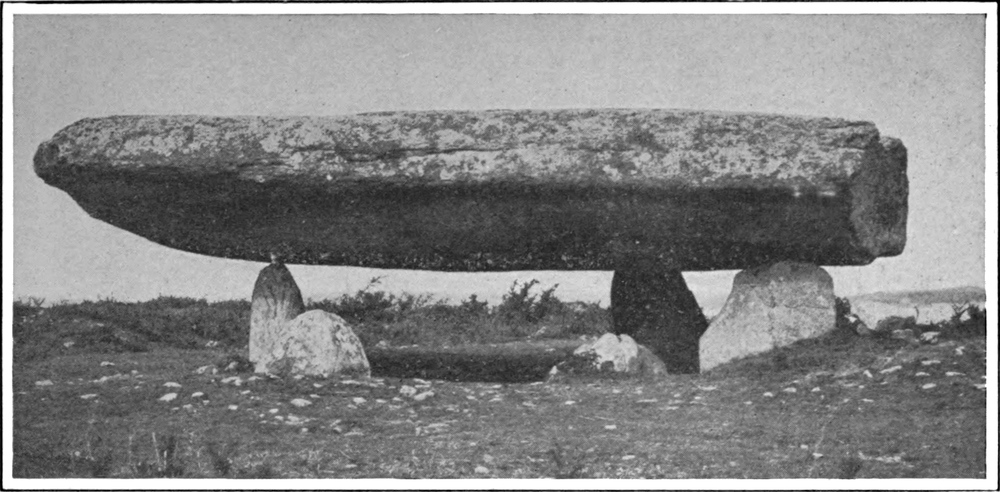
“THE MERCHANTS’ TABLE”: AN IMMENSE DOLMEN ERECTED IN THE STONE AGE
Archæologists are not entirely agreed as to the purpose of these dolmens. They were more likely graves, or chambers associated with religious rites, than residences. This example is at Locmariaquer, near Carnac, in Brittany.
So that in these giant’s chambers we have real buildings, which imply high technical accomplishments and have preserved for us the usual form of the dwellings of those early times. In what manner the huge covering-stones were placed on the side-walls of the giant’s chambers is a problem still unsolved. Doubtless many hands were occupied on such structures; and the history of building teaches us that with the proper use of human strength—as, for instance, in ancient Egypt—great weights can be raised and placed in position with very simple tools—round pieces of wood as rollers, ropes, and handspikes.
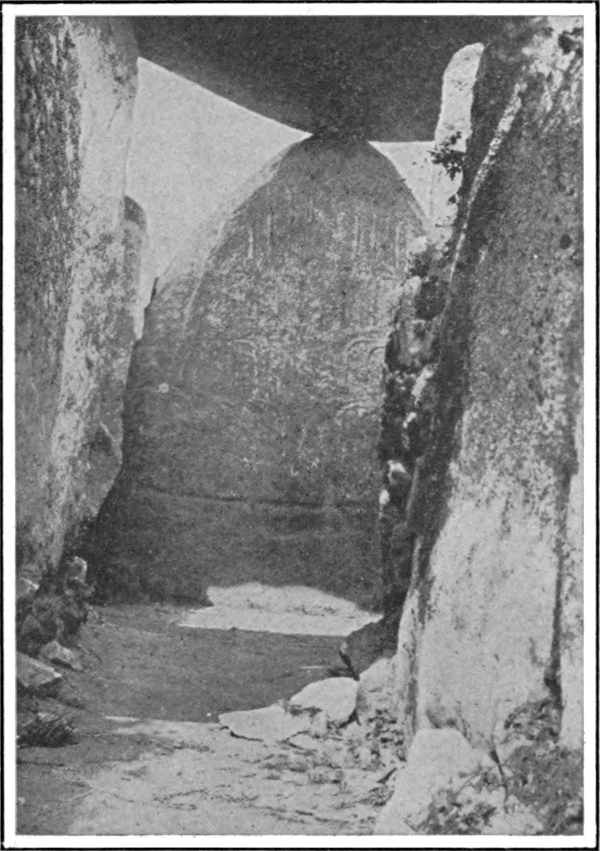
INTERIOR OF THE “MERCHANTS’ TABLE”
This is the interior of the above dolmen. It will be seen that the earth has slowly risen a great height since it was erected, nearly covering the dolmen, thus indicating immense age. The principal supporting stone is covered with sculpture.
Some of these giant’s chambers, which were originally enclosed in mounds or barrows, are still preserved at the present day, and splendidly too. Very often the chamber was quite covered with earth outside; it then formed the centre of what was generally a circular barrow, often regular small hills ten to fifteen feet high and frequently over ninety feet in circumference.
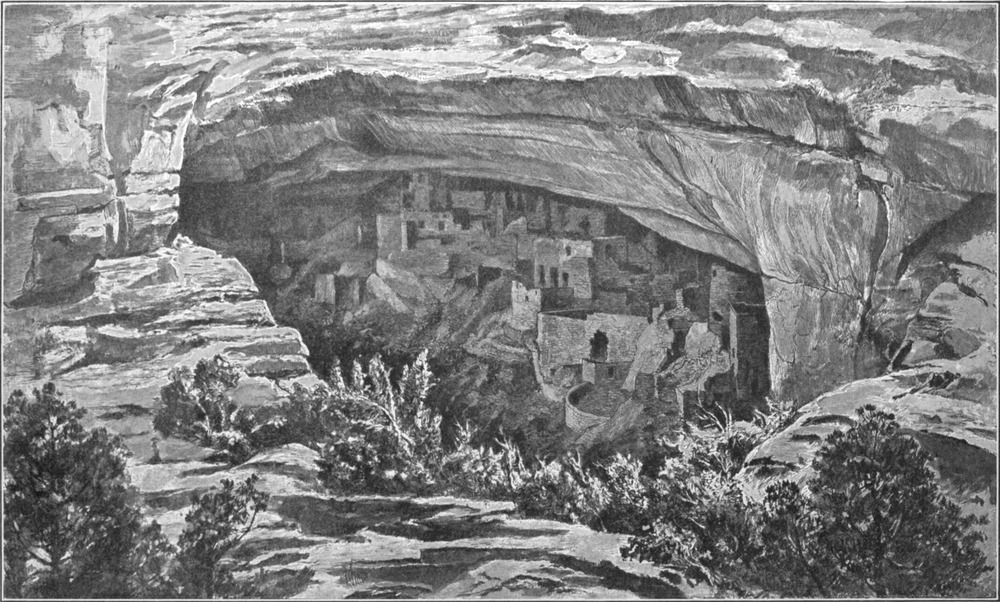
A PALACE UNDER A CLIFF: A REMARKABLE MONUMENT OF THE STONE AGE IN CLIFF PALACE CAÑON, COLORADO
This is perhaps the most noteworthy of all the remains of the cliff dwellers, and indicates how considerable was the culture of those early people in America.
LARGER IMAGE
The corpses were buried, not cremated. They were frequently in a crouching attitude, or that of a sleeper lying sideways with the legs drawn up to the body. The smaller graves often represent single interments; the larger or largest ones are mostly family tombs, in which numerous corpses were interred one after the other at different times. But this repeated use of the graves is found also with smaller ones, and even with stone cists. Only the last corpse then lies in a normal position, while, through the repeated opening of the grave and the later interments, the skeletons belonging to previously interred corpses appear more or less disturbed or intentionally put aside. The skulls of the corpses interred in the Neolithic graves are well formed, their size indicating a very considerable brain development. The corpses were no bigger than the present inhabitants of the same districts, and the form of the head corresponds partly with that of the present population of those countries. Nor do the skeletons otherwise differ from those of modern men.
In America, also, gigantic structures were erected by the aborigines who lived in the Stone Age, to commemorate and to protect their dead. They consist partly of large mounds of stones and earth, which are likewise often regular small hills, and partly of stone structures reminding one of the giants’ chambers. The majority of the mounds were doubtless mainly sepulchral; others may have been temple-hills or sacrificial mounds, defensive works or observatories.
The objects buried with the occupants belong mostly to the Neolithic Period, and consist chiefly of stone weapons and tools, some rude, but others finely worked and polished. Some are of pure natural copper, which was beaten into shape cold with stone hammers. Besides these, and ornaments and pottery, an American specialty is found in the form of tobacco-pipes carved from stone, some of which give interesting representations of men and animals; this seems to prove that tobacco also played a part in the American funeral rites of those times.
The graves of the Neolithic Period not only indicate that mankind generally was endowed with the same gifts as regards the first principles of the art of building, but they also afford us a glimpse of the mental life of that period of civilisation which at a more or less distant period was spread over the whole earth. What is so characteristic is the affectionate care for the corpse, for whose protection no amount of labour and trouble appeared too great. We can have no doubt that this reverence was based on a belief in the immortality of the soul—a belief which we find also at the present day among the most backward and abandoned “savages.” That the prehistoric men of the Stone Age held this belief is proved by the ornaments, weapons, implements, and food placed with the dead for use in the next world. Their burial customs certainly express a kind of worship of departed souls which has played and still plays so important a part in the religious ideas of all primitive peoples, and is one of the oldest fundamental notions common to mankind.
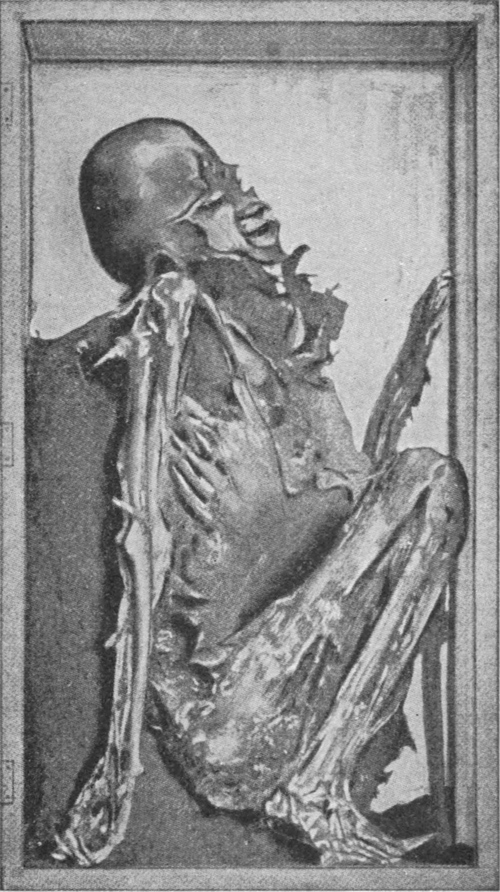
G. Nordenskiöld
HOW STONE AGE MAN WAS BURIED
Photograph of an actual skeleton, in position of burial, taken from a prehistoric mound grave in North America.
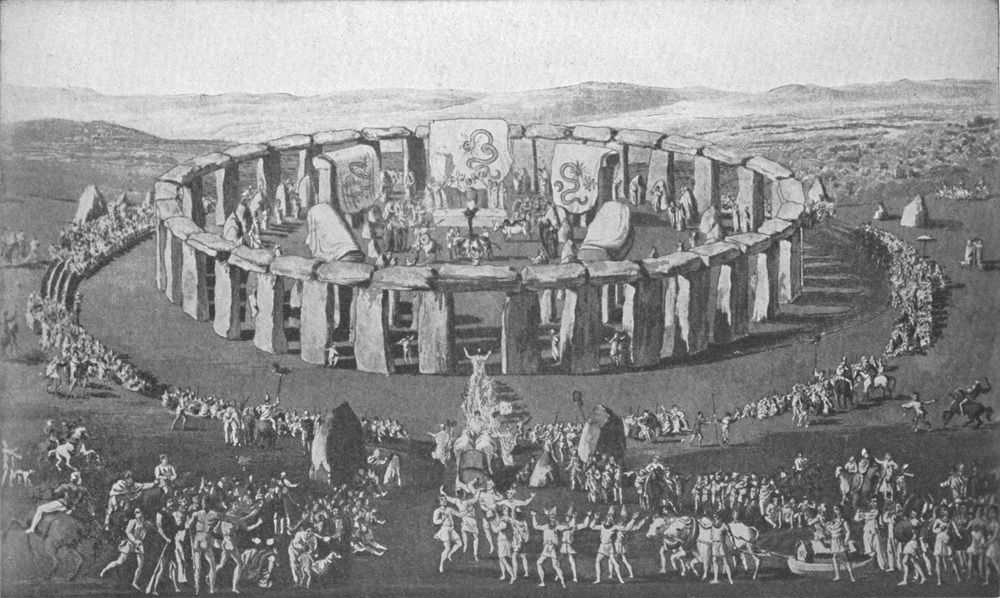
THE STRANGE RELIGION OF THE STONE AGE: A DRUID CEREMONY AT STONEHENGE
A vivid illustration, from an old print, of the purposes of the mysterious stone circles common in Celtic countries.
LARGER IMAGE
THE WORLD BEFORE HISTORY—VI
Professor JOHANNES RANKE
WHEN HISTORY WAS DAWNING
T
THE discovery of Drift Man, his distinction from man of the later Stone Age, the investigation of the Palæolithic and Neolithic strata of culture of Europe and of the whole earth, and the scientific reconstruction of the earliest forms of civilisation based on these, are due solely to the natural-science method of research.
It was only when the exact methods of palæontology and geology had been brought to bear with all their rigour on the study of ancient man by savants schooled in natural science that solid results were obtained. On this sure foundation the science of history now continues building, and uses, even for the later periods, so far as recorded information is not available, and to supplement it, the same methods of palæontology and natural science which were applied so successfully to the earliest stages of the evolution of mankind.
Time-Table of Prehistoric Periods
The first point is to collect the relics of the periods of the evolution of culture which follow on the later Stone Age, and to separate them according to geological strata, uninfluenced by those older pseudo-historic fancies by which the deepening of our historical knowledge has so long been hindered. By carefully separating and tracing the earth’s strata till we come to those that furnish remains of times recorded in history, it has been possible to establish first a relative chronology of the so-called later prehistoric periods of Central Europe, whose offshoots pass immediately into recorded history.
By digging, after the same method of palæontological science, through stratum after stratum in the oldest centres of culture, especially in the Mediterranean countries, and by arranging the products by strata—uninfluenced by historical hypotheses—after the same natural-science method of research which has produced such remarkable results in Central Europe, the most surprising conformity in the evolution of culture in widely remote regions has been shown. It was found that in the Mediterranean countries, and also in Egypt and Babylonia, forms of culture already belong to the time of real history which were first recognised in Central Europe as preliminary prehistoric stages of historical strata; so that it was possible also to establish an absolute historical chronology for those instead of the relative prehistoric one.
Europe’s Prehistoric Night
Thus times which, as regards Central Europe, were hitherto wrapped in prehistoric night are enlightened by history. Although, as regards Central and Northern Europe, we cannot name the peoples who were the bearers of those forms of culture, and although we disdain to give them a premature nomenclature of hypothetical names, yet their conditions of life and culture and the progressive development of these, in manifold contact and intercourse with neighbouring and even far remote historic peoples and periods, have risen from the darkness of thousands of years; and their relation in time to the latter has been recognised.
Thus prehistoric times have themselves become history. The historical account of every single region has henceforth to begin with the description of the oldest antiquities of the soil that tell of man’s habitation, in order thereby to obtain the chronological connection with the evolution of the history of mankind generally. That is the palæontological method of historical research.
Landmarks of Early Culture
The palæontology of man has proved the Stone Age to be a general primary stage of culture for the whole human race. All further general progress in culture was affected by the discovery of the art of metal-working—the extraction of the metals from their ores and the casting and forging of them. The later and latest eras of culture are the Metal Ages, as opposed to the Stone Ages. It is not the use of metal in itself, but the above-mentioned metallurgical arts, that form the criterion of the advance of culture beyond the bounds of the Stone Age. Where, as in some parts of America, native copper was found in abundance, this red malleable mineral could probably be worked in the same way as stone, without any further progress necessarily developing therefrom. The same may apply to meteor-iron, which is said to have been used for arrows, together with stone points, by American tribes who were otherwise in the age of stone and but poorly civilised.
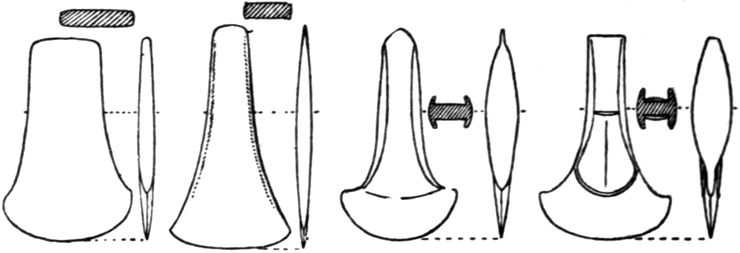
From stone to metallic form
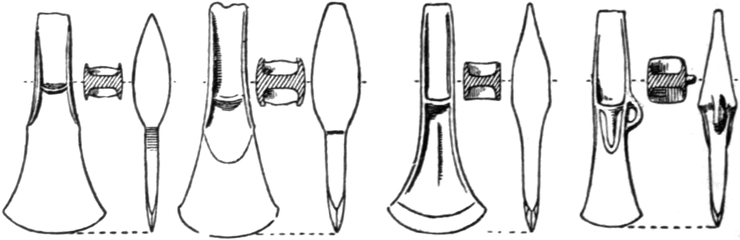
Growth of the stop-ridge
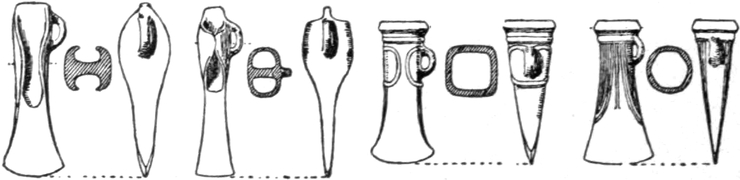
Growth of the wings
THE TRANSITION FROM STONE TO IRON
This series of diagrams, reproduced from specimens in the British Museum, by permission of the Trustees, shows how the stone axehead was used as the model for the metal axe or celt, and how that in turn was modified as workers gained experience in the use of the metal
In civilised lands it is chiefly metal casting and the forging of the heated metal which have made it possible to produce better weapons and tools and more valuable ornaments. The worked metals are first copper, then the alloy of copper and tin that bears the name of classical bronze, and to these are soon added gold and—especially in districts rich in the metal, as in Spain—silver. Later on the extraction of iron from its ores and the forging of that metal are discovered.
According to this course of metallurgical progress the first metal period is distinguished as the Bronze Period, which is begun by a Copper Period lasting more or less long in different places. The second or later metal period is the Iron Period, in which we are living at the present day. In the course of time, by gradually displacing bronze and copper from the rank of metals worked for weapons and tools, this Iron Age has developed to its present stage.
In Central Europe the pile-dwellings in the lakes of Western Switzerland again present us with specially clear and uninterrupted series of illustrations of the progress of culture from the Stone Age to the Iron Age. Ending the Stone Age, we find first a period of transition, in which, while stone continued to be principally employed, a few ornaments, weapons, and tools of metal began to be used. This metal is at first almost exclusively copper, with only very little bronze; iron is quite absent. Copper objects have been found in Western Switzerland by Victor Gross, most extensively in Fenel’s lake-dwelling station, which otherwise still belongs to the Stone Age. The majority of these are small daggers, formed after the pattern of the flint daggers; some already possess rivetings for fastening the blade to a handle. There are also chisels and small awls in bone handles, beads, and small ornamental leaves, and hatchets of the form of the simplest stone hatchets, with the edge hammered out and broadened. Much has proved the existence of a Copper Period corresponding to this description in the lake-dwelling in the Mond See in Austria, and in Hungary the remains of a Copper Period are particularly frequent. Parallel cases also occur in many other parts of Europe, particularly, as Virchow has proved, in the Spanish Peninsula, and in the Stone Age graves of Cujavia in Prussian Poland. These are the more important as they are most closely related to the conditions of culture discovered in the ancient strata of Hissarlik-Troy. Further unmistakable analogies occur with very ancient finds in Cyprus, and probably even with the oldest remains of Babylonian culture hitherto known. Here, too, we may include the finds of copper in the Stone Age of America.
The Passing of the Stone Age
So that in the normal and complete evolution of culture there seems to be first a stratum of copper as the connecting link between the Stone and Metal Ages; and this must be missing in those regions in which progress from the stone to the metal culture was only brought about at a relatively later period by external influences. This applies not only to all modern races in an age of stone, who obtained metal in recent times only through contact with European nations who had been living in the Iron Period for thousands of years, but, curiously enough, also to the greater part of Africa, where the use of iron was prevalent at a prehistoric period.
Just as the modern Stone races passed straight from the Stone Age into the most highly-developed Iron Age of the most advanced culture, so also the stone stratum of Central and South Africa is immediately overlaid by a stratum of iron culture, which was brought there in ancient times, probably direct from Egypt. As there is in Egypt and throughout North Africa a regular development from the Copper-bronze Period to the complete iron culture, corresponding to the progress of the metal cultures of Europe and Asia, the point of time is thus chronologically fixed at which this important element of culture was transmitted from Europe to the blacks of Central and South Africa.
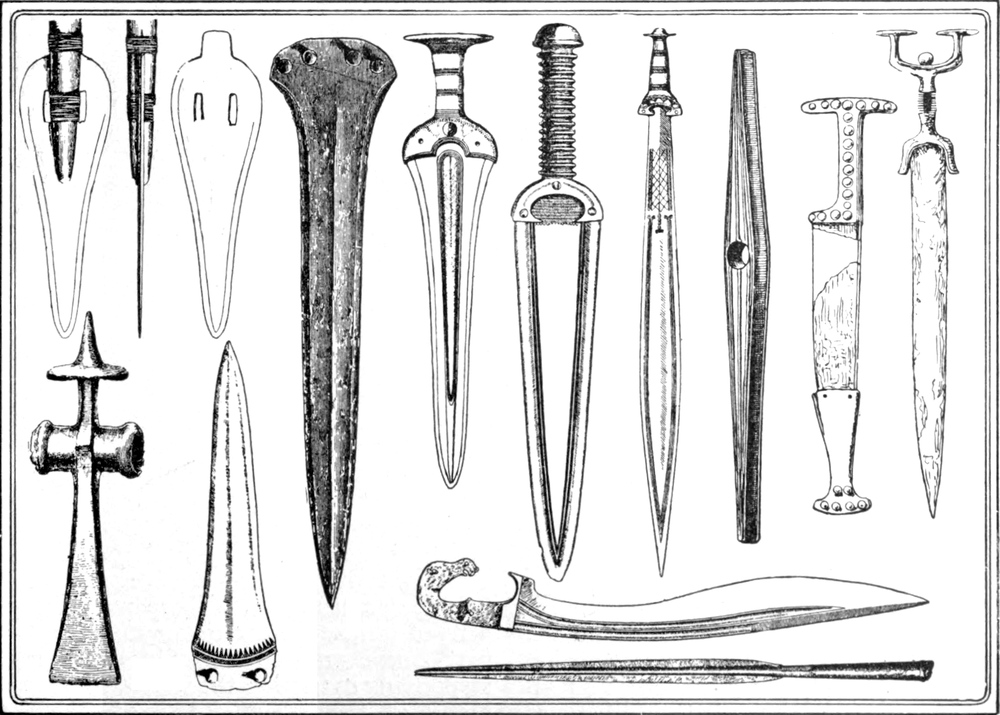
WEAPONS USED BY MAN IN THE PERIODS OF DAWNING HISTORY
Reproduced chiefly from specimens in the British Museum.
Advancing Civilisation in Bronze Age
In Western Switzerland the transition period of copper is followed without a gap in the development by the Bronze Period proper. With the introduction of bronze all the conditions of life were more highly developed in the sense of increased culture. With better tools the stations of the Bronze Age could be erected at a greater distance from the bank, often two hundred to three hundred yards; the space they take up is also much greater. The piles are not only better preserved, according as the time of their being driven in more nearly approaches our own, but they are also better worked, are often square, and the points that are rammed into the lake-bottom are better cut. The settlements of the Bronze Age often cover an area of several hundred square yards, and are no longer comparatively mean villages, as in the Stone Age; the pile settlements of the Bronze Age are well-organised market towns and even flourishing small cities, where a certain luxury already prevails. The products of their industry are graced by that beauty and elegance of form that only an advanced civilisation can create. As in the Stone Age, so also in the Bronze Age of Central and Northern Europe, the most important working-implement, which was, however, also used as a weapon, was the axe, or celt. The most primitive forms of axes, like the above-mentioned copper axes, still resemble the simple stone axes: like these, they have no special contrivance for fastening the handle. In more developed forms of axes such contrivances for fastening the handle appear first in the form of slight flanges, which become wider and wider; finally they develop into regular wings, which, by curving towards one another, develop into two almost closed lateral semi-canals on the upper side of the celt. In the hollow celts a simple socket for the handle was cast in the making; an additional means of fastening the handle was provided in a loop, which also occurs on winged celts. Besides the celt, or axe-blade, broad and narrow chisels of bronze occur in various forms for working wood. A second chief type of instrument is the one-edged bronze knife with elegantly curved back and a handle tongue.
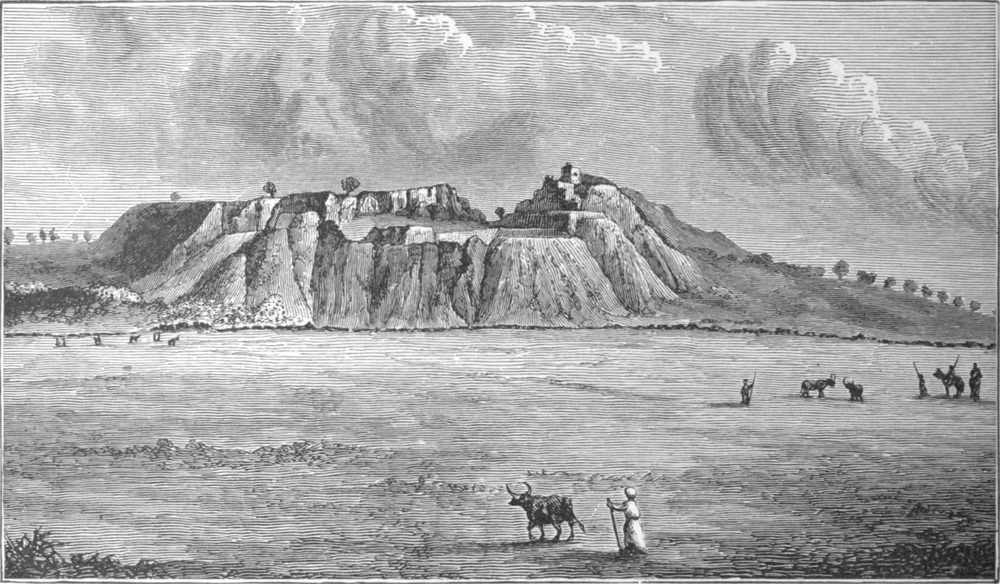
THE HILL OF TROY, IN WHICH IS RECORDED A WONDERFUL STORY OF MAN’S PROGRESS
Seven towns of Troy were built upon this hill, one above the ruins of the other, the earliest dating from 3000 B.C.; and the brilliant excavations of Dr. Henry Schliemann, which have won him immortal fame, have contributed more to our knowledge of the history of mankind than any other excavations in our time, as on this site is concentrated a continuous record of man’s progress from the late Stone Age to the height of Greek civilisation.
The manner in which iron was found in the lake-dwellings, as mentioned above, shows the gradual development of a period of transition between a Bronze and an Iron Age. In spite of the difference in the material which the lake-dwellers used for making their weapons and tools in the periods of transition, they still imitate the old forms received from their forefathers. Just as the first metal axes of copper are copies of the stone axes, so also, when iron first became known, were weapons made of this metal which corresponded in form to the bronze weapons that had hitherto been used.
The Bronze Period was first proved to have been a complete form of culture in the North of Europe—in North Germany and Scandinavia. We have now succeeded in establishing the fact that it was a preliminary stage of the Iron Age, in locally original development, in all ancient centres of culture. It is very remarkable that the civilised states of the New World also employed only copper and bronze as working metals. Thus the Peruvians did not know iron any more than the other American peoples until they came in contact with European influences. Besides copper and bronze they had tin and lead, gold and silver. The Peruvian bronzes contain silver to the extent of five to ten per cent. There are axes or celts of bronze similar to the rudest of the first European beginnings in metal corresponding in form to the simple stone axe. Many of the other forms of weapons and implements familiar in the Bronze Age of the Old World were also made of bronze or copper in America; semi-lunar knives with a handle in the middle, lance-heads and arrow-heads, swords, war-clubs like morning stars, etc. At the same time weapons and implements of stone still remained in use.
In the Old World progress beyond bronze is everywhere due to iron.
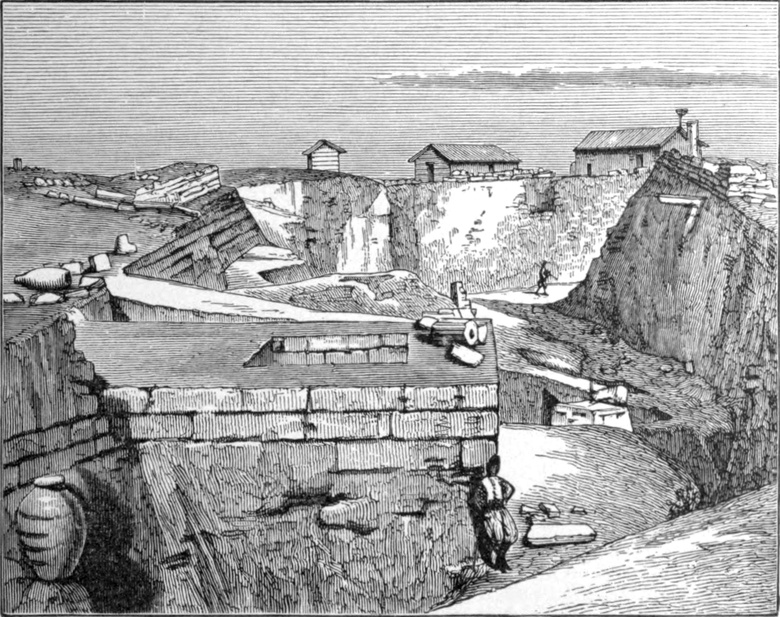
EXCAVATIONS IN THE TEMPLE OF ATHENA AT TROY
Dr. Schliemann’s discoveries in the ruins of this temple and the ruins of older buildings beneath it were among the richest in the entire annals of archæological research.
One place has been found and most completely investigated after the method of palæontological research, with all the help afforded by archæological and historical science, where, in overlying geological strata, the evidences have been found of a progressive development of culture from the end of the Stone Age down to the brilliant days of Græco-Roman history. There the chronological connection has been obtained, not only for the metal periods, but also for the end of the Neolithic Period. This most important place is Troy, the citadel-hill of Hissarlik, by the excavation of which Henry Schliemann has won immortal fame. Schliemann’s excavations, supplemented and completed in decisive manner by Dörpfeld, have brought about the most important advancement of the history of mankind that our age can show.
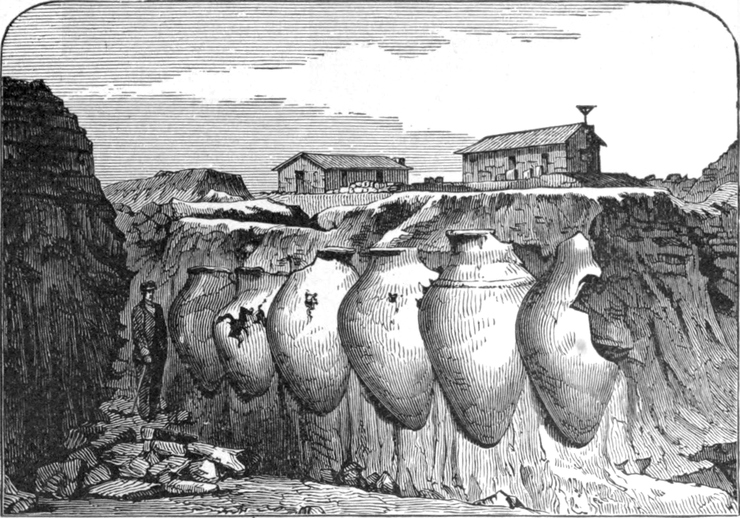
A WINE MERCHANT’S CELLAR IN ANCIENT TROY
Nine colossal earthen jars were discovered by Dr. Schliemann in the depths of the Temple of Athena. They had evidently belonged to some wine merchant’s cellar in the pre-Hellenic period.
Virchow’s name is inseparably associated with Schliemann’s. Furtwängler, in his account, based on personal observation, of the results of the excavations at Troy, has accomplished the great service of exactly determining the chronological connections of the prehistoric with the historic eras, and thereby linking the former to history.
On the spot on which tradition placed Homeric Troy (says Furtwängler) there really has stood a stately citadel, which was contemporaneous with the golden age of Mycenæ, the epoch of the Agamemnon of legend, was intimately related to Mycenæan culture, and at the same time corresponds most exactly to the idea of Troy underlying the old epic.
Seven Towns on One Hill
The citadel-hill of Troy terminates a ridge of heights stretching westward from Mount Ida, almost parallel to the Hellespont, and slopes steeply into the Trojan plain or the valley of the Scamander. The natural hill itself is not very high, but it was overlaid by enormous layers of ruins of buildings and walls, whereby it has been considerably increased not only in height, but also in breadth. Stratum after stratum lies one upon the other like the leaves of a bud, so that the history of the habitation of this venerable place from the most ancient times can be read from these strata which have been opened up by Schliemann and Dörpfeld, as from the leaves of a book. The original ground of the hill-plateau now lies some sixty feet above the plain, but the latter may have been raised something like sixteen to twenty feet by alluvial deposits since the Trojan War. The whole stratum of ruins lying on the original ground of the hill, which Schliemann opened up, amounts to about fifty-two and a half feet. Schliemann distinguished seven or eight different layers or strata, corresponding to as many towns which were successively built on this hill, one on the ruins of the other.
The lowest stratum, lying immediately on the original ground, belongs accordingly to the oldest, or first town, on the citadel-hill of Troy. Furtwängler says:
The First Town of Troy
By moderate computation this settlement must belong to the first half of the third millennium before Christ, but it may very well date back even to the fourth millennium. The inhabitants already used copper implements in addition to stone ones. Their whole culture is most closely connected with that which prevailed in Central Europe during the Copper Period. Clay vessels of the Copper Period from Lake Mond, in Austria, agree completely with those of the first Trojan town. Troy represents only an offshoot of Central European culture, and its inhabitants were in all probability of European origin.
We have already learned that the Copper Period is the end of the Neolithic Period and the beginning of the Metal Age. In the first Trojan town there is still extraordinarily little metal used, the axes, hatchets, knives, and saws still being of stone, of the familiar Central European types, and of the same materials, among which nephrite is particularly frequent. Other materials are serpentine, diorite, porphyry, hematite, flint, etc.
The First Period of Troy’s Glory
The forms of these implements correspond entirely to those of the later Stone Age of Europe. The character of the ceramics also conforms in many respects, according to Virchow, to that of the European Stone Age; and the Stone Age finds at Butmir, in Bosnia, and similar ones in Transylvania seem especially to offer close analogies. It would be a highly important step toward connecting history with the Neolithic Period if the first town could be even more closely investigated, and perhaps more sharply divided from that second stratum which lies between it and the stratum described by Schliemann as the second or burnt city, and which Schliemann afterward separated into two strata, corresponding to two towns. Perhaps the metal comes only from the second or higher stratum under the burnt city. In that case the oldest would belong purely to the Stone Age. The ceramics would seem to contradict this. Furtwängler continues:
High above the first town, a deep layer of débris, is the level surface of the second town, which must at least be dated back to the second half of the third millennium before Christ. It was the first period of Troy’s glory. Mighty walls protected the citadel. Three different building periods may be distinguished. The walls were brought out a long way and strengthened, and magnificent new gates were built. During the third period of this second city a prince, fond of splendour, had the old narrow gateway replaced by magnificent propylæa and a large hall-erection with a vestibule. A great conflagration destroyed his citadel. A treasure was found by Schliemann—he called it Priam’s treasure—in the upper part of the citadel wall, which was made of straw bricks. The tools of the second city are still partly of stone, but also partly of bronze, so that they already belong to the Bronze Age.
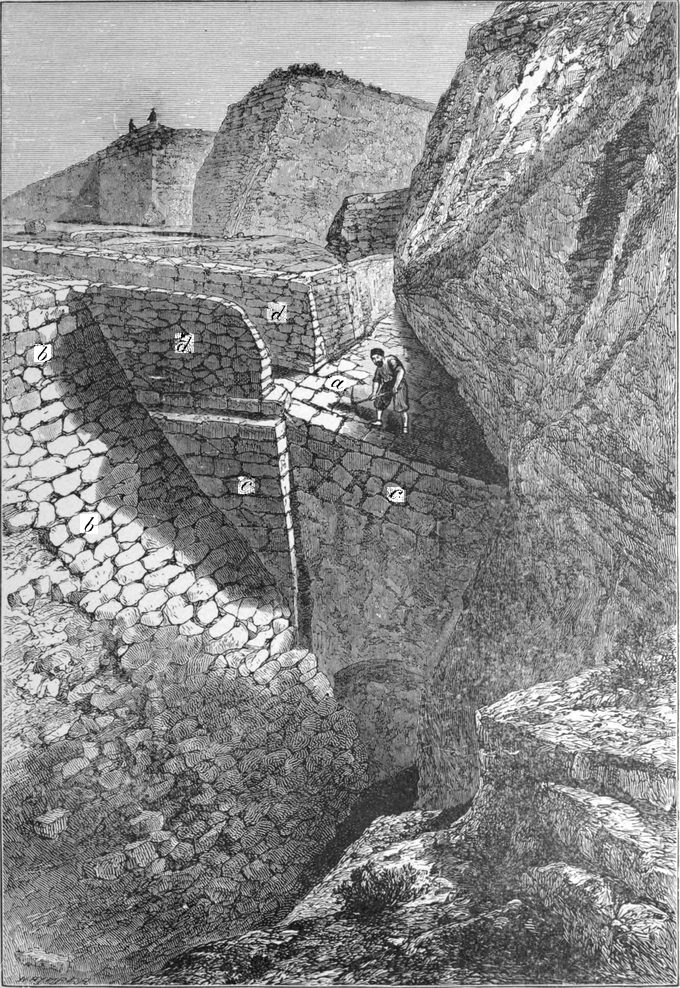
THE EXCAVATIONS AT TROY: REVEALING THE WALL OF THE ACROPOLIS
A view of the great substruction wall of the acropolis of the second city of Troy, on the west side, close to the south-west gate: (a) is the paved road, which leads from the S.W. gate down to the plain; (b) is the continuation of the great acropolis-wall of the second city on the west side of the S.W. gate; (c) is the foundation of the paved road and the quadrangular pier to strengthen it; (d) marks the masonry added by the third settlers.
LARGER IMAGE
The Early Culture of Troy
The general character of culture is, according to Furtwängler, still essentially Central European. And yet many an individuality has developed, and the influence of Babylonian culture is everywhere apparent, although it does not go very deep. To this influence our authority chiefly attributes the occurrence of a few pots turned on the wheel, especially flat dishes; for the potter’s wheel was still quite unknown at that time in Europe, and even at a post so far advanced toward the East as Cyprus, while in Egypt and Babylonia it had been in use from the earliest times. In this period also Troy inclines more to Central Europe as its centre of gravity, but remains far behind the peculiar development that bronze work attained there; in the metal tools no advance is made on the forms of the Copper Period. Into any close relation with Cyprus it does not come; only the basis of their culture is common to both. But this basis had a wide range, relics from German districts being often more closely related to the Trojan ones than are those from Cyprus.
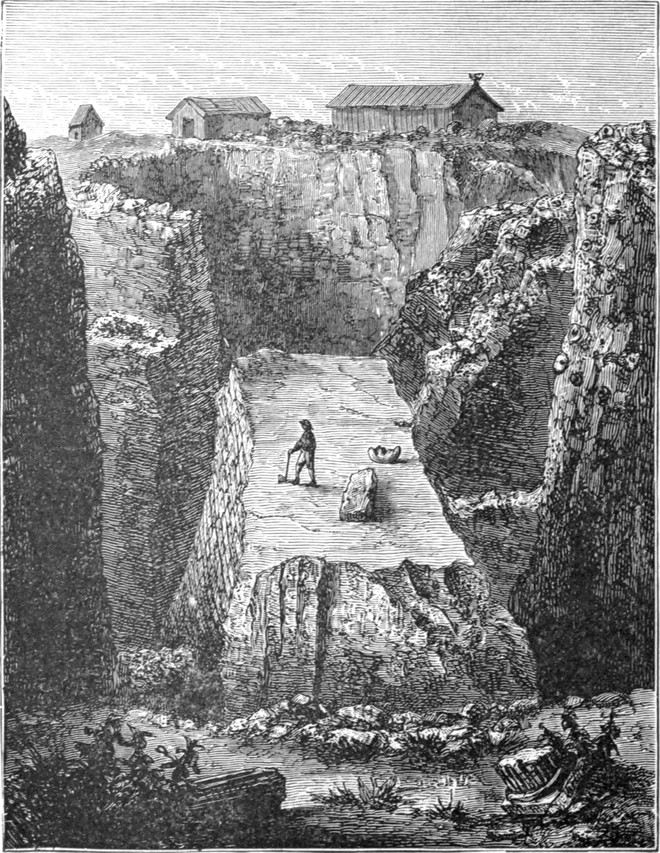
TROY: THE GREAT TOWER OF ILIUM
The top of the tower is 26 ft. below the surface of the hill. The foundation is on the rock 46 ft. deep; the height of the tower is 20 ft.
The brilliant period of the second city is followed by a long period of decline for Troy. Ruins are piled upon ruins, walls rise upon walls, but each poorer than the others; no new citadel walls, no gates, no palaces belong to this period, in which three strata—the third, fourth, and fifth towns—are distinguished. The first half of the second millennium before Christ must at least be regarded as the time of this deposit. The inhabitants evidently remained the same, and their culture is that of the second city. But no progress was made; nothing but stagnation; the same forms of vessels continue to be made, the same decorated whorls. Naturally, no active intercourse with abroad could develop in this period. And yet this was the time when an active civilised life began to develop on the islands of the Ægean Sea and on the east coast of Greece, which was to bloom in all its splendour in the following period. To this time the finds at Thera belong, where the pottery, all turned on the wheel, is already painted with a so-called varnish colour which shines like metal, and in which plants, flowers, and animals are treated in quite a new and promising naturalistic style hitherto unheard of in Europe. In Cyprus, too, the decoration of pottery developed exceedingly in wealth and variety in this period of the Bronze Age. Troy, on the other hand, is poor and degenerate.
But a new period of prosperity arrived for Troy, too; this is the sixth town. Rich and powerful princes again ruled in this citadel. They enlarged it far beyond its former compass. They built strong new walls—the old ones had long since sunk in ruins—not of small stones and straw bricks as before, but of large, smooth blocks, and gates and turrets. They did not have the sloping mound of ruins levelled, as the lords of the second city had done; they let the new buildings rise in terraces, on the ruins of the old; stately mansions with wide, deep halls, covered the acropolis. Constant intercourse existed with the princes of Greece, who at that time—the second half of the second millennium before Christ—built their citadels with cyclopean walls. The Trojans employed the same peculiar, constantly-recurring small projections in their walls that we find in a Mycenæan town on Lake Copaïs in Bœotia.
And, above all, the Trojans now provided themselves with those beautiful vessels painted with shining colour that characterise Mycenæan culture in Greece, and whose natural style had so wonderfully developed there on the basis of the attempts that we found at Thera. In Troy these things caused some imitation, but the results remained far behind the originals. The living, imaginative conception of the natural was closed to the Trojan; the home-made pottery kept, on the whole, to its unpainted vessels, although these were now almost entirely made on the wheel.