Volume 1 — LIST OF MAPS APPEARING IN THE BOOK OF HISTORY (continued 12)
Reading edition
Tarahumaras. See OPATA-PIMA.
Tarascans. A group of Indian tribes inhabiting the province of Michoaca in Mexico.
Tartars or Tatars. The modern Tartars are inhabitants of the Russian Empire, belonging to the Turki stock of the Northern Mongolic family. They are divided into various geographical subdivisions, such as the Kazan, Astrakhan, Crimean (or Krim) Caucasian and Siberian Tartars. The name has no definite ethnical significance. The Tatars—a Manchu word meaning “archers” or “nomads”—were Mongol tribes who were first so named in the ninth century. They formed a large part of the hordes of Genghiz Khan [see MONGOLS] and stood in the van of the mediæval Mongol incursions into Europe, whence they attracted an attention out of proportion to their importance. Europeans called them Tartars, confusing the name Tartar with the Greek Tartarus or Hell. See TURKI.
Tasmanians. The extinct aborigines of Tasmania, akin to the Australians (q.v.), but of a still lower Oceanic Negro type. They held a place at the very bottom of humanity, alike in physique, intelligence and culture, being still in the early Stone Age; savage, untamable, and degraded.
Tatars. See TARTARS.
Tats. See PERSIANS.
Tavastians. A branch of the Baltic Finns, with thick-set figures, small blue eyes, light hair, and white skins, probably the consequence of an admixture of German blood with the original Finnish stock. They inhabit central Finland.
Tazis. See TUNGUSES.
Teguas. See PUEBLO INDIANS.
Tehuelches. Another name for the gigantic Patagonians (q.v.) of South America.
Telugus. See DRAVIDIANS.
Tembus, Amatembu, or Tambukies. A group of Kafir (q.v.) tribes in Tembuland, to the north of the Kei River in Cape Colony. Formerly warlike and troublesome, now settled to agriculture and subjected to British rule.
Temné Group. A group of Sudanese Negro tribes, inhabiting the Sierra Leone district of West Africa, including the Temnés or Timnis, Kissis, Sherbros, Gallinas, Bulloms, Solimas, Limbas, and Mendis.
Tepeguanas. See OPATA-PIMA.
Teutons. An important stock of the Aryan family, inhabiting England and the Scottish Lowlands, with the United States and British Empire, Germany, Holland, and parts of Austria and Switzerland, Denmark, Norway, and Sweden. The Teutonic races are divided into Low German and High German divisions, to which some add, but others do not, Scandinavians.
Thlinkits. A race of North American Indians inhabiting the Pacific coast from Mount St. Elias to the Simpson River, and the adjacent islands. They live chiefly by fishing and hunting.
Thos. An Indo-Chinese race of Lao descent [see SHANS], in the north of Tongking.
Thracians. The ancient inhabitants of Thrace, on the west of the Black Sea. Their origin is dubious, but they are generally assumed to have belonged to the Aryan family, and been related to the Teutons and the Greeks. They were wild hill tribes, who acquired in later days a certain amount of Roman culture and spoke the Latin language. There is some probability that they were the ancestors of the Vlachs or Roumanians (q.v.).
Thuringians. A High German tribe inhabiting Thuringia in the fifth century, probably a branch of the Suevi (q.v.). Now merged into the modern Saxons.
Tibetans, or Bod-Pa. Natives of Tibet, forming the Tibetan stock of the Southern Mongolic family, and allied to the minor races of Lepchas, Baltis, Ladakhis, etc. (q.v.). The Tibetans are akin to the Burmese, with Mongolic features, broad-shouldered and muscular. They are a secluded and archaic race, with many curious customs, such as polyandry. Their religion is full of elaborate ceremonials, and the land abounds in monasteries.
Tibbus. A race inhabiting the oases of the Sahara, intermediate between Berbers and Negroes; perhaps descended from the ancient Garamantes (q.v.).
Timnis. See TEMNÉ GROUP.
Tinné, or Tinney. See ATHABASCAN.
Tobas. A warlike and predatory race of South American Indians on the Rio Vermejo in Bolivia.
Tocantins. See TUPI-GUARANI.
Todas. An isolated group of Caucasic race inhabiting the Nilgiri Hills, and distinguished from the neighbouring Dravidian tribes by their fine physique and regular features of Caucasic type; a dying race.
Togos. See EWE.
Toltecs. The oldest of Nahuan (q.v.) races, who established a semi-civilised State in Mexico before the Aztecs.
Tongans. See POLYNESIANS.
Tongas, or Amatonga. A Kafir race of peaceful agriculturists, occupying Tongaland, to the north of Zululand.
Tonkinese. A branch of the Annamese (q.v.), skilled in agriculture and dyke-building.
Toucouleurs. Sudanese Negroes of Senegambia, probably crossed with Hamitic blood; formerly dominant in the Western Sudan.
Tshi Group. A group of Sudanese Negro tribes of the Guinea Coast, including the warlike Ashantis, Fantis and Adansis.
Tuaregs. The predatory Berber (q.v.) Nomads of the Sahara.
Tudas. See DRAVIDIANS.
Tumalis. See NUBA GROUP.
Tunguses. A branch of the Mongol stock of the Northern Mongolic family, who lead a nomad existence in the mountains of East Siberia and the Amur region. They are of Mongolic physical type, with square skulls, low stature, and wiry, well-knit figures. They are distinguished by fine moral qualities, a fearless race of hunters, industrious, trustworthy, and self-reliant. Their main tribes are the Lamuts, or “sea people,” Orochs, Chapogirs, Golds, and Tazis. The modern Tunguses probably represent the primitive stock of the Manchus (q.v.).
Tupi-Guarani. A wide-spread family of South American Indians, in Brazil, including numerous distinct tribes, of which the Chiriguanas of Bolivia, Caribunas of the Rio Negro, Paraguay Indians, Tupinambas of the Para coast, Mundrucus of the Tapajos, Omaguas, Goajiris and Tocantins, are the most important. They are copper-coloured, thick-set and muscular, with broad features, black hair and sometimes obliquely set eyes. They are of apathetic nature, and are slow to acquire civilisation.
Tupinambas. See TUPI-GUARANI.
Turanian. An ethnological term, now abandoned, roughly corresponding to the Northern Mongolic or Ural-Altaic family.
Turguts. See KALMUKS.
Turkanas. An African Hamitic race, allied to the Masais (q.v.), and dwelling between Lake Rudolf and the Nile.
Turki, or Turks. An important and wide-spread stock of the Northern Mongolic family, dwelling in Central Asia, Asia Minor, and in European Turkey. The primitive Turki stock—the Chinese Tu-kiu and ancient Turcæ—seem to have inhabited the Altai region as early as the second century B.C. Thence they spread far and wide, and founded many powerful and predatory, but unstable empires. The Huns (q.v.) who followed Attila were largely of Turki stock. Their chief modern race is that of the Ottoman Turks [see TURKS], who raised their empire on the ruins of Constantinople in 1453. Other Turki races are the Yakuts, Usbegs, Naimans Andijanis, Nogais, Tartars, Bashkirs, Kizil-Bashis, Anatolian Turks, etc. They are closely allied to the Kirghiz, Kipchaks, Kara-Kalpaks and Turkomans (q.v.). The Turki physical type, of Mongol origin, has been modified by intermixture with Caucasic races.
Turks, Osmanlis, or Ottoman Turks. The dominant inhabitants of the Turkish Empire in Europe and Asia Minor, the most powerful of Turki races. They trace their descent from the Seljuks, a confederacy of Turki tribes who were settled on the Jaxartes in the eleventh century, and there adopted Islam. They conquered Persia and established kingdoms in Syria—the great Saladin was one of their princes—and Asia Minor, or Anatolia. The true Ottoman Turks entered the service of the Seljuk rulers in the thirteenth century, being driven from Kharasan by the advance of the Mongol hordes, and under Othman and his successors they became the dominant Turk race. They reared a great military power, and soon invaded Europe, where they destroyed the Eastern Empire in the middle of the fifteenth century and founded the still existing Turkish Empire. The Ottoman Turks are proud, ignorant and fanatical, but honourable and upright. They make admirable soldiers, when properly led, but are surpassed in the arts of peace by their subject races, Greeks, Bulgarians, Jews, etc.
Turkomans. A race of Turki nomads who inhabit the steppes east of the Caspian and south of the Oxus. They include such tribes as the Chaudors, Tekkes (Akhal and Merv), Salors, Yomuds, Goklen, and Ali-Elis. They were formerly noted for their predatory and man-stealing habits, but under Russian rule have been forced to live a more peaceful life. m
Tusayas. See PUEBLO INDIANS.
Tuscaroras. North American Indians. See IROQUOIAN.
Tushis. See CHECHENZES.
Tushilange. A branch of the Baluba (q.v.).
Tutelos. See SIOUAN.
Tyrolese. Natives of the Tyrol, the ancient Rhaetia, a mountainous district now belonging to the Austrian Empire. They are of High German Teutonic stock, and are noted for their patriotism and bravery, illustrated by their resistance under Hofer to the arms of Napoleon. They are industrious and thrifty, but backward in education, and devout Catholics.
Tyrrhenes. An ancient pre-Hellenic race of Greece, found in Thrace and Etruria, who probably belonged to the Pelasgian stock of the Hamitic family, giving birth to the Etruscans (q.v.).
Ugrian. A branch of the Finno-Ugrian stock (q.v.) including the Samoyedes, Voguls, Ostyaks, Soyots and Siryanians of Siberia, the Permian Finns of Russia, and the Magyars of Hungary. See under these heads.
Umbquas. See ATHABASCAN.
Umbrians. An ancient Italic race, perhaps allied to the Etruscans (q.v.) or the Samnites, afterwards subjugated by Rome.
Ural-Altaic. A term applied to the Northern Mongolic family of races, corresponding nearly to the older Turanian. It includes the Mongol, Turki, Finno-Ugrian, Siberian, and Koreo-Japanese stocks.
Uruts. See SHARRAS.
Utahs. See SHOSHONEAN.
Uzbegs. Nomadic Turki race of the Oxus Basin.
Vaalpens. A Negrito race of the Kalahari Desert, probably a half-breed between Bechuanas and Bushmen, formerly the serfs of the dominant Bantu races, but now freed under British rule.
Vandals. A Teutonic race, settled at the dawn of the Christian era in North-east Germany between the Oder and the Vistula. Like the Goths, whom they physically resembled, they were a warlike and roving race. Early in the fifth century they invaded Gaul and formed a settlement in Spain, where Andalusia (anciently Vandalitia) preserves their name. Later, under the fierce Genseric, they crossed to Africa and over-ran Mauretania, where they established a short-lived piratical Empire. In 534 it was destroyed by a Byzantine army under Belisarius, and the Vandals thereafter disappeared as a separate race. Their name has become a by word on account of their turn for devastation.
Vaudois. See WALDENSES.
Veddahs. A primitive hunting people of Ceylon, who are sometimes classed as Dravidian, but more probably represent the still older (Negrito?) aborigines of the island. They are dwarfish, of dark complexion, with features intermediate between the Hindu and Papuan types. They rank among the rudest and least civilised of races, being equally unable to laugh, count, or cook. They are dying out.
Veis, or Vey. A Sudanese Negro race, of Mandingan stock, on the West Coast of Africa, who are said to be the only Negro race who have invented an alphabet.
Venezuelans. White natives of Venezuela, of Spanish descent. Most of them are crossed with Indian blood.
Vikings. See NORSEMEN.
Visigoths. See GOTHS.
Voguls. A nomadic Finno-Ugrian race who inhabit both slopes of the Urals. They closely resemble the Ostyaks and Samoyedes (q.v.). m
Vuaregga, Vuarua, Vuarunga, Vuavinza. Bantu Negro tribes inhabiting the Congo basin and the Tanganyika district.
Wachaga. A predatory Bantu race on the southern slopes of Kilimanjaro.
Wadai Group. A group of Sudanese Negro tribes inhabiting Wadai and East Darfur, including Birkits, Massalits, Korungas, Mabas (mixed with Hamitic blood), and other tribes. They are mainly of pastoral habit.
Waganda. A Bantu Negro race who founded the kingdom of Uganda and attained a remarkable degree of civilisation before the arrival of white men. They are very intelligent, and their skill in the industrial arts has caused them to be called the Japanese of Africa. They are also warlike, and formerly indulged in frequent plundering and slave hunting raids among the surrounding races.
Wagogo. A Bantu Negro race of German East Africa.
Wahehe. See WASAGARA.
Wa-Huma. A conquering pastoral race, of Eastern Hamitic stock, who migrated from Gallaland and penetrated as far south as Unyamwezi, founding various kingdoms on the way. They are of Hamitic features, fair complexion, and tall stature; very warlike. The ruling classes of Uganda and Unyoro are of Wa-Huma origin. The Wa-Huma are a branch of the Gallas (q.v.). Among their tribes are the Wajiji, Warundi, Waruanda, etc.
Wajiji. See WA-HUMA.
Waldenses, or Vaudois. A heretical sect which originated in the South of France in the twelfth century, and was formed into a separate race by persecution; of French, Swiss, and Italian elements. They are now settled in Savoy.
Walloons. Natives of South-eastern Belgium, of mixed Celtic and Romanic stock, probably descended from the ancient Belgae (q.v.). They are tall, bony, and of strong physique, and are very successful in industry, as shown in the great manufacturing town of Liege.
Wanyamwezi. A warlike Bantu race of German East Africa, who formerly composed a powerful predatory state.
Wanyoro. Natives of Unyoro, in British East Africa, of Bantu race, skilled in industrial arts, and formerly allied with Arab slave-traders.
Wapisianas. See ARAWAKS.
Wapokomo. The chief Bantu race of the Tana basin, skilled boatmen and hunters, formerly under Masai domination, now acquiring civilisation under British rule.
Warraus. An aboriginal Indian race of British Guiana.
Warua. A powerful, warlike, and barbarous Bantu race of the Lualaba district in the Congo Free State, forming a powerful native state, and skilled in industry and rude art.
Waruanda, Warundi. See WA-HUMA.
Wasagara. A warlike and widespread Bantu people of German East Africa; fierce mountaineers, much given to marauding. The Wahehe, who claim Zulu affinities, are one of their tribes.
Waswahili. See SWAHILIS.
Wataveita. A mild and settled agricultural Bantu race inhabiting the slopes of Kilimanjaro in German East Africa.
Welle Group. A group of Sudanese Negro races inhabiting the region of the Upper Welle River in Central Africa, including the cannibal Niam-Niam, or Azandeh, the Mangbattu, Nsakkara, Amadi, Ababua, and other tribes.
Welsh, or Cymry. The chief surviving branch of the Brythonic or P Celts, inhabiting Wales, where they preserve their ancient language and customs. They probably represent the ancient Britons who inhabited England at the time of the Anglo-Saxon immigrations. “An old and haughty nation, proud in arms.”
Wends. A stock of the Western Slavonic family, settled in the north and east of Germany in the sixth century. They were gradually absorbed by the Teutonic Germans. A remnant of the Wendish race, preserving their ancient language and customs, survives in Lusatia, on the borders of Saxony and Prussia, where they are also known as Sorbs.
Winnebagos. See SIOUAN.
Wochuas. See PYGMIES.
Wolofs. Sudanese Negroes, dwelling between Lower Senegal and Gambia; very black, but with regular features, indicating a trace of Hamitic blood. Their chief branch is that of the Jolofs.
Wulwas. See LENCAN.
Xanthochroi. A suggested division of Caucasic Man, opposed to the Melanochroi, characterised by fair hair, blue eyes, and rosy complexion. It would thus include the Teutonic, Scandinavian, and Slavonic stocks of the Aryan family.
Xosas, or Amaxosa. The southern stock of the Kafir race (q.v.), allied to the Zulus, or northern stock. They are eminently warlike, and have an interesting system of social organisation. They are of Bantu origin, immigrants from the north, who have dispossessed the Hottentot or Bushman aborigines. They are tall, well-built, and muscular, with Negro features and complexion, and woolly hair. They are semi-nomadic cattle-breeders and hunters, but many have taken to the settled pursuits of agriculture. They were long at war with the British and Boer settlers, but are now a peaceful and contented people under British rule.
Yakuts. A Mongolic race of Turki stock, inhabiting the province of Yakutsk in East Siberia. They are of middle height, with black hair, flat noses, and narrow eyes. They are laborious and enterprising, and show more aptitude for civilisation than the Buriats or Tunguses. They inhabit log “yurtas” in winter, but camp out in summer. Cattle-breeding, and to a less degree agriculture, are their chief occupations.
Yankees. Natives of the New England States. In a wider sense, the northern inhabitants of the United States.
Yaos. Agricultural aborigines of French Indo-China, perhaps allied to the Chinese proper.
Yedinas. See LAKE CHAD GROUP.
Yomuds. See TURKOMANS.
Yorubas. A group of Sudanese Negro races inhabiting the eastern half of the Slave Coast district, and united by a common Yoruba language, though much broken up by political feuds. They are peacefully disposed, industrious, and friendly to strangers. Their main pursuit is agriculture, but they also practise many industries; they are the best architects in Africa. Their chief tribes are those of Egba, Jebu, Oworo, Ondo, Ife, and Oyo. Abeokuta, the Egba capital, owes its fame to the success with which it held out as a city of refuge against the slave-hunters of Dahomey and Ibadan.
Yukaghirs. A nomadic tribe of north-east Siberia, probably identical with the Tunguses (q.v.).
Yumas. See OPATA-PIMA.
Yuruks. A nomadic Turki race in the Konia vilayet of Turkey-in-Asia.
Yusufzais. See AFGHANS.
Zambos. See SAMBOS.
Zaparos. South American Indians, on the Upper Napo in Peru.
Zapotecs. Central American Indians of Oajaca in Mexico.
Zendals, Zotzils. See MAYA-QUICHÉ.
Zulus, or Amazulu. A very warlike Bantu race, allied to the Xosas and other Kafir tribes, whom they resemble in physique and organisation. Originally a small Kafir clan, the Zulus were raised to eminence at the beginning of the nineteenth century by the genius of Tchaka, a kind of Negro Napoleon, who established a severe military despotism, and dominated South Africa from the Zambesi to Cape Colony by the courage and military skill of his regiments. Tchaka’s descendants ruled Zululand proper, and waged war against Kafirs, Boers, and English, until their country was annexed by Britain in 1887. The Zulus are both physically and mentally one of the finest of African races.
Zunis. See PUEBLO INDIANS.
TYPES OF THE CHIEF LIVING RACES OF MANKIND
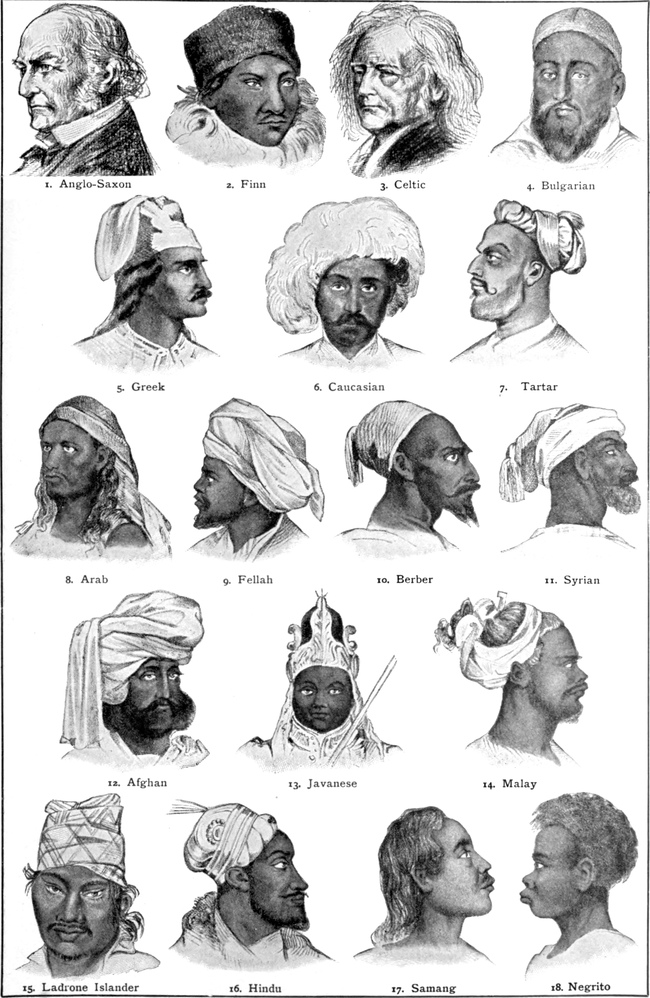
LARGER IMAGE
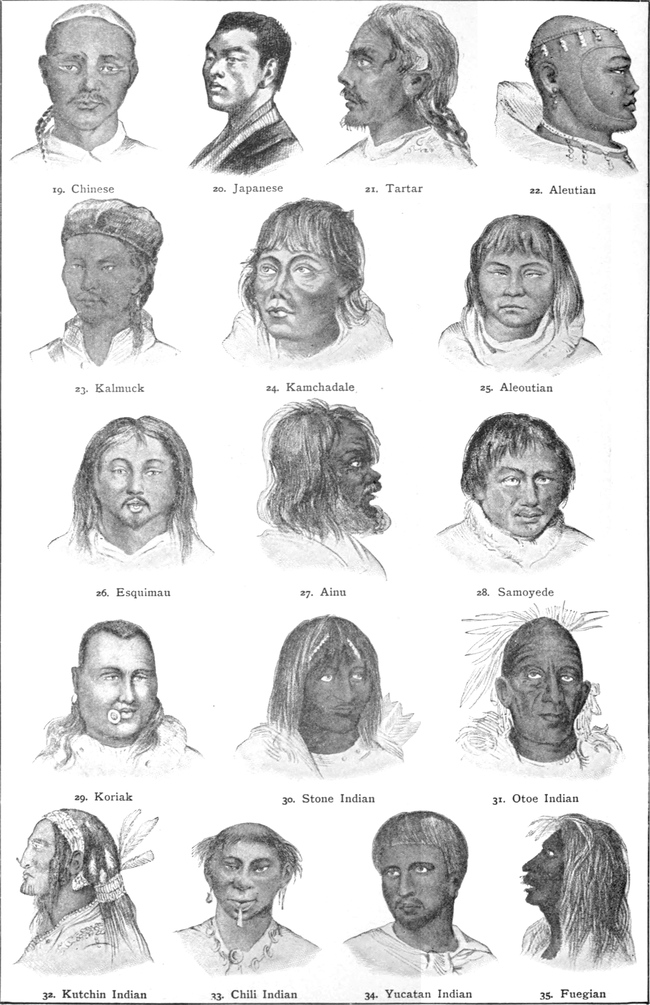
LARGER IMAGE
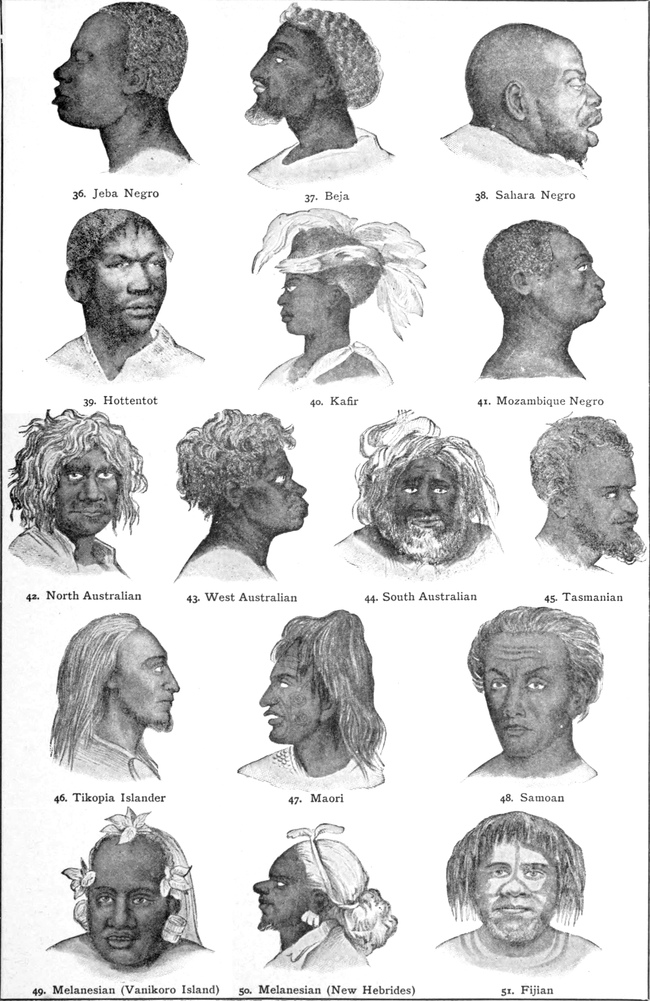
LARGER IMAGE
GROUPED ACCORDING TO PHYSIOLOGICAL RELATIONSHIP
ETHNOLOGICAL CHART OF THE HUMAN RACE
This Chart, intended for reference in connection with the Dictionary of Races beginning on page 311, gives a view of the various main divisions, families, and stocks into which the human race is divided by ethnologists. It is impossible to give a complete list of the individual races within the necessary limits, but the chief typical races are named under each stock in the right-hand column. The races marked with an asterisk are extinct.
ETHIOPIC DIVISION
Family Stock Typical races
AFRICAN NEGRO Sudanese Mandingan


Ashanti
Hausa
Azandeh
Bantu Herero

Wanyamwezi
Basuto
Waganda
Ama-Xosa (Kafir)
Zulu
Hottentot-Bushman Nama

Griqua
Bushman
AFRICAN NEGRITO Pygmy Wochua
Akka
Obongo
OCEANIC NEGRO Papuan New Guinea natives


Melanesian Fijian
Solomon Islanders
Australian Australian aborigines
Tasmanian*
OCEANIC NEGRITO Negrito Andamanese
Sakai
Aeta
MONGOLIC DIVISION
Family Stock Typical races
NORTHERN MONGOLIC Mongol Sharra

Kalmuk
Buriat
Tungus
Turki Turks
Tartars
Bashkirs
Kirghiz
Turkoman
Finno-Ugrian Samoyede
Magyar
Finn
Bulgar
Lapp
Siberian Chukchi
Kamchadale
Koreo-Japanese Korean
Japanese
Dravidian(?) Tamil
SOUTHERN MONGOLIC Tibetan Tibetan

Balti
Lushai
Indo-Chinese Burmese
Siamese
Bhil
Annamese
Chinese Chinese
Punti
Lolo
OCEANIC MONGOLIC Malaysian Malay
Dyak
Javanese
Malagasy Hova
Philippine Visayan
Ilocano
Formosan
AMERICAN DIVISION
Family Stock Typical races
ARCTIC Eskimo Eskimo
Aleutian
NORTH AMERICAN INDIAN Athabascan Apache

Navajo
Algonquian Delaware
Mohican
Blackfoot
Iroquioan Huron
Mohawk
Cherokee
Thlinkit Thlinkit
Haida Haida
Chinook Chinook
Siouan Sioux
Dakota
Omaha
Shoshonean Shoshone
Utah
Comanche
Pawnee
Muskhogean Choktaw
Seminole
Natchez Natchez*
Kiowa Kiowa
Salish Flathead
Pueblo Zuni
Taos
CENTRAL AMERICAN INDIAN Otomi Otomi
Opata-Pima Cora
Tarahumara
Guaicuri Guaicuri
Tarascan Tarascan
Nahuan Toltec
Aztec
Mexican
Maya-Quiché Maya
Quiché
Huastec
Lencan Chontal
Guatusa
Bribri Bribri
Talamanca Talamanca
Zapotec Zapotec
Miztec Miztec
Chorotegan Chorotegan
SOUTH AMERICAN INDIAN Inca Quichua
Chanca
Aymara Aymara
Chibcha Chibcha
Choco Choco
Zaparo Zaparo
Jivaro Jivaro
Mojo Mojo
Chiquito Chiquito
Barré Barré
Charrua Charrua*
Chuncho Chuncho
Conibo Conibo
Carib Macusi
Rucuyenne
Arawak Maypuri
Wapisiana
Warrau Warrau
Botocudo Botocudo
Tupi-Guarani Paraguay
Caribuna
Tupinamba
Payagua Payagua
Matacoan Matacoan
Toba Toba
Araucanian Araucanian
Puelche Puelche
Gaucho
Patagonian Patagonian
Fuegian Fuegian
CAUCASIC DIVISION
Family Stock Typical races
HAMITIC Eastern Egyptian
Somali
Galla
Masai
Western Numidian Berber
Iberian Basque
Pict*
Ligurian Corsican
Pelasgian Mycenæan*
Etruscan*
SEMITIC Assyrian Chaldæan*
Aramæan Syrian
Hittite*
Canaanite Israelite
Phœnician*
Carthaginian*
Arab Arab
Bedouin
Himyarite Abyssinian
ARYAN Hindu Punjabi
Bengali
Iranian Afghan
Persian
Armenian
Kurd
Hellenic Albanian
Greek
Italic Roman
Italian
French
Spanish
Portuguese
Latin American
Keltic Goidelic or Q Kelts Irish
Manx
Highland Scottish
Brythonic or P Kelts Welsh
Breton
Cornish*
Lettic Lithuanian
Lettish
Slavonic Russian
Czech
Polish
Servian
Scandinavian Norwegian
Swedish
Danish
Teutonic Low German Old Saxon*
Dutch
Flemish
Anglo-Saxon
High German German
Saxon
Swiss
Austrian
CAUCASIAN Southern Georgian
Western Circassian
Eastern Chechenz
Lesghian
INDONESIAN Polynesian Samoan
Maori
Marquesan
AINU Ainu Ainu
MAKING OF THE NATIONS
AND THE INFLUENCE OF NATURE
THE BIRTH & GROWTH OF NATIONS
BY PROFESSOR RATZEL
I
IN order that the cosmic conception of the life of man may be more than a mere isolated idea, incapable of being applied and developed, it is necessary to indicate the relation which human life bears to the collective life of the earth.
Man is Bound up with the Earth
Human existence is based upon the entire development of vegetable and animal life; or, as Alexander von Humboldt said, in reality the human race partakes of the entire life on earth. Just as plants and animals, vegetable and animal remains and products, occupy an intermediate position between man and the inanimate substance of the earth, so almost without exception the life of man depends not directly upon the earth, but upon the animals and plants, which in turn are immediately bound to the earth by the necessities of existence. It is the dependence of later and more evolved types upon the earlier and less evolved. In 1845 Robert Mayer, the German scientist, published his epoch-making thesis on “The Relations of Organic Motion to Metabolism,” in which he described the vegetable world as a reservoir wherein the rays of the sun are transformed into life-supporting material and are stored up for use. According to his view the physical existence of the human race is inseparably linked together with this “economic providence”; and he even went so far as to connect it with the instinctive pleasure felt by every eye at the sight of luxuriant vegetation.
Man’s Fight with Plants and Animals Spreading Life Over all the Earth
The history of mankind shows how various are the elements contained in this reservoir, and how manifold their action. Originally plants and animals share the soil with man, who must struggle with them for its possession. The plains favour and the forests obstruct historical movement; the inhabitant of the tropics is hardly able to overcome the growth of weeds that covers his field; for the Esquimau the vegetable world exists but two months in the year, and then only in stunted, feeble species. The unequal distribution of edible plants has in a large measure been the cause of divergence in the developments of different races. Australia and the Arctic countries have received almost nothing; the Old World has had abundance of the richest gifts showered upon it, Asia receiving more than Africa or Europe. The most valuable of domestic animals are of Asiatic origin. America’s pre-European history is incomparably more uniform than that of the Old World, and this is owing to her moderate endowment of useful plants and almost complete lack of domestic animals. The transplanting of vegetable species from one part of the earth to another, carried on by man, is one of the greatest movements in the collective life of the world. Its possibilities of extension cannot be conjectured; for the successful diffusion of single cultivated plants—the banana, for example—over a number of widely separated countries is yet problematical. This process can never be considered to have come to an end so long as necessity forces man to get a firmer and firmer hold on the store of earthly life.
The relations of man to the earth are primarily the same as those of any other form of life. The universal laws of the diffusion of life include also the laws of the diffusion of the human species. Hence the study of the geographical distribution of man must be looked upon only as a branch of the study of the geographical distribution of life, and a succession of the conceptions belonging to the latter.
The Material Tie that Binds Men Together
To these conceptions belong the main area of distribution, the habitable world, and all its various parts: zones, continents, and other divisions of the earth’s surface, especially seas, coasts, interiors of lands, bordering regions, divisions exhibiting continuity with others as links in a chain, and isolated divisions. Also relations as to area: the struggle for territory, variations in the life development in small or inextensive regions, in insular or in continental districts, on heights of land and plateaus, and, in addition, the hindrances and the aids to development presented by different conformations; the advance development in small, densely populated districts; or the protection afforded by isolated situations. All must be included. Finally, properties of boundaries must be conceived of as analogous to phenomena occurring on the peripheries of living bodies.
As races are forms of organic life, it follows that the state cannot be comprehended otherwise than as an organised being; every people, every state is organic, as a combination of organic units. Moreover there is something organic in the internal coherence of the groups and individuals from which a state is formed. However, in the case of a people and a state, this coherence is neither material nor structural; states are spiritual and moral organisms. But, together with the spiritual, there is also a material coherence between the individual members of a race or a nation. This is the connection with the ground. The ground furnishes the only material tie that binds individuals together into a state; and it is primarily for this reason that all history exhibits a strong and ever-increasing tendency to associate the state with the soil—to root it to the ground, as it were.
The State and the Soil
The earth is not only the connecting principle, but it is also the single tangible and indestructible proof of the unity of the state. This connection does not decrease during the course of history, as might be supposed, owing to the progressive development of spiritual forces; on the contrary, it ever becomes closer, advancing from the loose association of a few individuals with a proportionately wide area in the primitive community, to the close connection of the dense population of a powerful state with its relatively small area, as in the case of a modern civilised nation. In spite of all disturbances, the economic and political end has ever been to associate a greater and greater number of individuals with the soil. Hence the law that every relation of a race or tribe to the ground strives to take a political form, and that every political structure seeks connection with the ground. The notion of an unterritorial and a territorial epoch in the history of man is incorrect; ground is necessary to every form of state, and also to the germs of states, such as a few negroes’ huts or a ranch in the Far West. Development consists only in a constant increase in the occupation and use of land, and in the fact that, as populations grow, so do they become ever more firmly rooted in their own soils.
If One State Embraced the Whole Earth
At the same time the nature of the movements of peoples must change. Penetration and assimilation of one race by another occur instead of displacement of one by another; and with the rapid decrease of unoccupied territory the fate of the late-comers in history is irrevocably sealed. Since the state is an organism composed of independent individuals and households, its decay cannot be analogous to the death and corruption of a plant or an animal. When plants decay, the cells of which they are composed decay also. But in a decayed state the freed individuals live on and unite together into new political organisms; they increase, and the old necessity for growth continues in the midst of the ruin. The decay of nations is not destruction; it is a remodelling, a transformation. A great political institution dies out; smaller institutions arise in its place. Decay is a life necessity. Nothing could be more incorrect than the idea that the growth of nations would come to an end were one state to embrace the whole earth. If this were to happen, long before the great moment of union came, there would be a multitude of processes of growth already in operation, ready to rebuild in case of decadence, and to provide for a new organisation if needed. As yet the political expansion of the white races over the earth has not resulted in uniformity, but in manifoldness.
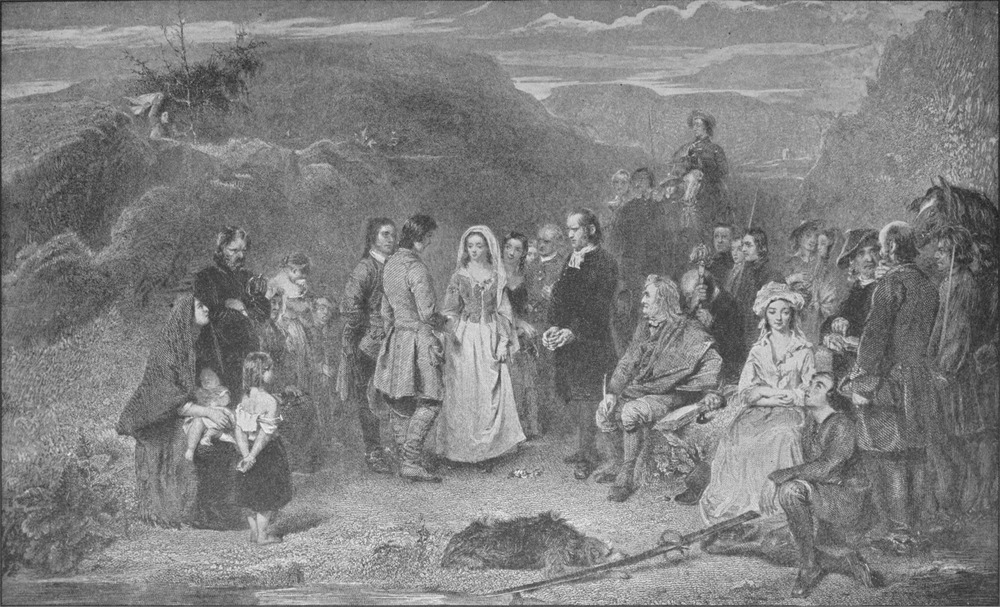
THE PEOPLE OF THE MOUNTAINS: SHOWING THE INFLUENCE OF ENVIRONMENT ON CHARACTER
This picture, by Alexander Johnston, illustrates the keynote of Professor Ratzel’s chapters on the influence of the earth on character. Johnston represents a marriage among the Scottish Covenanters, who, persecuted under the Stuarts, took to the moss-hags and the hills, of whose stern ruggedness their own stern independence was the outcome and counterpart.
LARGER IMAGE
Earth and the Movements of Peoples
All conditions and relations of peoples and states that may be geographically described, delineated, surveyed, and, for the greater part, even measured, can be traced back to movements—movements that are peculiar to all forms of life, and of which the origin is growth and development. However various these movements may be in other respects, they are always connected with the soil, and thus must be dependent upon the extent, situation, and conformation of the ground upon which they take place. Therefore, in every organic movement we may perceive the activity of the internal motive forces which are peculiar to life, and the influences of the ground to which the life is attached. In the movements of peoples, the internal forces are the organic powers of motion common to all creatures, and the spiritual impulses of the intellect and will of man.
In many a view of history these forces alone appear; but it must not be forgotten that they are conditioned by the fact that they cannot be active beyond the general limits of life, and they cannot disengage themselves from the soil to which life is bound. In order to understand historical movements it is first necessary to consider their purely mechanical side, which is shown clearly enough by an inquiry into the nature of the earth’s surface. Neglect of this occasions a delay in the understanding of the true character of such movements. Men merely spoke of geography, and treated history as if it were an atmospheric phenomenon.
National Emigrations in History
Nations are movable bodies whose units are held together by a common origin, language, customs, locality, and often necessity for defence—the strongest tie of all. A people expands in one direction and contracts in another; in case of two adjacent nations, a movement in the one betokens a movement in the other. Active movements are responded to by passive, and vice versa. Every movement in an area filled with life consists in a displacement of individuals. There are also currents and counter-currents: when slavery was abolished in the Southern States of America, an emigration of white men from the South was followed by an influx of ex-slaves from the North, thus causing an increase in the black majority of the South.
Why Nations Must Seek New Homes
Such external movements of peoples assume most varied forms. History takes a too narrow view in considering only the migrations of nations, looking upon them as great and rare events, historical storms as it were, exceptional in the monotonous quiet of the life of man. This conception of historical movements is very similar to the discarded cataclysmic theory in geology. In the history of nations, as in the history of the earth, a great effect does not always involve a presupposition of its being the immediate result of a mighty cause. The constant action of small forces that finally results in a large aggregate of effect must be taken into account in history as well as in geology. Every external movement is preceded by internal disturbance: a nation must grow from within in order to spread abroad. The increase of Arabs in Oman led to an emigration to East Africa along highways of traffic known to times of old. Merchants, craftsmen, adventurers, and slaves left their native land and drew together in Zanzibar, Pemba, and on the mainland. The process was repeated from the coast to the interior, and as a result of the aggregate labour of individuals as merchants, colonists, and missionaries, Arabian states grew up in the central regions of Africa. Instances of the occupation of vacant territories are of the greatest rarity in history as we are acquainted with it. The best example known to us is the settlement of Iceland by the Northmen. The rule is, a forcing in of the immigrating nation between other races already in possession; the opposition of the latter often compels the former to divide up into small groups, which then insinuate themselves peacefully among the people already established in the land.
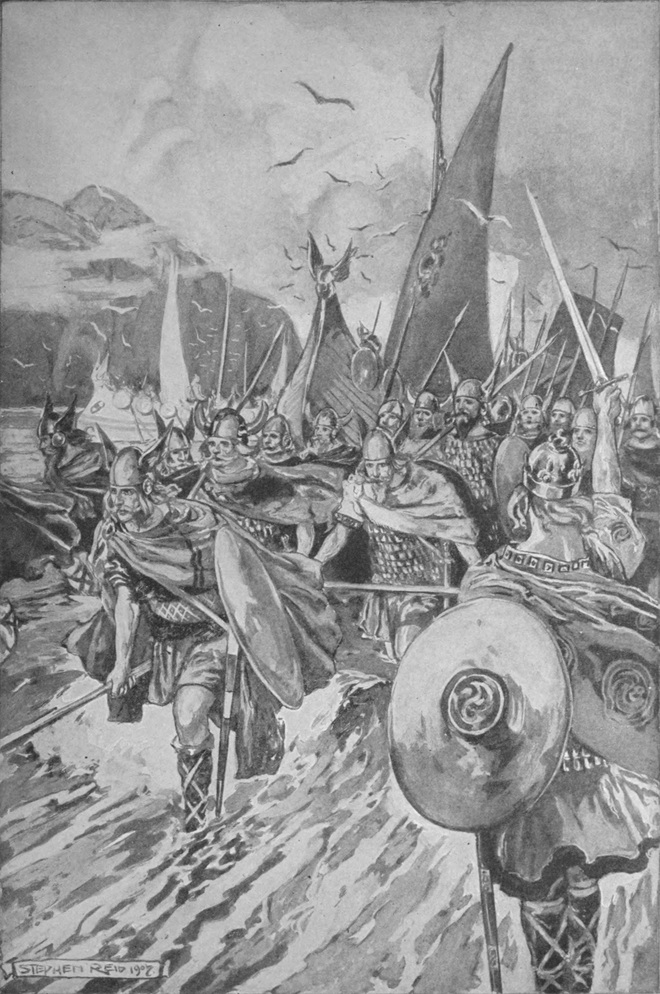
THE NORTHMEN TAKING POSSESSION OF ICELAND
Instances of peoples taking possession of uninhabited lands and settling therein are extremely rare. Iceland is the best example known. The hardy Northmen took possession of it in the ninth century, but found the country untenanted.
LARGER IMAGE
The Human Will Knows no Obstacle
The movements of nations resemble those of fluids upon the earth: they proceed from higher altitudes to lower; and obstacles cause a change of course, a backward flow, or a division. Though at first there may be a series of streams running along side by side, there is a convergence at the goal, as shown by the migration of different peoples to a common territory; there is concentration when there are hindrances to be overcome, and a spreading out where the ground is level and secure. One race draws other races along with it; and, as a rule, a troop of wanderers come from a long distance will be found to have absorbed foreign elements on its way. But it would be wrong to look upon the movements of nations as passive onflowings, or even to deduce a natural law from the descent of tribes from the mountains to the river valleys and to the sea—an idea that once led to the acceptance of the theory of the Ethiopian origin of Egyptian civilisation. Either the wills of individuals unite to form a collective will, or the will of a single man imposes itself upon the aggregate. The human will knows no insurmountable obstacle within the bounds of the habitable earth.
Bursting Nature’s Barriers
As time goes on, all rivers and all seas are navigated, all mountains climbed, and all deserts traversed. But these have all acted as obstructions before which movements have either halted or turned aside, until finally they have burst the barriers. At least two thousand years passed from the time of the first journey of a Phœnician ship out through the Pillars of Hercules into the Atlantic until the arrival of the day when a voyage across was ventured from Southern Europe. The Romans turned at the Alps, both to the right and to the left, seven hundred years after their city had been founded, but how many nooks in the interior of those mountains were unknown to them even centuries later! Yet to-day Europe feels the effect of this circumstance, the fact that the Romans did not advance straight through the Central Alps into the heart of the Teutonic country. They followed a roundabout way through Gaul, and thus Mediterranean culture and Christianity were brought to Central Europe from the west instead of from the south; hence the dependence of the civilisation of Germany upon that of France.
It is precisely the Romans who, contrasted with barbarians, show us that will or design in the movements of nations does not necessarily increase with growth of culture, even though culture constantly puts more means of action at its disposal, improved methods of transportation, by which the way may be lightened. The mounted bands of Celts and Germans crossed the Alps quite as easily as did the Roman legions; and in spreading about and penetrating to every corner of the Alps and the Pyrenees, the barbarians were always superior to the Romans.
The Great Wanderers of the Earth
Wandering tribes of semi-civilised people are smaller, less pretentious, and less encumbered. In every war that has taken place in a mountain land, the greater mobility of untrained militia has often led to victories over regular troops. Races of inferior culture are invariably more mobile than those of a higher grade of civilisation; and they are able to equalise the advantages of the superior modes of locomotion with which culture has supplied the latter. Mobility also indicates a weaker hold upon the ground, and thus uncivilised peoples are more easily dislodged from their territories than are nations capable of becoming, as it were, more deeply rooted. In nomadic races, mobility bound up with the necessity for an extensive territory assumes a definite form, and, owing to a constant preparedness for wandering and to the possession of an organised marching system, such peoples have been among the greatest forces in Old World history.
Movements of nations are often spoken of as if certain definite directions were forced upon them by some mysterious power. This view not only wraps itself in the garment of prophecy—for example, when announcing that the direction in which the sun travels must also be that of history—but it formally presupposes a necessary east-to-west progression of historical movements, endeavouring to substantiate its doctrine by citation of examples, from Julius Cæsar to the gold-seekers of California. But this necessity remains always in obscurity. Not only is it contradicted by frequently confirmed reflex movements in historical times, but it is also disproved still more by the great migrations which have taken place on the same continent in contrary directions. In Asia the Chinese have spread over the entire area of interior plain and desert, westward to the nation-dividing barriers of the Pamir Mountains; other Asiatic races have overflowed into Europe—also from east to west. Contrariwise, ever since the sixteenth century we have seen the Russians at work conquering the entire northern part of the continent, constantly pressing on towards the east. Even the sea proved no obstacle, for they both discovered and acquired Alaska during the course of this same movement.
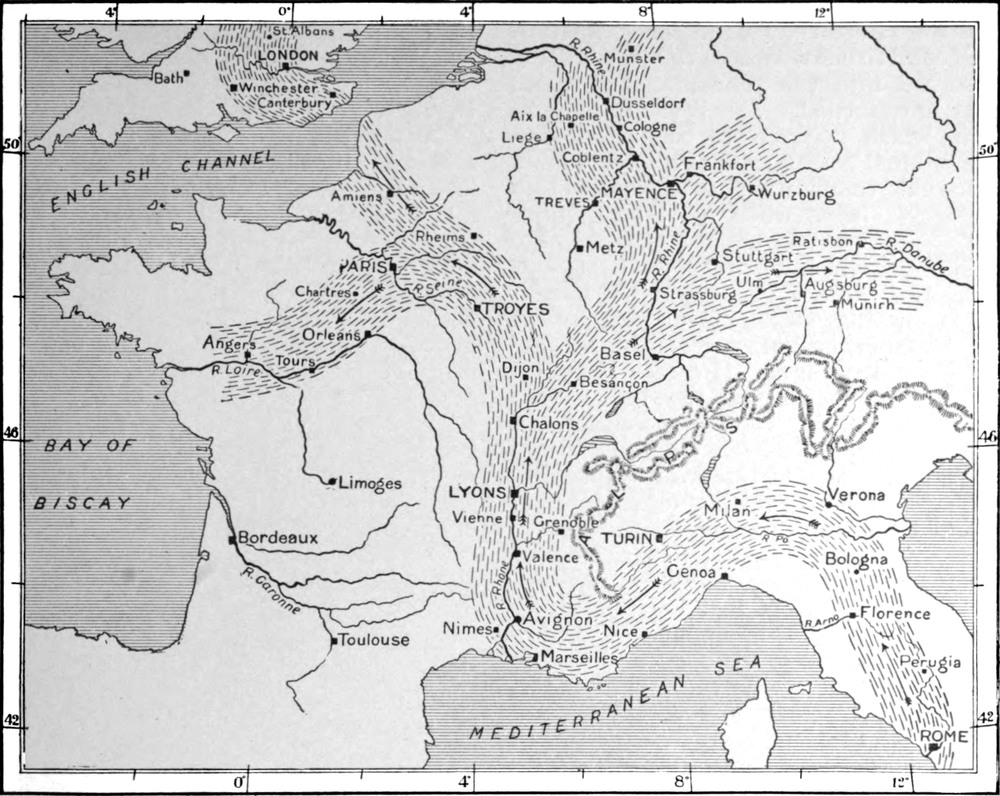
HOW CIVILISATION SPREAD THROUGH EUROPE
The inexorable influence of physical conditions on the life of the peoples is well illustrated by the influence of the Alps in deflecting the path of Mediterranean culture. These mountains hemmed in the north of the Roman Empire and forced the Romans, in their expansion, to the west. Hence Mediterranean culture and Christianity were carried to Central Europe from the west instead of from the south, and the civilisation of Germany depends on that of France. The map shows the route followed by the stream of Roman civilisation.
We shall not attach any universal significance to such fashionable terms employed in historical works as political or historical attraction, elective affinity or balance; least of all shall we presume to discover occult, mysterious sources for them. It is obvious that a powerful nation will overflow in the direction of least resistance; and in the case of a strong Power confronting one that is weak there is a constant movement toward the latter. Thus, from the earliest times, Egypt has pressed on toward the south; and everywhere in the Sudan we find traces of similar movements to the south as far as Adamawa, where they are still to-day in energetic continuance. The history of colonisation in America shows a turning of the streams of immigration, in the south as well as in the north, towards the more thinly settled regions; the more thickly populated are avoided. The migrations of nations, which took place during periods of history when a surplus of unoccupied land existed, were determined to a great extent by natural causes. The more numerous nations become, the greater the obstacles to migration, for most of these obstacles arise from the very nations themselves.
Nations increase with their populations; lands with enlargement of territory. So long as a country has sufficient area, the second form of growth need not of necessity follow the first—the race spreads out over the gaps which are open in the interior, and thus internal colonisation takes place. If there is need for emigration, occupiable districts may be found in the lands of another people—for centuries Germans have thus found accommodation in Austria, Hungary, Poland, and America.
How New States are Born
Of course, such colonists gradually become absorbed into the people among whom they have settled. This is simple emigration, which is therefore connected with the internal colonisation of a foreign land. External colonisation first comes into being when a state acquires territory under its control, into which territory, if it be suitable, a portion of the inhabitants of the state move and settle. Colonisation is not necessarily a State affair from the first. If a race inhabit a country so sparsely as the Indians did America in the sixteenth century, a foreign people, having the power of spreading out, may press into the gaps with such success that this initial internal colonisation may also be advantageous from a political standpoint. The State then intervenes and appropriates the territory over which groups of its inhabitants have previously acquired economic control.
The emigrants formed a social aggregate in the new country, and from this aggregate a state, or the germ of a state, develops. Since such an economic-social preparatory growth greatly assists in the political acquirement of land, it is obvious that this form of colonisation is especially sound and effectual. The opposite method follows when a state first conquers a territory which it occupies later with its own forces; this is colonisation by conquest. It can be capable of development only when subsequent immigration permanently acquires the land as a dwelling-place.
Why Rome’s Empire Endured Long
Conquest that neither can nor will take permanent possession of the soil is characteristic of a low stage of culture; thus the Zulu states in Africa, surrounded by broad strips of conquered yet uncontrolled territory, and the old “world-empires” of Western Asia, exhausted themselves in vain efforts to obtain lasting increase of area through aggressive expeditions. That the Roman Empire lasted a longer time than any of the preceding universal empires was due to the single fact that agricultural colonisation invariably followed in the footsteps of its political conquests.
The enlargement of a nation’s area is associated with soil and inhabitants. If the increase of territory—for example, through conquest—is much more rapid than the increase of population, an inorganic, loosely connected expansion results, which, as a rule, is soon lost again. If, on the contrary, population increases at a proportionately greater rate than area, a crowding together, checks to internal movements, and over-population follow. In consequence, great discrepancies between growth of territory and increase of population lead to the most varied results. The conquering nation expands over extensive regions for which there are no inhabitants. Passive races in India and in China become so crowded together that it is impossible for their soil to support them any longer; hence a continuous degradation and recurrent periods of famine, which may bring with them a relatively feeble and unorganised emigration.
The Modern Nations as Colonisers
There are nations with whom conquest and colonisation seem to follow in most profitable alternation: this appears to have been the case with all colonising countries of modern history that have followed the example of the Roman Empire. But there are great contrasts presented even by these nations. Germany, Austria, and Russia, in immediate connection with their conquered provinces, have colonised and expanded toward the east. In spite of a rapid increase of population, Germany has been backward in establishing trans-marine colonies, while France, with a proportionately smaller increase of population, began by colonising in all directions, but occupied more land than she was able to master; for which reason colonization in the history of France has taken more or less the character of conquest. England, on the contrary, with a vigorous emigration and an expansive movement in all directions, presents an example of the soundest and strongest method of founding colonies which has been seen since early times.
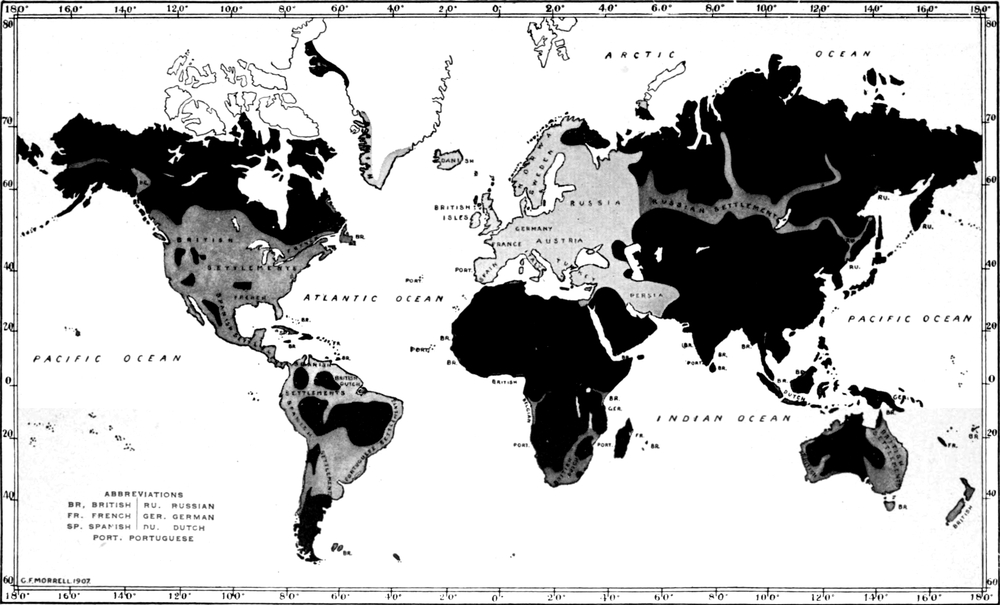
THE EXPANSION OF THE WHITE RACES THROUGHOUT THE WORLD
This map illustrates the extent to which the white races have spread into other than their native lands. The pale tint, as on the British Isles, indicates the native land of the whites; the darker tint shows where whites have settled down; while the black portions represent those parts of the earth where the coloured races predominate.
LARGER IMAGE
Some New National Problems
Through the entire course of history an ever-increasing value attached to land may be traced; and in the expansion of nations we may also see that mere conquest is growing less and less frequent, while the economic acquisition of territory, piece by piece, is becoming the rule. The getting of land assumes more and more the character of a peaceful insinuation. The taking possession of distant countries without consideration for the original inhabitants, who are either driven away, or murdered—speedily with the aid of bullets, or slowly with the assistance of gin or contagious diseases or by being robbed of their best land—is to-day no longer possible. Colonisation has become a well-ordered administration combined with instruction of the natives in useful employments. The old method has left scarcely a single pure-blooded Indian east of the Mississippi in the United States, and not one native in Tasmania; the new method has before it the problem how to share the land with negroes—in the Transvaal with 74 per cent. and in Natal with 82 per cent. Climatic conditions are also to be taken into consideration, for Caucasians are able to develop all their powers in temperate regions only; a hot climate impels them to ensure the co-operation of black labour through coercion.
Mankind Ages with Civilisation
During the course of centuries a motley collection of countries has developed, all of which are called colonies, although they stand in most striking contrast with one another. Several are nations in embryo, to which only the outward form of independence is lacking; not a few have once been independent; and many give the impression that they will never be fit for self-government. There are some in which the native population has become entirely extinct, such as Tasmania, Cuba, and San Domingo; others in which the original inhabitants, still keeping to their old customs and institutions, are guided and exploited by a few white men only; and, finally, colonies in which the rulers and the natives have assimilated with one another, as in Siberia. Once upon a time such tokens of the youth of races as may be seen in rude but remunerative labour on unlimited territory were widespread in many colonies. But the new countries fill up visibly, and even they show that mankind, as a whole, ages the more rapidly the more the so-called progress of civilisation is hastened. However, an examination of the peoples of the present day shows that the differences in age between mother-countries and colonies will, indeed, continue for a long time yet. Such differences exist between west and east Germans as well as between New Englanders and Californians; they are even to be detected in Australia, between the inhabitants of Queensland and of New South Wales. Such differences are shown not only in the characteristics of individuals, but also in the division of land and in methods of labour.
Nations Hold fast to Nature
Divergence and differentiation are the great factors of organic growth. They govern the increase of nations and states from their very beginnings. Since, however, these organisms are composed of independent units, differentiation does not consist in an amalgamation and transformation of individuals, but in their diffusion and grouping. Therefore the differentiation of nations becomes eminently an affair of geography. Never yet has a daughter people left its mother-country to become an independent state without a previous disjunction having taken place. All growth is alteration in area, and, at the same time, change in position. The further growth extends away from the original situation, the sooner dismemberment follows. In Australia, New South Wales spreads out towards the north, and at the new central point, Brisbane, a new colony, Queensland, is formed, which already differs materially from New South Wales. And Queensland itself expands towards the north, beyond the tropic of Capricorn into the torrid zone; and a younger, tropical North Queensland develops.
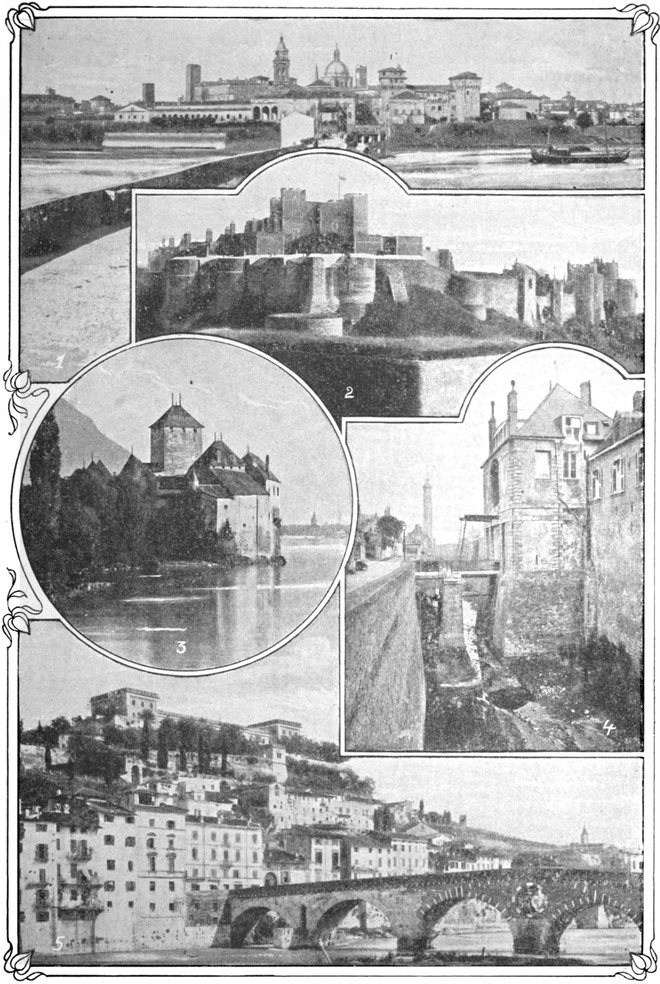
LANDMARKS OF PAST AGES: FAMOUS FORTRESSES THAT HAVE CEASED TO BE OF USE
With the changing conditions of politics, places once of enormous importance have often become mere curiosities. There are in Europe to-day hundreds of useless castles, fortresses, and harbours. Even Dover Castle is of little strategic value. The fortresses illustrated are (1) Mantua, (2) Dover, (3) Chillon, (4) Calais, (5) Verona.
Photographs by Frith and Neurdein
LARGER IMAGE
The Genius of the Coloniser
The fact that nations hold fast to their natural conditions of existence, even when growth impels them towards expansion in various directions, is a great controlling force in historical movement. Russia expands in its northern zone to the Pacific ocean; England continues its growth on American soil, across the Atlantic, in almost the same latitude. The Phœnicians, as a coast-dwelling people, remained on the coasts and on the islands; the colonising Greeks ever sought out similar situations to those of their native land; the Netherlanders are found everywhere in Northern Germany as colonists of the moors and marshes. All German colonies beyond the Alps and the Vosges have disappeared; and the few Germans that remain are Latinised. Nations that are accustomed to a limited territory, as were the Greeks, always search for a similar limited area; on the other hand, the Romans discovered a main factor of empire-building in their judicious agricultural colonisation of broad plains; and the Russians sought and found in Siberia the endless forests, steppes, and vast rivers of their native land. Every nation, in expanding, seeks to include within its area that which is of the greatest value to it. The victorious state acquires the best positions and drives the conquered race into the poorest districts. For this reason competition between the colonizing nations has become very keen; they all judge of the character of territory according to the same standard. Therefore, wherever England has colonised, only a gleaning remains for the rest of the Northern and Central European Powers.
Differentiation, arising from the valuation of land, is the cause of a constant creation of new political values and of a constant lapsing of old. Every portion of the world has its political value, which, however, may become dormant, and must then be either discovered or awakened. Such a discovery was the selection of the Piræus as the harbour for Athens from among a number of bights and bays.
The World is Being Centralised
Every settlement and every founding of a city is at bottom an awakening of dormant political value. Capacity for recognizing this value is a part of the genius of a statesman, whose policy may be called far-seeing partly because he is able to discern the dormant value while yet on the most distant horizon. It is obvious that political values vary; each is determined by the point of view from which it is looked upon. The French and the German valuations of the Rhine borderland are very different. Every nation endeavours to realise the political value which it recognises; and in respect to political growth, ends are set up in the shape of the portions of the earth to which that growth aspires. Peculiarities in the conformation of states may be traced back to an appreciation of the value of coasts, passes, estuaries, and the like. With the spreading out and the concentration of nations, such portions of the world as are important from a political point of view have marvellously increased both in number and in value. But for this very reason a choice of selection has become necessary, and this we see in the use of fewer Alpine passes during the age of railways than before, and in the concentration of a great commerce into fewer seaports—into such as are capable of accommodating vessels of the deepest draught. Others must withdraw from competition. To-day there are hundreds of worthless harbours, passes, and fortresses in Europe that were once situated on the highways of historical movement; now however, they are avoided, deserted by the current of traffic.
All the Rubbish of Civilisation
There are more things necessary to an understanding of the dependence of history on natural conditions than a mere knowledge of the land upon which the development has taken place, particularly than a mere knowledge of the ground as it was when history found it. Although each country is in itself an independent whole, it is at the same time a link in a chain of actions. It is an organism in itself, and, in respect to a succession or a group of lands forming a whole, of which it is a member, it is also an organ. Sometimes it is more organism than organ; sometimes the opposite is true; and an eternal struggle goes on between organism and organ. If the latter be a subjected province, a tributary state, a daughter country, a colony, or member of a confederation, the striving for independence is always a struggle for existence.
This by no means presupposes a state of war. Not only war, but the outwardly peaceful economic development of the world’s industries reduces organisms to organs. When the wholesale importation of bad but cheap products of European industries into Polynesia or Central Asia causes decay in the production of native arts and crafts, it is a loss to the life of the whole people; henceforth the race will be placed in the same category with tribes that must gather rubber, prepare palm-oil, or hunt elephants to supply European demand, and who in turn must purchase threadbare fabrics, spirits that contain sulphuric acid, worn-out muskets, and old clothes—in a word, all the rubbish of civilisation.
Their economic organisation dies; and in many cases this is also the beginning of the decline and extinction of a people. The weaker organism has succumbed to the more powerful. Is the case so different—that of Athens, unable to live without the corn, wood, and hemp of the lands on the Northern Mediterranean coast?—or of England, whose inhabitants would starve were it not for the importation of meat and grain from North America, Eastern Europe, and Australia?
In vain have men sought for characteristics in the rocks of the earth and in the composition of the air by which one land might be distinguished from another.
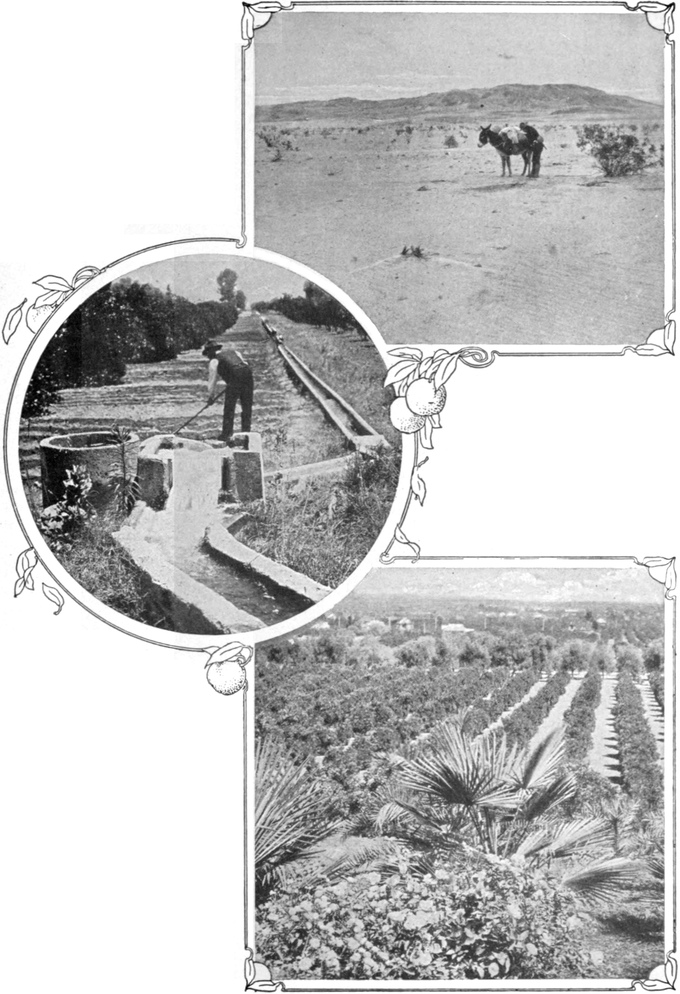
Underwood and Underwood.
MAN’S WONDERFUL TRIUMPH OVER NATURE
By irrigation the arid desert of California has been made to blossom as the rose in the luxurious orange groves of Riverside. These views show the desert, the method of irrigation, and the result of man’s labour.
LARGER IMAGE
How Man is Levelling the Earth
The idea of great, lasting, conclusive qualitative variations in different parts of the earth is mythical. Neither the Garden of Eden nor the land of Eldorado belongs to reality. There is no country whose soil bestows wondrous strength upon man or an exuberance of fruitfulness upon woman. In India precious stones are as little apt to grow out of the cliffs as silver and gold are likely to exude from fissures in the earth. Nor is there any basis for the slighter differences between the Old World and the New which the philosophers of history of the eighteenth century believed they had discovered. The opinion that the New World produces smaller plants, less powerful animals, and finally a feebler humanity, was not unconditionally rejected by even Alexander von Humboldt. The degeneration and wasting away of the American Indians would certainly be a less disgraceful phenomenon could it be attributed to some great natural law instead of to the injustice, greed, and vices of the white men. In the course of development of the European daughter-nations in America we cannot recognise any such great and universal distinction. The course of history in America, just as in corresponding periods of time in Northern Asia, in Africa, and in Australia, only confirms the belief that lands, no matter how distant from one another they may be, whenever their climates are similar, are destined to be scenes of analogous historical developments.
It is certain that, so far, one of the greatest results of the labour of man has been the levelling and overcoming of natural differences. Steppes are made fertile through irrigation and manuring; the contrast between open and forest land becomes less and less—indeed the destruction of forests is being far too rapidly and widely carried out—the acclimatisation of men, animals, and plants causes variations to disappear more and more as time passes. We can look forward to a time when only such extremes as mountains and deserts will remain—everywhere else the actions of the earth will be equalised. The process by which this is carried out may be described shortly. Man, in spite of all racial and national differences, is fundamentally quite as much of a unity as the soil upon which he dwells; through his labour more and more of this character of unity is transmitted to the earth, which, as a result, also becomes more and more uniform.
History from Heaven to Earth
One of the most powerful of the ties by which history is bound to Nature is that of its dependence on the ground. At the first glance any given historical development is involved with the earth only—the earth upon which the development takes place. But if we search deeper we shall find that the roots of the development extend even to the fundamental principles of the planetary system. By this it is not meant that every history must be founded on a cosmological basis, that it must begin with the creation, or, at least, with the destruction of Troy, as was once thought necessary; but it is certainly safe to say that a philosophy of the history of the human race, worthy of its name, must begin with the heavens and then descend to the earth, filled with the conviction that all existence is fundamentally one—an indivisible conception founded from beginning to end on an identical law.
The 316,250,000 square miles of the earth’s surface is the first area with which history has to do. Within it all other surface dimensions are included; it is the standard for measurement of all other areas, and also comprehends the absolute limits of all bodily life. This area is fixed and immutable so far as the history of mankind is related to it, although in respect to the history of the world it is not to be looked upon as having been unalterable in the past, or as being likely to remain unchanged in the future.
316,250,000 Miles of History
The earth’s surface may be divided into three unlike constituent parts—84,250,000 square miles of land, 220,000,000 square miles of water, and 13,750,000 square miles of ice-covered, and for the greater part unexplored, land and sea in the Northern and Southern Polar regions. The land is the natural home of man, and all his historical movements begin and end upon it. The size of states is computed according to the amount of land which they include; their growth has derived its nourishment from the 84,250,000 square miles of earth as from a widespread fundamental element. The sea is not to be looked upon as an empty space between the divisions of land, merely separating them one from another, for the 220,000,000 square miles of water are also of historical importance, and the area of every ocean and of every portion of an ocean has its historical significance. History has extended itself over the sea, from island to island, from coast to coast, at first crossing narrow bodies of water, later broad oceans; and states whose foundations arose from connections by sea remain dependent on the sea. The Mediterranean held together the different parts of the Roman Empire just as the oceans unite the Colonies of the British Empire.
The variations of the earth’s form from that of a perfect oblate spheroid are so small that they may be entirely disregarded from the point of view of history. All portions of the earth’s surface may be looked upon as of equal curvature; the pyriform swelling which Columbus believed to be a peculiarity of the tropic zones in the New World was merely an optical illusion. Thus all portions are practically similar, and uniformity obtains over the entire earth to such an extent that there is room left only for minor inequalities in configuration. To these belong the differences in level between lands and seas, highlands and lowlands, mountains and valleys. Such variations amount to very little when compared with the earth as a whole; for the height of the tallest of the Himalayas added to the earth’s radius would increase its length by about 1⁄700 only; and the same may be said of the greatest depressions beneath the level of the sea—inequalities that cannot be represented on an ordinary globe. Their great historical significance is due chiefly to the fact that the oceans and seas occupy the depressions, from which the greatest elevations emerge as vast islands.
Irregular Surface of the Earth
The remaining irregularities of the earth’s surface are not sufficient to produce any permanent variations in the diffusion of races or of states. Their influence is merely negative; they may only hinder or divert the course of man in his wanderings. Even the Himalayas have been crossed—by the Aryans in the west, and by the Tibetans in the east; and British India has extended its boundaries far beyond them to the Pamirs. The historian is concerned with but two of the variable qualities of the land—differences in level and differences in contour. Variations in constitution, development, elementary constituents, and the perpetual phenomena of transformation and dissolution which present a thousand problems to the geographer, scarcely exist for the historian. Nor are those great inequalities, the depressions in which the seas rest, of any interest to him. It is indifferent whether the greatest of such depressions be covered by five miles of water, or, as we now know, by almost six miles. The fact that the Mediterranean reaches its greatest depth in the eastern part of the Ionian Sea has nothing whatever to do with the history of Greece.
Depths of The Sea
To be sure, there is a general connection between the depth of the Mediterranean, shut up within the Straits of Gibraltar, and the climate of the neighbouring regions, which has a direct influence on the inhabitants of Mediterranean countries; but it is a very distant connection, and it is only mentioned here in order to remind the reader that there is not a single phenomenon in Nature that is not brought home to mankind at last. Still, as a rule, history is concerned with the depths of the sea only in so far as they are the resting-places for submarine telegraph cables; and this is a fact of very recent times. It may be said that the formation of the earth’s crust occurred at a period too
remote to have had any influence on the history of man, and that therefore all questions concerning it should be left to geology. The first statement may be admitted, but the latter does not follow by any means; for if the whole Mediterranean region from the Caucasus to the Atlas Mountains, and from the Orontes to the Danube, is a region of uniform conformation, it is purely by reason of a uniformity in development. In the same manner there is an extensive region of uniform conformation to the north, between the Atlantic Ocean and the Sudetic Mountains in Austria.
Nature Divides and Unites
There are great features of the earth’s conformation that are so extensive that groups of nations share them in common. Russia and Siberia occupy the same plain upon which the greater portions of Germany, Belgium, and Holland are situated. Germany and France share the central mountain system which extends from the Cévennes to the Sudeten, or Sudetic Mountains. A mere participation in a common geological feature produces such affinity and relationship as may be seen in the Alpine states, in Sweden and Norway, and in the nations of the Andes. This reminds us of the groups of nations that surround seas; but that which separates the Baltic states binds them together; and the mountains that unite the Swiss cantons also separate them from one another. Lesser features of conformation divide countries and often exhibit gaps and breaches in development, for the reason that they divide a political whole into separate natural regions. The history of the lowlands of North Germany differs greatly from that of the mountainous districts of the same country; the lowlands of the Po and Apennine Italy are two different lands. The great contrast between the hilly manufacturing west of England and the low-lying agricultural east extends throughout English history; and in like manner the highlands and the lowlands are opposed to each other in Scotland.
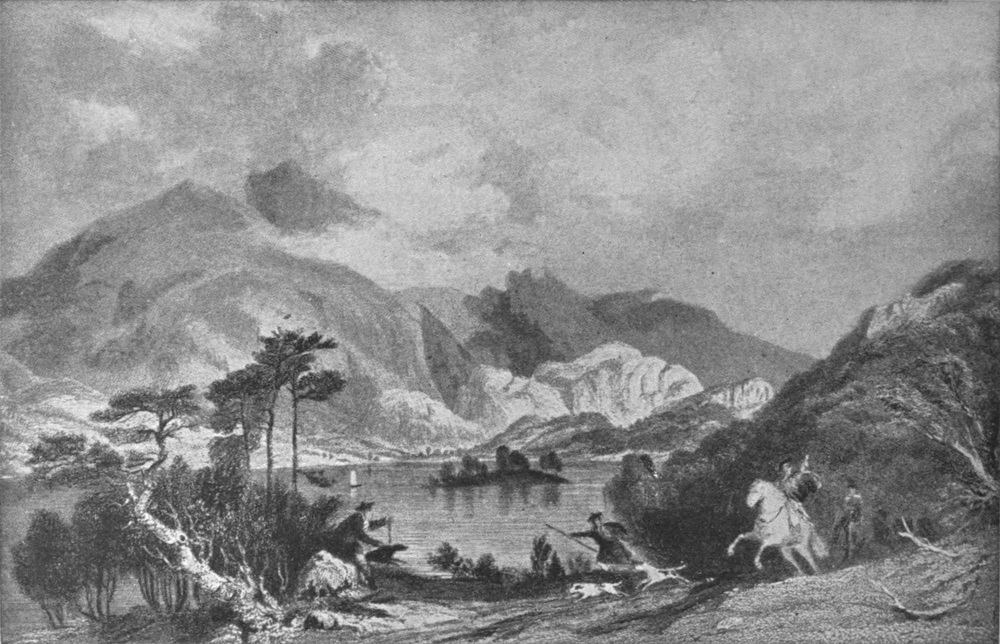
SCENERY THAT SHAPES CHARACTER: THE INFLUENCE OF THE MOUNTAINS
The stories of mountain peoples are very similar; the Highlanders of Scotland, Wales, Switzerland, the Cevennes, and Tyrol, have many characteristics in common, owing their rugged nature and independence to environment.
Wherever mountain formations occur largely in a country, the question arises whether, in spite of all diversity, they unite to form a whole, or whether they exist as separate, independent neighbouring parts. The elements of the surface formation of the earth are not only historically important in themselves as units, but also on account of the way in which they are connected with one another. We have in Greece an example of an exceedingly intricate mountain system in which barren plateaus are interspersed with fertile valleys and bays. Owing to the sea, such bays as those of Attica, Argos, and Lamia are to a high degree self-dependent; they became little worlds in themselves, independent states, which could never have grown into a united whole had they not been subjected to external pressure.
The reverse of this state of disunion, arising from the juxtaposition of a great number of different formations, is the division of North America into the three great regions of the Alleghanies, the Mississippi Valley, and the Rocky Mountain plateau, which gradually merge into one another and are bound into a whole by the vast central valley. Austria-Hungary includes within itself five different mountain features—the Alps, Carpathians, Sudeten, the Adriatic provinces, and the Pannonian plains. Vienna is situated where the Danube, March, and Adria meet, and from this centre radiates all political unifying power. If a still closer-knit unity is co-existent with a diversified geological formation of insular or peninsular nature, as in Ireland or Italy, it follows that this unity binds the orographic divisions into an aggregate. The discrepancies between Apennine Italy, Italy of the Po Valley, and Alpine Italy, which have been evident in all periods of history, formed, in their rise and in their final state of subjugation to political force, an example of dissimilarity of mountain features existing within peninsular unity.
The great continental slopes are also important aids to the overcoming of orographic obstacles to political unity. In Germany there is a general inclination towards the north, crossed and recrossed by a number of mountain chains and successions of valleys. It is not to be denied that the intersecting elevations have furthered political disunion. Without doubt, a gradual slope from the southern part of Germany to the sea, with a consequent partition of the country by the rivers into strips extending from east to west, would have been attended by a greater political unity. Again, but in another way, the preponderance of any one orographic element has a unifying effect on all the other elements, as we have seen in North America, where the simple, even course of development has been in conformity with the existence of geological formations on a large scale.
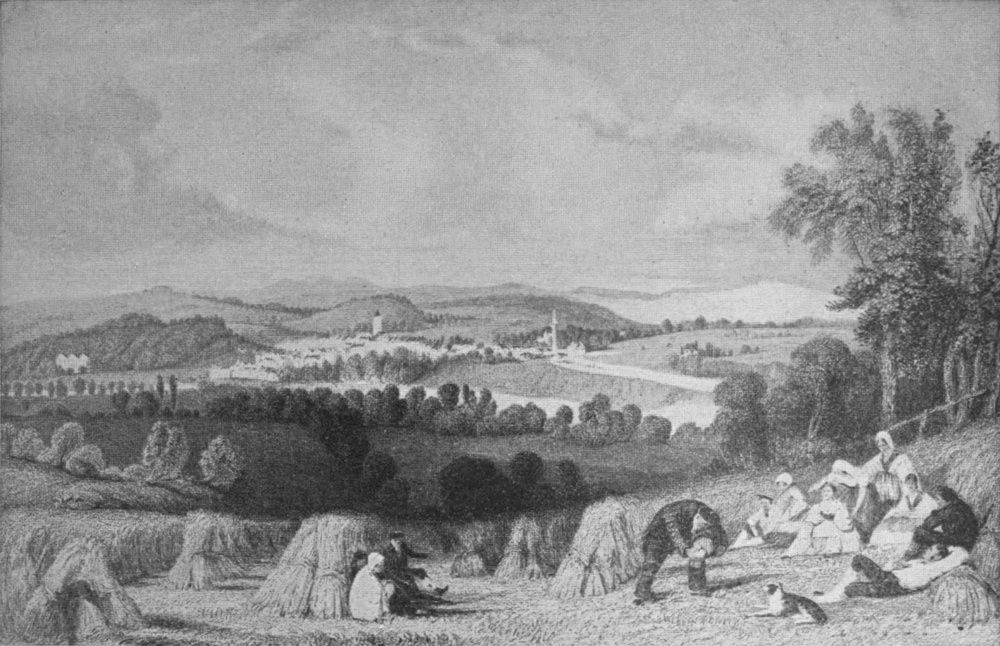
THE SOFTENING EFFECT OF THE RICH AND FRUITFUL LOWLANDS
Whereas mountains breed independence and rugged character in their inhabitants, the more fruitful lowlands develop a gentler race, loving the companionship of communities. The lowlands, also, are the homes of mixed races.
There are internal differences in formation in every mountain range and in every plain, all of which have different influences on history. The steep fall of the Alps on the Italian side has rendered a descent into the plains of the Po far easier than a crossing in the opposite direction, where many obstacles in the shape of mountain steeps, elevated plateaus, and deep river valleys surround the outer border of the Alps. Again, penetration from the plains to the interior of the Alps is less difficult in the west, where there are no southern environing mountains, than in the east, where there is such a surrounding mountain chain. The compact formation of the Alps in the west crowds obstacles together into a small space, where they may be overcome with greater labour and in a shorter time than in the east, among the broadened-out chains of mountains, where there are numerous smaller hindrances to progression spread out over a wider territory. The route from Vienna to Trieste is twice as long as that from Constance to Como.
In mountain passes orographic differences are concentrated within very limited areas, and for this reason passes are of great importance in history. The value of gorges and defiles increases with their rarity, and their number varies greatly in different mountain chains. The Pindus range is broken but once, by the cleft of Castoreia, and an easy passage from Northern to Central Greece is possible only by way of Thermopylæ; the short overland route from Persia to India is through the Khyber or Bolan Passes. The Rhætian Alps are rich in defiles and gorges; but the mountain ridges are poor in crossing-places, and, as a rule, the elevation of the passes decreases towards the east.
Nature’s Place in History
The possibility of journeying over the Himalayas increases as we travel westward. During the Seven Years’ War the great difference between the accessible, sloping Erz-Gebirge of the Bohemian frontier and the precipitous, fissured, sandstone hills of the Elbe was very apparent. Mountain passes are always closely connected with valleys and rivers; the latter form the ways leading to and from the former. The valleys of the Reuss and the Tessin are the natural routes to the pass of St. Gothard; and were it not for the gorges of the Inn and the Etsch in the northern and the southern Alps, the Brenner Pass would not possess anything like its present supreme importance. Wherever such entrances to passes meet together or cross one another, important rallying-points either for carrying on traffic or for warlike undertakings are formed; such places are Valais, Valteline, and the upper valley of the Mur. Coire is a meeting-point of not less than five passes—the Julier, Septimer, Splügen, St. Bernardin, and Lukmanier. The value of passes varies according to whether they cross a mountain range completely from side to side, or extend through only a part of it. When the Augsburgers, on the way to Venice, had got through the Fern Pass, or that of Leefeld, the Brenner still remained to be crossed; but when the Romans had surmounted the difficulties of Mont Genevre, the ridges of the Alps were no longer before them; they were in Gaul.
There are also passes through cross ridges that connect mountain chains, such as the Arlberg, that pierces a ridge extending between the northern and the central Alps. Passes of this sort are of great importance to life in the mountains, for, as a rule, they lead from one longitudinal valley to another, such valleys extending between ridges being the most fertile and protected districts in mountainous regions. In this manner the Furka Pass connects Valais, the most prosperous country of the Alps during the time of the Romans, with the upper Rhine valley; and the Arlberg connects the Vorarlberg with the upper valley of the Inn.
Value of Mountain Passes
Mountain passes are not only highways for traffic, they are the arteries of the mountains themselves. Commerce along the mountain ways leads to settlements and to agriculture at heights where they would hardly have developed had it not been for the roads; and the highest permanent dwellings are situated in and about passes. The Romans established their military colonies in the neighbourhood of passes, and the German emperors rendered the Rhætian gorges secure through settlements. There are political territories that are practically founded on mountain passes. The kingdom of Cottius, tributary to the Romans, was the land of the defiles of the Cottian Alps; Uri may be designated as the country of the north Gothard, and the Brenner Pass connects the food-producing districts of the Tyrol with one another.
Battlefields of Mountain Borderlands
The transition point from one geological formation to another is invariably the boundary line between two districts that have different histories. The movements in one region bring forces to bear on the movements in the other. Hence the remarkable phenomena which occur on mountain borderlands. The historical effects of mountainous regions are opposed by forces that thrust themselves in from without; external powers anchor themselves, as it were, in the mountains, seeking to obtain there both protection and frontier lines. Rome encroached more and more upon the Alps, first from the south, and then from the west and the north, by extending her provinces. Austria, Italy, Germany, and France have drawn up to the Alps on different sides; they merely fall back upon the mountains, however; their centres lie beyond. The same phenomenon is shown in the regions occupied by different races. Rhætians, Celts, Romans, Germans, and Slavs have penetrated into the Alps; but the bulk of their populations have never inhabited the mountainous districts. The question as to which nation shall possess a mountain chain or pass is always decided on the borders. Here are the battlefields; here, too, are the great centres of traffic whose locations put one in mind of harbours situated at points where two kinds of media of transmission come into contact with each other. This margin, like that of the sea, also has its promontories and bays.
THE BANDIT’S WIFE
The effect of life in the hills is clearly seen in this picture by Leopold Robert, who painted it after living among the “Brigands of the Mountains” and studying their wild and picturesque life. The association of peoples with mountains develops a rugged character and gives that strength and independence which mountain races have displayed in history.
Height of land obstructs historical movements and lengthens their course. The Romans remained at the foot of the Alps for two centuries before they made their way into them, forced to it by the constant invasion of Alpine robbers who descended from the heights as if sallying forth from secure fortresses. Long before this the Romans had encircled the western side of the Alps and had begun to turn the eastern side. The colonies on the Atlantic coast of America, the predecessors of the United States, had been in existence for almost two hundred years before they passed the Alleghanies; and it is certain that this damming up of the powerful movement towards the west, which arose later, had a furthering influence on the economic and political development of the young states. The passes of the Pyrenees occur at about two-thirds of the distance from the level ground to the summits of the mountains; in the Alps the elevation of the gorges is but one-half or one-third that of the mountain tops; hence, as a whole, the Alps are more easy of access than the Pyrenees. The Colorado plateau is a greater obstacle than the Sierra Nevada range in California, which, although of much greater elevation, slopes gently and is interspersed with broad valleys. It was due rather to the forests than to the moderate elevation of the central mountains of Germany that their settlement was delayed until the twelfth and thirteenth centuries. The influence of the broad, desert tableland of the great basin in separating the western from the Mississippi states is greater than that of the Rocky Mountains with peaks more than twelve thousand feet in height. The extensive glacial formations and the sterility of the mountains in Scandinavia have held Sweden and Norway asunder, and at the same time have permitted the Lapps and their herds of reindeer to force themselves in between like a wedge. The broad, elevated steppes of Central Tien-schan enabled the Kirghese to cross the mountains with their herds and to spread abroad in all directions.
Little Worlds on the Heights Man in Touch with Nature
In such cases the natives of tablelands and mountainous regions, who inhabit little worlds of their own on the heights, themselves contribute not a little towards rendering it difficult to pass through their countries. The most striking example of this is Central Asia with its nomadic races, whose influence in separating the great coast-nations of the east, west, and south from one another has been far more potent than that of the land itself. And these nomads are a direct product of the climate and the soil of this greatest plateau in the world. The dry tablelands of North America, from the Sierra Madre in Mexico to Atacama in the south, were in early times inhabited by closely related races, having more or less similar institutions and customs. A like effect of life on plateaus, shown in the Caucasus Mountains, that have preserved their character as a barrier against both Romans and Persians, and have been crossed by the Russians only in recent times, points to a further reason for the sundering influence of the wall-like position of mountains between the steppes and the sea. Phenomena similar to those observed in Central Asia and in North America occur on a smaller scale in every mountainous country—extensive uninhabited tablelands in which man and free nature come into direct contact with each other. Independent development is thus assured to the dwellers on mountains, and to their states a preponderance of territory over population. The political importance of Switzerland is not owing to its three millions of inhabitants, but to the impossibility of occupying one-fourth of the Alps. The position—almost that of a Great Power—held by Switzerland during the fifteenth and sixteenth centuries was due to the union of this element of strength (and the fact that Switzerland, by reason of its situation, includes many of the most important commercial routes in Europe) with the mountain-bred spirit of liberty and independence of its people. In other respects, too, mountain states stand pre-eminent among nations—as Tyrol outshone all other Austrian provinces in 1809, so the mountain tribes of the Caucasus were the only Asiatics able to offer any permanent resistance to the advance of the Russians. The broad, rough character of a highland country is an active force; in all mountain wars it has led to the spreading out of armies and to the lengthening of columns.
Mountains the Friends of Weak Nations
The support afforded by mountains to weak nations that without the protection of a great uninhabited region would not have been able to maintain their independence can be likened only to the protection which, as we have seen, is given by the sea. Switzerland has often been compared to the Low Countries; and there is even a still greater resemblance between city cantons such as Basle and Geneva and ports like Hamburg and Lübeck. It was owing to similar reasons that the strongholds of French Protestantism during the sixteenth century were the Cévennes, Berne, and La Rochelle. The protection given by mountains must not be looked upon as of an entirely passive nature, for the rugged nature of mountaineers, and their concentration within small areas where a development is possible, rendering them conscious of independence and assisting them to preserve it, are also a result of life in the highlands. In low-lying countries difference in levels cannot exceed a thousand feet; and, as the variations in conformation are correspondingly small, the lowlands offer fewer hindrances to historical movements than do rivers, seas, and marshes—thus there is a greater opportunity for the development of such movements upon the plains. Consequently there is a rapid diffusion of races over extensive regions whose boundaries are determined by area rather than by conformation.
Effect of Mountains on People
Lowlands hasten historical movements. There is no trace of the retarding and protecting effects of the highlands in lands where, as Labu said of Saxony, a nation dwells together with its enemies on the same boundless level. Nomadism is the form of civilisation characteristic of broad plains and extensive tablelands. But the Germanic races of history, a great part of which were no longer nomads, exhibited a hastening in their movement towards the west when they reached the lowlands; for they appeared on the lower Rhine at an earlier time than on the upper Rhine, delayed in their wanderings towards the latter by the mountainous, broken routes. Long after the Celts had disappeared from the lowlands, when their memory only was preserved in the names of hills and rivers, they still continued to exist in the protected mountain regions of Bohemia. In like manner, in later times, the Slavs maintained themselves in natural strongholds after they had vanished from the plains of Northern Germany. Compare the conquest of Siberia, accomplished in a century, with the endless struggles in the Caucasus. And what lowland country can show remnants of people equivalent to those of the Caucasus?
The Natural Strongholds of Nomad Races
The lowlands are also regions of the most extensive mingling of races. We have but to think of Siberia or the Sudan. In the development of states, lowlands take precedence over mountainous district. Rome expanded from the sea-coast to the Apennines, and from the valley of the Po to the Alps; the conquest of Iberia began in the one great plain of the peninsula, in Andalusia, and in the lowlands of the Ebro; and foreign control of Britain ended at the mountains of Scotland and Wales. In North America colonisation spread out in broad belts at the foot of the Alleghanies before it penetrated into the mountains. In Southern China the mountains with their unsubdued tribes are like political islands in the midst of the Mongolised hills and plains.
The lesser the differences in level, and the smaller the conformations of the earth, the more important are those differences that remain within heights of less than a thousand feet above the sea. Elevations of a dozen yards were of the greatest importance on the battlefields of Leipzig, Waterloo, and Metz. The significance of the little rise in the land of Gavre, near Ghent, lies in the fact that even at times of flood a foundation for a bridge will remain firm upon it. The slightest elevation in the lowland cities of Germany and Russia offers such a contrast in altitude to its surroundings that a fortress, a cathedral, or a kremlin is erected upon it. The two ridges that extend through the plains of North Germany are not only very prominent in the landscape, but also in history. Owing to their thick forests, their lakes and marshes, and small populations, they are peculiarly like barriers; and the breaches in them are of importance to the geography both of war and of commerce. The battles fought against Sweden and Poland, round about the points where the Oder and the Vistula cross these regions, are to be counted among the most decisive struggles in the history of Prussia.
Nature at Waterloo
Wherever there are no differences in level, a substitute is sought in water. In such cases wide rivers or numerous lakes and marshes form the most effective obstacles, boundaries, and strongholds. Finally the plains approach the sea and are submerged by it; and here lowland countries find a support safer than that of the mountains, and richer in political results. North Germany is supported by the sea; South Germany by mountains. Which boundary is the more definite, the more capable of development, politically and economically? Political superiority is ever connected with the protection and support of the sea.
The influences of vegetation upon historical movements are often more important than those of the earth-formation itself. Wherever extensive lowland regions are overgrown with grass, we always find mobile nomadic races that, with their large herds and warlike organisations, are great causes of disturbance in the development of neighbouring lands. Since the form of vegetable growth which covers grass steppes and prairies is dependent on climate, it follows that nomadism is prevalent throughout the entire northern sub-temperate zone, where such grass is abundant—from the western border of Sahara to Gobi. Nomadic races of historical significance are even to be seen in the New World—for example, the Gauchos of the Pampas, and the Llaneros of Venezuela.
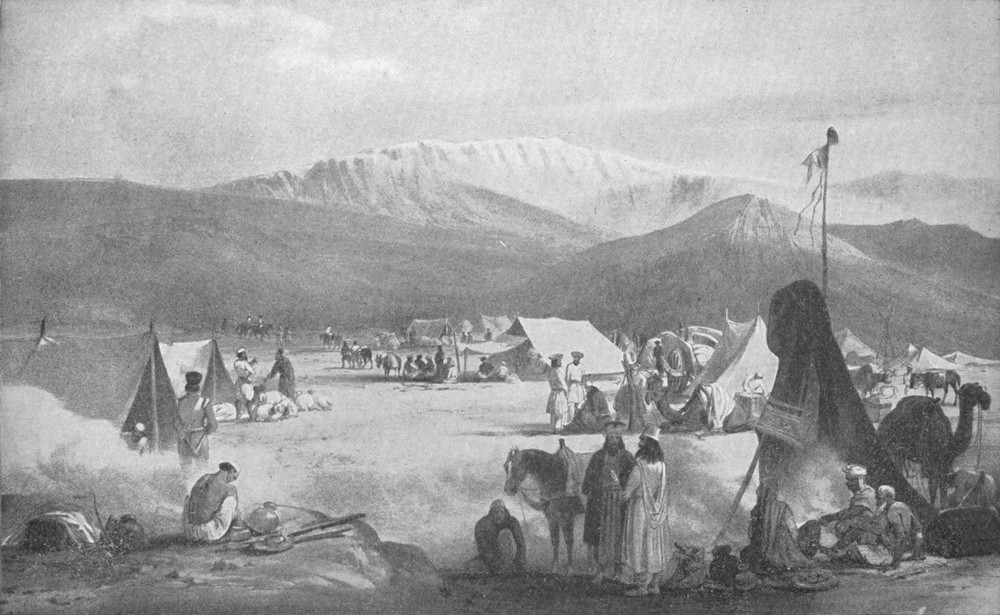
THE GREATEST PLATEAU IN THE WORLD: ITS PEOPLE, AND ITS INFLUENCE IN HISTORY
This is a typical scene of life in Central Asia, the greatest plateau in the world, whose people, the direct product of the climate and the soil, inhabiting little worlds of their own on the heights, have exercised an enormous influence in separating the great coast nations of the east, west, and south from one another.
LARGER IMAGE
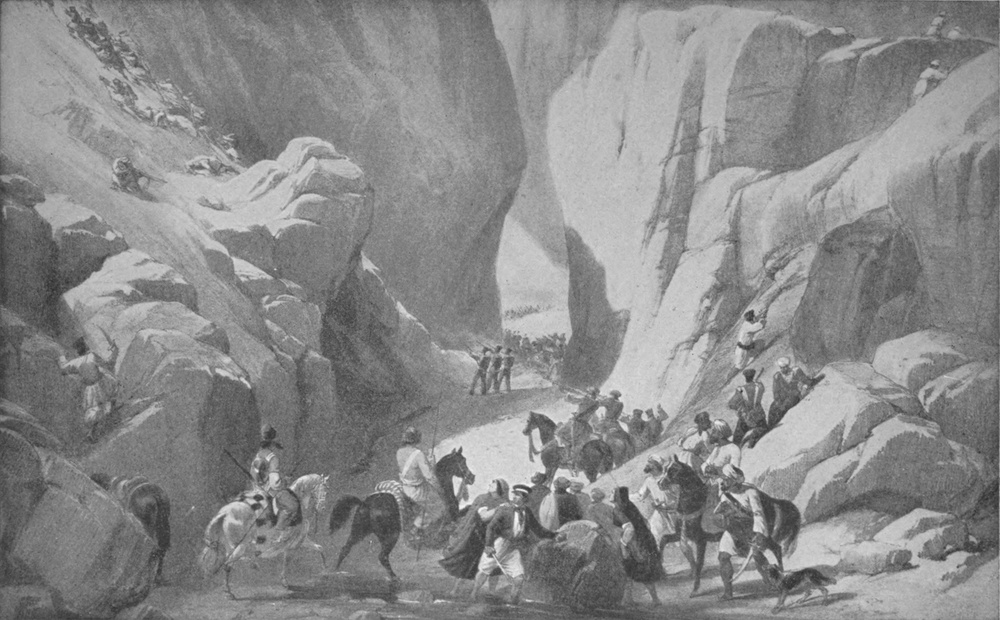
A MOUNTAIN PASS: A NATURAL FACTOR OF VAST IMPORTANCE IN HISTORY
Mountain passes have been of great importance in history. The Romans established their military colonies in the neighbourhood of passes, and there are political territories practically founded on mountain passes. This is a picture of an entrance to the famous Bolan Pass, through which, and through the Khyber Pass, lie the shortest overland routes from Persia to India.
LARGER IMAGE
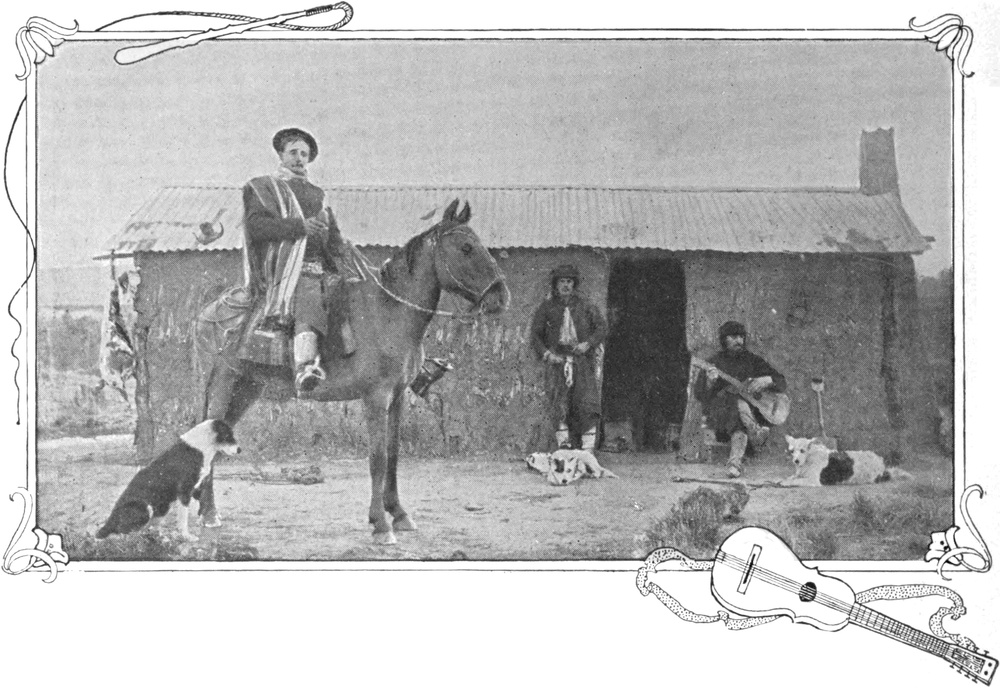
NOMADIC PEOPLES OF THE NEW WORLD
Wherever there are vast lowland countries covered with grass, nomadic peoples are found moving from place to place with their herds. There are many such peoples in the Old World and a few in the New World, notable among the latter being the Gauchos of the Pampas, types of whom are here seen.
In comparison with plains and prairies, forests are decided hindrances to historical movements. Peoples are separated from one another by strips of woodland; the state and the civilisation of the Incas ceased at the fringe of primeval forest of the east Andes. Thickly-wooded mountains present the most pronounced difficulties to historical movements. The appearance of the oldest large states and centres of culture on the borders of steppes, in the naturally thinly-wooded districts at the mouths of rivers, and on diluvial plains, seems natural enough to us when we think of the difficulties presented by life in a forest glade to men who had only stone implements and fire at their command.
A description of the difficulties encountered during Stanley’s one hundred and fifty-seven days’ journey through the primeval woods of Central Africa gives us a very clear conception of what are termed “hindrances” to historical movements. The early history of Sweden has been characterised as a struggle with the forest; and this description is valid for every forest country. The forest divides nations from each other; it allows only small tribes to unite, and creates but small states, or, at the most, loosely bound confederations. It is only where a great river system forms natural roads, as in the regions of the Amazon and the Congo, that great forest districts may be rapidly united to form a state. In other cases settlements in forest clearings and road-breaking precede political control.
In this way the Chinese conquered the races of the western half of Formosa in two hundred years; in the eastern half the land is still under forest and the natives have also retained their independence. The existence of small states, with their many obstacles to political and economic growth, still continues in forest regions alone; and the roaming hordes of hunters inhabiting them belong to the simplest forms of human societies.
THE MAKING OF THE NATIONS—II
Professor FREDERICK RATZEL
LAND AND WATER AND THE GREATNESS OF PEOPLES
S
SINCE man is a creature capable only of life on land, bodies of water must at one time have been the greatest obstacles to his diffusion. Thus the original family of human beings could have inhabited only one portion of the earth, to which it was restricted by impassable barriers of water. We know that in early geological times the division of the earth’s surface into land and water was subject to the same general laws as to-day; therefore such a portion of the earth could not have been more than a part of the total land in existence—a larger or smaller world-island.
Early Man’s Greatest Invention
The first step beyond the bounds of this island was the first step towards the conquest of the whole earth by man. The first raft was therefore the most important contrivance that man could have invented. It not only signified the beginning of the acquisition of all parts of the earth to their very farthest limits, but also—and this is far more important—the potentiality for all possibilities of divergence and temporary separation offered by our planet. It brought with it escape from the development that always turns back upon itself, travelling in a circle, and the progress that constantly consumes itself—factors inseparable from life confined within a small area; it led to the creation of fruitful contrasts and differences, and to wholesome competition—in short, to the beginning of the evolution of races and peoples. Looked at from this point of view, even the discovery of Prometheus has been of less moment to the progress of mankind than that of the inventor who first joined logs together into a raft and set out on a voyage of discovery to the nearest islet.
Why the Sea is Important
From the time of this first step onward, the development of the human race was so intimately connected with the uninhabitable water that one of its most powerful incentives lay in the struggle with the sea. And so little have we advanced from this condition that the stoutest race of the present day is one that from a narrow island commands the ocean. England’s strength is a proof of the tremendous importance of the sea as a factor of political power and of civilisation. But not to exaggerate the significance of the ocean, we may at the same time remember that it consists in the fact that, by means of the sea, open highways are presented from land to land. Command of the sea is a source of greatness to nations, for it facilitates dominion over the land.
By reason of its consistency the water is an important agent of levelling and equalising effects. As we perceive this in Nature, so do we also in history. A race familiar with the sea in one place is familiar with it in all regions. The Normans off the coast of Finland, and the Spaniards in the Pacific, found the same green, surging element, moved by the same tides, subject to the same laws. The ocean has an equalising effect upon the coasts even; the dunes of Agadir and of the harbour at Vera Cruz awaken memories of home in the mind of the sailor from Hela. The diffusion of the sea over three-quarters of the earth’s surface must also be taken into account. Thus the influence of the ocean in rendering men familiar with different parts of the world is far greater than that of the land. From the ocean comes a constant unifying influence which ever tends to reduce the disuniting effect of the separation of land from land. As yet no attempt to extend boundaries beyond the land out over the sea has been followed by lasting success.
No Nation can Possess the Sea The Sea’s Unifying Influence
No nation can or ever will possess the sea. Carthage and Tarentum wished to forbid Italian vessels the passage of the Lacinian capes by treaty; the Venetians desired dominion over the Adriatic to be granted them by the Pope; Denmark and Sweden strove for a dominion over the Baltic Sea; but all this is against the very nature of the sea; it is one and indivisible. Only near by the coast, within the three-mile limit of international law, and in landlocked bays, may it be ruled as land is ruled. The claims of the Americans concerning the sovereignty of Behring Sea have never been recognised, and England can retain dominion over the Irish Sea only by means of her naval power. The ocean has a unifying influence on the land, even when this influence consists only in the same ends to be attained being placed before different nations. During a time of the greatest disunion, German cities that lay far enough from one another were united by Baltic interests. The union of scattered land-forces prepared the way for the opening up of wider horizons to England in the sixteenth century in the same manner as for Italy and Germany in the nineteenth.
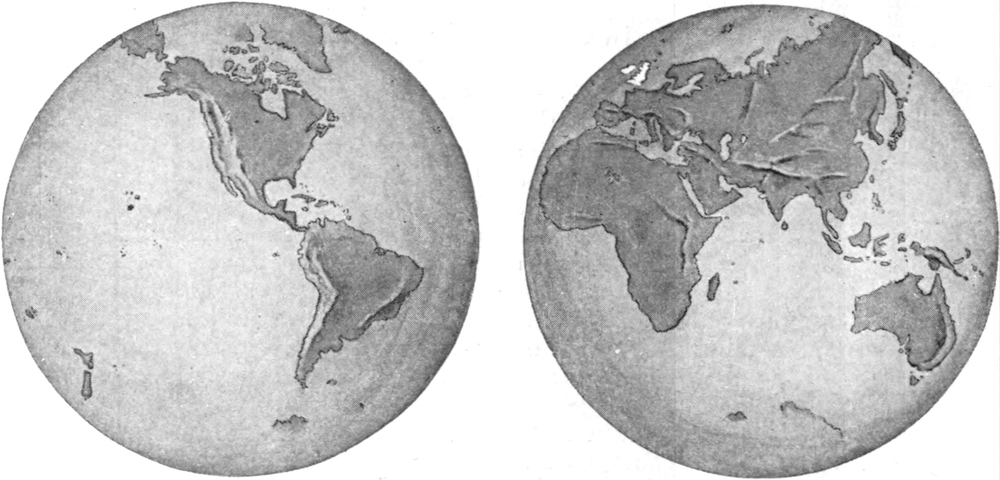
THE LITTLE ISLAND THAT RULES THE SEA
The command of the sea is the source of national greatness, as it facilitates dominion over land. England from a narrow island dominates the sea. The tiny part of white in the Eastern Hemisphere on this page shows how relatively insignificant Great Britain is to the vast world of waters where her shipping is supreme.
Sea power is far more closely connected with traffic than is land power; in fact, the foundation of sea power is trade and commerce. It is, however, more than mere commercial power and monopoly of trade. In spite of all egoism, greed, and violence there remains one great characteristic peculiar to maritime Powers, spared even by Punic faith and Venetian covetousness. Even the neighbourhood of the ocean is characterised by its vast natural features; rivers broaden as they approach the sea, great bays lie within the coasts, and, though the latter may be flat, the horizon lines of their low dune landscapes are broad. The horizons of maritime races are also broad. Whether it be the hope of profit from commerce or of gain from piracy that lures men forth, many a ship has returned to port bearing with it inestimable benefits to mankind; for the greatest maritime discoveries have not been mere explorations of new seas, but of new lands and peoples. Such discoveries as these have contributed most to the broadening of the historical horizon. Even political questions expand, assume a larger character, and often become less acute, when they emerge from the narrow limits of continental constraint upon the free and open coasts. This is true even of the Eastern Question, to the solution of which definite steps were taken upon the Mediterranean when it seemed to have come to a deadlock in the Balkan peninsula.
Short-lived Nations of the Sea The Fall of Maritime Nations
The ocean is no passive element to maritime races. By deriving power from the sea they become subject to the sea. The more strength they draw from the ocean, the less firm becomes their footing upon the land. Finally, their power no longer remains rooted in the land, but grows to resemble that of a fleet resting upon the waves; it may with but small expenditure of effort extend its influence over an enormously wide area, but it may also be swept away by the first storm. As yet all maritime nations have been short-lived; their rise has been swift, often surprisingly so; but they have never remained long at the zenith of prosperity, and, as a rule, their decay has been as rapid as their elevation to power. The cause of the fall of all maritime nations has been the smallness of their basis, their foreign possessions, widely separated from one another and difficult to defend, and their dependence upon these foreign possessions. In many cases the over-balancing of political by economic interests, the neglect of materials for defence, and effeminacy resulting from commercial prosperity, have also contributed to their destruction.