Volume 1 — LIST OF MAPS APPEARING IN THE BOOK OF HISTORY (continued 7)
Reading edition
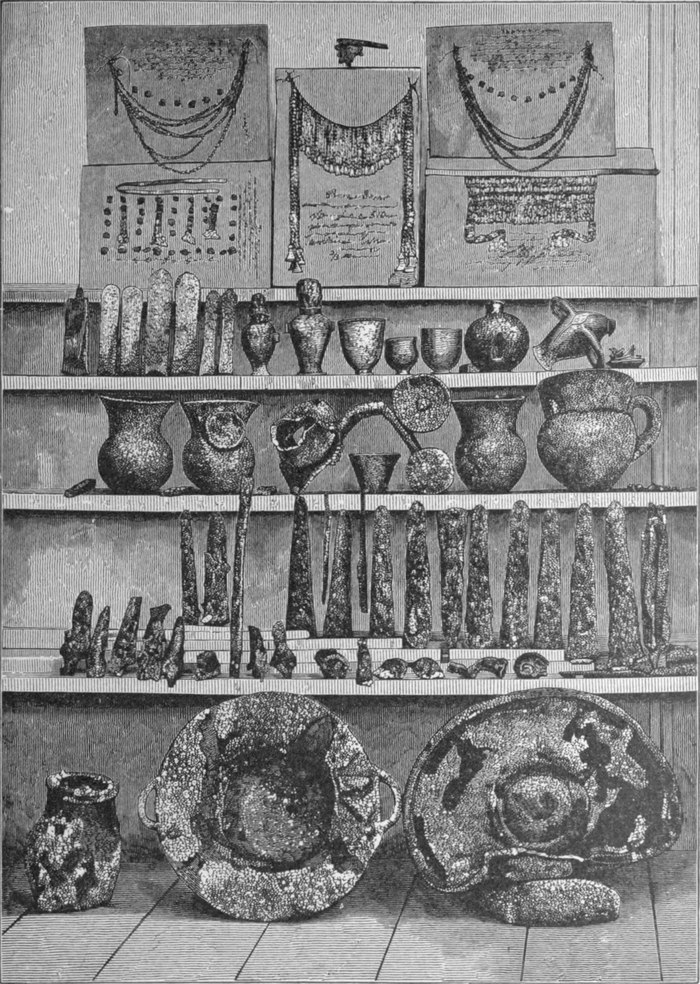
THE TREASURE OF PRIAM, KING OF TROY: A COLLECTION REVEALED BY THE EXCAVATIONS
This remarkable collection of regal treasure comprises the key of the treasure-house (at top of picture in centre); and, under and about the key, a number of golden diadems, fillets, earrings, and smaller jewels. On the shelf below there are a number of silver talents and vessels of silver and gold; while below them is a series of silver vases and a curious plate of copper. A variety of weapons and helmet crests of copper and bronze are displayed beneath, and on the floor are a vessel, a cauldron and a shield, all made of copper.
Yet what chiefly interests us is the historical. The sixth town, too, was suddenly given up, destroyed, and burnt. What follows it are again only poor settlements. Its destruction must have taken place about the end of the Mycenæan epoch of culture. The seventh town, which is built immediately on the ruins of the sixth, shows, already, other and later culture. It had long been suspected that a historical kernel was concealed in the legend of Troy—now we have the monumental confirmation. There really was a Troy, which was strong and great at the same time as the rulers of Mycenæ, rich in gold and treasure, held way in Greece. And that Troy was destroyed—we may now safely affirm, from this agreement between relics and legend—by Greek princes of the Mycenæan epoch, whom the legend calls Agamemnon and his men.
The seventh and eighth towns, built soon after the destruction of the sixth, show an interruption in the intercourse with Greece. There the Mycenæan period was broken by the displacement of peoples known as the Doric migration, and that rich civilised life was replaced by a relapse into the semi-barbaric conditions of the North. In Troy, too, we perceive a period of decline, “a relapse into a stage long since past; black hand-made vessels, which in their form and decoration are strikingly like the home-made pots usual in Italy, especially Etruria and Latium, in the first part of the first millennium before Christ.” Finally, the seventh town also furnishes inferior imported Greek vases with painting, though coming not from Greece itself, but from the coast of Asia Minor, where Greeks had settled in connection with the Doric migration. “The Æolic colonisation of Troas brought Ilium no fresh prosperity. Other places rose, Troy remained a miserable village. In the Hellenistic period the sky clears over Troy. What Alexander intended, Lysimachus carried out; he restores Ilium to the place of a real city with new walls, and erects a magnificent temple to Athene on the top of the acropolis.... Yet artistic creation came to no real perfection. It was only when the great men of Rome, mindful of their Trojan ancestors, began to interest themselves in the place, that new life bloomed on Troy’s ruins.”
Thus the geological-archæological method relates history, merely relying upon the monuments of the soil, without requiring written evidences. Pre-history has here attained its end; it has become history.
JOHANNES RANKE
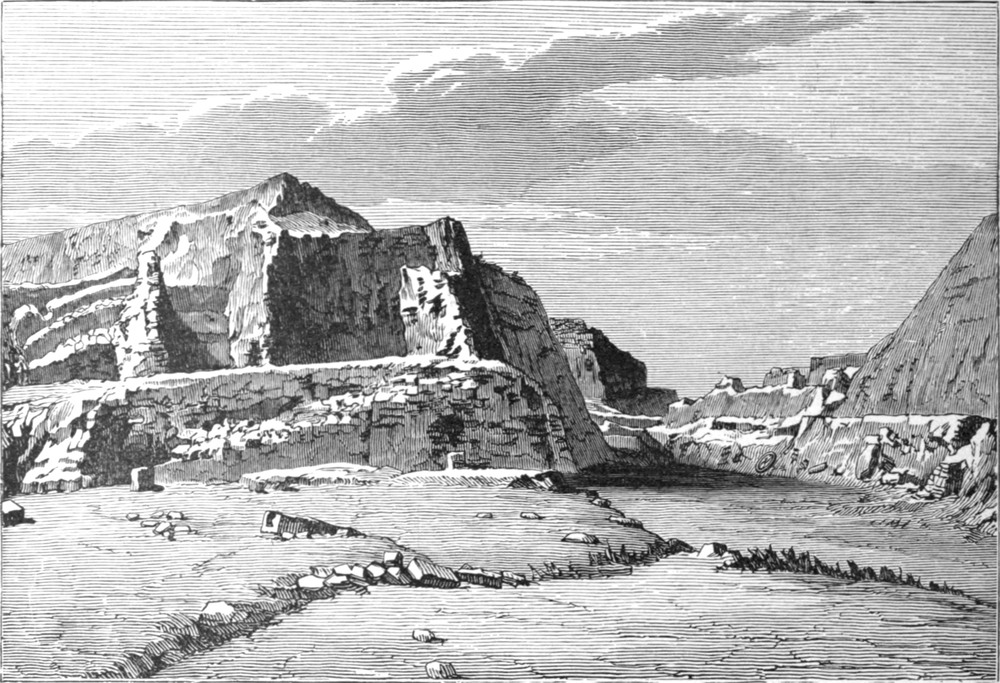
A VIEW SHOWING THE REMARKABLE CHARACTER OF THE EXCAVATIONS AT TROY
Some idea of the enormous work involved in unearthing ancient Troy will be gathered from the fact, made clear in this view, that the ground-level before excavating was above the height of these buildings. A deep trench was cut, as shown in the illustration, through the whole hill of Hissarlik, the citadel town.
THE MATERIAL PROGRESS OF MANKIND
T
THE opinion that our own circumstances and affairs are the only standard for judging universal history has long been obsolete. Our day, with its conceptions, beliefs, hopes, and endeavours, is but a tiny portion of the past; for thousands of years peoples have existed who have lived in other intellectual spheres than ours, who have pursued other ideals.
The study of history does not consist in an examination of the past projected, as it were, into the present; it is the study of the past considered as a part of the constant coming and going of men. And in order to become qualified as historians we must first of all attain a point of view from which we may, independently of time, behold history with all its great events file by; as though we were men who had ascended to some elevation in the universe from which they could look down upon the whole earth lying as a unity before them. This is rendered possible through the power of abstraction gained from a study of history; it enables us, on the one hand, to adapt ourselves to strange times and beliefs, and, on the other, to look upon our own day—all time to its contemporary men—objectively, as a mere hour of the ages of human development. We must learn to escape from the present, to withdraw ourselves from that which we may call the tyranny of our own time.
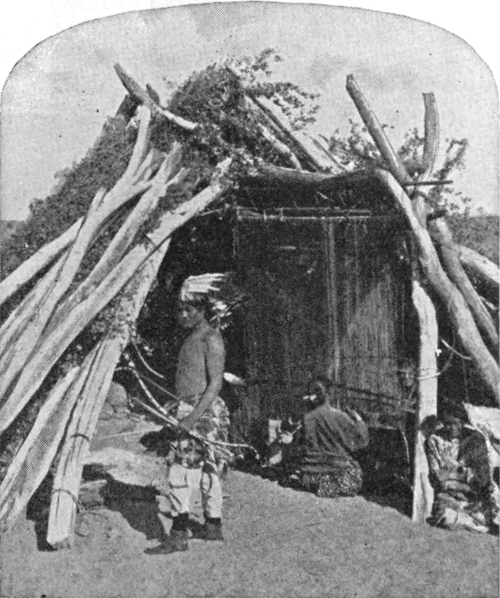
THE PRIMITIVE ART OF WEAVING
The art of weaving arose from plaiting, and soon developed to perfection, the American Indians and most primitive peoples of our own day being skilled weavers.
From universal history we obtain a picture of the development of humanity—that is, the development of the various active germs or principles inherent in man. By these are meant the active principles innate in mankind in the aggregate, in contradistinction to those which may exist in single individuals or in single races.
The result of development is called “civilisation”—the state of intellectual being, and of outward, material life, attained by a people through evolution. Although spiritual and material culture flow into each other, they may be separated to this extent: as a physical being endowed with senses, man endeavours to obtain satisfaction of his needs, and strives for a position in relation to his environment corresponding with the efforts he has made to obtain welfare; as a feeling, inquiring, spiritual being he contains within him an ever-present desire to fuse the multitude of separate impressions he receives into unity, and to struggle forward until he arrives at a conception of the world and of life.
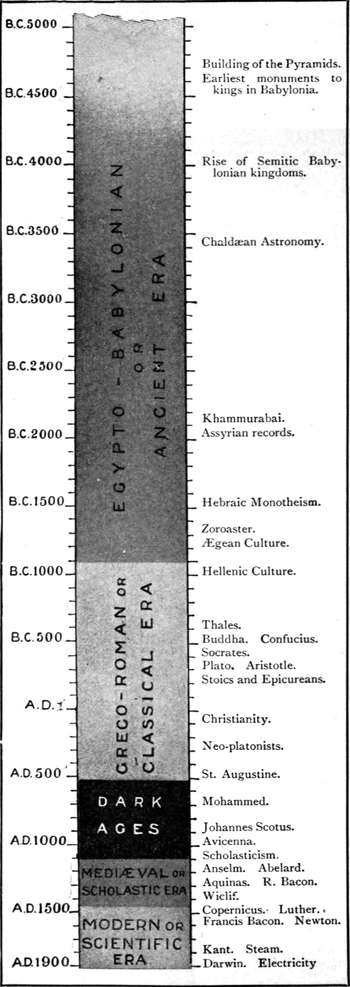
OUR OWN DAY COMPARED WITH THE HISTORIC PAST
Our day, with its conceptions, beliefs, hopes, and endeavours, is but a tiny portion of the past; for thousands of years peoples have existed who have lived in other intellectual spheres than ours, who have pursued other ideals.
LARGER IMAGE
“Material civilisation” is the mode of life through which the obstacles opposed to humanity may be overcome. By the surmounting of obstacles is meant the conquering of enemies, particularly of hostile animals, the obtaining of means for the preservation of existence, and the employing of these means for the increase of bodily welfare. In respect of material civilisation man passes through stages that differ widely from one another, that vary according to the manner in which the necessities for existence are obtained, and according to the way in which enemies are withstood for the safeguarding of life, welfare, and acquisitions already gained. Races are spoken of as supporting themselves by the chase and fishing, or by cattle-breeding and farming, according to whether they are accustomed to derive subsistence directly from “nature unadorned,” or by means of the cultivation and utilisation of natural products.
No sharp line of distinction, however, may be drawn. It is inadmissible to speak of races as supporting themselves solely by hunting and fishing, for the very same peoples feed on products of the soil wherever they are found and recognised as means of subsistence. They live, it is true, upon flesh and fish, but also upon roots and the fruit of wild trees. While in this state of civilisation, man avails himself only of that which Nature places before him; he neither adapts Nature to his desire, to his needs, or to his manner of living, nor understands how to do it. He can make no further use of Nature than to acquire a knowledge of the sources of supply, of how to seize time and opportunity, and to overcome the obstacles of life in his own territory. He ascertains the haunts of game, discovers how to obtain fish, explores for wild honey or edible roots, learns to climb the tallest trees and to let himself down into the deepest caves; but he lacks the ability to cultivate Nature, to cause her to produce according to his will.
Gradually the one phase amalgamates with the other. It is not seldom that hunting tribes have small tracts of land on which they raise a few edible plants. Observation of Nature teaches them that germs develop from fallen seeds, and leads of itself to the idea that it is not best to allow plants to grow up wild, and that it would be expedient to clear the surrounding ground for their better growth. And when this stage is reached, the next step—not to allow seeds to spring up by chance, but to place them in the soil one’s self—is not very far off; and thus the mere acquisition of Nature’s raw vegetable products gives place to agriculture. Often enough we observe instances of the men of a group carrying on hunting operations, while the women are not only occupied with their domestic employments, but also till the soil; thus the men are hunters and fishers, and the women are agriculturists. Domestic work led the latter to take up the cultivation of plants, even as it led them to the other light feminine handicrafts; while the repairing of weapons and of contrivances used for the capture of animals lay within the province of the men.
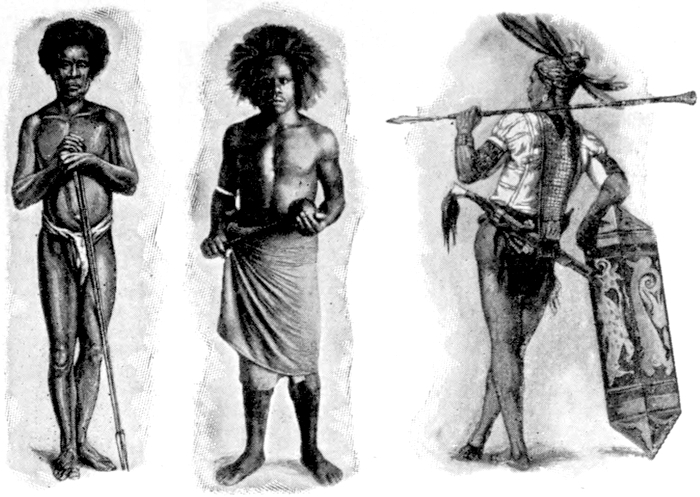
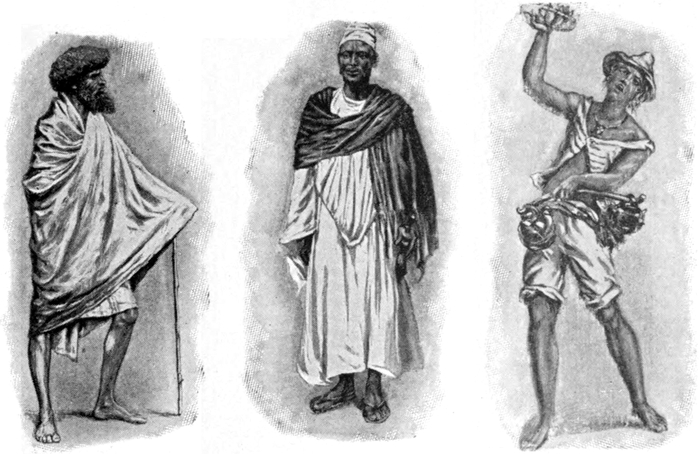
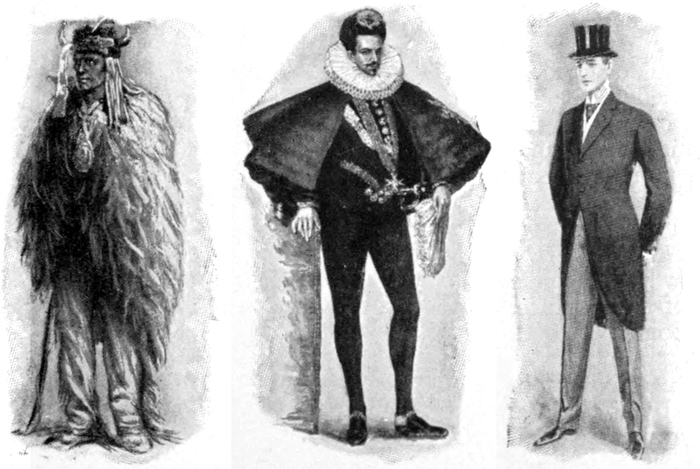
MANKIND’S PROGRESS IN HABITS OF DRESS
This series of typical pictures is intended roughly to illustrate the upward progress of man from the almost nude savage to the neatly and conveniently dressed gentleman of to-day. The Elizabethan dandy is, of course, as fully dressed as man can be, and is introduced only as indicating the great change of sartorial ideas in modern times.
The discovery of how to produce fire by artificial means, independently effected in all parts of the world—as was also the discovery of the art of navigation—was of the greatest importance for the entire future. Fire was first a result of chance.
When lightning set a portion of the forest in flames, and caused a multitude of animals or fruits to be roasted, men put it to practical use. They recognised the advantage that fire gave them and sought to preserve it. The retention of the fire which had been sent down from heaven became one of the most weighty and significant of functions. Man learned how to keep wood-fibres smouldering, and how to blow them into flame at will; he also learned that it was possible to convey fire, or the potentiality of fire, along with him in his wanderings. But even then success was uncertain until a lucky chance led him to discover how to produce flames at will, by rubbing two sticks together or by twirling one against the other. These actions were originally performed for other purposes—to bore holes in a piece of wood, or to rub it into fibres; finally, one or the other was carried out with such vigour that a filament began to burn, and the discovery was made. Sparks from flint must have suggested a second method of kindling a fire; certainly the art of igniting soft filaments of wood by means of a spark—thus enabling the very smallest source of combustion to be used for human purposes—was known to man in the earliest times. The obvious results of the use of fire are means of obtaining warmth and of cooking food.
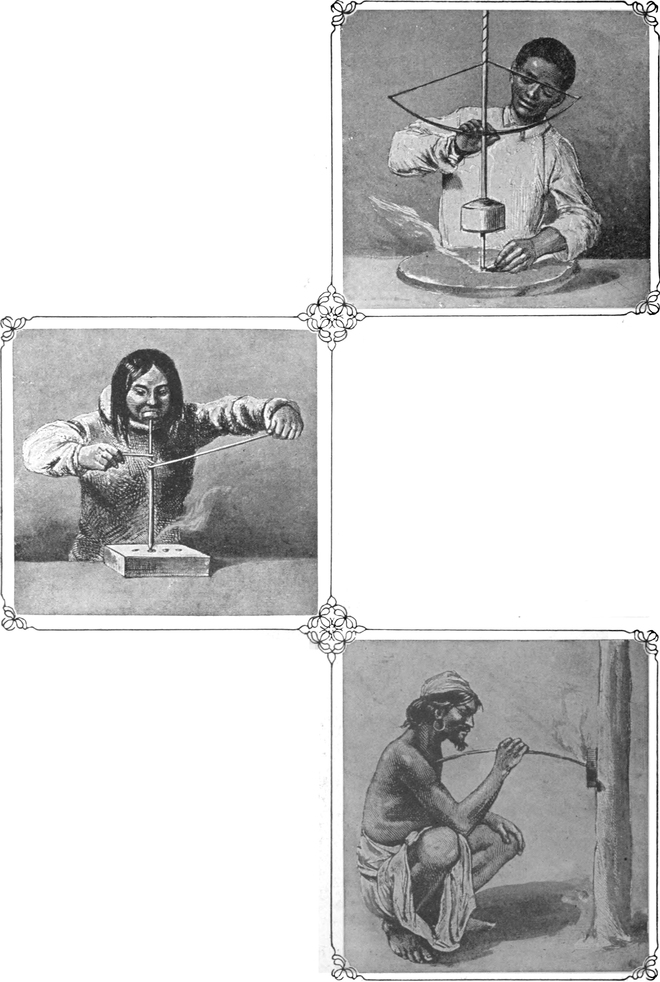
AN INGENIOUS INDIAN FIRE DRILL
ESQUIMAU MAKING FIRE BY FRICTION
THE GAUCHO’S WAY OF GETTING A LIGHT
LARGER IMAGE
Self-defence had already led to the use of weapons, and, at the same time, the contrivances for hunting and fishing must have become more and more perfect. A very low degree of civilisation is that of races unacquainted with the bow and arrow, and familiar with club or boomerang only—who know how to make use merely of the weight of a substance, or, as in the case of the boomerang, of a peculiar means of imparting motion.
The time previous to the discovery of the art of working in metal was the Age of Stone. It was a natural transition period during which men began to learn to make use of the malleable metals, which could be hammered and beaten into various shapes, and finally discovered how to work in iron. Iron, by being placed in the fire, brought to a white heat, and smelted, was rendered capable of being put to such uses as were impossible in the case of brittle materials—bone or stone, for example. Many races never acquired the art of working even in the softer metals, and procured metallic implements from other peoples. The great importance of metal-working is borne out by the fact that the position of the smith, even in legendary times, has been of the utmost significance. The Ages of Stone and of Metal belong to the most important stages of civilisation.
Having made himself weapons, man did not employ them in fights with animals only; he also used them on his fellow-men, and at the same time arose the necessity for protective coverings—that is, the need for a means of neutralising the effect of weapons on the body. Thus followed the invention of the shield as a portable shelter, of the coat of mail and of the helmet, and of armour in general in all its different forms and varieties.
Together with weapons, utensils are characteristic of material culture. Utensils are implements used in the arts of peace, domestic and industrial; they are instruments which enable us to increase power over Nature. Some utensils have undergone the same transformations as have weapons; others have their own independent history. Just as the edges of shells served as patterns for knife-blades, so did hollow stones, the shells of crustaceans or of tortoises, become models for dishes and basins. From the discovery of the imperviousness of dried earth, the potter’s art developed; it became possible to mould clay into desired shapes while moist, and then, when dry, to employ it in its new form as a vessel for holding liquids; for that which has always been of the greatest importance in the making of utensils has been the taking advantage of two opposite characteristics displayed by a material during the different stages of its manufacture—plasticity, which admits of its first being moulded into various forms, and another quality, which causes it afterward to stiffen into solidity and strength.
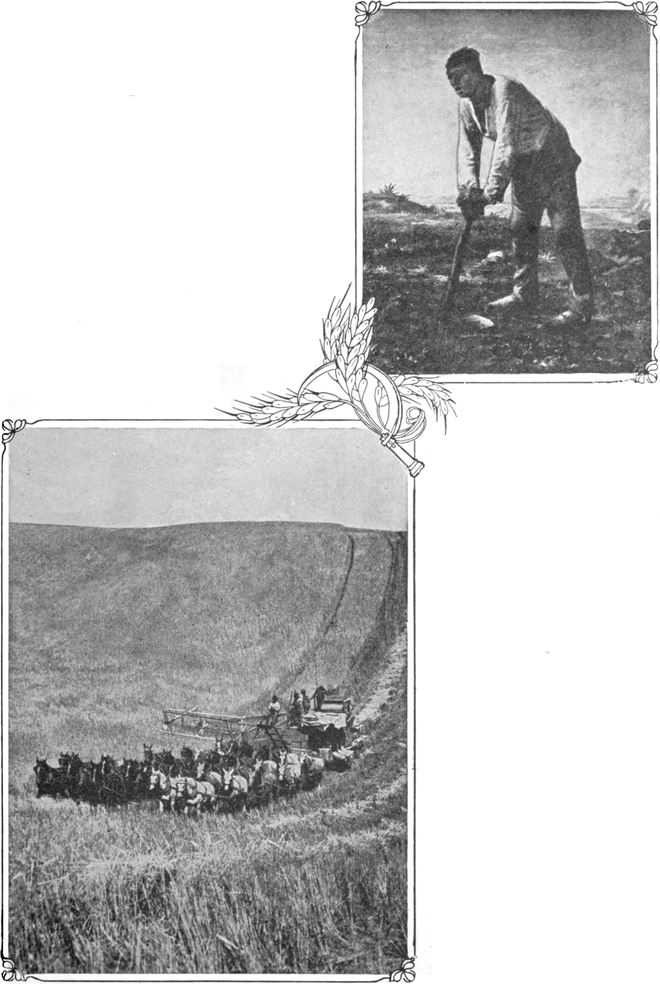
Mansell THE MAN WITH THE HOE From the painting by Millet
Underwood & Underwood THE WONDERFUL ADVANCE IN AGRICULTURE These pictures present a striking contrast: the sullen clod with his primitive hoe, and the great Canadian reaper drawn by thirty horses, both in use to-day.
LARGER IMAGE
Growth of the Textile Arts
A further acquisition was the art of braiding and plaiting, the joining together of flexible materials in such a way that they held together by force of friction alone. Thus coherent, durable fabrics may be produced, and by joining together small parts into an aggregate it is also possible to give a definite form to the whole and to adapt it to various uses. The quality of adaptability is especially developed in the products of plaiting, but the quality of imperviousness is lacking. Wickerwork was used not only in the form of baskets, but also in other shapes, as means for protection and shelter, as material for sails, as well as for tying and binding. The art of weaving arises from plaiting, and along with it come methods for spinning thread. It thus becomes possible to make an immense number of different useful articles out of shapeless vegetable material. Fibres are rendered more durable by being bound together, and textures formed from threads are adapted to the most various uses of life. This has an influence on the development of weapons also: bow-strings, slings, and lassos presuppose a rudimentary knowledge, at least, of the textile arts; and as knowledge increases, so are the products improved in turn.
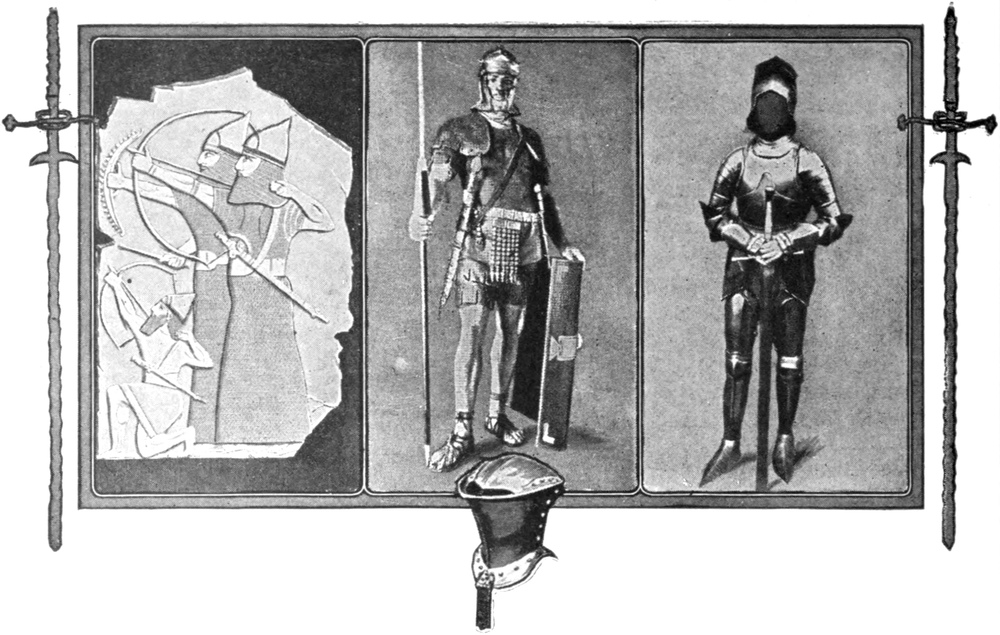
MAN’S METAL DRESS: THE DEVELOPMENT OF ARMOUR FROM ANCIENT TO MEDIÆVAL TIMES
The way in which man has protected himself against his foes in battle, and the gradual progress and decline of such methods, is shown in these pictures. The first is from the monuments of Nineveh, and shows the earliest form of chain mail. In the second we see the armour of the Roman legionary, while the third shows the heavy accoutrement of a mediæval warrior. A helmet of the same period is also shown.
Means for conveyance are also invented, that difficulties arising from distance may be overcome. At first men carry burdens upon their backs, heads, or shoulders, or in the hand, placing whatever they wish to transport in a utensil—a basket or a piece of cloth—thus producing a coherent whole; later, in order to render conveyance still more convenient, handles are invented. Objects are dragged along the ground, and from an effort to save them from injury the idea of sledges develops. Things that are round enough are rolled to their destinations; this leads to the invention of rollers and wheels, materials of required form being brought into combination with rudimentary agents of circular motion, and thus, through a rotary, a horizontal movement is obtained; and so the force of gravity is made use of, consistency of motion procured, and the hindering effect of friction overcome to the greatest possible degree.
Means for carrying inanimate objects once invented, it is not long before they are put to use for the conveyance of man himself; thus methods for the transportation of human beings are discovered in the same manner as the means for the carriage of goods.
Man’s First Boats
In primitive times transportation by water is employed to a far greater extent than by land. Man learns how to swim in the same way as other animals do, by discovering how to repress his struggles, transforming them into definite, regular movements. The sight of objects afloat must, through unconscious analysis—experience—have taught men to make light, water-tight structures for the conveyance of goods upon water, and, later, for the use of man himself. The pole by which the first raft was pushed along developed into the rudder. Kayaks and canoes were built of wood, of bark, and of hides. In this connection, moreover, an epoch-marking invention was that of cloths in which to catch the wind—sails; and this, too, was a result of observation and experience. Man had known the effect of the wind upon fluttering cloth, to his loss, long enough before he hit upon the idea of employing it to his advantage. Finally he learned that by adjusting the sails he might make use of winds blowing from any direction.
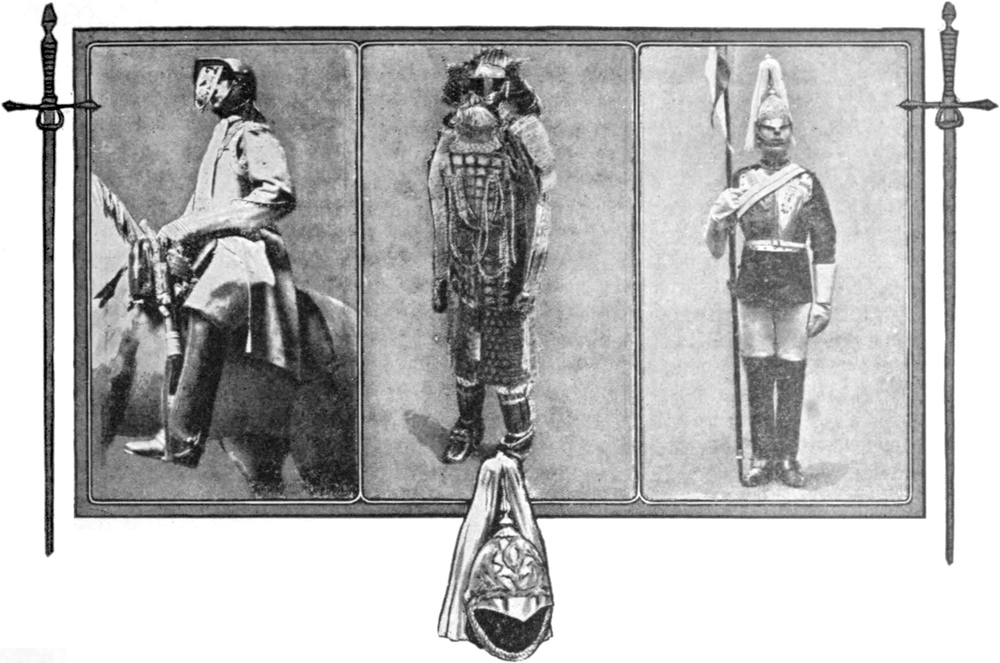
MAN’S METAL DRESS: THE GRADUAL MODIFICATION OF ARMOUR IN MODERN TIMES
The invention of gunpowder and firearms rendered the protection of armour useless, and by the sixteenth century it had been greatly modified. The first of these pictures shows the slight armour worn by James II. The second is a suit of Japanese armour, discarded in our own time; while the last is a portrait of a present day Life-guardsman, whose cuirass is more ornamental than useful.
Man’s First Houses
Habitations are structures built in order to facilitate and assure the existence of man and the preservation of his goods. Indeed, the presence of caverns caused men to recognise the protective virtue of roof and wall, and the knowledge thus acquired gave rise in turn to the making of artificial caves. Holes beneath overhanging banks and precipices led to the building of houses with roofs extending beyond the rambling walls. Perhaps the protection afforded by leafy roofs, and the walls formed by the trunks of trees in primeval forests, may also have turned men’s thoughts to the construction of dwellings. Houses of various forms were built, circular and rectangular; some with store-rooms and hearths. The use of dwellings presupposes a certain amount of consistency in the mode of living, the presence of local ties, and a general spirit favouring fixed and permanent residence. Nomadic races use movable or temporary shelters only—waggons, tents, or huts.
Home and Dress
The houses of stationary peoples become more and more firm and stable. At first they are built of earth and wickerwork, later of stone, and finally of bricks, as among the Babylonians. Foundations are invented, dwellings are accurately designed as to line and angle; the curved line is introduced, bringing with it arches both round and pointed, as may be seen in the remains of Roman and Etruscan buildings. The structure is adorned, and it becomes a work of art.
But man also dwelt over the water, sometimes erecting his habitations upon rafts and floats, often upon structures that rose from beneath the surface. Thus was he, dwelling in communities of various sizes, secure from the attacks of land enemies. Even to-day there are uncivilised peoples who live over water, constructing their homes upon piles.
Taming of the Wild
Clothing, however, was invented partly that in cold climates men might survive the winter, partly for the sake of ornament. In tropical regions man originally had no knowledge of the necessity for clothing: garments are masks, disguises; they bear with them a charm; they are the peculiar property of the medicine-men or of those who in the religious dance invoke the higher powers. Modesty is a derived feeling; it cannot exist until a high state of individualisation has been attained, until each man desires exclusive possession of his wife, and therefore wishes to shield her from the covetousness of other men. With the knowledge of dress, a desire for adornment, the effort to assist Nature in producing certain definite æsthetic effects, arises. Less uniformity in the appearance of the body is wanted, and this brings tattooing and the use of ornament into vogue. Later there is a fusing of these several aims; clothing becomes protection, veil, and ornament in one, fulfilling all three functions at the same time.
Another epoch-marking discovery, often arrived at while races are still in the state of subsistence by hunting, is the domestication of animals. This may have originated in the practice of provoking one beast to attack another in order to vanquish them both the more easily. Further development, bringing with it the idea of totemism and the notion that the soul of an animal dwells in man, drew him nearer to his animal neighbours; and he sought them out as comrades and attendants. The taming of wild creatures arose from two sources—human egoism, and the innate feeling of unity and identification with Nature common to all savages; hence on the one hand, the subjugation of animals, and, on the other, their domestication. Neither employment rendered it by any means less possible for men to hold animals in reverence, or to attribute to them virtue as ancestral spirits.
Such acquisitions of external culture accompany man during the transition from his subsistence by the pure products of Nature to the cultivation of natural resources, cattle-breeding and agriculture—occupations necessitating the greatest unrest and mobility. The simple life in Nature incites men to wander forth that they may discover land adapted for their support; they rove about in search of roots as well as of living prey. The breeding of domestic animals also causes them to travel in the hope of finding ground for pasture; nor does agriculture in its primitive form tend to establish permanence of residence, although it contains within itself latent possibilities of developing a settled life, one of the most important factors in the progress of mankind.
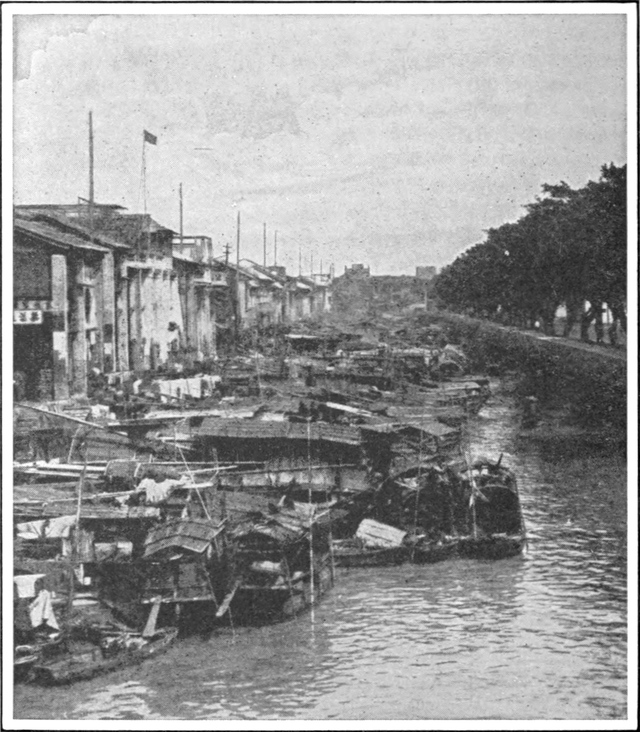
PRIMITIVE DWELLINGS OF TO-DAY: HOUSE-BOATS AT CANTON
Not only are there lake-dwellers to-day, as we have seen, but even large communities, as at Canton, in China, live in boats.
Mankind “Settling” Down
Only fixed, domestic peoples are able to create great and lasting institutions, to store up the results of civilisation for distant later races, and to establish a developed, well-organised commercial and civil life. The transition from nomadism to life in permanent residences has, therefore, been one of the greatest steps in the development of humanity. At the time of the beginnings of agriculture, however, man was still a periodic wanderer. According to the field-grass system of cultivation, seed is sown in hastily-cleared ground, which soon becomes exhausted and is then abandoned. A migration follows and new land is cleared. This system continues until men learn to cultivate part of the land in a district, allowing the remainder to lie fallow for a time in order that the soil may recover; thus they remain fixed in their chosen district. Various circumstances—for example, the danger of enemies from without, and the difficulties attending migration—must have led to this change, the transition to the system of alternation of crops. The wanderings are confined to less extensive regions, the same fields are returned to after a few years, until finally the relation of patches under cultivation to fallow land is reduced to a system, and the time of wandering is past.
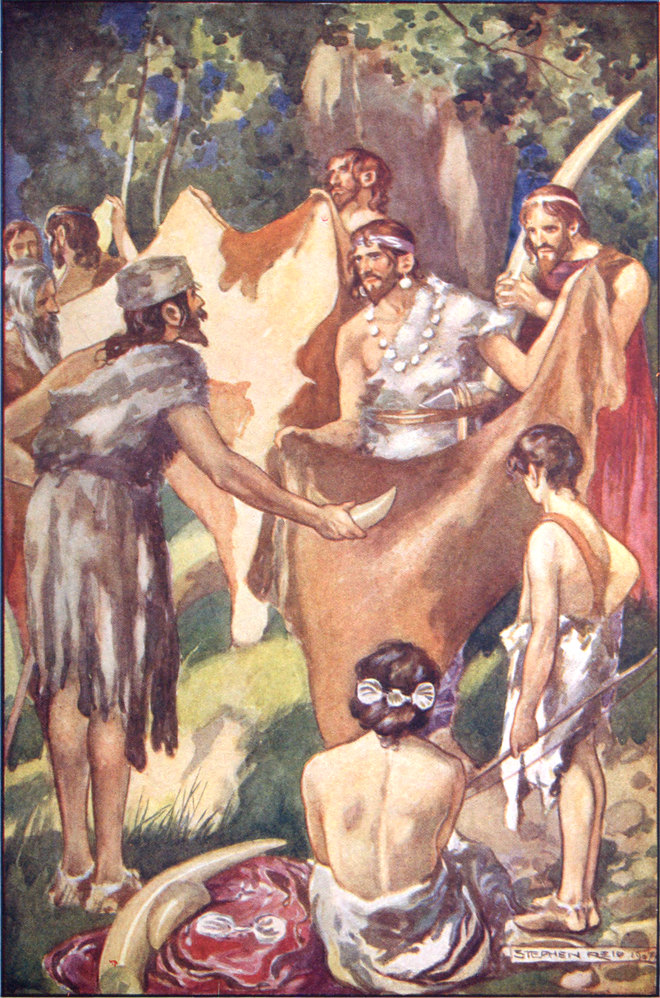
THE BEGINNINGS OF COMMERCE: PRIMITIVE PEOPLE BARTERING IVORY TUSKS AND BULL-HIDES
LARGER IMAGE
The coming of the Craftsman
With fixed residence the forms of communities alter. The group settles in a certain district, homes are built close to one another, and the patriarchal organisation gives place to the village, which, with its definite boundaries, is thenceforth the nucleus of the social aggregate. Often several village communities have fields and forests in common, and a common ownership of dams and canals; Nature takes care that they do not become isolated, but unite together in close contact for common defence and protection. With agriculture is associated the working up of raw products. These are fashioned into materials for the support of life and for enjoyment; furniture for dwellings, clothing, tools, utensils, and weapons are made. For, however much agriculture favours a life of peace, so rarely does man live in friendship with his fellows that agricultural peoples also find it necessary to arm themselves for war.
At first manufacture is not separated from farming; the agriculturist himself prepares the natural products, assisted by the members of his family. Later, it is easily seen that some individuals are more skilled than others; it is also recognised that skill may be developed by practice and that employments must be learned. Therefore it is requisite that special individuals of the community should prepare themselves for particular activities in the working up of raw products and pursue these activities in consistency with the needs of the society—trade or craft. The craftsman at first labours for the community; in every village the tailor, cobbler, smith, barber, and schoolmaster is supported by society at large. The craftsman receives his appointed income—that is, his portion of the common supply of food; and, in addition, every one for whom he expends his labour gives him something in compensation, or finds him food while employed about his house, until, finally, a systematic method of exchange is established; and with this another advance—an epoch for civilisation—is arrived at.
The First Labour Problem
This is the division of labour. It is found advantageous not only that the craftsman be employed as he is needed, but also that he produce a supply of products peculiar to his trade; for the times of labour do not in the least harmonise with the times of demand. Although during the first periods of industrial life men sought more or less to adjust these factors, in later times they become wholly separate from one another. There is always, in addition, labour ready to be expended on casual needs; in more advanced phases of civilisation this condition of affairs is not avoided; but wherever labour can be disassociated from fortuitous necessity, the capacity for production is greatly increased. Commodities are manufactured during the best seasons for production and are preserved until the times of need; thus men become independent of the moment. Here also, as in other problems of civilisation, it is necessary to surmount the incongruities of chance, and to render all circumstances serviceable to our purposes.
Crafts and Trades Developing
Exchange and division of labour are the great factors of the progress of a civilisation based upon industrialism. Crafts and trades develop and improve; greater and greater skill is demanded, and consequently the time of preparation necessary for the master craftsman becomes longer and longer. The worker limits himself to a definite sphere of production and carries his trade forward to a certain perfection. His wares will then be more eagerly sought for than those made by another hand; they are better, yet cheaper, for his labour is lightened by his greater skill. His various fellow craftsmen, and the agriculturist also, must exchange their goods for his; for the more specialised the work of an individual, the more necessary the community is to him, in order that he may satisfy all his various requirements. Exchange is at first natural; that is, commodities are traded outright, each individual giving goods directly in return for the goods he receives. The production of the community as a whole has become far richer, far more perfect. The labour of the organised society produces more than the activity of separate individuals.
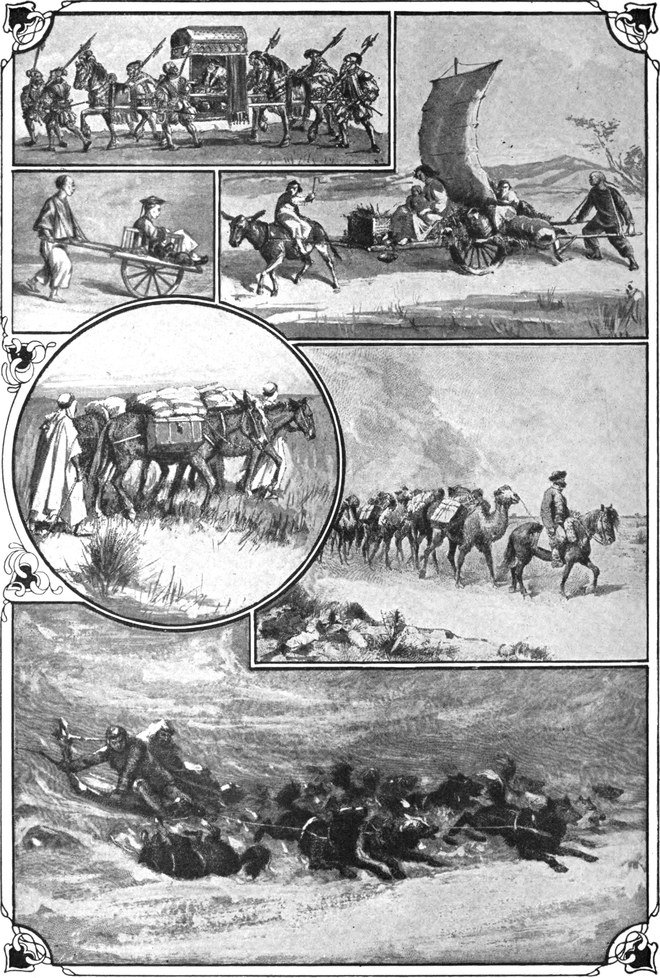
THE BEARERS OF MAN’S BURDENS: PRIMITIVE AND NATURAL METHODS OF CARRYING
These illustrations show a palanquin borne by horses; the Chinese single-wheel cart and the same assisted by a donkey and a sail; pack mules and camels; and a sledge drawn by Esquimau dogs.
LARGER IMAGE
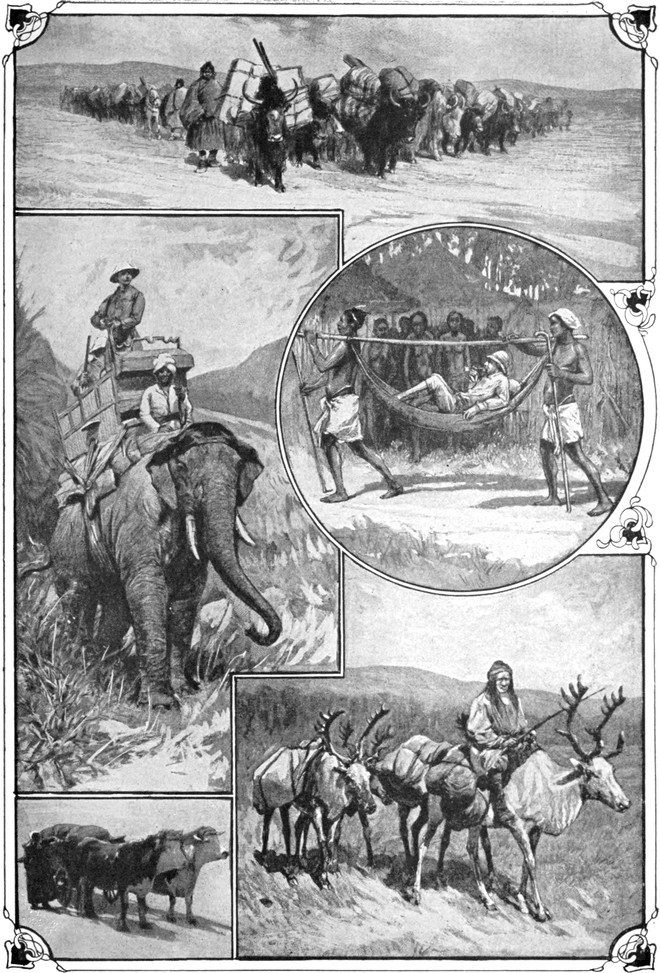
SOME METHODS OF CONVEYANCE IN VARIOUS AGES AND COUNTRIES
In this plate are illustrated a caravan of yaks; the elephant with a howdah; the African litter; reindeers as pack animals; and the familiar bullock waggon of France—a few of the many methods of carrying used by man.
LARGER IMAGE
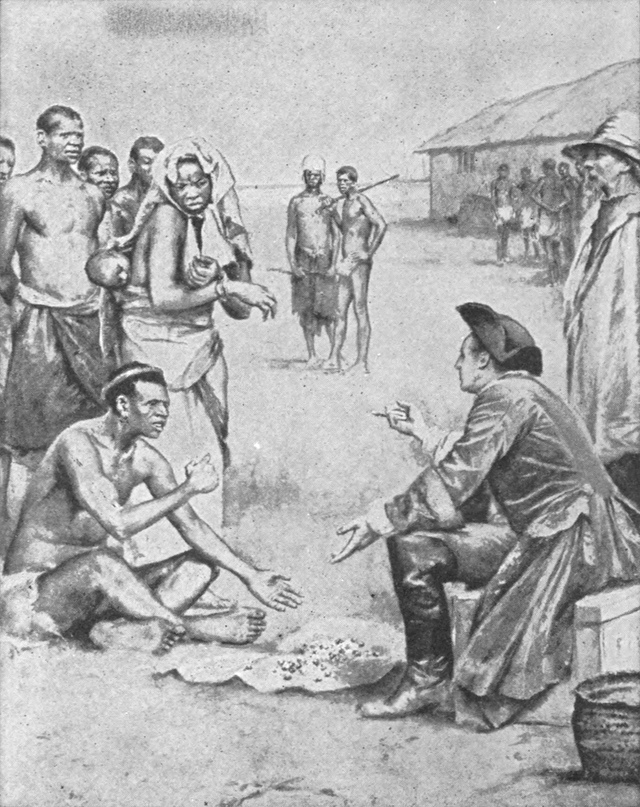
PRIMITIVE MONEY: SELLING A SLAVE FOR COWRIES
Cowries, which are small shells, are a very primitive form of money, still used in parts of Africa and in Siam. They were formerly so used in India, where $150,000 worth used to be imported annually. In Africa 5,000 shells are equivalent to $1.
Here, again, is shown the impulse of man to free himself from the exigencies of the moment, to lift himself above the fortuitous differences that arise between supply and demand. The more varied the production, the more difficult it becomes to find men who are able to offer the required commodity in exchange for what has been brought to them. An escape from this embarrassment lies in the discovery of a universal measure of exchange value and medium of exchange—money. Money is the means of adjustment which renders traffic between men independent of individual requirements.
Mediums of exchange, particularly necessary for the carrying on of traffic between different communities, which exist in large quantities and can be divided up into parts, make their appearance in very early times. At first their values are more or less empirical, dependent upon the conditions of individual cases, until gradually a medium obtains general recognition and thus becomes money. The same need for surmounting the lack of uniformity in individual requirements has led the most different peoples in the world to the invention of money. Naturally, many different things have been employed as mediums of exchange; these vary according to geographical situations, conditions of civilisation, and the customs of races. Pastoral tribes at first employed cattle; but tobacco, cowries, strings of flat shells, bits of mother-of-pearl, rings, and hides are also used. At last it is found that metal is stable, durable, divisible, and of generally recognised value; and finally the precious metals take precedence of all others. Finally this form of money is adopted by all civilised races.
Division of labour originates in the development of the handicrafts, in the distinction made between the labour of working up the raw material and that of its production. With the help of a currency it leads to a complete transformation, not only of economic relations, but also of the social conditions of men.
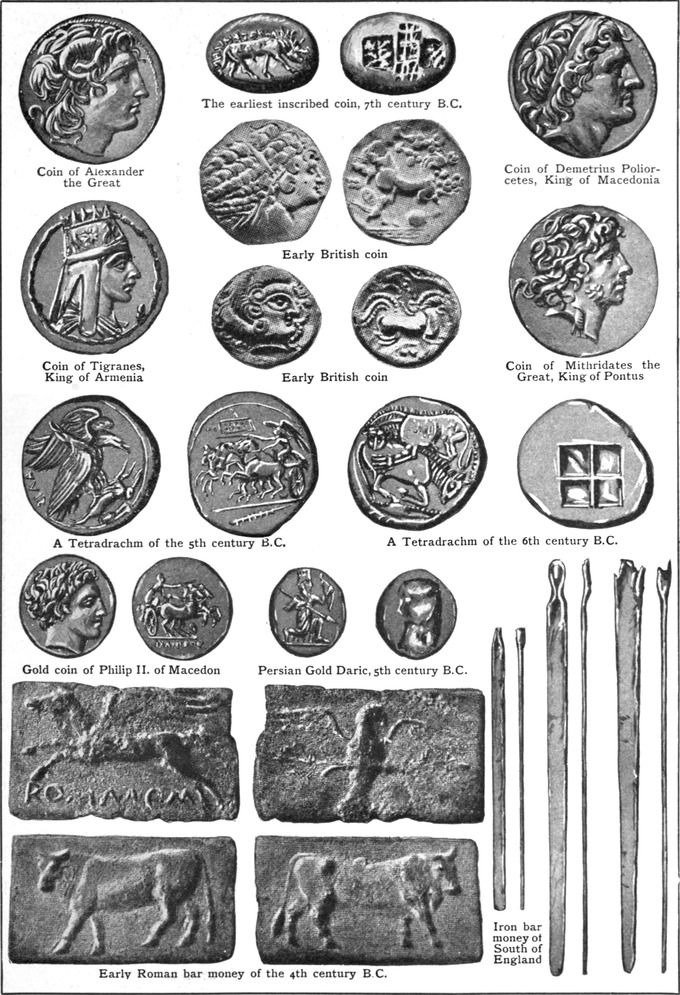
THE BEGINNING OF MONEY: SOME OF THE EARLIEST KNOWN COINS IN EXISTENCE
Of these coins, chiefly from the British Museum, the South England iron currency bars are perhaps most interesting. Our reproduction of these is one-tenth actual size. It will be noticed that the handles and the sizes vary.
LARGER IMAGE
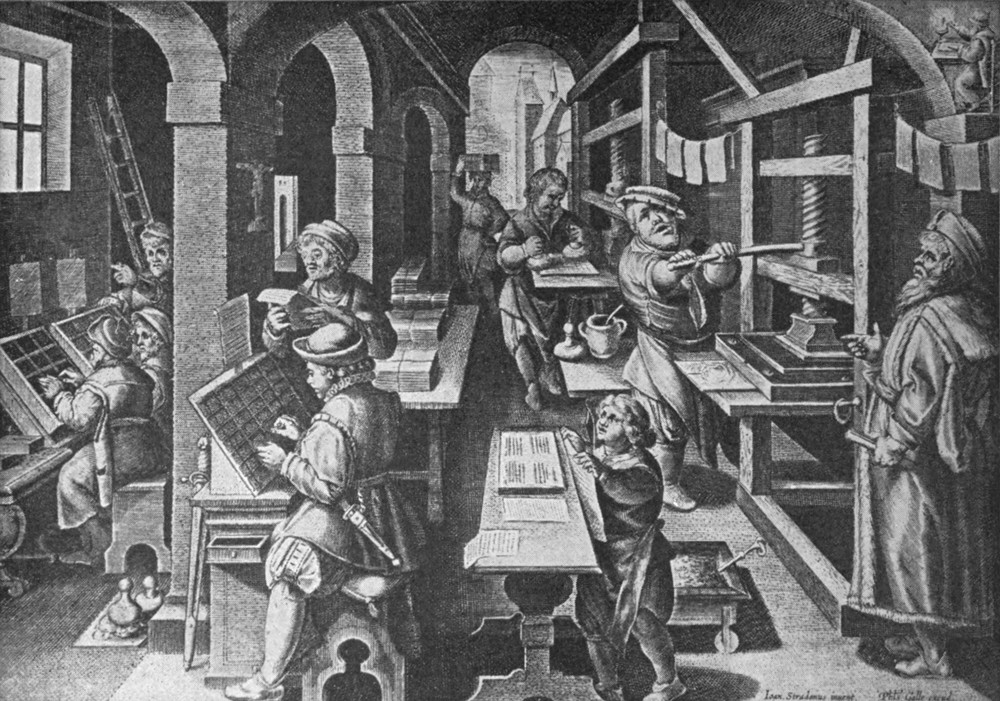
THE BEGINNING OF PRINTING: STRADANUS’S PRINTING OFFICE AT ANTWERP IN THE YEAR 1600
From a very rare engraving in the British Museum.
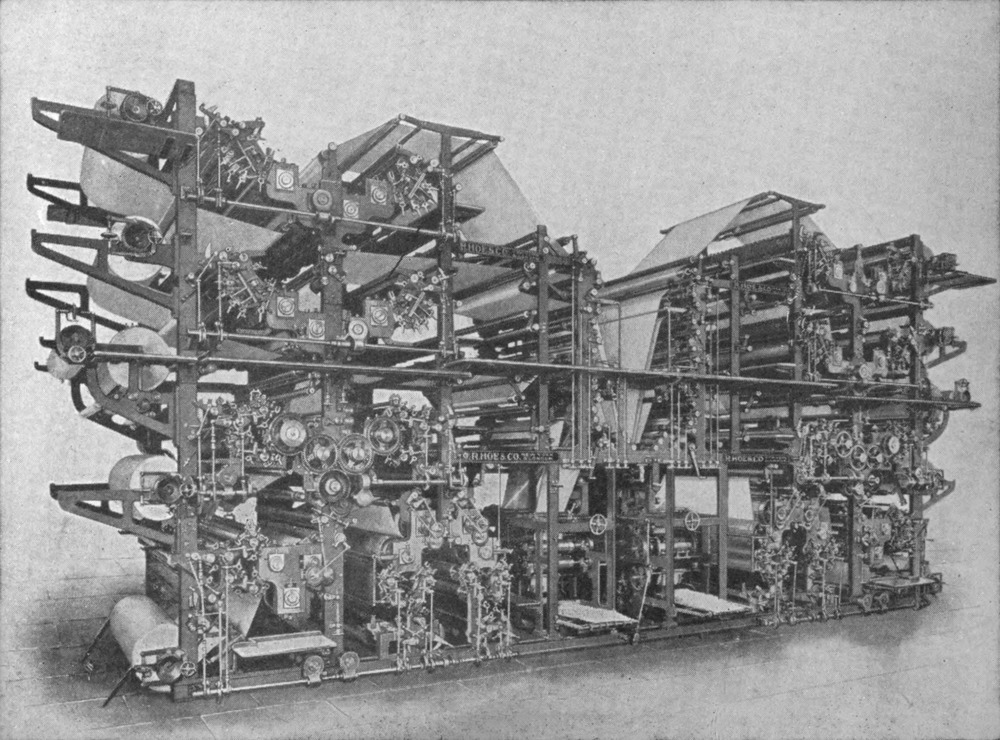
THE DEVELOPMENT OF PRINTING: THE LARGEST PRESS IN THE WORLD
How great has been the progress in the art of printing is seen from these two pictures. The modern Hoe printing press is a marvel of mechanism. The first editions of this History were printed on a similar machine.
Markets and Prices
Country becomes city; centres of population which rest upon an industrial basis arise; in many cases growth of the various manufacturing industries is furthered by unfavourable agricultural conditions. Such industrial centres require markets and market-places; it is necessary for the producers of raw materials to come to market from the country with their goods, in order that they may meet together with the craftsmen of the city, and with other producers from the country who offer their wares in turn. The market town is the point of departure for further culture. Here, too, the endeavour to harmonise individual incongruities exists. Fruit is sent to market; each man has his choice; an exchange value is determined by means of comparison, through analysis of the individual prices which themselves do not furnish any rational determination of worth, and therefore expose both buyer and seller to chance. Thus a market-price develops. The city is the living agency promoting industry and exchange; it brings its population into contact with the population of the country by means of the market, and prevents men from separating into isolated, unsympathetic, or even hostile groups.
Here industry flourishes—arts, crafts, and large manufactures. In the latter, division of labour is developed to a maximum degree, and production in factories derives a further impulse through the introduction of machinery. Machines, in contrast to implements and utensils, are inanimate but organised instruments for labour, requiring subordinate human activity only (attendance) so that they may impart force and motion in a manner corresponding with the designs of the inventor. Machinery is originally of simple form, dependent on water or wind for motive power—rude mills, and contrivances for the guiding of water in canals or conduits belong to its primitive varieties.
The Use of Natural Forces
But man’s power of invention increases, and in the higher stage of industrial evolution the facilities for labour are enormous. We have but to think of steam and of electricity with all their tremendous developments of power. Finally the discovery of the unity of force leads men to look upon Nature as a storehouse of energy and to devise means by which natural forces may be guided, one form of energy converted into another and transferred from place to place; and thus man becomes almost all-powerful. He is not able to create, it is true, but he may at least mould and shape to his desire that which Nature has already formed. Thus the discovery how to direct the forces of Nature enables us again, according to the principle already cited, to escape the disabilities of human differentiation with its attendant incongruities.
Boundless Growth of Commerce
As already stated, division of labour leads to exchange; exchange leads to commerce. Commerce is exchange on a large scale, organised into a system with special regard to the production of a store, or supply. The latter requires a certain knowledge of trade; the centres of demand must be sought out, and the goods transported to these centres. In this way a fruitful reciprocal action develops; and as production influences trade, so may trade influence production, governing it according to the fluctuations of demand, and leading to the creation of stores of commodities for which a future market is to be expected. Thus commerce presupposes special knowledge and special skill; it develops a special technique through which it is enabled to execute its complicated tasks. Men who live by trade become distinct from craftsmen; and the mercantile class results. Merchants are men whose task is to effect an organised exchange of natural and manufactured products. Commerce always displays an impulse to extend itself beyond the borders of single nations—not to remain inland only, but to become a foreign trade also; for the products of foreign countries and climates, however valuable they may be, would be inaccessible except for commerce. Thus trade becomes both import and export. The first step is for the tradesman or his representative to travel about peddling goods, or for an owner of wares or money to offer capital to an itinerant merchant with the object that the latter may divide the profits with him later on. This leads to the sending of merchandise to a middleman, who places it on the market in a distant region—commission business. The establishment of a branch or agency in a foreign country, in order to trade there while in immediate connection with the main business house, follows; and, finally, merchants deal directly with foreign houses without the intervention of middlemen, thus entering into direct export trade. This, of course, presupposes a great familiarity with foreign affairs and confidence in their soundness; consequently it is possible only in a highly developed state of civilisation.
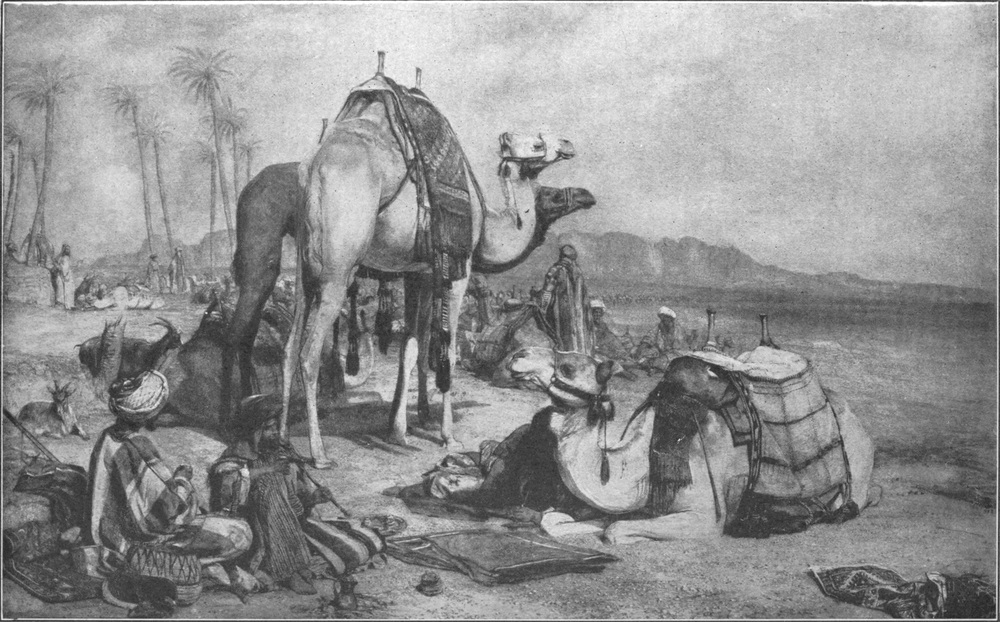
“THE SHIP OF THE DESERT”: THE CARAVAN IS THE OLDEST EXISTING MEANS OF COMMUNICATION BETWEEN PEOPLES
From J. F. Lewis’s picture “The Halt in the Desert,” in the South Kensington Museum
(Photo, Mansell)
LARGER IMAGE
Birth of New Trades and Institutions
Foreign trade is carried on overland by means of caravans, and, in later times, by railways; over sea, through a merchant marine—sailing vessels and steamships. The magnitude of commerce, its peculiar methods, and its manifold, varying phases combine to produce new and surprising phenomena: traffic by sea leads to insurance and to different forms of commercial associations; intercourse by caravan gives rise to the construction of halting-stations, establishments for refreshment and repair, that finally develop into taverns and inns. And that which first arose from necessity is subsequently turned to use for other purposes: insurance is one of the most fruitful ideas of the present day; hotels are an absolute necessity.
Commerce is able to bring further contrivances and institutions into being, here, again, overcoming individual incongruity by means of combination. Trade cannot always be carried on directly between the places of production and of consumption; one district requires more, another less; it would be difficult to supply all from one centre of distribution. Thus an intermediate carrying trade is developed, rendering the surmounting of obstacles less difficult and increasing the stability of the market. The demands of the middleman are compensated for by these advantages.
Commerce Brings the World Together
Thus the world’s commerce develops, and that which is accomplished by market traffic in lesser districts is brought about by the concentrative influence of bourses, or exchanges, in the broadest spheres. Here, as in the smaller markets, the tendency is for all prices to seek a level, to become as independent as possible of individual conditions; and so commerce between nations, and the possibility of ordering goods from the most distant lands, bring with them an adjustment: world prices are formed; and to establish these, is the business of the exchanges. The exchange is a meeting together of merchants for the transaction of business by purchase or sale. It has acquired still more the character of a world institution since men have been able to interchange advices by means of telegraph and telephone; it is possible for the bourses of different countries to transact business with one another from moment to moment, so that the ruling prices of the world can be immediately known. It has already been stated that commerce leads to a taking up of residence in foreign countries; it also leads to colonisation, and it is chiefly due to commerce that civilisation is introduced into foreign lands.
Supply of Human Labour
In earlier centuries the labour question was settled by means of the legal subjection of certain classes of men, until complete injustice was reached in slavery. The system was rendered still more efficient by making slave-ownership hereditary. Slavery, originated in wars and man-hunting, in times when there were but few domesticated animals and no machines, when utensils, were very imperfect and a more or less developed mode of life could only be conducted by means of the manual labour of individuals. Therefore, in order to obtain labourers, men resorted to force, introducing a slave population of which the individuals were either divided among households or kept in special slave habitations. The industry of the slave was often increased by the promise of definite privileges or private possessions. He was often granted a home and family life, and thus he became a bondman—burdened and taxed and bound to the soil, it is true, but otherwise looked upon as a man possessed of ordinary rights and privileges. Even during the days of slavery there were instances of emancipation, and the possibility was opened up of rising to the social position of a slave-owner.
The evolution of a free working class, with recompense for labour, is one of the most important chapters in the history of modern civilisation. The chief sphere of development is that of the crafts and trades. The power of guilds often induces legislation in their favour; thus they become monopolies, and only such individuals as are members of an association may adopt its particular trade or craft as a profession. Sometimes the unity of a guild is broken, and the individual right to form judgments enters in place of the rules laid down by the corporation. From this results competition, which finally leads up to free competition. Through free competition, the encumbering rigidity of the guilds is avoided; it leads to a high development of the individual, and is therefore a great source of progress; it discloses the secrets of the craft, freeing men from deeply-rooted prejudices in regard to different vocations; and it increases man’s inventive capacity, producing new methods for carrying on trades and new combinations and connections.
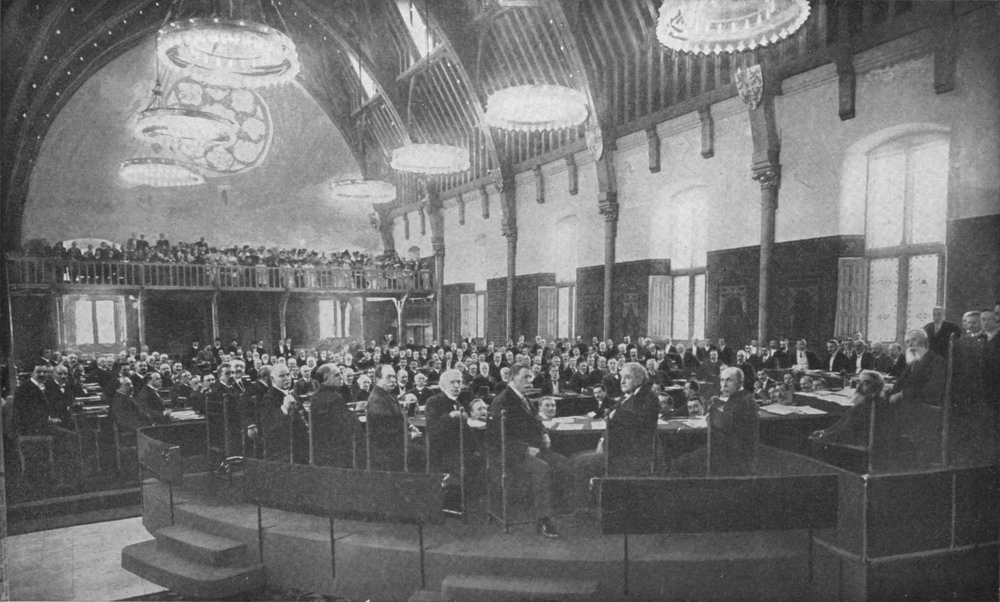
THE PROMISE OF PEACE: THE HAGUE CONFERENCE OF THE NATIONS OF THE WORLD IN 1907
Nothing could more effectively illustrate the ideal of international peaceful co-operation to which hopeful historians look forward than this photograph of the representatives of all the leading Powers of the world, met together at The Hague, in the year 1907, to promote the amity of nations and the eventual abolition of war.
LARGER IMAGE
THE HIGHER PROGRESS OF MANKIND
S
SPIRITUAL culture may develop in the directions of knowing and of feeling. These two forms of the manifestation of consciousness are originally not to be separated from each other; but as time goes on, a preponderance of one or the other becomes noticeable. Language is the first result of spiritual culture: the communication of thoughts by means of words (sound pictures of ideas). Language arises from the necessities of life, from the need for communication among the members of a social aggregate.
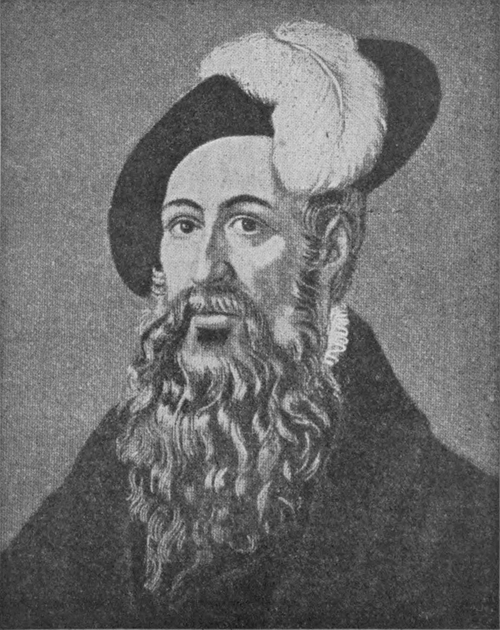
GUTENBERG, THE INVENTOR OF PRINTING
Nothing has eclipsed the printing press as an agency of man’s intellectual and spiritual advancement.
A much later acquisition, the art of writing, or the fixation of language in a definite, permanent form, stands in close connection with speech. Writing develops according to two systems: the one based on the symbolising or picturing of ideas—picture-writing, hieroglyphics; and the other on the breaking up of the speech-sounds of a language into a notation of syllables or letters—syllabic or letter writing. According to the first method thoughts are directly pictured; according to the second, sounds, not ideas, are represented by symbols—that is, the sounds which stand for the ideas are transformed into signs. The transition from sign to syllabic writing comes about in this manner: if, during its development, a language uses the same sound to express various conceptions, men represent this sound by one sign; and whenever a foreign word is reproduced in writing it is first separated into syllables, and the syllables are then pictured by the same signs as are employed to represent similar sounds—but different ideas—in the native speech. Thus symbols are employed more and more phonetically, and less and less meaning comes to be attached to them. This process must continue its development if the pronunciation changes as time goes on; the old writing, with its national symbol-method, may be retained; but with the changing of speech-sounds the new writing is altered; syllables are now represented by signs, and combinations of syllables are reproduced by means of a combination of their corresponding symbols. Thus phonetic writing was not an invention, but a gradual development. Together with the phonetic symbols, ideograms or hieroglyphs also exist, as in Babylonian. It is especially interesting, and indicative of the unity of the human mind, that the transition to syllabic writing has been arrived at independently by different races; the Aztecs, for example, exhibit a wholly independent development.
The Spreading of Ideas
Communication by writing may be either single or private, or general and public; in the latter case plurality is attained through such methods as the affixing of bills and placards, or by means of transcripts or reproductions of the original copy. At first the latter are made in accordance with the ordinary methods of writing; and in slave-holding communities—Rome, for example—slaves who wrote to dictation were employed as scribes. The discovery of a method by which to obtain a plurality of copies through a single mechanical process was epoch-making. The printing-press has performed a far greater service to humanity than have most inventions; for, with the possibility of producing thousands of copies of a communication, the thoughts embodied in it become forces; they may enter the minds of many individuals who are either convinced or actually guided by them. Ideas become active through their suggestion on the masses of the population. This may lead to a one-sided rule of public opinion; but a healthy race will travel intellectually in many directions, and various beliefs supplement one another, struggle together, conquer, and are conquered. In this manner thoughts awaken popular movements, rousing a people to a hitherto unknown degree, and forcing men to think and to join issues. Thus the Press becomes a factor in civilisation of the very first importance. The necessity for periodic communication, together with curiosity that refuses to wait long for information, leads to the establishment of regularly recurrent publications; and thus, in addition to the book-press, the newspaper-press, that has learned how to hold great centres of population under its control, appears. Naturally this method of aiding the progress of civilisation has its disadvantages, as have all other methods; the conception of the world becomes superficial; individuality loses in character; not only a certain levelling of education, but also a levelling of views of life and of modes of thought, results. But, on the whole, knowledge is spread abroad as it never was before.
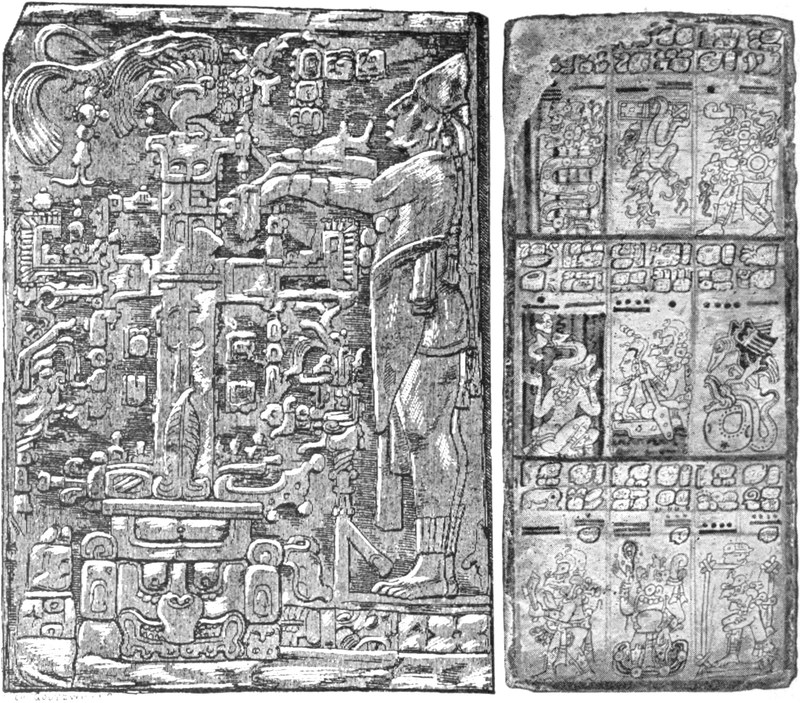
EXAMPLES OF AZTEC HIEROGLYPHIC SCULPTURE AND WRITING
The hieroglyphics and script of the Aztecs were independently developed. The first illustration is from a sculpture in Mexico, and the other is a small reproduction of a page of the Maya manuscript at Dresden. In both cases the symbolism is only imperfectly understood at present.
Man, as a thinking being, craves for a conception of life; and in his inmost thoughts he seeks for an explanation of the double relationship of Man to Nature and of Nature to Man, striving to bring all into harmony. This he finds in religion.
Frith
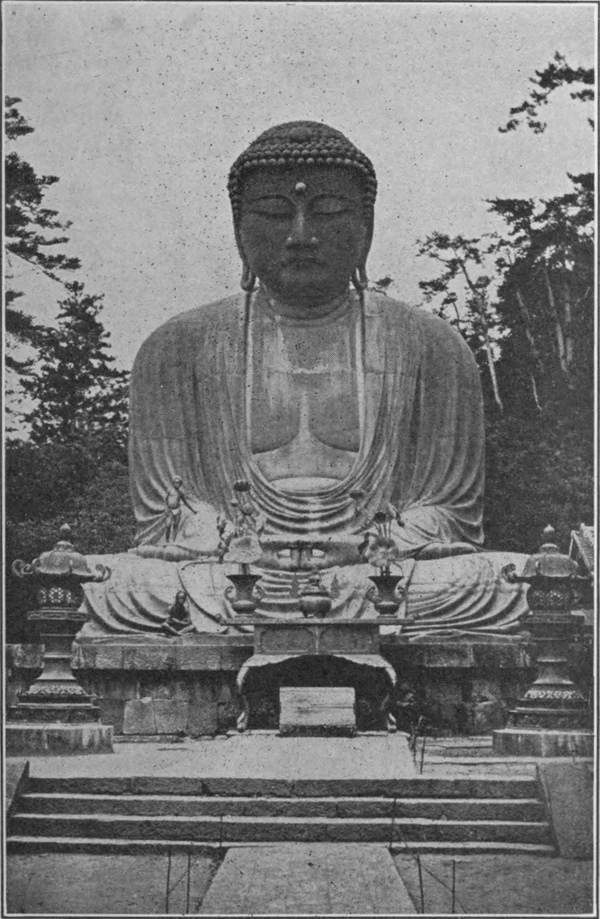
THE GREAT BUDDHA AT KAMAKURA, IN JAPAN
Professor Kohler points out that in the history of the world’s religions, although the belief in the omnipotence of God has become so widespread, it is not thought inconsistent that a Buddha, claiming to incarnate the Supreme Being completely within himself, should appear.
Man’s Craving for Religion Beginnings of Nature Worship The Realm of Shadows
Religion is belief in God; that is, belief in spiritual forces inseparable from and interwoven through the universe—forces that render all things distinct and separate, yet make all coalescent and firm, permeating all, and giving to every object its individuality. Man is impelled by Nature to conceive of the universe as divine. This idea exhibits itself universally among primitive folk in the form of animism—a belief that the entire internal and external world is animated, filled with supernatural beings that have originally no determinate nature, but which may appear in the most varied of forms, may vanish and may create themselves anew, as clouds arise from unseen vapour in the air. Spirits are supposed to be not far removed from man; families as well as individuals consider themselves to stand more or less in connection with them; and men, too, have a share in the invisible world when they have cast aside the garment of the body in dream or in death. Thus, every man is thought to have his protecting spirit, his manitou, that reveals itself to him through signs and dreams. Special incarnations, objects in which supernatural beings are inherent or with which they are in some way connected, are called “fetiches”; hence arises fetichism, in regard to which the strangest ideas were held in previous centuries when the science of anthropology was unknown. Trees, rocks, rivers, bits of wood, images of one’s own making—any of these are thought capable of containing beings of divine nature. Naturally, the tree or the fragment of wood or of stone is not worshipped, as men formerly thought, but the spirit that is believed to have entered it. In many cases the belief approaches worship of Nature, especially among agricultural peoples. Divinity is recognised in the shape of factors essential to agriculture—sun, sky, lightning, thunder; these being the beneficent deities, in contrast to whom are the earth-spirits who bring pestilences, earthquakes, and other evils to mankind. Thus the cult is refined; spirits are no longer attached to fetiches, but men worship the heavens, and the earth also. Religion accompanies man from birth to death. Spirits both for good and for evil are supposed to hover about him at his very birth. The soul of some being—perhaps an animal, perhaps an ancestor—enters into the new-born child, and from this spirit he receives his name.
Oftentimes there is a new consecration at the time of marriage; often when an heir-apparent succeeds to the chieftainship. At his decease primitive folk believe that man enters the realm of shadows. At first he hovers over the sea or river of death, and often only after having passed through many hardships does he arrive in the new kingdom, where he either continues to live after the manner of his former existence, or, according to whether his life on earth has been good or evil, inhabits a higher or a lower supernatural sphere. To the dead are consecrated their personal possessions—horses, slaves, wives even—that they may make use of them during the new existence; men go head-hunting in order to send them new helpmates. On the other hand great care is often taken that the spirits of the departed, satisfied with their new existence, may no longer molest the world of the living: propitiative offerings are made; men avoid mentioning the name of the departed, that he may not be tempted to visit them with his presence; they seek to make themselves unrecognisable during the time immediately following his death, wear different clothes, and adopt other dwelling-places. Sometimes the light placed near the deceased for the purpose of guiding him back to his old home is moved further and further away, so that his ghost, unable to find the right path, shall never return.
Thus the belief in spirits encompasses primitive man, following him step by step.
The Belief in Many Gods Happiness found in Religion
From animism develops worship of heroes and polytheism, with their attendant mythological narrations. The idea of the unity of the supernatural world becomes lost; and the indefinite forms of spirit become separate, independent beings, that are developed more and more in the direction of the souls either of animals or of men. This splitting up of the deity, which destroys the tendency toward unity in religion, is followed by a reaction that comes about partly through a belief in creation by a father of the gods, partly through acceptance of a historical origin of the mythological world from a single source (theogonic myths), and partly through direct banishment of the plurality of gods and a new formation of the belief in a unity according either to theistic or to pantheistic ideas. In spite of the conception of a world permeated and pervaded by God alone, the belief that certain persons and places are more powerful in respect to the divinity than others is retained; and the appearance from time to time of a Buddha who incarnates and manifests the Supreme Being directly and completely within himself—in a special manner apart from other natural phenomena—is also not looked upon as inconsistent.
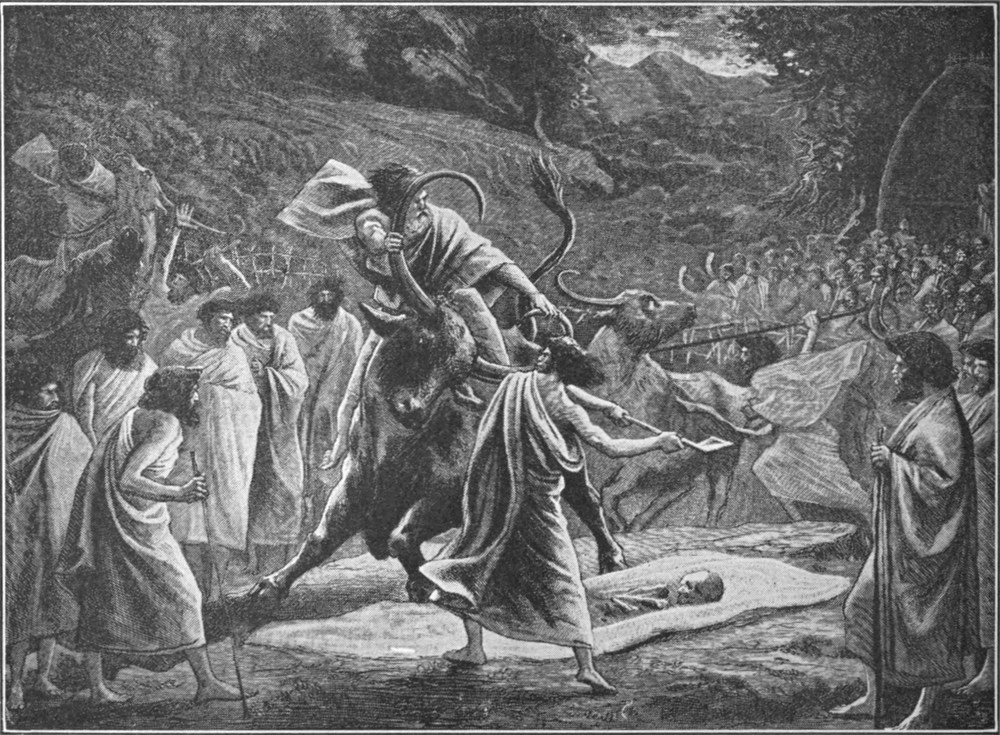
A STRANGE RELIGIOUS RITE: FUNERAL SACRIFICE OF THE TODAS IN SOUTHERN INDIA
The elaborate and extraordinary funeral rites of the Todas illustrate admirably the older notions of life and death. A funeral endures for several days; the body is cremated; last of all the buffaloes of the deceased are slaughtered at the grave and thought to enter into mystic reunion with their master. In olden times a whole troop would be slaughtered, but under British influence the number has been limited to one for a common person and two for a chief.
Religion is a thing of the emotions, not merely in the sense of having its origin in fear, or in the remembrance of lasting sensations derived from visions or dreams, but emotional in so far that it satisfies the necessity felt by men for a consistent life-conception—not an intellectual but an emotional conception. It is not the matter-of-fact desire for knowledge that finds its expression in religion, but the joy of the heart in a supreme power, the call for help of the needy, and the consciousness of our own insignificance and our mortality. Judgment is not yet abstracted from the other psychic functions; indeed, it really retires behind the emotions.
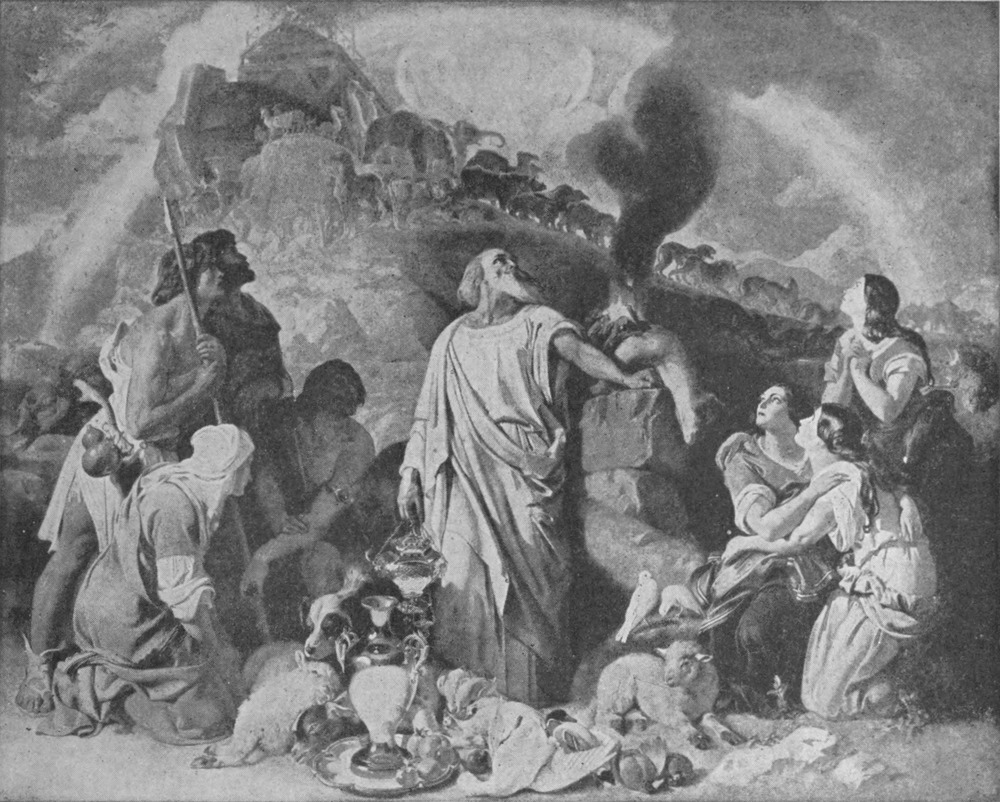
NOAH’S SACRIFICE
From the painting by Daniel Maclise, R.A.
The Basis of Worship The Growth of the Priesthood
When men thus believe in divinity, if the belief have an active influence on the emotions, it follows that the individual must establish some connection between himself and the object of his worship. This is brought about through certain actions, or through the creation of circumstances in which special conditions of consecration are perceived, and therewith the possibility of a close relationship with the Supreme Being. The acts through which this relationship may be brought about, taken collectively, are embraced in the word “worship,” and if performed according to a strict system they are called “rites.” Sacrifice has an important place among the ceremonies observed in accordance with ritual. It is based on a conception of the wants and necessities of the higher beings, and, in later times, is refined into a representation of man’s ethical feelings—unselfishness and gratitude, which give pleasure to the Deity and thus contribute to its happiness. But sacrifice does not retain its unselfish character for any great length of time. Man thinks of himself first: he makes offerings to the good spirits, but more particularly to the evil gods, in order to pacify their fury and appease their evil desires. Sacrifices are also offered to the dead, and from such offerings and memorials is developed the idea of a “family” or “clan,” which outlives the individual.
Thus, emotion is the principal active agent; but intellectual power also must gradually lay its hold on the system of belief. The principles discovered are formulated into a science and the cultivation of this science becomes the special duty of the priesthood, often as a secret art—esoteric system—in which concealment is conducive to the maintenance of the exclusiveness and peculiar power of the priest class. The science becomes partly mythologic-historical, partly dogmatic, and partly ritualistic.
Out of Religion Came Art
The artistic instinct develops partly in connection with worship, partly in the direction of its practical application to life; and although no very sharp line of distinction is drawn between the two tendencies, the germ at least of the difference between the fine and the industrial arts is thus in existence from the very earliest times. Worship gives rise to images and pictures, at first of the very roughest form. They are not mere symbols; they are the garments or habitations with which the spirit invests itself. The spirit may take up its abode anywhere according to the different beliefs of man—in a plant, an animal, a stone, above all, in a picture or effigy that symbolically reflects its peculiarities. Therefore, the ghosts of ancestors are embodied in ancestral images. Just as skulls were reverenced in earlier times, in later days the images of the dead (korwar) are worshipped. Such images are the oldest examples of the art of portraiture; and the oldest dolls are the rude puppets which according to the rites of many races—the American Indians, for example—widows must wear about them as tokens, or as the husks or wrappers of their husbands’ doubles.
Religion itself becomes poetry. The belief in the identity of spirits of the departed with animals, and the myths of metamorphosis, take the form of fables and fairy tales; the cosmogonic and theogonic conceptions develop into mythologies; hero sagas become epics; the myths of life in Nature become a glorification of the external world, an expression of unity with Nature, and thus a form of lyric poetry.
Artistic Expression of Life
Everyday life, too, demands artistic expression. At first the childish passion for the changing pictures that correspond with different ideas of the imagination joins with the desire to impress others, and finery in dress and ornamentation result. This has developed in every clime. Tattooing arises not only from a religious motive, but also from the desire for ornament. The painting of men’s bodies, the often grotesque ideas, such as artificial deformation of the head, knocking out and blackening of teeth, ear ornaments and mutilation of ears, pegs thrust through the lips, and various methods of dressing the hair, may be in part connected with religious conceptions, for here the most varied of motives co-operate to the same end. Yet, on the other hand, there is no doubt that they are also the outcome of a craving for variation in form and in colour. In the same way the dance is not only an act of worship; it is also a means of giving vent to latent animal spirits: thus, dances are often expressions of the tempestuous sensual instincts of a people.
The Birth of the Drama
The dance exhibits a special tendency to represent the ordinary affairs of life in a symbolic manner; thus there are war and hunting dances, and especially animal dances in which each of the participants believes himself to be permeated by the spirit of some animal which throughout the dance he endeavours to mimic. In this way dramatic representation, which is certainly based on the idea of personification, on the notion that a man for the time being may be possessed by the spirit of some other creature that speaks and acts through him, originates. Thus arose the primitive form of masques, in which men dressed themselves up to resemble various creatures, real or imaginary, as in the case of the animal masques of old time; for according to the popular idea the spirit dwells in the external, visible form, and through the imitation or adoption of its outward appearance we become identified with the spirit whose character we assume. Among many races not only masks proper were worn, but also the hides and hair or feathers of the creatures personated. Dramatic representation was furthered by the dream plays—especially popular among the American Indians—in which the events of dreams are adapted for acting and performed. Even as men seek illumination in dreams as to questions both divine and mundane, so do they anticipate through dreams the dramatic representations which shall be performed on holidays as expressions of life.
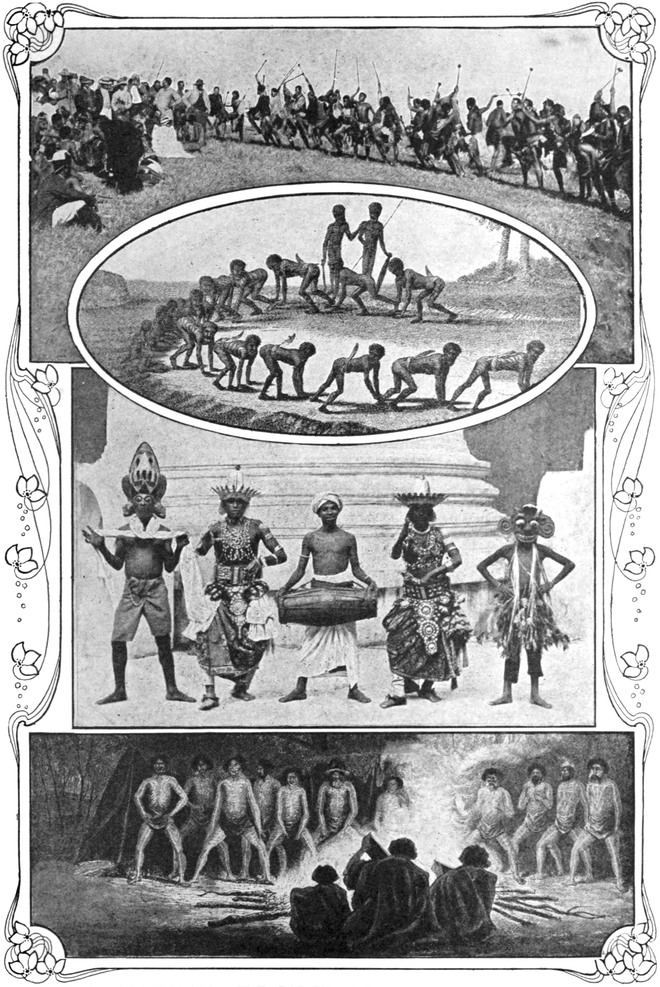
SAVAGE DANCES: THE FAR-OFF BEGINNINGS OF THE DRAMA
The dance is an effort to give symbolic expression to affairs and moods of everyday life. Thus the Zulu wedding dance is self-evident in its purpose. The second illustration depicts a strange religious dance of the Australian natives, associated with totemism or animism. The third picture shows dancers in Kandy endeavouring to banish evil spirits, and the last illustrates an Australian corroboree. From such sources the drama has been slowly evolved.
LARGER IMAGE
Art & Play in the Life of Man
Play is a degeneration of the dance, and it arises less from the instinct for beauty than from a desire to realise whatever entertainment and excitement may be got from any incident or occurrence. From another special inclination originate those satirical songs of Northern peoples, written in alternating verses, in which the national tribunal and the voice of the people are given expression at the same time. Thus they have a truly educative character. These are the preliminary steps to the free satire and humour that gleam through the lives of civilised peoples, now like the flicker of a candle, now like a purifying lightning flash, freeing men from life’s monotony, and illuminating the night of unsolved questions. Capacity for organised play is a characteristic that lifts man above the lower animals. The expression of individuality without any particular object in view, the elevation of self above the troubles of life, and free activity, uncoerced by the necessities of existence, are characteristic both of play and of art. Thus play, as well as art, exhibits to a pre-eminent degree man’s consciousness of having escaped, if only temporarily, from the coercion of environing nature; being without definite object, it proves that he can find employment when released from the pressure of the outer world—that is, when he is momentarily freed from his endeavour to establish a balance between himself and the necessities of life, with a view to overcoming the latter. Man stands in close connection with his environment and with the immutable laws of nature; but in play and in art he develops his own personality—a development that neither in direction nor in object is influenced by the outer world and its constraint.
Fall of Man and Rise of the Race
The step that leads to the overcoming of custom is the recognition of right. “Right” is that which society strictly demands from every individual member. Not all that is customary is exacted by right; a multitude of the requirements of custom may be ignored without opposition from the community as a whole, although, of course, detached individuals may express their displeasure. The aggregate, however, grants immunity to all who do not choose to follow the custom. In other words, the separation of custom from right signifies the development of a sharper line of demarcation between that which is and that which ought to be. In primitive times “is” and “ought to be” are fairly consonant terms; but gradually a spirit of opposition is developed; cases arise in which custom is opposed, in which the actions of men run counter to a previous habit. Man is conscious of the possibility of raising himself above the unreasoning tendencies toward certain modes of conduct, and he takes pleasure in so doing—the good man as well as the evil. Whoever oversteps the bounds of custom, even through sheer egotism, is also a furtherer of human development; without sin the world would never have evolved a civilisation; the Fall of Man was nothing more than the first step toward the historical development of the human race.
This leads to the necessity for extracting from custom such rules as must prove advantageous to mankind, and this collection of axioms—which “ought to be”—becomes law.
Custom, Right, and Morality
The distinction between right and custom was an important step. The relativity of custom was exposed with one stroke. Many, and by no means the worst members of communities, emancipate themselves from custom. It is the opening in the wall through which the progress of humanity may pass. Nor do the demands of right remain unalterable and unyielding. A change in custom brings with it a change in right; certain rules of conduct gradually become isolated owing to the recession of custom, and to such an extent that they lose their vitality and decay. And as new customs arise, so are new principles of right discovered. In this manner an alteration in the one is a cause of change in the other—naturally, in conformity with the degree of culture and contemporary social relations. Custom and right mutually further each other, and render it possible for men to adapt themselves to newly acquired conditions of civilisation.
Together with right and custom a third factor appears—morality. This is a comparatively late acquisition. It, too, contains something of the “ought to be,” not because of the social, but by virtue of the divine authority or order based on philosophical conceptions. Morals vary, therefore, as laws vary, according to peoples and to times. The rules of morality form a second code, set above the social law, and they embody a larger aggregate of duties. The reason for this is that men recognise that the social system of rules for conduct is not the only one, that it is only relative and cannot include all the duties of human beings, and that over and beyond the laws of society ethical principles exist.
Naturally conflicts arise between right and morals, and such struggles lead to further development and progress.
The late appearance of ideas of morality proves that ethical considerations were originally foreign to the god-conceptions. The spirits, fetiches, and world-creators of different beliefs are at first neutral so far as morals are concerned; myths and legends are invented partly from creation theories, partly from historic data, and partly through efforts of the imagination. In primitive beliefs there is no trace of an attempt to conceive of deities as being good in the highest—or even in a lower—sense; and it would not be in accordance with scientific ethnology to appraise, or to wish to pass judgment on, religions according to the point of view of ethics. Not until the importance of morality in life is realised, and the profound value of a life of moral purity recognised, do men seek in their religious beliefs for higher beings of ethical significance, for morally perfect personalities among the gods.
Underwood & Underwood
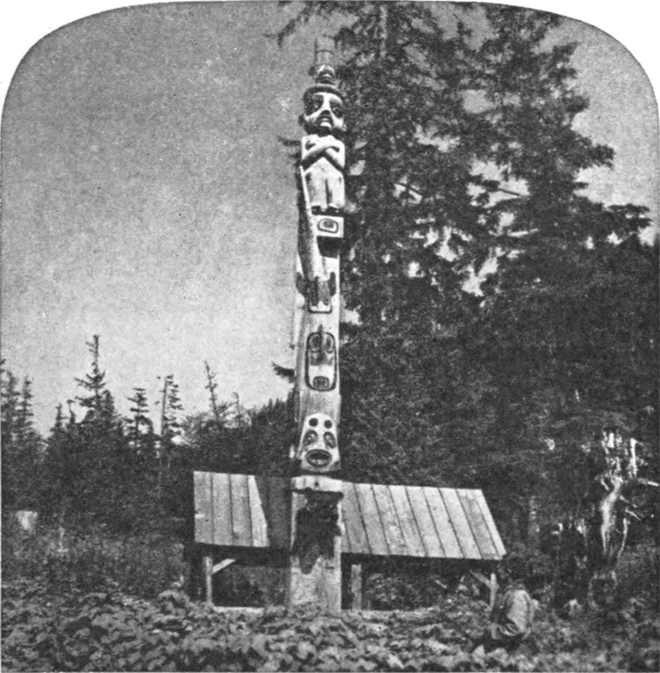
THE EMBLEM OF A TRIBE: ALASKAN INDIAN TOTEM
This mysterious “totem” distinguishes a family or tribe of the old Hydah Indians and is erected at Wrangel in Alaska.
Different elements of civilisation vary greatly in their development in different civilised districts; one race may have a greater tendency toward intellectual, another toward material culture. No race has approached the Hindoos in philosophic speculation, yet they are as children in their knowledge of natural science. One people may develop commerce to the highest extent, another poetry and music, a third the freedom of the individual. The language of the American Indians is in many respects richer and more elegant than English. Therefore nothing is farther from the truth than to say that, in case one institution of civilised life is found to exist in a hunting people, another in an agricultural race, or the one in an otherwise higher, and the other in an otherwise lower nation or tribe, the institution in question must have reached a state of perfection corresponding with the general development of the people possessing it. According to this, the monogamic uncivilised races were further advanced than the polygamous Aryans of India and the Mohammedans; and the Polynesians, with their skill in the industrial arts and their dramatic dances, perhaps in a higher state of civilisation than Europeans!
Development fulfils itself in communities of men. Except in a human aggregate it cannot come to pass; for the germs of development which are brought forth by the potentiated activity of the many may exist only in a society of individuals.
It has therefore been a significant fact that from the very beginning men have joined together in social aggregates, partly on account of an instinctive impulse, partly because of the necessity for self-defence. Thus it came about that primitive men lived together in wandering, predatory hordes, or packs. The individuals were bound to one another very closely; there was no private life; and the sex-relationships were promiscuous. Men not only dwelt together in groups, but the groups themselves assimilated with one another, inasmuch as marriages were reciprocally entered into by them. So far as we are able to determine, one of the earliest of social institutions was that of group-marriage. Individuals did not first unite in pairs, and then join together in groups—such would soon have fallen asunder; on the contrary, group-marriage itself created the bond that held the community together; the most violent instinct of mankind not only united the few but the many, indeed, complete social aggregates.
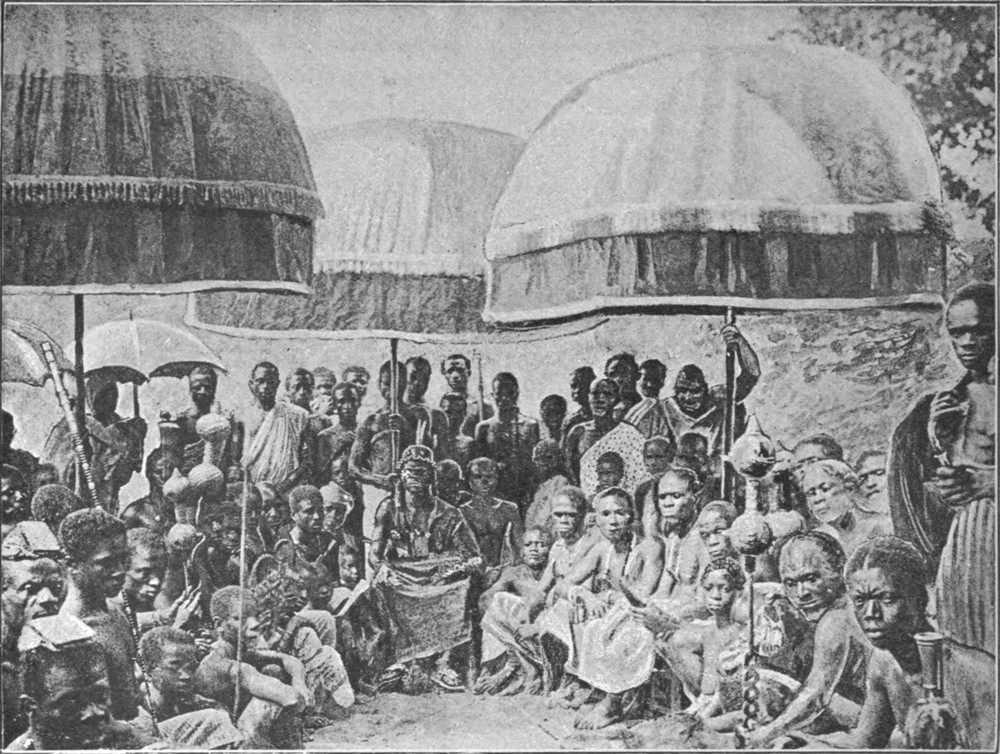
THE BEGINNINGS OF MONARCHY: AFRICAN CHIEF SEATED IN STATE AMONG HIS HEADMEN
The tribal state has a fixed form of government. The chiefs or patriarchs of the various families stand at the head of affairs, the position of chief being either hereditary or elective. In most cases, however, it is determined by a combination of both methods, a blood descendant being chosen, provided he is able to give proof of his competence.
Group-marriage is the form of union established by the association of two hordes, or packs, according to which the men of one group marry the women of the other; not a marriage of individual men with individual women, but a promiscuous relationship, each man of one group marrying all the women of the other group—at least in theory—and vice versâ; not a marriage of individuals, but of aggregates. Certainly with such a sex-relationship established, sooner or later regulations develop from within the community, through which the marital relationships of individuals are adjusted in a consistent manner; but the principle first followed was, as community in property, so community in marriage; and this must of itself lead to kinships entirely different from those with which we are familiar.
Group-marriage was closely bound up with religious conceptions; single hordes, or packs, considered themselves the embodiment of a single spirit. And since at that time spirits were only conceived of as things that existed in nature, the horde felt itself to be a single class of natural object—some animal or plant, for example; and the union of one pack with another was analogous to the union of one animal with another. Each group believed itself to be permeated by the spirit of a certain species of animal, borrowed its name thence and the animal species itself was looked upon as the protecting spirit. The ancestral spirit was worshipped in the animal, and the putting to death or injuring of an individual of the species was a serious offence.
Such a belief is called Totemism. “Totem”—a word borrowed from the language of the Massachusetts Indians—is the natural object or animal assumed as the emblem of the horde or tribe, and correspondingly the group symbolised by the class of animal or natural object is called a Totem-group.
This belief led to a close union of all who were partakers of the spirit of the same animal; it also strictly determined which groups could associate with one another. And as the totem-group mimicked the animal in its dances, and fancied itself to be possessed by its spirit, it also ordered the methods of partaking of food, and all marriage, birth, and death ceremonies in accordance with this conception. It is said that, the totem being exogamous, marriages were not possible within the totem, but only without it. Precisely so; for the original conception was not that individuals formed unions, but that the whole totem entered the marriage relationship; a single marriage would have been considered an impossibility.
To which totem the children belonged—to the mother’s, to the father’s, or to a third totem—was a question that offered considerable difficulty. All three possibilities presented themselves; the last mentioned, however, only in case the child belonged to another group, a sub-totem, and in that event its descendants could return to the original totem.
The First Ideas of Kinship
Descent in the male or in the female line occasioned in later times the rise of important distinctions between nations. If a child follow the mother’s totem, we speak of “maternal kinship”; conversely, of “paternal kinship” in case of heredity through the father. Which of these is the more primitive, or did tribes from the very first adopt either one or the other system, thus making them of equal antiquity, is a much-vexed question. There is reason to believe that maternal kinship is the more primitive form, and that races have either passed with more or less energy and rapidity to the system of descent through males, or have kept to the original institution of maternal succession. There are many peoples among whom both forms of kinship exist, and in such instances the maternal is undoubtedly the more primitive; from this it appears very probable that development has thus taken place, the more so since there are traces of maternal kinship to be found in races whose established form is paternal.
Growth of Marriage
As time passed, marriage of individuals developed from group-marriage or totemism. Such unions may be polygamous—one man having several wives—or polyandrous—one woman having several husbands. Both forms have been represented in mankind, and, indeed, polygamy is the general rule among all races, excepting Occidental civilised peoples. The form of marriage toward which civilisation is advancing is certainly monogamy; through it a complete individual relationship is established between man and wife; and although both individualities may have independent expression, each is reconciled to the other through the loftier association of both. Nearly associated with
monogamy is the belief in union after death; it arises from the religious beliefs prevalent among many peoples. Among other races there is at least the custom of a year of mourning, sometimes for husband, sometimes for wife, often for both.
Marriage of individuals has developed in different ways from group or totem marriage: sometimes it was brought about through lack of subsistence occasioned by many men dwelling together; sometimes it arose from other causes. One factor was the practice of wife-capture: whoever carried off a wife freed her, as it were, from the authority of the community, and established a separate marriage for himself. Marriage by purchase was an outcome of marriage by capture and of the paying of an indemnity to the relatives of the bride; men also learned to agree beforehand as to the equivalent to be paid. The practice of acquiring wives by purchase developed in various directions, especially in that of trading wives and in the earning of wives by years of service. Gradually the purchase became merely a feigned transaction; and a union of individuals has evolved—now sacerdotal, now civil in form—from which every trace of traffic and of exchange has disappeared.
Religion Ennobles Marriage
Thus already in early times marriage had become ennobled through religion. It is a widespread idea that through partaking of food in common, blood-brotherhood, or similar procedures, a mystic communion of soul may be established; and in case of marriages brought about by the mediation of a priesthood the priest invokes the divine consecration. Marriage is thereby raised above the bulk of profane actions of life; it receives a certain guarantee of permanency; indeed, in many cases, by reason of the mystic communion of souls, it is looked upon as absolutely indissoluble.
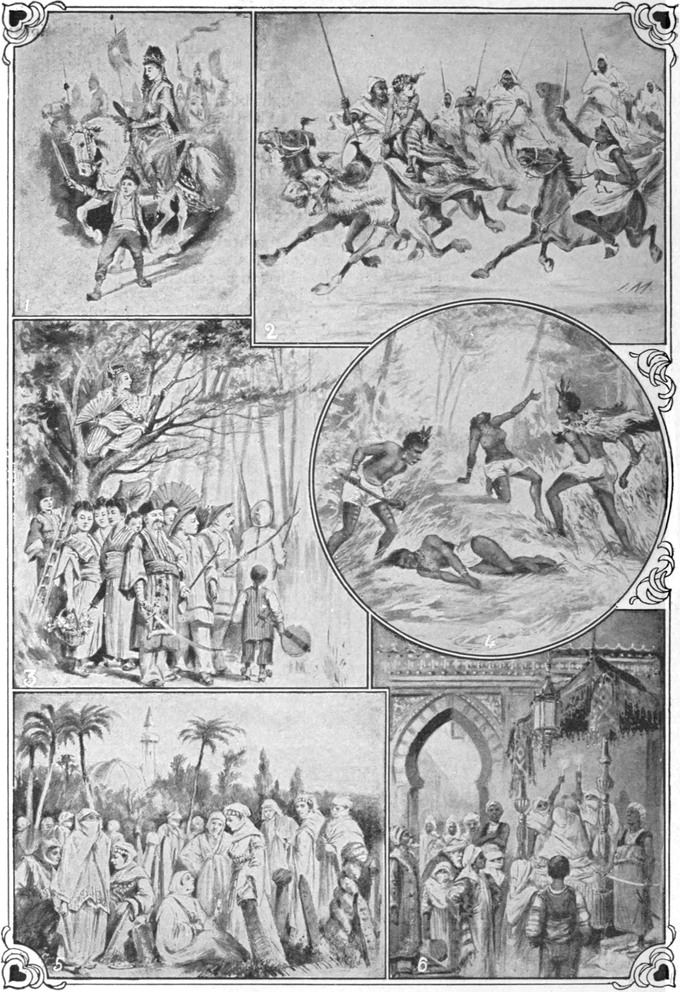
THE IDEA OF MARRIAGE: WEDDING CUSTOMS IN MANY LANDS
In countries where women are subservient to men the idea of marriage by capture or by compulsion prevails. The Bedouin bride (2) makes a pretence of escaping and is pursued by the bridegroom and his kinsmen. Some Africans (4) show their love by knocking down their prospective brides. The Moorish bride (6) shrouded and seated in bed is an object of curiosity. 1, 3, and 5 represent respectively the marriage customs of Persians, Chinese, and Moslems.
LARGER IMAGE
The ownership of property also was originally communistic, and the idea of individual possession has been a gradual development. The idea of the ownership of land, especially when developed by agricultural peoples, is of a communistic nature; and, from common possession, family and individual ownership gradually comes into being. It is brought about in various ways, chiefly through the division of land among separate families: at first only temporary, held only until the time for a succeeding division arrives; later, owned in perpetuity. Nor was it a rare method of procedure to grant land to any one who desired to cultivate it—an estate that should be his so long as he remained upon it and cultivated the soil, but which reverted to the community, on his leaving it. There gradually developed a constant relationship between land and cultivator as agriculture became more extended and lasting improvements were effected on the soil. Land became the permanent property of the individual; it also became an article of commerce.
Ownership of movable property even was at first of communistic character. Clothing and weapons, enchantments effectual for the individual alone, such as medicine-bags or amulets, were, to be sure, assigned to individuals in very early times; but all property obtained by labour, the products of the chase or of fishing, originally belonged to the community, until in later days each family was allowed to claim the fruits of its own toil, and was only pledged to share with the others under certain conditions. Finally, individuals were permitted to retain or to barter property which they had produced by labour; and exchange, especially exchange between individuals, attained special significance through the division of labour.
The individualisation of the ownership of movable property was especially furthered by members of families performing other labour, outside the family, in addition to their work within the family circle. Although the fruit of all labour accomplished within the family was shared by the members in common, the results of work done outside became the property of the particular individual who had performed the labour. Consequent expansion of the conception of labour led men to one of the greatest triumphs of justice, to the idea of establishing individual rights in ideas and in combinations of ideas, to the recognition of intellectual or immaterial property—right of author or inventor—one of the chief incentives to modern civilisation.
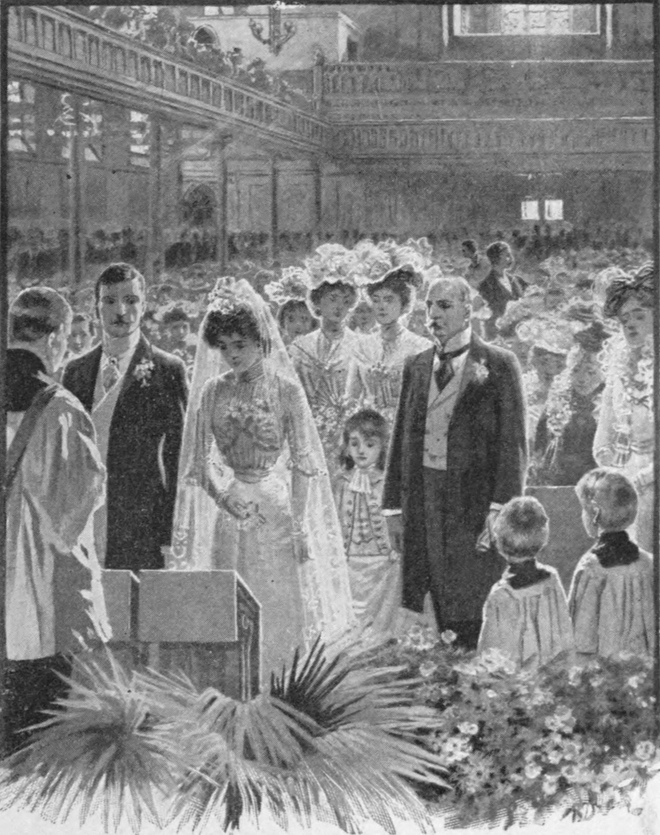
THE CHURCH AND MARRIAGE: A WEDDING SCENE
In very early times marriage had assumed a religious significance and came to be regarded among the sacred as opposed to the secular functions of life.
On the other hand, individual rights in transactions led to conceptions concerning obligations and debts. Exchange, either direct or on terms of credit, brought with it duties and liabilities for which originally the persons and lives of the individuals concerned were held in pledge, until custody of the body—which also included possession of the corpse of a debtor—was succeeded by public imprisonment for debt, and finally by the mere pledging of property, imprisonment for debt having been abolished—a course of development through which the most varied of races have passed.
Rights of Property
The relation of the individual to his possessions led men at first to place movable property in graves, in order that it might be of service to the departed owner during the life beyond; hence the universal custom of burning on funeral pyres, not only weapons and utensils, but animals, slaves, and even wives. In later times men were satisfied with symbolic immolations, or possessions were released from the ban of death and put into further use. The property of the deceased reverted to his family, and thus the right of inheritance arose. There was no right of inheritance during the days of communism; on the death of a member of the family a mere general consolidation of property resulted; with individual property arose the reversion of possessions to the family from which they had been temporarily separated. Thus property either reverted to the family taken as a whole, or to single heirs, certain members of the family; hence a great variety of procedure arose. Up to the present day inheritance by all the children, or inheritance by one alone, exists in Eastern Asia as in Western nations.
In like manner criminal responsibility was originally collective; the family or clan was held responsible for the actions of all its individual members except those who were renounced and made outcasts. Such methods of collective surety still exist among many exceedingly developed peoples; but the system is gradually dying away, the tendency being for the entire responsibility to rest upon the individual alone.
Beginning of the Community
The state is a development of tribal, or patriarchal, society. The tribal group is a community of intermarried families, all claiming descent from a common ancestor. From tribal organisation the principle is developed that participation in the community is open only to such individuals as belong to one or other of the families of which it is composed; and the political body thus made up of individuals related either by blood or through marriage is called a patriarchal, or tribal, state. This form of community was enlarged even in very early times, advantage being taken of the possibility of adopting strangers into the circle of related families, and of amalgamating with them. Still, the fundamental idea that the community is composed of related families always remains uppermost in the minds of uncivilised peoples. The tribal state gradually develops into the territorial state. The connection of the community with a definite region becomes closer; strange tribes settle in the same district; they are permitted to remain provided tribute is paid and services are performed, and are gradually absorbed into the community, the strangers and the original inhabitants—plebeians and patricians—united together into one aggregate. Thus arises the conception of a state which any man may join without his being a member of any one of the original clans or families.
Growth of the Idea of a State
In this way the idea of a state becomes distinct from that of a people bound together by kinship, the latter being especially distinguished by a certain unity of external appearance, custom, character, and manner of thought. This is not intended to suggest that an amalgamation of different race elements in a state and an assimilation of different modes of thought and of feeling are not desirable, or that a spirit analogous to the sense of unity in members of the same family is not to be sought for; such a condition is most likely to be attained if a certain tribe or clan take precedence of the others, as the most progressive, to which the various elements of the people annex themselves.
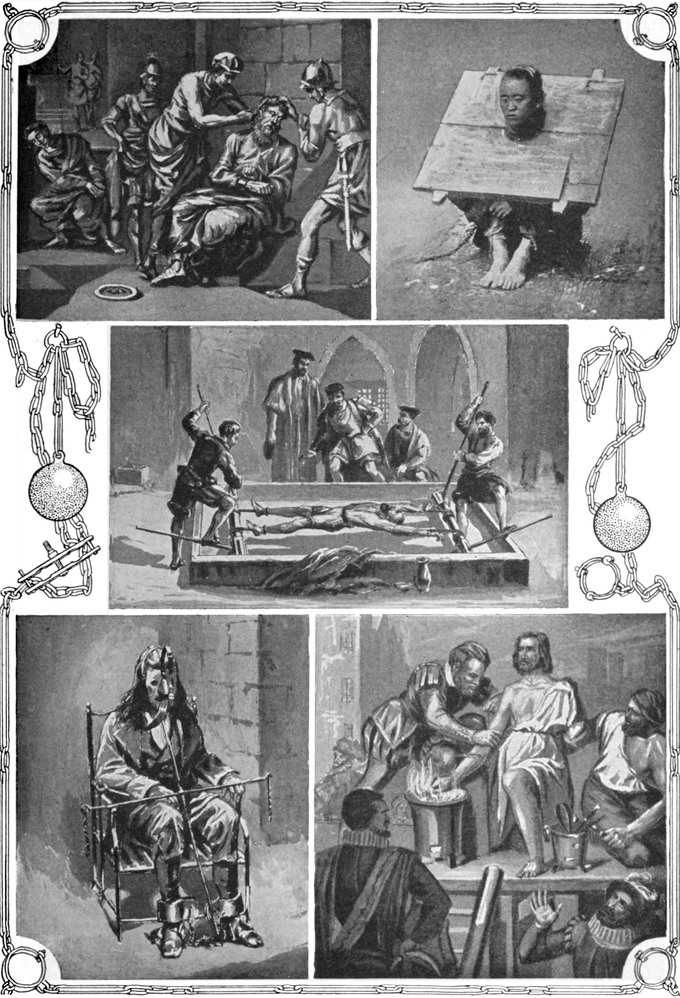
“IN THE NAME OF JUSTICE”: SOME OLD METHODS OF TORTURE
These pictures represent: 1. Roman gaolers cutting off a Christian’s ears. 2. The cangue as still used in China. 3. A prisoner on the rack in Mediæval England. 4. Torture of the Iron Chair. 5. The ordeal of fire and branding.
LARGER IMAGE
Tribes and their Chiefs
The tribal state has a fixed form of government. The chiefs or patriarchs of the various families stand at the head of affairs, the position of chief being either hereditary or elective. In most cases, however, it is determined by a combination of both methods, a blood descendant being chosen provided he is able to give proof of his competence. In addition there is often the popular assembly. In later times many innovations are introduced. Passion for power united to a strong personality often leads to a chieftainship in which all rights and privileges are absorbed or united in the person of one individual; so that he appears as the possessor of all prerogatives and titles, those of other men being entirely secondary, and all being more or less dependent upon his will. Religious conceptions, especially, have had great influence in this connection. Nowhere is this so clearly shown as in “teknonymy,” an institution formerly prevalent in the South Pacific islands, according to which the soul of the father is supposed to enter the body of his eldest son at the birth of the latter, and that therefore, immediately from his birth, the son becomes master, the father continuing the management of affairs merely as his proxy. Other peoples have avoided such consequences as these by supposing the child to be possessed by the soul of his grandfather, therefore naming first-born males after their grandfathers instead of after their fathers. Another outcome of the institution of chieftainship is the chaotic order of affairs which rules among many peoples on the death of the chieftain, continuing until a successor is seated on the throne—a lawless interval of anarchy followed by a regency.
The power of a chieftain is, however, usually limited by class rights; that is, by the rights of sub-chieftains of especially distinguished families, and of the popular assembly, among which elements the division of power and of jurisdiction is exceedingly varied. These primitive institutions are rude prototypes of future varieties of coercive government, of kingship, either of aristocratic or of republican form, in which the primitive idea of chieftainship as the absorption of all private privileges is given up, and in its place the various principles of rights and duties of government enter.
Growth of Military Classes
Class-differentiation with attendant privileges and prerogatives is especially developed in warlike races, and in nations which must be ever prepared to resist the attacks of enemies, by the establishment of a militant class. The militant class occupies an intermediate position between the governing, priest, and scholar classes on the one hand, and the industrial class—agriculturists, craftsmen, merchants—on the other. Employment in warfare, necessary discipline, near association with the chieftain, and the holding of fiefs for material support give to this class a unique position. Thus the warrior castes developed in India, the feudal and military nobility in Japan, the nobility in Germany, with obligations and service to feudal superiors and to the Court. This system survives for many years, until at last feudal tenure gradually disappears, and its attendant prerogatives are swallowed up by all classes through a universal subjection to military service; although even yet a distinct class of professional soldiers remains at the head of military affairs and operations, and will continue to do so as long as there is a possibility of internal or external warfare. However, here too the militant class is absorbed into a general body of officials. Officials are citizens who not only occupy the usual position of members of the state, but to whom in addition is appointed the execution of the life functions of the nation, as its organs; in other words, such functions as are peculiar to the civic organisation in contradistinction to the general functions exercised and actions performed by individual citizens as independent units. Officialism includes to a special degree duty to its calling and to the public trust, and there are also special privileges granted to officials within the sphere appointed for them.
The Birth of Parliaments
In a society governed by a chieftain, as well as in a monarchy, there is a popular assembly or consultative body; either an unorganised meeting of individuals, or an organised convention of estates founded on class right. A modern development, that certainly had its prototype in the patriarchal state, is the representative assembly, an assembly of individuals chosen to represent the people in place of the popular gathering. The English Government, with its representative legislative bodies, is a typical example in modern civilisation.
One of the chief problems encountered not only in a society ruled by a chieftain, but also in states of later development, whether governed by a potentate or by an aristocracy, is the relation of temporal to spiritual power. Sometimes both are united in the head of the state, as in the cases of the Incas of Peru and of the Caliphate. Sometimes the spiritual head is distinct and separate from the temporal; frequently the two forces are nearly associated, a member of the imperial family being chosen for the office of high-priest, as among the Aztecs. Often, however, the two functions are completely independent of each other, as among many African races, the medicine-man occupying a position entirely independent of the chieftain. Such separation may, of course, lead to friction and civil war; it may also become an element furthering to civilisation, a source of new ideas, opening the way to alliances between nations, and setting bounds to the tyranny of individuals, as exemplified in the relation of the Papacy to the Holy Roman Empire.
State Justice a Momentous Step Forward
The form of state in which the functions of government are exercised by a chieftain contributes greatly to state control and enforcement of justice. The realisation of right had been from the first a social function; but its enforcement was incumbent on the unit group of individuals (families or tribes bound together by friendship). The acquisition by the state of the power to dispense justice and to make and enforce law is one of the greatest events of the world’s history. The idea of all right being incorporated in the chieftain (and social classes) played an important part in bringing about this condition of affairs; for as soon as this conception receives general acceptance, the chieftain, and with him the state, become interested in the preservation and enforcement of justice, even in its lower forms in the common rights of the subjects. On the other hand, not only the interests of chieftainship, but also those of agriculture and commerce, are furthered by the preservation of internal peace; and internal peace calls for state control of justice and enforcement of law.
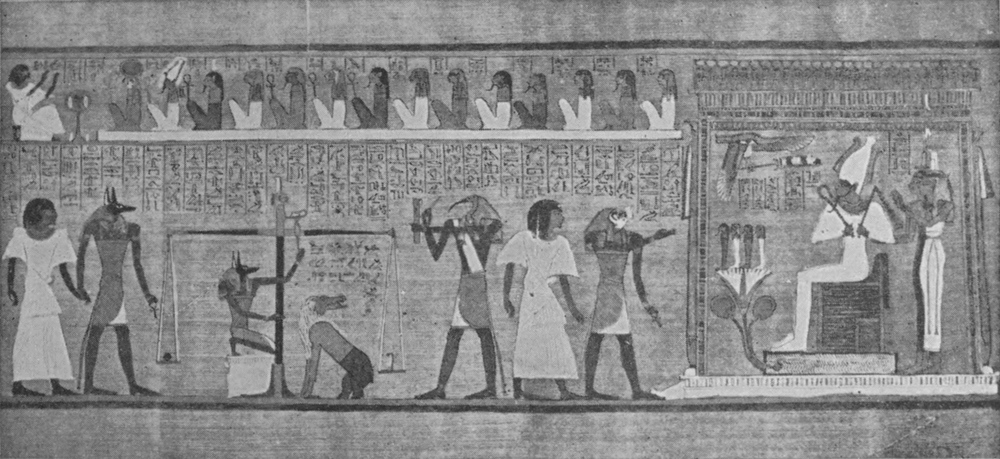
Mansell
AN EARLY EGYPTIAN REPRESENTATION OF JUSTICE
“The Judgment of the Dead” as illustrated by innumerable paintings on the walls of Egyptian temples and tombs.
Moreover the religious element worked to the same end. Wickedness was held to be an injury to the deity, whose anger would be visited upon the entire land—a conception that lasted far into the Middle Ages, and according to which the fate of Sodom and Gomorrah was held to be typical of the effect of the curse of God. Already in primitive times religion led to a strange idea of justice—secret societies consecrated by the deity took upon themselves the function of enforcing right, instituting reigns of terror in their districts, maintaining order in society, and claiming authorisation from the god with whose spirit they were permeated. Later, influenced by all these causes, the social aggregate took over the control of justice. It was already considered to be the upholder of right, the servant of the deity, the maintainer of public peace, the dispenser of atoning sacrifices, etc.; and so the various elements conceived of as justice, which had previously been distributed among the single families, tribes, associations, and societies, were combined, and placed under state control.
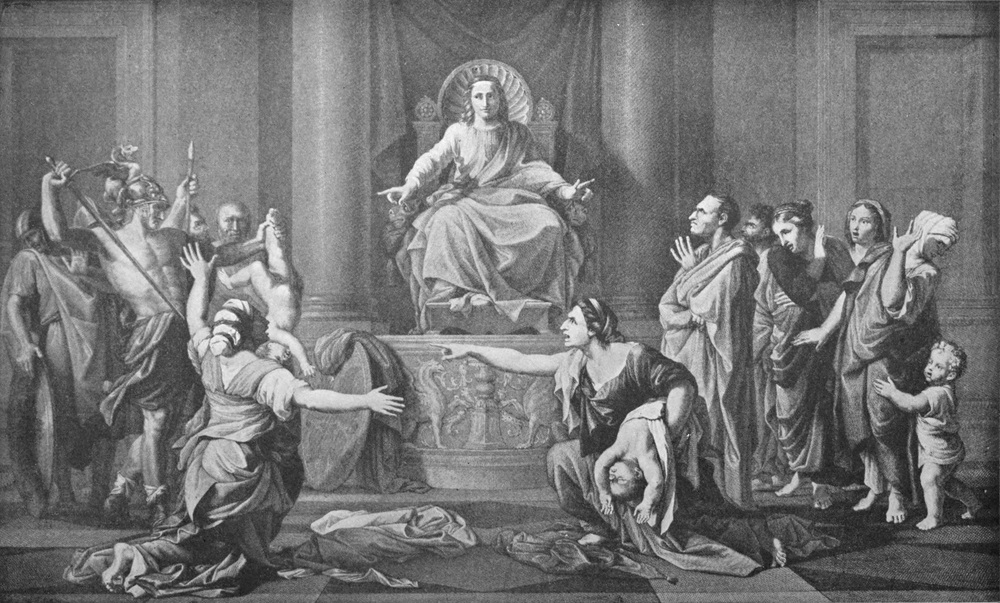
AN EARLY CONCEPTION OF THE SPIRIT OF JUSTICE: THE JUDGMENT OF SOLOMON
Reproduced from the picture by the French artist, Nicolas Poussin, who flourished in the first half of the seventeenth century.
LARGER IMAGE
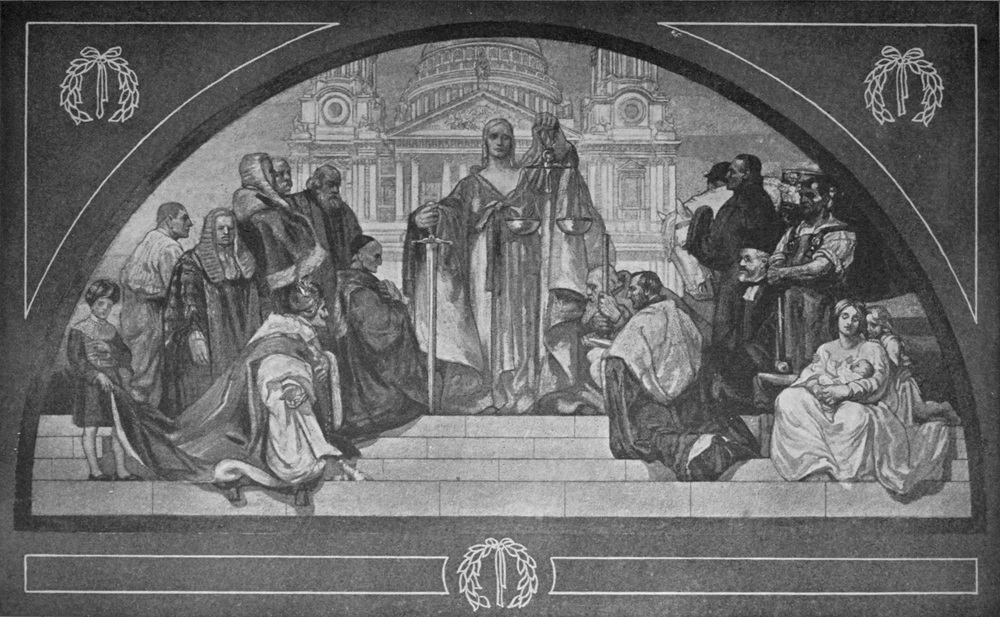
THE MODERN IDEAL OF JUSTICE
From the fresco by Gerald Moira in the New Central Criminal Court, London. Most of the figures are studies from well-known public men of recent years.
LARGER IMAGE
Terror & Tyranny of Religion The Ordeal and the Curse
Certain forms for the dispensation of justice, judging of crimes, and determining of punishments were developed. Thus arose the different forms of judicial procedure, which, for a long time bore a religious character. The deity was called upon to decide as to right and wrong—divinity in the form of natural forces. Hence the judgments of God through trial by water, fire, poison, serpents, scales, or—especially in Germany during the Middle Ages—combat, or decision by the divining eye, that was closely allied to the so-called trial by hazard. A peculiar variety of ordeal is that of the bier, according to which the body of a murdered man is called into requisition, the soul of the victim assisting in the discovery of the murderer. Ordeals are undergone sometimes by one individual, sometimes by two. An advance in progress is the curse, which takes the place of the ordeal, the curse of God being called down upon an individual and his family in case of wrongdoing or of perjury. The curse may be uttered by an individual in co-operation with the members of families. Thus arise ordeals by invocation and by oath with compurgators. Originally a certain period of time was allowed to pass—a month, for example—for the fulfilment of the curse. In later times, whoever took the oath—oath of innocence—was held guiltless. Witnesses succeeded to conjurers; divining looks were replaced by circumstantial evidence; and, instead of a mystic, a rational method of obtaining testimony was adopted. The development was not attained without certain attendant abuses; and the abolition of ordeal by God was among many peoples—notably the inhabitants of Eastern Asia, the American Indians, and the Germans of the Middle Ages—succeeded by the introduction of torture. In many lands torture stood in close connection with the judgment of God; in others it originated either directly or indirectly in slavery. According to the method of obtaining evidence by torture, the accused was forced through physical pain to disclosures concerning himself and his companions, and, in case he himself were considered guilty, to a confession. However barbarous and irrational, this system was employed in Latin and Germanic nations excepting England, until the eighteenth century, in some instances even until the nineteenth.
The Slow Building up of Law Evolution of the Modern State
Judgment was first pronounced in the name of God; in later times, in the name of the people or of the ruler who appeared as the representative of God. The principles of justice, the validity of which at first depends upon custom, are in later times proclaimed and fixed as commands of God. Thus systems of fixed right come into being first in the form of sacred justice, then as commands of God, and finally as law. Law is a conception of justice expressed in certain rules and principles. Originally there were no laws; the standard for justice was furnished to each individual by his own feelings; only isolated cases were recorded. As time advanced, and great men who strove to bring about an improvement in justice arose above the generality of mankind; when the ruling class became differentiated from the other classes; when it was found necessary to root out certain popular customs—then, in addition to the original collection of precedents, there arose law of a higher form: law that stood above precedent, that altered custom, and opened up new roads to justice. Great codes of law have not been compilations only; they have led justice into new paths. Originally a law was looked upon as an inviolable command of God, as unalterable and eternal; its interpretation alone was earthly and transitory. As years passed, men learned to recognise that laws themselves were transitory; and it became a principle that later enactments could alter earlier rules. The relations of later statutes to already established law, and how the laws of different nations influence one another, are difficult, much-vexed questions for the solution of which special sciences have developed—transitory and international law. Judgment and law are intimately concerned with justice, the conception of right as evolved from the double action of life and custom. To this development of justice is united an endeavour of the state or government not only to further welfare by means of the creation and administration of law, but also to take under its control civilising institutions of all sorts. This was originally a feature of justice itself; certain practices inimical to civilisation were interdicted and made punishable offences. Already in the Middle Ages systems of police played a great part among governmental institutions, especially in the smaller states. Subsequently the idea was developed that not only protection through the punishment of crime, but also superintendence of and promotion of the public weal, should be administered by law; and thus the modern state developed with its policy of national welfare. With this arose the necessity for a sharper distinction to be drawn between justice and the various actions of an administration; and thus in modern times men have come to the system—based on Montesquieu—of the separation of powers and independence of justice.