TAPESTRY.
James Dafforne translation
Scriptural Origin of Tapestry.—Needlework Embroidery in Ancient Greek and Roman Times.—Altalic Carpets.—Manufacture of Carpets in Cloisters.—Manufactory at Poitiers in the Twelfth Century.—Bayeux Tapestry, named “De la Reine Mathilde.”—Arras Carpets.—Inventory of the Tapestries of Charles V.; enormous Value of these Embroidered Hangings.—Manufactory at Fontainebleau, under Francis I.—The Manufacture of the Hôpital de la Trinité, at Paris.—The Tapestry Workers, Dubourg and Laurent, in the reign of Henry IV.—Factories of Savonnerie and Gobelins.
F there is an art which bears brilliant testimony to the industry and ingenuity of mankind in the remotest ages, undoubtedly it is that of weaving, or of embroidering tapestry; for, however far back we trace the annals of nations, we find this art flourishing and producing marvels of workmanship.
Let us first open the Bible, the oldest of all historical documents; we read therein of woven fabrics, not only worked on the loom, but also made by hand, that is, richly embroidered in needlework on linen or canvas. These magnificent fabrics, which were laboriously and minutely executed, represented all kinds of designs in relief and in colours; they were used as decorations for the holy temple, and as ornamental garments for the priests who performed the religious ceremonies. Indubitable proof of this is the description, in the book of Exodus, of the curtains surrounding the tabernacle. Some of these embroideries, in the manufacture of which gold and silver thread, combined with dyed wools and silk, was used, were named opus plumarii (work in imitation of bird’s plumage); others—such, for example, as the veil of the Holy of Holies, which represented cherubim in the act of adoration—were called opus artificis (work of the artisan), because they were made by the weaver on the loom; and, with the aid of numerous shuttles, the woof of wools and silks of various hues was introduced.
In the traditions of the magnificent city of Babylon we also find figured tapestry delineating the mysteries of religion, and handing down to us the recollection of historical incidents. “The palace of the kings of Babylon,” says Philostratus, in the “Life of Apollonius of Tyana,” “was ornamented with tapestries in gold and silver tissues, which recorded the Grecian fables of Andromeda, of Orpheus, &c.” The Greek poet Apollonius of Rhodes, who wrote a century before our era, relates in his poem of “The Argonauts” that the women of Babylon excelled in the execution of these gorgeous textures. The famous tapestries which were sold in the time of Metellus Scipio for 800,000 sesterces (about 165,000 francs), and a hundred years later were purchased for the exorbitant sum of two million sesterces (about 412,000 francs) by Nero, to place on his festive couches, were of Babylonian workmanship.
Ancient Egypt, which would seem to have been the early cradle of an advanced civilisation, was also renowned for this marvellous art, the invention of which the Greeks attributed to Minerva, and to which allusion is frequently made in their mythology. Penelope’s web, whereon were delineated the exploits of Ulysses, has remained the most celebrated among them all. It was on a similar web that Philomela, in her prison, illustrated in embroidery the narrative of her misfortunes, after Tereus had cut out her tongue, to prevent her telling her sister Progne the outrage she had suffered at his hands.
Throughout the poems of Homer we find embroidery of this kind either mentioned, or described as made with the needle or loom, and intended for decorative drapery, or as garments for men and women. During the siege of Troy, Helen embroidered, upon a fine tissue, the sanguinary combats of the heroes who were destroying each other for her sake. The cloak of Ulysses represents a dog pulling down a fawn, &c.
The custom of embroidering such scenes as combats and hunting-incidents seems to have lasted during a long time. According to Herodotus, certain races bordering on the Caspian Sea were accustomed to have figures of animals, flowers, and landscapes delineated on their garments. This custom is mentioned among the pagans by Philostratus, and among Christians by Clement of Alexandria. Pliny, the naturalist, who lived in the first century of our era, also alludes to it on several occasions in his works. Three hundred years later, Amasius, Bishop of Amasia, deplores the folly which “set a great value on this art of weaving, a vain and useless art, which by the combination of the warp and woof imitates painting.” “When persons thus dressed appear in the street,” adds the pious bishop, “the passers-by look at them as walking pictures, and the children point at them with their finger. We see lions, panthers, bears, rocks, woods, hunters; the religiously inclined have Christ, his disciples, and his miracles figured on their garments. Here we see the wedding of Cana, and the pitchers of water turned into wine; there we have the paralytic carrying his bed, or the sinner at the feet of Jesus, or Lazarus being raised from the dead.”
We have only to look into the works of the writers of the time of Augustus to learn that the halls in the houses of the wealthy were always hung with tapestry; and that the tables, or rather the beds, upon which the guests were seated, were covered with carpets.
The Attalian carpets, which were thus named because they came from the inheritance bequeathed to the Roman people by Attalus, King of Pergamos, were indescribably magnificent. Cicero, who was a connoisseur in such matters, speaks of them with enthusiasm in his works.
Under Theodosius I., that is to say, at the time of the decline of the great empire which was soon to break up and be separated, and at last to merge into new nationalities, a contemporaneous historian shows us “the youth of Rome engaged in making tapestry-work.”
In the early period of French history, this ingenious and delicate work would seem to have been mainly carried on by women, and especially by those of the highest rank. At any rate it is a fact that rich tapestries were in common use, both in private houses and for ecclesiastical purposes, as early as the sixth century; for Gregory of Tours does not fail to tell us of the embroidered hangings, and also of the tapestry, in most of the ceremonies which he describes. When King Clovis renounced paganism and asked to be baptised, “this intelligence was the greatest joy to the bishop; he orders the sacred fonts to be prepared; the streets overhung with painted cloths; the churches ornamented with hangings.” When the abbey-church of St. Denis had to be consecrated, “its walls are covered with tapestry embroidered in gold and ornamented with pearls.” These tapestries were for a long time preserved in the abbey-treasury. Subsequently, this same treasury received, as a present from Queen Adelaide, the wife of Hugh Capet, “a chasuble, a valance, as also some hangings, worked by her own hand;” and Doublet, the historian of this ancient abbey, states that Queen Bertha (the same whom the old French proverb makes an indefatigable worker with her needle) embroidered on canvas a series of historical subjects, depicting the glorious deeds of the family.
Nevertheless, there is no written authority for asserting that in France the manufacture of tapestries and hangings worked on the loom can be traced beyond the ninth century; but at this period, and a little later, we find some documents which are as precise as they are curious—proving that this industry, the principal object of which, at that period, was the ornamentation of churches, had to a certain extent obtained a footing, and was flourishing in religious establishments. The ancient chronicles of Auxerre relate that St. Anthelm, the bishop of that city, who died in 828, caused to be made, under his own directions, numerous rich carpets for the choir of his church.
One hundred years later we find a regular manufactory established at the monastery of St. Florent, at Saumur. “In the time of the abbot Robert III.,” says the historian of this monastery, “the vestry (fabrique) of the cloister was further enriched by magnificent paintings and pieces of sculpture, accompanied by legends in verse. The above-mentioned abbot, who was passionately devoted to similar works, sought for and purchased a considerable quantity of magnificent ornaments, such as large dorserets[1] in wool, curtains, canopies, hangings, bench-covers, and other ornaments, embroidered with various devices. Among other objects, he caused to be made two pieces of tapestry of large size and of admirable quality, representing elephants; and these two pieces were joined together with a rare kind of silk, by hired workers in tapestry. He also ordered two dorserets in wool to be manufactured. It happened that, during the time one of these was being completed, the above-mentioned abbot went to France. The ecclesiastic left in charge took advantage of his absence to forbid the artisans to work the woof according to the customary method. ‘Well,’ said they, ‘in the absence of our good abbot we will not discontinue our employment; but as you thwart us we shall make quite a different kind of fabric.’ And this now admits of proof. They made several square carpets, representing silver lions upon a field of gules (red), with a white border covered with scarlet animals and birds. This unique piece of workmanship was looked upon as a perfect specimen of this kind of fabric, until the time of the abbot William, when it was considered the most remarkable piece of tapestry belonging to the monastery. In fact, on the occasions of great solemnities the abbot had the elephant tapestry displayed, and one of the priors showed that on which were the lions.”
From the ninth or tenth century there was also a manufactory at Poitiers; and its fabrics, on which figured kings, emperors, and saints, were of European celebrity, as appears to be attested, among other documents, by a remarkable correspondence which took place, in 1025, between an Italian bishop, named Léon, and William IV., Count of Poitou. To understand rightly this correspondence, it must be borne in mind that at the time Poitou was as famous for its mules as for tapestry. In one of his letters, the bishop begs the count to send him a mule and a piece of tapestry, both equally marvellous (mirabiles), and for which he has been asking six years. He promises to pay whatever they may cost. The count, who must have had a facetious disposition, replied, “I cannot, at present, send you what you ask, because for a mule to merit the epithet of marvellous, he would require to have horns, and three tails, or five legs—and this I should not be able to find in our country. I shall therefore content myself with sending you one of the best I can procure. As to the tapestry, I have forgotten the dimensions you desire. Let me have these particulars again, and it will then soon be sent to you.”
But this costly industry was not limited to the French provinces. In the “Chronique des Ducs de Normandie,” written by Dudon, in the eleventh century, it is stated that the English were clever workers in this art; and when designating some magnificent embroidery, or rich tapestry, it was described as of English work (opus Anglicanum). Moreover, the same chronicle relates that the wife of Richard I.,[2] the Duchess Gonnor, assisted by her embroiderers, made hangings of linen and of silk, embellished with images and figures representing the Virgin Mary and the Saints, to decorate the church of Notre Dame, Rouen.
The East, also, which from the earliest times had been renowned for the art of producing beautiful embroidered fabrics, became still more famous during the Middle Ages for those of wool and silk, embroidered with silver and gold. It was from the East were brought the rich stuffs covered all over with emblazonments, and with figures of animals, and probably also embroidered in open-work: these fabrics were called étoffes sculptées, or pleines d’yeux.
The librarian Anastasius, in his book the “Lives of the Popes,” which undoubtedly was written before the eleventh century, gives, when describing church decorations, some curious and circumstantial details regarding the subject we are now discussing. According to him, as early as the time of Charlemagne (eighth century), Pope Leo III. “had a veil made of purple worked in gold, on which was the history of the Nativity and of Simon, having in the centre the Annunciation of the Virgin.” This was to ornament the principal altar of the Holy Mother of God, at Rome. He also ordered for the altar of the church of St. Laurence, “a veil of silk worked in gold, having on it the histories of the Passion of our Saviour and of the Resurrection.” He placed on the altar of St. Peter’s “a veil of purple of a remarkable size, worked in gold and ornamented with precious stones; on one side was seen our Saviour giving St. Peter the power to bind and to loose, on the other the Passion of St. Peter and St. Paul.” In the same book, several other pieces of tapestry are described in such terms that it seems difficult to realise the richness and the beauty of finish of these artistically-worked fabrics, which for the most part came from Asia or Egypt. It was only in the twelfth century, after the return from the first crusades had enabled Western nations to admire and to appropriate to themselves luxuries quite new to them, that the custom of using tapestry, while becoming far more general in churches, found its way also into private dwellings. If, in the cloisters, the monks, in order to find employment, lavished their utmost care on the weaving of wool and of silk, there was the more reason why this occupation should prove pleasing to the noble châtelaines who were confined to their feudal castles. It was then, when surrounded by their tire-women, as in earlier times were the Roman matrons by their slaves, that these fair dames, while listening to the reading of tales of chivalry which deeply interested them, or inspired by a profound faith, gave themselves to the task of reproducing with the needle either the pious legends of the saints or the glorious exploits of warriors. The bare walls, when thus draped with touching incidents or warlike memorials, assumed a peculiar eloquence which doubtless inspired the mind with grand visions, and aroused noble sentiments in the heart.
Among the finest specimens of this kind is one which, owing to its really exquisite character, has escaped what would have seemed inevitable destruction. We allude to the famous Bayeux tapestry called “de la Reine Mathilde” (of the wife of William the Conqueror). This work represents the conquest of England by the Normans. If we are to accept the ancient traditions to which it owes its name, it must date from the last half of the eleventh century.
In these days we may be permitted to doubt, in consequence of the many discussions that have taken place among the learned, if this embroidery is as ancient as was at one time supposed. And although we first find it alluded to in an inventory (prepared in 1476) of the treasury of Bayeux Cathedral, we may venture, with a certain degree of confidence, to believe that it was made in the twelfth century by Englishwomen, who at that time were particularly famous for their needlework; an opinion confirmed by more than one author contemporaneous with William and Matilda.
This tapestry, which is 19 inches in height, by nearly 212 feet in length, is a piece of brown linen, on which are embroidered with the needle, in wool of different colours (and these seem to have lost none of their early freshness), a series of seventy-two groups or subjects, with legends in Latin interspersed with Saxon, embracing the whole history of the Conquest, as related by the chroniclers of the period (Figs. 27 and 28).
At the first glance, this embroidery may seem to be but a rudely executed grouping of figures and animals; nevertheless there is character throughout, and the original outline, discoverable beneath the intersections of the wool, is not wanting in a certain accuracy that brings to our mind the vigorous simplicity of the Byzantine style. The decoration of the double border, between which is delineated a drama wherein 530 figures are introduced, is the same as those of the paintings in manuscripts of the Middle Ages. And, in short, failing any exact proof, if we are determined not to deprive this immense work of its traditional antiquity, it might, with much probability, be attributed to a female embroiderer of Queen Matilda, named Leviet, whose skill has rescued her name from oblivion. It may also be well to observe that at the time it is first alluded to in history, this tapestry is found belonging to the very church in which Matilda desired to be buried.
We have already seen (in the chapter on Furniture) that towards the twelfth and thirteenth centuries, under the influence of Eastern habits and
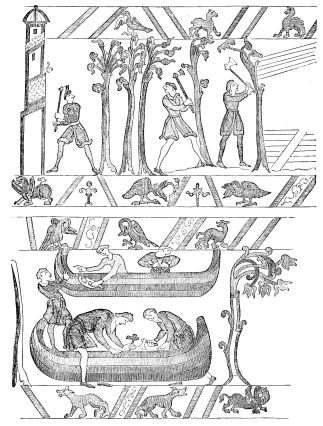
Fig. 27.—A piece of the Bayeux Tapestry, representing the construction of Boats for William (with Border).
customs, the practice of sitting on carpets was established at the court of our kings. From this date rich tapestries were frequently used for making tents for campaigning or for hunting. They were displayed on festive occasions; as, for instance, when princes were entering a town, the object being to hide the bare walls. The dining-halls were hung with magnificent tapestries, giving additional splendour to the interludes (entremets, or intermèdes) performed during the repast. The champions in the lists saw glittering around them, suspended from the galleries, fabrics on which heroic deeds were embroidered. Lastly, the caparison of the charger (the war-horse’s garb of honour) displayed its brilliant emblazonings to the eyes of admiring crowds.
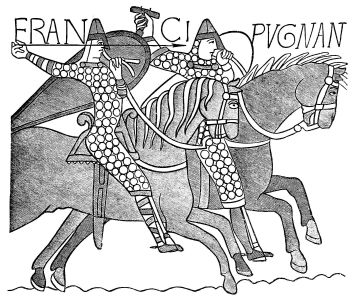
Fig. 28.—A portion of the Bayeux Tapestry, representing two mounted men of Duke William’s army armed from head to foot, and in the act of fighting.
It was moreover the custom that the tapestries made for noblemen should bear their respective armorial devices, the object being, no doubt, that it might be known to whom they belonged when used on the occasion of the entry of royal and other distinguished personages in solemn processions; and also at jousts and tournaments.
In the fourteenth century the manufactories of Flanders, which were of considerable reputation even about the twelfth century, made great advance, and the success of the Arras tapestries became so general that the most handsome hangings were called Arras tapestry, although the greater part of them did not come from that city. It may here be noticed that the term Arrazi is, in Italy, still synonymous with valuable tapestry (Fig. 29).
These fabrics were generally worked in wool, and sometimes in flax and linen: but at the same period Florence and Venice, which had imported this industry from the East, wove tapestries wherein gold and silk were blended.
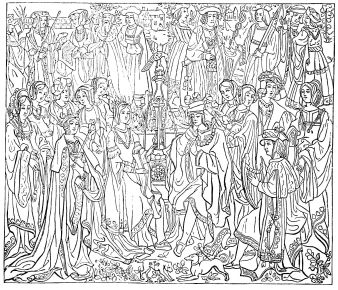
Fig. 29.—Marriage of Louis XII. and Anne of Brittany. Tapestry in wool and silk, with a mixture of gold and silver thread. Made in Flanders the end of the Fifteenth Century. (Lent by M. Achille Jubinal.)
An inventory, dated 21st January, 1379, contained in a manuscript now in the “Bibliothèque Impériale,”—in which are enumerated “all the jewels in gold and silver, all the rooms with embroidery and tapestries belonging to Charles V.,”—gives us an idea not only of the multiplicity of hangings and tapestries that appertained to the personal property of royalty, especially at the Hôtel Saint-Pol, but it also shows us the variety
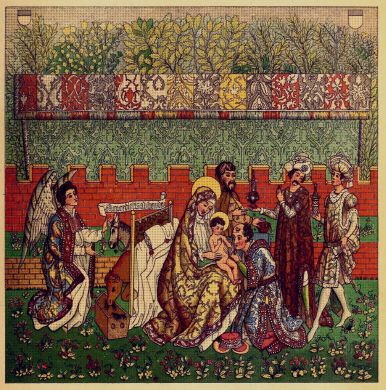
THE ADORATION OF THE MAGI.
Tapestry of Berne of the fifteenth Century
(Communicated by M. Achille Jubinal.)
of subjects therein represented. A few of these pieces of tapestry are still preserved, but among some which have been destroyed or lost we may mention those representing the Passion of our Saviour, the Life of St. Denis, the Life of St. Theseus, and that entitled Goodness and Beauty—all these were of large dimensions. Then again, the tapestry of the Seven Mortal Sins, two pieces of the Nine Bold Knights, that of the ladies hunting and flying (qui volent), in other words, hawking; that of the Wild Men; two of Godfrey de Bouillon; a white tapestry for a chapel, in the centre of which was seen “a compass with a rose,” emblazoned with the arms of France and of Dauphiny, this was three yards square; one large handsome piece of tapestry, “the king has bought, which is worked with gold, representing the Seven Sciences and St. Augustin;” the tapestry of Judith (the queen who subsequently appears on playing-cards); a large piece of Arras cloth, representing the Battles of Judas Maccabæeus and Antiochus; another of “the Battle of the Duke of Aquitaine and of Florence;” a piece of tapestry “whereon are worked the twelve months of the year;” another of “the Fountain of Jouvent” (Jouvence), a large piece of tapestry “covered with azure fleurs-de-lys, which said fleurs-de-lys are mingled with other small yellow fleurs-de-lys, having in the centre a lion, and, at the four corners, beasts holding banners, &c.”—in fact, the list is endless. We must still, however, add to these figured tapestries those with armorial bearings, made for the most part with “Arras thread,” and bearing the arms of France and Behaigne (the latter being those of the queen, daughter of the King of Bohemia). There was also a piece of tapestry “worked with towers, fallow bucks and does, to put over the king’s boat.” The tapestry called velus, or velvet, which now we call moquettes, was as commonly seen as any other kind. There were also to be noticed the Salles d’Angleterre, or the tapestries from that country, which, as we have said, had previously acquired a great celebrity in that art. Among these one was “ynde (blue), with trees and wild men, with wild animals, and castles;” others were vermilion, embroidered with azure, having vignette borders, and in the centre lions, eagles, and leopards.
In addition to these, Charles V. possessed at his castle of Melun many “silken fabrics and tapestries.” At the Louvre one could but admire, among other magnificent pieces of tapestry, “a very lovely green room, ornamented with silk covered with leaves; and representing in the centre a lion, which two queens were in the act of crowning, and a fountain wherein swans were disporting themselves.”
Yet we must not be led away with the idea that it was only the royal palaces which presented such sumptuousness; for it would be easy to enumerate many instances similar to those we have given, by looking over the inventories of the personal property of nobles, or those of the treasuries of certain churches and abbeys. In one place the tapestries represent religious subjects taken from the Bible, the Gospels, or the legends of the saints; in another the subjects are either historical or relating to chivalry, more especially battles or hunting scenes (Fig. 30).
We are thus justified in asserting that the luxury of tapestry was general among the higher classes. An expensive taste it was; because not only does an examination of these marvellous works show us that they could have been purchased only at a very high price, but in old documents we find more than one certain confirmation of this fact. For example, Amaury de Goire, a worker in tapestry, received in 1348, from the Duke of Normandy and Guienne, 492 livres, 3 sous, 9 deniers, for “a woollen cloth,” on which were represented scenes from the Old and New Testaments. In 1368, Huchon Barthélmy, money-changer, received 900 golden francs for a piece of “worked tapestry, representing La Quête de St. Graal (the search for the blood of Christ); and in 1391, the tapestry exhibiting the history of Theseus, to which we have already alluded, was purchased by Charles V. for 1,200 livres; all these sums, considering the period, were really exorbitant.
The sixteenth century, remarkable for the progress and the excellence to which the arts of every kind had attained, gave a renewed impulse to that of tapestry. A manufactory was established by Francis I., at Fontainebleau, where the tapestry was woven in one entire piece, instead of being made up, as had been the practice, of separate pieces matched and sewn together. In this new fabric gold and silver threads were mixed with silk and wool.
When Francis sent for the Primate from Italy, he commissioned him to procure designs for several pieces of tapestry, to be made in the workshops of Fontainebleau. But, while liberally rewarding the Italian or Flemish artists and artisans collected in the dependencies of his château, the king still continued to employ Parisian tapestry-workers; proof of which is to be found in a receipt of the sieurs Miolard and Pasquier, who give an
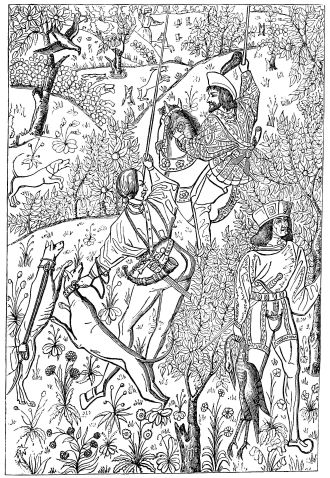
Fig. 30.—Tapestry representing a Hunting Scene, from the Château d’Effiat. (In the possession of M. Achille Jubinal.)
acknowledgment of having been paid 410 livres tournois, “to begin the purchase of materials and other requisites for a piece of silk tapestry, which the said seigneur had ordered them to make for his coronation, according to the patterns which the said seigneur has had prepared for this purpose, and on which must be represented a Leda, with certain nymphs, satyrs, &c.”
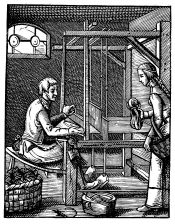
Fig. 31.—The Weaver. Drawn and Engraved by J. Amman.
Henry II. did even more than maintain the establishment at Fontainebleau; in addition he instituted, in compliance with the request of the guardians of the Hôpital de la Trinité, a manufactory of tapestry in Paris, in which the children belonging to the hospital were employed in dyeing wool and silk, and in weaving them in the loom with a high and low warp.
The new manufactory, whether on account of the excellence of its productions, or from influential patronage, obtained so many privileges that the public peace was on several occasions seriously disturbed by the jealousy of the guild of tapestry-workers; an ancient and numerous corporation still possessing great authority and influence.
The manufactory of the Hôpital de la Trinité continued to flourish during the reign of Henry III.; and Sauval, in his “Histoire des Antiquités de
PLAN OF PARIS IN THE FIFTEENTH CENTURY,
WITH THIS LEGEND:
Mil cinq cents ans quarante et neuf passez Du déluge: Paris le noble roy Dix-huitième: fonda en grand arroy Ville et cité de Paris belle assez Devant que Rome eust des gens amassez Six cent cinquante et huit ans comme croy.
TRANSLATION.
One thousand five hundred and forty-nine years after the Deluge, the noble King Paris, the eighteenth of his name, founded with great pomp the fine town and city of Paris, anterior to the foundation of Rome, which took place, as I think, 658 (?) years before Jesus Christ.
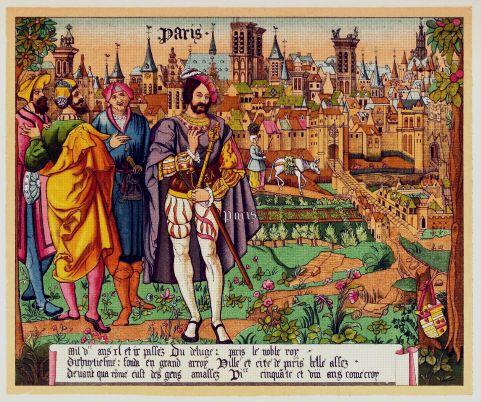
PLAN OF PARIS IN THE FIFTEENTH CENTURY.
Beauvais Tapestry (Communicated by M. Achille Jubinal.)
Paris,” informs us that in the following reign it reached its highest point of prosperity. In 1594, Dubourg made in these workshops, from the designs of Lerembert, the beautiful tapestries which, to a date very near our own, decorated the Church of Saint-Merry. Henry IV., says Sauval, hearing this work much spoken of, desired to see it, and was so pleased therewith that he resolved to restore the manufactories in Paris, “which the disorder of preceding reigns had abolished.” He therefore established Laurent, a celebrated tapestry-worker, in the maison professe of the Jesuits, which had remained closed since the trial of Jean Chastel. He allowed one crown a day, and one hundred francs a year, as wages to this skilful artist; his apprentices receiving ten sous a day, and his fellow-workmen twenty-five, thirty, and even forty sous, according to their skill. At a later period Dubourg and Laurent, who had entered into partnership, were both installed in the galleries of the Louvre. Henry IV., following the example of Francis I., brought from Italy skilled workers in gold and in silk. These he lodged in the Hôtel de la Maque, Rue de la Tisseranderie: the special works they made were hangings in fine cloth of gold and silver (frisé).

Fig. 32.—Banner of the Tapestry Workers of Lyons.
Subsequently to the sixteenth century, the tapestries fabricated at the manufactories of the Savonnerie, the Gobelins, and at Beauvais, &c., although more perfect as regards the weaving, and therefore presenting greater regularity of design and a better comprehension of colour and perspective, unfortunately lost the original simplicity which characterized them in olden times. Approaching the reign of Louis XIV., under the influence of the school of Le Brun,[3] they affected an imitation of Greek and Roman forms, which seem out of place in France. Handsome countenances are the result, out accompanied by meaningless figures; the frankness of truth gives place to staid coldness, the ideal usurps the place of nature, conventionality that of spontaneity. We find them ingenious, pretty, and even beautiful productions, but wanting character, the real soul of works of art.