ENGRAVING.
James Dafforne translation
Origin of Wood-Engraving.—The St. Christopher of 1423.—“The Virgin and Child Jesus.”—The earliest Masters of Wood-Engraving.—Bernard Milnet.—Engraving in Camaïeu.—Origin of Engraving on Metal.—The “Pax” of Maso Finiguerra.—The earliest Engravers on Metal.—Niello Work.—Le Maître of 1466.—Le Maître of 1486.—Martin Schöngauer, Israel van Mecken, Wenceslaus of Olmutz, Albert Dürer, Marc Antonio, Lucas van Leyden.—Jean Duret and the French School.—The Dutch School.—The Masters of Engraving.
LMOST all authors who have devoted themselves to investigate this subject have asserted, but doubtless very erroneously, that engraving on metal was naturally derived from engraving on wood. Nevertheless, any one who gives but a slight consideration to the difference existing between the two processes must be led to the belief that the two arts must result from two distinct inventions. In wood-engraving, the impression is, in fact, formed by the portions of the block which are in relief; while in engraving on metal, the incised strokes give the lines of the print. Now, no one who has any knowledge of professional matters can for a moment doubt that, in spite of the similar appearance of the productions, there is a radical difference in the starting-points and modes of execution of these two methods.
We certainly must consider it probable that the appearance of prints produced by wood-engraving may have suggested the idea of seeking to obtain a similar or better result by some other process; but that a process should be assimilated, as if by affiliation, to another diametrically opposed to it is a view we do not feel called upon to accept without reservation.
Be this as it may, certain authors look upon wood-engraving as having been invented in Germany at the commencement of the fifteenth century. Others have derived it from China, where it was in use in the year 1000 of our era. Others, again, propound the opinion that the art of printing stuffs by means of engraved blocks was employed in different parts of Asia, to which it had been imported from ancient Egypt, at a period long before it was first thought of in Europe. These hypotheses being admitted, the whole question reduces itself into an inquiry as to the way in which the art made its entrance into Western Europe in the first half of the fifteenth century; this being the earliest date at which we find engravings made in Germany, France, and the Low Countries.
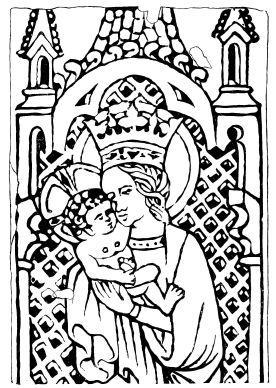
Fig. 258.—“The Virgin and Infant Jesus.” Fac-simile of a Wood-Engraving of the Fifteenth Century. (Bibl. Imp., Paris.)
The most ancient dated impression known of a cut engraved on wood is a St. Christopher, without either mark or name of its author, bearing a Latin inscription and the date of 1423. This specimen is so roughly engraved, and in drawing is so faulty, that it is only natural to assume it must be one of the earliest attempts at wood-engraving. There is, however, an engraving in the Imperial Library, Paris, representing the Virgin holding the Child Jesus seated in her arms (Fig. 258), which may perhaps be considered an earlier specimen than the St. Christopher. The back of the niche is a kind of mosaic, formed of diamond-shaped quadrilaterals; the aureolæ and ornaments of the niche are coloured a yellowish brown. There is, however, one singularity in this engraving which testifies to its great antiquity; it is printed on paper made of cotton, and is unsized, and the impression sinks so deeply into it that it may be seen nearly as well on the back of the print as on the front. We must not omit to mention another engraving, preserved in the Royal Library, Brussels; this is also a “Virgin with the Child Jesus,” surrounded by four saints (Fig. 259). It is a composition of a somewhat grand style, and does not agree very well with the date, MCCCCXVIII., which is seen at the foot of the print.
We must, doubtless, attribute to nearly the same time some specimens of playing-cards,—these we have already mentioned when dealing specially with this subject; and also a series of figures of the Twelve Apostles with Latin legends, underneath which are the same number of phrases in French, or rather in the ancient dialect of Picardy, reproducing the whole text of the Decalogue; one of these xylographic plates may be seen in the chapter on “Printing.” In these engravings each figure is standing up, clothed in a long tunic, and covered with a wide mantle; the ink, so to speak, is bistre, and the mantles are coloured, red and green alternately. The Apostles all bear the symbolical sign which distinguishes them, and are surrounded with a long fillet, whereon is traced in Latin the sentence of the Creed attributed to each, and one of the ten Commandments. St. Peter, for instance, has for his motto this French sentence, “Gardeis Dieu le roy moult sain;” St. Andrew, “Ne jurets point son nome en vain;” St. John, “Père et Mère tosjours honoras;” St. James the Greater, “Les fiestes et dymeng, garderas,” &c.
There are other engravings belonging to the middle of the fifteenth century which make known the fact that the art of engraving was practised by several artists in France; and that without doing any injustice
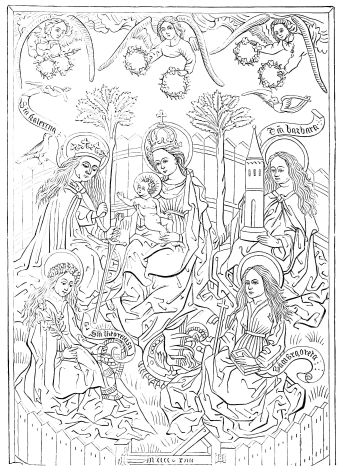
Fig. 259.—“The Virgin and Child.” A Wood-Engraving of the Fifteenth Century(?). (Bibl. Roy., Brussels.)
to Germany we can attribute several anonymous works to French masters. But we must in any case claim the very characteristic works of an engraver named Bernard Milnet. In the engravings of this master there are neither lines nor cross-hatching; the ground of the print is black; the lights are
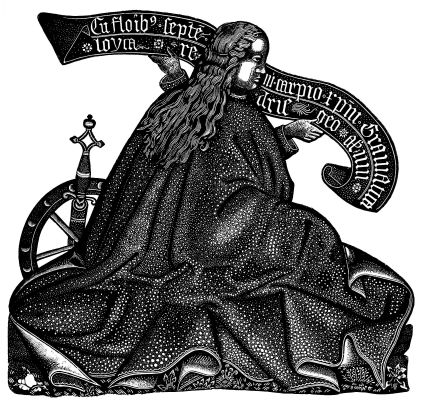
Fig. 260.—“St. Catherine on her Knees.” Fac-simile of an Engraving on Wood, by Bernard Milnet, called the “Master with the dotted backgrounds.” (Bibl. Imp., Paris.)
formed by an infinite number of white dots varying in size according to the requirement and taste of the artist. This engraver does not appear to have had any imitators; and, to tell the truth, his mode of operation must have presented many difficulties in execution. There are only six known specimens of his work—a “Virgin with the Child Jesus,” “St. Catherine Kneeling” (Fig. 260), the “Scourging of Christ,” a group of “St. John, St. Paul, and St. Veronica,” a “St. George,” and a “St. Bernard.”
Although engravings of this time are now extremely rare, it does not necessarily follow that they were equally scarce at the dates when they were executed. M. Michiels, in his “Histoire de la Peinture en Flandre,” says that, “according to ancient custom, on feast-days the Lazarists, and others belonging to religious orders who were accustomed to nurse the sick, carried in the streets a large wax candle ornamented with mouldings and glass-trinkets, and distributed to the children wood-engravings illuminated with brilliant colours, and representing sacred subjects. There must, therefore, have been a considerable number of these engravings.”
In the sixteenth century wood-engraving, improved by the pupils of Albert Dürer, and especially by John Burgkmair (Fig. 261), was very extensively developed; and the art was then practised with a superiority of style which left far behind the timid attempts of the preceding century.
The works of most of the wood-engravers of this period are anonymous; nevertheless, the names of a few of these artists have survived. But it is only by an error that, in the nomenclature of the latter, certain painters and designers, such as Albert Dürer, Lucas van Leyden, and Lucas van Cranach, have long been made to figure. There are wood-engravings which do actually bear the signatures or monograms of these masters; but the fact is, that the latter were often in the habit of drawing their designs on the wood, as is frequently the practice with artists in our own day; and the engraver (or rather the formschneider, form-cutter, to employ the usual expression), in reproducing the composition drawn with a pencil or pen, has copied also the signature which the designer of the subject added. An error often committed by writers may be thus easily set right.
We must not quit the subject of wood-engraving without mentioning engraving in camaïeu; a process of Italian origin, in which three or four blocks, applying in succession to the print uniform tints of more or less intense tones, ultimately produced engravings of a very remarkable effect, imitating drawings with the stump or the pencil. At the commencement of the sixteenth century several artists distinguished themselves in this
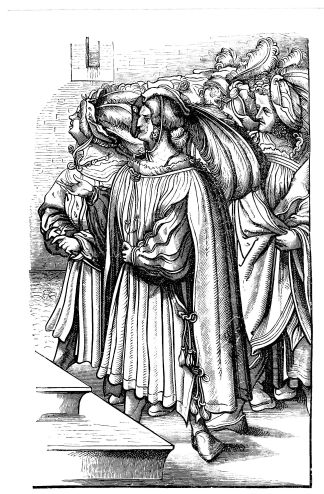
Fig. 261.—The Archdukes and High Barons of Germany assisting, in State Costume, at the Coronation of the Emperor Maximilian. A fragment taken from a large collection of Engravings, entitled the “Triumph of Maximilian I.,” by J. Burgkmair. (Sixteenth Century.)
mode of engraving, especially Ugo di Carpi, who worked at Modena about the year 1518; Antonio Fantuzzi, a pupil of Francis Parmigianino, who accompanied and assisted Primaticcio at Fontainebleau; Gualtier, and Andrew Andreani; and lastly, Bartholomew Coriolano, of Bologna, who would have been the last engraver in this style, were it not for Antonio M. Zanetti, a celebrated Venetian amateur, who was still nearer to us in point of date. Two or three Germans, John Ulrich in the sixteenth, and Louis Buring[40] in the seventeenth, century, also made some engravings in camaïeu, but only with two blocks: one giving the design of the subject with the outline and cross-hatching, the other introducing a colour, usually bistre, on which all the lights were taken out, so as to leave the ground of the paper white. These specimens imitated a pen-and-ink drawing on coloured paper, and finished with the brush or pencil.
We must now go back to the year 1452, which is generally fixed upon as the date of the invention of engraving on metal (Fig. 262).[41] When discussing the subject of “Goldsmith’s Work,” we mentioned, among the pupils of the illustrious Ghiberti, Maso Finiguerra, and stated that this artist had engraved on silver a “Pax” intended for the treasury of the Church of St. John. Certain writers having recognised in a print now in the Imperial Library of Paris, and also in another print in the Library of the Arsenal, an exact impression of this engraving, were led to attribute to the celebrated Florentine goldsmith the honour of an invention in which he might perhaps have had no share at all. Possibly this process of printing off an impression, which was a very natural thing to do, had been actually practised by goldsmiths long before Finiguerra; they wished, doubtless, to preserve a pattern of their niello-work, or to see how it progressed in its various stages. The proofs, thus taken off by hand, having been lost, Finiguerra may have been considered the originator of a method which he only applied as a matter of course to his goldsmith’s work. The two circumstances—that the plate is made of silver and not of any common metal, and that it may be classed among the numerous nielli, engraved plates of decorative goldsmith’s work, which have been handed down to us and are of even earlier dates—will alone suffice, in our opinion, to dispose of the
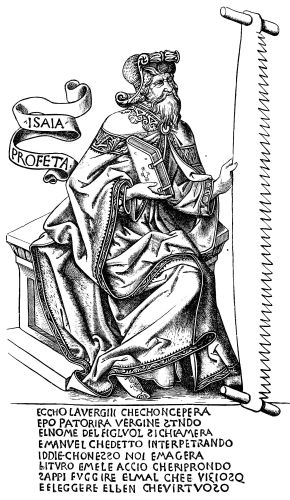
Fig. 262.—The Prophet Isaiah, holding in his hand the saw which was the instrument of his martyrdom. (Fac-simile from an Engraving on Copper by an unknown Italian Master of the Fifteenth Century.)
idea that this work was expressly executed in order to furnish impressions on paper. It was nothing but chance that in this case introduced the name of Finiguerra, which would not have become known in this connection, if it had not been for the preservation of two ancient impressions of his niello-work; while those taken from other and perhaps older plates had been destroyed. Thus the date, or the asserted date, of the invention of engraving on metal was fixed by the ascertained date of the piece of goldsmith’s work.
Be this as it may, the print of the “Pax,” or rather of the “Assumption,” engraved by Finiguerra, does not fail, in the opinion of all writers and amateurs, to bear the title of the earliest print from metal; a title to which it has a perfect right, and in thus regarding it we are induced to give a brief description of the subject represented in the engraving. Jesus Christ, seated on a lofty throne and wearing a cap similar to that of the Doges, places, with both his hands, a crown on the head of the Virgin, who, with her hands crossed upon her breast, is seated upon the same throne; St. Augustine and St. Ambrose are kneeling; in the centre, below, and on the right, several saints are standing, among whom we can distinguish St. Catherine and St. Agnes; on the left, in the rear of St. Augustine, we see St. John the Baptist and other saints; lastly, on both sides of the throne a number of angels are blowing trumpets; and, above, are others holding a streamer, on which we read: “Assvmpta. est. Maria. in. celvm. ave. exercitvs. angelorvm;” “Mary is taken up into Heaven. Hail, army of angels!”
The first of the impressions of this niello found its way into the Royal Library with the Marolles Collection, bought by Louis XIV. in 1667: the other was discovered only in 1841, by M. Robert Dumesnil, who, in the Library of the Arsenal, was turning over the leaves of a volume containing engravings by Callot and Sebastian Le Clerc. This latter impression, though taken on inferior paper, is nevertheless in a much better state of preservation than the other; but the ink is of a greyer hue, and one might readily fancy that, as M. Duchesne, the learned writer, asserts, it was printed before the final completion of the plate.
In support of the opinion which we before indirectly expressed, that the practice of taking impressions from engraved plates of metal might well be a kind of fortuitous result of a mere professional tradition incidental to the goldsmith’s art, we may remark that most of the engravings which have been handed down to us as belonging to the era fixed upon for the invention of engraving, are the work of Italian goldsmith-engravers. More than four hundred specimens of this date have been preserved; among the artists we must mention Amerighi, Michael Angelo Bandinelli, and Philippo Brunelleschi, of Florence; Forzoni Spinelli, of Arezzo; Furnio, Gesso, Rossi, and Raibolini, of Bologna; Teucreo, of Siena; Caradosso and Arcioni, of Milan; Nicholas Rosex, of Modena, of whose work we have three nielli and more than sixty engravings; Antonio Pollajuolo, who engraved a print called the “Fight with Cutlasses,” representing ten naked men fighting; lastly, the most skilful of the metal-chasing goldsmiths after Finiguerra, Peregrino of Cesena, who has left his name and his mark on sixty-six nielli.
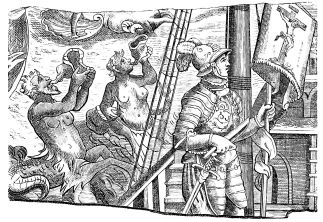
Fig. 263.—Fac-simile of a Niello executed on Ivory, from the original design of Stradan, representing Columbus on board his Ship, during his first Voyage to the West.
More special mention must be made of Bartholomew Baldini, better known under the name of Baccio, to whom we owe, in addition to some large engravings both of a sacred and of a mythological character, twenty vignettes designed for the folio edition (1481) of Dante’s “Inferno;” of Andrea Mantegna, a renowned painter, who himself engraved many of his own compositions; and of John van der Straet, called Stradan (Fig. 263), who executed at Florence many remarkable plates.
We find in Germany an engraver who dates several of his works in the year 1466, but on none of them has he left more than his initials, E. S. This has not failed to tax the ingenuity of those who would establish his individuality in some authentic way. Some have agreed to call him Edward Schön or Stern, on account of the stars he frequently introduces into the borders of the vestments of his figures; one asserts that he was born in Bavaria, because in a specimen of his works is the figure of a woman holding a shield emblazoned with the arms of that country; another believes him to have been a Swiss, because he twice engraved the “Pilgrimage of St. Mary of Einsiedeln,” the most celebrated in the country. But those amateurs who, upon the whole, think more of the work than the workman, are content to designate him as the Master of 1466.
This engraver has left behind him three hundred examples, most of them of small dimensions, among which, independently of sundry very curious compositions, we must notice two important series, namely, an Alphabet composed of grotesque figures (Fig. 264), and a pack of Numeral Cards, the greater part of which are in the Imperial Library.
At almost the same epoch Holland also presents us with an anonymous engraver, who might be called the Master of 1486, from the date on one only of his engravings. The works of this artist, whose manner exhibits a powerful and original style, are very rare in any collections not belonging to the country in which he worked. The Cabinet of Engravings at Amsterdam possesses seventy-six of them, while that of Vienna has but two, that of Berlin one only, and that of Paris six, among which we may remark “Samson sleeping on the knees of Delilah,” and “St. George,” on foot, piercing with his sword the throat of the dragon which menaced the life of the Queen of Lydia.
We have still three comparatively celebrated engravers to mention before reaching the epoch at which Marc Antonio Raimondi in Italy, Albert Dürer in Germany, and Lucas van Leyden in Holland, all simultaneously flourished.
Martin Schöngauer, for some time designated by the name of Martin Schön, who died at Colmar in 1488, was a good painter as well as a skilful engraver. More than one hundred and twenty specimens of his work are known, the most important of which are—“Christ bearing his Cross,” “The Battle of the Christians” (waged against the infidels by the apostle St. James), both very rare compositions of large size; the “Passion of Jesus Christ,” the “Death of the Virgin,” and “St. Anthony tormented by Demons,” one proof of which, it is said, was coloured by Michael Angelo. We must add (and this circumstance shows again the kind of direct relation which we have already noted as existing between engraving and goldsmith’s work), that Martin Schöngauer also engraved a pastoral staff and a censer, both of very beautiful workmanship.
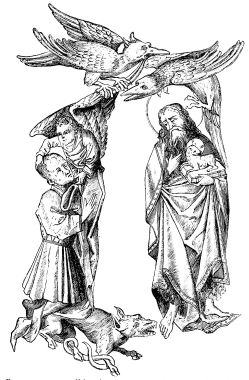
Fig. 264.—Fac-simile of the letter N from the “Grotesque Alphabet,” engraved by the “Master of 1466.”
Israel van Mecken (or Meckenem), supposed to be a pupil of Francis van Bocholt, as he worked at Bocholt previous to the year 1500, is, of all German engravers of this epoch, the one whose works are most extensively known. The Cabinet of Engravings in the Imperial Library, Paris, possesses three volumes of his engravings, containing two hundred and twenty-eight superb examples; among these we must especially notice a composition engraved on two plates of the same height; “St. Gregory perceiving the Man of Sorrows at the Moment of the Mass.” We must confine ourselves to the mention, in addition, of his “St. Luke painting the Portrait of the Virgin;” “St. Odile releasing from Purgatory, by his prayers, the Soul of his Father, Duke Etichon;” “Herodias” (Fig. 265); and “Lucretia killing herself in the presence of Collatinus and others,” which last is the only subject this artist has taken from profane history.
We mention Wenceslaus of Olmutz, who was engaged in engraving from the year 1481 to 1497, with the especial object of describing an allegorical print due to his burin; it may serve to give a notion of the fantastic tendency impressed on the ideas of the day by the religious dissensions which arose at this epoch between several princes of Germany and the court of Rome. This print, or rather this graphic satire, most of the allusions in which are now lost to us, represents the monstrous figure of a woman entirely naked, seen in profile and turning to the left, her body covered with scales, with the head and mane of an ass; her right leg terminates in a cloven foot, and the left in a bird’s claw; her right arm is terminated by the paw of a lion, and the left by a woman’s hand. The back of this fantastic being is covered with a hairy mask, and in the place of a tail she has the neck of a chimera, with a deformed head from which darts a serpent’s tongue. Above the engraving is written, “Roma Caput Mundi” (“Rome the head of the world”). On the left hand is a three-storied tower, upon which a flag adorned with the keys of St. Peter is floating. On the château is written, “Castelagno” (Castle of St. Angelo); in the foreground is a river, upon whose waves is traced the word “Tevere” (the Tiber); lower still is the word “Ianrarii” (January), below the date 1496: on the right, in the background, is a square tower, upon which is written, “Tore Di Nona” (Tower of the Nones); on the same side, in front, is a vase with two handles, and in the centre of the lower part the letter W, the monogrammatic signature of the engraver. Our interest in this plate is increased by the date it bears; for, being engraved by means of
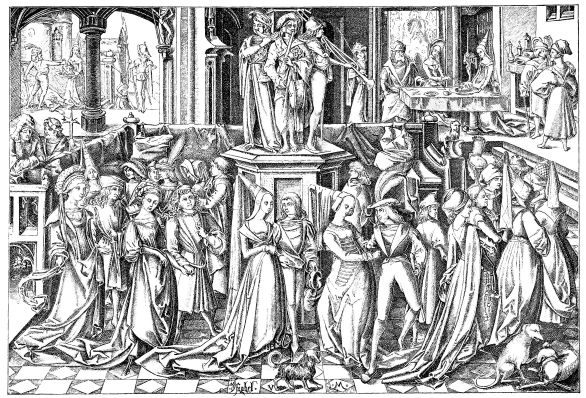
Fig. 265.—“Herodias,” a Copper-plate Engraving, by Israel van Mecken.
aquafortis, it proves that Albert Dürer is wrongfully regarded as the inventor of this mode of engraving, more expeditious than with the burin, as the oldest aquafortis work of Albert Dürer is dated 1515, that is to say, nineteen years later than that of Wenceslaus of Olmutz.
We now come to three great artists who, at a period in which the art of engraving had made the most remarkable progress, availed themselves of it for producing works which eminently characterise each master respectively.
Albert Dürer, born at Nuremberg in 1471, was a vigorous painter, and was not less remarkable for the productions of his burin and etching-needle. We do not intend to describe all his works, though all are worthy of notice, but must content ourselves with mentioning “Adam and Eve standing by the Tree of Knowledge of Good and Evil,” a small plate of delicate workmanship and admirable perfectness of design; the “Passion of Jesus Christ,” in a series of sixteen plates; “Christ praying in the Garden of Gethsemane,” the first work executed by this master by means of aquafortis, then a new method, which, being less soft than the burin, gave rise to an idea not dispelled for some time, that this print and several others were engraved on iron or tin; several figures of the “Virgin with the Infant Jesus,” which are all remarkable for expression and simplicity, and have received odd sobriquets on account of some accessory object which accompanies them (for instance, the “Virgin with the pear, butterfly, ape,” &c.); the “Prodigal Son keeping Swine,” a composition in which the painter himself is represented; “St. Hubert praying before the Cross borne by a Stag” (Fig. 266), a very rare and beautiful plate; the “Chevalier and his Lady;” lastly, the “Chevalier of Death,” a chef-d’œuvre, dated 1515, and representing Francis of Sickingen, who was destined to be the firmest supporter of Luther’s Reformation.[42]
Marc Antonio Raimondi, born at Bologna about the year 1475, was first a pupil of Francis Raibolini, and afterwards of Raphael,[43] whose style he often
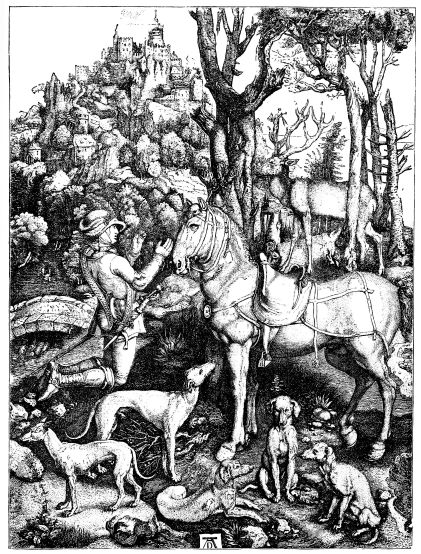
Fig. 266.—“St. Hubert praying before the Cross borne by a Stag.” Engraved by Albert Dürer.
followed, and in his compositions did his utmost to imitate his pure and noble manner. Everything in his designs is ideally true, and all is harmonious in the ensemble of his works. Most of his engravings still existing are very much sought after, and as any description we could give would only convey but an imperfect idea of the excellence of these works, the strongest testimony in favour of their merit will be to mention the high prices given for certain prints by this master at the public sale which took place in 1844. For example:—“Adam and Eve,” a print after Raphael, 1,010 francs (£40); “God commanding Noah to build the Ark,” from the same master, 700 francs (£28); the “Massacre of the Innocents,” 1,200 francs (£48); “St. Paul preaching at Athens,” 2,500 francs (£100); the “Lord’s Supper,” 2,900 francs (£116); the “Judgment of Paris,” which is regarded as the chef-d’œuvre of Marc Antonio, 3,350 francs (£134); three pendentives of the “Farnesina,” 1,620 francs (£64 10s.), &c. Subsequently, these enormous prices have been even exceeded.
Lucas van Leyden, born in 1494, and, like Albert Dürer, a clever painter as well as skilful engraver, has left about eighty plates, the most remarkable of which are “David playing the Harp before Saul;” the “Adoration of the Magi;” a large “Ecce Homo,” engraved by the artist at the age of sixteen; a “Peasant and Peasant-woman with a Cow;” the “Monk Sergius killed by Mahomet;” the “Seven Virtues;” a plate called the “Little Milkmaid,” very rare; lastly, a “Poor Family travelling,” of which only five proofs are known; they were bought for sixteen louis d’or by the Abbot of Marolles, when he formed his cabinet of prints, which became one of the richest additions to the Imperial Library.
In a befitting rank below these famous artists we may class a French engraver, Jean Duret, born at Langres in 1488, who was goldsmith to Henri II., and executed several beautiful allegorical plates on the intrigues of the king and Diana of Poitiers, as well as twenty-four compositions taken from the Apocalypse; also Pierre Woeiriot (or Voeiriot), an engraver and goldsmith of Lorraine, born in 1531, who produced numerous fine works down to the end of the century; the most famous of them, designated by the name of the “Bull of Phalaris” (Fig. 267), represents the tyrant of Agrigentum shutting up human victims destined to be burnt alive in a brazen bull.
There were at work in Italy at the same epoch Augustine of Musi
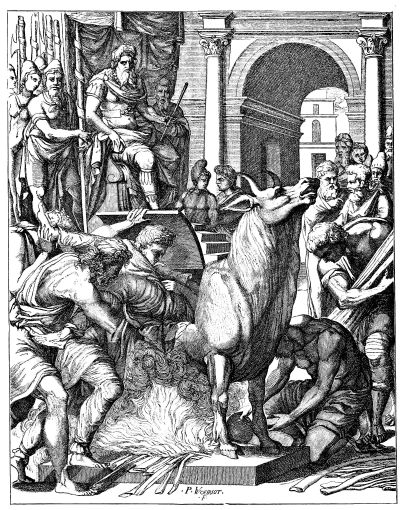
Fig. 267.—“Phalaris, Tyrant of Agrigentum, causing Victims destined to be burnt alive to be shut up in a Brazen Bull.” Engraved by P. Woeiriot. (French School of the Sixteenth Century.)
(Agustino de Musis, called the Venetian), Giacomo Caraglio, the Ghisis,[44] Eneas Vico; in Germany, Altdorfer (Fig. 268), George Pencz,[45] Aldegrever, Jacque Binck, Bartel and Hans Sebald Beham (Fig. 269), who are designated under the collective name of the “Little Masters;” in Holland, Thierry (Dirk) van Staren.
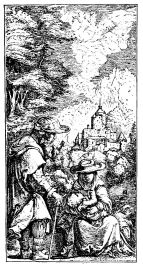
Fig. 268.—“Repose of the Holy Family.” Engraved by A. Altdorfer.
In the course of the sixteenth century engraving reached its culminating point, and at that time Italy and Germany no longer took the lead in this branch of art, for the most skilful and renowned masters then belonged to Holland and France.
Those of Holland were Henry Goltzius (or Goltz), born in 1558, and his pupils Matham and the Mullers, whose vigorous gravers might remind one of brilliant effects of colour without any loss of purity of design; the two brothers, Boetius and Scheltius Bolswaert, so called from their native town Bolswaert, born in 1580 and 1586 respectively; Paul Pontius and Lucas Vorsterman, both born in 1590, whose engravings so well represent the chiaroscuro and colour of Van Dyck and Jordaens.
In France was Jacques Callot, born in 1594, whose works were both numerous and original, and enjoyed a somewhat popular celebrity; among them the most worthy of remark are the “Temptation of St. Anthony,” the “Fair of the Madonna d’Imprunette,” “The Garden” and the “Parterre,” both scenes in Nancy; as well as several series, such as the “Miseries of War,” &c. There were also Michael Lasne, born in 1596, who engraved a number of historical portraits; and Etienne (Stephen) Baudet, who reproduced eight large landscapes after Poussin.
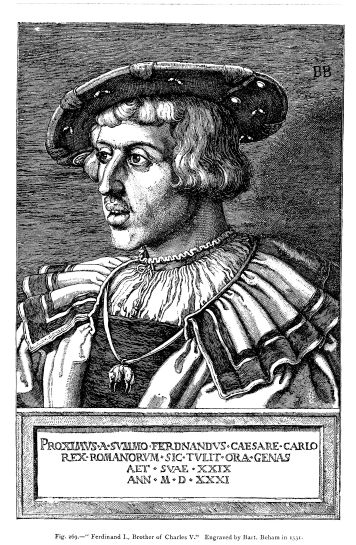
Fig. 269.—“Ferdinand I., Brother of Charles V.” Engraved by Bart. Beham in 1531.
A separate notice is reserved for Jonas Suyderoef, born at Leyden in 1600, who, by combining the graver, the etching-needle, and aquafortis, gave an exceptional character to his works. Among the two hundred engravings by this master the most admired are the “Treaty of Munster,” after Terburg; and the “Burgomasters of Amsterdam receiving the News of the Arrival of Queen Mary of Medicis,” after De Keyser.
We are now touching closely upon, even if we have not already exceeded, the limits to which we are prescribed by the scope of our notices; but as the history of engraving does not present, like that of so many other arts, the spectacle of a grievous decadence after a period of brilliancy, we cannot without regret come to a conclusion, when mention might still be made of many distinguished names among the engravers of every country.
We should also scarcely be able to pass on to another subject without having alluded to those men whose works belong, indeed, to the following epoch, but the date of whose birth connects them with that we are considering. We could not, in fact, assume to have treated of engraving had we passed over in silence Van Dyck, Claude Lorraine, and Rembrandt (Fig. 270), those greatest of masters who were equally celebrated for painting and engraving. In truth, perhaps, we could not say anything of them which would not be superfluous.
Who is not acquainted with at least some few works by Van Dyck? This celebrated pupil of Rubens has left in painting as many masterpieces as canvases; and in engraving he knew how to give to his etching-needle so much verve and spirit, that his prints are perfect models to follow, and have never been surpassed. Who is there that does not admire the landscapes of Claude Lorraine, which are equally remarkable for the light diffused over them, and the misty atmosphere that tempers its brilliancy? We all know this master produced, as if for recreation, certain engravings which for truth and melancholy (mélancolic) are hardly surpassed by his marvellous paintings. And how can we speak of Rembrandt without seeming to be commonplace? For his fertile and varied talent no difficulty ever seemed to exist; a theme, the most simple and common in appearance, becomes in his hands the basis of a masterly conception; nature, to which he seemed to lend a new life, while seizing upon its most striking realities, was for him an inexhaustible source of powerful compositions.
The mention of these artists on the threshold of an epoch into which we
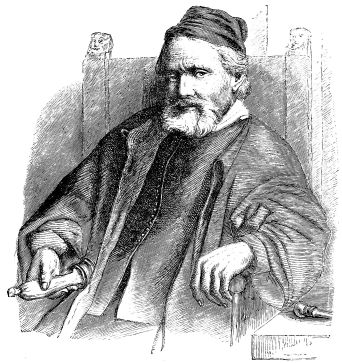
Fig. 270.—“Portrait of John Lutma, Goldsmith of Groningen.” Designed and Engraved in aquafortis by Rembrandt.
are precluded from following them, must suffice to convey some idea of the height that art had attained during this century. We will, however, enumerate after them a few names among foreign engravers. The Flemish artists, Nicolas Berghem and Paul Potter, both great animal-painters, have left some prints in aquafortis for the possession of which amateurs contend; Wenceslaus Hollar, the Englishman,[46] engraved “The Queen of Sheba,” after Veronese; to Cornelius Visscher, a Dutchman, we owe the famous “Seller of Ratsbane;” and to Stefano della Bella, of Florence, the “View from the Pont-Neuf, Paris.” Rupert, the Prince-Palatine (nephew of Charles I. of England), was the inventor of the mezzo-tinto, or black style of engraving; and William Faithorne, an Englishman, engraved several portraits after Van Dyck. France also presents to our notice some justly celebrated names. The views of towns by Israel Silvestre, of Nancy, are very beautiful; François de Poilly, of Abbeville, reproduced several pictures by Raphael; Jean Pesne, of Rouen, himself a painter, engraved especially after Poussin; Antoine Masson, of Orleans, has left a print of the “Pilgrims of Emmaus,” after the picture by Titian, which is regarded as a chef-d’œuvre. Lastly, Robert Nanteuil, of Rheims, the famous portrait-painter, engraved Péréfixe, Archbishop of Paris, four times; the Archbishop of Rheims five times; Colbert six times; Michel Le Tellier, Chancellor of France, ten times; Louis XIV. eleven times, and Cardinal Mazarin fourteen times.
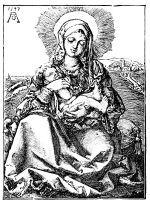
Fig. 271.—“The Holy Virgin.” Engraved by Aldegrever in 1527.