CARRIAGES AND SADDLERY.
James Dafforne translation
Horsemanship among the Ancients.—The Riding-horse and the Carriage-horse.—Chariots armed with Scythes.—Vehicles of the Romans, the Gauls, and the Franks: the Carruca, the Petoritum, the Cisium, the Plaustrum, the Basterna, the Carpentum.—Different kinds of Saddle-horses in the Days of Chivalry.—The Spur a distinctive Sign of Nobility: its Origin.—The Saddle, its Origin and its Modifications.—The Tilter.—Carriages.—The Mules of Magistrates.—Corporations of Saddlers and Harness-makers, Lorimers, Coachmakers, Chapuiseurs, Blazonniers, and Saddle-coverers.
HE horse has been described by Buffon as “the noblest conquest made by man.” Historians, both, sacred and profane, inform us that the conquest dates from the most remote ages. In the Book of Job we have this magnificent description:—“Then the Lord said, Hast thou given the horse strength? hast thou clothed his neck with thunder? Canst thou make him afraid as a grasshopper? the glory of his nostrils is terrible. He paweth in the valley, and rejoiceth in his strength: he goeth on to meet the armed men. He mocketh at fear, and is not affrighted; neither turneth he back from the sword. The quiver rattleth against him, the glittering spear and the shield. He swalloweth the ground with fierceness and rage; neither believeth he that it is the sound of the trumpet. He saith among the trumpets, Ha, ha; and he smelleth the battle afar off.” The sacred writer is here referring expressly to the fiery animal trained for war, and obedient to the master who has trained him.
Xenophon, in his “Treatise on Horsemanship” and his “Instructor of Cavalry,” and Diodorus in his “Histories,” are among the Greeks who adduce the most numerous testimonies to the honour in which equestrian exercises were held. Among the Latins, Virgil, in reference to the funereal games celebrated by Acestes in honour of Anchises, tells us that the Roman youth were taught equestrian art as practised by the Trojans. The horse and chariot races, which took place at the solemn games in Greece, have always been justly celebrated; as were those which continued in Rome and in all the great cities of the Roman world until the fifth or sixth century.
We are disposed to believe that the use of the saddle-horse and the carriage-horse was introduced about the same time. But it seems that chariots were rarely mounted by any but chiefs, who fought from that ambulatory elevation while squires managed the horses.
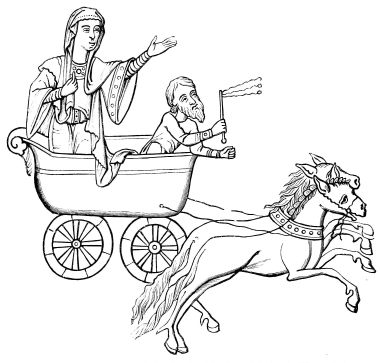
Fig. 72.—The Carruca, or Pleasure-Carriage, drawn by a Pair of Horses, dating from the Fifth to the Tenth Century. (Taken from a MS. of the Ninth Century, in the Royal Library at Brussels.)
To Cyrus the Great is ascribed the first idea of arming chariots with scythes, which cut to pieces in every direction those who opposed the progress of the vehicle, or who were thrown down by the violence of the shock. The same war-carriages were found among the Gauls; for a king named Bituitus, having been taken prisoner by the Romans, appeared in his chariot armed with scythes in the triumphal procession of the general who had conquered him.
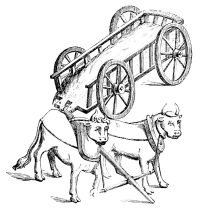
Fig. 73.—Cart drawn by Oxen, end of the Fifteenth Century. (Taken from the “Chroniques de Hainault,” MS. in the Royal Library at Brussels.)
Riding on horseback was not only practised, but was carried to the highest degree of perfection, among the nations of antiquity; and the use of chariots was, in former times, almost general in war and on certain state occasions. The Romans, and in imitation of them the Gauls who prided themselves on being skilful carriage-builders, had several sorts of wheeled vehicles. Those adopted by the Romans and the Gauls, but discountenanced by the Franks, who preferred to ride on horseback, were the carruca, or carruque, with two wheels and a pair of horses (Fig. 72), richly ornamented with gold, silver, and ivory; the pilentum, a four-wheel carriage with a cloth canopy; the petoritum, an open carriage suitable for rapid travelling; the cisium, a basket-carriage drawn by mules, and used for long journeys; and finally, various carts—the plaustrum, the serracum, the benne, the camuli (trucks), &c. These last, which were chiefly employed as field-carts, continued in use even after pleasure-carriages had entirely disappeared. There remained, however, independent of mule-litters, the basterna and carpentum, state-carriages of the Merovingian period, but only queens and ladies of high rank, who were unequal to long journeys on horseback, indulged in such means of locomotion, while men—even kings and high personages—would have blushed to be conveyed like “holy relics,” as picturesquely expressed by one of Charlemagne’s courtiers; but certainly not at the period of the “lazy kings,” when, as Boileau has well said,—
“In Paris, four oxen, in pace soft and slow, Drew the indolent monarch, when airing he’d go.”
“Chivalry,” wrote M. le Marquis de Varenne, “the exercises of which were the image of war, rendered horsemanship a new art always indispensable in the education of the nobility; and chevalier soon became synonymous with a man of good birth.” “The Book of Facts,” by the “Bon Chevalier Messire Jean le Maingre, called Baucicaut, Marshal of France,” written in the beginning of the fifteenth century, enumerates the exercises which a youth aspiring to the title of a gentleman had to undergo:—“They endeavoured to leap (sailler) upon a charger, fully armed; item, leaped, without placing the foot in the stirrup, on a charger in all its armour; item, leaped from the ground a-straddle on to the shoulders of a tall man on a large horse, seizing the man by the sleeve with one hand, without other assistance; item, placing one hand on the saddle-bow of a large charger, and the other near the ears, taking him by the mane, and from the level ground jumping to the other side (côté) of the charger.”
The Chevalier Bayard, while yet page to the Duke of Savoy, and only seventeen years of age, performed, as his historian relates, wonders in the meadows of Ainay, at Lyons, before King Charles VIII., “in leaping on his charger,” and by his management of it creating a favourable impression of his merits. This will suffice to show the estimation in which horsemanship was held. No one was regarded as a valiant knight until he had proved his prowess in jousts and tournaments (Fig. 74) in the rank of squire. Although his functions were essentially those of serving, a squire, who ranked higher than a page, was to the knight rather an auxiliary and a companion than a servant. It was his duty to carry the arms of the knight, to take charge of his table, his house, and his horses. On the field of battle he remained in his rear, ready to defend him, to lift him up if he were overthrown, and to provide him, when necessary, with another horse or other arms. He guarded the prisoners captured by the knight, and occasionally fought for him at his side.
The principal sign distinguishing knights from squires consisted in the material of which their spurs were made—of gold for the former, of silver for the latter. It is well known that, at the disastrous battle of Courtray, the Flemings collected after the action, from the slain, four thousand pairs of gold spurs; consequently, four thousand knights of the army of Philip the Fair had fallen.
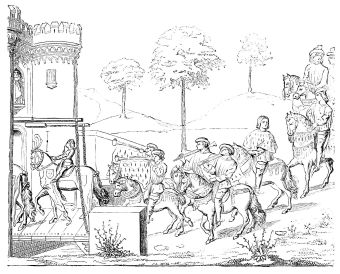
Fig. 74.—A Knight entering the Lists. (From a Miniature in the “Tournois du Roi René.”)
In order to win his spurs (of gold)—an expression become proverbial—it was indispensable that one who aspired to the honour should perform some valiant deed, proving him worthy of being “dubbed,” or armed as a knight. The ceremony of admission commenced by presenting the spurs; and whosoever conferred the order of chivalry, were he king or prince, condescended to put on and fasten the spurs for the recipient. In pursuance of the same principle, when a knight, having committed a fault or any cowardly act, had incurred blame or correction, it was by deprivation of, or by changing his spurs, that his degradation commenced. For a slight offence a herald substituted silver spurs for those of gold, which lowered a knight to the grade of squire. But in a case of “forfeiture,” as it was termed, an executioner or a cook cut off the straps of his spurs, or they were struck off on a dunghill with an axe: infamy was the future portion of him who had been subjected to that public disgrace.
The privilege of wearing spurs was regarded as a mark of independence and authority; so that when a noble tendered faith and homage to his sovereign, he was obliged to take off his spurs in token of vassalage. In 816, ere chivalry had been instituted, an assembly of lords and bishops prohibited ecclesiastics from adopting the profane fashion of wearing spurs then prevailing among the higher classes of the clergy.
The use of the spur appears to date from the most ancient times. The origin of the word has been much disputed. From the time of Louis le Débonnaire it was called spuors, which has become sporen in Germany, sperane in Italian, spur in English, éperon in French. The Latins called it calcar (which originally signified cock’s spur), doubtless from the form first given to the spur. That form has strangely varied during centuries. The oldest known shape is that of the spur found in the tomb of Queen Brunehaut, who died in 613, and which is simply like a skewer. This seems to have long continued to be the form; but, from the commencement of the thirteenth to the end of the sixteenth century, the spur is seen in the form of a rose, or of a star with a turning rowel, and was mostly fashioned in a very rich and delicate manner. At the period when horses were clad in steel or leather, the spurs were necessarily very long, in order to reach the animal’s flanks (Figs. 75 and 76). The spurs of Godfrey of Bouillon, which have been preserved (their authenticity is more or less questionable), are in that style. In the reign of Charles VII. the young nobles wore, rather for show than for use, spurs the rowel of which was as large as the hand, and fixed at the end of a metal stem half a foot long.
If, therefore, from time immemorial every mounted horse “felt the spur,” there was at least a period when every sort of spur could not be indiscriminately applied to the flanks of each individual of the equine race. “There are,” says Brunetto Latini, a writer of the thirteenth century, in his “Treasury of all Things”—a sort of encyclopædia of the age—“there are horses of several kinds: chargers, or tall horses, for the combat, whence the expression, ‘mounting the high horse;’ others, for gentle exercise, use palfreys, which were also called amblers and hackneys; others employ pack-horses, courtants (cropped horses), to carry a load (somme).” Somme here signifies a burden, and this, which we now call baggage, consisted of spare arms and hauberk, which a knight was careful to take with him when he went to the wars. Mares and bât-horses (horses carrying the bât, or load) were reserved for agriculture and other field-purposes; and it was clearly on that account that a knight was not allowed to ride them. To make a knight ride upon a mare was, like the loss of his spurs, one of the most degrading punishments that could be inflicted on him, and thenceforth “any one who regarded his own honour would no more have touched that disgraced knight than a shaven idiot (leper).”
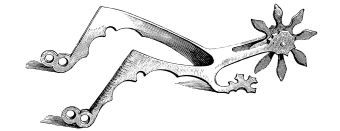
Fig. 75.—German Spur.
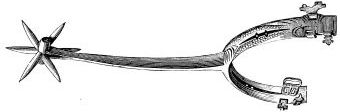
Fig. 76.—Italian Spur.
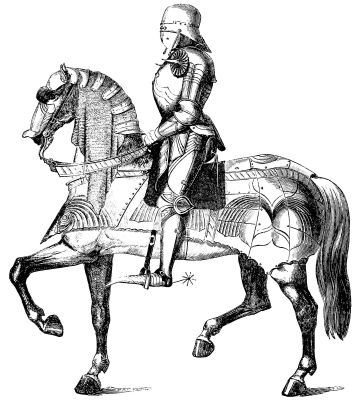
Fig. 77.—A Knight armed and mounted for War. (Museum of Artillery, Paris.)
The horses of French knights were without ears or mane; those of the Germans without tails. According to Carrion-Nisas, the armour of the horse, and the style in which it was caparisoned, were the cause of these mutilations. We have elsewhere remarked that if the men were cased in steel their horses were not less heavily cuirassed (Fig. 77). The entire armour and appointments of a horse were called the harness; the plates of steel or leather (for leather also was often used) were called bardes. We find enumerated, not only the articles of which the harness consisted—chanfrein, nasal, flancois, &c.—but examples are cited to denote the sumptuousness of this equipment of the horse. We need not, however, dwell longer here on this subject, that refers more properly to the manufacture of arms; but a few words must be said regarding the saddle, which is, if we may use the expression, an implement of horsemanship, and not a part of the armour.
The use of saddles seems to have been unknown in early times, and never to have been introduced among certain nations which, by the way, were most famous in the art of training the horse and making him serviceable. The Thessalonians and the Numidians rode on the bare back, without saddle or stirrups; seated firmly on the horse simply by the pressure of the knees and the calf of the legs; a position which is still that of the boldest riders in the East and in Africa. Hippocrates has ascribed the common and severe diseases of the hips and legs which afflicted the Scythians to the rider’s want of support on horseback. Galen makes the same remark regarding the Roman legions, who only introduced the use of a saddle about the year 340 of the Christian era. The Gauls and Franks used neither saddles nor stirrups; but when steel armour was adopted, it would have been impossible for knights to preserve an equilibrium without the aid of a saddle, or to sustain the slightest shock to which they were exposed, as armour rendered them in a manner rigid, or with little flexibility on their large horses.
They therefore had recourse to a high, or rather a deep, saddle, closely adhering to the thighs and loins, with large stirrups serving as supports to the feet. The several parts of the armour being splendidly ornamented, it followed that the saddles, which also were exposed to view, were no more neglected than other ornaments of the animal. Engraved and chased, they were also gilt and painted, and thus, with the shield, helped to distinguish, by the “devices” they bore, the armed warrior completely cased in his steel covering (Figs. 78 to 81).
As to stirrups, of which there certainly is no trace among the Greeks or the Romans, it may be said they were coeval with the invention of saddles. They made their appearance in the earliest days of the Merovingian dynasty; and if we accept the German etymology which the learned have offered (streben, to support one’s self), the name and the object was introduced by the Franks into Gaul. However that may be, they were no longer dispensed with, especially in war, and when the weight of armour rendered their use necessary. They were of course very large, very massive, and very clumsy in the days of chivalry. When they diminished in size and weight they were wrought with more care, and became objects of art, charged with ingenious ornaments, and embellished with engraving, chasing, and gilding.
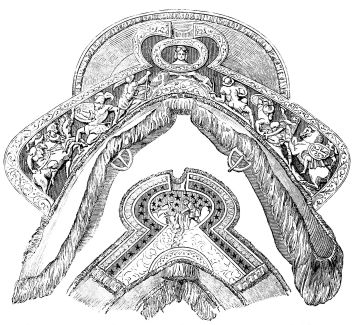
Figs. 78 and 79.—Tournament Saddles, ornamented with Paintings, taken from the Armoury Real, Madrid. Sixteenth Century. (Communicated by M. Ach. Jubinal.)
In accordance with the opinion held by M. de la Varenne, we have already ascribed the disuse of private carriages to the contempt with which the Franks regarded a mode of conveyance deemed by them to be effeminate. But, following the same author, we must observe that a reason might also be discovered in the wretched condition into which, after the decline of the Romans, those magnificent roads formed by them in all their conquered provinces had fallen. In towns, moreover, the streets, narrow, crooked, and with no regular direction, were very frequently so many holes and quagmires. Philip Augustus I. had some of the streets of Paris paved in that lutèce[13] which already, at the time of the Roman conquest, had deserved the significant epithet of miry. The princes and the nobles who, as Molière humorously makes Mascarilla say, feared “to leave the impression of their shoes in mud,” and could not without difficulty drive about the towns in carriages, consequently had recourse to the horse or the mule. The ladies made use of them also; but very frequently, if not carried in litters, they rode on a pillion behind the horseman.
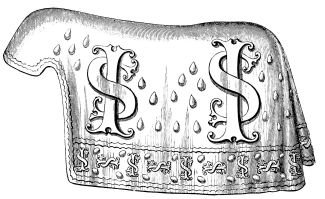
Fig. 80.—The Caparison of the Horse of Isabel the Catholic. (Communicated by M. Ach. Jubinal.)
In the thirteenth century chariots reappeared; but the fashion did not long prevail, for Philip the Fair discouraged them, in one of the clauses of his sumptuary ordinance of 1294, by declaring that “no citizen may have a chariot.”
The litter continued to be held in repute for processions; but queens frequently rode on horseback. Isabel of Bavaria rode on a beautiful palfrey, with her ladies and her maids also on horseback, on the occasion of her entering Paris to espouse Charles VI. And when Mary of England, who went to be married to Louis XII., made her entry into Abbeville, she also, as Robert de la Marck relates, was mounted on a palfrey, as were most of her ladies, “and the remainder in chariots; and the king, riding a large, prancing bay horse, came to receive his bride, with all the gentlemen of his household and of his guard on horseback.” The meeting of Henry VIII. and Francis I. in the camp of the Field of the Cloth of Gold, presented the most beautiful display that had ever been seen of caparisoned horses, decorated and furnished with unprecedented richness (Fig. 82).
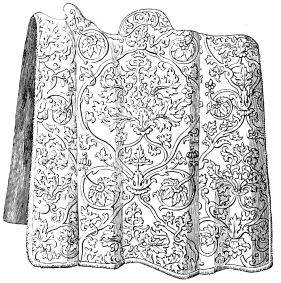
Fig. 81.—Saddle-cloth. Sixteenth Century.
Charles V., in consequence of frequent attacks of gout, was soon compelled to renounce riding. When he went into the country, or on a journey, he was generally followed by a litter and a chair. Mules bore the litter, in which he could recline, while bearers carried the chair, which was
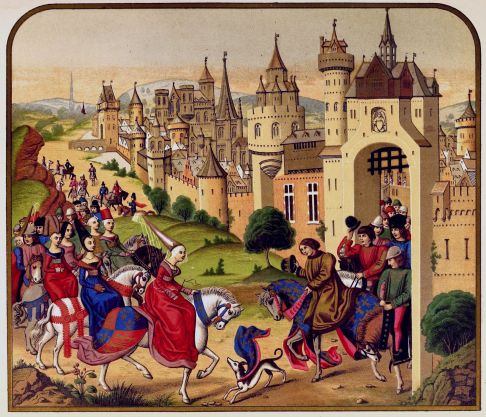
ENTRANCE OF THE QUEEN ISABEAU OF BAVARIA INTO PARIS.
From a Miniature in Froissart’s Chronicles, National Library, Paris.
provided with a movable back; its four uprights could be fitted with a sort of canopy of canvas or leather.
In 1457 the ambassadors of Ladislaus V., King of Hungary, presented to Marie of Anjou, Queen of France, a chariot which excited the admiration of the whole court and the inhabitants of Paris, “because,” as the historian of the times says, “it was branlant (suspended), and very rich.”
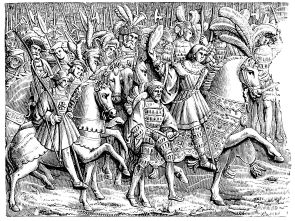
Fig. 82.—Henry VIII. in the Camp of the Field of the Cloth of Gold (1520). From the Bas-reliefs of the Hôtel of the Bourg Herolde at Rouen.
It is difficult to reconcile the inference to be drawn from the ordinance of Philip the Fair with the assertion of many historians, that coaches first appeared in France only in the time of Francis I. The point is still doubtful. Nevertheless, one may suppose historians to mean that coaches, instead of being the only vehicles employed in Paris in the time of Francis I., were but chariots of a grander and more gorgeous description than any seen before that time. But we know for certain that, during the Middle Ages, the horse and the mule were generally ridden by everybody, by citizens and by nobles, by women and by men. The horse-blocks fixed in the streets—too narrow evidently, if not for one carriage, at least for two to pass each other—and the rings fastened on doors sufficiently denote that it was so. The mule was especially ridden by sedate men, such as magistrates and doctors, who had to “amble” through the towns. “To take care of the mule,” a proverbial expression signifying to wait impatiently, is derived from the custom of lawyers’ servants remaining in the court of the Palace to take charge of the riding-horses or mules belonging to their masters.
According to Sauval, the two first coaches seen in Paris, and which called forth the wonder of the people, belonged, one to Queen Claude, the first wife of Francis I.; and the other to Diana of Poitiers, his mistress.
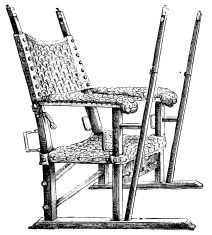
Fig. 83.—Sedan-chair of Charles V. (Armoury Real, Madrid.)
The fashion was soon followed; so much so, that even where the sumptuary laws were still regarded as efficient, we find parliament entreating Charles IX. to prohibit the circulation of coaches (coches) through the town. The magistrates continued, until the commencement of the seventeenth century, to attend at the courts of justice on their mules. Christopher of Thou, father of the celebrated historian, and first President of Parliament, was the first who came thither in his carriage; but only because he suffered from gout, for his wife continued to ride on horseback, seated pillion-fashion behind a servant.
Henry IV. had only one carriage. “I shall be unable to go and see you,” he one day wrote to Sully, “for my wife uses my coach (coche).” These coaches were neither elegant nor convenient. For doors they were provided with leathern aprons, which were drawn or opened for entrance or exit, with similar curtains to protect against the rain or the sun.
Marshal Bassompierre, in the time of Louis XIII., had a glass coach made for him, which was regarded as a real marvel: it originated the impulse which has led to the productive era of modern coach-building.
Formerly there were in Paris, as appears from numerous documents, several corporations representing the saddler’s trade. First came the selliers-bourreliers, and the selliers-lormiers-carrossiers. The privileges of the first secured to them specially the manufacture of saddles and harness (collars and other articles for draught). The second made also carriages, bridles, reins, &c. Another very ancient corporation was that of the lormiers-éperonniers—“artisans,” says the Glossary of Jean de Garlande, “whom the military nobles greatly patronised, because they manufactured silvered and gilt spurs, metal breastplates for their horses, and well-executed bits.” There were also chapuissiers, who made saddle-bows and pack-frames for the beasts of burden, which were mostly manufactured of alder-wood.
The blazenniers and cuireurs then covered with leather the packs and the saddles prepared by the chapuissiers; and, finally, saddle-painters were employed to ornament them, either in compliance with fashion, which has always been omnipotent in France, or according to the laws of heraldry, when intended for men of rank for purposes of state or war.
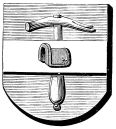
Fig. 84.—Banner of the Corporation of the Saddlers of Tonnerre.