MINIATURES IN MANUSCRIPTS.
James Dafforne translation
Miniatures at the Beginning of the Middle Ages.—The two “Vatican” Virgils.—Painting of Manuscripts under Charlemagne and Louis le Débonnaire.—Tradition of Greek Art in Europe.—Decline of the Miniature in the Tenth Century.—Origin of Gothic Art.—Fine Manuscript of the time of St. Louis.—Clerical and Lay Miniature-Painters.—Caricature and the Grotesque.—Miniatures in Monochrome and in Grisaille.—Illuminators at the Court of France and to the Dukes of Burgundy.—School of John Fouquet.—Italian Miniature-Painters.—Giulo Clovio.—French School under Louis XII.
ONTEMPORANEOUS, almost, with the idea which first caused oral traditions, chronicles, speeches, and poetry to be collected together under the form and name of book, is the art of ornamenting manuscripts with miniatures. Our intention is not to go back to the sources—as obscure as they are distant—of that art, but only to point out its principal phases of improvement or of decay during the Middle Ages.
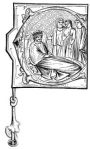
The most ancient known miniatures date from the very commencement of that period which is generally called the Middle Ages; that is to say, from the third and fourth centuries. These paintings, of which there exist but two or three specimens in the libraries of Europe, nevertheless offer, in their correctness and masterly beauty, the great characteristics of ancient Art. The most celebrated are those of the “Virgil,” preserved in the Vatican Library (Fig. 348), a manuscript long celebrated among learned men for the authenticity of its text. Another “Virgil,” of the date of about a century later, and which, before its presentation to the Pope, was one of the most beautiful ornaments of the ancient library of the Abbey of St. Denis, in France, contains paintings not less remarkable in respect of colour, but very inferior as far as drawing and the style of the compositions are concerned. These two incomparable examples are sufficient in themselves to show the state of the painting of manuscripts at the beginning of the Middle Ages.
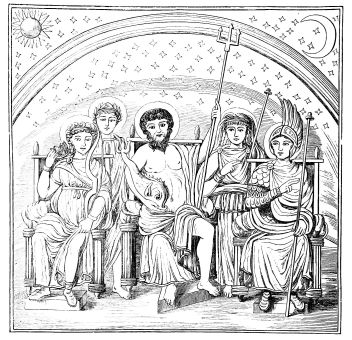
Fig. 348.—Miniature taken from the “Virgil” in the Library of the Vatican, Rome.
(Third or Fourth Century.)
The sixth and seventh centuries have left us no books with miniatures; the utmost we find at that period are some capital letters embellished by caligraphy. In the eighth century, on the contrary, the ornaments were multiplied, and some rather elegant paintings can be pointed out; the fact is, under the reign of Charlemagne a movement of renovation took place in the Arts as in literature: the Latin writing, which had become illegible, was reformed, and the style of painting manuscripts assumed something of the form of the fine antique examples still extant at that period. (Fig. 350.)
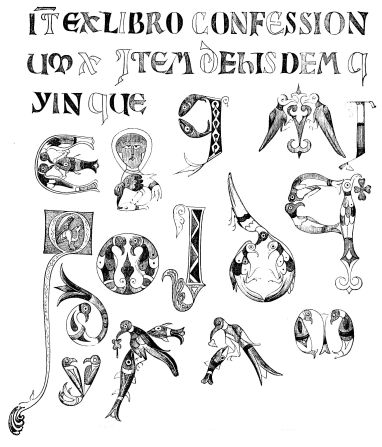
Fig. 349.—Painted Capital letters, taken from Manuscripts of the Eighth or Ninth Century.

Fig. 350.—Border, taken from a Book of the Gospels of the Eighth Century. (Library of Vienna).
If we would have an idea of the heaviness and the ungraceful character of the writing and of the ornaments which accompanied it before the period of Charlemagne, it will suffice to examine Fig. 349. “It was then quite time,” says M. Aimé Champollion-Figeac, “that the salutary influence exercised by the illustrious monarch made itself felt in the Arts as well as in letters.” The first manuscripts which seem to bear witness to this progress are first a sacramentary, said to be that of Gellonius, the allegorical paintings of which are of great interest in the history of Christian symbolism; and a Book of the Gospels, now in the Louvre: the latter is said to have belonged to the great emperor himself, and we reproduce one of the paintings from it (Fig. 351). We may mention, as of the ninth century, many Books of the Gospels, in one of which, given by Louis le Débonnaire to the Abbey St. Médard de Soissons, the purest Byzantine style shows itself; then the Bible called the “Metz” Bible, in which are paintings of large dimensions, remarkable for the felicitous groupings of the figures and for the beauty of the draperies. One of these miniatures excites an interest quite peculiar, inasmuch as King David, who is represented in it, is but a copy of an ancient Apollo, round whom the artist has personified Courage, Justice, Prudence, &c.
Let us mention still further two Bibles and a book of prayers, the last containing a very fine portrait of the king, Charles the Bald, to whom it belonged; and lastly, two books really worth attention, on account of the delicacy and freedom of the outline drawings, for the attitudes of the characters represented, and for the draperies, which resemble those of ancient statues. These books are a “Terence,” preserved in the Imperial Library, Paris, number 7,899 in the catalogue; and a “Lectionary of the Cathedal of Metz,” from which the
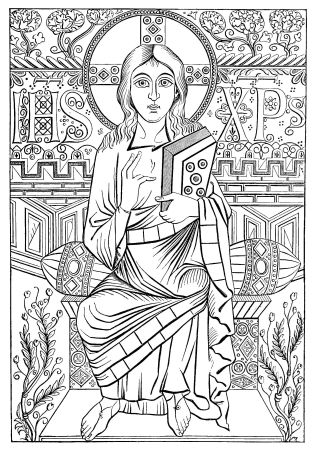
Fig. 351.—Miniature from the Book of the Gospels of Charlemagne.
(Manuscript in the Library of the Louvre.)
border (Fig. 352) is taken. While in France the art of painting manuscripts had progressed so much as to produce some perfect models of delicacy and taste, Germany had never got beyond the simplest compositions, as we see in the “Paraphrase on the Gospels,” in Theotisc (the old Teutonic language), belonging to the Library of Vienna.

Fig. 352.—Border of a Lectionary in the Cathedral of Metz. (Ninth Century.)
The artistic traditions of the ancients in the ninth century are attested by the manuscripts of Christian Greece, whereof the Imperial Library, Paris, possesses many magnificent specimens, at the head of which we must place the “Commentaries of Gregory Nazianzus,” ornamented with an infinite number of paintings, in which all the resources of ancient art are applied to the representation of Christian subjects (Fig. 353). The heads of the characters portrayed are admirably expressive, and of the finest style; the colouring of the miniatures is warm and soft; the costumes, the representations of buildings and of the accessories, offer, moreover, very interesting subjects of study. Unfortunately, these paintings were executed on a very crumbling surface, which has in many places peeled off: it is sad to see one of the most precious monuments of Greek and Christian Art in a deplorable state of dilapidation.
The masterpiece of the tenth century, which again is due to the artists of Greece, is a “Psalter, with Commentaries,” belonging also to the Imperial Library (number 139 among the Greek manuscripts), a work in which the miniature-painter seems not to have been able to disengage himself from the Pagan creeds in illustrating Biblical episodes. Two celebrated manuscripts of the same time, but executed in France, and preserved in the same collection, show, by the stiffness and incorrectness of the drawing, that the impetus given by the genius of Charlemagne had abated: these are the “Bible de Noailles,” and the “Bible de St. Martial,” of Limoges (Fig. 355).
To speak truly, if in France there was a decadency, the Anglo-Saxon and Visigothic artists of this period
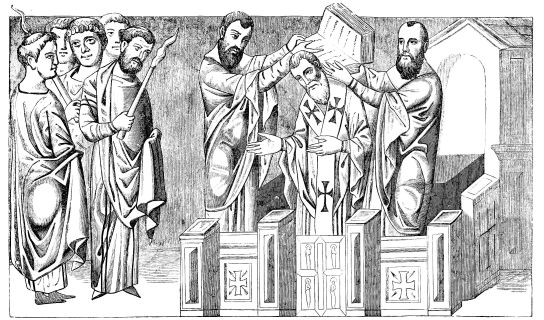
Fig. 353.—Miniature of the Ninth Century, extracted from the “Commentaries of Gregory Nazianzus,” representing the consecration of a Bishop. (Large folio Manuscript in the Imperial Library, Paris.)
were also very inferior, to judge from a Latin Book of the Gospels of the tenth century painted in England (Fig. 356); it, however, proves that the art of ornamenting books had degenerated less than that of drawing the human figure. Another manuscript with paintings, called Visigothic, containing the Apocalypse of St. John, gives, in its fantastic ornaments and animals, an example of the strange style adopted by a certain school of miniature-painters.

Fig. 354.—Fac-smile of a Miniature drawn with the pen, taken from a Bible of the Eleventh Century. (Imperial Library, Paris.)
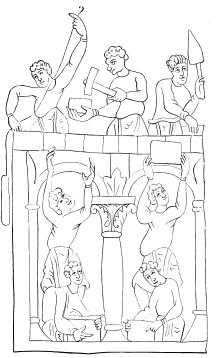
Fig. 355.—Border taken from the Bible of St. Martial of Limoges. (Tenth Century.)
Germany now began to improve in the art of painting miniatures. It owed this happy result to the emigration of Greek artists, who came to the German court to take refuge from the troubles of the East. The progress accomplished in this part of Europe shows itself in the drawing of the figures of a German Book of the Gospels of the beginning of the eleventh century, a work very superior to that of the Teutonic Book of the Gospels just referred to. The border of which we give a fac-simile in Fig. 357 shows also a certain degree of improvement; it is taken from a Book of the Gospels of the same period, preserved in the Royal Library, Munich.

Fig. 356.—Border taken from a Book of the Gospels in Latin, executed in England. (Tenth Century.)

Fig. 357.—Border taken from a Book of the Gospels of the beginning of the Eleventh Century. In the Royal Library, Munich.
But in France, to foreign invasions and to misfortunes of all kinds, which, since the death of Charlemagne, had afflicted the country, was added the terror caused by the general expectation that the world was coming to an end at the expiration of the first millennial. People were, therefore, otherwise employed than in ornamenting books. Accordingly, this epoch is one of the most barren in religious or other paintings. Fig. 358 represents the last degree of abasement in this art. Nothing in the world could be more barbarous, nor farther removed from all sentiment of the beautiful, and even from the instinctive idea of drawing. Ornamentation, however, remained sufficiently good, although under very heavy forms, as the Sacramentary of Æthelgar, which is preserved in the Library of Rouen, shows (Fig. 359). The decadency, however, seems to have come to a stop in France towards the end of the eleventh century, if we judge of the art from paintings, executed in 1060, and contained in a Latin manuscript, bearing the number 818, in the Imperial Library.
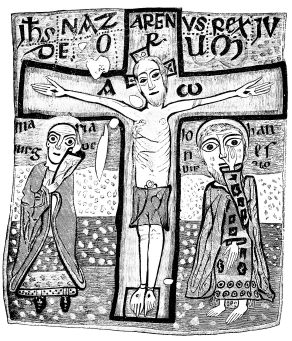
Fig. 358.—Miniature taken from a Missal of the Beginning of the Eleventh Century.
(Imperial Library, Paris, No. 821.)
In the manuscripts of the twelfth century, the influence of the Crusades made itself already felt. At this period, the East regenerated in some sort the West in all that concerned arts, sciences, and literature. Many examples witness that the painting of manuscripts was not the last to undergo this singular transformation. Everything the imagination could invent of the most fantastic was particularly brought into play to give to the Latin letters a peculiar character—imitated, moreover, from the ornaments of Saracenic architecture. This practice was even applied to public acts and documents, as Fig. 360 proves; it represents some of the initial letters in the “Rouleau Mortuaire” of St. Vital. Callot, in his “Temptation of St. Anthony,” has, we think, imagined nothing stranger than the figure we give; a demon standing on the back of Cerberus forms the vertical line in the letter T; while two other demons, whose feet are in the mouth of the first, form the two lateral branches of the letter.
Fig. 359.—Border taken from the Sacramentary of Æthelgar. (Rouen Library.)
In the thirteenth century, Saracenic or Gothic art universally prevailed. Everywhere figures assumed gaunt, elongated forms; coats-of-arms invaded the miniatures; but the colouring was of marvellous purity and brightness; burnished gold, applied with the greatest skill, stood out from blue or purple backgrounds which even in our own day have lost nothing of their original freshness.
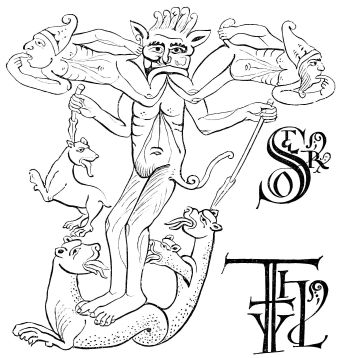
Fig. 360.—Initial Letters extracted from the “Rouleau Mortuaire” of St. Vital, Twelfth Century.
(Imperial Archives of France.)
Among the most remarkable manuscripts of this century we must mention a Psalter in five colours, containing the French, Hebrew, and Roman versions, with some commentaries (Imperial Library, No. 1,132 bis). One should analyse the greater number of subjects depicted in this manuscript to understand all their importance; we will mention only that among them are sieges of towns, Gothic fortresses, interiors of Italian banking-houses, various musical instruments, &c. There is, perhaps, no other manuscript which equals this in the richness, the beauty, and multiplicity of its paintings: it contains ninety-nine large miniatures, independently of ninety-six
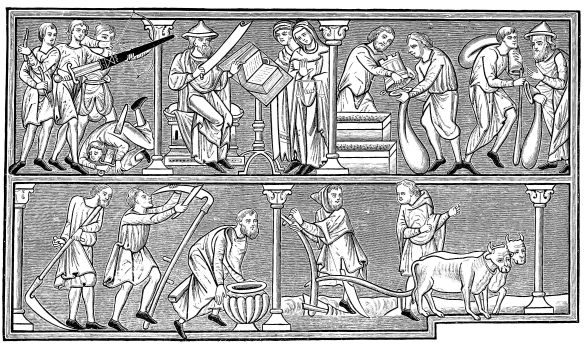
Fig. 361.—Facsimile of a Miniature of a Psalter, of the Thirteenth Century, representing warlike, scientific, commercial, and agricultural Works. (Imperial Library, Paris.)
medallions representing divers episodes suggested by the text of the Psalms (Fig. 361). After this psalter we must place the Breviary of St. Louis, or rather of Queen Blanche, formerly preserved in the Arsenal Library, Paris, and now in the Musée des Souverains; a celebrated manuscript which has, on folio 191, this inscription: “C’est le Psautier monseigneur St. Loys, lequel fu à sa mère.”[57] But the volume is not rich in large miniatures. We observe in it, however, a calendar ornamented with small subjects very delicately executed, representing the labours appropriate to each month, according to the seasons of the year. The character of the paintings exhibits a style anterior to the reign of Louis IX.; and it is supposed, indeed, that this book first belonged to the mother of that king.
We must now mention another Psalter, which was actually used by St. Louis; as is proved not only by an inscription at the beginning of the volume, but still further by the fleurs-de-lis of the king, the arms of Blanche of Castile, his mother, and perhaps also les pals de gueules of Margaret of Provence, his wife. Nothing can equal the beautiful preservation of the miniatures in this volume, which contains seventy-eight subjects, with as many explanatory texts in French. The heads of the characters, though almost microscopic, have nevertheless, generally, a fine expression.

Fig. 362.—A Border taken from a Gospel in Latin, of the Thirteenth Century.
(Imperial Library, Paris.)
The “Livre de Clergie,” which bears the date of 1260, merits far less attention: so does the “Roman du Roi Artus,” No. 6,963, in the Imperial Library, Paris, executed in 1276. But we must point out two of the most beautiful examples of this period, a Book of the Gospels in Latin, No. 665 in the Supplement, Imperial Library, from which we have borrowed an elegant border (Fig. 362), and the “Roman du Saint-Graal,” No. 6,769, also in the Imperial Library.
Italy was then at the head of civilisation in everything; it had particularly inherited the grand traditions of painting which had gone to sleep for ever in Greece only to wake up again in Europe.
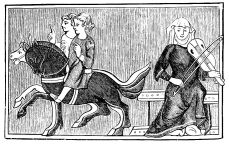
Fig. 363.—Facsimile of a Miniature of the Thirteenth Century, representing a scene of an old Romance: the beautiful Josiane, disguised as a female juggler, playing a Welsh air on the Rote (Fiddle), to make herself known to her friend Bewis. (Imperial Library, Paris.)
Here we must introduce a remark, the result of a general examination of the manuscripts bequeathed to us by the thirteenth century; namely, that the miniatures in sacred books are much more beautifully and carefully executed than those of the romances of chivalry and the chronicles of the same period (Figs. 363 and 364). Must we attribute this superiority to the power of religious inspiration? Must we suppose that in the monasteries alone clever artists met with sufficient remuneration? Before answering these questions, or rather as an answer to them, let us remember that in those days religious institutions absorbed nearly all the social intellectual movement, as well as the effective possession of material riches, if not of territorial property. Solely occupied with distant wars or intestine quarrels which impoverished them, the nobles were altogether unable to become protectors of literature and Art. In the abbeys and convents were lay-brethren who sometimes had taken no vow, but whose fervent spirits, burning with poetical imagination, sought in the monastic retreat redemption from their past sins: these men of faith were happy to consecrate their whole existence to the ornamentation of a single sacred book destined for the community which gave them in exchange all the necessaries of life.
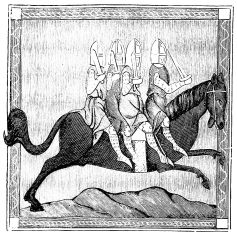
Fig 364.—The Four Sons of Aymon on their good Steed, Bayart. From a Miniature in the Romance of the “Four Sons of Aymon,” a Manuscript of the Thirteenth Century. (Imperial Library, Paris.)
This explains the absence of the names of the miniature-painters in ancient manuscripts, particularly in those which are written in Latin. However, when romances and chronicles in the vulgar tongue began to come into fashion, artists of great talent eagerly presented themselves to be engaged by princes and nobles who wished to have this sort of books ornamented; but the anonymous which these lay artists generally preserved is explained by the circumstance that in most cases they were considered only as artistic assistants in the lordly houses where they were employed, and in which they fulfilled some other domestic duty; for instance, Colard de Laon, the favourite painter of Louis of Orleans, was also valet-de-chambre to this prince; Pietro Andrea, another artist, doubtless an Italian, to judge from his Christian name, was gentleman-usher; and we see this
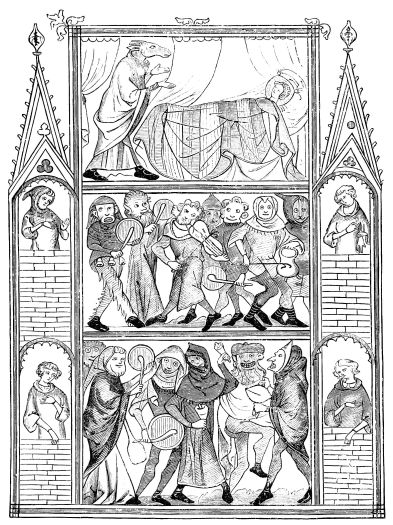
Fig. 365.—Miniature taken from the “Roman de Fauvel” (Fifteenth Century), representing Fauvel, or the Fox, reprimanding a Widow who has married again, and to whom is being given a Serenade of Rough Music.
(Imperial Library, Paris.)
same painter “sent from Blois to Tours, to procure certain matters for the accouchment of Madame the Duchess;” or again, “from Blois to Romorantin, to inquire after Madame d’Angoulesme, who was reported to be very unwell.”
Certain artists, however, who then took the modest name of illuminators, lived entirely by their profession; working at tableaux benoîts (blessed pictures), or popular paintings, which were sold at the church-doors. Others, again, were paid assistants of the recognised painters to princes or nobles; and the anonymous was quite naturally imposed upon them by their subordinate position, if not by the simple modesty which was for a long time the accompaniment of talent. In the fourteenth century the study of miniatures is peculiarly interesting, on account of the scenes of public and private life, of manners and customs, we find reproduced in them. Portraits after life, d’après le vif, as they were called in those days, made their appearance; and caricature, at all times so powerful in France, already began to show itself with a daring which, occupying itself with the clergy, women, and chivalry, stopped only before the prestige of royalty.
The miniatures of a French manuscript, dated 1313 (Imperial Library, Paris, No. 8,504, F. L.), deserve to be mentioned, especially on account of the various subjects they represent; for, besides the ceremony of the reception of the King of Navarre into the order of chivalry, we see in it philosophers discussing, judges administering the law, various scenes of conjugal life, singers accompanying themselves on divers instruments of music, villagers engaged in the labours of country life, &c. We must mention also a manuscript of the “Roman de Fauvel,” in which is especially prominent the very original scene of a popular concert of rough music, by masked performers, given, according to an old custom, to a widow who had married a second time (Fig. 365).
The period during which Charles V. occupied the throne of France is one of those that produced the finest specimens of manuscript-painting. This monarch, the founder of the Royal Library, was an admirer of illustrated books, and had accumulated, at great cost, a large collection in the great tower of the Louvre. A royal prince, whom we have already mentioned as being excessively devoted to artistic luxuries, was the rival of Charles V. in this respect: this was his brother, the Duke Jean de Berry, who devoted enormous sums to the purchase and production of manuscripts.
Fig. 366.—Border taken from a Prayer-book belonging to Louis of France, Duke of Anjou, King of Naples, of Sicily, and of Jerusalem. (Fourteenth Century.)
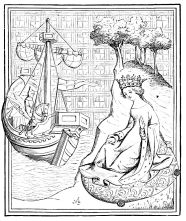
Fig. 367.—Miniature taken from “Les Femmes Illustres,” translated from Boccacio. (Imperial Library, Paris.)
Even under Charles VI. this impulse did not abate, and the art of painting manuscripts was never in a more flourishing condition. The border taken from the “Livre d’Heures,” or prayer-book, of the Duke d’Anjou, uncle of the king (Fig. 366), is an example of this. We might mention, as specimens of illustrated works of this period, the book of the “Demandes et Réponses,” by Peter Salmon, a manuscript executed for the king, and ornamented with exquisite miniatures, in which all the characters are true historical portraits, beautifully finished. Nevertheless, the masterpieces of the French school at this period show themselves in the miniatures of two translations of Boccacio’s “De Claris Mulieribus” (“Beautiful Women”) (Fig. 367).
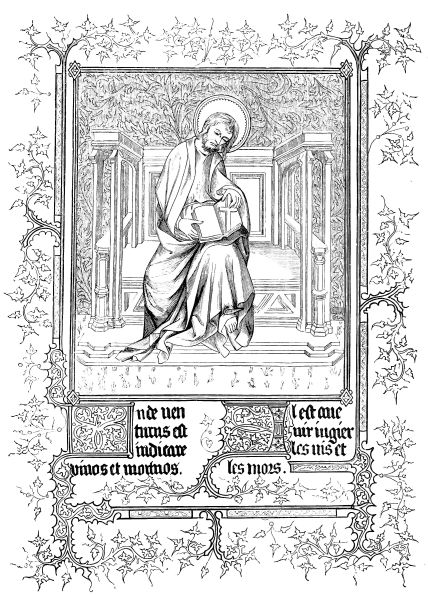
Fig. 368.—Miniature of the Psalter of John, Duke of Berry, representing the Man of Sorrow, or Christ, showing the Sign of the Cross. (Imperial Library, Paris.)
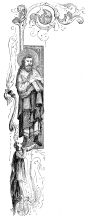
Fig. 369.—Border taken from the Bible called Clement VII.’s. (Fourteenth Century.)
At that time two new styles appeared in the painting of manuscripts: miniatures en camaïeu (in one colour only), and miniatures en grisaille (in two colours, viz., a light colour shaded, generally with brown). Of the first kind, we may instance “Les Petites Heures” of John, Duke de Berry (Fig. 368), and “Les Miracles de Notre-Dame.”
Germany did not in this respect rise to the height of France; but miniature-painting in Italy progressed more and more towards perfection. A remarkable specimen of Italian art of this period is the Bible called Clement VII.’s (Fig. 369), which is preserved in the Imperial Library, Paris. But there exists one more admirable still in the same establishment, so rich in curiosities, of the manuscript of “The Institution of the Order of the Holy Ghost,” an order of chivalry founded at Naples in 1352, by Louis de Tarento, King of Naples, during a feast on the day of Pentecost; it is in this superb manuscript, executed by Italian or French artists, may, perhaps, be found the most exquisite miniatures of that day (Fig. 370); especially remarkable are the beautiful portraits in camaïeu of King Louis and his wife, Jane I., Queen of Naples. A valuable copy of the romance of “Lancelot du Lac,” of the same date, recommends itself to the attention of connoisseurs by a rare peculiarity: one can follow in it the successive operations of the painter in miniature; thus are presented to us consecutively the outline-drawing, then the first tints, generally uniform, executed by the illuminator; next the surface on which the gold is to be applied; then the real work of the miniature-painter in the heads, costumes, &c.
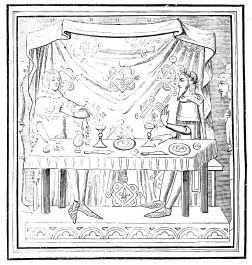
Fig. 370.—Miniature from a Manuscript of the Fourteenth Century, representing Louis de Tarento, second Husband of Queen Jane of Naples, instituting the Order of the Holy Ghost.
(Imperial Library, Paris.)
France, in spite of the great troubles which agitated her, and the wars she had to maintain with foreign powers during the fifteenth century, saw, nevertheless, the art of the painter improve very considerably. The fine copy of Froissart in the Imperial Library, Paris (Fig. 371), might alone suffice to prove the truth of this assertion. The name of John Foucquet, painter to King Louis XI., deserves to be mentioned with eulogy, as that of one of the artists who contributed most to the progress of painting on manuscripts. Everything thenceforward announced the Renaissance which was to take place in the sixteenth century; and if we wish to follow the onward progress of art from the beginning of the fifteenth century till the time
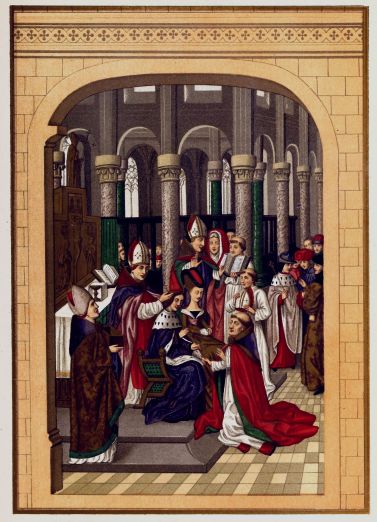
CORONATION OF CHARLES V., KING OF FRANCE.
Miniature from Froissart’s Chronicles in the National Library, Paris.
Fig. 371.—Border taken from “Froissart’s Chronicles,” a French Manuscript of the Fifteenth Century. (Imperial Library, Paris.)

Fig. 372.—Border taken from an “Ovid.” An Italian Manuscript of the Fifteenth Century. (Imperial Library, Paris.)
of Raphael, it is in the miniatures of manuscripts we shall find the best evidences of it. Let us observe, by the way, that the Flemish school of the Dukes of Burgundy exercised great influence over this marvellous art for a period of more than a century. Spain was also progressing; but it is to the Italian artists we must, from that time forward, look for the most remarkable works. The Imperial Library of Paris possesses many manuscripts which bear witness to the marked improvement in miniature-painting at this period; among others an “Ovid” of the fifteenth century (Fig. 372); but in order to see the highest expression of the art, we must examine an incomparable copy of Dante’s works, preserved in the Vatican, a manuscript proceeding from the hands of Giulio Clovio (Fig. 373), an illustrious painter, pupil and imitator of Raphael: his miniatures are remarkable for beauty.
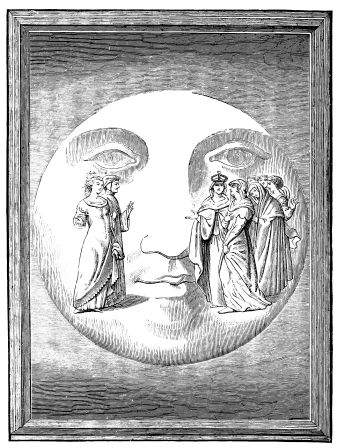
Fig. 373.—Miniature, painted by Giulio Clovio, of the Sixteenth Century, taken from Dante’s “Paradise,” representing the Poet and Beatrice transported to the Moon, the abode of Women devoted to Chastity. (Manuscript in the Vatican Library, Rome.)
Lastly, in the reign of Louis XII., the complete regeneration of the Arts was effected. We should, however, mention that at this period there were two very distinct schools: one whose style still showed the influence of ancient Gothic traditions, the other entirely dependent on Italian taste. The Missal of Pope Paul V. emanated from this last school (Fig. 374).
Fig. 374.—Border taken from the Missal of Pope Paul V. (An Italian Manuscript of the Sixteenth Century.)
This immense progress, which showed itself simultaneously in France and in Italy by the production of many original works, seems to have attained its climax in the execution of a justly celebrated manuscript, known by the name of “Heures d’Anne de Bretagne” (Fig. 375). Among the numerous pictures which decorate this book of prayers, many would not be unworthy of Raphael’s pencil: the expression in the face of the Virgin Mary is, with many others, remarkable for its sweetness; the heads of the angels have something divine in them; and the ornaments which occupy the margin of each page are composed of flowers, fruits, and insects, represented with all the freshness and brilliancy of nature. This inimitable masterpiece was, like a sort of sublime testament, to mark the glorious boundary-line of an art which must necessarily degenerate now that the printing-press was causing the numerous class of scribes and illuminators of the Middle Ages to disappear. It has never revived since, but at intervals; and then more to meet the requirements of fancy than to be of any real use.
A few manuscripts adorned with miniatures of the end of the sixteenth century may still be mentioned, especially two “Livres d’Heures” (prayer-books) painted in grisaille, which
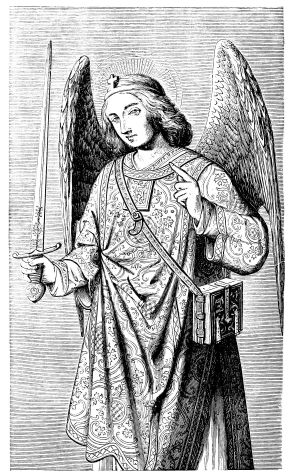
Fig. 375.—Miniature from the Prayer-book of Anne de Bretagne, representing the Archangel St. Michael.
(Musée des Souverains.)
belonged to Henry II., King of France (now in the Musée des Souverains), and the “Livre d’Heures,” executed for the Margrave of Baden by a painter of Lorraine or of Metz named Brentel (Fig. 376), who, however, did nothing
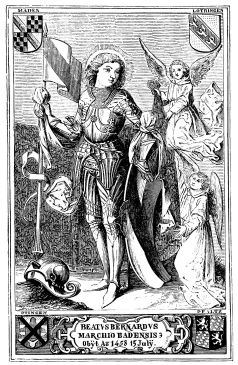
Fig. 376.—Miniature in the “Livre d’Heures” belonging to the Margrave of Baden, representing the Portrait of the blessed Bernard of Baden, who died in the odour of Sanctity, on July 15, 1458.
(Imperial Library, Paris.)
but put together designs copied from the great masters of Italy and Flanders. There were, nevertheless, good miniature-painters in France up to the seventeenth century, to illustrate the manuscripts executed with so much taste by the famous Jarry and the caligraphers of his school. The last manifestation of the art shines forth, for example, in the magnificent “Livre d’Heures” presented to Louis XIV. by the pensioners of the Hôtel des Invalides, a remarkable work, but yet unworthy to appear by the side of the “Livre d’Heures d’Anne de Bretagne,” which the painter seems to have adopted as his model.

Fig. 377.—Escutcheon of France, taken from some Ornaments in the Manuscript of the “Institution of the Order of the Holy Ghost.” (Fourteenth Century.)