BOOKBINDING
James Dafforne translation
Primitive Binding of Books.—Bookbinding among the Romans.—Bookbinding with Goldsmith’s Work from the Fifth Century.—Chained Books.—Corporation of Lieurs, or Bookbinders.—Books bound in Wood, with Metal Corners and Clasps.—First Bindings in Leather, honeycombed (waffled?) and gilt.—Description of some celebrated Bindings of the Fourteenth and Fifteenth Centuries.—Sources of Modern Bookbinding.—John Grollier.—President De Thou.—Kings and Queens of France Bibliomaniacs.—Superiority of Bookbinding in France.
S soon as the ancients had made square books, more convenient to read than the rolls, binding—that is to say, the art of reuniting the leaves stitched or stuck (ligati) into a movable back, between two square pieces of wood, ivory, metal, or leather—bookbinding was invented. This primitive binding, which had no other object than that of preserving the books, no other merit than than of solidity, was not long ere it became associated with ornament, and thus put itself in relation with the luxury of Greek and Roman civilisation. Not contented with placing on each side of the volume a little tablet of cedar-wood or of oak, on which was written the title of the book (for books were then laid flat on the shelves of the library), a piece of leather was stretched over the edge to preserve it from dust, if the book was valuable, and the volume was tied up with a strap passed round it many times, and which was subsequently replaced by clasps. In certain instances the volume was enveloped in thick cloth, and even enclosed in a case of wood or leather. Such was the state of bookbinding in ancient times.

There were then, as now, good and bad bookbinders. Cicero, in his letters to Atticus, asks for two of his slaves who were very clever ligatores librorum (bookbinders). Bookbinding, however, was not an art very generally known, for square books, notwithstanding the convenience of their shape, had not yet superseded rolls; but we see, in the Notices of the Dignities of the Eastern Empire (“Notitia Dignitatum Imperii), written towards 450, that this accessory art had already made immense progress; since certain officers of the empire used to carry, in the public ceremonies, large square books containing the administrative instructions of the emperor: these books were bound, covered with green, red, blue, or yellow leather, closed by means of leathern straps or by hooks, and ornamented with little golden rods disposed horizontally, or lozengewise, with the portrait of the sovereign painted or gilt on their sides. From the fifth century goldsmiths and lapidaries ornamented binding with great richness. And so we hear St. Jerome exclaiming:—“Your books are covered with precious stones, and Christ died naked before the gate of his temple!” “The Book of the Gospels,” in Greek, given to the basilica of Monza by Theodelinda, queen of the Lombards, about 600, has still one of these costly bindings.
A specimen of Byzantine art, preserved in the Louvre, is a sort of small plate, which is supposed to be one of the sides of the cover of a book; on it we find executed in bas-relief the “Visit of the Holy Women to the Tomb,” and several other scenes from the Gospels. In this example the beauty of the figures, the taste which dictated the arrangement of the draperies, and the finish in the execution, furnish us with evidence that, in the industrial arts, the Greeks had maintained till the twelfth century their pre-eminence over all the people of Europe.
In those days the binding of ordinary books was executed without any ornamentation, this being reserved for sacred books. If, in the treasures of churches, abbeys, and palaces, a few manuscripts covered with gold, silver, and precious stones were kept as relics, books in common use were simply covered in boards or leather; but not without much attention being given to the binding, which was merely intended to preserve the volumes. Many documents bear witness to the great care and precision with which, in certain monasteries, books were bound and preserved. All sorts of skins were employed in covering them when they had been once pressed and joined together between boards of hard wood that would not readily decay: in the North, even the skins of seals and of sharks were employed, but pig-skin seems to have been used in preference to all others.
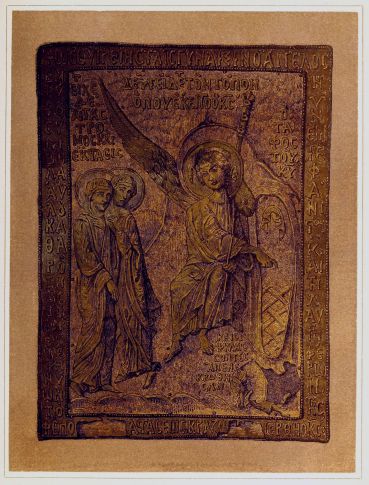
PANEL OF A BOOK COVER.
Bas-relief in Gold Repoussé. Ninth Century. (in the Louvre.)
It must be admitted that we, perhaps, owe to their rich bindings, which were well calculated to tempt thieves, the destruction of a number of valuable manuscripts when towns or monasteries were sacked; but, on the other hand, the sumptuous bindings with which kings and nobles covered Bibles, the Gospels, antiphonaries,[58] and missals, have certainly preserved to us very many curious examples that, without them, would by degrees have deteriorated, or would not have escaped all the chances of destruction to which they were exposed. It is thus, for instance, that the famous manuscript of Sens has descended to us, which contains “La Messe des Fous,” set to music in the twelfth century; it is bound between two pieces of ivory, with bas-relief carvings of the fourth century, representing the festivals of Bacchus. All great public collections show with pride some of these rare and venerable bindings, decorated with gold, silver, or copper, engraved, chased, or inlaid with precious stones or coloured glass, with cameos or antique ivories (Fig. 378). The greater number of rich books of the Gospels mentioned in history date back as far as the period of Charlemagne, and among these we must mention, above all, one given by the emperor himself to the Abbey of St. Riquier, “covered with plates of silver, and ornamented with gold and gems;” that of St. Maximinius of Treves, which came from Ada, daughter of Pepin, sister of Charlemagne, and was ornamented with an engraved agate representing Ada, the emperor, and his sons; and lastly, one that was to be seen as late as 1727 in the convent of Hautvillers, near Epernay, and which was bound in carved ivory.
Sometimes these sumptuous volumes were enclosed in an envelope made of rich stuff; or, in pursuance of an ancient custom, a casket not less gorgeously decorated than the binding, contained it. The Prayer-book of Charlemagne, now preserved in the Library of the Louvre, is known to have been originally enclosed in a small casket of silver gilt, on which were represented in relief the “Mysteries of the Passion.”
These books, however, bound with goldsmith’s work, were not those that were chained in churches and in certain libraries (Fig. 379), as some volumes still in existence show, with the rings through which passed the chain that fastened them to the desk. These catenati (chained books) were generally Bibles and missals, bound in wood and heavily ornamented with metallic corners; which, while placed at the disposition of the faithful and of the public in general, their owners wished to guarantee against being stolen.
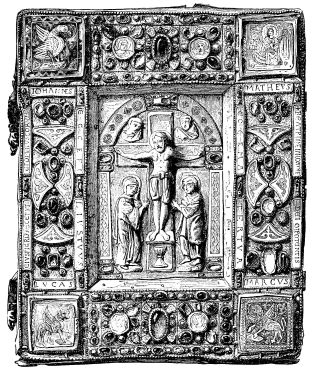
Fig. 378.—Binding in Gold, adorned with precious Stones which covered a “Book of the Gospels” of the Eleventh Century, representing Jesus Crucified, with the Virgin and St. John at the Foot of the Cross.
(Musée du Louvre).
We must not forget to mention, among the most beautiful bindings of the eleventh and twelfth centuries, the coverings of books in enamelled copper (Fig. 380). The Museum of Cluny possesses two plates of incrusted enamel of Limoges, which must have belonged to one of these bindings: the first has for its subject the “Adoration of the Magi;” the other
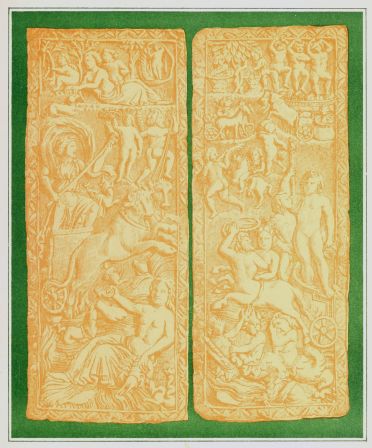
IVORY DIPTYCH OF THE LOWER EMPIRE.
Serving as a Book Cover, “l’Office des fous.”. (In the Library of Sens)
represents the monk Etienne de Muret, founder of the order of Grandmont (in the twelfth century), conversing with St. Nicholas. The Cathedral of Milan contains in its treasury the covering of a book still more ancient and much richer, about fourteen inches long by twelve inches wide, and profusely covered with incrusted enamel, mounted and ornamented with polished, but uncut, precious stones of various colours.
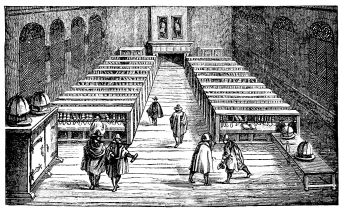
Fig. 379.—Library of the University of Leyden, in which all the Books were chained, even in the Seventeenth Century.
But all these were only the work of enamellers, goldsmiths, illuminators, and clasp-makers. The binders, or bookbinders properly so called, fastened together the leaves of books, and placed them between two boards, which they then covered with leather, skin, stuff, or parchment; they added to these coverings sometimes leathern straps, sometimes metal clasps, sometimes hooks, to keep the volume firmly closed, and almost always nails, whose round and projecting heads preserved the flat surface of the binding from being rubbed.
In the year 1299, when the tax was imposed upon the inhabitants of Paris for the exigencies of the king, it was ascertained that the number of bookbinders then actually in the town amounted only to seventeen, who, as well as the scribes and booksellers, were directly dependent on the

Fig. 380.—Large Painted Initial Letter in a Manuscript in the Royal Library, Brussels, showing the arrangement of the Binding, in enamelled Metal, of a book of the Gospels. (Ninth or Tenth Century.)
University, the authorities of which placed them under the surveillance of four sworn bookbinders, who were considered the agents of the University. We must except, however, from this jurisdiction the acknowledged bookbinder to the “Chambre des Comptes,” who, before he could be appointed to this office, had to make an affirmation that he could neither read nor write.
In the musters, or processions, of the University of Paris, the bookbinders came after the booksellers. To explain the relatively small number of professed bookbinders, we must remember that at this period the majority of scholars bound their own books, as divers passages of ancient authors prove; while the monasteries, which were the principal centres of bookmakers, had one or many members of their community whose special function it was to bind the works written within their walls. Tritheimius, Abbot of Spanheim at the end of the fifteenth century, does not forget the bookbinders in the enumeration he makes of the different employments of his monks:—“Let that one,” says he, “fasten the leaves together, and bind the book with boards. You, prepare those boards; you, dress the leather; you, the metal plates, which are to adorn the binding.” These bindings are represented on the seal of the University of Oxford (Fig. 381), and on the banners of some French corporation of printers and booksellers (Figs. 382 and 386).
The metal plates, the corners, the nails, the clasps with which these volumes were then laden rendered them so heavy that, in order to enable the reader to turn over the leaves with facility, they were placed on one of those revolving desks having space for many open folios at the same time, and which were capable of accommodating many readers simultaneously. It is said that Petrarch had caused a volume containing the “Epistles of Cicero,” transcribed by himself, to be bound so massively, that as he was continually reading it, he often let it fall and injured his leg; so badly once that he was threatened with amputation. This manuscript in Petrarch’s handwriting is still to be seen in the Laurentian Library at Florence; it is bound in wood, with edges and clasps of copper.
The Crusades, which introduced into Europe many luxurious customs, must have had great influence on bookbinding, since the Arabs had for a long while known the art of preparing, dyeing, stamping, and gilding the skins they employed to make covers for books: these covers took the name of alæ (the wings), no doubt from the resemblance between them and the wings of a bird of rich plumage. The Crusaders having brought back from their expeditions specimens of Oriental binding, our European workmen did not fail to turn their brilliant models to account.

Fig. 381.—Seal of the University of Oxford, in which is a Book bound with Corners and Clasps.
An entire revolution, moreover, which had taken place in the formation of royal and princely libraries, was to produce a revolution in binding also. Bibles, missals, reproductions of ancient authors, treatises on theology, were no longer the only books in common use. The new language had given rise to histories, romances, and poems, which were the delight of a society becoming more and more polished every day. For the pleasure of readers, the gallant of one sex and the fair of the other, books were required more agreeable to the eye, and less rough to the touch, than those used for the edification of monks or the instruction of scholars. And first of all were substituted, for the purpose of manuscripts, sizes more portable than the grave folio. Then fine and smooth vellum was used for writing, and books were covered in velvet, silk, or woollen stuffs. Moreover, paper, a recent invention, opened up a new era for libraries; but two centuries were to elapse before pasteboard had entirely taken the place of wooden covers.
It is in the inventories, in the accounts, and in the archives of kings and princes, we must look for the history of bookbinding in the fourteenth and fifteenth centuries (Fig. 383). We shall limit ourselves to giving a description of some costly bindings, taken from the inventories of the magnificent libraries of the Dukes of Burgundy and of Orleans, now partly destroyed, and partly scattered about among the great public collections of France and other countries.
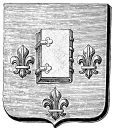
Fig. 382.—Banner of the Corporation of Printers-Booksellers of Angers.
Belonging to the Dukes of Burgundy, Philip the Bold, Jean sans Peur, and Philip the Good, we see a small Book of the Gospels and of the “Heures de la Croix” (a kind of prayer-book), with “a binding embellished with gold and fifty-eight large pearls, in a case made of camlet, with one large pearl and a cluster of small pearls;” the romance of the “Moralité des Hommes sur le Ju (jeu) des Eschiers” (the game of chess), “covered in silk, with white and red flowers, and silver-gilt nails, on a green ground;” a Book of Orisons, “covered in red leather, with silver-gilt nails;” a Psalter, “having two silver-gilt clasps, bound in blue, with a golden eagle with two heads and red talons, to which is attached a little silver-gilt instrument for turning over the leaves, with three escutcheons of the same arms, covered with a red velvet chemise.”[59]
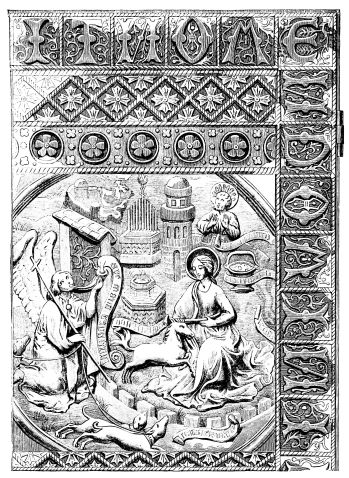
Fig. 383.—Fragment of an engraved and stamped Binding in an unknown Material (Fifteenth Century), representing the mystical Chase of the Unicorn, which is taking refuge in the lap of the Virgin.
(Public Library, Rouen.)
The chemise was a sort of pocket in which certain valuable books were enveloped. The “Heures de St. Louis” (St. Louis’s Prayer-book), now in the Musée des Souverains, is still in its chemise of red sandal-wood.
Belonging to the Duke of Orleans, brother of Charles VI., we find Végèce’s book, “On Chivalry,” “covered in red leather inlaid, which has two little brass clasps;” the book of “Meliadus,” “covered in green velvet, with two silver-gilt clasps, enamelled with the arms of his Royal Highness;” the book of Boèce, “On Consolation,” “covered in figured silk;” “The Golden Legend,” “covered in black velvet, without clasps;” the “Heures de Notre-Dame,” “covered in white leather.”
The same inventories give an account of the prices paid for some bindings and their accessories. Thus, in 1386, Martin Lhuillier, a bookseller at Paris, received from the Duke of Burgundy 16 francs (equivalent to about 114 francs French money of the present time), “for binding eight books, of which six were covered in grained leather;” on Sept. 19, 1394, the Duke of Orleans paid to Peter Blondel, goldsmith, 12 livres 15 sols, “for having wrought, besides the duke’s silver seal, two clasps” for the book of Boèce; and on Jan. 15, 1398, to Émelot de Rubert, an embroideress at Paris, 50 sols tournois, “for having cut out and worked in gold and silk two covers of green Dampmas cloth, one for the Breviary, the other for the Book of Hours of the aforesaid nobleman, and for having made fifteen markers (sinets) and four pair of silk and gold straps for the said books.”
The old style of thick, heavy, in some sort armour-plated, binding, could not exist long after the invention of printing, which, while multiplying books, diminished their weight, reduced their size, and, moreover, gave them a less intrinsic value. Wooden boards were replaced by compressed cardboard, nails and clasps were gradually laid aside, and stuffs of different kinds no longer used; only skin, leather, and parchment were employed. This was the beginning of modern binding; but bookbinders were as yet but mechanics working for the booksellers, who, when they had on their premises a bookbinding-room (Fig. 384), assumed, in their editions, the double title of libraire-relieur (bookseller-bookbinder) (Fig. 385). In 1578, Nicholas Eve still placed on his books and his sign-board, “Bookseller to the University of Paris and Bookbinder to the King.” No volume was sold unbound.
From the end of the fifteenth century, although bookbinding was always considered as an adjunct to the bookseller’s shop, certain amateurs who had a taste for art required richer and more recherché exteriors for their books. Italy set us the example of beautiful bindings in morocco, stamped and gilt; imitated, however, from those of the Koran and other Arabian manuscripts, which Venetian navigators frequently brought back with them from the East. The expedition of Charles VIII. and the wars of Louis XII. introduced into France not only Italian bindings, but Italian binders also. Without renouncing, however, at least for the livres d’heures, the bindings ornamented with goldsmith’s work and gems, France had very soon binders of her own, surpassing those who had been to them as initiators or masters. Jean Grollier, of Lyons, loved books too much not to wish to give them an exterior ornamentation worthy of the wealth of knowledge they contained. Treasurer of War, and Intendant of the Milanese before the battle of Pavia, he had begun to create a library, which he subsequently transported into France, and did not cease to enlarge and to enrich till his death, which happened in 1565. His books were bound in morocco from the Levant, with such care and taste that, under the supervision of this exacting amateur, bookbinding seemed to have already attained perfection.

Fig. 384.—Bookbinders’ Work-room, drawn and engraved in the Sixteenth Century, by J. Amman.
Princes and ladies of the court prided themselves on their love of books and the desire to acquire them; they founded libraries, and encouraged the works and inventions of good bookbinders who produced masterpieces of patience and ability in decorating the covers of books, either with enamelled paintings, or with mosaics made of different pieces inlaid, or with plain gildings stamped on the surface with small irons. It would be impossible to enumerate the splendid bindings in all styles that the French bookbinders of the sixteenth century have left us, and which have never been surpassed since. The painter, the engraver, and even the goldsmith, co-operated with the bookbinder in his art, by furnishing him with designs for ornaments. We now see reappearing some plates obtained from hot or cold dies, representing various subjects, and the designs from which they were taken, reproduced from those that had been in fashion towards the beginning of the sixteenth century, were often drawn by distinguished artists, such as Jean Cousin, Stephen de Laulne, &c.

Fig. 385.—Mark of William Eustace (1512), Bookseller and Binder, Paris.
Nearly all the French kings, especially the Valois, were passionately fond of splendid bindings. Catherine de Medicis was such a connoisseur of finely-bound books, that authors and booksellers, who eagerly presented her with copies of their works, tried to distinguish themselves in the choice and beauty of the bindings which they had made expressly for her. Henry III., who appreciated handsomely-bound books no less than his mother, invented a very singular binding, when he had instituted the Order of “Penitents;” this consisted of death’s heads and cross bones, tears, crosses, and other instruments of the Passion, gilt or stamped on black morocco leather, and having the following device, “Spes mea Deus” (“God is my hope”), with or without the arms of France.
It is impossible to associate these superb bindings with the usual and common work executed at the booksellers’ shops, and under their superintendence. Some booksellers of Paris and of Lyons, the houses of Gryphe and Tournes, of Estienne and Vascosan, paid a little more attention, however, than others of the fraternity, to the binding of books which they sold to the reading public; they adopted patterns of dun-coloured calf, in compartments; or white vellum, with fillets and arabesques in gold, fine specimens of which are now very rare.
At this period Italian bookbinding had reached the most complete state of decadency, while in Germany and other parts of Europe the old massive bindings,—bindings in wood, leather, and parchment, with fastenings of iron or brass,—still held their ground. In France, however, the binders, whom the booksellers kept in a state of obscurity and servitude, had not even been able to form themselves into a guild or fraternity. They might produce masterpieces of their art, but were not allowed to append their names to their works; and we must come down as far as the famous Gascon (1641) before we can introduce the name of any illustrious bookbinder.

Fig. 386.—Banner of the Corporation of Printers-Booksellers of Autun.