ARMS AND ARMOUR.
James Dafforne translation
Arms of the Time of Charlemagne.—Arms of the Normans at the Time of the Conquest of England.—Progress of Armoury under the Influence of the Crusades.—The Coat of Mail.—The Crossbow.—The Hauberk and the Hoqueton.—The Helmet, the Hat of Iron, the Cervelière, the Greaves, and the Gauntlet; the Breastplate and the Cuish.—The Casque with Vizor.—Plain Armour and Ribbed Armour.—The Salade Helmet.—Costliness of Armour.—Invention of Gunpowder.—Bombards.—Hand-Cannons.—The Culverin, the Falconet.—The Arquebus with Metal-holder, with Match, and with Wheel.—The Gun and the Pistol.
HE most ancient and authentic document that presents to us a just and almost perfect idea of the arms in use towards the end of the eleventh century, is the celebrated tapestry of Bayeux, of which we have already spoken.

It is sufficient to examine with some attention that complex and illustrated narrative of the conquest of England in 1066, to learn what was the general aspect of war at that period. But any one who has at all studied the ancient historians and the annals of our earliest career as a people, will not fail to recognise, as so many constituent parts combining to form the equipment of war, most of those weapons that were adopted among various races, the contests and the union of which was to give birth to modern nations.
If we can rely on the testimony of some miniatures in manuscripts of the time of Charlemagne, Roman customs are constantly recalled in the costume and arms of the warriors of the eighth and ninth centuries (Fig. 46), “but with the modifications necessarily resulting from contemporaneous corrupt taste,” as observed by M. de Saulcy, whom, it may be remarked, we follow step by step, as it were, in the labours which he has conscientiously devoted to the history of warlike arms; “for at that time the helmets, the bucklers, and the swords had assumed forms very unlike the models whereof they were supposed to be an imitation. One can readily imagine that costume had become subjected to the same sort of change as language, corrupted as this was by the admixture of German manners with those of the nations subjected to Rome.”
In the middle of the ninth century the Normans disembarking, possessed themselves of Neustria, and introduced among the French nation, with which they at first contended, and at length concluded a peace, an entire series of defensive arms entirely novel in form, if not in their nature. It is then, according to certain learned men, that warriors are seen, in illustrated manuscripts, attired in dresses furnished with small rings or iron scales, wearing pointed helmets, and using shields cut horizontally above, and terminating at the base in a point more or less sharp.
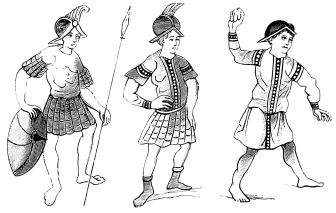
Fig. 46.—Gallo-Romano Soldiers. Fac-simile of Miniatures in the MS. of Prudentius. (Imp. Library of Paris.)
In the Bayeux tapestry we see the army of William that fought the battle of Hastings composed of three different bodies of troops: the archers, light infantry, armed with arrows and darts; foot-soldiers, or Heavy infantry, using weightier arms, and clad in iron mail; and cavalry, in the midst of which figures the Duke William (Fig. 47).
The costume exhibits little variety; only two sorts of accoutrements are observable; one very plain, worn by men who have no helmet, is evidently that of an inferior soldier; the other, covered with iron rings, not interlaced, extends from the shoulders to the knees, and belongs only to warriors whose head-dress is a narrow, conical helmet, more or less sharply pointed, extending behind (en couvre nuque) to cover the nape of the neck (Fig. 48), and in front provided with a metal protector for the face, called the nasal.
Among the horsemen thus encased in iron, are some who have boots and stirrups, others are without them, and even wear no spurs. Their shields are convex, secured to the arm by a leather strap, generally circular at top, and terminating in a point below. Some, however, are polygonal and convex, and in the centre show a rather long point.
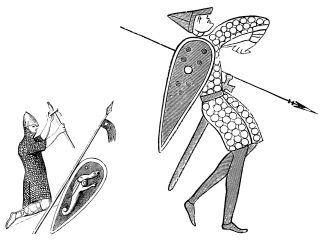
Fig. 47.—King William, as represented on his seal preserved in England.
Fig. 48.—Lancer of William’s Army.
Offensive arms consist of swords, axes, lances, javelins, and arrows. The swords are long, of uniform width nearly to the extremity which comes abruptly to a point, and have heavy, strong hilts. The axes exhibit no remarkable peculiarity. The spears terminate in an iron point, probably sharpened, and equal in length to one-sixth of the handle. We see also clubs, maces, and, finally, pronged staves (bâtons fourchus), doubtless the earliest form of the weapon; these last were subsequently called bisaguë, and, with maces and clubs, were ordinarily used by serfs and peasants; the sword and the spear being reserved for freemen.
The sling is not to be found in the hands of any warrior; but it is remarkable that, in the border of the Bayeux tapestry, it is used by a peasant aiming at a bird; from which it may be inferred that the sling had become a mere weapon for field-sport. Moreover, this was also the case with the bow among the French; which was again held in honour after the advent of the Normans, especially since the latter could ascribe to it their success at the battle of Hastings, where Harold, the opponent of William, was killed by an arrow. Nevertheless, the statutes of the Conqueror, who himself excelled with the bow, did not include that weapon among those of the nobility.
From the conquest of the Normans to the Crusades, we scarcely find anything worth notice, except the adoption of a very murderous implement of war, which acquired the name of the flail, or armed whip (fléau, or fouet d’armes); it was formed of iron balls studded with points, and was attached to the end of a strong staff by small chains. But we come to a period when the events which occurred in Asia had a considerable influence on the arms and the military costume of Europe. The first and principal of the importations due to those distant expeditions was that of the coat of mail, then in common use among the Arabs, and which has since been discovered in the sculptures of the period of the Sassanidæ, a royal race that ruled over Persia from the third to the seventh century.
It is not affirmed that prior to the first crusade we had no knowledge of iron chain-work, of which the Orientals made defensive helmets; but we imitated it only in a heavy and clumsy manner. This armour, which was of ponderous weight, and, besides, was far from rendering invulnerable those who were burdened with it, had not displaced the haubergeons, the jacques de fer, the brigandines, the armures à macles (Fig. 49), (such were the names given to the cuirasses of leather and of cloth covered with metal plates); but when such defensive armour came to be better known, with all its original good qualities; and when we had learned to make it according to the Oriental method, there was no further delay in adopting that network of iron (tricot) at once flexible, light, and, in some degree, impenetrable. However, since the manufacture of ancient armour was more simple, and consequently less costly, it was not altogether abandoned. It is only so late as the time of Philip Augustus and Louis IX. (the thirteenth century) that the use of coats of mail became general; to this some knights attached mail hose, to protect the thighs, legs, and feet (Fig. 50).
In the reign of Louis le Gros (twelfth century) we see the first attempt at a movable vizor adapted to the conical helmet of the Normans; and to the same period must be referred the invention of the crossbow: or, it may rather be said that a stock, or arbrier, was added to the bow, which afforded greater facility for stretching the string, and also aided in directing the arrow. This new weapon, after being exclusively used in the chase, appeared in warfare; but, in 1139, Pope Innocent II., confirming the decisions of the Council of Lateran, which had condemned it as too destructive, prohibited its use. The crossbow was not restored to military equipments until the third crusade, under Richard Cœur de Lion, who, having permitted his men to resume the weapon, was subsequently assumed to have invented it.
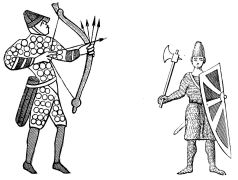
Fig. 49.—Norman Archer.
Fig. 50.—Jean Sansterre, as represented on his Seal. Reproduced by Meyrick.
During the first crusade, barons and knights wore a hauberk of links of iron or steel. Every warrior had a helmet—silver-plated for royalty, of steel for nobles, and of iron for the private soldiers. The crusaders used the lance, the sword, a kind of dagger called miséricorde, the club and the battle-axe, the sling and the bow.
In the windows which Suger, minister of Louis VII., caused to be painted for the church of the abbey of Saint-Denis, and which represented the principal events of the second crusade, we see the chiefs of the crusaders still clothed in hauberks of links, or macles (plates of iron); the helmet is conical and without the nose-piece (nasal); and, lastly, the buckler, formed like a scutcheon, covers the breast, generally suspended from the neck by a leather thong.
Towards the middle of the twelfth century, the iron breastplate is said to have been introduced; it was placed over the chest to support the hauberk, the direct pressure of which being found detrimental to health. But no description of it is to be met with in the romances of chivalry, that furnish the best documentary evidence regarding the armour of the twelfth and thirteenth centuries.
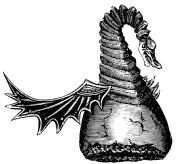
Fig. 51.—Helmet of Don Jaime el Conquistador (Armeria Real, Madrid.)
Under Philip Augustus, who, as we know, was one of the leaders of the third crusade, the conical helmet assumed a cylindrical form; to this was occasionally added a vizor called ventail, intended to protect the face. Richard I., King of England, is represented on his seal with this kind of helmet; level with the eyes and also at the height of the mouth are two horizontal slits, which admit of seeing and breathing. Still the use of the conical helmet without vizor or nose-piece was retained even to the thirteenth century in Spain, as is proved by that worn by Jaime I., King of Aragon (Fig. 51), which is preserved in the Armeria Real, Madrid. It is of polished steel, is surmounted by a dragon’s head, and portions of it are richly ornamented.
Thus in the third crusade the use of the “coat-of-arms” became general,—a sort of overcoat, if we may so term it, of cloth or of silk stuff, and the purpose of which, at first, was only to mitigate the insupportable effect of the rays of an Eastern sun on metal armour. This new garment soon served, moreover, when made of various colours, to distinguish different nations marching under the standard of the Cross (Fig. 52). It became really a dress of military splendour, was made of the richest stuffs, and embroidered in gold or silver with excessive refinement.
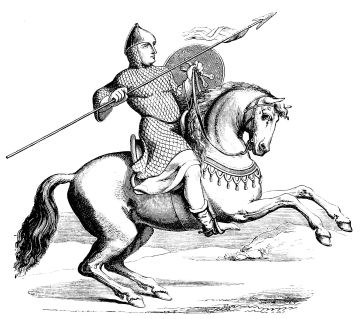
Fig. 52.—Knight in his Hauberk (after Meyrick).
The slingers, who had never been otherwise recruited than from the lower orders, disappeared from the French armies after the reign of St. Louis. As for the archers, those of England wore at that time, over the hauberk, a leather jacket, adopted subsequently by the French archers, and called jacque d’Anglois. An old author, in fact, thus mentions it:—
“C’étoit un pourpoint de chamois; Farci de bourre sus et sous; Un grand vilain jacque d’Anglois, Qui lui pendoit jusqu’aux genoux.”
The jacque having become the fashion in France was soon recognised in every kind of material more or less costly; it continued in use until the end of the fourteenth century; Charles VI. wore one of black velvet during a journey he made in Brittany.
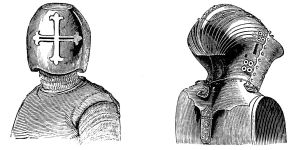
Fig. 53.—Helmet of Hughes, Vidame of Chalons. (End of Thirteenth Century.)
Fig. 54.—Tournament Helmet, screwed on the Breastplate. (End of Fifteenth Century.)
The casque, or helmet, from that time enclosing the head entirely, assumed, under St. Louis, the form of two truncated cones “réunis par leurs grandes bases.” In addition to the helmet there was also worn at that time the chapel de fer, which at first was only a simple cap underneath the hood of the hauberk; but when, curtailing the hood, a brim was added to the cap, it thus became a hat almost of the form of the felts now in use. To protect the neck there was also attached to the rim of the hat a tippet of mail, falling on the shoulders, and called camail.[5] The iron cap then took
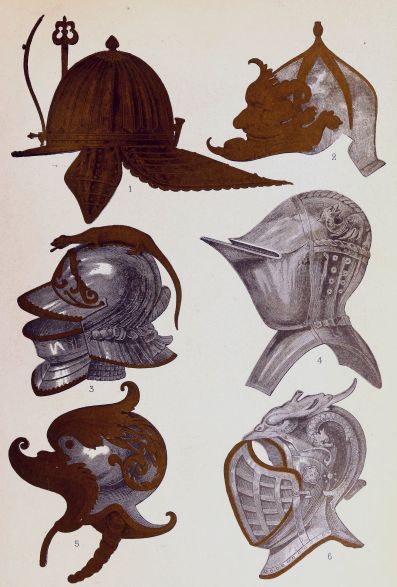
CASQUE, MORION, AND HELMETS.
With and without vizors, from the Armeria Real at Madrid.
the name of coiffre or cervelière, and later it became a kind of reversed pot concealing the entire head, and kept in position by its weight only (Fig. 53).
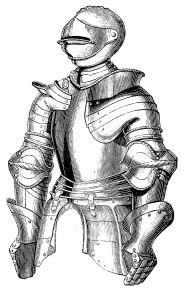
Fig. 55.—Plain Armour of the Fifteenth Century, about 1460. (Museum of Artillery, Paris.)
Again; there had for some time been manifested a movement which gradually caused the knights to be entirely cased in iron. A king of Scotland, contemporary with Philip Augustus, is represented on his seal with a plate of armour intended to protect the elbow. The knee-cap followed. Under Philip the Bold, successor of St. Louis, the iron grévières (greaves), or half leg-pieces, protecting the front of the legs, were adopted. In the reign of Philip the Fair we have the first example of an iron gauntlet with its fingers separate and jointed: previously it was merely an inflexible piece covering the back of the hand. About the same time the cervelière, either flat or spherical, became pointed at the top, and took the name of bassinet; but this bassinet was unlike the casque which, in the following century, retained that name and was made completely closed. The exact period of the transition from mailed armour to that of plain iron or steel, called also plate-armour, dates from the first thirty years of the fifteenth century (Fig. 55).
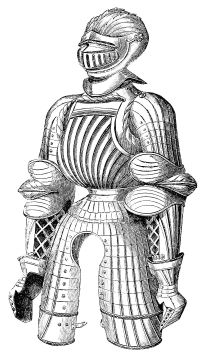
Fig. 56.—Convex Armour of the Fifteenth Century, said to be that of Maximilian. (Museum of Artillery, Paris.)
The annals of Florence contain a statute of 1315, requiring every horseman serving in a campaign to have a helmet, a breastplate, gauntlets, cuishes, and leg-pieces, all of iron; but in France and England the whole of these pieces were not adopted until somewhat later. In the reigns of Philip V. and Charles IV. we see the ventail of the helmet with a grating, and the vizor opening with a hinge. The bassinet, lighter than the helmet, was at first worn by the knight when no hostile encounter was anticipated; but subsequently, and at an early date, the vizor was added to the bassinet, as well as to the casque; and then it became as much used as the helmet, which, towards the end of the fourteenth century, was abandoned.
About the same period some portions of iron horse-armour began to make their appearance. We find entered in the inventory of the armour of Louis X., a chanfrein (a plate of iron fastened on the horse’s forehead).
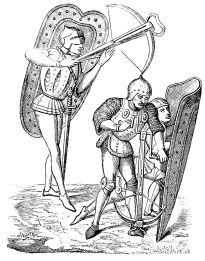
Fig. 57.—Crossbow Men protected by Shield-bearers. Fifteenth Century. After a Miniature from the Chronicles of Froissart. (MS. Bibl. Imp. de Paris.)
The crossbow, for some time prohibited by ecclesiastical authority, was the weapon most in use at the period spoken of; as having the double advantage of being drawn with more power than the ordinary bow, and of throwing its arrows to a longer distance with greater precision. Historians say that at Crécy, in 1346, there were fifteen thousand crossbow men in the French army. The Genoese were considered the most skilful in Europe; and next, those of Paris. A manuscript in the British Museum shows them wearing iron helmets, brassières,[6] and leg-pieces; and for body-covering, jackets with long, hanging sleeves. While the bowmen had both hands occupied in discharging their arrows, shield-bearers were employed to protect them by means of large bucklers (Fig. 57).
In the year 1338 the use of firearms is for the first time noted in France. But we think it right to reserve all we have to say of these modern offensive weapons until our history of the ancient system of armour is finished. Considering the early imperfections of firearms, the old system must have long continued, especially among combatants of noble degree—for they affected contempt for the new warlike equipments, by means of which personal valour became in a manner useless and could no longer ensure victory in battle.
Under John the Good, that is, in the middle of the fourteenth century, plain armour was generally adopted; the long coat of mail, heavier and less convenient, was entirely abandoned; but chain-armour still covered certain parts of the body not yet protected by iron plates. The bassinet, then very pointed, was furnished with mail, covering the neck and a portion of the shoulders. The upper part of the arm was protected by a half-armlet, called the épaulette, but the lower part was provided with mail.
Ornaments began to be introduced in armour in the reign of Charles V.; until that time it had a simple and plain appearance. For instance, the camail of the bassinet is embroidered on the shoulders with gold and silver, and the point surmounting it is decorated with an imitation of foliage—an ornament which, according to the “Chronicle of Du Gueslin,” had the disadvantage of presenting a kind of handle to an opponent. The cuirass, to which it was then deemed sufficient to impart a bright polish, or to paint in ordinary colours, sometimes bright, sometimes dark, began to be engraved and chased towards the end of the following reign.
In the time of Charles VI. there was introduced, for the first time, four or five flexible plates, called faldes, which protected the lower part of the stomach without impeding the movements of the body. A little later, tassettes were added; they were attached to the top of the thigh to guard the hips and the groin. It appears that at this period the artisans of Milan, were especially renowned for the manufacture of armour; for Froissart relates that Henry IV., King of England, when Earl of Derby,[7] and preparing to enter the lists with the Duke of Norfolk, requested armour from Galeas, Duke of Milan, who sent it with four Milanese armourers. The swords and spears made at Toulouse and at Bordeaux were also held in great repute; so also were the double-handed swords in use from the middle of the thirteenth century, and manufactured at Lubeck, in Germany. The steel helmets of Montauban were also much in request.
Towards the commencement of the fifteenth century, engines of war, distinct from those in which powder was used, had attained a remarkable degree of perfection. When John the Fearless, Duke of Burgundy, marched upon Paris, in 1411, there was with his army a considerable number of machines called ribaudequins, a species of gigantic crossbow drawn by a horse, and which with enormous strength threw javelins to a great distance.
Under Charles VII., the breastplate of the cuirass was composed of two parts: one covered the breast; the other, reaching to the hips, protected the stomach, and was attached to the former by clasps and leather straps. Generally the breastplate was convex.
Taught by the disastrous defeat of Agincourt,—where ten thousand men, of whom eight thousand were of the nobility, had fallen, owing to the precision and the celerity of the fire of the English archers,—Charles VII. instituted in France the franc archer (Fig. 58), who wore the salade and the jacket or brigandine, and carried the dagger, the sword, the bow, the quiver or crossbow garnie. These archers were exempt from all taxes or imposts; their equipments were declared not distrainable for debts, and during war they received pay at the rate of four livres a month.
The salade, a part of armour which has remained particularly celebrated, and the name of which has been applied subsequently to helmets of divers forms, is pre-eminently the helmet of the epoch of Charles VII. At first it was a head-dress for war, composed of a simple cap (timbre), that covered the top of the head, with a pendent piece of metal of greater or less length at the back, which sometimes was made for protecting the neck, and
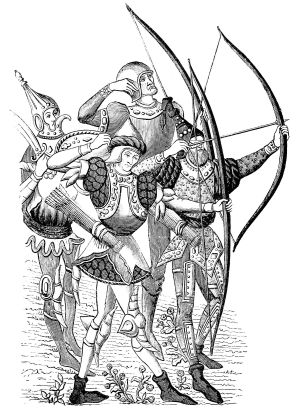
Fig. 58.—Franc Archers (Fifteenth Century), from the Painted Hangings of the Town of Rheims.
sometimes to guard a portion of the shoulders. Towards the end of the fifteenth century there was added to the salade a small vizor, that was gradually lengthened downwards to near the upper lip, and in which a narrow opening was then made for the sight. In the reign of Louis XII. the salade received a chin-piece, the lower part of which was a gorget, that surrounded and protected the neck. The top of the cuirass had a cord, to which was attached the salade; and this helmet, so different to the primitive salade, continued to bear the same name (Fig. 59).
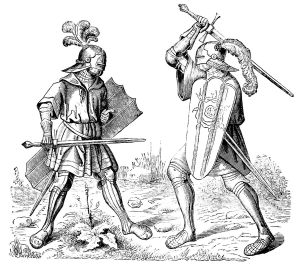
Fig. 59.—Knights in complete Armour, with the Salade. (End of Fifteenth Century.) A Single Combat, taken from “The Triumph of Maximilian,” by Burgmayer, after a drawing by Albert Dürer.
The brigandine, recalling the early armour abandoned for the coat of mail, was composed of small plates of steel or iron arranged on a strong piece of leather, and stitched or fixed with wire, in the form of the scales of a fish. A decree of Peter II., Duke of Brittany, issued in 1450, ordered the nobles to equip themselves as archers, or in brigandine, if they knew how to use arrows; but otherwise, to be provided with guisarmes, with good salades, and leg-armour; each noble was to be attended by one coustillier, and to have two good horses. The guisarme was a sort of two-edged and pointed javelin. The coustillier was a foot-soldier, or a horseman, whose duty it was to act as a servant to the nobleman, and to carry the coustille, a long, slender sword, triangular or square, apparently resembling the foil in our fencing-rooms.
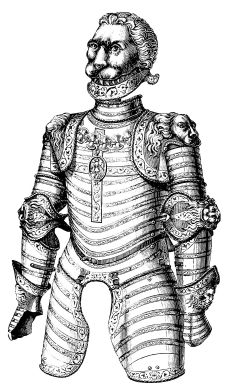
Fig. 60.—Armour ornamented with Lions, supposed to be that of Louis XII. (Museum of Artillery, Paris.)
About this period French noblemen displayed much magnificence in the adornment of the chanfrein of their horses. For instance, we know that at the siege of Harfleur, in 1449, the charger of the Count de Saint-Pol had on its head a massive gold chanfrein, of the most delicate work, valued at not less than twenty thousand crowns. In the same year, at the siege of Bayonne, the Count de Foix entered the conquered city mounted on a horse whose chanfrein of polished steel was enriched with gold and precious stones to the value of fifteen thousand gold crowns.
Half a century later—that is, in the reign of Charles VIII. and that of Louis XII.—chargers wore, besides the chanfrein, the manefaire, protecting the neck, the poitrail, the croupière, the flancois, which respectively covered the chest, the back, and the flanks of the horse; and to these was added another piece of armour placed under the tail.
Of the date of Louis XII., we still see embossed suits of armour ornamented with fluting, sometimes blended with beautiful engraved work executed in the metal by the use of aquafortis, or subjects in relievo produced by embossing: ornamentation of this nature elevated the equipments of the warrior to real works of art (Fig. 60).
Louis XII. was the first to admit Greek mercenaries into his army. These were named stradiots; they tendered their military services equally to both Turks and Christians. The armour of these troops consisted of a cuirass with sleeves and gauntlets in mail, and over this a jacket; on their head a vizorless helmet was worn. The stradiots were armed with a large sword, called a braquemart, much resembling the Turkish sword, but with a cross-handle; the sword and its scabbard were ornamented with Grecian devices. They carried in addition several small arms at the saddle-bow, and also a zagaye, a very long lance, tipped at both extremities with iron.
At this period also was introduced the pertuisane,[8] the blade of which, wider than that of the lance, formed a crescent immediately above the handle.
There were at that time two kinds of cross-bows—one for discharging bolts, the other for bullets. The bow was slung by means of a moulinet, a kind of hand-winch.
Embossed and fluted armour was not the only kind used in France and in Italy at the end of the fifteenth and the commencement of the following century. The monuments in the former country of the time of Louis XII., and on the other side of the Alps, show how prevalent was a peculiar description of plain armour, whereof the cuirass, which was longer than that of the embossed armour, had a rib or raised line in the middle. This rib, which completely altered the character of the cuirass, in that it served to turn aside the thrust of the lance, became increasingly distinctive as the seventeenth century drew near.
In the reign of Francis I. embossed and ribbed armour were equally
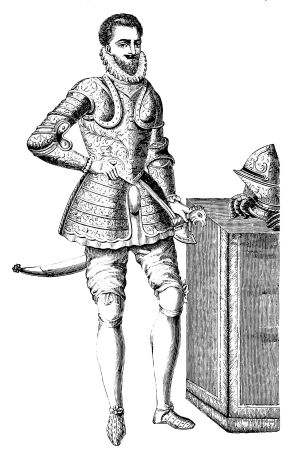
Fig. 61.—Damaskeened Armour of the end of the Sixteenth Century. (Portrait of François, Duc d’Alençon, from Montfaucon’s “La Monarchie Françoise.”)
used (Fig. 61). In the Museum of Artillery, in Paris, is preserved the armour which that king wore at the battle of Pavia. The body is longer than in the cuirass of the preceding century, the rib in the centre is more raised, the gusset of the shoulder-piece is made of several movable plates, and of large size. The casque, a generic name given since those times to all descriptions of head-armour, assumed a comfortable and elegant shape, which was maintained as long as the use of armour continued.
Another cuirass of the same date, still longer in the body, was made to turn up towards the lower extremity, and then took an inward bend to fit the hip. It was made with movable plates overlapping from below; this allowed the wearer to stoop, which it was almost impossible to do when the breast-piece and the back-piece were in one. Sometimes these plates were only three or four in number over the stomach, and the others over the breast were only represented, not genuine plates.
The armour called à éclisse, or à écrevisse, worn at a certain period by the halberdiers, must not be passed over; it received this name because the cuirass was made of horizontal plates (éclisses), three or four inches in width, which, though they covered the entire body, did not in any way impede its movements.
We must, however, refer to a peculiarity in this armour which prevented its general adoption; it was that as the movement or “play” of the éclisses made it convenient to wear, so from this flexibility it was found that the plates frequently became disconnected, and thus left a part of the body defenceless. In making the éclisses to overlap from below, regard was had to the usual direction of a sword-cut or dagger-thrust, which usually came from below; but there was all the more danger from blows of the martel[9] and battle-axe, the stroke of which weapon was directed downwards.
Bronzed armour came in about the middle of the sixteenth century, and was somewhat commonly worn in 1558; it was introduced on account of its being far more easily kept clean than polished steel. For the same reason black armour was tried, but the engravings and chasings, the gildings and damaskeenings were more effective on the greenish ground; consequently black varnish was given up in favour of bronze. At the end of the sixteenth century, and during the long civil wars which desolated France, armour took a variety of shapes, and as regards ornamentation at least, there was generally to be seen a strange medley of the style of the previous century with that of the period (Fig. 61). However, the decline of the use of armour, which became in a measure inevitable, was at hand.
De la Noue, an eminent Huguenot officer of the time of Charles IX., says, in his “Discours Militaires”—“The penetrating power of pikes and arquebuses has very naturally led to the adoption of armour stronger and more capable of great resistance than formerly. It is now so heavy that one is laden with anvils rather than protected by armour. Our men-at-arms and light cavalry in Henry II.’s time presented a much finer appearance, with their helmets, their brassarts, tassets,[10] and the morion,[11] carrying the lance with a flag; their armour was not so heavy but that a strong man was able to support its weight for twenty-four hours; but those of the present day are so ponderous that a young knight of thirty has his shoulders quite crippled.”
Thus, in endeavouring to make the resistance of armour keep pace with the improvement in new warlike engines, they rendered it useless; because the weight was intolerable, especially in warm weather, during long marches, or in lengthened combats. Having vainly tried to make suits of armour invulnerable, men began to leave off wearing such portions as were of minor importance, which by degrees were entirely discontinued. Under Louis XIII. we see armour undergoing further modifications, but of fashion rather than of utility: finally, there is every reason to think that the magnificent armour presented by the Republic of Venice to Louis XIV., in 1668, and which is now to be seen in the Museum of Artillery in Paris, was one of the latest sets made in Europe.
Let us now retrace our steps to examine a series of arms, the gradual adoption of which was destined to completely change the art of warfare.
It is now the almost universal opinion that the invention of gunpowder,—assumed to have been discovered in 1256, or at all events its application to artillery, which first dates from 1280,—is due to Berthold Schwartz, an Augustin friar, born at Fribourg. Some writers, however, make these dates a century later, and affirm that powder and cannons were first known from 1330 to 1380. Nevertheless, the employment of artillery only became general during the wars of Charles-Quint and of Francis I., that is, towards 1530, or two centuries after its invention.
But perhaps in place of giving, as we have done, the unconditional acceptation to the word artillery which it now has, we ought perhaps to have said artillery used with gunpowder; for long before the invention of gunpowder the word artillery was employed when speaking of all machines or engines of war (Fig. 62). Thus in the middle of the thirteenth century we find among the personnel of the artillery a grand master of the crossbow men, masters of the engines, of the cannoniers (the word cannon was even then applied to the tube forming one of the principal portions of an engine for hurling projectiles), and in 1291 we see Philip the Fair appointing a grand master of the artillery of the Louvre.
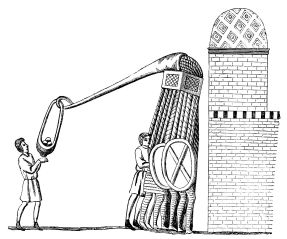
Fig. 62.—Engine for hurling Stones; taken from a Miniature of the Chevalier au Cygne. (Bibl. Imp. de Paris, No. 340, S. E.)
In order to follow methodically the progress of the manufacture of arms such as we shall call novel, we will, in the first place, treat separately of the engines of large calibre which were first employed, and then of portable arms.
The earliest allusion to cannons in France is found in 1338, in an account of the treasurer of war, wherein we read:—“To Henri de Vaumechon, for buying powder and other necessaries for cannons,” which had been used at the siege of Puy-Guilhem, in Périgord.
In Froissart, we next find that, in 1340, the inhabitants of Quesnoy, when repelling the attack of the French, made use of bombards and cannon which hurled huge bolts at the besiegers. But the statement of Villani, that the English were indebted to the employment of artillery for the victory of Crécy, in 1346, must be treated as a pure invention, because it is certain that the firearms which may have been in use at that time were in no way suited to field warfare; and that they were only employed with the older engines in the attack and defence of fortresses. Not only did their cumbrous weight and the rude construction of their carriages render them extremely difficult of transport, but, intended as they were to be employed as catapults, they were generally constructed for hurling heavy projectiles, by causing these to describe a curved line, like modern shells; and their shape is, in fact, much more like that of our mortars than of cannon (Fig. 63).
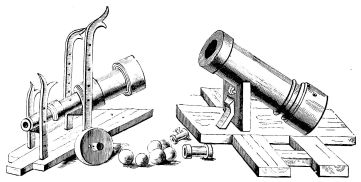
Fig. 63.—Bombards on fixed and rolling carriages. (From the MSS. 851 and 852, Bibl. Imp. de Paris.)
“It would seem,” says M. de Saulcy, “that, in loading them, hollow cylinders (manchons), or movable chambers, were used, in which the charge was previously laid; and these fitted, by means of a wedge, into the body of the piece. Sometimes these cylinders were at the side, and formed a right angle with the axis of the piece, but usually they fitted into the breech, of which they formed a prolongation.”
The name bombards, which we have just used, and which is derived, as we may conclude, from the Greek bombos (noise), was the first employed for designating cannon; but these engines were so imperfect in principle, and so feeble in power, that catapults, which had played so signal a part in sieges during the Middle Ages, were used in preference when very heavy projectiles had to be hurled (Fig. 64).
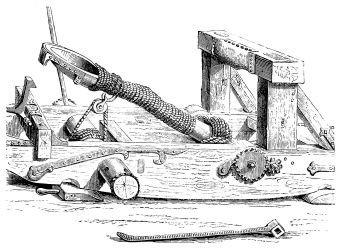
Fig. 64.—Mangonneau; an Engine of War of the Fifteenth Century. (Miniature in the MS. 7,239, Bibl. Imp. of Paris.)
Originally the piece rested, as it were, fixedly on a massive support; but soon the means of sighting had to be considered; thus we see depicted in early manuscripts pieces that could be moved up and down by means of trunnions; or which were elevated or depressed for firing by a sort of tail or long projection behind the tube; at other times the muzzle of the cannon is sustained by a fork more or less buried in the ground. This bombard, attached to a platform on wheels, received the denomination of cerbotana ambulatoria; this last word conveying the idea of the movability of the engine.
We have seen that projectiles were of stone, but there is no doubt that from the fourteenth century they were also made of metal; that was nothing new, for ancient engines of war, including the sling, threw leaden balls and masses of red-hot iron. No doubt it was with the object of giving the largest size possible to projectiles of artillery by means of powder that stone was used; which, in the state of the art at that time, was much better adapted than metal for large balls.
Christine of Pisa, who wrote in the time of Charles VI. the “Livre des Faits d’Armes et de Chevalrie,” has left us a collection of very interesting details of the condition of artillery used with powder, which, as early as the fifteenth century, had become much more extended than would be easily believed; moreover, in the descriptions this author gives of armaments, or of narratives of battles, we almost always still see catapults, the large cross-bows, &c., appearing by the side of cannon; a certain proof that the use of powder found its equivalent in more than one instance in the ancient means of the propulsion of projectiles.
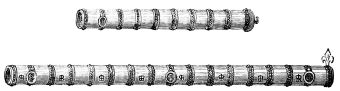
Fig. 65.—Earliest Models of Cannon. In the Tower of London.
Valturio, an Italian writer, whose treatise on military art was first printed in 1472, has described and drawn all the engines of war then in use. Cannons are not forgotten. We observe that the greater number of these pieces have no longer any box forming a movable chamber; this implies an important advance in the art of making them; but, on the other hand, these cannons, bound with cords to a block of wood, or resting on platforms, must have been very difficult to move.
At this period pieces of the largest calibre, which projected enormous balls of stone, were more commonly called bombards; mortars, the very short cannons throwing heated projectiles; cannons, pieces of medium calibre carrying iron projectiles (Fig. 65); culverins, the long pieces loaded with leaden balls, which, as well as the powder, were rammed in with an iron rod; hand-cannons, or bâtons à feu (Fig. 66), were in a manner portable, for if they were handled by one man, it was never without his having recourse to another for firing them.
This last-named term, bâtons à feu, like that of cannon, existed before the invention of gunpowder. As swords and lances had often been designated under the generic name of bâtons, it followed that the name which implied arms in general should also be applied to the earliest portable firearms. In ancient royal ordinances we even see the term gros bâtons used to designate large pieces of artillery.
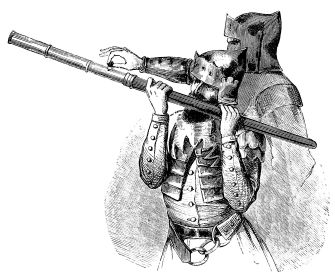
Fig. 66.—Hand Cannon (or Bâton à feu), taken from a piece of Tapestry belonging to the Church of Notre Dame de Nantilly, Saumur.
According to M. de Saulcy, the most important improvement ever made in artillery is certainly that which consisted in placing a gun with trunnions on a carriage à flasques—upright beams of wood, between which the gun can oscillate, and united by cross-pieces; this carriage was mounted on wheels, and admitted of the gun being inclined by the simple use of a wedge of wood placed under the breech. But, strangely enough, it is most difficult to state precisely the date of this improvement. Nevertheless, circumstances tend to the belief that it was between 1476 and 1494—that is, during the reigns of Louis XI. and of Charles VIII.—that they succeeded in making pieces of all calibres carrying iron shot, and also in solidly fixing the trunnions, which not only supported the weight, but also resisted the recoil of the cannon. The carriages for these guns were mounted on wheels. From this period the art of fortifying towns underwent a complete revolution, which suddenly changed the whole system.
When, in 1494, Charles VIII. entered Italy to conquer the kingdom of Naples, the French artillery produced universal admiration. The Italians had only iron guns, drawn by bullocks in rear of the army, and more for appearance than for use. After the first discharge it was some hours before the gun was ready for a second. The French had lighter cannon of bronze, drawn by horses, and moved with so much order that their transport hardly delayed the march of the army; they planted their batteries with incredible promptitude, considering the period, and the rounds were as quickly delivered as they were well aimed. Cotemporaneous Italian writers say that the French used almost exclusively iron shot, and that the guns, both of large and small calibre, were admirably balanced on their carriages.
Yet no single specimen, or even a drawing, of this remarkable artillery has been handed down to us. The Museum of Artillery does, indeed, possess one small piece, on which, between the trunnions and the breech, is this inscription:—“Presented by Charles VIII. to Bartemi, Lord of Pins, captain of the bands of artillery, in 1490.” This cannon presents nothing remarkable in its construction, for we already recognise the form, one that has scarcely varied since then, and which, it seems, was definitely adopted under Louis XII. and Francis I. Of this period we still have two magnificent bronze cannons. They were found at Algiers in 1830; the porcupine, the salamander, and the fleur-de-lys that ornament them, made their origin known.
Artillery, which in the reign of Charles VIII. had become an important arm, and had, besides, the prestige of success in Italy, became a subject to which particular attention was given in succeeding reigns. But, we again say, the true principles of manufacture and mounting were already well ascertained, and only improvements in matters of detail remained to be discovered.
The Armoury Real of Madrid contains a curious dragonneau,[12] cast at Liège in 1503, which figured in the siege of Santander in 1511 (Fig. 67). The carriage, consisting of a single piece of carved oak, is by its delicacy and finish worthy of sustaining this masterpiece of bronze-work, which presents a double interest, first as regards art, and then on account of the rapid advance already made in firearms; for this dragonneau has a double barrel, and is loaded at the breech.
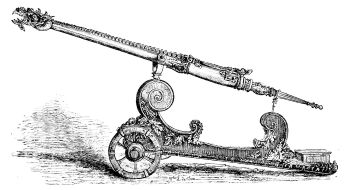
Fig. 67.—Double-barrelled Dragonneau. Armoury Real of Madrid.
Having arrived at this point, let us again retrace our steps, in order to note, and rapidly follow from its origin, the progress of firearms.
The earliest of these used in the middle of the fourteenth century were called hand-cannon, and were merely formed of an iron tube pierced with a vent, without stock or lock.
A manuscript of that period represents a warrior who, standing on one of those little movable towers then forming part of the siege matériel, is shooting a stone with a gun of this description. The piece is resting on the parapet. By the side a sling is placed with its stone—a circumstance which indicates the relative power of the hand-cannon, as no doubt each engine was to be used alternately. In another place is a horseman holding a small gun with a prolongation; the muzzle is supported by a prong fixed on the pommel of the saddle. Thus it was impossible for him to take aim, and he applied the fire with his hand.
A little later, to prevent the effect of the recoil, there was added below the barrel, a little short of the centre, a sort of hook, intended to serve the purpose of checking the piece. When fired, it was supported on a fork or on a wall; hence the name of arquebuse à croc, which took the place of that of canon à main.
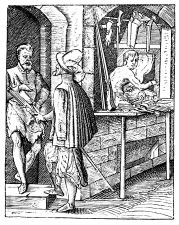
Fig. 68.—Arquebusier. Drawn and Engraved by J. Amman.
The arquebuse à croc sometimes weighed from fifty to sixty pounds, measured from five to six feet in length, and in principle was chiefly adapted for firing from a wall; it was lightened a little that it might be used by foot-soldiers, who, however, never fired it without a fixed or a movable rest.
The inconvenience of applying fire with the hand, which, moreover, prevented the right direction of the missile, was soon partially superseded by adapting to the barrel a stock to fire from the shoulder, and a lock for a match, called a serpentin, which had only to be let down to ignite the powder at the touch-hole. This was the matchlock arquebus still used by certain Eastern nations in our time, and which secured victory to the Spaniards at the battle of Pavia.
Although the matchlock arquebus, which was made lighter, and was then called mousquet, continued to be the usual arm of infantry until the time of Louis XIII., many serious objections to the use of the serpentin continued. It compelled the soldier always to have a lighted match, or some means of striking a light. Besides, for nearly each shot it was necessary so to regulate the match that the end of it, which was placed in the head of the serpentin (lock), should come exactly into the priming-pan; then the priming-pan had to be opened; these operations were, so to speak, impossible for mounted men, who at the same time had to manage their horses.
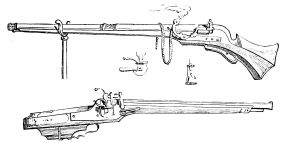
Fig. 69.—Arquebus with Wheel and Match.
About 1517 the Germans invented the screw-plate called à rouet,—wheel-lock (Fig. 69).
To the Spaniards is due the merit of the improvement that followed, the type of which is still in a measure perpetuated in our percussion guns; which, in their turn, have just been replaced by the needle-gun. The Spanish screw-plate, often called the miquelet screw-plate, had on the outside a spring, which pressed, at the extremity of its movable limb, on one of the catches of the hammer; when the gun was cocked the other catch pressed against a pin which projected from the inside and traversed the screw-plate; this pin could be removed, and then the spring acted on the hammer, which was no longer held back; the flint (for at that time a flint was fitted to the gun) struck upon a ribbed plate of steel forming part of the cover of the priming-pan, the action of the flint on the plate produced the fire.
Among the arms in use during the sixteenth century was one called petrinal or poitrinal (petronel), on account of the bent stock, which rested on the chest. This short and heavy arquebus, which could only throw balls, but of a very large size, to a short distance, was usually suspended from the shoulder by a strap or a broad cross-belt.
Light troops were armed with these guns, and took the name of carabins; from this the weapon was next called carabine—a designation which since then has received quite another meaning.
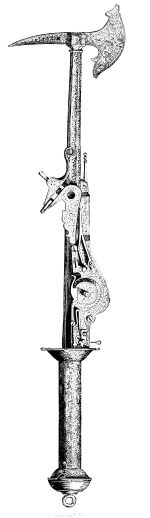
Fig. 70.—Battle-axe and Pistol of the 16th Century. (Museum of Artillery, Paris.)
Then followed the pistoles and the pistolets, thus named, it is said, because they were invented at Pistoia; but, with other etymologists, we can also believe that they owed the name to the fact of their bore being of equal diameter with that of the pistole, a coin of the time. The earliest pistols were made with wheels (à rouet), and the barrel did not measure more than a foot in length. Subsequently they varied in shape and in use; some were made which fired several shots in succession, and in other cases they attempted to combine a pistol with the dagger or the battle-axe. (Fig. 70, &c.) This is a notably fine specimen.
We must not forget to note, in what may be called les armes de luxe, the joint application of the match-holder and the wheel to highly-finished arms, this combination being available.
The screw-plate à miquelet, improved by French experiments, led to the mechanism called flint-lock (fusil). There were also then pistols and arquebuses with flint-locks, as formerly there had been pistols and arquebuses with wheels. Subsequently the explanatory became the absolute term, and the entire weapon was known as fusil.
Fig. 71.—Banner of the Sword-cutlers of Angers.