GLASS-PAINTING.
James Dafforne translation
Painting on Glass mentioned by Historians in the Third Century of our Era.—Glazed Windows at Brioude in the Sixth Century.—Coloured Glass at St. John Lateran and St. Peter’s in Rome.—Church-Windows of the Twelfth and Thirteenth Centuries in France: Saint-Denis, Sens, Poitiers, Chartres, Rheims, &c.—In the Fourteenth and Fifteenth Centuries the Art was at its Zenith.—Jean Cousin.—The Célestins of Paris; Saint-Gervais.—Robert Pinaigrier and his Sons.—Bernard Palissy decorates the Chapel of the Castle of Ecouen.—Foreign Art; Albert Dürer.
E have already established the fact that the art of manufacturing and colouring glass was known to the most ancient nations; and, says Champollion-Figeac, “if we study the various fragments of this fragile substance that have been handed down to our time, if we take into consideration the varied ornamentation with which they are covered, even the human figures which some of them represent, it would be difficult to assert that antiquity was unacquainted with the means of combining glass with painting. If antiquity did not produce what are now called painted-windows, the real cause doubtless was because the custom of employing glass in windows did not then exist.” Some few specimens of it have, however, been found in the windows of the houses exhumed at Pompeii; but this must have been an exception, for the third century of our era is the earliest date in which traces are found in history of window-glass being used in buildings; and we must bring down our researches as late as the times of St. John Chrysostom and St. Jerome (the fourth century) in order to find any reliable affirmation as to its adoption.
In the sixth century Gregory of Tours relates that a soldier broke the glass-window of a church at Brioude in order to enter it secretly and commit robbery; and we know that when this prelate caused the restoration of the Church of St. Martin of Tours, he took care to fill its windows with glass “of varied colours.” About the same time Fortunatus, the poet-bishop of Poitiers, highly extols the splendour of the glass-window of a church in Paris, the name of which he does not mention; but the learned investigations of Foncemagne with reference to the first kings of France inform us that the church built at Paris by Childebert I. in honour of the Holy Cross and St. Vincent, as well as the churches of Lyons and Bourges, were closed in with glass-windows. Du Cange, in his “Constantinople Chrétienne,” describes the glass-windows of the basilica of St. Sophia, rebuilt by Justinian; and Paul, the Silentiary,[28] dwells with enthusiasm on the marvellous effect produced by the rays of the sun upon this assemblage of various coloured glasses.
In the eighth century, the epoch at which the use of glass-windows was becoming general, the basilica of St. John Lateran and the Church of St. Peter at Rome possessed coloured glass-windows; and Charlemagne, who had caused mosaics of coloured glass to be made in a large number of churches, did not fail to avail himself of this kind of ornament in the cathedral erected by him at Aix-la-Chapelle.
Up to this time the only method of making glass was in small pieces, generally round, and designated by the name of cires, a number of which by means of a network of plaster, wooden frames, or strips of lead, were used to fill up the windows. This material being, however, very costly, it could only be introduced into edifices of great importance. Added to this, it can scarcely be a source of wonder if, at a time when all branches of art had relapsed into a sort of barbarism, and glass was only exceptionally employed in ordinary purposes, no one thought of decorating it with painted figures and ornaments.
With regard to mosaic, either in marble or coloured glass, Martial, Lucretius, and other writers of antiquity, mention it in their works. Egypt had a knowledge of it even before Greece; the Romans were accustomed to employ it in ornamenting the roofs and pavement of their temples, and even their columns and streets. Some magnificent specimens of these decorations have remained to our time, and they are considered as inseparable from the architecture of the emperors.
Some have desired to attribute the custom of employing coloured glass in mosaics to the rarity of coloured marbles. Would it not be a more probable hypothesis that the simultaneous use of marble and glass for this purpose was the result of improvements in the art of making mosaics? for glass that, by metallic mixtures, may be brought to a variety of colours, is much more easily adapted to pictorial combinations than marble, the tints of which are the result of the caprices of nature. Seneca, alluding to the use of coloured glasses in mosaic, complains of people not being able “to walk except on precious stones;” this shows how prevalent the use of rich mosaics had become in Rome. But this art must have singularly fallen into decay, for the few examples of the kind we now possess, which date from the first centuries of Christianity, are marked with a character of simplicity that fully harmonises with the rudeness of the artists of those times. Among these specimens must be mentioned a pavement discovered at Rheims, upon which are represented the twelve signs of the zodiac, the seasons of the year, and Abraham’s Sacrifice; another on which are depicted Theseus and the labyrinth of Crete, in juxtaposition with David and Goliath. It is, moreover, known that there existed in the Forum of Naples a portrait in mosaic of Theodoric, king of the Goths, who had caused a representation of the Baptism of Christ to be executed, in the church of Ravenna, by the same process. Sidonius Apollinaris, describing the excessive luxury of Consentius at Narbonne, speaks of arches and pavements ornamented with mosaics. The churches of St. John Lateran, St. Clement, and St. George in Velabro, at Rome, still display mosaics of this period. Lastly, Charlemagne caused the greater part of the churches constructed by him to be ornamented with mosaics.
To return to glass-work, we find that in the time of Charles the Bald, in 863, mention is made of two artisans, Ragenat and Balderic, who became as it were the heads of the race of French glass-makers. We also learn from the chronicle of St. Benignus of Dijon, that in 1052 there existed in that church a “very ancient painted window,” representing St. Paschasie, which was said to have been taken from the earlier church. We have therefore a right to conclude that at this period the custom of painting on glass had long been common.
In the tenth century glass-makers must have acquired some degree of importance, for the reigning Dukes of Normandy of that era established certain privileges in their favour; but, says Champollion-Figeac, “as all privilege was the prerogative of the order of nobility, they contrived to give them to noble families whose fortunes were precarious. Four Norman families obtained this distinction. But although it was understood that in devoting themselves to the trade these titled individuals incurred no degradation, it was never said, as is commonly believed, that the profession of this art conferred nobility; on the contrary, a proverb arose which long continued in use, namely, that ‘in order to make a gentleman glass-maker, you must first take a gentleman.’”
Although painting on glass was from that time carried on with considerable activity, in many cases it was still very far from being accomplished by the processes which were destined to make it one of the most remarkable productions of art. The application of the brush to vitrifiable colours was not generally adopted. In the examples of this period that remain to our days, we indeed find large cives cast in white glass, upon which characters were painted by the artist; but, as the colour was not designed to be incorporated with the glass by the action of fire, with a view to ensure the preservation of the painting, another transparent but thick cive was placed over the first and closely soldered to it.
While glass-painting was thus seeking to perfect its processes, mosaic work gradually declined. Only a very small number of mosaics of the tenth and eleventh centuries exist at the present day, and these, moreover, are very incorrect in design, and entirely wanting in taste and colour.
In the twelfth century all the arts began to revive. The fear of the end of the world, which had thrown mankind into a strange state of perturbation, was dissipated. The Christian faith everywhere stirred up the zeal of its disciples. Magnificent cathedrals with imposing arches sprang up in various places, and the art of the glass-maker came to the aid of architecture in order to diffuse over the interiors consecrated to worship the light, both prismatic and harmonious, which affords the calm, necessary for holy meditation. But though, in the painted windows of this period, we are forced to admire the ingenious combinatian of colours for the rose-work (rose-windows), the case is very different as regards the drawing and colouring of the designs. The figures are generally traced in rough, stiff lines on glass of a dull tint, which absorbs all the expression of the heads; the entire drapery of the costume is heavy; the figure is spoilt by the folds of
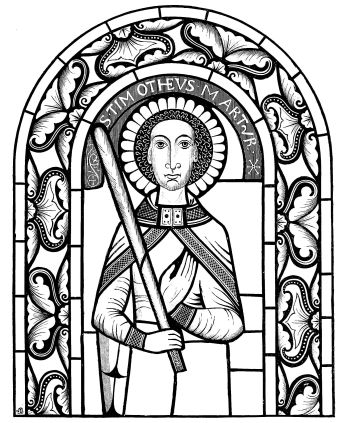
Fig. 231.—St. Timothy the Martyr, Coloured Glass of the end of the Eleventh Century, found in the Church of Neuwiller (Bas-Rhin) by M. Bœswillwald. (From the “History of Glass-Painting,” by M. Lasteyrie.)
its vestments as if it were enclosed in a long sheath. This is the general character of the examples of that period as they are known to us (Fig. 231).
The painted windows which Suger made to adorn the abbey-church of St. Denis, some of which exist in our days, date from the twelfth century. The abbot made inquiries in every country, and gathered together at a great expense the best artists he could find, in order to assist in this decoration. The Adoration of the Magi, the Annunciation, the History of Moses, and various allegories, are there represented in the chapel of the Virgin and those of St. Osman and St. Hilary. Among the principal pictures may be also observed a portrait of Suger himself at the feet of the Virgin. The borders surrounding the subjects may be considered as models of harmony and good arrangement of effect; but still the taste shown in the selection and combination of colours is carried to the highest point in the subjects themselves, the designs of which are very excellent.
In the Church of St. Maurice, at Angers, we find examples of a rather earlier date—perhaps the most ancient specimens of painted windows in France; these are the history of St. Catherine and that of the Virgin, which, in truth, are not equal in merit, as regards execution and taste, to the ancient windows of the Church of St. Denis.
We still have to mention some fragments contained in the Church of St. Serge, and the chapel of the Hospital, in the town of Angers; also a glass-window in the Abbey of Fontevrault; another in the Church of St. Peter, at Dreux, in which is represented Queen Anne of Brittany. We will, in conclusion, mention one of the windows of the choir in the Church of the Trinity, at Vendôme; it represents the Glorification of the Virgin, who bears on her forehead an aureola, the shape of which, called amandaire,[29] has furnished archæologists with a subject for long discussions; some being desirous of proving that this aureola, which does not appear to be depicted in the same way on any other painted window, tends to show that the works of the Poitevine glass-makers, to whom it is attributed, had been subject to the influence of the Byzantine school; others assert that the almond-shaped crown is a symbol exclusively reserved for the Virgin. Before we proceed to the examples handed down to us from the twelfth century, we must mention some remains of glass to be seen at Chartres, Mans, Sens, and Bourges (Fig. 232), &c. We may also add, as an incident not without interest, that a chapter of the order of the Cistercians, considering the great expense to which the acquisition of painted windows led, prohibited the use of them in churches under the rule of St. Bernard.
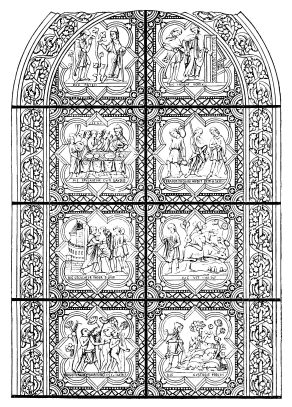
Fig. 232.—Fragment of a Church-window, representing the “Prodigal Son.” Thirteenth Century. (Presented to the Cathedral of Bourges by the Guild of Tanners.)
“The architecture of the thirteenth century,” according to the judicious remarks of Champollion-Figeac, “by its style of moulding, which is more slender and graceful than the massive forms of Roman art, opened a wider and more favourable field for artists in glass. The small pillars then projected, and extended themselves with a novel elegance, and the tapering and delicate spires of the steeples lost themselves in the clouds. The windows occupied more space, and likewise had the appearance of springing lightly and gracefully upwards. They were adorned with symbolical ornaments, griffins, and other fantastic animals; leaves and boughs cross and intertwine with one another, producing that varied rose-work which is the admiration of modern glass-makers. The colours are more skilfully combined and better blended than in the windows of the preceding century; and although some of the figures are still wanting in expression, and have not thrown off all the stiffness which characterised them, the draperies, at least, are lighter and better drawn.” Examples of the thirteenth century which have remained to our time are very numerous. There is at Poitiers some painted glass composed of small roses, and chiefly placed in one of the windows in the centre of the church and in the “Calvary” of the apse; at Sens, the legend of St. Thomas of Canterbury is represented in a number of small medallions, called verrières légendaires; at Mans is glass representing the corporations of trades; at Chartres, the painted glass in the cathedral, a work both magnificent and extensive, contains no fewer than one thousand three hundred and fifty subjects, distributed throughout one hundred and forty-three windows. At Rheims, the painted glass is perhaps less important, but it is remarkable both for the brilliancy of its colours and also for its characteristic fitness to the style of the edifice. Bourges, Tours, Angers, and Notre-Dame in Paris, present very beautiful specimens. The Cathedral of Rouen possesses, to this day, a window which bears the name of Clement of Chartres, master glazier, the first artist of this kind who has left behind him any work bearing his signature. We must, in conclusion, mention the Sainte-Chapelle, Paris, which is unquestionably the highest representation of what the art is capable of producing. The designs of the windows in this last edifice are legendary, and although some few inaccuracies may be noticed in the figures, the fault is redeemed by the studied elegance of the ornamentation and the harmony of colours, which combine to render them one of the most consistent and perfect works of painting on glass.
In the thirteenth century “grisaille” first made its appearance; it was quite a new style, and has been often since employed in the borders and ornaments of painted windows. “Grisaille,”[30] the name of which is to some extent sufficient to describe its aspect, was used simultaneously with the mosaics of variegated glass, as we see in the Church of St. Thomas, Strasbourg, in the Cathedral of Freybourg in Brisgau, and in many churches of Bourges.
The large number of paintings on glass belonging to the thirteenth century, which may still be studied in various churches, has given rise to the idea of classifying all these monuments, and arranging them under certain schools, which have been designated by the names of Franco-Norman, Germanic, &c. Some have even gone further, and desired to recognise in the style peculiar to the artists of ancient France a Norman style, a Poitevin style (the latter recognisable, it is said, by the want of harmony in the colours), &c. We can hardly admit these last distinctions, and are the less inclined to do so, as those who propound them seem to base their theories rather on the defects than the good qualities of the artists. Besides, at a period in which a nobleman sometimes possessed several provinces very distant from each other—as, for example, Anjou and Provence—it might so happen that the artists he took with him to his different residences could scarcely fail, by the union of their various works, to cause any provincial influences to disappear, and would finally reduce the distinction between what is called the Poitevin style, the Norman style, &c., to a question of a more or less skilful manufacture, or of a more or less advanced improvement.
In the fourteenth century the artist in glass became separated from the architect; although naturally subordinate to the designer of the edifice, in which the windows were to be only an accessory ornament, he wished to give effect to his own inspiration. The whole of the building was subjected by him to the effect of his more learned and correct drawing, and his purer and more striking colouring. It mattered little to him should some part of the church have too much light, or not light enough, if a flood of radiance deluged the apse or the choir, instead of being gradually diffused everywhere, as in earlier buildings. He desired his labour to recommend him, and his work to do him honour.
The court-poets, Guillaume de Machaut and Eustache Deschamps, celebrate in their poems several works in painted glass of their time, and even give some details in verse on the mode of fabricating them.
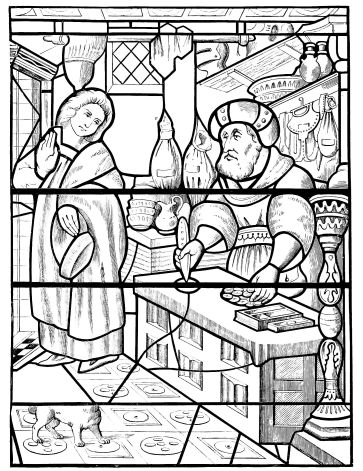
Fig. 233.—Legend of the Jew of the Rue des Billettes, Paris, piercing the Holy Wafer with his Knife. (From a Window of the Church of St. Alpin, at Châlons-sur-Marne. Fourteenth Century.)
In 1347 a royal ordinance was proclaimed in favour of the workmen of Lyons. The custom existed at that time of adorning with painted windows royal and lordly habitations. The artists produced their own designs, adapting them to the use that was made, in private life, of the halls for which they were intended. Some of these windows representing familiar legends adorned even the churches (Fig. 233).
Among the most important works of the fourteenth century, we must mention in the first place the windows of the cathedrals of Mans, Beauvais, Évreux (Fig. 234), and the rose-windows of St. Thomas at Strasbourg. Next come the windows of the Church of St. Nazaire at Carcassonne and of the Cathedral of Narbonne. There are, besides, in the Church of St. John at Lyons, in Notre-Dame of Semur, in Aix in Provence, at Bourges, and at Metz, church-windows in every respect worthy of attention.
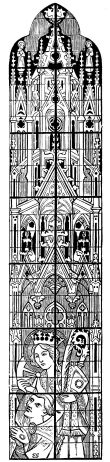
Fig. 234.—Fragment of a Window presented to the Cathedral of Evreux by the Bishop Guillaume de Cantiers. Fourteenth Century.
The fifteenth century only continues the traditions of the preceding one. The principal works dating from this epoch begin, according to the order of merit, with the window of the Cathedral of Mans, which represents Yolande[31] of Aragon, and Louis II., King of Naples and Sicily, ancestors of the good King René; after them we shall place the windows of the Sainte-Chapelle, Riom; St. Vincent, Rouen; the Cathedral of Tours; and that of Bourges, representing a memorial of Jacques Cœur, &c.
The sixteenth century, although bringing with it, owing to religious troubles, many ravages of new iconoclasts, has handed down to us a variety of numerous and remarkable church-windows. We are, of course, unable to mention them all; but it seems expedient—adopting the rule of most archæologists—to divide them into three branches or schools, which are actually formed by the different styles of the artists of that epoch; the French school, the German school, and the Lorraine school (Fig. 235), which partakes of the characteristics of the two preceding.
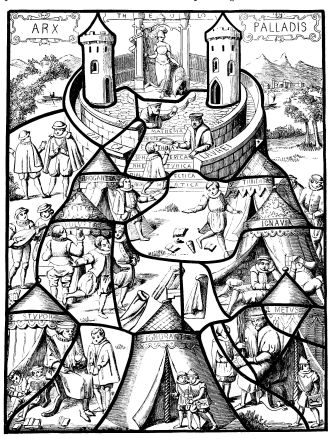
Fig. 235.—Allegorical Window, representing the “Citadel of Pallas.” (Lorraine work of the Sixteenth Century, preserved in the Library at Strasbourg.)
At the head of the French school figures the celebrated Jean Cousin, who decorated the chapel of Vincennes; he also made for the Célestins monastery, Paris, a representation of Calvary; for St. Gervais, in 1587, the windows representing the “Martyrdom of St. Lawrence,” the “Samaritan conversing with Christ,” and the “Paralytic.” In these works, which belong to a high style of painting, the best method of arrangement, vigorous drawing, and powerful colouring, seem to reflect the work of Raphael. Windows in “grisaille,” made from the cartoons of Jean Cousin, also decorated the Castle of Anet.
Another artist, named Robert Pinaigrier, who, although inferior to Cousin, was much more fertile in production, assisted by his sons Jean, Nicholas, and Louis, and several of his pupils, executed a number of windows for the churches of Paris, of which the greater part have disappeared: Saint-Jacques la Boucherie, the Madeleine, Sainte-Croix en la Cité, Saint Barthélemy, &c. Magnificent specimens of his work still remain at Saint-Merry, Saint-Gervais, Saint-Etienne du Mont, and in the Cathedral of Chartres. Pinaigrier’s works in the decorations of châteaux and the mansions of the nobility are perhaps equally numerous.
At this period several windows were made from the drawings of Raphael, Leonardo da Vinci, and Parmigiano; it may also be remarked that two patterns of the latter’s work were used by Bernard Palissy, who was a glass-maker before he became an enameller, in forming windows in “grisaille” for the chapel of the Château of Ecouen. For the same place, following the style of Raphael, and from the drawings of Rosso, called Maître Roux, Bernard Palissy executed thirty pictures on glass, representing the history of Psyche, which are justly considered as ranking among the most beautiful compositions of the epoch; but it is not now known what has become of these valuable windows, which at the Revolution were transported to the Museum of French Monuments.
They were, it is said, executed under the direction of Leonard of Limoges, who, like all the masters of that school (Fig. 236), applied to painting on glass the processes of enamelling, and vice versâ. In the collections of the Louvre and of several amateurs, there are still examples of his composition, on which he employed the best glass-painters of his time; for he could not himself work on all the objects that proceeded from his studios, and which were almost exclusively destined for the king’s palace.
The French art of glass-working became cosmopolitan. It was introduced into Spain and also into the Low Countries under the protection of Charles V. and the Duke of Alba. It even appears to have crossed the Alps; for we know that in 1512 a glass-painter of the name of Claude adorned with his works the large windows of the Vatican; and Julius II. summoned Guillaume of Marseilles to the Eternal City, the pontiff when occupying the sees of Carpentras and Avignon having appreciated his talent. We must not omit to mention, among the Flemish artists who escaped this foreign influence, the name of Dirk of Haarlem (Fig. 237), the most celebrated master in this art at the close of the fifteenth century.
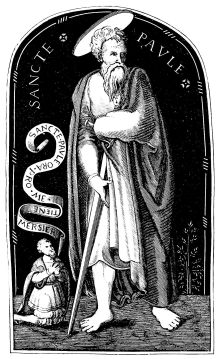
Fig. 236.—St. Paul, an Enamel of Limoges, by Etienne Mercier.
While French art was thus spreading over the continent, foreign art
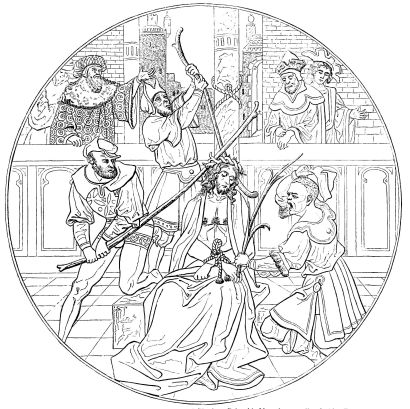
Fig. 237.—Flemish Window (Fifteenth Century), half life-size. Painted in Monochrome, relieved with yellow, by Dirk of Haarlem. (Collection of M. Benoni-Verhelst, Ghent.)
was being introduced into France. Albert Dürer employed his pencil in painting twenty windows in the church of the Old Temple, in Paris, and produced a collection of pictures characterised by vigorous drawing, and warm and intense colouring. The celebrated German did not work alone—other artists assisted him; and, notwithstanding the devastations which took place during the Revolution, in many a church and mansion traces of these skilful masters may still be found; their compositions, which are generally as well arranged as they are executed, are marked with a tinge of German simplicity very suitable to the pious nature of the subjects they represent.
In 1600, Nicholas Pinaigrier placed in the windows of the Castle of La Briffe seven pictures in “grisaille,” copied from the designs of Francis Floris, a Flemish master, who was born in 1520. At this same period Van Haeck, Herreyn, John Dox, and Pelgrin Rösen, all belonging to the school of Antwerp, and other artists who had decorated the windows of most of the churches in Belgium, especially St. Gudule in Brussels, influenced either directly or indirectly the glass-painters of the east and north of France. Another group of artists, the Provençals, imitators of the Italian style, or rather perhaps inspired by the same luminary, the sun of Michael Angelo, trod a similar path to that which Jean Cousin, Pinaigrier, and Palissy had followed with so much renown. The chiefs of this school were Claude, and Guillaume of Marseilles, who, as we have just mentioned, carried their talent and their works into Italy, where they succeeded in educating some clever pupils.
With regard to the school of Messin or Lorraine, it is principally represented by a disciple of Michael Angelo, Valentin Bousch, the Alsatian, who died in 1541 at Metz, where he had executed, since 1521, an immense number of works. The windows of the churches of St. Barbe, St. Nicolas du Port, Autrey, and Flavigny-sur-Moselle, are due to the same school, in which Israel Henriet was also brought up; he became the chief of a school exclusively belonging to Lorraine, at the time when Charles III. had invited the arts to unite under the patronage of the ducal throne. Thierry Alix, in a “Description inédite de la Lorraine,” written in 1590, and mentioned by M. Bégin, speaks of “large plates of glass of all colours,” made in his time in the mountains of Vosges, where “all the herbs and other things necessary to painting” were found. M. Bégin, after having quoted this curious statement, adds that the windows which at that era were produced in the studios of Vosges, and subsequently carried to all parts of Europe, constituted a very active branch of commerce.
“Nevertheless,” says Champollion-Figeac, “art was declining. Christian art especially was disappearing, and had almost come to an end, when Protestantism stepped in and gave it the last blow; this is proved by the window in the cathedral church of Berne, in which the artist, Frederic
“FRANCIS I. AND ELEANOR HIS WIFE AT PRAYERS.”
PART OF A WINDOW IN THE CHURCH OF ST. GUDULE IN BRUSSELS. FROM “L’HISTOIRE DE LA PEINTURE SUR VERRE EN EUROPE.”
This magnificent window was given to the Church of St. Gudule by Francis I. and Eleanor of Spain, his wife, sister of Charles V., and widow by her first marriage of Emmanuel the Great, King of Portugal.
The donors are represented kneeling, each one protected by his or her patron saint; the king is attended by St. Francis of Assisi, who is receiving in a vision the impress of the stigmata of Jesus on the Cross; the queen is accompanied by St. Eleanor, who holds in her hand the palm of the elect. This window is from a design by Bernard van Orley.
Francis I. and Eleanor expended on the window two hundred and twenty-two crowns, or four hundred florins, an important sum in those days (1515-47).
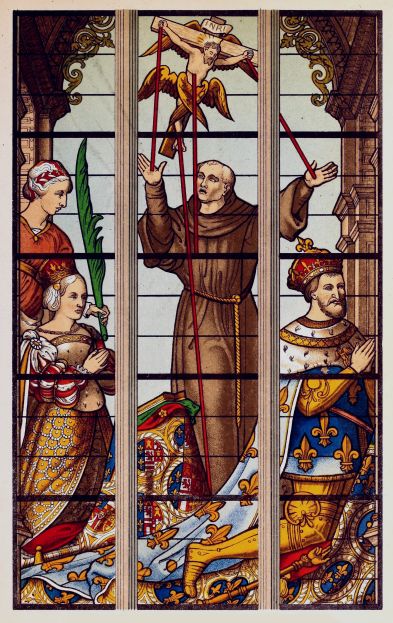
FRANCIS I. AND ELEONORA AT THEIR DEVOTIONS.
Portion of a Stained Glass Window in the Church of St. Gudule at Brussels.
Walter, dared to launch his satire against doctrine itself, and to ridicule transubstantiation by representing a pope shovelling four evangelists into a mill, from which come forth a number of wafers; these a bishop is receiving into a cup in order to distribute them to the wondering people. Any edification of the masses by the powerful effect of transparent images placed, so to speak, between the earth and heaven, soon ceased to be possible, and glass-painting, henceforth alienated from the special aim of its origin, was destined also to disappear.”
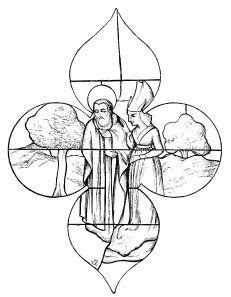
Fig. 238.—Temptation of St. Mars, a Hermit of Auvergne, by the Devil disguised as a Woman. Fragment of a Window of the Sainte-Chapelle of Riom. Fifteenth Century. (From “Histoire de la Peinture sur Verre,” by M. F. de Lasteyrie.)