PLAYING-CARDS.
James Dafforne translation
Supposed Date of their Invention.—Existed in India in the Twelfth Century.—Their connection with the Game of Chess.—Brought into Europe after the Crusades.—First Mention of a Game with Cards in 1379.—Cards well known in the Fifteenth Century in Spain, Germany, and France, under the name of Tarots.—Cards called Charles the Sixth’s must have been Tarots.—Ancient Cards, French, Italian, and German.—Cards contributing to the Invention of Wood-Engraving and Printing.
HE origin of playing-cards has for many years past formed a special subject of investigation among scholars and antiquarians. For, however trifling the matter may appear in itself, this curious point is connected with two of the most important inventions of modern times—engraving and printing.
We must not, however, take upon ourselves to assert too positively that all the profound researches, persevering study, and ingenious deductions which have been applied to the subject have entirely succeeded in elucidating the question. Nevertheless, a certain degree of light has been thrown upon it, by which we shall endeavour to profit.
The question is, at what date are we to fix the invention of playing-cards, and to whom are we to attribute it? In order to solve these queries, they must be divided; for, although the introduction of playing-cards into Europe may not date back beyond the fourteenth century, and the invention of our game of piquet may not have been prior to the reign of Charles VII., it is at least asserted—(1st), that playing-cards existed in India in the twelfth century; (2nd), that the ancients played at games in which certain figures and numbers were represented on dice or tablets; (3rd), that in comparatively recent times the game of chess and the game of cards presented striking affinities, proving the common origin of these two games—one connected with painting, the other with sculpture.
If we are to believe Herodotus, the Lydians, in order to beguile the sufferings of hunger during a long and cruel famine, invented nearly every game, especially that of dice. Later authors ascribe the honour of these inventions to the Greeks, when irritated at the tedious delays of the siege of Troy. Cicero even mentions by name Pyrrhus and Palamedes as the originators of the “games in use in camps” (ludos castrenses). What were these games? Some say, chess; others, dice or knuckle-bones.
Certain very ancient specimens prove unquestionably that the Indian cards were nothing but a transformation of the game of chess; for the principal pieces in this game are reproduced on the cards, but in such a way that eight players instead of two could take part in it. In the game of chess there were only two armies of pawns, each having at its head a king, a vizier (who was afterwards turned into a “queen”), a knight, an elephant (which became a “bishop”), and a dromedary (afterwards a “castle”). There can be no doubt that the course and arrangement of these games were very different; but in both may be found an original affinity in the fact that they recalled to mind the terrible game of war, in which each adversary had to attack by means of stratagems, combinations, and vigilance.
We have now learned from certain authority (Abel de Rémusat, Journal Asiatique, September, 1822) that playing-cards, proceeding from India and China, were, like the game of chess (Fig. 203), in the hands of the Arabians and the Saracens at the commencement of the twelfth century. It is therefore almost certain they must have been brought into Europe after the Crusades, with the arts, traditions, and customs which the men of the West then derived from their Oriental antagonists. There is, however, every reason to believe that the use of cards spread but slowly; for at an epoch when the civil and ecclesiastical authorities were constantly issuing ordinances against games of chance, we do not find that cards were ever the subject of legal proceedings, like dice and chess.
The first formal mention made of playing-cards is found in a manuscript chronicle of Nicolas de Covelluzzo, preserved in the archives of Viterbo. “In the year 1379,” says the chronicler, “there was introduced at Viterbo the game of cards, which comes from the country of the Saracens, and is called by the latter naïb.” There is, in fact, a German book, the “Jeu d’Or,” printed at Augsbourg in 1472, which testifies to the fact that cards existed in Germany in the year 1300. But, in the first place, this evidence is not contemporary with the fact alleged; and, besides,
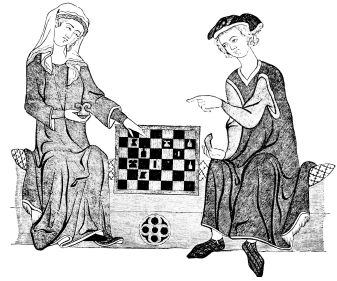
Fig. 203.—Chess-Players. Fac-simile of a Miniature of the Thirteenth Century. (MS. 7,266, Bibl. Imp., Paris.)
we may well suppose that the vanity of the Germans, which had attributed to themselves the discovery of printing, desired, with about as much reason, to appropriate also the invention of cards—that is, of wood-engraving. We shall, therefore, act judiciously in paying but little attention to this doubtful assertion, and hold to the account given by the chronicler of Viterbo. But the latter, unfortunately, furnishes us with no details as to the nature of these cards. Was the game similar to that which is still extant in India? Or was it one peculiar to the Arabs? These are questions which must remain unsolved. The only facts presented to our notice are, that in 1379 cards made their appearance in Europe, brought from Arabia, or the country of the Saracens, and that their original name is given. The Italians for a long time gave to cards the name of naïbi. In Spain they are still called naypes. If it be understood that the word naïb in Arabic signifies “captain,” we shall see that the game in question was one of a military character, like that of chess, and we shall be led to recognise in these primitive cards the tarots which were for a long time current in the south of Europe.
In 1387, John I., King of Castile, issued an ordinance prohibiting to play with dice, naypes, or at chess.
In the archives of the Audit Office, in Paris, there formerly existed an account of the treasurer, Poupart, who states that, in 1392, he had “paid to Jacquemin Gringonneur, painter, for three packs of cards in gold and various colours, ornamented with numerous devices, to lay before the lord the king (Charles VI.) for his amusement, 50 sols of Paris.” This game, which seemed at first intended only for the amusement of the king in his mental derangement, subsequently spread so much among the people, that the provost of Paris, in an ordinance of January 22, 1397, issued a prohibition “to persons engaged in trade from playing at tennis, bowls, dice, cards, and skittles, except on feast-days.” We must remark that, twenty-eight years previously, Charles V., in a celebrated ordinance which enumerates all the games of chance, did not mention cards.
The “Red Book” of the town of Ulm, a manuscript register preserved in the archives of that town, contains an ordinance dated in 1397, in which is conveyed a prohibition of games with cards.
These facts are the only authenticated evidence which can be brought forward with a view of fixing the approximate period of the introduction of cards into Europe. Some authors have certainly imagined they were in a position to determine an earlier epoch, but they have gone upon data the value of which has since been destroyed by more thorough investigation.
In the fifteenth century there are evident traces both of the existence and popularity of cards in Italy, Spain, Germany, and France. Their names, colours, and emblems, their number and forms, were indeed constantly changing, according to the country in which they were used and the fancy of the players. But whether called tarots or “French cards,” they were in fact nothing but modifications of the primitive Oriental cards, and an imitation more or less faithful of the ancient game of chess.
Reckoning from the fifteenth century, we meet with cards in every enumeration of games of chance; we find them also proscribed and condemned in ecclesiastical and royal ordinances. The clergy, too, raised their voices against them; but these measures did not prevent the trade in
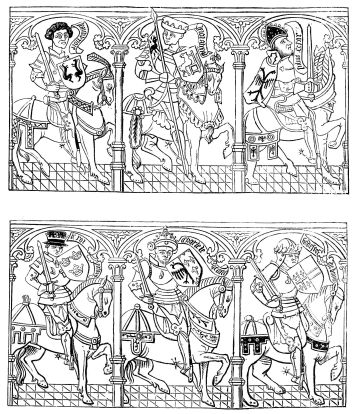
Figs. 204 and 205.—Jean Dunois, King Alexander, Julius Cæsar, King Arthur, Charles the Great, and Godefroi de Bouillon. From ancient coloured Wood-Engravings; prints analogous to the first Playing-Cards of the Fifteenth Century. (Bibl. Imp., Paris, Department of Manuscripts.)
them from increasing, nor great attention to their improved manufacture. Poets and romance-writers vied with each other in speaking of them; they appeared in the miniatures in manuscripts, and also in the first attempts at engraving on wood and copper (Figs. 204 and 205). And, notwithstanding the fragile nature of the cards themselves, some have been preserved which belong to the earliest years of the fifteenth century.
As we have already seen, cards had, in principle, been classed among the number of childish games; but it may be safely asserted that this could not have long been the case, else how could we explain the legal strictures and the ecclesiastical anathemas of which they were the subject?
St. Bernard, for example, speaking on the 5th of March, 1423, to the crowd assembled in front of a church at Siena, inveighed with so much energy, and fulminated with so much persuasion, against games of chance, that all who heard ran at once and fetched their dice, chess, and cards, and burnt them on the very spot. But, adds the chronicle, there was a card-maker who, being ruined by the sermon of the saint, went to seek him, and with a flood of tears said to him: “Father, I am a maker of cards, and I have no other trade by which to live. By preventing me from following my trade, you condemn me to die of hunger.” “If painting is all you are capable of,” replied the preacher, “paint this picture.” And he showed him an image of a radiating sun, in the centre of which shone the monogram of Christ—I. H. S. The artisan followed his advice, and soon made his fortune by painting this representation, which was adopted by St. Bernard as his device.
Although in every direction similar censures were directed against cards, they nevertheless did not fail to come much into fashion, especially in Italy; and to have a considerable sale. Thus, in 1441, we find the master card-makers at Venice “who formed a rather numerous association,” claiming and obtaining from the senate a kind of prohibitory order against “the large quantity of painted and printed cards which were made out of Venice and were introduced into the town, to the great detriment of their art.” It is important to notice that mention is made here of printed as well as of painted cards. The fact is, that at this date, not only did all the cities in Italy make their own cards, but, in consequence of the invention of wood-engraving, Germany and Holland exported a large quantity of them. We must also point out that documents of the same date appear to establish a distinction between the primitive naïbi and cards properly so called, without, however, affording any detailed characteristics of either. It is, however, known that prior to the year 1419, one François Fibbia, a noble of Pisa who died in exile at Bologna, obtained from the “reformers” of this city, on the score of his being the inventor of the game of tarrochino, the right of placing his escutcheon of arms on the “queen de bâton,” and that of his wife’s arms on the “queen de denier.” Bâtons, deniers, with coupes and épées, were then the suits of the Italian cards, as carreau (diamond), trèfle (club), cœur (heart), and pique (spade), were those of the French cards.
No original specimen has been preserved of the tarots (tarrochi, tarrochini) or Italian cards of this epoch; but we possess a pack engraved about 1460, which is known to be an exact copy of them. Added to this, Raphael Maffei, who lived at the end of the fifteenth century, has left in his “Commentaries” a description of tarots, which were, he says, “a new invention,”—in comparison, doubtless, with the origin of playing-cards. From these two documents—though they present some differences—we may gather that the pack of tarots was then composed of four or five series or suits, each of ten cards, bearing consecutive numbers, and presenting so many deniers, bâtons, coupes, and épées, equal in number to that of the card. To these series we must add a whole assortment of figures, representing the King, the Queen, the Knight, the Foot-traveller, the World, Justice, an Angel, the Sun, the Devil, a Castle, Death, a Gibbet, the Pope, Love, a Buffoon (Fig. 206), &c.
It is evident that tarots were current in France long before the invention of the game of piquet, which is unquestionably of French origin; and among these tarots we must class the cards that are called those of Charles VI. (Figs. 207 and 208), and are now preserved in the Print-Room of the Bibliothèque Impériale in Paris; these may be considered as the oldest to be found in any collection, either public or private. The Abbé de Longuerue states that he saw the pack with all its cards complete; but only seventeen have been preserved to our day. These cards are painted with delicacy, like the miniatures in manuscripts, on a gilt ground, filled with dots forming a perforated ornamentation; they are also surrounded by a silvered border in which a similar dotting depicts a spirally twisted ribbon. This dotting is doubtless the tare, a kind of goffering produced by small holes pricked out and arranged in compartments, to which the tarots owe their names, and of which our present cards still retain a kind of reminiscence, in their backs being covered with arabesques or dotted over in black or various colours. These cards were about seven inches long and three and a half inches wide, and were painted in distemper on cardboard ·039 inch thick. The composition of them is ingenious and to some extent skilful, the drawing correct and full of character, and the colouring or illumination brilliant.
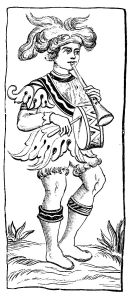
Fig. 206.—The Buffoon, a Card from a Pack of Tarots. Fifteenth Century.
Among the subjects they represent are some which deserve all the more attention, because they can hardly fail to recall to mind a conception somewhat similar to that of the “Dance of Death,” that terrible “morality” which, dating from this epoch, was destined to increase more and more in popularity. Thus, for instance, by the side of the Emperor, who is covered with silver armour and holds the globe and the sceptre, a Hermit makes his appearance as an old man muffled in a cowl and holding up an hour-glass, an emblem of the rapidity of time. Then we have the Pope, who, with the tiara on his head, sits between two cardinals; but Death is also there, mounted on a grey horse with a rough and shaggy coat, and sweeping down with his scythe kings, popes, bishops, and other great men of the earth. If we see Love, represented by three couples of lovers who embrace as they converse, while two cupids dart at them their arrows from a cloud above; we also see a Gibbet, on which hangs a gambler suspended by one foot, and still holding in his hand a bag of money. An Esquire, clothed in gold and scarlet, rides gallantly along, proudly waving his sword; a Chariot bears in triumph an officer in full armour; a Fool places his cap and bells under his arm that he may count upon his fingers. Finally, the last trumpets are waking up the dead, who come out of their graves to appear at the Last Judgment.
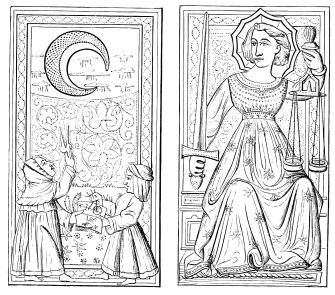
s: Fig. 207.—The Moon.
Fig. 208.—Justice.
(Cards taken from the Pack, said to be of Charles VI., preserved in the Bibl. Imp., Paris.)
Most of these allegorical subjects have been retained in the tarots, which include, independent of the sixteen figures of our piquet-pack, twenty-two cards, representing the Emperor, the Lover, the Chariot, the Hermit, the Gibbet, Death, the House of God, the End of the World, &c.
We should scarcely be justified in imagining that these tarots, presenting as they did a picture of life so gloomily philosophical, regarded from a Christian point of view, could have enjoyed any great favour in the centre of a frivolous and corrupt court, devoted to little else but fêtes, masquerades, and singing; this, too, at a time when the State, a prey to every kind of intrigue, was falling into ruin, and the voice of insurrection was surging up among a people burdened by taxes, and decimated by pestilence and famine. On the other hand these tarots might well please the imagination of certain good people who, having been deprived of their property in some of the disturbances incidental to these times, could not fail to accept as a consolation such emblematical representations of life and death. Artists of every kind tried their best to reproduce them in all forms; and as these designs found a place even in the ornaments of the female sex, it was scarcely probable that playing-cards would form an exception.
We are in possession of the remains of two ancient packs of cards, produced by means of engraved plates; they were discovered, like most cards of this date which have come to light, in the bindings of books of the fifteenth century. These cards, which belong to the reign of Charles VII., are essentially French in their character. We find in them the king, the queen, and the knave of each suit, as in our present pack of piquet cards. In one of these ancient packs we notice, however, traces of the Saracenic origin of the naïbi; the Mussulman “crescent” being substituted for the “diamond,” while the “club” is depicted in the Arabian or Moorish fashion; that is, with four similar branches. There is also another peculiarity; the “king of hearts” is represented by a kind of savage, or hairy ape, leaning upon a knotty stick. The “queen” of the same suit is likewise covered with hair, and holds a torch in her hand. The “knave of clubs,” who is well fitted to serve as an escort to the “king” and “queen of hearts,” is also covered with hair, and carries a knotty stick on his shoulder. We may, besides, notice the legs of a fourth hairy personage among those which have been separated from their bodies by the knife of the bookbinder. But, with the exception of these, all the other personages are clothed according to the fashion or the etiquette which prevailed at the court of Charles VII. The “queen of crescents” is represented in a costume similar to that of
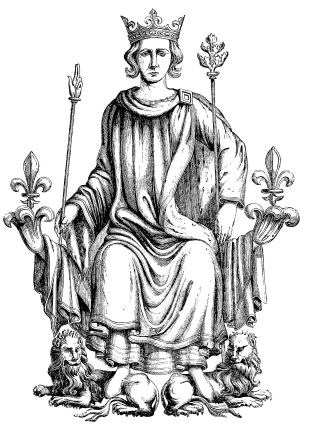
Fig. 209.—Charles VI. on his Throne, from a Miniature in the MS. of the Kings of France. (Bibl. Imp., Paris.)
Mary of Anjou, the wife of the king; or in that of Gérarde Grassinel, his mistress. The representations of the kings, the hairy one excepted, are identical with those we have of Charles VII. himself, or the nobles of his suite. Their costume was a velvet hat surmounted by the crown ornamented with fleurs-de-lis; a robe open in front and lined with ermine or menu vair, a tight doublet, and close stockings. The “knaves” are copied from the pages and sergeants-at-arms of the period; one wears the plumed flat cap and long cloak; another, on the contrary, is clad in a short dress, and stands erect in his close-fitting doublet and tightly drawn breeches. The latter displays, written on a streamer which he is unrolling, the name of the card-maker, “F. Clerc.” These are certainly cards of French invention, or, at any rate, of French manufacture; but what explanation are we to give of the presence of the savage “king” and “queen,” and the “hairy knave,” among the kings, queens, and knaves all dressed according to the fashion of the time of Charles VII.? We may, perhaps, find a satisfactory reply by referring to the chronicles of the preceding reign.
On the 29th of January, 1392, there was a grand fête at the mansion of Queen Blanche in honour of the marriage of a Chevalier de Vermandois with one of the queen’s ladies. The king, Charles VI., had only just recovered from his mental malady. One of his favourites, Hugonin de Janzay, projected an entertainment in which the king and five lords were to take a part. “It was,” says Juvénal des Ursins, “a masquerade of wild men chained together, and all shaggy; their dress was made to fit close to their body, and was rendered rough by flax and tow fastened on by resinous pitch, greased so as to shine the better.” Froissart, who was an eye-witness of this fête, says that the six actors in the ballet entered the hall yelling and shaking their chains. As it was not known who these maskers were, the Duke of Orleans, brother of the king, wishing to find out, took a lighted torch from the hands of his servant, and held it so close to one of these strange personages that “the heat of the fire caught the flax.” The king was fortunately separated from his companions, who were all burned, with the exception of one only, who threw himself into a tub full of water. Although Charles VI. escaped from this peril, he was deeply affected by the thought of the danger to which he had been exposed, and the result was a relapse into his former insanity.
This fearful ballet des ardents left such an impression on the minds of people generally, that seventy years afterwards a German engraver made it the subject of a print. Should we, then, be venturing on an inadmissible hypothesis if we attribute to a cardmaker of this epoch the idea of introducing the same subject in a pack of cards? which, as is abundantly proved, was modified according to the whim of the artist. In order to justify the costume of a female savage and the torch, which are given to the “queen of hearts,” we must not forget that Isabel of Bavaria, consort of Charles VI., is accused of having assisted in devising this fatal masquerade, which was intended to get rid of the king; and of having taken as her accomplice the Duke of Orleans, her brother-in-law, who is said to have purposely set fire to the clothing of these pretended wild men, among whom was the king.
The second pack, or fragment of a pack, which is dated back to this epoch, presents a similarity to our present cards of a yet more striking nature, at least in the characters and costumes of the figures; although the names and devices of the personages still are suggestive of their Saracenic origin. We must remark, under this head, that for several centuries the names coupled with the different personages were incessantly varying. In this pack we find “kings,” “queens,” and “knaves” of clubs, hearts, spades, and diamonds; the Saracenic crescent has disappeared. The “kings” are all holding sceptres, and the “queens” carry flowers. Everything in the representations is not only in harmony with the fashions of the period, but in addition to this, there are no violations either of the laws of heraldry or of the usages of chivalry.
According to tradition, this pack, the true piquet-pack, which superseded the Italian tarots and the cards of Charles VI., and soon became generally used in France, was the invention of Etienne Vignoles, called La Hire, one of the bravest and most active soldiers of that period. The tradition has a right to our respect, for the mere examination of this piquet-pack proves that it must have been the work of some accomplished chevalier, or at least of a mind profoundly imbued with the manners and customs of chivalry. But, without any wish to exclude La Hire, who, as the historians say, “always had his helmet on his head and his lance in his hand, ready to attack the English, and never rested until he died of his wounds,” we are led rather to ascribe the honour of this ingenious invention to one of his contemporaries, Etienne Chevalier, secretary and treasurer to the king, who was distinguished by his skill in designing. Jacques Cœur, whose commercial relations with the East brought upon him the accusation of having “sent arms to the Saracens,” might well have become the importer of Asiatic cards into France, and Chevalier might then have amused himself by applying devices to them or, as was then said, by moralising or symbolising them. In India it had been the game of the vizier and of war; the royal treasurer turned it into a pack having reference to the knight and chivalry. In the first place he placed on it his own armorial bearings, the unicorn, which figures in several ancient packs of cards. He did not forget the allusive arms of Jacques Cœur, and substituted “hearts” for the coupes. He made the “clubs” imitate the heraldic flower of Agnes Sorel; and also changed the deniers into diamonds, or arrow-heads (Fig. 210), and the épées into spades, to do honour to the two brothers Jean and Gaspard Bureau, grand-masters of artillery in France.
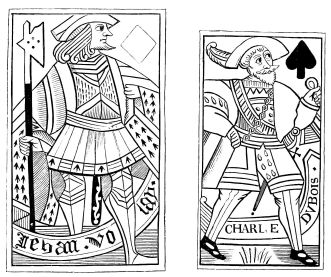
Fig. 210.—Ancient French Card of the Fifteenth Century. (Bibl. Imp., Paris.)
Fig. 211.—Specimen of a Pack of Cards of the Sixteenth Century. (Bibl. Imp., Paris.)
Etienne Chevalier, as the most skilful designer of emblems of the period, was eminently capable of substituting, in playing-cards, ladies or queens for the Oriental “viziers” or Italian “knights” which, on the tarots, figured alone among the “kings” and “knaves.” We must, however, repeat that we have no intention of depriving La Hire of the honour of the invention, and only hazard a supposition in addition to the opinion generally received.
These cards, which bear all the characteristics of the reign of Charles VII., must be looked upon as the first attempts at wood-engraving, and at printing by means of engraved blocks. They were probably executed between 1420 and 1440, that is to say, prior to most of the known xylographic productions. Playing-cards, therefore, served as a kind of introduction or prelude to printing from engraved blocks, an invention which considerably preceded the printing from movable characters.
When, however, we observe that so early as the middle of the fifteenth century playing-cards were spread all over Europe, it is but natural to imagine that some economical plan of manufacture had been discovered and employed. Thus, as we have already mentioned, Jacquemin Gringonneur, in 1392, was paid fifty-six sols of Paris, that is about £7 1s. 8d. of our present money, for three packs of tarots, painted for the King of France. One single pack of tarots, admirably painted, about the year 1415, by Marziano, secretary to the Duke of Milan, cost one thousand five hundred golden crowns (about £625); but in 1454, a pack of cards intended for the Dauphin of France cost no more than five sous of Tours (about eleven or twelve shillings). In the interval between 1392 and 1454 means had been discovered of making playing-cards at a cheap rate, and of converting them into an object of trade; mercers were accustomed to sell them together with the “pins,” which then took the place of copper and silver counters; hence the French proverb, “Tirer son épingle du jeu” (to get out of a scrape).
Although the use of playing-cards continued to extend more and more, we must not imagine that they had ceased to be the subject of prohibitory and condemnatory ordinances on the part of the civil and ecclesiastical authorities. On the contrary, a long list might be made of the decrees launched against cards themselves and those that used them. Princes and lords, as a matter of right, felt themselves above these prohibitions; the lower orders and the dissolute did not fail to infringe them. It was nevertheless the case, that in the face of these constantly-renewed prohibitions, the manufacture of playing-cards could only be developed, or rather perhaps be carried on, in some indirect mode. Thus, we find the business at first was concealed, as it were, under that of a stationer or illuminator. Not until December, 1581—that is, in the reign of Henry III.—do we find the first regulation fixing the statutes of the “master-cardmakers.” These statutes, confirmed by letters patent in 1584 and 1613, remained in force down to the (French) Revolution. In the confirmation of corporate privileges granted at the latter date, it is laid down as a rule that henceforth master-cardmakers should be bound to place their names, surnames, signs, and devices on the “knave of clubs” (Figs. 212, 213) of every pack of cards. This prescription appears to have done nothing more than legalise an old custom—a fact which may be proved by an examination of the curious collection of ancient cards in the Print-Room of the Bibliothèque Impériale. We have already stated that for a period of many years the names given to the various personages in the pack varied constantly, according to the fancy of the cardmaker; a mere glance at the collection just mentioned will confirm this assertion.
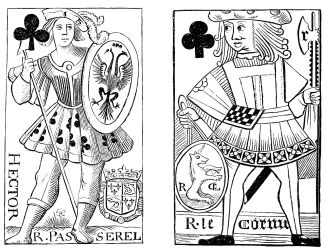
Figs. 212 and 213.—The “Knave of Clubs” in the Packs of Cards of R. Passerel and R. Le Cornu. (Sixteenth Century. Bibl. Imp., Paris.)
The cards that might be styled those of Charles VII., which appear to us to convey some reminiscence of the ballet des ardents, have no inscription but the name of the cardmaker. But in the other pack of the same date the “knave of clubs” bears as a legend the word Rolan; the “king of clubs,” Sans Souci; the “queen of clubs,” Tromperie; the “king of diamonds,” Corsube; the “queen of diamonds,” En toi te fie; the “king of spades,” Apollin, &c. This collection of names reveals to us the threefold influence of the Saracenic origin of playing-cards, the ideas conveyed at that period to the mind by the reading of the old romances of chivalry, and the effect of contemporary events. In fact, in the ancient epics, Apollin (or Apollo) is a deity by whom the Saracens were accustomed to swear; Corsube is a knight of Cordova (Corsuba). Sans Souci is evidently one of those sobriquets which squires acquired the habit of adopting at the time they were proving themselves worthy of the title of knight. Roland, the mighty Paladin who died at Roncevaux fighting against the Saracens, seems to have been placed upon the cards in order to oppose the memory of his glory to that of the infidel kings. The queen “En toi te fie” might well allude to Joan of Arc. The queen “Tromperie” recalls to mind Isabel of Bavaria, who was an unfaithful wife and a cruel mother; and, moreover, had betrayed France to England. All these ideas are doubtless mere suppositions, but such as a critical examination of a more minute and extended character would perhaps succeed in changing into unquestionable certainties.
Next after the cards of the time of Charles VII. follow, as the most ancient in point of date, two packs which certainly belong to the reign of Louis XII. One of these packs does not bear any kind of legend; in the other the “king of hearts” is called Charles; the “king of diamonds,” Cæsar; the “king of clubs,” Arthur; the “king of spades,” David; the “queen of hearts,” Héleine; the “queen of diamonds,” Judith; the “queen of clubs,” Rachel; the “queen of spades,” Persabée (doubtless for Bathsheba).
In a pack of cards belonging to the reign of Francis I., the “king of clubs” becomes Alexander, and the name of Judith is transferred to the “queen of hearts;” and for the first time (at least in the specimens which have been preserved) some of the “knaves” bear special names—the “knave of hearts” is La Hire, and the “knave of diamonds” Hector of Trois (sic).
A few years later, about the time of the battle of Pavia and of the king’s captivity, the influence of Spanish and Italian fashions begins to affect the legends on packs of cards. It is remarked that the “knave of spades,” which presents nothing in the way of a legend but the name of the cardmaker, is made to resemble Charles-Quint (Fig. 211). The three other knaves bear the singular denominations of Prien Roman, Capita Fili, and Capitane Vallant. The kings are: “hearts,” Julius Cæsar; “diamonds,” Charles; “clubs,” Hector; “spades,” David. The queens are: “hearts,” Héleine; “diamonds,” Lucresse; “clubs,” Pentaxlée (Penthesilea); “spades,” Beciabée (Bathsheba).
In the reign of Henry II., the names given to the personages come much nearer to the arrangement observed in our present cards. Cæsar is the “king of diamonds;” David, the “king of spades;” Alexander, the “king of clubs.” Rachel is the “queen of diamonds;” Argine, of “clubs;” Pallas, of “spades.” Hogier, Hector of Troy, and La Hire, are the “knaves” of “spades,” “diamonds,” and “hearts,” respectively.
At the time of Henry III., who devoted himself much more to regulating the fashions than to governing his kingdom, and was the first to grant statutes to the association of cardmakers, the pack of cards became the mirror of the extravagant fashions of this effeminate reign. The “kings” have the pointed beard, the starched collar, the plumed hat, the breeches puffing out round the loins, the slashed doublet, and the tight-fitting hose. The “queens” have their hair drawn back and crisped, the dress close round the body, and made à vertugarde (in the form of a hoop-petticoat). We see a Dido, an Elizabeth, and a Clotilde, make their appearance in the respective characters of “queens” of “diamonds,” “hearts,” and “spades.” Among the kings figure Constantine, Clovis, Augustus, and Solomon.
The valiant Béarnais[26] mounts the throne, and the cards still reflect the aspect of his court. But soon Astrea and a whole cortége of tender and gallant heroes begin to assume an influence over refined minds, and we then find Cyrus and Semiramis as “king and queen” of diamonds; Roxana is the “queen of hearts” (Fig. 214), Ninus the “king of spades,” &c.
In the regency of Marie de Medicis, in the reign of Louis XIII., or rather of Richelieu, in the time of Anne of Austria and Louis XIV., playing-cards continued to assume the character of the period, following the whim of the court, or the fancy of the cardmaker. At a certain time they began to take an Italian character. The “king of diamonds” was called Carel; his queen, Lucresi; the “queen of spades,” Barbera; the “queen of clubs,” Penthamée; the “knave of diamonds,” capit. Melu.
A vast field of investigation would lie before us if, in tracing out the detailed history of these numerous variations, we were to endeavour to distinguish and settle the different causes which gave rise to them. One fact must certainly strike any one devoting himself to such inquiry; he would see that, in contradistinction to the changes which have affected the personages on the cards and their names, a continuous state of stability has been the characteristic of the four suits in the French cards or the piquet-pack, which were adopted from the very commencement, and that no attempt has ever been made against their arrangement and nature. Cœur (hearts), carreau (diamonds), trèfle (clubs), and pique (spades)—these were the divisions established by La Hire or Chevalier, and they are still faithfully maintained in the present day, although at various times endeavours have been made to define their symbolical signification.
For a long time the opinion of Father Menestrier was the prevalent one; that “hearts” were an emblem of the clergy or the choir (chœur); “diamonds,” of the citizens, who had their rooms paved with square tiles; “clubs,” of labourers; and “spades,” of military men. But Menestrier was in egregious error. A much clearer view of the matter was taken by Father Daniel, who, like all sensible interpreters, recognising in cards a game of an essentially military character, asserted that “hearts” denoted the courage of the commanders and soldiers; “clubs” (trèfle—“trefoil”) the stores of forage; “spades” and “diamonds,” the magazines of arms. This was a view which, as we think, comes much closer to the real interpretation of the suits; and Bullet was still nearer the mark when he recognised offensive arms in “clubs” and “spades,” and defensive arms in “hearts” and “diamonds.” The first were the sword and the lance; the second, the target and the shield.
But in order to do full honour to French cards, we must not exclude from our attention the tarots, which preceded our game of piquet, and continued to be simultaneously used even in France.
The Spanish and Italian cardmakers, who had been nearly always established in France, made a large quantity of tarots (Fig. 215); but they made a certain concession to French politeness by substituting “queens” for the “cavaliers” of their national game. We must remark here, that even at the epoch of the conquests of Charles VIII. and Louis XII., French cards with the four “queens” replacing the “cavaliers” never succeeded in nationalising themselves in Italy, and still less in Spain; on the contrary, the fact was that as regards this point of fashion, the vanquished people obtained the advantage over their conquerors, and the tarots came into full favour among the victorious soldiery.
The Spaniards must certainly have received the Oriental naïb from the Moors and Saracens a long time prior to the introduction of this game into Europe at Viterbo; but we have no written proofs which certify to the existence of cards among the Saracens of Spain. The first document
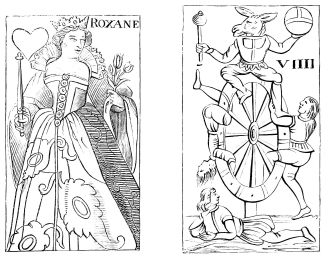
Fig. 214.—Roxana, Queen of Hearts. (Specimen of the Cards of the time of Henry IV.)
Fig. 215.—Card of Italian Tarots, from the Pack of the minchiate. (Collection of Playing-Cards, Bibl. Imp., Paris.)
in which they are mentioned is the edict of John I., of the date of 1387, to which reference has been made. Certain savants have endeavoured to ascertain the signification of the four suits of the Spanish naypes, and have fancied that they could distinguish in them a special symbolism. In their view, the dineros, copas, bastos, and spadas, denoted the four estates which composed the population: the merchants, who have the money; the priests, who hold the chalice or cup; the peasantry, who handle the staff; and the nobles, who wear the sword. This explanation, although ingenious, does not appear to us to be based on any very solid foundation. The signs or suits of the numeral cards were fixed upon in the East, and Spain as well as Italy merely adopted them without taking much trouble to penetrate into their allegorical meaning. The Spaniards became so addicted to this game that they soon preferred it to any other recreation; and we know that when the companions of Christopher Columbus, who had just discovered America, formed their first settlement at St. Domingo, they almost instantly set to work to make playing-cards out of the leaves of trees.
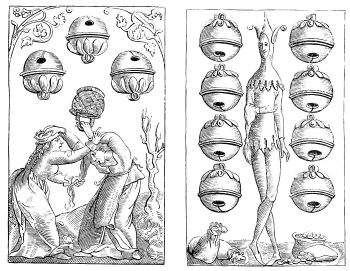
Figs. 216 and 217.—The “Three” and “Eight” of “Bells.” German Cards of the Sixteenth Century. (Bibl. Imp. of Paris. Print-Room.)
There can be no doubt that playing-cards very soon made their way from Italy into Germany; but as they advanced towards the North they almost immediately lost their Oriental characteristics and Saracenic name. There is, in fact, no longer any etymological trace to be found in the old German language of the words naïb, naïbi, or naypes. Cards were called
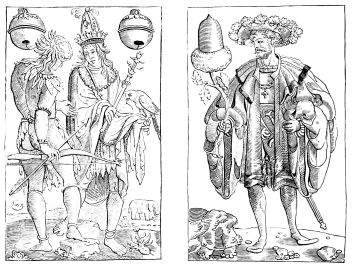
Figs. 218 and 219.—The “Two of Bells” and the “King of Acorns,” taken from a Pack of Cards of the Sixteenth Century, designed and engraved by a German Master. (Bibl. Imp. of Paris. Print-Room.)
Briefe, that is, letters; the game itself Spielbriefe, game of letters; the earliest cardmakers were Briefmaler, painters of letters. The four suits of the Briefe were neither Italian nor French in character; they bore the name of Schellen, “bells” (Figs. 216, 217, 218), or roth (red), grün (green), and Eicheln (acorns) (Fig. 219). The Germans, in their love of symbolism, had comprehended the real original signification of the game of cards, and although they introduced many marked changes, they made it their study, at least in principle, to preserve its military characteristics. Their suits depicted, it is said, the triumphs or the honours of war—the crowns of oak-leaves or ivy, the bells were the bright insignia of the German nobility, and the purple was the recompense of their valiant warriors. The Germans were careful not to admit ladies into the thoroughly warlike company of kings, captains (ober), and officers (unter). The ace was always the flag, the warlike emblem par excellence; in addition to this, the oldest game was the Landsknecht, or lansquenet (Fig. 220), the distinctive term of the soldier.
We are speaking here only of the earliest German cards, for, after a certain date, the essential form and emblematical rules of the pack depended on nothing but the fancy and whim of the maker or the engraver. The figures were but seldom designated by a proper name, but often bore devices in German or Latin. Among the collections of ancient cards we find one pack half German and half French, with the names of the Pagan gods. There are also several sets of cards with five suits (of fourteen cards each), among others those of “roses” and “pomegranates.”
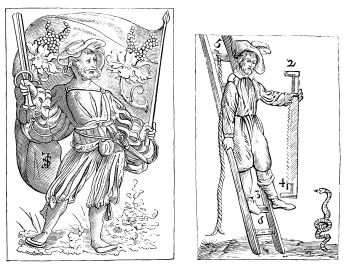
Fig. 220.—The “Two” of a Pack of German Lansquenet Cards. (Bibl. Imp. of Paris.)
Fig. 221.—Card from a Game of “Logic,” invented by Th. Murner, and copied from his “Chartiludium Logices.” (Cracow, 1507.)
The Germans were the first who entertained the idea of applying cards to the instruction of youth; and, as it were, of moralising a game of chance by making it express all the categories of scholastic science. Thomas Murner, a Franciscan monk, and professor of philosophy, made in 1507 an attempt of this kind (Fig. 221.) He designed a pack of fifty-two cards, divided into sixteen suits, corresponding to the same number of scholastic treatises; each card is covered with so many symbols that a description would resemble the setting forth of some obscure riddle (ténébreux logogriphe). The German universities, which were far from being dismayed at a little mysticism, were only the more eager to study the arcana of grammar and logic while playing at cards. Imitations of Murner’s cards were multiplied ad infinitum.
A game and pack of cards attributed to the celebrated Martin Schœngauer, or to one of his pupils, must also be dated in the fifteenth century. The cards are distinguished by their form, number, and design; they are round in shape, and much resemble Persian cards, are painted on ivory and covered with arabesques, flowers, and birds. This pack, only a few pieces of which now exist in some of the German collections, was composed of fifty-two cards divided into four numeral series of nine cards each, and with four figures in each series—the king, the queen, the squire, and the knave. The suits or marks are the “Hare,” the “Parrot,” the “Carnation,” and the “Columbine.” Each of the aces represents the type of the suit, and they bear philosophical devices in Latin. The four figures of the “Parrot” suit are of African character; those of the “Hare” are Asiatic or Turkish; those of the “Carnation” and the “Columbine” belong to Europe. The “kings” and “queens” are on horseback; the “squires” and “knaves” are so similar that it is difficult to distinguish them, with the exception of the knaves of “Columbine” and “Carnation” (Figs. 222 to 227).
The English also were in possession of playing-cards at an early date, obtaining them through the medium of the trade which they carried on with the Hanseatic towns and Holland; but they did not manufacture cards before the end of the sixteenth century; for we know that in the reign of Queen Elizabeth the Government retained in its own hands the monopoly of playing-cards, “which were imported from abroad.” The English, while adopting indiscriminately cards of a German, French, Italian, or Spanish character, gave to the valet the characteristic appellation of “knave.”[27]
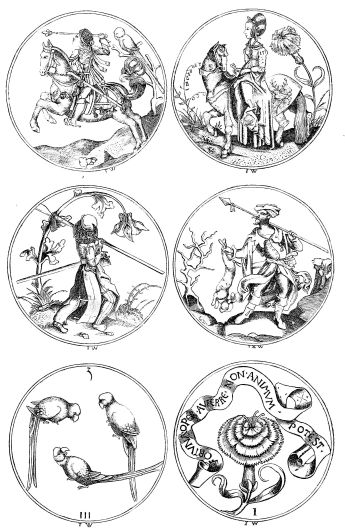
Figs. 222 to 227.—German Round-shaped Cards, with the Monogram T. W.
1. “King of Parrots.” 2. “Queen of Carnations.” 3. “Knave of Columbine.” 4. “Knave of Hares.” 5. “Three of Parrots.” 6. “Ace of Carnations.”
(Bibl. Imp. of Paris.)
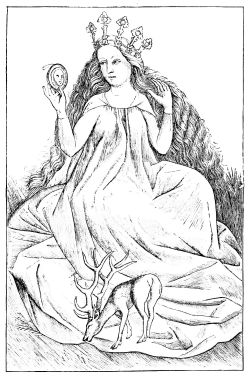
Fig. 228.—La Damoiselle, from a Pack of Cards engraved by “The Master of 1466.” (Bibl. Imp. of Paris. Print-Room.)
Wood-engraving, which was invented at the commencement of the fifteenth century, and perhaps even before, must have been applied at the very first and almost simultaneously to the reproduction of sacred pictures and the manufacture of playing-cards. Holland and Germany have contended for the honour of having been the cradle of this invention. Taking advantage of this, they have also even thought themselves warranted in laying claim to the credit of the original manufacture of cards;
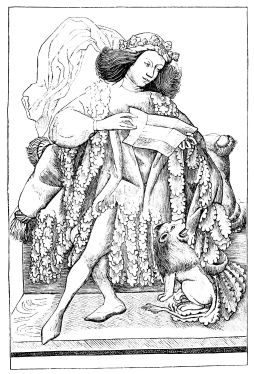
Fig. 229.—The Knight, from a Pack of Cards engraved by “The Master of 1466.” (Bibl. Imp. of Paris.)
whereas the fact is that all they can claim is to have been the first to produce them by some more expeditious method of making. According to the opinion of several savants, Laurent Coster of Haerlem was only an engraver of wood-blocks for cards and pictures, before he became a printer of books. It certainly is a fact that wood-engraving, which was for a long time limited to a few studios in Holland and Upper Germany, owed a large share of its progress to the trade in playing-cards—one which was carried on with such activity that, as we read in an old chronicle of the city of Ulm, about the year 1397, “they were in the habit of sending playing-cards in bales to Italy, Sicily, and other southern countries, to exchange for groceries and various merchandise.”
A few years later, engraving on metal or copper-plate was employed in producing playing-cards of a really artistic character, among which we may mention those of “The Master of 1466” (Figs. 228 and 229), and by his anonymous rivals. The pack of cards of this engraver exists only in a small number of print-collections, and it is in every case incomplete. As far as we can judge, it must have been composed of sixty cards, consisting of forty numeral cards divided into five series, and twenty picture-cards, being four to each series. The figures are the king, queen, knight, and knave. The suits, or marks, present rather a strange selection of wild men, ferocious quadrupeds, deer, birds of prey, and various flowers. These objects are numerically grouped and tolerably well arranged, so as to allow the numbers indicated to be distinguished at first sight.
Thus, as we have seen, playing-cards made their way through Arabia from India to Europe, where they first arrived about the year 1370. Within a few years they spread from the south to the north of the latter country; but those who, under the influence of a passion for play, had so eagerly welcomed them, were far indeed from suspecting that this new game contained within itself the germ of two of the most beautiful inventions ever devised by the human mind—those of engraving and printing. There can be no doubt that playing-cards were in use for many a long year, ere the public voice had proclaimed the almost simultaneous discovery of the arts of engraving on wood and metal, and of printing.
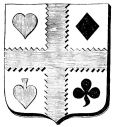
Fig. 230.—Coat of Arms of the Cardmakers of Paris.