FRESCO-PAINTING.
James Dafforne translation
The Nature of Fresco.—Employed by the Ancients.—Paintings at Pompeii.—Greek and Roman Schools.—Mural Paintings destroyed by the Iconoclasts and Barbarians.—Revival of Fresco, in the Ninth Century, in Italy.—Fresco-Painters since Guido of Siena.—Principal Works of these Painters.—Successors of Raphael and Michael Angelo.—Fresco in Sgraffito.—Mural Paintings in France from the Twelfth Century.—Gothic Frescoes of Spain.—Mural Paintings in the Low Countries, Germany, and Switzerland.
OO frequently in conversational language and even in the writings of grave authors,” says M. Ernest Breton, “the word fresco is made synonymous with mural painting in general. This confusion of terms has sometimes caused the most fatal errors. The etymology of the word is the best definition of the subject. The Italians give the name of paintings in fresco or a fresco, that is to say, à frais, or sur le frais, to those works executed upon damp stucco into which the colour penetrates to a certain depth. The ancient French authors, preserving the difference existing between the Italian fresco and the French frais, wrote the word fraisque. At the present day Italian orthography has prevailed, and with us this word has now more relation to its etymology than its real signification.”
Whatever may be the common acceptation of the word, we must, in order to keep within the limits of our subject, here only take into consideration real frescoes, or in other words, works of art executed upon a bare wall, properly prepared for the purpose, with which they are as it were incorporated; for in the roll of art all are excluded from the catalogue of mural paintings, rightly so called, which, although applied to walls either directly or by the aid of panels or fixed canvas, are produced otherwise than with water-colours, and used in such a manner as to penetrate the special kind of plaster with which the wall had been previously covered. We will mention as a striking example of this the famous “Lord’s Supper” of Leonardo da Vinci, which has many times been called a fresco (it is well known to have been painted upon the wall of the refectory of Santa Maria della Gratia, at Milan), but is nothing but a painting in distemper[32] on a dry partition—a circumstance, by-the-bye, which has not a little contributed to the deterioration of this magnificent work.
Fresco has long been considered the most ancient style of painting. Vasari, who wrote in the middle of the sixteenth century, says in apt terms that “the ancients generally practised painting in fresco, and the first painters of the modern schools have only followed the antique methods;” and, in our own day, Millin, in his “Dictionnaire des Beaux-Arts,” asserts that the great paintings in the “Pœcile” of Athens and the “Lesche” of Delphi, by Panænus and Polygnotus, spoken of by Pausanias, were executed by this process; the same author also ranks among frescoes the numerous paintings left by the Egyptians in their temples and catacombs. “It was,” he remarks, “what the Romans called in udo pariete pingere (to paint on a damp wall); they say in cretula pingere (to paint on chalk) to designate water-colour painting on a dry ground.”
Some persons have considered the paintings found at Herculaneum and Pompeii to be frescoes; nevertheless Winckelmann, who is an authority in these matters, said, a hundred years ago, in speaking of those works, “It is to be remarked that the greater part of these pictures were not painted on damp lime, but upon a dry ground, which is rendered very evident by several of the figures having scaled off in such a way as to show distinctly the ground upon which they rest.”
The whole mistake has arisen from taking the expression “in udo pariete,” found in Pliny, in too literal a sense; the error, which might at all events have been dissipated by an attentive examination of the examples themselves, would not have lasted long if the passage from Pliny had been compared with a statement of Vitruvius, which informs us that they applied to fresh walls uniform tints of black, blue, yellow, or red, which were destined to form the grounds of paintings, or even allowed them to remain plain, like our present coloured walls. The employment of this process may also be easily recognised in the paintings of Pompeii, where this uniform colouring has sometimes penetrated nearly an inch into the stucco of the wall. On this ground, when it was perfectly dry, ornamental subjects were painted either in distemper or encaustic.
Thus, therefore, it is shown that the process of painting in fresco was unknown to the ancients, and was invented by artists of succeeding times; but it would be difficult to assign any precise date to this invention; for however far we go back, we do not find any authors who fix the epoch at which the new method was for the first time followed. We are, therefore, compelled to notice the age of some particular example which shows that the discovery had then taken place, without being able to determine the exact date of its commencement.
Painting, which with the Greeks attained its greatest height in the reign of Alexander, fell, says M. Breton, “with the power of Greece. In losing its liberty, the country of the Fine Arts lost, too, the perception of the beautiful.” At Rome, painting never reached the same degree of perfection as it did in Greece; for a long time it was only practised by men of the lowest rank and by slaves. A few patricians, such as Amulius, Fabius Pictor (painter), and Cornelius Pinus, were, at the best, able to bring about only some slight revival. After the twelve Cæsars, painting followed the movement of decadence which carried away with it all the arts; like them, it received its death-blow in the fourth century, on the day when Constantine, quitting Rome in order to establish the seat of empire at Byzantium, took with him into his new capital not only the best artists, but also a prodigious number of their productions, and of those of the artists who preceded them. Several other causes may also be mentioned as having led to the decline of art, or to the destruction of examples which would now bear witness to its power in remote ages. In the first place, there was the birth of Christian Art, which rose on the ruins of Paganism; then, the invasion of barbarians which took place in the fifth century; lastly, in the eighth and ninth centuries, the fury of the Iconoclasts, or Image-breakers, a sect at the head of which figured several emperors of the East, from Leo the Isaurian, who reigned in 717, down to Michael the Stammerer and Theophilus, who respectively ascended the imperial throne in 820 and 829.
Even among the ignorant masses, to whom we owe the loss of so many chefs-d’œuvre, were some individuals who formed honourable exceptions, not only by opposing the devastations, but also by manifesting a laudable conservative instinct. Cassiodorus tells us that Theodoric, king of the Goths, re-established the office of centurio nitentium rerum (guardian of beautiful objects), instituted by the emperor Constantius; and we know that the Lombard kings who succeeded this prince and reigned in Italy for 218 years, although less zealous in the culture of the arts, did not fail to honour and protect them. In Paul the Deacon[33] we read that, in the sixth century, queen Teudelinde, wife of Autharis and afterwards of Agilulphus, caused the valorous deeds of the first Lombard kings to be painted on the basilica that she had consecrated at Monza under the name of St. John. Other paintings of the same epoch may still be seen at Pavia. The Church of St. Nazaire at Verona possesses in its crypt paintings spoken of by Maffei, which have been engraved by Ciampini and Frisi: these must date back to the sixth and seventh centuries. Lastly, they have recently found in the subterranean chapel of the basilica of St. Clement, in Rome, some admirable mural paintings, which archæologists refer to the same epoch.
The Eastern artists, driven away by the persecutions of the Iconoclasts, sought an asylum in Italy, where the Latin Church, obedient to the prescriptions of the Council of Nice, seemed determined to multiply sacred images as much as possible. The arrival of the Grecian artists in the West was also singularly promoted by the commercial relations which from that time were established between all points of the Mediterranean shore and the maritime or mercantile towns of Italy—Pisa, Genoa, and Venice. Thus was brought about the movement which, although taking place on Italian soil, drew from an entirely Eastern source the inspiration of the revival of the Fine Arts; thus was continued the so-called Byzantine school, destined to be the foundation of all modern art.
In 817 some Greek artists, by order of Pope Pascal I., executed under the portico of the Church of St. Cecilia in Rome a series of frescoes, the subjects of which were taken from the life of the saint. To the same school we are indebted for the sitting figures of Christ and His mother (Fig. 239), in the old Church of Santa-Maria Trans-Tiberia, in Rome; the large Madonna painted on the walls of Santa-Maria della Scala, Milan, which, at the time when this church was destroyed and replaced by the theatre of La Scala, was taken away and carried to the Church of Santa-Fidelia, where it still remains; a series of portraits of the Popes after St. Leo, a collection of which a large portion perished in the fire of St. Paul-extra-Muros, Rome (Fig. 240); and lastly, the paintings in the vaults of the Cathedral of Aquila.
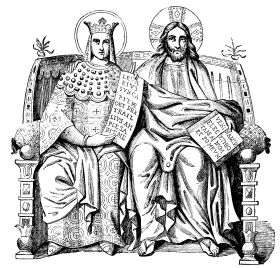
Fig. 239.—Christ and His Mother. Fresco-Painting of the Ninth Century, in the Apse of Santa-Maria Trans-Tiberia, Rome.
“The works of these earliest painters,” observes M. Breton, “seem to mark the transition from painting to sculpture: they are long figures as stiff as columns, single or arranged symmetrically, forming neither groups nor compositions, without perspective or effects of light and shade, and having nothing to express their meaning than a sort of legend proceeding out of the mouths of the characters. These frescoes, which are so weak when looked at in an artistic point of view, are remarkable for their material execution, being extremely solid in their workmanship. It is astonishing to see the wonderful preservation of some pictures of saints that adorn the pilasters of St. Nicholas in Treviso and the walls of the church in Fiesole, whereon are preserved the frescoes of Fra Angelico.”
Among the paintings remaining to our time, the first in which the authors departed from the uniform style of the Byzantine masters are those which adorn the interior of the ancient temple of Bacchus, now the Church of St. Urban in the Campagna of Rome: there is nothing Grecian either in the figures or draperies, and it is impossible not to recognise in them an Italian pencil; the date, however, is 1011. Pesaro, Aquila, Orvieto, and Fiesole, possess examples of the same epoch.
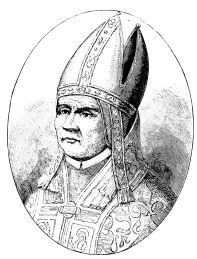
Fig. 240.—Portrait of the Pope Sylvester I. Fresco-Painting in Mosaic, on a gold ground, in the Basilica of St. Paul-extra-Muros, Rome.
At last, in the thirteenth century, notwithstanding its fierce intestine struggles, Italy, and especially Tuscany, witnessed the dawn of the sun of the Fine Arts, which, after a long period of darkness, was to shine with so much brilliancy over the whole world. Pisa and Siena, earliest in the revival, gave birth respectively to Giunta and Guido (Palmerucci), each of whom in his time acquired great renown; but the only works of these artists which remain now, in the Cathedral of Assisi, seem but to indicate a desire of progress without manifesting any real advancement in art.
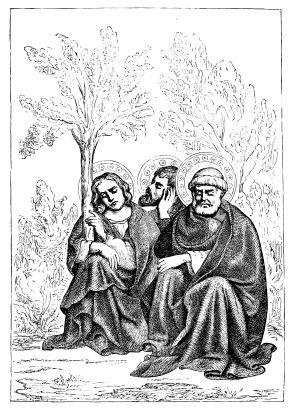
Fig. 241.—The Apostles in the Garden of Gethsemane. Fresco by Berna, at San-Geminiano. (Fourteenth Century.)
To Guido of Siena succeeds, but not immediately, the friend of Petrarch, Simon Memmi, whose frescoes in the Campo Santo of Pisa testify to his powerful genius, and denote the first remarkable stage of art.
In the collegiate church of San-Geminiano[34] may be still seen a fresco by Berna (Fig. 241), an eminent master in the school of Siena, who died in 1370.
Passing, but not without mention, Margaritone and Bonaventura Berlinghieri, who were only the timid harbingers of a great individuality, the Florentine school places in the first rank of its celebrities Cimabue (1240-1300), justly regarded by the artistic world as the true restorer of painting. Cimabue pointed out the path; Giotto, his pupil, trod it. He took nature for his guide, and has been surnamed “nature’s pupil.” Real imitation was the object of his endeavour, and as he found this system marvellously applied in the beautiful antique marbles which had already inspired, in the preceding century, the sculptors John and Nicolas of Pisa, he made an earnest study of these ancient chefs-d’œuvre. The impulse was given, and the Campo Santo of Pisa shows us its first results in “The Dream of Life.”
For two centuries there was a slow but always progressive improvement, owing to the industry of Buffamalco, Taddeo Gaddi, Orcagna, Spinello of Lucca, and Masolino of Panicale. With the fifteenth century appeared Fra Angelico of Fiesole (Figs. 242 and 246), and Benozzo Gozzoli; then Masaccio, Pisanello, Mantegna, Zingaro, Pinturicchio, and lastly Perugino, the Master of the divine Raphael. In the sixteenth century art attained its culminating point. At this epoch Raphael and his pupils painted the “Farnesina” and the “Stanze” and “Loggie” of the Vatican (it is known that the two first pictures of the “Loggie” (Fig. 243) were painted solely by the hand of Raphael); Michael Angelo alone executed the immense expanse of the “Last Judgment,” and Paul Veronese painted the ceilings of the palace of the Doges at Venice. Then Giulio Romano covered with his works the walls of the Te palace at Mantua; Andrea del Sarto, those of the “Annunziata” and “Dello Scalzo” at Florence. Daniel of Volterra painted his famous “Descent from the Cross” for the Trinité du Mont, Rome; at Parma, the Pencil of Correggio worked marvels on the circle of the dome of the cathedral. Leonardo da Vinci, besides the picture of the “Lord’s Supper,” which we before mentioned only to exclude it from the
“THE DREAM OF LIFE.”
FRESCO-PAINTING, BY ORCAGNA, IN THE CLOISTER OF THE CAMPO SANTO OF PISA. (FOURTEENTH CENTURY.)
This fresco is by Andrea Cione, called Orcagna, a Florentine painter of the fourteenth century, who executed for the Campo Santo of Pisa a series of paintings which are still admired, representing the four destinies of man:—“Death,” “Judgment,” “Hell,” and “Paradise.” Each of these large compositions embraces several scenes; that which we give belongs to the “Triumph of Death.”
Petrarch had just given to the world the concluding notes of his funereal song, and the wish of the painter seems to have been to call to life, in his fresco, the strange vision of the poet. The happy of this world are here represented gathered together under cool shades and upon carpets of verdure; gay lords are murmuring magic words into the ears of the young ladies of Florence. Even quiet falcons on the wrists of the lords seem captivated by this delicious music. Everything appears to invite forgetfulness of the miseries of life,—the richness of the vestments, the beautiful sky of Italy, the perfumes, the love-songs.... This is the “Dream of Life,” which “Death” is destined to dispel with one sweep of his mighty wing.
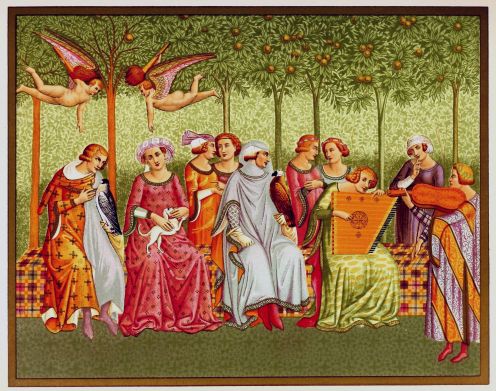
THE DREAM OF LIFE.
(After a Copy made for the Library of M Ambroise Firmin Didot.) From a fresco Painting by Orcagna, in the Cloister of the Campo Santo of Pisa. Fourteenth Century.
number of frescoes, endowed the monastery of St Onofrio at Rome with a magnificent Madonna, and the palace of Caravaggio, near Bergamo, with
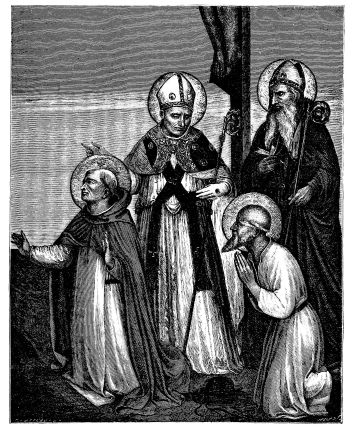
Fig. 242.—Group of Saints, taken from the large Fresco of “The Passion” in the Convent of St. Mark. Painted by Fra Angelico of Fiesole.
a colossal Virgin. It was, in short, the age of splendid productions in mural painting, that in which the great Buonarotti exclaimed when engaged in enthusiastic labour on one of his sublime conceptions—“Fresco is the only painting; painting in oils is only the art of women and idle and unenergetic men.” And yet, at least as regards improvements in the process of execution, fresco had hardly reached its climax.
In the seventeenth century the school of Bologna, after having for a long time maintained a merely imitative style of art, shone forth with independent light under the influence of the Carracci, who, summoned to Rome, covered the walls of the Farnesian gallery with frescoes, to which none others could be compared for brilliancy and powerful effect. As much must be said of the works of their pupils: the “Martyrdom of St. Sebastian,” in the Church of St. Mary of the Angels; the “Miracles of St. Nil,” at Grotta-Ferrata, near Rome; the “Death of St. Cecilia,” at Saint-Louis-des-Français, by Domenichino; “Aurora,” by Guercino, at the Villa Ludovici; the “Chariot of the Sun,” by Guido, in the Rospigliosi Palace, &c.
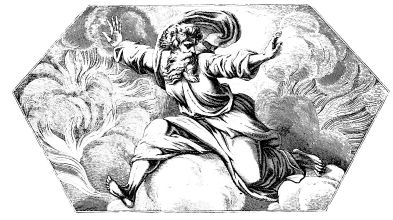
Fig. 243.—First Picture of the Loggie of Raphael—“God creating the Heaven and the Earth.”
Luca Giordano, a Neapolitan painter, founder of the gallery of the Ricciardi Palace at Florence, and author of the frescoes in numerous churches in Italy and Spain, must not be forgotten; and with him must be mentioned Pietro da Cortona, of the Roman school, who especially distinguished himself in the ceilings of the Barberini Palace, at Rome.
We still have to mention the fertile painters of the Genoese and Parmesan schools—Lanfranc, Carloni, and Francavilla; but the hour of decadence had come when these artists appeared; they had more boldness than talent, they aimed at the majestic, but only succeeded in attaining to the gigantic; their pencils were skilful, but their soul lacked fervour and conviction; in spite of their efforts, fresco-painting declined under their hands, and since that time has only decayed and gradually sunk into oblivion.
We must not quit the classical ground of the Fine Arts without mentioning a process of painting which is closely allied to fresco, and bears the characteristic name of sgraffito (literally, a scratch). This style of painting, or rather of drawing (for the works had the appearance of a large drawing in black crayon), was more generally used for the exterior of buildings, and was produced by covering the wall first with black stucco, then with a second layer of white, and afterwards by removing with an iron instrument the second layer so as to lay bare, in places, the black ground. The most important work executed in this style is the ornamentation of the monastic house of the knights of St. Stephen, at Pisa; this work is by Vasari, to whom also has been attributed—but wrongfully—the invention of sgraffito, which was used long before his time.
Hitherto we have chiefly confined our remarks to Italy and Italian artists; however, in the consideration of them we have nearly summed up our brief history of fresco. If we would look to France for any remarkable works of this kind, we must refer to the epochs in which Italy sent Simon Memmi to decorate the palace of the popes at Avignon, and Rosso and Primaticcio to adorn that of the kings at Fontainebleau. Prior to this, all we meet with are, at the most, a few primitive, not to say barbarous, subjects, painted here and there, in distemper, by unknown artists, on the walls of churches or monasteries. Among these conventional examples it is, however, only just to distinguish some pictures of powerful effect, if not in execution, at least for the ideas they are intended to convey; we would speak of the “Dance of Death,” or “Dance of the Dead,” like that which existed at Paris in the Cemetery of the Innocents, and another still to be seen in the Abbey of Chaise-Dieu, in Auvergne; legends more than
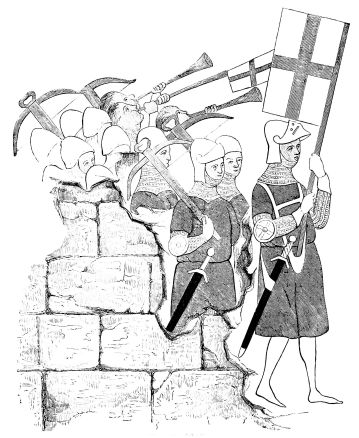
Fig. 244.—“Fraternity of the Cross-bowmen.” (Fresco-Painting of the Fifteenth Century, in the ancient Chapel of St. John and St. Paul, Ghent.)
pictures, and philosophical compositions rather than manifestations of art. Spain, too, has no reason to be proud of her national productions; for, with the exception of the Gothic frescoes still existing in the Cathedral of Toledo, representing the combats between the Moors and the Toledans (pictures specially worthy of the attention of archæologists), the only frescoes of Spanish origin we can mention are the paintings of a few ceilings in the Escurial and in a chapter-room in the Cathedral of Toledo; all the other frescoes must be attributed to Italian artists.
Whenever the northern artists, usually so cold and methodical in their mode of operation, devoted themselves to mural painting, it seems to have been necessary that they should enliven their temperament in the sunny rays of a southern sky; for while in Holland and Belgium we notice but few walls covered with decorative painting, we find a large number of Italian churches and palaces which contain frescoes bearing the signature of Flemish masters.
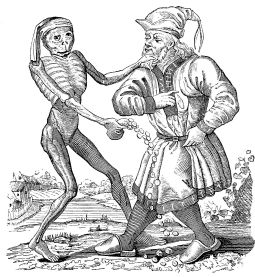
Fig. 245.—“Death and the Jew.” An episode from the “Dance of Death.” Painted in 1441, in the Cemetery of the Dominicans, Basle. (Facsimile from the Engraving of M. Mérian.)
There was considerable excitement manifested a few years ago at the discovery of the mural paintings in the ancient Chapel of St. John and St. Paul, in Ghent (Fig. 244). These works are of the fifteenth century, and although satisfactory enough as regards the design, they derive more importance from the subjects which they represent than from any merit of execution.
In speaking of Germany, we should not omit to mention the ancient “Dance of Death” (Fig. 245), at Basle, in the cemetery of the Dominicans, painted in the middle of the fifteenth century; also another “Dance of Death” much more famous, and the façades of several houses, painted at Basle by Holbein. We must also indicate the paintings with which (in 1466) Israel de Meckenheim covered the walls of a chapel of St. Mary of the Capitol, at Cologne; and the frescoes of St. Etienne and St. Augustine, at Vienna. But it does not follow, from this limited enumeration of works, that Germany either created or followed any special school.
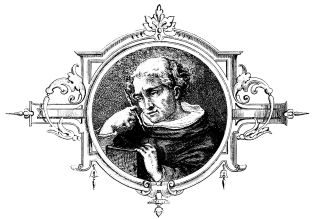
Fig. 246.—Fra Angelico, of Fiesole.