SCULPTURE.
James Dafforne translation
Origin of Christian Sculpture.—Statues in Gold and Silver.—Traditions of Antique Art.—Sculpture in Ivory.—Iconoclasts.—Diptychs.—The highest Style of Sculpture follows the Phases of Architecture.—Cathedrals and Monasteries from the Year 1000.—Schools of Burgundy, Champagne, Normandy, Lorraine, &c.—German, English, Spanish, and Italian Schools.—Nicholas of Pisa and his Successors.—Position of French Sculpture in the Thirteenth Century.—Florentine Sculpture and Ghiberti.—French Sculptors from the Fifteenth to the Sixteenth Century.
T is an indisputable fact that the epoch in which the Emperor Constantine, by receiving baptism, effected the triumph of Christianity, developed a kind of revival in the movement of the decorative arts, the ideas of which were then exclusively directed to the exaltation of the new faith. To construct numerous basilicas, to adorn them magnificently, and by means of the chisel to embody in a material form the spiritualism of the Gospel, were the objects of this pious monarch. Gold and silver were the less spared, as marble was considered too common a substance in which to represent the sacred personages of the divine hierarchy. At Constantinople, in the basilica constructed by Constantine, there was represented, on one side of the apse, a seated figure of our Saviour surrounded by His twelve disciples; on the other side, Christ was represented also sitting on a throne and accompanied by four angels, who had precious stones of Alabanda, inlaid, to represent their eyes. All these figures were life-size, and made of silver repoussé; each one weighing from ninety to a hundred and ten pounds. In the same church, a canopy representing the Apostles and cherubim in relief, of polished silver, weighed more than two thousand pounds. But these splendours were even eclipsed by those of the font of porphyry in which Constantine received baptism from the hands of Bishop Sylvester. The part whence the water flowed away was adorned with massive silver over an extent of five feet, and for the purpose three thousand pounds of this precious metal were employed. In the centre, columns of gold supported a lamp of the same metal weighing fifty-two pounds, in which, during the feast of Easter, two hundred pounds of perfumed oil were burnt. The water was poured into the font through the image of a lamb of solid gold, weighing thirty pounds. On the right was a life-size representation of our Saviour, weighing a hundred and seventy pounds; on the left was a statue of John the Baptist of the same size; while seven hinds of silver placed around the font, and pouring water into the basin, harmonised in their dimensions and materials with the other figures.
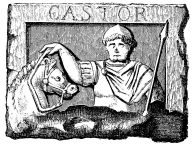
Fig. 272.—Altar of Castor (a Gallo-Roman Sculpture), discovered in 1711 under the Choir of Notre-Dame, Paris.
We would not assert that these works, pompously enumerated by Anastasius, the Librarian, corresponded in purity and elevation of style with the richness of the materials employed; for we know, on the contrary, that in order to comply with the wishes of the powerful emperor, artists were found who, by simple substitution of heads, attributes, or inscriptions, converted without any scruple a Jupiter into God the Father, or a Venus into a Virgin. The large cities were not as yet depopulated of the innumerable crowd of statues which adorned them; and it was only in provinces far from the metropolis that the images of the false gods were buried under the fragments of their overthrown temples (Figs. 272 and 273).
In fact, before the art had adopted, or rather created, the system of Christian symbolism, it was absolutely necessary to borrow the elements of its existence from the glorious materials of the past, and even to imitate the works of Pagan art.
In Greece more than elsewhere—and by Greece we include Constantinople—statuary preserved, under Constantino and his earliest successors, a certain degree of power which we might call original. The design still adhered to beautiful forms, and, in the arrangement of subjects, the principles of the ancients were for a long time applied, as if instinctively. Although artists no longer studied nature, they were, at all events, surrounded by excellent models, which guided them with somewhat imperious rule.
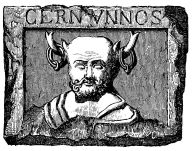
Fig. 273.—Altar of Jupiter Ceraunus (Gallo-Roman Sculpture), discovered in 1711, under the Choir of Notre-Dame, Paris.
We have already seen that, among the barbaric chiefs who invaded the empire of the Cæsars and seated themselves on the Imperial throne of Rome, were some who, at a certain period, professed to be, if not the protectors of the Fine Arts, which had then sunk into torpor, at least the preservers of the Greek and Roman monuments belonging to the noblest epoch of Art. The statues were no longer broken down; the inscriptions and bas-reliefs ceased to be mutilated; the triumphal arches (Fig. 274), the palaces, and the theatres, were respected, or, rather, were left standing. But a kind of deadness had come over the artistic world, and a few sympathetic manifestations of this kind were not sufficient to reanimate its enervated spirit; it was necessary that the period of repose should be fully accomplished—a period which, in the views of Providence, was perhaps a phase of profound contemplation or preparatory development.
Nevertheless, although the art which gives life to marble and bronze—a high style of sculpture—was in a stationary or retrograde state, the lower kind, which we may call domestic, preserved some degree of activity. For instance, it was then the custom for great personages to send as presents diptychs of ivory, on the outer face of which were carved bas-reliefs recalling some memorable event. Monarchs, on their accession, were in the habit of conferring diptychs of this kind on the governors of provinces and bishops; and the latter, in order to testify to the good understanding existing between the civil and religious authorities, placed the diptych on the altar. A marriage, a baptism, or any success, gave occasion for the presentation of diptychs. For two centuries artists lived on nothing but this kind of work. It needed events of some very extraordinary character to cause the production of any monument of real sculpture.
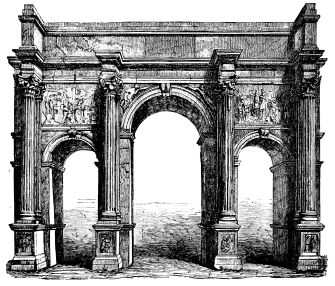
Fig. 274.—Restoration of a Roman Triumphal Arch, with its Bas-reliefs.
In the sixth century the cathedrals of Rome, Trèves, Metz, Lyons, Rhodez, Arles, Bourges, and the abbeys of St. Médard at Soissons, St. Ouen at Rouen, and St. Martin at Tours, are mentioned as remarkable; and yet the walls of these edifices were nothing but bare stone, without either ornament or sculpture. “To become living stones,” says M. J. Duseigneur, “they had to wait for another age. The whole of the ornamentation was exclusively applied to the altar and the baptismal font. The tombs even of great personages present the most primitive simplicity.” (Fig. 275.)
Ancient Gaul, in spite of its disasters, still retained, in certain parts of its territory, men, or rather groups of men, in whose hearts the cultivation of Art still remained a living principle. This was the case in Provence, round the archbishops of Arles; in Austrasia (Metz), near the throne of Brunehaut; in Burgundy, at the court of King Gontran. Most of the works and even the names of these artists are now lost; but history has recorded the movement, which was, as it were, a happy link destined to abbreviate the solution of continuity in artistic tradition.
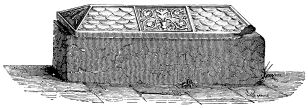
Fig. 275.—A Stone Tomb, of one of the first Abbots of St. Germain-des-Prés, Paris.
At the time when Greek art, in its degenerate state, had sunk down into a department of mere goldsmith’s work, casting over Europe only a pale and feeble light; when artists, in representing sacred or profane subjects, contented themselves with simple medallions of bronze, gold, or silver, which were generally inserted in a shrine, or suspended on the walls; across the seas Byzantine art was springing into life; an art which blended Hellenic reminiscences with Christian sentiment.
In the eighth century, the epoch of the uprising of the Iconoclasts against images of all kinds, Byzantine sculpture had acquired certain well-marked characteristics: rigidness of outline, meagreness of form, elongation of the proportions, combined with great profuseness of costume; all was the expression of saddened resignation and costly grandeur. The monumental statuary of this age has, however, almost entirely disappeared, and we should be nearly destitute of any accurate record as to the state of Art for a period of several centuries, were it not for numerous diptychs which, to some extent, supply this want. Many of these sacred diptychs were exquisitely wrought. Gori, in his “Trésor des Diptyques,” written in Latin and published at Florence in 1759, divides these monuments into four classes: diptychs intended to receive the names of the newly baptised; those wherein were written the names of the benefactors of the church, sovereigns, and popes; and those destined to preserve the memory of the faithful who had died in the bosom of the church (Fig. 276). Their outward surface generally represented some scene taken from the Evangelists, in which Christ was especially depicted as young and beardless, his head glorified with a nimbus without a cross. The more these representations were condemned, the more they who paid respect to them endeavoured to perpetuate their use. The Greek artists, being unable to find a livelihood in their own country, made their way into Italy in such numbers that the popes Paul I., Adrian I., and Pascal I., erected monasteries to receive them. Owing to the influence of this immigration, Art, which in the West was germinating in an undecided state between a weak style of originality and an awkward mode of imitation, was compelled to assume a character of its own, and this necessarily was the Byzantine character; that is, a manner which was firm, clear, and, in general, impressed with a certain imposing nobility of style. This style attained all the more success by its being illustrated by very eminent artists, whom Charlemagne patronised as fully adequate to the magnificence of his ideas; and also because the richness of ornament which this style combined with its work was likely to render it pleasing to the populace.
The royal palaces of Aix-la-Chapelle, Goddinga, Attiniacum, and Theodonis Villa, and the monasteries of St. Arnulph, Trèves, St. Gall, Salzbourg, and Prüm felt the salutary influence which Charlemagne exercised on all kinds of Art. Prior to 1793, in these various localities precious remains were still to be seen, reaching back to the eighth century; they testified to the fact that, apart from Byzantine influence, and bearing the impress of a simple Christian sentiment, sculpture still clung, owing to Lombard ascendancy, to some of the grand traditions of antiquity.
This union of principles gave rise to a number of works bearing a remarkable character. The foundation of the abbeys of St. Mihiel (Lorraine), Isle-Barbe (near Lyons), of Ambernay and Romans; the erection of several of the great monasteries in Alsace, Soissonnais, Brittany, Normandy, Provence, Languedoc, and Aquitaine; the construction of the
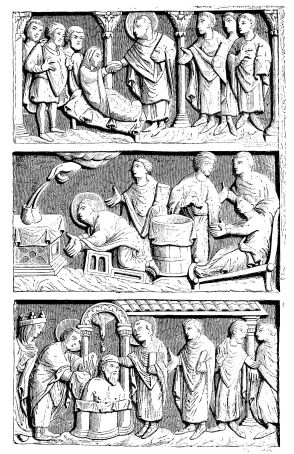
Fig. 276.—Diptychs in Carved Ivory of the Eleventh Century. (M. Rigollot’s Collection, Amiens.)
The first compartment represents St. Remy, Bishop of Rheims, healing a paralytic; the second, St. Remy healing a sick man by the invocation of the sacrament on the altar; the third, St. Remy, assisted by a holy bishop, baptising King Clovis in the presence of Queen Clotilda, and receiving from the Holy Spirit the sacred ampulla.
important churches of Metz, Toul, Verdun, Rheims, Autun, &c.; the restorations which took place at the abbeys of Bèze, St. Gall, St. Benignus of Dijon, Remiremont, St. Arnulphe-lès-Metz, and Luxeuil, were of sufficient importance to occupy an immense number of artists, architects, and sculptors, who, like the monk Gundelandus, abbot of Lauresheim, handled the compasses and the mallet with as much authority as the crucifix. Nothing could equal the splendour of some of the monasteries, which were perfect centres of genius and skill, in which all the Fine Arts united were a mutual assistance to one another; directed, perhaps, by a master who was himself inspired by a feeling for elevated production (Fig. 277).
Nevertheless, the smaller examples of sculpture and carving constituted the principal work of the artists of the eighth century. In the execution of any larger objects they were deterred by a dread of the Iconoclasts, who still continued their course of destruction, neither was it much less after the death of Charlemagne, owing to the civil wars and invasions which, in every direction, put a stop to or ruined architectural works. A shrine or an altar might perhaps be saved, but a church-front or doorway could not be protected; and the hereditary hatred with which princes pursued one another did not fail to be wreaked on their effigies. At that time there were neither artists nor monks; every one became a soldier, and the common peril gave some energy to our alarmed ancestors.
When these invasions had almost come to an end in Europe, the very disasters they had caused assisted to some extent the progress both of architecture and sculpture. In the first place there sprang up a complete order of new buildings, originated by the need that arose for fresh edifices for the purpose of public worship; the Church, having a thousand disasters to repair, built or restored a number of monasteries which assumed a decided character of individuality. The cathedrals of Auxerre, Clermont, Toul, the Church of St. Paul at Verdun, the abbeys of Montier-en-Der and of Gorze, of Munster, Cluny, Celles-sur-Cher, &c., were specially adorned with the sculptural characteristics of this epoch. Crucifixes in high relief were multiplied, the introduction of which into monumental sculpture did not take place before the pontificate of Leo III. In the arched recesses over doorways representations of the good and the bad were placed opposite to one another; the worship of the Virgin was celebrated in all kinds of artistic productions; and, in short, sculpture was displayed everywhere with an extraordinary amount of richness. Nothing escaped, so to speak, its luxurious growth: ambons,[47] seats, arches, baptismal fonts, columns, cornices, bell-turrets, and gargoyles—everything, in short, testified that sculpture and stone were now in full harmony. Almost all the figures were then represented as clothed in the Roman style, with a short tunic, and the chlamys clasped upon the shoulder; this still continued to be the court-costume, and consequently the only one suitable to the representation of the exalted followers of Christianity.
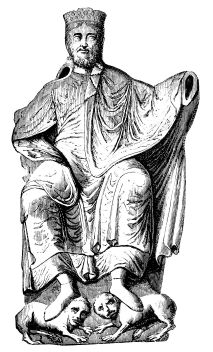
Fig. 277.—Bas-relief in the Abbey-Church of St. Denis; a reproduction of the ancient Statue of Dagobert I., destroyed in the Ninth Century.
It is worthy of remark that the monuments of this age are generally wanting both in dates and the name of the sculptor. Not more than five or six of the principal artists or directors of artistic works of the period are mentioned by name in any historical records. Among them, however, are Tutilon, a monk of Saint-Gall, who at once poet, sculptor, and painter, ornamented with his works the churches of Mayence and Metz; Hugues, Abbot of Montier-en-Der; Austée, Abbot of St. Arnulph, in the diocese of Metz; Morard, who, with the co-operation of King Robert, rebuilt, towards the end of the tenth century, the old church of St. Germain-des-Prés, at Paris; lastly, Guillaume, Abbot of St. Benignus, at Dijon, who took under his direction forty monasteries, and became chief of a school of Art, as well as their head on religious matters. The doorways of the churches of Avallon, Nantua, and Vermanton, executed at this epoch, bear witness to the rigour of an improved taste; and it may be well said that this abbot Guillaume, who for a long series of years directed a number of artists, who also in their turn became chiefs of schools, exercised as powerful an influence on French art as Nicholas of Pisa on Tuscan art in the following century.
But although it embraced within its influence a very extended sphere, the school of Burgundy did not fail to find on the ancient Gallic soil very skilful and industrious rivals. The districts of Messin, Lorraine, Alsace, Champagne, Normandy, and the Ile-de-France, in short all the various centres of the South, possessed numerous artists, each of whom impressed on their works their own special character of individuality.
While all this activity was prevailing in France, Italy had as yet taken so insignificant a part in the revival of Art, that in 976 Peter Orseolo, Doge of Venice, having formed the idea of rebuilding the basilica of St. Mark, was compelled to summon from Constantinople both architects and artists.
A period of check to any progress took place in France, however, just as in all the rest of Europe, when, at the approach of the year 1000, the whole population became subject to an ideal dread that the end of the world was at hand; but when this date was once passed, every school of art set vigorously to work, and the most remarkable monuments of Romanesque architecture sprang up throughout Europe in every direction.
Then it was that the artists of Burgundy built and ornamented, among other churches and monasteries, the Abbey of Cluny, the apse of which consisted of a bold cupola, supported by six columns thirty-six feet in height, of
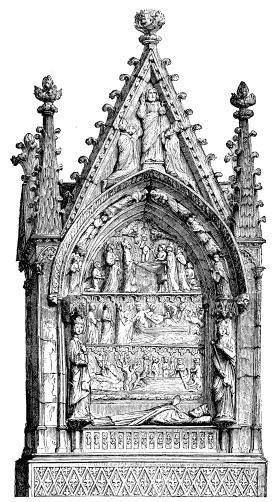
Fig. 278.—Tomb of Dagobert, executed by order of St. Louis, in the Abbey-Church of St. Denis. It represents the King carried away by Demons, after his death, towards the Infernal Bark, from which he is rescued by Angels and the Fathers of the Church. (Thirteenth Century.)
Cipolin and Pentelican marble, with captials, cornices, and friezes, carved painted, and decorated with bronze. In Lorraine they worked at the cathedrals of Toul and Verdun, and the abbey of St. Viton. In the diocese of Metz Gontran and Adélard, celebrated abbots of St. Trudon, covered Hasbaye with new buildings. “Adélard,” says a chronicler, “superintended the construction of fourteen churches, and his outlay was so great that the imperial treasury would scarcely have sufficed for it.” In Alsace, the cathedral at Strasbourg and the two churches of Colmar and Schelestadt simultaneously arose, and in Switzerland the Cathedral of Basle. These magnificent edifices are still standing to show the vigour and majestic simplicity with which the art of sculpture was then able to embody its ideas; and, by lending its aid to architecture, to manifest, so to speak, the faith which actuated it. It was in this century that Fulbert, Bishop of Chartres, who was doubtless a sculptor also, superintended the restoration of his church, the splendour of which is still open to the admiration of all. Art, too, did not less distinguish herself in the decoration of certain additions made at that time to edifices already existing. The doorways of the churches of Laon, Châteaudun, and St. Ayoult of Provins, grand works of the earliest years of the twelfth century, yield the palm only to the splendid external ornamentation of the Abbey of St. Denis, executed between the years 1137 and 1180. The Abbot Suger, who was himself an eminent artist, does not name any of the sculptors to whose care this important task was committed. We are equally ignorant as to the sculptors of the statues of Dagobert and of Queen Nanthilde, his wife; and also as to the artists of a large golden crucifix, the foot of which was enriched with bas-reliefs, and the figure of Christ, that presented, says Suger, “an expression really divine.” The names of the sculptors of the cathedral church of Paris are likewise concealed from our admiration. One might suppose that a body of artists fired with the same inspiration, and with a common sentiment both in thought and action, had there assembled to design their works; some sculpturing in marble the sarcophagus of Philip of France; some peopling the rood-loft and the apse with tall figures and a long gallery of Biblical subjects; others decorating the façade and exterior with statues, all of every diversified character, but yet all appearing to unite in the expression of the same feelings and the same faith (Fig. 279).
In the twelfth century, the Burgundian artists continued their marvellous
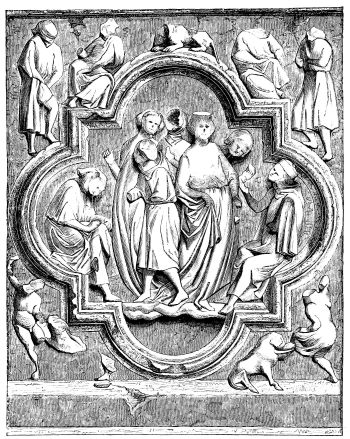
Fig. 279.—External Bas-relief of Norte-Dame, in Paris, representing Citizens relieving Poor Scholars. (The work of Jean de Chelles. Date 1257.)
work. The tomb of Hugues, Abbot of Cluny; the doorway of the monastery of St. Jean, that of the Church of St. Lazare at Autun; the nave and the west front of Semur-en-Auxois, are all of this school, and of this epoch.
The school of Champagne raised to the memory of Count Henry I., in the Church of St. Etienne, at Troyes, a tomb surrounded with forty-four columns of gilded bronze, surmounted by a slab of silver on which were placed, in a recumbent position, the statues of the Count and of one of his sons; bas-reliefs, in bronze and silver, representing the Holy Family, the celestial court, angels, and prophets, surrounded this monument. The tomb of Count Henry was a triumph of sculpture in metal; and, at that time, surpassed all other tombs in France, just as the Cathedral of Rheims was destined, ere long, to excel all others.
In Normandy we find the same enthusiasm, the same zeal, the same skill in Art; and there, at least, we learn the names of some of the artists: Otho, the builder of the Cathedral of Séez; Garnier, of Fécamp; Anquetil, of Petit-Ville, &c. The masons and sculptors, too, formed at this epoch a numerous and powerful corporation.
In the South, Asquilinus, Abbot of Moissac, near Cahors, ornamented with fine statues the cloister and front of his church, and affixed to the sides of the apse a Crucifixion so skilfully carved, that it was believed to have emanated from some divine hand (“ut non humano, sed divino artificio facta”). In Auvergne, Provence, and Languedoc, many other important works of sculpture were executed. But the chief masterpiece of all, which combines the different styles of the southern schools, is the famous Church of St. Trophimus of Arles, the front of which, where the breadth and grace of the Greek style is allied with the purest Christian simplicity, carries back the imagination to the brightest epochs of the art.
Towards the end of the eleventh and the commencement of the twelfth century, the sculptors’ studios of the districts of Messin and Lorraine were in full activity. Several magnificent churches having been destroyed by fire, particularly that of Verdun, the whole population assisted, either with money or labour, in the restoration of these edifices. It was a perfect artistic crusade, in which several bishops and abbots, who were clever artists as well as spiritual chiefs, took the lead in the movement.
In Alsace, art asserted its position in the magnificent Cathedral of Strasbourg,[48] a kind of challenge thrown out to the artists on the other side of the Rhine, who were unable, even at Cologne, to carry an edifice to such an
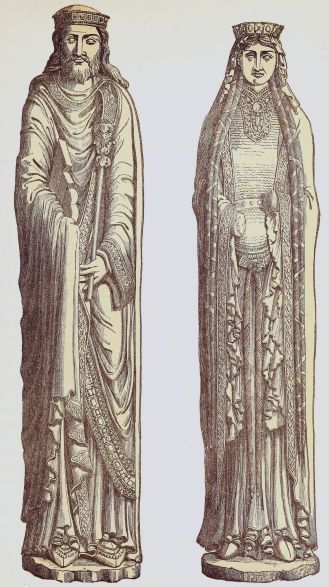
CLOVIS I. AND CLOTILDE HIS WIFE.
Statues formerly at the Entrance of the Church of Notre Dame at Corbeil. Twelfth Century.
enormous height, or to adorn it with such a diversified multitude of statues. Although belonging more especially to the thirteenth century, it may be taken as the starting-point of the prodigious works executed by an association of freemasons, who have marked with their hieroglyphic signatures the stones of this edifice, as of all others executed by them in the valley of the Rhine, from Dusseldorf to the Alps.
We are, however, led to believe that Germany also did not fail to be subject to the influence of this artistic school, for among contemporary monuments are several in a style which manifestly testifies to the effects of the neighbouring country of Alsace.
Flemish art of that time is exemplified by the Church of St. Gudule at Brussels, the style of which is especially rich with decorations borrowed from churches on the banks of the Rhine, the Moselle, the Sarre, and the Upper Meuse.
If we include in one comprehensive glance French, German, and Flemish sculptural works, we shall recognise in all, notwithstanding the predominance of any particular school, one original and special type. The characteristics of this are elongated faces with a calm, contemplative, and penitent expression; stiffness of attitude, and a kind of ecstatic immobility, rather than any glow of animation; draperies with small narrow folds and close-fitting, as if wetted; pearled fringes or ribbons, set off with gems (Fig. 280). We see statues of lofty proportions reared up; representations of various personages are multiplied on the tombs; Greek art is disappearing and its learned theories are giving way before Christian sentiment; thought is obtaining the mastery over mere form; symbolism makes its appearance and becomes a science.
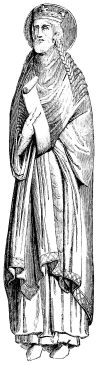
Fig. 280.—Statue said to be of Clovis I., formerly in the porch of St. Germain-des-Prés, Paris. (Twelfth Century.)
But let us turn our eyes towards Italy. Venice had scarcely raised her lofty dome ere Pisa aspired to have one also. Many a Tuscan ship, launched upon the sea for conquests of a new kind, brought from Greece an infinity of monuments, statues, bas-reliefs, capitals, friezes, and various fragments; and the Tuscan people, the best organised race in Europe for fully appreciating all the beauty of form, were called upon to draw their inspiration from the relics of ancient works of Art. The enthusiasm became general. In 1016, Buschetto, regarded as the first architect of his time, undertook the building of the Cathedral of Pisa, where ancient fragments are still conspicuous amid the works of more modern creation: a kind of holographic testament the benefit of which the followers of the art of Phidias have thus handed down to posterity. The pupils of Buschetto, accepting the impulse of his masterly hand and reproducing his ideas, soon spread all over the peninsula, and the cathedrals of Amalfi, Pistoia, Siena, and Lucca arose, the Byzantine character of which differed from the Lombard style presented by the Cathedral of Milan. One might almost have fancied that the bosom of the earth brought forth statues which, as if by enchantment, peopled every pedestal; and that from heaven descended the ray which animated them with their sublime expression. The art of casting in bronze, hitherto almost unknown in Italy, became naturalised there as much as the art of carving in stone.
While in the West the Arts were making such a spring, in the East they had relapsed into the lowest stage of debasement, at the period when Byzantium was simultaneously threatened by the Bulgarians and the Crusaders; although for a time they had appeared to revive, owing to the zeal of Basil the Macedonian, Constantine VIII., and some of their successors. Eastern sculpture disappeared when the Latins sacked the ancient capital of the first Christian emperor (1204).
At the approach of the thirteenth century, which was destined to be the great age of Christian architecture and sculpture, artists no longer looked, as they had hitherto done, towards Byzantium, they depended on themselves; and although some hesitation might still be felt, they found all round them models they could imitate, traditions they could follow, and masters to whom they could listen. Christian art had now an independent existence, and the various schools asserted their styles in a way which became every day more clear, more powerful, and more original.
“The style of the head of Christ at Amiens” (Fig. 281), says M. Viollet-le-Duc, writing on this subject, “fully deserves the attention of
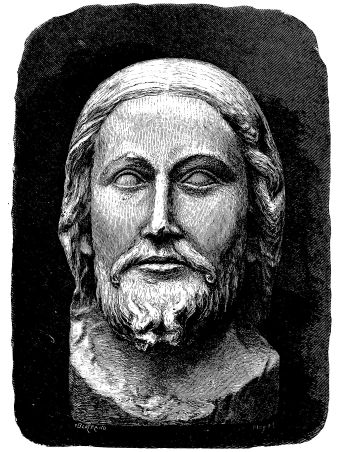
Fig. 281.—“The Beau Dieu d’Amiens;” a Statue of Christ in the Front of the Cathedral of Amiens. (Thirteenth Century.)
sculptors. This carving is treated in the same way as the Greek heads called Eginetic. There is the same simplicity of model, the same purity of outline, the same style of execution, at once broad and delicate. It well represents the features of Christ as a man: a blending of sweetness with firmness, a gravity devoid of sadness.”
This is not the place to assert any minute comparisons between different manners and styles; even the bare enumeration of the many monuments to which this fervent age gave birth might prove wearisome. We call it a “fervent age,” and fully are we justified, for, at a time when a whole world of artist-sculptors of ornaments and figures were devoting themselves to the most delicate and marvellous works of sculpture (Fig. 282), none seemed desirous of displaying his own personal distinction. We find, for instance, numerous sculptors setting aside all claim to individual merit, and carrying this self-denial so far that, instead of their own names, they inscribed that of the Virgin Mary on the carvings of the churches which they had enriched with their finest works: “Hoc panthema pia cælaverat ipsa Maria.”
In Germany, Christian art became specially enthroned in Saxony; and Dresden, which has been justly styled the German Athens, can date back her architecto-sculptural adornments to the tenth century. On the banks of the Rhine, at Cologne, Coblentz, and Mayence, we find again the school of Saint-Gall, which, having been planted in 971, under the auspices of Notker, Bishop of Laodicea, left its stamp, during a period of two centuries, in a series of remarkable works.
England, as early as the seventh century, had called to her aid some of the French “masters in stone” and best workmen, and she subsequently continued to do so for the building and ornamentation of her finest religious edifices. William of Sens, a very skilful artist (artifex subtilissimus), proceeded, in 1176, to rebuild Canterbury Cathedral. Norman and French artists also restored the abbeys of Croyland and Wearmouth, and York Cathedral, already enriched with Byzantine and French sculpture.
Spain and Portugal, the soil of which had long been the theatre of an inveterate conflict between two races embracing two irreconcilable religions, were destined to inherit from these very struggles the creation of a singularly characteristic style of art. In adopting the Byzantine style, the Moors had deprived it of its character of simple earnestness, and made it to harmonise with the tendencies of their refined sensualism. Even when Christian art was able to exercise an undivided rule, it could not fail to be influenced by the buildings erected by the Moors; and the fact that this alliance of architectural and sculptural styles succeeded in producing masterpieces is well attested by the cathedrals of Cuenca, Vittoria, and some portions of those of Seville, Barcelona, and Lugo in Galicia.
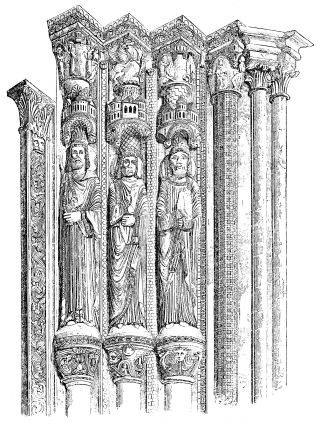
Fig. 282.—Statues in the South Porch of Bourges Cathedral. (Twelfth Century.)
Sicily and the kingdom of Naples followed the movement made in other countries of Europe; but here, again, was felt the influence of various foreign importations. Some of them were of Greek origin, coming from Byzantium; some northern, from Normandy, and perhaps also from Germany; most, however, from Spain, and especially from the important school of Aragon.
“Nicolas of Pisa,” says Emeric David, “was born towards the end of the twelfth century, in a town then peopled with Greek masters and the pupils of those masters, and full of Greek monuments of every age; a town which might be called altogether Greek. He had the good sense to disdain the productions of his own time and to devote himself to the more elevated contemplation of the chefs-d’œuvre of ancient Greece. This proof of undoubted discernment, and a high degree of taste on his part, could not but lead to very marked progress. But a premature study of the antique is not so sure a guide to the desired end as the contemplation of nature, to which Guido of Siena, his contemporary, and a little later Cimabue and Giotto, taught perhaps by his errors, assiduously applied themselves.” There can, however, be no doubt that the first development of Christian sculpture in Italy must unquestionably be referred to Nicolas of Pisa. He had, nevertheless, some rivals who were well worthy of competing with him. Among these were Fuccio, sculptor of the magnificent tomb of the Queen of Cyprus, in the Church of San Francesco at Florence; and also Marchione of Arezzo, who in 1216 carved his name over the doorway of the church of that town. Giovanni of Pisa, son of Nicolas, who sculptured many beautiful works at Arezzo, Pistoia, and Florence, and even surpassed himself in the Campo Santo at Pisa, perhaps the most remarkable monument in Christian Europe, has been placed by some far below his father in rank as a sculptor, on account of an accusation made against him of having abandoned the Greek style. But this renunciation was, in fact, a real trait of genius, and actually constitutes his glory; for, by neglecting form to some extent, he was enabled to carry religious idealism and power of expression to its very highest limits. We must, therefore, consider Giovanni and Margaritone, pupils of Nicolas; Andrea Ugolino, pupil of Giovanni; Agnolo and Agostino of Siena; and the celebrated Giotto, who was at once architect, sculptor, and painter, as real regenerators of the art. Indeed, we might call these great artists the creators of Christian sculpture in Italy—that art in which simultaneously shone forth seriousness of composition, grace and ease of attitude, simplicity of imitation, elevation of sentiment; in short, all the great harmonies of a style which seemed to breathe forth a hymn of love and faith.
Thanks to the studios of Agnolo and Agostino, Siena, a small town which calls to mind the ancient Sicyone, so weak in a political point of view and yet so learned and polished, was for some time the rival of Pisa, up to the period when Florence absorbed the artistic splendour of the two cities. Florence, as the home of the Arts, became the centre of radiation, whence artists took their flight over the whole of Italy, and from Italy spread among all the nations of Europe.
Towards the end of the thirteenth century, the churches of Florence, on which the fraternities combined their efforts, and some of the civil buildings of this rich and flourishing city, were filled with statues. The foundation of the municipal palace in 1282, and that of the cathedral in 1298, made these two wonderful edifices real museums of sculpture, in which, among the works of Eastern artists, those of Giovanni of Arezzo and Giotto are distinguished. Agostino and Agnolo of Pisa executed at that time some magnificent examples at Santa Maria in Orvieto, San Francisco in Bologna, and in the subterranean Church of Assisi, &c. Lastly, Andrea of Pisa, a contemporary of Giotto, as he died only in 1345, extracted from antiquity all that Christian sculpture could borrow from it; that is, he combined sublimity both of form and expression. At Pisa, the chancel of Santa Maria a Ponte; at Florence, the campanile and the high-altar of Santa Maria de’ Fiori, and a door of San Giovanni; in the Cathedral of Pistoia, the tomb of Cino, are all of them so many masterpieces; above which, however, the old Pisan master proudly classed the works of his son Nino. This young artist, who carved the monument of the Scaligers at Verona, became, in fact, the worthy follower of the school which recognised Andrea as its chief. Jacopo della Quercia and Niccolo Aretino enriched also with magnificent works the towns of Siena, Lucca, Bologna, Arezzo, and Milan, as well as Florence. But when, in 1424, the tomb closed over Jacopo della Quercia, the lofty destinies of the art seemed to come to a termination, and soon rapidly declined. In Venice, at the death of Filippo Calendario, which occurred in 1355, Italian sculpture had already lost much of its nobility and vigour of style.
Italian sculpture (Fig. 283), as remarked by Emeric David, raised itself to the height of the sublime by merely striving after a simple and exact imitation of nature. It was by the same course of action that French sculpture always emulated its Transalpine rival; but, in order to attain the same end, the imitation followed a different path. In Italy, Art raised itself to the ideal by an attentive study of Greek forms; while on this side of the Alps, when sentiment required it, form was, if not sacrificed, at least neglected. French art showed more respect for the orthodoxy of Christian thought; she did not introduce into the sanctuary of the Holy of Holies any of those profane and material ideas that might have been inspired by the marbles of Greece. In spite of the pointed architecture which everywhere prevailed, French sculpture, replete with a certain eloquent unction, preserved for a considerable period the Byzantine style in the appearance of the head and in the delicacy of draperies; without, however, altogether renouncing its individuality of character, and without ceasing to seek for models peculiar to its own soil.
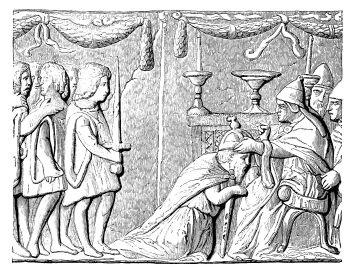
Fig. 283.—Bas-relief on one of the Bronze Gates of St. Peter’s at Rome, representing the Coronation of the Emperor Sigismund by Pope Eugène IV., in 1433. (Sculpture of the Fifteenth Century.)
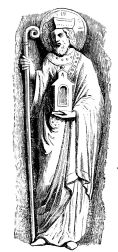
Fig. 284.—Statuette of St. Avit, in the Church of Notre-Dame de Corbeil, demolished in 1820.
(Eleventh Century.)
Unfortunately for the personal glory of the French sculptors, the historians of the time have scarcely taken the trouble to record their names. In order to discover but a few of them, learned men of modern days have been compelled to undertake laborious researches; while many, and those the most remarkable—worthy, no doubt, to be compared with the greatest Italian artists—are and must remain ever unknown (Fig. 284). The Italians were more fortunate; to them Vasari, their rival and contemporary, has raised a lasting monument. In French art, the list of the sculptors of so many masterpieces must come to a close when we have mentioned Enguerrand, who, from 1201 to 1212, commenced the Cathedral and the Church du Buc, at Rouen, and had for his successor Gautier de Meulan; Robert de Coucy, chief of the body of artists who, in 1211, caused the Cathedral of Rheims to rise loftily from the earth; Hugues Libergier, who rebuilt the ancient basilica of St. Jovin; Robert de Luzarches, the founder, in 1220, of the Cathedral of Amiens, continued after his death by Thomas de Cormont and his son Regnault; Jean, Abbot of St. Germain-des-Prés, who in 1212 undertook the Church of St. Cosme, Paris; that of St. Julien le Pauvre being restored and adorned with sculpture at the same date, from the designs of the abbot and the “brethren” of Longpont (Fig. 285); Jean des Champs, who in 1248 worked at the ancient Cathedral of Clermont; lastly, the two Jeans de Montereau, who at one time as military architects, at another as sculptors of sacred subjects, were at the command of St. Louis, and produced some extraordinary works both of construction and sculpture.
Alsace manifested no less enthusiasm than France for the new architectural system, and sculpture was also subject to a similar development. From Basle to Mayence, the slopes of the Vosges and the long valley of the Rhine, became full of edifices enriched with sculpture and peopled with statues. Erwin of Steinbach (who died in 1318), assisted by Sabina, his daughter, and William of Marbourg, were the most renowned masters in these parts.
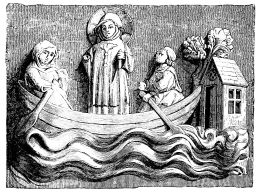
Fig. 285.—Bas-relief formerly over the Doorway of St. Julien le Pauvre, Paris, representing St. Julien and St. Basilissa, his wife, conveying in their boat Jesus Christ under the figure of a Leper.
(Thirteenth Century.)
The extraordinary advance that French sculpture made in this age was assisted—if not as regards the higher style of work, which could do without this help, at least in respect to the minor details of the art—by the institution of the fraternities of the Conception Notre-Dame. In many towns the sculptors of images and the painters, the moulders, the bahutiers, or carvers in wood, horn, and ivory (Fig. 286), were all united under the same banner. In Germany and Belgium also existed hanses, or guilds, which were in direct communication with those of Alsace, and who accepted as guides French artists of known ability; as, for instance, Volbert and Gérard, architect-sculptors, who were simultaneously engaged in the construction of the Church of the Holy Apostles, Cologne.
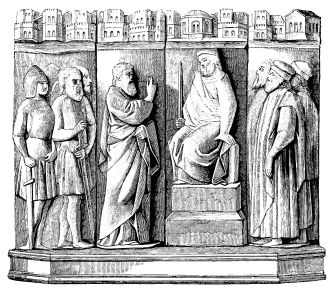
Fig. 286.—Fragment of a small Reredos, in carved Bone (Fourteenth Century).
Presented by Jean, Duc de Berry, Brother of Charles V., to the church of the ancient Abbey of Poissy.
(Museum of the Louvre.)
With respect to the works commenced or finished in the fourteenth century, the only difficulty is to make a choice among these wonderful monuments of Art; which, however, must be looked upon as the last manifestations of Christian art, properly so-called. We must, however, point out the polychrome sculptures of Chartres, of St. Remy, Rheims; St. Martin, Laon; St. Yved, Braisne; St. Jean des Vignes, Soissons; of the Chartreux, Dijon. In this ducal city we find, in 1357, Guy le Maçon, a celebrated
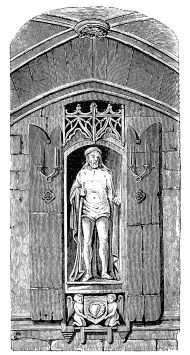
Fig. 287.—“Le Bon Dieu,” in the old Chapel of the Charnier des Innocents, Paris.
(Fifteenth Century.)
sculptor; at Bourges, about the same date, Aguillon, of Droues; at Montpellier, between 1331 and 1360, the two Alamans, John and Henry; at Troyes, Denisot and Drouin of Mantes, &c. Beyond France, Matthias of Arras, in 1343, laid the foundations of the Cathedral of Prague, which was to be continued and finished by another French artist, Pierre of Boulogne. Arrested as our attention must be by the statues and bas-reliefs which were multiplied under the porches, in the niches (Fig. 287), and on all the tombs, we can cast but a very cursory glance on the immense number of wood-carvings, figures in ivory, and movable pieces of sculpture, executed by artists who may be divided into two very distinct classes, the Norman and the Rhenish; all of other schools appear to have been nothing but imitators of these.
In 1400 the Maître Pierre Pérat, architect of three cathedrals, who was at once both civil engineer and sculptor, and one of the greatest masters of whom France can boast, died at Metz, where he was interred with all the honours due to his wonderful talents. Just at the same time a memorable competition was opened at Florence. The object in view was to finish the doors of the Baptistery of St. John. The formal announcement of the competition, which was made all over Italy, did not fail to call forth the most skilful artists. Seven of these were selected, on account of their renown, to furnish designs: they consisted of three Florentines—Filippo Brunelleschi, Donatello, and the goldsmith, Lorenzo Ghiberti; Jacopo della Quercia of Siena; Nicolo Lamberti d’Arezzo; Francesco da Valdambrina; and Simone da Colle, called de’ Bronzi. To each of these competitors the republic granted one year’s salary, on condition that, at the end of the period, each of them should furnish a panel of wrought bronze of the same size as those of which the doors of St. John were to be composed. On the day fixed for the examination of the works, the most celebrated artists of Italy were summoned. Thirty-four judges were selected, and before this tribunal the seven models were exhibited, in the presence of the magistracy and the public. After the judges had audibly discussed the respective merits of the works, those of Ghiberti, Brunelleschi, and Donatello were preferred. But to whom of the three was the palm to be awarded? They hesitated. Then Brunelleschi and Donatello retired apart and exchanged a few words; after which one of them, commencing to address the assembly, said:—“Magistrates and citizens, we declare to you that in our own judgment Ghiberti has surpassed us. Award him the preference, for our country will thus acquire the greater glory. It is less discredit to us to make known our opinion than to keep silence.”
These doors, at which Ghiberti worked for forty years, with the assistance of his father, his sons, and his pupils, are perhaps the finest work we have in sculptured metal.
At the date when Lorenzo Ghiberti, Donatello, Brunelleschi, and their pupils were the representatives of Florentine sculpture, the French school also produced its masters and its works of Art. Nicholas Flamel, the famous
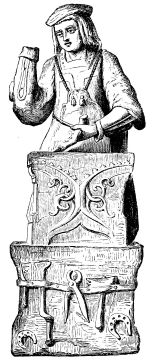
Fig. 288.—“St. Eloi, Patron of Goldsmiths and Farriers.” A Sculpture of the Fifteenth Century, in the Church of Notre-Dame d’Armançon, at Semur, Burgundy.
writer (écrivain) of the parish of St. Jacques la Boucherie, ornamented the churches and mortuary chapels of Paris with mystical and alchemical (alchimiques) sculptures, of which he was the designer if not the actual artist. Thury executed the tombs of Charles VI. and Isabelle of Bavaria; Claux Sluter, author of the “Ruits de Moïse,” at Dijon, assisted by James de la Barre, multiplied the works of monumental sculpture in Burgundy (Fig. 288). In Alsace, under the impulse of King René, himself an artist, the sculptor’s art produced examples bearing the impress of a remarkable individuality. In the district of Messin, Henry de Ranconval, his son Jehan, and Clausse, were distinguished. In Touraine, Michael Columb executed the tomb of Francis II., Duke of Brittany; Jehan Juste, that of the children of Charles VIII., as introductory to the mausoleum of Louis XII., which he executed between 1518 and 1530, for the basilica of St. Denis; a German, Conrad of Cologne, assisted by Laurent Wrine, master of the ordnance to the king, cast in metal the effigy for the tomb of Louis XI. In Champagne appeared Jean de Vitry, sculptor of the stalls of the Church of St. Claude (Jura); in Berry, Jacquet Gendre, master-mason and figure-maker for the Hôtel de Ville, Bourges, &c.
At the end of the same century, Peter Brucy, of Brussels, exercised his art at Toulouse; the inspiration of the Alsacian artists was developed in the magnificent sculpture of Thann, Kaisersberg, and Dusenbach; while Germany, achieving but a late independence, sheltered the faults of her early genius under the illustrious names of Lucas Moser, Peter Vischer, Schühlein, Michel Wohlgemuth, Albert Dürer (Fig. 289), &c.
In sculptural works, as in every other branch of art, historical sentiment and faith seemed to die out with the fifteenth century. Mediæval art was subjected to protest; the desire seemed to be to re-create beauty of form by going back to the antique; but the emphatically Christian individuality was no longer reached, and this pretended renaissance, in which even earnest minds were induced to gratify themselves, only served to exhibit the feeble efforts of an epoch that sought to reproduce the glories of a vanished age. In the time of Charles VIII. and Louis XII., Lombarde-Venetian art, the affected and ingenious imitation of the Greek style, was introduced into France; it suited the common people, and pleased mediocre intellect. The sculptors who came at that period to seek their fortunes at the court of the French kings worked exclusively for the aristocracy, and vied with one another in adorning, with an ardent infatuation for Italian art, the royal and aristocratic palaces which were being built or restored in every direction, such as the Châteaux of Amboise and Gaillon. But they failed to do any injury to French artists, who still remained charged with the works of sacred sculptures; and their style became but slightly, if at all, influenced by this foreign immigration. Even Benvenuto Cellini himself failed to exercise much effect on the vigorous schools of Tours, Troyes, Metz, Dijon, and Angers; his reputation and his works never passed, so to speak, beyond the limits of the court of France, and the brilliant traces they
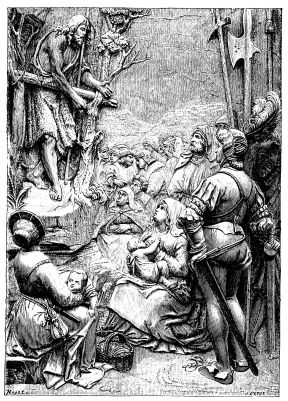
Fig. 289.—“St. John the Baptist preaching in the Desert.” Bas-relief in Carved Wood by Albert Dürer.
(Brunswick Gallery.)
left behind them were confined to the school of Fontainebleau. Ere long, some zealous artists from all the principal centres of the French schools left their country and betook themselves to Italy; among these were Bachelier of Languedoc, Simon and Ligier Richier of Lorraine, Valentine Bousch of Alsace, and Jacques of Angoulême, who had the honour of a victory over his master, Michael Angelo, in a competition of statuary (many of the former artist’s works now exist in the Vatican); Jean de Boulogne, and several others. Some of them, after they had become celebrated on the other side of the Alps, returned to their native country, bringing back to it their own native genius matured by the lessons of the Italians. There was, therefore, always a French school that preserved its individual characteristics, its generic good qualities and defects, which are so well represented in the sculptures of the Hôtel du Bourgtheroulde, Rouen (Fig. 290).
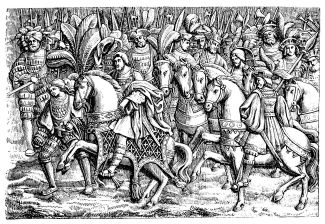
Fig. 290.—Bas-relief of the Hôtel du Bourgtheroulde, Rouen, representing a Scene in the Interview between Francis I. and Henry VIII., on the Field of the Cloth of Gold.
Michael Angelo was born on the 6th of March, 1475, and died on the 17th of February, 1564, without having shown any signs of decadence; greater, possibly, by his genius than by his works, he is the personification of the Renaissance. It would be, perhaps, irreverent to say that this age was an age of decay; we might fear of desecrating the tomb of Buonarotti if we laid to his charge that his grand boldness led ordinary talents astray; and it is not a pleasant subject of thought that, influenced by two currents of ideas—one coming from Italy, the other from Germany—the art of the century operated to its own suicide. When the very soil itself seemed to be shaken, and the Christian pedestal which had formed both its grandeur and power overturned, what could be done in the way of opposition to the downfall of Art by Jean Goujon, Jean Cousin (Fig. 291), Germain Pilon, François Marchand, Pierre Bontemps, those stars of French sculpture in the sixteenth century?
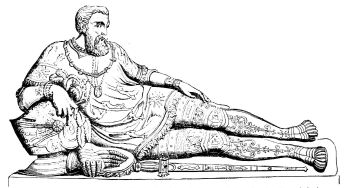
Fig. 291.—Statue in Alabaster of Philip Chabot, Admiral of France, by Jean Cousin. Formerly in the Church of the Célestins, Paris, now in the Museum of the Louvre.
A final manifestation of the old religious feeling was, however, apparent in the tombs of the Church of Brou, designed by Jean Perréal, the great painter of Lyons, executed by Conrad Meyt, and carved by Gourat and Michael Columb; also in the mausoleum of Francis II., carved by Columb and his family; in the sepulchre of St. Mihiel (Fig. 292) by Richier; of the Saints de Solesme, in the tombs of Langey du Bellay, and of the Chancellor De Birague, by Germain Pilon, &c. But fashion and the prevailing taste now required from artists nothing but profane and voluptuous compositions, and they adopted this line of Art all the more readily, seeing, as they did every day, most beautiful works of Christian sculpture mutilated by a new tribe of Iconoclasts, the Huguenots, who seldom showed mercy to the figured monuments in Catholic churches. The stalls of the Cathedral of Amiens, by Jean Rupin, the rood-loft by Jean Boudin, and a number of other works of the same kind, testify to the irruption of the Greek style, its implantation in religious art, and its hybrid association with pointed architecture. It is, however, only due to our sculptors of the sixteenth century to say, that when they sacrificed themselves to the requirements of their age in imitating the masterpieces of Italy, they approached the natural grace of Raphael much closer than
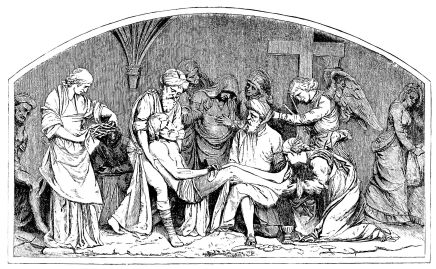
Fig. 292.—“The Entombment,” by Richier, in the Church of St. Mihiel (Meuse). (Sixteenth Century.)
Cellini, Primaticcio, or any of the other Italian artists who were settled in France; that they combined in the best possible way the mythological expression of the ancients with our modern ideas, and that, thanks to them, France is enabled to point with pride to a natural art, original and independent, which has been handed down to our days in direct succession by Sarrazain, Puget, Girardon, and Coysevox.
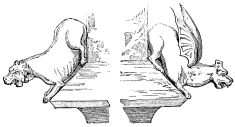
Figs. 293, 294.—Gargoyles on the Palace of Justice, Rouen. (Fifteenth Century.)