MUSICAL INSTRUMENTS.
James Dafforne translation
Music in the Middle Ages.—Musical Instruments from the Fourth to the Thirteenth Century.—Wind Instruments: the Single and Double Flute, the Pandean Pipes, the Reed-pipe, the Hautboy, the Flageolet, Trumpets, Horns, Olifants, the Hydraulic Organ, the Bellows-Organ.—Instruments of Percussion: the Bell, the Hand-bell, Cymbals, the Timbrel, the Triangle, the Bombulum, Drums.—Stringed Instruments: the Lyre, the Cithern, the Harp, the Psaltery, the Nable, the Chorus, the Organistrum, the Lute and the Guitar, the Crout, the Rote, the Viola, the Gigue, the Monochord.
HE history of Music in the Middle Ages would commence about the fourth century of our era. In the sixth century, Isidore of Seville, in his “Sentiments sur la Musique,” writes as follows:—“Music is a modulation of the voice, and also an accordance of several sounds and their simultaneous union.”
About 384, St. Ambrose, who built the Cathedral of Milan, regulated the mode in which psalms, hymns, and anthems should be performed, by selecting from Greek chants those melodies he considered best adapted to the Latin Church.
In 590, Gregory the Great, in order to remedy the disorder which had crept into ecclesiastical singing, collected all that remained of the ancient Greek melodies, with those of St. Ambrose and others, and formed the antiphonary which is called the Centonien, because it is composed of chants of his selection. Henceforward, ecclesiastical chanting obtained the name of Gregorian; it was adopted into the whole of the Western Church, and maintained its position almost unaltered down to the middle of the eleventh century.
It is thought that originally the music of the antiphonary was noted in accordance with Greek and Roman usage—a notation known as the Boethian, from the name of Boethius the philosopher, by whom we are informed that in his time (that is, about the end of the fifth century) the notation was composed of the first fifteen letters of the alphabet.
The sounds of the octave were represented—the major by capital letters, the minor by small letters, as follows:—
Major modeABCDEFG
Minor modeabcdefg
Some fragments of music of the eleventh century are still preserved, in which the notation is represented by letters having above them the signs of another kind of notation called neumes (Fig. 154).
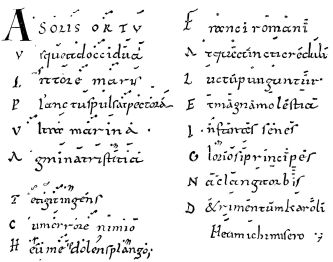
Fig. 154.—Lament composed shortly after the Death of Charlemagne, probably about 814 or 815, and attributed to Colomban, Abbot of Saint-Tron. (MS. de la Bibl. Imp., No. 1,154.)
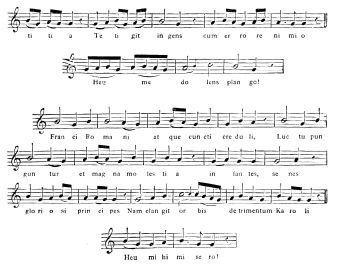
Musical Notation expressed in Modern Signs, the Text and Translation of the Lament on Charlemagne.
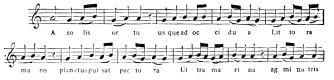
A solis ortu usque ad occidua Littora maris, planctus pulsat pectora; Ultra marina agmina tristitia Tetigit ingens cum errore nimio. Heu! me dolens, plango. From the East to the Western shores, sorrow agitates every heart; and inland, this vast grief saddens armies. Alas! in my grief, I, too, weep.
Franci, Romani, atque cuncti creduli, Luctu punguntor et magna molestia, Infantes, senes, gloriosi principes; Nam clangit orbis detrimentum Karoli. Heu! mihi misero! French, Romans, and all believers are plunged into mourning and profound grief: children, old men, and illustrious princes; for the whole world deplores the loss of Charlemagne. Alas! miserable me!
About the fourth century the neumes were in use in the Greek Church; they are spoken of by St. Gregory of Nazianzus. Certain modifications in them were introduced by the Lombards and Saxons.
“They were specially in use from the eighth to the twelfth century,” says M. Coussemaker, in his learned work, “Histoire de l’Harmonie au Moyen Age,” “and consisted of two sorts of signs: some formed like commas, dots, or small inclined or horizontal strokes, which represented isolated sounds; others in the shape of hooks, and strokes variously twisted and joined, expressing groups of sound composed of various intervals.
“These commas, dots, and inclined or horizontal strokes were the origin of the long notes, the breve and the semibreve, and afterwards of the square notation still in use in the plain-chant of the Church. The hook-shaped signs and the variously twisted and joined strokes gave rise to the ligatures and connections of notes.
“From the eighth to the end of the twelfth century—that is, during one of the brightest periods of musical liturgy—the neumes were the notation exclusively adopted over the whole of Europe, both in ecclesiastical singing and also in secular music. From the end of the eleventh century, this system of notation was established in France, Italy, Germany, England, and Spain.”
The chief modification to which the notation of music was subject at the end of the eleventh century is due to the monk Guido, of Arezzo. In order to facilitate the reading of the neumes, he invented placing them on lines, and these lines he distinguished by colours. The second, that of the fa, was red; the fourth, that of the ut, was green; the first and the third are only traced on the vellum with a pen. In order that the seven notes should be better impressed upon the memory, he gave as an example the three first lines of the Hymn of St. John the Baptist, in which the syllables ut, re, mi, fa, sol, la, corresponded to the signs of the gamut:—
“Ut queant laxis Resonare fibris Mira gestorum Famuli tuorum, Solve polluti Labii reatum, Sancte Joannes.”
The choristers, in singing this hymn, slightly raised the intonation of each of the italicised syllables, which were soon adopted for indicating six of the notes of the gamut. To supply the seventh, which was not named in this system, the barbarous theory of muances (divisions) was introduced, and it was not until the seventeenth century the term si was applied in France.
But after the commencement of the tenth century many individuals, and especially poets, had invented rhythmical songs, which were entirely different from those of the Church. “Harmony formed by successions of various intervals,” as we are told by the author whom we have before quoted, “obtained in the eleventh century the name of discantus, in old French déchant. Francon de Cologne is the most ancient author who makes use of this word. During the whole course of the eleventh century the composition of melody was independent of harmony, and henceforth the composition of music was divided into two very distinct parts. The people, and poets and persons in high life, constructed the melody and the words; but being ignorant of the science of music, they resorted to a professional musician to have their inspirations written down. The first were very justly called trouvères (trobadori), the others the déchanteurs, or harmonisers. Harmony was then only adapted for two voices—a combination of fifths, and of movements in unison.
“In the twelfth century, the construction of melody continued to be in the hands of poets. The déchanteurs or harmonisers were the professional musicians. Popular songs became very numerous. Troubadours multiplied all over Europe, and the greatest lords deemed it an honour to cultivate both poetry and music. Germany had her ‘master-singers,’ who were in request at every court. In France, the Châtelain de Coucy, the King of Navarre, the Comte de Béthune, the Comte d’Anjou, and a hundred others acquired a brilliant reputation by songs, of which they composed both the words and the melody. The most celebrated of these trouvères was Adam de la Halle, who flourished in 1260.”
In the fourteenth century, the name of counterpoint was substituted for that of déchant; and in 1364, at the coronation of Charles V. at Rheims, a mass was sung which was written in four parts, composed by Guillaume de Machault, poet and musician.
Among the ancients the number of musical instruments was considerable, but their names were even still more numerous, because derived from the shape, the material, the nature and character of the instruments, all of which varied infinitely, according to the whim of the maker or the musician. Added to this, every country had its national instruments; and as each in its own language designated them by descriptive names, the same instrument appeared under ten different denominations, and a similar name was applied to ten instruments. However, having nothing but monumental representation to guide us, and in the absence of the instruments themselves, an almost inextricable confusion arises.
The Romans carried back to their own country, as the results of conquest, specimens of most of the musical instruments they found in use in the countries subdued by them. Thus Greece supplied Rome with nearly all the soft instruments of the class of lyres and flutes. Germany and the northern provinces, being inhabited by warlike races, gave to their conquerors the taste for loud-sounding instruments, such as trumpets and drums. Asia, and Judæa especially, which had multiplied various kinds of metal-instruments for use in their religious ceremonies, were the means of naturalising in Roman music deep-toned instruments of the class of bells and tom-toms (a kind of drum). Egypt introduced into Italy the timbrel along with the worship of Isis. Byzantium had no sooner invented the first pneumatic organs than the new religion of Christ took possession of them for exclusive consecration to its service, both in the East and in the West.
All the musical instruments of the known world had therefore taken refuge, as it were, in the capital of the Roman empire; but their fate was only to disappear and sink into oblivion after they had played their part in the last pomps of that falling empire, and in the final festivals of the ancient mythology. In a letter in which he specially treats of “various kinds of musical instruments,” St. Jerome, who lived from 331 to 420, speaks of those which were in use in his time for the requirements of religion, war, ceremonial, and art. He mentions, in the first place, the organ, and describes it as composed of fifteen brazen pipes, two air-reservoirs of elephant’s skin, and twelve large sets of bellows, “to imitate the voice of thunder.” He next specifies, under the generic name of tuba, several kinds of trumpets: that which called the people together, that which directed the march of troops, that which proclaimed the victory, that which sounded the charge against the enemy, that which announced the closing of the gates, &c. One of these trumpets, the shape of which is rather difficult to gather from his description, had three brazen bells, and roared through four air-conduits. Another instrument, the bombulum, which must have made a frightful uproar, was, as far as we can conjecture from the text of the pious writer, a kind of peal of bells attached to a hollow metallic column which, by the assistance of twelve pipes, reverberated the sounds of twenty-four bells that were set in motion by one another. Next come the cithara of the Hebrews, in the shape of a triangle, furnished with twenty-four strings; the sackbut, of Chaldæan origin, a trumpet formed of several movable tubes of wood, fitting one into the other; the psaltery, a small harp provided with ten strings; and lastly, the tympanum, also called the chorus, a hand-drum to which were fixed two metal flute-tubes.
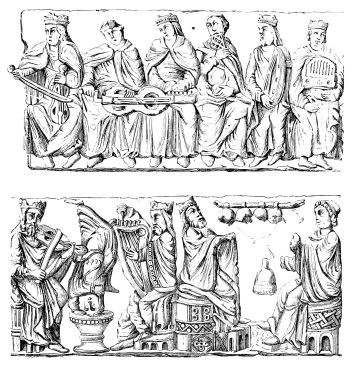
Fig. 155.—Concert; a Bas-relief, taken from a Capital in Saint-Georges de Boscherville, Normandy. (A Work of the Eleventh Century.)
A nomenclature of a similar kind, applying to the ninth century, exists in a history of Charlemagne, in Latin verse, by Aymeric de Peyrac. This shows as that, during the lapse of four centuries, the number of instruments had been nearly doubled, and that the musical influence of Charlemagne’s reign had made itself felt in the revival and improvement of several instruments which had been formerly abandoned. This curious metrical composition enumerates all the stringed, wind, and pulsatile instruments which celebrated the praise of the great emperor, the protector and restorer of music. The number of instruments specified are twenty-four in number, among which we find nearly all those mentioned by St. Jerome.
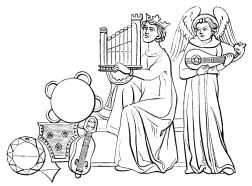
Fig. 156.—Concert and Musical Instruments. From a Miniature in a Manuscript of the Thirteenth Century.
The names, therefore, of musical instruments had passed through seven or eight centuries without undergoing any kind of change than that naturally resulting from variations in the language. But the instruments themselves, during this long interval of time, had been often modified to such extent that the primitive denomination not unfrequently appeared to contradict the musical characteristics of the instrument to which it still continued to be attached. Thus, the chorus, which had been a four-stringed harp, and from its name seems to indicate a collection of instruments, had become a wind-instrument.[22] So also the psaltery, which was originally touched by a plectrum (stick) or with the fingers, now only gave forth its notes under the influence of a bow; an instrument that had had twenty strings now only retained eight; another, the name of which seemed to refer to a square shape, was rounded; those primitively made of wood were now constructed of metal. There is reason to believe that, generally speaking, these changes were made not so much with the view of any musical improvement, properly so called, as with an idea of gratifying the
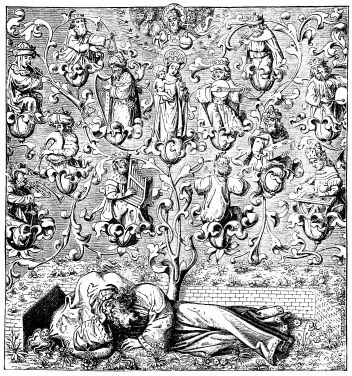
Fig. 157.—The Tree of Jesse. The ancestors of Jesus Christ are represented with Musical Instruments, and as forming a Celestial Concert. (Fac-simile from a Miniature in a Manuscript Breviary of the Fifteenth Century. Royal Library, Brussels.)
fancy of the eye (Figs. 155 to 157). Scarcely any fixed rules for the construction of musical instruments existed before the sixteenth century, when learned musicians applied mathematical principles to the theory of manufacture. Down to 1589 musical instruments were made in Paris by workmen who were organ-makers, lute-makers, or even coppersmiths, under the inspection and guarantee of the community of musicians; but at this epoch the makers of musical instruments were united in a trade corporation, and obtained, through the goodwill of Henry III., certain privileges and special statutes.
As musical instruments have always been divided into three particular classes,—stringed, pulsatile, and wind instruments,—we shall adopt this natural division in passing under review the various kinds in use during the Middle Ages and the Renaissance. We shall not, however, pretend to be always able to point out the precise musical value of these instruments, for in several instances we have no knowledge of them, except from representations more or less truthful.
The class of wind instruments comprised flutes, trumpets, and organs; each of these was, however, subdivided into several very distinct kinds. In the division of flutes alone, for instance, we find the straight flute, the double flute, the side-mouthed or German flute, the Pandean pipes, the chorus, the calamus, the bagpipes (muse or mousette), the doucine or hautboy, the flaïos or flageolet, &c.
The flute is the most ancient of musical instruments; even in the Middle Ages no orchestra was considered complete which did not contain an entire order of flutes, differing both in shape and tone. In principle, the simple flute, or flûte à bec, consisted of a straight pipe of hard and sounding wood, made in one piece, and pierced with four or six holes. But the number of holes being successively increased to eleven, and the pipe being enlarged to a length of seven or eight feet, the result was that the fingers were unable to act simultaneously upon all the openings; thus, in order to close the two holes farthest from the mouthpiece, keys were attached to the body of the flute which the instrumentalist acted on with his foot.
The simple flute, of greater or less length, is seen on the figured monuments of every epoch. The double flute, which was equally in use, had, as its name indicates, two pipes, generally of unequal lengths; the left-hand tube, which was the shortest and therefore called the feminine, produced shrill sounds, while the right-hand, or masculine, gave the low notes. Whether these two tubes were united or were separate, this flute had always two distinct mouths,—although they were often very close together—on which the musician played alternately. The double flute (Fig. 158) was the instrument employed in the eleventh century by the jongleurs or jugglers as an accompaniment.
The side-mouthed flute, which was at first very little used, owed its celebrity in the sixteenth century to the improvements it received from the Germans, hence it acquired the name of the German flute (Fig. 160).
The syrinx was nothing but the ancient Pandean pipes, composed generally of seven tubes of wood or metal, gradually decreasing in length; they were closed at the bottom, and at the top took the form of a horizontal plane, which was touched by the lip of the musician as it passed along (Fig. 159). In the eleventh and twelfth centuries, the syrinx, which must have produced very shrill and discordant music, was generally made in the shape of a semicircle, and contained nine tubes in a metallic case pierced with the same number of holes.
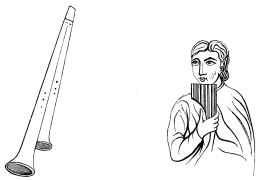
Fig. 158.—Double Flute, Fourteenth Century. (From Willemin’s “French Monuments.”)
Fig. 159.—Seven-tubed Syrinx, Ninth or Tenth Century. (Angers MS.)
The chorus, which in the time of St. Jerome was composed of a skin and two tubes, one forming the mouth, the other the bell-end (Fig. 161), must have presented a very great similarity to the modern bagpipes. In the ninth century its shape had changed but little, except that we sometimes find two bell-ends, and the membranous air-reservoir is in some examples replaced by a kind of case made of metal or resonant wood (bois sonore). Subsequently this instrument was transformed into a simple dulcimer.
The calamus, called the chalemelle or chalemie, which derived its origin from the calamus or reed-pipe of the ancients, became in the sixteenth century a treble to the hautboy, the bombarde being its counter-bass and tenor, and the bass being executed on the cromorne. There was, however, quite a group of hautboys. The douçaine or doucine, a soft flute, the great hautboy of Poitou played the parts of tenor or of fifth. The length of the hautboy having been found inconvenient, it was divided into pieces united in a movable cluster (faisceau) known by the name of fagot. This instrument was afterwards called courtaut in France, and sourdeline or sampogne in Italy, where it had become a kind of bagpipe, like the muse or estive. The muse de blé was a simple reed-pipe, but the muse d’Aussay (or d’Ausçois, district of Auch) was certainty a hautboy. With regard to the bagpipes, properly so called, they generally bore the name of chevrette, chevrie, or chièvre, on account of the skin of which the bag was made. They were also designated by the names of pythaule and cornemuse, drone-pipe (Fig. 162).
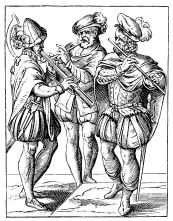
Fig. 160.—German Musicians playing on the Flute and Goat’s Horn. (Drawn and Engraved by J. Amman.)
The flaïos de saus, or reed-flutes, were nothing but mere whistles, such as village children are still in the habit of making in the spring; but there were, says an ancient author, more than twenty kinds, “as many loud as soft,” which were coupled by pairs in an orchestra. The fistule, the souffle, the pipe, and the fretiau or galoubet, were all small flageolets played on by the left hand while the right marked the time on a tambourine or with the cymbals. The pandorium, which has been classed among the flutes without its shape and character of tone being rightly determined, must have presented, at least at its origin, some similarity of sound to the stringed instrument called pandore (pandora).
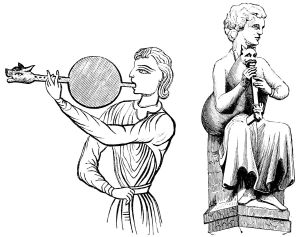
Fig. 161.—Chorus with single Bell-end with Holes. (Ninth Century, MS. of Saint-Blaise.)
Fig. 162.—Bagpiper, Thirteenth Century. (Sculpture on the Musicians’ Hall at Rheims.)
Trumpets formed a much more numerous class than the flutes. In Latin they were called tuba, lituus, buccina, taurea, cornu, claro, salpinx, &c.; in French, trompe, corne, olifant, cornet, buisine, sambute, &c. In most cases, however, they derived their name either from their shape, the sound which they produced, the material whereof they were made, or the use for which they were specially intended. Thus, among military trumpets of copper or brass, the names of some (claro, clarasius) indicating the piercing sound which they produced; the names of others seem rather to refer to the appearance of their bell-ends (Fig. 164), which imitated the head of a bird, a horn, a serpent, &c. Some of these trumpets were so long and heavy that a foot or stand was required to support them, while the performer took the end in his mouth and blew through it with full power of breath (Fig. 163.)
The shepherds’ horns, made of wood rimmed with brass, were a heavy and powerful kind of speaking-trumpet, which in the eighth century the Welsh herdsmen and those of the landes of Cornouaille always carried with them (Fig. 165.) When the barons or knights desired to convey any signals rendered necessary either in war or hunting, they were in the habit of using horns of a much more portable character, which were suspended at their girdles; they used them, also, as drinking vessels when occasion required. At first these instruments were generally made of nothing but buffalo’s or goat’s horns; but when the fashion arose of working delicately in ivory, they took the name of olifant, an appellation destined to become famous in the old romances of chivalry, in which the olifant played a very important part (Fig. 166). To cite only one example among a thousand, Roland, when overwhelmed by numbers in the valley of Ronceveaux, sounded the olifant in order to call Charlemagne’s army to his aid.
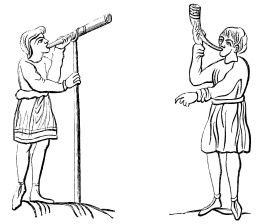
Fig. 163.—Straight Trumpet with Stand. (Eleventh Century. Cotton MS., British Museum.)
Fig. 164.—Curved Trumpet. (Eleventh Century. Cotton MS., British Museum.)
In the fourteenth century according to a passage in a manuscript in the Library of Berne, quoted by M. Jubinal, there were in bodies of troops corneurs, trompeurs, and buisineurs, who played under certain special circumstances. The trompes sounded for the movements of the knights, or men-at-arms; the cornes for the movements of the banners or the foot-soldiers, and the buisines, or clarions, when the entire camp (ost) was to march. The heralds-at-arms, whose duty it was to make the announcements or proclamations in the public ways, were in the habit of using either long trumpets, called à potence, on account of the forked stick whereon they were supported, or trumpets à tortilles (serpentine), the name of which sufficiently indicates their shape. Added to this, the sound of the trumpet or horn accompanied or signalised the principal acts of the citizens both in public and private life. During the meals of great men, the water, the wine, and the bread, were heralded by sound of trumpet. In towns this instrument announced the opening and closing of the gates, the opening and closing of the markets, and the time of curfew, till the time when the horn and the copper trumpet were superseded in this function by the bells in church-towers.
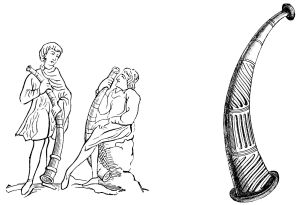
Fig. 165.—Shepherd’s Horn. Eighth Century. (MS., British Museum.)
Fig. 166.—Horn, or Olifant, Fourteenth Century. (From Willemin’s “French Monuments.”)
Polybius and Ammianus Marcellinus tell us that the ancient Gauls and Germans had a great passion for large, hoarse-sounding trumpets. At the time of Charlemagne, and still more in the days of the Crusades, the intercourse that took place between the men of the West and the African and Asiatic races introduced among the former the use of musical instruments of a harsh and piercing tone. Then it was that the Saracen-horns, made of copper, replaced the wooden or horn trumpets. At the same period sackbuts, or sambutes (Fig. 167), made their appearance in Italy: in those of the ninth century, we find the principle of the modern trombone. About the same epoch the Germans introduced great improvements into the trumpet
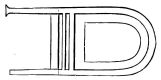
Fig. 167.—Sambute, or Sackbut, of the Ninth Century. (Boulogne MS.)
by adapting to it the system of holes, which up to that time had been the characteristic of flutes (Fig. 168).
But among all the wind instruments of the Middle Ages, the organ was the one most imposing in its nature, and destined to the most
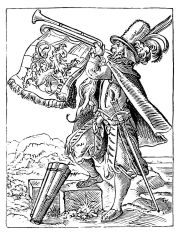
Fig. 168.—German Musician sounding the Military Trumpet. Drawn and Engraved by J. Amman.
glorious career. The only instrument of this kind known by the ancients was the water-organ, in which a key-board of twenty-six keys corresponded to the same number of pipes; and the air, acted upon by the pressure of water, produced most varied sounds. Nero, it is said, spent a whole day examining and admiring the mechanism of an instrument of this kind.
The water-organ, although described and commended by Vitruvius, was not much in use in the Middle Ages. Eginhard speaks of one constructed, in 826, by a Venetian priest; and the last of which mention is made existed at Malmesbury in the twelfth century. But this latter might be regarded more in the light of a steam-organ; for, like the warning whistles of our locomotives, it was worked by the effects of the steam of boiling water rushing into brass pipes.
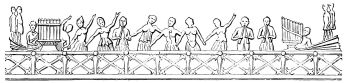
Fig. 169.—Pneumatic Organ of the Fourth Century. (Sculpture of that date at Constantinople.)
The water-organ was, in very early times, superseded by the pneumatic or wind-organ (Fig. 169), the description of which given by St. Jerome agrees with the representations on the obelisk erected at Constantinople in the time of Theodosius the Great. We must, however, fix a date as late as the eighth century for the introduction of this instrument into the West, or at least into France. In 757, Constantine Copronymus, Emperor of the East, sent to King Pépin a number of presents, among which was an organ that excited the admiration of the court. Charlemagne, who received a similar present from the same monarch, had several organs made from this model. These were provided, according to the statement of the monk of Saint-Gall, with “brazen pipes which were acted on by bellows made of bull’s hide, and imitated the roaring of thunder, the accents of the lyre, and the clang of cymbals.” These primitive organs, notwithstanding the power and richness of their musical resources, were of dimensions which rendered them quite portable. It was, in fact, only in consequence of its almost exclusive application to the solemnities of Catholic worship that the organ became developed on an almost gigantic scale. In 951, there existed in Winchester Cathedral an organ which was divided into two parts, each provided with its apparatus of bellows, its key-board, and its organist. Twelve bellows above, and fourteen below, were worked by seventy strong men, and the air was distributed by means of forty valves into four hundred pipes, arranged in groups or choirs of ten, each group corresponding with one of the twenty-four keys of each key-board (Fig. 170).
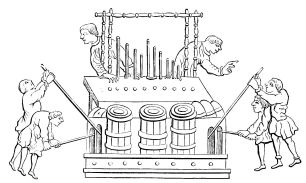
Fig. 170.—Great Organ, with Bellows and double Key-board, of the Twelfth Century. (MS. at Cambridge.)
In the ninth century, the German organ-makers acquired great renown. The monk Gerbert, who, as we have already remarked, became pope under the name of Sylvester II., and co-operated so efficiently in the progress of the horological art, established in the monastery of which he was abbot a workshop for the manufacture of organs. We must add, that all the musical treatises written from the ninth to the twelfth century entered into very considerable details concerning the arrangement and working of this instrument. Nevertheless, the admission of the organ into churches did not fail to meet with earnest opponents among the bishops and priests of the day. But while some complained of the thunder and rumbling of the organs, others appealed to the examples of king David and the prophet Elisha. Finally, in the thirteenth century, the right of placing organs in all churches was no longer disputed, and the only question was, who could build the most powerful and most magnificent instruments. At Milan was an organ the pipes of which were of silver; at Venice some were made of pure gold. The number of these pipes was varied and multiplied to an infinite extent, according to the effects the instrument was required to produce. The mechanism was, generally speaking, rather complicated, and the working of the bellows very laborious. In large organs the key-board was made up of key-plates five or six inches wide, which the organist, his hands defended by thickly padded gloves, had to strike with his clenched fist in order to bring out the notes (Fig. 171).
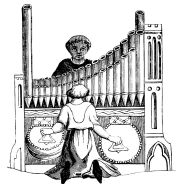
Fig. 171.—Organ with single Key-board of the Fourteenth Century. (Miniature from a Latin Psalter, No. 175, Bibl. Imp., Paris.)
The organ, which, as we have seen, was at first of a portable nature, in some cases resumed its original dimensions (Fig. 172). It was then sometimes called simply portatif (hand-organ), and sometimes régale or positif (choir-organ). Raphael, in one of his famous pictures, represents St. Cecilia singing sacred hymns, and accompanying herself on a choir-organ.
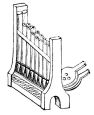
Fig. 172.—Portable Organ of the Fifteenth Century. (Miniature in Vincent de Beauvais’ “Miroir Historial,” MS. in the Bibl. Imp., Paris.)
The class of pulsatile instruments was formed of bells, cymbals, and drums.
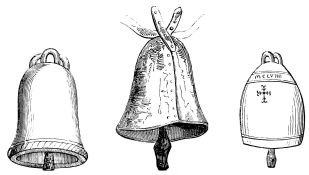
Fig. 173.—Tintinnabulum or Hand-Bell of the Ninth Century. (Boulogne MS.)
Fig. 174.—The Saufang of St. Cecilia’s at Cologne. (Sixth Century.)
Fig. 175.—Bell in a Tower of Siena. (Twelfth Century.)
There can be no doubt that the ancients were acquainted with large bells, hand-bells, and strung-bells (grelots). But we must ascribe to the requirements of Christian worship the first introduction of the bell, properly so called, formed of cast-metal (campana or nola, the first having been made, it is said, at Nola), which was employed from the first in summoning the faithful to the public services. In the first instance the bell was merely held in the hand and shaken by some monk or ecclesiastic who stood in front of the church-door, or mounted a raised platform for the purpose. This tintinnabulum (Fig. 173), or portable bell, subsequently passed into the hands of the public criers, the societies of ringers, and those who rang knells for the dead, at a time when most of the churches were provided with campaniles or bell-towers, wherein were hung the parish bells, which daily assumed dimensions of increasing importance. These great bells, of which the Saufang of Cologne (sixth century) is an example (Fig. 174), were at first made of wrought-iron plates laid one over the other, and riveted together. But in the eighth century they began to cast bells of copper and even of silver. One of the most ancient still existing is that in the tower of Bisdomini at Siena (Fig. 175). It bears the date of 1159, and is formed in the shape of a cask, being rather more than a yard high: the sound it produces is very sharp. The combination of several bells of various sizes naturally produced the peal or chime; this at first consisted of an arch of wood or iron whereon were suspended the bells, which the player struck with a small hammer (Fig. 176). The number and classification of the bells becoming subsequently rather more complicated, the hand of the chimer was superseded by a mechanical arrangement. This was the origin of those peals of bells for which there was such a demand in the Middle Ages, and of which certain towns are still so proud.
The designations of cymbalum and flagellum were, in the first instance, applied to small hand-chimes; but there were also regular cymbals (cymbala or acetabula), spherical or hollowed plates of silver, brass, or copper. Some of these were shaken at the ends of the fingers, or fastened to the knees or feet, so as to be put in motion by the movement of the body. These small cymbals, or crotales, were a kind of rattle (grelots), causing the dancers to make a noise in their performance, as do the Spanish castanets, which in the sixteenth century were called in France maronnettes, and were the same as the cliquettes, or snappers, used by lepers in former days. Small strung-bells became so much the fashion at a certain epoch that not only was the harness of horses adorned with them, but they were suspended to the clothes both of men and women, who at the slightest movement made a ringing, tinkling noise, sounding like so many perambulating chimes.
The use of pulsatile instruments producing a metallic sound increased greatly in Europe, especially after the return from the Crusades. But even before this date the Egyptian timbrel was used in religious and festival music; this instrument was composed of a circle whereon rings were hung, which tinkled as they struck together when the timbrel was shaken. The Oriental triangle was also used on these occasions; this was almost the same then as it is at the present day.
The drum has always been a hollow case covered with a stretched skin, but the shape and size of this instrument have caused great variations in its name, and also in the way in which it was used. In the Middle Ages it was called taborellus, tabornum, and tympanum. It generally made its appearance in festal music, and especially in processions; but it was not until the fourteenth century that it began to take a place in military bands, at least in France; the Arabians, however, have used it from the earliest ages. In the thirteenth century the taburel was a kind of tambourine, played on with only a drum-stick; in the tabornum we may recognise the military drum of the present day; and the tympanum was equivalent to our tambourine. Sometimes, as seen in a sculpture in the Musicians’ Hall at Rheims, this instrument was attached to the right shoulder of the performer, who played upon it by striking it with his head, while at the same time he blew through two metal flutes communicating with the inside of the drum (Fig. 177).
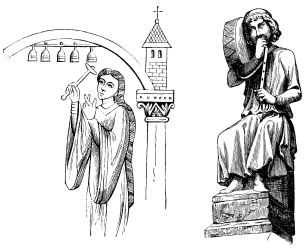
Fig. 176.—Chime of Bells of the Ninth Century. (MS. de Saint-Blaise.)
Fig. 177.—Tympanum of the Thirteenth Century. (Sculpture on the Musicians’ Hall, Rheims.)
We have now to speak of stringed instruments, the whole of which may be divided into three principal classes: those played on by the fingers, those that are struck, and those which are rubbed (frottées) by means of some appliance.
As a matter of fact, there are some stringed instruments which may be said to belong to all three of these classes, as all three modes of playing upon them has been adopted either simultaneously or in succession.
The most ancient are doubtless those that are played on by the fingers, first among which, in right of its antiquity, we must name the lyre; from this have sprung the cithern, the harp, the psaltery, the nabulon, &c. In the Middle Ages, however, considerable confusion arose from the fact that these original names were at the time often diverted from their real acceptation.
The lyre, the stringed instrument par excellence of the Greeks and Romans, preserved its primitive form as late as the tenth century. The strings were generally of twisted gut, but sometimes also of brass wire, and varied in number from three to eight. The sounding-box, which was always placed at the lower part of the instrument, was more often made of wood than of either metal or tortoise-shell (Fig. 178).
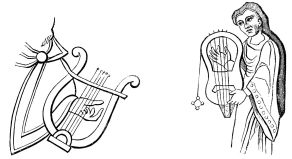
Fig. 178.—Ancient Lyre. (Angers MS.)
Fig. 179.—Lyre of the North. (Ninth Century.)
The lyre was held upon the knees, and the performer touched or rubbed the strings with one hand, either with the fingers or by means of a plectrum. The lyre specified as “Northern” (Fig. 179), was certainly the origin of the violin, to the shape of which it even then bore some resemblance; it was fastened at the top, and had a cordier at the end of the sounding-board, as well as a bridge in the centre of the face of the instrument.
The lyre was superseded by the psaltery and the cithern. The psaltery, which never was furnished with fewer than ten, or more than twenty, strings, differed essentially from the lyre and the cithern by the sounding-board being placed at the top of the instrument. Psalteries were made of a round, square, oblong, or buckler-shaped form (Fig. 181); and sometimes the sounding-box was lengthened so as to rest upon the shoulder of the musician (Fig. 180). The psaltery disappeared in the tenth century and gave place to the cithern (cithara), a name which had been at first applied to all kinds of stringed instruments. The shape of the cithern, which in the days of St. Jerome resembled a Greek delta (Δ), varied in different countries, as is proved by the epithets—barbarica, Teutonica, Anglica, which we find at different times coupled with its generic name. In other places, in consequence of these local transformations, it became the nabulum, the chorus, and the salterion or psalterion (which latter must not be confounded with the psaltery, a primary derivative of the lyre).
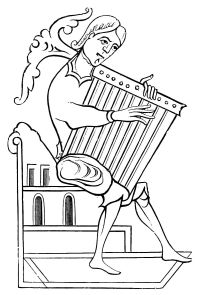
Fig. 180.—Psaltery to produce a prolonged sound. Ninth Century. (MS. in the Bibl. Imp., Paris.)
The nabulum[23] (Fig. 182) was made either in the shape of a triangle with truncated corners, or of a semicircle joined at the two extremities; its sounding-board occupied the whole of the rounded part, and left but a very limited space for the twelve strings. The chorus or choron, the imperfect representation of which in the manuscripts of the ninth and tenth centuries calls to mind the appearance of a long semicircular window or of a Gothic capital N, generally had one of its sides prolonged, on which the performer leaned so as to hold the instrument in the same way as a harp (Fig. 183).
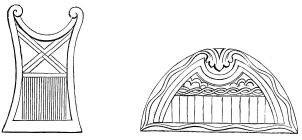
Fig. 181.—Buckler-shaped Psaltery with many Strings. (Ninth Century. Boulogne MS.)
Fig. 182.—Nabulum. Ninth Century. (MS. d’Angers.)
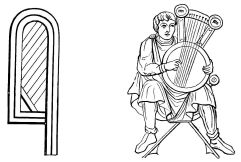
Fig. 183.—Choron. Ninth Century. (Boulogne MS.)
Fig. 184.—Psalterion. Twelfth Century.
The psalterion, which was in use all over Europe after the twelfth century, and is thought to have originated in the East, where it was found by the Crusaders, was at first composed of a flat box of sounding wood, with two oblique sides; it assumed the shape of a triangle truncated at its top, with twelve or sixteen metallic strings either of gold or silver, which were played upon by means of a small bow of wood, ivory, or horn (Fig. 184); subsequently the strings were made more slender, the number being increased to as many as twenty-two; the three angles of the sounding-box were cut off, and holes were made, sometimes one only in the middle, sometimes one at each angle, and sometimes as many as five, symmetrically arranged. The performer placed the instrument against his chest, and held it so as to touch the strings either with the fingers of the two hands, or with a pen or plectrum (Fig. 185). This instrument, which in the representations of poets and painters never failed to figure in celestial concerts, produced tones of incomparable softness. The old romances of chivalry exhausted all the phrases of admiration in describing the psalterion. But the highest eulogium which can be passed on this instrument is that it formed the starting-point of the harpsichord, or of the stringed instruments struck or played on by means of mechanism.
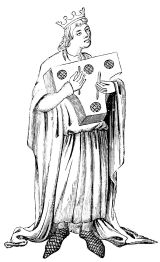
Fig. 185.—Performer on the Psalterion. Fourteenth Century. (MS. No. 703 in the Bibl. Imp. of Paris.)
It is, in fact, thought that a kind of harpsichord with four octaves, which in the fourteenth century was called dulcimer or dulcemelos, and is but imperfectly described, was nothing else than a psalterion, with a sounding apparatus that assumed the proportions of a large box, to which also a key-board had been adapted. This instrument, when it had but three octaves, was called clavicord or manicordion, and in the sixteenth century produced forty-two to fifty tones or semi-tones: one string expressed several notes, and this was effected by means of plates of metal which, serving as a movable bridge to each string, either increased or diminished the intensity of its vibration. The grand-pianos of the present day unquestionably have their key-boards placed in the same position as they were in the dulcimer and clavicorde. The earliest improvements in metallic stringed instruments constructed with a key-board are due to the Italians; these improvements soon had the effect of throwing the psalterion into oblivion.
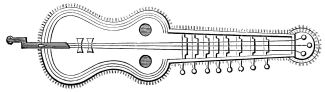
Fig. 186.—Organistrum. Ninth Century. (MS. de Saint-Blaise.)
In the ninth century a stringed instrument was in use the mechanism of which, although not very perfect, evidently tended to an imitation of the key-board applied to organs: this was the organistrum (Fig. 186), an enormous guitar pierced with two sound holes, and provided with three strings set in vibration by a small winch; eight movable screws, rising or falling at will along the finger-board, formed so many keys which served to vary the tones. In the first instance two persons performed on the organistrum—one turning the winch while the other touched the keys. When its size was decreased it became the vielle (hurdy-gurdy) properly so called, which could be managed by one musician. It was at first called rubelle, rebel, and symphonie; subsequently this last name was corrupted into chifonie and sifonie, and we may remark that even now in certain districts of central France the vielle still bears the popular name of chinforgne. The chifonie never found a place in musical concerts, and fell almost immediately into the hands of the mendicants, who solicited alms accompanied by the doleful and somewhat discordant notes of this instrument, and thence obtaining the name of chifoniens.
Notwithstanding all the efforts which were made to substitute wheels and key-boards for the action of the fingers on the strings of instruments, still those that were played on by the hand only, such as harps and lutes, did not fail to maintain the preference among skilful musicians.
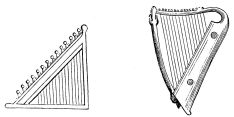
Fig. 187.—Triangular Saxon Harp of the Ninth Century. (Bible of Charles le Chauve.)
Fig. 188.—Fifteen-stringed Harp of the Twelfth Century. (MS. in the Bibl. Imp., Paris.)
The harp was certainly Saxon in its origin, although some have imagined they could discover traces of it in Greek, Roman, and even Egyptian antiquities. This instrument was at first nothing but a triangular cithern (Fig. 187), in which the sounding-board occupied the whole of one side from top to bottom, instead of being limited to the lower angle, as in the primitive cithara, or confined to the upper part as in the psaltery. The English harp (cithara Anglica) of the ninth century differed but little from the modern instrument; the simplicity and good judgment shown in its shape bear witness to the perfection it had already attained (Fig. 188). The number of strings and the shape of this instrument varied constantly from time to time. The sounding-box was sometimes made square, sometimes elongated, and sometimes round. The arms were sometimes straight and sometimes curved; the upper side was often lengthened so as to represent an animal’s head (Fig. 189) and the lower angle, on which the instrument rested on the ground, terminated in a griffin’s claw. According to the miniatures in manuscripts, the harp was of a size that the top of it did not extend higher than the head of the performer, who played upon it in a sitting posture (Fig. 190). There were, however, harps of a lighter character, which the musician bore suspended from his neck by a strap, and played upon while standing up. This portable harp was the one that may par excellence be called noble, and was the instrument on which the trouvères accompanied their voices when reciting ballads and metrical tales (Fig. 191). In the romances of chivalry harpers are constantly introduced, and their harps are ever tuned to some lay of love or war; we find this taking place as well in the north as in the south. “The harp,” says Guillaume de Machaut—
“tous instruments passe, Quand sagement bien en joue et compasse.”
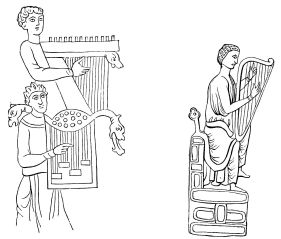
Fig. 189.—Harpers of the Twelfth Century, from a Miniature in a Bible. (MS. in the Bibl. Imp., Paris.)
Fig. 190.—Harp-player of the Fifteenth Century. From an Enamelled Dish found near Soissons, and preserved in the Bibl. Imp., Paris.
In the sixteenth century, however, it began to fall into disfavour; it was supplanted by the lute (Fig. 192), an instrument much used in the thirteenth century, and by the guitar, which was brought into fashion in France from Spain and Italy, and formed the delight both of the court and private circles. At that time every great lord, imitating kings and princesses, wished to have his lute or guitar player, and the poet Bonaventure des Périers, valet de chambre of Marguerite de Navarre, composed for her “La Manière de bien et justement entoucher les Lucs et Guiternes.” The lute and the guitar, which for about two centuries were in high favour in what was called “chamber music,” have since the above-named epoch scarcely been altered in shape. With certain modifications, however, they gave rise to the theorbo and the mandolin, which never attained more than a transient or local favour.
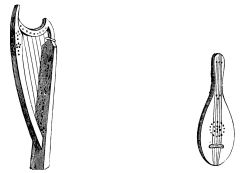
Fig. 191.—Minstrel’s Harp, of the Fifteenth Century. (MS. in the Miroir Historial of Vincent de Beauvais.)
Fig. 192.—Five-stringed Lute. Thirteenth Century. (MS. in the Bibl. Imp., Paris.)
Stringed instruments that were played on by means of bows were not known before the fifth century, and belonged to the northern races; they did not become prevalent in Europe generally until after the Norman invasion. At first they were but roughly made and rendered indifferent service to musical art; but from the twelfth to the sixteenth century, these instruments were subject to many changes both in form and name, and were brought to perfection according as the execution of musicians also improved. The most ancient of these instruments is the crout (Fig. 193), which must have produced the rote, so dear to the minstrels and the trouvères of the thirteenth century. The crout, which is the instrument placed by tradition in the hands of the Armorican, Breton, and Scotch bards,[24] was composed of an oblong sounding-box, more or less hollowed out at the two sides, with a handle fixed in the body of the instrument, in which were made two openings that allowed the performer to hold it by the left hand and at the same time to touch the strings; these, as a matter of principle, were only three in number. Subsequently it had four strings, and then six—two of which were played open (à vide). The musician played on it with a straight or convex bow, provided with a single thread either of iron wire or of twisted hair. Except in England, where the crout was national, it did not last beyond the eleventh century. It was replaced by the rote, which was not, as its name (apparently derived from rota, a wheel) would seem to intimate, a vielle or symphonie. It would be useless to seek for the derivation of the name of rota, except in the word crotta, the Latin form of the term crout.
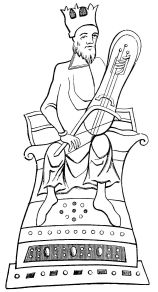
Fig. 193.—Three-stringed Crout of the Ninth Century. From a Miniature.
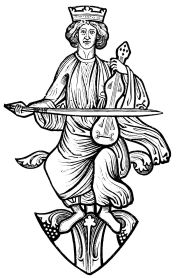
Fig. 194.—King David playing on a Rote. From a Painted Window of the Thirteenth Century. (Chapel of the Virgin, Cathedral of Troyes.)
In the earliest rotes (Fig. 194), those made in the thirteenth century, there is an evident intention of combining the two modes of playing on the strings—rubbing with a bow and touching with the fingers. The box, which was not hollowed out and rounded at the two ends, was much deeper at the lower end, where the strings commenced, than higher up, near the pegs, where these strings are sounded open under the action of the finger, which reaches them through an aperture; the bow acting on them near the string-bridge in front of the sounding-holes. It must have been difficult to touch with the bow one string alone, but it should be remarked that the harmonic ideal of this instrument consisted in forming accords by consonances of thirds, fifths, and eighths. The rote was soon developed into a new instrument, assuming the form that our violoncellos have almost exactly retained. The box was increased in size, the handle was lengthened beyond the body of the instrument, the number of strings was reduced to three or four, stretched over a bridge, and the sounding-holes were made in the shape of a crescent. From this time the rote acquired a special character it had not lost even in the sixteenth century, when it became the bass-viol. This was its true destination. The size of the instrument dictated the manner in which it was held, either on the knees or on the ground between the legs (Fig. 195).
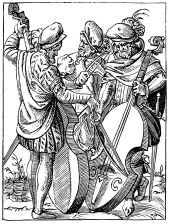
Fig. 195.—German Musicians playing on the Violin and Bass-Viol. Drawn and Engraved by J. Amman.
The vielle or viole, which had no affinity except in shape with the vielle (hurdy-gurdy) of the present day, was at first a small rote held by the performer against his chin or his breast, in much the same way as the violin is now used (Fig. 196). The box, which was at first conical and convex, became gradually oval in shape, and the handle remained short and wide. It was, perhaps, this handle which terminated in a kind of ornamental scroll in the shape of a violet (viola), that originated the name of the instrument. The viole, just as the rote, formed the accompaniment obligato of certain songs; and among the jugglers who played upon it good performers were rare (Figs. 197, 198). Improvements in the vielle came for the most part from Italy, where the co-operation of a number of skilful lute-players was the means of gradually forming the violin. Even before the famous Dnifloprugar, born in the Italian Tyrol, had hit upon the model of his admirable violins, the handle of the vielle had been lengthened,
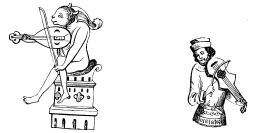
Fig. 196.—Oval Vielle with Three Strings, of the Thirteenth Century. (Sculpture on the Cathedral of Amiens.)
Fig. 197.—Juggler playing on a Vielle, hollowed out at the Sides. Fifteenth Century. (“Heures du Roi René,” MS. No. 159 in the Bibl. Imp. of the Arsenal, Paris.)
its sides hollowed out, and its strings had received a more extended field of action by removing the stringer (cordier) from the centre of the sounding-board
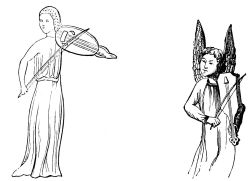
Fig. 198.—Player on the Vielle. Thirteenth Century. (Taken from an Enamelled Dish at Soissons.)
Fig. 199.—Angel Playing on a Three-stringed Fiddle. Thirteenth Century. (Sculpture in the Cathedral of Amiens.)
Henceforth the play of the board became more free and easy, the performer was able to touch every string singly, and was in a position to substitute effects more characteristic instead of the former monotonous consonances.
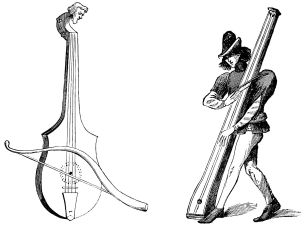
Fig. 200.—Rebec, of the Sixteenth Century. From Willemin.
Fig. 201.—Long Monochord played on with a Bow. Fifteenth Century. (MS. of Froissart, in the Bibl. Imp., Paris.)
England was the birthplace of the crout; France invented the rote, and Italy the viole; Germany originated the gigue,[25] the name of which may perhaps be derived from the similarity presented by the shape of the instrument to the thigh of a kid. The gigue was provided with three strings (Fig. 199), and its special distinction from the viole was, that instead of the handle being as it were independent of the body of the instrument, it was a kind of prolongation of the sounding-board. The gigue, which bore a considerable resemblance to the modern mandolin, was an instrument on which the Germans were accustomed to work wonders in the way of performance; according, at least, to the statement of Adenès, the trouvère, who speaks with admiration of the “gigueours of Germany.” The gigue, however, entirely disappeared, at least in France, in the fifteenth century; but its name still remained as the designation of a joyous dance, which for a considerable period was enlivened by the sound of this instrument.
Among the musical instruments of this class in the Middle Ages, we have still to mention the rebec (Fig. 200), which was so often quoted by the authors of the day, and yet is so little known, although it figured in the court concerts in the time of Rabelais, who specifies it by the term aulique, in contrast to the rustic cornemuse (bagpipes).
We must, in conclusion, speak of the monochord (monocordium), which is always mentioned by the authors of the Middle Ages with feelings of pleasure, although it appears to have been nothing more than the most simple and primitive expression of all the other stringed instruments (Fig. 201). It was composed of a narrow oblong box, on each end of the front-board were fixed two immovable bridges supporting a metallic string stretched from one to the other, and corresponding to a scale of notes traced out on the instrument. A movable bridge, which was shifted up and down between the string and the scale, produced whatever notes the performer wished to bring out. In the eighth century there was a kind of violin or mandolin furnished with a single metallic string played on with a metallic bow. Later still, we find a kind of harp formed of a long sounding-box traversed by a single string, over which the musician moved a small bow handled with a sudden and rapid movement.
The instruments we have named do not, however, embrace all those in use in the Middle Ages and the Renaissance. There certainly were others which, in spite of the most intelligent investigations, and the most judicious deductions, are now known to us only by name. As regards, for instance, the nature and appearance of the éles or celes, the échaqueil or échequier, the enmorache, and the micamon, we are left to the vaguest conjectures.

Fig. 202.—Triangle of the Ninth Century. (MS. of Saint-Emmeran.)