PARCHMENT AND PAPER.
James Dafforne translation
Parchment in Ancient Times.—Papyrus.—Preparation of Parchment and Vellum in the Middle Ages.—Sale of Parchment at the Fair of Lendit.—Privilege of the University of Paris on the Sale and Purchase of Parchment.—Different Applications of Parchment.—Cotton Paper imported from China.—Order of the Emperor Frederick II. concerning Paper.—The Employment of Linen Paper dating from the Twelfth Century.—Ancient Water-Marks on Paper.—Paper Manufactories in France and other parts of Europe.
LTHOUGH most authors who speak of parchment attribute the invention of it, on the testimony of Pliny, to Eumenius, king of Pergamus (doubtlessly from the etymology of the word by which it was designated, viz., Pergamena), it seems to be proved, according to Peignot, that the use of it is much more ancient, and that its origin is utterly lost. Certainly, in many passages of the Old Testament we find a Hebrew Word, in Latin volumen, which can only be understood to mean a roll formed of prepared skin or of the leaves of papyrus, and it is consequently evident that the Jews, from the time of Moses, wrote the tables of the Law on rolls of parchment.
Herodotus says that the Ionians called books diphthera (διφθἑρα, a prepared hide), because, at a time when the biblos (βἱβλος, the inner bark of the papyrus) was scarce, they wrote on skins of goats or of sheep. Diodorus Siculus affirms that the ancient Persians wrote their annals on skins, and we must suppose that Pliny’s assertion refers only to some improvements the King of Pergamus had made in the art of preparing a material that could supply the place of papyrus, which Ptolemy Epiphanius would no longer allow to leave Egypt. The absolute deficiency of papyrus raised into activity the fabrication of parchment, and soon so large a quantity was seen to flow into Pergamus that this town was considered as the cradle of the new trade, already so flourishing. There were then books of two kinds, the one in rolls composed of many leaves sewed together, on one side of which only was there writing; the others, square-shaped, were written upon both sides. The grammarian Crates, ambassador of Eumenius at Rome, passed as the inventor of vellum.
Ordinary parchment is the skin of a goat, sheep, or lamb, prepared in lime, dressed, scraped, and rendered smooth by pumice-stone. Its principal qualities are whiteness, thinness, and stiffness; but the work of the currier must have been formerly very imperfect, for Hildebert, Archbishop of Tours in the eleventh century, tells us that the writer, before beginning his occupation, “was in the habit of clearing away from the parchment, with the aid of a razor, the remains of fat and other gross impurities, and then with pumice-stone to make the hair and tendons disappear:” this almost amounts to affirming that the scribes bought the hide undressed, and, by an elaborate preparation, made them fit for proper use. Virgin parchment, which in its grain and colour resembles vellum, was made of the skins of those lambs and goats which had been clipped. Vellum, more polished, whiter, more transparent, is made, as its name indicates, of the hide of the calf.[52]
It is probable that with the Romans, papyrus, considering the facility they had of procuring it for themselves, was more frequently used than parchment, which, at first, was rare and costly. But parchment, more durable and of greater resistance than papyrus, was reserved for the transcription of the most important works. Cicero, who had many books on parchment in his magnificent library, said that he had seen the “Iliad” copied on a scroll of pergamena which went into a nut-shell. Many of Martial’s epigrams prove to us that in the time of this poet books of such kind were still more numerous. Unfortunately, there remains to us no writing on parchment dating from this distant period. The Virgil in the Vatican, and the Terence at Florence, are of the fourth and fifth century of our era. Admitting that time destroys all, and also that the work of the rude tribes on many occasions assisted this natural cause of destruction, we must not forget that at certain periods, to supply the place of new parchment when it was scarce, a plan had been devised of making the parchment rolls which had already been used for manuscripts serve again
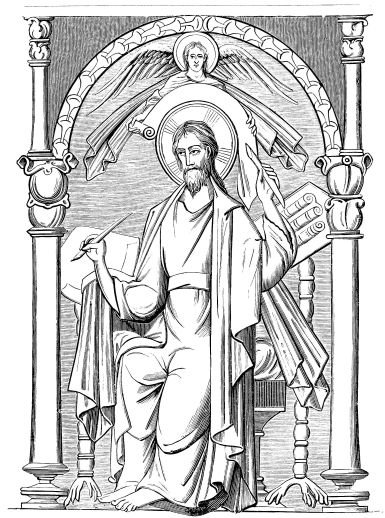
Fig. 328.—Miniature of the Ninth Century, representing an Evangelist who is transcribing with the Calamus, on Parchment, the Sacred Text, of which he is receiving the revelation.
(Bibl. de Bourgogne, Brussels.)
for a similar purpose, either by scraping and rubbing them with pumice-stone, or by boiling them in water or soaking in lime. There is no doubt but the scarceness and the dearness of parchment was the cause of the loss of very many excellent works. Muratori cites, for example, a manuscript of the Ambrosian Library, of which the writing, dating from eight or nine centuries back, had been substituted for another of more than a thousand years old; and Maffei informs us that the employment of ancient parchment scraped and washed became so general, in the fourteenth and fifteenth centuries, throughout Germany, that the Emperors put a stop to this dangerous abuse by issuing an order to the notaries to use nothing but parchment “quite new.”
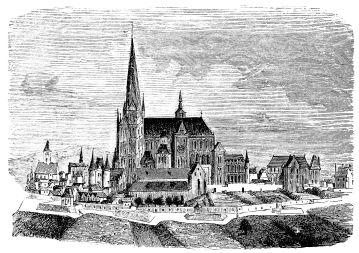
Fig. 329.—View of the Ancient Abbey of St. Denis and its Dependencies.
Generally, the quality of parchment serves to determine the date of its manufacture. The vellum of manuscripts till the middle of the eleventh century is very white and thin; the parchment of the twelfth century is thick, rough, and brownish, which often shows it has been scraped or washed. The greater number of fine manuscripts are on
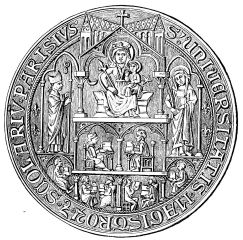
Fig. 330.—Seal of the University of Paris (Fourteenth Century), after one of the Dies preserved in the Collection of Medals in the Imperial Library, Paris.
virgin parchment, which from its nature was suited to the delicacies of calligraphy and illumination. Moreover, we see from a statute of the University of Paris, dated 1291, that the parchment trade had attained at that period to considerable development; so, as a protection against the frauds and deceptions which might result from the great competition of traders in it, and to insure a good article being furnished to students and artists, a special privilege was granted to the university, which, in the person of its rector, had not only the right of inspection, but also the refusal of all parchment bought in Paris, no matter whence it had come. Besides which, at the fair of Lendit, which was held every year at Saint-Denis, on the domains of the abbey (Fig. 329), and at the fair of Saint-Lazare, the rector likewise caused the parchment brought to them to be examined, and the merchants of Paris could not purchase any till the king’s agents, those of the Bishop of Paris, and the masters and scholars of the university, had provided themselves with what they required (Fig. 330). Let us add that the rector was paid a duty on all parchment sold, and the result of this tax was the only source of income attached to the rectorship in the seventeenth century.
Although white parchment seems to be the best suited for writing, the Middle Ages, following the example of antiquity, gave to the material various tints, especially purple and yellow. The purple was chiefly intended to receive characters of gold or silver. The Emperor Maximinius, the younger, inherited from his mother the works of Homer inscribed in gold on purple vellum; and parchment tinted in this way was, during the first centuries, one of the prerogatives reserved for princes and the great dignitaries of the Church. It is remarkable that the barbarism of the seventh and eighth centuries did not diminish the favour in which these luxurious manuscripts were held. Little by little, however, the custom (of writing the entire work in gold or colours) dwindled away. Scribes began by colouring a few pages only in each volume, then some margins or frontispieces; and lastly this decoration was restricted to the heads of chapters, or to words to which great prominence was to be given, or to capital letters. The rubricatores (literally, writers in red), workmen who performed this operation, came in time to be mere painters of letters or rubrics (so called because they were originally painted red), of whose assistance, however, the first printers availed themselves to rubric or colour the initials of missals, Bibles, and law books.
The dimensions or sizes of our books at the present day have their origin in the sizes of the parchment in olden times. The entire skin of the animal, cut square and folded in two, represented the “in-folio,” which, moreover, varied in length and breadth; and we have every reason to suppose that paper, from the day it was invented, followed the ordinary sizes of the folded parchment.
As to the dimensions of the parchment employed for diplomas, they varied according to the time, the brevity of the matter, or the nature of its employment. Among the ancients, who wrote only on one side of the parchment, the skins were cut in bands joined together so as to form volumes or rolls, which were unrolled as their contents were read. This custom was preserved for public and judicial acts for a long time after the invention of the square book (codex) had caused the opisthographic writing to be adopted, by which is to be understood writing on both sides of the page. In principle, only the final formulæ, or the signatures, were written on the back of the document. By degrees people adopted the practice of writing on the back as well as the front of the page; but it was not till the sixteenth century that this custom became general.
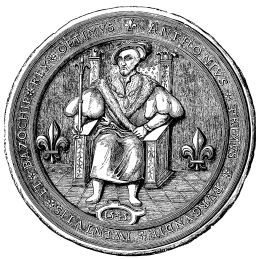
Fig. 331.—Seal of the King of La Basoche. (This title was suppressed, with all its prerogatives, by Henry III.)
Judicial acts, composed sometimes of many skins sewed together, came in time to form rolls of twenty feet in length; to such extreme proportions did they reach, though at first they were so small in size that their limited dimensions are truly incredible; for in 1233 and 1252 we find contracts of sales of two inches long by five inches wide, and in 1258 a will written on a piece of parchment of two inches by three and a half. It was by way of compensating for the great cost of parchment that opisthographic writing was adopted and rolls were put aside; and the name alone remains as applied to the rolls of procedure. The size that leaves should assume was also fixed, according to the different uses for which they were intended. For instance, the leaves of parliamentary documents were nine inches and a half long by seven and a half wide; those of the council, ten by eight; those of finance and of private contracts, twelve and a half by nine and a half; letters of pardon, under the king’s hand, were to be on entire skins squared, two feet two inches by one foot eight inches in diameter.
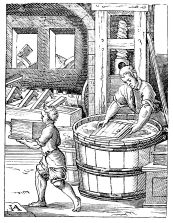
Fig. 332.—The Paper-Maker, drawn and engraved in the Sixteenth Century by J. Amman.
But while the use of parchment was still strictly employed in the chancellor’s offices and the tribunals, where the basoche (a brotherhood of lawyers of all grades) considered it as one of their most lucrative privileges (Fig. 331), it had for a long while ceased to be used anywhere else. Paper, after having during many centuries competed with parchment, at last almost entirely replaced it (Fig. 332); for if less durable, it had the great advantage of costing much less. Formerly nothing but the ancient papyrus of Egypt was known, and it was made use of concurrently with parchment till there was brought into Europe, towards the tenth century, cotton paper, which is generally believed to be a Chinese invention, and which was at first called Grecian parchment, because the Venetians, who introduced it into the West, had found it in use in Greece.
Actually, this paper was at first of a very inferior quality, coarse, spongy, dull, and subject to the attacks of damp and worms; so much so that the Emperor Frederick II. issued, in 1221, an order declaring null and void all documents written on it, and fixing the term at two years by which all were to be transcribed on parchment.
The use and the knowledge of the process of manufacturing paper from cotton soon led to the fabrication of paper from linen or rags. It is, however, impossible to say when and where it was accomplished—the assertions and the testimonies on this point are so contradictory. Some think that the paper was brought from the East by the Spanish Saracens; others say it came from China; these affirm it has been employed since the tenth century; those, that we can only find specimens of it as far back as the reign of St. Louis.
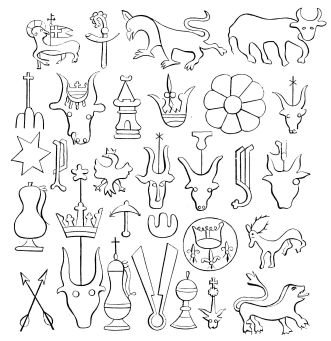
Fig. 333.—Water-Marks on Paper, from the Fourteenth to the Fifteenth Century.
At any rate, the most ancient writing on paper made of rags known at the present day is a letter from Joinville to Louis X., dated 1315; we may, moreover, mention with certainty, as written on linen paper, an inventory of goods belonging to a certain Prior Henry, who died in 1340, which is preserved at Canterbury, and many authentic writings, dating back as far as 1335, preserved in the British Museum, London. The first paper-manufactory established in England was, it is said, at Hertford, which dates only from 1588; but important paper-manufactories existed in France from the reign of Philippe de Valois, that is, from the middle of the fourteenth century; particularly at Essonne and at Troyes. The paper which came from these manufactories bore generally, in the paper itself, different marks (Fig. 333) called water-marks, such as a bull’s head, a cross, a serpent, a star, a crown, &c., according to the quality or destination of the paper. Many other countries in Europe had also flourishing paper-manufactories in the fourteenth century. From this period we find, indeed, a large number of documents written on paper made of rags, the use of which thus preceded by about a century the invention of printing.

Fig. 334.—Banner of the Paper-Makers of Paris.