PRINTING
James Dafforne translation
Who was the Inventor of Printing?—Movable Letters in Ancient Times.—Block Printing.—Laurent Coster.—Donati and Specula.—Gutenberg’s Process.—Partnership of Gutenberg and Faust.—Schoeffer.—The Mayence Bible.—The Psalter of 1457.—The “Rationale” of 1459.—Gutenburg prints by himself.—The “Catholicon” of 1460.—Printing at Cologne, Strasbourg, Venice, and Paris.—Louis XI. and Nicholas Jenson.—German Printers at Rome.—Incunabula.—Colart Mansion.—Caxton.—Improvement of Typographical Processes up to the Sixteenth Century.
IFTEEN towns have laid claim to the honour of being the birthplace of printing, and writers who have applied themselves to search out the origin of this admirable invention, far from coming to any agreement on the point in their endeavours to clear up the question, have only confused it. Now, however, after many centuries of learned and earnest controversy, there only remain three antagonistic propositions, with three names of towns, four names of inventors, and three different dates. The three places are Haarlem, Strasbourg, and Mayence; the four inventors, Laurent Coster, Gutenberg, Faust, and Schoeffer; the three dates which are assigned to the invention of printing are 1420, 1440, 1450. In our opinion these three propositions, which some try to combat and destroy by opposing each to the other, ought, on the contrary, to be blended into one, and combined chronologically in such a manner as to represent the three principal periods of the discovery of printing.
There is no doubt that printing existed in the germ in ancient times; that it was known and made use of by the ancients. There were stamps and seals bearing legends traced the wrong way, from which positive impressions were obtained on papyrus or parchment, in wax, ink, or colour. We are shown, in museums, plates of copper or of cedar-wood, covered with characters carved or cut out in them, which seem to have been intended for the purpose of printing, and which resemble the block plates of the fifteenth century.
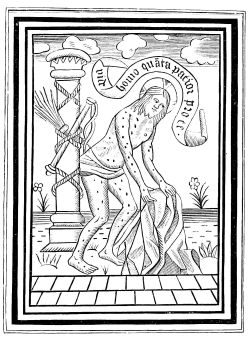
Fig. 387.—Ancient Wood-block Print, cut in Flanders before 1440, representing Jesus Christ after his Flagellation. (Delbecq’s Collection, Ghent.)
Something very much like the process of printing in movable type is described by Cicero in a passage in which he refutes the doctrine of Epicurus on the creation of the world by atoms: “Why not believe, also, that by throwing together, indiscriminately, innumerable forms of letters of the alphabet, either in gold or in any other substance, one can print with these letters, on the ground, the Annals of Ennius?” The movable letters possessed by the ancients were carved in box-wood or ivory; but they were only employed for teaching children to read, as Quinctilian testifies in his “Oratorical Institutions,” and St. Jerome in his “Epistles.” There was then only wanting a fortunate chance to cause this carved alphabet to create the typographic art fifteen centuries earlier than its actual birth.
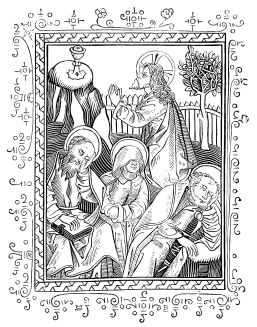
Fig. 388.—Fac-simile of an Engraving on Wood, by an ancient Flemish Engraver (about 1438); which was inserted, after the manner of a Miniature, in a Manuscript of the Fifteenth Century, containing Prayers for the use of the People. (Delbecq’s Collection, Ghent.)
“The art of taking impressions once discovered,” says M. Léon de Laborde, “and applied to engraving in relief, gave rise to printing, which was only the perfection to which a natural and rapid progression of attempts and efforts would naturally lead.” “But it was only,” adds M. Ambroise-Firmin Didot, “when the art of making paper—that art familiar to the Chinese from the beginning of our era—spread in Europe and became generally known, that the reproduction, by pressing, of texts, figures, playing-cards, &c., first by the tabular process, called xylography (block-printing), then with movable types, became easy, and was consequently to appear simultaneously in different places.”
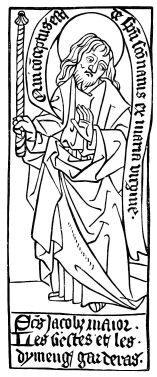
Fig. 389.—Wood-block, cut in France, about 1440, representing an Image of St. James the Great, with one of the Commandments as a Text. (Imperial Library, Paris, Collection of Prints.)
But, at the end of the fourteenth century, at Haarlem, in Holland, wood-engraving had been discovered, and consequently tabular impression, with which the Chinese, it is said, were already acquainted three or four hundred years before the modern era. Perhaps it was some Chinese book or pack of cards brought to Haarlem by a merchant or a navigator, that revealed to the cardmakers and printsellers of the industrious Netherlands a process of impressing more expeditious and more economical. Xylography began on the day when a legend was engraved on a wood-block; this legend, limited at first to a few lines, very soon occupied a whole page; then this page was not long in becoming a volume (Fig. 387 to 389).
Here is an extract from the account given by Adrian Junius, in his Latin work entitled “Batavia,” of the discovery of printing at Haarlem, written in 1572:—“More than one hundred and thirty-two years ago there lived at Haarlem, close to the royal palace, one John Laurent, surnamed Coster (or governer), for this honourable post came to him by inheritance, being handed down in his family from father to son. One day, about 1420, as he was walking after dinner in a wood near the town, he set to work and cut the bark of beech-trees into the shape of letters, with which he traced, on paper, by pressing one after the other upon it, a model composed of many lines for the instruction of his children. Encouraged by this success, his genius took a higher flight, and then, in concert with his son-in-law, Thomas Pierre, he invented a species of ink more glutinous and tenacious than that employed in writing, and he thus printed figures (images) to which he added his wooden letters. I have myself seen many copies of this first attempt at printing. The text is on one side only of the paper. The book printed was written in the vulgar tongue, by an anonymous author, having as its title ‘Speculum nostræ Salutis’ (‘The Mirror of our Salvation’). Later, Laurent Coster changed his wooden types into leaden, then these into pewter. Laurent’s new invention, encouraged by studious men, attracted from all parts an immense concourse of purchasers. The love of the art increased, the labours of his workshop increased also, and Laurent was obliged to add hired workmen to the members of his family, to assist in his operations. Among these workmen there was a certain John, whom I suspect of being none other than Faust, who was treacherous and fatal to his master. Initiated, under the seal of an oath, into all the secrets of printing, and having become very expert in casting type, in setting it up, and in the other processes of his trade, this John took advantage of a Christmas evening, while every one was in church, to rifle his master’s workshop and to carry off his typographical implements. He fled with his booty to Amsterdam, thence to Cologne, and afterwards to Mayence, where he established himself; and calculating upon safety here, set up a printing-office. In that very same year, 1422, he printed with the type which Laurent had employed at Haarlem, a grammar then in use, called ‘Alexandri Galli Doctrinale,’ and a ‘Treatise of Peter the Spaniard’ (‘Petri Hispani Tractatus’).”
This account, which came, indeed, rather late, although the author referred to the most respectable authorities in support of it, met at first with nothing but incredulity and contempt. At this period the right of Mayence to be considered the birthplace of printing could only be seriously counterbalanced by the right Strasbourg had to be so considered. The three names of Gutenberg, of Faust, and of Schœffer were already consecrated by universal gratitude. Everywhere, then, except in Holland, this new testimony was rejected; everywhere the new inventor, whose claim had just been made for a share of the honour, was rejected as an apocryphal or legendary being. But very soon, however, criticism, raising itself above the influences of nationality, took up the question, discussed the account given by Junius, examined that famous “Speculum” which no one had yet pointed out, proved the existence of xylographic impressions, sought for those which could be attributed to Coster, and opposed to the Abbé Tritheim (or Trithemius), who had written on the origin of printing from information furnished by Peter Schœffer himself, the more disinterested testimony of the anonymous chronicler of Cologne in 1465, who had learned from Ulric Zell, one of Gutenberg’s workmen, and the first printer of Cologne in 1465, this important peculiarity:—“Although the typographic art was invented at Mayence,” says he, “nevertheless the first rough sketch of this art was invented in Holland, and it is in imitation of the ‘Donatus’ (the Latin syntax by Cœlius Donatus, a grammarian of the fourth century, a book then in use in the schools of Europe), which long before that time was printed there; it is in imitation of this, and on account of it, that the said art began under the auspices of Gutenberg.”
If Gutenberg imitated the “Donatus,” which was printed in Holland before the time he himself printed at Mayence, Gutenberg was not the inventor of printing. It was in 1450 that Gutenberg began to print at Mayence (Fig. 390); but from as early a date as 1436 he had tried to print at Strasbourg; and, before his first attempts, there had been printed in Holland,—at Haarlem, and Dordrecht,—“Specula” and “Donati” on wooden boards; a process known by the name of xylography (engraving on wood), while the attempts at typography (printing with movable type) made by Gutenberg entirely differed from the other; since the letters, engraved at first on steel points (poinçons), and afterwards forced into a copper matrix reproduced by means of casting in a metal more fusible than copper the impress of the point on shanks (tiges) made of pewter or lead, hardened by an alloy (Fig. 391).
Now, a rather singular circumstance comes to corroborate what was said by Adrian Junius. A Latin edition of the “Speculum,” an in-folio of sixty-three leaves, with wood engravings in two compartments at the head of each leaf, consists of a mixture of twenty xylographic leaves, and of forty-one leaves printed with movable type, but very imperfect, and cast in moulds which were probably made of baked earth: an edition of a Dutch “Speculum,” in folio, has also two pages in a type smaller and closer than the rest of the text. How are we to explain these anomalies? On the one hand, a mixture of xylography and typography; on the other, a combination of two different kinds of movable type. My hypothesis is, if indeed the details given by Junius, open to suspicion as they are, be correct, that the dishonest workman who, according to his own account, stole the implements
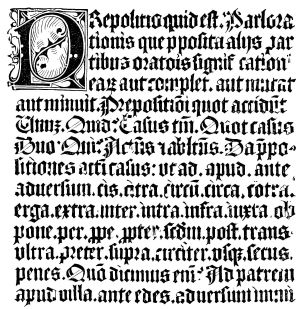
Fig. 390.—Fac-simile of a Page of the most ancient Xylographie “Donatus” (Chapter on Prepositions), printed at Mayence, by Fust and Gutenberg, about 1450.
employed in the workshop of Laurent Coster, and who must have acted with a certain amount of precipitation, contented himself with carrying off some forms of the “Speculum” just ready for the press. The type employed for twenty or twenty-two pages was sufficient to serve as models for a counterfeit edition, and also for a book of small extent, such as the “Alexandri Galli Doctrinale,” and the “Petri Hispani Tractatus.” It is probable that the Latin and Dutch editions of the “Speculum” were both entirely composed, set up, and prepared for the text to be struck off, when the thief took at hazard the twenty-two forms, which he determined to turn to account, at any rate as a model for the counterfeit edition he intended to publish. In cast-iron type, these forms could not have weighed more than sixty pounds; in wooden type, not half as much; if we add to these the composing-sticks, the pincers, the galleys, and other indispensable elements of the trade, we shall find that the booty was not beyond the strength of a man to carry easily on his shoulders. As for the press, about that there could be no question, since the impressions produced at Haarlem were made with a pad and by hand, as is still the case with playing-cards and prints.
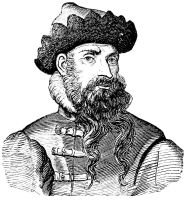
Fig. 391.—Portrait of Gutenberg, from an Engraving of the Sixteenth Century.
(Imperial Library of Paris, Print Room.)
It remains now to discover who was this John who appropriated the secret of printing, and took it from Haarlem to Mayence. Was it John Fust or Faust, as Adrian Junius suspected? Was it John Gutenberg, as many Dutch writers have alleged? or was it not rather John Gensfleisch the elder, a relation of Gutenberg, as, from a very explicit passage of the learned Joseph Wimpfeling, his contemporary, the latest defenders of the Haarlem tradition think? The question is still undecided.
The “Speculum,” however, is not the only book of the kind which
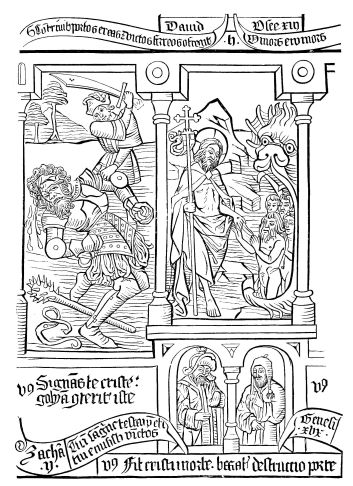
Fig. 392.—Fac-simile of the Twenty-eighth Xylographic Page of the “Biblia Pauperum;” representing, with Texts taken from the Old Testament, David slaying Goliath, and Christ causing the Souls of the Patriarchs and Prophets to come out of Purgatory.
had appeared in the Low Countries before the period assigned to the discovery of printing in Holland. Some of these were evidently xylographic, others show signs of having been printed with movable type of wood, not of metal. All have engravings of the same character as those of the “Speculum,” especially the “Biblia Pauperum” (“Poor Men’s Bible”) (Fig. 392), the “Ars Moriendi” (“The Art of Dying”) (Fig. 393) the “Ars Memorandi” (“The Art of Remembering”), which had a very wide circulation.
However this may be, Laurent Coster, notwithstanding the progress he had made with his invention, was certainly ignorant of its importance. In those days the only libraries were those belonging to convents and to a few nobles of literary acquirements; private individuals, with the exception of some learned men who were richer than their fellows, possessed no books at all. The copyists and illuminators by profession were employed exclusively in reproducing “Livres d’Heures” (prayer-books), and school books: the first were sumptuous volumes, objects of an industry quite exceptional; the second, destined for children, were always simply executed, and composed of a few leaves of strong paper or parchment. The pupils limited themselves to writing passages of their lessons from the dictation of their teachers; to the monks was assigned the task of transcribing, at full length, the sacred and profane authors. Coster could not even have thought of reproducing these works, the sale of which would have seemed to him impossible, and he at first fell back upon the “Specula,” religious books which addressed themselves to all the faithful, even to those who could not read, by means of the stories or illustrations (images) of which these books were composed; then he occupied himself with the “Donati,” which he reprinted many times from xylographic plates, if not with movable type, and for which he must have found a considerable demand. It was one of these “Donati” that, falling under the eyes of Gutenberg, revealed to him, according to the “Chronique de Cologne,” the secret of printing.
This secret was kept faithfully for fifteen or twenty years by the workmen employed in his printing-house, who were not initiated into the mysteries of the new art till they had served a certain time of probation and apprenticeship: a terrible oath bound together those whom the master had considered worthy of entering into partnership with him; for on the preservation of the secret depended the prosperity or the ruin of the inventor and his coadjutors, since all printed books were then sold as manuscripts.
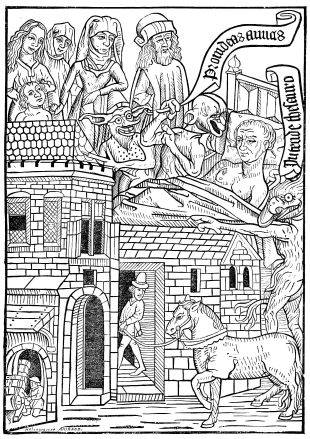
Fig. 393.—Fac-simile of the fifth Page of the first Xylographic Edition of the “Ars Moriendi,” representing the Sinner on his Death-bed surrounded by his Family. Two Demons are whispering into his ear, “Think of thy treasure,” and “Distribute it to thy friends.”
But while the secret was so scrupulously maintained by the first Dutch printer and his partners, a lawsuit was brought before the superior court of Strasbourg which, though the motives for it were apparently but of private interest, was nevertheless to give the public the key to the mysterious trade of the typographer. This lawsuit,—the curious documents relating to which were found only in 1760, in an old tower at Strasbourg,—was brought against John Gensfleisch, called Gutenberg (who was born at Mayence, but was exiled from his native town during the political troubles, and had settled at Strasbourg since 1420), by George and Nicholas Dritzehen, who, as heirs of the deceased Andrew Dritzehen, their brother, and formerly Gutenberg’s partner, desired to be admitted as his representatives into an association of whose object they were ignorant, but from which they no doubt knew their brother expected to derive some beneficial results. It was, in short, printing itself which was on its trial at Strasbourg towards the end of the year 1439; that is, more than fourteen years before the period at which printing is known to have been first employed in Mayence.
Here is a summary, as we find them in the documents relating to this lawsuit, of the facts stated before the judge. Gutenberg, an ingenious but a poor man, possessed divers secrets for becoming rich. Andrew Dritzehen came to him with a request that he would teach him many arts. Gutenberg thereupon initiated him into the art of polishing stones, and Andrew “derived great profit from this secret.” Subsequently, with the object of carrying out another art during the pilgrimage of Aix-la-Chapelle,[60] Gutenberg agreed with Hans Riffen, mayor of Lichtenau, to form a company, which Andrew Dritzehen and a man named Andrew Heilman desired to join. Gutenberg consented to this on condition that they would together purchase of him the right to a third of the profits, for a sum of 160 florins, payable on the day of the contract, and 80 florins payable at a later date. The agreement being made, he taught them the art which they were to exercise at the proper period in Aix-la-Chapelle; but the pilgrimage was postponed to the following year, and the partners required of Gutenberg that he should not conceal from them any of the arts and inventions of which he was cognisant. New stipulations were entered upon whereby the partners pledged themselves to pay an additional sum, and in which it was stated that the art should be carried on for the benefit of the four partners during the space of five years; and that, in the event of one of them dying, all the implements of the art, and all the works already produced, should belong to the surviving partners; the heirs of the deceased being entitled to receive no more than an indemnity of 100 florins at the expiration of the said five years.
Gutenberg accordingly offered to pay the heirs of his late partner the stipulated sum; but they demanded of him an account of the capital invested by Andrew Dritzehen, which, as they alleged, had been absorbed in the speculation. They mentioned especially a certain account for lead, for which their brother had made himself responsible. Without denying this account, Gutenberg refused to satisfy their demands.
Numerous witnesses gave evidence, and their depositions for and against the object of the association show us a faithful picture of what must have been the inner life of four partners exhausting themselves and their money in efforts to realise a scheme the nature of which they were very careful to conceal, but from which they expected to derive the most splendid results.
We find them working by night; we hear them answering those who questioned them on the object of their work, that they were “mirror-makers” (spiegel-macher); we find them borrowing money, because they had in hand “something in which they could not invest too much money.” Andrew Dritzehen, in whose care the press was left, being dead, Gutenberg’s first object was to send to the deceased’s house a man he could trust, who was commissioned to unscrew the press, so that the pieces (or forms), which were fixed closely together by it, might become detached from each other, and then to place these forms in or on the press “in such a manner that no one might be able to understand what they were.” Gutenberg regrets that his servant did not bring him back all the forms, many of which “were not to be found.” Lastly, we find figuring among the witnesses a turner, a timber-merchant, and a goldsmith who declared that he had worked during three years for Gutenberg, and that he had gained more than 100 florins by preparing for him “the things belonging to printing” (das zu dem Trucken gehoret).
Trucken—printing! Thus the grand word was pronounced in the course of the lawsuit, but certainly without producing the least effect on the audience, who wondered what was this occult art which Gutenberg and his partners had carried on with so much trouble, and at such great expense. However, it is quite certain that, with the exception of the indiscretion, really very insignificant, of the goldsmith, Gutenberg’s secret remained undiscovered, for it was supposed it had to do with the polishing of stones and the manufacture of mirrors. The judge, being informed as to the good faith of Gutenberg, pronounced the offers he made to the plaintiffs satisfactory, decided against the heirs of Andrew Dritzehen, and the three other partners remained sole proprietors of their process, and continued to carry it out.
If we study with some attention the documents relating to this singular trial at Strasbourg, and if we also notice, that our word mirror is the translation of the German word spiegel and of the Latin word speculum, it is impossible not to recognise all the processes, all the implements made use of in printing, with the names they have not ceased to bear, and which were given to them as soon as they were invented; the forms, the screw (which is not the printing-press, for they printed in those days with the frotton, or rubber, but the frame in which the types were pressed), the lead, the work, the art, &c. We see Gutenberg accompanied by a turner who made the screw for the press, the timber merchant who had supplied the planks of box or of pear wood, the goldsmith who had engraved or cast the type. Then we ascertain that these “mirrors,” in the preparation of which the partners were occupied, and which were to be sold at the pilgrimage of Aix-la-Chapelle, were no other than the future copies of the “Speculum Humanæ Salvationis,” an imitation more or less perfect of the famous book of illustrations of which Holland had already published three or four editions, in Latin and in Dutch.
We know, on the other hand, that these “Mirrors” or “Specula” were, in the earliest days of printing, so much in request, that in every place the first printers rivalled each other in executing and publishing different editions of the book with illustrations. Here, there was the reprint of the “Speculum,” abridged by L. Coster; there, the “Speculum” of Gutenberg, taken entirely from manuscripts; now it was the “Speculum Vitæ Humanæ,” by Roderick, Bishop of Zamora; then the “Speculum Conscienciæ,” of Arnold Gheyloven; then the “Speculum Sacerdotum,” or again, the voluminous “Speculum” of Vincent de Beauvais, &c.
It cannot now any longer be assumed that Gutenberg really made mirrors or looking-glasses at Strasbourg, and that those pieces “laid in a press,” those “forms which came to pieces,” that lead sold or wrought by a goldsmith, were, as they wished it to be supposed, only intended to be used “for printing ornaments on the frames of looking-glasses!”
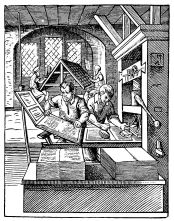
Fig. 394.—Interior of a Printing-office in the Sixteenth Century, by J. Amman.
Would it not have been surprising that the pilgrims who were to visit Aix-la-Chapelle on the occasion of the grand jubilee of 1440, should be so anxious to buy ornamented mirrors? As to the art “of polishing stones,” which Gutenberg had taught at first to Andrew Dritzehen, who derived from it “so much profit,” having anything to do with printing was, no doubt, also questionable; but we have not been able to solve the enigma, and wait to clear up the difficulty till a new incunable (incunabula, “a cradle,” the word is applied to the first editions ever printed) is discovered, the work of some Peter (πἑτρος “a stone”) or other; as, for example, the Latin sermons of Hermann de Petra on the Lord’s Prayer; for Gutenberg, when speaking of polishing stones, might have enigmatically designated a book he was printing; just as his partner, in answer to the judge, after having raised his hand on high and sworn to give true evidence, could call himself a maker of mirrors, without telling a falsehood, without committing perjury. The secret of printing was to be religiously kept by those who knew it.
In short, it results from all this that Gutenberg, “an ingenious man and a man of invention,” having seen a xylographie “Donatus,” had endeavoured to imitate it, and had succeeded in doing so, the secret being confided to Andrew Dritzehen; that the other arts, which Gutenberg at first kept to himself, but which he subsequently communicated to his partners, consisted in the idea of substituting movable type for tabular printing; a substitution that could only be effected after numerous experiments had been made, and which were just about to be crowned with success when Andrew Dritzehen died. We may then consider it as nearly certain that printing was in some sort discovered twice successively—the first time by Laurent Coster, whose small printed books, or books in letterpress (en moule), attracted the attention of Gutenberg; and the second time by Gutenberg, who raised the art to a degree of perfection such as had never been attained by his predecessor.
It was after the Strasbourg lawsuit between the years 1440 or 1442, as stated by many historians, that Gutenberg went to Holland, and there became a workman in the establishment of Coster; this is asserted in order that they might be able to accuse him of the theft which Junius has laid to the account of a certain man whose name was John. Only—and the coincidence is not, in this case, unworthy of remark—two unedited chronicles of Strasbourg and the Alsatian Wimpfeling relate, almost at the same time, a robbery of type and implements used in printing, but mentioning Strasbourg instead of Haarlem, Gutenberg instead of Laurent Coster, and naming the thief John Gensfieisch. But, according to the Strasbourg tradition, this John Gensfieisch the elder, related to and employed by Gutenberg, robbed him of his secret and his tools, after having been his rival in the discovery of printing, and established himself at Mayence, where, by a just visitation of Providence, he was soon struck blind. It was then, adds the tradition, that in his repentance he sent for his former master to come to Mayence, and gave up to him the business he had founded. But this last part of the tradition seems to savour too much of the moral deductions of a story; and as it is very improbable, moreover, that two thefts of the same kind were committed at the same period, and under the same circumstances, we are inclined to believe that the John mentioned by Junius was, in fact, Gutenberg’s relative, who went to Haarlem to perfect himself in the art of printing, and robbed Coster; for there really existed at Mayence, at the time mentioned, a John Gensfleisch, who might have printed, before Gutenberg went to join him there, the two school books, “Doctrinale Alexandri Galli,” and “Petri Hispani Tractatus.” This is rendered still more probable from the fact that, after search had been long made for these books, which were absolutely unknown when Junius mentioned them, three fragments of the “Doctrinale,” printed on vellum with the type of the Dutch “Speculum,” were at length found.
However, Gutenberg had not succeeded with his printing at Strasbourg. When he quitted the town, where he left such pupils as John Mentell and Henry Eggestein, he removed to Mayence, and established himself in the house of Zum Jungen. There he again printed, but he exhausted his means in experiments, alternately taking up and laying aside the various processes he had employed—xylography, movable types of wood, lead, and cast iron. He used, for printing, a hand-press which he had made on the same principle as a wine-press; he invented new tools; he began ten works and could finish none. At last, his resources all gone, and himself in a state of despair, he was just going to give up the art altogether, when chance sent him a partner, John Fust or Faust, a rich goldsmith of Mayence.
This partnership took place in 1450. Fust, by a deed properly drawn up by a notary, promised Gutenberg to advance him 800 gold florins for the manufacture of implements and tools, and 300 for other expenses—servants’ wages, rent, firing, parchment, paper, ink, &c. Besides the “Specula” and “Donati” already in circulation, which Gutenberg probably continued to print, the object of the partnership was the printing of a Bible in folio of two columns, in large type, with initial letters engraved on wood; an important work requiring a great outlay.
A caligrapher was attached to Gutenberg’s printing establishment, either to trace on wood the characters to be engraved, or to rubricate the printed pages; in other words, to write in red ink, to paint with a brush or to illuminate (au frottou) the initials, the capital letters, and the headings of chapters. This caligrapher was probably Peter Schœffer or Schoiffer, of Gernsheim, a small town in the diocese of Darmstadt, a clerk of the diocese of Mayence, as he styles himself, and perhaps a German student in the University of Paris; since a manuscript copied by him, and preserved at Strasbourg, is terminated by an inscription in which he testifies that he himself wrote it in the year 1449, in “the very glorious University of Paris.” Schœffer was not only a literary man, but was also a man of ingenuity and prudence (ingeniosus et prudens). Having entered Gutenberg’s establishment, on whom Fust had forced him, in 1452, to take part in the new association they were then forming, Schœffer invented an improved mould with which he could cast separately all the letters of the alphabet in metal, whereas up to this time they had been obliged to engrave the type with a burin. He concealed his discovery from Gutenberg, who would naturally have availed himself of it; but he confided the secret to Fust, who, being very experienced in casting metals, carried out his idea. It was evidently with this cast type, which resisted the action of the press, that Schœffer composed and executed a “Donatus,” of which four leaves, in parchment, were found at Treves in 1803, in the interior of an old bookcover, and were deposited in the Imperial Library of Paris. An inscription in this edition, printed in red, announces formally that Peter Schœffer alone had executed it, with its type and its initial letters, according to the “new art of the printer, without the help of the pen.”
That was certainly the first public disclosure of the existence of printing, which up to this time had passed off its productions as the work of caligraphers. It seems that Schœffer thus desired to mark the date and to appropriate to himself the invention of Gutenberg. It is certain that Fust, allured by the results Schœffer had obtained, secretly entered into partnership with him, and, in order to get rid of Gutenberg, profited by the power which his bond gave him over that unfortunate individual. Gutenberg, summoned to dissolve the partnership and to return the sums he had received, which he was quite incapable of paying, was obliged, in order to satisfy the demands of his pitiless creditor, to give up to him his printing establishment with all the materials it contained; among them was included this same Bible, the last leaves of which were, perhaps, in the press at the moment when they robbed him of the fruits of his long-protracted labours.
Gutenberg evicted, Peter Schœffer, and Fust, who had given Schœffer his daughter in marriage, completed the great Bible, which was ready for sale in the early months of 1456. This Bible, being passed off as a manuscript, must have commanded a very high price. This accounts for the non-appearance on it of any inscription to show by what means this immense work had been executed; let us add that in any case we may well suppose Schœffer and Fust were not willing to give to Gutenberg a share of the glory which they dared not yet appropriate to themselves.
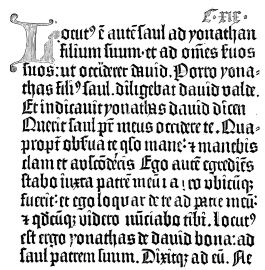
Fig. 395.—Fac-simile of the Bible of 1456 (1 Samuel xix, 1-5), printed at Mayence by Gutenberg.
The Latin Bible, without date, which all bibliographers agree in considering as that of Gutenberg, is a large in-folio of six hundred and forty-one leaves, divided into two, or three, or even four volumes. It is printed in double columns, of forty-two lines each in the full pages, with the exception of the first ten, which consisted of only forty or forty-one lines (Fig. 395). The characters are Gothic; the leaves are all numbered, and have neither signatures nor catchwords. Some copies of it are on vellum, others on paper. The number of copies which were printed of this Bible may be estimated at one hundred and fifty—a considerable number for that period. The simultaneous publication of so many Bibles, exactly alike, did not contribute less than the lawsuit of Gutenberg and Fust to make known the discovery of printing. Besides which, Fust and his new partner, although they had mutually agreed to keep the secret as long as possible, were the first to reveal it, in order to get all the credit of the invention for themselves, when public rumour allowed them no longer to conceal it within their printing-office.
It was then they printed the “Psalmorum Codex” (Collection of Psalms), the earliest book bearing their names, and which fixed, in a manner, for the first time, a date for the new art they had so much improved. The colophon, or inscription at the end of the “Psalmorum Codex,” announces that the book was executed “without the help of the pen, by an ingenious process, in the year of our Lord, 1457.”
This magnificent Psalter, which went through three editions without any considerable alterations being made in it in the space of thirty-three years, is a large in-folio volume of one hundred and seventy-five leaves, printed in red and black characters, imitated from those used in the liturgical manuscripts of the fifteenth century. There exists, however, of the rarest edition of this book but six or seven copies on vellum (Fig. 396).
From this period printing, instead of concealing itself, endeavoured, on the contrary, to make itself generally known. But it does not as yet seem to have occurred to any one that it could be applied to the reproduction of other books than Bibles, psalters, and missals, because these were the only books that commanded a quick and extensive sale. Fust and Schœffer then undertook the printing of a voluminous work, which served as a liturgical manual to the whole of Christendom, the celebrated “Rationale Divinorum Officiorum” (“Manual of Divine Offices”), by William Durand, Bishop of Mende, in the thirteenth century. It suffices to glance over this “Rationale,” and to compare it with the coarse “Specula” printed in Holland, to be convinced that in the year 1459 printing had reached the highest degree of perfection. This edition, dated from Mayence (Moguntiæ), was no longer intended for a small number of buyers; it was addressed to the entire Catholic world, and copies of it on vellum and on paper were disseminated so rapidly over the whole of Europe as to cause the belief, thenceforward, that printing was invented at Mayence.
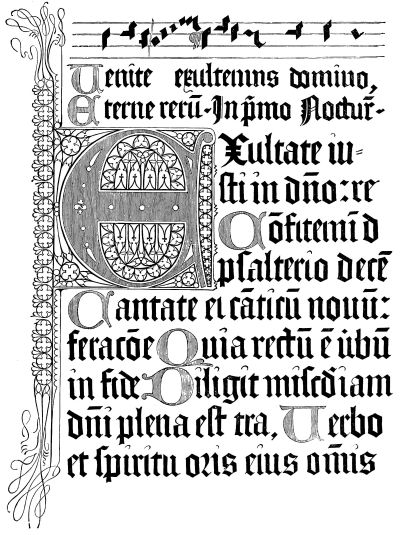
Fig. 396.—Fac-simile of a page of the Psalter of 1459, second edition, or the second copy that was struck off. Printed at Mayence, by J. Fust and P. Schœffer.
The fourth work printed by Fust and Schœffer, and dated 1460, is the collection of the Constitutions of Pope Clement V., known by the name of “Clementines”—a large in-folio in double columns, having superb initial letters painted in gold and colours in the small number of copies still extant.
But Gutenberg, though deprived of his typographic apparatus, had not renounced the art of which he considered himself, and with reason, the principal inventor. He was, above all, anxious to prove himself as capable as his former partners of producing books “without the help of the pen.” He formed a new association, and fitted up a printing-office which, we know by tradition, was actively at work till 1460, the year wherein appeared the “Catholicon” (a kind of encyclopædia of the thirteenth century), by John Balbi, of Genoa, the only important work the printing of which can be attributed to Gutenberg (Fig. 397), and which can bear comparison with the editions of Fust and Schœffer. Gutenberg, who had imitated the Dutch “Donati” and “Specula,” doubtless felt a repugnance at appropriating to himself the credit of an invention he had only improved; accordingly, in the long and explicit anonymous inscription placed at the end of the volume, he attributed to God alone the glory of this divine invention, declaring that the “Catholicon” had been printed without the assistance of reed, stylus, or pen, but by a marvellous combination of points, matrices, and letters.
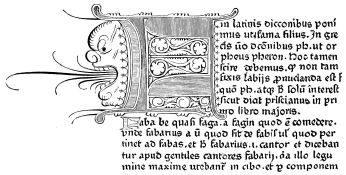
Fig. 397.—Fac-simile of the “Catholicon” at 1460, printed at Mayence by Gutenberg.
This undertaking brought to a happy termination, Gutenberg, no doubt weary of the annoyances incident to business, transferred his printing-office to his workmen, Henry and Nicholas Bechtermuncze, Weigand Spyes, and Ulric Zell. Then, having retired near to Adolphus II., elector and archbishop of Mayence, where he occupied the post of gentleman of the ecclesiastical court of that prince, he contented himself with the modest stipend attached to that office, and died at a date not authentically determined, but which cannot be later than February 24, 1468. His friend, Adam Gelth, erected in the Church of the Récollets at Mayence, a monument to his memory, with an epitaph styling him formally “the inventor of the typographic art.”
Fust and Schœffer did not the less continue to print books with indefatigable ardour. In 1462 they completed a new edition of the Bible, much more perfect than that of 1456, and of which copies were probably sold, as were those of the first edition, as manuscripts, especially in countries where, as in France, printing did not already exist. It seems that the appearance in Paris of this Bible, (called the Mayence Bible), greatly excited the community of scribes and booksellers, who saw in the new method of producing books, without the aid of the pen, “the destruction of their trade.” They charged, it is said, the sellers of these books with magic; but it is more probable the latter were proceeded against, and condemned to fine and imprisonment, for having omitted to procure from the University authority for the sale of their Bible; such permission being then indispensable for the sale of every kind of book.
In the meantime the town of Mayence had been taken by assault and given up to pillage (October 27, 1462). This event, in consequence of which the printing-office of Fust and Schœffer remained shut up for two years, resulted in the dissemination over the whole of Europe of printers and the art of printing. Cologne, Hamburg, and Strasbourg appear to have been the first towns in which the emigrants established themselves.
When these printers left Mayence, and carried their art elsewhere, it had never produced any book of classic literature; but it had proved by important publications, such as the Bible and the “Catholicon,” that it could create entire libraries, and thus propagate, ad infinitum, the masterpieces of human genius. It was reserved for the printing-office of Fust and Schœffer to set the example in that direction, and of printing the first classical work. In 1465, Cicero’s treatise “De Officiis,” issued from the press of these two faithful associates, and marked, as we may say, the commencement of the printing of books for libraries, and with so great success that in the following year a new edition of the treatise was published, in quarto.
At this period, Fust himself came to Paris, where he established a dépôt of printed books, but left the management of the concern to one of his own fellow-countrymen. This person dying soon afterwards, the books found in his house, being the property of a foreigner, were sold by right of forfeiture, for the king’s benefit. But upon the petition of Peter Schœffer, backed up by the Elector of Mayence, the King, Louis XI., granted to the petitioners a sum of 2,425 golden dollars, “in consideration of the trouble and labour which the said petitioners had taken for the said art and trade of printing, and of the benefit and utility which resulted and may result from this art to the whole world, as well by increasing knowledge as in other ways.” This memorable decree of the King of France bears date April 21, 1475.
We must mention, however, that about the year 1462, Louis XI., inquisitive and uneasy at what he had heard of the invention of Gutenberg, sent to Mayence Nicholas Jenson, a clever engraver, attached to the mint at Tours, “to obtain secret information of the cutting of the points and type, by means of which the rarest manuscripts could be multiplied, and to carry off surreptitiously the invention and introduce it into France.” Nicholas Jenson, after having succeeded in his mission, did not return to France (it was never known why), but went to Venice and established himself there as a printer. It would seem, however, that Louis XI., not discouraged at the ill success of his attempt, despatched, it is said, another envoy, less enterprising but more conscientious than the first, to discover the secrets of printing. In 1469, three German printers, Ulric Gering, Martin Crantz, and Michael Friburger, began to print in Paris, in a room of the Sorbonne, of which their fellow-countryman, John Heylin, named De la Pierre, was then the prior; in the following year they dedicated to the king, “their protector,” one of their editions, revised by the learned William Fichet; and in the space of four years they published about fifteen works, quartos and folios, the majority being printed for the first time. Then, when they were forced to leave the Sorbonne, because John de la Pierre, who had returned to Germany, had no longer authority over the institution, they set up in the Rue Saint-Jacques a new printing establishment, whose sign-board was the “Soleil d’Or,” from which, during the next five years, were issued twelve other important works.
The Sorbonne then, like the University, was the cradle and the foster-mother in Paris of the art of printing, which soon attained to a nourishing condition, and produced, during the last twenty years of the fourteenth[61] century, numerous fine books of history, poetry, literature, and devotion, under the direction of the able and learned Pierre Caron, Pasquier Bonhomme, Anthony Vérard, Simon Vostre (Fig. 398), &c.
After the capture of Mayence, two workmen, who had been dismissed from the establishment of Fust and Schœffer, Conrad Sweynheim and Arnold Pannartz, carried beyond the Alps the secret that had been confided to them under the guarantee of an oath. They remained for a time in the Convent of Subiaco, near Rome, in which were some German monks, and there they organised a printing apparatus, and printed many fine editions of Lactantius, Cicero, St. Augustine, &c. They were soon invited to Rome, and met with an asylum in the house of the illustrious family of Massimi; but they found an opponent in the city in one of their own workmen from the convent, who had come to Rome and engaged himself as printer to the cardinal John of Torquemada. Henceforward sprang up between the two printing establishments a rivalry which showed itself in unparalleled zeal and activity on both sides. In ten years the greater number of the writings of the ancient Latin authors, which had been preserved in manuscripts more or less rare, passed through the press. In 1476 there were in Rome more than twenty printers, who employed about a hundred presses, and whose great object was to surpass each other in the rapidity with which they produced their publications; so that the day soon arrived when the most precious manuscripts retained any value only because they contained what had not been already made public by printing. Those of which printed editions already existed were so universally disregarded, that we must refer to this period the destruction of a large number. They were used, when written on parchment, for binding the new books; and to this circumstance may be attributed the loss of certain celebrated works which printing in nowise tended to preserve from the knife of the binder.
While printing was displaying such prodigious activity in Rome, it was
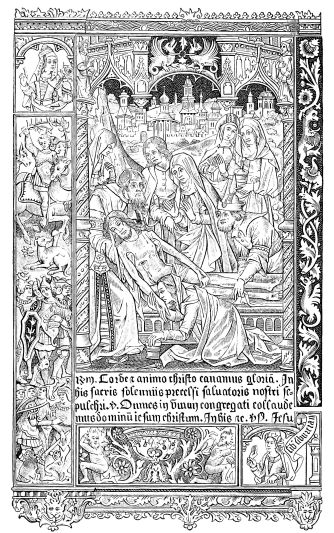
Fig. 398.—Fac-simile of a page of a “Livre d’Heures” printed in Paris, in 1512, by Simon Vostre.
not less active in Venice, where it seems to have been imported by that Nicholas Jenson whom Louis XI. had sent to Gutenberg, and whom for a long time even the Venetians looked on as the inventor of the art with which he had clandestinely become acquainted at Mayence. From the

Fig. 399.—The Mark of Gérard Lecu, Printer at Gouwe (1482).
Fig. 400.—The Mark of Fust and Schœffer, Printers. (Fifteenth Century.)
year 1469, however, Jenson had no longer the monopoly of printing in Venice, where John de Spire had arrived, bringing also from Mayence all the improvements Gutenberg and Schœffer had obtained. This art having ceased to be a secret in the city of the Doges, great

Fig. 401.—Mark of Arnold de Keyser, Printer at Ghent.
(1480.)
competition arose among printers, who flocked to Venice, where they found a market for their volumes which a thousand ships carried to all parts of the world. At this period important and admirable publications issued from the numerous rival printing establishments in Venice. Christopher Waltdorfer, of Ratisbon, published in 1471 the first edition of the “Decameron” of Boccaccio, of which a copy was sold for £2,080 at the Roxburgh sale; John of Cologne published, in the same year, the first dated edition of “Terence;” Adam of Amberg reprinted, from the Roman editions, “Lactantius” and “Virgil,” &c. Finally, Venice already possessed more than two hundred printers, when in 1494 the great Aldo Manuzio made his appearance, the precursor of the Estiennes,[62] who were the glory of French printing. From every part of Europe printing spread itself and flourished (Figs. 399 to 411); the printers, however, often neglected, perhaps intentionally, to date their
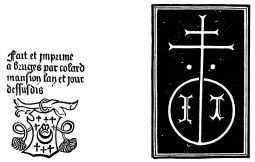
Fig. 402.—Mark of Colard Mansion, Printer at Bruges. (1477.)
Fig. 403.—Mark of Trechsel, Printer at Lyons. (1489.)
productions. In the course of 1469 there were only two towns, Venice and Milan, that revealed, by their dated editions, the time at which printing was first established within their walls; in 1470, five towns—Nuremberg, Paris, Foligno, Treviso, and Verona; in 1471, eight towns—Strasbourg, Spires, Treviso, Bologna, Ferrara, Naples, Pavia, and Florence; in 1472, eight others—Cremona, Felizzano, Padua, Mantua, Montreuil, Jesi, Munster, and Parma; in 1473, ten—Brescia, Messina, Ulm, Bude, Lauingen, Mersebourg, Alost, Utrecht, Lyons, and St. Ursio, near Vicenza; in 1474, thirteen towns, among which are Valentia (in Spain) and London; in 1475, twelve towns, &c. Each year we find the art gaining ground, and each year an increase in the number of books newly edited, rendering science and literature popular by considerably diminishing the price of books. Thus, for example, at the beginning of the fifteenth century, the illustrious Poggio sold his fine manuscript of “Livy,” to raise money enough to buy himself a villa near Florence; Anthony of Palermo mortgaged his estate in order to be able to purchase a manuscript of the same historical writer, valued at a hundred and twenty-five dollars; yet a few years later the “Livy,” printed at Rome by Sweynheim and Pannartz, in one folio volume on vellum, was worth only five golden dollars.
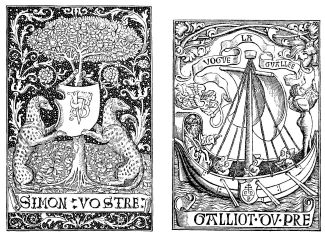
Fig. 404.—Mark of Simon Vostre, Printer at Paris, in 1531, living in the Rue Neuve Nostre-Dame, at the Sign of St. John the Evangelist.
Fig. 405.—Mark of Galliot du Pré, Bookseller at Paris. (1531.)
The largest number of the early editions resembled each other, for they were generally printed in Gothic characters, or lettres de somme—letters which bristled with points and angular appendices. These characters, when printing was only just invented, had preserved in Holland and in Germany their original form; and the celebrated printer of Bruges, Colard Mansion, only improved on them in his valuable publications, which were almost contemporaneous with Gutenberg’s “Catholicon;” but they had already under-gone in France a semi metamorphosis in getting rid of their angularities and their most extravagant features. These lettres de somme were then adopted under the name of bâtarde (bastard) or ronde (round), in the first books printed in France, and when Nicholas Jenson established himself in Venice
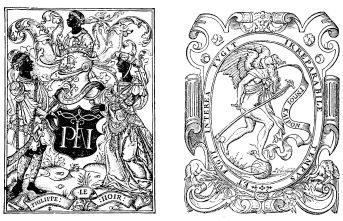
Fig. 406.—Mark of Philippe le Noir, Printer, Bookseller, and Bookbinder, at Paris, 1536, living in the Rue St. Jacques, at the sign of the “Rose Couronnée.”
Fig. 407.—Mark of Temporal, Printer at Lyons, 1550-1559, with two devices; one in Latin, “And in the meanwhile time flieth, flieth irreparably;” the other in Greek, “Mark, or know, Time.” (Observe the play upon the words tempus, καιρὁς and Temporal.)
he used the Roman, which were only an elegant variety of the lettres de somme of France (Gothic characters). Aldo Manuzio, with the sole object of insuring that Venice should not owe its national type to a Frenchman, adopted the Italic character, renewed from the writing called cursive or de chancellerie (of the chancellor’s office), which was never generally used in printing, notwithstanding the fine editions of Aldo. Hereafter the Ciceronean character was to come into use, so called because it had been employed at Rome in the first edition of the “Epistolæ Familiares” (Familiar Letters) of Cicero, in 1467. The character called “St. Augustinian,” which appeared later, likewise owes its name to the large edition of the works of St. Augustine, published at Basle in 1506. Moreover, during this first period in which each printer engraved, or caused to be engraved under his own directions,

Fig. 408.—Mark of Robert Estienne, Printer at Paris, 1536.
“Do not aspire to know high things.”
Fig. 409.—Mark of Gryphe, Printer at Lyons, 1529.
“Virtue my Leader, Fortune my Companion.”
the characters he made use of, there was an infinite number of different types. The register, a table indicative of the quires which composed the book, was necessary to point out in what order these were to be arranged

Fig. 410.—Mark of Plantin, Printer, at Antwerp, 1557.
“Christ the true Vine.”
Fig. 411.—Mark of J. Le Noble, Printer at Troyes. (1595.)
and bound together. After the register came the catchwords, which, at the end of each quire or of each leaf, were destined to serve an analogous purpose; and the signatures, indicating the place of quires or of leaves by letters or figures; but signatures and catchwords existed already in the manuscripts, and typographers had only to reproduce them in their editions. There was at first a perfect identity between the manuscripts and the books printed from them. The typographic art seems to have considered it imperative to respect the abbreviations with which the manuscripts were so encumbered as often to become unintelligible; but, as it was not easy to transfer them precisely from the manuscripts, they were soon expressed in such a way, and in so complicated a manner, that in 1483 a special explanatory treatise had to be published to render them intelligible. The punctuation was generally very capriciously presented: here, it was nearly nil; there, it admitted only of the full stop in various positions; the rests were often indicated by oblique strokes; sometimes the full stop was round, sometimes square, and we find also the star or asterisk employed as a sign of punctuation. The new paragraphs, or breaks, are placed indifferently in the same line with the rest of the text, projecting beyond it or not reaching to it.
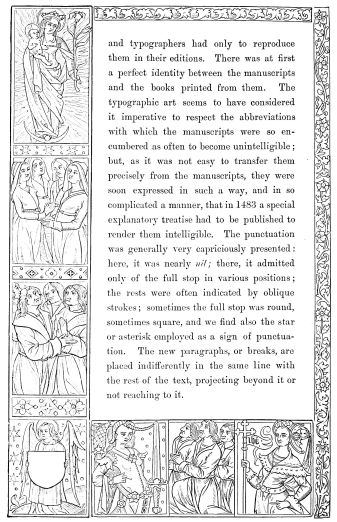
Fig. 412.—Border from the “Livre d’Heures” of Anthony Vérard (1488), representing the Assumption of the Virgin in the presence of the Apostles and Holy Women, and at the bottom of the page two Mystical Figures.
The book, on leaving the press, went, like its predecessor the manuscript, first into the hands of the corrector, who revised the text, rectifying wrong letters, and restoring those the press had left in blank; then into the hands of the rubricator, who printed in red, blue, or other colours, the initial letters, the capitals, and the new paragraphs. The leaves, before the adoption of signatures, were numbered by hand.
At first, nearly all books were printed in folio and quarto sizes, the result of folding the sheet of paper in two or in four respectively; but the length and breadth of these sizes varied according to the requirements of typography and the dimensions of the press. At the end of the fifteenth century, however, the advantages of the octavo were already appreciated, which soon became in France the sex-decimo, and in Italy the duo-decimo.
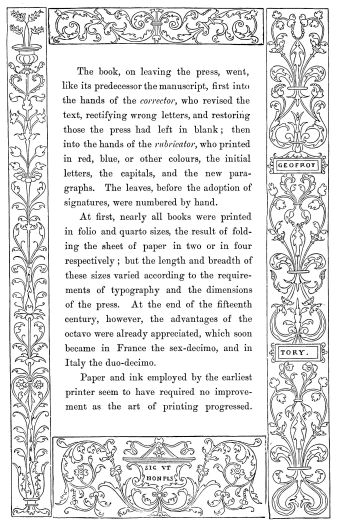
Fig. 413.—Border taken from the “Livre d’Heures” of Geoffroi Tory (1525).
Paper and ink employed by the earliest printer seem to have required no improvement as the art of printing progressed.
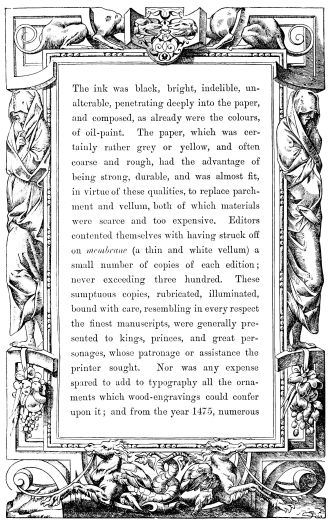
Fig. 414—“Livre d’Heures,” by Guillaume Roville (1551), a composition in the style of the school of Lyons, with Caryatides representing female Saints semi-veiled.
The ink was black, bright, indelible, unalterable, penetrating deeply into the paper, and composed, as already were the colours, of oil-paint. The paper, which was certainly rather grey or yellow, and often coarse and rough, had the advantage of being strong, durable, and was almost fit, in virtue of these qualities, to replace parchment and vellum, both of which materials were scarce and too expensive. Editors contented themselves with having struck off on membrane (a thin and white vellum) a small number of copies of each edition; never exceeding three hundred. These sumptuous copies, rubricated, illuminated, bound with care, resembling in every respect the finest manuscripts, were generally presented to kings, princes, and great personages, whose patronage or assistance the printer sought. Nor was any expense spared to add to typography all the ornaments which wood-engravings could confer upon it; and from the year 1475, numerous illustrated editions, of which an example was found in the first “Specula,” especially those printed in Germany, were enriched with figures, portraits, heraldic escutcheons, and a multitude of ornamented margins (Figs. 412 to 415). For more than a century the painters and engravers worked hand in hand with the printers and booksellers.
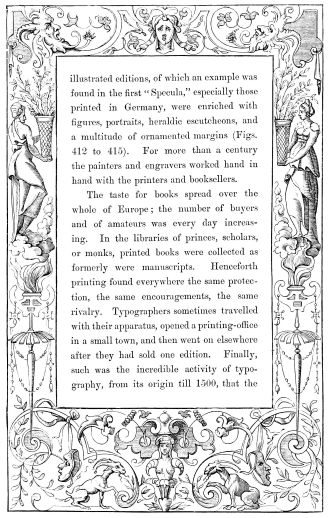
Fig. 415.—Border employed by John of Tournes, in 1557, ornamented with Antique Masks and Allegorical Personages bearing Baskets containing Laurel Branches.
The taste for books spread over the whole of Europe; the number of buyers and of amateurs was every day increasing. In the libraries of princes, scholars, or monks, printed books were collected as formerly were manuscripts. Henceforth printing found everywhere the same protection, the same encouragements, the same rivalry. Typographers sometimes travelled with their apparatus, opened a printing-office in a small town, and then went on elsewhere after they had sold one edition. Finally, such was the incredible activity of typography, from its origin till 1500, that the number of editions published in Europe in the space of half a century amounted to sixteen thousand. But the most remarkable result of printing was the important part it played in the movement of the sixteenth century, from which resulted the transformation of the arts, of literature, and science; the discoveries of Laurent Coster and of Gutenberg had cast a new light over the world, and the press made its appearance to modify profoundly the conditions of the intellectual life of peoples.
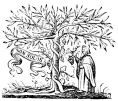
Fig. 416.—Mark of Bonaventure and Abraham Elsevier, Printers at Leyden, 1620.
LONDON: PRINTED BY VIRTUE AND CO., CITY ROAD.
FOOTNOTES: