Book 4 — XXXVII.-THE NORSEMEN.
Reading edition
1. The Gulf Stream flows so near to the southern coast of Norway, and to the Orkneys and Western Islands, that their climate is much less severe than might be supposed. Yet no one can help wondering why they were formerly so much more populous than now, and why the people who came westward even so long ago as the great Aryan migration, did not persist in turning aside to the more fertile countries that lay farther southward. In spite of all their disadvantages, the Scandinavian peninsula, and the sterile islands of the northern seas, were inhabitated by men and women whose enterprise and intelligence ranked them above their neighbors.
2. Now, with the modern ease of travel and transportation, these poorer countries can be supplied from other parts of the world. And though the summers of Norway are misty and dark and short, and it is difficult to raise even a little hay on the bits of meadow among the rocky mountain-slopes, commerce can make up for all deficiencies. In early times there was no commerce, except that carried on by the pirates, if we may dignify their undertakings by such a respectable name, and it was hardly possible to make a living from the soil alone. But it does not take us long to discover that the ancient Northmen were not farmers, but hunters and fishermen. It had grown more and more difficult to find food along the rivers and broad grassy wastes of inland Europe, and pushing westward they had at last reached the place where they could live beside waters that swarmed with fish and among hills that sheltered plenty of game.
3. The tribes that settled in the north grew in time to have many peculiarities of their own, and as their countries grew more and more populous, they needed more things that could not easily be had, and a fashion of plundering their neighbors began to prevail. Men were still more or less beasts of prey. Invaders must be kept out, and at last much of the industry of Scandinavia was connected with the carrying on of an almost universal fighting and marauding. Ships must be built, and there must be endless supplies of armor and weapons. Stones were easily collected for missiles or made fit for arrows and spear-heads, and metals were worked with great care.
4. In Norway and Sweden were the best places to find all these, and if the Northmen planned to fight a great battle, they had to transport a huge quantity of stones, iron, and bronze. It is easy to see why one day's battle was almost always decisive in ancient times, for supplies could not be quickly forwarded from point to point, and after the arrows were all shot and the conquered were chased off the field, they had no further means of offense except a hand-to-hand fight with those who had won the right to pick up the fallen spears at their leisure. So, too, an unexpected invasion was likely to prove successful; it was a work of time to get ready for a battle, and when the Northmen swooped down upon some shore town of Britain or Gaul, the unlucky citizens were at their mercy. And while the Northmen had fish and game, and were mighty hunters, and their rocks and mines helped forward their warlike enterprises, so the forests supplied them with ship-timber, and they gained renown as sailors wherever their fame extended.
5. There was a great difference, however, between the manner of life in Norway and that of England and France. The Norwegian stone, however useful for arrow-heads or axes, was not fit for building purposes. There is hardly any clay there, either, to make bricks with, so that wood has usually been the only material for houses. In the southern countries there had always been rude castles in which the people could shelter themselves, but the Northmen could build no castles that a torch could not destroy. They trusted much more to their ships than to their houses, and some of their captains disdained to live on shore at all.
6. There is something refreshing in the stories of old Norse life; of its simplicity and freedom and childish zest. An old writer says that they had "a hankering after pomp and pageantry," and by means of this they came at last to doing things decently and in order, and to setting the fashions for the rest of Europe. There was considerable dignity in the manner of every-day life and housekeeping. Their houses were often very large, even two hundred feet long, with flaring fires on a pavement in the middle of the floor, and the beds built next the walls on three sides, sometimes hidden by wide tapestries or foreign cloth that had been brought home in the viking ships. In front of the beds were benches where each man had his seat and footstool, with his armor and weapons hung high on the wall above.
7. The master of the house had a high seat on the north side in the middle of a long bench; opposite was another bench for guests and strangers, while the women sat on the third side. The roof was high; there were a few windows in it, and those were covered by skins, and let in but little light. The smoke escaped through openings in the carved, soot-blackened roof; and though in later times the rich men's houses were more like villages, because they made groups of smaller buildings for store houses, for guest-rooms, or for work-shops all around still, the idea of this primitive great hall or living-room has not even yet been lost. The latest copies of it in England and France that still remain are most interesting; but what a fine sight it must have been at night when the great fires blazed and the warriors sat on their benches in solemn order, and the skalds recited their long sagas, of the host's own bravery or the valiant deeds of his ancestors! Hospitality was almost chief among the virtues.
8. We must read what was written in their own language, and then we shall have more respect for the vikings and sea-kings, always distinguishing between these two; for, while any peasant who wished could be a viking—a sea-robber—a sea-king was a king indeed, and must be connected with the royal race of the country. He received the title of king by right as soon as he took command of a ship's crew, though he need not have any land or kingdom. Vikings were merely pirates; they might be peasants and vikings by turn, and won their names from the inlets, the viks or wicks, where they harbored their ships. A sea-king must be a viking, but naturally very few of the vikings were sea-kings.
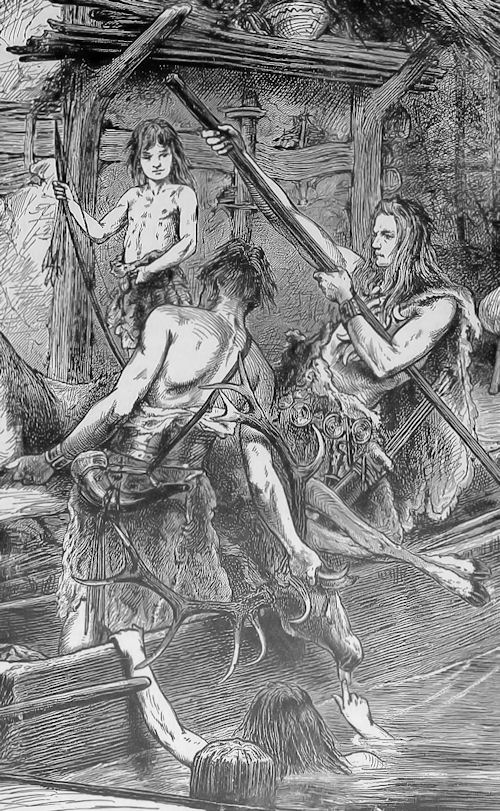
A Viking's Home.
9. The viking had rights in his own country, and knew what it was to enjoy those rights; if he could win more land, he would know how to govern it, and he knew what he was fighting for, and meant to win. If we wonder why all this energy was spent on the high seas and in strange countries, there are two answers: first, that fighting was the natural employment of the men, and that no right could be held that could not be defended; but besides this, one form of their energy was showing itself at home in rude attempts at literature.
10. The more that we know of the Northmen, the more we are convinced how superior they were in their knowledge of the useful arts to the people whom they conquered. There is a legend that, when Charlemagne, in the ninth century, saw some pirate ships cruising in the Mediterranean, along the shores of which they had at last found their way, he covered his face and burst into tears. He was not so much afraid of their cruelty and barbarity as of their civilization. Nobody knew better that none of the Christian countries under his rule had ships or men that could make such a daring voyage. He knew that they were skillful workers in wood and iron, and had learned to be rope-makers and weavers; that they could make casks for their supply of drinking-water, and understood how to prepare food for their long cruises. All their swords and spears and bow-strings had to be made and kept in good condition, and sheltered from the sea-spray.
11. When we picture the famous sea-kings' ships to ourselves, we do not wonder that the Northmen were so proud of them, or that the skalds were never tired of recounting their glories. There were two kinds of vessels: the last-ships, that carried cargoes, and the long-ships, or ships of war. Listen to the splendors of the "Long Serpent," which was the largest ship ever built in Norway. A dragon-ship, to begin with, because all the long-ships had a dragon for a figure-head, except the smallest of them, which were called cutters, and only carried ten or twenty rowers on a side. The "Long Serpent" had thirty-four rowers' benches on a side, and she was one hundred and eleven feet long. Over the sides were hung the shining red and white shields of the vikings, the gilded dragon's head towered high at the prow, and at the stern a gilded tail went curling off over the head of the steersman. Then, from the long body, the heavy oars swept forward and back through the water, and as it came down the fiôrd, the "Long Serpent" must have looked like some enormous centipede creeping out of its den on an awful errand, and heading out across the rough water toward its prey.
12. The voyages were often disastrous in spite of much clever seamanship. They knew nothing of the mariner's compass, and found their way chiefly by the aid of the stars—inconstant pilots enough on such foggy, stormy seas. They carried birds, too, oftenest ravens, and used to let them loose and follow them toward the nearest land. The black raven was the vikings' favorite symbol for their flags, and familiar enough it became in other harbors than their own. They were bold, hardy fellows, and held fast to a rude code of honor and rank of knighthood.
13. The valleys of the Elbe and the Rhine, of the Seine and the Loire, made a famous hunting-ground for the dragon-ships to seek.
14. The people who lived in France were of another sort, but they often knew how to defend themselves as well as the Northmen knew how to attack. There are few early French records for us to read, for the literature of that early day was almost wholly destroyed in the religious houses and public buildings of France. Here and there a few pages of a poem or of a biography or chronicle have been kept, but from this very fact we can understand the miserable condition of the country.
15. The whole second half of the ninth century is taken up with the histories of these invasions. We must follow for a while the progress of events in Gaul, or France as we call it now, though it was made up then of a number of smaller kingdoms. The result of the great siege of Paris was only a settling of affairs with the Northmen for the time being; one part of the country was delivered from them at the expense of another.
16. They could be bought off and bribed for a time, but there was never to be any such thing as their going back to their own country and letting France alone for good and all. But as they gained at length whole tracts of country, instead of the little wealth of a few men to take away in their ships as at first, they began to settle down in their new lands and to become conquerors and colonists instead of mere plunderers. Instead of continually ravaging and attacking the kingdoms, they slowly became the owners and occupiers of the conquered territory; they pushed their way from point to point.
17. At first, as you have seen already they trusted to their ships, and always left their wives and children at home in the north countries, but as time went on, they brought their families with them and made new homes, for which they would have to fight many a battle yet. It would be no wonder if the women had become possessed by a love of adventure, too, and had insisted upon seeing the lands from which the rich booty was brought to them, and that they had been saying for a long time: "Show us the places where the grapes grow and the fruit-trees bloom, where men build great houses and live in them splendidly. We are tired of seeing only the long larchen beams of their high roofs, and the purple and red and gold cloths, and the red wine and yellow wheat that you bring away. Why should we not go to live in that country, instead of your breaking it to pieces, and going there so many of you, every year, only to be slain as its enemies? We are tired of our sterile Norway and our great Danish deserts of sand, of our cold winds and wet weather, and our long winters that pass by so slowly while the fleets are gone. We would rather see Seville and Paris themselves, than only their gold and merchandise and the rafters of their churches that you bring home for ship timbers."
18. The kingdoms of France had been divided and subdivided, and, while we find a great many fine examples of resistance, and some great victories over the Northmen, they were not pushed out and checked altogether. Instead, they gradually changed into Frenchmen themselves, different from other Frenchmen only in being more spirited, vigorous and alert. They inspired every new growth of the religion, language, or manners, with their own splendid vitality. They were like plants that have grown in dry, thin soil, transplanted to a richer spot of ground, and sending out fresh shoots in the doubled moisture and sunshine. And presently we shall find the Northman becoming the Norman of history. As the Northman, almost the first thing we admire about him is his character, his glorious energy; as the Norman, we see that energy turned into better channels, and bringing a new element into the progress of civilization.
Sarah O. Jewett. "The Story of the Normans."
Putnam's "Stories of the Nations" Series.