Book 4 — XI.—DAMON AND PYTHIAS.
Reading edition
1. About four hundred years before the Christian era, the government of Syracuse fell into the hands of Dionysius, a successful general of the army. He dispossessed the magistrates whom the people elected, and was therefore a usurper. While ruling justly in the main, he had a capricious temper, and often in his rage performed actions which he sincerely regretted in his sober moments. He was a good scholar, and very fond of philosophy and poetry, and he delighted to have learned men around him, and he had naturally a generous spirit; but the sense that he was in a position that did not belong to him, and that every one hated him for assuming it, made him very harsh and suspicious. It is of him that the story is told, that he had a chamber hollowed in the rock near his state prison, and constructed with galleries to conduct sounds like an ear, so that he might overhear the conversation of his captives; and of him, too, is told that famous anecdote which has become a proverb, that on hearing a friend, named Damocles, express a wish to be in his situation for a single day, he took him at his word, and Damocles found himself at a banquet with everything that could delight his senses, delicious food, costly wine, flowers, perfumes, music, but with a sword with the point almost touching his head, and hanging by a single horse-hair! This was to show the condition in which a usurper lived.
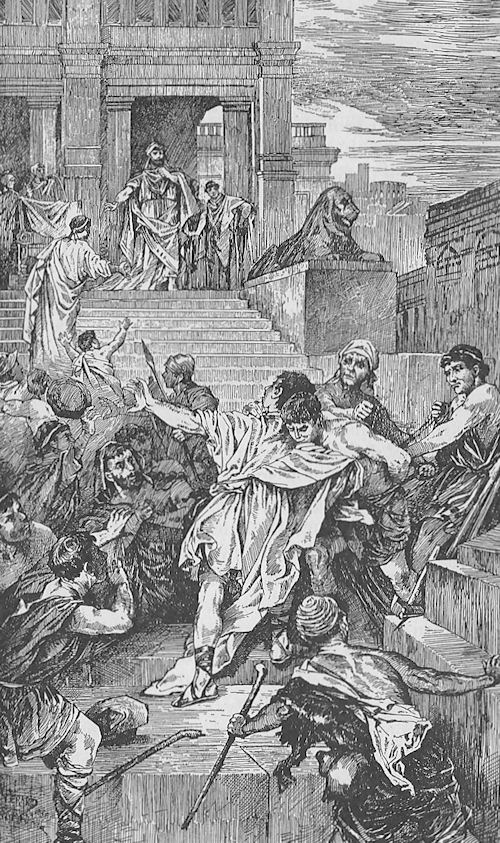
Damon and Pythias.
2. Thus Dionysius was in constant dread. He had a wide trench round his bedroom, with a drawbridge that he drew up and put down with his own hands; and he put one barber to death for boasting that he held a razor to the tyrant's throat every morning. After this he made his young daughters shave him; and by-and-by he would not trust them with a razor, and caused them to singe off his beard with hot nut-shells.
3. One philosopher, named Philoxenus, he sent to a dungeon for finding fault with his poetry, but he afterward composed another piece, which he thought so superior that he could not be content without sending for this adverse critic to hear it. When he had finished reading it, he looked to Philoxenus for a compliment; but the philosopher only turned round to the guards, and said dryly, "Carry me back to prison." This time Dionysius had the sense to laugh, and forgive his honesty.
4. All these stories may not be true; but that they should have been current in the ancient world, shows what was the character of the man of whom they were told, how stern and terrible was his anger, and how easily it was incurred. Among those who came under it was a Pythagorean called Pythias, who was sentenced to death, according to the usual fate of those who fell under his suspicion.
5. Pythias had lands and relations in Greece, and he entreated as a favor to be allowed to return thither and arrange his affairs, engaging to return within a specified time and suffer death. The tyrant laughed his request to scorn. Once safe out of Sicily, who would answer for his return? Pythias made reply that he had a friend who would become security for his return; and while Dionysius, the miserable man who trusted nobody, was ready to scoff at his simplicity, another Pythagorean, by name Damon, came forward and offered to become surety for his friend, engaging that, if Pythias did not return according to promise, to suffer death in his stead.
6. Dionysius, much astonished, consented to let Pythias go, marveling what would be the issue of the affair. Time went on, and Pythias did not appear. The Syracusans watched Damon, but he showed no uneasiness. He said he was secure of his friend's truth and honor, and that if any accident had caused his delay, he should rejoice in dying to save the life of one so dear to him.
7. Even to the last day Damon continued serene and content, however it might fall out; nay, even when the very hour drew nigh and still no Pythias. His trust was so perfect that he did not even grieve at having to die for a faithless friend who left him to the fate to which he had unwarily pledged himself. It was not Pythias's own will, but the winds and waves, so he still declared, when the decree was brought and the instruments of death made ready. The hour had come, and a few moments more would have ended Damon's life, when Pythias duly presented himself, embraced his friend, and stood forward himself to receive his sentence, calm, resolute, and rejoiced that he had come in time.
8. Even the dim hope they owned of a future state was enough to make these two brave men keep their word, and confront death for one another without quailing. Dionysius looked on more struck than ever. He felt that neither of such men must die. He reversed the sentence of Pythias, and calling the two to his judgment-seat, he entreated them to admit him as a third in their friendship.
Charlotte M. Yonge.