Book 4 — XXXI.—THE DEATH OF CÆSAR.
Reading edition
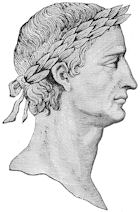
Cæsar (enlarged from a Roman Coin).
1. The greatest of Rome's generals, and one of the greatest of military chieftains of all ages, was Julius Cæsar. Of a patrician family, he was one of the most accomplished men of Rome. He was great in civil as well as military life. He became the most popular of the greatest men of Rome's most brilliant days. His military feats rivaled those of Alexander, and he extended the rule of Rome through all central Europe, completely subduing all of the tribes with which he came in contact. From his northern victories he turned his victorious army south, crossed the Rubicon, which marked the border of his own province, and seized the control of Rome.
2. In the management of civil affairs he was as successful as in the field. He corrected abuses that had crept into the political management of affairs, and placed new safeguards around the rights of the people.
3. His administration was almost as brilliant as that of Pericles in Athens; yet the principal nobles did not love him, and with the people at large he suffered still more, from a belief that he wished to be made king. On his return from Spain he had been named dictator and imperator for life. His head had for some time been placed on the money of the republic, a regal honor conceded to none before him. Quintilis, the fifth month of the old calendar, received from him the name which it still bears. The senate took an oath to guard the safety of his person.
4. He was honored with sacrifices, and honors hitherto reserved for the gods. But Cæsar was not satisfied. He was often heard to quote the sentiment of Euripides, that, "if any violation of law is excusable, it is excusable for the sake of gaining sovereign power." It was no doubt to ascertain the popular sentiments that various propositions were made toward an assumption of the title of king. His statues in the forum were found crowned with a diadem; but two of the tribunes tore it off, and the mob applauded.
5. On the 26th of January, at the great Latin festival on the Alban Mount, voices in the crowd saluted him as king; but mutterings of discontent reached his ears, and he promptly said; "I am no king, but Cæsar." The final attempt was made at the Lupercalia on the 15th of February. Antony, in the character of one of the priests of Pan, approached the dictator as he sat presiding in his golden chair, and offered him an embroidered band, like the diadem of Oriental sovereigns. The applause which followed was partial, and the dictator put the offered gift aside. Then a burst of genuine cheering greeted him, which waxed louder still when he rejected it a second time. Old traditional feeling was too strong at Rome even for Cæsar's daring temper to brave it. The people would submit to the despotic rule of a dictator, but would not have a king.
6. Other causes of discontent had been agitating various classes at Rome. The more fiery partisans of Cæsar disapproved of his clemency; the more prodigal sort were angry at his regulations for securing the provincials from oppression. The populace of the city complained—the genuine Romans, at seeing favor extended to provincials, those of foreign origin because they had been excluded from the corn bounty. Cæsar, no doubt, was eager to return to his army, and escape from the increasing difficulties which beset his civil government. But as soon as he joined the army, he would assume monarchical power in virtue of the late decree; and this consideration urged the discontented to a plot against his life.
7. The difficulty was to find a leader. At length Marcus Junius Brutus accepted the post of danger. This young man, a nephew of Cato, had taken his uncle as an example for his public life. But he was fonder of speculation than of action. His habits were reserved, rather those of a student than a statesman. He had reluctantly joined the cause of Pompey, for he could ill forget that it was by Pompey that his father had been put to death in cold blood. After the battle of Pharsalia he was treated by Cæsar almost like a son. In the present year he had been proclaimed prætor of the city, with the promise of the consulship. But the discontented remnants of the senatorial party assailed him with constant reproaches. The name of Brutus, dear to all Roman patriots, was made a rebuke to him. "His ancestors expelled the Tarquins; could he sit quietly under a king's rule?" At the foot of the statue of that ancestor, or on his own prætorian tribunal, notes were placed, containing phrases such as these: "Thou art not Brutus: would thou wert." "Brutus, thou sleepest." "Awake, Brutus." Gradually he was brought to think that it was his duty as a patriot to put an end to Cæsar's rule even by taking his life.
8. The most notable of those who arrayed themselves under him was Cassius. This man's motive is unknown. He had never taken much part in politics; he had made submission to the conquerer, and had been received with marked favor. Some personal reason probably actuated his unquiet spirit. More than sixty persons were in the secret, most of them, like Brutus and Cassius, under personal obligations to the dictator. Publius Servilius Casca was by his grace tribune of the plebs. Lucius Tullius Cimber was promised the government of Bithynia. Decius Brutus, one of his old Gallic officers, was prætor elect, and was to be gratified with the rich province of Cisalpine Gaul. Caius Trebonius, another trusted officer, had received every favor which the dictator could bestow; he had just laid down the consulship, and was on the eve of departure for the government of Asia. Quintius Ligarius had lately accepted a pardon from the dictator, and rose from a sick bed to join the conspirators.
9. A meeting of the senate was called for the Ides of March, at which Cæsar was to be present. This was the day appointed for the murder. The secret had oozed out. Many persons warned Cæsar that some danger was impending. A Greek soothsayer told him of the very day. On the morning of the Ides his wife arose so disturbed by dreams, that she persuaded him to relinquish his purpose of presiding in the senate, and he sent Antony in his stead.
10. This change of purpose was reported after the House was formed. The conspirators were in despair. Decius Brutus at once went to Cæsar, told him that the Fathers were only waiting to confer upon him the sovereign power which he desired, and begged him not to listen to auguries and dreams. Cæsar was persuaded to change his purpose, and was carried forth in his litter. On his way, a slave who had discovered the conspiracy tried to attract his notice, but was unable to reach him for the crowd. A Greek philosopher, named Artemidorus, succeeded in putting a roll of paper into his hand, containing full information of the conspiracy; but Cæsar, supposing it to be a petition, laid it by his side for a more convenient season. Meanwhile, the conspirators had reason to think that their plot had been discovered. A friend came up to Casca and said, "Ah, Casca, Brutus has told me your secret!" The conspirator started, but was relieved by the next sentence: "Where will you find money for the expenses of the ædileship?" More serious alarm was felt when Popillius Lænas remarked to Brutus and Cassius: "You have my good wishes; but what you do, do quickly"—especially when the same senator stepped up to Cæsar on his entering the house, and began whispering in his ear. So terrified was Cassius, that he thought of stabbing himself instead of Cæsar, till Brutus quietly observed, that the gestures of Popillius indicated that he was asking a favor, not revealing a fatal secret. Cæsar took his seat without further delay.
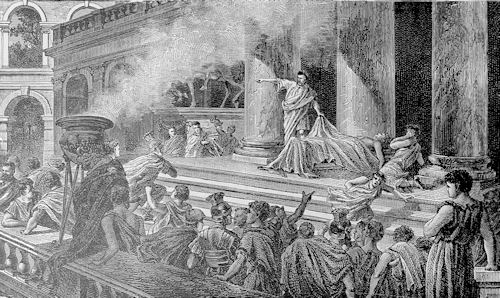
Antony delivering the Oration on the Death of Cæsar.
11. As was agreed, Cimber presented a petition praying for his brother's recall from banishment; and all the conspirators pressed round the dictator, urging his favorable answer. Displeased at their importunity, Cæsar attempted to rise. At that moment Cimber seized the lappet of his robe, and pulled him down; and immediately Casca struck him from the side, but inflicted only a slight wound. Then all drew their daggers and assailed him. Cæsar for a time defended himself with the gown folded over his left arm, and the sharp-pointed style which he held in his right hand for writing on the wax of his tablets. But when he saw Brutus among the assassins, he exclaimed, "You, too, Brutus!" and covering his face with his gown, offered no further resistance. In their eagerness, some blows intended for their victim fell upon themselves. But enough reached Cæsar to do the bloody work. Pierced by twenty-three wounds, he fell at the base of Pompey's statue, which had been removed after Pharsalia by Antony, but had been restored by the magnanimity of Cæsar.
12. Thus died "the foremost man of all the world," a man who failed in nothing that he attempted. He might, Cicero thought, have been a great orator; his "Commentaries" remain to prove that he was a great writer. As a general he had few superiors, as a statesman and politician no equal. That which stamps him as a man of true greatness, is the entire absence of vanity and self-conceit from his character. He paid, indeed, great attention to his personal appearance, even when his hard life and unremitting activity had brought on fits of an epileptic nature, and left him with that meager visage which is familiar to us from his coins. Even then he was sedulous in arranging his robes, and was pleased to have the privilege of wearing a laurel crown to hide the scantiness of his hair. But these were foibles too trifling to be taken as symptoms of real vanity. His successes in war, achieved by a man who in his forty-ninth year had hardly seen a camp, add to our conviction of his real genius. These successes were due not so much to scientific manœuvres, as to rapid audacity of movement, and mastery over the wills of men.
13. The effect of Cæsar's fall was to cause a renewal of bloodshed for another half generation; and then his work was finished by a far less general ruler. Those who slew Cæsar were guilty of a great crime, and a still greater blunder.
Liddell.