Book 4 — XXXVI.—CHARLEMAGNE.
Reading edition
1. We come now to one of the greatest men of all times, Charles the Great, son of Pepin the Short, a man who has left his mark on history for all time. Charles (called by the French Charlemagne) was great in many ways, whereas most great men are great in one or two. He was a great warrior, a great political genius, an energetic legislator, a lover of learning, and a lover also of his natural language and poetry at a time when it was the fashion to despise them. And he united and displayed all these merits in a time of general and monotonous barbarism, when, save in the church, the minds of men were dull and barren.
2. From 769 to 813, in Germany and Western and Northern Europe, Charlemagne conducted thirty-two campaigns against the Saxons, Frisians, Bavarians, Avars, Slavs, and Danes; in Italy, five against the Lombards; in Spain, Corsica, and Sardinia, twelve against the Arabs, two against the Greeks, and three in Gaul itself, against the Aquitanians and Bretons—in all, fifty-three expeditions in forty-five years, among which those he undertook against the Saxons, the Lombards, and the Arabs were long and difficult wars.
3. The kingdom of Charles was vast; it comprised nearly all Germany, Belgium, France, Switzerland, and the north of Italy and of Spain. He had, in ruling this mighty realm, to deal with different nations, without cohesion, and to grapple with their various institutions and bring them into system.
4. The first great undertaking of Charles was against the Saxons. They were still heathen, and were a constant source of annoyance to the Franks, for they made frequent inroads to pillage and destroy their towns and harvests.
5. In the line of mountains which forms the step from lower into upper Germany, above the Westphalian plains, is one point at which the river Weser breaks through and flows down into the level land about three miles above the town of Minden. This rent in the mountain is called the Westphalian Gate. The hills stand on each side like red sandstone door-posts, and one is crowned by some crumbling fragments of a castle; it is called the Wittekindsberg, and takes its name from Wittekind, a Saxon king, who had his castle there. Wittekind was a stubborn heathen, and a very determined man.
6. In 772 Charles convoked a great assembly at Worms, at which it was unanimously resolved to march against the Saxons and chastise them for their incursions. Charles advanced along the Weser, through the gate, destroyed Wittekind's castle, pushed on to Paderborn, where he threw down an idol adored by the Saxons, and then was obliged to return and hurry to Italy to fight the Lombards, who had revolted. Next year he invaded Saxony again. He built himself a palace at Paderborn, and summoned the Saxon chiefs to come and do homage. Wittekind alone refused, and fled to Denmark.
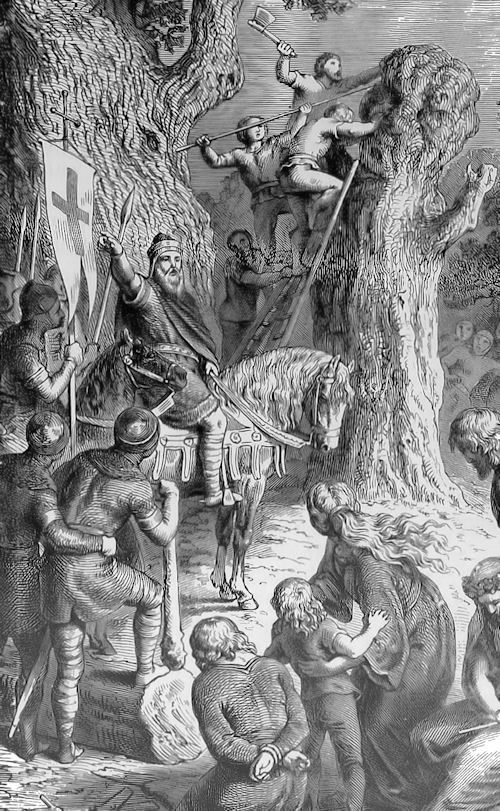
Charlemagne.
7. No sooner had Charles gone to fight the Moors in Spain than Wittekind returned, and the Saxons rose at his summons, and, bursting into Franconia, devastated the land up to the walls of Cologne. Charles returned and fought them in two great battles, defeated them, erected fortresses in their midst, and carried off hostages. Affairs seemed to prosper, and Charles deemed himself as securely master of Saxony as Varus had formerly in the same country, and under precisely the same circumstances. Charles then quitted the country, leaving orders for a body of Saxons to join his Franks and march together against the Slavs. The Saxons obeyed the call with alacrity, and soon outnumbered the Franks. One day, as the army was crossing the mountains from the Weser, at a given signal the Saxons fell on their companions and butchered them.
8. When the news of this disaster reached Charles he resolved to teach the Saxons a terrible lesson. Crossing the Rhine, he laid waste their country with fire and sword, and forced the Saxons to submit to be baptized and accept Christian teachers. Those who refused he killed. At Verdun he had over four thousand of the rebels beheaded. At Detmold, Wittekind led the Saxons in a furious battle, in which neither gained the victory. In another battle, on the Hase, they were completely routed.
9. Then Wittekind submitted, came into the camp of Charles, and asked to be baptized. A little ruined chapel stands on the Wittekindsberg, above the Westphalian Gate, and there, according to tradition, near the overturned walls of his own castle, the stubborn heathen bowed the neck to receive the yoke of Christ. Charles's two nephews, the sons of Karlomann, were with Desiderius, the Lombard king, and Desiderius tried to force the Pope to anoint them kings of the Franks, to head a revolt against Charles. When the great king heard this he came over the Alps into Italy, dethroned Desiderius, and shut him up in a monastery. Then he crowned himself with the iron crown of the Lombard kings, which was said to have been made out of one of the nails that fastened Christ to the cross.
10. Duke Thassils of Bavaria had married a daughter of Desiderius, and he refused to acknowledge the authority of Charles. He also stirred up the Avars who lived in Hungary to invade the Frankish realm. Charles marched against Thassils, drove him out of Bavaria, subdued the Avars, and converted the country between the Ems and Raab—that is, Austria proper—into a province, which was called the East March, and formed the beginning of the East Realm (Oesterreich), or Austria. Charles also fought the Danes, and took from them the country up to the river Eider.
11. When we consider what continuous fighting Charles had, it is a wonder to us that he had time to govern and make laws; but he devoted as much thought to arranging his realm and placing it under proper governors as he did to extending its frontiers.
12. Charles constituted the various parts of his vast empire—kingdoms, duchies, and counties. He was himself the sovereign of all these united, but he managed them through counts and vice-counts. The frontier districts were called marches, and were under march-counts, or margraves. Count is not a German title; the German equivalent is Graf, and the English is earl. The counties were divided into hundreds; a hundred villages went to a vice-count. He had also counts of the palace, who ruled over the crown estates, and send-counts (missi), whom he sent out yearly through the country to see that his other counts did justice, and did not oppress the people. If people felt themselves wronged by the counts, they appealed to these send-counts; and if the send-counts did not do them justice, they appealed to the palatine-counts.
13. Every year Charles summoned his counts four times, when he could, but always once, in May, to meet him in council, and discuss the grievances of the people. As the great dukes were troublesome, because so powerful, Charles tried to do without them, and to keep them in check. He gave whole principalities to bishops, hoping that they would become supporters of him and the crown against the powerful dukes.
14. He was also very careful for the good government of the Church. He endowed a number of monasteries to serve as schools for boys and girls. He had also a collection of good, wholesome sermons made in German, and sent copies about in all directions, requiring them to be read to the people in church. He invited singers and musicians from Italy to come and improve the performance of divine worship, and two song-schools were established, one at Gall, another at Metz. His Franks, he complained, had not much aptitude for music; their singing was like the howling of wild beasts or the noise made by the squeaking, groaning wheels of a baggage-wagon over a stony road!
15. Charles was particularly interested in schools, and delighted in going into them and listening to the boys at their lessons. One day when he had paid such a visit he was told that the noblemen's sons were much idler than those of the common citizens. Then the great king grew red in the face and frowned, and his eyes flashed. He called the young nobles before him and said in thundering tones: "You grand gentlemen! You young puppets! You puff yourselves up with the thoughts of your rank and wealth, and suppose you have no need of letters! I tell you that your pretty faces and your high nobility are accounted nothing by me. Beware! beware! Without diligence and conscientiousness not one of you gets anything from me."
16. Charles dearly loved the grand old German poems of the heroes, and he had them collected and copied out. Alas! they have been lost. His stupid son, thinking them rubbish, burned them all. The great king also sent to Italy for builders, and set them to work to erect palaces and churches. His favorite palaces were at Aix and at Ingelheim. At the latter place he had a bridge built over the Rhine. At Aix he built the cathedral with pillars taken from Roman ruins. It was quite circular, with a colonnade going round it; inside it remains almost unaltered to the present day.
17. He was very eager to promote trade, and so far in advance of the times was he that he resolved to cut a canal so as to connect the Main with the Regnitz, and thus make a water-way right across Germany from the Rhine to the Danube, and so connect the German Ocean with the Black Sea. The canal was begun, but wars interfered with its completion, and the work was not carried out till the present century by Louis I of Bavaria.
18. Charles was a tall, grand looking man, nearly seven feet high. He was so strong that he could take a horseshoe in his hands and snap it. He ate and drank in moderation, and was grave and dignified in his conduct.
19. In the year 800, an insurrection broke out in Rome against Pope Leo III. While he was riding in procession his enemies fell on him, threw him from his horse, and an awkward attempt was made to put out his eyes and cut out his tongue. Thus, bleeding and insensible, he was put into a monastery. The Duke of Spoleto, a Frank, hearing of this, marched to Rome and removed the wounded Pope to Spoleto, where he was well nursed and recovered his eye-sight and power of speech. Charles was very indignant when he heard of the outrage, and he left the Saxons, whom he was fighting, and came to Italy to investigate the circumstance. He assumed the office of judge, and the guilty persons were sent to prison in France.
20. Then came Christmas-day, the Christmas of the last year in the eighth century of Christ. Charles and all his sumptuous court, the nobles and people of Rome, the whole clergy of Rome, were present at the high services of the birth of Christ. The Pope himself chanted the mass; the full assembly were rapt in profound devotion. At the close the Pope rose, advanced toward Charles with a splendid crown in his hands, placed it upon his brow, and proclaimed him Cæsar Augustus. "God grant life and victory to the great emperor!" His words were lost in the acclamations of the soldiery, the people, and the clergy.
21. Charles was taken completely by surprise. What the consequences would be to Germany and to the papacy, how fatal to both, neither he nor Leo could see. So Charlemagne became King of Italy and Emperor of the West—the successor of the Cæsars of Rome.
22. When Charles felt that his end was approaching, he summoned all his nobles to Aix into the church he had there erected. There, on the altar, lay a golden crown. Charles made his son Ludwig, or Louis, stand before him, and, in the audience of his great men, gave him his last exhortation: to fear God and to love his people as his own children, to do right and to execute justice, and to walk in integrity before God and man. With streaming eyes Louis promised to fulfill his father's command. "Then," said Charles, "take this crown, and place it on your own head, and never forget the promise you have made this day."
Sabine, Baring-Gould. "The Story of Germany."
Putnam's "Stories of the Nations" Series.