Book 4 — XXX.—ARCHIMEDES.
Reading edition
1. This extraordinary man was a native of Syracuse, a city of Sicily. He was born two hundred and eighty-eight years before the Christian era, and from fifty to one hundred years after the appearance of the far-famed Euclid. Who his parents were, and what was their rank in life are not known, though it is claimed that he was in some way related to Hiero the king of Syracuse. It is said that Hiero considered himself greatly honored by such a relation, and well he might be, for science and genius combined are much higher than royalty. Besides it is probable that the name of the monarch would never have been preserved except in connection with the great philosopher.
2. By whom he was instructed in the elements of education, history fails to inform us, but it tells us of the progress he made in mechanics and geometry, and for the sake of the quiet necessary to pursue these branches he gave up all the advantages of a political life derived from his connection with the king. His favorite studies had more charms for him than the glitter of events or the plunder of conquered cities.
3. After studying at home until he could learn nothing more in the city of his birth, he repaired to Alexandria in Egypt, at that time the educational center that had inherited the philosophy and culture of Athens. Here he studied for some years and became acquainted with the most distinguished scholars of his day. Among his most intimate friends was Conon, a famous mathematician from Samos, who often exchanged problems with him for solution. While staying at Alexandria he began his work of practical invention which he afterward turned to such good account.
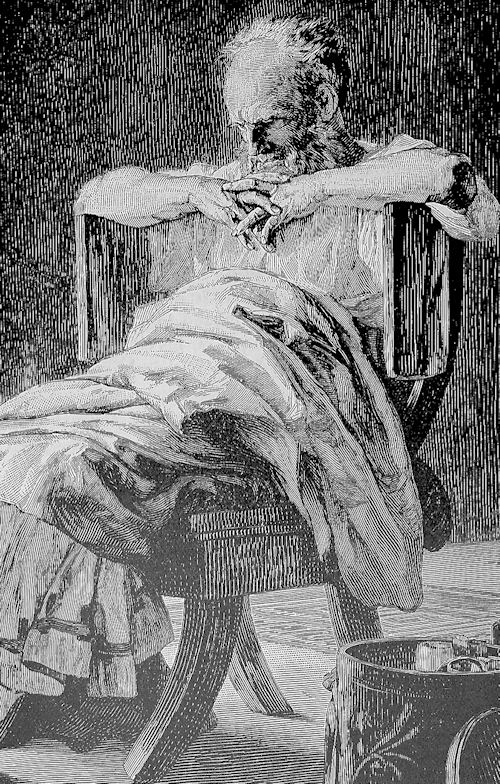
Archimedes.
4. Some of his ardent admirers have maintained that Archimedes taught the Egyptians more than they taught him; that while he imbibed philosophy and book learning, he more than repaid the New Athens by inventions which were of the greatest use in the ordinary work of the home and the shop. Although we do not know exactly what he turned his hand to, we are quite sure that in many ways he performed feats that have scarcely been surpassed in modern times.
5. After his return to his native city, Archimedes continued his studies with unabated vigor, often neglecting his food and the care of his person when a new problem was to be solved or a new invention perfected. The method of determining the relative amount of gold and base metal in Hiero's crown occurred to him while in his bath, and without stopping to put on his clothes, he is said to have rushed through the streets exclaiming "Eureka! Eureka!"
6. To prevent the ruin of his health his servants were sometimes obliged to take him by main force to the table and bath, and to take his daily exercise. Hiero at one time expressed an admiration of some of his inventions when Archimedes replied that had he a place to fix his machines upon he could move the earth itself. His days were passed in study and retirement until the safety of his native city called him out to take part in its defense.
7. During the wars between the Romans and Carthaginians, the people of Sicily, and especially the Syracusans, had for a long time remained neutral or been in alliance with the Romans. But a Carthaginian interest sprung up which mastered and sought to extend itself over the whole island. As soon as the news of this political movement and rebellion reached Marcellus, the Roman general, he hastened with a strong force into Sicily, and after the capture of the principalities he laid siege to Syracuse.
8. Here he met with an unexpected check. The inventive genius of Archimedes enabled the Syracusans to successfully defend their city for three years. He so improved the warlike instruments for the discharge of missiles, that he repeatedly beat back the most determined assault, and the Romans were more than once on the point of abandoning the siege, believing that the city was defended by the gods. By means of long and powerful levers, together with grappling irons, he is said to have destroyed many of the Roman galleys when they approached the walls of the city; and when they retired for safety he set them on fire by a combination of immense burning-glasses.
9. The story of these exploits is told by the Romans themselves, and there can be no doubt but here Science gained one of her greatest triumphs. The success of the new engine was evidently so great, that an element of superstition entered into the record. But the triumph of genius was not complete. During a festival in honor of Diana when wine flowed freely, the guards neglected to man some particular part of the walls. The Romans observing this scaled the walls and made themselves masters of the city.
10. Amid the plunder and carnage which followed, Archimedes was killed. Marcellus had given orders for his special protection, but the deed was done by a Roman soldier. One account says that he was slain in his laboratory where he was found studying a problem, and he refused to move until he had completed the solution. Another account says that he was put to death on the street while drawing a geometrical figure in the sand. The third and most rational account is that while bearing some boxes of mathematical instruments to Marcellus he was killed by a soldier who supposed that the boxes contained treasure. His death happened about 210 B. C. at the age of seventy-six.