Book 4 — Introductory material
Reading edition
I.—ARION.
1. Arion was a famous musician, and dwelt at the court of Periander, King of Corinth, with whom he was a great favorite. There was a musical contest in Sicily, and Arion longed to compete for the prize. He told his wish to Periander, who besought him like a brother to give up the thought. "Pray stay with me," he said, "and be contented. He who strives to win may lose." Arion answered: "A wandering life best suits the free heart of a poet. A talent which a god bestowed upon me I would fain make a source of pleasure to others; and if I win the prize, how will the enjoyment of it be increased by the consciousness of my wide-spread fame!"
2. He went, won the prize, and embarked with his wealth in a Corinthian vessel for home. On the second morning after setting sail, the wind breathed mild and fair. "O Periander!" he exclaimed, "dismiss your fears. Soon shall you forget them in my embrace. With what lavish offerings will we display our gratitude to the gods, and how merry will we be at the festal board!" The wind and sea continued favorable, not a cloud dimmed the firmament. He had not trusted too much to the ocean, but to man he had. He overheard the seamen plotting to get possession of his treasure. Presently they surrounded him, loud and mutinous, and said: "Arion, you must die! If you would have a grave on the shore, yield yourself to die on this spot; but if otherwise, cast yourself into the sea."
3. "Will nothing satisfy you but my life?" said he; "take my gold in welcome. I willingly buy my life at that price." "No, no; we can not spare you. Your life would be too dangerous to us. Where could we go to escape Periander if he should know that you had been robbed by us? Your gold would be of little use to us, if, on returning home, we could never more be free from fear." "Grant me, then," said he, "a last request, since naught will prevail to save my life, that I may die as I have lived, as becomes a bard. When I shall have sung my death-song, and my harp-strings cease to vibrate, then I will bid farewell to life, and yield to my fate." This prayer, like the others, would have been unheeded—they thought only of their booty—but to hear so famous a musician moved their hearts. "Suffer me," he added, "to arrange my dress. Apollo will not favor me unless I am clad in my minstrel garb."
4. He clothed himself in gold and purple, fair to see, his tunic fell around him in graceful folds, jewels adorned his arms, his brow was crowned with a golden wreath, and over his neck and shoulders flowed his hair, perfumed with odors. His left hand held the lyre, his right the ivory wand with which he struck the chords. Like one inspired he seemed to drink the morning air and glitter in the morning ray. The seamen gazed in admiration. He strode forward to the vessel's side, and looked down into the blue sea.
5. Addressing his lyre, he sang: "Companion of my voice, come with me to the realm of shades! Though Cerberus may growl, we know the power of song can tame his rage. Ye heroes of Elysium, who have passed the darkling flood—ye happy souls, soon shall I join your band. Yet can ye relieve my grief? Alas! I leave my friend behind me. Thou, who didst find thy Eurydice, and lose her again as soon as found, when she had vanished like a dream, how thou didst hate the cheerful light! I must away, but I will not fear. The gods look down upon us. Ye who slay me unoffending, when I am no more your time of trembling shall come! Ye Nereids, receive your guest, who throws himself upon your mercy!" So saying, he sprang into the deep sea. The waves covered him, and the seamen held their way, fancying themselves safe from all danger of detection.
6. But the strains of his music had drawn around him the inhabitants of the deep to listen, and dolphins followed the ship as if charmed by a spell. While he struggled in the waves a dolphin offered him its back, and carried him mounted thereon safe to shore. At the spot where he landed, a monument of brass was afterward erected upon the rocky shore to preserve the memory of the event.
7. When Arion and the dolphin parted, each returning to his own element, Arion thus poured forth his thanks: "Farewell, thou faithful, friendly fish! Would that I could reward thee! but thou canst not wend with me, nor I with thee; companionship we may not have. May Galatea, queen of the deep, accord thee her favor, and thou, proud of the burden, draw her chariot over the smooth mirror of the deep!"
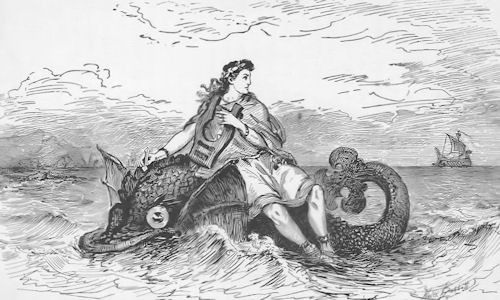
Arion and the Dolphin.
8. Arion hastened from the shore, and soon saw before him the towers of Corinth. He journeyed on, harp in hand, singing as he went, full of love and happiness, forgetting his losses, and mindful only of what remained, his friend and his lyre. He entered the hospitable halls, and was soon clasped in the embrace of Periander. "I come back to thee, my friend," he said. "The talent which a god bestowed has been the delight of thousands, but false knaves have stripped me of my well-earned treasure." Then he told all the wonderful events that had befallen him. Periander, who heard him in amazement, said: "Shall such wickedness triumph? Then in vain is power lodged in my hands. That we may discover the criminals you must lie here concealed, so that they come without suspicion."
9. When the ship arrived in the harbor, he summoned the mariners before him. "Have you heard anything of Arion?" he inquired. "I anxiously look for his return." They replied, "We left him well and prosperous in Tarentum." As they said these words, Arion stepped forth and faced them. He was clad in all his glory as when he leaped into the sea. They fell prostrate at his feet, as if a lightning-bolt had struck them. "We meant to murder him, and he has become a god! O earth, open and receive us!" Then Periander spoke: "He lives, the master of the lay! kind Heaven protects the poet's life. As for you, I invoke not the spirit of vengeance; Arion wishes not your blood. Ye slaves of avarice, begone! Seek some barbarous land, and never may aught beautiful delight your souls!"