Book 4 — XLI.—THE NORMAN CONQUEST.
Reading edition
1. Poor old Edward the Confessor, holy, weak, and sad, lay in his new choir of Westminster—where the wicked cease from troubling and the weary are at rest. The crowned ascetic had left no heir behind. England seemed as a corpse, to which all the eagles might gather together; and the South-English, in their utter need, had chosen for their king the ablest, and it may be the justest, man in Britain—Earl Harold Godwinson: himself, like half the upper classes of England then, of all-dominant Norse blood; for his mother was a Danish princess.
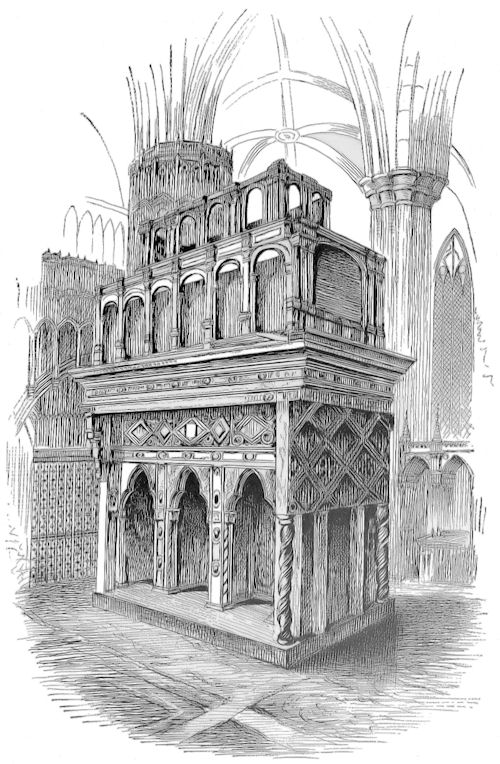
Edward the Confessor's Tomb.
2. Then out of Norway, with a mighty host, came Harold Hardraade, taller than all men, the ideal Viking of his time. He had been away to Russia to King Jaroslaf; he had been in the Emperor's Varanger guard at Constantinople—and, it was whispered, had slain a lion there with his bare hands; he had carved his name and his comrades' in Runic characters—if you go to Venice you may see them at this day—on the loins of the great marble lion, which stood in his time not in Venice but in Athens. And now, King of Norway and conqueror, for the time, of Denmark, why should he not take England, as Sweyn and Canute took it sixty years before, when the flower of the English gentry perished at the fatal battle of Assingdune? If he and his half-barbarous host had conquered, the civilization of Britain would have been thrown back, perhaps, for centuries. But it was not to be.
3. England was to be conquered by the Normans; but by the civilized, not the barbaric; by the Norse who had settled, but four generations before, in the northeast of France under Rou, Rollo, Rolf the Ganger, so called, they say, because his legs were so long that, when on horseback, he touched the ground and seemed to gang, or walk. He and his Norsemen had taken their share of France, and called it Normandy to this day; and meanwhile, with that docility and adaptability which marks so often truly great spirits, they changed their creed, their language, their habits, and had become, from heathen and murderous Berserkers, the most truly civilized people in Europe, and—as was most natural then—the most faithful allies and servants of the Pope of Rome. So greatly had they changed, and so fast, that William Duke of Normandy, the great-great grandson of Rolf the wild Viking, was perhaps the finest gentleman, as well as the most cultivated sovereign and the greatest statesman and warrior in Europe.
4. So Harold of Norway came with all his Vikings to Stamford Bridge by York; and took, by coming, only that which Harold of England promised him, namely, "forasmuch as he was taller than any other man, seven feet of English ground."
5. The story of that great battle, told with a few inaccuracies, but as only great poets tell, you should read, if you have not read it already, in the "Heimskringla" of Snorri Sturluson, the Homer of the North:
High feast that day held the birds of the air and the beasts of the field, White-tailed erm and sallow glede, Dusky raven, with horny neb, And the gray deer the wolf of the wood.
The bones of the slain, men say, whitened the place for fifty years to come.
6. And remember that on the same day on which that fight befell—September 27, 1066—William, Duke of Normandy, with all his French-speaking Norsemen, was sailing across the British Channel, under the protection of a banner consecrated by the Pope, to conquer that England which the Norse-speaking Normans could not conquer.
7. And now King Harold showed himself a man. He turned at once from the north of England to the south. He raised the folk of the southern, as he had raised those of the central and northern shires, and in sixteen days—after a march which in those times was a prodigious feat—he was intrenched upon the fatal down which men called Heathfield then, and Senlac, but Battle to this day—with William and his French Normans opposite him on Telham Hill.
8. Then came the battle of Hastings. You all know what befell upon that day, and how the old weapon was matched against the new—the English axe against the Norman lance—and beaten only because the English broke their ranks.
9. It was a fearful time which followed. I can not but believe that our forefathers had been, in some way or other, great sinners, or two such conquests as Canute's and William's would not have fallen on them within the short space of sixty years. They did not want for courage, as Stamford Brigg and Hastings showed full well. English swine, their Norman conquerors called them often enough, but never English cowards.
10. Their ruinous vice, if we trust the records of the time, was what the old monks called accidia, and ranked it as one of the seven deadly sins: a general careless, sleepy, comfortable habit of mind, which lets all go its way for good or evil—a habit of mind too often accompanied, as in the case of the Anglo-Danes, with self-indulgence, often coarse enough. Huge eaters and huger drinkers, fuddled with ale, were the men who went down at Hastings—though they went down like heroes—before the staid and sober Norman out of France.
11. But these were fearful times. As long as William lived, ruthless as he was to all rebels, he kept order and did justice with a strong and steady hand; for he brought with him from Normandy the instincts of a truly great statesman. And in his sons' time matters grew worse and worse. After that, in the troubles of Stephen's reign, anarchy let loose tyranny in its most fearful form, and things were done which recall the cruelties of the old Spanish conquistadores in America. Scott's charming romance of "Ivanhoe" must be taken, I fear, as a too true picture of English society in the time of Richard I.
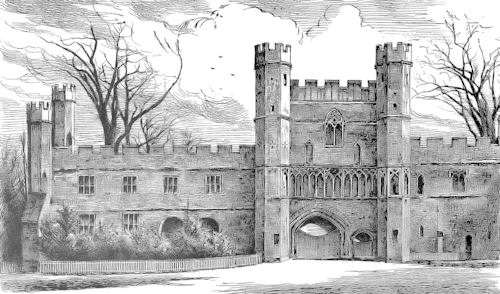
Battle Abbey.
12. And what came of it all? What was the result of all this misery and wrong? This, paradoxical as it may seem: that the Norman conquest was the making of the English people; of the free commons of England.
13. Paradoxical, but true. First, you must dismiss from your minds the too common notion that there is now in England a governing Norman aristocracy, or that there has been one, at least since the year 1215, when the Magna Charta was won from the Norman John by Normans and by English alike. For the first victors at Hastings, like the first conquistadores in America, perished, as the monk chronicles point out, rapidly by their own crimes; and very few of our nobility can trace their names back to the authentic Battle Abbey roll.
14. The cause is plain: The conquest of England by the Normans was not one of those conquests of a savage by a civilized race, or of a cowardly race by a brave race, which results in the slavery of the conquered, and leaves the gulf of caste between two races—master and slave. The vast majority, all but the whole population of England, have always been free, and free as they are not when caste exists to change their occupations. They could intermarry, if they were able men, into the rank above them; as they could sink, if they were unable men, into the rank below them.
15. Nay, so utterly made up now is the old blood-feud between Norman and Englishman, between the descendants of those who conquered and those who were conquered, that, in the children of the Prince of Wales, after eight hundred years, the blood of William of Normandy is mingled with the blood of Harold, who fell at Hastings. And so, by the bitter woes which followed the Norman conquest was the whole population, Dane, Angle, and Saxon, earl and churl, freeman and slave, crushed and welded together into one homogeneous mass, made just and merciful toward each other by the most wholesome of all teachings, a community of suffering; and if they had been, as I fear they were, a lazy and a sensual people, were taught—
That life is not as idle ore, But heated hot with burning fears, And bathed in baths of hissing tears, And battered with the strokes of doom To shape and use.
Charles Kingsley.