Book 4 — XXVI.—TARQUIN THE WICKED.
Reading edition
1. For his tyranny King Tarquin was banished from Rome about 500 B. C., and after his expulsion he sent messengers to Rome to ask that his property should be given up to him, and the senate decreed that his prayer should be granted. But the king's ambassadors, while they were in Rome, stirred up the minds of the young men and others who had been favored by Tarquin, so that a plot was made to bring him back. Among those who plotted were Titus and Tiberius, the sons of the consul Brutus; and they gave letters to the messengers of the king. But it chanced that a certain slave hid himself in the place where they met, and overheard them plotting; and he came and told the thing to the consuls, who seized the messengers of the king with the letters upon their persons, authenticated by the seals of the young men. The culprits were immediately arrested; but the ambassadors were let go, because their persons were regarded as sacred. And the goods of King Tarquin were given up for plunder to the people.
2. Then the traitors were brought up before the consuls, and the sight was such as to move all beholders to pity; for among them were the sons of Lucius Junius Brutus himself, the first consul, the liberator of the Roman people. And now all men saw how Brutus loved his country; for he bade the lictors put all the traitors to death, and his own sons first; and men could mark in his face the struggle between his duty as a chief magistrate of Rome and his feelings as a father. And while they praised and admired him they pitied him yet more. This was the first attempt to restore Tarquin the Proud.
3. When Tarquin saw that the plot at home had failed, he prevailed on the people of Tarquinii and Veii to make war with him against the Romans. But the consuls came out against them; Valerius commanding the main army, and Brutus the cavalry. And it chanced that Aruns, the king's son, led the cavalry of the enemy. When he saw Brutus, he spurred his horse against him, and Brutus did not decline the combat. They rode straight at each other with leveled spears; and so fierce was the shock, that they pierced each other through from breast to back, and both fell dead.
4. Then, also, the armies fought, but the battle was neither won nor lost. But in the night a voice was heard by the Etruscans, saying that the Romans were the conquerers. So the enemy fled by night; and when the Romans arose in the morning, there was no man to oppose them. Then they took up the body of Brutus, and departed home, and buried him in public with great pomp.
5. And thus the second attempt to restore King Tarquin was frustrated. After the death of Brutus, Valerius, the remaining consul, ruled the people for awhile by himself, and began to build himself a house upon the ridge called Velia, which looks down upon the forum. So the people thought that he was going to make himself king; but when he heard this, he called an assembly of the people, and appeared before them with his fasces lowered, and with no axes in them, whence the custom remained ever after, that no consular lictors wore axes within the city, and no consul had power of life and death except when he was in command of his legions abroad. And he pulled down the beginning of his house upon the Velia, and built it below that hill. Also, he passed laws that every Roman citizen might appeal to the people against the judgment of the chief magistrates. Wherefore he was greatly honored among the people, and was called Poplicola, or Friend of the People.
6. After this Valerius called together the great assembly of the centuries, and they chose Spurius Lucretius, father of Lucretius, to succeed Brutus. But he was an old man, and not many days afterward he died, and Marcus Horatius was chosen in his stead.
7. The temple on the Capitol which King Tarquin began had never yet been consecrated. Then Valerius and Horatius drew lots which should be the consecrator, and the lot fell on Horatius. But the friends of Valerius murmured, and they wished to prevent Horatius from having the honor; so, when he was now saying the prayer of consecration, with his hand upon the door-post of the temple, there came a messenger who told him that his son was just dead, and that one mourning for a son could not rightly consecrate the temple. But Horatius kept his hand upon the door-post, and told them to see to the burial of his son, and finished the rite of consecration. Thus did he honor the gods even above his own son.
8. In the next year Valerius was again made consul, with Titus Lucretius; and Tarquin, despairing now of aid from his friends at Veii and Tarquinii, went to Lars Porsena of Clusium, a city on the river Clanis, which falls into the Tiber. Porsena was, at this time, acknowledged as chief of the twelve Etruscan cities; and he assembled a powerful army and came to Rome. He came so quickly that he reached the Tiber, and was near the Sublician Bridge before there was time to destroy it; and if he had crossed it the city would have been lost.
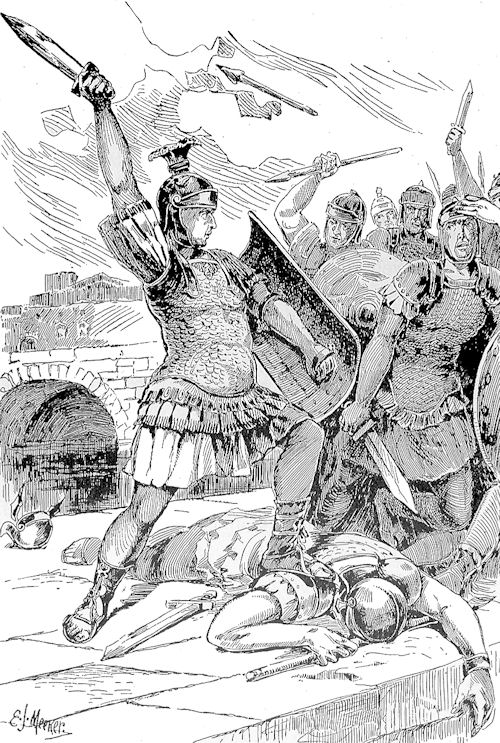
9. Then, a noble Roman, called Horatius Cocles, of the Lucerian tribe, with two friends—Spurius Lartius, a Ramnian, and Titus Herminius, a Titian—posted themselves at the far end of the bridge, and defended the passage against all the Etruscan host, while the Romans were cutting it off behind them. When it was all but destroyed, his two friends retreated across the bridge, and Horatius was left alone to bear the whole attack of the enemy. He kept his ground, standing unmoved amid the darts which were showered upon his shield, till the last beams of the bridge fell crashing into the river. Then he prayed, saying, "Father Tiber, receive me, and bear me up I pray thee." He then plunged in, and reached the other side safely; and the Romans honored him greatly: they put up his statue in the Comitium, and gave him as much land as he could plow round in a day, and every man at Rome subscribed the cost of one day's food to reward him.
Liddell.
10. This story is told in very spirited verse by Macaulay, in his poem of Horatius:
HORATIUS.
1. Fast by the royal standard, O'erlooking all the war, Lars Porsena of Clusium Sate in his ivory car. By the right wheel rode Mamilius, Prince of the Latian name; And by the left false Sextus, That wrought the deed of shame. 2. But when the face of Sextus Was seen among the foes, A yell that rent the firmament From all the town arose. On the house-tops was no woman But spate toward him and hissed; No child but screamed out curses, And shook its little fist. 3. But the consul's brow was sad, And the consul's speech was low; And darkly looked he at the wall, And darkly at the foe. "Their van will be upon us Before the bridge goes down; And if they once may win the bridge, What hope to save the town?" 4. Then out spoke brave Horatius, The captain of the gate: "To every man upon this earth Death cometh soon or late. And how can man die better Than facing fearful odds For the ashes of his fathers, And the temples of his gods!
Horatius.
5. "Hew down the bridge, Sir Consul With all the speed ye may; I, with two more to help me, Will hold the foe in play. In yon straight path a thousand May well be stopped by three. Now, who will stand on either hand, And keep the bridge with me?" 6. Then out spoke Spurius Lartius, A Ramnian proud was he: "Lo, I will stand on thy right hand, And keep the bridge with thee." And out spoke strong Herminius, Of Titian blood was he: "I will abide on thy left side, And keep the bridge with thee." 7. The three stood calm and silent, And looked upon the foes. And a great shout of laughter From all the vanguard rose: And forth three chiefs came spurring Before that mighty mass; To earth they sprang, their swords they drew And lifted high their shields, and flew To win the narrow pass. 8. Aunus from green Tifernum, Lord of the Hill of Tines; And Seius, whose eight hundred slaves Sicken in Ilva's mines; And Picus, long to Clusium Vassal in peace and war, Who led to fight his Umbrian powers From that gray crag where, girt with towers, The fortress of Nequinum lowers O'er the pale waves of Nar. 9. Stout Lartius hurled down Aunus Into the stream beneath; Herminius struck at Seius, And clove him to the teeth; At Picus brave Horatius Darted one fiery thrust, And the proud Umbrian's gilded arms Clashed in the bloody dust. 10. But meanwhile axe and lever Have manfully been plied, And now the bridge hangs tottering Above the boiling tide. "Come back, come back, Horatius," Loud cried the Fathers all. "Back, Lartius! back, Herminius! Back, ere the ruin fall!" 11. Back darted Spurius Lartius; Herminius darted back: And as they passed, beneath their feet They felt the timbers crack. But when they turned their faces, And on the further shore Saw brave Horatius stand alone, They would have crossed once more. 12. But with a crash like thunder Fell every loosened beam, And, like a dam, the mighty wreck Lay right athwart the stream; And a long shout of triumph Rose from the walls of Rome, As to the highest turret tops Was splashed the yellow foam. 13. Alone stood brave Horatius, But constant still in mind; Thrice thirty thousand foes before, And the broad flood behind. "Down with him!" cried false Sextus, With a smile on his pale face. "Now yield thee," cried Lars Porsena, "Now yield thee to our grace." 14. Round turned he, as not deigning Those craven ranks to see; Naught spake he to Lars Porsena, To Sextus naught spake he; But he saw on Palatinus The white porch of his home, And he spake to the noble river That rolls by the towers of Rome. 15. "Oh, Tiber! Father Tiber! To whom the Romans pray, A Roman's life, a Roman's arms, Take thou in charge this day!" So he spoke, and speaking sheathed The good sword by his side, And with his harness on his back Plunged headlong in the tide. 16. But fiercely ran the current, Swollen high by months of rain; And fast his blood was flowing; And he was sore in pain, And heavy with his armor, And spent with changing blows: And oft they thought him sinking, But still again he rose. 17. And now he feels the bottom; Now on dry earth he stands; Now round him throng the fathers, To press his gory hands; And now with shouts and clapping, And noise of weeping loud, He enters through the River-gate, Borne by the joyous crowd. 18. And still his name sounds stirring Unto the men of Rome, As the trumpet-blast that cries to them To charge the Volscian home; And wives still pray to Juno For boys with hearts as bold As his who kept the bridge so well In the brave days of old. 19. And in the nights of winter, When the cold north winds blow, And the long howling of the wolves Is heard amidst the snow; When round the lonely cottage Roars loud the tempest's din, And the good logs of Algidus Roar louder yet within; 20. When the oldest cask is opened, And the largest lamp is lit, When the chestnuts glow in the embers, And the kid turns on the spit; When young and old in circle Around the firebrands close; When the girls are weaving baskets, And the lads are shaping bows; 21. When the goodman mends his armor, And trims his helmet's plume; When the goodwife's shuttle merrily Goes flashing through the loom; With weeping and with laughter Still is the story told, How well Horatius kept the bridge In the brave days of old.
Macaulay.