Book 4 — XXIX.—THE ROMAN FATHER.
Reading edition
1. Among the most interesting of the early legends of Rome is that of Virginius, a soldier of the army belonging to the plebeian order. While performing his duty in the army which was encamped about twenty miles from Rome, his young daughter, Virginia, about fifteen years of age found her home with her near relatives in the city. Her beauty attracted the attention of Appius Claudius, one of the ten governors of Rome. With the view of getting possession of her person, he ordered one of his clients, M. Claudius by name, to lay hands upon her as she was going to her school in the Forum, and to claim her as his slave. The man did so; and when the cries of her nurse brought a crowd round them, M. Claudius insisted on taking her before the decemvir, in order (as he said) to have the case fairly tried. Her friends consented, and no sooner had Appius heard the matter, than he gave judgment that the maiden should be delivered up to the claimant, who should be bound to produce her in case her alleged father appeared to gainsay the claim.
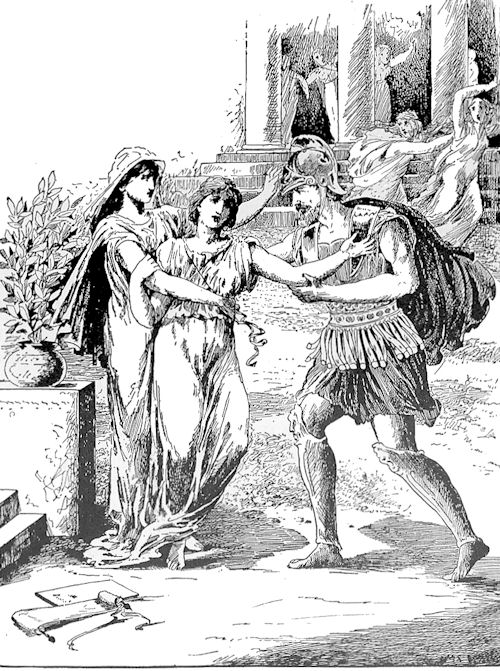
The Seizure of Virginia.
2. Now this judgment was directly against one of the laws of the Twelve Tables, which Appius himself had framed: for therein it was provided, that any person being at freedom should continue free, till it was proved that such person was a slave. Icilius her betrothed, therefore, with Numitorius, the uncle of the maiden, boldly argued against the legality of the judgment; and at length, Appius, fearing a tumult, agreed to leave the girl in their hands, on condition of their giving bail to bring her before him next morning; and then, if Virginius did not appear, he would at once, he said, give her up to her pretended master.
3. To this Icilius consented; but he delayed giving bail, pretending that he could not procure it readily, and in the mean time he sent off a secret message to the camp on Algidus to inform Virginius of what had happened. As soon as the bail was given, Appius also sent a message to the decemvirs in command of that army, ordering them to refuse leave of absence to Virginius. But when this last message arrived, Virginius was already half-way on his road to Rome; for the distance was not more than twenty miles, and he had started at nightfall.
4. Next morning early, Virginius entered the forum leading his daughter by the hand, both clad in mean attire. A great number of friends and matrons attended him; and he went about among the people entreating them to support him against the tyranny of Appius. So, when Appius came to take his place on the judgment-seat, he found the forum full of people, all friendly to Virginius and his cause. But he inherited the boldness as well as the vices of his sires, and though he saw Virginius standing there, ready to prove that he was the maiden's father, he at once gave judgment against his own law, that Virginia should be given up to M. Claudius, till it should be proved that she was free. The wretch came up to seize her, and the lictors kept the people from him. Virginius now despairing of deliverance, begged Appius to allow him to ask the maiden whether she were indeed his daughter or no. "If," said he, "I find I am not her father, I shall bear her loss the lighter." Under this pretense, he drew her aside to a spot upon the northern side of the forum (afterward called the Novæ Tabernæ), and here, snatching up a knife from a butcher's stall, he cried: "In this way only can I keep thee free!" and, so saying, stabbed her to the heart.
5. Then he turned to the tribunal, and said: "On thee, Appius, and on thy head be this blood." Appius cried out to sieze "the murderer"; but the crowd made way for Virginius, and he passed through them holding up the bloody knife, and went out at the gate, and made straight for the army. There, when the soldiers had heard his tale, they at once abandoned their decemviral generals, and marched to Rome. They were soon followed by the other army from the Sabine frontier; for to them Icilius had gone, and Numitorius; and they found willing ears among the men. So the two armies joined their banners, elected new generals, and encamped upon the Aventine hill, the quarter of the plebeians.
6. Meantime, the people at home had risen against Appius; and after driving him from the forum, they joined their armed fellow citizens upon the Aventine. There the whole body of the commons, armed and unarmed, hung like a dark cloud ready to burst upon the city.
Liddell.
VIRGINIUS.
1. When Appius Claudius saw that deed he shuddered and sank down, And hid his face some little space with the corner of his gown, Till with white lips and blood-shot eyes Virginius tottered nigh, And stood before the judgment-seat, and held the knife on high. "Oh! dwellers in the nether gloom, avengers of the slain, By this dear blood, I cry to you, do right between us twain; And even as Appius Claudius hath dealt with me and mine, Deal you by Appius Claudius and all the Claudian line!" So spake the slayer of his child, and turned, and went his way; But first he cast one haggard glance to where the body lay, And writhed, and groaned a fearful groan; and then with steadfast feet, Strode right across the market-place into the sacred street. 2. Then up sprang Appius Claudius: "Stop him; alive or dead! Ten thousand pounds of copper to the man who brings his head." He looked upon his clients, but none would work his will. He looked upon his lictors, but they trembled and stood still. And as Virginius, through the press, his way in silence cleft, Ever the mighty multitude fell back to right and left. And he hath passed in safety unto his woful home, And there ta'en horse to tell the camp what deeds are done in Rome. 3. By this the flood of people was swollen from every side, And streets and porches round were filled with that o'erflowing tide, And close around the body gathered a little train Of them that were the nearest and dearest to the slain. They brought a bier, and hung it with many a cypress crown, And gently they uplifted her, and gently laid her down. The face of Appius Claudius wore the Claudian scowl and sneer, And in the Claudian note he cried, "What doth this rabble here? Have they no crafts to mind at home, that hitherward they stray? Ho! lictors, clear the market-place, and fetch the corpse away!" 4. Till then the voice of pity and fury was not loud, But a deep, sullen murmur, wandered among the crowd. Like the moaning noise that goes before the whirlwind on the deep, Or the growl of a fierce watch-dog but half-aroused from sleep. But when the lictors at that word, tall yeomen all, and strong, Each with his axe and sheaf of twigs, went down into the throng, Those old men say, who saw that day of sorrow and of sin, That in the Roman Forum was never such a din. The wailing, hooting, cursing, the howls of grief and hate, Were heard beyond the Pincian hill, beyond the Latin gate. 5. But close around the body, where stood the little train Of them that were the nearest and dearest to the slain, No cries were there, but teeth set fast, low whispers, and black frowns, And breaking up of benches, and girding up of gowns. 'Twas well the lictors might not pierce to where the maiden lay, Else surely had they been all twelve torn limb from limb that day. Right glad they were to struggle back, blood streaming from their heads, With axes all in splinters, and raiment all in shreds.
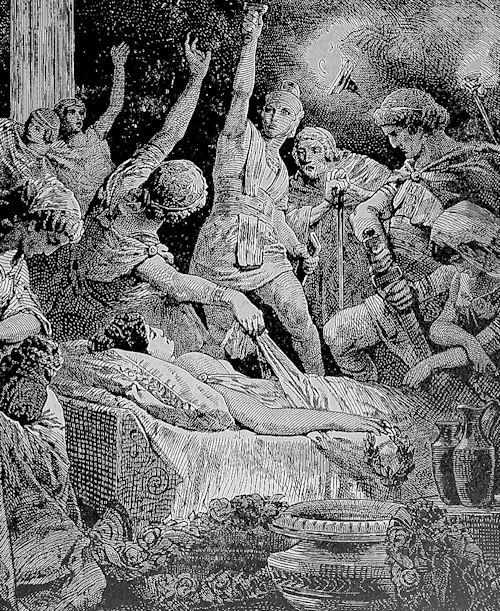
The Dead Virginia.
6. Then Appius Claudius gnawed his lip, and the blood left his cheek; And thrice he beckoned with his hand, and thrice he strove to speak; And thrice the tossing forum sent up a frightful yell— "See, see, thou dog! what thou hast done; and hide thy shame in hell, Thou that wouldst make our maidens slaves, must first make slaves of men. Tribunes!—Hurrah for tribunes! Down with the wicked Ten!" And straightway, thick as hailstones, came whizzing through the air Pebbles, and bricks, and potsherds, all round the curule chair; And upon Appius Claudius great fear and trembling came; For never was a Claudius yet brave against aught but shame. 7. So now 'twas seen of Appius. When stones began to fly, He shook, and crouched, and wrung his hands, and smote upon his thigh. "Kind clients, honest lictors, stand by me in this fray! Must I be torn to pieces? Home, home the nearest way." While yet he spake, and looked around with a bewildered stare, Four sturdy lictors put their necks beneath the curule chair; And fourscore clients on the left, and fourscore on the right, Arrayed themselves with swords and staves, and loins girt up for fight. 8. But, though without or staff or sword, so furious was the throng, That scarce the train, with might and main, could bring their lord along. Twelve times the crowd made at him; five times they seized his gown; Small chance was his to rise again, if once they got him down: And sharper came the pelting; and evermore the yell— "Tribunes! we will have tribunes!" rose with a louder swell: And the chair tossed as tosses a bark with tattered sail, When raves the Adriatic beneath an eastern gale, When the Calabrian sea-marks are lost in clouds of spume, And the great Thunder-Cape has donned his veil of inky gloom. One stone hit Appius in the mouth, and one beneath the ear; And ere he reached Mount Palatine, he swooned with pain and fear. His cursed head, that he was wont to hold so high with pride, Now, like a drunken man's, hung down, and swayed from side to side; And when his stout retainers had brought him to his door, His neck and face were all one cake of filth and clotted gore.
Macaulay.