Book 4 — XLII.—KING RICHARD CŒUR DE LION IN THE HOLY LAND.
Reading edition
1. At the end of August, 1191, Richard led his crusading troops from Acre into the midst of the wilderness of Mount Carmel, where their sufferings were terrible; the rocky, sandy, and uneven ground was covered with bushes full of long, sharp prickles, and swarms of noxious insects buzzed in the air, fevering the Europeans with their stings; and in addition to these natural obstacles, multitudes of Arab horsemen harrassed them on every side, slaughtering every straggler who dropped behind from fatigue, and attacking them so unceasingly that it was remarked, that throughout their day's track there was not one space of four feet without an arrow sticking in the ground. Richard fought indefatigably, always in the van, and ready to reward the gallant exploits of his knights. A young knight who bore a white shield, in hopes of gaining some honorable bearing, so distinguished himself that Richard thus greeted him at the close of the day: "Maiden knight, you have borne yourself as a lion, and done the deed of six crusaders."
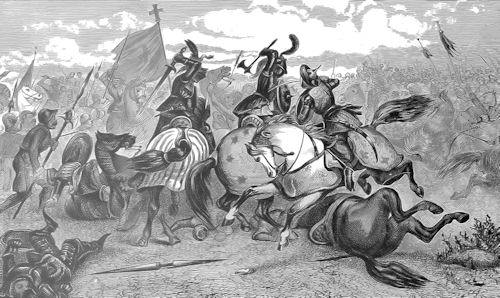
Battle of Arsaaf.
2. At Arsaaf, on the 7th of September, a great battle was fought. Saladin and his brother had almost defeated the two religious orders (the Templars and the Hospitallers), and the gallant French knight Jacques d'Avesne, after losing his leg by a stroke from a cimeter, fought bravely on, calling on the English king until he fell overpowered by numbers. Cœur de Lion and Guillaume des Barres retrieved the day, hewed down the enemy on all sides, and remained masters of the field. It is even said that Richard and Saladin met hand to hand, but this is uncertain. This victory opened the way to Joppa, where the crusaders spent the next month in the repair of the fortifications, while the Saracen forces lay at Ascalon.
3. While here, Richard often amused himself with hawking, and one day was asleep under a tree when he was aroused by the approach of a party of Saracens, and springing on his horse Frannelle, which had been taken at Cyprus, he rashly pursued them and fell into an ambush. Four knights were slain, and he would have been seized had not a Gascon knight named Guillaume des Parcelets called out that he himself was the Malak Rik (great king), and allowed himself to be taken. Richard offered ten noble Saracens in exchange for this generous knight, whom Saladin restored together with a valuable horse that had been captured at the same time. A present of another Arab steed accompanied them; but Richard's half-brother, William Longsword, insisted on trying the animal before the king should mount it. No sooner was he on its back, than it dashed at once across the country, and before he could stop it he found himself in the midst of the enemy's camp. The two Saracen princes were extremely shocked and distressed lest this should be supposed a trick, and instantly escorted Longsword back with a gift of three chargers, which proved to be more manageable.
4. From Joppa the crusaders marched to Ramla, and thence, on New Year's Day, 1192, set out for Jerusalem through a country full of greater obstacles than they had yet encountered. They were too full of spirit to be discouraged until they came to Bethany, where the two Grand Masters represented to Richard the imprudence of laying siege to such fortifications as those of Jerusalem at such a season of the year, while Ascalon was ready in his rear for a post whence the enemy would attack him.
5. He yielded, and retreated to Ascalon, which Saladin had ruined and abandoned, and began eagerly to repair the fortifications so as to be able to leave a garrison there. The soldiers grumbled, saying they had not come to Palestine to build Ascalon, but to conquer Jerusalem; whereupon Richard set the example of himself carrying stones, and called on Leopold, the Duke of Austria, to do the same. The sulky reply, "He was not the son of a mason," so irritated Richard, that he struck him a blow; Leopold straightway quitted the army, and returned to Austria.
6. It was not without great grief and many struggles that Cœur de Lion finally gave up his hopes of taking Jerusalem. He again advanced as far as Bethany; but a quarrel with Hugh of Burgundy, and the defection of the Austrians made it impossible for him to proceed, and he turned back to Ramla. While riding out with a party of knights, one of them called out, "This way, my lord, and you will see Jerusalem." "Alas!" said Richard, hiding his face with his mantle, "those who are not worthy to win the Holy City are not worthy to behold it." He returned to Acre; but there hearing that Saladin was besieging Joppa, he embarked his troops and sailed to its aid.
7. The crescent (the standard of the Saracens) shone on its walls as he entered the harbor; but while he looked on in dismay, he was hailed by a priest who had leaped into the sea and swum out to inform him that there was yet time to rescue the garrison, though the town was in the hands of the enemy. He hurried his vessel forward, leaped into the water breast-high, dashed upward on the shore, ordered his immediate followers to raise a bulwark of casks and beams to protect the landing of the rest, and rushing up a flight of steps, entered the city alone. "St. George! St. George!" That cry dismayed the infidels, and those in the town to the number of three thousand fled in the utmost confusion, and were pursued for two miles by three knights who had been fortunate enough to find him.
8. Richard pitched his tent outside the walls, and remained there with so few troops that all were contained in ten tents. Very early one morning, before the king was out of bed, a man rushed into his tent, crying out: "O king! we are all dead men!" Springing up, Richard fiercely silenced him: "Peace! or thou diest by my hand!" Then, while hastily donning his suit of mail, he heard that the glitter of arms had been seen in the distance, and in another moment the enemy were upon them, seven thousand in number. Richard had neither helmet nor shield, and only seventeen of his knights had horses; but undaunted he drew up his little force in a compact body, the knights kneeling on one knee covered by their shields, their lances pointing outward, and between each pair an archer with an assistant to load his cross-bow; and he stood in the midst encouraging them with his voice, and threatening to cut off the head of the first who turned to fly. In vain did the Saracens charge that mass of brave men, not one seventh of their number; the shields and lances were impenetrable; and without one forward step or one bolt from the cross-bows, their passive steadiness turned back wave after wave of the enemy.
9. At last the king gave the word for the cross-bowmen to advance, while he, with the seventeen mounted knights charged, lance in rest. His curtal axe bore down all before it, and he dashed like lightning from one part of the plain to another, with not a moment to smile at the opportune gift from the polite Malek-el-Afdal, who, in the hottest of the fight, sent him two fine horses, desiring him to use them in escaping from this dreadful peril. Little did the Saracen princes imagine that they would find him victorious, and that they would mount two more pursuers!
10. Next came a terrified fugitive with news that three thousand Saracens had entered Joppa! Richard summoned a few knights, and without a word to the rest galloped back into the city. The panic inspired by his presence instantly cleared the streets, and riding back, he again led his troops to the charge; but such were the swarms of Saracens, that it was not till evening that the Christians could give themselves a moment's rest, or look round and feel that they had gained one of the most wonderful of victories. Since daybreak Richard had not laid aside his sword or axe, and his hand was all over blistered. No wonder that the terror of his name endured for centuries in Palestine, and that the Arab chided his starting horse with, "Dost think that yonder is the Malek Rik?" while the mother stilled her crying child by threats that the Malek Rik should take it.
11. These violent exertions seriously injured Richard's health, and a low fever placed him in great danger, as well as several of his best knights. No command or persuasion could induce the rest to commence any enterprise without him, and the tidings from Europe induced him to conclude a peace and return home. Malek-el-Afdal came to visit him, and a truce was signed for three years, three months, three weeks, three days, three hours, and three minutes, thus so quaintly arranged in accordance with some astrological views of the Saracens. Ascalon was to be demolished on condition that free access to Jerusalem was to be allowed to the pilgrims; but Saladin would not restore the piece of the True Cross, as he was resolved not to conduce to what he considered idolatry.
12. Richard sent notice that he was coming back with double his present force to effect the conquest, and the Sultan answered, that if the Holy City was to pass into Frank hands, none could be nobler than those of the Malek Rik. Fever and debility detained Richard a month longer at Joppa, during which time he sent the Bishop of Salisbury to carry his offerings to Jerusalem. The prelate was invited to the presence of Saladin, who spoke in high terms of Richard's courage, but censured his rash exposure of his own life. On October 9, 1193, Cœur de Lion took leave of Palestine, watching with tears its receding shores, as he exclaimed, "O, Holy Land, I commend thee and thy people unto God. May He grant me yet to return to aid thee!"
Charlotte M. Yonge.