Book 4 — XXIII.—THE MACEDONIAN EMPIRE.
Reading edition
1. After the battle of Platæa, in which the army of the Persian king Xerxes was defeated and destroyed, the Greek states became the dominant power in the civilized world, and the Greek cities became centers of influence and art. Under Pericles, the successor of Themistocles, Athens, in richness and beauty of her palaces and temples, arrived at a point of excellence which far surpassed anything the world had before seen. But jealousies between different states led to civil wars that desolated the whole land, and in the next one hundred and fifty years scarcely any progress was made in adding to the national strength. While these bloody wars were going on principally between Sparta and Athens, the tribes of Macedon, a region lying immediately north of Greece, were rapidly becoming civilized and consolidated. In 359 B. C. Philip became the reigning monarch.
2. He was very desirous of being considered as a Greek, invited distinguished men to his court, and ordered public rejoicings in his kingdom when his chariots had won the prize at the Olympic games. He was very clever, and cared little about the justice and honor of the means by which he attained his ends, which were, to hold in subjection all the rest of Greece, and to conquer Persia. In the first design he succeeded, for the latter he only prepared the way for his son. He had both to form his officers and his army. The first he attempted by bringing the young nobles to his court, and there instructing them; and in the last he succeeded in a remarkable manner.
3. The chief strength of the army, as he constituted it, was in the phalanx, a body of sixteen thousand foot soldiers, fully armed in the Greek fashion, with spears twenty-four feet long. When drawn up in order of battle, the four front ranks held their spears pointing outward, and stood at such a space apart, that the foremost line had four spear-points between each man and the enemy, or on occasion they marched with their shields touching, so as to form an almost impenetrable wall.
4. As soon as Philip's designs against Greece were apparent, a strong spirit of resistance showed itself, and chiefly at Athens, where the great orator, Demosthenes, never ceased to rouse his countrymen to maintain their freedom. Demosthenes had trained himself in eloquence under great difficulties; he naturally either stammered, or had an indistinct pronunciation—a defect which he cured by speaking with pebbles in his mouth, and he used to rehearse his speeches to the roaring sea, in order to nerve himself against the clamors of a tumultuous assembly. He so far succeeded, that he often swayed the minds of the Athenians; his name stands as the first of orators, and his Philippics, as his discourses against Philip are called, are considered as models of rhetoric.
5. At Cheronæa, in 338, a battle was fought by Philip against the allied forces of the Athenians and Thebans. At one time the Athenians gained some advantage, but they used it so ill, that Philip, calling out to his troops, "They do not know how to conquer," made a sudden charge, and routed them with great slaughter. The battle of Cheronæa was the end of the independence of Greece, which from that time forward became subject to Macedon, in spite of its many struggles to shake off the yoke, and recover the liberty which had been lost for want of a firm, united, settled government.
6. The King of Macedon next commenced his arrangements for his other favorite scheme—the invasion of Asia; but in the year 336, in the midst of the feasts in honor of his daughter's marriage, he was murdered by a young Macedonian noble, who was slain in the first anger of the surrounding guards, without having time to disclose the motive of his crime.
7. Alexander, son of Philip and his Epirot queen Olympias, was twenty years of age when he came to the throne. On the night of his birth the temple of Diana, at Ephesus, was burned to the ground by a man named Erostratus, in the foolish desire of making himself notorious, and this Alexander liked to consider as an omen that he should himself kindle a flame in Asia.
8. He traced his descent from his father's side from Hercules, and by his mother's from Achilles, and throughout his boyhood he seems to have lived in a world of the old Greek poetry, sleeping with Homer's works under his pillow, and dreaming of deeds in which he should rival the fame of the victors of Troy. He was placed under the care of Aristotle, the great philosopher of Stagira, to whom, when Philip had written to announce Alexander's birth, he had said that he knew not whether most to rejoice at having a son, or that his son would have such a teacher as Aristotle.
9. From him the young Alexander learned to think deeply, to resolve firmly, and devise plans of government; by others he was instructed in all the graceful accomplishments of the Greeks, and under his father he was trained to act promptly. At fourteen he tamed the noble horse Bucephalus, which no one else dared to mount; two years later he rescued his father in a battle with the Scythians, and he commanded the cavalry at Cheronæa, but he was so young at the time of his accession, that the Greeks thought they had nothing to fear from him.
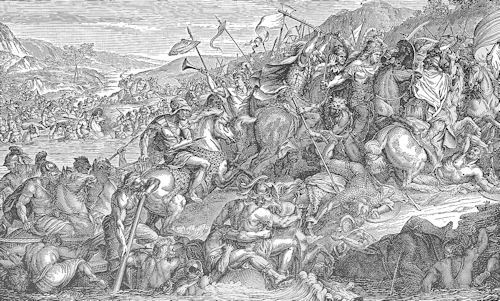
Battle on the Granicus.
10. There were very ungenerous rejoicings at Athens at the murder of Philip. Demosthenes, though he had just lost a daughter, crowned himself with a wreath of flowers, and came with great tokens of joy to announce it to the Athenians so soon after the event, as almost to excite a suspicion that he must have been concerned in the crime. But they found that their joy was unfounded, for no sooner did Thebes take up arms, than Alexander marched against it, destroyed the walls, killed many of the citizens, and blotted it out from the number of Greek cities. The other states did not dare to make any further opposition, and he was thus at leisure to prepare for the invasion of Persia.
11. Leaving Antipater as governor of Macedon, he set out in the spring of 334, at the head of thirty thousand infantry and four thousand five hundred cavalry, and bade farewell to his native land, which he was never to see again. He crossed the Hellespont, and was the first man to leap on Asiatic ground; then, while his forces were landing, he went to visit the spot which had so long been the object of his dreams—the village which marked the site of Troy. He offered a sacrifice at the tomb of Achilles, hung up his own shield in the temple, and took down one which was said to be a relic of the Greek conquerors, intending to have it always borne before him in battle.
12. His march was at first toward the east, along the shore of the Hellespont, until at the river Granicus he met the Persians drawn up on the other bank of the river, under the command of the satrap Memnon. Alexander himself, at the head of his cavalry, charged through the midst of the rapid stream, won the landing-place, and followed by the phalanx, quickly gained a complete victory.
13. All the neighboring country fell into his hands, and after taking possession of it, he changed his course, marching along the shores of the Ægean, and taking all the towns. It was his first object to cut the Persians off from their seaports, and thus deprive them of the use of their fleet, which was so superior to his own, that he never ventured on one sea-fight.
14. This march round the western and southern coasts of Asia Minor, together with an expedition into the interior, occupied a year, and in the early part of the summer, he arrived at Tarsus, in Cilicia. Here, on entering the city, overwhelmed with heat and fatigue, he bathed in the cold waters of the Cydnus, and the chill brought on a violent fever, which nearly cost him his life. A letter was sent to warn him that his physician, Philip, had been bribed by the Persian king to poison him. While he was reading it the physician himself brought him a draught of medicine; the king put the letter into his hand, took the cup and drank it off, even before Philip could profess his innocence. In three days' time he was again able to appear at the head of his troops, and not before he was needed, for the enemy's army was near at hand, under King Darius Codomanus himself.
15. The Persians advanced in great state. First came a number of persons bearing silver altars, on which burned the sacred fire; then followed the Magi, and three hundred and sixty-five youths robed in scarlet, in honor of the days of the year. Next came the chariot and horses of the Sun, with their attendants, and afterward the army itself, the Immortal Band, with gold-handled lances, white robes, and jeweled corslets, and a host of others of less note, all far more fit for show than for battle. Darius himself, arrayed in purple robes and glittering with jewels, was in the midst, in a chariot covered with gold ornaments, and with him came his mother, Sisygambis, his principal wife, his daughters, a number of other ladies, and a multitude of slaves. This unwieldy and useless host took up their position on the hilly ground above the city of Issus, where they were so entangled among the rocks, that their numbers were of little profit to them, and it was an easy victory for the Macedonians. No sooner did Darius see that the day was against him, than he turned his chariot and fled, leaving his family to fall into the hands of the conqueror, while he himself hastened to Babylon to collect another army.
16. Alexander treated the mother, wife, and children of Darius with great kindness and courtesy, sending an officer to assure them of his protection, and going the next morning to visit them, accompanied by his friend Hephæstion, a young man of his own age. Alexander, though of beautiful and noble countenance, and well formed for strength and activity, was rather short in stature, and as his dress was very simple, Sisygambis mistook Hephæstion for the King of Macedon, and threw herself on the ground before him; and she was greatly confused and distressed when she discovered her error; but Alexander said, as he raised her, "You were not deceived, for he is Alexander's other self." He gave her the name of mother, never sat down in her presence except at her request, and showed in every point a respect and courtesy such as she had probably never before received from the Asiatic princes, who always held women in contempt.
17. Pursuing his intention of first destroying the naval power of the Persian empire, Alexander next entered Phoenicia, and readily received the submission of Zidon, but Tyre refused to admit him within the walls. New Tyre, which was built after the seventy years' desolation which followed the conquest by Nebuchadnezzar, stood upon an island about half a mile from the shore, and was inhabited by a numerous and brave people, who thought themselves secure from an enemy who had no fleet to bring against them.
18. Alexander was, however, not to be daunted by any difficulty. He at first attempted to build a causeway from the shore to the island, and when the Tyrians destroyed his works he went to Zidon and there obtained a fleet, by means of which he at length took the city after a seven months' siege. He stained his victory by a cruel slaughter, and made slaves of all whose lives were spared, excepting a few whom the Zidonians contrived to conceal in their ships. This was the final fall of the great merchant city, so often predicted by Isaiah and Ezekiel.
19. He then marched through the rest of Palestine, intending to punish Jerusalem, which had stood loyal to Darius, and refused to send him supplies. The Jews, on his approach, prayed for guidance and protection, and it was revealed to Jaddua, the high-priest, that he should open the gates and go forth in his sacred robes to receive the Grecian conqueror. It was accordingly done; and Jaddua, in the vestments of Aaron, came forth at the head of the choir of priests in white garments as Alexander and the Greeks mounted the hill toward the city. No sooner did the king meet the procession than he bent down to the ground in adoration, and walked in the midst of the priests to the temple, where a sacrifice was offered; and he not only spared the Jews, but showed them much favor.
20. He told his generals that before he left Macedon he had seen in a dream a figure exactly resembling that of the high-priest, which had foretold all his conquests. And surely there is little reason to doubt that such a revelation might be made to a conqueror marked out as clearly by prophecy as Nebuchadnezzar or Cyrus, before he set out on the work appointed for him. Both his predecessors in conquest, as soon as they came in contact with the chosen people, were taught that they were the subjects of prophecy; and Alexander, in his turn, was shown by Jaddua the prediction of Daniel, which spoke of him as a he-goat (the actual ensign of Macedon), "Who came from the West, and smote the ram, and brake his two horns, and cast him down and trampled on him." "And the rough goat is the King of Grecia."
21. He then proceeded southward, besieged and took Gaza, after a brave resistance, which he cruelly requited, and entered Egypt, subduing it with little difficulty. On one of the peninsulas formed by the mouth of the Nile, he founded a city, called after his name Alexandria, which became the capital of Egypt under its Greek rulers, and one of the most famous cities in the world. He made an expedition to the temple of Jupiter Ammon, on an oasis in the Libyan desert, and consulted the oracle there, and then after appointing a Macedonian satrap in Egypt, retraced his steps toward the Holy Land, and marched toward Babylonia, where Darius was again collecting his forces to oppose him.
Charlotte M. Yonge.