Book 4 — XX.—GLAUCON.
Reading edition
1. When Glaucon, the son of Ariston, attempted to harangue the people, from a desire, though he was not yet twenty years of age, to have a share in the government of the state, no one of his relatives, or other friends, could prevent him from getting himself dragged down from the tribunal and making himself ridiculous; but Socrates, who had a friendly feeling toward him on account of Charmides, the son of Glaucon, as well as on account of Plato, succeeded in prevailing on him, by his sole dissuasion, to relinquish his purpose.
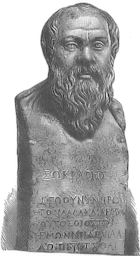
Socrates.
2. Meeting him by chance, he first stopped him by addressing him as follows, that he might be willing to listen to him: "Glaucon," said he, "have you formed an intention to govern the state for us?" "I have, Socrates," replied Glaucon. "By Jupiter," rejoined Socrates, "it is an honorable office, if any other among men be so; for it is certain that, if you attain your object, you will be able yourself to secure whatever you may desire, and will be in a condition to benefit your friends; you will raise your father's house, and increase the power of your country; you will be celebrated first of all in your own city, and afterward throughout Greece, and perhaps, also, like Themistocles, among the barbarians, and, wherever you may be, you will be an object of general admiration." Glaucon, hearing this, was highly elated, and cheerfully stayed to listen. Socrates next proceeded to say: "But it is plain, Glaucon, that if you wish to be honored, you must benefit the state." "Certainly," answered Glaucon. "Then, in the name of the gods," said Socrates, "do not hide from us how you intend to act, but inform us with what proceeding you will begin to benefit the state." But as Glaucon was silent, as if just considering how he should begin, Socrates said: "As, if you wished to aggrandize the family of a friend, you would endeavor to make it richer, tell me whether you will in like manner also endeavor to make the state richer?" "Assuredly," said he. "Would it then be richer, if its revenues were increased?" "That is at least probable," said Glaucon. "Tell me then," proceeded Socrates, "from what the revenues of the state arise, and what is their amount; for you have doubtless considered, in order that if any of them fall short, you may make up the deficiency, and that if any of them fail, you may procure fresh supplies." "These matters, by Jupiter," replied Glaucon, "I have not considered."
3. "Well, then," said Socrates, "if you have omitted to consider this point, tell me at least the annual expenditure of the state; for you undoubtedly mean to retrench whatever is superfluous in it." "Indeed," replied Glaucon, "I have not yet had time to turn my attention to that subject." "We will therefore," said Socrates, "put off making our state richer for the present; for how is it possible for him who is ignorant of its expenditure and its income to manage those matters?"
4. "But Socrates," observed Glaucon, "it is possible to enrich the state at the expense of our enemies." "Extremely possible, indeed," replied Socrates, "if we be stronger than they; but if we be weaker, we may lose all that we have." "What you say is true," said Glaucon.
5. "Accordingly," said Socrates, "he who deliberates with whom he shall go to war, ought to know the force both of his own country and of the enemy, so that, if that of his own country be superior to that of the enemy, he may advise it to enter upon the war, but if inferior, may persuade it to be cautious of doing so." "You say rightly," said Glaucon.
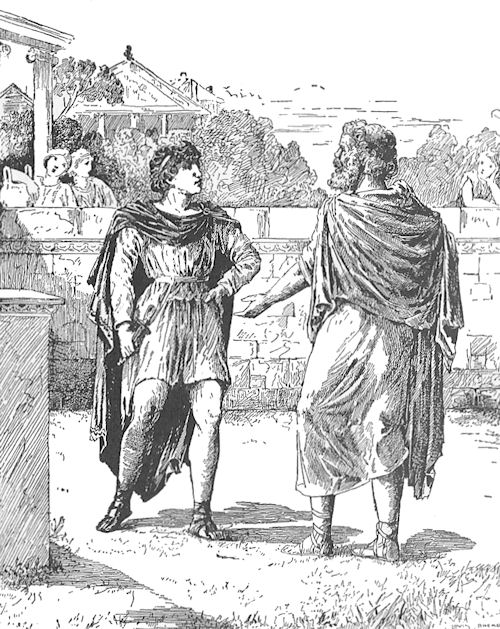
Socrates and Glaucon.
6. "In the first place, then," proceeded Socrates, "tell us the strength of the country by land and sea, and next that of the enemy." "But, by Jupiter," exclaimed Glaucon, "I should not be able to tell you on the moment, and at a word." "Well, then, if you have it written down," said Socrates, "bring it, for I should be extremely glad to hear what it is." "But, to say the truth," replied Glaucon, "I have not yet written it down."
7. "We will therefore put off considering about war for the present," said Socrates, "for it is very likely that on account of the magnitude of these subjects, and as you are just commencing your administration, you have not yet examined into them. But to the defense of the country, I am quite sure that you have directed your attention, and that you know how many garrisons are in advantageous positions, and how many not so, what number of men would be sufficient to maintain them, and what number would be insufficient, and that you will advise your countrymen to make the garrisons in advantageous positions stronger, and to remove the useless ones."
8. "By Jove," replied Glaucon, "I shall recommend them to remove them all, as they keep guard so negligently, that the property is secretly carried off out of the country." "Yet, if we remove the garrisons," said Socrates, "do you not think that liberty will be given to anybody that pleases to pillage? But," added he, "have you gone personally and examined as to this fact, or how do you know that the garrisons conduct themselves with such negligence?" "I form my conjectures," said he. "Well, then," inquired Socrates, "shall we settle about these matters also, when we no longer rest upon conjecture, but have obtained certain knowledge?" "Perhaps that," said Glaucon, "will be the better course."
9. "To the silver-mines, however," continued Socrates, "I know that you have not gone, so as to have the means of telling us why a smaller revenue is derived from them than came in some time ago." "I have not gone thither," said he. "Indeed, the place," said Socrates, "is said to be unhealthy, so that when it is necessary to bring it under consideration, this will be a sufficient excuse for you." "You jest with me," said Glaucon. "I am sure, however," proceeded Socrates, "that you have not neglected to consider, but have calculated, how long the corn which is produced in the country, will suffice to maintain the city, and how much it requires for the year, in order that the city may not suffer from scarcity unknown to you, but that, from your own knowledge, you may be able, by giving your advice concerning the necessaries of life, to support the city and preserve it." "You propose a vast field for me," observed Glaucon, "if it will be necessary for me to attend to such subjects."
10. "Nevertheless," proceeded Socrates, "a man can not order his house properly, unless he ascertains all that it requires, and takes care to supply it with everything necessary; but since the city consists of more than ten thousand houses, and since it is difficult to provide for so many at once, how is it that you have not tried to aid one first of all, suppose that of your uncle, for it stands in need of help? If you be able to assist that one, you may proceed to assist more; but if you be unable to benefit one, how will you be able to benefit many? Just as it is plain that, if a man can not carry the weight of a talent, he need not attempt to carry a greater weight?"
11. "But I would improve my uncle's house," said Glaucon, "if he would but be persuaded by me." "And then," resumed Socrates, "when you can not persuade your uncle, do you expect to make all the Athenians, together with your uncle, yield to your arguments?
12. "Take care, Glaucon, lest, while you are eager to acquire glory, you meet with the reverse of it. Do you not see how dangerous it is for a person to speak of, or undertake, what he does not understand? Contemplate, among other men, such as you know to be characters that plainly talk of, and attempt to do, what they do not know, and consider whether they appear to you, by such conduct, to obtain more applause or censure, whether they seem to be more admired or despised?
13. "Contemplate, again, those who have some understanding of what they say and do, and you will find, I think, in all transactions, that such as are praised and admired are of the number of those who have most knowledge, and that those who incur censure and neglect are among those that have least.
14. "If, therefore, you desire to gain esteem and reputation in your country, endeavor to succeed in gaining a knowledge of what you wish to do; for if, when you excel others in this qualification, you proceed to manage the affairs of the state, I shall not wonder if you very easily obtain what you desire."
Xenophon.