Book 4 — XXIV.—ALEXANDER'S CONQUESTS.
Reading edition
1. Alexander crossed the Euphrates and Tigris without opposition, and the decisive battle did not take place till he reached the plain of Arbela, where the Persians were drawn up to receive him. The Macedonians wished to make a night attack, but Alexander would not permit it, saying that he disdained to steal a victory, and the combat took place the next day.
2. The present army of Persians was drawn from the more remote regions of Bactria and Parthia, where the men were more warlike, and they fought better than any whom the Macedonians had before encountered; but Darius himself fled early in the day, leaving behind him his bow and shield; his men lost courage, and followed him, and Alexander was left master of the field of Arbela.
3. This battle placed in his power all the western part of the Persian empire, and he had only to march to the great cities of Babylon, Susa, Ecbatana, and Persepolis, to take possession of the huge stores of treasures there heaped up by the Persian kings, which he now distributed among his followers with royal bounty. The unfortunate Darius escaped into Bactria, where two satraps, in whom he had confided, treacherously seized him and made him prisoner, carrying him along with them as they fled before Alexander, until at length, being closely pressed by the Greeks, they threw their darts at him, and left him lying on the ground mortally wounded.
4. He was still alive when some of the Greeks came up, but died before the arrival of Alexander. The conqueror wept as he beheld the corpse of the last of a line of such great princes; he threw his own cloak over it, and sent it to Babylon, where it was buried with great magnificence.
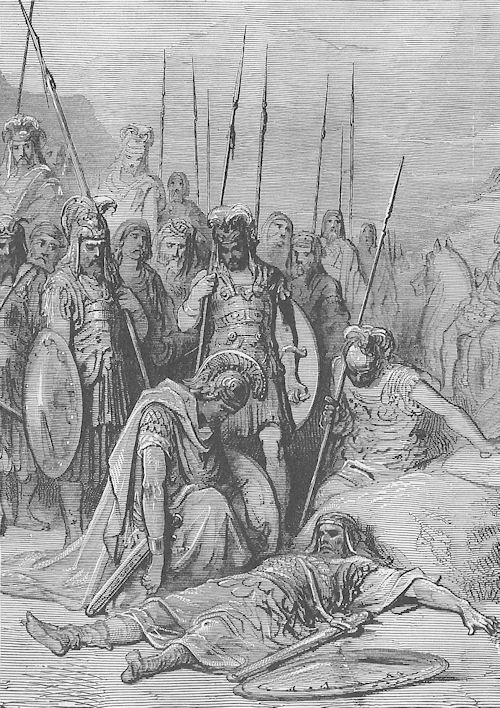
Alexander at the Dead Body of Darius.
5. The wife of Darius had died a prisoner, but Sisygambis still remained with her grandchildren at Babylon. Only once does Alexander seem to have hurt her feelings, and this was through ignorance of Persian customs. He showed her some robes of his sister's own weaving and embroidery, and offered to have her grand-daughters instructed in the same art, at which she wept, since Persian ladies deemed such employments work fit only for slaves and captives, and Alexander was obliged to explain how honorably the loom and needle were esteemed by his own countrywomen.
6. Alexander was much attached to his own mother, Olympias, and portions of his letters to her have come down to our time. She was a proud and violent woman, who often interfered with Antipater, governor of Macedon, and caused him to send many complaints to the king: "Ah!" said Alexander, "Antipater does not know that one tear of a mother will blot out ten thousand of his letters."
7. Alexander had indeed an open and affectionate heart, but he was fast becoming too much uplifted by his successes. On Darius's death, he took the state as well as the title of a king of Persia, wore the tiara and robes, and claimed from the Macedonians the same servile tokens of homage as were paid by the eastern nations, thus causing perpetual heart-burnings among them, since they could neither endure to see their king exalted so much further above them, nor to be placed on the same level with the barbarians whom they despised.
8. Their jealousies troubled Alexander from the time he assumed the tiara of Persia. He found it impossible to raise the condition of the Persians, and treat them with favor, without offending the Macedonians, and his temper did not always endure these provocations. The worst action of his life was the sentencing to death, on a false accusation, the wise old General Parmenio, and his son; and in a fit of passion at a riotous banquet, he slew, with his own hand, his friend Clitus, his nurse's son, who had saved his life at the battle of Granicus. It was the deed of a moment of drunken violence, and he bitterly lamented it, shutting himself up for several days without allowing any one to approach him, and paying all honors to the memory of his murdered friend.
9. His pride and vain-glory went so far, that he declared that the oracle of Jupiter Ammon had announced that he was the son of Jupiter, and sent to Greece to desire to be enrolled among the gods in his life-time. Some of the Greeks were shocked at his profanity, others laughed at him; but all the Spartans said was, "If Alexander will be a god, let him."
10. The next four years were the most laborious of Alexander's life. He pursued the murderers of Darius into Bactria and Sogdiana, avenged his death, and reduced the numerous hill-forts as far as the frontier of Scythia. Fierce insurrections broke out among the wild tribes of Sogdiana, which it required all his activity and judgment to quell, and more than once provoked him into cruelty, though in general, conqueror as he was, he was no spoiler, but wherever he went founded cities, and tried to teach the Persians the civilized arts of Greece.
11. In 326 he set out for India, as the region was called round the river Indus. Here the inhabitants were warlike, and Porus, king of a portion of the country, made a brave resistance, but was at length defeated and taken prisoner. On being brought before Alexander he said he had nothing to ask, save to be treated as a king. "That I shall do for my own sake," said Alexander, and accordingly not only set him at liberty, but enlarged his territory.
12. All these Indian nations brought a tribute of elephants, which the Macedonians now for the first time learned to employ in war. Alexander wished to proceed into Hindostan, a country hitherto entirely unknown, but his soldiers grew so discontented at the prospect of being led so much farther from home, into the utmost parts of the earth, that he was obliged to give up his attempt, and very unwillingly turned back from the banks of the Sutlej.
13. While returning, he besieged a little town belonging to a tribe called the Malli, and believed to be the present city of Mooltan. He was the first to scale the wall, and after four others had mounted, the ladder broke, and he was left standing on the wall, a mark for the darts of the enemy. He instantly leaped down within the wall into the midst of the Malli, and there setting his back against a fig-tree, defended himself until a barbed arrow deeply pierced his breast, and, after trying to keep up a little longer, he sunk, fainting, on his shield. His four companions sprung down after him—two were slain, but the others held their shields over him till the rest of the army succeeded in breaking into the town and coming to the rescue.
14. His wound was severe and dangerous, but he at length recovered, sailed down to the mouth of the Indus, and sent a fleet to survey the Persian Gulf, while he himself marched along the shore. The country was bare and desert, and his army suffered dreadfully from heat, thirst, and hunger, while he readily shared all their privations. A little water was once brought him on a parching day, as a great prize, but since there was not enough for all, he poured it out on the sand, lest his faithful followers should feel themselves more thirsty when they saw him drink alone.
15. At last he safely arrived at Caramania, whence he returned to the more inhabited and wealthy parts of Persia, held his court with great magnificence at Susa, and then went to Babylon. Here embassies met him from every part of the known world, bringing gifts and homage, and above all, there arrived from the Greek states the much desired promise that he should be honored as a god. He was at the highest pitch of worldly greatness to which mortal man had yet attained, and his designs were reaching yet further; but his hour was come, and at Babylon, the home of pride, "the great horn" was to be broken.
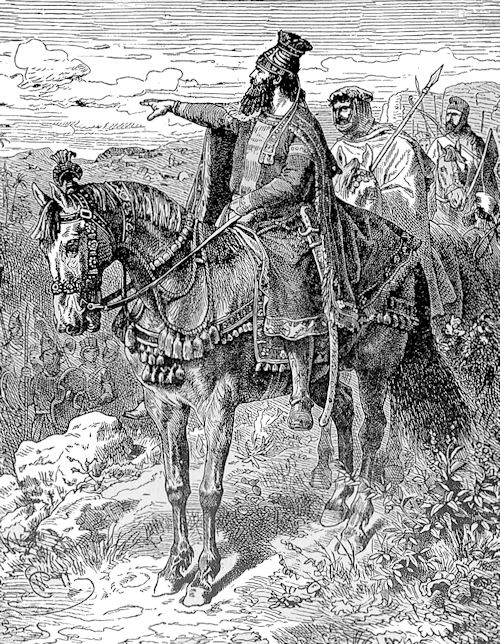
Alexander the Great.
16. In the marshes into which the Euphrates had spread since its channel was altered by Cyrus, there breathed a noxious air, and a few weeks after Alexander's arrival, he was attacked by a fever, perhaps increased by intemperance. He bore up against it as long as possible, continued to offer sacrifices daily, though with increasing difficulty, and summoned his officers to arrange plans for his intended expedition; but his strength failed him on the ninth day, and though he called them together as usual, he could not address them. Perhaps he thought in that hour of the prophecy he had seen at Jerusalem, that the empire he had toiled to raise should be divided, for he is reported to have said that there would be a mighty contest at his funeral games. He made no attempt to name a successor, but he took off his signet-ring, placed it on the finger of Perdiccas, one of his generals, and a short time after expired, in the thirty-third year of his age, and the twelfth of his reign.
17. There was a voice of wailing throughout the city that night. The Babylonians shut up their houses, and trembled at the neighborhood of the fierce Greek soldiery, now that their protector was dead; the Macedonians stood to arms all night, as if in presence of the enemy; and when in the morning the officers assembled in the palace council chamber, bitter and irrepressible was the burst of lamentation that broke out at the sight of the vacant throne, where lay the crown, scepter, and royal robes, and where Perdiccas now placed the signet-ring. More deeply than all mourned the prisoner, the aged Sisygambis, who covered her face with a black veil, sat down in a corner of her room, refused all entreaties to speak or to eat, and expired five days after Alexander.
18. Nor did the Persians soon cease to lament the conqueror, who had ruled them more beneficently than their own monarchs had done; their traditions made Alexander a prince of their own, and adorned him with every virtue valued in the East. That he had many great faults has already been shown, and, of course, by the rules of justice, his conquests were but reckless gratifications of his own ambition; but he was a high-minded, generous man, open of heart, free of hand, and for the most part acting up to his knowledge of right; and if unbridled power, talent of the highest order, and glory such as none before or since has ever attained, inflamed his passions, and elated him with pride, still it is not for us to judge severely of one who had such great temptations, and so little to guide him aright.
Charlotte M. Yonge.