XX.—THE MONASTIC ORDERS
Reading edition
Mrs. Jameson says: “There is a Latin distich which well expressed the different localities and sites affected by the chief Monastic Orders:
Bernardus valles, colles Benedictus, amabat, Oppida Franciscus, magnas Ignatius urbes; (Bernard loved valleys, Benedict the hills, Francis, towns; Ignatius, great cities);
and we shall find almost uniformly the chief foundations of the Benedictines on hills or mountains, those of the Cistercians in fertile valleys by running streams, those of the Franciscans in provincial towns, and those of the Jesuits in capital cities” (Legends of the Monastic Orders).
The Benedictines, founded by St. Benedict and distinguished by a habit entirely black. This order embraces the following branches of reformed Benedictines:
The Camaldolesi, founded by St. Romualdo; habit, black.
The Vallombrosans, founded by St. John Gualberto; habit, pale ash colour, or light grey.
The Carthusians, founded by St. Bruno; habit, white, sandalled feet, and shaven heads.
The Cistercians, white habit, a long loose robe with very wide sleeves, and a hood or cowl.
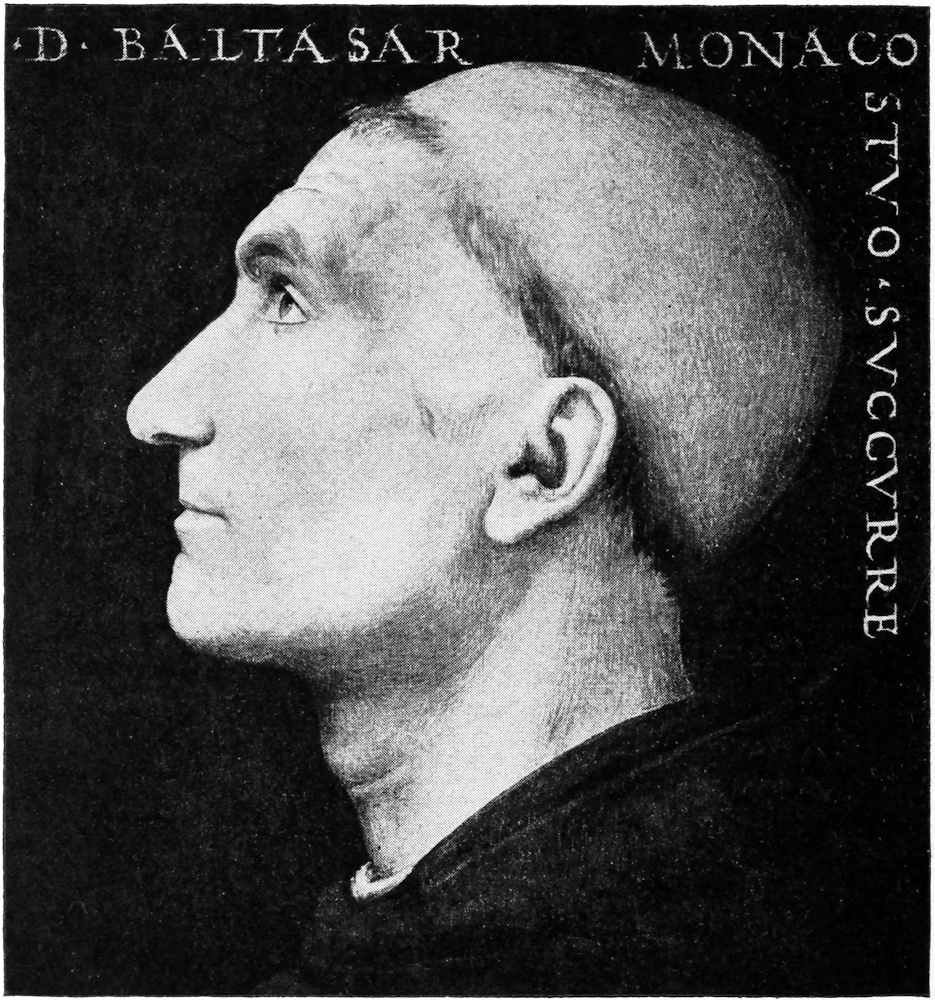
Photo. Alinari
A VALLOMBROSAN MONK.—PERUGINO
(Academy, Florence.)
The Olivetani, founded by St. Bernard dei Tolomei; habit, white.
The Oratorians, founded by St. Philip Neri; habit, black.
The word Abbey (Ital. Badia, Abbazia, Fr. Abbaye) belongs especially to the foundations of this order.
In pictures painted for the Benedictine Orders, the saints most frequently represented are St. Benedict and his sister St. Scholastica, and his disciples St. Maurus, St. Placidus, and St. Flavia, who all wear the black habit; except, when St. Benedict appears as patriarch of any of the Reformed orders which adopted the white habit, he then wears white. The black habit is also given to:
St. Boniface, the Apostle of Germany. St. Bennet, Bishop of Durham. St. Benedict of Anian. St. Bavon of Ghent. St. Ildefonso of Toledo. St. Giles of Languedoc. St. Dunstan of Canterbury. St. Walpurgis of Eichstadt.
St. Bernard is prominent in all the Cistercian abbeys and churches. St. John Gualberto figures principally in Florentine art, or pictures painted for the Vallombrosans.
The Augustines claim St. Augustine, one of the Four Latin Fathers, as their founder, and wear the black habit. This order embraces:
The Premonstratensians, founded by St. Norbert; habit, brown or black, with a white cloak.
The Servi, founded by St. Philip Benozzi; habit, black.
The Trinitarians,[11] founded by St. John de Matha; habit, white with a blue and red cross on the breast.
The Brigittines, founded by St. Bridget of Sweden; habit, black.
The Order of Mercy, founded by St. Peter Nolasco; habit, white, and the badge of the arms of the King of Aragon on the breast.
In the churches of the Augustines, one finds St. Augustine and his mother Monica; St. Joseph, the husband of the Virgin Mary, whom the Augustines reverence as their patriarch and patron saint; Joachim and Anna; the apostles and saints of the earliest ages, and the hermits St. Anthony and St. Paul; but next to St. Augustine their great saint is St. Nicholas of Tolentino.
The Mendicant Orders: the Franciscans, the Dominicans, the Carmelites. These monks were not called Padri, fathers, but Frati, brothers of men, and so great was the humility of St. Francis that he called his community Frati Minori, lesser brothers.
The Franciscan Order, founded by St. Francis of Assisi; the habit, originally grey, was changed after the first two centuries to a dark brown. The knotted cord around the waist was used symbolically by St. Francis to represent the halter or bridle of a subdued beast, or the body in subjection to the spirit. The reformed branches of the Franciscans are:
The Capuchins, habit dark brown with a long, pointed hood.
The Poor Clares, Franciscan nuns, founded by St. Clara; grey or brown habit and cord, and black veil.
The Observants, founded by St. Bernardino of Siena; grey habit and cord.
The Cordeliers, brown habit.
The Minimes, founded by St. Francis de Paula; brown habit, short scapulary with rounded ends, and the cord of St. Francis.
In pictures painted for any of the Franciscan churches or convents are found, singly or in groups, their eight great saints, called in Italian I Cardini dell’Ordine Serafico,” “The Chiefs of the Seraphic Order.”
St. Francis, Padre Serafico, patriarch and founder.
St. Clara, Madre Serafica.
St. Bonaventura, il Dottore Serafico, the great prelate of the order.
St. Anthony of Padua, second only to St. Francis as a worker of miracles.
St. Bernardino of Siena, their great reformer and preacher, and the three royal saints, St. Louis of France; St. Louis of Toulouse; and St. Elizabeth of Hungary (wearing her crown, and with her lap full of roses).
The Dominican Order: founded by St. Dominick; distinguished by a white habit under a long black cloak with a hood. The Dominicans are always shod. The Franciscans are generally barefoot or wear a wooden sandal.
The four celebrated saints who figure in Dominican pictures are:
St. Dominick, founder and patriarch.
St. Peter Martyr, distinguished by the wound in his head.
St. Thomas Aquinas, who represents the learning of the order.
St. Catherine of Siena, the great female saint of the Dominican Order.
The Carmelites claim the prophet Elijah as patriarch and founder, with the Virgin Mary as protectress. They were first formed into an order by St. Albert of Vercelli. The habit is a dark brown, with a long scapulary and a white mantle. The reformed branch, the Scalzi, or barefooted Carmelites, was founded by St. Theresa.
The Jeronymites claim St. Jerome as founder.
The Jesuits, founded by St. Ignatius Loyola; habit, a straight black cassock and square black cap.
The Order of the Visitation of St. Mary was founded by St. Francis de Sales and Ste. Jeanne Françoise de Chantal (grandmother of Madame de Sévigné).