XIV.—MARY MAGDALENE
Reading edition
St. Mary Magdalene. Lat. Sancta Maria Magdalena. Ital. Santa Maria Maddalena. Fr. La Madeleine.
It has always been a question in dispute among the theologians and expounders of the Gospels whether Mary Magdalene, “out of whom Jesus cast seven devils,” Mary of Bethany, and the “woman who was a sinner” are three distinct persons, or one and the same under different appellations. In Western art they are represented as identical.
The legends relate that Mary Magdalene was rich and of noble race, and lived with her sister and brother, Martha and Lazarus, in their castle Magdalon on the Sea of Galilee. Lazarus became a soldier, Martha was a model of virtue and propriety, but Mary abandoned herself to pleasure and became so dissolute that she was known as “The Sinner.” Her sister, grieving, frequently rebuked her, and finally persuaded her to listen to Jesus, and hearing him her heart was touched, and she became converted.
The legends follow closely the Gospel stories of the supper at the house of Simon the Pharisee, Christ’s entertainment at the house of Martha, Mary’s devotion to the Saviour, and those final scenes at His death and resurrection in which she takes so prominent a part. In all these she appears again and again in art.
According to an old Provençal legend, after the ascension of Christ, Lazarus and his sisters, with their handmaid Marcella, Maximin, who had baptised them, and the blind man Cedron, to whom Jesus had given sight, were put in a boat by the heathen—a boat that was without rudder or sails or oars,—and set adrift. The winds and waves carried them safely to Marseilles, where the people at first refused to give them food or shelter. But Mary began to tell them of Christ, and both sisters performed such marvellous miracles, that many became converted and were baptised. Lazarus, after the death of Maximin, was made the first Bishop of Marseilles.
Of the many miracles attributed to Mary Magdalene in the old legends, is that relating to a certain Provençal prince, who became partially converted by the preaching of Mary Magdalene, and wishing a proof, told her of his desire and his wife’s, to have a son, and asked if she could obtain this grace for them by prayers to her God. And Mary answered, “If thy prayer be granted, wilt thou believe?” The prince promised, but shortly after, still but half-convinced, he decided to visit St. Peter in Jerusalem and see if his preaching accorded with the words of Mary.
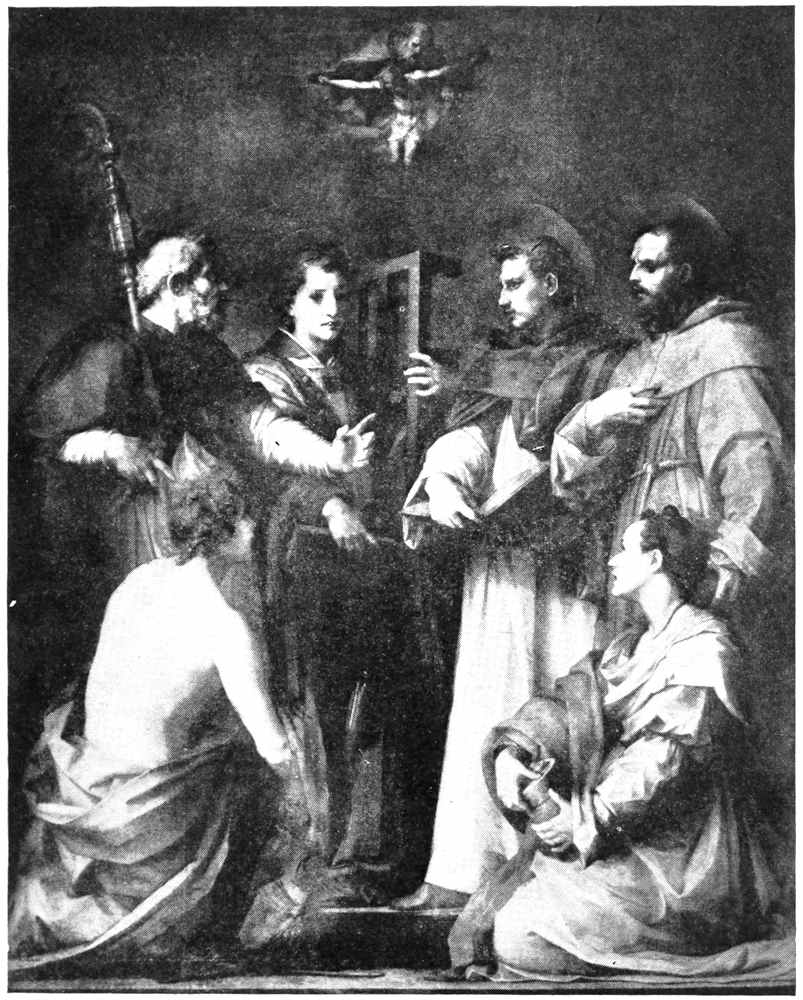
Photo. Alinari
LA DISPUTA DELLA TRINITÀ. ST. AUGUSTINE, ST. LAURENCE, ST. PETER MARTYR, ST. FRANCIS; ST. SEBASTIAN, AND MARY MAGDALENE, KNEELING.—ANDREA DEL SARTO
(Pitti Palace, Florence.)
So he and his wife departed in a vessel bound for Jerusalem. A fearful storm arose on the way, and his wife, who was with child, gave birth to a son, and then died. The sailors, in their superstition, wished to throw the dead body into the sea, believing the tempest would not cease as long as they had it on board, but the prince restrained them until they came to a barren, rocky island, where he laid his wife with the living child on her bosom, praying to Mary Magdalene to have pity on his grief and if her prayers availed, to save at least the life of his child.
When the prince and his attendants reached Jerusalem, he found St. Peter, who instructed him and showed him where Christ performed His miracles, so that he became an ardent believer in the faith of the Christians. After two years, he set sail again for his own country, and passing the island where he had left his wife he landed there to pray. What was his joy to find that not only the prayers of the Magdalene had kept his son alive, but as he approached the body of his dead wife, she awoke as from a deep sleep and was miraculously restored to him. Then they returned joyfully to Marseilles, and falling at the feet of Mary Magdalene blessed her, and became baptised.
After some years of active good works Mary retired to a barren wilderness not far from Marseilles, and here she lived in solitude for thirty years, fasting and doing penance and mourning for her past sins. If it had not been for angels, and the comfort bestowed upon her by celestial visions, she must have perished. A hermit who lived not far off in the desert once beheld angels bearing her in their arms towards heaven, and hurried to the city to tell of his vision. Some legends assert that St. Mary died in a church after receiving the sacrament from St. Maximin, but the more popular versions represent her as dying in her solitude, watched over to the last by angels.
Devotional pictures represent her as patron saint and as the penitent. The historical pictures are those scenes from the Gospel in which she is conspicuous, and the scenes from her legendary life. In all these subjects the accompanying attribute is the alabaster box of ointment which has a twofold meaning; it may be the precious ointment which she poured over the feet of Christ, or the balm and spices that were brought to anoint his body. Sometimes she carries it in her hand, or it stands at her feet or near her; frequently, in later pictures, it is borne by an attendant angel. It may be a small vase, or a casket; a cup with a cover, or a box; the form varying according to the artist’s fancy—but it is always there, the symbol of her conversion and her love, and so unmistakable that there can be no doubt of her identity.
In the ancient pictures she is usually represented in red, to express the fervour of her love. In modern pictures, and where she appears as the penitent, she wears blue or violet,—violet, the colour of mourning and penitence; blue, the colour of constancy. Where both love and sorrow are expressed, she wears a violet-coloured tunic and a red mantle. Her long, luxuriant hair is light or golden in colour.
As patron saint she became idealised into a noble, imposing woman, retaining no trace of sin or sorrow on her beautiful face. If it were not for the nimbus she might be mistaken for Pandora. As in scenes before her conversion, she is richly attired.
The Magdalene doing penance in the desert became a favourite subject with the artists in the sixteenth century. She was represented in two aspects; first as bemoaning her sins, where she appears lying prostrate upon the ground, or standing or kneeling at the entrance to her cave; her long yellow hair flows over her shoulders, her hands are clasped or raised towards heaven, and her eyes are streaming with tears. The crucifix, skull, and sometimes the scourge are seen symbolising faith, mortality, and penance. In the second she has made her atonement and is seen reading and meditating with a serene and uplifted countenance. Angels scatter flowers or present the palm; a book rests beside the skull, and the skies are bright with a vision of glory. In every instance the alabaster box appears.
The Noli me tangere is the subject of many pictures; the arrangement is arbitrary and fixed by tradition and only admits of the two figures of Christ and the Magdalene.
Before leaving the subject of those who were intimately connected with our Lord in His lifetime, a few words upon the Last Supper in art may perhaps find a fitting place here.