XVI.—THE FOUR LATIN FATHERS
Reading edition
“The Evangelists and Apostles represented in Art the Spiritual Church, and took their place among the heavenly influences. The great Fathers or Doctors were the representatives of the Church Militant on earth: as teachers and pastors, as logicians and advocates, they wrote, argued, contended, suffered, and at length, after a long and fierce struggle against opposing doctrines, they fixed the articles of faith thereafter received in Christendom. For ages, and down to the present time, the prevailing creed has been that which was founded on the interpretations of these venerable personages. They have become, in consequence, frequent and important subjects of Art, particularly from the tenth century—the period when, in their personal character, they began to be regarded not merely as gifted and venerable, but as divinely inspired; their writings appealed to as infallible, their arguments accepted as demonstration” (Jameson’s Sacred and Legendary Art).
St. Jerome. Lat. Sanctus Hieronymus. Ital. San Geronimo, or Girolamo. Fr. St. Jérome, Hiérome, or Géroisme. Ger. Der Heilige Hieronimus.
As a subject of painting, St. Jerome is by far the most popular of the four Latin doctors, not only because of the interesting character of the man and the varied and picturesque incidents of his life, but also as founder of Monachism in the West and as the translator of the Old and New Testaments into Latin.
St. Jerome was born in 342 in Dalmatia, and was the son of a nobleman named Eusebius. While still very young he was sent to Rome to complete his studies. He became a finished scholar and was particularly fond of the classics. There for a time he abandoned himself to a life of pleasure, but his nature was so strong, and his love of learning so great, that he soon tired of dissipation and taking up the study of law he became famous for his eloquence.
When over thirty he travelled into Gaul and visited the schools of learning there. About this time he was baptised and took the vows of celibacy.
In the year 373 he travelled to the East to visit the scenes of the life of Christ. Here he encountered hermits and ascetics, and becoming enamoured of the idea of a life of solitude, he retired to a desert and there spent four years in study and seclusion, leading a life of penance and self-denial. As further penance he studied Hebrew, which he detested, and made his great translation of the Bible into Latin, which has ever since been celebrated as the “Vulgate.”
After ten years in the East he returned to Rome, his fiery enthusiasm still unsubdued by the years of solitude and penance. He preached the doctrine of denial and abstinence, boldly attacking the self-indulgence of the clergy. His influence was enormous, and particularly so over the Roman women. His most celebrated convert was Paula, a noble Roman matron, descended from the Scipios and the Gracchi. Marcella was another, who founded a religious community and has been called the first nun.
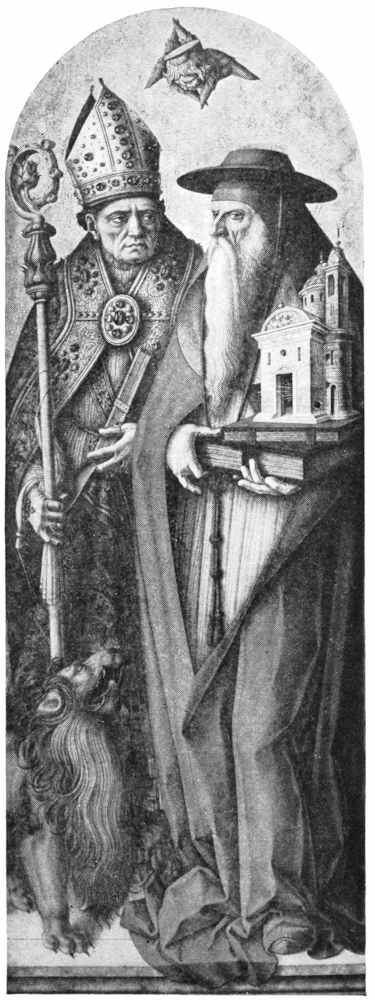
Photo. Alinari
ST. AUGUSTINE AND ST. JEROME—CRIVELLI
(Academy, Venice.)
After three years in Rome he returned to Palestine and lived and died in a monastery he had founded at Bethlehem. Feeling the approach of death, he caused himself to be carried to the chapel, received the sacrament for the last time from the priest, and then expired, dying in 420 A. D.
In the legends of St. Jerome, as he sat within the gates of the monastery at Bethlehem, a lion entered, limping. The brothers fled in terror; but St. Jerome met him as if he were a guest. The lion lifted to him his paw and St. Jerome, taking it, found a thorn, which he extracted, and the grateful lion stayed with him ever after. The saint employed him to guard an ass, who brought them firewood from the forest. One day some merchants stole the ass from the pasture while the lion slept, and the latter, after looking for him in vain returned to his master much cast down and ashamed. Jerome, believing he had eaten the ass, compelled the lion to carry the wood. One day, having finished his task, the lion, who was always seeking his companion, saw a caravan of merchants passing by, with a string of camels led on a cord by an ass: recognising his old friend, he drove all the camels into the convent, so terrifying the merchants that they came to St. Jerome and confessed the theft, and were pardoned.
The lion in pictures of St. Jerome is supposed to refer to this legend, but in reality, from earliest times, the lion was given to the saint as a symbol of his fiery nature, and to typify his life in the wilderness. And in later times the legend was invented to explain the symbol.
Devotional pictures represent him in one of his three great characters,—first as patron saint and Doctor of the Church. He usually stands full length, dressed in cardinal’s robes or with a cardinal’s hat at his feet (although there is no historical authority for making him cardinal, as cardinal-priests were not ordained until three centuries later). When his head is uncovered, his forehead is very high and bald, his beard long, reaching almost to his waist, his features fine and sharp, and his nose aquiline. In his hand he holds a book or scroll, frequently the emblematical church.
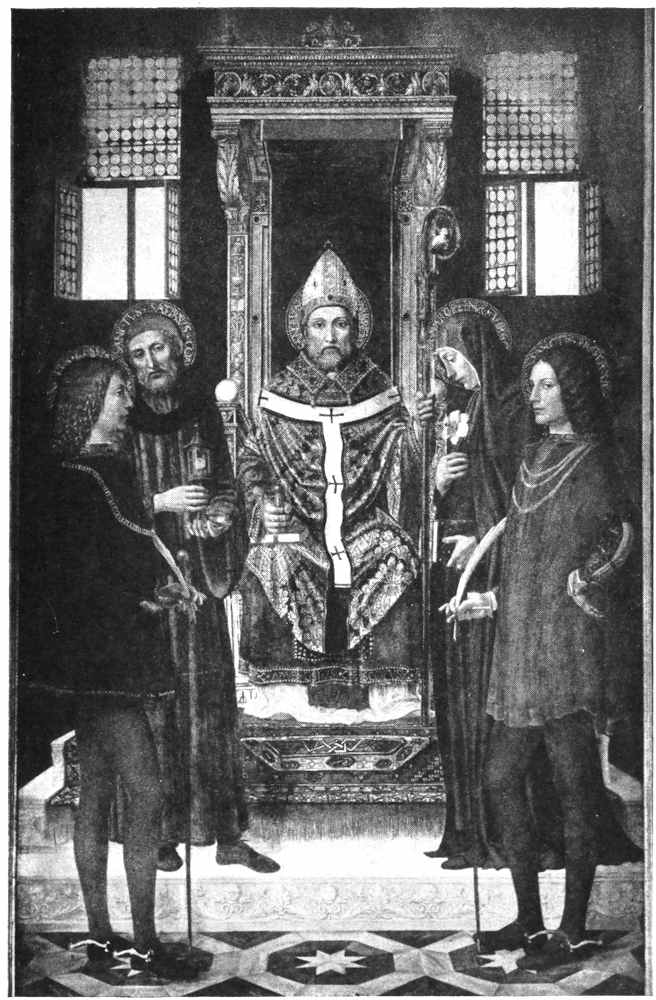
Photo. Alinari
ST. AMBROSE.—BERGOGNONE
(Certosa, Pavia.)
In his second character of translator of the Scriptures, he is usually seated in a cave, or cell. He has a loose robe over his wasted form and his eyes are bent on his book or writing, or he glances up as if seeking heavenly inspiration. An angel is sometimes dictating to him.
The penitent St. Jerome is the recognised symbol in the Christian Church of penitence, self-denial, and humiliation. The scene is usually a rocky solitude, St. Jerome, half-naked and almost a skeleton, with unkempt hair and beard, is kneeling before a crucifix, beating his breast with a stone. The lion is nearly always introduced, sometimes crouching at his feet.
St. Ambrose. Lat. S. Ambrosius. Ital. Sant’ Ambrogio. Fr. St. Ambroise. Ger. Der Heilige Ambrosius.
Ambrose was the son of a prefect of Gaul, and was born at Trèves in the year 340. The story that when still an infant a swarm of bees alighted on his mouth without injuring him is related by all his chroniclers. This was interpreted as a sign of future eloquence,[8] and for this reason the beehive becomes the symbol of St. Ambrose. The same story was related of Plato and Archilochus, and with the same interpretation.
Ambrose studied at Rome, and after that was made prefect of Æmilia and Liguria (Piedmont and Genoa), and dwelt at Milan. About this time the Bishop of Milan died and a fierce dispute arose between the Catholics and Arians as to who should succeed him. Ambrose appeared, as prefect, to quell the disorder. He spoke so wisely, with an eloquence so persuasive, that the tumult ceased, and suddenly out of the hush that followed his speech a voice like a child’s was heard, saying, “Ambrose shall be bishop!” The multitude took up the cry with enthusiasm. In vain Ambrose pleaded that he was only a catechumen. The wishes of the people, confirmed by the approbation of the emperor, finally prevailed.
Ambrose was baptised, and in eight days he was consecrated Bishop of Milan. He gave all his worldly goods to the poor, studied the Scriptures earnestly, introduced from the East the manner of chanting the service since called the Ambrosian Chant, and it was he who invested the services of the Church with that magnificence and grandeur of form that has ever since made its ceremonies so imposing.
St. Ambrose advocated celibacy in both sexes, and held that ecclesiastical power was above that of sovereign or civil power. The most celebrated example of this was his humiliation of the Emperor Theodosius. The latter, angered by a sedition in Thessalonica, had ordered a general massacre. For this murderous act, by which seven thousand lives were sacrificed, Ambrose forbade him to enter the church. At length, after eight months of interdict, during which the emperor had stormed and pleaded, Ambrose relented, upon the emperor’s performing public penance for his sin. The emperor, completely cowed, submitted, and clad in sackcloth, with dust and ashes upon his head, prostrated himself before the altar of Christ.
There are many legends of this saint. At the consecration of the Cathedral at Milan, the relics of St. Gervasius and St. Protasius were miraculously revealed to him in a dream. The remains were disinterred, conveyed in solemn procession to the cathedral, and deposited beneath the high altar.
He performed many cures and had many visions, and died at Milan in the year 397.
St. Ambrose is usually represented in bishop’s robes, with mitre and crozier; the beehive is sometimes placed at his feet, but his more frequent attribute is a knotted scourge with three thongs, the scourge symbolising the castigation of sin. In the hand of St. Ambrose it may also signify the penance inflicted on the Emperor Theodosius, or the expulsion of the Arians from Italy and the triumph of the Trinitarians. It has this meaning when the scourge has three knots or three thongs. When St. Ambrose holds two human bones in his hand, this attribute alludes to the discovery of the relics of St. Gervasius and St. Protasius. Devotional pictures of him alone are rare.
St. Augustine. St. Austin. Lat. Sanctus Augustinus. Ital. Sant’ Agostino. Fr. St. Augustin.
St. Augustine, the third of the Doctors of the Church, was born at Tagaste, in Numidia, in 354. His father was a heathen; his mother, Monica, a Christian. With splendid talents, his youth was passed in every form of vice and dissipation, to the great sorrow of his mother, who never ceased praying for his conversion. She related her grief to the Bishop of Carthage, who after listening to her, said, “Go in peace; the son of so many tears will not perish!”
St. Augustine practised law for a time in Rome. Here his eloquence soon brought him distinction and wealth, but driven by some chance, restless, unsettled and unhappy, Augustine went to Milan, and there, after many struggles, he was converted by St. Ambrose, and was baptised by him in the presence of his mother, Monica.
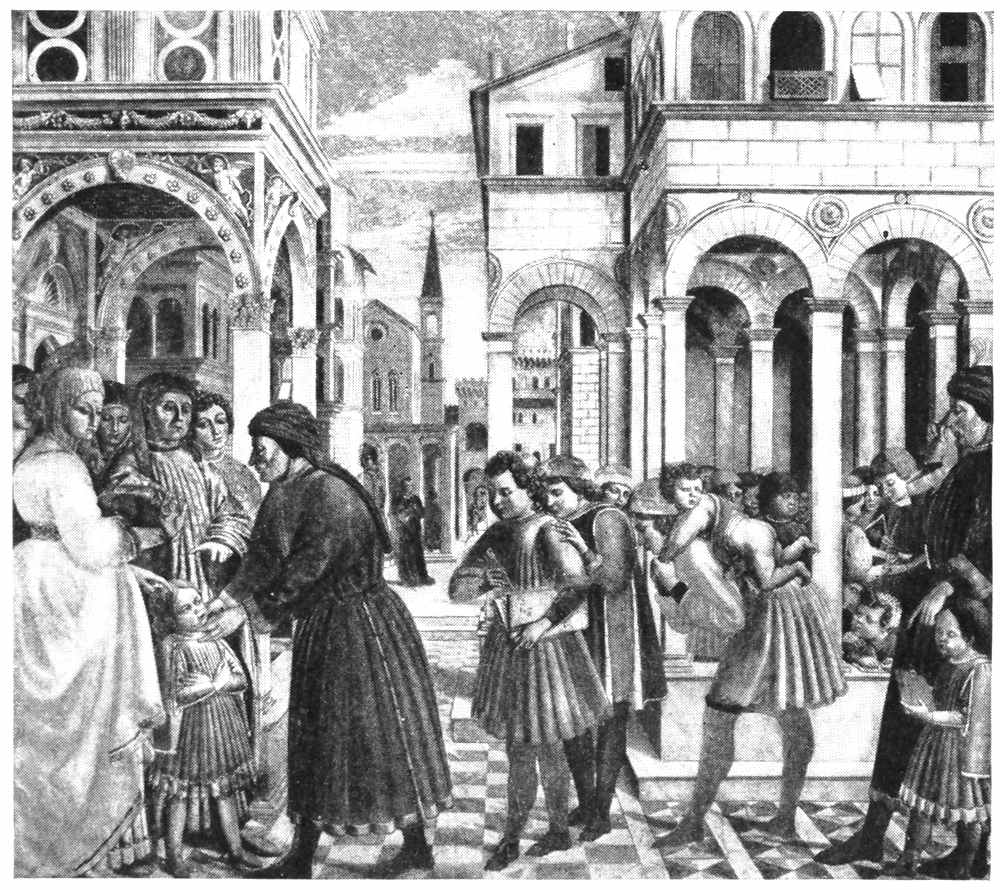
Photo. Alinari
ST. AUGUSTINE AT SCHOOL.—BENOZZO GOZZOLI
(Church of San Agostino, San Gimignano.)
On this occasion was composed the Te Deum still used in the Church, St. Ambrose and St. Augustine reciting the verses alternately as they advanced to the altar.
St. Augustine, after devoting some time to study, was ordained a priest and afterwards became the Bishop of Hippo, near Carthage, where he died thirty-five years later, at the time the city was besieged by the Vandals. His writings are very celebrated.
St. Augustine is not often represented in art alone; and when grouped with others in devotional pictures it is often difficult to distinguish him from other bishops, for his proper attribute, the heart flaming or transpierced, to express the ardour of his piety or the intensity of his repentance, is rarely introduced. When a bishop stands with a book or a pen in his hand, accompanied by St. Jerome, St. Augustine is probably intended.
His most frequent symbols are: books at his feet or in his hand; a heart flaming or transfixed by an arrow; bishop’s robes, mitre, crozier; infant by the seashore.
The subject most often represented in art is the Vision of St. Augustine. While meditating on his “Discourse on the Trinity,” he strolled along the seashore, and saw a little child attempting to fill a hole in the sand with water he was bringing from the sea. Augustine inquired what he was doing, and the child replied he was going to empty all the waters of the sea into that hole. “That is impossible!” exclaimed St. Augustine. “Not more impossible,” returned the child, “than for a finite mind to contain the Infinite”—and he vanished. The version of the child’s reply more often given, is: “Not more impossible than for thee, O Augustine! to explain the mystery on which thou art now meditating.”
St. Gregory. Lat. Sanctus Gregorius Magnus. Ital. San Gregorio Magno, or Papa. Fr. St. Grégoire. Ger. Der Heilige Gregor.
St. Gregory, known as Gregory the Great, was born in Rome in the year 540, and came of a patrician family. His mother had a vision when he was an infant that he would be pope. He was a lawyer until his father’s death, but after coming into his inheritance he gave all that he had to charities, converted his home on the Celian hill into a monastery and hospital, and dedicated it to St. Andrew. He lived there in a cell and, adopting the habit of the Benedictine Order, devoted himself to study. When a terrible plague broke out in Rome he gave himself up to nursing the sick. Pope Pelagius was one of the victims, and the people desired Gregory as his successor. Gregory believed himself unworthy and entreated the emperor not to heed the wishes of the people, but the emperor confirmed their choice. Then Gregory fled from Rome and hid himself in a cave. But those who sought for him were directed to him by a celestial light, and brought him back to Rome.
As pope he showed himself in all respects worthy. Although exalting his high office, he himself was the most humble of men and was the first pope to call himself the “servant of the servants of God”—Servus servorum Dei. He abolished slavery throughout Christendom and was the first to send missionaries to England, his pity being excited by seeing some British captives for sale in the market-place. It was he who made the belief in purgatory an article of faith. He instituted the celibacy of the clergy, reformed the services of the Church, and introduced the style of chanting still called Gregorian. His charities were boundless. He died in 604, in the fourteenth year of his pontificate, and was the last pope who was canonised.
His bed and the little scourge with which he was wont to keep the choristers in order are still preserved in the Church of the Lateran, Rome.
Next to St. Jerome he was the most popular of the Four Fathers, and single pictures of him abound, variously treated, but generally he bears the tiara as pope, and the crozier with double cross. His peculiar attribute is the dove which, in the old pictures, was placed close to the ear. Frequently he is seated on a throne wearing the pontifical robes and tiara, one hand raised in benediction, and the other holding a book. The dove rests on his shoulder or hovers over his head.
Legends of St. Gregory have furnished many picturesque themes for art. John the deacon, his secretary, declared that he beheld the Holy Ghost, in the form of a dove perched upon his shoulder while he was writing his famous homilies. This vision has been represented as a reality by the early painters.
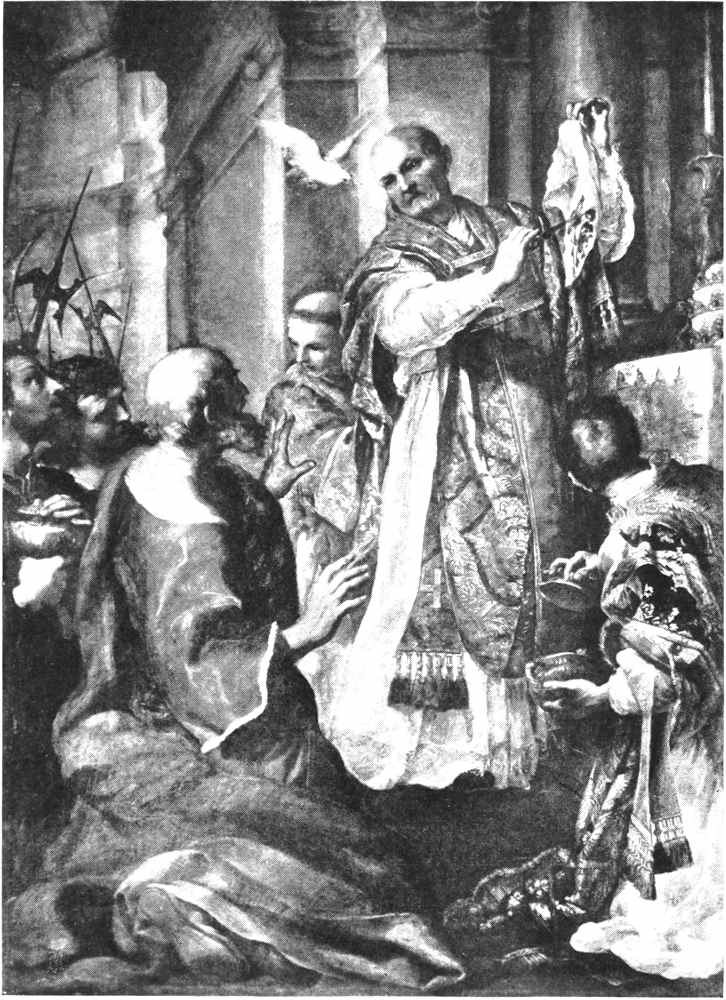
Photo. Alinari
MIRACLE OF THE BRANDEUM.—ANDREA SACCHI
(Vatican, Rome.)
A favourite legend is that while a monk in the monastery of St. Andrew a beggar asked for alms, and being helped, came again and again, receiving aid until there was nothing left but a silver porringer which his mother Sylvia had sent to St. Gregory. This, too, he gave to the beggar. Now it happened that it was his custom, after he became pope, to entertain every evening at supper twelve poor men, in memory of our Lord’s apostles. But one evening he counted thirteen; and calling his steward to him he asked how it was, but the latter, greatly mystified, could only count twelve. After the meal was finished, Gregory called forth the unbidden guest and asked him who he was. And he replied, “I am the poor man whom thou didst formerly relieve, but my name is ‘The Wonderful’ and through me thou shalt obtain whatever thou shalt ask of God.” Then Gregory knew that he had entertained an angel, or according to another version our Lord Himself. This legend has been frequently painted under the title of The Supper of St. Gregory.
In the legend of the Brandeum the Empress Constantia sent to St. Gregory desiring some of the relics of St. Peter and St. Paul. He, not daring to disturb their sacred remains, sent her part of a consecrated cloth (brandeum) which had enfolded the body of St. John the Evangelist. The empress rejected the gift with scorn. Then Gregory, to show that miracles are not wrought so much by things as by the faith of believers, laid the brandeum on the altar and, after praying, cut it with a knife and blood flowed from it as from a living body. This was called the Miracle dei Brandei.
It was Pope Gregory who sent St. Augustine of Canterbury to England.