VII.—ARCHANGELS[4]
Reading edition
VII.—ARCHANGELS[4]
The seven archangels who stood in the presence of God are frequently referred to in Scripture. These are: Michael, Gabriel, Raphael, Uriel, Chamuel, Jophiel, Zadkiel.
From the standpoint of art, however, it is necessary to consider only the characteristics of the first three, who are venerated as saints in the Catholic Church. These, by their majestic and gracious beauty, and their accredited mission as counsellor, messenger, and healer to mankind, have inspired some of the most poetical and beautiful works of art.
St. Michael. Lat. Sanctus Michael Angelus. Ital. San Michele, Sanmichele. Fr. Monseigneur Saint Michel.
Poetry and art have united in giving St. Michael pre-eminence over all created spirits. All the glory of princedoms, powers, virtues, dominations, and thrones radiate from him, and God manifested His glory in him when He made him victor over the power of sin and over the “great dragon that deceived the world.”
The worship of St. Michael became general in France from the ninth century, and he was made the patron saint of France, and of the military order instituted in his honour by Louis XI., in 1469. This worship extended to England after the Norman Conquest, and churches dedicated to St. Michael are found in all the towns and cities along the southern and eastern shores.
St. Michael is also the angel of good counsel.
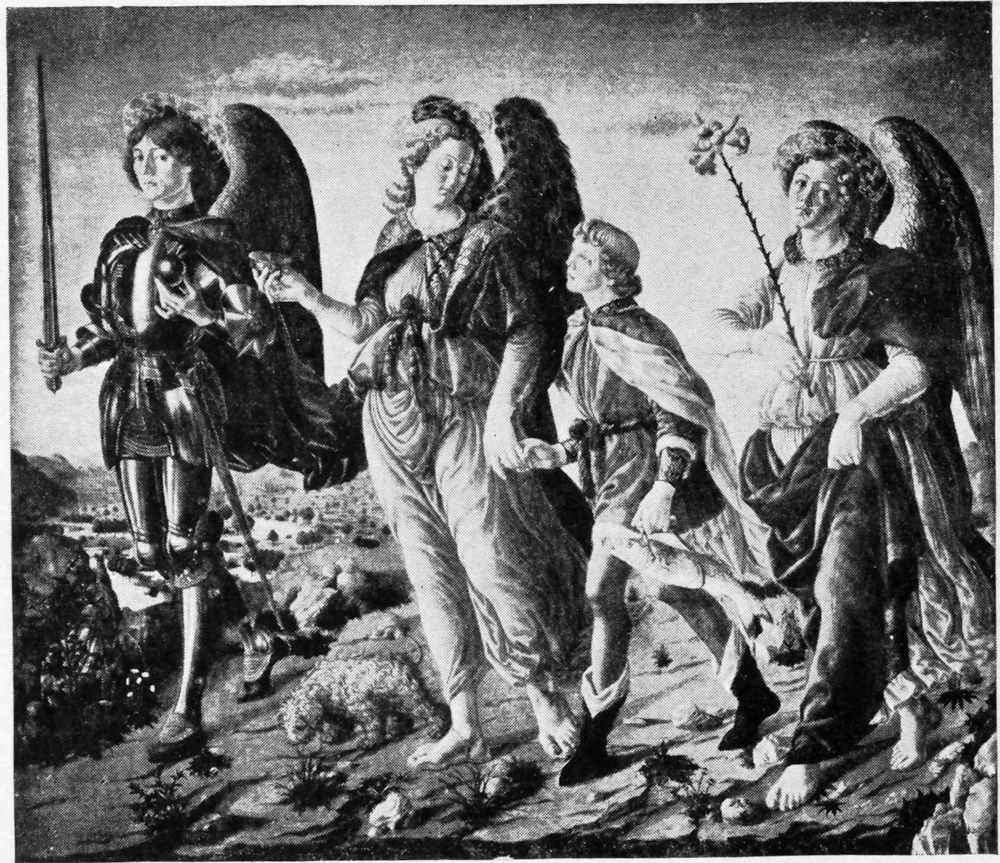
Photo. Alinari
THE THREE ARCHANGELS.—BOTTICELLI
(Academy, Florence.)
He is represented in three characters in art: as patron saint and prince of the Church Militant; as captain of the hosts of heaven and conqueror of the powers below; as lord of souls,—the conductor and guardian angel of the spirits of the departed.
In all representations of St. Michael in art the leading motif is the same. He is young and beautiful, with a severe, imperious beauty. In early art he is represented in white, with large many-coloured wings, and carries only the sceptre, or the lance surmounted by a cross, as one who conquered sin by spiritual power alone. In later representations—those imbued with the spirit of chivalry, he becomes the idealised expression of knighthood, and is attired in a magnificent coat of mail, with shield and spear and sword. Sometimes he wears a helmet; more often his long, fair hair is confined by a jewelled tiara, or floats loose upon his shoulders, the only angelic attribute being the wings that spring resplendent from his shoulders.
In devotional pictures of St. Michael, he is represented as captain of the heavenly host and conqueror of the Evil One. He is armed and stands with his foot on the half-human, half-dragon form of Lucifer, whom he is about to pierce with his lance or to hurl down into the infernal regions. This representation is the universal symbol of the ultimate victory of good over evil.
When St. Michael is portrayed as lord of souls he is unarmed. He holds a balance and upon each scale sits a little naked figure representing two human souls. The beato—the blessed one—has his hands joined in gratitude, while the other, the rejected one, is in an attitude of hopeless misery. Frequently a demon is seen grasping the descending scale with his talons or a long two-pronged hook.
Whether with or without the balance, St. Michael appears as lord of souls in the death and assumption of the Virgin. The legends assert that he received her spirit and guarded it during the interim of her death and assumption.
St. Gabriel. Ital. San Gabriele, San Gabriello, L’Angelo Annunziatore.
Where the Angel Gabriel’s name occurs in Scripture it is in the character of a messenger only. It is he who is sent to Daniel to interpret the vision which shows the destinies of mighty nations, and to announce the return of the Jews from captivity. In the New Testament he foretells the birth of John the Baptist to the high-priest Zacharias and six months later he is sent to the Virgin to proclaim the coming of the Redeemer of the world. In the Apocryphal New Testament he foretells to Joachim the birth of the Virgin and is thought to have foretold the birth of Samson. He is more important in the New Testament than Michael and as the angel who announced the birth of Christ he is reverenced as the angel who presides over childbirth.
In devotional pictures he is represented as the second of the three archangels. In his character of l’angelo annunziatore, he usually carries a lily or a sceptre in one hand and in the other a scroll inscribed “Ave Maria, Gratia Plena!”
St. Raphael. Ital. San Raffaello. Ger. Der Heilige Rafael.
Raphael is the prince of guardian spirits, the guardian angel of all humanity and thus, according to the early traditions, he appeared to the shepherds by night, “with good tidings of great joy, which shall be for all people.”
Raphael in his character of guardian angel is generally represented leading the youthful Tobias. When in order to show the difference between the heavenly and the mortal being, Tobit is made to look like a child, and the angel appears with wings and is not disguised, it is no longer historical, but devotional, and Tobias with his fish represents the Christian protected and guided by his guardian spirit.
All the pictured subjects of Raphael belong to the history of Tobit, and incidents from this beautiful apocryphal legend have been favourite subjects of art. Tobias dragging the fish ashore and the angel standing by has been often painted. In such pictures the angel should be without wings and disguised as the friendly traveller; the dog, which should not appear in the devotional pictures, is here an attribute and belongs to the story.
Devotional pictures represent him attired as a pilgrim or traveller, with sandalled feet and hair confined by a fillet or diadem. He has the pilgrim’s staff and a wallet or panetière suspended from his belt. Often as guardian spirit he has a sword; usually, however, he bears a small vase or casket containing the “fishy charm” against evil spirits (Tobit, vi., 6-7).