IV.—GENERAL SYMBOLS
Reading edition
“A symbol is an exterior formula, the representation of some dogma or belief. The lamb is the symbol of Christ, for the sacred texts relating to the Divine lamb oblige us to receive it as the necessary and dogmatical representation of Christ. A figure, on the other hand, is an arbitrary representation of any idea. The figure is not imposed by sacred dogma, but results simply from the free use of the human mind.... We are required to receive a symbol, but may be persuaded to admit a figure; the first demands our faith, the second fascinates the mind. The lion, cross, and lamb are the sole symbols of Christ, but he has been figured by the pelican and the fish.”—Didron’s Christian Iconography.
The Nimbus, Aureole, or Glory that is used in Christian art to distinguish holy personages was used by the pagans, who not only employed it as an attribute of divinity, but often gave it to the Emperors of Rome and the Kings of Eastern Europe and Asia. It expressed the radiance believed to emanate from the Divine Essence.
The glory around the head is the nimbus or aureole. The oblong glory surrounding the whole person (called in Italian the Mandorla—almond—from its form) is used only in connection with figures of Christ and the Virgin, or with saints as they are seen ascending into heaven.
When used to represent one of the three divine persons of the Trinity, the glory is often cruciform or triangular. A cruciform nimbus is a nimbus stamped with a cross, and although appropriate to the Deity, belongs peculiarly to Christ.
The Triangle, the emblem of the Divine Trinity, denotes three of the inseparable attributes of the Deity: to be; to think; to speak.
The Square was a geometrical symbolic figure used to indicate the earth; the circle was the symbol of heaven. Thus eternity was shown by a circle, life by a square, and the eternity of life by a square within a circle.
The Square Nimbus indicates that the person was living at the time the picture was painted.
From the fifth to the twelfth century the nimbus was shaped like a disc or plate over the head. During the thirteenth and fourteenth centuries it was a broad golden band behind the head, consisting of circle within circle, frequently ornamented with jewels. The custom prevailed at this time (especially in Germany) of inscribing the saint’s name within the edge of the nimbus above his head. From the fifteenth century, the nimbus became a bright fillet over the head, and its use was abandoned in the seventeenth century.
In pictures, the nimbus or aureole is always golden, the colour of light.
The Fish[1] (usually a dolphin, which had also a sacred significance among the pagans,) was the earliest of the Christian emblems. It was used, partly because the Greek word for fish forms the anagram of the name of Jesus Christ; and as a symbol of water and the rite of baptism; also in reference to the passage in the Gospel: “Follow me, and I will make you fishers of men.” When given to St. Peter the fish signifies his occupation as a fisherman, his conversion to Christianity, and his vocation as an apostle—a fisher of men. It is also given as an attribute to bishops who were celebrated for the number of their conversions and baptisms.
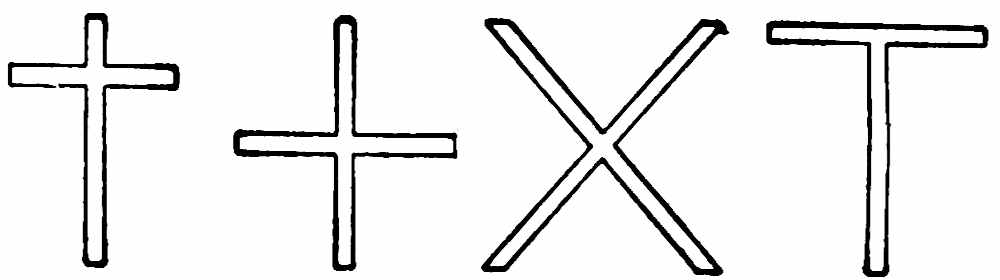
a
b
c
d
The Cross. About the tenth century the fish was superseded by the cross, which became the universal symbol of the Christian faith. The Latin cross (a), that upon which Christ was believed to have suffered, is the form usually given to a saint. But other crosses are used, having the same signification; as the Greek cross (b), in which the arms are all the same length; the transverse cross (c), on which St. Andrew is supposed to have died; the Egyptian cross (d), often given to St. Philip the Apostle, was the form also of the crutch of St. Anthony and was embroidered on his cope or robe, hence it is called St. Anthony’s cross.
The double cross on the top of a staff instead of a crozier belongs only to a pope. The staff with a single cross is borne by the Greek bishops. Often the cross was made of gold or silver, the five wounds of Christ being indicated by a ruby or carbuncle at each end and in the centre. Not until the sixth century did the cross become a crucifix, no longer a symbol, but an image.
The Lamb has been the peculiar symbol of the Saviour, as the “sacrifice without blemish,” from the earliest times. The lamb is also the general symbol of modesty, innocence, and meekness, and is thus given to St. Agnes.
The Pelican, who tears open her breast to feed her young with her own blood, was one of the early symbols of our redemption through the sufferings of Christ.
The Dragon is the symbol of Satan and of sin. The scriptural phrase, “the jaws of hell,” was rendered literally in early art by depicting the dragon’s jaws as open, emitting flames. The Serpent also typified sin and is sometimes placed under the feet of the Madonna with an apple in its mouth, or winding around a globe, signifying the power of sin over the whole world.
The Lion[2] is an ancient Christian symbol that frequently occurs, especially in architectural decoration. Antiquaries differ as to the exact meaning of the mystical lions placed in the porches of so many old Lombard churches; sometimes with an animal, sometimes with a man in their paws. The lion was an ancient symbol of the Redeemer, “the lion of the tribe of Judah,” also of the resurrection of the Redeemer, because according to an Oriental tradition the lion’s cub is born dead, and in three days its sire licks it into life. The lion, as a creature of the wilderness, is also an emblem of solitude, and is given to St. Jerome and other saints who did penance, or lived as hermits in the desert. The lion as an attribute indicated death in the amphitheatre, and thus is given to St. Ignatius and St. Euphemia. As the type of fortitude and resolution, the lion is placed at the feet of those martyrs of unfaltering courage, as St. Adrian and St. Natalia.
The Hart or Hind is an emblem of solitude and purity of life, and also of religious aspiration. “Like as the hart panteth after the water-brooks, so panteth my soul for Thee, O God!” When the original meaning of the lion, the hart, and other emblems had faded from the popular mind, legends were invented to explain them and that which had been a symbol became an incident or an historical attribute; as the legend of the lion healed by St. Jerome, or two lions digging the grave of St. Paul, the stag that appeared to St. Eustace and St. Hubert, and the hind that spoke to St. Julian.
The Peacock, the bird of Juno, was an old pagan symbol signifying the apotheosis of an empress. The early Christians, with this interpretation in mind, used it as a general symbol of immortality. It was not until modern times that the peacock became the emblem of earthly pride.
The Crown in Christian art is either an emblem or an attribute. In all ages it has been the emblem of victory and reward due to surpassing power or virtue. “Henceforth there is laid up for me a crown of righteousness”; and in this sense the crown became the especial symbol of the glory of martyrdom. Among the Jews, the crown was worn by a bride, and usually only the female martyrs wear the symbolical crown of glory, signifying in a double sense the bride of Christ, and the martyr. Martyrs of the other sex hold the crown in their hands or it is borne by an angel. The crown is also the symbol of sovereignty. The Virgin wears it as Queen of Heaven and Regina Angelorum. It is important to distinguish between the symbol and the attribute. When the crown is given to St. Cecilia and St. Barbara it is the emblem of their glorious martyrdom. When given to St. Catherine and St. Ursula it is not only the symbol of martyrdom but the attribute of their royal rank as princesses.
As an attribute it is frequently worn by a saint or placed at his feet, indicating that he was of royal birth, as in pictures of Louis of France, St. Helena, and many others.
The Sword is also a symbol or an attribute. In general it signifies martyrdom by a violent death and thus is given to many saints who did not perish by the sword. As an attribute, it shows that the martyr was beheaded. Thus it is given to St. Paul, St. Catherine, and many others. It is also given to the warrior martyrs typifying their military profession.
Other symbols of martyrdom are:
The Lance, the Axe, the Club.
The Arrow, the attribute of St. Ursula, St. Christian, and St. Sebastian.
The Anvil is an attribute of St. Adrian only, signifying his martyrdom.
The Poniard, of St. Lucia.
The Caldron, given to St. Cecilia and St. John the Evangelist.
The Pincers and Shears, St. Apollonia and St. Agatha.
The Wheels, St. Catherine.
Fire and Flames sometimes indicate martyrdom, sometimes religious fervour.
The Palm is the universal symbol of martyrdom, for which the Christians found scriptural authority in Rev. vii., 9, 14: “And after this I beheld, and lo, a great multitude ... stood before the throne ... clothed with white robes, and with palms in their hands.” ... “And he said to me, These are they which came out of great tribulation.” Thus in pictures of martyrdoms an angel is introduced with the palm.
The Standard or Banner is the symbol of victory. It is carried by our Saviour after His resurrection, and is given to St. George, St. Maurice, and other military saints; to some victorious martyrs, as St. Julian and St. Ansano, also to St. Ursula and St. Reparata, the only female saints.
The Ship. The Ark of Noah was in early times a symbol of the Church of Christ. Later the Ark became a Ship.
The Anchor symbolises immovable firmness, patience, and hope.
The Lamp, Lantern, or Taper is the emblem of piety: “Let your light so shine before men,” etc. Thus it is given to St. Gudula, St. Geneviève of Paris, and St. Bridget. It also signifies wisdom, and when given to St. Lucia typifies celestial light or wisdom.
A Church in the hands of a saint shows that he was the founder of some particular church. But in the hands of St. Jerome it signifies the whole Catholic Church, and to make the symbol more impressive rays of light stream out from the portal.
The Chalice, or Sacramental Cup with the Host, signifies faith, and is thus given to St. Barbara.
The Scourge in the hand of a saint or at his feet indicates the penance he inflicted upon himself; in the hand of St. Ambrose, however, it shows the punishment he inflicted upon others.
The Olive, emblem of peace and reconciliation, is found on the tombs of the early martyrs; sometimes with, and again without, the dove. It is carried as the attribute of peace by the Angel Gabriel, sometimes also by the angels in a Nativity who announce “peace on earth.”
The Dove in sacred art is the symbol of the Holy Ghost, and is given to certain saints who are considered to have been divinely inspired, as St. Gregory, St. Thomas Aquinas, St. Hilarius, and others. It is also introduced into various subjects from the New Testament, as the Annunciation, the Baptism, and the Pentecost. It also symbolises simplicity and purity of heart, and is the emblem of the soul, and in this sense is seen coming forth from the lips of dying martyrs.
The Lily is another emblem of purity and appears in pictures of the Virgin, particularly those of the Annunciation. It belongs also to St. Joseph, the husband of the Virgin Mary, whose staff, according to the legend, put forth lilies. It is given as an emblem only to St. Francis, St. Anthony of Padua, St. Dominick, and St. Catherine of Siena, to emphasise the great purity of their lives.
The Unicorn is another “ancient symbol of purity, in allusion to the fable that it could never be captured except by a virgin stainless in mind and life.” It is the emblem of female chastity, and is given only to the Virgin Mary and St. Justina.
The Flaming Heart symbolises fervent piety and love.
The Book, in the hands of the evangelists and the apostles, represents the Gospel, and is an attribute. In the hand of St. Stephen it is the Old Testament; with any other saint it may be the Gospel, but it may also be a symbol signifying that the saint was famous for his learning. It is thus given to St. Catherine, the Doctors of the Church, St. Thomas Aquinas, and St. Bonaventura.
Flowers and Fruit may be simply ornamental in ecclesiastical works of art, but in many instances they have a definite meaning. Roses are symbolical in pictures of the Madonna, who is the “Rose of Sharon.”
The Apple was the accepted emblem of the fall of man and original sin. In pictures of the Madonna and Child, in the hand of the Infant Christ, or presented by an angel, it symbolised redemption.
The Pomegranate bursting open, showing the seeds, was a symbol of the future and hope of immortality.
An Apple, Pear, or Pomegranate placed in the hand of St. Catherine as the mystical bride of Christ, alludes to the scriptural text, “The fruit of the Spirit is love, joy, peace.”
A Bell was supposed to exorcise demons, and thus it is given to the haunted St. Anthony.
The Shell signifies pilgrimage.
The Skull, penance.