XIX.—LEGENDS OF THE SAINTS MOST FREQUENTLY FOUND IN ART
Reading edition
St. Stephen. Protomartyr. Lat. St. Stephanus. Ital. San Stefano. Ger. Der Heilige Stefan. Fr. St. Étienne.
“And St. Stephen shone in beauty of body, in flower of age, in fair speech of reason, wisdom of holy thought, in works of divinity.”
Little has been added to the brief account of St. Stephen given in the sixth and seventh chapters of the Acts of the Apostles. His name is held in the highest honour as the first one who died for his faith in Christ. He was made a deacon during the ministry of Peter and before the conversion of Paul. He was accused of speaking blasphemously of the Temple and the Jewish law, and for this was condemned to death, and stoned by a mob outside the city gates.
In devotional pictures, the figure of St. Stephen occurs repeatedly. He is represented young, and of a mild and beautiful countenance wearing the rich dress of a deacon; the dalmatica, usually crimson in colour, and covered with embroidery. He bears the palm as protomartyr. His peculiar attribute, the stones, are in his hand or in his drapery, or on his head and shoulders, or lying at his feet; or sometimes on the Scriptures, signifying that he suffered for the Gospel.
St. Laurence. Lat. S. Laurentius. Ital. San Lorenzo. Fr. St. Laurent. Ger. Der Heilige Laurentius or Lorenz.
Nothing authentic is known of the early life of this saint, who is honoured in Rome next to St. Peter and St. Paul. He was a Spaniard of Huesca, Aragon, and came to Rome while very young. “He walked so meekly and so blamelessly before God,” that Sixtus II., Bishop of Rome, made him his archdeacon, and put him in charge of the treasures of the Church. When Sixtus was denounced as a Christian and led away to death, Laurence wished to die with him, but the holy bishop told him that in three days he would follow him, and that his battle would be harder, his torments longer and more severe than his; and he bade him distribute all the treasures of the Church to the poor, that they might not fall into the hands of the tyrant. Thus comforted, St. Laurence sought the poor and the sick, the naked and the hungry, and he washed the feet of the Christians and gave them alms. “In this manner he went from one dwelling to another, consoling the persecuted, and dispensing alms, and performing works of charity and humility. Thus he prepared himself for his impending martyrdom.”
The prefect, hearing that the treasures of the Church were in his care, demanded them, and St. Laurence brought all the poor and the sick whom he had helped, before the prefect, and said, “Behold the treasures of Christ’s Church!” The prefect, in fury, thinking that he mocked him, ordered him tortured and cast into a dungeon, in charge of Hippolytus, whom, with his whole family, he converted and who afterwards suffered martyrdom. When the prefect found he could not subdue him, “he ordered a torture more strange and cruel than ever entered into the heart of a tyrant to conceive.” He had him stretched on a sort of iron bed formed of iron bars in the manner of a gridiron, and a fire lighted beneath, and he was roasted alive. And all wondered at a cruelty that would “condemn to such torments a youth of such fair person, and courteous and gentle bearing, and all for lust of gold.” In the midst of these torments St. Laurence said to the tyrant, “Seest thou not that I am already roasted on one side and if thou wouldst have me well cooked it is time to turn me on the other?”
Hippolytus buried his remains in the Via Tiburtina and Constantine built the church known as San Lorenzo fuori le Mura on the spot. The common people of Rome gave him the title of Il cortese Spagnolo—“the courteous Spaniard”—because when they opened his sarcophagus two hundred years after his death and lowered into it the body of St. Stephen, St. Laurence moved on one side, giving the place of honour on the right to St. Stephen.
St. Laurence is constantly represented in devotional pictures, and like St. Stephen and St. Vincent he wears the rich dress of the deacon and has the palm as martyr. He is unmistakable, when he bears his peculiar attribute, the gridiron (la graticola), which varies in form. When it is the common kitchen utensil, it is no longer an attribute, but simply an emblem of the death he suffered. Sometimes a small gridiron is suspended around his neck, or he holds it in his hand, or it is embroidered on his robe. Occasionally it is omitted and he carries a dish full of gold and silver, representing the treasures of the Church, or he swings a censer, or carries a cross. He is always pictured young.
St. Vincent. Lat. S. Vincentius Levita. Ital. San Vincenzio Diacono, San Vincenzino.
St. Vincent was born in Saragossa in the kingdom of Aragon. During the persecution under Diocletian, the proconsul Dacian caused all the Christians of Saragossa to be massacred. At this time lived St. Vincent. He had been early taught in the Christian faith, and although barely more than twenty, he was already a deacon. The dangers and sufferings of the Christians only aroused his sympathy and zeal; and he encouraged and sustained many of his brethren in the torments inflicted upon them. When he and his aged bishop were brought before the tribunal to answer the charge of being Christians, the latter spoke in so feeble a voice that St. Vincent took the words from his lips, proclaiming his faith loudly and defying his persecutors.
Upon him, for this, were inflicted the most inhuman and barbarous tortures that cruelty could invent. The young saint endured them unflinchingly. His body was lacerated with iron forks, and when left torn and bleeding angels came to comfort him. The proconsul, after St. Vincent’s death, ordered his body to be thrown to the wild beasts, but God sent a raven to guard his sacred remains, and when a wolf approached to devour them the raven obliged it to retire.
Furious at this, Dacian commanded his minions to sew up in an ox-hide——as was done to parricides——the body of the holy martyr, and to throw it into the sea. Placing it thus in a bark, they rowed far out to sea, and flung it, attached to a millstone, overboard. But, to their astonishment, upon returning immediately to land, they found that the body of St. Vincent had preceded them and was lying on the sand. They fled terrified, and the waves of the sea, by the command of God, hollowed a tomb for him in the sands, where he lay protected from all harm, hidden from all human knowledge, until after many years the spot was miraculously revealed to certain Christians, who brought his body to Valencia and buried it there.
The Christians of Valencia, obliged to flee from the Moors in the eighth century, carried with them the remains of St. Vincent. Their vessel was driven by the winds onto a promontory, ever since called the Cape of St. Vincent. The body of St. Vincent remained there—again guarded by ravens—until it was removed to Lisbon by Alonzo I., about 1147. On this journey two ravens piloted the ship, one at the prow and the other at the stern. “Thus after many wanderings the blessed St. Vincent rested in the Cathedral of Lisbon; and the crows which accompanied him, having multiplied greatly, rents were assigned to the chapter for their support.”
This renowned saint is very popular in Spain, the scene of his legend, and has been since the sixth century one of the most venerated saints in France.
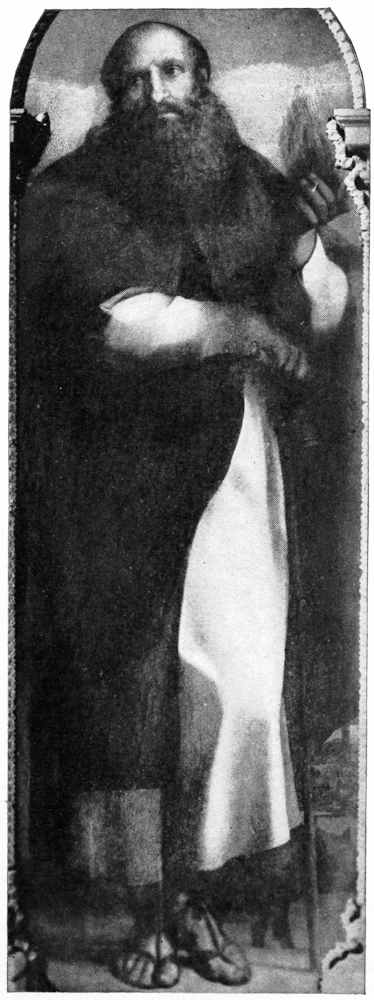
Photo. Alinari
ST. ANTHONY.—PALMA VECCHIO
(Church of S. Maria Formosa, Venice.)
In art, it is sometimes hard to distinguish St. Vincent from St. Stephen and St. Laurence. He, too, is young and beautiful, wears the deacon’s robes, and carries the palm. His peculiar attribute, however, is a crow or raven, sometimes perched upon a millstone. Occasionally the iron fork—instrument of his martyrdom—is introduced. In Italian pictures he rarely has any attribute except the palm, while St. Laurence and St. Stephen are rarely without their respective symbols, the gridiron and the stones.
St. Vincent is often pictured in art with St. Laurence.
St. Anthony, Hermit. Ital. Sant’ Antonio Abbate, or l’Erémita. Fr. St. Antoine l’Abbé. Ger. Der Heilige Anton, or Antonius.
Anthony was born in Alexandria, Egypt. His parents died when he was eighteen and left him a noble name, great riches, and an only sister. He was imperfectly educated, knowing no language but his native Egyptian, and was a constant attendant on Christian worship. He had been of a melancholy disposition from childhood, and feared the temptations of the world and the responsibilities of his possessions. One day he heard the sentence, “Go, sell all thou hast, and give to the poor ... and come and follow me.” He took this as a message from heaven, and divided his wealth with his sister, gave his share to the poor, and withdrew to the desert, where dwelt a company of hermits.
Here he lived a life of such sanctity and self-denial that he was the admiration and wonder of all; and Satan, displeased at such amazing virtue, sent his demons to tempt him.[9] They whispered to him of all that he had sacrificed for this weary life of perpetual rigour and self-denial, but the saint prayed till the demon ceased.
Then Satan had recourse to stronger weapons, and clothed his demons in human forms: they plied him with delicious food, and hovered around him as beautiful women trying to allure him to sin. But St. Anthony resisted these temptations, and in anguish fled to a cave farther in the desert, where he lived alone and fasted more rigorously than ever.
But Satan followed him even here and now tortured him with pain, and tried to “affright him with all the terrors that can overwhelm the soul of man,” but in the midst of all these appalling shapes and sounds, suddenly there shone from heaven a great light which fell upon Anthony, and all these terrors vanished at once, and he arose unharmed and strong to endure. And he said, looking up, “O Lord Jesus Christ, where wert thou in those moments of anguish?” And Christ answered, “Anthony, I was here beside thee, and rejoiced to see thee contend and overcome. Be of good heart; for I will make thy name famous through all the world.”
When Anthony had lived in the desert seventy-five years, “his heart was lifted up by the thought that no one had lived so long in solitude and self-denial as he had done.” But in a vision a voice said to him, that there was one holier than he, for Paul the hermit had served God in solitude and penance for ninety years. Anthony resolved to seek Paul, and on the third day he came to a cavern overhung with rocks, with a palm tree, and a fountain flowing near, and there he found Paul. And while they talked there came a raven carrying in his beak a small loaf, which he let fall between them, and Paul blessed the goodness of God, and said: “For sixty years, every day hath this raven brought me half a loaf; but because thou art come, my brother, lo! the portion is doubled, and we are fed as Elijah was fed in the wilderness.”
Then Paul told St. Anthony that God had sent him to receive his last breath, and to bury him; and bade him return to his dwelling for the cloak given him by the holy Bishop Athanasius, and to wrap him in it and to lay him in the earth. Weeping, St. Anthony went to his monastery, took down the cloak, and returned as fast as his aged limbs would permit, and found Paul dead in his cave. Wrapping him in the cloak, he thought how he might bury him, for he had no strength to dig a grave and behold, two lions came, and by their roaring expressed their sympathy, and began to dig in the sand with their paws, and in a short time had dug the grave in which Anthony reverently laid the body of Paul. After this, Anthony lived fourteen years, and died aged one hundred and five.
Figures of St. Anthony occur frequently, and are easily recognised. He wears the monk’s habit and cowl, usually black or brown, and in Greek pictures the letter T, always blue, is on the left shoulder or on the cope. Anthony and his monks bear the T from the Greek word Theos, God, signifying, “These are they which follow the Lamb whithersoever he goeth. These were redeemed from among men, and in their mouth was found no guile, for they are without fault before the throne of God.”
The crutch given St. Anthony indicates his age and feebleness. The bell is given him because he had the power to exorcise evil spirits. The devil, according to Durandus, cannot endure the sound of a consecrated bell. The asperges—the rod for sprinkling holy water—as an instrument of exorcism, was also given St. Anthony. The hog represents the demon of sensuality and gluttony which St. Anthony overcame. Flames of fire placed near him, or a city or house burning in the background, signify his spiritual aid as patron saint against fire in this world and in the next. He is found with one or more of these attributes alone or in Madonna pictures.
In historical pictures the Temptation of St. Anthony is the most common subject.
The legend of St. Paul the hermit is interwoven with that of St. Anthony. He is represented in devotional pictures as extremely old and wasted; his legs and arms bare; beard and hair white and very long; garbed only in a mat of palm leaves. When a raven is introduced, bringing him food, it is only by his dress of plaited leaves and his attenuated and aged appearance that St. Paul can be distinguished from Elijah in the wilderness. He does not often appear in Madonna pictures or grouped with other saints, but is usually alone, seated upon a rock, in deep meditation.
St. Benedict. Ital. San Benedetto. Fr. Saint Benoit. Spa. San Benito.
St. Benedict was born about 480 in Norcia, a small town in the duchy of Spoleto. He came of noble family and was sent to Rome to study. But even as a boy, he became disgusted with the profligacy of the times, and this, added to the religious enthusiasm of the age, drove him into a hermitage at fifteen. His nurse, who had been with him from infancy, followed him, and insisted upon waiting upon him and cooking for him. Feeling that his penance was not severe enough while thus looked after, St. Benedict secretly fled from his nurse and took refuge in a cave in Subiaco, a wilderness about forty miles from Rome, where he lived three years, supplied with bread and water by a hermit named Romano.
Here he experienced many temptations. Memories of a beautiful Roman woman haunted his imagination, and the desire to rush from his solitude and seek her was well nigh irresistible. But, believing that these thoughts came from Satan to try him, he flung himself naked into a thicket of briars and nettles, which so lacerated and stung the flesh that the temptation vanished, never to return.
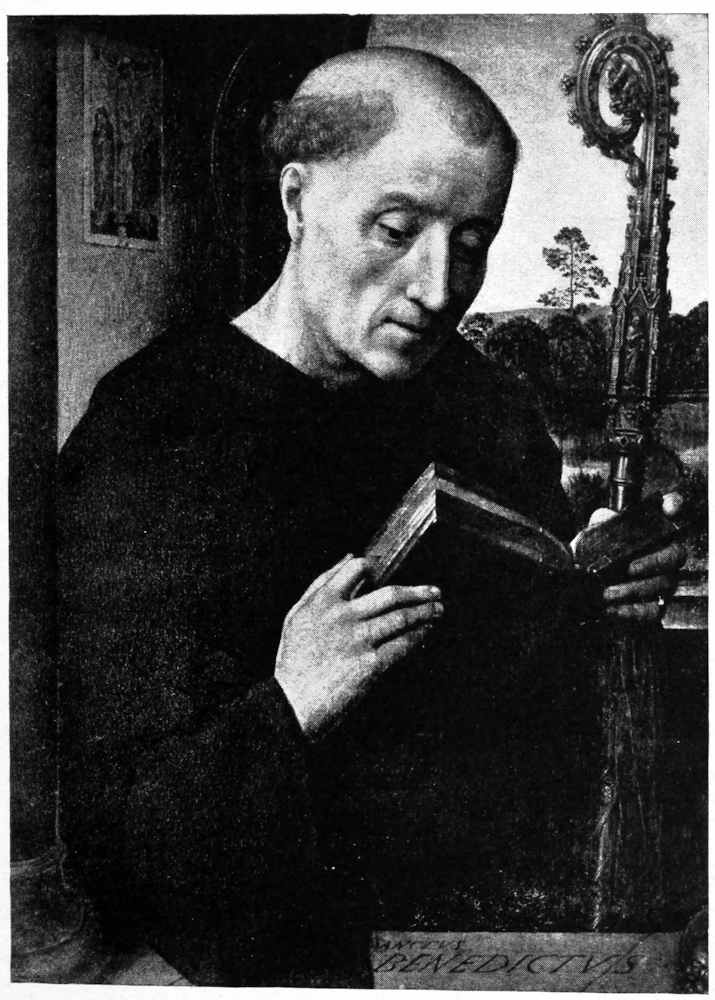
Photo. Alinari
ST. BENEDICT.—HANS MEMLING
(Uffizi, Florence.)
His fame spread, and people came from all over and begged for his prayers and brought their sick to be healed. He yielded to persuasion and became head of a monastery near by, but the strictness of his life filled the monks, who had grown lax, with dismay, and one tried to poison him in a cup of wine. But St. Benedict blessed it as usual and made the sign of the cross, and the cup fell broken, with its contents spilled. He then left them and returned to his cave in Subiaco. There crowds gathered in huts and cells, attracted by the fame of his sanctity and miracles. At length he had built twelve monasteries, in each of which he placed twelve disciples with a superior over them.
Two Roman senators brought him their sons, Maurus and Placidus, to be educated. St. Benedict devoted himself to their care and they became his most famous disciples. (St. Maurus founded a monastery in France, and St. Placidus was sent to Sicily, where he and his young sister Flavia were martyred.) His community became celebrated for brotherly love and charity, until jealousy crept in and one priest, named Florentius, tried to blacken the name of St. Benedict. He also tried to corrupt the monks by introducing seven young women into one of the monasteries. He then attempted to kill St. Benedict by means of a poisoned loaf, but Benedict suspected treachery and gave the loaf to a tame raven, who carried it away. Then St. Benedict left Subiaco, but had scarcely gone when a messenger came to him with word that his enemy had been crushed to death by the falling of a gallery in his house.
Hearing of a temple on Monte Cassino, not far from Rome, where the people performed pagan rites to Apollo, Benedict repaired thither, and by his preaching converted the people and persuaded them to break the statue and throw down the altar. He built two chapels here, and higher up on the mountain established the first monastery of the Benedictine Order. He here gave the famous Rule that became the general law for monks in Western Europe, and consisted of the three vows of poverty, chastity, and obedience, to which St. Benedict added that of manual labour for seven hours a day, and vows perpetual after a novitiate of one year.
His sister, St. Scholastica, followed her brother to Mt. Cassino with a small company of pious women, and he was wont to visit her once a year. On his last visit, refusing to listen to his sister’s pleadings that he remain longer with her, she prayed that heaven might interfere, and immediately there came a furious storm, which delayed his departure several hours. St. Scholastica died two days later, and as St. Benedict was praying in his cell, he beheld the soul of his sister ascending to heaven in the form of a dove. This scene is often represented in pictures for the Benedictine nuns.
St. Benedict died March 21, 543, and it would take volumes to relate all the miracles attributed to him.
He is difficult to distinguish in art, because he is often represented wearing the white habit, whereas the habit of the order was black. In white it is easy to confuse him with St. Bernard, St. Bruno, or St. Romualdo, and in black, for St. Anthony, so one must look for more characteristic attributes.
In pictures for Benedictine churches, which depend on Mt. Cassino and Subiaco, and in single devotional pictures, he wears the black habit with hood: as patriarch of the Reformed Benedictines of Clairvaux, Citeaux, Camaldoli, or Vallombrosa, the white habit. Sometimes beardless, more often long white beard. As Abbot of Mt. Cassino he sometimes carries the staff and mitre; frequently holds an open book. Like other saints who have resisted temptation, he carries the asperges—the rod for sprinkling holy water—here an emblem of purity or holiness by which he conquered. The thorn bush is an attribute, showing the means whereby he conquered. A pitcher of wine or broken cup on a book expresses the attempt to poison him, also the raven with loaf of bread with serpent creeping from it. When a nun in black habit is introduced with St. Benedict, or stands alone with a lily in her hand and a dove at her feet or pressed to her bosom, it is St. Scholastica. When grouped with his two disciples, Maurus and Placidus, they all wear the black habit, or St. Benedict appears as abbot and the others as deacons, wearing the dalmatica over the black tunic. St. Maurus holds a book or a censer, and St. Placidus carries the palm as martyr.
St. Bernard of Clairvaux. Lat. Sanctus Bernardus. Ital. San Bernardo di Chiaravalle, Abbate. Ger. Der Heilige Bernhard.
Bernard was born at Fontaines, near Dijon, in 1091. Both parents were of noble family, and his mother, a highly gifted woman, superintended his early education. His personal beauty was very great, but his health was always delicate and he practised extreme self-denial from an early age. His thirst for knowledge was amazing, and after studying at the University of Paris, he entered the Reformed Benedictine monastery of Citeaux. The Abbot of Citeaux saw qualities in Bernard which convinced him that he would be the proper head of a new foundation, and in the year 1115 he sent him forth with twelve other monks to found another Cistercian monastery. Bernard led them to a wilderness called the “Valley of Wormwood,” and there built the famous abbey of Clairvaux.
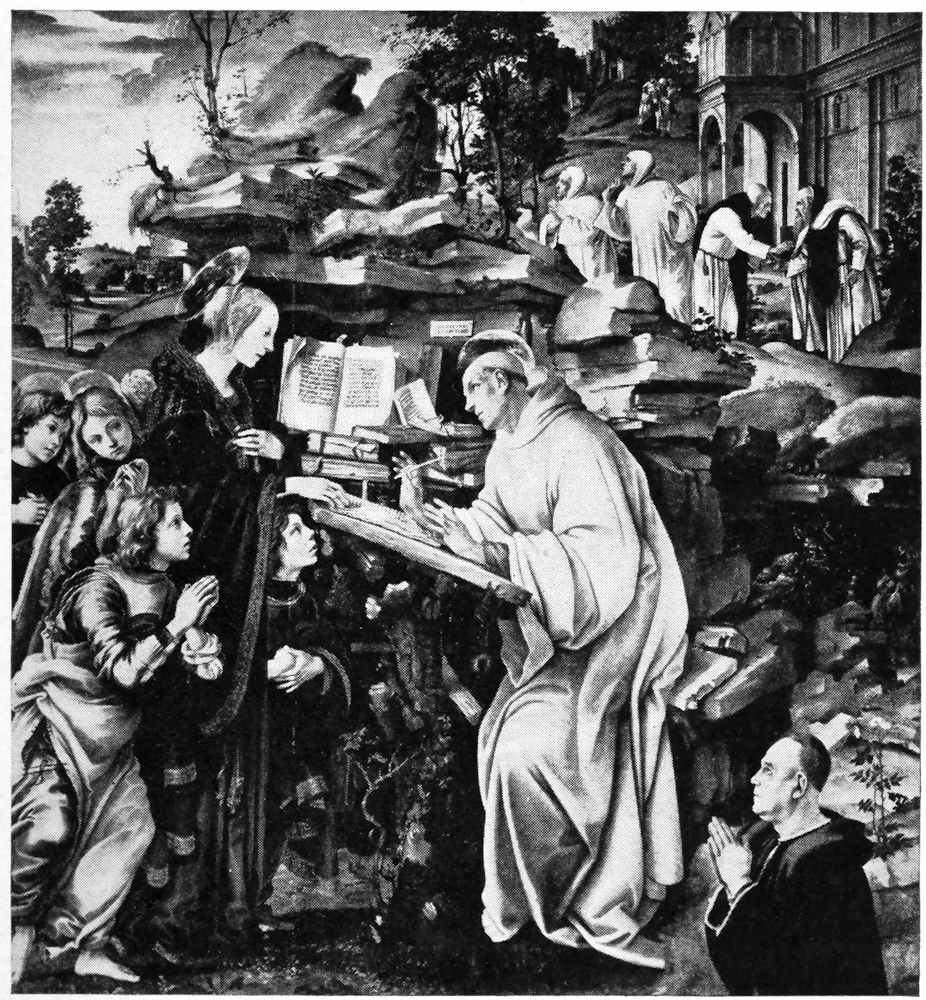
Photo. Alinari
THE MADONNA APPEARING TO ST. BERNARD.—FILIPPINO LIPPI
(Church of the Badia, Florence.)
Bernard became known throughout the Christian world, and was appealed to by feudal lords and ecclesiastics alike. He was an authority on all subjects, and his decisions were received with perfect submission. He was commissioned by Eugenius III. to preach a second crusade. Only a remnant returned from the ill-starred expedition, and the people turned on Bernard with sudden hatred. But he defended himself with such eloquence that their rage vanished. He affirmed boldly that they had been punished for their sins, and bade them go home and repent, which they did.
His bitter religious controversies with Abelard will be recalled.
He died in his sixty-third year at Clairvaux, where he had been abbot thirty-eight years, and was canonised twenty years later by Pope Alexander III. No man of his age had greater renown nor fills a larger place in the history of that age. His reputation rests on the integrity of his character, his eloquence as a preacher, his remarkable executive ability, and his skill as a writer.
In devotional pictures St. Bernard is represented as a monk in the white habit of the Cistercian Order, with shaven crown, little or no beard, carrying a large book under his arm, or presenting books to the Madonna, or with writing implements before him. Other attributes are the demon—signifying heresy—fettered behind him; sometimes three mitres on his book or at his feet signifying the three bishoprics he refused—those of Chartres, Spires, and Milan; also the beehive as symbol of eloquence in common with Chrysostom and Ambrose.
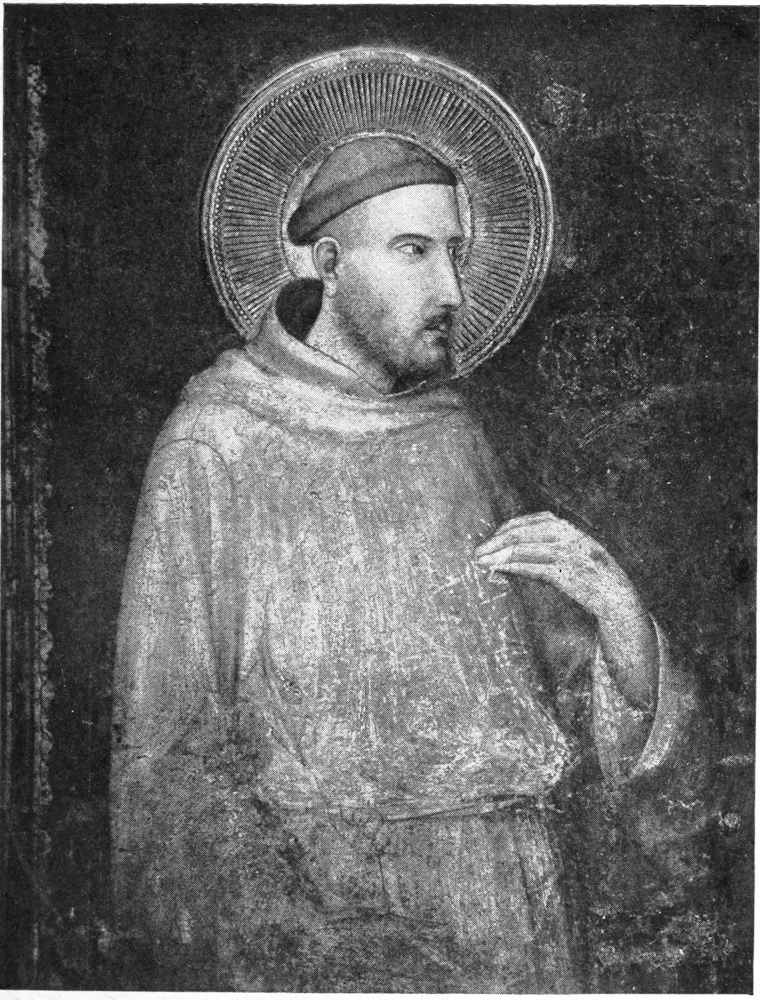
Photo. Alinari
ST. FRANCIS OF ASSISI.—SIMONE MARTINI
(Church of S. Francesco, Assisi.)
The Vision of St. Bernard has been charmingly rendered in art. The subject is mystical and devotional. St. Bernard’s most celebrated writings were devoted to the honour and glory of the Blessed Virgin who, in consequence, regarded him with peculiar favour, and it is related that once when he was writing his homilies he was so ill he could hardly hold his pen, and behold! she appeared to him and comforted and restored him by her gracious presence.
St. Francis of Assisi. Lat. Sanctus Franciscus, Pater Seraphicus. Fr. Saint François d’Assise. Ital. San Francesco di Assisi.
St. Francis was the founder of the Franciscans, one of the three Mendicant Orders of Friars. He was born in Assisi in 1182. His father, Pietro Bernardone, was a wealthy merchant. The son was taught French, and spoke it with such ease that his companions changed his baptismal name of Giovanni to Francesco—the Frenchman—by which he was ever afterwards known. In his youth he was remarkable for his extravagance and excessive love of pleasure. But he was kind and generous, and beloved by all. In a quarrel between the inhabitants of Perugia and Assisi he was taken a prisoner, and detained for a year in the fortress of Perugia.
After his return home, he was ill for many months, and his thoughts constantly turned from this world to God. Upon his recovery, he met a beggar in filthy rags, who asked him for alms. St. Francis recognised him as a former noble, who had commanded the expedition against Perugia, and exchanged his own rich apparel with him who was now a mendicant, putting on the other’s tattered garments. Going into a church that was falling into ruin, to pray, he heard in his soul a voice saying, “Francis, repair my church, which falleth into ruin.” Taking these words literally, he sold merchandise of his father’s, and brought the money to the priests of the church. This put his father in a rage, and thinking him mad, he first locked him up in his chamber, but as he still persisted in his ideas, he took him before the bishop. Here Francis tore off his garments and flung them to his father, saying, “Henceforth I recognise no father but him who is in heaven.” The bishop, touched and weeping with admiration, took a coarse cloak from a beggar who stood by and gave it to him. Francis received it gladly, as the first fruit of that poverty to which he had given himself. He was now twenty-five years old, and from this time forth he went about preaching charity, humility, and self-abnegation, existing only on alms.
It was a period in the history of the world of great mental and moral excitement. St. Francis was the living expression of an awakening emotion in the minds and hearts of the people, and his example was imitated with passionate enthusiasm by an immense number of followers. He made the first condition of their joining him absolute poverty. Hence the allusion to his marriage with the Lady Poverty.
He went to Rome to obtain the pope’s sanction for his order, and was at first repulsed as a visionary enthusiast. But the pope in a dream that night beheld the walls of the Lateran tottering and about to fall, then he saw the weight of the whole Church borne and sustained on the shoulders of him who had approached him in the morning. Greatly impressed by this, he sent for Francis, confirmed the rule of his order, and gave him power to preach. Returning then to his cell called the Porzioncula, Francis gathered his followers about him, gave to his order the name of Frati Minori, and established his Rule with its three vows of Poverty, Chastity, and Obedience.
Previous to this, at mass one day he heard the text from St. Luke (ix., 3): “Take nothing for your journey, neither staves nor scrip, neither bread, neither money, neither have two coats apiece”; and looking upon this as an ordinance it became the rule of his life. He was already barefoot and wretchedly clad, begging his food wherever he happened to be. There was nothing he could do without, except his leathern girdle. This he threw away, substituting one of hempen cord, which was adopted by his followers. These have thence been called the Cordeliers.
St. Francis’s life was one of continual prayer and self-inflicted penance. So gentle and tender and compassionate was he that “when he found worms or insects in his road he was careful not to tread upon them.” He loved all animals and was accustomed to call all living things his brothers and sisters. He interpreted literally the text “Go ye into all the world, and preach the gospel to every creature,” and Giotto has painted St. Francis preaching to the birds.
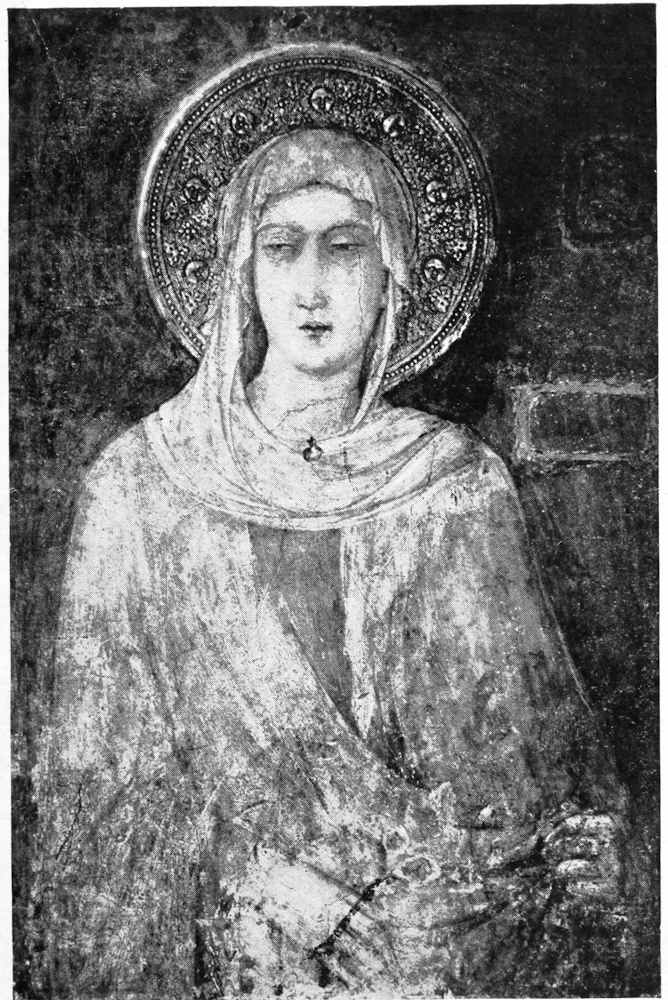
Photo. Alinari
ST. CLARA.—SIMONE MARTINI
(Church of S. Francesco, Assisi.)
We are told that he suffered from sickness, pain, and weakness and wept so much that he nearly became blind. It is also related that, having fasted in his cell on Mt. Alverna for forty days, passing the time in prayer and ecstatic contemplation, he beheld in a vision a seraph with six shining wings, and between his wings he bore the form of a man crucified. When the vision disappeared and he awoke, St. Francis found that he had received the stigmata, and ever after it was seen that he carried in his hands, his feet, and his side the wounds of our Saviour. He died in 1226 and was canonised by Pope Gregory IX. in 1228.
St. Francis is more frequently represented in art than any other saint, and is nearly always unmistakable. He may be distinguished by his habit, which is grey or dark brown, girded by a hempen cord. He bears the stigmata in his hands and feet and is often portrayed in the act of opening his tunic to display the wound in his side. The stigmata distinguishes him from all other saints wearing the same habit. Sometimes he has the crucifix and the skull. The lamb and the lily are also given him as symbols of meekness and purity. When St. Francis and St. Dominick are pictured together the crucifix is given to the former and the lily to St. Dominick.
St. Clara. Ital. Santa Chiara. Fr. Sainte Claire.
St. Clara was born in Assisi of noble parents, who desired her to marry; but, inspired by the example of St. Francis, she fled to him for counsel, and he advised her to renounce the world. She took refuge in the convent of San Paolo, whither her kinsmen pursued her, and in vain tried to drag her away. Soon after, her younger sister, Agnes, and other ladies of high rank joined her, and finally her mother, and thus was formed the Order of “Poor Clares,” Franciscan nuns, who followed the Rule of St. Francis, in all its austerity. A lifelong friendship existed between St. Clara and St. Francis, and he invariably turned to her for consolation in those periods of despondency which afflicted his soul.
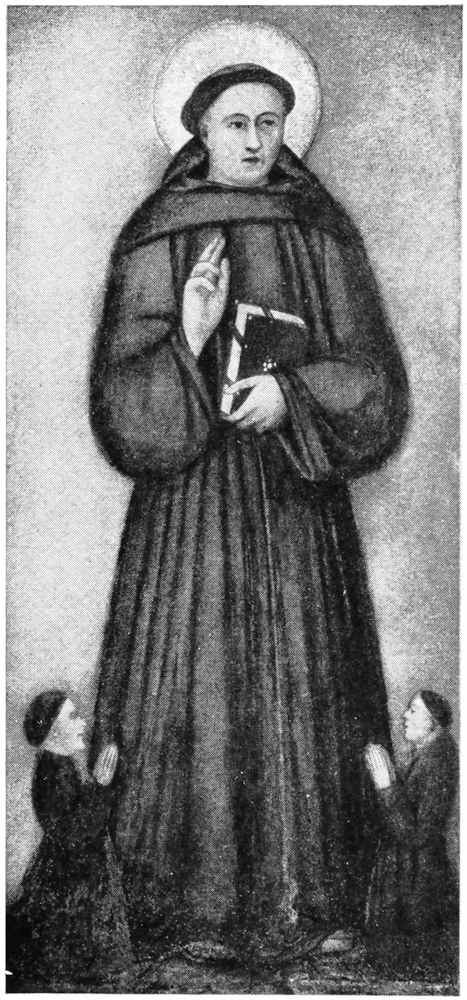
Photo. Alinari
ST. ANTHONY OF PADUA.—SCHOOL OF GIOTTO
(Basilica of S. Antonio, Padua.)
At one time, when the Saracens attacked the convent of San Damiano, and the nuns were filled with terror and despair, St. Clara, who had been bed-ridden, arose, took from the altar the pyx containing the Host, placed it on the threshold, and kneeling began to sing, “Thou hast rebuked the heathen,” etc., whereupon the barbarians, panic-stricken, fled. The fame of this miracle spread, so that people came from far and wide to obtain the prayers and intercession of Clara. The pope himself visited her, and solemnly confirmed the Rule of her order. At the age of sixty, she expired in a kind of trance in which she heard angels’ voices calling her. She was canonised in 1256.
When she carries the palm it is not as martyr, but is the palm of victory over suffering. She bears the lily, and is distinguished from other saints with the same emblem by her grey habit and the cord of St. Francis. In devotional pictures she is young and beautiful. She wears the habit of her order—the grey tunic, the knotted girdle, and the black veil. Her peculiar attribute is the pyx, containing the Host, in allusion to the miraculous deliverance from the Saracens.
St. Anthony of Padua. Lat. Sanctus Antonius Thaumaturgus. Spa. San Antonio de Padua. Ital. Sant’ Antonio di Padova, Il Santo.
St. Anthony was completely imbued with the spirit of St. Francis, and his popularity in religious art is nearly as great. He was a Portuguese by birth, and having entered the Franciscan Order, went to Morocco as a missionary, but became very ill there, and was obliged to return to Europe. Contrary winds drove him to the coast of Italy, and he came to Assisi when St. Francis was holding the first General Chapter of his Order.
St. Anthony’s learning and ability made him of great value to St. Francis as a coadjutor, and for some time he taught divinity in the universities of Paris, Toulouse, Bologna, and Padua, but finally gave up teaching altogether to become a preacher to the people. Owing to his persuasive eloquence and skill in argument, crowds came to hear him wherever he went, and his followers have ascribed many miracles to him, before and after his death. He died in his thirty-sixth year, and the next year was canonised by Pope Gregory IX., and the magnificent church at Padua was begun in his honour.
In art he is a young man with a mild, melancholy countenance, without beard, and wearing the habit and cord of St. Francis. His usual attributes are the lily and the crucifix—the lily sometimes twined around the crucifix. In pictures of the Siena school he holds in his hand a flame of fire, symbol of his ardent piety. He is often pictured as caressing the Infant Christ, who is seen standing on his book, or he holds Him in his arms. It is related that at one time as he was explaining to his hearers the mystery of the Incarnation the form of the Infant Christ descended and stood upon his book. This is called the “Vision of St. Anthony of Padua,” and is often represented in art.
The legend of the mule is one of the most popular miracles of St. Anthony and is a frequent subject for pictures painted for the Franciscan churches. Bovadilla, a heretic, doubting the real presence in the sacrament, demanded of St. Anthony a miracle in proof of this favourite dogma of the Church. St. Anthony saw Bovadilla’s mule, and commanded it to fall on its knees as he carried the Host in procession. The mule obeyed instantly, and in spite of its master’s efforts to tempt it aside by a sieve full of oats, remained kneeling until the Sacred Host had passed.
St. Bonaventura, called the Seraphic Doctor, is regarded as one of the greatest lights of the Roman Catholic Church. He was born in Tuscany, and was so ill when an infant that his life was despaired of. His mother took him to St. Francis and begged him to intercede with his prayers for the life of her child. When St. Francis saw him he exclaimed, O buona ventura! and the mother, in gratitude for his recovery, dedicated him to God by the name of Bonaventura.
He entered the Franciscan Order and completed his theological studies in Paris. There he was greatly honoured by Louis IX. (Saint Louis) and in a few years became known as one of the greatest writers and teachers in the Church. He faithfully practised all the precepts of his order and his humility was such that he hardly dared present himself to receive the sacrament, feeling himself unworthy; so, in the legends, angels are represented bringing it to him.
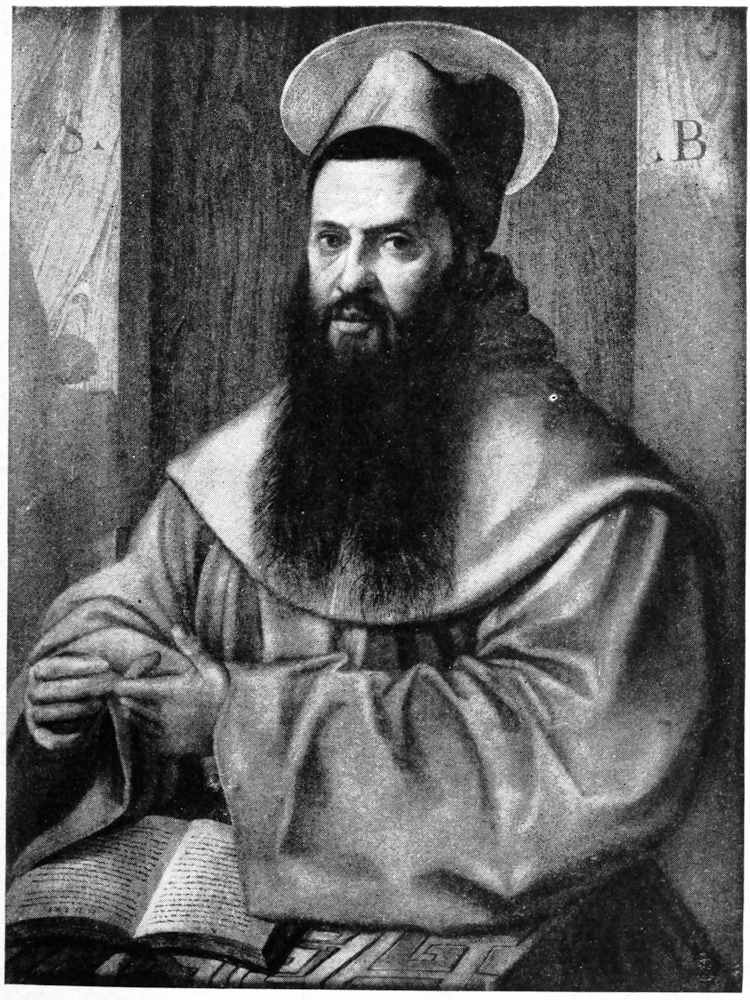
Photo. Alinari
ST. BONAVENTURA.—A. BRONZINO
(Academy, Florence.)
In 1256 he was made General of the Franciscan Order and restored the harmony which had previously been threatened by factional dissensions. He declined the archbishopric of York, but later Gregory X. made him Cardinal and Bishop of Albano. When the two nuncios of the pope brought him the cardinal’s hat they found him in the garden of a little Franciscan convent near Florence, washing the plate from which he had just dined. He told them to hang the hat on the bough of a tree until he could take it in his hands. Hence in pictures of this saint the cardinal’s hat is often seen hanging on a branch of a tree. He died at the age of fifty-three and was buried in the Franciscan Church at Lyons, and was canonised by Sixtus IV. in 1462. During the wars of the League, the Huguenots broke into his shrine and threw his ashes into the river Saône.
According to a Spanish legend, having left his Life of St. Francis unfinished when he died, he returned to earth for three days and completed it.
In devotional pictures, sometimes he wears the cope over the grey habit of his order, with the mitre on his head, as Bishop of Albano, and the cardinal’s hat at his feet, or on the branch of a tree. Sometimes he wears only the Franciscan habit, and carries the sacramental cup in his hand, or it is borne by an angel. Occasionally he is attired in the crimson robes and hat of a cardinal, with a book in his hand, the symbol of his great learning.
St. Louis of France. Lat. Sanctus Ludovicus Rex. Ital. San Luigi, Rè di Francia.
Louis IX. was born at Poissy in 1215. He was the son of Louis VIII. and Blanche of Castile—the Louis and Blanche who figure in Shakespeare’s King John. Gibbon says of St. Louis that he united the virtues of a king, a hero, and a man. Voltaire said of him, Il n’est guère donné a l’homme de pousser la vertu plus loin. He had the most intense veneration for relics, and when Baldwin II. approached him for aid, he at once granted him “succors in men and money” in exchange for the “holy crown of thorns.” Louis, barefoot and bareheaded, brought this precious relic himself from Sens to Paris; and having obtained also a small piece of the true cross, he built for these treasures the chapel since called La Sainte Chapelle (Paris).
In 1247, after a dangerous illness, he sent for the Archbishop of Paris and asked for the cross of a crusader, and, in spite of the grief and remonstrances of friends, as soon as his health permitted he sailed for Egypt with an army of fifty thousand men, including the flower of the French nobility. Most of his followers perished, and Louis was taken prisoner. His belief in the goodness of his cause never wavered, however. When ransomed he spent three years in Palestine, and then returned to France, where he reigned sixteen years and then, never having laid aside the cross, he started on a second crusade, landing in Africa. His troops, affected by the climate, perished miserably; and Louis died in his tent, lying upon ashes, and wearing the garb of a penitent. He was canonised by Boniface VIII. in 1297, twenty-seven years after his death. Part of his body was carried by Charles of Anjou to Palermo, and placed in the church of Monreale; the rest was placed in a shrine at St. Denis, which was destroyed in the first French revolution.
Pictures of St. Louis are found in Franciscan churches, the Franciscans claiming that he put on the habit of the “Third Order of Penitence” before starting on his first crusade, and that he died in the habit and cord of St. Francis.
The proper attribute of St. Louis is the crown of thorns, which he holds in one hand, his sword in the other, and the royal crown and sceptre at his feet. When painted in the grey habit and cord of the Franciscans, he wears the crown of royalty.
St. Louis of Toulouse. Ital. San Ludovico Vescovo.
Louis of Anjou was the nephew of St. Louis, King of France, and son of Charles of Anjou, King of Naples and Sicily. When Louis was fourteen, his father was taken prisoner by the King of Aragon, and was obliged to deliver up his three sons as hostages. Louis spent several years in captivity, and the hardships he endured broke his gentle spirit, and, on regaining his freedom in 1294, he resigned all his rights to the kingdom of Naples to his brother Robert, and entered the Order of St. Francis. Soon afterwards he was made Bishop of Toulouse and set out for his new office barefooted, and dressed as a friar. Although his life there was short, he endeared himself to his people by his gentleness and charity. Two years later he died, in his twenty-fourth year, in his father’s castle in Provence, where he had gone on a charitable mission. He was canonised in 1317 by Pope John XXII., and his remains are enshrined at Valencia.
In art he is represented as young, beardless, and of gentle face, wearing the episcopal robes over the Franciscan habit. The fleur-de-lys is embroidered on his cope, or on some part of his dress. The crown he resigned is at his feet. He wears the mitre as bishop, or carries it in his hand, or it is borne by an angel.
St. Bernardino of Siena. This saint was born of a noble Sienese family, and from his youth upward was distinguished for his personal beauty and grace, united to such intelligence and purity of character, that his presence alone sufficed to restrain and hush the most vulgar of tongue. At seventeen, he entered a confraternity that cared for the poor and the sick, and when a pestilence broke out in Siena, he and twelve other young men took entire charge of the plague hospital for four months. He escaped the contagion, but his health was never strong afterwards.
He entered the Franciscan Order at twenty-three, and became one of their most celebrated preachers. His influence for good was unbounded, and his hearers, even the hardest sinners, were melted to tears. Thieves made restitution; gamblers threw away their cards; enemies became reconciled, and women cast their jewels at his feet. Wherever he went he preached peace, and when preaching he held in his hand a tablet on which was the name of Jesus in a circle of golden rays.[10] A manufacturer of cards and dice complained to Bernardino that since his preaching his business had been ruined. The saint advised him to make these tablets instead, and sell them to the people; which he did, and the desire for them became so general that he realised a fortune. St. Bernardino is said to have founded the Monte-di-Pietà, for lending money on small pledges to the very poor. These institutions are still called in France Monts-de-Piété. He was founder of a reformed Order of Franciscans, called in Italy Osservanti because they observed the Rule of St. Francis, went barefoot, and professed absolute poverty. He refused three bishoprics, and died at Aquila in the Abruzzi, where his remains are enshrined in the church of San Francesco. He was canonised by Pope Nicholas V. in 1450, and is venerated throughout all of Italy.
In devotional figures his peculiar attribute is the tablet, with I. H. S. encircled with rays, which he holds in his hand. Another attribute is the Monte-di-Pietà, a little green hill of three mounds, and on the top a cross or standard, on which is the figure of the dead Saviour—usually called in Italy a Pietà. Sometimes three mitres, in allusion to the three bishoprics, he refused.
St. Dominick. Lat. Sanctus Dominicus. Ital. San Domenico. Spa. San Domingo. Fr. Saint Dominique.
This saint was the founder of the Order of Dominicans or Preaching Friars, and was a Castilian of an illustrious family. Before he was born his mother dreamed that she had given birth to a black and white dog holding a lighted torch in its mouth. At his baptism a star descended from heaven and settled on his brow. These were interpreted as signs that he would be a light to the world and he early showed his ascetic and saintly nature.
He studied theology at Valencia and became a canon of St. Augustine while still very young. When about thirty, he went to France on a political mission with the Bishop of Osma, and passed through the land of the Albigenses. Their heresies were so shocking to Dominick that he felt that his vocation lay in forming an order of preachers for the conversion of heretics. He went to Rome in 1207 and obtained permission from the pope to preach in the Vaudois to the Albigenses. Here miracles aided him. A writing of Dominick’s, defending the Catholic faith, thrice cast into the fire, is said to have thrice leaped out uninjured, while a writing of the heretics was instantly consumed. This converted many.
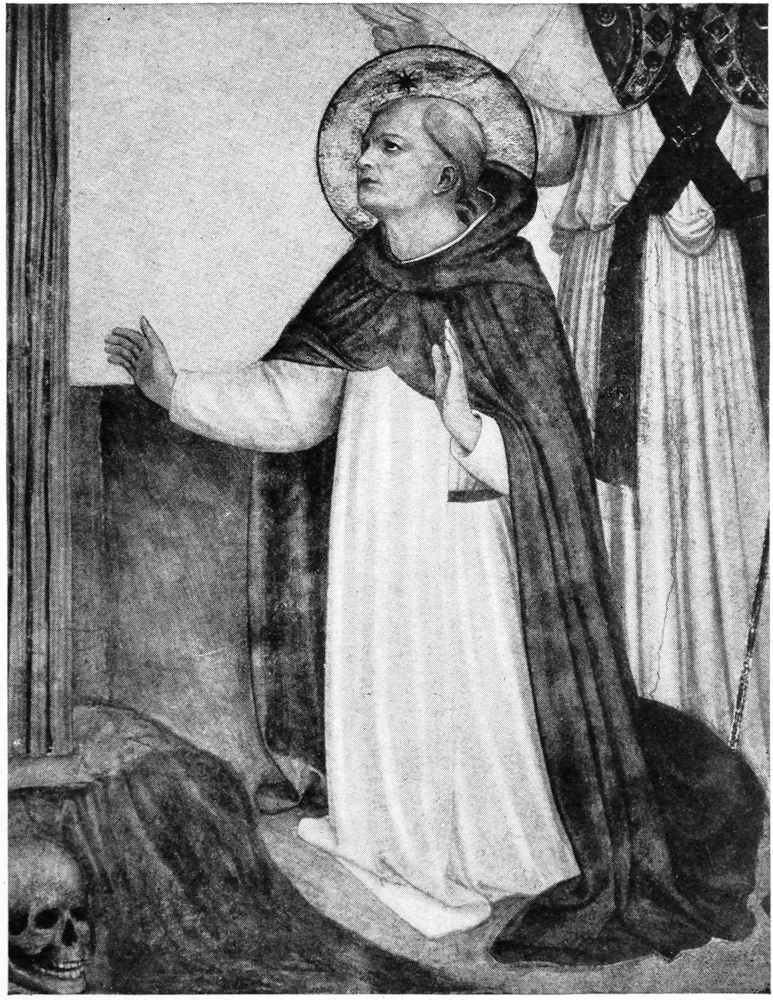
Photo. Alinari
ST. DOMINICK. DETAIL FROM THE CRUCIFIXION.—FRA ANGELICO
(San Marco, Florence.)
A fierce religious war broke out about this time against the Albigenses. How far Dominick took part in this is hotly disputed. For several centuries public opinion considered him the founder of the Inquisition, and it was believed that he directed the persecutions from the beginning. His defenders, however, assert that he was filled with horror at the barbarities committed in the name of Christ. St. Dominick instituted the rosary, which was received with enthusiasm and made more converts than all his orthodoxy. He founded many convents in the principal cities of Europe, preaching wherever he went. Bologna became the chief Dominican centre, and here St. Dominick died in 1221, worn out by his labours. He was canonised in 1233 by Gregory IX.
The devotional figures of St. Dominick represent him in his habit—the white tunic, white scapulary, and long black cloak with a hood. In one hand a book, in the other a lily. A star is on his forehead, or just above his head. The dog with a flaming torch in its mouth is his peculiar attribute, but in pictures is often omitted.
St. Peter Martyr. St. Peter the Dominican. Fr. Saint Pierre le Dominican, Martyr. Ital. San Pietro or San Pier Martire.
He was born at Verona in 1205. His parents belonged to the heretical sect of the Cathari, but sent Peter to a Catholic school, and St. Dominick persuaded him to take the Dominican habit at the age of fifteen. He became an eminent preacher and was noted for his intolerance and cruelty to the heretics with whom he had formerly been associated. Pope Honorius III. made him Inquisitor General. He was not loved in his lifetime even by his own brotherhood, and his harsh persecutions made him universally detested. Finally two noblemen, who had suffered at his hands, hired assassins to waylay him in a wood through which he and a lay brother must pass on their way from Como to Milan. Peter was struck down by a blow from an axe. Then the ruffians pursued his attendant, and stabbed him. Returning, they found that Peter had risen to his knees and was reciting the Apostles’ Creed; or, as others say, was writing it on the ground with his blood. He had just finished the word Credo when they rushed on him, and pierced him through with a sword. He was canonised in 1253 and is one of the most popular saints in Italy.
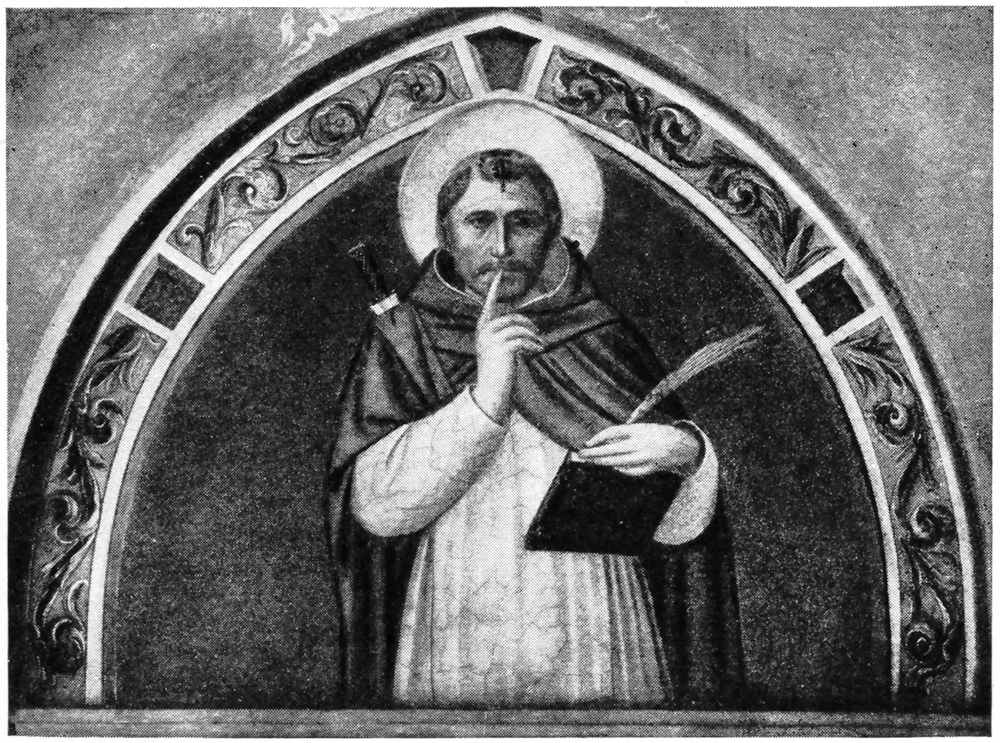
Photo. Alinari
ST. PETER MARTYR.—FRA ANGELICO
(San Marco, Florence.)
In devotional art, he wears the Dominican habit, carries the crucifix as preacher, and the palm as martyr, which, if not in his hand, is at his feet. His peculiar attribute is the gash in his head, with blood trickling from it, or the axe or sabre stuck into his head.
St. Thomas Aquinas. Ital. San Tomaso di Aquino, Dottore Angelico.
St. Thomas Aquinas, called the “Angelic Doctor,” ranks with the Four Great Doctors of the Western Church. He was born at Belcastro in 1226. He was of noble lineage, his father being Count of Aquino, and connected both by descent and marriage with several of the royal families of Europe. Thomas was sent to the Benedictines at Mt. Cassino, where he showed himself so precocious that when ten years of age his masters declared they could teach him no more. The splendour of his father’s home filled him with humility, rather than pride. He was gentle, thoughtful, and silent, and from childhood was remarkable for the sweetness of his temper.
After a few years, he was sent to the new University of Naples, where he was noted for his devotion to study and the singular purity of his life. At seventeen he received the habit of the Dominican Order. His relatives were violently opposed to this, and seized and imprisoned him in a tower of his father’s castle, allowing no one to see him but his two sisters. After many months, aided by one of his sisters, whom he had converted, he made his escape and returned to the convent, where he took his final vows. The modesty with which he concealed his profound learning gave him the nickname of Bos, the ox. Later he studied in Cologne and his master exclaimed one day, when his brilliant answers had astonished them all, “This dumb ox shall give such a bellow in learning as all the world shall hear.” His reputation steadily increased until he was acknowledged the greatest theological writer and teacher of his age. His works are still held as authority and of great value. He died in his fiftieth year and was canonised in 1323.
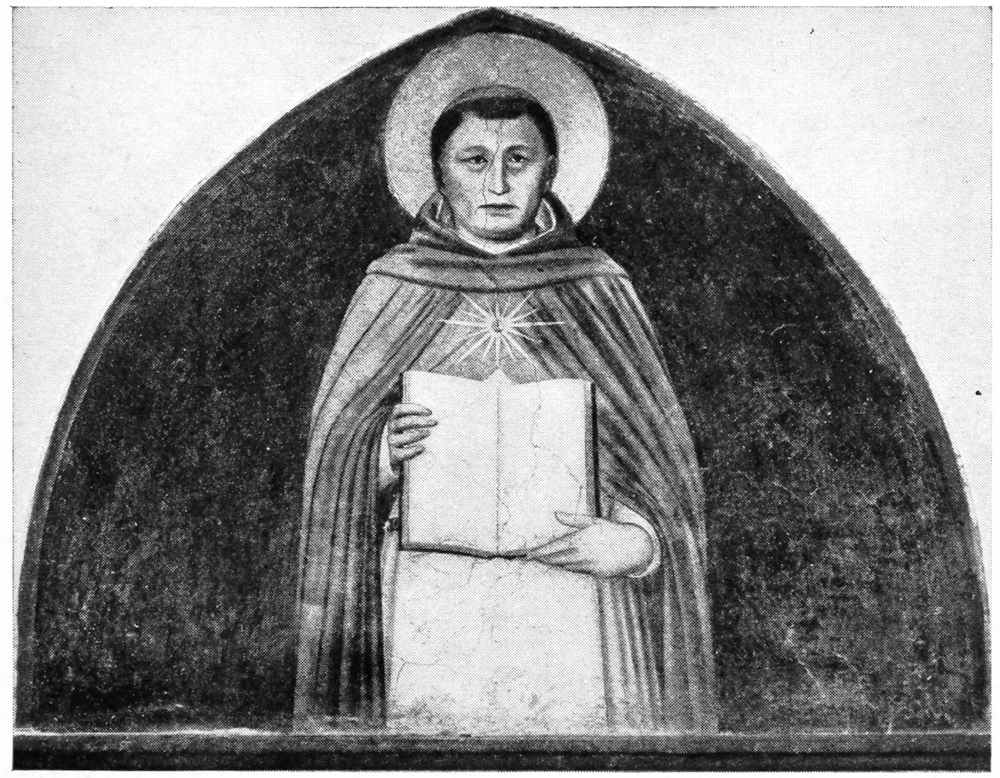
Photo. Alinari
ST. THOMAS AQUINAS.—FRA ANGELICO
(San Marco, Florence.)
He is represented in the Dominican habit, often writing, with the dove, emblem of inspiration, hovering about him. His attributes are a book, or books; the pen, or ink-horn; the sacramental cup, on account of his having composed the Office of the Sacrament, still in use; on his breast a sun, and sometimes a human eye within it to express his far-seeing wisdom.
St. Catherine of Siena. Lat. Sancta Catherina Senese. Ital. Santa Caterina di Siena.
Volumes have been filled in chronicling the deeds and visions of this remarkable saint, known at Siena as “la Santa.” She was born in Siena in 1347. Her father, Giovanni Benincasa, was a dyer by trade. Catherine was the youngest and most beloved of all the children and was fair and gay and graceful, but (unlike other children), visionary, solitary, and strange. She had heard of Catherine of Alexandria and prayed that she also might become the bride of Christ, and at eight years of age she took secret vows of perpetual chastity.
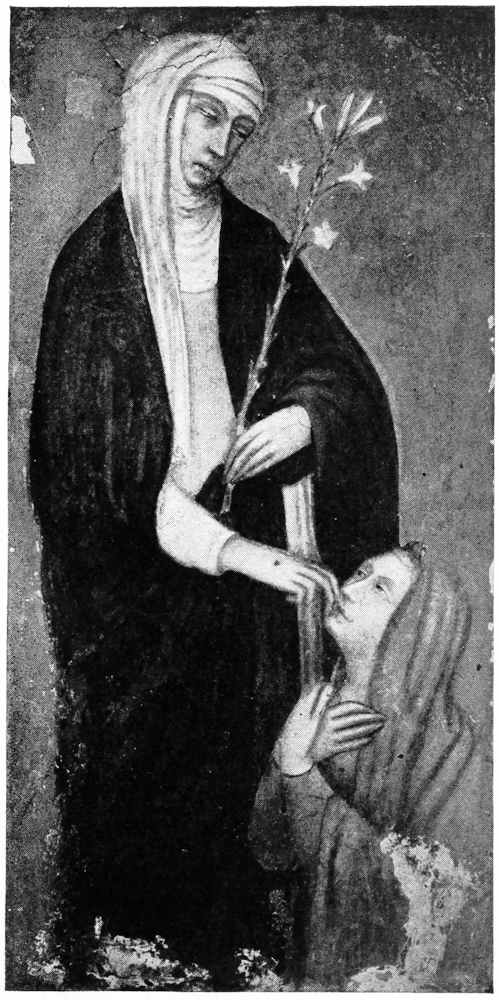
Photo. Alinari
ST. CATHERINE OF SIENA.—VANNI
(Church of San Domenico, Siena.)
As she grew up her vigils and penances and love of solitude seemed nonsensical to her parents, who desired her to marry. Angered by her refusal, they treated her harshly, putting all sorts of menial duties upon her, until her father, entering her chamber one day, found her kneeling in prayer, and resting on her head was a snow-white dove. He now saw that she was protected by the Holy Spirit, and believing in her vocation he allowed her to go her own way. She was received in the convent of St. Dominick as a penitent of the Third Order, but never became a professed nun. She vowed herself to silence for three years, practised all sorts of self-denials, going to the convent church every day, where she had wonderful visions. Her charity to the poor was boundless. She nursed the sick, no matter how repulsive the disease, and converted by her eloquence so many wicked persons and unbelievers that her fame spread through all of Italy.
When the Florentines were excommunicated by Pope Gregory VI. they chose Catherine of Siena for their ambassador and mediator. She went to Avignon, where the pope then resided, and displayed such discretion and wisdom that the pope left it to her to decide the terms of peace. It was by her influence and persuasions that the pope was induced to return to Rome, and once more make the seat of government in the Lateran. After the death of Gregory, in the Great Schism that followed, she took the part of Urban VI., who appointed her his ambassador to the court of Joanna II. of Naples. But in the midst of this her health failed, and she died at thirty-three, worn out with fasting, labour, and suffering.
It is related that while praying before a crucifix at Pisa she fell into a trance and received the stigmata, which miracle she tried to conceal, but it was known by many. Others assert it was not impressed visibly on her body, but on her soul.
She would often pray for a new heart, and once, it is related, our Saviour appeared to her in a vision, took her heart from her bosom and replaced it with His own, and there remained a wound or scar on her left side from that time. Her letters and writings are principally upon devotional subjects, written in very pure Italian.
In art St. Catherine is distinguished by the Dominican habit and the stigmata. She usually bears the lily. A book in her hand alludes to her writings.