XII.—THE FOUR EVANGELISTS
Reading edition
The earliest symbol used to typify the Four Evangelists was four scrolls placed in the four angles of a Greek cross, or four books, representing the Gospels. Next came the four rivers whose source was in paradise.
Their conventional symbols, the angel or man for St. Matthew, the lion, winged, for St. Mark, the ox for St. Luke and the eagle for St. John are derived from the Apocalypse (Rev. iv., 7). The Four Beasts are also found in the prophecy of Ezekiel (chap. i., 10). How early these “four mysterious creatures” were adopted as symbols of the Four Evangelists is not known. They are found in the fifth century, and in the seventh century were universally recognised as fixed attributes.
It was thought that the cherub or man was given to St. Matthew because he dwelt more upon the human side of Christ; the lion to St. Mark because he was called the “Historian of the Resurrection,” and the revival of the lion’s cub symbolised the resurrection, also because he begins his Gospel with the mission of the Baptist—“the voice of one crying in the wilderness”—the lion typifying the wilderness; the ox to St. Luke because it was the emblem of sacrifice, and Luke in his Gospel dwelt more especially upon the priesthood of Christ; to St. John the eagle because it was the emblem of the highest inspiration.
“Rupertus considers the Four Beasts as typical of the Incarnation, the Passion, the Resurrection, and the Ascension; an idea previously dwelt upon by Durandus, who adds that the man and the lion are placed on the right because the incarnation and the resurrection are the joy of the whole earth; whilst the ox is on the left, because Christ’s sacrifice was a trouble to the apostles; and the eagle is above the ox as suggestive of our Lord’s upward flight into heaven. According to others, the proper order in the ascending scale is thus: at the lowest point on the left, the ox; to the right, the lion; above the ox, the eagle; and above all, the angel. So in Raphael’s Vision of Ezekiel [Pitti, Florence] the angel gazes into the face of the Holy One, the others form His throne” (Mrs. Jameson).
Many ideas are conveyed in these apparently fanciful symbols. Sometimes in church decoration the Four Evangelists are grouped with the Four Greater Prophets, thus expressing the old and the new law. Sometimes, particularly in stained glass, they are represented with the Four Doctors, the evangelists appearing as witnesses and the doctors as interpreters of the faith. A curious painting of the Four Doctors is seen in the Louvre, in which the doctors are given not only their own symbols, but also the symbols of the Four Evangelists.
St. Matthew. Lat. S. Mattheus. Ital. San Matteo. Fr. St. Mathieu. Ger. St. Matthäus.
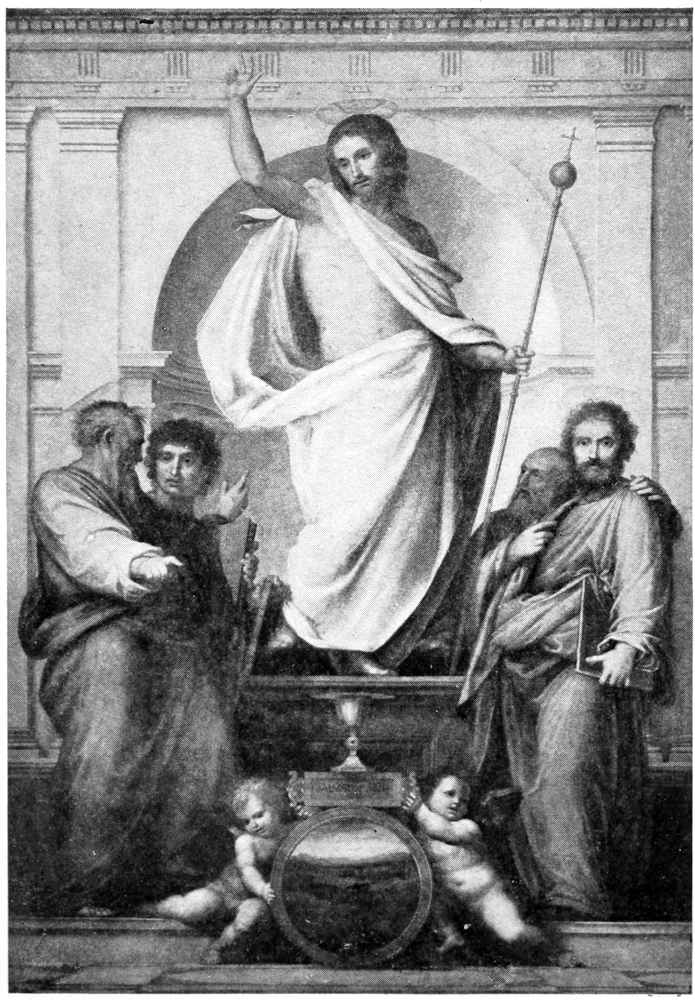
Photo. Alinari
CHRIST AND THE FOUR EVANGELISTS.—FRA BARTOLOMMEO
(Pitti Palace, Florence.)
St. Matthew ranks seventh or eighth among the apostles, but is first as evangelist, because his Gospel was supposed to be the first that was written. Scarcely anything is known of his history, except that he was a Hebrew who served the Romans as a publican or tax-gatherer and that his original name was Levi.
After the ascension he is said to have gone to Egypt and Ethiopia, preaching the Gospel, and to have remained there twenty-three years. While there he overcame two terrible magicians, raised the son of the King of Egypt from the dead, and healed his daughter of leprosy. He is believed to have perished in the reign of Domitian, A. D. 90, but the manner of his death is in doubt. By some it is believed that he suffered martyrdom by the sword or spear, but, according to the Greek legends, his end came peacefully.
St. Matthew is not a favourite in art and is seldom represented alone or in devotional pictures. As evangelist he holds a book or a pen, and the angel, his proper symbol, stands by dictating or pointing up to heaven. As apostle he frequently holds a purse, or money bag, signifying his former occupation.
St. Mark. Lat. S. Marcus. Fr. St. Marc. Ital. San Marco Evangelista. Ger. Der Heilige Marcus.
According to the traditions accepted in the Roman Church, St. Mark was not one of the twelve apostles, but was a convert of St. Peter’s and became his favourite disciple. While in Rome he wrote his Gospel for the use of the Roman converts—some say from the dictation of St. Peter. He founded the Church of Alexandria, the most renowned of all the early Christian churches, but the wrath of the heathen became so great, because of his miracles, that they seized him while he was worshipping one day and, binding him, dragged him up and down the streets and highways, and over the most stony and rocky places, until the breath left his suffering body. The legends relate that, as his soul departed, a terrific tempest of hail and lightning descended suddenly from the skies, by which his murderers were instantly scattered and destroyed.
The Christians of Alexandria buried his mangled remains, and his tomb there was held in reverence for several centuries. But about 815 A. D. some Venetian merchants carried off the relics and brought them to Venice, and the magnificent Church of St. Mark was built over them. Since that time St. Mark has been honoured as the patron saint of Venice, and his legendary history has supplied the Venetian painters with many beautiful and picturesque subjects.
When represented as one of the Four Evangelists, alone or grouped with others, his symbol is almost invariably the lion—winged or unwinged, but usually winged—distinguishing him from St. Jerome, who also has the lion as a symbol, but always unwinged. In devotional pictures St. Mark often wears the habit of bishop, as the first Bishop of Alexandria, holding his Gospel in his hand.
St. Luke. Lat. Sanctus Luca. Fr. Saint Luc. Ital. San Luca.
Little is known of the real history of St. Luke. He was not an apostle, and like St. Mark, is supposed to have been converted after the ascension. He was a beloved disciple of St. Paul, and accompanied him to Rome and remained with him until the last. After the martyrdom of St. Peter and St. Paul he preached the Gospel in Greece and Egypt, but whether he suffered martyrdom or died a natural death is merely conjecture. There is some occasion for the belief that Luke was a physician, and there is a legend that makes him a painter and represents him as painting the portrait of the Virgin Mary, but this is not confirmed by any of the earlier traditions. Because of this legend, however, he was made the patron saint of painters.
St. Luke is usually represented with his Gospel, and his attendant ox, winged or unwinged; but in Greek art and the art which came under the Byzantine influence, he is represented as evangelist, young and without beard, holding the portrait of the Virgin as his symbol in one hand, and his Gospel in the other.
St. John. Lat. Sanctus Johannes. Ital. San Giovanni Evangelista. Fr. Saint Jean, Messire Saint Jehan. Ger. Der Heilige Johann.
St. John was the son of the fisherman Zebedee, and with his brother James was among the first followers of Christ.
In the legends of St. John, after the death of the Blessed Virgin he went into Judæa preaching the Gospel, and then into Asia Minor, where he founded the Seven Churches. During the persecution under Domitian, he was sent in fetters to Rome and was cast into a caldron of boiling oil, but he came out of it unharmed. He had other miraculous escapes, and being accused of magic was exiled to the island of Patmos, where he wrote his Revelation. He was released after Domitian’s death and returned to his church at Ephesus. He died there a few years later, being nearly a century old.
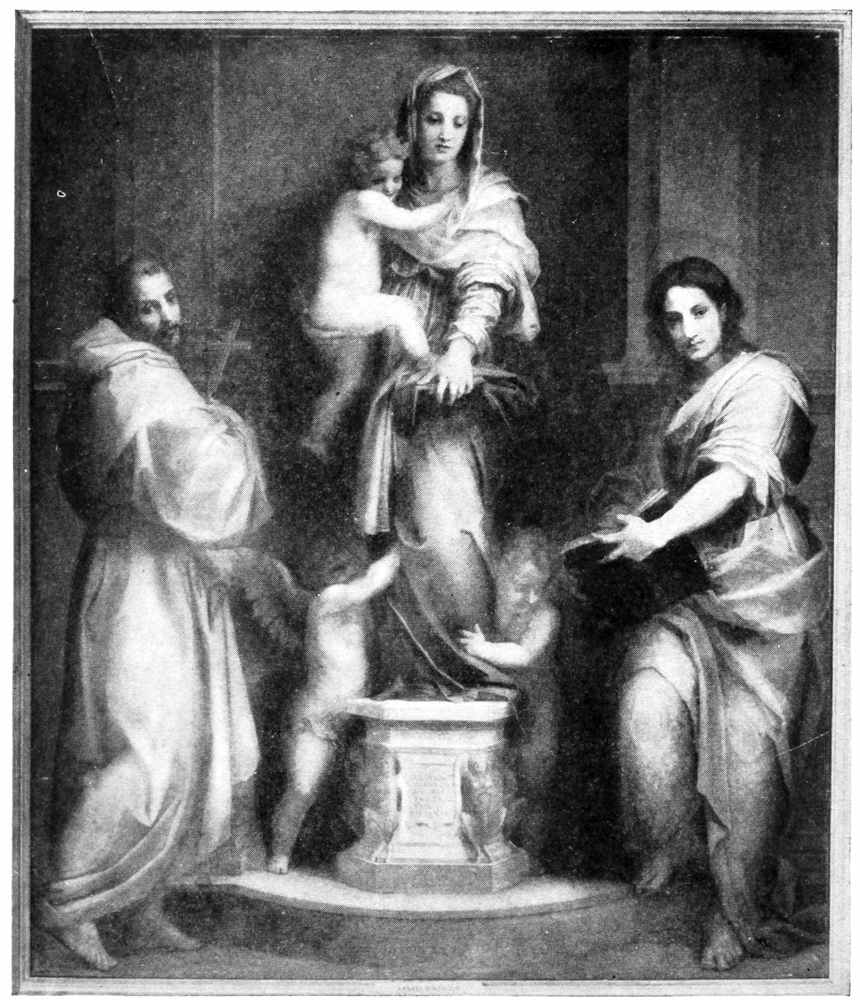
Photo. Alinari
MADONNA OF THE HARPIES WITH ST. FRANCIS AND ST. JOHN, EVANGELIST.—ANDREA DEL SARTO
(Uffizi, Florence.)
A legend that is often represented in art is, that when he returned to Ephesus he met a funeral procession and was told that it was that of Drusiana, at whose house he had formerly dwelt. Bidding them set down the bier, he prayed that she might be restored to life, and she arose and walked to her house, the apostle going with her.
He is popular as a patron saint, and pictures of him are more numerous than of any of the other evangelists. These represent him—as evangelist, apostle, or prophet.
In early art St. John is an aged man with white hair and long white beard, but with the later painters St. John as evangelist, although nearly a century old, is represented as beardless, with light curling hair, and has all the attributes of the youthful apostle. He is sometimes seated, with his pen and his book,—sometimes standing; the attendant eagle is always near him and frequently holds the pen or ink-horn in its beak.
In his second character, or as one of the series of apostles, St. John is represented in Western art as young and beardless, with pale brown or golden flowing hair, and a face full of sweetness, candour, and gentleness. His mantle is red in colour and the tunic blue or sometimes green. He holds in his hand the sacramental cup from which a serpent is seen to appear. St. Isidore relates that at Rome an attempt was made to poison St. John in the cup of the sacrament; he drank of the same and administered it to the communicants without injury, the poison having by a miracle vanished from the chalice in the form of a serpent, but the hired assassin fell down at his feet dead. According to another account, the poisoned cup was given to him by order of the Emperor Domitian. Another legend relates that Aristodemus, the high-priest of Diana at Ephesus, dared him as a test of the truth of his mission to drink of the poisoned chalice. St. John drank unharmed, but the priest dropped dead. Yet another interpretation is that the cup in the hand of St. John alludes to Christ’s reply when the mother of James and John demanded for her sons that they be given a place of honour in heaven,—“Ye shall indeed drink of my cup.”
In his third character of prophet and writer of the Revelation St. John is generally represented in art as very old with a white, flowing beard, seated in a rocky desert; the sea in the distance or around him, representing the island of Patmos; he has the eagle at his side.