XVII.—THE PATRON SAINTS OF CHRISTENDOM
Reading edition
All saints may be considered patron saints either of some trade or industry, or of some especial province or city. But there is a vast difference between those whose fame is confined to a certain locality—as St. Januarius, who is worshipped only in Naples, St. Corentin, who is little known out of Brittany, or St. Denis, whose name belongs almost exclusively to France—and those other great saints who are reverenced in all the countries of the world alike.
These are St. George, St. Sebastian, St. Christopher, SS. Cosmo and Damian, St. Roch and St. Nicholas, and the four virgin patronesses, St. Catherine, St. Barbara, St. Margaret, and St. Ursula. Although without the apostolic and scriptural sanction accorded to St. Peter of Rome, and the other great apostles, these saints have been from earliest times the object of universal faith and worship, and invested with a pre-eminent dignity and authority that puts them in a class by themselves.
St. George of Cappadocia. Lat. Sanctus Georgius. Ital. San Giorgio. Fr. St. Georges. Ger. Der Heilige Georgius, or Jorg or Georg.
St. George was born in Cappadocia of a noble family. His parents were Christians and he was a tribune in the Roman army. One time as he was on his way to join his legion, he came to a city in Libya called Selene, whose inhabitants were in terror of a fearful dragon, who lived in a marsh outside the walls, and devoured their flocks and herds. These being gone, the people, fearing the dragon might enter the city, sent out daily two sheep to appease his hunger, and when they had no more sheep left they were forced to sacrifice each day two children who were chosen by lot, and sent forth to be devoured.
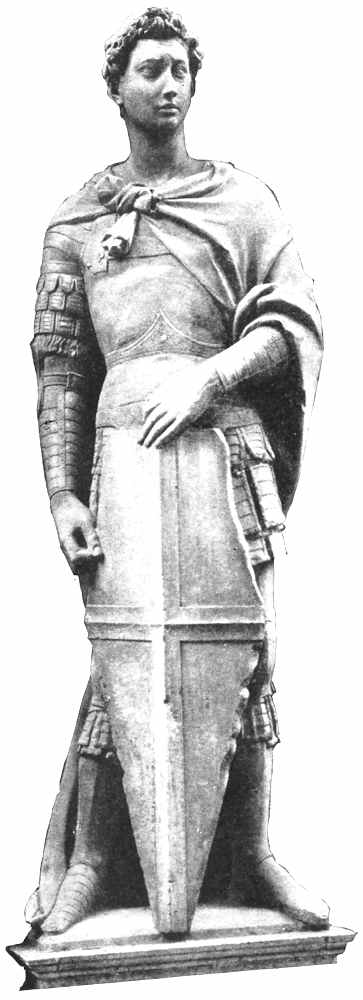
Photo. Alinari
ST. GEORGE.—DONATELLO
(Bargello, Florence.)
The king had one daughter, Cleodolinda, who was very beautiful, and at last the lot fell to her. So she went forth to die for the people, weeping sadly as she walked toward the dwelling of the monster. At this moment St. George, who was riding by, saw her and wondered why so fair a maiden should be in tears. He asked her her sorrow and when she told him, he said: “Fear not, for I will deliver you.” She begged him to fly lest he, too, perish, but St. George refused, saying, “I will save thee through the power of Jesus Christ.” Just then the dragon came forth from his lair and rushed toward them. St. George made the sign of the cross, and calling on the name of our Saviour, spurred toward the monster, and after a terrible battle pinned him to earth with his lance. Then, binding him with the girdle of the princess, he told her to lead the conquered brute back to the city, and she did, the dragon following after them like a dog. Seeing this, the king and the people believed, and were baptised—twenty thousand in one day. St. George killed the dragon and cut off his head, and the king heaped treasures upon the knight, but he gave all to the poor, and went on his way to Palestine.
Seeing there the edict of Diocletian against the Christians on the gates of the temples and in the market-place, he tore it down and trampled it under his feet. For this he was seized, and suffered most cruel tortures for eight days and was finally beheaded. The veneration paid him in England dates from the time of Richard I., who in the wars of Palestine put himself and his army under the protection of St. George. His feast was ordered to be kept as a holiday in England in 1222, and the Order of the Garter was instituted in 1330.
In single devotional pictures St. George is young or in the prime of life, dressed in armour. He bears in one hand the palm and in the other the lance, from which sometimes depends a red banner. His expression is uplifted and triumphant, the slain dragon is at his feet. This representation is allegorical, showing the victory of faith over the powers of evil. St. George and the Dragon becomes historical when accessories are introduced, such as the princess, or the walls of the city and the combat still undecided. The dragon of St. George never has the human or satanic form, as in the legend of St. Michael.
He is particularly honoured by the Greeks, who gave him the title of The Great Martyr.
St. Sebastian. Lat. Sanctus Sebastianus. Ital. San Sebastiano; or San Bastiano. Fr. St. Sébastien.
St. Sebastian was born at Narbonne in Gaul, of noble parents, and when very young was made commander of a company of the Prætorian Guards and was thus brought near the Emperor Diocletian, with whom he was a favourite. Secretly a Christian, his position as a soldier enabled him to protect many who were persecuted for Christ’s sake. He had two friends among the soldiers, who had endured torture bravely for being Christians; but upon being led forth to die, their families implored them to recant, and as they were moved by their supplications and about to weaken, St. Sebastian rushed forward and urged them to die rather than renounce our Saviour. All present were so influenced by his eloquence, that the families of the condemned, and even the judges, became converted and baptised, and Marcus and Marcellinus met their death gloriously.
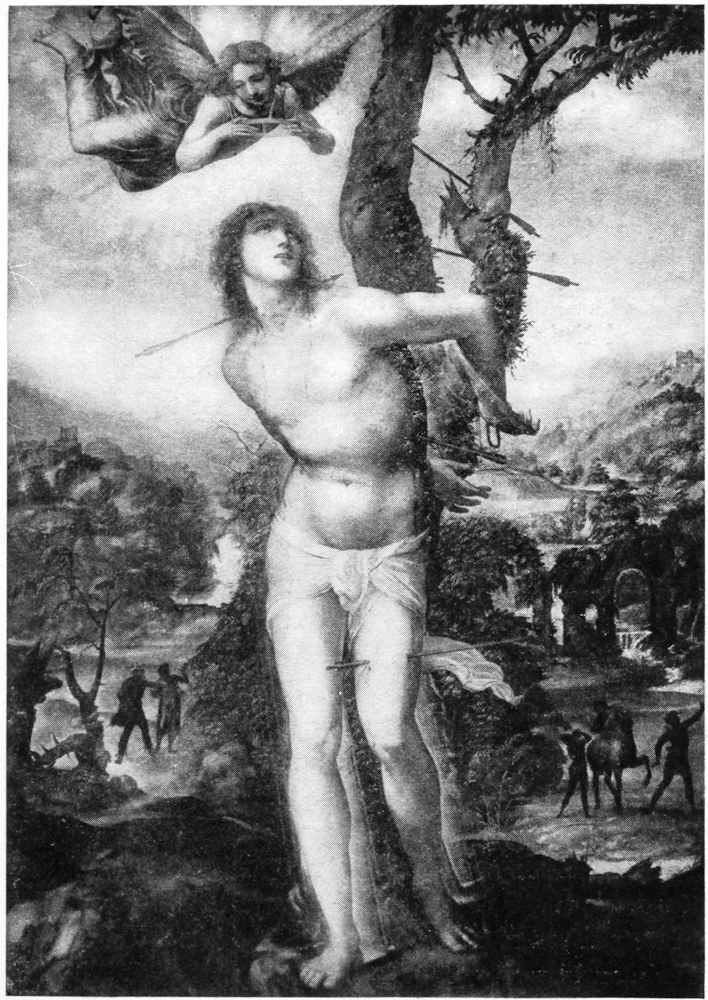
Photo. Alinari
ST. SEBASTIAN.—SODOMA
(Uffizi, Florence.)
Sebastian was then denounced as a Christian, and the emperor, who loved him, reasoned with him privately, but Sebastian was firm, and Diocletian ordered him bound to the stake and shot to death with arrows, and that there should be inscribed on the stake that he was without fault except that of being a Christian. The archers pierced him with arrows and left him for dead, but Irene, widow of a martyred friend, coming to take his body away, found him still living and took him home and nursed him back to health. His friends urged him to flee from Rome, but instead he presented himself to Diocletian and reproached him for his intolerance and cruelty, and the emperor, enraged, had him seized and put to death with clubs.
In pictures St. Sebastian is always young and beautiful, undraped, bound to a tree or column, and pierced by one or many arrows. Arrows from the most ancient times were the emblem of pestilence, so they symbolise the shafts of pestilence, and are also the attribute of the martyrdom and power of the saint, who has been considered from the earliest days of Christianity as patron saint against plague and pestilence—there being, according to the legends, hardly a city in Europe that has not been saved by his intercession.
The pathos of his story, added to his courage, and youth, and beauty, has made St. Sebastian the favourite saint of Italian women, particularly the women of Rome.
St. Christopher. Lat. St. Christophorus. Ital. San Cristofero, or Cristofano. Fr. St. Christophe, or St. Christofle. Ger. Der Heilige Christoph.
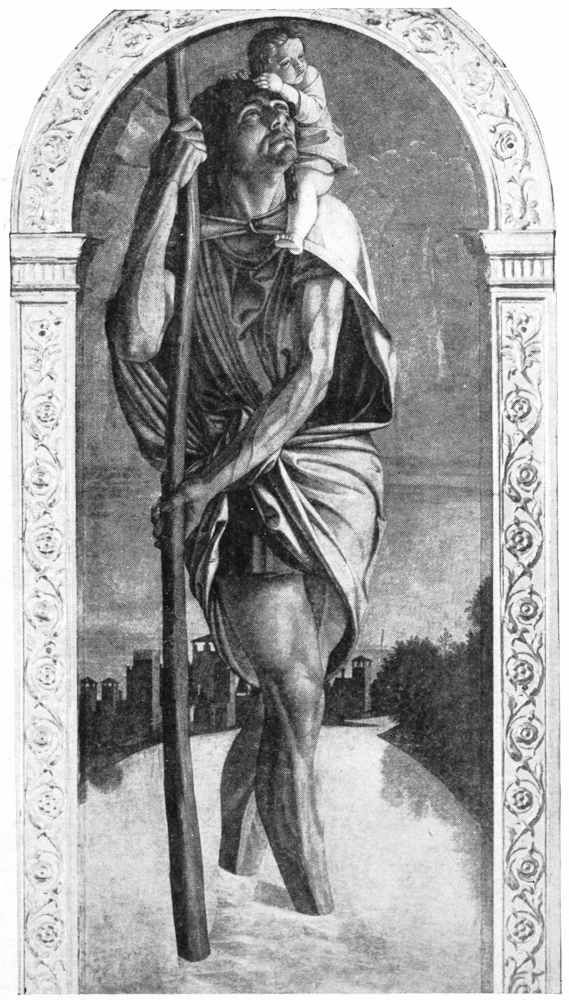
Photo. Alinari
ST. CHRISTOPHER.—GIOVANNI BELLINI
(Church of SS. Giovanni e Paolo, Venice.)
There was a giant of the land of Canaan, whose name was originally Offero. Being very proud of his size and strength, he was determined to serve no other than the most powerful monarch in the world. So he travelled to the court of a king whose fame was greater than all others, and the king gladly accepted him as his servant. Before long Offero noticed that when the name of Satan was mentioned the king trembled, and he asked him, “Who is this Satan at the mention of whose name thou crossest thyself?” The king answered, “He is as wicked as he is mighty, and I fear lest he slay me.” Then Offero knew there was one greater than the king, and he sought and entered into the service of Satan.
One day as they journeyed, they came to a cross by the wayside, and when the devil saw it he turned back and went a long distance out of his way to avoid it. Offero questioned him as to this, and the devil replied: “’T was on this cross that Jesus died, and He it is whom I fear.” Offero said: “Since thou fearest Him, He is greater than thou and Him will I serve.” So he left Satan and went in search of Christ; and he came to a hermit who taught him concerning Jesus, and desired him to fast and pray. Offero would not fast and knew not how to pray, saying, “Such service is for weak ones, not for me.” So the hermit said: “If thou wouldst use thy strength, go to a certain river that is swollen with the rains, and whose current is so swift that many perish, and help all who struggle with the waves. This is a service for Christ and He may accept thee.” Offero went joyfully, and built himself a hut by the side of the river, and rooting up a palm tree, he used it for a staff, and aided all who wished to cross the stream.
One night he heard a child’s voice calling him. He arose and went out, but could find no one. Again the voice called and again he searched in vain. The third time that he heard it, he went forth with his lantern, and found a little child sitting by the water’s edge, who begged to be taken over, and Offero placed him upon his shoulders, took his staff, and began to cross the stream; but a storm arose and the current became swift as never before, and the weight of the child grew heavier and heavier, and Offero feared that they both would be lost, but he struggled on bravely until, exhausted, he reached the other shore, and putting the child safely down, he cried, “Whom have I borne! Had it been the whole world the burden had not been heavier!” The child replied, “Thou hast borne not only the whole world but Him who made it, upon thy shoulder. Thou wouldst serve Christ, and behold! I have accepted thee.” Then Offero confessed and worshipped Christ.
From there he went to Samos, where he was taken as a Christian before the king, who said: “Who art thou?” and Offero replied: “My name was Offero the Bearer, but now I serve Christ, whom I have borne on my shoulders, and am called Christ Offero, the bearer of Christ.” St. Christopher was scourged and beheaded, and as he was about to die he prayed that all who beheld him, believing in our Saviour, should not suffer from fire, earthquake, or tempest. The sight of his image is thought to give strength to the weak, and prevent all evils from accident. The following inscription often accompanies his pictures:
“Christophori Sancti speciem quicumque tuetur, Illo namque die nullo languore tenetur.” “Whoever shall behold the image of St. Christopher On that day shall not faint or fail.”
In pictures St. Christopher stands above his ankles in water, his proportions those of a giant, the Infant Christ seated on his shoulders, usually bearing in his hand the globe, but sometimes the cross as the Redeemer. The saint looks up at the divine Child, supporting his steps with the staff, which is often the entire palm tree. When he is introduced near the Madonna the water is omitted, but he is never without this staff.
St. Cosmo and St. Damian. Lat. SS. Cosmas et Damianus. Ital. SS. Cosimo e Damiano. Fr. SS. Côme et Damien.
These brothers were Arabians, and lived in Ægae in Cilicia. They studied medicine and became the greatest and most holy of physicians, giving their services to the poor and suffering, without fee. They even cared for sick animals, doing everything for charity and the love of God. In the time of Diocletian, Lycias, proconsul of Arabia, seized them as Christians and cast them into prison. First they were thrown into the sea, but were saved by angels; then thrown into fire, but the fire would not burn them. Then they were bound and stoned, but the stones recoiled and fell on those who had sent them, and finally they were beheaded, “a punishment which no saint but St. Denis ever survives.”
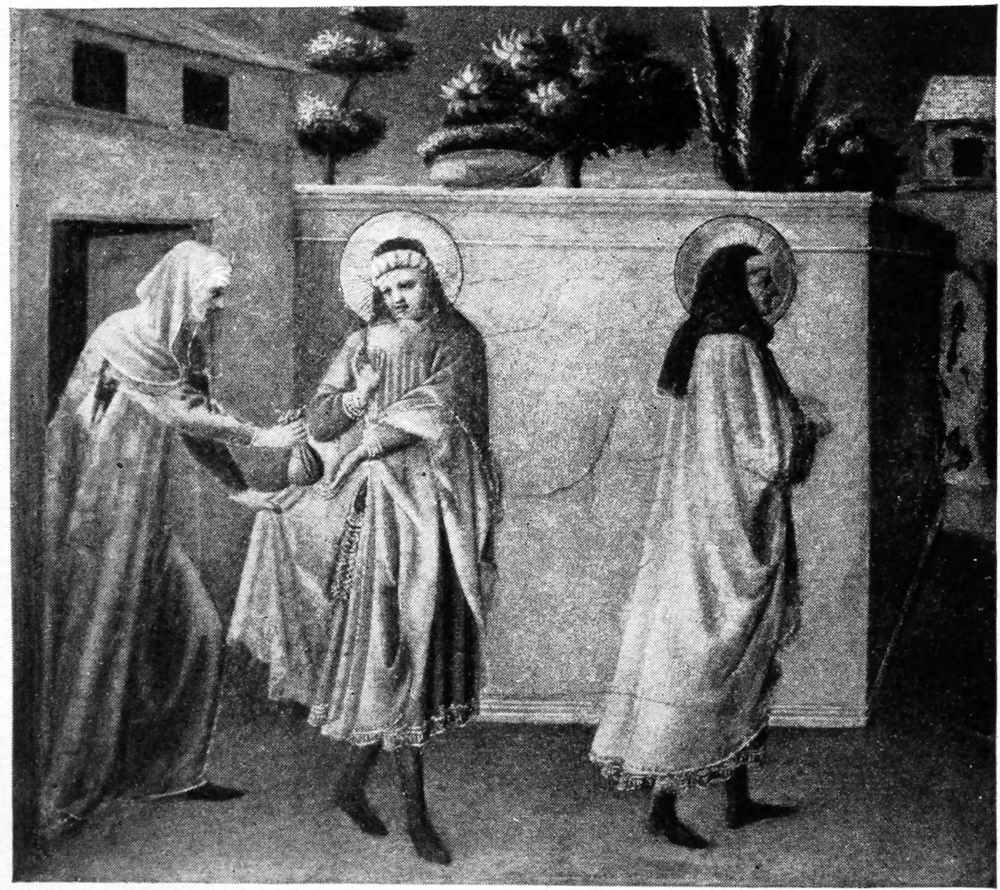
Photo. Alinari
AN EPISODE IN THE LIFE OF ST. COSMO AND ST. DAMIAN.—FRA ANGELICO
(Academy, Florence.)
In art they are always together, wearing loose dark red robes trimmed with fur, and usually red caps. Thus Chaucer describes a physician’s garb: “In scarlet gown, furred well.” They have a small box of ointment in one hand and lancet or surgical instrument in the other, sometimes a pestle and mortar. These saints appear frequently in the old Florentine pictures, especially of the time of Cosimo de’ Medici.
St. Roch. Lat. Sanctus Rochus. Ital. San Rocco. Fr. St. Roch or Roque.
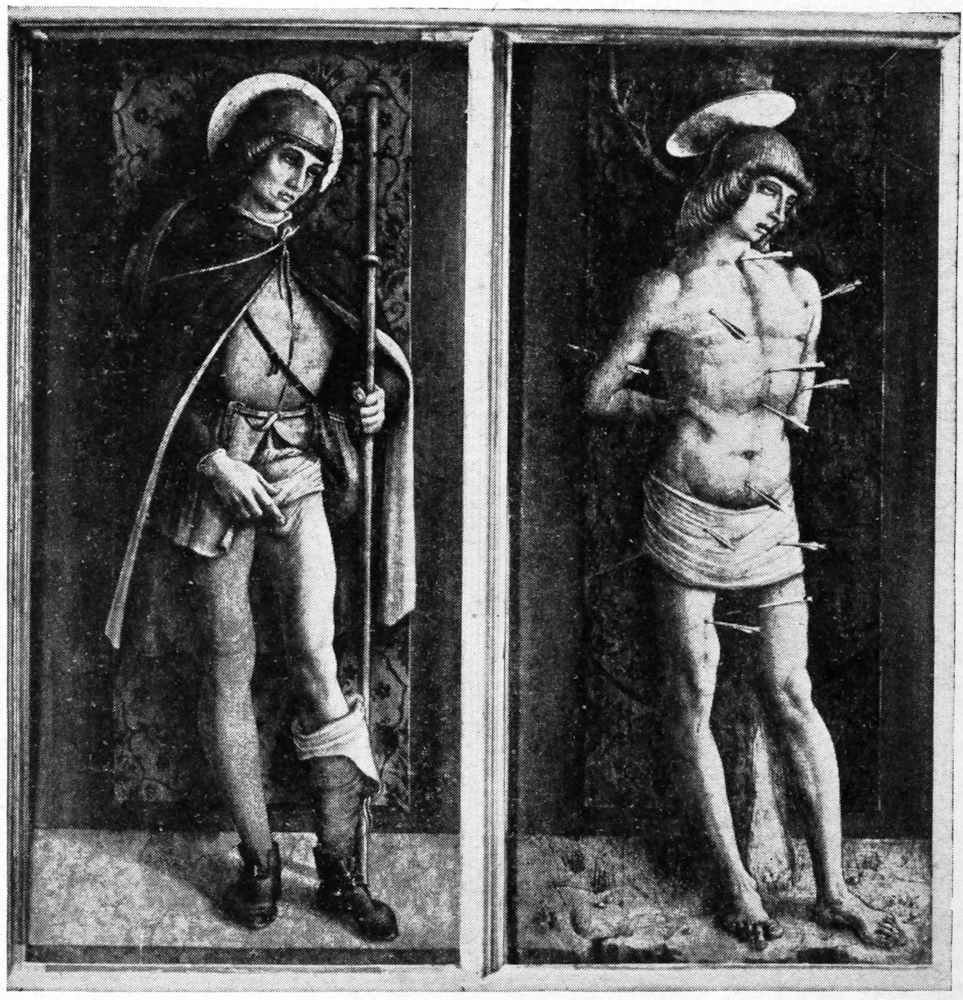
FOUR SAINTS—ST. ROCH AND ST. SEBASTIAN;
(Academy, Venice.)
St. Roch was born in Montpellier in Languedoc of wealthy and noble parents. His parents dying before he was twenty, he gave all that he had to the poor and the hospitals, and spent his life in healing and caring for the sick. He went wherever he heard that the plague had broken out, and nursed those who were most miserable and abandoned.
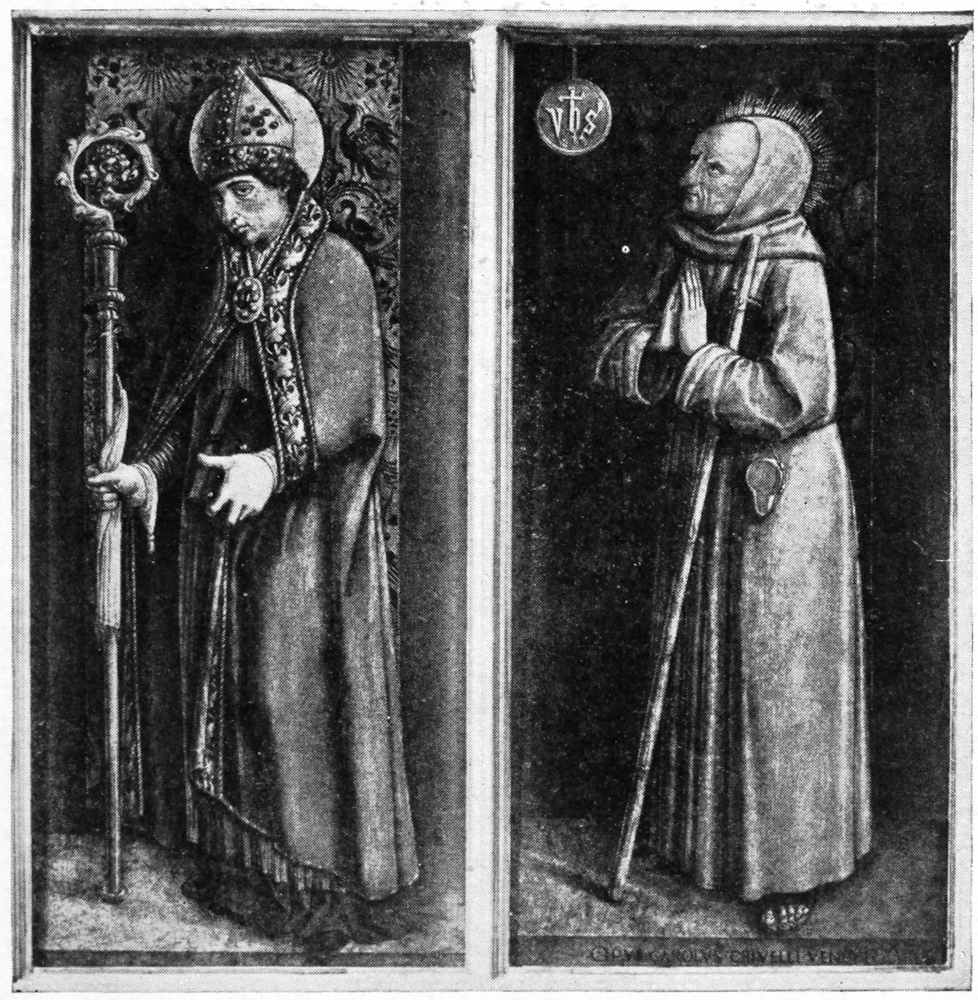
Photo. Alinari
ST. AUGUSTINE (?); ST. BERNARDINO, OF SIENA.—CARLO CRIVELLI
At last in Piacenza he himself became plague-stricken, and a fearful ulcer broke out on his thigh. The pain was so terrible that, fearing he might cry out and disturb those in the hospital, he crawled out to the street, and not being allowed to remain, dragged himself to the woods to die; but his faithful little dog, who had been his companion everywhere, trotted to the city each day, returning with a loaf of bread for his master, and an angel from heaven dressed his wound.
When St. Roch had recovered he returned to his old home, but no one knew him, so wasted and haggard was he, and he was cast into prison and remained there five years. One morning, the jailer entered and found his cell filled with a dazzling light, and the prisoner dead. By his side there was writing telling his name, and these words: “All those who are stricken by the plague and who pray for aid through the merits and intercession of Roch, the servant of God, shall be healed.”
In art St. Roch is represented in the prime of life, dressed as a pilgrim with the cockle-shell in his hat; wallet by his side, in one hand a staff, while with the other he lifts his robe to show the plague spot, or points to it. He is usually accompanied by his dog.
St. Sebastian and St. Roch figure in numerous works of art as joint protectors against the plague. With St. Cosmo and St. Damian, the medical saints, the first two are patrons of the sick, and the last two patrons of those who heal the sick.
An old French legend relates that when St. Roch died he wished to take his little dog in with him through the gates of heaven. But St. Peter refused, and St. Roch entered alone, feeling very sad. As he wandered around, heaven did not seem like heaven to him without his little dog. No one spoke to him. The saints and prophets were all assembled around a great white throne, and had no eyes for St. Roch. Still lonely, he went to the wall of heaven, to see if by looking over he might not discover his little dog. There he was! looking wistfully at the gate wherein had passed his master. St. Roch whistled softly, his dog caught sight of his face, and leaping over the wall, sprang into his master’s arms. Then St. Roch was happy in heaven.
St. Nicholas of Myra. Lat. Sanctus Nicolaus. Ital. San Niccolò, or Nicola di Bari. Ger. Der Heilige Nicolaus or Niklas.
Of all the saints in Christendom St. Nicholas is perhaps the most popular and the most universally beloved. While knighthood claims St. George, St. Nicholas belongs to the children, and to the common people. The mariner, the labourer, the poor, and the weak all implore the aid of St. Nicholas.
He was born in Panthera, a city of Lycia in Asia Minor. His parents were Christians, wealthy, and of illustrious family. It is related that on the day he was born St. Nicholas stood up in his bath and praised God for having brought him into the world. His parents, impressed by the many instances of his early piety, dedicated him to God, and he became a priest and later Bishop of Myra. In 1084 his relics were carried to Bari, and thus he is often known as St. Nicholas di Bari.
The legends of this saint are almost without number. His proper attribute, the three balls, is supposed to refer to the three bags of gold which he threw into the poor man’s window. A certain nobleman with three daughters, having lost all his money, had no resource except he sacrifice them to infamous lives. St. Nicholas, hearing this, considered how he could help them, and one night he threw in a bag of gold through a window which he found open, and with this the father portioned his eldest daughter. St. Nicholas did this a second time, and the father married off his second daughter. Greatly wishing to know his benefactor, the father watched, and when St. Nicholas came the third time he flung himself at his feet giving thanks, but St. Nicholas desired him to tell no man.
Sometimes the attribute is three children in a tub, which refers to the legend of the wicked man who, during a famine, stole little children, whom he killed, and served their limbs as meat for his guests. St. Nicholas visited his house when he was bishop, and having this dish put before him divined the awful contents. He denounced his host and going to the tub where the bodies of the children were salted down, he made the sign of the cross and they rose up alive and whole.
At Nice, St. Nicholas listened to the prayers of some mariners in danger of perishing; his spirit guided their ship and the tempest ceased. “And when they were come to his Church, they knew him without any man to show him to them, and yet they had never seen him” (Golden Legend).
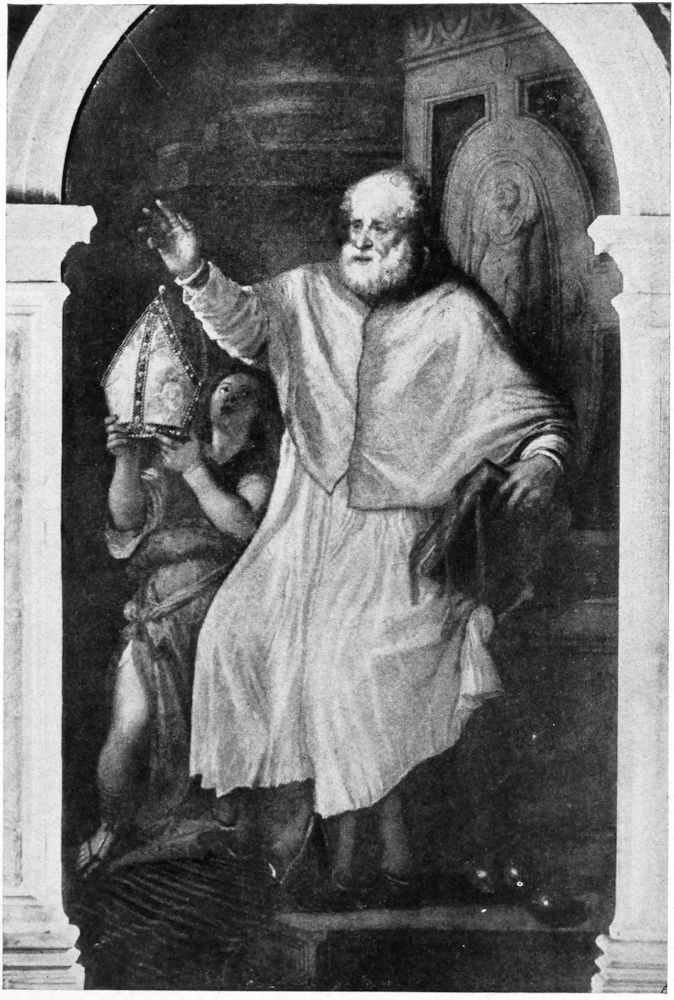
Photo. Alinari
ST. NICHOLAS.—TITIAN
(Church of San Sebastiano, Venice.)
While the province of Myra suffered a great famine, certain ships laden with wheat arrived at the port, and Nicholas persuaded the mariners to give him a certain portion, promising they would bring as much to the emperor as had been measured to them in Alexandria, and this was indeed so. Yet by this miracle, “the holy man distributed the wheat to every man after that he had need, in such wise that it sufficed for two years, not only for to sell, but also to sow.”
In art St. Nicholas is dressed as a bishop with mitre, cope, and crozier, his robes often gorgeously embroidered. Sometimes he is beardless, but usually has a short grey beard. The three balls are placed on his book, or at his feet, or sometimes in his lap. Some say they represent the loaves of bread, in allusion to his feeding the poor during the famine, but the more popular version is the three purses or bags of gold. Sometimes, instead of three balls, three purses are given.
The Four Virgin Patronesses: ST. CATHERINE, ST. BARBARA, ST. URSULA, AND ST. MARGARET.
Mrs. Jameson says, “We owe to these beautiful and glorious impersonations of feminine intellect, heroism, purity, fortitude, and faith, some of the most excelling works of art which have been handed down to us. Other female martyrs were merely women glorified in heaven, for virtues exercised on earth; but these were absolutely, in all but the name, Divinities.... Their wholly ideal character, the tacit setting aside of all human testimony with reference to their real or unreal existence, instead of weakening their influence, invested them with a divine glory.... These allegories (which by simplicity and ignorance were long accepted as facts) should ever hereafter be received but as one form of poetry ... to which the world listened in its dreamy childhood, and which, like the ballad or the fairy tale which kept the sleep from our eyes and our breath suspended in infancy, have still a charm for our latest years.”
St. Catherine of Alexandria. Lat. Santa Catharina. Ital. Santa Caterina. Fr. Madame Saincte Catherine. Spa. Santa Catalina. Ger. Die Heilige Katharine von Alexandrien.
St. Catherine represents the highest type of eloquence and intellect that is found in woman. She is an example of courage and piety; and all wisdom and good counsel are found in her. She is the Minerva of the pagan, to whom has been added all the virtues of the Christian martyr.
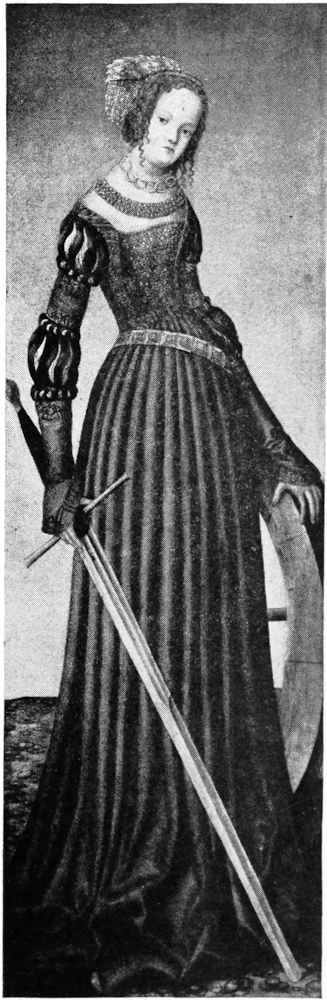
Photo. Alinari
ST. CATHERINE.—LUCAS CRANACH
(Dresden Gallery.)
St. Catherine was the daughter of Costis (half brother to Constantine the Great) and Sabinella, Queen of Egypt. A glory of light played around her head from the moment she came into the world, and from earliest childhood she was remarkable for beauty of person and of mind. Even while very young, Plato and Socrates were her favourite studies. She had seven learned masters, but was so marvellously endowed that she excelled each in his branch. At fourteen her father died, but as queen she cared not for worldly things and devoted herself to study. The nobles, discontented, wished her to marry, but she told them her husband must be as noble, as great, as beautiful, and as rich as she, and the nobles knew not what to say, for they realised well that no such man could be found.
Now a holy hermit came to St. Catherine with a message from the Virgin Mary, telling her that the husband she desired was her Son, and he gave her a picture of Christ and His mother. And so filled was her soul with love, that she forgot her books and thought only of Him. One night she dreamed that she was brought before the King of Glory, but He turned away His head, saying, “She is not fair nor beautiful enough for me,” and she awoke weeping.
Then she asked the hermit what she must do to become worthy of her celestial bridegroom, and he instructed her in the Christian faith and baptised her. That night as she slept, the Virgin Mary appeared with her divine Son and a heavenly host, and the Lord smiled upon her and plighted His troth, putting a ring on her finger, and when she awoke the ring was still there, and henceforth she considered herself betrothed of Christ, and thought only of heavenly things.
At this time the tyrant Maximin came to Alexandria and persecuted all Christians, commanding them to worship heathen gods. St. Catherine confronted him and argued for the truth of Christianity, and so wonderful was she, that learned philosophers and scholars were confounded by her eloquence, and confessed themselves converted. This so infuriated the emperor, that he had them burned at the stake, Catherine comforting them to the end. Then she was thrown into prison and kept without food, but angels ministered unto her, and at the end of twelve days, the empress visited her and found her cell filled with fragrance and light; and she and two hundred attendants were instantly converted and baptised.
Maximin ordered them all to be put to death, and then, sending for St. Catherine, because he was much inflamed with her beauty, he offered to marry her if she would give up Christ. Upon her refusal, he had her bound between four spiked wheels, which, turning in different directions, would tear her body in pieces. But fire fell from heaven and consumed the wheels, and three thousand persons were killed by the flying pieces. Then St. Catherine was cruelly scourged and beheaded, and angels carried her body to the top of Mt. Sinai. In the eighth century a monastery was built over her remains, which are revered to this day.
As patron saint, St. Catherine has several attributes: the palm as martyr; the sword showing the manner of her death; the crown as a sovereign princess; the book, signifying her learning; or as trampling on the pagan tyrant: but her peculiar attribute is the wheel. When entire it is the emblem of torture, when broken it is the historical attribute showing the torture meditated, and the miracle by which she was saved. She is pictured leaning upon it, or it is at her feet or an angel bears it over her head. She is usually richly dressed, with all the attributes of royalty.
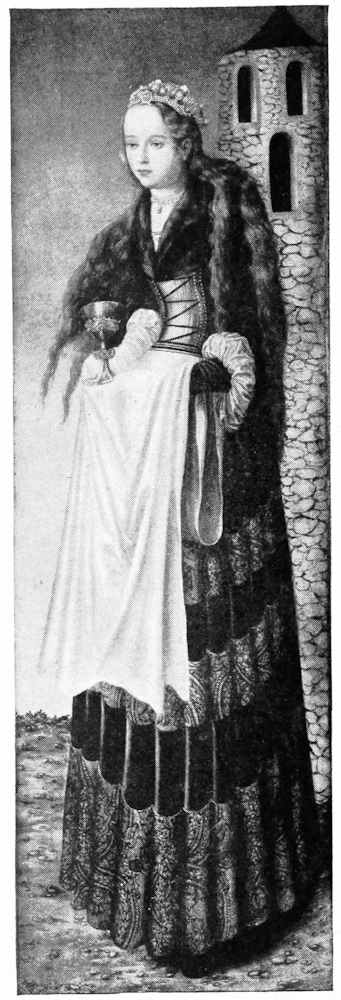
Photo. Alinari
ST. BARBARA—LUCAS CRANACH
(Dresden Gallery.)
The Marriage of St. Catherine is a devotional subject and does not appear in Italian art until the middle of the fifteenth century.
St. Barbara. Ital. Santa Barbara. Fr. Sainte Barbe.
Dioscorus, who lived in Heliopolis, was noble and very rich, and he had a daughter Barbara whom he loved so much that, fearing her beauty (which was very great) would cause her to be desired in marriage and thus he would lose her, kept her shut up in a high tower away from the eyes of men. Here she gave herself up to the study of all things which concern the universe, and grew to believe that the gods of her fathers must be false gods. Hearing of the famous teacher Origen, she secretly wrote him for instruction, and he sent her one of his disciples disguised as a physician, who converted and baptised her. Some workmen were engaged in putting in two windows in her tower, and she commanded that they insert a third. When her father questioned her for doing this thing, she answered, “Know, my father, that through three windows doth the soul receive light—the Father, the Son, and the Holy Ghost; and the Three are One.”
Then her father knew she was a Christian, and drew his sword to kill her, but she fled to the top of her tower, her father pursuing; there angels came to her assistance and bore her to a distance. A shepherd, however, told Dioscorus where she was concealed, and he dragged her forth by the hair, and beat her, and shut her up; but as she would not yield, he denounced her to the proconsul, who had her scourged and tortured. Still she would not deny her faith, and her father carried her up on a mountain and himself cut off her head. As he was descending the mountain, a tempest arose, and fire fell on him from heaven and consumed him utterly.
In devotional pictures St. Barbara carries the sword and palm as martyr, and when she wears the crown, it is as martyr, and not as princess. She has also a book and is often reading, to show her life of meditation. But her peculiar attribute is the tower, usually with three windows in reference to the legend.
St. Barbara as protectress against thunder and lightning, firearms and gunpowder, is invoked against sudden death, and those who implore her aid shall not die without receiving the holy sacraments. Thus she carries the sacramental cup and wafer, and is the only female saint with this attribute. She is pictured as dressed magnificently, usually with red drapery, the tower in the background, or sometimes holding a small tower in her hand.
St. Ursula. Lat. S. Ursula. Ital. Santa Orsola. Fr. Sainte Ursule.
The Cologne version of the quaint and charming legend of St. Ursula is the one usually followed by the artists. A portion of it follows.
There reigned in Brittany a king named Theonotus, whose wife, Daria, was a Sicilian princess. They were both Christians, and had one daughter, whom they called Ursula, and whom they educated with exceeding care. She was beautiful, gifted, and accomplished in all the ways of wisdom and knowledge, so that many desired to marry her, but she refused them all.
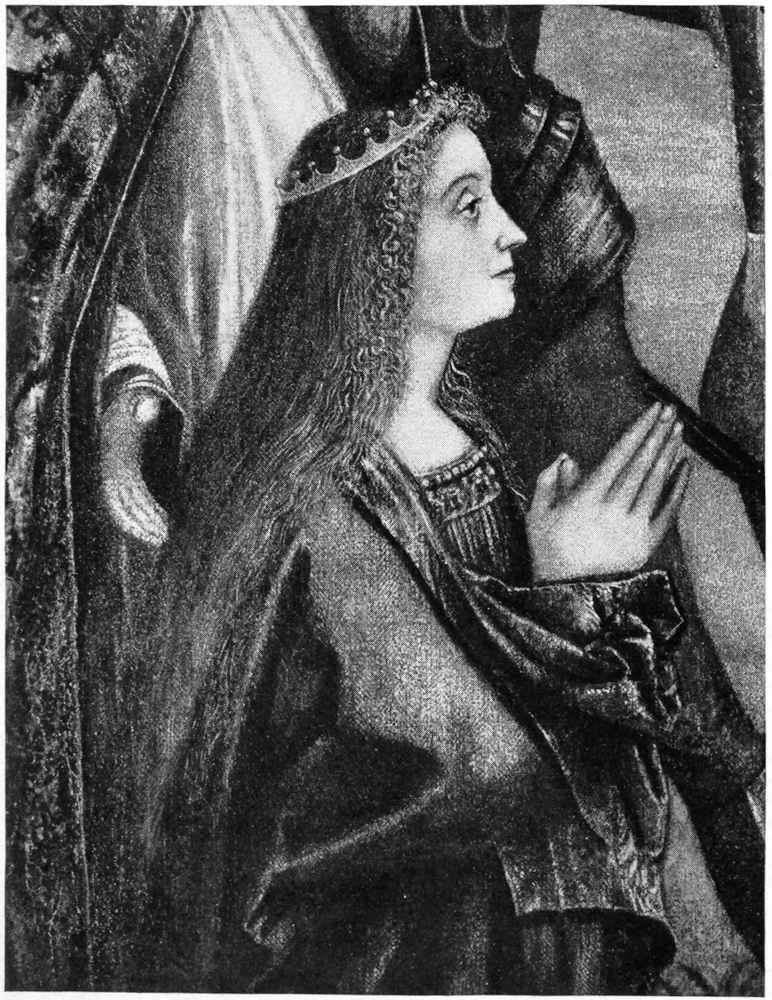
Photo. Alinari
DETAIL FROM THE MARTYRDOM OF ST. URSULA.—V. CARPACCIO
(Academy, Venice.)
Now the King of England had an only son named Conon, as celebrated for all manly qualities, as was Ursula for her beauty, piety, and wisdom. He became one of her suitors, and not wishing to offend so powerful a monarch, she sent answer that she would accept him if he would do three things: First, he must give her as companions ten virgins of the noblest blood in his kingdom, and to each of these a thousand attendants, and to her also a thousand maids in waiting; secondly, he must wait for her three years, while she and her companions visited the holy shrines of the saints; and third, that the prince and his court shall receive baptism, “for other than a perfect Christian I cannot wed.”
The wise Princess Ursula felt that Prince Conon must refuse these demands, but if he did not, then eleven thousand virgins would be dedicated to the service of God.
Now the ambassadors brought back such reports of her beauty and wisdom, that the king was willing to grant anything, and the prince only too eager to do all she asked. So he was baptised, and the king his father wrote to all the knights of his kingdom, asking that they send the required number of maidens, spotless, beautiful, and of noble birth, to attend on the Princess Ursula, who was to wed his son Prince Conon. And from all parts they came, fair and beautiful and clad in rich garments, and when they arrived in Brittany, Ursula received them with great gladness, praising God that so many of her sex had been redeemed from the world’s vanities.
“Now when Ursula had collected all her virgins together on a fresh and fair morning in the springtime, she desired them to meet in a meadow near the city, which meadow was of the freshest green, all over enamelled with the brightest flowers; and she ascended a throne which was raised in the midst, and preached to all the assembled virgins of things concerning the glory of God, and of His Son, our Lord and Saviour, with wonderful eloquence; and of Christian charity and of a pure and holy life dedicated to Heaven. And all these virgins, being moved with a holy zeal, wept, and, lifting up their hands and their voices, promised to follow her whithersoever she should lead. And she blessed them and comforted them; and as there were many among them who had never received baptism, she ordered that they should be baptised in the clear stream which flowed through that flowery meadow.”
Then they started on their pilgrimage, some say attended by the prince, but others that he remained to comfort her father. They embarked on ships, the virgins steering, but by some mistake they sailed to the north instead of the south, and were driven by the winds into the mouth of the Rhine as far as the port of Cologne. Here it was revealed to St. Ursula that upon her return she and her companions should suffer martyrdom on this spot. They continued their voyage, visited many places, and finally came to Rome.
Now it happened that the prince, by a miracle, who had gone out in search of his bride, arrived in Rome that same day. Being happily reunited, he knelt with Ursula at the feet of Cyriacus, Bishop of Rome, and “he no longer aspired to the possession of Ursula, but fixed his hope on sharing with her the crown of martyrdom on earth, looking to a perpetual reunion in heaven, where neither sorrow nor separation should touch them more.
“After this blessed company had duly performed their devotions at the shrine of St. Peter and St. Paul the good Cyriacus would fain have detained them longer, but Ursula showed him that it was necessary they should depart in order to receive the crown ‘already laid up for them in heaven.’ When the bishop heard this, he resolved to accompany her. In vain his clergy represented that it did not become a pope of Rome and a man of venerable years to run after a company of maidens, however immaculate they might be. Cyriacus had been counselled by an angel of God, and he made ready to set forth and embark with them on the river Rhine.
“Now it happened that there were at Rome in those days two great Roman captains, cruel heathens, who commanded all the imperial troops in Germania. They, being astonished at this multitude of virgins, said one to the other, ‘Shall we suffer this? If we allow these Christian maidens to return to Germania, they will convert the whole nation; or if they marry husbands, then they will have so many children—no doubt all Christians—that our empire will cease; therefore, let us take counsel what is best to be done.’ So these wicked pagans consulted together, and wrote letters to a certain barbarian King of the Huns, who was then besieging Cologne, and instructed him what he should do.
“Meantime St. Ursula and her virgins, with her husband and his faithful knights, prepared to embark; with them went Cyriacus, and in his train Vincenzio and Giacomo, cardinals, and Solfino, archbishop of Ravenna, and Folatino, bishop of Lucca, and the bishop of Faenza, and the patriarch of Grado, and many other prelates; and after a long and perilous journey they arrived in the port of Cologne.
“There the pagans rushed upon their unresisting victims, and one of the first to perish was the prince, who fell pierced through by an arrow at the feet of his beloved princess. Then they drew swords and massacred them all so that the plain ran in rivers of blood. But the barbarians, awed by the majestic beauty of Ursula had no power to strike her, but carried her before their prince, who wished to marry her and make her the greatest queen in all Germany. But St. Ursula repelled him with scorn. Then, seized with fury and bending his bow, which he held in his hand, he, with three arrows, transfixed her pure breast, so that she fell dead and her spirit ascended into heaven, with all the glorious sisterhood of martyrs whom she had led to death, and with her betrothed husband and his companions.”
In devotional pictures of St. Ursula she has the crown as princess; the arrow as martyr; and the pilgrim’s staff, surmounted by a white banner with the red cross, the Christian standard of victory. Sometimes she has a dove, because a dove revealed her burial place to St. Cunibert.
As patron saint she appears alone; is crowned and richly dressed with regal ornaments and wears a green or scarlet mantle lined with ermine; she holds in one hand a book, in the other an arrow; or sometimes the arrow in one hand, and in the other the banner with the red cross.
As martyr she kneels or stands, her golden hair unbound. Sometimes she is crowned, sometimes not; her hands are clasped, her bosom transfixed by an arrow; on the ground about her, her maidens lie dead.
Sometimes she is painted standing, holding open with both hands her mantle, which shelters many maidens wearing crowns. She is here the patroness of young maidens. The date of the martyrdom of St. Ursula and her eleven thousand virgins has been variously given as A. D. 237, 383, or 451. The legend can be traced to the year 600.
St. Margaret. Ital. Santa Margarita. Fr. Sainte Marguerite. Ger. Die Heilige Margaretha.
St. Margaret was the daughter of a pagan priest of Antioch named Theodosius, and being a frail child, was sent to a nurse in the country, who was a Christian and who brought her up in the faith. Here she was seen by Olybrius, governor of Antioch, who was so enamoured of her beauty that he ordered her to be brought to his palace and, if she was free-born, he would marry her. St. Margaret refused his offers, and declared herself a Christian, to the horror of her father and relatives, who fled, leaving her in the power of the governor. Olybrius then sought to subdue her by torments so great that even he was forced to cover his face from the sight.
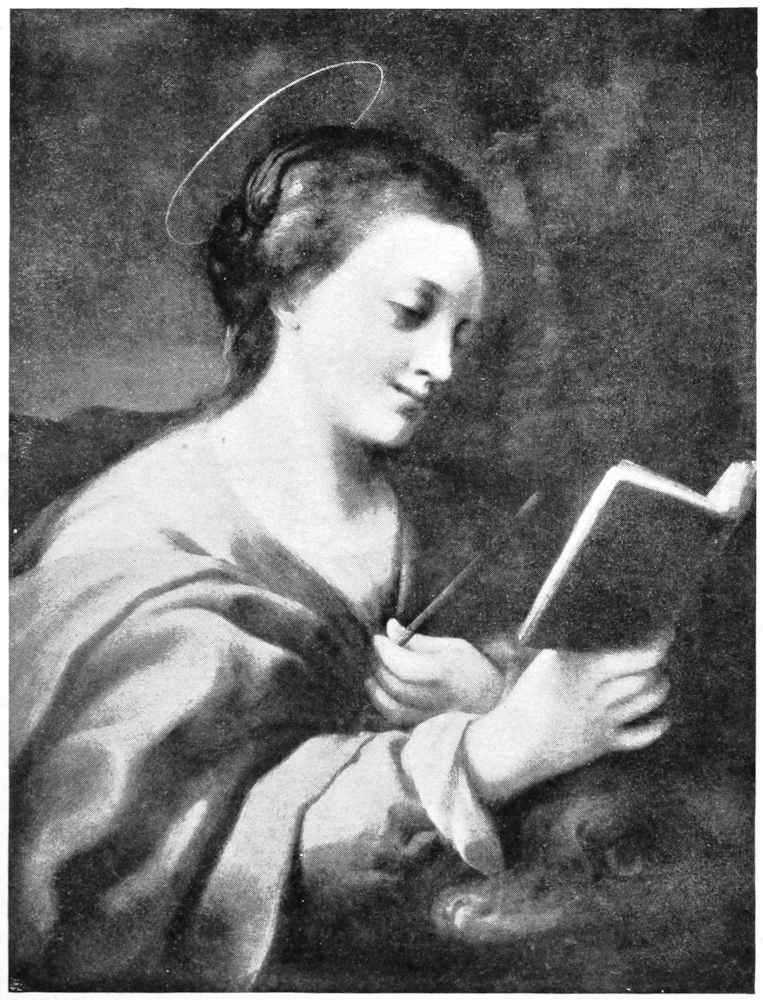
Photo. Alinari
ST. MARGARET.—SCHOOL OF CORREGGIO
(Dresden Gallery.)
She endured all without flinching. Then she was thrust into a dungeon, and there Satan in the form of a frightful dragon endeavoured to terrify her into subjection; but St. Margaret held up the cross of the Redeemer and he fled before it. A more popular version is, that he swallowed her alive and immediately burst asunder, and she came forth unhurt. Satan then came to her in the form of a man to tempt her, but she overcame him, and placing her foot on his head, she made him confess his vileness. Again she was brought before the tyrant, and refusing to deny her faith, was again tortured. Such constancy in one so young and beautiful induced many to be converted, so that five thousand were baptised in one day and wished to die with her. Alarmed at this, the governor ordered her to be beheaded forthwith.
In art St. Margaret is usually represented trampling a dragon, her peculiar attribute, under her feet, holding the cross in her hand. Sometimes the dragon is bound with a cord, or his jaws are open as if to swallow her; or he is seen rent or burst, St. Margaret standing upon him unharmed.
As martyr she bears the palm and crown. In some pictures she has a garland of pearls in allusion to her name. She is always the type of maiden innocence and the only one of the four great patronesses who is not represented as very learned.